Case report
Acute myocardial infarction after botulinum toxin injection
B.E. STA
¨ HLI, L. ALTWEGG, T.F. LU¨SCHER and R. CORTI
From the Department of Cardiology, Cardiovascular Center, University Hospital Zu¨rich, Zu¨rich,
Switzerland
Address correspondence to Dr R. Corti, Department of Cardiology, Cardiovascular Center, University Hospital Zu¨rich, Ra¨mistrasse 100, 8091 Zu¨rich, Switzerland. email: [email protected]
Case presentation
A 56-year-old male patient with a history of Friedreich ataxia was referred to the cardiac cath-eterization laboratory after electromechanical resus-citation due to ventricular fibrillation. Two hours before, trans-urethral intra-vesical botulinum toxin A injection (300 U) had been performed because of neurogenic bladder dysfunction. His past medical history was positive for hypertension and smoking, but negative for any cardiovascular event.
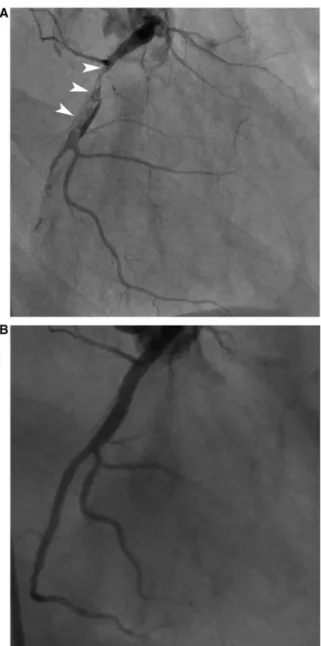
On admission, laboratory analysis had been un-remarkable and baseline ECG showed incomplete right bundle branch block and T-wave inversions in leads V1–V2. Postrescuscitation, new preterminal T-wave inversions were noted in the inferior leads and in leads I, and V3–6, along with troponin T elevation (0.72 mg/l). In the course, dynamic discrete ST segment elevations developed in leads V1–V3. Unfractionated heparin, acetylsalicylic acid and clo-pidogrel were administered for suspected acute cor-onary syndrome. Corcor-onary angiography revealed thrombotic occlusion of the right coronary artery with a large thrombus extending from the proximal to the mid segment (Figure 1A). Of note, there were no coronary artery spasms observed; in particular, vascular tone was unchanged after intracoronary nitroglycerine administration. Immediate percutan-eous coronary intervention was performed and the vessel reopened by means of thrombus aspiration using a diver catheter and the utilization of two drug-eluting stents (Biomatrix). Final angiographic
documentation revealed complete restoration of flow and normal left ventricular wall motions with preserved left ventricular systolic function (Figure 1B). The post-interventional course on the intensive care unit (ICU) was unremarkable and the patient was transferred to the regular ward 1 day after admission.
Discussion
We describe a case of acute myocardial infarction in a patient with Friedreich ataxia following intra-vesical botulinum toxin A injection.
Cardiac involvement is frequently observed in Friedreich ataxia. However, acute coronary syn-dromes have rarely been described in these patients. Typically, hypertrophic cardiomyopathy, which was excluded in our patient using echocardiography, and an abnormal repolarization phase and arrhyth-mias are detected.1
Botulinum toxin A impedes neuromuscular trans-mission causing muscle weakening. It blocks acetyl-choline release in nerve terminals by cleaving SNARE proteins, thereby preventing fusion of acetyl-choline vesicles with the cell membrane. Botulinum toxin A is widely used for cosmetic applications, and in the treatment of muscle spasms, chronic pain syndroms or bladder dysfunction.2
Botulinum toxin A is assumed to have mainly local effects. However, systemic side effects have been described. Hence, botulinum toxin A might also affect vasoreactivity or interact with the
! The Author 2010. Published by Oxford University Press on behalf of the Association of Physicians. All rights reserved. For Permissions, please email: [email protected]
Q J Med 2011;104:615–616
coagulation cascade, endothelial cells or platelets and in turn promote thrombus formation. Indeed, single cases of myocardial infarction, pulmonary embolism, and even death have been reported after botulinum toxin A injection.3 The effect of
botulinum toxin A on vasoreactivity is not fully understood. In rat, aortic rings suspended in organ chambers, contractions to potassium chloride (KCl) and norepinephrine were completely inhibited after incubation with botulinum toxin.4 Furthermore, in Sprague Dawley rats, femoral vessel diameter was increased after subcutaneous botulinum toxin injection.5 Hence, and in line with the coronary angiogram, vasospasms as the pri-mary cause of the acute myocardial infarction appear unlikely in this patient. Rather, the extensive thrombus burden suggests a pro-thrombotic state. As we did not exclude a patent foramen ovale in our patient, paradoxical embolism cannot be ruled out completely. However, such events are rare and typ-ically present with abrupt distal coronary occlusion suggestive of embolism on angiogram. In any case, pro-thrombotic effects of botulinum toxin A have not been described so far, both, in vitro and in vivo, and may be assumed.
The temporal coincidence of botulinum toxin injection and the onset of myocardial infarction in our patient suggest a causal relationship. Importantly, as botulinum toxin injections are widely performed, also in elderly patients with car-diovascular disease, and as acute coronary syn-dromes are serious complications, clinicians should be cautious using botulinum toxin A because of the risk of serious side effects and patients have to be monitored carefully after botulinum toxin injections.
Conflict of interest: None declared.
References
1. Pandolfo M. Friedreich Ataxia. Arch Neurol 2008; 65:1296–1303.
2. Mu¨nchau A, Bhatia KP. Uses of botulinum toxin injection in medicine today. Br Med J 2000;320:161–5.
3. Cote´ TR, Mohan AK, Polder JA, Walton MK, Braun MM. Botulinum toxin type A injections: adverse events reported to the US Food and Drug Administration in therapeutic and cosmetic cases. J Am Acad Dermatol 2005;53:407–15. 4. Murakami E, Iwata H, Imaizumi M, Takemura H. Prevention
of arterial graft spasm by botulinum toxin: an in-vitro experi-ment. Interact Cardiovasc Thorac Surg 2009;9:395–8. 5. Clemens MW, Higgins JP, Wilgis EF. Prevention of
anasto-motic thrombosis by botulinum toxin A in an animal model. Plast Reconstr Surg 2009;123:64–70.
Figure 1. (A) Coronary angiography revealing thrombotic occlusion of proximal and mid segments of the right cor-onary artery with collateral flow from the left anterior des-cending artery. (B) Coronary angiography of the right coronary artery following percutaneous coronary intervention.