Prognostic Values of Tumor Necrosis Factor/Cachectin, Interleukin-l,
Interferon-a, and Interferon-v in the Serum of Patients with Septic Shock
Thierry Calandra, Jean-Daniel Baumgartner,
Georges E. Grau, Mei-Miau Wu,
Paul-Henri Lambert, Joop Schellekens, Jan Verhoef,
Michel P. Glauser, and the Swiss-Dutch
J5 Immunoglobulin Study Group*
From the Division of Infectious Diseases, Department of Internal Medicine, Centre Hospitalier Universitaire J4ludois, Lausanne, and Department of Pathology, World Health Organization Immunology Research and Training Centre, University of Geneva, Switzerland, and Clinical Bacteriology, State University of Utrecht,TheNetherlands
Serum concentrations of immunoreactive tumor necrosis factor/cachectin (TNF), interleukin-1jJ (IL-interleukin-1jJ), interferon-y (IFN"(), and interferon-a (IFNa) were prospectively measured in 70 patients with septic shock to determine their evolution and prognostic values. In a univariate analysis, levels of TNF(P
=
.002) and IL-1jJ(P=
.05) were associated with the patient's out-come, but not IFNa(P= .15) and IFN"((P= .26). In contrast, in a stepwise logistic regression analysis, the severity of the underlying disease(P=
.01), the age of the patient(P=
.02), the documentation of infection (nonbacteremic infections vs. bacteremias,P=.03), the urine output(P
=
.04), and the arterial pH(P=
.05) contributed more significantly to prediction of patient outcome than the serum levels of TNF(P=
.07). After 10 days, the median concentration of TNF was undetectable «100 pg/ml) in the survivors, whereas it remained elevated (305 pg/ml,P
=
.002) in the nonsurvivors. Thus, in patients with septic shock due to various gram-negative bacteria, other parameters than the absolute serum concentration of immunoreactive TNF con-tributed significantly to the prediction of outcome.Tumor necrosis factor/cachectin (TNF) is a cytokine pro-duced by activated macrophages [1] shown in experimental studies to be a primary mediator of the deleterious effects of endotoxin[2-10]. Recently, in patients with meningococce-mia, high serum levels of TNF, interleukin-6, interleukin-l, and interferon-y and low serum levels of fibrinogen were shown to correlate with the severity of the disease [11-13]. So far, the kinetics of TNF serum levels in humans has been determined in healthy volunteers challenged with a single in-travenous injection of endotoxin [8]. However, similar data on the evolution of serum levels of TNF have not been ob-tained in patients with gram-negative bacteremia or with septic shock.
Therefore, we prospectively measured the serum concen-trations of immunoreactive TNF in patients with septic shock due mainly to gram-negative organisms, to determine the evo-lution of the serum levels of TNF during the course of septic shock and to relate these levels to patient outcome. Serum concentrations of immunoreactive interleukin-lji (IL-I/3),
Received 25 July 1989; revised 14 November 1989.
Presented in part at the 28th Interscience Conference on Antimicrobial Agents and Chemotherapy (abstract 1340), Los Angeles. October 1988. Grant support: 3.825-0.86, Fonds National Suisse de la Recherche Sci-entifique.
Reprints and correspondence: Dr. Thierry Calandra, Division of Infec-tious Diseases. Dept. ofInternal Medicine, Centre Hospitalier Universitaire Vaudois, CH-lOlI Lausanne, Switzerland.
*
See Acknowledgment.TheJDuma!of Infectious Diseases 1990;161:982-987
© 1990 by The University of Chicago. All rights reserved. 0022-1899/90/6105-0026$01.00
interferon-a (IFNa), and interferon-y (IFN')') were also mea-sured to study the interplay of these cytokines and TNF in patients with septic shock.
Materials and Methods
The patients enrolled were part of a prospective, double-blind trial that investigated the efficacy of two IgG preparations for the treat-ment of gram-negative septic shock. The results of that trial includ-ing the detailed information about the study design, the tested IgG preparations, the case review, and data analysis have been reported elsewhere [14]. The type of IgG allocated at randomization had no significant impact on the outcome of patients(P = .30) and on the serum concentrations of cytokines (study entry:P
=
.72 for TNF,P
=
.73 for IL-ljJ,P=
.55 for IFNa,P=
.75 for IPN"(; day 1:P
=
.10 for TNP,P = .74 for IL-ljJ,P=
.65 for IPNa,P = .74 for IFN"(; day 10:P=
.25 for TNP,P=
.09 for IL-ljJ,P = .37 for IPNa.P= .06 for IFN"(). Therefore, the two treatment groups were pooled for the purpose of the present study.Patienteligibility. Patients eligible for study were those in sep-tic shock definedbythe followingtwo criteria: The first was the pres-ence of shock, defined by a systolic blood pressure <90 mm Hg or a decrease of> 30 mm Hg in a hypertensive patient, in the absence of other causes of shock such as hypovolemia, myocardial infarc-tion, or pulmonary embolism. In addiinfarc-tion, at least one of the fol-lowing signs had to be present: oliguria «30 ml/h), hypothermia «36°C), hypoxemia (oxygen tension <70 mm Hg), metabolic aci-dosis (pH <7.3 or base excess <-10 mmolll), coagulation abnor-malities (prothrombin time <50% or partial thromboplastintime >40 s or elevation of fibrin split products), or thrombocytopenia «100 X lQ9/1 or a decrease of >50% of a previously abnormal value). The second criterion was the presence of an infection, that is, a bac-teremia or a microbiologically documented focal infection. The
iso-JID 1990;161 (May) Cytokines in Septic Shock 983
latedorganism wasconsidered to be the pathogen of sepsisif recovered within a 24-h period beforeor after the onset of shock. Postmortem positive blood cultures were disregarded. In a few patients all cul-tures remained sterile, possibly because of the concomitant use of broad-spectrum antibiotics. However, despite sterile cultures these patients were included in the study because their clinical courses were highly suggestive of an ongoing infection.
Serum sampling and cytokines radioimmunoassays. Serum was collected in sterile tubes at study entry(i.e., before the infusion of immunoglobulins) and at days I and 10 (in those surviving). Serum samples were aliquoted, coded with numbers, and stored at -70°C until assayed blindly. Serum samples underwent at the most two freeze-thaw cyclesbeforebeing assayed. Serum TNF, IL-lt), IFNa, and IFN-y wereassayedwith a competitiveinhibition radioimmuno-assay (IRE-Medgenix, Fleurus, Belgium) [12]. The limits of detec-tion of these radioimmunoassays were 100pg/ml of TNF, 150pg/ml
for IL-It), I unit/ml ofIFNa, and 1 unit/ml ofIFN-y. When mea-sured in healthy controls, the serum levels of these cytokines were below the respective limit of detection.
Definitions. The severityof the underlyingdisease was reported according to the classification proposed by McCabeandJackson[15]. Death was attributed to septic shock if the patient died of irreversi-ble shock, of a direct consequence of shock (i.e., multiple organ failure), or of a complication of infection(i.e., diffuse hemorrhage related to disseminated intravascularcoagulation). Other causes of death were attributed to the underlying diseases.
Statistical analyses. Statistical analyses of clinical and labora-tory data were done using theX2test or Fisher's exact test for the
comparisons of proportions and the Kruskall-Wallis test for com-paring intergroup differences. Wilcoxon signed-rank test was used to test the interday difference of the serum levelsof cytokines. All reportedsignificance levels are two-sided. A stepwise logisticregres-sion was performed to select the most predictive variables of the patient's outcome and to assess their relative importance in this re-spect. For this particular analysis usingthe BMDPLR program, the maximum likelihoodratio method and all other default values were used for selecting the prognostic factors [16].
Results
Of the 100patients with septic shock randomized in the study of treatment of gram-negative septic shock with two IgG preparations,78patients had sera collected for the measure-ment of TNF, IL-II3, IFNa, and IFNI'. Eight patients were excluded from this study because shock either was not due to sepsis (5) or was not present at study entry (3). Thus, we report here on the prognostic values and on the evolution of the serum levels of these four cytokines in70 patients with septic shock.
Etiology of septic shock. The pathogens of septic shock
were gram-negative bacteria in54patients (77%) - pure cul-ture in 36patients and mixed culture in 18.Gram-positive bacteria were isolated in5patients(7%)and yeasts in3 (4%). In 8 patients (11%)all cultures remained sterile. Of the 70 patients,41(59%)were bacteremic, of whom37(90%)were infected by gram-negative bacteria (pure gram-negative
bac-teremia,30patients; mixed gram-negative bacteremia,7), 3 (7%) by gram-positive bacteria, and I (3%) by a yeast.
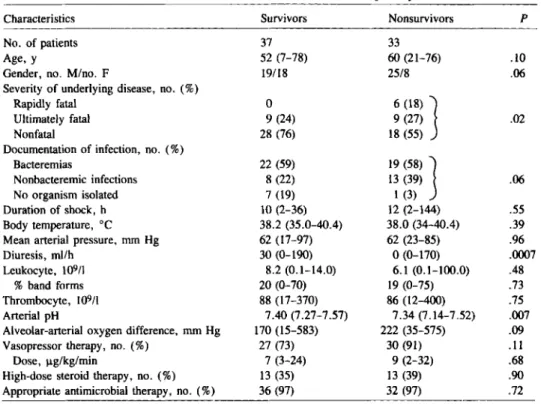
Characteristics of the patients at study entry. Of the 70 patients with septic shock,37 (53%)survived and33 (47%) died. The survivors and the nonsurvivors were similar with respect to the following parameters (table I): age, duration of shock before study entry, body temperature, mean arterial pressure, leukocyte count with differential, thrombocyte count, and alveolar-arterial oxygen difference. In contrast, the two groups of patients differed in gender ratio, severity of the un-derlying disease, documentation of infection, urine output, and pH. With respect to therapy, a similar proportion of the survivors and of the nonsurvivors were treated with vasopres-sors, with high-dose corticosteroids, and with appropriate an-timicrobial treatment.
Tumor necrosis factor. Immunoreactive TNF was detected
in55(79%)of70patients (figure I). The median serum lev-els of TNF at study entry (i.e., before the infusion of immu-noglobulins) were higher in the nonsurvivors (330 pg/ml; range,<100-3500)than in the survivors (180pglml; range,
<100-1300; P
=
.002). Thus, in patients with septic shock due to various microorganisms, the concentrations of im-munoreactive TNF was associated with outcome. The serum levels of TNF did not correlate with duration of shock before study entry(r= -
.07,P=
.59), or with duration of survival in those patients ultimately dying of shock(r = .04,P=
.83).Since there was an overlap of the serum levels ofTNF measured in the survivors and in the nonsurvivors, we deter-mined the concentration ofTNF that would best discriminate these two groups of patients. The best cutoff value of serum TNF was at250pg/ml. Indeed, of42patients with TNF lev-els <250pg/ml, 31 (74%) survived compared with only 6 (21%) of28 patients with TNF levels >250 pg/ml (P=
.00005).For predicting survival, this cutoff value of250pg/ml had a sensitivity of84% (31137),a specificity of67 %(22/33),a positive predictive value of74% (31142), and a negative predictive value of79% (22/28).
In the54patients with gram-negative infections, the same correlation was observed between the serum levels of TNF and the outcome of the patients(P = .02). Six of the 8 pa-tients infected with gram-positive organisms or with yeasts had elevated concentrations of TNF(140, 170, 180, 200, 200, and 530 pg/ml) at study entry.
To determine the evolution of the serum levels ofTNF dur-ing the course of septic shock, TNF was measured at days I and 10after study entry. The median concentration of TNF in the survivors decreased from 180pg/ml at study entry, to 150pg/ml (range, <100-600)at day I, and to <100pglml (range,<100-400)at day 10(P
=
.57andP=
.008, respec-tively, when compared with levels ofTNF at study entry; figure 2A).In contrast, the median concentration ofTNF remained high in the nonsurvivors; it was330pg/ml at study entry, 250 pg/ml (range, <100-1500)at day I, and 305pg/ml (range,Table 1. Characteristics of survivors and of nonsurvivors at study entry.
Characteristics Survivors Nonsurvivors P
No. of patients 37 33
Age, y 52 (7-78) 60 (21-76) .10
Gender, no. M/no. F 19/18 25/8 .06
Severity of underlying disease, no.(%)
Rapidly fatal 0 6 (18) ]
Ultimately fatal 9 (24) 9 (27) .02
Nonfatal 28 (76) 18 (55)
Documentation of infection, no. (%)
Bacteremias 22 (59) 19 (58) ]
Nonbacteremic infections 8 (22) 13 (39) .06
No organism isolated 7 (19) I (3)
Duration of shock, h 10 (2-36) 12 (2-144) .55
Body temperature, °C 38.2 (35.0-40.4) 38.0 (34-40.4) .39
Mean arterial pressure, mm Hg 62 (17-97) 62 (23-85) .96
Diuresis, ml/h 30 (0-190) 0(0-170) .0007
Leukocyte, 109/1 8.2 (0.1-14.0) 6.1 (0.1-100.0) .48
%band forms 20 (0-70) 19 (0-75) .73
Thrombocyte, 109/1 88 (17-370) 86 (12-400) .75
Arterial pH 7.40 (7.27-7.57) 7.34 (7.14-7.52) .007
Alveolar-arterial oxygen difference, mm Hg 170 (15-583) 222 (35-575) .09
Vasopressor therapy, no.(%) 27 (73) 30 (91) .11
Dose, ug/kg/rnin 7 (3-24) 9 (2-32) .68
High-dose steroid therapy, no. (%) 13 (35) 13 (39) .90
Appropriate antimicrobial therapy, no.(%) 36 (97) 32 (97) .72
NOTE. Alldataare median (range) unless specified otherwise.
Figure 1. Serum levels of immunoreactive TNF measured at study entry (before infusion of immunoglobulins) in survivors and non-survivors. Horizontal bars represent median concentrations ofTNF in each group of patients. Broken line shows limit of detection of radioimmunoassay «100 pg/ml).
<100-480) at day 10(P
=
.78andP=
.69, respectively, when compared with levels of TNF at study entry). As a conse-quence, at days I and 10 the concentrations ofTNF remained significantly higher in the nonsurvivors than in the survivors (P=
.01 andP=
.002, respectively). Thus, the serum con-centrations of TNF remained elevated in 11 of the 13 nonsur-vivors that were still alive at day 10. Seven of these II patients died of irreversible septic shock between 10 and 15 days after study entry; 5 of the 7 had a persistent gram-negative bacter-emia, I a cavitating gram-negative pneumonia, and I an acute respiratory distress syndrome. The other 4 patients died of septic shock after 27-39 days. Their clinical coursewas
charac-terized by a transient improvement in their hemodynamic profile, followed by a recurrence of septic shock, due to an unresolved primary infection in 3 patients and to a gram-negative pulmonary superinfection in a ventilated patient.IL-I[3, IFNa.,
andIFN",.
The median concentrationsofIL-1[3 at study entry were significantly higher in the nonsurvivors (480 pg/ml; range, <150-2920) than in the survivors (300 pg/ml; range, <150-3260; P = .05; figure 2B). In contrast to TNF, this difference in the concentration oflL-I[3 between the nonsurvivors and the survivors did not persist at day I (510 pg/ml [range, <150-5250] vs. 450 pg/rnl [range,
<150-4000], P = .62) and at day 10 (470 pg/ml [range, <150-1060] vs. 310 pg/ml [range, <150-1460],P= .12).
Se-...
Nonsurvivors:e:
·
330or·
·
i
i
I·
o o o Survivors 180 35001
1000!700~
60al 50) 400I
3001
2001
I
100 --- - 00- - ----<10 01
00888 37L
p= u.. Z ~1ID 1990;161 (May) Cytokines in Septic Shock 985
day 0 day 1 day 10
Figure 2. Evolution of serum levels of TNF (A),IL-111(B), and IFNa (C) in survivors(.&)and nonsurvivors (_) during course of septic shock. Concentrations of cytokines are given as median with 95%confidence interval (vertical bars). Stippled zones represent limit of detection in each radioimmunoassay.
8 N;33i--
~d
IN;13]1
:::> 6P~.07
til N;37 N;36 N;34 s: a. 4 p; .15 [ijZ
!:!: 2 .. ...•.. ... C 0 ...rum levels of IL-I{3 did not correlate with the serum levels of TNF, when considering either the whole group of patients (r
=
-.009,P
=
.94) or those patients with gram-negative infections (r = -.04,P
= .75).Serum concentrations of IFNa (4.98 units/ml [range, <1-36.9] in the survivors and 7.14 units/ml [range, <1-16.6] in the nonsurvivors, P = .15; figure 2C) and of IFNy «1 unit/ml [range, <1-19.2] in the survivors and <1 unit/ml [range, <1-18.9] in the nonsurvivors,P= 27) did not correlate with the patient's outcome and remained unchanged during the course of septic shock. As for IL-1{3, neither the serum levels ofIFNa(r
=
-.079,P=
.52) nor those ofIFN-y (r=
.161,P = .20) correlated with the serum levels of TNF.
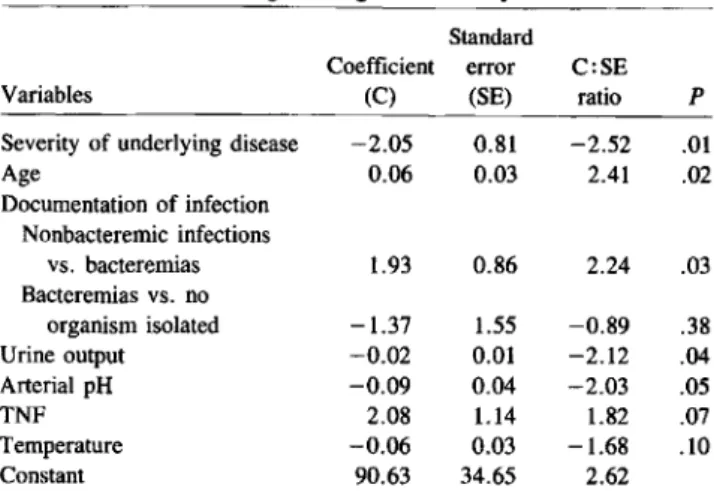
Logistic regression analysis.
Since some of the variablesp .01 .02 C:SE ratio -2.52 2.41 0.81 0.03 -2.05 0.06 1.93 0.86 2.24 .03 -1.37 1.55 -0.89 .38 -0.02 0.01 -2.12 .04 -0.09 0.04 -2.03 .05 2.08 1.14 1.82 .07 -0.06 0.03 -1.68 .10 90.63 34.65 2.62 Standard Coefficient error (C) (SE) Variables
Table 2. Results of logistic regression analysis.
Severity of underlying disease Age Documentation of infection Nonbacteremic infections vs, bacteremias Bacteremiasvs,no organism isolated Urine output Arterial pH TNF Temperature Constant
are intercorrelated, their joint effect on patient outcome can-not be assessed univariately. Therefore, we performed a step-wise logistic regression analysis to assess the importance of TNF in the presence of other factors. On the basis of data from the literature [17, 18] and our exploration of the data of our 70 patients, the following 13 clinical and laboratory variables were evaluated: age, gender, severity of underlying disease, documentation of infection, body temperature, blood pressure, urine output, serum concentrations (of TNF, IL-1{3, and IFNa), arterial pH, alveolar-arterial oxygen differ-ence, and leukocyte count. In a stepwise manner, 7 of the 13
variables considered initially were included in the model, of which 6 contributed significantly to prediction of patient out-come (table 2). The most significant of these variables were the severity of underlying disease (P
=
.01), age(P=
.02), documentation of infection (nonbacteremic infections vs. bac-teremias,P=
.03, and bacteremias vs. no organism isolated, P=
.38), urine output(P=
.04), and arterial pH(P=
.05). In this statistical model, immunoreactive TNF was at only the limit of significance (P = .07) and the temperature was not statistically significant (P = .10).To further assess how good the model was, we examined the percentage of correct prediction of patient outcome using either all or only some of the significant variables. With all 6 variables, one could predict the survival of the 70 patients correctly in up to 84%of the cases. When TNF levels were not taken into account, the correct prediction was still 83
%,
indicating that TNF contributed marginally to the prediction of patient outcome when the other 5 clinical and laboratory parameters were included. When only severity of underlying disease, documentation of infection, and age were included, patient outcome was predicted correctly up to 75%.
The ac-curacy of the prediction dropped to 62%if only severity of underlying disease was taken into account.NOTE. The ratio of coefficient to standard error (C:SE) can be read roughly as
tstatistics. Absolute value <2 indicates variable of minor effect in presence of other variables. N;13 day 10 day 10 day 1 day 1 day 0 day 0 p; .002 N;37~P;.01 P; .002 N;36
--: --- --.
---Z~ N;33L
,.,1-
J
N;33 N;13P;~05~P~.12
N;37r
p;~62
~
N;34 700 600 ~500E
400 0> S 300 ~ ~ 200 100OL-o.---.J
500 ~400~
300 S ~ 200 I-100 A 0 BDiscussion
Inthe present study, we examined the evolution and the prog-nostic value of the serum levels of immunoreactive TNF,
IL-1(1, IFNa,and IFNI' in 70 patients with septic shock due to various microbial agents, mainly gram-negative bacteria. Im-munoreactive TNF was detectable in 79%of our patients with established septic shock. Recently, de Groote et al. [19] mea-sured plasma levels of immunoreactive TNF in 38 patients with presumed sepsis, of whom 14 had gram-negative and 2 had pneumococcal bacteremias. Only 6 (16
%)
of these 38 patients had detectable TNF levels. In43criticallyillseptic patients, of whom 11 had positive and 9 had gram-negative bacteremias, Debets et al. [20] detected plasma lev-els of immunoreactive TNF in only 11 patients (25%).Thus, the data of our present study demonstrate that in contrast to patients with sepsis, most patients with established septic shock due to various gram-negative bacteria have imniunoreactive TNF present in their serum. In addition, the detection of elevated TNF levels in the serum of 6 of 8 patients with septic shock due to gram-positive bacteria or yeasts suggests that TNF might also playa role during the development of these infections.In a univariate analysis, the serum levels ofTNF measured at study entry were significantly associated with patient out-come. However, there was a wide overlap between the sur-vivors and the nonsursur-vivors. Other investigators have also found that levels of biologically active [11] or immunoreac-tive [12] TNF were associated with outcome in patients with meningococcemia, but they did not determine the relative prognostic value of TNF and of other clinical and laboratory variables.
In order to determine the relative importance of the vari-ous prognostic factors of outcome in our patients and to as-sess whether the serum levels ofTNF would remain significant once these factors were taken into account, we performed a stepwise logistic regression analysis. In this analysis, five sim-ple clinical and laboratory variables were significantly as-sociated with the outcome of the patients, while serum levels of immunoreactive TNF were at the limit of the statistical significance. Indeed, the percentage of correct prediction of patient outcome was increased only from 83%to 84%by add-ing TNF to these five variables, showadd-ing that TNF itself had a negligible impact for prediction. Thus, our observations sug-gest that in patients with established septic shock, the abso-lute serum concentration of immunoreactive TNF is not a prime indicator of the severity of the patient's condition and might be of limited value in predicting patient outcome.
Since TNF has been unequivocally shown to be of critical importance in the development of the clinical and humoral manifestations of septic shock in animals [2-7, 21] and in hu-mans [8,22]challenged with whole gram-negative bacteria or with lipopolysaccharide, the results of the logistic regres-sion analysis should be cautiously interpreted with regard to the role played by TNF in the pathogenesis of septic shock in our patients. First, measuring serum concentrations of
im-munoreactive TNF does not discriminate biologically active TNF from potentially inactive TNF once it is bound to recep-tors, plasma proteins, or inhibitors. Second, in contrast to ro-dents [3, 7] or primates [6] dying a few hours after an acute challenge with gram-negative bacteria, endotoxin, or recom-binant TNF, only 30% of our patients died within24h of an overwhelming and irreversible septic shock. The other 70% died of direct or indirect consequences of septic shock at a median of 10 days (range,2-39)after the onset of septic shock. In addition, the magnitude and evolution of the serum con-centrations of TNF in our patients differed strikingly from those observed in patients with fulminant meningococcal septic shock, in whom the levels of biologically active [II] or im-munoreactive TNF [12J were much higher, possibly because meningococcal septic shock follows a particular fulminant course in comparison with septic shock causedbyother gram-negative organisms. Moreover, while immunoreactive TNF levels in volunteers were undetectable 4 h after a single injec-tion of endotoxin [8], 79%of our patients had detectable lev-els of TNF 10 h after the development of shock, probably reflecting differences of infectious stimuli between volunteers and patients. Indeed, we observed two different evolutions of the serum levels of immunoreactive TNF during the course of septic shock. In patients surviving septic shock, the con-centrations of TNF had decreased to undetectable levels 10 days after the acute episode, whereas in II of the 13 nonsur-vivors TNF levels remained elevated.
The persistence of high levels of TNF in the 13 nonsur-vivors was related to unresolved primary infections, as shown by the documentation of recurrent gram-negative infections in 6. This could suggest that in patients with septic shock, the persistence of high levels of immunoreactive TNF despite appropriate antimicrobial therapy might be an early clue for a persistent infection as well as for the development of multi-ple organ failure. Altogether, the present results might there-fore indicate that in patients dying from the consequences of septic shock, the host response to TNF production mightbe
somewhat different from that observed in animals after an acute challenge and suggest that once septic shock is estab-lished, other variables should be considered for predicting patient outcome.
With regard to levels of other cytokines, we found in a univariate analysis that the serum levels of IL-l(1 were also significantly higher in the nonsurvivors than in the survivors
(P = .05). However, the relation between IL-l(1 and patient outcome did not remain significant when other prognostic vari-ables were taken into account in the logistic regression anal-ysis. Since it has been shown that the production ofIL-l(1 can be induced by TNF both in vitro[23]and in vivo [24],and since IL-l(1 experimentally potentiates the lethal effect ofTNF [25], we examined the interplay ofTNF and IL-I(1 in the se-rum of our patients. There was no correlation between sese-rum levels ofTNF and ofIL-l(1, either in the overall patient popu-lation or in patients with documented gram-negative infec-tions. These results contrast with those observed by Girardin
1ID 1990;161 (May) Cytokines in Septic Shock 987
et al. [12] and by Waage et al. [13]in children with purpura fulminans, possibly because the correlation between TNF and IL-113 is restricted to meningococcal septic shock.
With regard to IFNa and iFNI' serum levels, neither was related to patient outcome. A similar lack of correlation be-tween IFNI' and outcome was observed by Waage et al. [13] in patients with meningococcal septic shock, in contrast to the results of Girardin et al. [12] in children with severe menin-gococcal purpura.
In conclusion, the results of this study showed that im-munoreactive TNF and, to a lesser extent, IL-113 are produced in the serum of patients with septic shock due to various gram-negative bacteria, but also due to gram-positive bacteria and to yeasts. Different evolutions of the serum level of TNF were observed in survivors and in nonsurvivors during the course of septic shock. In the survivors, serum TNF progressively decreased to undetectable levels, while it remained elevated for at least IOdays in the vast majority of the nonsurvivors and was often related to the presence of a persistent infection. However, although associated univariately with patient out-come, TNF was shown in a multivariate analysis to contrib-ute less significantly to the prediction of outcome than five simple clinical and laboratory variables.
Acknowledgment
The principal investigators and participating centers in the Swiss-Dutch 15 Immunoglobulin Study Group were as follows (number of entries into the TNF study):1.Schellekens and1.Verhoef, Uni-versity Hospital, Utrecht, The Netherlands (28);
w.
Zimmerli, Kantonsspital, Basel, Switzerland (16); E. Kalter, Sint Radboudzie-kenhuis, Nijmegen, The Netherlands(15); T. Calandra and M. P. Glauser, Centre Hospitalier Universitaire Vaudois, Lausanne, Swit-zerland (9); A. Nicole andC.Regamey, Hopital Cantonal, Fribourg, Switzerland (5); P. Erard, Hopital des Cadolles, Neuchatel, Swit-zerland(3); and A. Schaffner, Universitiitsspital, Zurich, Switzer-land (2).We thank C. Gysler-Pittet, D. Gretener, and M. Giddey for tech-nical assistance, M. A. Blanc for help with manuscript preparation, and Marc Baudrihaye (IRE-Medgenix, Fleurus, Belgium) for provid-ing the radioimmunoassays for measurprovid-ing TNF, IL-l/3, IFNa, and IFNI'.
References
I. Beutler B, Mahoney 1,LeTrang N, Pekala P, Cerami A. Purification of cachectin, a lipoprotein lipase-suppressing hormone secreted by endotoxin-induced RAW 264.7 cells. 1 Exp Med 1985;161:984-995 2. Beutler BA, Milsark tW, Cerami A. Cachectin/tumor necrosis factor: production, distribution and metabolic fate in vivo. 1 Immuno11985; 135:3972-3977
3. TraceyKJ,Beutler B, Lowry SF, Merryweather 1, Wolpe S, Milsark
rw,
HaririRJ, Fahey Tl III, Zentella A, Albert10,Shires GT, Cer-ami A. Shock and tissue injury inducedbyrecombinant human ca-chectin. Science 1986;234:470-4744. Beutler B, Milsark tW, Cerami AC. Passive immunization against cachec-tin/tumor necrosis factor protects mice from lethal effect of endo-toxin. Science 1985;229:869-871
5. Beutler B, Cerami A. Cachectin: more than a tumor necrosis factor. N Engl 1 Med 1987;316:379-385
6. TraceyKJ,Fong Y, Hesse DG, Manogue KR, Lee AT, Kuo GC, Lowry SF, Cerami A. Anti-cachectin/TNF monoclonal antibodies prevent septic shock during lethal bacteraemia. Nature 1987;330:662-664 7. Mathison lC, Wolfson E, UlevitchRJ. Participation of tumor necrosis factor in the mediation of bacterial lipopolysaccharide-induced in-jury in rabbits. 1 Clin Invest 1988;81:1925-1937
8. Michie HR, Manogue KR, Spriggs DR, Revhaug A, O'Dwyer S, Dinarello CA, Cerami A, Wolff SM, Wilmore D. Detection of cir-culating tumor necrosis factor after endotoxin administration. N Engl 1 Med 1988;318:1481-1486
9. Waage A, Espevik T, Lamvik1. Detection oftumour necrosis factor-like cytotoxicity in serum from patients with septicemia but not from un-treated cancer patients. Scand 1 Immunol 1986;24:739-743 10. Scuderi P, Sterling KE, Lam KS, Finley PR, RyanKJ,Ray CG, Petersen
E, Slymen Dl, Salmon SE. Raised serum levels of tumor necrosis factor in parasitic infections. Lancet 1986;2:1364-1365
II. Waage A, Halstensen A, Espevik T. Association between tumor necro-sis factor in serum and fatal outcome in patients with meningococcal disease. Lancet 1988;1:355-357
12. Girardin E, Grau GE, Dayer 1M, Raux-Lombard P, the 15 Study Group, Lambert PH. Tumor necrosis factor and interleukin-I in the serum of children with severe infectious purpura. N Engl 1 Med 1988; 319:397-400
13. Waage A, Brandtzaeg P, Halstensen A, Kierluf P, Espevik T. The com-plex pattern of cytokines in serum from patients with meningococcal septic shock. Association between interleukin 6, interleukin I, and fatal outcome. 1 Exp Med 1989;169:333-338
14. Calandra T, Glauser MP, Schellekens 1, Verhoef 1, the Swiss-Dutch 15 Immunoglobulin Study Group. Treatment of gram-negative septic shock with human IgG antibody toEscherichia coli 15: a prospec-tive, double-blind, randomized trial. 1 Infect Dis 1988;158:312-319 15. McCabe WR, lackson GG. Gram-negative bacteremia.I.Etiology and
ecology. Arch Intern Med 1962;1l0:847-855
16. Dixon WI, ed. BMDP statistical software. Berkeley, CA: University of California Press, 1985
17. Kreger BE, Craven DE, McCabe WR. Gram-negative bacteremia. IV. Reevaluation of clinical features and treatment in 612 patients. Am 1 Med 1980;68:344-355
18. Bryan CS, Reynolds KL, Brenner ER. Analysis of 1,186 episodes of gram-negative bacteremia in non-university hospitals: the effects of antimicrobial therapy. Rev Infect Dis 1983;5:629-638
19. de Groote MA, Martin MA, Densen P, Pfaller MA, Wenzel RP. Plasma tumor necrosis factor levels in patients with presumed sepsis. lAMA 1989;262:249-251
20. Debets IMH, Kampmeijer R, Van der Linden MPMH, Buurman WA, Van der Linden CJ. Plasma tumor necrosis factor and mortality in criticallyill septic patients. Crit Care Med 1989;17:489-494 21. Natanson C, Eichenholz PW, Danner RL, Eichacker PQ Hoffman WD,
Kuo GC, Banks SM, MacVittieTJ, Parillo IE. Endotoxin and tumor necrosis factor challenges in dogs simulate the cardiovascular profile of human septic shock. 1 Exp Med 1989;169:823-832
22. Suffredini AF, Fromm RE, Parker MM, Brenner M. The cardiovascu-lar response of normal humans to the administration of endotoxin. N Engl 1 Med 1989;321:280-287
23. Dinarello CA, Cannon10,Wolff SM, Bernheim HA, Beutler B, Cer-ami A, Figari IS, Palladino MA Jr, O'Connor IV. Tumor necrosis factor (cachectin) is an endogenous pyrogen and induces production of interleukin I. 1 Exp Med 1986;163:1433-1450
24. Dinarello CA, Cannon10,Wolff SM. New concepts on the pathogene-sis of fever. Rev Infect Dis 1988;10:168-189
25. Waage A, EspevikT.Interleukin I potentiates the lethal effect of tumor necrosis factor a/cachectin in mice. 1 Exp Med 1988;167:1987-1992