by
Kevin Taylor Chu
B.S. Chemistry, Stanford University, 1998
M.S. Sci. Comp. & Comp. Math., Stanford University, 1999
Submitted to the Department of Mathematics
in partial fulfillment of the requirements for the degree of
Doctor of Philosophy
at the
MASSACHUSETTS INSTITUTE OF TECHNOLOGY
September 2005
( Kevin Taylor Chu, MMV. All rights reserved.
The author hereby grants to MIT permission to reproduce and distribute publicly
paper and electronic copies of this thesis document in whole or in part.
Author
... ...
Department of Mathematics
June 6, 2005
Certified
by...
...
...
Martin Z. Bazant
Associate Professor of Applied Mathematics
Thesis Supervisor
Accepted
by ...
...
Rodolfo Ruben Rosales
Chairman, Applied Mathematics Committee
Accepted
by ...
,
...
Pavel I. Etingof
l
Uhairperson, Department Uommittee on raduate Students
I
i~~~~~QJo9~7eic
i~~~C~s
MASSACHUSETTS INSTMTE OF TECHNOLOGY SEP 15 2005LIBRARIES
Kevin Taylor Chu
Submitted to the Department of Mathematics
on June 6, 2005, in partial fulfillment of the requirements for the degree of
Doctor of Philosophy
Abstract
In the study of electrochemical transport processes, experimental exploration currently outpaces theoretical understanding of new phenomena. Classical electrochemical transport theory is not equipped to explain the behavior of electrochemical systems in the extreme operating conditions required by modern devices. In this thesis, we extend the classical theory to examine the response of two electrochemical systems that form the basis for novel electrochemical devices.
We first examine the DC response of an electrochemical thin film, such as the separator in a micro-battery, driven by current applied through reactive electrodes. The model system consists of a binary electrolyte between parallel-plate electrodes, each possessing a compact Stern layer which mediates Faradaic reactions with Butler-Volmer kinetics. Our analysis differs from previous studies in two significant ways. First, we impose the full nonlinear, reactive boundary conditions appropriate for electrolytic/galvanic cells. Since surface effects become important for physically small systems, the use of reactive boundary conditions is critical in order to gain insight into the behavior of actual electrochemical thin films that are sandwiched between reactive electrodes, especially at high current densities. For instance, our analysis shows that reaction rate constants and the Stern-layer capacitance have a strong influence on the response of the thin film. Second, we analyze the system at high current densities (far beyond the classical diffusion-limited current) which may be important for high power-density applications. At high currents, we obtain previously unknown characterizations of two interesting features at the cathode end of the cell: (i) a nested boundary layer structure and (ii) an extended space charge region.
Next, we study the response of a metal (i.e., polarizable) colloid sphere in an elec-trolyte solution over a range of applied electric fields. This problem, which underlies novel electrokinetically driven microfluidic devices, has traditionally been analyzed using circuit models which neglect bulk concentration variations that arise due to double layer charg-ing. Our analysis, in contrast, is based on the Nernst-Planck equations which explicitly allow for bulk concentration gradients. A key feature of our analysis is the use of surface
conservation laws to provide effective boundary conditions that couple the double layer charging dynamics, surface transport processes, and bulk transport processes. The for-mulation and derivation of these surface conservation laws via boundary layer analysis is one of the main contributions of this thesis. For steady applied fields, our analysis shows
that bulk concentrations gradients become significant at high applied fields and affect both
bulk and double layer transport processes. We also find that surface transport becomes important for strong applied fields as a result of enhanced absorption of ions by the double layer. Unlike existing theoretical studies which focus on weak applied fields (so that both
of these effects remain weak), we explore the response of the system to strong applied fields where both bulk concentration gradients and surface transport contribute at leading order. For the unsteady problem at applied fields that are not too strong, we find that diffusion processes, which are necessary for the system to relax to steady-state, are suppressed at leading-order but appear as higher-order corrections. This result is derived in a novel way using time-dependent matched asymptotic analysis. Unfortunately, the dynamic response of the system to large applied fields seems to introduce several complications that make the analysis (both mathematical and numerical) quite challenging; the resolution of these challenges is left for future work.
Both of these problems require the use of novel techniques of asymptotic analysis (e.g., multiple parameter asymptotic expansions, surface conservation laws, and time-dependent asymptotic matching) and advanced numerical methods (e.g., pseudospectral methods, Newton-Kantorovich method, and direct matrix calculation of Jacobians) which may be applicable elsewhere.
Thesis Supervisor: Martin Z. Bazant
Title: Associate Professor of Applied Mathematics
and my fiancee,
Throughout my graduate studies, I have had the good fortune to be surrounded by many wonderful friends and colleagues. Without their generous support and guidance, I would
not have been able to complete graduate school and this thesis.
First, and foremost, I would like to thank my advisor, Martin Z. Bazant, for introducing me to challenging problems at the intersection of science/engineering and mathematics and giving me the freedom to explore these (and other) problems independently. During those times when it seemed like all roads to progress were blocked, his boundless energy and enthusiasm were a refreshing source of inspiration and motivation.
I have had the pleasure of working with many excellent scientists during my gradu-ate career. Armand Ajdari from Ecole Sup6rieure de Physique et de Chimie Industrielles (ESPCI) provided invaluable physical insight for the work on the charging of a metal col-loid sphere and electrochemical transport. Rodolfo Ruben Rosales kindly offered advice and perspective on mathematics, science, career development, and life in general. Yuxing
Ben and Jeremy Levitan taught me about many practical and theoretical aspects of
mi-crofluidic devices. Jaehyuk Choi and Boguk Kim have been wonderful office-mates; much of my understanding of numerical methods have been a direct result of our many white-board discussions. 1Finally, my experience and understanding of the world (both academic and beyond) has been greatly enhanced by many conversations I have had with fellow students (listed in no particular order): David Vener, David Hu, Fumei Lam, Brian Sutton, Brian Taylor, Jaydeep Bardhan, Bree Aldridge, Nava Ariel, Pak-wing Fok, Chris Rycroft, Alice
Chan, Lisa Treat, Per-Olof Persson, and many others.
Completion of my degree and thesis could not have happened without the strong support of my friends and family. My fiancee, Anna Chiu, and our cat, Audrey, kept my life balanced by constantly reminding me that there is life outside of work. I especially appreciate Anna's tireless efforts to keep me well-fed and to shield me from the "little distractions" in life, so I could focus on my work. Our house-mate, Emy Chen, always kept stress at bay (even while she was writing her own thesis) with her laid-back and relaxed view on life. My cousin, David Wu, and his wife, Grace Hsiao, were great neighbors and made home a warm and welcoming place to be. My good friend, Bob Petersen, has always been there to help me see things from other (especially non-academic) perspectives. He and his wife, Gina
Liao, were gracious enough to let me stay with them during my practicum at Lawrence Livermore National Laboratory. Another good friend, Edison Ng, has always helped me to stay connected to the practical side of science and engineering by keeping me abreast of new and exciting developments in technology. He kindly allowed me to "hide-out" at his home for a short period of time while I was writing my thesis but did not allow me to become so absorbed that I forgot to take breaks to have fun. Finally, I cannot thank my parents, Wengenn and Bihju Chu, and my siblings, Alina, Melissa, and Henry, enough for just being good family.
I would also like to express my appreciation to the department's support staff. In particular, Shirley Entzminger, the Physical Applied Math Group's beloved administrator, played a crucial role in the success of the Simple Person's Applied Math Seminar (among many other department and institute activities), and Tivon Luker, Matt Walburn, and Dave Backeberg, the department system administrators, provided invaluable advice and
experi-ence for setting up and maintaining the Applied Mathematics Computational Laboratory's
Beowulf cluster.
Financial support for my graduate studies was generously provided by the Department of Energy through the Computational Science Graduate Fellowship (CSGF) and a summer research assistantship through the Center for Material Science Research at MIT. The CSGF is truly a fellowship of computational scientists; I feel privileged to have been given the opportunity to be a part of and interact with this extraordinary group of people.
Parts of this thesis have appeared (or will soon appear) in the following published articles:
Chapters 2 and 5
M. Z. Bazant, K. T. Chu and B. J. Bayly. Current-voltage relations for electrochemical thin films. To appear in SIAM J. Appl. Math.
Chapters 2 and 5
K. T. Chu and M. Z. Bazant. Electrochemical thin films at and above the classical
limiting current, To appear in SIAM J. Appl. Math.
1 Introduction
1.1 Electrochemical Transport ...
1.1.1 Bulk Transport. 1.1.2 Surface Processes.
1.2 Electrochemical Transport Theory ...
1.3 Scope and Outline of Thesis ...
2 Mathematical Model
2.1 Introduction .
2.2 Ion Transport Equations ...
2.2.1 Poisson's Equation.
2.2.2 A note about the physical domain ...
2.3 Electrode Surface Boundary Conditions ...
2.3.1 Faradaic electrode reactions ...
2.3.2 Inert species and Integral Constraints ...
2.3.3 Double layer capacitance.
2.3.4 Simple Boundary Conditions ...
2.4 Dimensionless Formulation ...
2.5 Concl][usion ...
3 Aspects of Classical Electrochemical Analysis
3.1 Introduction .
3.2 Local Electroneutrality ... 11 21 21 22 23 23 2427
27 28 29 30 30 32 37 38 41 42 4445
45 46CONTENTS
3.2.1 Electric Potential.
3.2.2 Pure diffusion of ion concentrations 3.2.3 Boundary conditions ...
3.3 Supporting Electrolyte.
3.4 Low applied voltages ...
3.5 Potential Theory ...
3.6 Conclusion ...
4 Surface Conservation Laws
4.1 Introduction .
4.2 Derivation of Surface Conservation Laws ... 4.3 Conclusion ...
5 Electrochemical Thin Films
5.1 Introduction .
5.2 Mathematical Model ...
5.2.1 Transport Equations ...
5.2.2 Electrode Boundary Conditions ... 5.2.3 An Integral Constraint ...
5.2.4 Galvanostatic Operating Conditions ... 5.2.5 Formulation in terms of the Electric Field . .
5.3 Low Currents
(j
1- O(e2/3)) ...5.3.1 Boundary-layer Analysis ...
5.3.2 Polarographic Curves for Thin Double Layers, 5.3.3 Thick Double Layers, = 0(1) ...
5.4 High Currents
(j >
I - O(e
2/
3))
...5.4.1 Unified Analysis at All Currents ...
5.4.2 Nested Boundary Layers at the Limiting Current, j = 1 - O(e2/3)
5.4.3 Bulk Space Charge Above the Limiting Current, 1 + O(2/3) << j <<
5.4.4 Polarographic Curves ... 47 48 50 51 56 58 58 61 61 64 68 69 . . . .69 . . . .71 . . . .72 . . . .74 . . . .75 . . . .75 . . . .. . .. . . .. . 76 . . . .76 . . . 76 e 0 ... . 84 . . . .90 . . . .94 . . . .. . .. . . .. . 97 98 105 114 12
...
...
...
...
...
...
...
5.4.5 Effects of the Stern-Layer Capacitance ... 116
5.5 Numerical Model ... 117
5.6 Conclusions ... 118
5.7 Future Research ... 120
6 Double Layer Charging of Metal Colloid Spheres
121
6.1 Introduction . . . ... 1216.2 Mathematical Model ... 125
6.2.1 Electroneutral Bulk Equations ...
..
126
6.2.2 Effective Boundary Conditions ...
..
127
6.3 Steady response to large applied electric fields ... 135
6.3.1 Numerical model ... 136
6.3.2 Enhanced Surface Excess Concentration and Surface Conduction . . 141
6.3.3 Bulk Concentration Variation and Diffusion Currents . ... 144
6.3.4 Individual Ion Currents ... 146
6.4 Linear Response to Weak Applied Fields ... . 148
6.4.1 Transform Solutions for Arbitrary e and 6 ... 149
6.4.2 Response to a Weak, Oscillatory Fields ... 152
6.4.3 Accumulated Surface Charge Density ... 153
6.4.4 Time Scales for Linear Response ... . 154
6.5 Weakly Nonlinear Dynamics ... 155
6.5.1 Dynamics at the RC Time ... 155
6.5.2 Dynamics at the Diffusion Timescale ... 165
6.5.3 Future work ... 169
6.6 Strongly Nonlinear Dynamics ... 169
6.6.1 Leading Order Equation in Strongly Nonlinear Regime ... 170
6.6.2 Challenges with Strongly Nonlinear Analysis ... 170
6.7 Conclusions ... ... 171
6.8 Future
Research
. .
...
... . 172
14 CO
A Overpotentials
B Positivity of Ion Concentrations
C Numerical Methods
C.1 Pseudospectral Spatial Discretizations ...
C.1.1 Pseudospectral Grids for Common 1-D Computational Domains C.1.2 Pseudospectral Discretizations in Higher Dimensions ... C.1.3 References for Spectral Methods ...
C.2 Computation of Exact Jacobians for Discretized PDEs ...
NTENTS
177
179 181 . 181 . 183 . 190 . 191 . 192D MATLAB Code
D.1 Differentiation Operators195
... . . . 19 5 D.1.1 DM_TL.m ... D.1.2 DM_cosine_interior.m ...D.1.3 div.m .
D.1.4 grad.m ...
D.1.5 laplacian.m ...
D.1.6 div_s.m ...
D.2 Electrochemical Thin-Films ... D.2.1 solveSteadyPNP.m ...D.3 Steady-state, Charging of Metal Colloid Sphere ....
D.3.1 solveHighFieldSteadyResponse3D.m ...
D.3.2 computeZetaPotential .m.
D.4 Weakly Nonlinear Response of Metal Colloid Sphere D.4.1 computeBulkChargingDynamicsRC3D.m .... D.4.2 ODE_RHS_BULK_RC.m . ... . .. . .. .. 195 ... . .. . . ... 197 . . . 199 ... . . .. ... . 201 ... . .. . . .. . 203 ... . .. . . .. . 205 ... . . . . .. .. 206 ... . .. . . .. . 206 ... . . .. . .. . 217 ... .. . . .. .. 217 ... . .. . . .. . 229 ... . . . .. .. . 232 ... . .. . . .. . 232 ... . . .. . . .. 235
2-1 Sche:rnatic Diagram of Double Layer Structure ... 39
4-1 Schem:natic diagram of fluxes at a sharp interface ... 62
4-2 Schemnatic diagram of a microscopically diffuse interface ... 63
5-1 Schematic diagram of model problem ... 72
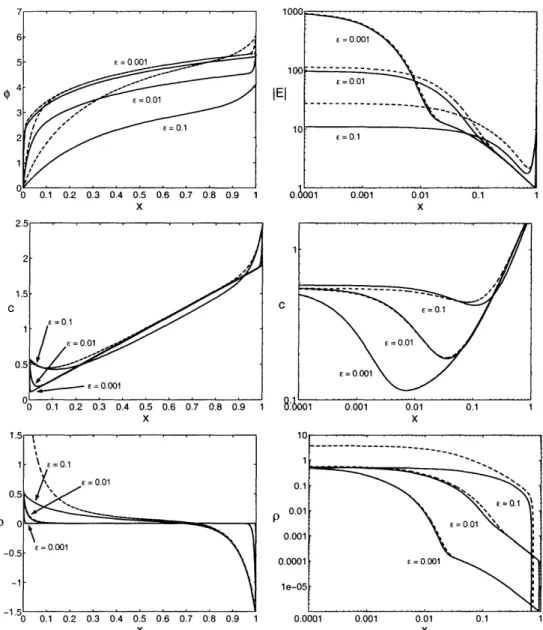
5-2 Numerical solutions of PNP equations compared with the asymptotic ap-proximations for j = 0.9, k, 10, j, = 10, = 0, and e = 0.001, 0.01, 0.1 .. 78
5-3 Exact polarographic curves for varying a values compared to polarographic curves for the Gouy-Chapman and Helmholtz limits ... 87
5-4 Polarographic curves in the Gouy-Chapman and Helmholtz limits as the re-action rate constants are increased ... 91
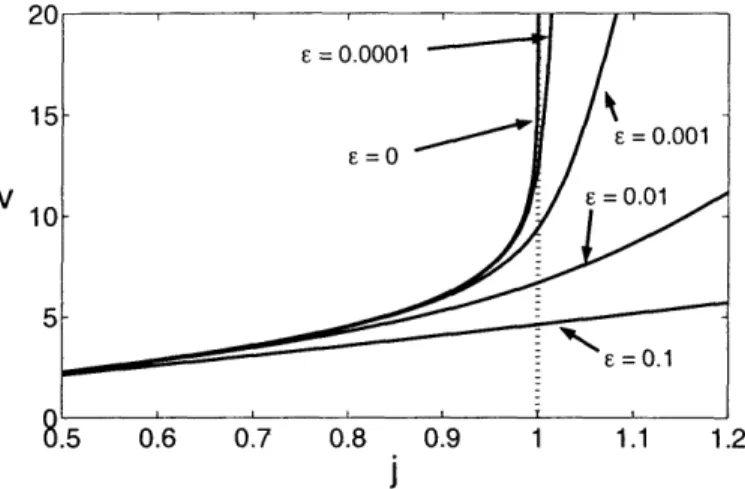
5-5 Polarographic curves for values of 0, 0.0001, 0.001, 0.01, and 0.1 with the
other physical parameters taken to be = 0, k = 10, and
jr= 10 ...
92
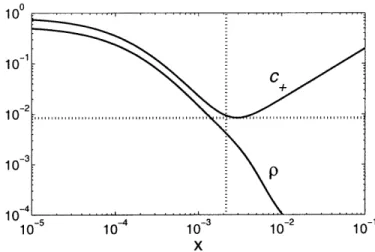
5-6 Numerical solutions for the dimensionless cation concentration and charge
density at the diffusion-limited current with physical parameters kc = 10,
3r = 10, a, = a, = 0.5, 6 = 0.0 and e = 0.0001 ...
94
5-7 Profiles of the dimensionless potential, electric field, total ionic concentration, and charge density in three regimes: below the classical diffusion-limited
current, at the limiting current, and above the limiting current ...
96
5-8 Numerical solutions for the electric field at current densities of j = 0.9 and
j = 1.0 demonstrating the expansion of the diffuse layer at the limiting current 100
LIST OF FIGURES
5-9 Numerical solutions for the dimensionless electric field E(x) and concentra-tion c(x) at the classical diffusion-limited current compared with leading
order asymptotic approximations ... 103
5-10 Numerical solutions for the dimensionless electric field E(x), average con-centration c(x), and charge density p(x) above the diffusion-limited current compared with leading order asymptotic approximations ... . 106 5-11 Numerical solutions for the dimensionless cation and anion concentrations
above the diffusion-limited current. ... 107
5-12 Numerical solutions for the dimensionless electric field E(x), average concen-tration c(x), and charge density p(x) far above the diffusion-limited current compared with leading order asymptotic approximations ... . 108 5-13 Comparison of numerical polarographic curves with leading-order asymptotic
approximations given in (5.118) for several values of e ... 116
5-14 Decomposition of the total cell voltage into contributions from the cell interior
and the Stern layer as a function of 6 ...
117
6-1 Schematic diagram of model problem ... 125
6-2 Numerical solutions for the concentration and excess potential for E = 10 . 141 6-3 Bulk electric potential and concentration profiles at surface of sphere for
varying values of the applied electric field . ... 142 6-4 Surface charge density and excess surface concentration of neutral salt and
for varying values of the applied electric field . ... 142 6-5 Tangential surface fluxes for the surface charge density and excess surface
concentration of neutral salt for varying values of the applied electric field . 143 6-6 Comparison of the magnitudes of surface conduction and surface diffusion
for the tangential fluxes of q and w ... 143 6-7 Tangential component of bulk electric field at surface of sphere for varying
values of the applied electric field ... 144 6-8 Normal flux of current and neutral salt into the double layer for varying
values of the applied electric field ... 145
6-9 Diffusion currents ... . 146
6-10 Comparison of the magnitudes of bulk electromigration and diffusion at
var-ious positions on the surface of sphere. ... 147
6-11 Tangential surface fluxes of cations and anions for varying values of the ap-plied electric field ... 148
6-12 Exponential relaxation time constants for the charge density and
accumu-lated surface charge density at weak applied fields as a function of e and 6 . . . . ... 1546-13 Five dominant regions of space-time that define the dynamic response of a metal colloid sphere to an applied electric field ... 156
6-14 Dipolar double layer charging in the weakly nonlinear regime ... 164
6-15 Time evolution of dominant expansion coefficients for in the weakly non-linear regime at the RC time when sphere has a nonzero applied voltage . . 164
6-16 Double layer charging in the weakly nonlinear regime at the RC time for varying values . . . ... 165
C-1 Equi--spaced endpoint grid for periodic intervals. ... 184
C-2 Chebyshev endpoint grid for finite, non-periodic intervals. ... 186
C-3 Rational Chebyshev grid for infinite intervals. ... 189
C-4 Rational Chebyshev grid for semi-infinite intervals. ... 190
5.1 Comparison of the cell voltages predicted by asymptotic approximations with numerically calculated values at various and 3 values ... 114
Introduct ion
In spite of its respectable age and obvious practical relevance, electro-diffusion is still remarkably poorly understood.
- Isaak Rubinstein [95]
1.1 Electrochemical Transport
The transport of charge from one location to another is a fundamental process underlying
many physical phenomena in industry and nature. Industrial examples abound in a wide
range of applications: energy storage and conversion (e.g., batteries and fuel-cells), wa-ter treatment and purification (e.g., electrodialysis), microfluidics (e.g., electrokinetically driven pumping and mixing), metallurgy (e.g., electroplating and large-scale production of metals/alloys), and semiconductors devices. Similarly, electrochemical transport appears in many natural processes, such as corrosion and ion transport through ion channels in biological cells.
What makes electrochemical transport phenomena so fascinating (and complicated to understand) is the coupling between multiple physical and chemical processes. In many electrochemical systems, bulk and surface processes occur simultaneously. In the bulk, the driving force for ion motion comes from two fundamentally different sources: diffusion and electromigration. At electrode surfaces, double layer charging, electrochemical reactions, and surface conduction may all be in action. Together, these processes and their interactions
CHAPTER 1. INTRODUCTION
lead to the rich and varied behavior of electrochemical systems seen in nature and and used by industry.
1.1.1 Bulk Transport
For dilute electrolytes, there are two main driving forces for ion motion. At the molecular level, each individual ion simultaneously undergoes Brownian motion as a result of constant bombardment (or collisions) with other species in the electrolyte and feels a force as its charge interacts with the local electric field. The resulting motion is a random walk that is biased in the direction of the electric field. In the continuum limit, this molecular motion becomes a flux of ion concentration containing two terms [5, 86, 95]:
J = -DVC - zCV),
(1.1)
where C is the local ion concentration, ) is the electric potential, and D and z are the diffusivity and charge, respectively, of the ion. The first term in this expression describes diffusion which drives ions from regions of higher concentration to regions of lower concen-tration. The second term describes electromigration which drags the ion in the direction
(or opposite) of the electric field.
At first glance, (1.1) seems relatively straightforward. However, a major complication lies hidden within the electric potential. From basic electricity and magnetism, we know that the source of electric fields is charge [58]. Therefore, the ions themselves contribute to the local electric potential. As a result, ion transport is inherently a nonlinear process that tightly couples ion concentrations and the electric potential. This nonlinearity greatly complicates the mathematical analysis of the ion transport equations. Fortunately, nature disfavors the build up of large regions of non-zero charge density, so it is often possible to treat the bulk as locally electroneutral [86, 95]. In this approximation, the only nontrivial charge density resides in very thin regions near interfaces - the electrical double layers.
1.1.2
Surface Processes
The double layer is a region of high activity for many electrochemical systems. Perhaps the most important process that occurs in the double layer is the accumulation of charge density, which is present to some extent in all electrochemical systems. For example, it plays a critical role in all electrokinetic phenomena [56, 68], which are a result of coupling between ion motion and fluid flow. Double layer charge is also important in the context of electrochemistry where it can affect the expected rate of an electrochemical reaction by adjusting the effective electrode potential via the Frumkin correction [5, 39, 86].
Electrode reactions themselves are another important process that occurs at surfaces. With the aid of electrons donated (or accepted) by an electrode, electrode reactions convert one (or more) species in the solution into another (perhaps several) species via oxidation-reduction reactions. The net result is the passage of charge through the electrode into the electrolyte and a change in concentration of reactive species in the region immediately
adjacent to the electrode surface.
One final type of surface process worth mentioning is surface transport which moves charge and ions along surfaces completely within the double layer. Under ordinary circum-stances, surface transport is negligible because the double layer possesses only a very small amount of excess ion concentration (relative to the bulk solution). However, it becomes sig-nificant at high applied fields for polarizable surfaces due to strong absorption of electrolyte
by the double layer. At weaker applied fields, surface conduction is still important (though much weaker) because it plays a role in bulk diffusion, which only occurs as a correction to a uniform background concentration.
1.2 Electrochemical Transport Theory
The theoretical study of electrochemical transport has a very long and distinguished tradi-tion dating back over a century to the work of Helmholtz [53], Nernst [81, 82, 83], Planck [90], and Warburg [113, 114]. Over the years, their original ideas have been successfully devel-oped and applied in many different fields. In all cases, theoretical understanding was made possible through the judicious use of physically appropriate simplifications to the
compli-CHAPTER 1. INTRODUCTION
cated physics. Some typical approximations include: assumption of local electroneutrality, bulk transport purely by diffusion or electromigration, and modeling the bulk as a linear resistor. Fortunately, common experimental procedures, such as the addition of support-ing electrolyte [5, 86] and the use of three-electrode cells [5, 10], justify the use of these approximations in many situations.
In modern times, novel electrochemical devices that push the bounds of classical theory are actively being developed [2, 30, 84, 101, 109, 1121. Attempts to understand the oper-ation of these devices have forced the theoretical community to reexamine electrochemical transport theory in exotic new regimes (e.g., high applied voltages and fields [8, 97, 98], very small length scales [6, 25], etc.). In addition to being intellectually interesting, the theoretical understanding gained from these investigations (even if qualitative) enhances our ability to engineer and optimize these devices.
1.3 Scope and Outline of Thesis
The work presented in this thesis contributes to the effort of studying the behavior of electrochemical systems in extreme operating conditions. We focus specifically on two problems: (i) the steady response of electrochemical thin-films, which has applications in the design of thin-film batteries [2, 30, 84, 101, 109, 112], and (ii) double layer charging of metal colloid spheres, which has applications to modern induced-charge electro-osmosis
driven pumps and mixers [1, 7, 15, 41, 61, 65, 104, 105, 108]. To address these problems,
our general approach is to use a combination of asymptotic analysis (in an appropriately chosen parameter) and numerical modeling to obtain solutions to the governing equations, and then explore the behavior of the solutions as a function of the physical (dimensionless) parameters for the system.
We begin in Chapter 2 by formulating a mathematical description of the physical pro-cesses involved in electrochemical transport. Here, we devote a considerable amount of time discussing appropriate electrode boundary conditions for Faradaic reactions because they are central to our analysis of electrochemical thin-films. In Chapter 3, we provide a firm mathematical foundation for many common notions from classical electrochemistry
through the use of asymptotic analysis. The main contribution of Chapters 2 and 3 is a unified presentation of the mathematical framework for studying electrochemical systems
with an emphasis on systems with reactive electrodes. In Chapter 4, we present a novel
formulation and derivation of surface conservation laws in the thin double-layer limit when
the transport process within the boundary layer are the same as those in the bulk. These
surface conservation laws are important because they make it possible to "integrate" out
the spatial structure of the double layer and analyze bulk transport using effective boundary conditions. In Chapter 5, we analyze the DC response of an electrochemical thin-film. Un-like previous studies of 1D electrochemical systems, we pay special attention to the impact of surface phenomena, specifically Faradaic electrode reactions and Stern layer capacitance, and analyze the system far above the classical diffusion-limited current. In our analysis, we examine both current-voltage relationships (i.e., polarographic curves) as well as the con-centration and potential profiles through the electrochemical cell. In Chapter 6, we explore
the steady and transient response of a metal colloid sphere to an applied electric field. Here,
we use the Nernst-Planck equations to model ion transport in the bulk, which allows us to go beyond the standard circuit model approach traditionally used by the electrokinetics com-munity. We also investigate the response of this system over a wide range of applied electric fields (in contrast to many studies which focus solely on weak applied fields). Through numerical simulations, we find that strong applied fields lead to large bulk concentration gradients and significant surface transport within the double layer. For weaker fields, we show, using timne-dependent asymptotic analysis, that diffusion processes are still active but only as a first-order correction. Finally, in Chapter 7, we present concluding remarks on extreme electrochemical transport theory and some directions for future research.
Mathematical Model
A scientific theory should be as simple as possible, but no simpler.
- Albert Einstein
2.1
Introduction
In order to embark on our theoretical explorations of extreme electrochemical transport
processes, we need a firm mathematical description of the system. However, because many of the assumptions underlying common electrochemical models are questionable in extreme operating conditions, we must build our model from basic physical principles. In this chapter, we develop a general mathematical model for electrochemical transport processes. We begin by deriving the governing equations for the bulk region starting from a general form for the ionic flux. Next, we give a detailed discussion of boundary conditions for these equations. We specifically focus on the mathematical description of Faradaic reactions and double layer capacitance because they involve many subtleties and are modeled in multiple different ways throughout the literature. Finally, to facilitate our analysis, we put the governing equations and boundary conditions in dimensionless form. In the process, we identify several important dimensionless parameters that define a parameter space of operating regimes for electrochemical systems.
CHAPTER 2. MATHEMATICAL MODEL
2.2 Ion Transport Equations
Ion transport processes are mathematically described by conservation laws for the chemical species present in the system:
a
= -V. Fi
(2.1)
at
where Ci and Fi are the concentration and flux of species i. For a general electrolyte solution, the flux of species i is a function of the electrochemical potential gradient of all of the species:
Fi
=
-C),
(2.2)
where the j are electrochemical potentials and the Lij are generalized mobilities that account for the possibility of interactions between the different species [86]. This general form for the flux is necessary when there are strong chemical interactions between the ionic species and forms the basis of concentrated solution theory [86].
While it is important to use (2.2) when describing concentrated solutions, it is common to study electrochemical systems in the dilute-solution limit for which it is acceptable to neglect the interactions between individual species [5, 86, 95]. In this limit, the flux for species i reduces to
Fi= -uiCiZVpi
(2.3)
where ui is the single species the mobility of the i-th species. Furthermore, in the dilute solution limit, the electrochemical potential can be decomposed into separate diffusion and migration terms:
pi
=
RTln
Ci + ziF
)(2.4)
where T is the absolute temperature, R is the universal gas constant, F is Faraday's constant
(a mole of charge), zi is the charge number of species i, and I is the electrostatic potential. It should be noted that the electrostatic potential is a well-defined quantity independent of any choice of a reference ionic species only in the dilute solution limit [86].
Equations (2.1), (2.3), and (2.4) form the basis for the well-known Nernst-Planck
tions [5, 86, 95]. Substituting (2.4) into (2.3), we find that the ionic fluxes are given by
Fi = - (DiVCi + uiziFCiVb)
(2.5)
where we have made use of the Nernst-Einstein relation Di =
uiRT to relate the mobility
to the diffusion coefficient Di. Thus, by using (2.5) in (2.1), we arrive at the Nernst-Planck equations for ion transport:
ac,
= V. (DiVCi + uiziFCiV)
(2.6)
This system of equations form the standard starting point for mathematical models of
electrochemical transport (in the absence of convection) [5, 86, 95].
2.2.1
Poisson's Equation
Due to the presence of the electric potential in the Nernst-Planck equations, (2.6) do not form a closed system of equations. Closure is provided by Poisson's equation which relates
the the electrostatic potential to local ionic concentrations:
-
V2 = p =
=
ziFCi.
(2.7)
Here es is the permittivity of the solvent, which we have taken to be constant1. Taken together, (2.6) and (2.7) are known as the Poisson-Nernst-Planck (PNP) equations and form the basis for many mathematical analyses of electrochemical systems [3, 4, 87].
An important alternative to Poisson's equation for many practical electrochemical sys-tems is the local electroneutrality condition:
>ziFCi
=
0.
(2.8)
Local electroneutrality plays an important role in many classical (and modern) mathemati-'At large electric fields, such as those that may arise in interfacial double layers, this classical approxima-tion could break down as the polarizaapproxima-tion of solvent molecules in large electric fields can lower the solvent dielectric permit-tivity by an order of magnitude [5, 28, 86].
CHAPTER 2. MATHEMATICAL MODEL
cal models of electrochemical transport [86, 95]. However, it is important to recognize that it is only an approximation to Poisson's equation. Because of its importance in classical electrochemical analysis, we shall discuss local electroneutrality and its connection to to Poisson's equation in more detail in Chapter 3.
In this thesis, we will focus solely on the dilute solution limit of electrochemical trans-port. While concentrated solution theory is applicable to a wider range of electrochemical systems, dilute solution theory is a good approximation in many practical systems (e.g.,
"macroscopic" electrochemical cells and electrokinetically driven flows). From the per-spective of mathematical analysis, the tight coupling between the different ionic species in concentrated solution theory makes it difficult to make analytical progress. Moreover, the large number of physical parameters present in concentrated solution theory (compared with dilute solution theory) complicates the identification of the dominant physics. For these rea-sons, we shall follow the tradition within the applied mathematics community of using the PNP equations as the starting point for studying electrochemical transport [3, 4, 87].
2.2.2
A note about the physical domain
There is a subtle, but important, dependency of the spatial domain on the choice of clo-sure relationship for the transport equations (2.6). When cloclo-sure is provided by Poisson's equation, the physical domain is the entire electrochemical cell including the diffuse part of the charged double layer. However, when the local electroneutrality condition is used, the
charged double layer must be excluded from the physical domain to maintain consistency of the mathematical description.
2.3 Electrode Surface Boundary Conditions
Although the PNP equations constitute a well-understood and widely accepted
approxi-mation for electrochemical transport, appropriate boundary conditions for them are not
so clear, and drastic approximations, such as constant concentration, potential or sur-face charge (or zeta potential), are usually made, largely out of mathematical conve-nience [3, 4, 87, 95, 96, 97]. On the other hand, in the context of electric circuit models
for electrochemical cells [8, 40, 72], much effort has been made to describe the nonlinear response of the electrode-electrolyte interface, while describing the bulk solution as a simple circuit element, such as a linear resistor. For systems driven far from equilibrium, an appro-priate choice of boundary conditions is critical because the response of the electrochemical cell can be significantly affected by interfacial physics. In this thesis, we formulate general boundary conditions based on classical models of the double layer [5, 14, 28] and fairly standard models for electrode reactions [5, 86]. The hope is that these boundary conditions
at least qualitatively capture the physics at electrode surfaces.
Mathematically, for electrochemical systems composed of N chemical species, the PNP
equations form a system of N + 1 equations for the concentrations of the N species and
the electric potential. Thus, because the governing equations (2.6) and (2.7) are parabolic-and elliptic-like, respectively, we require N + 1 boundary conditions to be specified on the domain boundaries. In this section, we discuss the physical origin of boundary conditions for electrochemical cells containing reactive electrode surfaces. First, we shall find that, for the transport equations, consideration of electrode reactions (or lack thereof) naturally leads to Neunmann-like boundary conditions on the normal flux of chemical species. Next, we derive the boundary condition for the electric potential by examining the effect of surface capacitance. Finally, we mention other common boundary conditions for the PNP equations that arise in other physical contexts.
Before delving into a discussion of electrode boundary conditions, it is worth mentioning boundary conditions at infinity for unbounded systems. Far from the region of interest2, it is commonly assumed that the system has a simple response to the applied fields. For example, for a system subjected to an externally applied electric field, we usually assume that concentrations approach the background concentration and that the electric field ap-proaches the applied electric field. While the boundary conditions at infinity are necessary for a complete mathematical description of the system, the boundary conditions at elec-trode surfaces are much more interesting and lead to much of the rich behavior observed in electrochemical systems.
CHAPTER 2. MATHEMATICAL MODEL
2.3.1
Faradaic electrode reactions
At electrode surfaces, chemical reactions act as sources (or sinks) for electrochemically active species. These electrode reactions are directly related to the current density and ion fluxes at electrode surfaces. In this section, we will discuss the kinetics of electrode reactions and the boundary conditions that they imply for the transport equations. To facilitate the discussion, we will assume that the electrochemical reaction which occurs at the electrode surface is the reduction of species O to form species R:
O + e k_ R, (2.9)
ka
where O and R are the oxidized and reduced species, respectively, and kc and ka are the cathodic (forward) and anodic (backward) reaction rate constants.
Mathematically, electrode reactions are the source of ion flux into the system at the electrode surfaces:
FO
= r (Co, CR, AS)
(2.10)
FR
.h
= -r(Co,CR, A-S),
(2.11)
where is a normal vector pointing out of the system and r (Co, CR, ADs) is the net reaction rate density for conversion of species O into species R. Note that the net reaction rate density depends only on Co and CR, the concentrations of the reactive species at the electrode surface, and on Ads, the potential of the electrode surface measured relative to the neighboring solution (i.e., electric potential drop across the compact part of the electrical double layer).
For the one-step, single electron transfer processes (2.9), it is typical to assume that the reaction rate density is the difference between the forward and backward reaction rates:
r(Co, CR, AS) = kCo exp
aZFA
RT
- kcaCR
exp azRT
(2.12)
RT
RT
where c and a are transfer coefficients for the cathodic and anodic reactions, respec-tively [5, 10, 86]. The transfer coefficients for a general single electron reaction are free
to vary as long as a, + a, = 1. For simplicity, however, we will restrict our attention to
the symmetric charge transfer case, cac ca 2 ½, which is a good approximation in many situations [5, 10, 86]. Notice that the expressions for the forward and backward reactions
are biased by the Stern voltage with an Arrhenius temperature dependence; the Stern layer
voltage contributes -zFAI
P to the activation energy multiplied by the appropriate transfer
scoefficient.
The current density at the electrode surface is closely related to the ionic fluxes (and
therefore the reaction rate densities). Observing that one unit of positive charge flows out of the electrochemical cell for every molecule of O that is converted to R, the current density
J flowing from the electrolyte into the electrode is given by
acZFA(,
aazFsAD
J = F kcCo exp
(-kaCR
exp
aaz
$)]
(2.13)
RT
RT
which is the well-known Butler-Volmer equation that characterizes the relationship
be-tween the current density and reaction rates [5, 14, 86]. It should be noted that (2.13) differs somewhat from the standard forms of the Butler-Volmer equation [5, 86] because it involves A(Is rather than the surface overpotential r (see Appendix A for a discussion of overpotentials). Fortunately, it is possible to relate the two formulations by expressing the surface overpotential as
rls= , -/
eq,
(2.14)
where A(Isqis the Stern-layer voltage at equilibrium (i.e., in the absence of current). Setting J to zero in (.13), it is straightforward to derive an explicit formula for A(Isq:
zF/eq
kcC
exp (
RT ) = kaC,
(2.15)
where CO and CR are the equilibrium concentrations of the reactive species. Combining these last two results, we obtain the overpotential form of the Butler-Volmer equation:
[C o
(
cz
x
Fr
p
CR (eaz
;1
(r
J
= J co
exp
t-RT )
Cexp
RT
(2.16)
CHAPTER 2. MATHEMATICAL MODEL
where the exchange current density, J, is given by
Jo = F (koCh) a (kaC~)C. (2.17)
Physically, the exchange current is the rate of either the forward or backward reactions when the cell is at equilibrium. The magnitude of the exchange current is a measure of the intrinsic rate of the electrode reaction. Before moving on, it is worth commenting on two variations of (2.16) that occur in the literature. Both of these variations make (2.16) more useful for the analysis of experimental data.
Because the total overpotential, 71 = E - E
e q, which is the difference between the
to-tal cell voltage during operation and at equilibrium, for an electrochemical cell is the only experimentally accessible overpotential, (2.16) is sometimes written with the surface over-potential replaced by the total overover-potential [5]. The validity of this approximation rests on the assumption that the potential drop across the bulk solution (i.e., concentration over-potential) can be safely neglected. For standard electrochemical analysis, this assumption is experimentally addressed by adding sufficient quantities of supporting electrolyte to the solution, which raises the conductivity of the solution (a mathematical justification of this procedure will be described in the next chapter).
A second variant of (2.16) assumes that the concentrations of reactive species at the electrode surface during operation do not change from their equilibrium values [5, 86]:
Co = CO and CR = CR. With this assumption, (2.16) becomes
J=
Jo[exp(
czFr)
exp (azF
)
(2.18)
RT
RT
This formulation of the Butler-Volmer equation makes it possible to sidestep the problem of experimentally determining the concentrations of the reactive species at the electrode surface. However, it requires that steps are taken to ensure that mass-transfer effects (i.e., concentration gradients) are negligible. Stirring the solution and running the experiment at low currents are common ways to address this issue [5].
A significant distinction between (2.13) and the traditional overpotential formulations of the Butler-Volmer equation is the physical location where the boundary condition is
applied. The precise position of the physical boundary is important because it implicitly determines how the the driving forces for electrode reactions depend on the local electric potential and concentrations. When using (2.16) or its variants, the local electroneutrality condition is typically used to close the transport equations, so the boundary condition must be applied completely outside of the electrically charged double layer. As a result, the traditional formulations of the Butler-Volmer equation provide only empirical relationships
between the current density and the state of the electrically neutral bulk solution; the
dif-ferences in electric potential and concentrations of reactive species across the entire double layer (including the diffuse part) are the driving forces for electrochemical reactions. In
contrast, the outer edge of the Stern layer is the physical boundary for the PNP equations,
so the driving force for electrochemical reactions depend on differences in the state variables across only the compact part of the double layer. Physically, the driving forces in the PNP equations makes more sense because electrochemical reactions occur at the outer edge of
the Stern layer, not across the entire double layer. The application of boundary conditions
at the outer edge of the Stern layer was first proposed by Frumkin [39] and forms the basis for the so-called Frumkin correction to the traditional Butler-Volmer current-overpotential relationships [5, 86]. While the the Frumkin correction provides a procedure for incorporat-ing the structure of the diffuse part of the double layer into traditional formulations of the Butler-Volmer, it essentially requires augmenting the locally electroneutral bulk equations with the PNP equations as a "microscopic" model for the double layer [5]. This procedure
amounts to studying the PNP equations in the thin-double layer limit (further discussed in
Chapter 3).
The Butler-Volmer model for electrode reactions is the simplest model that includes charge transfer at the electrode surface because it only involves the transfer of a single electron that occurs in a single step. It is widely accepted that the rate-limiting step in multi-step electron transfer reactions is a single electron transfer reaction [5]. However, there may be other elementary reactions involved in a complete description of the electron transfer mechanism (e.g., adsorption, desorption, etc.). While these additional reaction steps can in principle be included in the description electrode reactions [5], consideration of these multi-step mechanisms is beyond the scope of this thesis.
CHAPTER 2. MATHEMATICAL MODEL
While the Butler-Volmer equations provide a precise description of the charge transfer process at the electrode surface for general electrochemical systems, they are difficult to analyze due to the strongly nonlinear relationship between the field variables. As a result, many simplifications are commonly used in the electrochemistry literature. While some of these simplifications are inappropriate for the systems we examine in this thesis, they provide a framework for gaining physical insight from electrochemical systems and so are worth mentioning.
Linear response at small overpotentials
At low currents, it is common to use linear circuit models to model electrochemical cells and interpret the response of the system in terms of charge- and mass-transfer "resistances." In this limit, it is most convenient to work with (2.16) because it is the overpotential (not the potential drop across the Stern layer) that is small near equilibrium.
For small currents, we expect the overpotential to be small, so we can linearize (2.16)
about rIs =
0
to obtain
J -J
RT'
.
(2.19)
This linear relationship between the current and overpotential (and therefore the potential drop across the Stern layer) has been used in many studies to make analytical progress while incorporating electrode reactions in the mathematical model [20, 57, 59]. Our work goes beyond these earlier studies by examining the response of electrochemical cells at high currents where (2.19) no longer holds.
Nernstian behavior for fast reactions
Another approximation commonly used to simplify the reaction boundary condition is to assume that electrode reactions are fast so that the electrochemical reactions are essentially at equilibrium at any moderate current. Mathematically, reactions are considered fast when
J < J. A slight rearrangement of (2.16) yields
J
-
exp
(
a,-
)CR exp(
CRa,
)F2
(2.20)
J
0C~
RT
C
RT(
which shows that for fast reactions, the forward and backward reaction rates must balance each other regardless of the current J. Thus, in the fast reaction limit, the Butler-Volmer reaction rate equation is effectively replaced by an algebraic relationship between the
con-centrations at the electrode surface and the overpotential:
Co
=
C exp zFr).
(2.21)
CR
RT '
Or, in terms of the Stern layer voltage, the boundary condition becomes
Co
exp
z-___
Co exp zFA
8
ka(2.22)
CR RT k
While the boundary conditions are still nonlinear, the boundary conditions are somewhat simpler because they are Dirichlet-like involving only the concentrations and potential, not their gradients. While the fully nonlinear form of these boundary conditions has been used extensively in the electrochemistry community in the context of locally electroneutral models [5], they do not seem to have received as much attention in the mathematical
modeling community studying the PNP equations.
2.3.2
Inert species and Integral Constraints
Faradaic boundary conditions are only appropriate for the electroactive species in an elec-trochemical system. In contrast, inert species have no means to enter or exit the system, so they satisfy- "no-flux" boundary conditions,
Fi i ft = 0, (2.23)
These boundary conditions are valid assuming that the inert species do not specifically adsorb onto the surfaces, which holds for many anions at typical metal surfaces (e.g., SO42,
OH-, F-).
For time-dependent problems, (2.23) implies that the total amount of each inert species remains fixed for all time:
CHAPTER 2. MATHEMATICAL MODEL
where V is the total volume of the system; that is, the concentration of each inert species satisfies an integral constraint. This result is easily obtained by integrating (2.1) over the entire system and applying the divergence theorem. For steady problems, the integral constraints (2.24) are an essential part of the mathematical formulation of the problem.
Without them, the solution of the PNP equations would not be uniquely specified. The
no-flux boundary conditions, by themselves, are insufficient because they are degenerate, leaving one degree of freedom for each inert species.
It is important to realize that the integral constraints do not hold for reactive species. While we are accustomed to assuming that we know the total cation concentration at all times based on the original molarity of the solution, this "macroscopic" thinking does not apply when the physics at the microscopic level are explicitly being studied (e.g., diffuse charge layers or micro-electrochemical systems). What distinguishes reactive species from inert species is that electrode reactions can cause reactive species to be injected into or removed from the system. As a result, the total number of ions for a reactive species may change relative to the total number present initially. For steady problems, the total amount of reactive species is completely determined by the Faradaic boundary conditions discussed in the previous section.
Blocking Electrodes
For problems where we are interested in studying ion transport in the absence of electrode reactions, electrodes are treated as blocking or ideal polarized electrodes [5]. In these sit-uations, (2.23) and (2.24) hold for all ionic species. These types of electrodes commonly appear in the context of mercury electrodes [5], electrokinetically driven microfluidic de-vices [7, 104], and have been studied as a model system for understanding the dynamics of diffuse layer charging [8].
2.3.3
Double layer capacitance
In addition to acting as a driving force for electrode reactions, the potential drop across
the Stern layer A4is provides the boundary condition for the electric potential through the
relation
4electrode = + A-'s,
(2.25)
where
electrodeis the potential applied directly at the electrode surface. The Stern layer
potential drop is exactly the quantity required to relate the electrode potential to the
potential at the boundary of the electrolyte. To derive a closed form for the electric potential boundary condition, we will need an explicit formula for AQ>1. This formula can be obtained via a model for the electrical double layer, which we now consider.
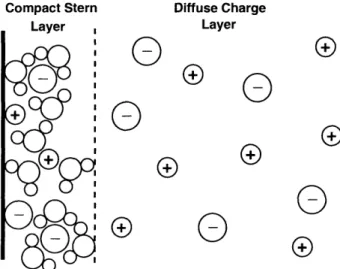
As discussed in Chapter 1, local charge neutrality always breaks down in the double layers that form at electrode-electrolyte interfaces (see Figure 2-1). Helmholtz first proposed
Diffuse Charge Layer
Q
0
o 0
000
Figure 2-1: Schematic diagram of the structure of the double layer. Immedi-ately adjacent to the electrode is the compact Stern layer which is composed of specifically adsorbed ions (possibly with their solvation structure) or sur-face contaminants. The ions in this layer are mainly restricted to motion within the compact layer. Further away from the electrode is the diffuse charge layer where ions move freely through the solution.
a very simple model for the double layer treating it as a linear capacitor [53]. While this crude model fails to account for several key features of the double layer, it plays an important role within the Gouy-Chapman-Stern (GCS) model that is commonly used within the electrochernical community [5]. Later Gouy [42] and Chapman [21] developed a theory, confirmed experimentally by Grahame [44, 45], that provides a description of the diffuse part of the double layer (i.e., the region of the double layer composed charged ions free to
CHAPTER 2. MATHEMATICAL MODEL
move around). A full theoretical understanding of the Stern layer (i.e., compact part of the double layer) is much more challenging and is still an area of active research [50, 51].
To make progress, we use a simple model of the Stern layer based on realistic prop-erties of the interface. Neglecting the specific adsorption of anions, the Stern layer acts as a nonlinear capacitor in series with the diffuse layer. Grahame's celebrated electrocap-illary measurements [44, 45] suggest that (i) the Stern layer capacitance, Cs, is roughly independent of concentration, depending mainly on the (variable) total charge, a,
d(A/\I) _ 1 (2.26)
da Cs(a)'
and (ii) dilute solution theory accurately describes the capacitance, CD(a, Co, CR), of the diffuse layer, at least when the charge and current are small enough to be well-described by Poisson-Boltzmann theory (discussed in Section 5.3.1). Using Gauss' law, the surface charge density can be expressed in terms of the normal electric field at the outer edge of the Stern layer, a = -s81/on, where es is an effective permittivity of the compact layer. Therefore, integrating (2.26), Grahame's model corresponds to the assumption,
-
fs=/dn
"Jo
do,
(2.27)
Cs(a)
which determines how the voltage across the compact layer (relative to the point of zero charge for which A1s = 0) varies as the two capacitors become charged. The function,
Cs(a), should be fit to experimental or theoretical electrocapillary curves at large
concen-trations (since 1/Ctotal
=1/CD + 1/CS
1/Cs in that case).
The simplest model that captures this interplay between the compact and diffuse layers is the Gouy-Chapman-Stern (GCS) model [5, 14], which assumes the capacitance of the compact layer, Cs, to be constant [106]. While more complicated models for the compact layer have been proposed [28, 69, 70], the Stern model makes it easy to describe surface capacitance easily in the context of our model of Faradaic reactions. Following Itskovich et
al. [57], Bonnefont et al. [12] and Bazant et al. [8], let us introduce an effective width, As,
for the compact layer, As = es/Cs, so that (2.27) reduces to a linear extrapolation of the
potential across the compact layer,
A = As (2.28)
Physically, the Stern layer, as an effective solvation shell for the electrode, is only a few molecules wide, so it is best to think of As as simply a measure of the capacitance of the Stern layer. More generally, the same boundary condition could also describe a thin dielectric layer on the electrode [1, 7, 104] (e.g., arising from surface contamination or a passivating monolayer). It is worth mentioning that because the GCS model neglects the dependence of the Stern layer capacitance on the surface charge density, it is most accurate at low concentrations and near the point of zero charge when the capacitance of the double layer is dominated by the effects of the diffuse layer.
In this thesis, we shall model the double layer using the GCS model. Because our goal is a model that describes surface capacitance and Faradaic reactions in a simple manner, the GCS model is perfect for our purposes. To complete the derivation of the boundary conditions for the electric potential, we substitute (2.28) into (2.25) to obtain a mixed Dirichlet-Neurnann boundary condition
'Celectrode
= ' + As
an,
-.
'
(2.29)
2.3.4
Simple Boundary Conditions
The PNP equations have been studied in many contexts with simpler boundary conditions
substituted for the reaction (2.10)-(2.11) and Stern boundary conditions (2.29). For
exam-ple, it is not uncommon to neglect the Stern layer capacitance so that the Stern boundary
condition (2.29) reduces to a Dirichlet boundary condition on the electric potential [86]. Similarly, in te field of colloid science, the reaction boundary conditions are replaced by a constant surface charge (or zeta potential) which leads to a simple boundary condition on the electric field. Other important examples include transport in ion channels [3, 4, 87] and electrodialysis [95, 97, 98] where simple Dirichlet boundary conditions on both the