Automating Modular Program Verification by
Refining Specifications
by
Mana Taghdiri
Submitted to the Department of Electrical Engineering and Computer
Science
in partial fulfillment of the requirements for the degree of
Doctor of Philosophy
at the
MASSACHUSETTS INSTITUTE OF TECHNOLOGY
February 2008
@
Massachusetts Institute of Technology 2008. All rights reserved.
A uthor ...
Department of Electrical Engineering and Computer Science
December 2007
Certified by ...
,-D--i-TN.
Jackson
Professor of Electrical Engineering and Computer Science
Thesis Supervisor
Terry P. Orlando
Accepted by...
MASSACHUSELTS INSTITUTEOF TEGHNOLOGY
APR
0 7 2008
LIBRARIES
Chairman, Department Committee on Graduate Students
Automating Modular Program Verification by Refining
Specifications
by
Mana Taghdiri
Submitted to the Department of Electrical Engineering and Computer Science on December 2007, in partial fulfillment of the
requirements for the degree of Doctor of Philosophy
Abstract
Modular analyses of software systems rely on the specifications of the analyzed mod-ules. In many analysis techniques (e.g. ESC/Java), the specifications have to be provided by users. This puts a considerable burden on users and thus limits the applicability of such techniques. To avoid this problem, some modular analysis tech-niques automatically extract module summaries that capture specific aspects of the modules' behaviors. However, such summaries are only useful in checking a restricted class of properties.
We describe a static modular analysis that automatically extracts procedure spec-ifications in order to check heap-manipulating programs against rich data structure properties. Extracted specifications are context-dependent; their precision depends on both the property being checked, and the calling context in which they are used. Starting from a rough over-approximation of the behavior of each call site, our anal-ysis computes an abstraction of the procedure being analyzed and checks it against the property. Specifications are further refined, as needed, in response to spurious counterexamples. The analysis terminates when either the property has been vali-dated (with respect to a finite domain), or a non-spurious counterexample has been found.
Furthermore, we describe a lightweight static technique to extract specifications of heap-manipulating procedures. These specifications neither are context-dependent, nor require any domain finitizations. They summarize the general behavior of proce-dures in terms of their effect on program state. They bound the values of all variables and fields in the post-state of the procedure by relational expressions in terms of their values in the pre-state. The analysis maintains both upper and lower bounds so that in some cases an exact result can be obtained.
Thesis Supervisor: Daniel N. Jackson
Acknowledgments
I would like to thank my advisor Professor Daniel Jackson not only for his invaluable technical guidance on this project over the past few years, but also for his patience, encouragement, and enthusiasm that made the task of preparing talks and papers enjoyable. I also thank my thesis committee members Professor Martin Rinard and Professor Srini Devadas for their helpful comments.
I thank my friends at MIT, Emina Torlak, Robert Seater, Gregory Dennis, Felix Chang, Jonathan Edwards, Derek Rayside, Sarfraz Khurshid, Ilya Shlyakhter, Manu Sridharan, Tina Nolte, Viktor Kuncak, Alexandru Salcianu, and Mandana Vaziri, who made my graduate studies a wonderful academic and social experience. I spe-cially thank Emina Torlak for her insights on the Alloy modeling language, and her implementation of Kodkod, the most efficient Alloy model finder currently available. I thank Gregory Dennis for many useful discussions about checking Java code, and for providing me with his tool Forge. I thank Mandana Vaziri for providing me with Jalloy, a Java bug finder that made it possible for me to evaluate my ideas at the very early stages. I thank Robert Seater, Viktor Kuncak, and Alexandru Salcianu for their valuable comments on my procedure summarization technique.
But above all, I would like to thank my family: my parents Afsaneh and Hossein, and my sisters Shiva and Sara, who always encouraged me to learn and supported me with love throughout my life, and my husband Mehdi, for all his love, patience, encouragement, and support without which this thesis would have never been possible. This thesis is dedicated to my family.
Contents
1 Introduction
1.1 Problem Description
1.1.1 Automating Modular Program Verification . 1.1.2 Existing Approaches . . . .... 1.2 Proposed Solution ... 1.2.1 Specification Refinement ... 1.2.2 Instantiation: Karun . ... 1.2.3 Limitations ... ... 1.3 Exam ple ... 1.3.1 User Experience . ... 1.3.2 Underlying Analysis . ... 1.4 Evaluation ... 1.5 Contributions . ... 1.6 Thesis Organization ...
2 Method
2.1 Overview ... 2.2 Definitions ... 2.3 Input Functions ... 2.4 Computed Functions . 2.5 Input Functions Properties 2.6 Algorithm ...2.7 Properties ...
17
2.7.1 Termination 2.7.2 Completeness
2.7.3 Soundness ...
3 Context
3.1 Programming Language: Java 3.2 Specification Language: Alloy
3.2.1 Declarations ... 3.2.2 Expressions ... 3.2.3 Formulas ... 3.2.4 Auxiliary Constraints . 3.2.5 Examples ... 3.3 Bounds ...
4 Extracting Initial Specifications 4.1 Overview ... 4.2 Logic... 4.3 Examples . . . . 4.4 Abstraction Technique . ... 4.4.1 Definitions... 4.4.2 Transfer Function . . . 4.4.3 Simplifications ... 4.5 Properties . ... 4.5.1 Safety ... 4.5.2 Termination ... 4.5.3 Complexity ... 4.6 Optimization ...
5 Checking Abstract Programs: Forge 5.1 Overview ...
127 . . . . . . . 127 5.2 Translating Java to Alloy . .
. . . . . 7 5 . . . . . 7 6 89 .. . 89 .. . 92 94 99 99 103 110 112 112 123 123 125 . • . .• • • • . . . .. . . . • • • . .• . . . . . . . . . . . . . . . . . . . . .• • . . . ..
. . . .
S. . . . . . . . . . . . . . . . . . . . . . . . . . 1295.2.1 Encoding Basic Statements . . . . 5.2.2 Encoding Call Site Specifications . . . . 5.2.3 Example ...
5.3 Generating Relation Bounds ... . . 5.4 Solving Alloy Formulas: Kodkod ... .. 6 Refining Specifications
6.1 Validity Checking of Counterexamples . . . . . 6.1.1 Interpretation of a Counterexample . . . 6.1.2 Checking Call Sites . ...
6.2 Specification Refinement . ... . . 6.2.1 Generating Small Unsatisfiability Proofs 6.2.2 Example ... . . . . 7 Experiments 7.1 Overview. ... 7.2 Case Studies ... 7.2.1 Quartz API ... 7.2.2 OpenJGraph API .... 7.2.3 Discussions ... 7.3 Evaluating Performance .... 7.4 Evaluating Initial Summaries
7.4.1 Accuracy ... 7.4.2 Effectiveness ... 8 Conclusion 8.1 Summary ... 8.2 Related Work ... 8.2.1 Underlying Ideas . . . . 8.2.2 Overall Goal ... 8.3 Discussion ... . . . . . 130 . . . . . 133 ... 138 . . . . . 141 . . . . . 142 145 145 146 151 154 155 158 161 . . . . 16 1 . . . . 163 . . . . 167 . . . . 172 . . . . 173 . . . . 174 . . . . 176 . . . . 177 . . . 18 1 185 .. ... 185 ... 187 . . . . . 187 . . . . . 193 ... 200
8.3.1 Merits . ... ... . . . .... 200 8.3.2 Limitations . ... ... . . . .... 202 8.3.3 Future Directions ... .... 203
List of Figures
1-1 Exam ple. . . . .. . . . 30
1-2 Properties: (a) the resulting order of nodes is a permutation of the original nodes of the graph, (b) the in-degree of each node is smaller than the number of nodes preceding it in the topological sort, (c) the representation invariants ... 32
1-3 Counterexample: (a) textual description, (b) pre-state heap, (c) corre-sponding graph ... 34
1-4 Program execution corresponding to the counterexample. Executed statements are given in bold. Called methods are expanded below call sites. Program states before and after the execution, and the state updates after each executed statement are also given. ... 35
1-5 Initial specifications. ... 37
1-6 Final specification for fixIns. ... . . . . . ... 38
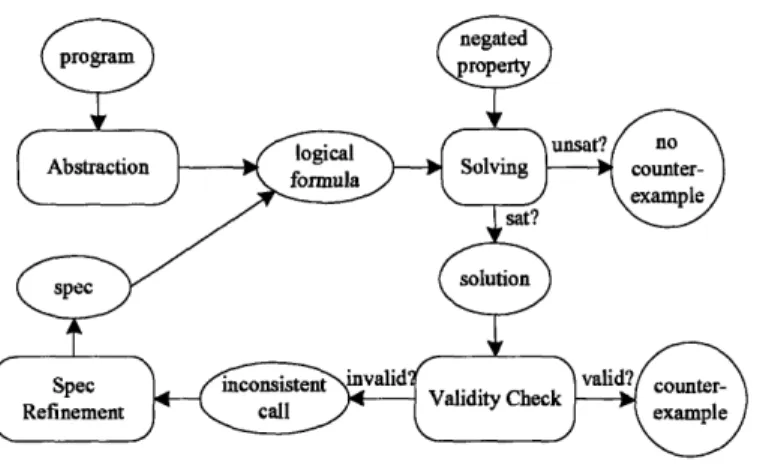
2-1 An overview of the framework. ... ... ... . 46
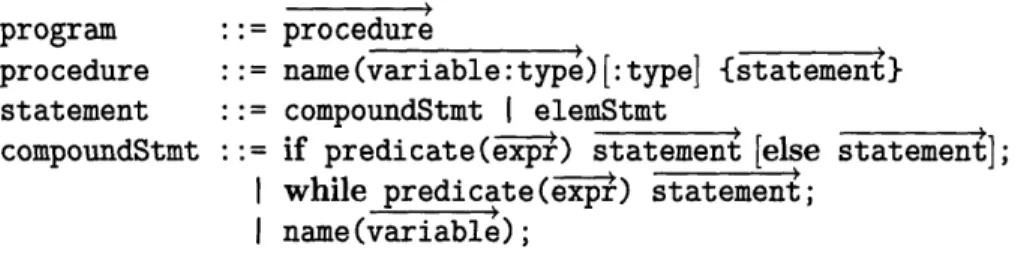
2-2 Abstract syntax for the analyzed language. ... 47
2-3 Example: an xor operation. ... 48
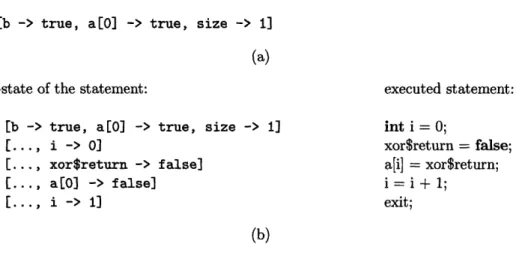
2-4 Example: (a) an initial program state, (b) the corresponding trace: each line gives an executed statement and the state before the execution of that statement ... 49
2-6 Translation example: (a) initial variable and value mappings, (b) the transformed xorAll method, (c) Variable mappings after translating each statement, and (d) the translation of statements to a boolean
form ula . . . .. . . .... 54
2-7 Examples of initial specification: (a) the xor method and its pre-state mappings, (b) first specification and the post-state variable mapping, (c) second specification and the post-state variable mapping ... . 58
2-8 An example of converting states to instances and vice versa. ... 59
2-9 An example of extracting traces from instances: (a) initial variable and value mappings and the instance, (b) the xorAll method, (c) variable mappings used to compute the trace of each statement, and (d) the generated trace ... .. . .. . .. . .. . ... . .. . ... ... . .. 64
2-10 Abstraction example: (a) initial variable and value mappings, (b) the unrolled xorAll method, (c) variable mappings after abstracting each statement, and (d) the abstraction of statements as a boolean formula. 65 2-11 An example of extracting calls from an instance. . ... . 68
2-12 Analysis by procedure abstraction ... .. 71
2-13 An illustration of the analysis: (a) the xorAll method and its prop-erty of interest, (b) initial and final mappings involved in the abstrac-tion, (c) the encoded property, (d) the found instance, (e) the call site invoked by the instance, and its pre-state variable mapping, (f) the translation of the call to the xor method, (g) inferred specification. 74 2-14 Analysis without abstraction. . ... ... 75
3-1 Program statements. ... . ... 80
3-2 Syntax of the Alloy logic .. . . . ... ... . 81
4-1 Syntax of summaries. . ... ... 93
4-2 Declaration part of the example in Chapter 1. ... ... . 94
4-3 Simple update and read statements. . ... 95
4-5 Initializing. ... ... 97
4-6 Integer arithmetic. ... 97
4-7 Searching a list ... ... .... ... 98
4-8 Widening rules ... ... 101
4-9 Auxiliary functions to evaluate program expressions in an environment. 104 4-10 The auxiliary function to add loop conditions to loop variables. . . 109
4-11 The simplification rules used. The function type(e) denotes the relation corresponding to the type of an expression e. The expressions Xnew and xpre represent the cases where x is a newly allocated symbolic object and where it belongs to the pre-state, respectively. A name with no subscript may be either. . ... .. 111
4-12 Relation between concrete states and abstract states . ... 112
4-13 (a) The definition of F: an operational semantics on a concrete state c E C. The first rule lifts the semantics to a set of concrete states C* C C. (b) The auxiliary function evaF(e, c) evaluates an expression e on a concrete state c... 114
5-1 Forge architecture: the gray box shows Forge internal processes. .... 128
5-2 Initial specifications of the called procedures. . ... 138
5-3 Translation example: (a) code with loop unrolled once, (b) Alloy en-coding (c) generated constraints. . ... . ... ... ... 140
6-1 Initial specifications. ... 146
6-2 Topological sort example: (a) Java code with 2 loop unrollings, (b) allocated Alloy relations ... 147
6-3 Counterexample: (a) textual description, (b) pre-state heap, (c) corre-sponding graph ... 149
6-4 Program execution corresponding to the counterexample. ... 150
6-5 The fixIns method: (a) code after two loop unrollings, (b) Alloy encoding and call site constraints, (c) pre- and post-state values . . . 153
7-1 Specifications used for the Set data structure. . ... . . 164
7-2 Specifications used for the Map data structure. . ... 166
7-3 An example of (a) an informal comment, and (b) its corresponding formalization in Alloy. ... 168
7-4 The first buggy method found ... ... 170
7-5 The second buggy method found. . ... . 171
List of Tables
7.1 A sampling of the properties analyzed in Quartz, their bounds, and
analysis time. ... 169
7.2 A sampling of the properties checked in OpenJGraph. ... . 173
7.3 Experimental results: performance evaluation. . ... . . 175
7.4 Partial specifications checked in graph procedures. . ... . . 180
7.5 Experimental results: comparing abstract interpretation to frame con-ditions .. . . . . 182
Chapter 1
Introduction
As software systems grow in size and complexity, using conventional techniques such as testing to validate their behavior becomes prohibitively expensive: a large number of carefully designed test cases is required to uncover their errors. Thus develop-ing easy-to-use automatic techniques to increase programmers' confidence in their developed software systems becomes a pressing issue.
Static program verification is one of the main approaches to reasoning about the
behavior of a program, in which a program is analyzed using only the information available from the text of the program; no actual execution of the code is involved. Therefore, the code can be analyzed conservatively so that the obtained results ac-count for all executions of the program within the analyzed domain.
Static program verification techniques check if a given program conforms to an intended property. Ideally, the property can be a specification describing the complete functionality of the program: what exactly the code is supposed to do. However, since checking an arbitrary piece of code with respect to an arbitrary specification is an undecidable problem, each program verification technique makes a trade-off between the expressiveness of the specification language it handles and its level of automation. Type checkers, for example, are fully automatic but they only check a very restricted class of properties, namely whether the use of variables and procedures conform to their declarations. On the other hand, theorem provers can handle very rich specification languages, but they require guidance from the users.
This thesis introduces a novel program verification technique that automatically checks programs against rich data structure properties. A data structure property constrains the structure of the objects in the heap of a program. Checking such prop-erties is particularly important because erroneous manipulations of data structures may cause loss and/or unauthorized access of data, and may eventually cause a wrong behavior in the program. Since data structures stored in the heap can get arbitrarily complex, it can be very hard to check their validity by traditional testing techniques. The analysis technique described in this thesis aims at minimizing the human cost: it does not require users to provide any annotations beyond the property to check. A procedure is checked against a property using the specifications of its called procedures as surrogates for their code. The specifications, however, are inferred automatically from the code rather than being provided by the user1. They are inferred iteratively as needed to check the given property. Therefore, their precision is context-dependent: they encode only as much information about their corresponding procedures as is necessary to check the top-level procedure against the given property.
The thesis also introduces a lightweight static technique that automatically ex-tracts specifications for the procedures of a program. These specifications are not context-dependent: they summarize the general behavior of the procedures in terms of their effect on program state. The technique can handle heap-manipulating code accessing complex data structures. Although used as part of our program verifica-tion technique in this thesis, this specificaverifica-tion extracverifica-tion technique is a stand-alone analysis that can be used in a variety of settings.
1.1
Problem Description
1.1.1
Automating Modular Program Verification
Checking data structure properties is a challenging problem. It requires a reasoning engine capable of handling aliasing (whether different pointers point to the same
1The specifications that we infer play the role of summaries in traditional analyses, but we prefer to call them specifications to emphasize their partial nature.
object in the heap), and reachability (whether an object is reachable from another object by traversing the fields). It also requires handling different notions that may arise in different kinds of data structures. For example, properties of a 'set' data structure typically involve membership and the cardinality of the set, a 'map' data structure requires the notion of a relationship between values and their keys, and a 'list' structure involves an ordering of elements.
Data structure properties arise in heap-manipulating programs: programs whose state can be represented as a graph of objects linked by fields. These programs typi-cally include dynamic features like dynamic object allocation and dynamic dispatch which make them particularly hard to analyze statically.
Due to the complexity of heap-manipulating programs and their behavioral prop-erties, monolithic approaches, where the code is treated as a whole regardless of its modularization, are not practical: they cannot handle large enough programs. Therefore, traditional program verification approaches made extensive use of program structure in structuring the reasoning. Each procedure would be checked against its specification, using the specifications of its called procedures as surrogates for their code. This analysis, called modular program verification (28], is usually performed bottom-up in the call tree using the assume-guarantee framework: assuming that the called procedures satisfy their specifications, it is checked if the analyzed procedure guarantees its specification. This approach is attractive because (1) the modular-ization of the code provides natural abstraction boundaries that can be exploited in reasoning about the behavior of a program, and (2) each procedure is analyzed exactly once, thus providing better scalability.
Automating modular approaches involves solving two problems: (1) given the specifications of all called procedures, how to check a top-level procedure automati-cally, and (2) how to extract the specifications of the called procedures automatically from the code. One of the main approaches to solving the first problem, i.e. to au-tomating the checking, is to translate the code along with the analyzed property to a set of logical constraints and present it for proof or refutation to a decision procedure. This approach forms the basis of several tools that verify data structure properties
of code (e.g. [5,14,21,35,37,58]). None of them, however, automates the specifica-tion extracspecifica-tion phase; they all assume that the specificaspecifica-tions of called procedures are provided by the user. Boogie [5], for example, extracts verification conditions from a procedure, and presents them for proof to a theorem prover. The tool has been incorporated into the Spec# programming system [6] and applied successfully to substantial programs. However, Boogie expects the user to provide specifications for all procedures that are called directly or indirectly by the analyzed procedure, which can become a considerable burden on the user. This thesis is built on the ideas of Jalloy [58], a counterexample detector for Java programs. Jalloy translates the code and the analyzed property to a boolean formula and solves it using a SAT solver. It inlines all procedure calls whose specifications are not provided by the user. The experiments, however, showed that such inlining does not scale and it is the main obstacle to using Jalloy for checking large systems.
This thesis introduces a strategy to overcome this obstacle. A modular analysis (similar to Jalloy's) is performed that is based on constraint solving and requires specifications of called procedures, but the specifications are inferred from the code rather than being provided by the user. Although in many cases, the inferred speci-fications are not so compact as they could be if provided by the user, they are small enough to be analyzed automatically.
Of course extracting a specification that summarizes the full observable behavior of a procedure as a logical constraint is not feasible in general. However, in order to check a procedure against a property, it is sufficient to capture only those aspects of the behavior of its callees that are relevant in the context of the calling procedure. Our inference scheme exploits this. In fact, the inferred specifications are sensitive not only to the calling context, but also to the property being checked. As a result, a very partial specification is sometimes sufficient, because even though it barely captures the behavior of the called procedure, it nevertheless captures enough to verify the caller with respect to the property of interest.
Since the specifications are extracted automatically from the code of the called procedures, they are guaranteed to be satisfied by those procedures. Therefore, if a
called procedure contains a bug that prevents the top-level procedure from satisfying the analyzed property, that bug will be carried in the inferred specifications and thus, will be uncovered by the analysis.
The analysis technique introduced in this thesis supports a rich specification lan-guage - a relational first order logic with transitive closure - sufficient for expressing rich data structure properties. The technique exploits partiality of properties. It pro-vides an effective analysis for checking partial properties of code. That is, rather than specifying the full functionality of a program, the analyzed property constrains only a portion of the program's behavior. This is motivated by the observation that the full behavior of a large software system is generally very expensive to check in one analysis. Instead, it can often be specified as several partial properties of the system that can be checked individually, allowing a much more scalable analysis.
In summary, the introduced analysis aims at supporting all the following features.
* Full Automation. We provide a fully automatic technique that does not require any user intervention to guide the analysis.
* No Annotations. In order to provide an easy-to-use technique, we do not rely on any user-provided annotations, except the top-level property to check.
* Scalability. We provide an analysis that can potentially scale to large pieces of code.
* Modularity. Although our goal is not to rely on user-provided annotations, our technique can benefit from such annotations whenever available. That is, a user can optimize the analysis of a program by providing specifications for some procedures. This becomes handy in analyzing code with calls to some procedures (e.g. from a library) whose source code is not available.
* Data Structure Properties. In spite of all the progress made in checking control-intensive properties of programs, only a few techniques are available to check rich data structure properties. We focus on analyzing properties that
express (partial) pre- and post-conditions for some procedure by constraining the configuration of the heap before and after the execution of that procedure.
1.1.2
Existing Approaches
Several static program verification techniques have been developed that support differ-ent subsets of the above features. However, to our knowledge, none of them provides a scalable analysis for checking the kind of rich data structure properties that we consider, without requiring extensive user-provided annotations.
SLAM [4] and BLAST [26], for example, provide scalable static analysis for C pro-grams without requiring user intervention or additional annotations. Their scalability is a result of applying a counterexample-guided abstraction refinement framework [11] that computes incremental abstractions of the program that are much simpler to check than the original code. Because the abstractions are computed iteratively, only as needed, the parts of the program that are irrelevant to the property being checked remain abstract during the course of the analysis. Although both tools have been successfully used to check the correctness of some substantial C programs, they fo-cus on analyzing control state transitions of the code (for example, an acquired lock should not be acquired again); they cannot handle the rich data structure properties that we consider.
Saturn [62] also provides a scalable technique for checking temporal safety prop-erties without requiring user-provided intermediate annotations. The scalability is a result of summarizing the called procedures in advance. Given a temporal safety property, Saturn efficiently computes summaries for all called procedures in the form of finite state machines during a pre-process. These summaries are then used in checking the selected procedure against the given property in a one-pass analysis. Saturn has been successfully used to detect memory leaks and erroneous sequences of locks and unlocks in the Linux kernel. However, again, it is highly-tuned for checking finite state properties, and cannot be used for analyzing data structure properties.
On the other hand, other tools are available that focus on checking data structure properties of programs. TVLA [51], for example, has been successfully used to verify
insertion sort and bubble sort [40] as well as some properties of lists and binary search trees [48]. It represents the heap as a graph in which the nodes represent objects and edges represent field relations. Since the graph can be arbitrarily large, they abstract it by merging all the nodes equivalent under a particular set of shape predicates into a single abstract node. Although the resulting abstract domain is finite, it may still become very large, and thus the approximating algorithms are too complex to scale to large programs. Furthermore, the precision of the analysis depends on the set of predicates of interest provided by the user.
Hob [37], and Jahob [35] also focus on checking data structure properties. Hob provides a suite of theorem provers to check the verification conditions automatically generated from the code. It has been successfully used to verify a number of ap-plications (e.g. an HTTP server and an implementation of the minesweeper game). Its analysis process, however, depends on user-provided procedure specifications and loop invariants. Hob assumes a simplified object-oriented language with no inher-itance and polymorphism, and only handles set-based data structure properties
-those that can be expressed by the boolean algebra of sets. Therefore, although it can handle properties about the contents of data structures (e.g. exposed cells are disjoint from mined cells in a minesweeper game), it does not handle, for example, those involving relationships between objects (e.g. whether a key object is linked to a value in a map data structure), or orderings of objects (e.g. in a list data structure). Jahob is a successor of Hob that handles a richer programming language as well as richer specifications. But it still requires user-provided procedure specifications and loop invariants in order to generate verification conditions from programs.
Inferring the behavior of procedures automatically is not a new concept. Interpro-cedural data flow analysis techniques, in particular, typically summarize the behavior of the called procedures in order to extract different pieces of information about a top level procedure. Points-to analysis [9,50, 61], for example, computes the set of objects that a pointer can possibly point to in different executions of the code. A procedure summary in this case consists of the pointer information of a procedure. Side-effect analysis [10, 43, 52] is another example of data flow analysis that detects
what heap locations may be mutated by each procedure. This information can be stored as a procedure's summary and be reused at the call sites. While such sum-marization improves the analysis by preventing it from computing the behavior of a called procedure at every call site, it is applied to extract only certain information from the code. That is, such procedure summaries are not sufficient for checking arbitrary data structure properties of the procedures.
1.2
Proposed Solution
Modularization of a program into procedures provides natural abstraction boundaries that make reasoning about the program's behavior much easier. We introduce a fully automatic technique that exploits the modularity of the code in order to provide a modular analysis. That is, a procedure is checked against a given property by substituting specifications for its called procedures.
However, rather than being provided by the user, the specifications are inferred from the code automatically. These specifications are exploited in checking like the specifications of Boogie, but are refined by a mechanism more similar to that of SLAM and BLAST.
1.2.1
Specification Refinement
The fundamental idea underlying our technique is a familiar one: counterexample-guided refinement of an abstraction [11]. The general scheme is as follows:
1. For a program P, generate an abstraction A(P) that overapproximates P.
2. Check if the property holds in A(P). If no counterexample is found, the analysis terminates and has successfully verified the code (against the given property). 3. If a counterexample is found, it is checked for validity. If it is valid, a fault has
4. Otherwise, the abstraction A(P) is refined so that the invalid counterexample is eliminated. The process then starts over at step 2.
This scheme provides a fully automatic analysis that holds promise for scalability. It has been previously applied in a number of different contexts [4, 19, 20, 26]. Our approach, however, differs from all the previous work in that the abstraction and its subsequent refinements follow the abstraction boundaries of the code itself. To our knowledge, all previous applications of this idea to software analysis involve refinement of predicate abstractions [25]. Our approach, in contrast, refines the specifications used to represent the behavior of called procedures.
We introduce a framework for counterexample-guided refinement of procedure specifications. It starts with a rough initial specification for each called procedure and refines it on demand in response to spurious counterexamples. The framework assumes an underlying analysis in which counterexamples are found by solving a logi-cal formula extracted from the code and the property. The property can be expressed in any language that can be converted to logical constraints. The validity of the found counterexamples are checked again using a constraint solver, and specifications are refined based on the proof of unsatisfiability generated by the solver when the coun-terexample is invalid. The framework requires the logic to be decidable. That is, the validity of the logical formulas can be determined in finite time. Our implementation uses the propositional logic underlying the Alloy modeling language [30] as the logic,
and a SAT solver as the constraint solver.
The analysis can start with arbitrarily weak initial specifications. Even empty specifications that allow the procedures to arbitrarily mutate the state of the program can be used in the initial abstraction. However, starting from richer specifications usually reduces the number of refinements needed to check the property, and thus improves the performance.
The main challenge in computing the initial abstraction is to extract specifications that are safe - that is, accounting for all possible executions of the code - and compact
- that is, easy to analyze - and yet not too approximate - that is, giving useful information about the underlying code.
We introduce a lightweight technique for extracting an initial specification for a procedure, that computes symbolic bounds on the final values of each field and variable that may be mutated by that procedure. The specifications inferred by this technique do not depend on the property being checked; they give general abstractions of a procedure's behavior that can be used in any context.
This initial specification extraction technique is an application of the abstract interpretation framework [13] in which the abstract domain consists of relational ex-pressions. A procedure is evaluated symbolically, with each field and variable initially holding a value represented by a fresh constant. Each statement updates an envi-ronment mapping fields and variables to values represented as relational expressions. After an if-statement, the branches are merged by forming a union expression. A loop is handled by computing a fixpoint which often results in an expression involving a transitive closure. The analysis maintains both upper and lower bounds on the values of variables and fields, so that in some cases an exact result can be obtained.
1.2.2
Instantiation: Karun
We have implemented our specification abstraction refinement technique in a tool called Karun. It checks an object-oriented program written in a subset of Java against a property expressed in Alloy [30].
Alloy is a first order relational logic with a transitive closure operator, making it well-suited for expressing data structure properties succinctly. A constraint on the heap of an object-oriented program can be expressed in Alloy by adopting a
relational view of the heap: a field f of type T declared in a class C is viewed as a
relation f: C -> T mapping objects of type C to objects of type T. Field dereferencing becomes relational join, and reachability becomes a formula involving a transitive closure.
The specifications inferred during the course of the analysis are also expressed in Alloy. The initial abstraction computes symbolic bounds on the final values of each relation (fields and variables) in the form of Alloy relational expressions. Karun translates the given code, the extracted specifications, and the negation of the
prop-erty being checked to a boolean formula in conjunctive normal form (CNF) using Forge [14]. It then uses the ZChaff SAT Solver [45] to find a solution to the gener-ated formula. The validity of the found solutions is checked using ZChaff again. If a solution represents an invalid counterexample, ZChaff generates a proof of unsatisfia-bility called an unsat core [63] which is an unsatisfiable subset of the solved formula, given as a witness to the unsatisfiability of that formula. The unsat core is then used to generate a refined Alloy specification for a procedure call so that the invalid counterexample is eliminated. It should be noted that Karun is not restricted to use ZChaff; any other SAT solver that provides a proof of unsatisfiability for unsatisfiable formulas can be used as its solving engine.
In order to translate Java programs to finite boolean formulas, Forge finitizes the length of the program executions. That is, it unrolls loops using some user-provided bound. Furthermore, since Alloy is a first order logic, translation of an Alloy con-straint to a boolean formula is based on bounding the size of the relations in that Alloy constraint. Therefore, the analysis also requires a bound on the number of objects of each datatype. Consequently, Karun analyzes programs with respect to a bounded scope: the user has to provide a bound on the number of loop iterations, and some bounds on the size of the heap. As a result, although the returned counterex-amples are guaranteed not to be spurious, their absence does not constitute proof of correctness.
1.2.3
Limitations
Our analysis framework is not designed for checking full specifications of programs. Given a property, our context-dependent analysis extracts those parts of the called procedures that are relevant to the property; all irrelevant parts remain abstract. Therefore, this analysis is most beneficial when only a subset of the code has to be analyzed. Although the technique can be used to check the full behavior of .a program, it may require several specification refinements to infer the full behavior of all procedures, and thus the benefit of the approach may be lost. A simple analysis that checks the whole code without iterations (e.g. by inlining all called procedures)
may in fact perform better in such cases.
Although not inherent in the analysis framework, our instantiation of the frame-work, Karun, has a few limitations. The most important one is that it does not per-form a complete analysis. That is, it misses those bugs in the program that require more loop iterations and/or objects than the bounds considered during the analysis. However, the analysis is exhaustive with respect to those bounds. That is, any bugs within the bounds are guaranteed to be found by Karun. Therefore, although Karun does not perform a complete verification, its analysis can be categorized as bounded
verification.
Furthermore, Karun currently handles only a subset of the Java language, includ-ing basic statements, inheritance, and dynamic dispatch; it does not support arrays, exceptions, multithreading, and any numerical expressions other than integer addi-tions and subtracaddi-tions. One-dimensional arrays, excepaddi-tions, and full integer arith-metic have been recently added to the Forge language and will be incorporated into Karun in the future. However, multi-dimensional arrays, multithreading constructs, and non-integer numerical expressions remain topics for future research.
Regarding properties, Karun handles the full Alloy language. Thus, any constraint expressible in Alloy can be analyzed by Karun. However, there are certain properties that cannot be expressed in Alloy, and thus checked by Karun. A functional correct-ness property that requires higher-order quantification is an example. To illustrate this, consider a method that takes a linked list and makes it "well-formed" (based on some definition of well-formedness) by updating the next fields of its entries. We can check that the method is correct by analyzing the property wellFormed(next') where next' is the resulting next link in the post-state. However, if we would like to check that the modified list is the closest well-formed list to the original one (based on some definition of distance), we should analyze the following property:
wellFormed(next') and
all nextO: Entry -> Entry I wellFormed(nextO) =>
This property, however, requires support for higher-order quantification because of the quantifier over the relation nextO. Therefore, it cannot be analyzed by Karun. There are also some categories of constraints, e.g. liveness, time-based, and perfor-mance properties, that cannot be analyzed using Alloy; checking them would require a different kind of logic.
1.3
Example
In this section, we illustrate our technique by first describing the user's experience checking the Java code given in Figure 1-1, and then describing the underlying analysis briefly.
The code is an implementation of a topological sort algorithm on a directed graph. The graph is represented by a list of nodes where each node contains two adjacency lists corresponding to its incoming and outgoing edges (stored in the inNodesList and outNodesList fields, respectively). The sizes of these lists are given by the inDeg and outDeg fields.
The topologicalSort method permutes the nodes of a graph to form an order in which any node n succeeds all the nodes that have an edge going to n. The algorithm is a simple one: it iteratively chooses a source node, i.e. a node with no incoming edges, and removes its outgoing edges from the list of the incoming edges of the remaining nodes. However, to avoid mutating the adjacency lists in the original graph, this example uses an auxiliary field, visitedInsNum, that keeps track of the number of nodes from the inNodesList that have been already put in the topological sort. A node is declared as a source node when all the nodes in its inNodesList are already visited. That is, inDeg == visitedInsNum. The topologicalSort method returns true if the graph is acyclic and the topological sort is computed successfully. If the graph contains a cycle, at some point during the algorithm, no source nodes can be found. The method returns false in this case.
We analyze the topologicalSort method against the properties given in Figure 1-2. The first property, given in Figure 1-2(a), specifies that if the algorithm terminates
class List { ListEntry head;
}
class ListEntry { Node node; ListEntry next; ListEntry prev;}
class Node { List inNodesList; List outNodesList; int inDeg; int outDeg; int visitedInsNum;}
class Graph { List nodes; boolean topologicalSort() { boolean isAcyclic = true; init();ListEntry cur = nodes.head; while (cur != null) {
ListEntry source = findSource(cur); if (source == null) {
isAcyclic = false; break; fixIns(source.node); Node tmp = source.node; source.node = cur.node; cur.node = tmp; cur = cur.next; return isAcyclic; void Graph.init() { ListEntry c = this.nodes.head; while (c != null) { c.node.visitedInsNum = 0; c = c.next;
ListEntry Graph.findSource(ListEntry entry) { ListEntry e = entry;
while ((e != null) &&
(e.node.inDeg != e.node.visitedlnsNum)) e = e.next; return e;
}
void Graph.fixlns(Node n) { ListEntry p =n.outNodesList.head; while (p != null) { p.node.visitedInsNum p.node.visitedlnsNum + 1; p = p.next; Figure 1-1: Example.successfully (i.e. when the method returns true), the computed topological sort is in fact a permutation of the nodes of the original graph. The second property, given in Figure 1-2(b), states that if the algorithm terminates successfully, the in-degree of each node is at most equal to the number of nodes preceding it in the computed topological order. We use primed and unprimed field names to denote the values of the fields after and before the execution of the method, respectively.
To ensure the consistency of the data stored in different data structures, the properties enforce the representation invariants given in Figure 1-2(c). The invariants specify that: (1) the graph does not contain any hyper-edges, i.e. none of the nodes in the graph has more than one outgoing edge to any other node, (2) the inDeg field of each node gives the number of nodes in its inNodesList, (3) the outDeg field gives the number of nodes in the outNodesList of each node, (4) if a node ni is in the inNodesList of a node n2, then n2 should be in the outNodesList of ni, and (5) the prev link must be the inverse of the next link. The auxiliary value contents represents the set of the nodes stored in a list, obtained by the expression head.*next. node which gives the node field of all the entries reachable from the head of the list by following the next link. (The operator '*' is a transitive closure operator that represents reachability.) Constraints within a pair of curly braces are implicitly conjoined.
In order to perform the analysis, the user has to provide two types of bounds: a bound on the number of loop iterations, and a bound on the heap size. In this example, we analyze the code with respect to 2 loop unrollings, 2 objects of each type, and a maximum bitwidth of 3 for integers.
1.3.1
User Experience
Valid properties: Both the permutation and the in-degree properties hold in the code given in Figure 1-1. Therefore, checking the topologicalSort method against these properties does not generate any counterexamples, implying that the property holds within the analyzed bounds.
((repInv = true$rel) and (topologicalSort$return = true$rel)) => (this.nodes'.head'.*next'.node' = this.nodes.head.*next.node)
permutation property (a)
((repInv = true$rel) and (topologicalSort$return = true$rel)) =>
(all e: this.nodes'.head'.*next' I int(e.node'.inDeg) < size(e.*prev')) in_degree property
(b)
repInv =
let contents = head.*next.node in {
(all n:this.nodes.contents I all el, e2: n.outNodesList.head.*next I
(el != e2) => (el.node != e2.node)) no hyperedge
(all n: Node I
n. inDeg = size(n.inNodesList. contents)) correct in-degree
(all n: Node I
n.outDeg = size(n.outNodesList contents)) correct outLdegree
(all ni, n2: Node I
(nl in n2.inNodesList.contents) <=> (n2 in nl.outNodesList.contents)) consistent adjacency lists (all el, e2: ListEntry I
(el.next = e2) <=> (e2.prev = el)) consistent links
}
(c)
Figure 1-2: Properties: (a) the resulting order of nodes is a permutation of the original nodes of the graph, (b) the in-degree of each node is smaller than the number of nodes preceding it in the topological sort, (c) the representation invariants.
generated. In order to illustrate that, we seed a bug in the code of Figure 1-1: we assume that the first statement of the init method is mistakenly written as c = nodes.head.next rather than c = nodes.head. The in-degree property does not hold any more, and the counterexample given in Figure 1-3 is generated. It should be noted that although the bug is in a called method, because it prevents the top level method from satisfying the property, it can be caught by our technique. Our tool currently outputs counterexamples in a textual format similar to the one shown in Figure 1-3(a). It can be further improved to generate a graphical output as shown in Figure 1-3(b) and highlight the program statements executed in the error trace as shown in Figure 1-4.
Figure 1-3(a) shows the values of the program variables and fields in the pre- and post-states. The value GO is a symbolic graph object representing the receiver graph. The values LO, EO, and NO are symbolic objects of types List, ListEntry, and Node, respectively. The pre-state encodes the heap given in Figure 1-3(b), and corresponds to the graph of Figure 1-3(c).
The values stored in the post-state are the same as those in the pre-state ex-cept for NO.visitedInsNum. The post-state violates the in-degree property be-cause EO.node.inDeg is the integer 1, but the size(EO.*prev) is 0. Therefore, the constraint int(EO.node.inDeg) < size(EO.*prev) evaluates to false. In fact, the topologicalSort method should not even return true in this case because the input graph contains a cycle. However, because of the bug in the init method, it returns true.
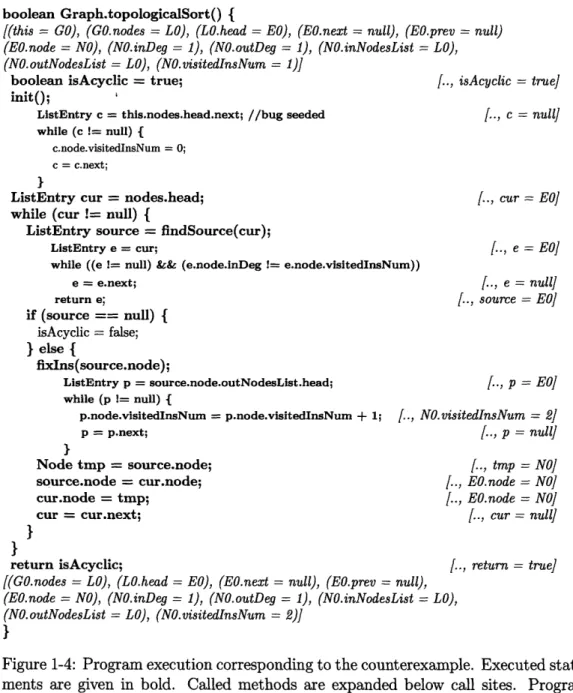
Figure 1-4 gives the program execution corresponding to this counterexample. The statements given in bold represent the executed statements. They are annotated by the values of the variables and fields before and after their execution. To simplify the representation, instead of showing the values of all variables and fields at each point, this figure only gives the updates after each statement. The executions of the called methods are shown by expanding the body of each called method as a block with a smaller font underneath its call site. Actual parameters are substituted for formal parameters. In this example, local variables of called procedures have unique
pre-state:
(this = GO) (GO.nodes = LO) (LO.head = EO) (EO.next = null) (EO.prev = null) (EO.node = NO) (NO.inDeg = 1) (NO.outDeg = 1)
(NO.outNodesList = LO) (NO.visitedInsNum = 1)
post-state:
(GO.nodes = LO) (LO.head = EO) (EO.next = null) (EO.node = NO) (NO.inDeg = 1) (NO.outDeg = 1) (NO.outNodesList = LO) (NO.visitedInsNum = 2)
(NO.inNodesList = LO) (EO.prev = null) (NO.inNodesList = LO) GO LO
noes
e
L J EOprev node next
null null
NO
inDeg outDe visitedlnsNum inNodesList outNodesList
1 1 11 1
1
1
1
No
(c)
Figure 1-3: Counterexample: (a) textual description, (b) pre-state heap, (c) corre-sponding graph.
boolean Graph.topologicalSort() {
[(this = GO), (GO.nodes = LO), (LO.head = EO), (EO.next = null), (EO.prev = null) (EO.node = NO), (NO.inDeg = 1), (NO.outDeg = 1), (NO.inNodesList = LO), (NO.outNodesList = LO), (NO.visitedInsNum = 1)]
boolean isAcyclic = true; [.., isAcyclic = true]
init();
ListEntry c = this.nodes.head.next; //bug seeded c.., C = null]
while (c != null) { c.node.visitedInsNum = 0;
c = c.next; }
ListEntry cur = nodes.head;
while (cur != null) {
ListEntry source = findSource(cur);
ListEntry e = cur;
while ((e != null) && (e.node.inDeg != e.node.visitedInsNum)) e = e.next; return e; if (source == null) { isAcyclic = false; } else { fixIns(source.node); ListEntry p = source.node.outNodesList.head; while (p != null) { p.node.visitedInsNum = p.node.visitedInsNum + 1; [., p = p.next; Node tmp = source.node; source.node = cur.node; cur.node = tmp; cur = cur.next; .., cur = EO] .., e = EO] [.., e = null] .., source = EO]
[.., p = EO]
NO.visitedlnsNum = 2] .., p = null] [.., tmp = NO] [.., EO.node = NO] /.., EO.node = NO] [., cur = null]}
return isAcyclic; /.., return = true]
[(GO.nodes = LO), (LO.head = EO), (EO.next = null), (EO.prev = null), (EO.node = NO), (NO.inDeg = 1), (NO.outDeg = 1), (NO.inNodesList = LO), (NO.outNodesList = LO), (NO.visitedInsNum = 2)]
}
Figure 1-4: Program execution corresponding to the counterexample. Executed state-ments are given in bold. Called methods are expanded below call sites. Program states before and after the execution, and the state updates after each executed statement are also given.
names, thus used directly. In an actual implementations, however, the names are preceded by unique scope identifiers to avoid name clashes. All loops are iterated at most once.
In the rest of this section, we describe analyzing the code given in Figure 1-1 where both properties hold. Analyzing the buggy case follows the same general steps, but infers different specifications.
1.3.2
Underlying Analysis
Our tool, Karun, analyzes the topologicalSort method against each property by inferring specifications for its call sites. Although at the end of the analysis, the inferred specifications are not necessarily complete, they encode sufficient information about the called procedures to check the property. When the analyzed property is partial, our approach, in general, performs substantially better than inlining the method calls. Checking the topologicalSort method against the in-degree property
(with respect to 3 loop unrollings, 3 objects of each type, and a maximum bitwidth of 4), for example, takes 47 seconds if the call sites are inlined. Karun, however, performs this analysis in 21 seconds. Similarly, checking this method against the permutation property (with respect to 4 loop unrollings, 4 objects of each type, and
a maximum bitwidth of 5) by inlining takes 51 seconds whereas Karun's analysis takes only 3 seconds. The rest of this section briefly describes how specifications are inferred, and illustrates the analysis for 2 loop unrollings, 2 objects of each type, and a bitwidth of 3 for integers.
The analysis starts by first computing initial specifications for the methods reach-able from the topologicalSort method. Figure 1-5 gives the computed specifica-tions. As mentioned before, these specifications do not depend on the property being checked. Chapter 4 explains in detail how they are computed automatically from the code, and what exactly they mean. Here we only give an, informal description. The specification computed for the init method is its full specification. It denotes that the init method changes the visitedInsNum field of all the nodes of the graph to zero. The initial specifications of fixIns and findSource, on the other hand, are
void Graph.init():
visitedInsNum' = visitedInsNum ++ (this.nodes.head.*next.node -> 0)
void Graph.fixIns(Node n):
visitedInsNum'C visitedInsNum + (n.outNodesList.head.*next.node -> Int) visitedInsNum' D visitedInsNum - (n.outNodesList.head.*next.node -> Int) ListEntry Graph.findSource(ListEntry entry):
findSource$return C (entry.*next &
(null + node.inDeg. (entry.*next.node.visitedInsNum))) findSource$return D none
Figure 1-5: Initial specifications.
approximate. The specification for fixIns specifies that given an argument node n, this method may change the visitedInsNum field of any node in the outNodesList of n to an arbitrary integer, and the specification for findSource specifies that this method can return any list entry reachable from the argument list entry entry, which is either null or its node has an inDeg field equal to the visitedInsNum field of some node in the entries reachable from entry.
Using these initial specifications, the analysis checks topologicalSort against the permutation property using a constraint solver. In this case, the solver does not find any counterexamples, meaning that the property holds in the abstract program, and thus, in the original program. Therefore, the analysis terminates and the property has been validated for this finite domain. The fact that analyzing this property does not require any specification refinements implies that the specifications that are initially extracted are accurate enough, i.e. they encode enough information about the called procedures, to validate this property.
However, checking the second property requires some specification refinements. Similar to checking the previous property, checking this property starts using the initial specifications given in Figure 1-5 for the called methods. In this case, the constraint solver finds a counterexample. But the counterexample is not valid in the original program due to an invalid state transition assigned to the first call to the fixIns method. Therefore, the specification for fixIns is refined. Chapter 6 describes in detail how a counterexample is checked for validity, and how the results
Graph.fixIns(n):
visitedInsNum' =
if (n.outNodesList.head != null$rel)
then if (n.outNodesList.head.next != null$rel) then visitedInsNum'
else visitedInsNum ++ (n.outNodesList.head.node ->
(int(n. outNodesList .head.node .visitedInsNum) + 1))
else visitedInsNum'
Figure 1-6: Final specification for fixIns.
of that check are used to refine the specifications.
As a result of this refinements, the specification given in Figure 1-6 is inferred. It specifies only a partial behavior of the fixIns method: if the outNodesList of the argument node n contains only one node (that is, (n. outNodesList. head != null) but (n.outNodesList.head.next = null)) then the visitedInsNum field of that node is incremented by one. In all other cases, the value of the visitedInsNum field is unconstrained.
Although the inferred specification is very partial, it is still sufficient to check the given property. That is, after conjoining this inferred specification with the previ-ous specification of the first call to fixIns, no further counterexamples are found. Therefore, the analysis terminates without further specification refinements, and the property has been validated in the analyzed domain.
As shown by this example, when checking partial properties of a program, we do not necessarily need the full specifications of all methods. For example, although the initial specifications of f ixIns and f indSource were very weak, they were still sufficient for checking the permutation property. The number of iterations that the analysis goes through totally depends on the property: the permutation property, for example, was validated with only the initial iteration of the analysis whereas the in-degree property required one more iteration to refine some specifications. Further-more, as shown by this example, the inferred specifications not only depend on the property being checked, but also on the call site: in checking the in-degree property, the first call to fixIns required a specification refinement, but for the subsequent
1.4
Evaluation
We have evaluated our technique on two case study applications, involving the veri-fication of two open source APIs: a graph package, and a job scheduler.
The graph package, OpenJGraph [1], is a Java implementation of a graph API that provides a number of algorithms (e.g. graph traversals, shortest paths, and minimum spanning trees) for directed and undirected graphs. We have checked 20 methods in two units of this package. Because the API implements well-known algorithms, we were able to extract the specifications from a widely used algorithms textbook [12]. In addition to that, we have checked the code with respect to some representation invariants extracted from the informal comments available in the code. All checks of this package have successfully passed.
The second case study involves checking a job scheduling API called Quartz [2] which is claimed to be used by thousands of people. We have checked 38 methods in 4 units of this package with respect to the correctness properties extracted from the informal comments available in the code.
Our experiments have uncovered two previously unknown bugs in Quartz that are actually observable by its users. Both bugs involve deeply structural properties of the code, and are caused by the errors in some called methods rather than the analyzed top-level method. In particular, one of the errors is in an overriding method which may be called by dynamic dispatch of a call site.
This experiment shows that although the user does not provide any specifications for the called procedures, our technique can still find those errors in the called proce-dures that are relevant to the property being analyzed. This is because the inferred specifications completely conform to the code of the called methods, and thus will carry all the errors relevant to the analyzed property.
Furthermore, although more experiments are needed to evaluate the scalability of this technique, our current experiments suggest that the technique can handle procedures with a realistic number of calls. In fact, one of the methods checked in the OpenJGraph package invoked 81 other methods directly or indirectly.
We also performed some experiments to evaluate the performance of our analysis technique. We compared our technique with our implementation of another technique that inlines all call sites, rather than abstracting them. Therefore, the results of this comparison show how the on-demand specification inference affects the performance of the analysis. Our experiments suggest that our technique substantially reduces the analysis time when the analyzed property is partial. However, in checking full properties of the code, a simple analysis that inlines all procedures performs better.
We performed other experiments to evaluate our abstract interpretation technique that extracts initial procedure summaries. We evaluated the accuracy of the extracted summaries by checking if the summaries generated for a number of procedures were sufficient to prove their specifications. In 17 of the 30 procedures, the generated sum-maries were sufficient to check the full specifications; in 16 procedures, the generated summaries included all frame conditions, and provided some partial specifications.
Only in one case there was a significant loss of information.
We also evaluated the effectiveness of our abstract interpretation technique by comparing the extracted summaries against frame conditions - specifications that only constrain which variables and fields are not modified by a procedure. Our experiments show that in almost all cases the summaries extracted by abstract interpretation result in a substantially reduced analysis time. This implies that not only are they effective in ruling out many invalid executions of the abstract code, but also the overhead of extracting these summaries is negligible in the overall analysis time. These results suggest that our abstract interpretation technique represents a useful balance between tractability and accuracy.
1.5
Contributions
This thesis makes the following contributions:
* A Context-Sensitive Specification Inference Technique. This thesis in-troduces a technique to analyze a procedure against a data structure property by inferring property- and call site-dependent specifications for the called
pro-cedures. All previous techniques for checking rich data structure properties of code either require extensive user-provided call site specifications (sometimes even loop invariants), or inline the code of all called procedures. Therefore, their scalability to large pieces of code is limited.
Our technique provides potential scalability by applying the counterexample-guided abstraction refinement framework. To our knowledge, this is the first application of this framework to infer procedure specifications that are suit-able for checking rich data structure properties. All previous applications of this framework refine predicate abstractions of the code, which requires a user-provided set of initial predicates.
* A Stand-Alone Specification Extraction Technique. This thesis also
introduces a technique to extract specifications statically from the text of a program. These specifications are syntactic objects expressed in the Alloy lan-guage, readable by both tools and users. Although designed to be used as the initial abstraction of the code in our abstraction refinement framework, the specifications neither are context-dependent, nor require any code finitizations. They summarize the behavior of a procedure in general. Therefore, they can be used as stand-alone approximations of the code in a variety of settings. The algorithm to generate these specifications is scalable: it is linear in the number of fields and the size of the code. The technique is an application of the abstract interpretation framework where the abstract values are widened based on some user-provided parameters. Therefore, the precision of the generated specifications can be tuned by the users.
* An Analysis Framework. This thesis describes the specification inference idea in the form of an abstract analysis framework. The framework assumes an underlying analysis in which counterexamples are found by solving constraints extracted from the code and the given property. The following features of the framework makes it easier to exploit the idea in a wider range of settings: