Advancing the theory and applications of Lagrangian
Coherent Structures methods for oceanic surface flows
by
Margaux Filippi
Submitted in partial fulfillment of the requirements for the degree of Doctor of Science
at the
MASSACHUSETTS INSTITUTE OF TECHNOLOGY
and the
WOODS HOLE OCEANOGRAPHIC INSTITUTION June 2019
@
2019 Margaux Filippi All rights reserved.The author hereby grants to MIT and WHOI permission to reproduce and to distribute publicly paper and electronic copies of this thesis document in whole or in part in any
medium now known or hereafter created.
Signature redacted
A u thor ... Joint Program in Certified by ... Certified by ... Accepted by...Applied Ocean Science & Engineering, M11 & WHOI
Mav2q. 2019
...
... .
Signature redacted
Irita"I. l{ypina Associate Scientist in Physical Oceanography, WHOI Thesis Supervisor
...
Signature redacted
Thomas Peacock Associate Professor ofEngineering, MIT
evisor
...
Signature
redacted.,...
( Nicolas Hadj'icoistantinou Chairman, Committee on Graduate Students,
A ccepted by ...
Department of Mechanical \ Engineering, MIT
Signature redacted
...
David Ralston Chairman, Joint Committee for Applied Ocean Science & Engineering, MIT
ARCHIVES
MASSACHUS TUE
OF TECHNOLOGY
JUN 13
2019
Advancing the theory and applications of Lagrangian Coherent
Structures methods for oceanic surface flows
by
Margaux Filippi
Submitted to the Joint Program in Applied Ocean Science & Engineering, MIT & WHOI on May 29, 2019, in partial fulfillment of the requirements for the degree of
Doctor of Science
Abstract
Ocean surface transport is at the core of many environmental disasters, including the spread of marine plastic pollution, the Deepwater Horizon oil spill and the Fukushima nuclear con-tamination. Understanding and predicting flow transport, however, remains a scientific chal-lenge, because it operates on multiple length- and time-scales that are set by the underlying dynamics. Building on the recent emergence of Lagrangian methods, this thesis investigates the present-day abilities to describe and understand the organization of flow transport at the ocean surface, including the abilities to detect the underlying key structures, the regions of stirring and regions of coherence within the flow.
Over the past four years, the field of dynamical system theory has adapted several algo-rithms from unsupervised machine learning for the detection of Lagrangian Coherent Struc-tures (LCS). The robustness and applicability of these tools is yet to be proven, especially for geophysical flows. An updated, parameter-free spectral clustering approach is developed and a noise-based cluster coherence metric is proposed to evaluate the resulting clusters. The method is tested against benchmarks flows of dynamical system theory: the quasi-periodic Bickley jet, the Duffing oscillator and a modified, asymmetric Duffing oscillator.
The applicability of this newly developed spectral clustering method, along with several common LCS approaches, such as the Finite-Time Lyapunov Exponent, is tested in several field studies. The focus is on the ability to predict these LCS in submesoscale ocean surface flows, given all the uncertainties of the modeled and observed velocity fields, as well as the sparsity of Lagrangian data. This includes the design and execution of field experiments targeting LCS from predictive models and their subsequent Lagrangian analysis. These experiments took place in Scott Reef, an atoll system in Western Australia, and off the coast of Martha's Vineyard, Massachusetts, two case studies with tidally-driven channel flows.
The FTLE and spectral clustering analyses were particularly helpful in describing key transient flow features and how they were impacted by tidal forcing and vertical velocities. This could not have been identified from the Eulerian perspective, showing the utility of the Lagrangian approach in understanding the organization of transport.
Thesis Supervisor: Irina I. Rypina
Title: Associate Scientist in Physical Oceanography, WHOI
Thesis Supervisor: Thomas Peacock
Title: Associate Professor of Mechanical Engineering, MIT
Acknowledgments
This thesis is the outcome of six years in the MIT/WHOI Joint Program. As is typically the case with interdisciplinary studies and field studies in particular, large collaborations are what made the work possible and as such, I would like to thank the people who were involved, as well as the organizations who funded my work and the people who helped me professionally and personally.
My advisor Thomas Peacock first introduced me to the field of dynamical systems theory when I joined his lab in June of 2013. Tom has always been enthusiastic about my work and his excitement was always contagious and motivating. Tom has also trusted me with many responsibilities and enabled many travels around the world; for these incredibly enriching experiences, I am tremendously grateful.
My advisor Irina Rypina officially joined this project in October of 2017. I am eternally grateful for her brilliance, her rigor and her insight, which have shaped a lot of this thesis. Her patience and her commitment to me as a student were also greatly appreciated. I hope the friendship that was developed can endure for many years.
The members of my thesis committee Pierre Lermusiaux and Amala Mahadevan were remarkably involved in my work throughout the years. Their exceptional expertises were humbling and a valuable input to this thesis. They were both also very supportive of me as a mentee and their devotion to teaching has been recognized by many students.
The mentorship of Alireza Hadjighasem made chapter 2 of this thesis possible. I must also thank George Haller for his interest and his useful feedback. The braids group, Jean-Luc Thiffeault, Marko Budisi6 and Michael Allshouse, have also taught me enormously about fluid flows, dynamical system theory and the world of research. Their guidance and their levity have been an incredible help over the past six years. I would also like to thank two other fluid dynamicists who have mentored me professionally and personally: Dick K.P. Yue and John 0. Dabiri.
The analyses in Chapter 3 of this thesis were carried out on the numerical model run and output by Matthew Rayson at the University of Western Australia (UWA) in Perth. The field work in this chapter was enabled by Ryan Lowe, Greg Ivey and Carlin Bowyer
at (UWA). The trip was funded by Thomas Peacock and MIT MISTI, as well as by the Martin A. Abkowitz Travel Award from the MIT Mechanical Engineering department. I was funded by the MITMartin FamilySociety ofFellows for Sustainability. The cruise was organized by the Australian Institute of Marine Science (AIMS). The principal investigator, James Gilmour, and the whole crew aboard research vessel Solander, were an incredibly help with the drifter release; moreover, their dedication to coral science was inspiring. The team at UWA and at AIMS offered me a warm welcome to Perth and my trip to Western Australia nothing short of amazing. It also included some of the best freediving I have ever experienced, in a remote coral atoll; to all the people who made this possible, I am forever grateful.
Chapter 4 was one of the outcomes of the ALPHA project, an international collaboration funded by the NSF Hazards SEES grant 1520825. Numerous members of the ALPHA team assisted in the releases of drifters and of drogues, so I must extend my thanks to the whole team. Pierre Lermusiaux's MIT MSEAS group provided the numerical model data; Pierre, Patrick Haley and Chinmay Kulkarni in particular were very helpful. Benjamin Hodges at WHOI taught me the building of mock drogues and the preparation of CODE drifters: these lessons will always be remembered. Finally, Siavash Ameli was an incredible help throughout the years: this thesis could not have been completed without his TRACE platform.
The Academic Program Office at WHOI supported me financially for the last year of this thesis. On a personal level, I would also like to acknowledge their encouragement and dedication to students. Thank you to Meg Tivey, Ed Boyle, Leanora Fraser and Henrik Schmidtfor the support. In the Applied Ocean Physics & Engineering department, I would like to express my gratitude to Andone Lavery for her mentorship and her support throughout the years. Being part of WHOI was an honor. Thank you also to my fellow JP students and my cohort of Oceans 13.
In the Mechanical Engineering department at MIT, I would like to thank the staff for supporting and cheering on their students. Many thanks in particular to Leslie Regan, Ray Hardin, Lorraine Rabb and Saana McDaniel. To my former and honorary labmates in the ENDLab, including Sasan John Ghaemsaidi, Rohit Supekar, Boyu Fan and Gerald (Jerry)
mentorship of Marty Culpepper, have provided me with a home in MechE and made me the engineer I am today. To all my fellow MW mentors, mentees and friends, thank you so much for the teachings and the friendships. You are everything I expected MIT to be. For this life-changing experience, I would like to express my gratitude to my dearest friend Maha Niametullah Haji and to Marcel Thomas.
The pursuit of a doctoral thesis can be grueling and I have been blessed with the support and the love from my friends and family. I would like to express my gratitude to a few people in particular. First, I could never thank my mother enough for everything she has done for me. My father made me who I am and I will always cherish what he has taught me. To my sister, Carole, thank you for looking after me and for comforting me through the ups and downs. To my step-father, Eric, thank you for the supportive and the invariably positive attitude. Maha Niametullah Haji has been here for me at every step of this thesis. To her, and to my friends Lauren Kuntz and Jackie Cristina Diaz-Sua, thank you for carrying me through graduate school. You are the best friends I could ask for. Finally, I am forever grateful to Ernest C. Browne IV for his unconditional love and support. By helping me build drogues, driving me between campuses, flying to conferences and constantly motivating me, you have facilitated so much over the past couple of years. Thank you for making my life so beautiful.
Contents
1 Introduction
1.1 The importance of ocean surface transport at the submesoscale.
1.2 1.3
1.4 1.5
The Lagrangian versus Eulerian perspectives of transport Common LCS detection methods . . . .
1.3.1 Finite-Time Lyapunov Exponent . . . .
1.3.2 Cluster-based methods . . . .
1.3.3 Non-exhaustive review of LCS methods . . . .
1.3.4 Bickley Jet example . . . .
Previous applications of LCS to ocean surface flows . . . Thesis overview . . . . 21 22 . . . . 27 . . . . 30 . . . . 31 . . . . 32 . . . . 33 . . . . 36 . . . . 40 . . . . 42
2 A parameter-free spectral clustering approach with noise-based cluster coherence metrics
2.1 M otivations . . . .
2.2 Clustering methods considered for Lagrangian Coherent Structures detection
2.2.1 Fuzzy C-Means (FCM) . . . .
2.2.2 Conventional Spectral clustering . . . .
2.3 Updated spectral clustering approach with noise perturbation metrics . . . .
2.3.1 Deviations from Hadjighasem et al. [2016] . . . .
2.3.2 Coherence m etrics . . . . 45 46 49 51 56 66 67 70
2.3.3 Algorithm Summary . . . . 73
2.4 Application to benchmark flows . . . . 75
2.4.1 Bickley Jet . . . . 75
2.4.2 Duffing oscillator . . . . 79
2.4.3 Asymmetric Duffing oscillator . . . . 86
2.5 Conclusions . . . . 89
3 Uncovering transport in a coral atoll with Lagrangian Coherent Structures 91 3.1 Motivations . . . . 92 3.2 3.3 3.4 3.5 3.6 Scott Reef geography . . . . Numerical modeling of Scott Reef . . . . Predictive analysis of the 2007 dataset . . . . Field experim ents . . . . R esu lts . . . . 3.6.1 Summary of the key experimental results . . . . 3.6.2 FTLE analysis of the 2016 dataset: neap tide versus spring tide events 3.6.3 Spectral clustering analysis of the 2016 dataset: finding the optimal 96 98 100 103 105 106 112 ... 116
3.6.4 Ocean physics and the role
3.7 Discussion . . . . 3.8 Acknowledgments . . . .
of surface convergence
4 Case studies of Lagrangian Coherent Structures around No 4.1 O verview . . . .
4.1.1 The ALPHA project . . . .
4.1.2 Oceanography and bathymetry of the domain . . . . .
4.1.3 Numerical model . . . . 4.1.4 Experimental methods . . . . 10 Man's Land parameters 119 126 129 131 132 132 134 134 137
4.2 No Man's Land 2017 experiment . . . .
4.2.1 LCS predictions . . . .
4.2.2 Experimental results . . . .
4.2.3 Comparison of experimental and numerical trajectories
4.2.4 LCS analysis . . . .
4.2.5 D iscussion . . . .
4.3 No Man's Land 2018 experiment . . . .
4.3.1 LCS predictions . . . .
4.3.2 Experimental results . . . .
4.3.3 Comparison of experimental and numerical trajectories
. . . . 137 . . . . 139 . . . . 142 . . . . 144 . . . . 146 . . . . 152 . . . . 153 . . . . 154 . . . . 156 . . . . 156
4.3.4 Comparison of experimental and numerical trajectories for the 04:00
to 10:00 time window on August 8 . . . .
4.3.5 LCS analysis for the 04:00 to 10:00 time window on August 15 . . . .
4.3.6 Discussion . . . . 4.4 Conclusions . . . . 5 Conclusion 5.1 Synthesis of results . . . . 5.2 Discussion . . . . 5.3 Upcoming work . . . .
A Parameter-free spectral clustering protocol function
A .1 Bickley Jet . . . . A.2 Duffing oscillator . . . .
B FTLE ridge calculations for Scott Reef
with the maximum distance 181
. . . . 18 1
. . . . 18 3
187
C Details on Lagrangian computations for the Martha's Vineyard case study197 160 161 166 168 173 173 175 179
C.1 2017 No Man's Land Experiment . . . 197
C.1.1 Finite-Time Lyapunov Exponent (FTLE) . . . 197
C.1.2 Spectral clustering . . . 198
C.1.3 Encounter volume . . . 202
C.2 2018 No Man's Land Experiment . . . 204
C.2.1 Spectral clustering . . . 204
C.2.2 Encounter volume . . . . ... . . . 205
List of Figures
1-1 A chart of the Gulf Stream by Poupard & Franklin [1786]. . . . . 22
1-2 Satellites images of ocean eddies and vortices highlighted by plankton blooms. 24
1-3 British Petroleum oil discarded into the Gulf of Mexico from the Deepwater
H orizon spill. . . . . 25
1-4 A rotating saddle misclassified as a vortex by most nonobjective diagnostics,
from H aller [2015]. . . . . 28
1-5 Steam rings blown by Mount Etna. Photography courtesy of Tom Pfeiffer.
Figure from [Haller, 2015]. . . . . 30
1-6 Comparison of Lagrangian methods on the Bickley jet example. Figure adapted
from Hadjighasem et al. [2017]. . . . . 37
1-7 Encounter volume for the periodic Bickley jet flow using encounter radius
5 x 10⁵. Figure adapted from Rypina & Pratt [2017] . . . . 37
1-8 Comparison between the evolution of fluid patches, LCS and drifters. Figure
from Olascoaga et al. [2013]. . . . . 41
1-9 Comparison between FSLE and drifters. Figure from Haza et al. [2010]. . . . 43
2-1 Examples of LCS methods targeting leakage-free vortices. . . . . 48
2-2 Comparison between K-Means and spectral clustering on six two-dimensional datasets. Figures from the Python scikit documentation [Pedregosa et al.,
2-3 Sensitivity of FCM to initial random initialization: output of 5 iterations of
the FCM algorithm on the same Bickley jet example dataset. . . . . 55
2-4 Mock example for spectral clustering with nodes xi, the edges ei between
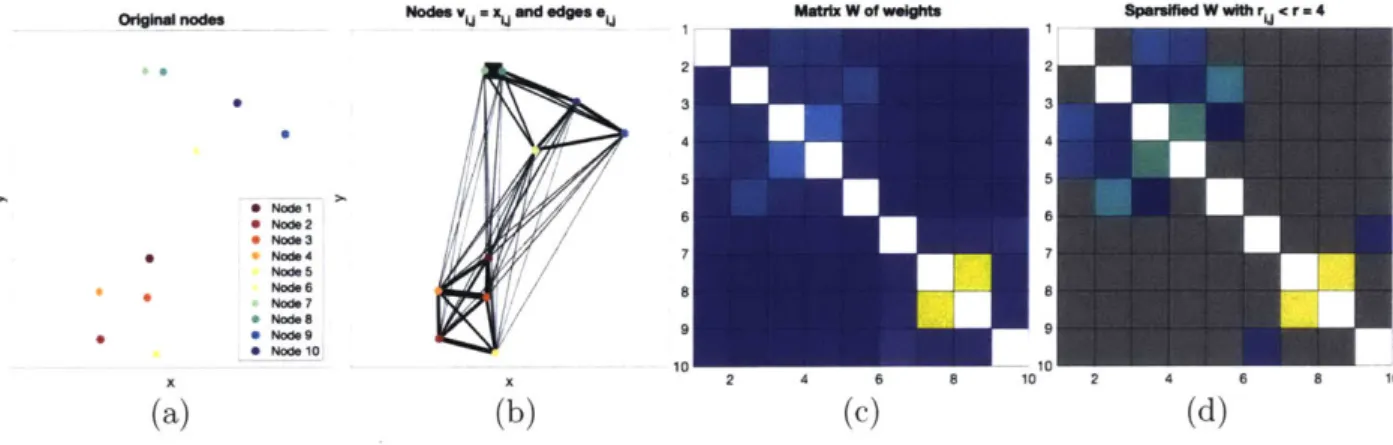
them, the matrix W of the associated weights wij and the sparsified W. . . . 58
2-5 Mock example of the partition of a set of nodes from figure 2-4, the graph
Laplacian and the corresponding eigenvalues. . . . . 60
2-6 The impact of the value of the radius r on the size of the detected clusters
and the number k of connected components with a Bickley Jet example. . . . 62
2-7 The impact of the distance function on spectral clustering with a Bickley Jet
exam ple. . . . . 65
2-8 Example spectral clustering results for the Bickley Jet with runs iterated from
Hadjighasem et al. [2016]. . . . . 66
2-9 Illustration of the gap ratio. . . . . 69
2-10 Illustration of the spectral clustering protocol with coherence metrics. ... 72
2-11 Mean pairwise distances between particles and boundary filtering examples. 74
2-12 Bickley Jet flow reiterated from Rypina et al. [2007]. . . . . 76
2-13 Quasi-periodic Bickley Jet flow reiterated from Hadjighasem et al. [2016]. . . 77
2-14 Step 1 of the spectral clustering protocol for the Bickley Jet example: gap
ratio as a function of r. . . . . 78
2-15 Step 2 of the spectral clustering protocol for the Bickley jet. . . . . 79
2-16 Step 3 of the spectral clustering protocol for the Bickley jet: results with
coherence metrics under noise. . . . . 80
2-17 The Duffing oscillator. (a) Poincare map with 1000 periods of perturbation
Tpert = 27/w. (b) Forward time FTLE for 30Tpert, time chosen for the spectral clustering analysis. (c) FTLE ridges in forward (red) and backward (green)
time for loTpert. (d) Superimposed forward (positive, red tones) and backward
(negative, green tones) FTLE fields for lOTpert. . . . . 81
2-18 Steps 1 and 2 of the spectral clustering protocol for the Duffing oscillator. . . 83
2-19 Step 3 of the spectral clustering protocol for the Duffing oscillator: results with coherence metrics under noise. The FTLE ridges are superimposed and correspond to the boundaries of the clusters. . . . . 84
2-20 Boundary calculations for the single connected set within the Duffing oscilla-tor, detected with r = 2.0. . . . . 84
2-21 The asymmetric Duffing oscillator. (a) Poincare map with 1000 periods of perturbation Tpert. (b) Forward and (c) backward FTLE for 1OTpert. .... 86
2-22 Steps 1 and 2 of the spectral clustering protocol for the asymmetric Duffing oscillator. . . . . 88
2-23 Step 3 of the spectral clustering protocol for the asymmetric Duffing oscillator: results with coherence metrics under noise perturbation. The FTLE ridges are superimposed and correspond to the boundaries of the clusters. . . . . . 89
2-24 Coherence metrics applied to closed orbits of the Poincard map of the asym-m etric Duffing oscillator. . . . . 90
3-1 Connectivity matrix for the Hawaiian archipelago. Retrieved from NOAA Coral Reef Watch based on the works of Kolinski & Cox [2003]; Kool et al. [2010] ... .... ... 93
3-2 Connectivity and LCS in Coral Bay, Australia. Figures and captions extracted from Leclair et al. . . . . 95
3-3 Location of the Scott Reef atoll system off the northwest coast of Western Australia (maps accessed in ESRI, ArcGIS). Figure and caption from Foster & G ilm our [2018]. . . . . 96
3-4 Bathymetry of Scott Reef from Rayson et al. [2018]. . . . . 97
3-5 Meshes used for the SUNTANS model runs. . . . . 100
3-7 (a) Spectral clustering and (b) FTLE analyses of the 2007 dataset for the
channel. Data from Alireza Hadjighasem. . . . 102
3-8 Research Vessel Solander from the Australian Institute of Marine Science docked in Broome, Western Australia. . . . . 104
3-9 Surface drifters built ad hoc . . . 104
3-10 Release strategy for the drifters at Scott Reef . . . 106
3-11 Scott Reef field release: drifter trajectories. . . . 107
3-12 Scott Reef field release Part 1. Comparison between the experimental drifter positions, the velocity field and the LCS analysis at the start of the release at (Left) 06:30 and (Right) 07:00 . . . 110
3-13 Scott Reef field release Part 2. Comparison between the experimental drifter positions, the velocity field and the LCS analysis throughout the release at 07:30, time at which all drifters were in water; 10:00, roughly half-way through the 6-hour experiment; 12:00 at low tide and start of the flood; and 13:30, 6 hours after all drifters were in water. . . . .111
3-14 FTLE fields in forward and backward times for Scott Reef South around (a) neap tide on September 27 and (b) spring tide on October 3. . . . 113
3-15 FTLE fields in forward and backward times in the Scott Reef channel around (a) neap tide on September 27 and (b) spring tide on October 3. . . . 115
3-16 Periodicity of the FTLE ridges around spring tide: superimposition of FTLE ridges (dark red) at 6 consecutive (a) highs and (b) lows of the tidal cycle. 116 3-17 Step 1 of the spectral clustering protocol for the Scott Reef channel. . . . 118
3-18 Step 2 of the spectral clustering protocol for the Scott Reef channel. . . . 119
3-19 Step 3 of the spectral clustering protocol with coherence metrics for the Scott R eef channel. . . . 120
3-20 Spectral clustering results for the Scott Reef high tide event with a 12-hour integration window, area shrinkage and vertical fluxes for the northern cluster
over 12 hours. . . . . 121
3-21 Divergence in the Scott Reef channel before and after removing the divergent component for (a) the neap tide event and (b) the spring tide event. . . . 123 3-22 Forward FTLE fields in the Scott Reef channel for the non-divergent velocity
fields around (a) neap tide on September 27 and (b) spring tide on October 3. 124 3-23 Step 1 of the spectral clustering protocol for the non-divergent velocity fields:
high tide during (a) neap tide and (b) spring tide. . . . . 125
3-24 Step 3 of the spectral clustering protocol for the non-divergent velocity field at high tide around neap tide: results with coherence metrics for the peak at
r = 0.025. . . . . 125
4-1 Google Earth satellite image of the region of interest around the island of
Martha's Vineyard, Massachusetts. . . . . 133
4-2 Bathymetry south of Martha's Vineyard. Depths in meters. Data from MSEAS. 135
4-3 CODE/DAVIS-type drifters. . . . . 138
4-4 LCS predictions for the August 14, 2017 No Man's Land experiment. . . . . 140
4-5 CODE drifter trajectories for the August 14, 2017 No Man's Land experiment. 143 4-6 (a) CODE drifter trajectories (thick blue lines) and numerical trajectories
individually seeded for each ensemble of the model (colored dotted lines). The release positions are shown in red crosses. (b) Pairwise distances between the experimental and numerical trajectories, for each ensemble and each drifter.
(c) Same as (b) minus drifters 4-6. . . . . 145
4-7 LCS results for the August 14, 2017 No Man's Land experiment. . . . . 147
4-8 LCS analysis for the August 14, 2017 No Man's Land experiment: zoom in
on the clustering results. . . . . 151
4-10 CODE drifter trajectories for the August 7, 2018 No Man's Land experiment
from 16:00 to 22:00. . . . . 157
4-11 (a) CODE drifter trajectories (thick lines) and numerical trajectories (thin lines), individually seeded in TRACE from the MSEAS velocity fields. Each color correspond to a different drifter trajectory. (b) Pairwise distances be-tween the experimental and numerical trajectories for each drifter. The colors
match those in (a). The average distance is plotted with the thick grey line. 158
4-12 (a) Wind data used by MSEAS forecasts. (b) Measured wind time series for
A ugust 7, 2018. . . . . 159
4-13 Tidal time series for August 7 and August 8, 2018. . . . . 161
4-14 CODE drifter trajectories (a) until August 15 12:00, 20 hours after the last drifter deployment and (b) from 04:00 to 10:00 on August 15. The drifter
positions are color-coded by time. . . . . 162
4-15 (a) CODE drifter trajectories (thick lines) and numerical trajectories (thin lines), individually seeded in TRACE from the MSEAS velocity fields, for 04:00 to 10:00 on August 15. (b) Pairwise distances between the experimental and numerical trajectories for each drifter. The average distance is plotted with the thick grey line. . . . 163 4-16 LCS analysis for the August 8, 2018 No Man's Land experiment. . . . 167 4-17 Zoom on the coherent spectral cluster at 10:00 from figure 4-16. . . . 168
A-1 Steps 1 and 2 of the spectral clustering protocol for the Bickley jet with the
maximum distance function. . . . 182
A-2 Step 3 of the spectral clustering protocol for the Bickley jet with the maximum
distance function. . . . 183
A-3 Steps 1 and 2 of the spectral clustering protocol for the Duffing oscillator. (Top) Sweep of r parameters with offset coefficient 1010 and the average dis-tance function. (Middle) Same for the maximum disdis-tance function. (Bottom)
Sweep of offset coefficients 10" for the gap ratio peaks. . . . . 184
A-4 Spectral clustering results for the Duffing oscillator with the maximum
dis-tance function. . . . . 184
B-i Comparison between backward-time FTLE ridge advected from 07:30 and computed backward-time FTLE fields on a sliding window covering the Scott
Reef field experim ent. . . . . 189
B-2 Comparison between backward-time FTLE ridge advected from 07:30 and computed backward-time FTLE fields on a sliding window covering the Scott
Reef field experiment (Part 2) . . . . 190
B-3 Comparison between forward-time FTLE ridge advected from 07:30 and com-puted FTLE fields on a sliding window covering the Scott Reef field experiment. 191 B-4 Comparison between forward-time FTLE ridge advected from 07:30 and
com-puted FTLE fields on a sliding window covering the Scott Reef field
experi-m ent (P art 2). . . . . 192
B-5 Comparison between forward-time FTLE ridge advected from 07:30 and com-puted FTLE fields on a sliding window covering the Scott Reef field
experi-m ent (P art 3). . . . . 193
B-6 Comparison between forward-time FTLE ridge advected from 07:30 and com-puted FTLE fields on a sliding window covering the Scott Reef field
experi-m ent (P art 4). . . . . 194
C-1 Tidal time series for August 14, 2017. . . . . 198
C-2 Evolution of the FTLE field at different times of the tidal cycle for the day of
August 14, 2017. ... ... 199
C-3 Sweep of r radii for the parameter-free spectral clustering protocol used for the analysis of the 2017 No Man's Land experiment. (a) Sweep for the 14:20
to 20:20 time window. (b) Sweep for the 15:51 to 21:51 time window. . . . . 200
C-4 Sweep of offset coefficients for the r values corresponding to the peaks in gap
ratios from figure C-3. (a) Sweep for the 14:20 to 20:20 time window. (b)
Sweep for the 15:51 to 21:51 time window. . . . . 201
C-5 Encounter volume over the entire domain of computations for the analysis of the 2017 No Man's Land experiment. (a) Results for the 14:20 to 20:20 time window. (b) Results for the 15:51 to 21:51 time window. (c) Results for the
21:51 to 03:51 time window. . . . . 203
C-6 Sweep of r radii for the parameter-free spectral clustering protocol used for
the analysis of the 2018 No Man's Land experiment. Sweep for the 04:00 to
10:00 tim e window . . . . 204
C-7 Sweep of offset coefficients for the r value corresponding to the peak in gap
ratios from figure C-6. Sweep for the 04:00 to 10:00 time window. . . . . 204
C-8 Encounter volume over the entire domain of computations for the analysis of the 2018 No Man's Land experiment. (a) Results for the 04:00 to 10:00 time window. (b) Results for the 10:00 to 16:00 time window. . . . 205
Chapter 1
Introduction
Ocean surface transport has been at the core of societal problems since the American Revo-lution: Benjamin Franklin, who charted the Gulf Stream as early as 1768, shared knowledge of its circulation patterns with America's French allies, thereby giving them a maritime tac-tical advantage in the North Atlantic during the Revolutionary War. A 1786 version of this chart provided in figure 1-1 on page 22. Centuries later, transport in the ocean is still a topic of active research as many environmental disasters are related to ocean surface transport, including the spread of marine plastic pollution, the Deepwater Horizon oil spill and the nu-clear contamination from the Fukushima Daiichi plant. Understanding and predicting flow transport, however, remains a scientific challenge.
Building on the recent emergence of Lagrangian methods and other analytical tools from dynamical system theory, this thesis investigates the present-day abilities to describe and understand the organization of flow transport at the ocean surface, including the abilities to detect the underlying key structures, the regions of stirring and regions of coherence within the flow. The motivations for studying ocean transport and, particularly, surface transport are presented in section 2.1. Section 1.2 introduces the Lagrangian perspective to describing flow transport. Section 1.3 presents an introduction to Lagrangian Coherent Structures (LCS). Previous applications of LCS to oceanic flows are reviewed in section 1.4. Lastly, the
Figure surface
u~5 VN A.% aySt ifk*N -%M a zi e-AS.W d. VEM 1-1:
ill
I
log AVII ?A AF'S-.r r. sale Yr i . i/i- iTi PA a r Pr r* (;MY. CA chart of the Gulf Stream by Poupard & Franklin [1786]. Knowledge of the currents helped navigation of the North Atlantic.
overview of this thesis is presented in section 2.2.
1.1
The importance of ocean surface transport at the
submesoscale
As seawater flows throughout the global ocean, it advects its physical properties and tracers such as heat, nutrients and oxygen. The distribution of different water properties by ocean transport occurs throughout the water column: at the surface, in the deep ocean and at the intermediate upper ocean layer, the layer between the surface and the steep temperature gradient called the thermocline. The dynamics of ocean transport play a major role in regulating Earth's climate [van Sebille et al., 2018]. Ocean physics also impact marine ecology by shaping the environmental conditions around different ecosystems, including their access
I
R
LLL C;
Xrt C
to nutrients and light.
The ocean surface is of particular importance because it is the interface between the atmosphere and the ocean: air-sea interactions dictate processes such as heat transport [Thomas et al., 2008; Zhang et al., 2014], which are an essential component of climate models. Moreover, about 50% of oxygen on Earth results from photosynthesis by phytoplankton in the upper layer of the ocean [Field et al., 1998; Marinov et al., 2008; Mahadevan, 2016], typically located within the upper 100 meters. Satellites images of plankton blooms, such as the ones provided in figure 1-2 on page 24, exemplify the role of oceanic structures in transporting and confining nutrients and plankton [Sandulescu et al., 2007]: the chlorophyll marks the edges of the ocean eddies and vortices trapping the plankton.
Ocean surface transport is also at the core of several societal and environmental disasters [Poje et al., 2014]. As previously mentioned, knowledge of the Gulf Stream helped the American Revolution; a 1786 chart was provided in figure 1-1. In 2010, the Deepwater Horizon spill released four million barrels of oil into the Gulf of Mexico, according to an estimate from Crone & Tolstoy [2010], highlighting the importance of reliable forecasts of oceanic contaminant transport [Olascoaga & Haller, 2012]. Pictures of the spill are shown in figure 1-3 on page 25. The following year, an earthquake and a tsunami caused the Fukushima Daiichi nuclear power plant to discharge radioactive particles into the ocean: these tracers have then spread throughout the North Pacific Ocean [Rypina et al., 2013, 2014a], further showing the importance of understanding the pathways and barriers to transport in the ocean.
Ocean surface transport is a complex problem because it operates on multiple length- and time-scales that are set by the underlying dynamics. At large length scales, such as that of ocean basins, the ocean dynamics are mostly governed by the Earth's rotation, by pressure and temperature gradients and by the small depth-to-length ratio, as the horizontal velocities are several orders of magnitude higher than the vertical velocities. At small lengthscales
(a) (b)
(c) (d)
Figure 1-2: Satellites images of plankton blooms trapped in eddies. (a) Phytoplankton blooms in the Drake Passage stretching about 1300 km and highlighting the multi-scale vortex structures. Image taken with the Visible Infrared Imaging Radiometer Suite on the Suomi NPP satellite (Credits: NASA/Norman Kuring). (b) Phytoplankton blooms (natural-color image) in the Baltic Sea captured by the Operational Land Imager on Landsat 8. (Credits: NASA/Joshua Stevens/U.S. Geological Survey.) (c) 150-km wide eddy off the South Africa coast captured by the Terra satellite with the Moderate Resolution Imaging Spectroradiometer (Credits: NASA/Jesse Allen). (d) Zoom in of the rectangular insert in
-(b)
Figure 1-3: British Petroleum oil discarded into the Gulf of Mexico from the Deepwater Horizon spill. Photographic credits: (a) Beltra [2010] (b) Kari Goodnough/Bloomberg via Getty Images.
between lie the mesoscale and the submesoscale. Mesoscale motions are characterized by a
small value of the Rossby number Ro = Lf'Ik, where U and L are the characteristic velocity
and length scales, respectively,
f
= 2Q sin(#) is the Coriolis frequency at latitude4
and Q isthe angular frequency of planetary rotation. Small Ro means that the flow is in geostrophic balance constrained by the planetary rotation and the pressure gradient force: the Coriolis force dominates over the inertial and centrifugal forces. Typically, the mesoscale refers to scales ranging from 10 to 500 km [Abernathey & Haller, 2018].
At large lengthscales and mesoscales, oceanic flow processes have been extensively studied [Ferrari & Wunsch, 2009; Wunsch & Ferrari, 2018], but within the transition scale between the mesoscale and the small scale, dynamical features are less well understood [Thomas et al., 2008; Poje et al., 2014; McWilliams, 2016]. This transition scale is called the submesoscale: it is often defined dynamically by 0(1) Rossby number Ro. Thomas et al. [2008] also
characterize the submesoscale by 0(1) Richardson number, Ri: Ri = N2 , where du/dz is
the vertical shear in velocity u(z) and N = is the Brunt-Vdisdld buoyancy frequency,
with g the local acceleration due to gravity and p the density. For typical flow speeds of 0.10
ms-1, 0(1) Ro corresponds to ~ 1 km in Massachusetts and - 750 m at very high latitudes;
Ro is undefined at the equator where
f
= 0. Typically, the submesoscale corresponds tolengthscales of 0(1-10km).
Submesoscale processes are of particular interest for several reasons: just to name a few, they play a major role in the energy cascade towards smaller-scale dissipation, they are also relevant to primary productivity by phytoplankton [Mahadevan, 2016]. Understanding ocean surface transport at this scale is also of vital importance for the outcomes of search and rescue operations [Peacock & Haller, 2013; Allshouse & Peacock, 2015b], as drifts of 0(1-10km) are typically found to occur over 2-3 days. One major reason why dynamical features on the ocean surface are the least understood at the submesoscale is because they present what McWilliams [2016] calls "an observational barrier": submesoscale processes have shorter spatiotemporal scales than mesoscale or larger features, making it hard to obtain a global
and continuous coverage of these processes with the required spatio-temporal resolution using standard technology and approaches [Zhang & Qiu]. For instance, present-day remote sensing offers global coverage of the Earth, but it only recently started offering the spatial accuracy required to observe submesoscale phenomena globally [McWilliams, 2016]; note that the temporal resolution required for a global coverage of submesoscale processes is
still lacking. Smaller features, including fine-scale microstructures of - O(<m)), can be
measured with shipboard instruments [Seo et al., 2018; Shao et al., 2018; Sun et al., 2018]. Submesoscale processes, however, are too large and too rapidly evolving to be fully captured by typical ship surveys.
This thesis investigates the present-day abilities to describe and understand the organi-zation of flow transport at the ocean surface over the submesoscale range. It is primarily based on a series of field experiments that consisted of drifter releases. The LCS analysis is applied to numerical model data and compared to the experimental investigations, with the goal to evaluate our abilities to detect the underlying key structures, the regions of stirring and regions of coherence within the flow. This analysis is conducted through established LCS methods as well as an approach newly-developed as a part of this thesis, a parameter-free spectral clustering protocol with a noise-based metric to evaluate the coherence of clusters.
1.2
The Lagrangian versus Eulerian perspectives of
trans-port
The dynamics of motion in geophysical fluid flows and the patterns of transport can be described from the Eulerian perspective and the Lagrangian perspective. The Eulerian de-scription of fluids represents the flow motion as a function of position x and time t from a fixed reference frame, focusing on the properties of the flow within a domain at an in-stantaneous time: for example, through the velocity field v(x, t). Velocity is inherently a frame-dependent property and needs to be adapted to the frame of reference to describe the
Figure 1-4: A rotating saddle misclassified as a vortex by most nonobjective diagnostics.
Figure and caption from Haller [2015].
material behavior. The Lagrangian description, in contrast, represents fluid motion by fol-lowing fluid parcels as they move through time and space and is a more natural perspective to study ocean transport [Davis, 1983; Mendoza & Mancho, 2012; Lehahn et al., 2018]. An-other important consideration to study flow transport is objectivity: the material response should be identified independently of the observer. A nice example that illustrates the need for objectivity is taken from Haller [2015] and provided in figure 1-4 on page 28: the closed and rotating streamlines around the red parcel of fluid can lead to the misclassification of this flow as elliptic or vortical. Advection of the red parcel, however, reveals that it is a ro-tating saddle flow. Had this parcel of fluid been trapped inside a coherent vortical structure instead, it would have stayed coherent over time.
For a given flow velocity field, the particle trajectories can be generated through the equation of motion:
dx
7 = v(x,t). (1.1)
at
The solutions are denoted by x(xo, to; t), where xo is the initial position at initial time to and
t - [to; ti] is the time instant within the interval from the initial time to to the final time
t1. This relatively simple equation can nonetheless generate complicated trajectories, even
in time-periodic flows: indeed, the resulting trajectories can result in chaotic motion [Aref, 1984; Rypina, 2007]. Chaotic motion is defined by a high sensitivity to initial conditions, meaning that very small changes in initial conditions can result in vastly different trajectories: neighboring particles can separate exponentially with time. Aperiodic flows also commonly generate trajectories with such sensitive dependence on initial conditions [Haller & Poje,
1998]. Oceanic flows are aperiodic, even when they are driven by periodic forcing, such as tidally-driven flows in inlets or coral lagoons. Oceanic velocity fields are typically obtained from analytical models [McWilliams, 1976], numerical models [Deleersnijder & Lermusiaux, 2008; F.J. et al., 2013; Rayson et al., 2018], high-frequency radar systems [Rypina et al., 2014b; Kirincich, 2016], or satellite altimetry [Lehahn et al., 2018]
The properties of distinct water parcels can be exchanged through homogenization via mixing, following the repeated stretching and folding of material surfaces, such as through mechanical swirling of the fluids. With stirring, the gradients between the water parcels increase sharply. Mixing is the second phase of homogenization and involves molecular diffusion. The processes governing stirring can be interpreted by the field of dynamical systems theory and its advances from the past 15-20 years [Haller & Yuan, 2000; Wiggins, 2005; Villermaux, 2019]. The patterns of transport can be recognized through the detection of areas with high rates versus low rates of stirring or through the detection of barriers to transport that can occur in a flow. Examples of the latter are plentiful in natural flows, including the smoke rings emerging from a puffing volcano, as shown in figure 1-5, oceanic and atmospheric fronts, the eddies shedding from the Gulf Stream or the vortices from figure 1-2. The Lagrangian structures that organize transport and govern coherent trajectory patterns over a given interval of time in such complex fluid flows are referred to as Lagrangian Cojherent Structures (LCS), a term coined by Haller & Yuan [2000]. These structures act as the hidden skeleton of spatiotemporally complex fluid flows [Mathur et al., 2007; Peacock & Haller, 2013; Haller, 2015] and are often undetectable and unidentifiable from the direct interpretation of velocity fields in unsteady flows.
This thesis considers several tools used to identify LCS. The following section presents a brief overview of the LCS methods that will be discussed or used in this thesis. Two methods in particular will be further explained in chapter 2: the Fuzzy C-Means (FCM) and the spectral clustering methods, which aim to detect coherent parcels of fluid from clusters of particle trajectories. The other primary LCS tool used is the Finite-Time Lyapunov
Figure 1-5: Steam rings blown by Mount Etna in November 2013. Courtesy of Tom Pfeiffer
http://www.volcanodiscovery. com. Figure and caption from Haller [2015].
Exponent (FTLE), described in section 1.3.1, whose usability for planning experiments will
be assessed in details.
1.3
Common LCS detection methods
LCS methods can be classified according to the type of structures they seek to detect. Some methods called cluster-based methods, such as Fuzzy C-Means (FCM) or spectral clustering, seek to detect parcels of fluids that remain coherent and non-filamenting over time, whereas other methods, such as the Finite-Time Lyapunov Exponent (FTLE) or the variational approach, look for the structures delimiting regions with qualitatively different transport be-haviors. Many LCS methods require large datasets of Lagrangian trajectories generated by velocity fields. This is the case for the FTLE, the most widely used method that is described in subsection 1.3.1, which requires a greater resolution than, for instance, cluster-based meth-ods. In contrast, some methods, like braid theory, have been developed to specifically analyze sparse datasets of trajectories, as dense datasets of Lagrangian trajectories are sometimes difficult to obtain.
Recent review papers of LCS methods include Allshouse & Peacock [2015b] and Had-jighasem et al. [2017]. Two cluster-based methods, FCM and spectral clustering, briefly summarized in subsection 1.3.2, will be further discussed in chapter 2. The encounter
vol-ume method, explained in subsection 1.3.3, will also be used in chapter 4. In chapters 3 and 4 of this thesis, the analysis of the case studies was based on numerical ocean models.
1.3.1
Finite-Time Lyapunov Exponent
In 2000, Haller & Yuan coined the term of Lagrangian Coherent Structures (LCS) and defined these structures as the "material lines with locally the longest or shortest stability or instability time". They computed fields of Finite-Time Lyapunov Exponents, or FTLE, from particle trajectories to look at LCS boundaries. Since then, the FTLE approach has remained the most widely used LCS method. FTLE fields can be computed by the differentiation of
the flow map, obtained from numerical trajectories xj (xo, to; t), typically generated from
velocity field datasets with high resolution, over a finite integration time t E [to; ti] from
initial conditions xo. The flow map at time I is denoted by Ft :=- xj(to, xo; t). The gradient
of the flow map is used to compute the Cauchy-Green strain tensor:
Ct(xo) = [VF" (xo)] [VFtl(xo)] (1.2)
as well as its eigenvalues Ai(xo). For a forward-time flow map, the largest eigenvalue yields the largest amount of stretching possible between neighboring tracer particles. It is used to
construct the scalar FTLE field and quantify the separation rate within the flow over [to; t1].
1
At'(xo) = log An(xo). (1.3)
t1 - to
Here, At'(xo) is the FTLE value at the position xo for the integration window [to; ti], n is the number of dimensions of the trajectories, with n = 2 for a two-dimensional flow, and An is the highest eigenvalue.
Locally maximum values of FTLE that are connected along a curve, referred to as FTLE ridges [Shadden et al., 2005], correspond to structures with the strongest separation rates for forward time advection: the separation of particles for the time window considered is
maximal on each side of the structures. These structures are thus often called 'repelling'
[Hadjighasem et al., 2017]. Conversely, FTLE ridges of backward-time calculations from ti
to to are the curves along which the strongest attraction rates occur in forward time and they identify locally attracting features.
For any LCS method, the analysis of a dynamical system depends on the time window of integration from to to ti: this time window is a property of the system that is analyzed rather than a parameter of the method. It also depends on the resolution of the numerical grid, i.e., the number of particles included for the computations: it must be sufficient for the method of interest, which can be verified by the convergence of results when the resolution is increased. The FTLE analysis depends on the time window and the numerical grid, but no parameters are needed, making this method very advantageous. It is important to note that the FTLE fields and/or ridges are computed for the chosen window of time to to ti. FTLE
fields are often computed sequentially over sliding integration windows [to + dt; t1 + dt] to look
at how the organization of a flow evolves in time. The corresponding FTLE ridges are not
time-evolving structures, as they are sequentially recomputed: indeed, each [to + dt; t1 + dt]
interval represents a different finite-time dynamical system. The sliding-window analysis is however commonly performed [Shadden et al., 2005; Hadjighasem et al., 2017], but it is important to note that the sliding window analysis looks at the LCS within a dynamical system evolving from to to tf as opposed to the evolving LCS of the dynamical system at time to. An example of the differences between advected FTLE ridges and sliding-window FTLE computations is provided for the case study in chapter 3, in appendix A-2.
1.3.2
Cluster-based methods
Cluster-based LCS methods detect groups of particles that form coherent sets isolated from the rest of the flow. Recently, methods have been developed based on algorithms from unsupervised machine learning, in which all individual particles are assigned to a cluster in an automatic way. The two cluster-based methods, Fuzzy C-Means and spectral clustering,
will be detailed and discussed further in chapter 2 and applied throughout this thesis. The Fuzzy C-Means (FCM) approach to LCS detection introduced by Froyland & Padberg-Gehle [2015] is a clustering algorithm that assigns particles to clusters based on the Euclidean distance between trajectories. The FCM algorithm allocates the trajectories according to the average over time of the geometrical distance between trajectories and cluster centers. The partition of the domain is optimized when the trajectories are close to their assigned clus-ter's center. This optimization is iterated through the particles' likelihoods of membership to different clusters.
The spectral clustering approach [Hadjighasem et al., 2016] also detects coherent clus-ters based on the distance between trajectories, but with weights that quantify pairwise similarities between trajectories, using tools from spectral graph theory. Spectral clustering assigns particles to different clusters in order to maximize the intra-cluster similarity while minimizing the inter-cluster similarity. Domains filling the space between coherent clusters correspond to the incoherent cluster, or mixing regions.
1.3.3
Non-exhaustive review of LCS methods
One of the first methods developed to detect coherent sets from sparse trajectories was the braid theory approach by Thiffeault [2010]; Allshouse & Thiffeault [2012]. It transposes the time-evolving trajectories into a two-dimensional space-time diagram, which highlights how trajectories intertwine, thereby reducing the data to a sequence of crossings between trajectories. The method measures the rate of topological entanglement of these trajectories and defines coherent groups from sets of particles with minimal entanglement compared to the rest of the dataset. To analyze a set of trajectories over a certain time interval T, the only parameter to pick is the ratio of entanglement, which distinguishes the coherent sets from the rest of the system where entanglement, and thus mixing, is much higher. However, to yield any result, braid theory necessitates the coherent sets to contain at least a couple of particles with a rate of entanglement much lower than the surrounding region of mixing. The
main drawback of applying the braid theory approach to geophysical flows is that the method requires a certain amount of entanglement of trajectories, as well as a range of entanglement levels that is wide enough to detect coherent group: in open domains, such as oceanic flows, the required coverage of trajectories in space and time is nearly impossible to obtain in field experiments.
The complexity method (CM) was developed by Rypina et al. [2011] to sort trajectories within a domain according to their levels of complexities. The method measures the cor-relation dimension of trajectories and their ergodicity defect d. The corcor-relation dimension
c E [0, 2], where c = 0 corresponds to stationary points, c =1 to smooth curves and c = 2 to chaotic curves densely covering an area, allows to distinguish relatively complex trajec-tories from less complex trajectrajec-tories. d uses a counting method similar to box counting and measures the deviation from ergodic motion. The trajectory complexity method requires a parameter beyond the grid resolution and the time window of integration: the number of sampled points along the trajectories. It also requires that the boxes in the box counting method decrease from the full domain to a domain small enough.
Rypina & Pratt [2017] also developed the encounter volume method, which computes the volume of fluid that a given trajectory encounters over a finite interval. The encounter volume gives an indication of the mixing potential of the flow: a low encounter volume characterizes, for example, the cores of coherent eddies; a high encounter volume characterizes chaotic regions. The encounter volume is calculated from the number of trajectories passing by a reference trajectory within a threshold distance, the encounter radius, over a time interval
T; this threshold is the only parameter to be picked by the user for the encounter volume
method, along with the numerical grid resolution and the window T. Another advantage of the encounter volume is that, similarly to the FTLE, it is a visualization of the kinematics of the flow that displays both the regions of low mixing and of high mixing. It reveals where water parcels can exchange water properties and gives an estimate for the mixing potential of the flow. The encounter volume can also be connected to diffusivity [Rypina et al., 2018].
Serra & Haller [2016] also looked at the differentiation of the flow map, but using the rate-of-strain tensor and the initial-time Taylor expansion of the Cauchy-Green strain ten-sor. In the limit of a small integration window, the Eulerian rate-of-strain tensor governs Lagrangian deformation. The Eulerian Objective Coherent Structures (OECS) are defined as the instantaneous limits of Lagrangian coherent structures. One advantage of OECS is that the computations rely on the velocity field and do not require the generation of trajec-tories. OECS are frame invariant, but they are not Lagrangian. The only parameter needed is the numerical grid resolution.
The geodesic approach by Haller [2015] applies principles from variational calculus to ma-terial surfaces to find extremizing functions. Repelling shrink- or strain-lines and attracting stretchlines are detected from the first and second eigenvectors of the Cauchy-Green strain tensor, respectively, which constitute hyperbolic LCS [Farazmand & Haller, 2012]. Alter-nating chains of strainlines and stretchlines connecting singularities of the Cauchy-Green tensor form parabolic LCS that minimize Lagrangian shear and are jet cores [Farazmand
et al., 2014]. Elliptic LCS are detected through the computation of material-line-averaged
stretching; closed material lines for which the stretching is of the same order as neighboring material curves are the elliptic LCS. The outermost closed shear line marks the boundaries of coherent vortices [Haller & Beron-Vera, 2013]. A drawback of the geodesics method is the number of parameters it requires, including, among others, the distance threshold between singularities for computing parabolic LCS.
Rotationally coherent LCS are defined by Farazmand & Haller [2016] as material sur-faces whose elements experience identical rotation over a finite time interval. The polar rotation angle (PRA) is computed from the flow gradient VFt (xo) to detect the bound-aries of rotationally coherent vortices from the outermost closed and convex level curves of the PRA. Building on the rotation angles theory, Farazmand et al. [2016] propose to use the Lagrangian-Averaged Vorticity Deviation (LAVD), which is the trajectory-averaged, normed deviation of the vorticity w(x(t; xo)) from its spatial mean cD, to identify rotationally coherent
LCS. The choice of the outermost convex contour is somewhat arbitrary.
Similarly to the FTLE, the Finite-Size or Finite-Scale Lyapunov Exponent (FSLE) method [Artale et al., 1997; Aurell et al., 1997] looks at separation in the flow by computing how fast the distance between neighboring trajectories reaches a certain threshold value. The FSLE approach, however, is not as widely used as other LCS methods such as the FTLE: it performs better at larger spatial scales [LaCasce, 2008] and it does not distinguish the different spatial scales of a system. Ultimately, it is unreliably sensitive to the temporal resolution of velocity fields at small scales [Hadjighasem et al., 2017].
1.3.4
Bickley Jet example
Most methods mentioned in sections 1.3.1-1.3.3 are illustrated in figures 1-6-1-7 on pages 37-37. The example is the Bickley Jet flow, which will be further detailed in the following chapter. It consists of a zonal jet that is a barrier to meridional transport with three recircu-lation vortices on each side. The Bickley Jet is a benchmark flow in dynamical system theory because it exhibits transport behaviors that are qualitatively different and are common in realistic ocean flows: the jet, the vortices and the background chaotic zone.
In figure 1-6, panel (a) shows the Poincar6 section, which was computed here for the periodic Bickley jet with the parameters as in Rypina et al. [2007]. The Poincare section is a long-established methodology in dynamical system theory to study periodic flows: this stroboscopic mapping plots the trajectory positions at each period. Figure 1-6.(a) reveals how the jet acts as barrier to transport, as well as the presence of vortices corresponding to concentric discretely-sampled closed orbits, which are islands of coherence among the incoherent background. In contrast, the stroboscopic mapping of the particle trajectories outside these closed orbits show clouds of dots corresponding to the chaotic regime of the incoherent background. The six vortices are all of similar sizes.
Panels (b)-(i) in figure 1-6 were taken from Hadjighasem et al. [2017], in which the Bickley Jet was modified from Rypina et al. [2007] to become quasi-periodic. Because the flow is
Poincare map
(a)
Tra ectory complexity
(d)
Fuzzy C-means clustering
(g) Trajecto le th (b) Geodesic LCS (e) Spectral clustering FTLE (c) LAVD (1 ) FSLE (r=5) (h 1)
Figure 1-6: Comparison of Lagrangian methods on the Bickley jet example (forward-time calculations only). (a) Poincard section computed for the parameters in Rypina et al. [2007]
corresponding to the periodic Bickley Jet flow. (b)-(j) Results of LCS methods on the
quasiperiodic Bickley jet example. The panels were adapted from Hadjighasem et al. [2017].
x. I. INA 1012 3.5 3 2.5 2 1.5 0.5 0 w I
Figure 1-7: Encounter volume for the periodic Bickley jet flow using encounter radius 5 x 10⁵.
Figure adapted from Rypina & Pratt [2017]
-9
not periodic, the Poincare section could not be constructed, but the quasi-periodic system is qualitatively similar to the periodic system. The methods that will be used for analysis in chapters 2-4 of this thesis are the FTLE (figure 1-6.c), FCM (figure 1-6.g), spectral clustering (figure 1-6.h), FCM (figure 1-6.g) and encounter volume (figure 1-7). The flow used to calculate the Poincard section in figure 1-6.a corresponds to the flow used for the encounter volume method in figure 1-7, the periodic Bickley Jet. The trajectory complexity (figure 1-6.d), the geodesics approach (figure 1-6.e), the LAVD (figure 1-6.f) and the FSLE (figure 1-6.i) are included for completeness and because they are compared with the other methods throughout this thesis, including in section 1.4 and in chapter 2.
Figure 1-6.(b) shows the trajectory length, which corresponds to an arc length computa-tion of the distance covered by the adveccomputa-tion particles, as introduced by Mancho et al. [2013]. It is not an LCS method per se: just as trajectory complexity, FSLE or even FTLE, it does not define what the sought coherent structure are, but it provides an illustration of transport within the domain of interest. Figure 1-6.(b) shows the contrast between the meandering jet, with high values of length in red, and the cores of the recirculation vortices, in light blue. The vortices are hard to discern, however, as there are no clear vortex boundaries.
For the Bickley Jet, various methods captured different aspects of transport within the flow. In the Poincard section (figure 1-6.a), the closed orbits and the islands of coherence they bound were of similar sizes, suggesting that the vortices detected by LCS method should also be of comparable size. The FTLE scalar field (figure 1-6.c) reveals useful information about the differences in separation rates within the flow, but the individual vortices are hard to discern. The core of the jet shows minimal rates of separation, in blue, consistent with the notion of transport barrier, whereas the boundaries of the jet show maximal rates of separation, in red. The vortices are hardly delimited, however, as the FTLE values smoothly go from blue to green away from the core. While the shape of the jet can be discerned, the vortices are hard to bound. The trajectory complexity (figure 1-6.d) most clearly highlights the meandering jet through its very low values, in dark blue; the vortices are discernible
![Figure from [Haller, 2015]. . . . . . . . . . . . . . . . . . . . . . . . . . . .](https://thumb-eu.123doks.com/thumbv2/123doknet/13890505.447348/13.918.86.793.295.1066/figure-from-haller.webp)


![Figure 2-1: Examples of LCS methods targeting leakage-free vortices. (a) Figure from Farazmand & Haller [2016] to illustrate the PRA method](https://thumb-eu.123doks.com/thumbv2/123doknet/13890505.447348/48.917.105.804.106.953/figure-examples-methods-targeting-leakage-vortices-farazmand-illustrate.webp)
![Figure 2-12: Bickley Jet flow reiterated from Rypina et al. [2007]. Poincare map with 1000 periods of integration.](https://thumb-eu.123doks.com/thumbv2/123doknet/13890505.447348/76.917.166.695.115.341/figure-bickley-jet-reiterated-rypina-poincare-periods-integration.webp)