HAL Id: hal-00850591
https://hal.archives-ouvertes.fr/hal-00850591
Submitted on 8 Aug 2013
HAL is a multi-disciplinary open access
archive for the deposit and dissemination of
sci-entific research documents, whether they are
pub-lished or not. The documents may come from
teaching and research institutions in France or
abroad, or from public or private research centers.
L’archive ouverte pluridisciplinaire HAL, est
destinée au dépôt et à la diffusion de documents
scientifiques de niveau recherche, publiés ou non,
émanant des établissements d’enseignement et de
recherche français ou étrangers, des laboratoires
publics ou privés.
Microdynamics of magnetic particles in complex fluids
Georges Bossis, Modesto Lopez-Lopez, Andrey Zubarev
To cite this version:
Georges Bossis, Modesto Lopez-Lopez, Andrey Zubarev. Microdynamics of magnetic particles in
complex fluids. International Journal of Modern Physics B, World Scientific Publishing, 2011, 25 (7),
pp.905-910. �10.1142/S0217979211058468�. �hal-00850591�
1
IN COMPLEX MEDIA
G.BOSSIS
LPMC(UMR6622),University of NiceSophiaAntipolis/CNRS ParcValrose, -06108 Nice,France
MODESTO T. LÓPEZ-LÓPEZ
Departamento de Física Aplicada, Universidad de Granada, Campus de Fuentenueva s/n Granada, 18071, Spain
A. ZUBAREV
Dpt of Physics,Ural State University,
Ekaterinburg, Russia
The aggregation of magnetic particles in the presence of a magnetic field is the basic phenomenon which underlies all the physics of magnetorheological (MR) fluids. Although these interactions are well understood when the suspending fluid is a simple liquid, new MR fluids based on dispersion of magnetic microparticles in a ferrofluid or MR elastomers based on dispersion of magnetic particles in a rubber matrix, present some unusual properties which are not well described by conventional theories. We analyze in this work the motion of magnetic particles dispersed in a ferrofluid and submitted to a magnetic field and discuss the possible applications.
1. Introduction
It is well known that in the presence of a magnetic field, two ferromagnetic particles which are approximately aligned in the direction of the field, experience attractive forces. If they are free to move, they will come into contact, aligned on the field direction. This is the basic phenomenon that causes a quick and important change in the rheological properties of a magnetorheological (MR) suspension upon application of a magnetic field [1]. On the contrary, ferrofluids, which are stable dispersions of magnetic nanoparticles, show almost negligible rheological changes because magnetic attraction is dominated by Brownian motion [2]. Some attempts of increasing the strength of magnetic forces between microparticles have been done by dispersing them in a ferrofluid,
2
and several authors have actually demonstrated that the field-induced yield stress could be substantially increased in this way [3-5]. In addition, it has been shown that suspensions of ferromagnetic microparticles in ferrofluids also exhibit a better colloidal stability against irreversible aggregation and sedimentation [6-9]. We have tried to understand the cause of these unexpected properties by looking at the dynamics of two ferromagnetic microparticles in a ferrofluid in the presence of a magnetic field. Very surprisingly we have observed that, instead of coming into contact, they stop at a surface-to-surface distance of the order of the particle diameter [10]. We shall demonstrate the existence of a new repulsive force, which is due to a phase separation of the ferrofluid in the zone of high magnetic fields between the microparticles.
2. Interaction of microparticles inside a ferrofluid
2.1. Experimental
Ferrofluids used in the experiments consisted of stable suspension of oleate-covered magnetite nanoparticles dispersed in kerosene. Details on its preparation are given elsewhere [4]. Magnetic microparticles used in this work were spherical nickel particles of average diameter 10 µm, supplied by Merck KgaA (Germany). The suspensions of microparticles dispersed in ferrofluids were prepared as described in Ref. [4]. The volume fraction of microparticles in the final suspensions was approx. 0.01 % in all cases. A drop of the suspension was placed between two glass slides and microscopic observations were performed. A magnetic field was applied to the samples with the help of a home-made electromagnet.
2.2. Results
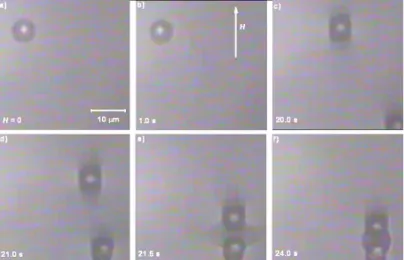
The first aim of this work was to study experimentally the field-induced aggregation process between magnetic microparticles dispersed in a ferrofluid. With this goal, we tried to find in our suspensions, whenever possible, groups of a few particles that upon magnetic field application would interact without being subjected to relevant influences of other particles not belonging to the group of interest. Then, the time evolution of the particles was monitored. As an example, Figure 1 shows the aggregation process of two nickel particles upon application of a magnetic field of intensity 22 kA/m. The snapshot shown in Figure 1a was taken before the application of the field. As observed, an isolated particle is placed in a homogeneous ferrofluid carrier. Figure 1b shows a snapshot taken 1.0 s after the field was applied. Apart from a little increase of the diffuse aspect
of the particle no other change is observed. On the other hand, a layer of nanoparticles attached to the microparticle is clearly deformed in snapshots shown in Figures 1c-d, where a clear motion of the microparticle is also observed. This deformation takes place as a remarkable thickening of the nanoparticle layer from the poles of the microparticles, along the field direction. As the particles approach each other (Figure 1e) a dense cloud of nanoparticles between the two microparticles is observed. As the equilibrium distance is reached this cloud becomes denser and smaller in size. In the stationary state (Figure 1f) this cloud of nanoparticles placed between the two microparticles has a diameter approx. twice the diameter of the latter ones and a spherical shape, centered in the imaginary line that links the centers of the microparticles.
Figure 1. Snapshots of the aggregation of two nickel particles dispersed in a ferrofluid, upon application of a magnetic field of 22 kA/m. Direction of the field is indicated. Ferrofluid solid concentration was 5 % vol. Snapshot a) was taken prior to magnetic field application. Snapshots b) to f) were taken after field application. Time elapsed since field application is indicated in each snapshot.
At this point, we have already arrived to the surprising finding of our work: upon magnetic field application, the equilibrium position of two magnetic microparticles dispersed in a ferrofluid is not the surface-to-surface contact position, but a position where there exists a distance, about one diameter of the particles, between the particles surfaces. This interesting result could only be explained if there is a repulsive force between the microparticles. Otherwise, as a consequence of the dipolar magnetic attraction, the particles would be in contact.
4
2.3. Theoretical model
Theoretical description of the micron magnetizable particle dynamics in a carrier ferrofluid, taking into account the dense ferrofluid clouds surrounding the particles, presents very complicated mathematical problem. Here we focus on the explanation of the observed stop-effect. The interaction between two micron-sized particles is the sum of the magnetic interaction between them and the osmotic forces, which are provided by the ferrofluid nanoparticles surrounding the magnetizable microparticles. Because of the dense ferrofluid coats near the microparticles, magnetic interaction between them strongly differs from that in a homogeneous medium. Thus in order to determine the force of magnetic and osmotic interactions between the particles, first, one needs to determine shape and density of these coats. Figure 1 demonstrates quite sharp boundaries between the coats and surrounding ferrofluid. Therefore the coat can be considered as a domain of dense phase of ferrofluid which appears due to condensation of the ferrofluid nanoparticles. It is well known (see, for example, refs. [11-17]) that magnetic field stimulates the phase condensation in ferrofluids, although only the biggest particles of polydisperse ferrofluid interact strongly enough to undergo the phase condensation.
Since the local magnetic field is especially strong near the poles of the magnetizable microparticles, ferrofluid condenses mainly near these poles. Determination of the equilibrium shape and density of the ferrofluid dense domains, as well as magnetic field and the nanoparticles distribution inside them, represents very intricate mathematical problem, which can not be solved strictly. In order to get reasonable estimates, we use the following approximation. First we consider the ferrofluid as monodisperse, consisting only of the biggest particles, which are able to condense into dense phases under the action of high enough magnetic field.
Next we use the following iteration procedure. At the first step of this iteration we ignore the heterophase coats near the microparticles and consider them as immersed in the homogeneous monodisperse ferrofluid. In the frameworks of this approximation, by using classical results of magnetostatics [18], one can estimate the magnetic moment M of each microparticle using the following relation: M=βVH0, where β is the magnetic contrast factor, V is the microparticle volume, and H0 is the magnetic field in the ferrofluid far from the
microparticle. Having estimated M, by using standard methods of magnetostatics, one can determine the local magnetic field H(r) distribution near the particle. This allows us, using condition of equality of the ferrofluid particle chemical potentials near the magnetizable microparticle and far from it, to
evaluate the shape of the dense coat and concentration of the ferrofluid particles inside the coat. To this end we take advantage of formulas of Ref. [11] for the chemical potential 1 of the ferrofluid particles as follows:
( )
( )
2 2 2 38 9
3
1
ln
8
3
1
kT
L
sh
κ
ϕ ϕ
χ
ϕ
ϕ
κ λ λ ϕ
κ
ϕ
1
3
4
− +
3
4
2
5
6
=
7
8
+
−
7
+
8
5
9
A
−
9
A
6
B
C
(1),
)
(
)
(
0kT
mH r
r
µ
κ
=
(
d
s
)
kT
m
3 2 02
4
+
=
π
µ
λ
Here, 2 is the hydrodynamical (i.e. determined with allowance for surfactant layers) volume concentration of nanoparticles, L(x)=cothx-1/x is the Langevin function, m is magnetic moment of the nanoparticle, d the diameter of its magnetic core, s is the thickness of the surfactant layer on its surface. Parameter
3 is the dimensionless, reduced to thermal energy kT, energy of interaction
between the nanoparticle and the local magnetic field 4, and 5 is the dimensionless parameter that characterizes the energy of magnetodipole interaction of the nanoparticles. Since in our experiments the volume concentration of microparticles was very low, we assumed that the ferrofluid particle concentration far from the microparticles was equal to the initial concentration 20 determined by the ferrofluid composition. The equilibrium
concentration 2(r) inside the dense domain has been determined from the condition
χ
(
ϕ
( )
r
,
H
(
r
)
) (
=
χ
ϕ
0,
H
0)
.
Let us now apply these calculations to a situation like that shown in Figure 1f, where the distance between the centers of the particles is approximately equal to 3a (a-radius of the microparticle). The magnitude of the magnetic field required to provoke phase separation, for the ferrofluid used in experiments, is estimated as Hc=22kA/m and we took for the far field H0=20kA/m. With this
value we actually obtained a dense zone around the particle whose extension is close to the experimental one. The calculated hydrodynamical volume concentration 2 of the ferrofluid particles inside this shell is about 30-35%. This estimate looks quite reasonable.
In the second step of iteration we take into account that the magnetic permeability 6 in the dense ferrofluid coats is higher than the permeability of the surrounding dilute ferrofluid. For both phases the ferrofluid relative permeability
6f can be estimated as
[
]
1
1 24 ( ) 1 8
f L L
µ = + ϕλ κ + λϕ∂ ∂κ κ− [11]. By using the
6
surface of the magnetizable particles. For simplicity we have supposed that the coat was homogeneous with permeability equal to the mean permeability
µ
over this region. The calculated magnitude ofµ
was 3.75. Let us introduce a spherical coordinate system with the origin in the center of the upper particle (Figure 1f), polar axis directed straight up, radius vector r and the angle 7 between r and this polar axis. The force F acting on the upper microparticle of Figure 1f, can be calculated as an integral on the surface of the particle:[
]
D
−
+
−
=
π
πσ
θ
σ
θθ
θ
θ
0 2sin
sin
cos
2
a
p
d
F
rr r (2)Here p is the osmotic pressure of the condensed gas of ferrofluid particles, 8rr and 8r7 are components of the Maxwell stress tensor.The expression for the osmotic pressure is the following:
With L the Langevin function. Our calculations shows that for the case corresponding to Figure 1f the force, acting on the upper particles, is
8
1.4 10
F ≈ ⋅ − N. Positive sign of this force means that the microparticle repels
from the second (down) microparticle. The physical reason of this repulsion is the oblate shape of the dense ferrofluid domain between the particles, and, consequently, the high demagnetizing factor of this zone which will tend to elongate like a ferrofluid drop in a magnetic field. In other words ,due to the dense ferrofluid zone inside the gap, the magnetic field inside the gap is much lower than in the absence of phase separation and can become lower than the average field on the upper side of the particle,giving rise to this repulsive magnetic force because the magnetizable particle is attracted towards the region with the highest magnetic field. On the other hand, when the particles are far apart their dense coats of ferrofluid do not interpenetrate (Figures 1c to 1e), so the magnetic field near the surfaces facing to the other particle is higher than near the opposite surfaces, and the particles attract. For a more exact calculation of this repulsive force and of the shape of the condensed domain of ferrofluid we plan to solve the magnetostatic equation with a permeability of the ferrofluid given by the local volume fraction φ(r,θ) in order to get the local field H(r,θ) ,then calculate a new volume fraction from the equality of the chemical potential and iterate this process until it converges
2 2 3 3 2 os
))
kT
)
,
r
(
H
m
(
L
.
.
4
3
4
(
)
1
(
1
)
,
H
(
P
φ
=
φ
+
φ
+
−
φ
φ
−
φ
−
λ
+
λ
θ
φ
Acknowledgments
This work has been supported by Biomag project (Conseil Régional PACA, France), projects P08-FQM-3993 and P09-FQM-4787 (Junta de Andalucía, Spain), project FIS2009-07321 (MICINN, Spain), grants of Russian Agency of Education 2.1.1/2571 and 2.1.1/1535, grants of Russian Federal Target Program 02.740.11.0202, 02-740-11-5172 and NK-43P(4), and grants of Russian Fund of Fundamental Investigations 10-01-96002-Ural, 10-02-96001, 10-02-00034 and 08-02-00647. M.T.L.-L. also acknowledges financial support by the University of Granada (Spain).
References
1. G. Bossis, O. Volkova, S. Lacis and A. Meunier, Lecture Notes in Physics
594, 186 (2002).
2. H. Shahnazian and S. Odenbach, Int. J. Mod. Phys. B 21, 4806 (2007). 3. J. M. Ginder, L. D. Elie and L. C. Davis - USA patent US5549837 (1996). 4. M. T. López-López, J. de Vicente, G. Bossis, F. González-Caballero and J.
D. G. Durán, J. Mater. Res. 20, 874 (2005).
5. N. M. Wereley A. Chaudhuri, J. H. Yoo, S. John, S. Kotha, A. Suggs, R. Radhakrishnan, B. J. Love and T. S. Sudarshan, Intell. Mater. Syst. Struct.
17, 393 (2006).
6. E. F. Burguera, B. J. Love, R. Sahul, G. T. Ngatu and N. M. Wereley, J.
Intell. Mater. Syst. Struct. 19, 1361 (2008).
7. M. T. López-López, P. Kuzhir, S. Lacis, G. Bossis, F. González-Caballero and J. D. G. Durán, J. Phys.-Condes. Matter 18, S2803 (2006).
8. G. T. Ngatu and N. M. Wereley, IEEE Trans. Magn. 43, 2474 (2007). 9. R. Patel and B. Chudasama, Phys. Rev. E 80, 012401 (2009).
10. M. T. López-López, A. Yu. Zubarev, G. Bossis, Soft Matter (2010) DOI: 10.1039/C0SM00261E
11. A. Yu. Buyevich and A. O. Ivanov, Physica A 193, 221 (1993). 12. C. F. Hayers, J. Colloid Interface Sci. 52, 239 (1975).
13. E. A. Peterson and A. A. Krueger, J. Colloid Interface Sci. 62, 24 (1977). 14. J. C. Bacri and D. Salin, J. Magn. Magn. Mater. 9, 48 (1983).
15. A. F. Pshenichnikov, J. Magn. Magn. Mater. 145, 139 (1995).
16. M. F Islam, K. H Lin, D. Lacoste, T. C. Lubenski, and A. G. Yodh, Phys.
Rev. E 67, 021402 (2003).
17. L. Yu. Iskakova, G. A. Smelchakova and A. Zubarev, Phys. Rev. E. 79, 011401 (2009).
18. L. D. Landau and E. M. Lifshits, Electrodynamics of Continuous Media (Pergamon Press, Oxford, 1984).