Publisher’s version / Version de l'éditeur:
Canadian Acoustics / Acoustique canadienne, 32, 3, pp. 170-171, 2004-10-01
READ THESE TERMS AND CONDITIONS CAREFULLY BEFORE USING THIS WEBSITE.
https://nrc-publications.canada.ca/eng/copyright
Vous avez des questions? Nous pouvons vous aider. Pour communiquer directement avec un auteur, consultez la
première page de la revue dans laquelle son article a été publié afin de trouver ses coordonnées. Si vous n’arrivez pas à les repérer, communiquez avec nous à [email protected].
Questions? Contact the NRC Publications Archive team at
[email protected]. If you wish to email the authors directly, please see the first page of the publication for their contact information.
NRC Publications Archive
Archives des publications du CNRC
This publication could be one of several versions: author’s original, accepted manuscript or the publisher’s version. / La version de cette publication peut être l’une des suivantes : la version prépublication de l’auteur, la version acceptée du manuscrit ou la version de l’éditeur.
Access and use of this website and the material on it are subject to the Terms and Conditions set forth at
Impact sound ratings : ISO versus ASTM
Warnock, A. C. C.
https://publications-cnrc.canada.ca/fra/droits
L’accès à ce site Web et l’utilisation de son contenu sont assujettis aux conditions présentées dans le site LISEZ CES CONDITIONS ATTENTIVEMENT AVANT D’UTILISER CE SITE WEB.
NRC Publications Record / Notice d'Archives des publications de CNRC:
https://nrc-publications.canada.ca/eng/view/object/?id=bf1701d4-749b-4b9e-858e-4764157f2708 https://publications-cnrc.canada.ca/fra/voir/objet/?id=bf1701d4-749b-4b9e-858e-4764157f2708Impact sound ratings: ASTM versus ISO
Warnock, A.C.C.
NRCC-47340
A version of this document is published in / Une version de ce document se trouve dans : Canadian Acoustical Association Annual Meeting, Ottawa, Ontario,
Oct. 6-8, 2004, pp. 170-171
I
MPACTS
OUNDR
ATINGS: ASTM
VERSUSISO
A.C.C. Warnock
Institute for Research in Construction, National Research Council Canada, 1200 Montreal Road, Ottawa, Ontario K1A 0R6, Canada. [email protected]
1. INTRODUCTION
ASTM1 and ISO2 impact sound tests use the same
standardized tapping machine and are essentially the same. Four possible metrics, described below, are available for
rating the effectiveness of the floor systems3,4. These
metrics are or can be used to evaluate floor coverings or toppings that may be placed on concrete slabs or on lightweight joist floors. Correlations among the metrics are poor and numerical differences can be very large. Data collected in the NRC laboratory over several years are used to illustrate the problems facing the standards-writing committees.
2. METRICS
The IIC4 fitting procedure differs in only two
respects from the ISO3 Ln,w procedure: data are rounded to
the nearest decibel instead of to the nearest 0.1 dB and the maximum deficiency allowed during the fitting procedure is 8 dB – the “8 dB rule”. When fitting is complete, IIC is obtained by subtracting the value of the reference contour at 500 Hz from 110. This has the effect that higher IIC numbers mean greater protection against impact sound. In
contrast, the Ln,w rating decreases as the floor impact sound
attenuation increases. When the 8 dB rule is not invoked, the two ratings are related by IIC = 110 – Ln,w.
In an informative Annex to ISO 717, spectrum adaptation terms are proposed that are meant to deal with low frequency impact sound. The sum of the adaptation term
and the Ln,w rating is equal to the unweighted energy sum of
the tapping machine levels minus 15 dB. The suggested frequency range is 100 to 2500 Hz but it can be extended down to 50 Hz. In this paper C50 and C100 denote the energy sums from 50 or 100 to 2500 Hz minus 15 dB.
3.
COMPLETE FLOOR SYSTEMS
IIC, Ln,w, C100 and C50 have been calculated for
407 floor tests carried out over several years at NRC. As might be expected, the 8 dB rule means IIC does not always
agree with Ln,w. 152 of the floors tested were given poorer
ratings by the ASTM metric4. The differences are not all
small. The origins of the 8 dB rule are shrouded in historical mist and it is not the point of this paper to examine its validity. The effect on IIC of rounding to the nearest 0.1 dB
instead of 1 dB is negligible; only 41 results changed when the rounding rule was changed and the changes were all by
only by ±1 point. Neither IIC nor Ln,w correlate very well
with the C100 rating as expected. The distribution of
differences is shown for 110-IIC and Ln,w in Figure 1.
Where the differences are large and positive, the floor tested usually had a concrete or other very hard surface.
0 20 40 60 80 100 120 140 -6 -5 -4 -3 -2 -1 0 1 2 3 4 5 6 7 8 9 10 11 12 13 14 15 16 17 18 19 Difference re C100 Count Lnw 110-IIC
Figure 1: Distribution of differences re C100.
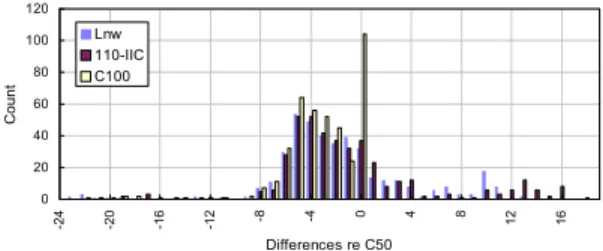
C50 ought to deal more effectively with the low frequency sounds since it includes data down to 50 Hz. The histogram of differences between C50 and the other ratings is shown in Figure 2. 0 20 40 60 80 100 120 -2 4 -2 0 -1 6 -1 2 -8 -4 0 4 8 12 16 Differences re C50 C ount Lnw 110-IIC C100
Figure 2: Distribution of differences re C50
The range of differences is much greater as might be expected since many of the floors in the database were joist floors which usually have most of the transmitted impact energy at low frequencies. Even C100 does not compare very well with the C50 rating. The situation becomes worse when ratings for floor toppings are compared.
4.
TOPPINGS ON CONCRETE SLABS
The ASTM5 and ISO6 test procedures for
evaluating floor coverings or toppings are almost identical. The rating procedures are based on E989 and ISO 717-2 and
are denoted as ∆IIC and ∆Ln,w. Because of the 8 dB rule in
E989, the reference contour for the bare reference slab is 4 dB lower when it is fitted than in the case of the ISO 717
fit. This bias can be further modified by a second application of the 8 dB rule to the reference slab plus the topping.
Toppings might also be evaluated using the differences in the two quantities C50 and C100. Figure 3 compares the two standard ratings with ∆C100. Figure 4 uses ∆C50 as the common reference. These variations are large.
0 5 10 15 20 25 30 3 4 5 6 7 8 9 10 11 12 13 14 15 16 Difference relative to ∆C100 Count ∆Ln,w ∆IIC
Figure 3: Differences between ∆IIC and ∆Ln,w and ∆C100
0 5 10 15 20 25 0 2 4 6 8 10 12 14 16 18 20 22 24 26 28 Difference re ∆C50 Count ∆IIC ∆Ln,w ∆C100
Figure 4: Differences between ∆IIC, ∆Ln,w,, ∆C100 and ∆C50 for
toppings on a concrete slab
5.
TOPPINGS ON JOIST FLOORS
An ISO working group has almost finished creating a test method for evaluating toppings placed on a standard
joist floor7. Toppings placed on joist floors with wood
subfloor do not give the same reduction in impact sound pressure level as they do when placed on a concrete slab. To estimate the magnitude of the differences among ratings, improvement spectra from 41 measurements of toppings on joist floors were applied to a reference spectrum and rated using the four rating schemes. Four new symbols are introduced. These are ∆joistIIC , ∆joistLn,w , ∆joistC100, and
∆joistC50.
Less than half of the differences between ∆joistLn,w and
∆joistIIC are in the range ±1. The ISO 717 based rating tends
to give higher ratings, which was not the case for toppings on concrete.
Figure 5 compares the contour-based ratings with .∆joistC100. The ∆joistLn,w rating tends to be higher than
∆joistC100; ∆joistIIC tends to be lower.
0 2 4 6 8 10 12 14 16 -1 6 -1 4 -1 2 -1 0 -8 -6 -4 -2 0 2 4 6 Difference re ∆joistC100 Count
∆joistIIC ∆joistLn,w
Figure 5: Difference in ratings for toppings on joist floors relative
to ∆joistC100 , the difference in the flat level from 100 to 2500 Hz.
∆joistC50 ought to be the best of these ratings since it
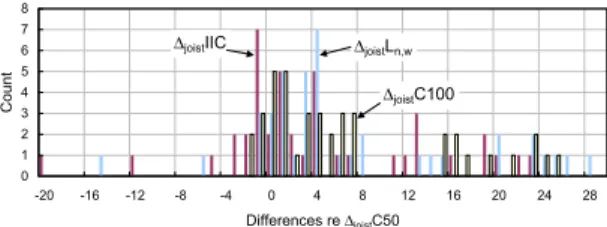
includes low frequencies. It is compared with the other three in Figure 6. Including frequencies below 100 Hz increases disagreement among the ratings.
Some of the differences seem unreasonably large but their cause can be understood when the individual spectra are examined. 0 1 2 3 4 5 6 7 8 -20 -16 -12 -8 -4 0 4 8 12 16 20 24 28 Differences re ∆joistC50 Count ∆joistC100
∆joistIIC ∆joistLn,w
Figure 6: Difference in ratings for toppings on joist floors relative to ∆joistC50.
6. SUMMARY
The poor correlation among the metrics means that complete floor systems are not ranked consistently. When differences in these metrics are used to rank floor toppings, not only are the rankings inconsistent but there is not always agreement that a topping actually improves the floor system. The C type ratings are not mandatory in ISO 717. It would be unwise to make them so without simultaneously
abandoning the use of the contour fitting procedures in E989 and ISO 717-2. To have four contradictory metrics in place would lead to intolerable confusion. It would be ideal if both ISO and ASTM could change simultaneously to an
improved rating. The C50 rating, because of the low frequencies included, might lead to unacceptably large reproducibility ranges for tests on complete floors but should be acceptable for toppings.
REFERENCES
1
ASTM E492. Standard Test Method for Laboratory Measurement of Impact Sound Transmission through Floor-ceiling Assemblies using the Tapping Machine.
2
ISO 140-6. Laboratory measurements of impact sound insulation of floors
3
ISO 717. Rating of sound insulation in buildings and of building elements, Impact sound insulation.
4
ASTM E989. Standard Classification for Determination of Impact Insulation Class (IIC).
5
ASTM E2179. Standard Test Method For Laboratory Measurement Of The Effectiveness Of Floor Coverings In Reducing Impact Sound Transmission Through Concrete Floors.
6
ISO 140-8. Measurement of sound insulation in buildings and of building elements, Laboratory measurement of the reduction of transmitted impact noise by floor coverings on a standard floor
7
ISO 140-11. Laboratory measurements of the reduction of transmitted impact noise by floor coverings on lightweight framed standard floors.