HAL Id: hal-00870225
https://hal.inria.fr/hal-00870225
Submitted on 11 Oct 2013
HAL is a multi-disciplinary open access
archive for the deposit and dissemination of
sci-entific research documents, whether they are
pub-lished or not. The documents may come from
teaching and research institutions in France or
L’archive ouverte pluridisciplinaire HAL, est
destinée au dépôt et à la diffusion de documents
scientifiques de niveau recherche, publiés ou non,
émanant des établissements d’enseignement et de
recherche français ou étrangers, des laboratoires
all the Way to the Client Machine
Marek Zawirski, Annette Bieniusa, Valter Balegas, Sérgio Duarte, Carlos
Baquero, Marc Shapiro, Nuno Preguiça
To cite this version:
Marek Zawirski, Annette Bieniusa, Valter Balegas, Sérgio Duarte, Carlos Baquero, et al.. SwiftCloud:
Fault-Tolerant Geo-Replication Integrated all the Way to the Client Machine. [Research Report]
RR-8347, INRIA. 2013. �hal-00870225�
0 2 4 9 -6 3 9 9 IS R N IN R IA /R R --8 3 4 7 --F R + E N G
RESEARCH
REPORT
N° 8347
August 2013SwiftCloud:
Fault-Tolerant
Geo-Replication
Integrated all the Way to
the Client Machine
Marek Zawirski
UPMC-LIP6 & INRIAAnnette Bieniusa
U. KaiserslauternValter Balegas
U. Nova de LisboaSérgio Duarte
U. Nova de LisboaCarlos Baquero
INESC Tec & U. MinhoMarc Shapiro
INRIA & UPMC-LIP6Nuno Preguiça
U. Nova de LisboaRESEARCH CENTRE PARIS – ROCQUENCOURT
Integrated all the Way to the Client Machine
Marek Zawirski
UPMC-LIP6 & INRIAAnnette Bieniusa
U. KaiserslauternValter Balegas
U. Nova de LisboaSérgio Duarte
U. Nova de LisboaCarlos Baquero
INESC Tec & U. MinhoMarc Shapiro
INRIA & UPMC-LIP6Nuno Preguiça
U. Nova de LisboaProject-Team Regal
Research Report n° 8347 — August 2013 — 24 pages
Abstract: Client-side logic and storage are increasingly used in web and mobile applications to
im-prove response time and availability. Current approaches tend to be ad-hoc and poorly integrated with the server-side logic. We present a principled approach to integrate client- and server-side storage. We support mergeable and strongly consistent transactions that target either client or server replicas and provide access to causally-consistent snapshots efficiently. In the presence of infrastructure faults, a client-assisted failover solution allows client execution to resume immediately and seamlessly access consistent snapshots without waiting. We implement this approach in SwiftCloud, the first transactional system to bring geo-replication all the way to the client machine.
Example applications show that our programming model is useful across a range of application areas. Our experimental evaluation shows that SwiftCloud provides better fault tolerance and at the same time can improve both latency and throughput by up to an order of magnitude, compared to classical geo-replication techniques.
Key-words: geo-replication, causal consistency, transactional causal+ consistency, eventual consistency, fault tolerance
This research is supported in part by ANR project ConcoRDanT (ANR-10-BLAN 0208), by the Google Europe Fellow-ship in Distributed Computing awarded to Marek Zawirski, and by Portuguese FCT/MCT projects PEst-OE/EEI/UI0527/2011 and PTDC/EIA-EIA/108963/2008 and Phd scholarship awarded to Valter Balegas (SFRH/BD/87540/2012).
tolérance aux pannes jusqu’à la machine cliente
Résumé : Afin d’améliorer le temps de réponse et la disponibilité, les applications web et mobiles
s’appuient fréquemment sur l’exécution de code et le stockage de données côté machine cliente. Cepen-dant, les solutions existantes sont « bricolées » et s’intégrent mal avec la logique côté serveur.
Nous présentons une approche méthodique, visant à intégrer le stockage côté client et côté serveur. Elle s’appuie sur des transactions hybrides (permettant aussi bien les mises à jour sans conflit que forte-ment cohérentes), qui accèdent aux données, soit du côté client soit côté serveur, et qui lisent un instan-tané causalement cohérent de façon efficace. Si une faute se produit dans l’infrastructure, le client peut changer de serveur et reprendre immédiatement l’exécution, tout en continuant à accéder sans interrup-tion à son instantané cohérent. Cette approche a été mise en œuvre dans SwiftCloud, le premier système transactionnel à proposer la géo-réplication jusqu’à la machine cliente.
Quelques exemples montrent que notre modèle de programmation est adapée à divers domaines d’application. Notre évaluation expérimentale montre que l’approche SwiftCloud améliore la tolérance aux fautes, et que la latence et le débit sont améliorés d’un ordre de grandeur, par rapport aux approches de géo-réplication classiques.
Mots-clés : géo-réplication, cohérence causale, cohérence transactionnelle causale+, cohérence finale, tolérance aux pannes
1
Introduction
Cloud computing infrastructures support a wide range of services, from social networks and games to col-laborative spaces and online shops. Cloud platforms improve availability and latency by geo-replicating data in several data centres (DCs) across the world [5, 14, 28, 29, 37, 40]. Nevertheless, the closest DC is often still too far away for an optimal user experience. For instance, round-trip times to the clos-est Facebook DC range from several tens to several hundreds of milliseconds, and several round trips per operation are often necessary [43]. Recall that users are annoyed when interactive latency is above 50 ms [22] and increased values turn them away [34]. Furthermore, mobile clients may be completely disconnected from any DC for an unpredictable period of minutes, hours or days.
Caching data at client machines can improve latency and availability for many applications, and even allow for a temporary disconnection. While increasingly used, this approach often leads to ad-hoc implementations that integrate poorly with server-side storage and tend to degrade data consistency guarantees. To address this issue, we present SwiftCloud, the first system to bring geo-replication all the way to the client machine and to propose a principled approach to access data replicas at client machines and cloud servers.
Although extending geo-replication to the client machine seems natural, it raises two big challenges. The first one is to provide programming guarantees for applications running on client machines, at a reasonable cost at scale and under churn. Recent DC-centric storage systems [28, 29, 37] provide trans-actions, and combine support for causal consistency with mergeable objects [35]. Extending these guar-antees to the clients is problematic for a number of reasons: standard approaches to support causality in client nodes require vector clocks entries proportional to the number of replicas; seamless access to client and server replicas require careful maintenance of object versions; fast execution in the client requires asynchronous commit. We developed protocols that efficiently address these issues despite failures, by combining a set of novel techniques.
Client-side execution is not always beneficial. For instance, computations that access a lot of data, such as search or recommendations, or running strongly consistent transactions, is best done in the DC. SwiftCloud supports server-side execution, without breaking the guarantees of client-side in-cache exe-cution.
The second challenge is to maintain these guarantees when the client-DC connection breaks. Upon reconnection, possibly to a different DC, the outcome of the client’s in-flight transactions is unknown, and state of the DC might miss the causal dependencies of the client. Previous cloud storage systems either retract consistency guarantees in similar cases [27–29], or avoid the issue by waiting for writes to finish at a quorum of servers [37], which incurs high latency and may affect availability.
SwiftCloud provides a novel client-assisted failover protocol that preserves causality cheaply. The insight is that, in addition to its own updates, a client may observe a causally-consistent view of stable (i.e., stored at multiple servers) updates from other users. This approach ensures that the client’s updates are not delayed, and that the client’s cached state matches the new DC, since it can replay its own updates and the others are known to the DC.
We evaluate our protocols experimentally, and compare them with a classical geo-replication ap-proach. The experiment involves three data centres in two continents, and hundreds of remote clients. Under sufficient access locality, SwiftCloud enjoys order-of-magnitude improvements in both response time and throughput over the classical approach. This is because, not only reads (if they hit in the cache), but also updates commit at the client side without delay; servers only need to store and forward updates asynchronously. Although our fault tolerance approach delays propagation, the proportion of stale reads remains under 1%.
The contributions of this paper are the following:
• The design of a cloud storage system providing geo-replication up to the client nodes.
Figure 1: SwiftCloud system structure.
model, in a system that includes replicas in the client nodes and in the servers.
• Fault-tolerant techniques for ensuring Transactional Causal+ Consistency guarantees, without adding latency to operations.
• An application study that shows the approach is useful in practice, and reveals where it falls short. • An experimental evaluation of the system, with different applications and scenarios.
2
System overview
SwiftCloud is a data storage systems for cloud platforms that spans both client nodes and data center servers (DCs), as illustrated in Figure 1. The core of the system consists of a set of data centres (DCs) that replicate every object. At the periphery, client nodes cache a subset of the objects. If the appropriate objects are in cache, responsiveness is improved and a client node supports disconnected operation.
2.1
Programming model
SwiftCloud provides a straightforward key-object API, presented in Figure 2. Applications running in the client can execute sequences of read and update operations, grouped into transactions. Transactions can provide either strong or weak consistency, as discussed next.
A client can request the execution of a stored transaction in the data server. A stored transaction is similar to a stored procedure in a database system, and can return a set of objects. Whereas a stored transaction runs completely in the server, a client-side transaction contacts the server only if there is a cache miss. We expect that common operations will execute asynchronously in the client cache, and that
begin () : tx_handle
read (tx_handle, object_id) : object
multi_read (tx_handle, set<object_id>) : set<object> update (tx_handle, object, effect_op) : void
commit (tx_handle) : void rollback (tx_handle) : void
exec_stored_tx (name, params, options): set<object>
Figure 2: SwiftCloud Client API.
Client A Client B Client C Time T1:B.frd.add(A) A.frd.add(B) T4:B.wall.post(m1) T6:R[B.wall]={m1,m2} R[B.frd]={A,C} T3: B.frd.add(C) C.frd.add(B) T5:B.wall.post(m2) T2: R[B.frd]={A} R[A.frd]={B}
Figure 3: Potential-Causality relation in an execution of a social networking application (represented by arrows).
stored transactions and strongly-consistent transactions will be rare. For example, in a social networking application, the user’s wall, and those of his friends, can be served directly in the cache, while computing recommendations, which requires accessing a huge number of objects, will be implemented as a stored transaction.
2.2
Transactional model
This section outlines our transactional model, Transactional Causal+ Consistency. Intuitively, it offers the following guarantees: every transaction reads a causally consistent snapshot; updates of a transaction are atomic (all-or-nothing) and isolated (no concurrent transaction observes an intermediate state); and concurrently committed updates do not conflict.
At the heart of Transactional Causal+ Consistency is the guarantee that state never goes back in time: once a client has read an object version that reflects some update, it cannot observe a state where that update was not applied. As an example, when user A adds friend B to her social network, and later posts something, if B later sees the post, she will also observe that she is A’s friend. This example is illustrated
by T1and T6in Figure 3.
Formally, we define a potential causality relation on operations (augmenting the definition of Lloyd et al. [28] with transactions):
1. Execution Thread. If a and b are two operations invoked by the same client, and a occurs before b, then a b.
2. Gets From. If u is an update and r is a read that returns the value written by u, then u r.
3. Transaction closure. Given a and b, two operations of some transaction T , and x and y, operations that are not part of T : if x a then x b, and if a y then b y.
Execution Threadensures that successive operations executed by a client are dependent. Gets From
ensures that a read depends on the updates it reads. For instance, in Figure 3, the read of B.frd(the
friend set of B) in T6depends on the update to B.frdin T3: B.frd.add(A) R[B.frd] = A. Transaction
Closureensures transaction isolation by extending dependence across all operations in the same
transac-tion. For instance, in Figure 3, B.frd.add(A) R[B.frd] = A is extended to A.frd.add(B) R[B.frd] = A,
guaranteeing that R[A.frd] = B. The relation is transitive and acyclic, hence it is a partial order.
An execution of a system satisfies Transactional Causal+ Consistency if:
1. Every transaction observes a valid snapshot and its own updates: all reads of a transaction observe a state that includes all updates from the same set of committed transactions, and earlier updates of its own transaction, applied in a sequence that is a linear extension of .
2. Every snapshot is causally consistent: the set of observed updates is transitively closed over and includes at least all updates committed earlier in .
For instance, after B observes she is a friend of A and C, she cannot observe that she is friend of A only, since successive reads depend on the read that showed B as friend of both A and C.
Note that this weak definition allows different clients to observe the same set of concurrent updates applied in different orders, which poses a risk of yielding different operation outcomes on different repli-cas or at different times. We address this problem by disallowing non-commutative (order-dependent) concurrent updates. Practically, we enforce this property with two different types of transactions, akin to the model of Walter [37] or Red-Blue [27]:
1. Mergeable transaction can update only objects with commutative operations and always commit. 2. Classic, non-mergeable transaction can perform non-commutative operations, but among
concur-rent transactions with conflicting updates at most one can successfully commit.
2.2.1 Mergeable transactions
The focus of this paper is the efficient and fault-tolerant support of mergeable transactions, i.e., transac-tions with updates that commute with all other updates. Mergeable transactransac-tions commute with each other and with non-mergeable transactions, which allows to execute them immediately in the cache, commit asynchronously in the background, and remain available in failure scenarios.
Read-only transactions are a simple case of mergeable transactions. Concurrent updates are more difficult to handle and often complicated to merge, with many existing systems relying on questionable heuristics, such as last-writer-wins [23, 28, 29]. Our approach is to permit concurrent update transactions on dedicated mergeable objects. Mergeable data types include last-writer-wins registers, the multivalue registers of Dynamo [16], the C-Set of Sovran et al. [37], and a number of higher-level Conflict-free Replicated Data Types (CRDT) of Shapiro et al. [35, 36]. CRDTs include a rich repertoire of high-level objects, such as replicated counters, sets, maps, graphs, and sequences.
CRDTs encapsulate common concurrency and replication complexity and allow to solve them at the system level once for all. However, real application require either complex custom objects or using multiple objects. The former is impractical, whereas the latter raises new issues, lacking cross-object guarantees [12]. Our transactional model introduces simple cross-object ordering guarantees and allows to compose multiple objects in applications. Examples in Section 5 suggest that for many applications mergeable transaction can express the dominant part of the workload. For stronger guarantees, non-mergeable transactions can be used.
2.2.2 Classic, non-mergeable transactions
SwiftCloud supports the traditional strongly-consistent transaction model, in which non-commuting con-current updates conflict (as determined by an oracle on pairs of updates) and cannot both commit. This primitive allows to implement arbitrarily difficult tasks, e.g., to build atomic registers and enforce strong data invariants when necessary.
3
Algorithms for transactions
3.1
Non-mergeable transactions
Non-mergeable transactions execute as stored procedures on the server side. We implement a simple read-one/write-all protocol, using two-phase commit to guarantee that no conflicting concurrent update has previously committed. The commit protocol could be replaced by Paxos Commit [20] for improved fault-tolerance.
3.2
Mergeable transactions
We present the algorithms used to implement mergeable transactions, first in the failure-free case, and later (in Section 4) in the presence of failures. We assume a classical sequential model where a client executes a single transaction at a time, i.e., a replica has a single thread of execution. Applications interface to the system via a local module called scout; we assume for now that it connects to a single DC. For client-side transactions, the scout is located in the client machine; for stored transactions, the code and the scout both run in the DC.
An application issues a mergeable transaction by interactively executing a sequence of reads and updates, and concludes the transaction with either a commit or rollback. Reads are served from the local scout; on a cache miss, the scout fetches the data from the DC. Updates execute in a local copy. When a mergeable transaction terminates, its updates are applied to the scout cache. Eventually, they will also be committed at its DC. The DC eventually propagates the effects to other DCs and other scouts scouts as needed.
3.2.1 System state
The system ensures the invariant that every node (DC or scout) maintains a causally-consistent set of object versions. A DC replicates all objects (full replication). The DC keeps several recent versions of an object, in order to serve the versions requested by scouts on behalf of their transactions. Old versions can be pruned, i.e., discarded, without impacting correctness.
Each DC maintains a vector clock VDCthat summarizes the set of transactions that it has processed.
At DCi, entry VDCi[i] counts the number of transactions that DCi committed. Any other entry VDCi[ j]
counts the number of transactions committed by DCj that DCi has processed. VDCi ≤ VDCj means that
DCiprocessed a subset of the transactions processed by DCj.
A scout S maintains a vector clock VS∗that summarises the transactions reflected by the most recent
version of cached objects. VS∗includes one entry for each DC, plus an additional entry for the transactions
locally committed at S. We denote with VSthe same vector clock restricted to the entries for DCs.
At all times, the globally-committed update transactions observed by a scout are a subset of those
known by its DC, i.e., VS≤ VDC. This invariant is obvious in the failure-free case; Section 4 explains how
we maintain it in the presence of failures.
3.2.2 Transaction execution at scout
An applications starts a transaction by executing begin. This allocates a vector clock D∗T that summarises
the causal dependencies of the transaction. It is set by default to the current state of the scout: D∗T := V∗
S.
Concurrently, while the transaction executes, VS∗increases as S processes committed transactions but D∗T
does not change. Thus, D∗T≤ V∗
S is an invariant.
begin operation also generates the transaction’s Origin Transaction IDentifier (OTID), composed of a monotonically-increasing timestamp and the unique scout identifier. Figure 4 illustrates transaction
C.frd={} B.frd={} V* S=[0 0|0] A.frd={B} B.frd={A} VDC0=[1 0] C.frd={} V* S=[0 0|0] C.frd={B} B.frd={C} V* S= [0 0|1] A.frd={B} B.frd={A,C} VDC0=[2 0] Read(B.frd) D* T5=[0 0|0] DC0 Client C T3: D*T3=[0 0|0] ; OTID: (1 C) B.frd.add(C) C.frd.add(B) Tx record OTID: (1 C) D* T5=[0 0|0] GTID: (2 DC0) {B.frd.add(C) C.frd.add(B)} commit
Figure 4: Execution of T3from Figure 3.
this section. In this example, OTID =(1,C) and D∗
T= [0,0|0] and client C has the set of her friends, C.frd,
on her cache.
Primitives read and multi_read of the SwiftCloud API, read one or several objects respectively. They return a version of the requested object(s) that satisfies the rules of Transactional Causal+ Consistency. If the corresponding version is not found in the cache, it is fetched from the DC. multi_read is an optimization that allows to fetch multiple missing objects in a single round-trip. If the corresponding version has been pruned away, the read fails, and the client has the option of continuing or aborting the transaction with no effect. update is called when an operation is executed on a previously read object. In
our running example, T3reads C.frdfrom the cache but needs to fetch B.frdfrom the DC before updating
it. As D∗T = [0,0|0], the version fetched from the DC still does not include the updates from T1, thus
having B.frd= {}.
Reads and updates execute against the local copies returned by read/multi_read. Update operations log their effect using the update primitive, so that later, the updates can be transmitted to other replicas.
Our mergeable transactions are interactive, i.e., read sets and write sets are determined on the fly by the transaction’s control flow. This enables, for instance, a user to display a consistent view of the network of her friends. This would be difficult in a system with non-interactive transactions such as COPS [28] or Eiger [29], since the data to browse is not known until the transaction reads the user’s friend set.
When a mergeable transaction terminates successfully at the scout, it commits locally. If the transac-tion was read-only, the story stops there. Update transactransac-tion logs its updates (if any) to durable storage,
and updates scout S’s own entry in VS∗with the timestamp part of the transaction’s OTID. The application
may start a new transaction immediately. Otherwise, its updates are now visible to later transactions at
the same scout. In the example of Figure 4, at the end of T3, we can see the cache with the updated value
for B.f rdand C.f rd and the new value of VS∗=[0,0|1], reflecting the OTID of T3.
The scout globally-commits the mergeable transaction by sending asynchronously the transaction’s
OTID, D∗T and updates to its DC. This asynchronous commit creates a durability issue, which we discuss
in Section 4. We expose the durability status of a transaction in the API so that the application can make use of this information, as suggested by Kraska et al. [25].
3.2.3 Transaction commit at the DC
When a mergeable transaction is received in a DC, the DC first checks if it satisfies the transaction’s dependencies. As long as the scout connects to the same DC, and the connection is FIFO, this will be
the protocol waits until dependencies are satisfied.
Globally-committing a transaction by DCiconsists of the following steps: assign it a Global
Trans-action IDentifier (GTID)(k,DCi) such that k = VDCi[i] + 1, log its commit record and update the DC
replicas, and finally increase VDCi[i] to k, thus making the transaction visible. The commit record
con-tains the transaction’s dependence vector D∗T, its OTID, its effects, and its GTID. In our running example,
T3 is assigned GTID = (2,DC0), and VDC0 = [2,0] is updated accordingly. The set of friends of B is
updated by merging the new update into the DC version, by making B.frd= {A,C}.
Later, the DC sends the transaction commit record to other DCs using epidemic propagation [32]. A receiving DC logs the record durably, and if dependencies are satisfied, it applies the updates to the DC replicas and updates its vector clock. Otherwise, the DC delays processing the transaction until the dependencies are satisfied.
3.2.4 Discussion
A globally-committed mergeable transaction (and the object versions that it generates) is identifiable by both its OTID and GTID. The OTID ensures uniqueness, and the GTID allows to refer to a transaction efficiently in a dependence vector. In some failure cases, a transaction may be assigned multiple GTIDs, but as explained in the next section, they are treated equivalently.
Our protocol encodes the causal status of a whole node (DC or scout) with a vector clock. The scout-DC topology, the small and static number of scout-DCs, and the assumption that transaction processing in a scout-DC is linearisable, all contribute to keeping these vectors small. This very compact data structure summarises the whole past history, i.e., the transitive closure of the current transaction’s dependence.
3.3
Cache maintenance
A scout maintains a cache containing replicas of a subset of objects (partial replication). An application may ask to pin an object in the cache; otherwise, the scout manages its cache with an LRU policy. The cache may be updated, either as the result of a local transaction commit, or because the cache is notified of a global commit by its DC. A cache is always updated as the result of executing a stored transaction.
The partially replicated subset is guaranteed causally consistent, but not necessarily complete. For instance, assume the following update causal dependencies: a b c; a scout might maintain only objects corresponding to a and c. If a version (in this example, installed by update b) is missing in the cache, it will be fetched from a DC, in accordance to the current transaction’s snapshot.
The scout processes global-commit records in causal order and atomically, ensuring that every state satisfies Transactional Causal+ Consistency. The scout may either receive a full update on a cached object modified by the transaction, in which case it installs a new version or just an invalidation. A scout does not need to receive an update for an object that is not cached; if it does, it is treated as a no-op.
3.4
Implementation issues
Stored mergeable transactions:Stored mergeable transactions execute using the same approach as
trans-actions executed in the scout, with the difference that transtrans-actions access directly the replicas in the data centre and that the clock of the data centre is used as the snapshot vector.
Scaling transaction processing:The transaction processing process in the DC is linearisable as whole
and our DC implementation is parallel internally. Data is partitioned across multiple storage nodes, and client requests are processed by multiple proxy nodes. Multiple global-commits can proceed concurrently. It is only the update of the DC’s vector clock that needs to be linearised, since this is the step that renders a transaction visible.
A sequencer module at the DC sequentially assigns transaction identifiers. This could become a per-formance bottleneck as well as a central point of failure. Fault-tolerance can be improved by replicating the sequencer, for instance by using chain replication [41] with a short chain. To improve performance, there could be more than one sequencer in each DC, at the expense of larger vectors.
Security: SwiftCloud caches objects and generates updates in the clients. This poses no new major
security threat, with access control enforcement at the cloud boundaries addressing the problem. SwiftCloud does not pose much of new challenges w.r.t. tolerating Byzantine clients. Incorrect op-erations can be tolerated similarly as in classic server-backed systems. Forged dependence vector of a transaction cause no harm to other transactions, same as client sending a wrong OTID (e.g., using the same OTID twice), as long as the DC keeps track of GTIDs and a summary of updates related to the OTID to detect it.
4
Fault-tolerant session and durability
We discuss now how SwiftCloud handles network, DC and client faults, focusing on client-side mergeable transactions. Our focus is primarily on our main contribution, mergeable transactions executing on the client side; we mention other cases briefly.
At the heart of mergeable transactions is causal consistency (i.e., session guarantees [8, 38]), which is easily ensured in the failure-free case, since DCs exchange transactions using causal broadcast, a DC commits a single transaction at a time, and a scout connects to a single DC over a FIFO channel. However, when a scout loses communication with its current DC, due to network or DC failure, the scout may need to switch over to a different DC. The latter’s state is likely to be different, and it might have not processed some transactions observed or indirectly observed (via transitive causality) by the scout. In this case, ensuring that the clients’ execution satisfies the consistency model and the system remains live is more complex. As we will see, this also creates problems with durability and exactly-once execution.
As a side-effect of tolerating DC faults and fail-over, our protocols also support client disconnection. Obviously, if a disconnected client requires state that is not currently cached, it cannot make progress. Similarly, if the client remains permanently disconnected or loses its durable state before reconnecting, there is not much that can be done. However, in-cache disconnected operation is supported “for free,” as long as the scout remains live and eventually reconnects.
4.1
Durability and exactly-once execution issue
The scout sends each transaction to its DC to be globally-committed, to ensure that the DC stores it durably, allocates a GTID, and eventually transmits it to every replica. If it does not receive an acknowl-edgment, it must retry the global-commit, either with the same or with a different DC. However, the outcome of the initial global-commit remains unknown. If it happens that the global commit succeeded with the first DC, and the second DC allocates a second GTID, the danger is that the transaction’s effects could be applied twice under the two identities.
For some data types, this is not a problem, because their updates are idempotent, for instance put(key,value) in a last-writer-wins map. For other mergeable data types, however, this is not true: think of executing increment(10) on a counter. Systems restricted to idempotent updates can be much simpler [29], but in order to support general mergeable objects with rich merge semantics, SwiftCloud must ensure exactly-once execution.
In principle, the DC could check that the transaction’s unique OTID does not appear in the log. Unfortunately, this is insufficient, since the log might be pruned while a scout was disconnected (e.g., during a long journey).
4.2
Causal dependency issue
When a scout switches to a different DC, the state of the new DC may be unsafe, because some of the
scout’s causal dependencies are missing. For instance, in Figure 1, suppose that transaction(23,DC2)
created some object, and later, the Paris scout updates that object. Vector clock VDCO[2] = 22 reveals
that DC0has not yet processed the creation transaction. Therefore, committing the update transaction to
DC0would lead DC into an unsafe state. Unless the scout can find another DC that has processed all the
transactions that it depends upon, its only option is to wait until DC0receives(23,DC2). This might take
a long time, for instance if DC2(which committed the missing transaction) is unavailable.
Before presenting our solution in the next section, let us consider some possible approaches.
Some geo-replication systems avoid creating dangling causal dependencies by making synchronous writes to multiple data centres, at the cost of high update latency [14]. Others remain asynchronous or rely on a single DC, but after failover clients are either blocked like in our example (unavailability) or they violate causal consistency [27–29]. The former systems trade consistency for latency, the latter trade latency for consistency or availability.
An alternative approach would be to store the dependencies on the scout. However, since causal dependencies are transitive, this might include a large part of the causal history and a substantial part of
the database.1 It would be similar to a peer-to-peer system, every scout being a first-class full replica,
with its own component in vector clocks. Traffic and storage requirements would be unbearable in this case.
Finally, a trivial solution would be for a client to observe only its own updates. This would ensure safety but, lacking liveness, would not be useful. To exclude such trivial implementations, we impose the convergence requirement that a client eventually observes all committed updates. Such a relatively weak property does not preclude serving the client with an old safe version, the freedom we use in our approach.
4.3
Fault-tolerant causal consistency
Our approach is to make scouts co-responsible for the recovery of missing session causal dependencies at the new DC. Since, as explained earlier, a scout cannot keep track of all transitive dependencies, we restrict the set of dependencies. We define a transaction to be K-durable at a DC, if it is known to be durable in at least K DCs, where K is a configurable threshold. Our protocols let a scout observe only the union of: (i) its own updates, in order to ensure the “read-your-writes” session guarantee [38], and (ii) the K-durable updates made by other scouts, to ensure other session guarantees, hence causal consistency. In other words, the client depends only on updates that the scout itself can send to the new DC, or on ones that are likely to be found in a new DC. The set of K-durable updates is causally consistent, i.e., it is transitively closed over the relation. When failing over to a new DC, the scout helps out by checking whether the new DC has received its recent updates, and if not, by repeating the commit protocol with the new DC.
The scout can switch to a DC, as long as this new DC ensures that the scout continues to observe a monotonically-growing set of K-durable updates. This is possible, since the scout’s own updates that are not K-durable cannot depend on updates from another scout that are themselves not K-durable.
SwiftCloud prefers to serve a slightly old but K-durable version, instead of a more recent but more risky version. Instead of the consistency and availability vs. latency trade-off of previous systems, Swift-Cloud trades availability for staleness. Since our system relies on gossiping between DCs, to some extent, the larger the parameter K, the higher the probability that an update that is K-durable at some DC will be found K-durable in another random DC. However, higher values of K cause updates to take longer to 1 Requiring programmer to provide explicit causal dependencies at the programming level may reduce the amount of direct
become visible and may increase the risk that an update is blocked by a network partition. On the other hand, lower values may increase the chance that a scout will not be able to find a suitable DC to fail-over
to. In particular, K= 1 corresponds to the original blocking session-guarantees protocol of Terry et al.
[38].
In practice, K≥ 2 is a good compromise, as it ensures session guarantees without affecting liveness
in the common case of individual DC failures or disconnections [14]. Our implementation uses K= 2,
tolerating a single fault. A better approach might be K= 3, to tolerate a single fault when a DC is closed
for scheduled maintenance [14].
By delaying visibility, rather than delaying writes like some previous works, we move the cost of causal consistency from the domain of commit-time latency, into the domain of data staleness. Our evaluation in Section 6 shows that our approach improves latency, with a negligible impact on staleness. The staleness increases concurrency of updates in the system, which is tolerable, since SwiftCloud uses mergeable objects to handle that seamlessly.
4.3.1 Discussion
Mahajan et al. [30] establish that causal consistency2is the strongest achievable consistency in an
always-available convergent system. The practical problem of ensuring similar guarantees in the presence of partial replicas, or of clients switching servers, was not addressed before. We demonstrated how to ensure Transactional Causal+ Consistency for clients under this new assumption, at the price of weaker liveness property.
4.4
Fault-tolerant exactly-once execution
We now address the remaining issue of ensuring that each update is delivered exactly once at each replica, a problem that arises with any commit protocol that allows retries. Simply repeating the global-commit protocol until the scout receives an acknowledgment takes care of one half of the problem, i.e., at-least-once delivery. We now consider the other half, eliminating duplicates in the presence of failures and pruning.
Our approach separates the concerns of tracking causality and of uniqueness, following by the insight of Preguiça et al. [33]. Recall (Section 3.2.4) that a transaction has both a client-assigned OTID, and one or more DC-assigned GTIDs. The OTID identifies it uniquely, whereas a GTID is used when a summary of a set of transactions is needed. Whenever a scout globally-commits a transaction at a DC, and the DC does not have a record of this transaction already having a GTID, the DC assigns it a new GTID. This approach makes the system available, but may assign several GTID aliases for the same transaction. All
alias GTIDs are equivalent in the sense that, if updates of T′depend on T , then T′comes after T in the
causality order, no matter what GTID T′uses to refer to T .
When a DC processes a commit record for an already-known transaction with a different GTID, it adds the alias GTID to its commit record on durable storage.
To provide a reliable test whether a transaction is already known, each DC maintains durably a map
of the last OTID received from each scout, noted maxOTIDi[S] for scout S and DCi.3 Thanks to causal
consistency, maxOTIDi[S] is monotonically non-decreasing.
When a DCireceives a global-commit message from scout S, it checks that its OTID is greater than
maxOTIDi[S]; if so, it allocates a new GTID, logs the commit record, and returns the GTID to the scout.
If it is not greater, this means that this transaction has already been delivered to this DC. In this case, 2Specifically, a stronger variant involving real-time dependencies.
3The number of entries in maxOTID is the number of scouts, which can be large. However, a map is local to a DC, and never
transmitted and the number of active clients is more limited. Supporting even millions of clients is well within the DC storage capabilities.
the DC searches its log for a commit record with the same OTID. If one is found, the DC returns the corresponding GTID to the scout.
Otherwise, this means that the commit record has been pruned. This raises the question of how the client will refer to the transaction in causal dependencies of subsequent transactions. It turns out this is not necessary: as only transactions that were processed by all DCs are pruned, such dependencies will be always satisfied; therefore, a null GTID is returned to the client.
Note that scouts do not need to worry about exactly-once delivery, since a scout will communicate with a DC only if the latter has processed a superset of the K-durable transactions that the scout has observed.
4.5
Fault tolerance on server-side
The fault tolerance algorithm just described is not directly applicable to update transactions executing on the server (DC) side, issued by exec_stored_proc call. We discuss briefly possible fault tolerance options here; these were not implemented in our prototype.
In the case of non-mergeable transactions, it is sufficient to tag a request with OTID and eliminate du-plicate execution using existing concurrency-control, treating dudu-plicates as concurrent conflicting trans-actions.
A similar technique can be applied to mergeable transactions executing on the server-side. In this
case, however, the OTID is augumented with a dependency vector D∗T. As long as client uses the same
OTID and D∗T for reissued transaction requests and the transaction processing is deterministic w.r.t. a
database version, duplicate execution of the transaction can only result in producing updates with the same identity, which is addressed by the technique in Section 4.4.
5
Building applications
The SwiftCloud approach is designed to fit best applications with sufficient locality to run in a small cache even if the total database size is large, and that use mergeable transactions mostly. We demonstrate the applicability of our application and consistency model by implementing a range of applications that meet these characteristics. Evaluating the performance of these applications is the focus of Section 6.
5.1
SwiftSocial social network
The SwiftSocial application is our port of WaltSocial, a simple social network prototype [37]. The port was straightforward, using the data types from the CRDT library and transactions. The SwiftSocial-specific code consists of approximately 680 Java LOC with few comments.
SwiftSocial maps (using a CRDT map) a user to his profile information (a LWW-Register) and to set CRDTs containing his wall messages, events, and friendship requests. The event set records every action involving the user, and thus grows linearly in the number of updates.
Update transaction types include registering a user, login (fetches the user’s profile and checks his password; subscribes to updates), logout (unsubscribes), posting a status update on the user’s wall, and sending a message to another user’s wall or accepting friendship request. Read-only transactions view another user’s wall, or list his friends. The workloads used in Section 6 consist of user sessions running a mix of these transactions.
Transaction’s atomicity ensures that accepting a friendship request updates both users’ friendship sets consistently or a notification event is added together with a wall post. Causality naturally helps user-experience, for example when a user follows a conversation thread, replies appear after the original messages. It also helps programming in some cases, since, in the same case, reply to a message does need to be processed (e.g. rendered) without a message.
We found that only the user registration transaction should preferably be of a non-mergeable type, in order to name users uniquely. A more advanced social network application could benefit from some server-side procedures, e.g., for searching user, content or suggesting advertisements.
5.2
SwiftDocs collaborative documents
Collaboration tools are typical applications that benefit from low-latency, highly-available client-side ac-cess to data, including offline. Our SwiftDocs application implements a mergeable file-system hierarchy with mergeable file types that allows to share documents and edit them concurrently. SwiftDocs sub-sumes some of the functionality of a DVCS like Git or Mercurial, and of online collaborative editors such as Google Docs.
SwiftDocs consists of a naming tree of directories, implemented using CRDT map objects. A di-rectory maps unique keys, which are strings of the form name ! type, to objects of arbitrary CRDT type. This hierarchical structure provides a variety of semantically different data objects for collaboration. For
instance, foo.txt ! lww refers to a file managed as untyped blob with LWW-Register semantics, whereas
foo.txt ! seq is a text file with fine-grained automatic merging of updates, managed as a conflict-free se-quence [42]. A family can edit their family tree without conflict by storing it as a CRDT object of type graph, e.g., The_Simpsons_family_tree ! graph.
Transactions ensure consistency across multiple object and updates. For instance, a user might snap-shot a subtree, perform updates throughout it (e.g., replace the word “SwiftCloud” in all files with another name), copy it to a different place, and delete the original, all as a single transaction.
Concurrent updates are merged using the following heuristic. Concurrently creating and populating two directories under the same name takes the union of elements; elements with the same name ! type are merged recursively. The semantics of merging two files is given by the merge method of their type. Embedding the type in the lookup key ensures that only files of the same type are merged.
Removing a directory recursively calls the remove interface of its elements. If remove is concurrent with another user’s update, remove wins and update is lost. However, the second user’s work can be accessed by recreating a snapshot that does not include the deletion. Furthermore, she can reinstate the missing file under its original unique key using a version of create().
The move operation is implemented as a mergeable transaction that takes a snapshot of the source subtree, copies it recursively, then recursively removes the source subtree. Anomalies may occur if the source is modified concurrently. To implement the Posix rename semantics, re-linking a subtree at a dif-ferent location, would require using a classical serialisable transaction; otherwise cycles might appear [7]. SwiftDocs operations exhibit good locality: caching a subtree and a global map may be often suffi-cient for good latency and disconnected support.
5.3
TPC-W benchmark
The TPC-W benchmark simulates an online book store. Simulated clients browse items, interact with shopping carts, and check out. We ported an existing open-source Java implementation [19] to Swift-Cloud. Our objectives were to demonstrate porting an existing application, and to provide the reader of this paper with a familiar point of reference.
Transactions are essential in TPC-W but most can be mergeable, with checkout being an exception that needs synchronous execution in the DCs. Checkout atomically pays for, and adjusts the stock of, each item in the shopping cart.
We model TPC-W database with CRDTs. For instance, a CRDT set represents the shopping cart, thus avoiding the anomalies of the Amazon shopping cart [16]. We index product records using CRDT sets. A CRDT counter is used to track the stock of each item. The benchmark specification allows stock to
Figure 5: Experimental topology and round-trip times.
become negative, as long as is eventually replenished. If desired, enforcing non-negative stock could be achieved by using non-mergeable transactions.
TPC-W can display some problems when naively ported to being executed at the edge. Namely, operations involving large read sets, such as queries to the whole product database, tend to perform poorly in the client cache. SwiftCloud can tackle this sort of issue by leveraging stored transactions.
6
Evaluation
This section presents an experimental evaluation of SwiftCloud based on the applications described in the previous section. The aim of this study is to assess the relative strengths and weaknesses of executing application logic at the two opposite ends provided by the SwiftCloud platform. Namely, we will compare our caching approach, executing both reads and updates at the client, against the standard approach of doing updates in the DC. As such, the horizontal scalability of DCs is not evaluated; in fact, all the (parallel) components of a SwiftCloud DC run on a single server in these experiments.
6.1
Experimental setup
SwiftCloud is written in Java. Approximate code sizes, including javadoc, are as follows: whole system, 20K LOC; DC-specific, 3.5K LOC; scout-specific, 3K LOC; CRDT library 5K LOC. It runs over a pre-existing communication, serialisation, and DHT package of approximately 12K LOC. Durable state is stored in a Berkeley DB database.
We run DCs in three Amazon EC2 availability zones, and clients on 96 PlanetLab machines located geographically near the DCs. Figure 5 describes their approximate geographical locations and round-trip times (RTTs). EC2 machines are equivalent to a single core 64-bit 2.0 GHz Intel Xeon virtual processor (2 ECUs) with 3.75 GB of RAM and run Java OpenJDK 64-bit IcedTea7 (Server) above Linux 3.2. Plan-etLab nodes have heterogeneous specifications and latencies. We use default system settings throughout. We compare configurations with one DC (Ireland), two (+ Oregon) and three DCs (+ North Virginia). Within an experiment, we vary parameters but keep constant the set of PlanetLab nodes. We vary the number of clients by adding more independent client threads per PlanetLab node, thus keeping the net-work latency distribution invariant.
A state-of-the-art geo-replication configuration is achieved by co-locating SwiftCloud scouts (with a cache size set to zero) within the DC. Its non-fault-tolerant “Cloud-noFT” configuration performs its updates at a single DC synchronously, and propagates them asynchronously to the others. The “Cloud-FT” configuration writes to two DCs synchronously, simulating disaster-tolerant geo-replication systems such as a configuration of Walter [37].
In the fault-tolerant “SwiftCloud” configurations, each client thread has a co-located scout, with a dedicated cache size of 512 objects, and uses the asynchronous global-commit protocol. In the alternative
0 10 20 30 40 50 60 70 80 90 100 0 50 100 150 200 250 300 Cumulative O currences [ % Latency [ ms ] reads, Cloud FT writes, Cloud FT reads, Cloud noFT writes, Cloud noFT reads, SwiftCloud writes, SwiftCloud reads, SwiftCloud naiveFT writes, SwiftCloud naiveFT
(a) All clients
0 10 20 30 40 50 60 70 80 90 100 0 50 100 150 200 250 300 Cumulative O currences [ % Latency [ ms ] reads, Cloud FT writes, Cloud FT reads, Cloud noFT writes, Cloud noFT reads, SwiftCloud writes, SwiftCloud reads, SwiftCloud naiveFT writes, SwiftCloud naiveFT
(b) One client 0 10 20 30 40 50 60 70 80 90 100 0 20 40 60 80 100 120 140 Cumulative O currences [ % Latency [ ms ] reads, 10% reads, 30% reads, 50% reads, 70% writes, 10% writes, 30% writes, 50% writes, 70%
(c) Various cache miss-ratios
Figure 6: Perceived latency for SwiftSocial.
“SwiftCloud-naiveFT” configuration, commit is synchronous and returns only when durable in at least two DCs.
All configurations evaluated, including Cloud-FT and Cloud-noFT, leverage the same codebase. They represent the extremes of the SwiftCloud system application logic distribution spectrum. The Cloud-FT/noFT configurations correspond to the classical approach where most or the entire application logic runs at the server in the DC, whereas the SwiftCloud configurations strive for the opposite, moving as much as possible to the client. Our evaluation emphasises the impact on performance of these two opposites.
6.2
Latency
We first evaluate the responsiveness of end-user operations, using the SwiftSocial benchmark. It simulates 25,000 users, each one associated to 25 friends uniformly at random, simulating user sessions as described in Section 5.1. 10% of transactions involve modifications; the rest are read-only. 90% of transactions involve data of the current user and his friends, and hit the cache once it is warm; the other 10% target (uniformly) random users and produce cache misses.
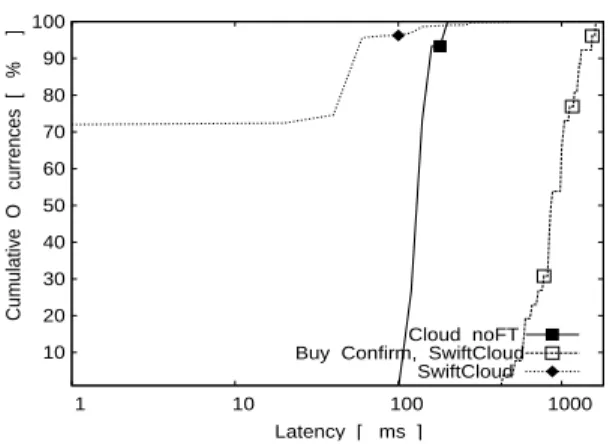
Figure 6(a) plots the CDF of the perceived latency of executing a transaction. In the SwiftCloud default configuration, around 90% of transactions have near-zero latency, the remaining 10% having variable latencies. This corresponds nicely to the 90/10% that respectively hit/miss in the cache; the cost of a miss depends on the RTT to the closest DC, which varies between PlanetLab nodes. Remember that,
10 20 30 40 50 60 70 80 90 100 1 10 100 1000 Cumulative O currences [ % ] Latency [ ms ] Cloud noFT Buy Confirm, SwiftCloud
SwiftCloud
Figure 7: Latency for TPC-W browsing workload.
with mergeable data, updates occur in cache, not just reads.
In the Cloud-noFT configuration, transaction latency is proportional to the client-DC RTT. Cloud-FT suffers additional latency for writing to a quorum. These classical configurations provide worse latency for both reads and writes, when compared with SwiftCloud. Fault-tolerant approaches requiring writing to a quorum of replicas synchronously penalise writes heavily, when compared with SwiftCloud client assisted failover approach. The same happens with the SwiftCloud-naiveFT configuration for the same reason.
Figure 6(b) shows the operation latency experienced by a particular client (other clients have a similar pattern, with the lines being shifted right or left depending on their RTT to the DC).
In Cloud-noFT and Cloud-FT, submitting a request costs a single RTT to the DC. With the SwiftCloud approach, each miss costs one RTT. When the benchmark accesses a non-friend, a cache miss fetches the first read, followed by several others (usually a read followed by a multi_read). For applications relying highly on client-side execution, the main drawback is that cache misses can be costly. It can be mitigated by moving execution of the most offending code paths to the server. To further address this issue in systematic a manner, we are implementing a mechanism to automatically switch to DC-side execution upon a cache miss.
Figure 6(c) plots the CDF of the perceived latency increasing the cache miss ratio by increasing the ratio of operations over non-friends. We can see that 90% of read-write transactions have zero latency, as writes are always on cached data, i.e., objects from the user or from friends. The ratio of read-only transactions experiencing zero latency is directly proportional to the cache hit ratio, as cache misses must be served from the DC. These results are compatible with the results obtained for TPC-W browsing workload with 95% read-only transactions, in a similar deployment, and a system configuration that exhibits 76% hit ratio (Figure 7). This result also shows that the checkout operation (buy confirm), requiring synchronous execution in the DC, presents high latency, as expected.
6.3
Throughput vs. latency
We now investigate how SwiftCloud performance compares with classical geo-replication approaches and how it scales with the number of DCs. Figure 8(a) plots throughput vs. latency, comparing SwiftCloud with Cloud-noFT, running the same SwiftSocial benchmark as before. It shows configurations with one, two and three DCs. In each configuration, we increase the load by adding more simulated clients. As the load increases, initially throughput improves while latency does not change; however, as the system saturates, throughput ceases to improve and latency becomes worse. Eventually, throughput decreases as well. We use a log-log scale; down and to the right is better.
10 100 1000 1 10 100 Latency [ ms ] TPM [ x 1000 ] 1 DC Cloud-noFT 2 DC Cloud-noFT 3 DC Cloud-noFT 1 DC SwiftCloud 2 DC-SwiftCloud 3 DC SwiftCloud
(a) 10% cache misses
10 100 1000 1 10 100 Latency [ ms ] TPM [ x 1000 ] 1 DC SwiftCloud 2 DC SwiftCloud 3 DC SwiftCloud (b) 50% cache misses
Figure 8: Performance of SwiftCloud (SwiftSocial).
The plot shows that, at equal hardware cost, SwiftCloud has order-of-magnitude better response time and better throughput, than the classical geo-replication approach, even though SwiftCloud is fault tol-erant and Cloud-noFT is not. The explanation is simple: SwiftCloud absorbs 90% of transactions in its cache. Recall that even updates are cached.
Interestingly, although adding a third DC to SwiftCloud improves latency and throughput at first, it does not improve peak performance at saturation, in contrast to the DC-based approach. The reason is that DCs are fully replicated, i.e., every DC processes every update transaction. In the Cloud case, additional DCs allow to process more read-only transactions in parallel, but for SwiftCloud this effect is negligible because read-only transactions were already absorbed by the client-side cache. In this benchmark, 10% of the transactions are read-only transactions that access the DC because of a miss, and 10% are updates that must global-commit in the DC. With a single DC, there is an equal number of both. With two DCs, each DC processes only half of the reads but all of the updates. Thus, the impact of adding a DC is less than in the Cloud setup. Additionally, the faster read transactions execute, the faster additional commits are sent to the DCs. This trend continues when adding additional DCs.
We confirm this explanation by increasing the amount of cache misses to 50% in Figure 8(b). The ratio is now five read-only transactions for one update transaction. This larger ratio is expected to enable SwiftCloud to scale with the number of DCs, as more read-only transactions will benefit from executing in a closer DC. This hypothesis is confirmed by the plot.
In summary, client-side caching of mergeable data enables scalable shared storage with a potentially reduced, cheaper DC infrastructure.
6.4
Staleness due to fault-tolerance
We showed in Section 6.2 that our approach to fault tolerance minimises the latency perceived by end-users, compared to the alternatives. However, it slows down propagation of updates; our next experiment aims to quantify by how much. A read will be considered stale if it returns a (K-durable) version, and a more recent (non-K-durable) one exists and satisfies Transactional Causal+ Consistency. Preliminary work (not shown here) showed that with the benchmarks used so far, the number of stale reads is neg-ligible. The reason is that the window of vulnerability — the time it takes for a transaction to become K-durable — is very small, approximately the RTT to the closest DC. We run the SwiftSocial benchmark with 190 PlanetLab nodes spread across Europe and five clients per node, connected to the Ireland DC and replicated in the Oregon DC. To further increase the probability of staleness, we make transactions longer by setting the cache size to zero, requiring reads to contact a DC, and commit to the farthest-away
0 1 2 3 4 5 0 5 10 15 20 25 O p s w / st a le re a d s [ % ]
Social Network DB Size [ users x 1000] Individual Reads
Transactions
Figure 9: Staleness of reads due to fault tolerance algorithm in SwiftCloud as a function of contention (SwiftSocial). 0 50 100 150 200 250 300 350 400 0 10 20 30 40 50 60 70 80 L a te n cy [ ms ] Time [ s ]
Figure 10: Latency for a single client switching data centres
DC, with a RTT of around 170 ms.
Figure 6.3 shows the occurrence of stale read operations, and of transactions containing a stale read, for different sizes of the database. We have 950 concurrent clients; with 2,500 simulated users, at any time approximately 40% of the users are actively executing operations concurrently. Even in this case, stale reads and stale transactions remain under 1% and 2.5% respectively. This number decreases as we increment the size of the database, as expected. This shows that even under high contention, accessing a slightly stale snapshot has very little impact on the data read by transactions.
6.5
Behaviour during faults
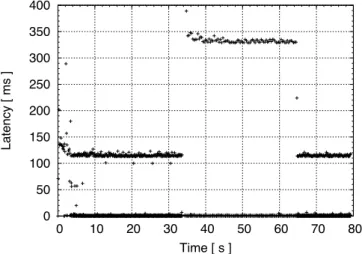
Our final experiment studies the behaviour of SwiftCloud when a DC becomes disconnected or fails. In this case, clients fail-over to another DC. The scatterplot in Figure 10 plots the latency of transactions at an individual client as its scout switches DCs, while running the SwiftSocial benchmark. Each dot represents the latency of an individual transaction. Starting with a cold cache, latency quickly drops to near zero for most transactions, those hitting in the cache, and to around 110 ms for those that perform remote reads due to cache misses. Approximately 33 s into the experiment, the scout is diverted to another DC in a different continent. The new latency pattern reflects the increased cost of cache misses, due to the higher RTT to the DC, which also causes a visible drop in throughput (sparser dots). At 64 s, the
client switches back the initial data centre, and performance smoothly recovers to the initial pattern. Note that there are no significant gaps associated with switching, showing that the protocol incurs negligible disruption to the client.
7
Related work
Cloud storage systems provide a wide range of consistency models. Some systems [14, 41] provide strong consistency [21], at the cost of unavailability when a replica is unreachable (network partitions) [18]. At the opposite end of the spectrum, some systems [39] provide only eventual consistency (EC), but allow any replica to perform updates even when the network is partitioned. Other systems’ consistency models lie between these two extremes.
Weak consistency: Causal consistency strengthens EC with the guarantee that if a write is observed, all previous writes are also observed. Mahajan et al. [30] show that, in the presence of partitions, this is the strongest possible guarantee in an always-available, one-way convergent system. To cope with concurrent updates, Causal+ Consistency incorporate mergeable data. This is the model of COPS [28], Eiger [29], ChainReaction [1] and Bolt-On [4]. These systems merge by last-writer-wins. Some also support an application-provided merge function; for instance Sporc [17] relies on operational transformation.
COPS and ChainReaction implement read-only transactions that are non-interactive, i.e, the read set is known from the beginning. Eiger additionally supports non-interactive write-only transactions. SwiftCloud extends these works with interactive transactions, integrated mergeable types support and support for DC failover. A similar approach, including the study of session guarantees and atomicity, was discussed by Bailis et al. [3]. Burckhardt et al. [10] and Orleans [11] also provide a model of transactions for EC that uses a branch-and-merge model with main revision, suitable for smaller databases.
Dynamo [16] and similar systems [24, 26] ensure EC and per-key causality. The timeline consistency of PNUTS [13] and the snapshot consistency of Megastore [5] enforce a total order on updates, but im-prove performance by allowing applications to read stale data. Walter [37] and Gemini [27] support both weak and strong consistency in the same system, for disjoint sets of objects and of operations respectively. Our support for non-mergeable transactions uses Gemini’s approach.
Concurrent updates: The last-writer-wins (LWW) rule [23] for for managing concurrent updates selects between concurrent versions the one with the highest timestamp [1, 4, 26, 28, 29]. Depot [31], Dynamo [16] and CAC [30] maintain all concurrent versions, letting the application merge them some-how.
The theoretical basis for mergeable data is commutativity and lattice theory. Conflict-free Replicated Data Types (CRDTs) [35, 37], proved to be mergeable using montonic semi-lattice or commutativity,
pro-vide abstractions such as sets, graphs, maps, counters and sequences. BloomLuses program analysis to
check that a program’s state progresses monotonically in a semi-lattice, and if not inserts a synchronisa-tion point [12]; in comparison, our model does not enforces determinism w.r.t. program input and avoids certain synchronisation points, but puts more work on application programmer to design transactions.
SwiftCloud offers CRDTs because several useful abstractions are available, richer yet subsuming LWW. CRDTs were recently added to Riak [24] and Walter uses a set-like CRDT. SwiftCloud is the first mergeable-data system to support transactions that span multiple CRDT types.
Fault-tolerance: With respect to tolerating DC faults, from the perspective of an end-client, previous geo-replication systems fall into two categories. Synchronous replication [14, 15] can ensure that clients observe a monotonic history in the presence of DC faults, but at the cost of update latency.
Existing asynchronous replication systems ensure fault-tolerant causal consistency only within the boundaries of the DC [4, 27–29, 37]. Their clients do not keep sufficient information to ensure causal consistency when a failure causes them to switch DCs. These approaches trade low update latency for consistency or availability. To the best of our knowledge, SwiftCloud is the first low-latency,
highly-available system that guarantees convergent causal consistency with transactions all the way to resource-poor end clients.
Bailis et al. [4] observe that causal consistency can be decomposed into separate safety and liveness components and that presenting clients with stale versions can eliminate waiting for safety dependencies. We stretch this idea to the client that is not a full replica.
Session guarantee protocols [38] implement the safety component of causal consistency. Brzezi´nski et al. [9] propose a protocol using K-durability. This allows the client to change server, but their protocol is synchronous and does not ensure exactly-once delivery.
Depot [31] is the system most similar to SwiftCloud. Depot ensures causal consistency and high availability to clients, even in the presence of server faults. Clients can communicate directly with one another. Depot is designed to tolerate Byzantine faults, a more difficult class of faults than SwiftCloud. However it is not designed to scale to large numbers of clients, to co-locate data with the user without placing a server in the user’s machine, nor does it support transactions.
8
Conclusion
We presented the design of SwiftCloud, the first system that brings geo-replication to the client machine, providing a principled approach for using client and data centre replicas. SwiftCloud allows applications to run transactions in the client machine, for common operations that access a limited set of objects, or in the DC, for transactions that require strong consistency or accessing a large number of objects. Our evaluation shows that the latency and throughput benefit can be huge when compared with traditional cloud deployments for scenarios that exhibit good locality, a property verified in real workloads [6].
SwiftCloud also proposes a novel client-assisted failover mechanism that trades latency by a small increase in staleness. Our evaluation shows that our approach helps reducing latency while increasing stale reads by less than 1%.
Several aspects remain open for improvement. Better caching heuristics, and support for transaction migration, would help to avoid the high latency caused by successive cache misses. Placing scouts at dif-ferent levels of a hierarchy, in particular in Content Delivery Network points of presence, might improve perceived latency even more. Finally, a better integration at the programming language level could help address engineering concerns, such as data encapsulation across software stack.
References
[1] S. Almeida, J. Leitão, and L. Rodrigues. ChainReaction: a causal+ consistent datastore based on chain replica-tion. In Euro. Conf. on Comp. Sys. (EuroSys). ACM, Apr. 2013.
[2] P. Bailis, A. Fekete, A. Ghodsi, J. M. Hellerstein, and I. Stoica. The potential dangers of causal consistency and an explicit solution. In Proceedings of the ACM Symposium on Cloud Computing (SoCC), 2012.
[3] P. Bailis, A. Fekete, A. Ghodsi, J. M. Hellerstein, and I. Stoica. HAT, not CAP: Highly Available Transactions. In W. on Hot Topics in Operating Systems (HotOS XIV). ACM, May 2013.
[4] P. Bailis, A. Ghodsi, J. M. Hellerstein, and I. Stoica. Bolt-on causal consistency. In Int. Conf. on the Mgt. of Data (SIGMOD), New York, NY, USA, June 2013. Assoc. for Computing Machinery.
[5] J. Baker, C. Bond, J. C. Corbett, J. Furman, A. Khorlin, J. Larson, J.-M. Léon, Y. Li, A. Lloyd, and V. Yushprakh. Megastore: Providing scalable, highly available storage for interactive services. In Biennial Conf. on Innovative DataSystems Research (CIDR), pages 229–240, Asilomar, CA, USA, Jan. 2011. URL http://www.cidrdb.org/cidr2011/Talks/CIDR11_Larson.pdf.
[6] F. Benevenuto, T. Rodrigues, M. Cha, and V. Almeida. Characterizing user behavior in online social networks. In Proceedings of the 9th ACM SIGCOMM conference on Internet measurement conference, IMC ’09, pages 49–62, New York, NY, USA, 2009. ACM. ISBN 978-1-60558-771-4. doi: 10.1145/1644893.1644900. URL http://doi.acm.org/10.1145/1644893.1644900.
[7] N. Bjørner. Models and software model checking of a distributed file replication system. In Formal Methods and Hybrid Real-Time Systems, pages 1–23, 2007. URL http://dx.doi.org/10.1007/978-3-540-75221-9_1. [8] J. Brzezi´nski, C. Sobaniec, and D. Wawrzyniak. From session causality to causal consistency. In
Proc. of 12th Euromicro Conf. on Parallel, Distributed and Network-Based Processing, 2004. URL http://citeseerx.ist.psu.edu/viewdoc/download?doi=10.1.1.106.3608&rep=rep1&type=pdf.
[9] J. Brzezi´nski, D. Dwornikowski, Ł. Pi ˛atkowski, and G. Soba´nski. K-resilient session guarantees synchroniza-tion protocol for mobile ad-hoc networks. Parallel Processing and Applied Mathematics, 7203:30–39, 2012. URL http://www.springerlink.com/index/G75577J3M2210502.pdf.
[10] S. Burckhardt, M. Fähndrich, D. Leijen, and M. Sagiv. Eventually consistent transactions. In Euro-pean Symposium on Programming (ESOP), Tallinn, Estonia, Mar. 2012. doi: http://dx.doi.org/10.1007/ 978-3-642-28869-2_4.
[11] S. Bykov, A. Geller, G. Kliot, J. R. Larus, R. Pandya, and J. Thelin. Orleans: cloud computing for everyone. In Symp. on Cloud Computing, pages 16:1–16:14, Cascais, Portugal, Oct. 2011. Assoc. for Computing Machinery. doi: http://doi.acm.org/10.1145/2038916.2038932.
[12] N. Conway, W. R. Marczak, P. Alvaro, J. M. Hellerstein, and D. Maier. Logic and lattices for distributed programming. In Proceedings of the ACM Symposium on Cloud Computing (SoCC), 2012.
[13] B. F. Cooper, R. Ramakrishnan, U. Srivastava, A. Silberstein, P. Bohannon, H.-A. Jacobsen, N. Puz, D. Weaver, and R. Yerneni. Pnuts: Yahoo!’s hosted data serving platform. Proc. VLDB Endow., 1(2):1277–1288, Aug. 2008. doi: 10.1145/1454159.1454167. URL http://dx.doi.org/10.1145/1454159.1454167.
[14] J. C. Corbett, J. Dean, M. Epstein, A. Fikes, C. Frost, J. Furman, S. Ghemawat, A. Gubarev, C. Heiser, P. Hochschild, W. Hsieh, S. Kanthak, E. Kogan, H. Li, A. Lloyd, S. Melnik, D. Mwaura, D. Nagle, S. Quinlan, R. Rao, L. Rolig, Y. Saito, M. Szymaniak, C. Taylor, R. Wang, and D. Woodford. Spanner: Google’s globally-distributed database. In Symp. on Op. Sys. De-sign and Implementation (OSDI), pages 251–264, Hollywood, CA, USA, Oct. 2012. Usenix. URL https://www.usenix.org/system/files/conference/osdi12/osdi12-final-16.pdf.
[15] J. Cowling and B. Liskov. Granola: low-overhead distributed transaction coordination. In Annual Technical Conference (Usenix ATC), pages 21–21, Boston, MA, 2012. USENIX Association. URL http://dl.acm.org/citation.cfm?id=2342821.2342842.
[16] G. DeCandia, D. Hastorun, M. Jampani, G. Kakulapati, A. Lakshman, A. Pilchin, S. Sivasubramanian, P. Vosshall, and W. Vogels. Dynamo: Amazon’s highly available key-value store. In Symp. on Op. Sys. Prin-ciples (SOSP), volume 41 of Operating Systems Review, pages 205–220, Stevenson, Washington, USA, Oct. 2007. Assoc. for Computing Machinery. doi: http://doi.acm.org/10.1145/1294261.1294281.
[17] A. J. Feldman, W. P. Zeller, M. J. Freedman, and E. W. Felten. SPORC: Group collaboration using untrusted cloud resources. In Symp. on Op. Sys. Design and Implementation (OSDI), pages 337–350, Vancouver, BC, Canada, Oct. 2010. Usenix. URL http://www.usenix.org/events/osdi10/tech/full_papers/Feldman.pdf. [18] S. Gilbert and N. Lynch. Brewer’s conjecture and the feasibility of consistent, available, partition-tolerant web
services. SIGACT News, 33(2):51–59, 2002. ISSN 0163-5700. doi: http://doi.acm.org/10.1145/564585.564601. [19] P. Gomes. TPC-W benchmark. https://github.com/PedroGomes/TPCw-benchmark, Retrieved