Donor and recipient treatment with the Lazaroid U-74006F do not
improve post-transplant lung function in swine
1Sven Hillinger
a, Ralph A. Schmid
a ,*, Uz Stammberger
a, Annette Boehler
b,
Othmar M. Scho¨b
a, Andreas Zollinger
c, Walter Weder
aa
Department of Surgery, University Hospital, Zu¨rich, Switzerland b
Pulmonary Division, Department of Internal Medicine, University Hospital, Zu¨rich, Switzerland c
Department of Anesthesiology, University Hospital, Zu¨rich, Switzerland
Received 22 June 1998; received in revised form 14 December 1998; accepted 12 January 1999
Abstract
Objective: U-74006F is the only Lazaroid which is currently in clinical use. A number of experimental studies demonstrate that
Lazaroids reduce ischemia/reperfusion injury in various organ systems. We evaluated the effect of U-74006F on reperfusion injury in a large animal model of lung allo-transplantation. Methods: Two different treatment modalities were evaluated and compared with corre-sponding control groups. Unilateral left lung transplantation was performed in 21 weight-matched pigs (24–31 kg). Donor lungs were flushed with 1.5 l cold (1°C) LPD solution and preserved for 20 h. In group I (n=5), donor animals were pretreated with U-74006F (10 mg/ kg i.v.) 20 min before harvest. In addition U-74006F was added to the flush solution (10 mg/l). In group III (n=6), the Lazaroid was given to the donor before flush and to the recipient before reperfusion (3 mg/kg i.v.). Group II and IV (n=5) served as control. One hour after reperfusion, the recipient contralateral right pulmonary artery and bronchus were ligated to assess graft function only. Extravascular lung water index (EVLWI), mean pulmonary artery pressure, cardiac output, and gas exchange were assessed during a 5 h observation period. Lipid peroxidation (TBARS) and neutrophil migration (MPO activity) were measured at the end of the assessment in lung allograft tissue.
Results: A significant change of TBARS concentration was shown in group III (group III 78.7±4.6 pmol/g vs. group IV 120.8±7.2 pmol/ g (P=0.0065) normal lung tissue 41.3±4.2 pmol/g). MPO activity was reduced in group III 3.74±0.25 DOD/mg per min vs. group IV 4.97±0.26 DOD/mg per min (P=0.027), normal lung tissue 1.04±0.27 DOD/mg per min). Pulmonary hemodynamics and gas exchange after reperfusion did not differ between groups. In group I and III, a tendency towards a reduced EVLWI was noted. Conclusion: We conclude that combined treatment of donor and recipient with U-74006F reduces free radical mediated injury in the allograft. However, this intervention did not result in a significant reduction of post-transplant lung edema or improvement of pulmonary hemodynamics. Donor pretreatment alone did not improve lung allograft reperfusion injury. These results indicate that the benefit of U-74006F is too small to consider clinical application in lung transplantation.1999 Elsevier Science B.V. All rights reserved.
Keywords: Lung transplantation; Reperfusion injury; Lazaroids; Animal model; Swine
1. Introduction
During the last 10 years, lung transplantation has become an accepted treatment modality for patients with end stage lung disease. Despite improved organ preservation and peri-operative management, graft dysfunction remains a
signifi-cant and unpredictable clinical problem and occurs in a severe form in over 10% of the recipients.
Activation of humoral and cellular responses are thought to be crucial for the development of post-transplant reper-fusion injury. Important mediators include neutrophil granulocytes, the complement system and oxygen free radi-cals.
Lazaroids are a group of 21-aminosteroids, which were originally synthesized as inhibitors of lipid peroxidation after trauma, bleeding, or ischemia of the CNS. They reduce lipid peroxidation [1,2] and subsequent edema formation
1010-7940/99/$ - see front matter 1999 Elsevier Science B.V. All rights reserved. P I I : S 1 0 1 0 - 7 9 4 0 ( 9 9 ) 0 0 0 2 2 - 6
* Corresponding author. Tel.: +41 1 255 8804; fax: +41 1 255 8805.
1Presented at the 12th Annual Meeting of the European Association for
[3,4] in combination with minimal glucocorticoid- or immu-nosuppressive side effects [5]. The protective capacity of these compounds made them candidates for use in other systems, e.g. post-transplant ischemia/reperfusion. A num-ber of in vivo and ex vivo experiments of ischemia/reperfu-sion injury using different Lazaroid compounds were published with contradictory results [6,7].
However, because of unfavorable pharmacodynamic and pharmacokinetic properties such as toxicity and instability of other Lazaroids [2], U-74006F is still the only substance of this group in clinical use. The purpose of this study was to evaluate the effect of U-74006F on post-transplant reperfu-sion injury using two different treatment modalities – donor pretreatment alone and combined donor/recipient treatment – in a large animal model of unilateral lung transplantation following prolonged preservation.
2. Materials and methods
2.1. Animals and operative procedure
Twenty-one weight-matched pairs of outbreed pigs served as donors and recipients. Harvest and left lung trans-plantation were performed as previously reported [8]. 2.2. Study groups
In group I (n=5) donor animals were pretreated with the 21-aminosteroid U-74006F (Freedox, generously provided by Pharmacia Upjohn AG, Du¨bendorf, Switzerland) 20 min before flush in a dose of 10 mg/kg i.v. over 10 min. In addition U-74006F was added to the low potassium dextran (LPD) solution (Perfadex, generously provided by Upjohn/ Medisan Pharmaceuticals AB, Uppsala, Sweden) in a dose of 10 mg/l. In group III (n=6), the Lazaroid was given to the donor before flush and to the recipient before reperfu-sion (3 mg/kg i.v.). Group II and IV (n=5) served as con-trol, no 21-aminosteroid was administered. The total preservation time was 20 h in all groups. In group I and II, the transplantation was performed after 18 h of cold ischemia (1°C) and a 2 h period of warm ischemia (20°C). In this first series of experiments, donor preparation and implantation were performed without topical cooling of the graft. In groups III and IV, the grafts were cooled topi-cally with ice slush during dissection and implantation to prevent warm ischemia as in clinical practice. U-74006F was administered according to the manufacturers instruc-tions based on toxicity and pharmacological characteristics. All animals received humane care in compliance with the European Convention on Animal Care. The protocol was approved by the local animals study committee.
2.3. Assessment
One hour after reperfusion of the transplanted lung, the
right pulmonary artery and the right main bronchus were ligated to assess allograft function only. During the assess-ment period anesthesia was maintained with Fluothane 1.5%. Systemic arterial, pulmonal arterial, central venous and left atrial pressure were recorded continuously. Arterial and mixed venous blood were collected for gas analysis every 60 min.
At the end of the assessment period, 5 h after reperfusion, the animals were sacrificed. Upper lobe allograft samples were submitted to histologic examination and tissue MPO and TBARS assay.
2.4. Extravascular lung water
Extravascular lung water as direct assessment of reperfu-sion edema was measured as previously described [8].
A fiberoptic catheter (System Cold Z-021, Pulsion, Munich, Germany) is advanced via the external carotid artery into the descending aorta. The indicator bolus con-sists of two components. Indocyanine green serves as vascular marker and ice cold 5% glucose as a thermal intra-and extravascular indicator. The bolus is injected via the external jugular vein with a temperature controlled injector. The dilution curves for dye and temperature are recorded simultaneously in the descending aorta with the thermistor tipped fiberoptic catheter. Thoracic intravascular and extra-vascular fluid volumes are determined based on the mea-surement of the mean transit times for thermal and dye indicators and of the decay time volumes calculated from the indicator dilution curves as described previously [9]. The lung water computer (System Cold Z-021, Pulsion, Munich, Germany) determines the mean transit time for the thermal indicator and for the dye indicator and calcu-lates total thermal volume (ITTV), intrathoracic blood volume (ITBV), and extravascular thermal volume (ETV) [10]. The extravascular thermal volume (ETV) is calculated as follows: ETV=ITTV−ITBV. All measurements were made hourly in triplicate. The mean value was used for analysis.
2.5. Myeloperoxidase assay
Donor and recipient lung samples were frozen immedi-ately and stored at −70°C until assay. Quantitative MPO activity was determined as previously described [11]. Enzyme activity is expressed as the change in optical den-sity unit per milligram of tissue protein per minute (DOD/ mg per min).
2.6. TBARS assays
The thiobarbituric acid-reactive substance (TBARS) levels in lung tissue were measured according to the method of Ohkawa et al. [12] with 10% wet weight per volume homogenate. TBARS levels were determined by reference to a standard curve of 1,1,3,3-tetramethoxypropane (Sigma
Chemicals, Buchs, Switzerland), and the results were expressed as picomoles of malondialdehyde (MDA)/g of wet lung.
2.7. Statistical analysis
All values are given as the mean± standard error of the mean (SEM). Donor weight, recipient weight, total preser-vation time, warm ischemic time, TBARS assay and MPO assay were checked for normal distribution within groups and analyzed by unpaired t-test. Gas exchange, hemody-namic parameters and extravascular lung water were assessed by repeated measures ANOVA and planned com-parison was applied. Analysis was performed by ANOVA (StatView 4.5, Abacus Concepts, 1995). P-values less than 0.05 were considered significant.
3. Results
3.1. Characteristics of experimental groups
No statistical differences between groups (I vs. II and III vs. IV) were noted in donor weight, recipient weight, total preservation time and warm ischemic time (Table 1). 3.2. Reperfusion edema
At the end of the 5 h assessment period, only a tendency towards a reduced allograft reperfusion edema in compar-ison with the controls was noted (group I 5.2±0.2 ml/kg vs. group II 6.7±1.1 ml/kg, P =0.16, and group III 7.4±0.6 ml/kg vs. group IV 9.2±0.9 ml/kg, P=0.13) (Fig. 1). 3.3. Gas exchange
PaO2levels in the Lazaroid treated animals were higher at
the end of the 5 h assessment period (group I 73.52±2.30 kPa vs. group II 69.05±1.61 kPa and group III 74.8 ±2.1 kPa vs. group IV 61.7±7.6 kPa), but statistical analysis did not demonstrate a significant difference between groups. 3.4. Hemodynamic parameters
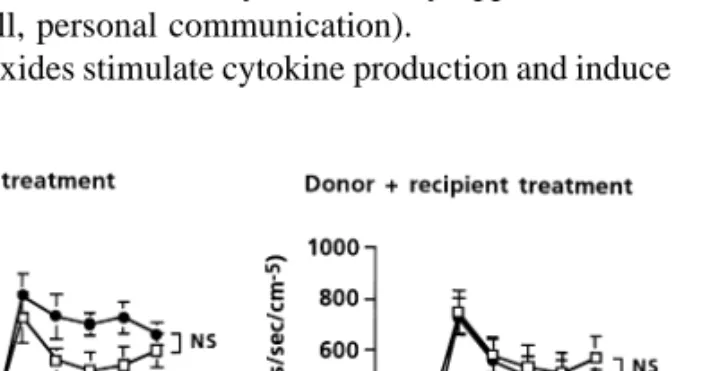
No statistically significant difference between groups was
noted in cardiac output (group I 2.5±0.3 l/min vs. group II 3.1±0.2 l/min and group III 3.6±0.2 l/min vs. group IV 3.1±0.4 l/min), pulmonary vascular resistance (group I 638 ±41 dynes/s per cm−5vs. group II 571±62 dynes/s per cm−5and group III 528±82 dynes/s per cm−5vs. group IV 580±85 dynes/s per cm−5) and pulmonary arterial pres-sure (group I 27±1 mmHg vs. group II 30 ±1 mmHg and group III 31±1 mmHg vs. group IV 32±3 mmHg) during the 5 h assessment period (Fig. 2).
3.5. PMN migration
Allograft MPO activity was reduced in group III animals in comparison with the corresponding control group (group I 3.78±0.30 DOD/mg per min vs. group II 3.25 ±0.37 DOD/mg per min and group III 3.74±0.25 DOD/mg per min vs. group IV 4.97±0.26 DOD/mg per min, (P=0.027). MPO activity in normal unflushed lung tissue was 1.04± 0.27 DOD/mg per min (Fig. 3).
3.6. TBARS
The malondialdehyde concentration as expression for lipid peroxidation was significantly reduced in group III (group I 126.9±15.9 pmol MDA/g vs. group II 120.8 ± 11.8 pmol MDA/g and group III 78.7±4.6 pmol MDA/g vs. group IV 120.8±7.2 pmol MDA/g, normal lung tissue 41.3± 4.2 pmol MDA/g) (P=0.0065) (Fig. 3).
4. Discussion
A number of mechanisms of the non-specific immune system mediate lung allograft ischemia/reperfusion injury. This acute lung injury manifests as post-transplant lung edema with subsequent increase of pulmonary vascular resistance and reduced gas exchange. One of the most important mediators of ischemia/reperfusion injury are superoxide radicals, which are generated during preserva-tion and reperfusion. Oxygen free radicals damage mem-branes and organelles by forming lipid peroxides which alter the configuration and function of these structures.
Lazaroid molecules act as membrane stabilizers by sol-ving in the lipid bilayer of cell membranes with the hydro-phobic steroid moiety located in the lipid phase and the
Table 1
Characteristics of experimental groups
Group (treatment) I (Donor) II (Control) III (Donor+Recipient) IV (Control)
Donor weight (kg) 26.2±0.78 28.2±1.27 27.2±1.1 27.1±1.2
Recipient weight (kg) 25.5±0.55 27.8±1.27 26.5±0.6 27.6±2.3
Total preservation time (min) 1221±11 1215±16 1180±3 1218±16
Warm ischemic time (min) 146±7 148±7 44±5 46±4
more hydrophilic heterocyclic ring system near the phos-pholipid head groups [13]. In addition, Lazaroids are known to act as potent free radical scavengers [2].
In experimental and clinical studies, a beneficial effect of Lazaroids after neuro trauma has been demonstrated [1–4]. In the field of organ preservation, a considerable amount of work has been done to evaluate the effects of Lazaroids with contradictory results.
Salahudeen et al. noted that renal function improved with U-74006F treatment after transplantation in rats. This effect correlated with a decrease of plasma and tissue MDA levels [14]. In contrast, Ishizaki and Wang found no significant changes in lipid peroxidation with U-74006F, but they observed a clear decrease with a definite dose of U-74500A [6,13]. In a previous study reported by Killinger et al., different Lazaroid compounds were compared. U-74006F in contrast to U-74500A did not improve endothe-lial cell viability [7]. U-74500A was found to be a more potent inhibitor of iron-catalyzed lipid peroxidation than U-74006F, but this compound has not been further devel-oped due to pharmaceutical instability and rapid elimination in vivo [2]. The two most important reasons for the decision to choose U-74006F for clinical application were the low toxicity and the best solubility in clinically applicable sol-vents (E. Hall, personal communication).
Lipid peroxides stimulate cytokine production and induce
expression of adhesion with subsequent leucocyte activa-tion and migraactiva-tion. Neutrophil activaactiva-tion highly correlates with the severity of lung injury [15], and Lazaroids are thought to reduce neutrophil migration after transplantation. Palma-Vargas reported a decrease in MDA levels and neu-trophil infiltration with U-74389G [16], but U-74006F did not reliably reduce neutrophil tissue migration following ischemia/reperfusion in vivo [17] and in vitro [18,19]. In the experiments of Ishizaki, the neutrophil infiltration was even higher in the 74006F group in comparison with U-74500A and U-74389G treated animals [6]. In the present study, we registered a significant decrease of neutrophil migration into the allograft after U-74006F administration in the group with combined treatment of donor and recipient (Fig. 3).
A number of authors previously evaluated the effect of Lazaroids in lung transplantations. Tanoue et al. noted a positive effect on pulmonary hemodynamics and gas exchange with U-74500A-treatment in a canine single left lung transplantation model [20]. Du et al. described similar results in a partially in vivo rat transplant model [21]. A favorable effect on gas exchange, however, could only be detected after 12 h of cold ischemic storage. After a 6-h preservation period, no difference between control and Lazaroid treated groups was found. Furthermore, the lung water content, which clearly raised after reperfusion, did not differ between groups. In our experiments, we could only demonstrate a tendency towards reduced lung edema with both treatment modalities, and no improvements in hemo-dynamic parameters nor gas exchange after Lazaroid treat-ment were noted.
Several ways of Lazaroid administration are described in the literature. It was added to the flush solution and/or to the recipient at the time or shortly before reperfusion. However, because the process of lipid peroxidation is thought to start at the onset of ischemia and is accelerated during reperfu-sion [22], we choose donor pretreatment before organ har-vest as a reasonable way of administration in the first series of experiments. Sasaki et al. evaluated donor in vivo admin-Fig. 1. Extravascular lung water index (EVLWI) in the pulmonary
allo-graft in the control groups increased during the first 120 min after reperfu-sion followed by a slight decrease. Lazaroid treatment did not reduce EVLWI significantly (groups I and III).
Fig. 2. Pulmonary vascular resistance (PVR) increased at the time of exclusion of the right native lung in all groups. Lazaroid treatment did not reduce this increase.
Fig. 3. PMN migration (MPO activity) and thiobarbituric acid reactive substance (TBARS) in lung allograft tissue at the end of the assessment. A significant reduction of both parameters in comparison with the controls could be demonstrated when the Lazaroid was given to the donor and the recipient (group III).
istration of Lazaroid U-74389G [23] and confirmed the results of Lambert and Egan, which demonstrate that a free radical scavenger must be present at the time of harvest to be effective [24]. In the study of Hausen et al., in a rat model of double-lung transplantation, donor treatment with U-74389G was more effective than administration to the recipient only [25]. The importance of treating the residual neutrophil pool in the donor lung as well as preventing lipid peroxidation caused by oxygen-free radicals released during ischemia from donor endothelial cells are thought to be important. Our results, however, indicate that donor treat-ment alone with U-74006F is not sufficient.
In preliminary studies, we noted that after 20 h of cold ischemic storage, donor treatment with U-74006F did not ameliorate reperfusion injury in this model [26]. As it is thought that oxygen free radicals are produced during warm ischemia, we extended the warm ischemic period in part one of the experiment (groups I and II) to 2 h before implantation.
An ischemic time of 20 h was chosen in this experiment to produce a severe reperfusion injury. Following this ischemic damage, the animals still tolerate ligation of the right pulmonary artery which allows to assess isolated graft function. If a longer preservation period is used, a rapid decrease of allograft gas exchange is noted and the animals die from right heart failure. It could be hypothesized that an ischemic time of 20 h is too long to demonstrate the protec-tive effect of Lazaroids, however, other groups reported in a canine model improved outcome after liver and lung trans-plantation with even longer ischemic times [20,27].
We conclude that combined treatment of donor and reci-pient with U-74006F, which is still the only clinically used Lazaroid, reduces free radical mediated injury in the allo-graft, however, this intervention did not improve neither post-transplant lung edema nor pulmonary hemodynamics. Donor pretreatment alone did not improve lung allograft reperfusion injury. These results indicate that the benefit of Lazaroids is too small to consider clinical application in lung transplantation.
Acknowledgements
We thank Pharmacia Upjohn AG, Du¨bendorf, Switzer-land for providing us with the Lazaroid U-74006F (Free-dox) and Upjohn/Medisan Pharmaceuticals AB, Uppsala, Sweden for providing us with the LPD solution (Perfadex). This work was supported by a grant from the Swiss National Science Foundation 32-46004.95.
References
[1] Hall ED, Yonkers PA, McCall JM, Braughler JM. Effects of the 21-aminosteroid U74006F on experimental head injury in mice. J Neurosurg 1988;68:456–461.
[2] Hall ED. Novel inhibitors of iron-dependent lipid peroxidation for neurodegenerative disorders. Ann Neurol 1992;32:S137–S142. [3] McIntosh TK, Thomas M, Smith D, Banbury M. The novel
21-ami-nosteroid U74006F attenuates cerebral edema and improves survival after brain injury in the rat. J Neurotrauma 1992;9:33–46. [4] Boisvert DP, Hall ED. Tirilazad prevention of reperfusion edema
after focal ischemia in cynomolgus monkeys. Can J Neurol Sci 1996;23:46–52.
[5] Braughler JM, Chase RL, Neff GL, Yonkers PA, Day JS, Hall ED, Sethy VH, Lathi RA. A new 21-aminosteroid antioxidant lacking glucocorticoid activity stimulates adrenocorticotropin secretion and blocks arachidonic acid release from mouse pituitary tumor (AtT-20) cells. J Pharmacol Exp Ther 1988;244:423.
[6] Ishizaki N, Zhu Y, Zhang S, Nemoto A, Kobayashi Y, Subbotin V, Starzl TE, Todo S. Comparison of various Lazaroid compounds for protection against ischemic liver injury. Transplantation 1997;63: 202–208.
[7] Killinger WA Jr, Dorofi DB, Keagy BA, Johnson G Jr. Improvement of endothelial cell viability at 4°C by addition of Lazaroid U74500A to preservation solutions. Transplantation 1992;53:983–986. [8] Schmid RA, Zollinger A, Singer T, Hillinger S, Leon-Wyss JR,
Scho¨b OM, Høga˚sen K, Zu¨nd G, Patterson GA, Weder W. Effect of soluble complement receptor type 1 (sCR1) on reperfusion edema and neutrophil migration following lung allo-transplantation in swine. J Thorac Cardiovasc Surg 1998;116:90–97.
[9] Hachenberg T, Tenling A, Rothen HU, Nystro¨m SO, Tyden H, Hedenstierna G. Thoracic intravascular and extravascular fluid volumes in cardiac surgical patients. Anesthesiology 1993;79:976– 984.
[10] Wickerts CJ, Jakobsson J, Frostell C, Hedenstierna G. Measurement of extravascular lung water by thermal-dye dilution technique: mechanisms of cardiac output dependence. Intensive Care Med 1990;16:115–120.
[11] Okabayashi K, Aoe M, De Meester SR, Cooper JD, Patterson GA. Pentoxifylline reduces lung allograft reperfusion injury. Ann Thorac Surg 1994;58:50–56.
[12] Ohkawa H, Ohishi N, Yagi K. Assay for lipid peroxides in animal tissues by thiobarbituric acid reaction. Ann Biochem 1979;95:351– 358.
[13] Wang Y, Mathews WR, Guido DM, Jaeschke H. The 21-aminoster-oid tirilazad mesylate protects against liver injury via membrane stabilization not inhibition of lipid peroxidation. J Pharmacol Exp Ther 1996;277:714–720.
[14] Salahudeen A, Wang C, McDaniel O, Lagoo-Denadyalan S, Bigler S, Barber H. Antioxidant Lazaroid U-74006F improves renal function and reduces the expression of cytokines, inducible nitric oxide synthase, and MHC antigens in a syngenic renal transplant model. Transplantation 1996;62:1628–1633.
[15] McGuire GM, Liu P, Jaeschke H. Neutrophil-induced lung damage after hepatic ischemia and endotoxemia. Free Radic Biol Med 1996;20:189–197.
[16] Palma-Vargas JM, Toledo AH, Garcia-Criado FJ, Misawa K, Lopez-Neblina F, Toledo-Pereyra LH. 21-aminosteroids block neutrophil infiltration and provide liver protection independent of NO2−/NO3−
levels. J Surg Res 1996;66:131–137.
[17] Liu P, Vonderfecht SL, McGuire GM, Fisher MA, Farhood A, Jaeschke H. The 21-aminosteroid tirilazad mesylate protects against endotoxin shock and acute liver failure in rats. J Pharmacol Exp Ther 1994;271:438–445.
[18] Gadaleta D, Verma M, Davis JM. Inhibition of neutrophil leukotriene generation by the 21-aminosteroid, U-74389F. J Surg Res 1994;57: 233–237.
[19] Meyer RJ, Juarez RA, Holden WE. 21-aminosteroids protect endothelial cells against injury by neutrophils. Am Rev Respir Dis 1992;145:A571.
[20] Tanoue Y, Morita S, Ochiai Y, Zhang Q-W, Hisahara M, Miyamoto K, Nishida T, Kawachi Y, Tominaga R, Yasui H. Successful
Twenty-four hour canine lung preservation with Lazaroid U74500A. J Heart Lung Transplant 1996;15:43–50.
[21] Du Z, Hicks M, Winlaw D, Macdonald P, Spratt P. Lazaroid U74500A enhances donor lung preservation in the rat. Transplant Proc 1995;27(6):3574–3577.
[22] Johnson G, Lefer AM. Protective effects of a novel 21-aminosteroid during splanchnic artery occlusion shock. Circ Shock 1990;30:155– 164.
[23] Sasaki S, Alessandrini F, Lodi R, McCully J, LoCicero III J. Improvement of pulmonary graft after storage for twenty-four hours by in vivo administration of Lazaroid U74389G: functional and morphological analysis. J Heart Lung Transplant 1996;15:35– 42.
[24] Lambert CJ Jr, Egan TM. Optimal timing of administration of a free
radical scavenger in lung preservation. Transplantation 1992;54: 205–209.
[25] Hausen B, Mueller P, Bahra M, Ramsamooj R, Morris RE, Hewitt CW. Donor treatment with the Lazeroid U74389G reduces ischemia-reperfusion injury in a rat lung transplant model. Ann Thorac Surg 1997;64:814–820.
[26] Stammberger U, Schmid RA, Hillinger S, Singer T, Scho¨b OM, Zollinger A, Weder W. Effect of a short period of warm ischemia after cold preservation on reperfusion injury in lung allo-transplantation. Eur J Cardio-thorac Surg 1998;13:442–448. [27] Todo S, Hamada N, Zhu Y, Zhang S, Subbotin V, Nemoto A,
Takeyoshi I, Starzl TE. Lazaroid U-74389G for 48-hour canine liver preservation. Transplantation 1996;61:189–194.