Publisher’s version / Version de l'éditeur:
Journal of Membrane Science, 233, 2004
READ THESE TERMS AND CONDITIONS CAREFULLY BEFORE USING THIS WEBSITE. https://nrc-publications.canada.ca/eng/copyright
Vous avez des questions? Nous pouvons vous aider. Pour communiquer directement avec un auteur, consultez la première page de la revue dans laquelle son article a été publié afin de trouver ses coordonnées. Si vous n’arrivez pas à les repérer, communiquez avec nous à [email protected].
Questions? Contact the NRC Publications Archive team at
[email protected]. If you wish to email the authors directly, please see the first page of the publication for their contact information.
NRC Publications Archive
Archives des publications du CNRC
This publication could be one of several versions: author’s original, accepted manuscript or the publisher’s version. / La version de cette publication peut être l’une des suivantes : la version prépublication de l’auteur, la version acceptée du manuscrit ou la version de l’éditeur.
For the publisher’s version, please access the DOI link below./ Pour consulter la version de l’éditeur, utilisez le lien DOI ci-dessous.
https://doi.org/10.1016/j.memsci.2004.01.004
Access and use of this website and the material on it are subject to the Terms and Conditions set forth at
Proton conducting membranes based on cross-linked sulfonated
poly(ether ether ketone) (SPEEK)
Mikhailenko, S.; Wang, K.; Kaliaguine, S.; Xing, P.; Robertson, Gilles;
Guiver, Michael
https://publications-cnrc.canada.ca/fra/droits
L’accès à ce site Web et l’utilisation de son contenu sont assujettis aux conditions présentées dans le site LISEZ CES CONDITIONS ATTENTIVEMENT AVANT D’UTILISER CE SITE WEB.
NRC Publications Record / Notice d'Archives des publications de CNRC:
https://nrc-publications.canada.ca/eng/view/object/?id=6a7c4d12-b290-413b-87c8-cc1d131686ac https://publications-cnrc.canada.ca/fra/voir/objet/?id=6a7c4d12-b290-413b-87c8-cc1d131686ac
Proton conducting membranes based on cross-linked
sulfonated poly(ether ether ketone) (SPEEK)
夽
Serguei D. Mikhailenko
a, Keping Wang
a, Serge Kaliaguine
a,∗, Peixiang Xing
a,b,
Gilles P. Robertson
b, Michael D. Guiver
baChemical Engineering Department, Laval University, Sainte-Foy, Que., Canada G1K 7P4
bInstitute for Chemical Process and Environmental Technology, National Research Council, 1200 Montreal Road,
Ottawa, Ont., Canada K1A 0R6
Received 3 September 2003; received in revised form 15 December 2003; accepted 9 January 2004
Abstract
A new method for the preparation of proton exchange membranes (PEMs), based on cross-linked sulfonated poly(ether ether ketones) is reported. The cross-linking involves thermally activated bridging of the polymer chains with polyatomic alcohols, which makes the polymer mechanically stronger and reduces its swelling by water. Although the cross-linking occurs through the sulfonic acid group, a major portion of acid functions is not involved in cross-linking and remains available for proton transfer. Owing to this, membrane conductivities are only somewhat reduced, leaving some with values above 2 × 10⁻²S/cm at room temperature.
© 2004 Elsevier B.V. All rights reserved.
Keywords:Sulfonated poly(ether ether ketone); Proton conductivity; Proton exchange membrane; Cross-linking
1. Introduction
A fuel cell (FC) is a device that generates electricity by direct electrochemical conversion of a fuel and an oxidant. Since the process does not involve combustion of fuel, a FC is not thermodynamically restricted and thus its efficiency greatly surpasses that of conventional power generation de-vices. A FC consists essentially of two catalytic electrodes separated by an electrolyte which can be liquids, such as al-kaline or H3PO4solutions, or solids, such as oxides or
pro-ton exchange membranes (PEMs). In the latter case the fuel is ionized on the anode, and the protons diffuse across the membrane to recombine with the oxygen ions on the sur-face of the cathode, while the electron current flowing from the anode to the cathode through an external load produces power.
The PEM separating the electrodes in a FC should have low resistance to the diffusion of ions from one electrode to the other, but must provide a barrier against fuel and
夽NRCC No: 46458
∗Corresponding author. Tel.: +1-418-656-2708;
fax: +1-418-656-3810.
E-mail address:[email protected] (S. Kaliaguine).
oxidant cross-leaks to keep them apart. Diffusion or leakage of the fuel or oxidant gases across the membrane leads to power loss and other undesirable consequences. The PEM should also have a high resistance to the electron flow since if the device is even partially shorted out, the power output is reduced.
For reasons of chemical stability, perfluorosulfonic acid polymer membranes, the best known example of which is DuPont’s Nafion®, are most widely used both in fuel cell research and industry. However, they suffer from several shortcomings among which their high cost presents a major obstacle for widespread application in FC. In addition, a loss of proton conductivity above 80◦
C and low resistance toward alcohols cross-leaks impose restrictions on the oper-ating temperature and choice of possible fuels. Many efforts have been recently undertaken to develop hydrocarbon based alternatives to Nafion, which would be less expensive and free from other disadvantages of perfluorinated membranes. Among the various polymers with diverse mechanical and electrical properties, long-term stability, efficiency and cost, which emerged over the last few years, membranes based on poly(ether ether ketone) (PEEK), were shown to be of con-siderable promise[1–6]. They were found to possess good thermal stability, appropriate mechanical strength and high
0376-7388/$ – see front matter © 2004 Elsevier B.V. All rights reserved. doi:10.1016/j.memsci.2004.01.004
94 S.D. Mikhailenko et al. / Journal of Membrane Science 233 (2004) 93–99
proton conductivity, which depend on their degree of sul-fonation (DS). However, the mechanical properties of PEEK tend to deteriorate progressively with sulfonation[7], which makes the long-term stability of highly sulfonated polymers questionable. The mechanical weakness of non-cross-linked sulfonated polymers has initiated a number of attempts to prepare more stable and mechanically stronger cross-linked PEMs. Sulfonated PEEK (SPEEK) can be conveniently cross-linked through bridging links to the reactive sul-fonic acid functions. The first reported cross-linking of SPEEK was carried out using suitable aromatic or aliphatic amines[8]. Later a modification of this preparation method was patented [9] where it was proposed to use a similar cross-linker also having terminal amide functions, which forms imide functionality through a condensation reaction with the sulfonic acid groups of SPEEK. The imide group is supposed to be acidic and therefore able to participate in proton transfer, contributing to the proton conductivity of the polymer.
Another way to perform cross-linking of SPEEK, as asserted by the authors of a US patent[10], can be accom-plished through intra/inter chain condensation of sulfonic acid functionalities, allegedly initiated simply by appro-priate thermal treatment. This technique will be discussed more thoroughly below.
The cross-linked SPEEK membranes were found to be much less susceptible to swelling than non-cross-linked SPEEK and comparable to commercial Nafion in terms of their mechanical strength, stability and proton conductivity. However no fuel cell performance data for these mem-branes are currently available in the literature. It should be also mentioned that when amine functions are employed in the cross-linking reactions with sulfonic acid groups as was performed in refs. [8,9], sulfanilamide is produced. The hydrolytic stability of sulfanilamide is questionable which casts much doubt upon the membrane durability under fuel cell operating conditions.
As follows from the above, the need for an inexpen-sive, mechanically and chemically stable proton conduct-ing polymer might be satisfied by developconduct-ing a technique for preparation of cross-linked SPEEK. The objective of this work is therefore to produce a high proton conductiv-ity, low electronic conductivity membrane, which is me-chanically strong and chemically stable and can prevent the cross-leaks of molecular gases. This was accomplished by a method developed in this study, which allows the production of cross-linked acidic SPEEK polymers and films thereof.
2. Experimental 2.1. PEEK sulfonation
PEEK extrudate samples used in this work were Vitrex®
PEEKTM kindly provided by Victrex. Typically 20 g of PEEK was dried in a vacuum oven at 100◦C and then
dis-solved in 500 ml of concentrated (95–98% H2SO4) sulfuric
acid at 50–90◦C under vigorous mechanical stirring. The
reaction time ranged from 1 to 6.5 h. The sulfonation reac-tion was terminated by decanting the polymer solureac-tion into a large excess of ice-cold water under continuous mechan-ical agitation. For samples with a DS of <0.8, the polymer precipitate was filtered and washed several times with dis-tilled water until the pH was neutral. For water swellable or soluble samples with DS > 0.8, residual sulfuric acid was removed by dialysing the polymer. The polymer was then dried under vacuum for 1–2 days at 25–40◦C. The DS
was determined by 1H NMR according to the technique described elsewhere[5].
2.2. Membrane preparation
The dry SPEEK polymer was first dissolved in one of the following solvents: dimethylacetamide (DMAc), di-methylformamide (DMF), N-methyl-pyrrolidinone (NMP), water–acetone or water–alcohol mixtures. To the 10–15 wt.% SPEEK solutions various amounts of a cross-linker were added, agitated for 30 min and after vacuum outgassing for 30 min cast onto a glass plate. The samples were dried under ambient conditions for several days and then cured under vacuum at 25–150◦C for a few more days.
2.3. Characterization of SPEEK membranes
The1H NMR spectra were recorded on a Varian Unity In-ova spectrometer at a resonance frequency of 399.961 MHz. For each analysis, a 2–5 wt.% polymer solution was prepared in DMSO-d6 and tetramethylsilane (TMS) was used as the
internal standard. The DS was determined by comparative integration of distinct aromatic signals[5]. Alternatively the degree of sulfonation was determined by titration: 1–2 g of the SPEEK was placed in 0.5 M aqueous NaOH and kept for 1 day. The solution was then back titrated with 0.5 M HCl using phenolphthalein as an indicator.
The amount of water absorbed in SPEEK membranes was determined by comparison of weights of a blotted soaked membrane and vacuum dried one. The water uptake was calculated with reference to the weight of the dry specimen: (Wwet/Wdry−1) × 100%.
The proton conductivity of the polymer membranes was measured by AC impedance spectroscopy using a Solartron 1260 analyzer across 13 mm diameter samples clamped be-tween two blocking stainless steel electrodes. The sample discs where hydrated by soaking in water overnight and placed wet in the measurement cell. The conductivity σ of the samples was calculated from the impedance data, using the relation σ = d/RS where d and S are the thickness and face area of the sample, respectively, and R was derived from the low intersect of the high frequency semi-circle on a com-plex impedance plane with the Re(Z) axis. The impedance data were corrected for the contribution from the empty and short-circuited cell.
3. Results and discussion
3.1. Cross-linking of SPEEK with polyatomic alcohols
A series of the experiments was carried out in this work as an attempt to obtain cross-linked SPEEK through intra/inter chain condensation of sulfonic acid functionalities by ther-mal treatment as suggested in ref.[10]. It was found, how-ever, that cross-linking of SPEEK did not occur after this treatment if no cross-linker was added. Indeed, in our experi-mental preparations all SPEEK membranes with DS ranging from 0.6 to 1.0 cast from solutions in DMF, DMAc, NMP, water–ethanol or water–acetone mixtures remained soluble in these solvents after drying and curing under vacuum at 120–150◦C for several days. This will be discussed below
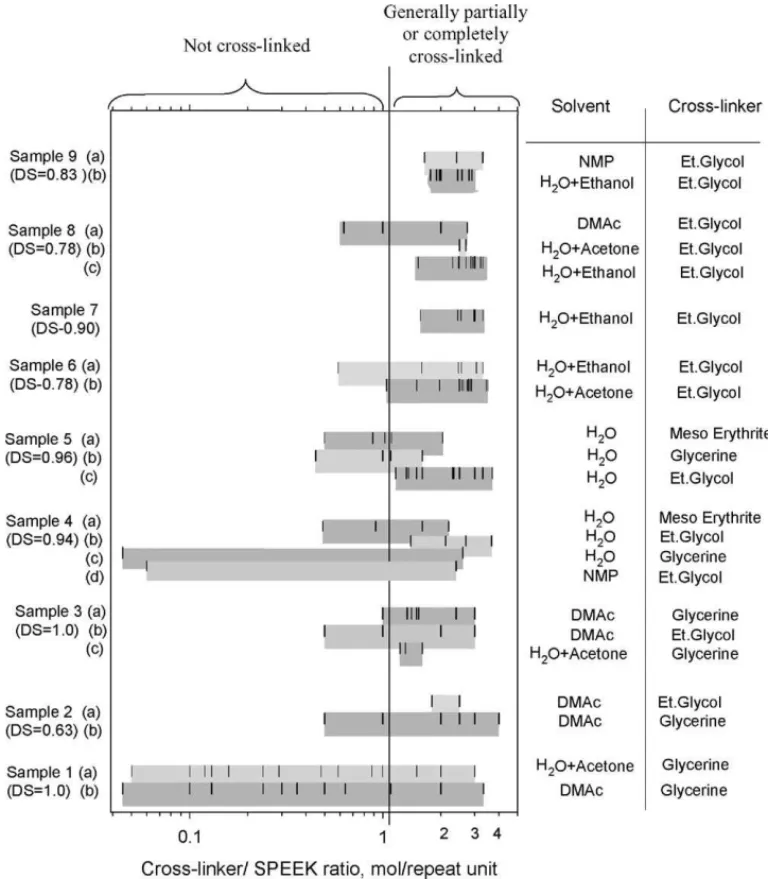
in more details usingFig. 1. In this figure, the far left col-umn shows DS of various samples of initial SPEEK, and every stroke within the rectangles corresponds to an attempt
Fig. 1. The preparation formulations of different SPEEK samples.
to prepare a cross-linked membrane. The left hand rectan-gle, where casting mixtures did not contain a cross-linker or its concentration was too low, corresponds to preparations, where no cross-linking was observed.
These experiments suggest that the thermal treatment alone does not induce any significant cross-linking, at least below 120–150◦C. This result is in contradiction with the
assertions made in ref. [10], which suggest that heating high DS SPEEK to 120◦C is sufficient to initiate thermal
cross-linking.
It is worth mentioning at this point that further heating of our high DS SPEEK samples up to 250◦C under
vac-uum resulted in membranes, which are insoluble in any sol-vent (except H2SO4) and stable in boiling water. In some
instances this thermally induced transformation started at 220◦C. However, the chemical analysis of these samples has
shown that heating above 200◦C brings about desulfonation
96 S.D. Mikhailenko et al. / Journal of Membrane Science 233 (2004) 93–99 Treatment temperature, oC 80 100 120 140 160 180 200 220 240 260 DS , m o l/ re pe at un it 0.0 0.2 0.4 0.6 0.8 1.0 S u lf ur content, w t.% 0 2 4 6 8 a) Sample 9b (EG=2.4) b) Same 9b (EG=2.4) sample c) Sample 4d (EG=0) d) Sample 4d (EG=2.4) e) Sample 4 (initial polymer)
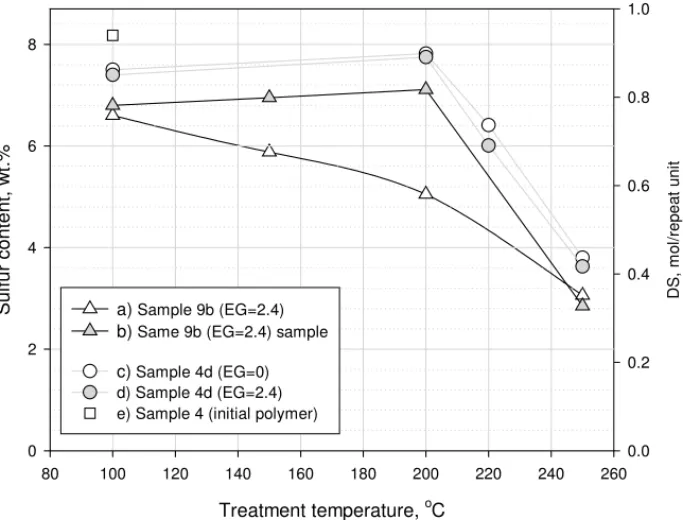
Fig. 2. Sulfur content in cross-linked and non-cross-linked SPEEK membranes as function of the treatment temperature: (a) DS determined by titration; sulfur content calculated from DS; (b, c and d) sulfur content determined by elemental analysis; DS calculated from sulfur content; (e) DS determined by1H NMR; sulfur content calculated from DS. For sample designation seeTable 1andFig. 1.
The results of sulfur elemental analysis for four mem-brane samples treated at different temperatures are presented inFig. 2. A pure (containing no cross-linker) SPEEK mem-brane cast from NMP solution and treated at different tem-peratures is represented by curve (c) inFig. 2. The sample studied had a DS 0.94 according to1H NMR analysis (see
Table 1), which corresponds to a calculated value of 8.2 wt.% of sulfur. It can be seen from the plot that the initial (sample 4d dried at 100◦C) sulfur content determined by chemical
analysis is 9% lower than the value calculated from NMR. Heating to 200◦C reduced the discrepancy between the
re-sults of these two analytical techniques, which suggests that this difference may be associated with the presence of resid-ual NMP solvent in the membrane. However, NMP is diffi-cult to remove completely as its boiling point is 202◦
C. Heating above 200◦
C under vacuum strongly reduces the sulfur content below the values corresponding to DS 0.5, as follows from Fig. 2c. These SPEEK samples be-come insoluble in many solvents and might be mistaken for thermally cross-linked. However, this increase of chemical stability should be mostly caused by desulfonation as it is known that at low DS pure SPEEK is insoluble in any sol-vents except concentrated H2SO4. At the same time when
initially the same samples were treated under vacuum not above 200◦C but at 150◦C for several days, these
mem-branes remained soluble and did not show any properties of cross-linked polymers.
The authors of patent [10] reported cross-linking of SPEEK with a treatment temperature of 120◦C, which is
significantly lower than the onset temperature of
desulfona-tion. A plausible explanation for this observed cross-linking at this low temperature is that some other fortuitous reac-tions occurred in the experiments reported in [10] during curing of the SPEEK. It was mentioned in ref. [10], that in the course of membrane preparation some glycerine was added (evidently as a plasticizer) to SPEEK, dissolved in a water–acetone mixed solvent. Our experiments revealed the role of the polyols, in cross-linking of sulfonated linear poly-mers. In all our experimental preparations, where the casting medium contained certain amounts of glycerol, cross-linking indeed has been observed: membranes changed colour from brownish-yellow to black and became mechanically stronger and insoluble in any of the solvents used. That oc-curred, when the ratio of glycerine to SPEEK was at least 1 molecule per repeat unit of the polymer. This can be seen in
Fig. 1, where the stroke marks indicate numerous prepara-tions that make a rather representative set of statistical data. The chemical reaction assumed to be involved in such cross-linking is shown inFig. 3. The glycerine, participating in the bridging of SPEEK fragments, may be replaced by any polyol. In order to verify this, a number of preparations has been carried out using ethylene-glycol (two-carbon) and mesoerythrite (four-carbon) polyols (seeFig. 3). It was ob-served, that starting from a certain molar ratio of cross-linker to SPEEK the reaction of polycondensation apparently oc-curs and some of the products obtained became insoluble in boiling water and organic solvents. The preparation formu-lations of different SPEEK membranes, including casting solvent and cross-linking polyol used, are listed inFig. 1. In order to initiate cross-linking the films were dried after
Table 1
Properties of the SPEEK membranes after cross-linking procedure Sample
(DS)a
Solvent Cross-linker Cross-linker/SPEEK ratio (mol/repeat unit)
Cure condition Conductivity at 25◦C (S/cm) Comments T (◦C) Time (h)
1a (1.0) DMAc Glycerol <1 125 36 – Soluble in water
>1 130 72 ≤1.5 × 10⁻² Partially soluble in DMAc, H2O
1b (1.0) Water + acetone Glycerol <1 125 48 – Soluble in water
>1 120 48 ≤2.5 × 10⁻² Complete cross-linking
2a (0.63) DMAc Ethylene-glycol >1 125 48 – Partially soluble in DMAc
2b (0.63) DMAc Glycerol <1 125 48 ≤2 × 10⁻³ Soluble in DMAc
>1 ≤5.7 × 10⁻³ Partially soluble in DMAc
3a (1.0) DMAc Glycerol =1 130 66 7.8 × 10⁻³ Soluble in water
>1 130 66 ≤1 × 10⁻² Partially soluble in DMAc
3b (1.0) DMAc Ethylene-glycol >1 130 66 ≤1.5 × 10⁻² Partially soluble in DMAc
3c (1.0) Water + acetone Glycerol >1 125 60 – Complete cross-linking
4a (0.94) Water Meso-erythritol <1 135 60 – Soluble in water
>1 135 60 ≤2.2 × 10⁻² Complete cross-linking, brittle
4b (0.94) Water Ethylene-glycol =1.4 135 60 2.2 × 10⁻² Soluble in water
>1.4 135 60 ≤2.2 × 10⁻² Complete cross-linking
4c (0.94) Water Glycerol 2.6 135 60 2.2 × 10⁻² Complete cross-linking
4d (0.94) NMP Ethylene-glycol <2.7 150 60 ≤4 × 10⁻² Soluble in hot water
5a (0.96) Water Meso-Erythritol 0.5–0.9 140 48 – Soluble in water
1–2 140 48 – Cross-linked, brittle
5b (0.96) Water Glycerol >1 140 48 ≤1.2 × 10⁻² Complete cross-linking
5c (0.96) Water Ethylene-glycol ≤1.5 140 48 ≤2.2 × 10⁻² Soluble in water at 100◦C
>1.5 140 48 ≤2.7 × 10⁻² Complete cross-linking
6a (0.78) Water + alcohol Ethylene-glycol 0.6 140 60 – Soluble in water
>1.6 140 60 ≤2.5 × 10⁻² Complete cross-linking
6b (0.78) Water + acetone Ethylene-glycol <1.5 140 60 ≤1.6 × 10⁻² Soluble in water at 100◦C
>1.5 140 60 ≤2.5 × 10⁻² Complete cross-linking
7 (0.90) Water + alcohol Ethylene-glycol >1.6 140 60 ≤4.2 × 10⁻² Complete cross-linking
8a (0.78) DMAc Ethylene-glycol <1 150 68 – Soluble in DMAc, hot water
>1 150 68 – Partially soluble in DMAc
8c (0.78) Water + alcohol Ethylene-glycol 1.5 150 68 ≤2.6 × 10⁻² Complete cross-linking 9a (0.83) NMP Ethylene-glycol 1.65–3.3 150 68 ≤4.6 × 10⁻² Soluble in water at 100◦C
9b (0.83) Water + alcohol Ethylene-glycol <1.9 150 68 ≤6.5 × 10⁻² Soluble in water at 100◦C
>1.9 150 68 ≤4 × 10⁻² Complete cross-linking aMeasured by NMR before membrane casting.
casting and cured according to the procedure described in ref.[10]or even sometimes under more stringent conditions (curing temperature up to 150◦C instead of 120◦C).
InTable 1, the results of the cross-linking procedure along with the conductivity values are presented more comprehen-sively than inFig. 1. It follows from this table that sample 1 with DS 1.0 is rendered completely cross-linked (insoluble in any solvent) only when cast from water–acetone solution and when the glycerine content is higher than one molecule per repeat unit of SPEEK (sample 1b). However, when DMAc was used as casting solvent, no (or only partial) cross-linking occurred even at high glycerine concentration.
The same was observed for all samples, whether they were low DS (samples 2a, 2b), high DS (samples 1a, 3a, 3b) or mid-DS (sample 8a). When the membranes were pre-pared using low cross-linker concentration, the membranes (samples 1, 3) remained soluble even in cold water, indicat-ing that no or only little cross-linkindicat-ing occurred. At higher cross-linker concentration, membranes were partially solu-ble in DMAc indicating that cross-linking was incomplete. The same was observed for another casting solvent NMP (samples 4d, 9a). It is apparent that cross-linking is blocked by the competing reaction of sulfonic acid groups with DMAc or NMP. Recently it has been shown that DMAc and
98 S.D. Mikhailenko et al. / Journal of Membrane Science 233 (2004) 93–99 O O SO3H C O CH2 CH)n HO (HO CH2 HO + O O SO3H C O SO2 SO2 CH2 CH)n O (HO CH2 O + 2 H2O n=0 Ethylene Glycol n=1 Glycerine n=2 Erythrite Fig. 3. Possible reaction of SPEEK cross-linking.
especially DMF form strong hydrogen bonding with sul-fonated PEEK[11,12]. Moreover, both solvents have been found to be prone to thermally activated decomposition, accelerated by sulfonic acid functions and the produced dimethylamine also forms strong bonding with SPEEK
[11,12]. It is therefore preferable to avoid these solvents for membrane casting, replacing them wherever possible (SPEEK with DS > 0.8) by water or water–acetone mix-tures. Water–alcohol mixture also may be used, because there is little likelihood of hydroxyl interaction with acid groups due to the very low boiling point of ethanol, which is about 4◦C under vacuum. This is sustained by the fact that
the proton conductivity of a water–alcohol cast membrane is no different from that obtained from water–acetone solution (compare completely cross-linked samples 6a and 6b).
It is interesting to note that the introduction of the cross-linker does not change the sulfur content of the mem-branes treated at different temperatures, as can be seen from the comparison of curves (c) and (d) inFig. 2. However, the results of titration turned out to be very different from that of elemental chemical analysis for sulfur for the cross-linked samples (compare plots a and b inFig. 2). The disparity in these two curves corresponds to the difference between the amount of sulfur comprised only in sulfonic acid functions (available for ion exchange as used in titration), and the total sulfur content, including bridging –SO2– functions not
detectable by titration but measurable by elemental analysis. Therefore, the difference between S content according to the results of elemental analysis and titration can be a mea-sure of degree of cross-linking: the larger this difference, the greater number of sulfonic functions became bridging.
Among the three cross-linkers used, the best membranes were obtained with ethylene-glycol. They were most strong mechanically, flexible and less liable to deformation. Glyc-erine gave slightly less strong membranes, which some-times were also less conductive than the ones made with ethylene-glycol (compare for example samples 5b and 5c). Mesoerythrite, despite the fact that it also ensures SPEEK cross-linking, results in membranes that are too brittle to be of any practical use (samples 4a, 5a).
In summary it may be said that the best cross-linked SPEEK membranes are obtained from SPEEK with 0.75 <
DS <1.0 using water–acetone or water–alcohol mixture as
a casting solvent and ethylene-glycol as a cross-linker at ra-tio between 1.5 and 3 molecules per SPEEK repeat unit. The 18 wt.% solution cast on the glass plate should be dried at room conditions for 2 days, and then under vacuum for 3 days at temperature gradually increasing from 25 to 150◦C
over 2 days.
3.2. Properties of cross-linked SPEEK membranes
The swelling of a SPEEK membrane in water is com-monly thought to be inversely related to its mechanical strength. InFig. 4the room temperature water uptake along with conductivity of a series of cross-linked membranes are presented as functions of their DSs, measured by titration as the number of sulfonic acid functions per repeat unit. As can be seen from Fig. 2, sulfur contents measured by titration (accounting only for sulfonic acid groups, available
DS 0.70 0.75 0.80 0.85 0.90 W a te r u p ta ke 40 60 80 100 Conduc ti vi ty ( , S/cm 10-2 10-1 Swelling Sample 6b Sample 5c (3.5) (2.62) (1.97) (1.5) (1.05) (0) (3.0) (2.3) (1.5) (1.17)
Fig. 4. Swelling and proton conductivity of cross-linked SPEEK mem-branes as function of DS, measured by titration (Nafion 117 conduc-tivity measured in the same cell and under the same conditions was σ25◦C = 3.3 × 10⁻²S/cm) Values in parentheses are ethylene-glycol/
for ion exchange) are lower than the total sulfur concentra-tion, defined by elemental analysis. From Fig. 4it follows that introduction of increasing amounts of ethylene-glycol into sample 6 caused a gradual decrease in the DS from 0.78 to 0.68, accompanied by more than a twofold wa-ter uptake decrease from 79 to 32 wt.%. At the same time the conductivity decreased less significantly from 2.7 × 10⁻² to 1.4 × 10⁻²S/cm and remained within the usable
range, where PEMs are still suitable for fuel cell applica-tion. The resulting membranes from DS 0.71 (corresponding to EtGly/SPEEK = 1.97) were completely cross-linked and maintained good mechanical strength even when swollen. It is worth mentioning that conductivity measurements were performed on the membranes that were subjected to boiling in water.
Sample 5c having DS 0.96 was initially soluble in water and therefore its water uptake may be considered as infinity. However at EtGly/SPEEK ratio 2.3 and higher it became fully cross-linked, with water uptake below 70 wt.% and con-ductivity above 2×10⁻²S/cm. Such a high conductivity
sug-gests that a major portion of sulfonic acid functions was not involved in cross-linking and remained available for proton transfer. It is important to note that despite cross-linking be-ing far from complete, the membranes were rigid and strong at ambient conditions, and at the same time, become mold-able and plimold-able at temperatures above 150◦C. That allows
their use in the preparation of membrane-electrode assem-blies for FC.
4. Conclusions
A method for cross-linking of sulfonated poly(ether ether ketones) was developed in this study. It is based on the thermally activated bridging of the polymer chains with polyatomic alcohols through condensation reaction with sulfonic acid functions. Cross-linking greatly increases the polymer mechanical strength and reduces its swelling in water. Although the cross-linking decreases the number of sulfonic acid groups available for proton transfer, the
SPEEK membrane conductivities are only slightly reduced. Some of the samples exhibited a room temperature conduc-tivity of above 2 × 10⁻²S/cm.
References
[1] G. Pourcelly, C. Gavach, Perfluorinated membranes, in: Ph. Colom-ban (Ed.), Proton Conductors: Solids, Membranes and Gels-Materials and Devices, Cambridge University Press, New York, 1992, pp 294– 310.
[2] O. Savadogo, Emerging membranes for electrochemical systems: (I) solid polymer electrolyte membranes for fuel cell systems, J. New Mat. Electrochem. Syst. 1 (1998) 47.
[3] T. Kobayashi, M. Rikukawa, K. Sanui, N. Ogata, Proton conduct-ing polymers derived from poly(ether-ether ketone) and poly(4-phenoxybenzoyl-1,4-phenylene), Solid State Ionics 106 (1998) 219.
[4] J. Kerres, A. Ullrich, Th. Haring, New ionomer membranes and their fuel cell application: 1. Preparation and characterization, in: 3rd International Symposium on New Materials for Electrochemical Systems, Montreal, Canada, July 1999, p. 230.
[5] S.M.J. Zaidi, S.D. Mikhailenko, G.P. Robertson, M.D. Guiver, S. Kaliaguine, Proton conducting composite membranes from polyether ether ketone and heteropolyacids for fuel cell applications, J. Membr. Sci. 173 (2000) 17.
[6] B. Bonnet, D.J. Jones, J. Rosière, L. Tchicaya, G. Alberti, M. Casci-ola, L. Massinelli, B. Bauer, A. Peraio, E. Ramunni, Hybrid organic-inorganic membranes for a medium temperature fuel cell, J. New Mat. Electrochem. Syst. 3 (2000) 87.
[7] X. Jin, M.T. Bishop, T.S. Ellis, F.E. Karasz, A sulfonated poly (aryl-ether-ketone), Br. Polym. J. 17 (1985) 4.
[8] F. Helmer-Metzmann, F. Osan, A. Schneller, H. Ritter, K. Ledjeff, R. Nolte, R. Thorwirth, Polymer electrolyte membrane, and process for the production thereof, US Patent 5,438,082 (1995).
[9] S.S. Mao, S.J. Hamrock, D.A. Ylitalo, Crosslinked ion conductive membranes, US Patent 6,090,895 (2000).
[10] S.P.S. Yen, S.R. Narayanan, G. Halpert, E. Graham, A. Yavrouian, Polymer material for electrolytic membranes in fuel cells, US Patent 5,795,496 (1998).
[11] G.P. Robertson, S.D. Mikhailenko, K.P. Wang, P. Xing, M.D. Guiver, S. Kaliaguine, Casting solvent interactions with sulfonated poly(ether ether ketone) during proton exchange membrane fabrication, J. Membr. Sci. 219 (2003) 113.
[12] S. Kaliaguine, S.D. Mikhailenko, K.P. Wang, P. Xing, G. Robertson, M. Guver, Properties of SPEEK based PEMs for fuel cell application, Catal. Today 82 (2003) 213.