Random Linear Network Coding Approach
The MIT Faculty has made this article openly available.
Please share
how this access benefits you. Your story matters.
Citation
Lucani, D.E., M. Medard, and M. Stojanovic. “Broadcasting in
time-division duplexing: A random linear network coding approach.”
Network Coding, Theory, and Applications, 2009. NetCod '09.
Workshop on. 2009. 62-67. © Copyright 2010 IEEE
As Published
http://dx.doi.org/10.1109/NETCOD.2009.5191395
Publisher
Institute of Electrical and Electronics Engineers
Version
Final published version
Citable link
http://hdl.handle.net/1721.1/59856
Terms of Use
Article is made available in accordance with the publisher's
policy and may be subject to US copyright law. Please refer to the
publisher's site for terms of use.
Broadcasting in Time-Division Duplexing: A
Random Linear Network Coding Approach
Daniel E. Lucani Muriel Medard
Massachusetts Institute of Technology Massachusetts Institute of Technology Cambridge, Massachusetts, 02139 Cambridge, Massachusetts, 02139
USA USA
Email: [email protected] Email: [email protected]
Milica Stojanovic
Northeastern University Boston, Massachusetts, 02115
USA
Email: [email protected]
Abstract - We study random linear network
cod-ing for broadcastcod-ing in time division duplexcod-ing chan-nels. We assume a packet erasure channel with nodes that cannot transmit and receive information simul-taneously. The sender transmits coded data packets back-to-back before stopping to wait for the receivers to acknowledge the number of degrees of freedom, if any, that are required to decode correctly the
infor-mation. We study the mean time to complete the
transmission of a block of packets to all receivers. We also present a bound on the number of stops to wait for acknowledgement in order to complete transmis-sion with probability at least 1 - E, for any E
>
o.
We present analysis and numerical results showing that our scheme outperforms optimal scheduling policies for broadcast, in terms of the mean completion time. We provide a simple heuristic to compute the num-ber of coded packets to be sent before stopping that achieves close to optimal performance with the advan-tage of a considerable reduction in the search time.I. INTRODUCTION
Reference [1] considered the use of network coding in channels in which time division duplexing is necessary, i.e. when a node can only transmit or receive, but not both at the same time. This type of channel is usually called half-duplex, but we will use the term time division duplexing (TDD) to emphasize that the transmitters and receivers may not use the channel half of the time each, i.e. the amount of time allocated to transmit and receive may vary. Examples of TDD channels are infrared devices, and underwater acoustic modems. High latency channels, e.g. in satellite, and deep space communications, can also take advantage of these ideas.
In particular, Reference [1] studied the case of trans-mitting a block of M data packets through a link using random linear network coding with the objective of min-imizing the mean time to complete transmission of that block of packets. Reference
[2]
extended the analysis for the problem of energy consumption of the scheme. Ref-erence[1]
and[2]
showed that there exists, an optimal number of coded data packets to be transmitted back-to-back before stopping to wait for an acknowledgment (ACK), under the minimum time and minimum energy criterion, respectively. Reference[2]
showed that choos-ing the number of coded data packets to optimize meancompletion time, as in
[1],
provides a very good trade-off between energy consumption and completion time.We analyze the problem of broadcast under the TDD constrain and using a similar random linear network cod-ing scheme to that in
[1],
i.e. we provide an extension of the scheme to the case of several receivers. We assume that the receivers are not allowed to cooperate in order to share their received coded packets in order to decode the information, which is to say that each receiver must be able to decode the information from the coded packets sent directly from the transmitter. We provide a bound to the number of stops to wait for ACKs in order to com-plete the transmission to all receivers with arbitrary high probability. Also, we study the mean completion time and energy of the broadcast scheme and compare it to optimal scheduling policies. Finally, we provide simple heuristics to determine the number of coded data packets to be transmitted back-to-back before stopping to wait for an ACK, with a considerable reduction in the compu-tation time.The paper is organized as follows. In Section II, we outline the set up of the problem. We provide a proof for the bound on the number of stops to listen for ACK pack-ets. In Section III, we study the mean completion time and heuristics to determine the number of coded packets. In Section IV, we present comparison schemes based on optimal scheduling policies. Section V presents numerical results for various broadcast scenarios. Conclusions are summarized in Section VI.
II. RANDOM NETWORK CODING FOR BROADCAST IN
TDD CHANNELS
A sender wants to broadcastM data packets at a given data rate R [bps] to N receivers as in Figure 1. We assume an independent packet erasure channel for each of the receivers and that receivers cannot cooperate or share information. Nodes can transmit and receive, but not both at the same time. The sender uses random linear network coding [3] to generate coded data packets. Each coded data packet contains a linear combination of the M data packets of n bits each, as well as the random coding coefficients used in the linear combination. Each coefficient is represented by 9 bits. For encoding over a field size q, we have that 9
=
log2 q bits. A coded packet is preceded by an information header of size h. Thus, the total number of bits per packet is h+
n+
gM. Figure 2 in [1] shows the structure of each coded packet.Figure 1: Broadcast network.
(3)
P(Sl ,S2,...,SN )-+(S~ ,S~ ,...,SN )
=
P (s~ls1 ,maXj=1 ,2,... ,NSj) .. .P (s~ls N ,maXj=1 ,2, ..,N Sj)
=
Figure 3: Markov chain for the case of N=
2 receivers and a block size ofM=
3.where P(s~ ISj,Ni )has a similar structure to the transition probabilities studied in [1]. The main difference is that the value ofN, is no longer associated with the starting state of a particular receiver , but with a value determined from all starting states. For 0
<
sj<
Sj , this can betranslated into
P(Sl ,.. .,SN)-->(s~,.. .,s~ )
=
P (s~IS1 " ",SN) .. .P (s~IS1"", SN )' (2) The dependence on the previous st ate (s1,S2 , .. . ,SN )can be translated into a dependence on the state with maximum dofs required to transmit, i.e. i
=
maxj=1 ,2,... ,N Sj , because i determines Ni, the number
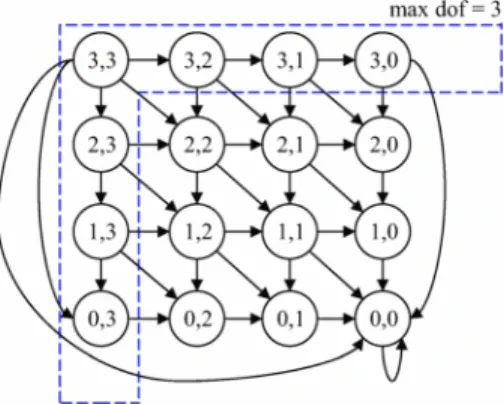
of coded data packets sent by the transmitter. Thus, packets. We have highlighted in this figure the states in which at least one receiver requires 3 coded packets in order to decode. Note that not all possible transitions from one state to the others have been included in this figure.
The transition probabilities from state (S1, S2, . . . , SN)
to state (s~ , s~ ,..., sN)are
p,(8 1 ,S 2 , · · · ,S N) ( "----. 8 1 ' S 2 " " ' S N, )
=
P (X1(n)=s~ ,... ,XN (n) =s~ IX1 (n- 1) =slo...,X N (n - 1)=s N ) (1) where Xi(n) is the number of dof required at receiver i at the end of transmission n. For simplicity of notation, let us say P (X1(n)=s~ , ... ,XN (n) =s~ I X1 (n- 1 )=s l , ...,X N (n - 1)=s N )
P(s~ ,...,S~ I S 1" " ,S N ) ' Similarly we consider that P (Xi(n)=s:IX1(n-1)=sl, .. .,X N (n - 1)= s N ) P (S:I S1,... ,SN ) and P (Xi(n)=s :IXi(n-1)=si ,m aXj=1 ,2,...,N Sj)
P(s:l s i ,maXj=1 ,2,... ,NSj) '
Ifwe consider independent packet erasure channels for each of the receivers,
CP
(I ,i)j :::i dofs neededtodecode inRx1
1--_-+-C_P_(2_,i)--I..::::::]
C
P
0';,;)[:::::::::::::::~]ACK'~I
Figure 2: Network coding TDD scheme.
The sender can transmit coded packets back-to-back before stopping to wait for an ACK packet from each receiver . Each ACK packet feeds back the number of de-grees of freedom (dof) , that are still required to decode successfully the M data packets to a particular receiver. As in [1], we assume that the field sizeqis large enough so that the expected number of successfully received pack-ets at the receiver , in order to decode the original data packets, is approximately M .
Transmission begins with M information packets, which are encoded into NM
2:
M random linear coded packets, and transmitted. If all M packets are de-coded successfully by all receivers, the process is com-pleted. Otherwise, each ACK informs the transmitter how many dofs are missing , say i 1,i z, .. .,iN for receivers 1,2, ...,N, respectively. The transmitter then sends N,coded packets, where i
=
maXj=1 ,2,... ,N ij . If an ACKis lost, the transmitter assumes the previous state for the corresponding receiver. This process is repeated un-til all M packets have been decoded successfully by all receivers. We are interested in the optimal number
N,
of coded packets to be transmitted back-to-hack. Note thatNi
2:
i .Figure 2, illustrates the time window allocated to the system to transmitN, coded pa ckets . Each coded packet
CP(l ,i) , CP(2 ,i), etc. is of duration Tp . The waiting
timeTw is chosen so as to accommodate the propagation delay and time to receive the ACKs from each receiver .
The process is modelled as a Markov chain . The states
(Sl , S2 , ... , SN) are defined by the number of dofs required Sk at receiver k to decode successfully the M packets. Thus, the states range from (M, M, ..., M) to (0,0, ...,0) . This is a Markov chain with(M
+
I t-1transient states and one recurrent state (state (0,0, ..., 0)) . Figure 3 pro-vides an example for 2 receivers and a block size of 3where
ifNi
2::
Sj,otherwise (5)
By the Cayley-Hamilton theorem, for
N
2::
n, pN=
Ei~Ol
cPz(N)PZ
for some constantscPz(N).
Denoting theeigenvalues by 1,A2' ..., Ary,and using Lagrange's interpo-lation formula as in [4], we can write
(7)
Since we are interested in la1ry(N) -
11 ::;
E, this trans-lates toIqOPN -
III
<
IA2I
N[I ,
0,...,0]
E£=2IFi(P)1 (10)=
I
A2IN[911'912, ...,
91ry] (11) where Fi(P)=
FP(P), IFi(P)1 denotes a matrix whose elements are the magnitudes of the elements of Fi(P), and(9)
(8) ry pN=
LFf(p)AfI i=l ry[911
...
91ry] LIFi(P)1=
:
:
:
i=2 9ry1 ... 9ryry where
N
Nil
"! 1 .~.(P- A)·1)F. (P)
=
A. ~)~=...;.;');...;...I_1. _ 1. 1. IlJ=l,j;J;i(Ai _ Aj)where1is the identity matrix, and Al
=
1.Since P is a stochastic matrix,
IAil
<
1 for i>
1. Since qOPN---+ II, asN
---+ 00, we have that qoFfO(P)=
qoF~(P)
=
qOF1(P)=
II. Thus,whereG is a constant.
and Pej and Peack-j represents the erasure probability of a coded packet and of an ACK packet for the erasure channel of receiver j, respectively.
For Sj
= sj >
0 the expression for the transitionprob-ability reduces to:
P(sjlsj,Ni)
=
(1-Peack_j)PejNi+
Peack-j. (6) Note that for P(OIO,Ni)=
1. Finally, forsj =
0 P (sj=Olsj,Ni)=
1 - E:~=lP (sjlsj,Ni).J
We can define P as the transition probability for our system. The speed of convergence from state (M, ..., M) to state (0, ... ,0) can be summarized in the following lemma.
Lemma 1: Let A2 be the second largest eigenvalue of P, and assume that there is only one eigenvalue with this magnitude. Then, the number of stops to wait for ACKs preceeded by transmissions of back-to-back coded packets
N
to transit from state(M, ..., M) to state (0, ... ,0) with probability at least 1 - E isN>
InG-lnE - -ln1A21Proof We use a similar method to the proof of lemma 2 in [4]. Let us assume, without loss of generality, that our transition probabilityP has the following structure
IA21N91ry
<
Ewhich concludes the proof.
(12)
D
whereaij(N) is the probability of transitioning from the
i-th state in the matrix to the j-th state in the matrix in
N
iterations (transmissions followed by stop to receive ACKs), and rJ are the number of columns in the matrix.We are interested in determining the number of stops to wait for ACKsN so that la1ry(N) -
11 ::;
E with E>
o.
In general, we could write this as IqOPN -
III
<
T, where qo is the starting state, II is the steady state pro ba-bility, and T is our performance target. In our case, qo=
[1,0, ... ,0] since we are interested in studying conver-gence when we start in state (M, ..., M),II
=
[0, ... ,0,1] because state (0, ... ,0) is the only absorbing state, and T=
[T1 ...Try-1E] where Eis our target performance, i.e. we have not imposed conditions for convergence from state (M, ..., M) to the other states(T1,..., Try-I).pN
= [
all~N) a12~N)
o
..
· ;.al'1~N)]
o
1 [ P(M, ...,M)~(M,... ,M)P -
-.
.
o
and .. 0P(M, ... ,M:-+(O, ... ,O) ] III. MEAN COMPLETION TIME
The expected time for completing the transmission of theM data packets constitutes the expected time of ab-sorption, i.e. the time to reach state (0, , 0) for the first time, given that the initial state is (M, , M). This can be expressed in terms of the expected time for completing the transmission given that the Markov chain is in state is (Sl, ...,SN), T(Sl, ... ,SN) ,\:fsi
=
O,I, ..M -1,\:fi=
1, ...,N.Let us denote the transmission time of a coded packet as Tp , and the waiting time to receive an ACK packet as
Tw • For our scheme, Tp
=
h+n:gM, as in [1], but theexpression of Tw changes slightly to consider the
trans-mission of multiple ACK packets from the receivers to the transmitter.
Let us define d; as the distance between the trans-mitter and node i, as in Figure 1. We assume that the nodes have been numbered so that d1 ::; d2 ::; ••• ::; dN •
Let us define titA as the time node i has to wait be-fore starting to transmit after he has received the last coded packet from the transmitter. The choice of titA depends on characteristics of the link between the ceivers and the transmitter and interference that a re-ceiver could generate in other rere-ceivers at the time of
64
where i
=
maXj=l, ...,NSj' We can express this in vectorform as
algorithm. These heuristics rely on solving the link case [1] considering as packet erasure probability of the link a function of the packet erasure probabilities of the different channels in broadcast.
1) Worst Link Channel: In this heuristic we approx-imate the system as a link to the receiver with the worst channel, i.e. Pe
=
maxjPej. Then, wecom-pute Ns,Vi
=
1, ... ,M to minimize the mean completion time as in [1] using the current values of Tp , Tw , andPeack
=
maxjPeack-j.2) Combined Erasure Effect: In this heuristic we ap-proximate the system as a link to a receiver withPe
=
1-IIj(1 - Pej ), i.e. assuming that a coded packet suffers an erasure in the link when it is seen as an erasure by at least one receiver. Then, we computeNi,Vi=
1, ... ,M to mini-mize the mean completion time as in[1]
using the current values ofTp , Tw , and Peack=
1 - IIj(I - Peack-j).Determining P for a link requires computing
o
(M
2) transition probabilities, while solving the
same problem for broadcast requires a computation of
o
((N(M+
1))2N)
equivalent transition probabilities. This does not include the savings provided by inverting considerably smaller matrices.Also, note the first heuristic is optimistic, disregarding the effect of nodes with better channels, while the sec-ond heuristic is pessimistic, concentrating the effect of all losses in one link. Since the Ni's increase as the proba-bility of erasure increases, the 'Worst Link Channel' and 'Combined Erasure Effect' heuristics provide a lower and upper bound on the values ofNi,Vi, respectively.
Finally, it is important to emphasize that the Ni's do not need to be computed in real time. As explained in
[1],
they can be pre-computed and stored in the receiver as look-up tables to reduce the computational load on the nodes. The nodes only have to choose the appropriate Ni's from the tables, considering channel conditions at the time of transmission.IV. COMPARISON SCHEMES
In this section, we extend the work in [5] to determine the mean completion time for optimal scheduling policies for broadcast. These policies consider no coding of the data packets, no channel state information, and nodes that only ACK when they have received all M data packets. As in [5], we restrict the analysis to independent sym-metric channels, i.e. Pel
= ... =
PeN, and no erasures in the ACKs for tractability. Note that we had no such restrictions in our network coding scheme. Our contri-bution includes 1)considering the effect of Trt , Tp , andTack,and 2) the characterization for full duplex and TDD channels.
1) Broadcast with Round Robin in Full Duplex Channel (RR Full Duplex): The objective is to transmit M data packets to all users. Since the channels are independent and identically distributed over time and users, one of the optimal policies is Round Robin (RR). Thus, packet k in the block is transmitted every (mM
+
k )Tp time units for(13) (16) (15) To _ det
(r
<--(M, ... ,M)p,)
(M, ... ,M) - det(f)t:
(SI, ... ,SN) =Ti+
L(S1 ,...,SN),(s~,...,s'rv)P(S1 ,...,SN)~(s~,...,s'rv)T(s~,...,s'rv)(14)where
T
=
[T(SI, ...,SN)],Jl
=
[Ti] andP is the correspond-ing transition probability.Since we are interested in the mean completion time when we start at state (M, ..., M), we can use Cramer's rule to determine
whereI'
=
I - P, and the notationTf-(M, ... ,M)Jl
repre-sents a matrix that has all columns as the T matrix ex-cept the column corresponding to state (M, ..., M) which is substituted by the vectorJl.
Due to characteristics of the Markov chain, T is a triangular matrix. Thus, com-puting det(f) reduces to multiplying the elements in the main diagonal of theT matrix.The expected time for each state depends on all the expected times for the previous states. However, opti-mizing the values of all N, is not as straight forward as the recursive method used in
[1].
Also, note that there are (M
+
I)N states in our Markov chain. This implies that we have to compute the transition probabilities to fill a((M
+
l)N-1)
x((M
+
l)N-1)
matrix and then solve the determinants of matrices of the same dimen-sions for each iteration of a search algorithm. Thus, the computational demands increases significantly, specially when we increase the number of receivers.Then, let us consider some heuristics to estimate the values ofNs,Vi
=
1, ... , M, either to use them directly as an approximate solution or as an initial point of a search transmitting its ACK. If the nodes do not generate inter-ference over other nodes, e.g. a satellite link which typi-cally has a very directional antennas, then we could usetttA
=
max(t~~1+Tack-Trt-i+Trt-(i-1)'O), whereTack
=
nack/R, nackis the number of bits in the ACK packet, R is the link data rate, and Trt-i is the roundtrip time for node i. Thus, Tw
=
Trt- N+
tt;A+
TackandtttA
=
O. If the transmission of the ACK packets can create interference in transmissions to other receivers, the first ACK could be sent after all data packets have been correctly received. In this case, tttA=
(Trt- N - Trt- 1)/2
and we can use the previous recursive formula fortttA and the expression forTui-We can defineTi as the time it takes to transmit N, coded data packets and receive the ACK packets from the different receivers. It is easy to show that Ti
=
NiTp +Trt- N
+
tt;A+
Tack,The mean completion time when the system is in state (Sl' ..., SN)is given by
m
=
0,1,2, ... until all the receivers get all M packets [5] . Using a similar analysis as in [5],E[T]
=
t ;+
TpM (I'+
E[maxXk]) (17)t ,k
where 1
+
x;
is the number of transmissions of packet kneeded to reach node i, I'E (1/2 ,1) , and
00
E[maxXkl
=
L
[1 - (1 - Pet)MN] (18)t ,k t=l
where P e
=
Pel= ... =
P eN . Note that I' 1 andI'
=
1/2 give us an upper and lower bound on the mean completion time, respectively.2) Broadcast with Round Robin in TDD (RR TDD) : This scheme assumes limited feedback due to the TDD constraint. We assume that the transmitter broadcasts all M packets back-to-back, then stops to receive ACK packets that indicate complet ion of the entire file. Ifthere are nodes that have not acknowledged the block of pack-ets, the transmitter repeats the process, i.e. sends all M packets and stops to listen for ACKs. We can express the mean complet ion time of this scheme as
E[T]
=
(Tw+
TpM) E[maxXk]. (19)t ,k
V . NUMERICAL RESULTS
This section provides numerical examples that com-pare the performance of our network coding scheme for broadcast in TDD channels, considering a satellite exam-ple. In particular, we compare the performance of the scheme when theN /s are l)chosen to minimize the mean complet ion time, 2)chosen using the 'Worst Link Chan-nel' heuristic, and 3) chosen using the 'Combined Erasure Effect ' heuristic. The comparison is carried out in terms of the mean completion time of M data packets under different pa cket erasure probabilities. We show that the 'Worst Link Channel' provides close-to-optimal perfor-mance with the advantage of reducing the computational load on the search algorithm. For simplicity, we consider that there are no erasures of ACK packets and that the distan ce between the transmitter and each receiver is the same . The latter is a good approximation in many satel-lite scenarios. Finally, we compa re our broadcast scheme with RR TDD and RR Full Duplex.
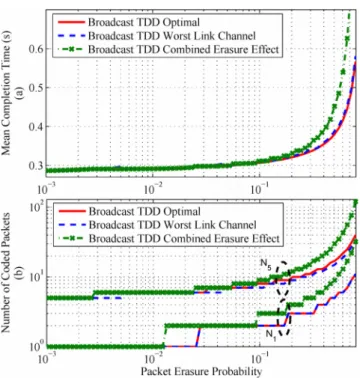
Figure 4 shows (a) the mean completion time and (b)number of coded packets N5 and NI , for the optimal
choice ofN /s and our two heuristics when we have inde-pendent channels with a common packet erasure proba-bility, i.e. P el
=
P e2. We consider data packet s of size n=
10,000 bits in a GEO satellite link with a propaga-tion delay of 125 ms, and the parameters specified in the figure .Figure 4(a) illustrates that choosing N /s using the 'Worst Link Ch annel' heuristic provide s close-to-optimal
- - Broadcast TOO Optimal
- - - Broadcast TOO Worst Link Channel
. '-lC- Broadcast TOO Combined Erasure Effect
10-
31 02U===================:::;-:-:-~~~": - - Broadcast TOO Optimal
: - - - Broadcast TOO Worst Link Channel
. '-lC- Broadcast TOO Combined Erasure Effe ct
10-2 10-1
Packe t Erasure Probab ility
Figure 4: (a)Mean completion time and (b) number of coded packets N5 and NI , for the optimal choice ofN i's
and two heuristics, for N
=
2 receivers at the same dis-t an ce from dis-the dis-transmidis-tdis-ter,M=
5, packet erasure prob-ability is the value for the two independent channels,R
=
1.5 Mbps ,h=
80 bits, g=
20 bits, n a ck=
50 bitsperformance in terms of mean completion time for a wide range of packet erasure probabilities. Although , the 'Combined Er asure Effect ' heuristic provides a better es-timate for low packet erasure probabilities in this case, its choice of N /s for high packet erasures produces con-siderably higher complet ion times. This fact is explained because the 'Combined Erasure Effect ' heuristic is pes-simistic in terms of the amount of coded packets that are successfully received.
Figure 4(b) shows that the optimal choice of Ni's is bounded by the choices ofNi's using our two heuristics. As explained in Section III , this is not surprising be-cause one of the heuristics is optimistic in its approxima-tion ('Worst Link Channel') and the other is pessimistic ('Combined Er asure Effect ') . This result is interesting at the time of developing an algorithm to sear ch for the optimal value , because we could limit the search to the values given by the heuristics.
Since the choice ofNi's using the 'Worst Link Channel' heuristic provides a performance that is close to the opti-mal, we could use it as an initial choice of theN / s so that a sear ch algorithm finds the optimalN i's , or we could use them dire ctly. However, for large values of Nand M a full search pro cedure might become exceedingly expensive in terms of computation time. Computing the Ni' s using the 'Worst Link Channel' heuristic is easily performed even for large values ofM, because it approximates the
66
0.75 0.7 0.65
E
0.6 r'-'-"-'-'-'-"-'-"--'-'---'----'---'---'---'---'---'---'---, f= t: .g0.55 <l) 0.. ~ 0.5 u t: i1 0.45 ~ 0.4 0.35--_
:_--10-2 10-1Packet Erasure Probabilit y
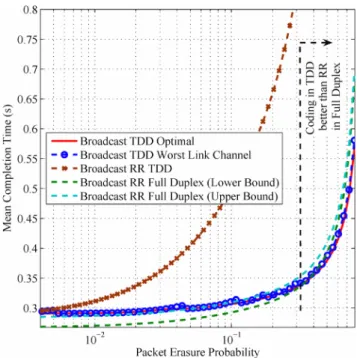
Figure 5: Mean completion time for the optimal choice of Ni's, 'Worst Link Channel' heuristic, and Round Robin Broadcast schemes with Full duplex and TDD channels. We use as parameters N
=
2 receivers at the same dis-tance from the transmitter, M=
5, packet erasure prob-ability is the value for the two independent channels,R
=
1.5 Mbps, h=
80 bits, 9=
20 bits, nack=
50 bits system as a link. Reference [1] shows some examples for cases of M=
90 and M=
130. In practice, using the heuristic provides a good trade-off between complexity and accuracy.Figure 5 compares the performance of our Broadcast TDD scheme with Ni's computed optimally and with the 'Worst Link Channel' heuristic, and compares it to the performance of RR TDD and RR Full Duplex. First, note that for the range of packet erasures considered, our cod-ing scheme performs at least as good as the RR TD D, and considerably better at high erasures. Second, the perfor-mance of our scheme is very close to that of the RR Full Duplex for low erasures. However, our coding scheme per-forms better at high packet erasures (Pel
=
Pe2>
0.3), e.g. at Pel=
Pe2=
0.8 the RR Full Duplex scheme takes 20% more time to complete transmissions. Thus, even with a single channel for data and feedback, i.e. half of the resources, we can perform better by tailoring cod-ing and feedback appropriately.VI. CONCLUSION
This paper provides an extension to the use of random linear network coding over channels where time division duplexing is necessary. In particular, we study the case of broadcasting a block ofM data packets to N receivers. Similar to our work in [1] and [2], the scheme consid-ers that a number of coded data packets are transmitted back-to-back before stopping to wait for the receivers to
acknowledge how many degrees of freedom, if any, are required to decode the information correctly.
We prove that the number of stops to listen for the ACK packets ~ in order to complete transmission with probability at least 1 - €, for any e
>
0, is ~2:
I~ ?nll~i.
Here we considered '\2 be the second largest eigenvalue of the transition probability matrix P, assumed that there is only one eigenvalue with this magnitude, and G is a constant.
We also provide a simple heuristic to compute the number of coded packets to be sent before stopping that achieves close to optimal performance with the advan-tage of a considerable reduction in the search time. This heuristic approximates the system as a link to the re-ceiver with the worst channel, and computes the number of coded packets to minimize completion time as in [1]. This heuristic provides a good trade-off between compu-tational complexity and performance.
Numerical results show that our coding scheme out-performs a Round Robin broadcast scheme in an TDD channel. More importantly, for high packet erasures, our coding scheme for TDD outperforms a RR scheme oper-ating in a full duplex channel.
Future research will extend the problem of broadcast to cases in which nodes forming a cluster are allowed to cooperate and share dofs in order to decode the infor-mation. Also, we will consider extensions to the general problem of wireless networks.
ACKNOWLEDGMENTS
This work was supported in part by the National Sci-ence Foundation under grants No. 0520075, 0831728 and CNS-0627021, by ONR MURI Grant No. N00014-07-1-0738, subcontract
#
060786 issued by BAE Sys-tems National Security Solutions, Inc. and supported by the Defense Advanced Research Projects Agency (DARPA) and the Space and Naval Warfare System Center (SPAWARSYSCEN), San Diego under Contract No. N66001-06-C-2020 (CBMANET), subcontract#
18870740-37362-C issued by Stanford University and sup-ported by the DARPA.REFERENCES
[1] Lucani, D . E. , Stojanovic, M., Medard, M. , "Random Lin-ear Network Coding For Time Division Duplexing: When To Stop Talking And Start Listening", to appear in INFOCOM '09, available at arXiv:0809.2350vl[cs.IT]
[2] Lucani, D. E ., Stojanovic, M., Medard, M., "Random Linear Network Coding For Time Division Duplexing: Energy Analy-sis" , to appear in ICC '09, available at arXiv:0901.0269vl[cs.IT] [3] Ho, T ., Medard , M., Koetter, R , Karger, D.R , Effros , M., Shi , J ., Leong, B., "A Random Linear Network Coding Approach to Multicast" , Trans. Info . Theory, vol. 52, no. 10, pp.4413-4430, Oct. 2006
[4] Medard, M., Srikant, R , "Capacit y of Nearly Decompos-able Markovian Fading Channels Under Asymmetric Receiver-Sender Side Information" , IEEE Trans. on Info . Theory, vol. 52, no . 7, pp . 3052-3062 , Jul. 2006
[5] Eryilmaz , A., Ozdaglar, A., Medard, M., "On Delay Perfor-mance Gains from Network Coding", In Proc. CISS '06 , pp . 864-870 , Princeton, NJ, USA , Mar. 2006