HAL Id: hal-00410333
https://hal.archives-ouvertes.fr/hal-00410333
Submitted on 20 Aug 2009
HAL is a multi-disciplinary open access
archive for the deposit and dissemination of
sci-entific research documents, whether they are
pub-lished or not. The documents may come from
teaching and research institutions in France or
abroad, or from public or private research centers.
L’archive ouverte pluridisciplinaire HAL, est
destinée au dépôt et à la diffusion de documents
scientifiques de niveau recherche, publiés ou non,
émanant des établissements d’enseignement et de
recherche français ou étrangers, des laboratoires
publics ou privés.
PT-Scotch and libScotch 5.0 User’s Guide
François Pellegrini
To cite this version:
PT-Scotch and libScotch 5.0
User’s Guide
(version 5.0.6)
Fran¸cois Pellegrini
ScAlApplix project, INRIA Bordeaux Sud-Ouest
ENSEIRB & LaBRI, UMR CNRS 5800
Universit´e Bordeaux I
351 cours de la Lib´eration, 33405 TALENCE, FRANCE
[email protected]
March 18, 2008
Abstract
This document describes the capabilities and operations of PT-Scotch and libScotch, a software package and a software library which compute parallel sparse matrix block orderings of graphs. It gives brief descriptions of the algorithms, details the input/output formats, instructions for use, instal-lation procedures, and provides a number of examples.
PT-Scotch is distributed as free/libre software, and has been designed such that new partitioning or ordering methods can be added in a straight-forward manner. It can therefore be used as a testbed for the easy and quick coding and testing of such new methods, and may also be redistributed, as a library, along with third-party software that makes use of it, either in its original or in updated forms.
Contents
1 Introduction 3
1.1 Sparse matrix ordering . . . 3
1.2 Contents of this document . . . 4
2 The Scotch project 4 2.1 Description . . . 4
2.2 Availability . . . 4
3 Algorithms 5 3.1 Parallel sparse matrix ordering by hybrid incomplete nested dissection 5 3.1.1 Hybrid incomplete nested dissection . . . 5
3.1.2 Parallel ordering . . . 6
3.1.3 Performance criteria . . . 9
4 Files and data structures 10 4.1 Distributed graph files . . . 10
5 Programs 11 5.1 Invocation . . . 11
5.2 File names . . . 12
5.2.1 Sequential and parallel file opening . . . 12
5.2.2 Using compressed files . . . 13
5.3 Description . . . 13
5.3.1 dgord . . . 13
5.3.2 dgscat . . . 15
5.3.3 dgtst . . . 15
6 Library 16 6.1 Calling the routines of libScotch . . . 16
6.1.1 Calling from C . . . 16
6.1.2 Calling from Fortran . . . 17
6.1.3 Compiling and linking . . . 18
6.1.4 Machine word size issues . . . 18
6.2 Data formats . . . 19
6.2.1 Distributed graph format . . . 19
6.2.2 Block ordering format . . . 24
6.3 Strategy strings . . . 24
6.3.1 Parallel ordering strategy strings . . . 25
6.3.2 Parallel node separation strategy strings . . . 26
6.4 Distributed graph handling routines . . . 29
6.4.1 SCOTCH dgraphInit . . . 29 6.4.2 SCOTCH dgraphExit . . . 30 6.4.3 SCOTCH dgraphFree . . . 30 6.4.4 SCOTCH dgraphLoad . . . 30 6.4.5 SCOTCH dgraphSave . . . 31 6.4.6 SCOTCH dgraphBuild. . . 32 6.4.7 SCOTCH dgraphGather . . . 33 6.4.8 SCOTCH dgraphScatter . . . 34 6.4.9 SCOTCH dgraphCheck. . . 35 6.4.10 SCOTCH dgraphSize . . . 35
6.4.11 SCOTCH dgraphData . . . 36
6.4.12 SCOTCH dgraphHalo . . . 38
6.4.13 SCOTCH dgraphGhst . . . 38
6.5 Distributed graph ordering routines . . . 39
6.5.1 SCOTCH dgraphOrderInit . . . 39 6.5.2 SCOTCH dgraphOrderExit . . . 39 6.5.3 SCOTCH dgraphOrderSave . . . 40 6.5.4 SCOTCH dgraphOrderSaveMap . . . 40 6.5.5 SCOTCH dgraphOrderSaveTree . . . 41 6.5.6 SCOTCH dgraphOrderCompute . . . 42 6.5.7 SCOTCH dgraphOrderPerm . . . 42 6.5.8 SCOTCH dgraphOrderCblkDist . . . 43 6.5.9 SCOTCH dgraphOrderTreeDist . . . 43
6.6 Centralized ordering handling routines . . . 44
6.6.1 SCOTCH dgraphCorderInit . . . 44
6.6.2 SCOTCH dgraphCorderExit . . . 45
6.6.3 SCOTCH dgraphOrderGather . . . 46
6.7 Strategy handling routines . . . 46
6.7.1 SCOTCH stratInit . . . 46
6.7.2 SCOTCH stratExit . . . 47
6.7.3 SCOTCH stratSave . . . 47
6.7.4 SCOTCH stratDgraphOrder . . . 48
6.8 Error handling routines . . . 48
6.8.1 SCOTCH errorPrint . . . 48
6.8.2 SCOTCH errorPrintW. . . 49
6.8.3 SCOTCH errorProg . . . 49
6.9 Miscellaneous routines . . . 49
6.9.1 SCOTCH randomReset. . . 49
6.10 ParMeTiS compatibility library . . . 50
6.10.1 ParMETIS V3 NodeND . . . 50
7 Installation 51
8 Examples 51
1
Introduction
1.1
Sparse matrix ordering
Many scientific and engineering problems can be modeled by sparse linear systems, which are solved either by iterative or direct methods. To achieve efficiency with di-rect methods, one must minimize the fill-in induced by factorization. This fill-in is a direct consequence of the order in which the unknowns of the linear system are num-bered, and its effects are critical both in terms of memory and of computation costs. Because there always exist large problem graphs which cannot fit in the memory of sequential computers and cost too much to partition, it is necessary to resort to parallel graph ordering tools. PT-Scotch provides such features.
1.2
Contents of this document
This document describes the capabilities and operations of PT-Scotch, a software package devoted to parallel sparse matrix block ordering. It is the parallel extension of Scotch, a sequential software package devoted to static mapping, graph and mesh partitioning, and sparse matrix block ordering. While both packages share a significant amount of code, because PT-Scotch transfers control to the sequential routines of the libScotch library when the subgraphs on which it operates are located on a single processor, the two sets of routines have a distinct user’s manual. Readers interested in the sequential features of Scotch should refer to the Scotch User’s Guide [25].
The rest of this manual is organized as follows. Section 2 presents the goals of the Scotch project, and section 3 outlines the most important aspects of the parallel partitioning and ordering algorithms that it implements. Section 4 defines the formats of the files used in PT-Scotch, section 5 describes the programs of the PT-Scotch distribution, and section 6 defines the interface and operations of the parallel routines of the libScotch library. Section 7 explains how to obtain and install the Scotch distribution. Finally, some practical examples are given in section 8.
2
The Scotch project
2.1
Description
Scotch is a project carried out at the Laboratoire Bordelais de Recherche en In-formatique (LaBRI) of the Universit´e Bordeaux I, and now within the ScALApplix project of INRIA Bordeaux Sud-Ouest. Its goal is to study the applications of graph theory to scientific computing, using a “divide and conquer” approach.
It focused first on static mapping, and has resulted in the development of the Dual Recursive Bipartitioning (or DRB) mapping algorithm and in the study of several graph bipartitioning heuristics [23], all of which have been implemented in the Scotch software package [26]. Then, it focused on the computation of high-quality vertex separators for the ordering of sparse matrices by nested dissection, by extending the work that has been done on graph partitioning in the context of static mapping [27, 28]. More recently, the ordering capabilities of Scotch have been extended to native mesh structures, thanks to hypergraph partitioning algorithms. New graph partitioning methods have also been recently added [6, 24]. Version 5.0 of Scotch is the first one to comprise parallel graph ordering routines.
2.2
Availability
Starting from version 4.0, which has been developed at INRIA within the ScAlAp-plix project, Scotch is available under a dual licensing basis. On the one hand, it is downloadable from the Scotch web page as free/libre software, to all interested parties willing to use it as a library or to contribute to it as a testbed for new partitioning and ordering methods. On the other hand, it can also be distributed, under other types of licenses and conditions, to parties willing to embed it tightly into closed, proprietary software.
The free/libre software license under which Scotch 5.0 is distributed is the CeCILL-C license [4], which has basically the same features as the GNU LGPL (“Lesser General Public License”) [19]: ability to link the code as a
library to any free/libre or even proprietary software, ability to modify the code and to redistribute these modifications. Version 4.0 of Scotch was dis-tributed under the LGPL itself. This version did not comprise any parallel features. Please refer to section 7 to see how to obtain the free/libre distribution of Scotch.
3
Algorithms
3.1
Parallel sparse matrix ordering by hybrid incomplete
nested dissection
When solving large sparse linear systems of the form Ax = b, it is common to precede the numerical factorization by a symmetric reordering. This reordering is chosen in such a way that pivoting down the diagonal in order on the resulting permuted matrix P APT produces much less fill-in and work than computing the factors of A by pivoting down the diagonal in the original order (the fill-in is the set of zero entries in A that become non-zero in the factored matrix).
3.1.1 Hybrid incomplete nested dissection
The minimum degree and nested dissection algorithms are the two most popular reordering schemes used to reduce fill-in and operation count when factoring and solving sparse matrices.
The minimum degree algorithm [30] is a local heuristic that performs its pivot selection by iteratively selecting from the graph a node of minimum degree. It is known to be a very fast and general purpose algorithm, and has received much attention over the last three decades (see for example [1, 10, 21]). However, the algorithm is intrinsically sequential, and very little can be theoretically proved about its efficiency.
The nested dissection algorithm [11] is a global, recursive heuristic algorithm which computes a vertex set S that separates the graph into two parts A and B, or-dering S with the highest remaining indices. It then proceeds recursively on parts A and B until their sizes become smaller than some threshold value. This ordering guarantees that, at each step, no non zero term can appear in the factorization process between unknowns of A and unknowns of B.
Many theoretical results have been obtained on nested dissection ordering [5, 20], and its divide and conquer nature makes it easily parallelizable. The main issue of the nested dissection ordering algorithm is thus to find small vertex separators that balance the remaining subgraphs as evenly as possible. Provided that good vertex separators are found, the nested dissection algorithm produces orderings which, both in terms of fill-in and operation count, compare favorably [12, 16, 27] to the ones obtained with the minimum degree algorithm [21]. Moreover, the elimination trees induced by nested dissection are broader, shorter, and better balanced, and therefore exhibit much more concurrency in the context of parallel Cholesky factorization [2, 8, 9, 12, 27, 29, and included references].
Due to their complementary nature, several schemes have been proposed to hybridize the two methods [15, 17, 27]. Our implementation is based on a tight
coupling of the nested dissection and minimum degree algorithms, that allows each of them to take advantage of the information computed by the other [28].
However, because we do not provide a parallel implementation of the minimum degree algorithm, this hybridization scheme can only take place after enough steps of parallel nested dissection have been performed, such that the subgraphs to be ordered by minimum degree are centralized on individual processors.
3.1.2 Parallel ordering
The parallel computation of orderings in PT-Scotch involves three different levels of concurrency, corresponding to three key steps of the nested dissection process: the nested dissection algorithm itself, the multi-level coarsening algorithm used to compute separators at each step of the nested dissection process, and the refinement of the obtained separators. Each of these steps is described below.
Nested dissection As said above, the first level of concurrency relates to the parallelization of the nested dissection method itself, which is straightforward thanks to the intrinsically concurrent nature of the algorithm. Starting from the initial graph, arbitrarily distributed across p processors but preferably balanced in terms of vertices, the algorithm proceeds as illustrated in Figure 1 : once a separator has been computed in parallel, by means of a method described below, each of the p processors participates in the building of the distributed induced subgraph corresponding to the first separated part (even if some processors do not have any vertex of it). This induced subgraph is then folded onto the first ⌈p
2⌉ processors, such that the average number of vertices per processor, which guarantees efficiency as it allows the shadowing of communications by a subsequent amount of computation, remains constant. During the folding process, vertices and adjacency lists owned by the ⌊p
2⌋ sender processors are redistributed to the ⌈ p
2⌉ receiver processors so as to evenly balance their loads.
The same procedure is used to build, on the ⌊p
2⌋ remaining processors, the folded induced subgraph corresponding to the second part. These two constructions being completely independent, the computations of the two induced subgraphs and their folding can be performed in parallel, thanks to the temporary creation of an extra thread per processor. When the vertices of the separated graph are evenly distributed across the processors, this feature favors load balancing in the subgraph building phase, because processors which do not have many vertices of one part will have the rest of their vertices in the other part, thus yielding the same overall workload to create both graphs in the same time. This feature can be disabled when the communication system of the target machine is not thread-safe.
At the end of the folding process, every processor has a folded subgraph fragment of one of the two folded subgraphs, and the nested dissection process car recursively proceed independently on each subgroup of p2 (then p4, p8, etc.) processors, until each subgroup is reduced to a single processor. From then on, the nested dissection process will go on sequentially on every processor, using the nested dissection rou-tines of the Scotch library, eventually ending in a coupling with minimum degree methods [28], as described in the previous section.
Graph coarsening The second level of concurrency concerns the computation of separators. The approach we have chosen is the now classical multi-level one [3, 14, 17]. It consists in repeatedly computing a set of increasingly coarser albeit topologically similar versions of the graph to separate, by finding matchings which
P1 P2 P0 P3 P0 P3 P1 P2 P0 P3 P1 P2 P2 P1 P0 P3
Figure 1: Diagram of a nested dissection step for a (sub-)graph distributed across four processors. Once the separator is known, the two induced subgraphs are built and folded (this can be done in parallel for both subgraphs), yielding two subgraphs, each of them distributed across two processors.
collapse vertices and edges, until the coarsest graph obtained is no larger than a few hundreds of vertices, then computing a separator on this coarsest graph, and projecting back this separator, from coarser to finer graphs, up to the original graph. Most often, a local optimization algorithm, such as Kernighan-Lin [18] or Fiduccia-Mattheyses [7] (FM), is used in the uncoarsening phase to refine the partition that is projected back at every level, such that the granularity of the solution is the one of the original graph and not the one of the coarsest graph.
The main features of our implementation are outlined in Figure 2. Once the matching phase is complete, the coarsened subgraph building phase takes place. It can be parametrized so as to allow one to choose between two options. Either all coarsened vertices are kept on their local processors (that is, processors that hold at least one of the ends of the coarsened edges), as shown in the first steps of Figure 2, which decreases the number of vertices owned by every processor and speeds-up future computations, or else coarsened graphs are folded and duplicated, as shown in the next steps of Figure 2, which increases the number of working copies of the graph and can thus reduce communication and increase the final quality of the separators.
As a matter of fact, separator computation algorithms, which are local heuristics, heavily depend on the quality of the coarsened graphs, and we have observed with the sequential version of Scotch that taking every time the best partition among two ones, obtained from two fully independent multi-level runs, usually improved overall ordering quality. By enabling the folding-with-duplication routine (which will be referred to as “fold-dup” in the following) in the first coarsening levels, one can implement this approach in parallel, every subgroup of processors that hold a working copy of the graph being able to perform an almost-complete independent multi-level computation, save for the very first level which is shared by all subgroups, for the second one which is shared by half of the subgroups, and so on.
The problem with the fold-dup approach is that it consumes a lot of memory. Consequently, a good strategy can be to resort to folding only when the number of vertices of the graph to be considered reaches some minimum threshold. This threshold allows one to set a trade off between the level of completeness of the independent multi-level runs which result from the early stages of the fold-dup process, which impact partitioning quality, and the amount of memory to be used in the process.
Once all working copies of the coarsened graphs are folded on individual pro-cessors, the algorithm enters a multi-sequential phase, illustrated at the bottom of
P3 P2 P1 P0 P1 P2 P0 P3 P0 P1 P2 P3 P1 P2 P0 P3
P
1P
2P
0P
3Figure 2: Diagram of the parallel computation of the separator of a graph dis-tributed across four processors, by parallel coarsening with folding-with-duplication in the last stages, multi-sequential computation of initial partitions that are locally projected back and refined on every processor, and then parallel uncoarsening of the best partition encountered.
Figure 2: the routines of the sequential Scotch library are used on every processor to complete the coarsening process, compute an initial partition, and project it back up to the largest centralized coarsened graph stored on the processor. Then, the partitions are projected back in parallel to the finer distributed graphs, selecting the best partition between the two available when projecting to a level where fold-dup had been performed. This distributed projection process is repeated until we obtain a partition of the original graph.
Band refinement The third level of concurrency concerns the refinement heuris-tics which are used to improve the projected separators. At the coarsest levels of the multi-level algorithm, when computations are restricted to individual proces-sors, the sequential FM algorithm of Scotch is used, but this class of algorithms does not parallelize well.
This problem can be solved in two ways: either by developing scalable and efficient local optimization algorithms, or by being able to use the existing sequential FM algorithm on very large graphs. In [6] has been proposed a solution which enables both approaches, and is based on the following reasoning. Since every refinement is performed by means of a local algorithm, which perturbs only in a limited way the position of the projected separator, local refinement algorithms need only to be passed a subgraph that contains the vertices that are very close to the projected separator.
The computation and use of distributed band graphs is outlined in Figure 3. Given a distributed graph and an initial separator, which can be spread across several processors, vertices that are closer to separator vertices than some small user-defined distance are selected by spreading distance information from all of the separator vertices, using our halo exchange routine. Then, the distributed band graph is created, by adding on every processor two anchor vertices, which are connected to the last layers of vertices of each of the parts. The vertex weight of the anchor vertices is equal to the sum of the vertex weights of all of the vertices they replace, to preserve the balance of the two band parts. Once the separator of the band graph has been refined using some local optimization algorithm, the new
P
0P
3Figure 3: Creation of a distributed band graph. Only vertices closest to the sep-arator are kept. Other vertices are replaced by anchor vertices of equivalent total weight, linked to band vertices of the last layer. There are two anchor vertices per processor, to reduce communication. Once the separator has been refined on the band graph using some local optimization algorithm, the new separator is projected back to the original distributed graph.
P0 P3
Figure 4: Diagram of the multi-sequential refinement of a separator projected back from a coarser graph distributed across four processors to its finer distributed graph. Once the distributed band graph is built from the finer graph, a centralized version of it is gathered on every participating processor. A sequential FM optimization can then be run independently on every copy, and the best improved separator is then distributed back to the finer graph.
separator is projected back to the original distributed graph.
Basing on these band graphs, we have implemented a multi-sequential refine-ment algorithm, outlined in Figure 4. At every distributed uncoarsening step, a distributed band graph is created. Centralized copies of this band graph are then gathered on every participating processor, which serve to run fully independent in-stances of our sequential FM algorithm. The perturbation of the initial state of the sequential FM algorithm on every processor allows us to explore slightly different solution spaces, and thus to improve refinement quality. Finally, the best refined band separator is projected back to the distributed graph, and the uncoarsening process goes on.
3.1.3 Performance criteria
The quality of orderings is evaluated with respect to several criteria. The first one, NNZ, is the number of non-zero terms in the factored reordered matrix. The second one, OPC, is the operation count, that is the number of arithmetic operations required to factor the matrix. The operation count that we have considered takes into consideration all operations (additions, subtractions, multiplications, divisions) required by Cholesky factorization, except square roots; it is equal toP
cn 2 c, where nc is the number of non-zeros of column c of the factored matrix, diagonal included. A third criterion for quality is the shape of the elimination tree; concurrency
in parallel solving is all the higher as the elimination tree is broad and short. To measure its quality, several parameters can be defined: hmin, hmax, and havgdenote the minimum, maximum, and average heights of the tree1, respectively, and h
dlt is the variance, expressed as a percentage of havg. Since small separators result in small chains in the elimination tree, havg should also indirectly reflect the quality of separators.
4
Files and data structures
For the sake of portability and readability, all the data files shared by the differ-ent programs of the Scotch project are coded in plain ASCII text exclusively. Although we may speak of “lines” when describing file formats, text-formatting characters such as newlines or tabulations are not mandatory, and are not taken into account when files are read. They are only used to provide better readabil-ity and understanding. Whenever numbers are used to label objects, and unless explicitely stated, numberings always start from zero, not one.
4.1
Distributed graph files
Because even very large graphs are most often stored in the form of centralized files, the distributed graph loading routine of the PT-Scotch package, as well as all parallel programs which handle distributed graphs, are able to read centralized graph files in the Scotch format and to scatter them on the fly across the available processors (the format of centralized Scotch graph files is described in the Scotch User’s Guide [25]). However, in order to reduce loading time, a distributed graph format has been designed, so that the different file fragments which comprise distributed graph files can be read in parallel and be stored on local disks on the nodes of a parallel or grid cluster.
Distributed graph files, which usually end in “.dgr”, describe fragments of val-uated graphs, which can be valval-uated process graphs to be mapped onto target architectures, or graphs representing the adjacency structures of matrices to order. In Scotch, graphs are represented by means of adjacency lists: the definition of each vertex is accompanied by the list of all of its neighbors, i.e. all of its adjacent arcs. Therefore, the overall number of edge data is twice the number of edges. Distributed graphs are stored as a set of files which contain each a subset of graph vertices and their adjacencies. The purpose of this format is to speed-up the loading and saving of large graphs when working for some time with the same number of processors: the distributed graph loading routine will allow each of the processors to read in parallel from a different file. Consequently, the number of files must be equal to the number of processors involved in the parallel loading phase. The first line of a distributed graph file holds the distributed graph file version number, which is currently 2. The second line holds the number of files across which the graph data is distributed (referred to as procglbnbr in libScotch; see for instance Figure 6, page 22, for a detailed example), followed by the number of this file in the sequence (ranging from 0 to (procglbnbr− 1), and analogous to procloc numin Figure 6). The third line holds the global number of graph vertices (referred to as vertglbnbr), followed by the global number of arcs (inappropriately called 1We do not consider as leaves the disconnected vertices that are present in some meshes, since they do not participate in the solving process.
edgeglbnbr, as it is in fact equal to twice the actual number of edges). The fourth line holds the number of vertices contained in this graph fragment (analogous to vertlocnbr), followed by its local number of arcs (analogous to edgelocnbr). The fifth line holds three figures: the graph base index value (baseval), the starting global index for all vertices of this fragment (analogous to procdsptab[procloc num]in Figure 6) and a numeric flag.
The graph base index value records the value of the starting index used to describe the graph; it is usually 0 when the graph has been output by C programs, and 1 for Fortran programs. Its purpose is to ease the manipulation of graphs within each of these two environments, while providing compatibility between them.
The numeric flag, similar to the one used by the Chaco graph format [13], is made of three decimal digits. A non-zero value in the units indicates that vertex weights are provided. A non-zero value in the tenths indicates that edge weights are provided. A non-zero value in the hundredths indicates that vertex labels are provided; if it is the case, vertices can be stored in any order in the file; else, natural order is assumed, starting from the starting global index of each fragment.
This header data is then followed by as many lines as there are vertices in the graph fragment, that is, vertlocnbr lines. Each of these lines begins with the vertex label, if necessary, the vertex load, if necessary, and the vertex degree, followed by the description of the arcs. An arc is defined by the load of the edge, if necessary, and by the label of its other end vertex. The arcs of a given vertex can be provided in any order in its neighbor list. If vertex labels are provided, vertices can also be stored in any order in the file.
Figure 5 shows the contents of two complementary distributed graph files mod-eling a cube with unity vertex and edge weights and base 0, distributed across two processors. 2 2 0 8 24 4 12 0 000 3 4 2 1 3 5 3 0 3 6 0 3 3 7 1 2 2 2 1 8 24 4 12 0 000 3 0 6 5 3 1 7 4 3 2 4 7 3 3 5 6
Figure 5: Two complementary distributed graph files representing a cube dis-tributed across two processors.
5
Programs
5.1
Invocation
All of the programs comprised in the Scotch and PT-Scotch distributions have been designed to run in command-line mode without any interactive prompting, so that they can be called easily from other programs by means of “system ()” or “popen ()” system calls, or be piped together on a single shell command line. In order to facilitate this, whenever a stream name is asked for (either on input or output), the user may put a single “-” to indicate standard input or output. Moreover, programs read their input in the same order as stream names are given
in the command line. It allows them to read all their data from a single stream (usually the standard input), provided that these data are ordered properly.
A brief on-line help is provided with all the programs. To get this help, use the “-h” option after the program name. The case of option letters is not significant, except when both the lower and upper cases of a letter have different meanings. When passing parameters to the programs, only the order of file names is significant; options can be put anywhere in the command line, in any order. Examples of use of the different programs of the PT-Scotch project are provided in section 8.
Error messages are standardized, but may not be fully explanatory. However, most of the errors you may run into should be related to file formats, and located in “...Load” routines. In this case, compare your data formats with the definitions given in section 4, and use the dgtst program of the PT-Scotch distribution to check the consistency of your distributed source graphs.
According to your MPI environment, you may either run the programs directly, or else have to invoke them by means of a command such as mpirun. Check your local MPI documentation to see how to specify the number of processors on which to run them.
5.2
File names
5.2.1 Sequential and parallel file opening
The programs of the PT-Scotch distribution can handle either the classical cen-tralized Scotch graph files, or the distributed PT-Scotch graph files described in section 4.1.
In order to tell whether programs should read from, or write to, a single file located on only one processor, or to multiple instances of the same file on all of the processors, or else to distinct files on each of the processors, a special grammar has been designed, which is based on the “%” escape character. Four such escape sequences are defined, which are interpreted independently on every processor, prior to file opening. By default, when a filename is provided, it is assumed that the file is to be opened on only one of the processors, called the root processor, which is usually process 0 of the communicator within which the program is run. Using any of the first three escape sequences below will instruct programs to open in parallel a file of name equal to the interpreted filename, on every processor on which they are run.
%p Replaced by the number of processes in the global communicator in which the program is run. Leads to parallel opening.
%r Replaced on each process running the program by the rank of this process in the global communicator. Leads to parallel opening.
%- Discarded, but leads to parallel opening. This sequence is mainly used to instruct programs to open on every processor a file of identical name. The opened files can be, according whether the given path leads to a shared direc-tory or to directories that are local to each processor, either to the opening of multiple instances of the same file, or to the opening of distinct files which may each have a different content, respectively (but in this latter case it is much recommended to identify files by means of the “%r” sequence).
%% Replaced by a single “%” character. File names using this escape sequence are not considered for parallel opening, unless one or several of the three other escape sequences are also present.
For instance, filename “brol” will lead to the opening of file “brol” on the root processor only, filename “%-brol” (or even “br%-ol”) will lead to the parallel open-ing of files called “brol” on every processor, and filename “brol%p-%r” will lead to the opening of files “brol2-0” and “brol2-1”, respectively, on each of the two processors on which which would run a program of the PT-Scotch distribution. 5.2.2 Using compressed files
Starting from version 5.0.6, Scotch allows users to provide and retrieve data in compressed form. Since this feature requires that the compression and decompres-sion tasks run in the same time as data is read or written, it can only be done on systems which support multi-threading (Posix threads) or multi-processing (by means of fork system calls).
To determine if a stream has to be handled in compressed form, Scotch checks its extension. If it is “.gz” (gzip format), “.bz2” (bzip2 format) or “.lzma” (lzma format), the stream is assumed to be compressed according to the corresponding format. A filter task will then be used to process it accordingly if the format is implemented in Scotch and enabled on your system.
To date, data can be read and written in bzip2 and gzip formats, and can also be read in the lzma format. Since the compression ratio of lzma on Scotch graphs is 30% better than the one of gzip and bzip2 (which are almost equivalent in this case), the lzma format is a very good choice for handling very large graphs. To see how to enable compressed data handling in Scotch, please refer to Section 7. When the compressed format allows it, several files can be provided on the same stream, and be uncompressed on the fly. For instance, the command “cat brol.grf.gz brol.xyz.gz | gout -.gz -.gz -Mn - brol.iv” concatenates the topology and geometry data of some graph brol and feed them as a single compressed stream to the standard input of program gout, hence the ”-.gz” to indicate a compressed standard stream.
5.3
Description
5.3.1 dgord Synopsis
dgord[input graph file [output ordering file [output log file]]] options Description
The dgord program is the parallel sparse matrix block orderer. It uses an ordering strategy to compute block orderings of sparse matrices represented as source graphs, whose vertex weights indicate the number of DOFs per node (if this number is non homogeneous) and whose edges are unweighted, in order to minimize fill-in and operation count.
Since its main purpose is to provide orderings that exhibit high concur-rency for parallel block factorization, it comprises a parallel nested dissection
method [11], but sequential classical [21] and state-of-the-art [28] minimum degree algorithms are implemented as well, to be used on subgraphs located on single processors.
Ordering methods can be combined by means of selection, grouping, and condition operators, so as to define ordering strategies, which can be passed to the program by means of the -o option.
The input graph file filename can refer either to a centralized or to a dis-tributed graph, according to the semantics defined in Section 5.2. The order-ing file must be a centralized file.
Options
Since the program is devoted to experimental studies, it has many optional parameters, used to test various execution modes. Values set by default will give best results in most cases.
-h Display the program synopsis. -moutput mapping file
Write to output mapping file the mapping of graph vertices to column blocks. All of the separators and leaves produced by the nested dissection method are considered as distinct column blocks, which may be in turn split by the ordering methods that are applied to them. Distinct integer numbers are associated with each of the column blocks, such that the number of a block is always greater than the ones of its predecessors in the elimination process, that is, its descendants in the elimination tree. The structure of mapping files is described in detail in the relevant section of the Scotch User’s Guide [25].
When the geometry of the graph is available, this mapping file may be processed by program gout to display the vertex separators and super-variable amalgamations that have been computed.
-ostrat
Apply parallel ordering strategy strat. The format of parallel ordering strategies is defined in section 6.3.1.
-rnum
Set the number of the root process which will be used for centralized file accesses. Set to 0 by default.
-toutput tree file
Write to output tree file the structure of the separator tree. The data that is written resembles much the one of a mapping file: after a first line that contains the number of lines to follow, there are that many lines of mapping pairs, which associate an integer number with every graph vertex index. This integer number is the number of the column block which is the parent of the column block to which the vertex belongs, or −1 if the column block to which the vertex belongs is a root of the separator tree (there can be several roots, if the graph is disconnected). Combined to the column block mapping data produced by option -m, the tree structure allows one to rebuild the separator tree.
-V Print the program version and copyright. -vverb
Set verbose mode to verb, which may contain several of the following switches.
s Strategy information. This parameter displays the default parallel ordering strategy used by dgord.
t Timing information. 5.3.2 dgscat
Synopsis
dgscat[input graph file [output graph file]] options Description
The dgscat program creates a distributed source graph, in the Scotch dis-tributed graph format, from the given centralized source graph file.
The input graph file filename should therefore refer to a centralized graph, while output graph file must refer to a distributed graph, according to the semantics defined in Section 5.2.
Options
-c Check the consistency of the distributed graph at the end of the graph loading phase.
-h Display the program synopsis. -rnum
Set the number of the root process which will be used for centralized file accesses. Set to 0 by default.
-V Print the program version and copyright. 5.3.3 dgtst
Synopsis
dgtst[input graph file [output data file]] options Description
The program dgtst is the source graph tester. It checks the consistency of the input source graph structure (matching of arcs, number of vertices and edges, etc.), and gives some statistics regarding edge weights, vertex weights, and vertex degrees.
It produces the same results as the gtst program of the Scotch sequential distribution.
Options
-h Display the program synopsis. -rnum
Set the number of the root process which will be used for centralized file accesses. Set to 0 by default.
6
Library
All of the features provided by the programs of the PT-Scotch distribution may be directly accessed by calling the appropriate functions of the libScotch library, archived in files ptlibscotch.a and libptscotcherr.a. All of the existing parallel routines belong to three distinct classes:
• distributed source graph handling routines, which serve to declare, build, load, save, and check the consistency of distributed source graphs;
• strategy handling routines, which allow the user to declare and build parallel ordering strategies;
• parallel ordering routines, which allow the user to declare, compute, and save distributed orderings of distributed source graphs.
Error handling is performed using the existing sequential routines of the Scotch distribution, which are described in the Scotch User’s Guide [25]. Their use is recalled in Section 6.8.
A ParMeTiS compatibility library, called libptscotchparmetis.a, is also available. It allows users who were previously using ParMeTiS in their software to take advantage of the efficieny of PT-Scotch without having to modify their code. The services provided by this library are described in Section 6.10.
6.1
Calling the routines of libScotch
6.1.1 Calling from C
All of the C routines of the libScotch library are prefixed with “SCOTCH ”. The remainder of the function names is made of the name of the type of object to which the functions apply (e.g. “dgraph”, “dorder”, etc.), followed by the type of action performed on this object: “Init” for the initialization of the object, “Exit” for the freeing of its internal structures, “Load” for loading the object from one or several streams, and so on.
Typically, functions that return an error code return zero if the function suc-ceeds, and a non-zero value in case of error.
For instance, the SCOTCH dgraphInit and SCOTCH dgraphLoad routines, de-scribed in section 6.4, can be called from C by using the following code.
#include "ptscotch.h" ... SCOTCH_Dgraph grafdat; FILE * fileptr; if (SCOTCH_dgraphInit (&grafdat) != 0) { ... /* Error handling */ }
if ((fileptr = fopen ("brol.grf", "r")) == NULL) { ... /* Error handling */
}
if (SCOTCH_dgraphLoad (&grafdat, fileptr, -1, 0) != 0) { ... /* Error handling */
} ...
Although the “scotch.h” and “ptscotch.h” files may look very similar on your system, never mistake them, and always use the “ptscotch.h” file as the right include file for compiling a program which uses the parallel routines of the libScotchlibrary, whether it also calls sequential routines or not.
6.1.2 Calling from Fortran
The routines of the libScotch library can also be called from Fortran. For any C function named SCOTCH typeAction() which is documented in this manual, there exists a SCOTCHFTYPEACTION () Fortran counterpart, in which the separating underscore character is replaced by an “F”. In most cases, the Fortran routines have exactly the same parameters as the C functions, save for an added trailing INTEGER argument to store the return value yielded by the function when the return type of the C function is not void.
Since all the data structures used in libScotch are opaque, equivalent declara-tions for these structures must be provided in Fortran. These structures must there-fore be defined as arrays of DOUBLEPRECISIONs, of sizes given in file ptscotchf.h, which must be included whenever necessary.
For routines that read or write data using a FILE * stream in C, the Fortran counterpart uses an INTEGER parameter which is the numer of the Unix file descrip-tor corresponding to the logical unit from which to read or write. In most Unix implementations of Fortran, standard descriptors 0 for standard input (logical unit 5), 1 for standard output (logical unit 6) and 2 for standard error are opened by default. However, for files that are opened using OPEN statements, an additional function must be used to obtain the number of the Unix file descriptor from the number of the logical unit. This function is called FNUM in most Unix implementa-tions of Fortran.
For instance, the SCOTCH dgraphInit and SCOTCH dgraphLoad routines, de-scribed in sections 6.4.1 and 6.4.4, respectively, can be called from Fortran by using the following code.
INCLUDE "ptscotchf.h"
DOUBLEPRECISION GRAFDAT(SCOTCH_DGRAPHDIM) INTEGER RETVAL
...
CALL SCOTCHFDGRAPHINIT (GRAFDAT (1), RETVAL) IF (RETVAL .NE. 0) THEN
...
OPEN (10, FILE=’brol.grf’)
CALL SCOTCHFDGRAPHLOAD (GRAFDAT (1), FNUM (10), 1, 0, RETVAL) CLOSE (10)
IF (RETVAL .NE. 0) THEN ...
Although the “scotchf.h” and “ptscotchf.h” files may look very similar on your system, never mistake them, and always use the “ptscotchf.h” file as the include file for compiling a Fortran program that uses the parallel routines of the libScotch library, whether it also calls sequential routines or not.
All of the Fortran routines of the libScotch library are stubs which call their C counterpart. While this poses no problem for the usual integer and double precision data types, some conflicts may occur at compile or run time if your MPI implemen-tation does not represent the MPI Comm type in the same way in C and in Fortran.
Please check on your platform to see in the mpi.h include file if the MPI Comm data type is represented as an int. If it is the case, there should be no problem in using the Fortran routines of the PT-Scotch library.
6.1.3 Compiling and linking
The compilation of C or Fortran routines which use parallel routines of the lib-Scotch library requires that either ptscotch.h or ptscotchf.h be included, re-spectively. Since some of the parallel routines of the libScotch library must be passed MPI communicators, it is necessary to include MPI files mpi.h or mpif.h, respectively, before the relevant PT-Scotch include files, such that prototypes of the parallel libScotch routines are properly defined.
The parallel routines of the libScotch library, along with taylored versions of the sequential routines, are grouped in a library file called libptscotch.a. Default error routines that print an error message and exit are provided in the classical Scotch library file libptscotcherr.a.
Therefore, the linking of applications that make use of the libScotch li-brary with standard error handling is carried out by using the following options: “-lptscotch -lptscotcherr -lmpi -lm”. The “-lmpi” option is most often not necessary, as the MPI library is automatically considered when compiling with com-mands such as mpicc.
If you want to handle errors by yourself, you should not link with library file libptscotcherr.a, but rather provide a SCOTCH errorPrint() routine. Please refer to Section 6.8 for more information on error handling.
6.1.4 Machine word size issues
Graph indices are represented in Scotch as integer values of type SCOTCH Num. By default, this type is equivalent to the int C type, that is, an in-teger type of size equal to the one of the machine word. However, it can represent any other integer type, by using the “-DINT=” definition at com-pile time. For instance, adding “-DINT=long” to the CFLAGS variable in the Makefile.incfile to be placed at the root of the source tree will make all SCOTCH Numintegers become long C integers.
This feature can be used to allow Scotch to handle large graphs on 32-bit architectures. If the SCOTCH Num type is set to represent a 64-bit integer type, all graph indices will be 64-bit integers, while function return values will still be traditional 32-bit integers.
This may however pose a problem with MPI, the interface of which is based on the regular int type. PT-Scotch has been coded such that there will not be typecast bugs, but overflow errors may result from the conversion of values of a larger integer type into ints.
One must also be careful when using the Fortran interface of Scotch. In the manual pages of the libScotch routines, all Fortran prototypes are given with both graph indices and return values specified as plain INTEGERs. In practice, when Scotchis compiled to use 64-bit SCOTCH Nums and 32-bit ints, graph indices should be declared as INTEGER*8, while error codes should still be declared as INTEGER*4 values.
These discrepancies are not a problem if Scotch is compiled such that all ints are 64-bit integers. In this case, there is no need to use the “-DINT=” definition.
Also, the MeTiS compatibility library provided by Scotch will not work when SCOTCH Nums are not ints, since the interface of MeTiS uses regular ints to represent graph indices. In addition to compile-time warnings, an error message will be issued when one of these routines is called.
6.2
Data formats
All of the data used in the libScotch interface are of integer type SCOTCH Num. To hide the internals of PT-Scotch to callers, all of the data structures are opaque, that is, declared within ptscotch.h as dummy arrays of double precision values, for the sake of data alignment. Accessor routines, the names of which end in “Size” and “Data”, allow callers to retrieve information from opaque structures.
In all of the following, whenever arrays are defined, passed, and accessed, it is assumed that the first element of these arrays is always labeled as baseval, whether basevalis set to 0 (for C-style arrays) or 1 (for Fortran-style arrays). PT-Scotch internally manages with base values and array pointers so as to process these arrays accordingly.
6.2.1 Distributed graph format
In PT-Scotch, distributed source graphs are represented so as to distribute graph data without any information duplication which could hinder scalability. The only data which are replicated on every process are of a size linear in the number of pro-cesses and small. Apart from these, the sum across all propro-cesses of all of the vertex data is in O(v + p), where v is the overall number of vertices in the distributed graph and p the number of processes, and the sum of all of the edge data is in O(e), where e is the overall number of arcs (that is, twice the number of edges) in the distributed graph. When graphs are ill-distributed, the overall halo vertex infor-mation may also be in o(e) at worst, which makes the distributed graph structure fully scalable.
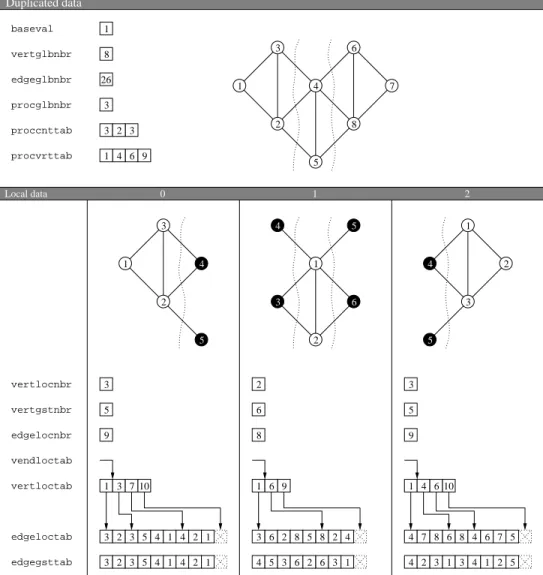
Distributed source graphs are described by means of adjacency lists. The de-scription of a distributed graph requires several SCOTCH Num scalars and arrays, as shown for instance in Figures 6 and 7. Some of these data are said to be global, and are duplicated on every process that holds part of the distributed graph; their names contain the “glb” infix. Others are local, that is, their value may differ for each process; their names contain the “loc” or “gst” infix. Global data have the following meaning:
baseval
Base value for all array indexings. vertglbnbr
Overall number of vertices in the distributed graph. edgeglbnbr
Overall number of arcs in the distributed graph. Since edges are represented by both of their ends, the number of edge data in the graph is twice the number of edges.
procglbnbr
proccnttab
Array holding the current number of local vertices borne by every process. procvrttab
Array holding the global indices from which the vertices of every process are numbered. For optimization purposes, this array has an extra slot which stores a number which must be greater than all of the assigned global in-dices. For each process p, it must be ensured that procvrttab[p + 1] ≥ (procvrttab[p] + proccnttab[p]), that is, that no process can have more local vertices than allowed by its range of global indices. When the global numbering of vertices is continuous, for each process p, procvrttab[p + 1] = (procvrttab[p] + proccnttab[p]).
Local data have the following meaning: vertlocnbr
Number of local vertices borne by the given process. In fact, on every process p, vertlocnbr is equal to proccnttab[p].
vertgstnbr
Number of both local and ghost vertices borne by the given process. Ghost vertices are local images of neighboring vertices located on distant processes. vertloctab
Array of start indices in edgeloctab and edgegsttab of vertex adjacency sub-arrays.
vendloctab
Array of after-last indices in edgeloctab and edgegsttab of vertex adja-cency sub-arrays. For any local vertex i, with baseval ≤ i < (baseval + vertlocnbr), vendloctab[i] − vertloctab[i] is the degree of vertex i. When all vertex adjacency lists are stored in order in edgeloctab with-out any empty space between them, it is possible to save memory by not allocating the physical memory for vendloctab. In this case, illus-trated in Figure 6, vertloctab is of size vertlocnbr + 1 and vendloctab points to vertloctab + 1. For these graphs , called “compact edge array graphs”, or “compact graphs” for short, vertloctab is sorted in ascend-ing order, vertloctab[baseval] = baseval and vertloctab[baseval + vertlocnbr]= (baseval + edgelocnbr).
Since vertloctab and vendloctab only account for local vertices and not for ghost vertices, the sum across all processes of the sizes of these arrays does not depend on the number of ghost vertices; it is equal to (v + p) for compact graphs and to 2v else.
veloloctab
Optional array, of size vertlocnbr, holding the integer load associated with every vertex.
edgeloctab
Array, of a size equal at least to (maxi(vendloctab[i]) − baseval), hold-ing the adjacency array of every local vertex. For any local vertex i, with baseval ≤ i < (baseval + vertlocnbr), the global indices of the neigh-bors of i are stored in edgeloctab from edgeloctab[vertloctab[i]] to edgeloctab[vendloctab[i]− 1], inclusive.
Since ghost vertices do not have adjacency arrays, because only arcs from local vertices to ghost vertices are recorded and not the opposite, the overall sum of the sizes of all edgeloctab arrays is e.
edgegsttab
Optional array holding the local and ghost indices of neighbors of local ver-tices. For any local vertex i, with baseval ≤ i < (baseval + vertlocnbr), the local and ghost indices of the neighbors of i are stored in edgegsttab from edgegsttab[vertloctab[i]]to edgegsttab[vendloctab[i]−1], inclusive. Local vertices are numbered in global vertex order, starting from baseval to (baseval + vertlocnbr − 1), inclusive. Ghost vertices are also numbered in global vertex order, from (baseval+vertlocnbr) to (baseval+vertgstnbr− 1), inclusive.
Only edgeloctab has to be provided by the user. edgegsttab is internally computed by PT-Scotch whenever needed, or can be explicitey asked for by the user by calling function SCOTCH dgraphGhst. This array can serve to index user-defined arrays of quantities borne by graph vertices, which can be exchanged between neighboring processes thanks to the SCOTCH dgraph Haloroutine documented in Section 6.4.12.
edloloctab
Optional array, of a size equal at least to (maxi(vendloctab[i]) − baseval), holding the integer load associated with every arc. Matching arcs should always have identical loads.
Dynamic graphs can be handled elegantly by using the vendloctab and proc vrttab arrays. In order to dynamically manage distributed graphs, one just has to reserve index ranges large enough to create new vertices on each process, and to allocate vertloctab, vendloctab and edgeloctab arrays that are large enough to contain all of the expected new vertex and edge data. This can be done by passing SCOTCH graphBuilda maximum number of local vertices, vertlocmax, greater than the current number of local vertices, vertlocnbr.
On every process p, vertices are globally labeled starting from procvrttab[p], and locally labeled from baseval, leaving free space at the end of the local arrays. To remove some vertex of local index i, one just has to replace vertloctab[i] and vendloctab[i] with the values of vertloctab[vertlocnbr − 1] and vendloctab [vertlocnbr−1], respectively, and browse the adjacencies of all neighbors of former vertex (vertlocnbr − 1) such that all (vertlocnbr − 1) indices are turned into is. Then, vertlocnbr must be decremented, and SCOTCH dgraphBuild() must be called to account for the change of topology. If a graph building routine such as SCOTCH dgraphLoad()or SCOTCH dgraphBuild() had already been called on the SCOTCH Dgraph structure, SCOTCH dgraphFree() has to be called first in order to free the internal structures associated with the older version of the graph, else these data would be lost, which would result in memory leakage.
To add a new vertex, one has to fill vertloctab[vertnbr-1] and vendloctab [vertnbr-1] with the starting and end indices of the adjacency sub-array of the new vertex. Then, the adjacencies of its neighbor vertices must also be updated to account for it. If free space had been reserved at the end of each of the neighbors, one just has to increment the vendloctab[i] values of every neighbor i, and add the index of the new vertex at the end of the adjacency array. If the sub-array cannot be extended, then it has to be copied elsewhere in the edge sub-array, and both vertloctab[i] and vendloctab[i] must be updated accordingly. With
Duplicated data Local data 0 1 2 vertglbnbr vertlocnbr vendloctab vertloctab vertgstnbr edgelocnbr edgegsttab edgeloctab baseval edgeglbnbr proccnttab procglbnbr procvrttab 26 10 4 10 4 4 4 5 6 2 3 1 2 3 1 4 5 1 2 4 3 5 1 4 5 8 7 6 3 2 1 3 2 3 3 8 6 4 9 1 1 3 7 5 9 1 6 9 8 9 1 5 6 6 3 2 3 5 4 1 4 2 1 4 5 3 6 2 6 3 1 4 2 3 1 3 1 2 5 3 2 3 5 4 1 4 2 1 3 6 2 8 5 8 2 4 4 7 8 6 8 6 7 5 3 2 3
Figure 6: Sample distributed graph and its description by libScotch arrays using a continuous numbering and compact edge arrays. Numbers within vertices are vertex indices. Top graph is a global view of the distributed graph, labeled with global, continuous, indices. Bottom graphs are local views labeled with local and ghost indices, where ghost vertices are drawn in black. Since the edge array is compact, all vertloctab arrays are of size vertlocnbr+ 1, and vendloctab points to vertloctab + 1. edgeloctab edge arrays hold global indices of end vertices, while optional edgegsttab edge arrays hold local and ghost indices. veloloctab and edloloctab are not represented.
Duplicated data Local data 0 1 2 vertglbnbr procvrttab vertlocnbr vertgstnbr edgelocnbr edgegsttab edgeloctab vertloctab vendloctab baseval edgeglbnbr proccnttab procglbnbr 26 11 17 99 4 4 11 11 11 12 11 11 17 19 12 19 11 11181917 19 4 11 17 18 12 2 3 1 12 17 19 11 18 2 3 1 4 5 1 2 4 3 5 1 4 5 6 3 2 1 3 2 3 3 8 1 5 9 6 8 9 5 3 2 3 9 1 6 2 1 7 5 6 3 5 4 1 3 1 3 2 3 2 4 2 1 2 1 5 9 6 4 5 3 6 2 3 2 3 6 1 2 4 2 3 1 3 1 2 5
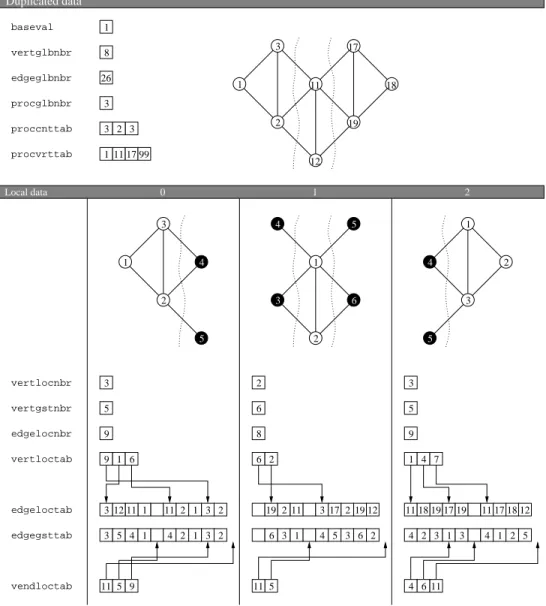
Figure 7: Adjacency structure of the sample graph of Figure 6 with a disjoint edge array and a discontinuous ordering. Both vertloctab and vendloctab are of size vertlocnbr. This allows for the handling of dynamic graphs, the structure of which can evolve with time.
simple housekeeping of free areas of the edge array, dynamic arrays can be updated with as little data movement as possible.
6.2.2 Block ordering format
Block orderings associated with distributed graphs are described by means of block and permutation arrays, made of SCOTCH Nums. In order for all orderings to have the same structure, irrespective of whether they are centralized or distributed, or whether they are created from graphs or meshes, all ordering data indices start from baseval. Consequently, row indices are related to vertex indices in memory in the following way: row i is associated with vertex i of the SCOTCH Dgraph structure as if the vertex numbering used for the graph was continuous.
Block orderings are made of the following data: permtab
Array holding the permutation of the reordered matrix. Thus, if k = permtab[i], then row i of the original matrix is now row k of the reordered matrix, that is, row i is the kth pivot.
peritab
Inverse permutation of the reordered matrix. Thus, if i = peritab[k], then row k of the reordered matrix was row i of the original matrix.
cblknbr
Number of column blocks (that is, supervariables) in the block ordering. rangtab
Array of ranges for the column blocks. Column block c, with baseval ≤ c < (cblknbr + baseval), contains columns with indices ranging from rangtab[i] to rangtab[i + 1], exclusive, in the reordered matrix. There-fore, rangtab[baseval] is always equal to baseval, and rangtab[cblknbr + baseval]is always equal to vertglbnbr+baseval. In order to avoid mem-ory errors when column blocks are all single columns, the size of rangtab must always be one more than the number of columns, that is, vertglbnbr + 1. treetab
Array of ascendants of permuted column blocks in the separators tree. treetab[i] is the index of the father of column block i in the separators tree, or −1 if column block i is the root of the separators tree. Whenever sep-arators or leaves of the sepsep-arators tree are split into subblocks, as the block splitting, minimum fill or minimum degree methods do, all subblocks of the same level are linked to the column block of higher index belonging to the closest separator ancestor. Indices in treetab are based, in the same way as for the other blocking structures. See Figure 8 for a complete example.
6.3
Strategy strings
The behavior of the block ordering routines of the libScotch library is parametrized by means of strategy strings, which describe how and when given partitioning or ordering methods should be applied to graphs and subgraphs
peritab cblknbr rangtab treetab permtab 13 10 11 12 10 11 12 10 −1 1 2 4 5 6 8 7 2 3 6 4 8 7 1 1 2 5 4 3 3 7 6 6 7 5 9 1 2 3 9 8 7 6 5 4 1 5 2 6 9 4 8 3 7 3 6 7 8 9 1 2 3 4 5 6 7 10 11 12 10 11 12
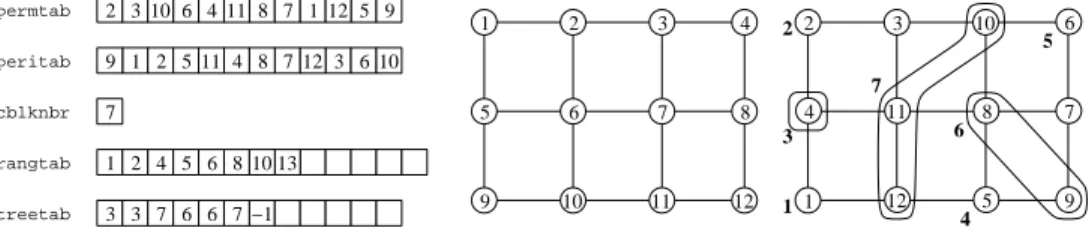
Figure 8: Arrays resulting from the ordering by complete nested dissection of a 4 by 3 grid based from 1. Leftmost grid is the original grid, and righmost grid is the reordered grid, with separators shown and column block indices written in bold. 6.3.1 Parallel ordering strategy strings
A parallel ordering strategy is made of one or several parallel ordering methods, which can be combined by means of strategy operators. The strategy operators that can be used in ordering strategies are listed below, by increasing precedence. (strat )
Grouping operator. The strategy enclosed within the parentheses is treated as a single ordering method.
/cond ?strat1[:strat2];
Condition operator. According to the result of the evaluation of condition cond, either strat1 or strat2 (if it is present) is applied. The condition applies to the characteristics of the current node of the separators tree, and can be built from logical and relational operators. Conditional operators are listed below, by increasing precedence.
cond1 |cond2
Logical or operator. The result of the condition is true if cond1 or cond2 are true, or both.
cond1 &cond2
Logical and operator. The result of the condition is true only if both cond1 and cond2 are true.
!cond
Logical not operator. The result of the condition is true only if cond is false.
var relop val
Relational operator, where var is a node variable, val is either a node variable or a constant of the type of variable var, and relop is one of ’<’, ’=’, and ’>’. The node variables are listed below, along with their types. edge
The global number of arcs of the current subgraph. Integer. levl
The level of the subgraph in the separators tree, starting from zero for the initial graph at the root of the tree. Integer.
load
The overall sum of the vertex loads of the subgraph. It is equal to vertif the graph has no vertex loads. Integer.
mdeg
proc
The number of processes on which the current subgraph is dis-tributed at this level of the separators tree. Integer.
rank
The rank of the current process among the group of processes on which the current subgraph is distributed at this level of the sepa-rators tree. Integer.
vert
The global number of vertices of the current subgraph. Integer. method[{parameters}]
Parallel graph ordering method. Available parallel ordering methods are listed below.
The currently available parallel ordering methods are the following.
n Nested dissection method. The parameters of the nested dissection method are given below.
ole=strat
Set the parallel ordering strategy that is used on every distributed leaf of the parallel separators tree if the node separation strategy sep has failed to separate it further.
ose=strat
Set the parallel ordering strategy that is used on every distributed sep-arator of the sepsep-arators tree.
osq=strat
Set the sequential ordering strategy that is used on every centralized sub-graph of the separators tree, once the nested dissection process has gone far enough such that the number of processes handling some subgraph is restricted to one.
sep=strat
Set the parallel node separation strategy that is used on every current leaf of the separators tree to make it grow. Parallel node separation strategies are described below, in section 6.3.2.
s Simple method. Vertices are ordered in their natural order. This method is fast, and should be used to order separators if the number of extra-diagonal blocks is not relevant
6.3.2 Parallel node separation strategy strings
A paralle node separation strategy is made of one or several parallel node separation methods, which can be combined by means of strategy operators. Strategy operators are listed below, by increasing precedence.
strat1 |strat2
Selection operator. The result of the selection is the best vertex separator of the two that are obtained by the distinct application of strat1 and strat2 to the current separator.
strat1 strat2
resulting from the application of strategy strat1 to the current separator. Typically, the first method used should compute an initial separation from scratch, and every following method should use the result of the previous one as a starting point.
(strat )
Grouping operator. The strategy enclosed within the parentheses is treated as a single separation method.
/cond ?strat1[:strat2];
Condition operator. According to the result of the evaluation of condition cond, either strat1 or strat2 (if it is present) is applied. The condition applies to the characteristics of the current subgraph, and can be built from logical and relational operators. Conditional operators are listed below, by increasing precedence.
cond1 |cond2
Logical or operator. The result of the condition is true if cond1 or cond2 are true, or both.
cond1 &cond2
Logical and operator. The result of the condition is true only if both cond1 and cond2 are true.
!cond
Logical not operator. The result of the condition is true only if cond is false.
var relop val
Relational operator, where var is a graph or node variable, val is either a graph or node variable or a constant of the type of variable var , and relop is one of ’<’, ’=’, and ’>’. The graph and node variables are listed below, along with their types.
edge
The global number of edges of the current subgraph. Integer. levl
The level of the subgraph in the separators tree, starting from zero for the initial graph at the root of the tree. Integer.
load
The overall sum of the vertex loads of the subgraph. It is equal to vertif the graph has no vertex loads. Integer.
proc
The number of processes on which the current subgraph is dis-tributed at this level of the nested dissection process. Integer. rank
The rank of the current process among the group of processes on which the current subgraph is distributed at this level of the nested dissection process. Integer.
vert
The number of vertices of the current subgraph. Integer.
b Band method. Basing on the current distributed graph and on its parti-tion, this method creates a new distributed graph reduced to the vertices which are at most at a given distance from the current separator, runs a parallel vertex separation strategy on this graph, and projects back the new separator to the current graph. This method is primarily used to run separator refinement methods during the uncoarsening phase of the multi-level parallel graph separation method. The parameters of the band method are listed below.
strat=strat
Set the parallel vertex separation strategy to be applied to the band graph.
width=val
Set the maximum distance from the current separator of vertices to be kept in the band graph. 0 means that only separator vertices themselves are kept, 1 that immediate neighboring vertices are kept too, and so on.
m Parallel vertex level method. The parameters of the vertex multi-level method are listed below.
asc=strat
Set the strategy that is used to refine the distributed vertex separa-tors obtained at ascending levels of the uncoarsening phase by pro-jection of the separators computed for coarser graphs. This strategy is not applied to the coarsest graph, for which only the low strategy is used.
dlevl=nbr
Set the minimum level after which duplication is allowed in the fold-ing process. A value of −1 results in duplication befold-ing always per-formed when folding.
dvert=nbr
Set the average number of vertices per process under which the fold-ing process is performed durfold-ing the coarsenfold-ing phase.
low=strat
Set the strategy that is used to compute the vertex separator of the coarsest distributed graph, at the lowest level of the coarsening process.
rat=rat
Set the threshold maximum coarsening ratio over which graphs are no longer coarsened. The ratio of any given coarsening cannot be less that 0.5 (case of a perfect matching), and cannot be greater than 1.0. Coarsening stops when either the coarsening ratio is above the maximum coarsening ratio, or the graph has fewer node vertices than the minimum number of vertices allowed.
vert=nbr
Set the threshold minimum size under which graphs are no longer coarsened. Coarsening stops when either the coarsening ratio is above the maximum coarsening ratio, or the graph has fewer node vertices than the minimum number of vertices allowed.
q Multi-sequential method. The current distributed graph and its sep-arator are centralized on every process that holds a part of it, and a
sequential vertex separation method is applied independently to each of them. Then, the best separator found is projected back to the dis-tributed graph. This method is primarily designed to operate on band graphs, which are orders of magnitude smaller than their parent graph. Else, memory bottlenecks are very likely to occur. The parameters of the multi-sequential method are listed below.
strat=strat
Set the sequential vertex separation strategy that is used to refine the separator of the centralized graph. For a description of all of the available sequential methods, please refer to the Scotch User’s Guide[25].
z Zero method. This method moves all of the node vertices to the first part, resulting in an empty separator. Its main use is to stop the separation process whenever some condition is true.
6.4
Distributed graph handling routines
6.4.1 SCOTCH dgraphInit Synopsis
int SCOTCH dgraphInit (SCOTCH Dgraph * grafptr,
MPI Comm comm)
scotchfdgraphinit (doubleprecision (*) grafdat,
integer comm,
integer ierr)
Description
The SCOTCH dgraphInit function initializes a SCOTCH Dgraph structure so as to make it suitable for future parallel operations. It should be the first function to be called upon a SCOTCH Dgraph structure. By accessing the communicator handle which is passed to it, SCOTCH dgraphInit can know how many processes will be used to manage the distributed graph and can allocate its private structures accordingly.
SCOTCH dgraphInitdoes not make a duplicate of the communicator which is passed to it, but instead keeps a reference to it, so that all future com-munications needed by libScotch to process this graph will be performed using this communicator. Therefore, it is the user’s responsibility, whenever several libScotch routines might be called in parallel, to create appropriate duplicates of communicators so as to avoid any potential interferences between concurrent communications.
When the distributed graph is no longer of use, call function SCOTCH dgraph Exitto free its internal communication structures.
Return values
SCOTCH dgraphInit returns 0 if the graph structure has been successfully initialized, and 1 else.