Ministry of Higher Education
University of Oran
Department of Anglosaxon Languages.
Faculty of Letters,Languages and Arts
A ProJect SUBMITTED IN PArtial
Fulfilment of THE REQUIREMENT of THE DEGREE OF
MAGISTER IN TEFL
Presented by: Miss Djoub Zineb
Members of the jury:
President :Pr.M.Miliani
Univerity of Oran El Senia
Examiner:Dr.F.Bedjaoui Univerity of Sidi Bel-Abbès
Supervisor:Dr S.M. Lakhdar Barka
2006-2007
BRITISH LITERATURE
TEACHING: TOWARDS AN
INTEGRATIVE APPROACH
ACKNOWLEDGEMENTS
I wish to express my deep gratitude and thankfulness to my supervisor Dr S.M. Lakhdar Barka for his precious help and valuable suggestions all along the preparation of this project.
I am very grateful to Pr.M.Miliani for his rich advice on the adequate techniques for conducting research and writing this projects.
I also gratefully acknowledge the help of Mr M.Bouhand, teacher of British literature at the university of Oran for his valuable contribution in the data collection procedure of this work.
Finally,I cannot forget the students who were generously co-operative in the data collection sessions.
List of Abbreviations
CA:Contrastive Analysis. EA:Error Analysis.
EFL:English as a Foreign Language. ELT:English Language Teaching. ESP:English for Specific Purposes. ESL:English as a Second Language FL:Foreign Language.
NLs:Native Languages
L1:Students’First Language (Arabic in this case). L2:Students’Second Language.(French in this case). SLA:Second Language Acquisition Research. SL:Second Language.
TLs:Target Languages.
List of Tables
Page
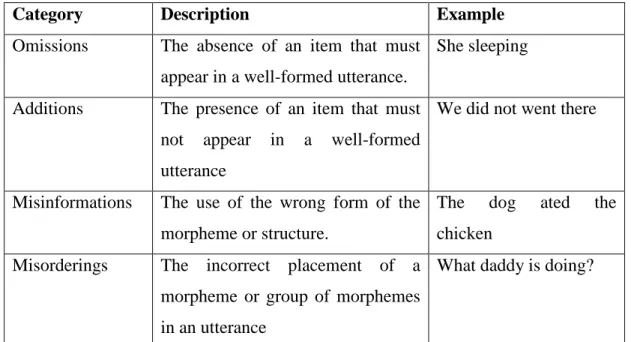
Table 2.1: Surface Strategy Taxonomy of Errors (Examples taken from Dlay,Burt
and Krashen stated in R.Ellis,1994:56) 49
Table 3.1: The Subjects’ Performance in The British Literature First Exam 66
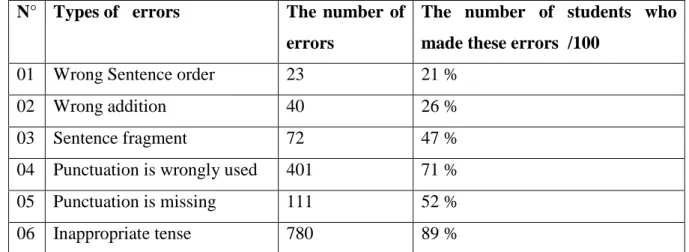
Table 3.2: Errors at The Form Level: Grammar and Punctuation. 68
Table 3.3:Errors at The Content Level:Lexix and Style. 71
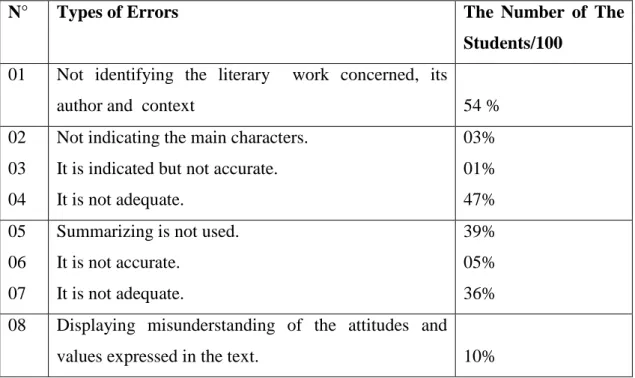
Table 3.4: Errors at The Content Level:Demonstrating Initial Understanding of
Elements of The Literary Text. 74
.
Table 3.5: Errors at The Content Level:Interpretation and Analysis of The Literary 76 Text.
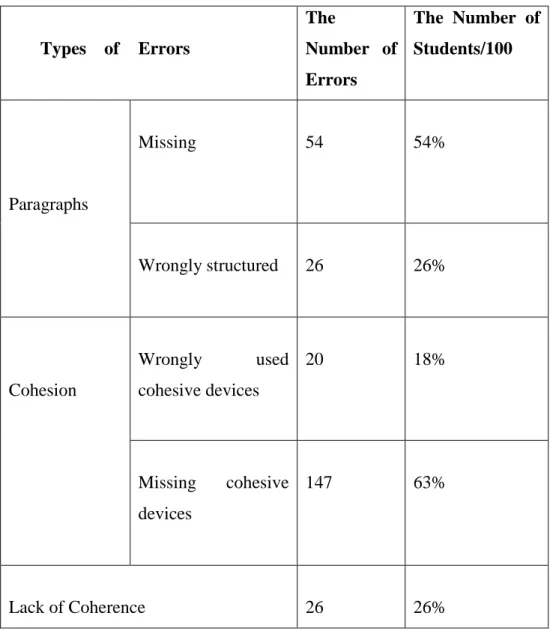
Table 3.6: Errors at The Content Level:Essay Organization. 78
Table 3.7: Errors at The Content Level: Comprehensibility of Ideas and Their 81 relation with The Topic.
Table 3.8: Students’ reading preferences in British literature. 84
List of Bar-Graphs
Page
Bar-Graph 3.1:The Subjects’Performance in The British Literature First Exam. 66
Bar-Graph 3.2:The number of students who made errors in grammar and lexis. 68
Bar-Graph 3.3: The number of students who made errors. 72
Bar-Graph 3.4: The number of students who displayed little understanding of
elements of the literary text. 74
Bar-Graph 3.5: The number of students who did not write organized essays. 79
Bar-Graph 3.6: The number of students whose ideas are incomprehensible and
TABLE OF CONTENTS
Page
Acknowledgements………i List of Abbreviations…….………...ii List of Tables……….…………...………....iv List of Bar-Graphs……….………..vTable of Contents ………..vii
General Introduction………..…..1
Chapter One:The Learning Situation 1.1 Introduction………..….05
1.2 The English Language Department: Objectives…..………..05
1.3 The British Literature Module:Status…..………..…06
1.4 Teachers’ Syllabus and Method………..08
1.4.1 Teachers’ Syllabus………...09
1.4.2 Teachers’ Method………...10
1.5 Students’ profile and Needs ………...12
1.5.1 Students’ Profile………...12
1.5.2 Students’ Needs ………...15
1.6 The Research Instruments………...17
1.6.1 Observations……….17
1.6.2 Corpus Analysis ………..17
1.6.3 The Interview………...18
1.7 Conclusion……….18
Chapter Two: Writing in Foreign Literature Teaching 2.1 Introduction……….……...22
2.2 An Historical Overview of literature Teaching………...22
2.3 Approaches to The Teaching of Literature……….24
2.3.1 The Cultural Based Approach……….24
2.3.3 The Personal Based Approach……….…...25
2.3.4 The Integrative Approach………..27
2.4 On The Notion of Literature……….28
2.4.1 A Definition of Literature………...28
2.4.2 Literary and Non-Literary Texts………...30
2.4.3 The Relation between Literature and Language Use………..32
2.5 Written Communication in Studying Literature……….34
2.5.1 The Nature of Writing………..34
2.5.1.1 Writing as a Communicative Act………...35
2.5.1.2 The Difference between Written and Spoken Communication……36
2.5.2 Writing a Literary Interpretation………37
2.5.3 Requirements in The Process………..39
2.5.3.1 Writing Fluency………39
2.5.3.2 Critical Reading………42
2.5.3.3 Self-Efficacy………...42
2.6 Error Analysis and Assessment in Literature………..46
2.6.1 Background of Error Analysis………46
2.6.2 Errors Taxonomies………..48
2.6.3 Assessment in Literature Teaching………50
2.7 Conclusion………...52
Chapter Three: Data Analyses 3.1 Introduction……….55
3.2 Data Collection Procedure……….55
3.2.1 Observations………...55
3.2.2 Error Analysis………...56
3.2.3 The Interview………..64
3.3 Results and Interpretations………...65
3.3.1 Observations Results……….65
3.3.2 Error Analysis Results……….67
4.3.3 The Interview Results………84
3.4 General Interpretations………...86
Chapter Four :Suggestions and Recommendations
4.1 Introduction……….92
4.2 Students’Training………...92
4.3 The Integrative Approach to British Literature Teaching……….94
4.3.1 Teachers’ Role………96
4.3.1.1 According to The language Based Approach………..96
4.3.1.2 According to The Personal Based Approach………...97
4.3.1.3 According to The Cultural Based Approach………...98
4.4 Text Choice………100
4.5 Designing Writing Activities in The Classroom……….101
4.5.1 Language Based Writing Activities in Literature……….102
4.4.2 Personal Based Writing Activities in Literature………...107
4.4.6 Cultural Based Writing Activities………..112
4.5 Conclusion………..119
General Conclusion……….122
Bibliography
Appendices:
Appendix A: The Interview
GENERAL INTRODUCTION
The issue of whether implementing literature in foreign language teaching is valuable for language learners or not has always raised controversial debates in research in literature.The generalization of the mass media in foreign language teaching and the increasing interest in learning English for special purposes have lead to the emergence of more skeptical views around this issue.It has been claimed that literature is an art which generates taste so that it cannot be taught in educational institutions.
However,despite such factors literature remains for most researchers a necessary component of the English language syllabus because of the rewarding and effective learning it can lead to.Current approaches have then endeavoured to re-examine the value of literature and have begun to uphold its worth again.Their concern has been mainly to find how to enable foreign students to communicate their ideas using the target language through the teaching of literature.
However,foreign students have often difficulties in using language properly.Introducing them to the teaching of literature will be then a hard task to achieve since students do not possess the necessary tools to express their ideas and feelings on what they read.Therefore,the present work aims at proposing a way of teaching British literature that may help students to cope with studying British literature and overcome some of their difficulties in its study .This approach aims also to develop their fluency in writing their literary response on a given literary masterpiece.
Before achieving this,the present work attempts to find tentative reasons for the students’difficulties in communicating their ideas in writing.Thus, it does not claim to identify all the difficulties which students may face in studying British literature such as reading difficulties, poor knowledge of the foreign culture, difficulties in expressing their ideas through participating in class,etc.
The observations which have motivated the present investigation are as follows:
- The students were interested in taking much more lectures notes about the literary text concerned.
- They did not perform well in the first exam of the British literature course which may imply that they had difficulties in studying this course.
The present work aims to undertake a preliminary investigation of whether students’ level of writing fluency and feeling of self-efficacy in using language are reasons for their reliance on ready made meanings and failure in the British Literature module.To answer this question more detailed questions have to be investigated:
- What is the nature of the students’ difficulties in studying British literature?.Are they of a writing nature or of a reading nature?.
- Do these difficulties contribute to their poor performance in the exam of British literature?.
- Do the students express creatively their ideas in writing their exam’s answers?.
From the above questions one can suggest the following hypotheses:
- The students’ difficulties may be of a writing nature rather than a reading nature,i.e. they may not be fluent in writing in English.
- Students’ lack of fluency in writing makes them more likely to make errors and get a negative assessment.
- Because of their lack of fluency in writing ,students may be less confident about their writing abilities and thus more reluctant to express their ideas in answering the exam question.
To illustrate these hypotheses an investigation including observations, the analysis of a corpus,i.e, students’ answer sheets of the first exam of the British literature module and the interview have been carried out.The informants are third year students who were attending the British literature course.The present work has selected these subjects and has been concerned with their performance in the British literature course for the following reasons:
- Third year university students have already studied British Literature in their second year at university.Thus,they may have at least an idea about what studying literature entails.
- The coefficient of the British literature module is three for third-year students (higher than in the second and fourth year ).These students are thus more likely to be motivated (instrumentally) to pass the year.
- The third-year is the first year of the content based module at university. This means that teachers of literature are expected to base more their assessment of students’exams sheets on their content than on their form.This kind of assessment encourages students to express their ideas fluently.
The whole work is divided into four interrelated chapters.
- The introductory chapter: will introduce the learning situation of the case under study, analyses students’ profile and needs and describe the research tools for the data collection.
- Chapter two: will describe the main approaches to foreign literature teaching, define the term literature and introduce the process of writing literary interpretation, its deficits and what is needed to be accomplished.
- Chapter three will analyse the students’ exams sheets to find out which kind of errors prevent them from communicating effectively their ideas both at the level of form and content of language.This chapter will also analyse the data collected from interviewing students concerning their perception of their writing ability about literature during exams.
- Finally, chapter four will suggest a way of teaching British Literature which aims to develop students’ fluency and self-efficacy in writing their literary responses.
Chapter One
The Learning Situation
Page
1.1 Introduction………05
1.2 The English Language Department:Objective………05
1.3 The British Literature Module:Status……….06
1.4 Teachers’ Syllabi and Method………..08
1.4.1 Teachers’ Syllabi………...09
1.4.2 Teachers’ Method……….10
1.5 Students’ Profile and Needs………..12
1.5.1 Students’ Profile………....12
1.5.2 Students’ Needs……….15
1.6.The Research Instruments………17
1.6.1 Observations……….17
1.6.2 Error Analysis..………17
1.6.3 The Interview………18
1.1 Introduction
This section presents and describes the characteristics of the learning situation of the group of subjects selected for this study.It also includes the description of the students’ profile and analysis of their needs according to the objective of the research work.Thus, their motivation, interest, difficulties and learning needs have been studied and analysed.The research instruments which are used for data collection are described in the last part of this chapter.
1.2 The English Language Department: Status
The objective of The English language department is to train students to become future English teachers or graduate in English with a licence degree.The latter is accomplished through a four-year curriculum whose content is based on language skills (reading, listening, writing and speaking),Educational Psychology, Phonetics, Grammar, Linguistics, Civilisation and Literature, in addition to Didactics, Psycholinguistics and T.E.F.L.
The students who have graduated from this department have been either recruited by the ministry of education in middle and secondary schools or they have joined different Science and Technology institutes as part time teachers.There are also students who have joined other institutes or universities for postgraduation, either in the country or abroad.
These students are expected to teach the English language appropriately and efficiently.Thus, they should have enough knowledge of this language and be able to transmit it in a proper way. Moreover, they should be able to read and understand different types of texts either literary or non-literary through the use of the reading skills.
Furthermore, the graduate students are not only expected to master English well but also to know about the socio-cultural dimension that holds its use.They should be aware of the foreign culture and the way it operates within language.Thus, these students are expected to communicate in cross-cultural situations.i.e,when they meet people from different cultures and languages. In doing so, they will be able to communicate with foreign communities in
different fields like Politics, sports, literature ,art and carry out research in English as Hemissi states:
“….North African learners are expected to study English as a foreign language so that they can cope with the ever- increasing amount of scientific, technical and commercial literature which is available only in English,and which they need urgently to keep abreast of the latest development in their field .They need also to participate in the production of this internationally produced literature…..”
(Hemissi,1992:23)
Having defined the role of the department, it becomes necessary to determine what status the British literature module has in this department in the following section.
1.3 British Literature Module: Status
The literature course is one of the components of the English degree curriculum through the teaching of British, American and Third World Literatures.The students are introduced to British literature in their second, third and fourth year.Whereas American literature is taught in the second and third year and Third World Literatures is introduced into the curriculum only in the third year
It follows from this, that among these modules more emphasis is put on the teaching of British literature since it is taught for three years.What is then the importance of this module and what status does it enjoy ?.
As it has been stated before, the British Literature module is programmed for second, third ,and fourth year students for one hour and half per week.The coefficient of this module is two points for the second year ,three points for the third year and one for the fourth year.It seems that the teaching of this literature is given more importance during the third year since its coefficient is three.This implies that students should do well in this module to deserve a pass mark for the fourth year.
However, though the coefficient of British literature is raised in the third year its practice remains the same as in the second and the fourth year.It is still programmed only once a week during one hour and half which may not enable teachers to tackle several literary texts and engage their students in extensive reading(1).
Nevertheless,it should be stated from the outset that studying literature is useful in EFL classroom for a number of reasons.Here are a few:
Exposing students to literature may help them acquire different linguistic uses, forms and conventions of the written mode.
Literature encourages students’ personal involvement and interaction since literary texts contain meanings that can be used effectively for classroom discussion.
Literature makes students aware of the foreign culture,i.e,the way of life of the country whose language is being learnt.( in this case the British culture )
In addition, literature educates the student by examining values in literary texts, teachers encourage students to develop attitudes towards them,which relate to the world outside the classroom.
Considering such benefits ,one can consider the module as being central to students’ linguistic ,communicative as well as cultural competence, besides the motivating effect it can have on them.To gain such benefits, a number of objectives are set by teachers as stated by Dahim (1988) as follows:
Teachers aim essentially at developing students’ability to make sound literary appreciation, developing their critical thinking and personal responses to the literary texts.Instead of memorizing and learning by heart data about literary texts.
Encouraging students to make use of language through participating in class:reading, explaining and commenting.
Develop students’ skills of communication by encouraging them to read other critical studies that help them interpret the literary text.
In addition, literature develops students’ aesthetic sensitivity through appreciating literary texts and it makes them familiar with the English language varieties that can be used in such texts.Hence, though literature teaching is conceived as a necessary tool in language acquisition and its objective are clearly stated, it is still viewed as providing students with literary texts and requiring them to read and respond critically to them in their essays during exams without taking into account their level of fluency in writing in English.
Concerning the assessment of the British literature module, students are required to sit for two exams during the two semesters of their academic year, besides the synthesis and the make up exam for those who did not get an average mark during the first and the second exam.Taking these exams for students is the only means of assessing their performance in studying British literature.
It follows from this that Students’ performance depends mostly on their writing ability.Therefore, being fluent in writing,i.e,being able to express their ideas and achieve a particular communicative purpose in a proper English is of crucial importance for these students to succeed in studying British literature.Thus, students who have not already developed this fluency may find it difficult to write a critical essay about a particular literary text and then perform well in the British literature exams.
It needs to be stated that the third year is the first year of the content based module.This means that teachers are expected to focus more on the content rather than the form of students’exams answers as it has been stated by the official directives. The objective behind such a kind of assessment is to develop students’ fluency in writing and enhance their interpretive abilities.
1.4 Teachers’ Syllabus and Method:
It is worth mentioning that students’ performance in the British literature course may be affected by the teacher’s methodology and strategies of teaching for “learning what is
meaningful and relevant depends partly on what is taught and depends partly on how it is taught.”(Brandus and Ginnis,P.1986:12).Therefore, it is necessary to identify the characteristics of the selected literary works.
1.4.1 Teachers’ Syllabus:
Most teachers supplied their students with an appropriate bibliograghy for reference and a list which comprises the literary works they are expected to study, as well as those they are recommended to read to go further into the period.In addition, students are provided with the historical background and the literary movement that is being dealt with and some bibliographical details about the author and his style.
However, concerning the selected work short stories are so often implemented in the programme.This is because one hour and half session a week is not sufficient to deal with different literary genres.Consequently, students may become bored and de-motivated from meeting the same type of class.
Furthermore, the literary works selected are not based on the students’ preferences or interests, so that they may not sustain their motivation.In fact, teachers of literature find the selection of such works a real problem because they are guided by many principles which must meet within the same selected literary work.These principles are stated by M.Miliani (2003:25) as follows:
a) ‘Of easy access’ : at the level of language and comprehension to facilitate the learning process.
b) ‘Appealing’: the story, theme of the work must be interesting or thought-provoking to sustain the learners’motivation.
c) ‘Of recognised worth’:works written by well-known writers should be considered not those of the obscure ones.
d) ‘Free from any socio-cultural or religious aggression’:since literature reveals the social and religious values,attitudes and beliefs of the writer or his society it would be best to choose the works which would not offend or disturb psychologically the learners nor question their identity, culture or creed.On the contrary, it should be an opportunity to know himself better and accept the image he gets from the contact with the other.
Thus, it is not only a matter of selecting literary texts that appeal to students’ interest but also accessible ones in terms of the level of language used and the culture expressed in them ,a task which most teachers find difficult to fulfil.Consequently, students may encounter difficulties in reading and their interaction with the literary texts may become hard to achieve.
Students’ performance during exams may reflect these reading difficulties.This is so,since these exams’questions concern the literary texts which were handled to students to read at home, discuss and study in class with their teacher.
During these exams, most teachers give their students two topics about the literary text which was studied and required them to answer one of them during two hours. Answering this topic entails writing arguments, personal ideas, showing understanding of the main events of the story under question and mastering the writing conventions as well.Failing to achieve these tasks, a student cannot perform well in the British literature exams.
Accordingly, one thinks that since students are not involved in different types of assessment, they are not given enough opportunities to explore their abilities in using English and get much more confidence in themselves.Besides, they are not helped to improve their performance and experience success.Thus,students’motivation,self-confidence in their abilities (self-efficacy) are likely to be reduced in this case.
1.4.2 Teachers’ Method:
In this learning situation, not only do literature teachers find difficulties in selecting the appropriate literary texts for their students ,they have also difficulties in deciding upon the proper way of teaching them,i.e.the techniques used to achieve their objectives.
The lack of adequate pedagogical means is one among the factors which may not facilitate studying British literature.Apart from the literary text no other pedagogical means like visual aids and audio-cassettes which can help in clarifying the text are provided in the classroom.Thus, the teacher is required to help his students to get insight into the story
handled through practising reading only.Therefore,students who are not proficient in reading or lack reading background in literature are not likely to cope with its study.
Furthermore,students are not engaged in pair or group activities which can motivate them to take risk and express their ideas in class.This is because the British literature course is practised in large classes where the number of students is over one hundred.Thus,involving them in such activities is difficult if not impossible for teachers to realize.
As a matter of fact, the British literature lectures tend often to be teacher-centred where the teacher has control over the talk in class while most students take notes as it has been observed in this investigation.Thus,what students gain from studying British literature in this kind of situation is the dull loaded lecture which keeps their ideas and responses on the literary text unexpressed
“….He tends to take over and profess the opinion of those critics he is taught to regard as prestigious. Being inexperienced and valid or not especially if they remain unexpressed and entirely private to himself.The only way in which he can learn whether they are feasible or even relevant is through active participation in discussion.”
(J.Collie and S.Slater,1987 :46)
Studying British literature here can have a negative effect on the students’motivation. They may not become interested in studying literature as this lecture does not give them the opportunity to make the text their own through expressing and sharing their views with each others, also because it includes no variety of activities apart from reading .Thus, students may become demotivated when faced with the same type of class.
Students may not then develop a liking of literature and achieve the required personal involvement with the literary texts being studied.In this case, reading such texts is unlikely to be conceived as an enjoyable and attractive experience so that no attention will be directed on the part of the students to make extensive reading in literature.Thus, students’ literature and reading competence may not develop in this way.
Furthermore, students are more likely to encounter difficulties in expressing their ideas and responses during exams.This is so, since these lectures do not involve them in communicative activities that can encourage them to elicit a response, share their views and
then deepen their understanding of the text, nor do they engage them in language based activities where they can analyse and understand the structure of the text.(2)
Thus,studying British literature may neither help students develop their ability to communicate in English nor help them in writing or speaking.It is likely, rather to raise their difficulties and reduce their self-confidence in using this language.
It needs to be argued that students have not been taught how to analyse and develop their responses on the literary text concerned, nor have they been trained to do so during any academic year.Besides their difficulties in writing in this language,their lack of awareness of the process of writing a literary interpretation is likely to contribute to their poor performance in the British literature exam.
1.5 Students’Profile and Needs:
Identifying students ’profile ,needs, interests, language level, motivation, cultural and learning background is a prerequisite task in deciding what should be taught in a literature course.Indeed ,the choice of a particular literary work for study depends on the variables mentioned above as J.Collie and S.Slater stated:
“What sort of literature is suitable for use with language learning? The
criteria of suitability depend ultimately on each particular group of students, their needs,interests,cultural background and language level”. (1987:06)
In this way, reading literary works can be accessible for students and studying literature can be more effective and interesting for them.For that purpose, a number of research tools had been designed and administered to the subjects selected for the study.Information about their profile can be provided as follows.
1.5.1 Students’Profile
The subjects chosen for the present investigation are third year university students who attend the English language courses at the university of Oran.These students were observed,
interviewed and their answer sheets of the British literature exam were examined according to the research objective.
Concerning the students’ learning background, it has been noticed that the students’ mastery of Arabic and French is better than English since the latter is less practised in the teaching of middle and secondary schools as compared to the two other languages. Moreover, English is considered as a foreign language and its practice is limited to the classroom environment, whereas Arabic and French are used in every day life.
Furthermore,in middle and secondary schools the students did not only have a lack of exposure to the English language but they also had no contact with the culture embodied in it.This is because Algeria like many other former colonies have suffered the colonizer’s denial of its identity and cultural heritage.
Therefore, after independence the first objective of the system of education has been to restore the Algerian identity by emphasizing “the nationally-oriented teaching of culture and
particularly of literature at elementary and secondary school…” (F.Hellal ,1988:105) .
Therefore, syllabi designers do not associate foreign teaching with its culture ,but rather present this foreign language in the Algerian context as M.Miliani argued:
“…In our educational institutions foreign cultures were simply discarded without justification from the official syllabi..There were even pieces of advices by certain course designers or language inspectors in some text books against the use of foreign cultures.Hence the design of English texts using situations belonging to the Algerian context”.(1998:77)
Thus,the teaching of foreign languages is considered as an end in itself and not as an opportunity to gain insight into the life of foreigners.This neglect of foreign cultures was meant to protect students from being accultered.(3)
As a matter of fact,the gap of cultural differences is widened and supplied by their value judgements and stereotypes.Thus,it would be unrealistic to expect university students to possess enough background knowledge of the target culture.(4). Moreover,students have not been exposed or taught British literature or any type of literature in English during their learning background.With this limited amount of practice, they might encounter difficulties
in reading literary texts and writing their responses in the language which they have little exposure to.
It should be noted that the students’ lack of exposure to the target language and culture during their past learning experience may be another reason for their difficulties in studying British literature.For studying this module requires a high linguistic level and cultural competence from its students.
Furthermore,in their learning experience, students have not been also encouraged to express their ideas in English, voice their personal views and develop much more confidence in their writing abilities.Instead, they were mostly involved in what is known as guided writing where accuracy is the main objective of the task. It is likely then that these students encounter difficulties in expressing their ideas in English and mainly in writing an analytical essay as it is the case in studying literature.
In addition, the way these students have been taught at schools can have an effect on their academic performance at university.With most subject matters, students have been trained to one mode of learning which is memorizing the teacher’s notes and reciting them on their exam answer sheets. This type of teaching does not help students develop their critical thinking and creativity in learning, but rather made them more dependent on their teacher.Consequently, students ‘attitudes at university are more likely to be as in S.M.Lakhdar Barka’s words:
“….they do not come to lectures in order to comment,to exchange ideas,to debate what they have read with their classmates and confront their opinion to what the other may think of it.Instead they attend lectures looking for literary ready-made answers they call documentation or reading notes for the exam”.(2004:41)
Accordingly,one may hypothesize that students’ lack of confidence and fluency in writing in English may be the main reason for their poor performance in the British literature module and their reliance on ready made meanings .
Concerning the students’ attitudes and perception towards studying this module,most of them viewed it as interesting and important in language learning as they stated in the interview.Yet,it was regarded as difficult to study and cope with.
Moreover, the observations of their attitudes have shown their interest in attending its lectures and getting the literary texts proposed in the curriculum.These results have been also confirmed through their responses to the interview where they expressed their interest in reading such works.It follows from this that the subjects were motivated to study the British literature course.
However, it has been noticed that though most students attended this course only a few tended to participate in class, while the majority preferred to take down the teacher’s notes.Students seemed to depend on their teacher in interpreting the literary text since nearly no personal involvement has been noticed on their part.
The students’ learning background, motivation, perception and attitudes in studying the British literature module have been identified in this section.What is needed now is to identify their needs in studying this module in the next section.
1.5.2 Students’ Needs
Identifying the needs of students is a prerequisite task to resort to in any given learning situation.This is because taking into account those needs when designing courses is of great importance since it may match the way of teaching to the way students need to learn ,raise their motivation and make learning better and faster.
The students’ needs can refer to what they are required to do at the end of their language course.The kind of language items, skills, strategies, etc, they need to learn in order to be able to function effectively in the target situation.To do this, one needs to learn about the different places learners will use their English in,so that the required language points and skills can be selected for that purpose.
The students’ needs can also be interpreted as lacks or what they do not know or can-not do in English.This can be defined in terms of the gap between the students’ proficiency and the proficiency required from them in the target language situation:
“The target proficiency…..needs to be matched against the existing proficiency of the learner.The gap between the two may be referred to as the learners’ lacks”.(Hutchinson and Waters,1989:56)
Moreover,they can refer to students’wants or expectations since students may prefer to learn one thing over another.
Concerning students’ target situation in this case, students will use their English for teaching in Primary,Middle and Secondary schools,or in institutions of occupational nature (science and technology).It is possible also that they will join different economic fields in the country like banks,touristic agencies,etc,where they will have to use technical English that is related to this particular profession.Some students will decide to use their English also for higher studies by joining postgraduations in the country or in foreign universities.
Therefore,the students’needs within the target situation are centred on the four skills: speaking,listening,reading and writing.Moreover,their needs go beyond their mastery of the language system to include their awareness of the foreign culture through the teaching of literature and civilisation, besides their needs to know about how to teach a foreign language through the teaching of TEFL and Educational Spychology.
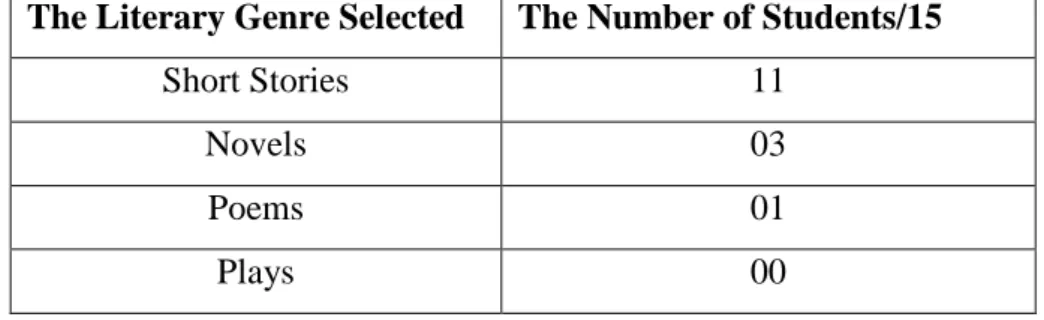
Concerning students’ wants or expectations for the British literature course, most of the subjects included in this investigation expressed their wants for reading short stories. When asked about the kind of themes they prefer to read ,the majority showed favour for romantic themes. ( These results are discussed in chapter three).
In the interview, the subjects have showed their need to get the teacher’s notes on the literary text concerned because of their writing difficulties.These difficulties lie in their inability to write appropriately and develop effectively their arguments while answering the British literature first exam as the error analysis conducted in this case study has revealed.
The interview has also showed the students’ needs to know the methodology of essay writing,i.e.how to analyse the literary text while answering the exam question.They also expressed their needs to be aware of the criteria upon which their exam answer sheets are assessed.The subjects explained that this awareness raising may help them understand what is required from them in taking the British literature exam and thus may enable them to perform well in it.
1.6 The Research Instruments
To make the study results more reliable, a variety of research tools ( observations, analysis of students’ exam answers sheets and the interview) have been used and triangulated on a sample population (a group of students).
1.6.1 Observations
They have always been considered a major data collection in both qualitative and quantitative research (Herbert and Elan,1989).They are most often used to study language learning and teaching processes, to collect data on students’ attitudes, and how they use language in different settings.
In the present investigation, these observations aim to have a preliminary idea of the students’ process of studying British literature, more particularly their interaction in the classroom and the difficulties they may encounter in this process. In addition, to have an idea about their performance in studying British literature their exam answer sheets of the first semester have been also observed.
1.6.2 Error Analysis
The corpus under study is students’ answer sheets of the British literature exam of the first semester (one hundred exam answer sheets).This analysis includes identification of errors that can affect written communication , their description and interpretation.
In the present investigation this analysis is meant to fulfil the following objectives:
Having a preliminary idea about the type of errors which are recurrent in the students’ exams sheets and which affect the message they tried to communicate.
To see to what extent these errors affect the effectiveness of the written product and how frequent they are occurring in their exam answer sheets.
To identify the causes of these errors.
1.6.3 The Interview
It is often referred to as self-report methods (Weir and Robert 1994).It is used mostly to elicit from students their attitudes towards a teaching method,for example, motivation,their profile and language background,etc.The kind of interview used in this investigation is a semi-structured one which “consists of specific and defined questions determined
beforehand,but at the same time it allows some elaboration in the question and answers” (
H.W.Seliger and E.Shottamy,1989:167).Thus,the subjects interviewed were prompted to express their ideas freely (5).This interview aims :
1) To have an idea about their motivation in studying British literature and their reading preferences of literary texts.
2) To reveal how the students find studying British literature,i.e.do they encounter difficulties in its study ?.
3) To have an idea about the kind of difficulties they encounter in responding to the exam question of the British literature module.
4) To know if these writing difficulties make them less confident about using language and hinder their self-expression.
5) To have an idea about how the students react to overcome these difficulties.
1.7 Conclusion
This first chapter has tried to describe the situation under which the teaching and learning process of the selected subjects is carried out.The nature of the learning situation,teachers’ syllabus and method as far as the British literature course is concerned, the students’ characteristics: motivation, perception towards studying this module and their needs have been identified.The analysis of the students’ needs has revealed their need for a training
in writing an analysis about the literary texts concerned.This was seen as a solution to their writing difficulties.
This chapter has also introduced the data collection tools used for testing the research hypothesis.Before analysing the data obtained ,the process of writing a literary analysis has to be defined and the role of self-efficacy, writing fluency and critical reading need to be provided in the following chapter.
Notes
1-Extensive reading :is free voluntary reading for pleasure.
2-Language based activities like writing summaries, projects,or dialogues between characters of literary texts,doing activities on grammar,vocabulary or figurative language of literary texts.Communicative activities can follow language based activities for example students can be asked to write their responses to the literary texts and discuss them with their peers.
3-Acculturation means the process of internalizing the culture of a society or social group (C.Kramsch,1993).
4-There are other factors which may contribute to students’ foreign cultural misunderstandings among them the influence which foreign Audio-visual means of communication (like T.V channels,Video,etc.) may have on them.The mass of cultural information which these means of communication broadcast find no adequate interpretation on the part of the students.This is because they are neither equipped to encounter them nor provided with the necessary safeguard that lessen their impact.
“…Algerian learners…are generally ill-equipped to encounter the excesses of these means of communication or to provide their recipients with the necessary safeguards that would enable them to relativize the messages received and to minimize the harmfulness of their intellectual and ideological consequence “. (F.Hellal,1988:105)
5-This is because they used their mother tong language,i.e, Algerian Arabic to answer the interview’s questions which were also addressed in this language.Moreover,to help the subjects express their ideas freely the present interview was not recorded.
Chapter Two
Writing in Foreign Literature Teaching
Page
2.1 Introduction………..22 2.2 An Overview of Literature Teaching……….22 2.3 Approaches to The Teaching of Literature………...24 2.3.1 The Cultural Based Approach………..24 2.3.2 The Language Based Approach………25 2.3.3 The Personal Based Approach………..25 2.3.4 An Integrated Approach to The Teaching of Literature………27 2.4 On The Notion of Literature………...28 2.4.1 A Definition of Literature………..28 2.4.2 Literary and Non-Literary Texts………..30 2.4.3 The Relation between Literature and Language Use………..32 2.5 Written Communication in Studying Literature………...34 2.5.1 The Nature of Writing………....34 2.5.1.1 Writing as a Communicative Act………...35 2.5.1.2 The Difference between Written and Spoken Communication……...36 2.5.2 Writing a Literary Interpretation………..37 2.5.3 Some Requirements in the process……….39 2.5.3.1 Writing Fluency………...39 2.5.3.2 Critical Reading………...42 2.5.3.3 Self-Efficacy………...44 2.6 Error Analysis and Assessment in Literature Teaching………....46 2.6.1 Background of Error Analysis………...46 2.6.2 Errors Taxonomies……….48 2.6.3 Assessment in Literature Teaching………..50 2.7 Conclusion………52
2.1 Introduction:
The concern of the present work is to attempt to investigate the deficit noticed of third year university students of English at the university of Oran in the module of British literature.The research question put prior to this study is whether the students’ lack of fluency and feeling of confidence in writing can account for their low rate of achievement in studying this module.This theoretical chapter attempts to shed light on some important aspects of the teaching of a foreign literature focusing mainly on writing as an important skill in its study.
2.2 An Overview of Foreign Literature Teaching:
The issue of teaching a foreign literature in a non-native context goes back to the early years of the twentieth century when literature was considered of high prestige and the main purpose of language learning.It had been assumed that if non-native students were continually exposed to the best uses of the English language i.e,the classics, it would ‘ rub-off ‘on their own performance in the language.(Short and Candlin1986:91)(1).
However, the difficulty and the inaccessibility of many literary texts to non-native English speaking students, besides the lack of a consistent and suitable methodology for the teaching of literature brought negative effects.The literature class consisted often of an enthusiastic teacher and passive students who could not cope with language and spent their time translating its unfamiliar words.
Consequently,there was a gradual withdrawal of literature teaching from the language classroom.It became only a means of language teaching through the structure of short tales and dialogues.Whereas the literary effect was neglected.
“ Surrogate literature replaced authentic texts in the form of situational textbook dialogues and short stories that were devised to carry structure only but none of the literary effect that characterises a genuine text.” (Ibid)
The place and the role of literature in the language classroom was questioned furthermore by the ELT approaches during the period 1960-1980.However,these approaches
were incompatible with literature teaching because they did not encourage learners to develop their personal responses to texts, but rather insisted on their language development. Sructuralism emphasized correctness in grammatical form and repetition of restricted lexis.Whereas, the communicative approach to language teaching during 1970’s and early 1980’s emphasized the study of language for practical purposes.Therefore, literature teaching had no place in the language classroom since it has no direct usefulness for the communicative needs of the learners.
However, during the 1980’s there was a strong reawakening of interest in literature and language teaching.Widdowson among the supporters of the return of literature in the language classroom insists on the role of language learning which cannot be exclusively made for training,but also for self-educating through literature teaching.
“There is more to life than safe investment of effort.Language learning is surely not simply a part of training,an element in actuarial estimates and the calculation of manpower needs.Surely,we might murmur wistfully, it should also have something to do with education as well”.(Widdowson1984:161)
Moreover,linguists and ELT scholars argued not only for the teaching of literature in the language classroom ,but also for the necessity of a pedagogical approach for non-native speakers of English.This new approach which has been known as ‘Stylistic’ is a linguistic approach which aims at developing students’ language by analysing the linguistic form of the text.
Thus, enabling them to make meaningful interpretations of the text and making them read and study literature more effectively.The language exercises include vocabulary exercises,grammar use or sound stress,punctuation exercises, paraphrasing ,text completion exercises, summarizing, etc.
However, the stylistic approach to literature teaching did not help students develop their critical ability to literary texts and their personal growth.This is because they were not encouraged to express their ideas and personal responses to the literary text which is considered the basis of literature teaching: “… the teaching of literature is an arid business
unless there is a response and even negative responses can create an interesting classroom situation”. (Long,1986:42)
The need for an approach that responds to students’needs increases with the belief in the importance of integrating literature into the EFL syllabus.
2.3 Approaches to The teaching of Literature
More recently ,Carter and Long (1991) described the main educational, linguistic and psychological arguments put forward for the teaching of literature through the following approaches.
2.3.1 The Cultural Based Approach:
It is the most traditional approach to literature teaching.It views a literary text as a product because it is treated as a source of information about the target culture.This is through examining the social, political and historical background to a text, literary movements and genres.There is no specific language work done on a text.By a teacher-centred methodology this approach seeks to provide the foreign language student with as much information as possible about literature.
However,this approach has often been criticized for giving too much importance to students’ accumulating knowledge about literature and learning them by memorization.It is widely argued that such a vision of teaching inevitably reduces the process itself to a mere mechanism against which educational psychologists stood.
“ Knowledge about literature means accumulation of facts about literary context,dates,authors,literary terms etc….can easily become knowledge for its own sake and does not lead automatically to a more responsive reading to a fuller interpretation of a text.”
(R.Carter and M.Long,1991:04)
Such a method leaves a very small space to the student in which he can express his opinions on the text he studies in class.Moreover,it does not seek to explain the language used in the text nor help him in his process of interpreting it.The latter has been emphasised by the language based approach.
2.3.2 The language Based Approach:
Unlike cultural based approach , this approach tends to be learner-centred giving special emphasis to the way language is used in the class.Moreover,it seeks to explore “how the
language operates in the text pattern to create particular meaning and efforts”.(S.Bock,1993,p.2).This approach is more concerned with the stylistic analyses
through involving systematic procedures for developing language competence such as summary, prediction ,writing, video, scripts, etc.Thus, students will enrich and develop their language input since literary texts offer contact with some of the more subtle and varied creative uses of language.
However,though there may be much to be gained in terms of language development from such an exposure,such a view seems to ignore the real nature of literature,which is created to communicate feelings ,thought and ideas.
“ Literature should not and cannot be taught solely for linguistic purposes for literature offers more than language would normally do,since it has greater freedom and since it acknowledges no linguistic barriers that restrain our ability to use language”. (Minnis,1971:252)
Studying literature only for linguistic purposes may result in mechanistic and demotivating teaching practices spoiling any pleasure that the reading of good literature can give.In addition,the contribution of the teaching of literature to the students’ personal growth seems to be totally neglected.For that reason the personal based approach has been suggested.
2.3.3 The Personal Based Approach:
This approach is an attempt to bridge the gap between the previous approaches .It tries to be more learner- centred by encouraging students to draw on their opinions, feelings and personal experiences.Thus,”it aims to infuse a continuous love and appreciation of literary
texts, which would continue beyond the classroom”.(Carter and Long,1991:36).
Furthermore, the model focuses on the pedagogical role of the teacher as an educator and enabler for the transmission of knowledge through involving in communication with his students.His role is to encourage them to read and appreciate literature by selecting texts
which appeal to their own interest and which are related to their respective personal experiences.Meanwhile,the text’s choice should also be based on the students’ linguistic capacity and their knowledge of the foreign culture so that they can enjoy the process of reading.
The personal growth model also highlights the necessity and the pedagogical value of developing the students’ critical awareness so that they become critical readers of literary texts and not passive accumulators of whatever is being taught to them.In this perspective, this model appears to fit in the notion that education could and should aim to be a means of empowerment (Benson and Voller 1997) and the current pedagogic trends on ELT such as humanistic languages teaching and the learner-centredness(Tudor1996).(2)
Nevertheless, the use of the personal based approach may not leave much space to the learning of the target language since it overemphasizes the extrinsic study of literary texts.Moreover, aiming at making students literary critics instead of helping them to solve their language problems is likely to be far from reaching in second or foreign language teaching.Therefore,the literature course should help students to overcome their language problems and develop a liking and appreciation of literature and not at making them literary critics as M.Miliani argued:
“I do not believe that the literature course should aim at preparing people to become literary “critics”.It should,in fact,help the learners find possible solutions to their language problems,but also develop in them a taste for literature and appreciation for literary masterpieces.”(2003,p.23)
What is needed then is an approach that can make literature accessible to students and beneficial for their linguistic development and personal involvement .For that purpose,an integrated approach to teaching literature in the EFL classroom has been suggested as the following section shows.
2.3.4 An Integrated Approach to The Teaching of Literature
As previously noted,the three approaches to literature teaching differ in terms of their focus on the text.The cultural based approach sees the text as a cultural artefact.The language
based approach sees it as a focus for grammatical and structural analysis.Whereas the personal based approach sees the text as the stimulus for personal growth activities.
Applied on its own, each of the three approaches has its own strengths and weaknesses,however,a fourth approach that integrates these elements was assumed to make literature teaching more effective.Duff and Maley (1990) stated that the main reasons for integrating the three approaches are linguistic, methodological and motivational.
Linguistically,by using a wide range of authentic texts,students are shown how language is used in different contexts and introduced to the analysis of the stylistic feature of a text (vocabulary,structure,register,etc),to find out not just what a text means,but also how it comes to mean what it does (Short,1996).Methodologically,by exploring the discourse feature of literary texts,students are involved in strategies for intensive and extensive reading,in making use of their schemata,etc.Motivationally,this is through increasing understanding,enjoyment of the text and enabling students to come to their own personal interpretation of it.
It should be noted that though this suggested approach integrates linguistic description with interpretation of the text,it is not as technical or analytical as the stylistic approach.With the appropriate selected literary text,this integrated approach to the use of literature in the foreign language classroom is considered by many researchers as the most conclusive of all,since it offers students the opportunity to develop not only their linguistic and communicative skills but their knowledge about language in all its discourse types.
In talking about literature teaching one needs to attempt to define the term literature in the next section .
2.4 On The Notion of Literature:
Many authors ,critics and linguists have tried to find what literature means,the characteristics of its texts and the relation it has with using language in EFL/ESL context. The main objective from such an attempt is to find how literature can be better exploited in the classroom.Yet, a large debate has been generated on these issues as the following section will display.
2.4.1 A Definition of Literature:
What sets literature apart from other writing ,why do not we consider the daily newspaper as a work of literature and why should literature include Shakespeare and exclude the daily newspaper?.These questions may come to the mind when attempting to define the term literature.
As defined by the Oxford Advanced Learner ‘s Dictionary ”literature means pieces of
writing that are valued as works of art ,especially novels ,plays and poems.(2000:751).However,finding out what is meant by a work of art has long generated
lively debates among writers and literary critics and has led to some quite sharp differences of opinions.The question that has concentrated a lot of attention is whether or not literature is fact stating ,i.e.it depicts human experience and reality.
R.J.Rees defined literature as “writing which expresses and communicates thoughts and
attitudes towards life”(1973:02).Thus, Reeds agreed with the truthfulness of the work of
fiction .Moreover,according to him literature cannot produce good writing unless it possesses the quality of being concerned with depicting thoughts and feelings which belong to real life,or as he called it “psychological truth or holding the mirror up to nature”(Ibid,p.91).
Another endeavour to define literature was by T.Eagleton who states that :
“The literary work is the production of certain produced representations of the real into an imaginary object.If it distantiates history ,it is not because it transmutes it to fantasy, shifting from one ontological gear to another, but because the significations into fiction are already representations of reality rather than reality itself”.(1976:75)
Literature is then mimetic,i.e,it represents reality in a compelling way through its aesthetic devices.Its use of imagination does not necessary imply its exclusion from depicting reality,but it is rather a means to represent reality in a way that requires more reflection on the experience evoked in it.
The debate over the truthfulness of literature has generated further questioning on the relation between literature and other fields which concern themselves with facts such as
history,sociology and psychology.Geoffrey Strickland maintains the relation between literature and history stating:
“…..literature belongs in every aspect to history,whether as a representation of life as seen from a particular historical document and the product of historical forces,or of its diffusion and influence as historical fact,a profound influence of myth and legend”.(1985:109)
However,this view was opposed by the Russian Formalists who sought to ensure an independent place for literary studies as a science in its own right as Jakobson put it:
“The situation has been that historians of literature act like nothing so much as policemen, who, out to arrest a certain culprit, take into custody (just in case) everything and everyone they find at the scene as well as any passers-by for good measure. The historians of literature have helped themselves to everything - environment, psychology, politics, philosophy. Instead of a science of literature they have worked up a concoction of homemade disciplines”.
(Quoted in Boris Eikhenbaum1921:11)
The same view was prevailing during the 19th century where literature was defined in terms of aesthetism or what has been called “ Art for Art Sake”:
“Literature is an end in itself and need not be didactic, politically committed, propagandist, moral or any thing else but itself, and it should not be judged by any non-aesthetic criteria”.
(J.A.Cuddon 1992:62)
However,a literary text cannot be considered as unique since it refers to and draws on works in its genre before it and on other writing in the culture.Therefore,R.Wellek and A.Warren evoked the extrinsic part in the study of literary texts or what they defined as “the
study of literature in association with psychology ,ideas ,society ,and other fields of humanities”.(1985:73).(3)
So far in this section one has tried to state some views which have attempted to define what is meant by the term literature.However,it needs to be argued that there is no clear-cut single definition which has been attainable and thus defining such a term is still open to questions and debates.
Not only defining literature has been the main interest of many literary critics, but also identifying what characterizes a literary text as the following section will attempt to show.
2.4.2 Literary and Non-Literary Texts:
Before discussing the distinction between the literary and non-literary texts,one may inquire about what is meant by the word text.A text is “the original words of an
author,document” as defined by the Oxford Advanced Learner ‘s dictionary (2000:943).It
needs to be noted that a text does not only concern the written language but also the spoken one as C.Kramsch states:”The product of language use,whether it be a conversational
exchange,or a stretch of written prose,held together by cohesive devices”(1998:132).
Another definition was given by H.L.Moody who stressed that a text “has no
precondition as to social or cultural status”(1983:19).However,Kramsch(1998) maintained
that a text cannot be meaningful if it is not viewed in relation to its context of culture and to the reader’s context of reception,i.e.discourse (4).Thus,one accepts that a text consists of words (whether spoken or written) which are related together and which make sense within their social context of production and through the reader’s attempt to work out their meaning.
In fact, Different types of texts exist such as news articles, reports, letters, reviews, etc.Yet, the question that concerns the present section:Is there a difference between these texts and non-literary ones ?.
Prominent post modern theories and cognitive psychology have argued that there are no special characteristics that distinguish literature from other texts .According to cognitive psychology reading of literature is a type of discourse processing or a particular organization of the cognitive processes that are also apparent in ordinary prose or conversation (Hobbs,1990).Whereas post modern literary theorists see reading literature as the outcome of the rhetorical devices designed to promote a particular category.Both theories imply that any text ,whether literary or not depends on functions common to all texts.
However, many have reacted against not according to literary texts their distinctiveness.Brumfit and Carter maintained that there is no language that is exclusively concerned with literature but there are rather “some uses of language which are more or less
literary than others”(1986:06).What they refer to as “literariness”(Ibid).What is then this
literariness?.
The term literariness was first coined by Jakobson in 1921.To define this term Jakobson studied the difference between poetic language and practical language.He concluded that the phonic texture of poems are the particular feature which devoid the poetic language of the practical function which every day language performs (Erlich 1981).Thus,literariness has been defined as a characteristic set of text properties which make language in literature deviates from ordinary language in various ways.(Ibid)
Victor Slovsky another formalist critic whose objective was to clarify more the term literariness pointed out at the occurrence of stylistic variation that are distinctively associated with literary texts.He introduced the term defamiliarization to refer to this technique of art in which “what the reader notices is not the picture of reality that is being presented but the
pecularities of the writing itself .”(J.A.Cuddon,1992: 226).
Another concept meant to define literariness was “foregrounding” as introduced by the literary theorist Jan Mukarovsky (1964).This term refers to the range of stylistics effects that occur in literature (whether at the phonetic level e.g, alliteration, the grammatical or the semantic level).He pointed out that foregrounding may occur in normal everyday language.
To understand more the concept of literariness and to enable EFL learners recognize its aspects ,it has been suggested that comparing examples of literary and non-literary texts can help accomplish this aim.Widdowson (1975) for example compares character description in stories with invented passport details.Similarly,Warren and Wellek(1985) compared the language of literature with the language of science.(5)
However,though it has been maintained that literariness is the distinctive feature of a literary text ,regarding the latter as different in kind from other texts is still not accepted as Rosenblatt said:“The belief that the classification of texts into literary and non-literary is
misleading;the same text may be read either efferently or aesthetically”(1978,stated in
C.Kramsch,1993:124).Efferent reading refers to the reader’s ability to retrieve the meaning of words while in aesthetic reading the reader goes beyond the meaning which the words convey to include the feelings, attitudes and ideas they refer to (Ibid).
Thus, the presence or absence of the literary language does not define a text as literary or non-literary.It is more accepted that a text is defined as literary if it is read and approached as literary by bringing certain expectations.Indeed, there is no inherent quality to a literary text that makes it a literary, it is rather the interpretation the reader gives to the text which makes it so (Eagleton1983).
Before attempting to explain what a literary interpretation means ,the relation between literature and language use needs to be provided in the next section.
2.4.3 The Relation between Literature and Language Use:
Traditionnally, using literature in language learning has long been limited to teaching language usage,i.e.knowledge of linguistic rules, but rarely has it been used to develop language use.Thus,the aim of using literature in ESL classes has been as in Povey’s words:
“Literature will increase all language skills because literature will extend linguistic knowledge by giving evidence of extensive and subtle vocabulary usage, and complex and exact syntax”.
(1972:187, stated in S.Mckay 1986:191)
To attain such an aim, literature classes were often loaded with activities on the grammar and vocabulary of the literary text under study.However, literature is an example of language use so that it can develop students’ability to use linguistic rules for effective communication as stated by S.Mckay:
“Literature presents language in discourse in which the parameters of the setting and role relationship are defined. Language that illustrates a particular register or dialect with a social context and thus there is a basis for determining why a particular form is used …literature is an ideal for developing an awareness of language use”. (Ibid:192)
Similarly C.Brumfit claimed that:
“The whole basis of a study of literature is the study of communication
in various forms ,of various ideas and that communication is the tie without which any co-operative endeavour is impossible”. (1986:239)