Teaching English as a
Foreign Language
FOR
by Michelle Maxom
A John Wiley and Sons, Ltd, Publication
Teaching English as a
Foreign Language
FOR
The Atrium Southern Gate Chichester West Sussex PO19 8SQ England
E-mail (for orders and customer service enquires): [email protected] Visit our Home Page on www.wiley.com
Copyright © 2009 John Wiley & Sons, Ltd, Chichester, West Sussex, England Published by John Wiley & Sons, Ltd, Chichester, West Sussex
All Rights Reserved. No part of this publication may be reproduced, stored in a retrieval system or transmitted in any form or by any means, electronic, mechanical, photocopying, recording, scanning or otherwise, except under the terms of the Copyright, Designs and Patents Act 1988 or under the terms of a licence issued by the Copyright Licensing Agency Ltd, Saffron House, 6-10 Kirby Street, London EC1N 8TS, UK, without the permission in writing of the Publisher. Requests to the Publisher for permission should be addressed to the Permissions Department, John Wiley & Sons, Ltd, The Atrium, Southern Gate, Chichester, West Sussex, PO19 8SQ, England, or emailed to [email protected], or faxed to (44) 1243 770620.
Trademarks: Wiley, the Wiley Publishing logo, For Dummies, the Dummies Man logo, A Reference for the
Rest of Us!, The Dummies Way, Dummies Daily, The Fun and Easy Way, Dummies.com and related trade dress are trademarks or registered trademarks of John Wiley & Sons, Inc. and/or its affi liates in the United States and other countries, and may not be used without written permission. All other trademarks are the property of their respective owners. Wiley Publishing, Inc., is not associated with any product or vendor mentioned in this book.
LIMIT OF LIABILITY/DISCLAIMER OF WARRANTY: THE PUBLISHER, THE AUTHOR, AND ANYONE ELSE INVOLVED IN PREPARING THIS WORK MAKE NO REPRESENTATIONS OR WARRANTIES WITH RESPECT TO THE ACCURACY OR COMPLETENESS OF THE CONTENTS OF THIS WORK AND SPECIFI-CALLY DISCLAIM ALL WARRANTIES, INCLUDING WITHOUT LIMITATION WARRANTIES OF FITNESS FOR A PARTICULAR PURPOSE. NO WARRANTY MAY BE CREATED OR EXTENDED BY SALES OR PRO-MOTIONAL MATERIALS. THE ADVICE AND STRATEGIES CONTAINED HEREIN MAY NOT BE SUITABLE FOR EVERY SITUATION. THIS WORK IS SOLD WITH THE UNDERSTANDING THAT THE PUBLISHER IS NOT ENGAGED IN RENDERING LEGAL, ACCOUNTING, OR OTHER PROFESSIONAL SERVICES. IF PRO-FESSIONAL ASSISTANCE IS REQUIRED, THE SERVICES OF A COMPETENT PROPRO-FESSIONAL PERSON SHOULD BE SOUGHT. NEITHER THE PUBLISHER NOR THE AUTHOR SHALL BE LIABLE FOR DAMAGES ARISING HEREFROM. THE FACT THAT AN ORGANIZATION OR WEBSITE IS REFERRED TO IN THIS WORK AS A CITATION AND/OR A POTENTIAL SOURCE OF FURTHER INFORMATION DOES NOT MEAN THAT THE AUTHOR OR THE PUBLISHER ENDORSES THE INFORMATION THE ORGANIZATION OR WEBSITE MAY PROVIDE OR RECOMMENDATIONS IT MAY MAKE. FURTHER, READERS SHOULD BE AWARE THAT INTERNET WEBSITES LISTED IN THIS WORK MAY HAVE CHANGED OR DISAPPEARED BETWEEN WHEN THIS WORK WAS WRITTEN AND WHEN IT IS READ.
For general information on our other products and services, please contact our Customer Care Department within the U.S. at 877-762-2974, outside the U.S. at 317-572-3993, or fax 317-572-4002. For technical support, please visit www.wiley.com/techsupport.
Wiley also publishes its books in a variety of electronic formats. Some content that appears in print may not be available in electronic books.
British Library Cataloguing in Publication Data: A catalogue record for this book is available from the British Library
ISBN: 978-0-470-74576-2
Printed and bound in Great Britain by Bell & Bain Ltd, Glasgow 10 9 8 7 6 5 4 3 2 1
About the Author
Michelle Maxombegan teaching part-time in 1997 after doing an intensive Trinity TESOL certifi cate. She later moved to Italy where she furthered her studies in EFL and honed her skills working with students of all ages and from a wide variety of backgrounds. She toured secondary schools and gave seminars in Caribbean literature and Britain’s multi-ethnic culture showing how the English language can open doors and minds. On returning to the UK she took on the post of Director of Studies at a central London EFL school, bringing it to accreditation by the British Council for the fi rst time and learning how to work behind the scenes in the industry. She has made an instructional fi lm for Thomson ELT and become a specialist in one-to-one courses. Since becoming a freelance teacher/trainer Michelle has delivered work experience programmes for trainee TEFL teachers, taught on intensive TEFL courses in person and tutored those taking distance learning courses. She is a member of the College of Teachers.
Michelle loves voluntary work, fi nding out about other languages and working at home by the river Thames.
Dedication
This book is dedicated to Mrs Keturah Samuels, her children past and present and all my family members who approach life with such faith, courage and grace.
Author’s Acknowledgements
I would like to thank my colleagues and students who responded to this project with such enthusiasm. You truly inspired me.
During my career there have been certain TEFL people who have given me special support. These are the folks at Salisbury School of English, Oxford School Mantova, Avalon School of English and TEFL Training. Thank you for giving me one stepping stone after another while allowing me to be myself inside and outside the classroom.
The input from Wejdan Ismail, Simon Bell and Kathleen Dobie at John Wiley has been invaluable. I certainly could not have written this book without you. Last but not least, thanks to Mum, Monique and all my dear brothers and sisters for constantly egging me on and for putting up with me.
Some of the people who helped bring this book to market include the following:
Acquisitions, Editorial, and Media Development
Project Editor: Simon Bell Content Editor: Jo Theedom Acquisitions Editor: Wejdan Ismail Publishing Assistant: Jennifer Prytherch Copy Editor: Sally Lansdell
Technical Editor: Chris Groves Production Manager: Daniel Mersey Cover Photos: © avatra images / Alamy
Cartoons: Rich Tennant
(www.the5thwave.com)
Composition Services
Project Coordinator: Lynsey Stanford Layout and Graphics: Reuben W. Davis,
Christin Swinford
Proofreader: Susan Moritz Indexer: Cheryl Duksta
Contents at a Glance
Introduction ... 1
Part I: Getting Started in TEFL ... 7
Chapter 1: Discovering the Wonderful World of TEFL ... 9
Chapter 2: Looking at What TEFL Teachers Actually Do ... 19
Chapter 3: Examining Courses, Qualifi cations and Jobs ... 31
Part II: Putting Your Lesson Together ... 47
Chapter 4: Starting from the Beginning: Planning the Lesson ... 49
Chapter 5: Standing in the Spotlight: Presenting to the Class ... 67
Chapter 6: Holding the Reins and Letting Them Loose – Giving Students Practice ... 85
Chapter 7: Giving Correction and Feedback ... 101
Chapter 8: Being Materialistic! Using Course Books and Other Materials ... 115
Chapter 9: Who’s The Boss around Here? Managing Your Classroom ... 125
Part III: Teaching Skills Classes ... 137
Chapter 10: Taken as Read: Teaching Reading Lessons ... 139
Chapter 11: Write or Wrong? Teaching Writing Lessons ... 157
Chapter 12: What Accent? Teaching Pronunciation... 171
Chapter 13: Setting Their Tongues Wagging: Speaking and Discussion ... 183
Chapter 14: In One Ear, Out the Other: Learning To Listen ... 195
Part IV: The Grammar You Need to Know –
and How to Teach It ... 209
Chapter 15: Stop Press! Student to Deliver Sentence ... 211
Chapter 16: Feeling Tense? Sorting Out Verb Tenses ... 227
Chapter 19: Getting Specifi c: Teaching Just One Student and Business English ... 275
Chapter 20: Getting Youth on Your Side: Coping with Younger Learners ... 283
Chapter 21: Making the Grade: Handling Exam Classes ... 299
Chapter 22: Distinguishing Monolingual and Multi-lingual Classes ... 317
Part VI: The Part of Tens ... 333
Chapter 23: Ten Ways to Liven Up an English Lesson ... 335
Chapter 24: Ten Great Resources for TEFL Teachers ... 341
Appendix A: Lesson Plan Templates ... 349
Appendix B: TEFL Locations around the World... 355
Table of Contents
Introduction ... 1
About This Book ... 1
Conventions Used in This Book ... 2
Foolish Assumptions ... 2
How This Book Is Organised ... 3
Part I: Getting Started In TEFL ... 3
Part II: Putting Your Lesson Together ... 3
Part III: How to Teach Skills Classes ... 4
Part IV: The Grammar You Need to Know – and How to Teach It ... 4
Part V: What Kind of Class Will I Have?... 4
Part VI: The Part of Tens ... 4
Icons Used in This Book ... 5
Where to Go from Here ... 5
Part I: Getting Started in TEFL ... 7
Chapter 1: Discovering the Wonderful World of TEFL. . . .9
Understanding Why English ... 9
Looking at the TEFL Marketplace ... 10
Considering countries – both home and abroad ... 10
Changing with the seasons ... 12
Teaching trends ... 13
Getting Out There ... 13
Preparing to leave town ... 13
Setting up elsewhere ... 14
Thinking About a Stint or a Life in TEFL ... 15
Filling gap years and career breaks ... 15
Planning a new life ... 16
Addressing some qualms ... 17
Chapter 2: Looking at What TEFL Teachers Actually Do. . . .19
Answering Common Questions ... 19
Can I teach English without knowing the students’ language? ... 19
Do I have to translate?... 20
Will the students be children? ... 20
Do I have to know all the grammar in the English language? ... 20
Can I teach without a degree and formal qualifi cations?... 21
I hated language lessons at school. Will the job be like that? ... 21
Are there lots of books and exercises for students to work through? ... 21
What kind of person makes an ideal TEFL teacher?... 22
Does it matter that I’m not a native speaker? ... 22
How many students will I have? ... 22
Is it okay if I don’t ‘talk posh’? ... 23
Will the students like me? ... 23
How will I know what to do? ... 23
Talking to Students and So Much More – Teaching Basics ... 23
Teaching the easier words fi rst ... 24
Focusing on the most useful words ... 26
Giving students room to talk ... 26
Keeping things relevant ... 27
Recognising What Your Students Want from You ... 27
Chapter 3: Examining Courses, Qualifi cations and Jobs . . . .31
Teaching the Teacher ... 31
Finding your level ... 32
Being an unqualifi ed teacher ... 32
Getting initiated ... 34
Becoming a qualifi ed teacher ... 35
Getting on Course ... 35
Entering introductory courses ... 35
Signing up for a certifi cate course ... 37
Keeping your distance... 40
Going for a diploma course ... 41
Staying in for in-house training ... 43
Banking on Salaries ... 44
Finding Work ... 45
Part II: Putting Your Lesson Together ... 47
Chapter 4: Starting from the Beginning: Planning the Lesson . . . .49
Deciding What to Teach ... 49
Beginner ... 50 Elementary ... 51 Pre-intermediate ... 52 Intermediate ... 52 Upper-intermediate ... 53 Advanced ... 54 Profi ciency ... 55
Keeping Things Relevant ... 55
Getting into Grading ... 56
Setting Aims and Objectives ... 58
Getting Your Timing Down and Planning for Interaction ... 59
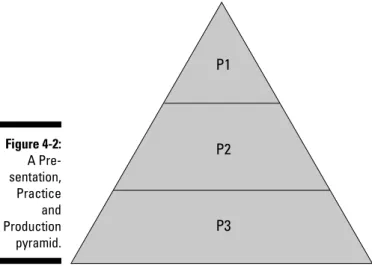
Assembling Presentation, Practice and Production ... 61
Introducing the point ... 61
xiii
Table of Contents
Trialling the language ... 62
Giving your students free practice ... 63
Stepping Out of the Spotlight to Let Your Students Shine ... 64
Chapter 5: Standing in the Spotlight: Presenting to the Class . . . .67
Eliciting Answers – Ask, Don’t Tell! ... 67
Creating Interest with Visual Aids ... 69
Showing and telling – pictures and objects ... 69
Travelling along timelines and tenses ... 70
Using the board effectively ... 72
Doing Concept Checks ... 74
Introducing Vocabulary ... 76
Sharing function and connotation ... 78
Fish and . . . ? Teaching vocabulary in chunks ... 79
All right mate! Teaching posh words and slang ... 80
Talking about words that mean the same and opposites – synonyms and antonyms ... 81
Presenting Grammar ... 82
Chapter 6: Holding the Reins and Letting Them Loose –
Giving Students Practice . . . .85
Practising New Words ... 85
Practising with the whole class fi rst ... 87
Practising alone ... 88
Practising in pairs ... 90
Practising in groups ... 93
Moving to the Production Stage ... 93
Writing and speaking ... 93
Role-playing in pairs ... 94
Getting dramatic in groups ... 95
Giving Instructions ... 96
Putting Students into Pairs and Groups ... 97
Trying Out Practice and Production Activities ... 97
Writing a blurb ... 98
Doing class surveys and reports... 98
Playing Mastermind ... 99
Producing predictions ... 100
Chapter 7: Giving Correction and Feedback . . . .101
Knowing What to Correct and When ... 101
Judging accuracy, timing and value ... 102
Exploring the nature of the error ... 103
Letting Your Fingers Do the Talking ... 104
Using your hands ... 104
Teaching with body language ... 105
Leading to Self Correction ... 106
Progressing by prompting ... 106
Encouraging Peer Correction ... 107
Scheduling Class Feedback ... 108
Wielding Your Red Pen ... 109
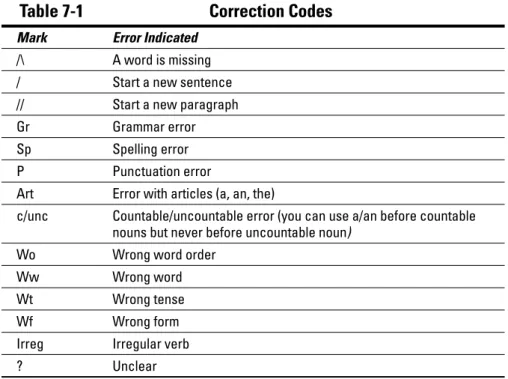
Marking with correction codes ... 109
Choosing written errors to work with ... 110
Marking criteria ... 112
Praising the good bits ... 112
Exposing Progress ... 113
Chapter 8: Being Materialistic! Using Course
Books and Other Materials . . . .115
Wasting No Time Reinventing the Wheel ... 115
Listing Popular Course Books and Published Resources ... 116
Going for general English books ... 117
Imparting business English... 118
Starting off younger learners ... 118
Adapting Your Course Book ... 119
Catering to a class of mixed ability ... 119
Dealing with mixed age groups ... 120
Setting tasks... 120
Making Use of Authentic Materials ... 121
Designing Your Own Materials ... 122
Using What’s at Hand ... 123
Chapter 9: Who’s The Boss around Here?
Managing Your Classroom . . . .125
Running Your Classes Effectively ... 125
Organising Your Classroom ... 127
Considering basic equipment... 127
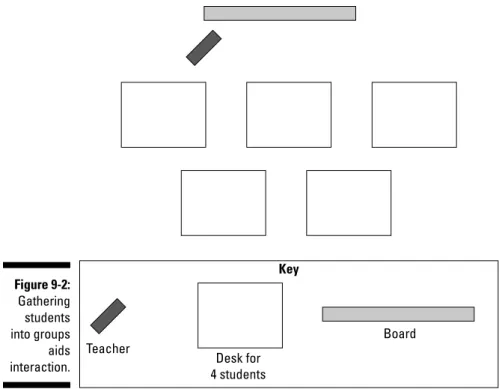
Arranging the room ... 128
Establishing Classroom Rules ... 130
Keeping Order ... 131
Troubleshooting ... 132
Dealing with disruptive students ... 133
Handling a lack of participation ... 134
Attending to poor attendance ... 135
Part III: Teaching Skills Classes ... 137
Chapter 10: Taken as Read: Teaching Reading Lessons. . . .139
Choosing a Text ... 139
Starting with the ABCs ... 140
Reading whole words ... 141
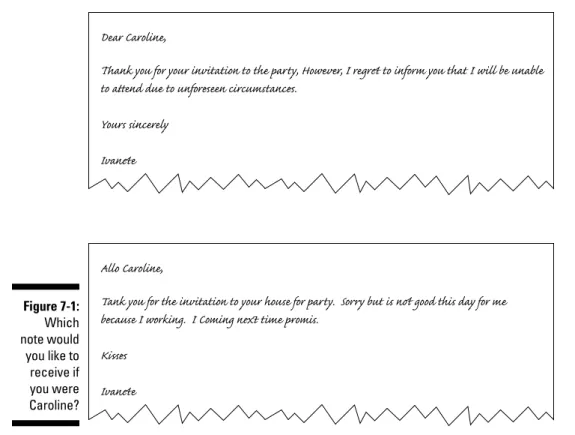
Graduating from words to sentences with the help of punctuation ... 142
xv
Table of Contents
Looking at length ... 144
Judging interest and relevance ... 144
Working with the Text ... 145
Getting ready to read: Pre-reading tasks ... 145
Finding your way around ... 146
Getting the gist ... 146
Getting down to the nitty-gritty ... 146
Predicting ... 147
Summarising ... 147
Handling Vocabulary ... 148
Before you set off ... 149
Along the way ... 149
Try another route ... 149
Working on Skills Associated with Reading ... 150
Including reading-related skills ... 150
Doing more than reading ... 150
Reading Case Study ... 152
Chapter 11: Write or Wrong? Teaching Writing Lessons . . . .157
Putting Pen to Paper ... 157
Paying attention to basic writing skills ... 158
Completing sentences ... 158
Moving on to paragraphs ... 159
Structuring a Writing Lesson ... 161
Energising the class with pre-writing tasks ... 161
Setting the writing task and explaining the stages ... 165
Registering the Right Degree of Formality ... 166
Writing Case Study ... 168
Chapter 12: What Accent? Teaching Pronunciation . . . .171
Repeat after Me ... 171
Repeating fi rst ... 171
Repeating as a class and individually ... 172
Using Phonology: Sound and Spelling ... 173
Getting to know the 44 key sounds of English ... 174
Using phonemes in class ... 177
Adding Emphasis to Words and Syllables ... 177
Impotent or important? Placing emphasis on syllables... 178
Emphasising words... 178
Improving Fluency through Pronunciation ... 179
Watch Your Tone! – Intonation ... 180
Chapter 13: Setting Their Tongues Wagging:
Speaking and Discussion . . . .183
Getting Students Talking ... 183
Warming up ... 184
How About You? Extending Conversations ... 187
Helping students depart from the script ... 187
Following up ... 189
In My Opinion – Agreeing, Disagreeing and Negotiating ... 190
Expressing an opinion ... 190
Interjecting, rephrasing and summing up... 191
Planning a Discussion Lesson ... 193
Choosing the right topic ... 193
Creating structure in the discussion ... 194
Paying attention without taking over ... 194
Chapter 14: In One Ear, Out the Other: Learning To Listen . . . .195
Structuring Your Lesson ... 195
Choosing a Listening Activity ... 196
Finding material from the real world ... 196
Choosing the material from course books ... 198
Using CDs and DVDs for authentic listening ... 198
Whetting Students’ Appetites ... 201
Motivating students to listen ... 201
Running through some pre-listening tasks ... 202
Come Again? Repeating the Text ... 204
Listening for the basic idea ... 204
Listening for detail ... 205
Planning Follow-Up Activities ... 207
Part IV: The Grammar You Need to Know –
and How to Teach It ... 209
Chapter 15: Stop Press! Student to Deliver Sentence . . . .211
Starting with the Basics: Subjects, Verbs and Objects ... 211
Thinking about subjects ... 212
Activating verbs ... 213
Acting on the object ... 216
Proposing Prepositions ... 217
Introducing Articles ... 218
Using the indefi nite a/an ... 219
Getting specifi c with ‘the’ ... 219
Foregoing the article altogether ... 220
Describing Adjectives and Adverbs ... 220
Sprucing up a noun with an adjective ... 220
xvii
Table of Contents
Connecting with Conjunctions ... 224
Differentiating conjunctions ... 224
Weaving conjunctions into writing and speaking ... 225
Chapter 16: Feeling Tense? Sorting Out Verb Tenses . . . .227
I Speak, I Spoke, I’ve Spoken: Identifying the Tenses ... 227
Beginning with the Present Simple ... 229
Staying Continuously in the Present ... 231
Going Back to the Past, Simply ... 231
Remembering a Moment in the Past ... 232
Presenting the Present Perfect Simple ... 233
Sharing experiences ... 233
Continuing from the past until the present ... 234
Anticipating expectations ... 234
Noting recent changes ... 234
Acting in the Present Perfect Continuous ... 235
Moving from the past until the present ... 235
Showing recent changes ... 235
Getting to the Past Perfect Simple ... 236
Seeing the structure ... 236
Plotting a timeline ... 237
Focusing on the Past Perfect Continuous ... 238
Expressing the Future ... 239
Doing the future simple ... 240
Going into the future continuous ... 241
Getting to the future perfect ... 242
Looking forward to the future perfect continuous ... 244
Talking about ‘To be going to’... 245
Chapter 17: Exploring More Important Verb Structures . . . .247
Knowing Your Modals ... 247
Identifying modal verbs ... 247
Comparing the modal verbs and what they do... 249
Sorting Out Phrasal Verbs ... 251
Following the rules about separable and inseparable phrasals .... 252
Teaching phrasal verbs ... 254
If I Were You . . . Conditional Structures ... 255
Being general: The zero conditional ... 255
Depending on the possible: The fi rst conditional ... 256
Imagining the second conditional... 258
Part V: What Kind of Class Will I Have? ... 263
Chapter 18: Putting Students to the Test . . . .265
Testing Early to Discover Your Students’ Needs ... 265
Having them test themselves ... 265
Assigning levels through placement tests ... 267
Testing for profi ciency ... 268
Testing to Establish the Best Course ... 268
Testing progress ... 269
Testing achievement ... 269
Marking Tests ... 272
Looking at Alternatives to Testing ... 273
Chapter 19: Getting Specifi c: Teaching Just One
Student and Business English . . . .275
Evaluating One-to-Ones ... 275
Listing pros and cons for the student ... 276
Talking pros and cons for the teacher ... 277
Planning and teaching a one-to-one lesson ... 279
Working at Teaching Business English ... 280
Chapter 20: Getting Youth on Your Side:
Coping with Younger Learners . . . .283
Teaching Kids’ Classes – Dream or Nightmare? ... 283
Looking at how little ones learn ... 284
Sorting out what young learners need ... 284
Imagining Once Upon a Time ... 285
Getting the grammar ... 286
Expanding vocabulary ... 287
TEFL Tiddlywinks: Using Games to Teach ... 288
Adapting real games ... 289
Using games from course books ... 290
Tuning-In to Songs and Nursery Rhymes ... 292
Choosing the right song ... 292
Teaching your class to sing ... 292
Keeping Teenagers Interested ... 294
Intriguing students with international English... 295
Spelling out abbreviations ... 296
Playing Kim’s game ... 297
Offering advice with problem pages ... 297
Chapter 21: Making the Grade: Handling Exam Classes. . . .299
Exploring University Entrance Exams ... 299
IELTS (International English Language Testing System) ... 300
xix
Table of Contents
Going for More General English Exams ... 304
Cambridge ESOL (English for Speakers of Other Languages) exams ... 304
Other exams ... 305
Sharpening Study Skills and Exam Techniques ... 307
Writing especially for exams ... 308
Reading for exams ... 310
Speaking in exams ... 311
Listening in exams ... 312
Teaching Exam Classes ... 313
Organising your course ... 313
Using English exam papers: Teaching what sounds ‘English’ ... 314
Chapter 22: Distinguishing Monolingual and
Multi-lingual Classes . . . .317
Speaking the Same: Monolingual Classes ... 317
Predicting errors ... 317
Using the students’ language ... 319
Pointing out the pitfalls of monolingual classes ... 320
Creating an ‘English’ environment ... 320
Diversifying with Multi-lingual Classes ... 322
Building rapport ... 322
Managing learning ... 324
Going beyond language: Teaching culture ... 326
Applying Case Studies ... 327
The English class in Italy ... 329
The English class in London ... 330
Part VI: The Part of Tens ... 333
Chapter 23: Ten Ways to Liven Up an English Lesson . . . .335
Bring in Real-World Objects ... 335
Step Outside the Classroom ... 336
Browse the Net ... 336
Start a Project ... 337
Let the Students Teach ... 337
Starting Out with ‘Once Upon a Time’ ... 338
Open Up Your Life ... 338
Move Around ... 339
Play a Game ... 339
Chapter 24: Ten Great Resources for TEFL Teachers. . . .341
Making the Most of EFL Reference Books ... 341
A grammar reference to fall back on ... 341
A book with grammar lessons to save the day ... 342
Looking It Up! Making Use of the Dictionary ... 342
Browsing Websites ... 343
Finding work ... 343
Planning lessons ... 344
Reading the English Language Gazette ... 344
Attending Professional Seminars ... 345
Getting Your Hands on Real Stuff- ... 345
Maps ... 345
Newspapers and magazines ... 346
Personal memorabilia ... 346
Playing Board Games ... 346
Roping in Friends and Family ... 347
Pointing to Charts and Posters ... 348
Appendix A: Lesson Plan Templates ... 349
PPP Lessons ... 349
Skills Lessons ... 351
Needs Analysis ... 352
Observing Lessons ... 353
Appendix B: TEFL Locations around the World ... 355
Brazil ... 355 China ... 356 Italy ... 356 Japan ... 357 Poland ... 358 Russia ... 358 Saudi Arabia ... 359 South Korea ... 360 Spain ... 360 Turkey ... 361 Vietnam ... 362
Index ... 363
Introduction
T
he English language is officially big business. There could be as many as a billion students learning English around the world at this time and that is reason enough to consider moving into Teaching English as a Foreign Language (TEFL). However, when you combine this with the freedom the job gives you to move around the world and earn your keep, the case for TEFL gets even stronger. While English speakers move out to different lands, stu-dents of English migrate to other parts of the globe in search of a better life and new horizons.Teaching English is something people do when they are ready to change their lives and this book gives you some of the basic tools you need to make that happen.
Most people who speak the language well can teach others to some degree. We do it all the time with children and with foreign friends. We explain words and concepts to each other on a daily basis. TEFL is an extension of what we do naturally and this book helps you zoom in on your language skills and structure them. People often surprise themselves by discovering that even without attending months and years of language study, they can teach. You are probably no different.
About This Book
I have been teaching English for many years now and I have found it an entirely rewarding experience. I have met the most fascinating people and had a hand in helping others reach their goals. My goal in this book is to help you enjoy TEFL too by giving you the confidence and know-how to get a job and deliver effective, engaging lessons.
You could read the book from cover to cover before deciding whether TEFL is for you. If you do, you will have a solid overview of the skills involved in teaching English well. On the other hand, you could use it as a resource that you dip into whenever you need some input because your lessons are falling a bit flat or you are short of ideas. The table of contents will point you to spe-cific areas of concern or maybe even areas you have never thought about but should have.
A book of this size can’t cover all the different ways of planning and deliver-ing a lesson. There are probably as many teachdeliver-ing techniques as there are
TEFL teachers, so I have chosen to present the tried and tested path to solid courses. If you do come across other effective ways to help students don’t discard them because they are not included here. Use TEFL for Dummies as a starting point. Hopefully it will inspire some great ideas of your own.
I should also mention that this is not a photocopiable resource book with ready made lesson plans. The aim is to show the kinds of activities and tech-niques you can use with your classes, adapting them to your own situation. This book is not strictly applicable to teaching in language schools which have their own trademark methodology and materials. In such cases the schools will expect you to teach in very defined ways with little room for other techniques.
Conventions Used in This Book
Throughout this book I use a few conventions which you need to know about up front:
✓ I use the words student and learner interchangeably.
✓ Presentation, Practice and Production written with capital Ps refer to specific stages of a lesson, not general concepts.
✓ English refers to whatever is normal in most English speaking countries
not just England. There are so many countries where English is an offi-cial language that I have chosen to keep it simple in this way.
✓ Web addresses appear in the book in monofont type, so they stand out. ✓ Sidebars – boxed text on a grey background – are chunks of material
which you might find useful as background knowledge, or as enhance-ments to the techniques you read about in the main text. Fun and help-ful, but not essential reading: skip them if you want.
Foolish Assumptions
I wrote this book with the intention of helping people who want to teach English for the first time, or who are inexperienced at the job and need some tips to improve their teaching.
I assume these things about you:
✓ You are a native speaker or proficient in speaking English.
✓ You are not a fully qualified TEFL teacher although you may have an ini-tial qualification.
3
Introduction
✓ You want to do a responsible job in the classroom and give studentsvalue for money.
✓ You are more interested in the mechanics of teaching than the methodol-ogy behind language learning.
✓ You are not enrolled on a full TEFL course leading to a diploma or MA. Please note that this book is not for you if you just want to improve your own English. The focus is on how to explain language points to students not simply to you, the reader.
How This Book Is Organised
This book is organised into six main parts, and two Appendixes. The parts cover the TEFL industry, putting together lessons and their content, and then to the courses as a whole.
Part I: Getting Started In TEFL
In this first section of the book I cover the information you need to know about the kind of people who go into TEFL and what the job can do for them. I help you to decide whether to only teach for a couple of summers or as a career, by explaining what the job entails. I tell you what the students expect from you too. You find out about the qualifications and training you need, if any, as there are different kinds of courses you can enrol on. As well as this, I include the points you need to keep in mind if you are moving abroad to teach. This is an introduction to the industry as a whole.
Part II: Putting Your Lesson Together
For most people who are new to teaching or have never done it before, the task of finding a point to teach and then working out how to package the information into an effective lesson is rather overwhelming. In these chapters I break the lesson down into different stages, known as Presentation, Practice and Production so that there is a clear structure for learning. There is also advice on how long the stages should last and who should be doing the talking. I include lots of examples and suggestions for classroom activities, whether you use a course book or design your own materials. You find out when and how to correct the students’ errors and keep them in check during the lesson through good classroom management.
Part III: How to Teach Skills Classes
In language courses there are four main skills which need to be included to make students truly proficient. These are listening, speaking, reading and writing. In this part of the book I take a look at each skill in isolation, showing you how to put a lesson together which is dedicated to one skill. These lessons have a slightly dif-ferent structure from grammar and vocabulary ones. There is also a chapter on pronunciation which is so vital to good communication that there are phonetic symbols and particular techniques for assisting students to speak clearly.
Part IV: The Grammar You Need
to Know – and How to Teach It
Grammar for foreign students is the topic of this section. It is the area which so many native speakers dread teaching, not having done much of this at school themselves. Although this book is not an exhaustive reference on the English grammar, here I cover most of the questions you need answered in order to hold your own in the classroom. You can you use this part of TEFL for Dummies along with your dictionary and reference works if you want to go deeper. So, you review the way sentences are put together with subjects, verbs and objects. Then you find out how to improve your students’ sentences with adjectives, adverbs and conjunctions. I present each tense explaining what it does and what it looks like. Finally there is a chapter covering modal verbs, phrasal verbs and conditional structures. There are lots of suggestions on practising grammar too.
Part V: What Kind of Class Will I Have?
First in this section I provide advice on using tests to get students in the right class and how to use testing progressively during the course. Following this there are sections on different kinds of courses and advice on handling them. You learn about one to ones classes, business English, teaching young people from small children to adolescents and exam classes. Finally, I compare two kinds of classroom situations. The first is the class with students who all speak the same language and the second is the class with students from all around the world. I take a look at one nationalities of students in detail. As a TEFL teacher you need to be ready for anything!
Part VI: The Part of Tens
Part VI is the part of tens which gives you ten tips each on a couple of TEFL issues. The first offers suggestions on making your lessons more lively and the second one looks at resources you can use to improve your teaching skills.
5
Introduction
There are two appendixes offering you extra information. Appendix A gives you templates which help you plan, observe and assess lessons. Appendix B takes a brief look at popular locations around the world for TEFL teachers and gives you an idea of what to expect from the country and the job.Icons Used in This Book
When you see this icon, you know you’ll be getting a real-world illustration of a language teaching idea or situation to help you grasp what’s going on.
This icon draws attention to points you should try to lodge in your memory.
This icon highlights helpful ideas for making your lessons run more smoothly.
If you want practical suggestions for how to go about teaching a particular point, look out for this icon.
This icon alerts you to common mistakes among newer teachers and suggests pointers to help you avoid problems.
Where to Go from Here
If you have never taught English before but are considering it as a source of income, the best place to start is probably Part I. That way you’ll know what the job is before you start digging deeper. For example Chapter 3 tells you about who is eligible to teach.
If you are living abroad and have already examined the local demand for English lessons you probably know who your prospective students will be. In that case, take a look at Part VI as you can start finding out about specific teaching situations. You could browse Chapter 19 on business English, for example.
Existing teachers should already know something about their shortcomings, be it explaining grammar (Part IV) or correcting students (Chapter 7), so you can find individual chapters which deal with your weak points. Perhaps your boss has just given you a new kind of course which is making you nervous and you want to know the best approach: Try Part VI.
Be confident as you proceed. There are many things in your favour: ✓ You already know English. You have probably been learning it since
infancy.
✓ You have probably taught someone something before and seen them apply what they have learned.
✓ Most people who start out in TEFL are not academics. They just enjoy travelling and like people but they manage to pull off great courses. You can too.
✓ If you gradually go through this book you will have all the information you need to get started.
Part I
Getting Started
in TEFL
T
his part covers the TEFL basics. Here’s where I tell you all you need to know about why TEFL is a great idea and what the job can do for you, whether you want to teach whilst travelling round the world, or as a full-time career.This part tells you what to expect in the TEFL environment and what the students expect from you, too. You should also dip in here to find out about the qualifications and training you need to meet your requirements and those of prospective employers. I also include the points you need to bear in mind if you’re planning to move abroad to teach.
Chapter 1
Discovering the Wonderful
World of TEFL
In This Chapter
▶ Realising the need for English teachers ▶ Finding out where you can teach ▶ Travelling to foreign lands
▶ Considering how far TEFL can take you
S
o you want to teach English as a foreign language. In this chapter you get an overview of the industry and an idea of what the lifestyle of a person in this rewarding career is really like.Understanding Why English
Many factors contribute to the market for Teaching English as a Foreign Language The historical factor offers the legacy of the old British Empire that took the language around the world. The political factor gives the current dominance of the USA. Science and technology have developed with English at the forefront. In addition, there’s a need for a global language to make international communications smoother, and tools such as the worldwide web truly accessible around the planet.
These days English is viewed as a language which gives you access to the world. Some want to study at prestigious English-speaking universities; some want a high flying career with international connections. Others just want a better chance in life and move to wherever the money seems to be, and then again, some just love Hollywood, international rock stars or their English girl-friend. Even the free-spirited backpackers need English to get by in far-flung lands.
Looking at the TEFL Marketplace
For most would-be TEFL teachers, the draw of the job is the ability to travel and work. Even if your responsibilities don’t allow you to leave your own shores, at least working in TEFL brings other travellers to you.
Considering countries – both
home and abroad
Before entering TEFL, give some consideration to where you want to teach and who your ideal students would be. Subtle differences exist between the criteria for teachers in English speaking countries and elsewhere. The train-ing you need for particular student groups also varies. In addition, unlike a career change at home, teaching abroad presents challenges you may not have considered.
Staying in the home market
Finding work in TEFL in an English-speaking country can be more difficult than doing so abroad. The problem is that, unlike being a foreigner overseas, you have no novelty value when you’re at home. As many English-speaking nations are economic powerhouses, they tend to have various regulatory bodies governing the employment of teachers and trying to ensure high stan-dards in education. In other words you need to jump through more hoops to get a decent job.
Very often TEFL jobs are advertised as ESOL (English for Speakers of Other
Languages) or ESL (English as a Second Language).Teaching English as a
Foreign Language, English as a Second Language and English for Speakers of Other Languages are all the same kind of work depending on which country you’re in and who your students are. There’s a slight difference between learn-ing a language to survive in the English-speaklearn-ing country you now live in and learning English while you’re in a non-English speaking country.
ESOL students may be refugees or economic migrants who need help with day-to-day situations such as seeing the doctor or understanding letters from their child’s school.
Many students are entitled to attend government funded courses or free classes run by charitable organisations. In addition, private language schools offer courses from two weeks up to two years. In the latter case, students pay for their lessons and often have other activities to make the experience more fun, including a social programme that teachers generally get involved with too.
11
Chapter 1: Discovering the Wonderful World of TEFL
Although the basic skills of the job are the same in each sector, you may not be eligible to apply for all of these jobs. The first thing you need is to be able to speak English well (whether you’re a native speaker or not). Most employ-ers require teachemploy-ers to have a first degree and a TEFL qualification (certifi-cate, diploma or Master of Arts) although in the public sector you usually need a qualification specifically for teaching adults in further education. Non-graduates can often get onto a training course but fewer job opportunities are available to them.Amongst countries in the European Union things have been changing. Citizens of the EU have rights in the UK, including the right to enrol on courses offered by the state. This means that instead of learning English in their home country and then moving to the UK to look for work or higher education opportunities, it’s quite feasible to move over and then learn the language through the state system and full immersion. There have been quite a few changes in the number of jobs offered in countries like Poland for these reasons. Unfortunately the British economy is not what it was, and as the world struggles with the recent banking crises, people are thinking twice about their prospects abroad anyway.
Working abroad
You can find far more opportunities for TEFL abroad than on home soil. The world is a big place, after all! However, despite the thrill of setting off on a new adventure overseas, you need to approach a TEFL work with a balanced outlook that considers both the advantages and the disadvantages.
The advantages are that:
✓ You get to experience another culture and broaden your horizons. ✓ You’re involved in a rewarding occupation through which you can help
others to change their lives.
✓ You get paid as you slowly travel around the world.
✓ If you already live abroad, you can find a job before you have mastered the local language.
✓ You work with a skill you already have, speaking English. But the disadvantages are that:
✓ It’s difficult to know what kind of employer you’re getting involved with until you arrive in the country.
✓ Once you’ve given up your home and job it isn’t quite as easy to turn back.
✓ You may feel thrown in at the deep end. Even if you get extensive train-ing first, when you actually have your own class, most of the time it’s just them and you.
✓ You’re unlikely to get rich. The best most EFL teachers abroad can hope for is a decent standard of living by local standards (which may be dif-ferent from what you’re used to) and enough money saved to get back home again.
✓ You’re out of the loop as far as your home country is concerned, both socially and professionally (if you already have another line of work). So many TEFL operators in the world – almost anyone who speaks the lan-guage well can find work somewhere but, as with jobs on home soil, the best opportunities go to graduates with a recognised TEFL qualification.
Ask a school abroad if you can contact one of the current foreign teachers to get some insight into local living. Even if the school declines, you can still put out some feelers among friends and Internet forums such as on www. eslcafe.com. You can ask just about anything and you’ll find someone out there who can help you find the answer.
Changing with the seasons
More often than not, TEFL jobs abroad follow the academic calendar. So in most countries jobs start in September or October and run for nine months to a year. Start looking for a good contract in the summer if you want to fly off in the autumn. Some positions begin in January, so December isn’t a bad time to look for a position either.
Considering China
These days many TEFL teachers are heading to China. It has become one of the biggest econo-mies in the world and is a huge market for the TEFL industry. It’s estimated that less than 1 per cent of Chinese people in China currently speak English and with a population of over a billion, the potential is huge.
That being said, there isn’t as much regulation of language schools as you find in other coun-tries, so you need to be very cautious about visas, work permits and contracts and make sure that they’re genuine.
With such a large country, you should also give some thought to where you want to teach. Some like to be around other Westerners so they don’t feel lonely, whereas others want to immerse themselves entirely in the new cul-ture. Apparently the weather varies greatly too, inside and outside the classroom, so check that you’re going to be working in a climate you can manage and that the school has appropriate facilities – like air-conditioning.
13
Chapter 1: Discovering the Wonderful World of TEFL
When the academic year finishes, students visit English speaking countries so they can practise their language skills. That’s why TEFL job opportunities in the UK and other similar places mushroom for the summer. You can often find short contracts from two to twelve weeks long at summer schools. Advertisements for these jobs start appearing in spring, typically in March and April.So if you want to work all year round, check whether your school closes for long periods and if so, make sure that you can save enough to tide you over or find a temporary position for the ‘holidays’.
Teaching trends
English language teaching has become more tailored to the varying needs of students. ESP (English for Specific Purposes) is big news, so instead of study-ing general English for years, more students are optstudy-ing for business English, EAP (English for Academic Purposes) or similar courses that address their needs more directly.
Another trend is towards online learning and training for students and teach-ers. Many resources are available on the Internet so students feel less inclined to ask a teacher for help in person these days. And with fewer students around, employers are looking for a higher standard from their teachers.
Getting Out There
There’s a lot to think about when you shut up shop and re-establish yourself in a new location. You need to prepare your mind in advance, not just your suitcase.
Preparing to leave town
If you already know where in the world you want to teach, find out as much as you can about what you’re likely to meet in terms of bureaucracy and daily life. Find the answers to these questions:
✓ Do I need a working visa? ✓ Do I need any jabs?
✓ Will I be eligible for medical treatment and if not what kind of insurance covers me in case of emergencies?
✓ What are the implications for my tax and pension contributions back home? ✓ Have I set up a forwarding address for my post?
✓ What do I know about the currency and economy? How much money do I need to take and in what form?
Don’t close your home bank account if you can help it. It’s really tricky to start all over again when you return because you often have to provide proof of address and accounts for three months just to rent a flat. Have your paper-work sent abroad or to a safe place back home.
Setting up elsewhere
Arriving in another country is a very exciting and frightening experience. When everything is new, you can find yourself feeling a bit isolated and home-sick at first, especially if you don’t speak the language, but if you’re open minded things usually get better.
Use these tips to help start feeling at home: ✓ Learn the language to a reasonable extent.
✓ Be curious. Find out all you can about your new environment.
✓ Listen to advice. Local people try to advise you about all kinds of things. You don’t have to follow it all but if you pay attention you’ll probably avoid some pitfalls.
✓ Accept invitations. If your students are going for a drink, go along from time to time (as long as your employer approves).
The lifestyle of an EFL teacher is usually a pleasant one. Jobs are most often three to five hours a day plus the time you spend preparing. So you can usu-ally find time to explore your surroundings. Take some of your lesson plan-ning out and about with you as you try out local cafés and beauty spots. You may find that if you look different from local people, they start conversations with you out of curiosity or on the other hand they may just stare. Either way, be friendly. When people get used to seeing you around, they’re more likely to accept you being there.
A small piece of advice is to judge accommodation by local standards. If you must complain, save it for your friends back home. It does annoy people when they hear ‘In my country . . . ’ too often.
15
Chapter 1: Discovering the Wonderful World of TEFL
Use the Internet to keep in touch with your friends and family. Even though you may be too excited to keep in touch when you first arrive, you’ll miss your mates a bit when things settle down, so don’t lose touch.Thinking About a Stint or a Life in TEFL
Some spend a few months in TEFL, others a couple of years and still others a lifetime. Believe it or not, TEFL work can meet all of those needs if you’re brave enough to set your reservations aside and go for it.
Taking someone from the basics of the language to independence is continu-ally rewarding. There’s something very special about hearing or seeing the penny drop in a lesson.
Filling gap years and career breaks
TEFL is the perfect antidote to a life chained to a desk. You may be one of those professionals who find that you just can’t bear the rat race unless you take some time out. Sales targets can really lose their appeal when you can’t see what’s really being accomplished by your work. For students, gap years in TEFL can give you the kind of life skills and experience that lectures just can’t match.
Real benefits can be gained from taking a year out; they include:
✓ Refocusing: You may have thought you had it all worked out but sud-denly you wonder whether your chosen path is really what you want. Giving yourself time to think and look at other possibilities should set you straight.
✓ Recharging your batteries: Perhaps you’ve made the right career choices but you’re a little burnt out. A short diversion into TEFL can energise you again.
✓ Appreciating what you have: Seeing how others live can really help you see the good in your own lifestyle when you return home.
✓ Giving something back: You can use TEFL to help people who don’t have the same advantages as you.
✓ Broadening your skill base: You can gain by: • Finding out how to be independent • Leading a team
• Taking responsibility for yourself and others too • Building rapport and communicating with others
• Solving problems
• Improving your planning and organisation skills
Planning a new life
On a personal level, TEFL can take you around the world, which is a goal in itself for many people. But even if you don’t cover the whole globe, it’s fasci-nating finding out new things about yourself or rediscovering them. Being in a new environment helps you to sort out the things you want to do from the things you previously just went along with and being exposed to other cul-tures truly inspires the imagination.
If you do happen to take to the job like a duck to water, you can work up the career ladder too. Once you’ve been teaching for a couple of years and you have a TEFL certificate (representing at least 100 hours of tuition) you can then become a senior teacher, which introduces you to teacher training roles and added responsibilities such as controlling learning resources. There may be extra money in that but by this time you’ll be ready to take your skills out-side the classroom sometimes anyway. The next steps are ADoS (assistant director of studies) and DoS (director of studies), which are positions offering a higher salary but which generally require additional qualifications – namely a diploma or master’s degree. The problem with managerial roles though, is that they tend to take you away from teaching and into the office. So you may want to embark on more of a sideways move:
✓ As an official examiner for the exams students of English as a Foreign Language sit.
✓ As a teacher trainer. ✓ As a materials writer.
✓ As a home-stay course provider, who accommodates and teaches stu-dents in their own home.
✓ As a marker for distance learning courses.
✓ As an agent connecting students with schools and colleges in different countries.
17
Chapter 1: Discovering the Wonderful World of TEFL
Addressing some qualms
Do you still need a final push to get out there? When you speak to people who have taught EFL, you usually find that there’s no need to hold back if this is what you want.
Some common fears include:
✓ Money: You don’t need to have huge amounts of money put by. Save enough to pay for some TEFL training, a return flight, and enough to set you up in the local currency (which may be comparatively little).
✓ Commitments at home: Although you have commitments, if you think
positively you may be able to get nine months abroad without changing your whole life. Have you asked your boss about taking an unpaid sab-batical? You never know, he may be keen on the idea. You can also speak to an estate agent about letting your home for a year and even your loved ones may be happy for you to take a break (in my experience, they love to have a place to visit for a free holiday).
✓ Age: Don’t start thinking that only youngsters get TEFL jobs. Students love to a see a mature face in the classroom. Most employers expect older teachers to be more dedicated and have a better work ethic, so there’s no need to write yourself off.
You may just have the time of your life working in TEFL, so go ahead and take the plunge.
Chapter 2
Looking at What TEFL
Teachers Actually Do
In This Chapter
▶ Addressing common concerns ▶ Looking at basic teaching methods ▶ Meeting your students’ needs
I
n this chapter you get an insight into the world of teaching English as a foreign language. You find out what the job entails from the teacher’s point of view and the student’s too.Answering Common Questions
Many would-be teachers are plagued with fears and insecurities about what TEFL is really like and whether they’re up to the challenge. In this section I give you some of the most common – and commonly troubling – questions and their answers.
Can I teach English without knowing the
students’ language?
In a word, yes! The only language you really need to know well is English. Some schools use the students’ language in the classroom but this is by no means typical of the TEFL industry as a whole, and it’s positively discouraged in most cases.
With so many different kinds of teaching situations and places to teach in, you’d have to know the language of everyone you may meet in the classroom at any point in your career, so neither you nor any other teacher would ever get started.
Do I have to translate?
Even though your students inevitably speak to you in their mother tongue from time to time, you can respond in simple English, with gestures or pic-tures. Of course, you may not understand what they’re saying anyway and this just gives them real motivation for learning your language. In a way, it makes the whole situation more authentic.
If you do translate in the classroom, you have to be absolutely certain that what you’re saying corresponds exactly to the students’ language. Students sometimes expect one language to translate word for word into another, but it just doesn’t work like that. For example, you can’t translate ‘bon voyage’ into ‘good journey’ if you want to get the sense of the expression.
Will the students be children?
Youngsters in many countries need English lessons, but the state takes care of this by using primary and secondary school teachers. TEFL teachers some-times give support to the state education system but do most of their work in the private sector. Parents often pay for extra English lessons, especially during the summer months.
However, many adults and teenagers preparing for work abroad or in an inter-national environment have a great desire to learn English. These students are highly motivated and usually well behaved.
Do I have to know all the grammar
in the English language?
You don’t need to know every last bit of English grammar, but you should aim to have a good working knowledge of all the tenses and be able to iden-tify and explain all the parts of speech (nouns, verbs, adjectives and so on). Check the chapters in Part 4 for some help with grammar issues.
The aim of TEFL is to produce students who can speak the language almost as well as you can, at the most. In reality, very few students have the time and resources to stay in the classroom setting beyond upper-intermediate or advanced level (proficiency is the highest level). As soon as students feel confident that they can use English for whatever purposes they need, they often get on with their lives. This is why you don’t need to know every last predicate and gerund.
21
Chapter 2: Looking at What TEFL Teachers Actually Do
Can I teach without a degree
and formal qualifications?
Yes you can, but finding work is easier if you have them. Most schools adver-tise vacancies for graduates in any discipline who have a TEFL certificate comprising about 100 hours of training.
However, if you actually live overseas and are prepared to trawl around the local language schools, you may find that these schools welcome native speakers with open arms, without or without the typical entry requirements. Get some training if you can as this gives you better opportunities.
I hated language lessons at school.
Will the job be like that?
I remember some of the phrases I learnt in my O-level French lessons. Most of them are pretty irrelevant to my life now and even to my life back then. Fortunately, language teaching has moved on rather a lot in the last thirty years. So these days there’s less emphasis on grammar drills and more empha-sis on practical role-playing and creating a relaxed learning environment. Even if education in general in your chosen destination is still rather dry, you can expect to teach according to the livelier techniques of the modern TEFL industry.
Are there lots of books and exercises
for students to work through?
You can make use of the stacks of course books, work books and resource books on the market but most schools encourage teachers to use their own ideas too. Depending on the country and the employer, you probably have a book and syllabus but a fair amount of latitude as well.
Most large bookshops have a section on English as a foreign language, so have a browse through some popular course books to get an idea of the kind of material teachers use. Some examples of course books that are popular in many countries are titles such as Innovations, Cutting Edge and English File, which are available for each level of English students and cover elementary, pre-intermediate and so on.
What kind of person makes
an ideal TEFL teacher?
A good EFL teacher enjoys meeting people and is interested in other lan-guages and cultures. The most successful teachers are often the ones who can put the students at ease and who have a sense of humour.
On the other hand, it’s not all about personality. You have greater insight into the students’ learning issues if you speak another language yourself, but this is not a must.
You definitely need to have a methodical approach, which usually includes taking the time to do your research and preparation before you enter the classroom. So, in a way, good teachers of English are also good students of their subject.
Does it matter that I’m
not a native speaker?
The answer to this depends on your level of English, who you’re teaching and in what situation. Most employers expect you to be proficient in English and have excellent, native pronunciation. You may get away with fewer skills if you’re teaching young children or if you’re teaching in your own country where native English speakers are in short supply.
You’re far less likely to find work in the private sector in an English-speaking country because students who pay to travel to and study in the UK, for example, quite reasonably expect their teachers to represent the vocabulary, grammar and pronunciation of that land fully. However, in the public and vol-untary sectors this may be different, as the students are usually immigrants who may relate well to a fellow immigrant who has found her feet in the English-speaking community.
How many students will I have?
Most classes have 10 to 20 students in them, but I have heard of ‘classes’ with more than 40 students, which are actually more like lectures. It depends on the country, the economy and the integrity of your employer.
23
Chapter 2: Looking at What TEFL Teachers Actually Do
Is it okay if I don’t ‘talk posh’?
Yes, but you need to have good grammar and a clear speaking voice, with or without a regional accent. If native speakers have trouble following you, you need to make some changes. However, there’s no point trying to sound aristocratic because the vast majority of students are unlikely to mix with the upper-class set in real life anyway.
Will the students like me?
Although you should aim to put your students at ease so that they’re more receptive to learning, you’re not there to be their best mate. Students should like your lessons and respect you as their teacher. If they happen to like you personally, it’s a bonus, not a prerequisite for a good course. In general, you can be a likeable teacher by being fair, considerate, responsible and well prepared.
How will I know what to do?
If at all possible, get yourself some training and observe some lessons before you start teaching. Once you’ve done that, speak to your colleagues for tips and guidance.
Use up-to-date course books to help you. Most course books have a teachers’ book too that gives you a complete lesson plan and some even include online training so you can see model lessons.
Talking to Students and So Much
More – Teaching Basics
The human brain is a marvellous instrument with the built-in capacity to decipher language. If you hear the same words in the same context enough, you start to work out what they mean – it’s like cracking a code. You discov-ered this as a baby. Mum said the word ‘teddy’ every time she waved that cuddly little chap in front of your face and pretty soon you made the connec-tion. Perhaps your Indian neighbour says ‘Namaste!’ every time he sees you. Pretty soon you understand that this means ‘Hello!’
Picking up language this way is almost effortless. However, busy people want-ing to learn a new language can’t go back to the restful days of babyhood, or take a couple of weeks to pick up a simple greeting. So, when students attend language classes, they need a system or methodology so that they can mea-sure their progress and balance this against the money they pay. The next sections give the basics on teaching methods.
In the classroom, students learn actively through direct instruction from the teacher and pick up the language incidentally at the same time. It’s surpris-ing how many of your favourite phrases your students imitate just because you drop them into your lessons. A couple of mine are ‘Okie dokie’ and ‘Here we go’.
Teaching the easier words first
When you pick up a language by hearing it spoken, everything is thrown at you at the same time and you have to wade through a lot of ‘noise’ before you hear something you recognise. However, when you teach systematically you generally start with easy words and phrases and then add a bit more each time. You save the most difficult words for the end.
In TEFL you grade whatever you say so that your speech matches the stu-dents’ level of English. When you start a beginners’ course, for example, you use a lot of pictures, gestures and repetition to put across the meaning of basic words like ‘car’ and ‘bus’.
Figure 2-1 uses an imaginary language – we can call it Dummese – to illustrate a dialogue typical of a Dummese beginner-level lesson.
The teacher in Figure 2-1 uses only four words to teach ‘car’ and ‘bus’ – ‘deeba’ and ‘dooba’ respectively. How about ‘Dum dim’? They must be equiv-alent to ‘this is a . . .’ in English. With only four words to decipher, the visual aid of the pictures, along with the reassuring smiles of the teacher, it’s quite easy for students to crack the code.
The lesson would logically continue with another few words connected with vehicles and transport as you use easy words in a clear context and build up from there. If you had to pick out words like these by listening to a compli-cated traffic report in Dummese, you would have a much more difficult, if not impossible, task.
25
Chapter 2: Looking at What TEFL Teachers Actually Do
Figure 2-1:
Starting off simply with props.
Deeba! Deeba! Dum dim ‘deeba’.
Deeba!
Dum dim deeba
Dum dim ‘dooba’
Dooba!
Dum dim deeba
Focusing on the most useful words
In theory you can spend your whole life learning a new language, especially a global language such as English to which new words are added or borrowed from other languages all the time.
Most people, however, make do with a few thousand words and leave the rest to those who particularly need them. So the question is, if English has around half a million words in its vocabulary, which ones do you teach? Obviously, you can’t teach them all.
The idea is to focus on teaching the words that allow the students to function competently in the language.
You only have 90 minutes or so per lesson, and perhaps 60 hours or so to complete a course, whether it’s a beginner, elementary or intermediate course. With that in mind, you can’t afford to be sidetracked by talking about words that particularly interest you but are seldom used.
Your students need to know all the words typically associated with a given level of English so that they can measure their progress and move on. The best way to become familiar with what students need to learn within each level is to refer to the syllabus at the beginning of an EFL course book. Usually the syllabus sets out the vocabulary areas and grammar chapter by chapter. In most cases the language school has approved a course book or set of materials, which you should use as your guide.
Giving students room to talk
Learning a new language is a great deal harder if you feel stressed. You’re likely to feel embarrassed about pronouncing the words and discouraged by grammar rules and differences from your mother tongue. This is why an important aspect of TEFL work is to present lessons in an enjoyable and engaging way.
In the TEFL industry, you challenge the stereotype of teachers as boring, sour-faced characters who spend most of their time writing on the board with their backs to the students. Neither do you lecture the students, forcing them to simply listen and take notes.
Actually, the students should be doing the talking for most of the lesson. They need to try out what they’ve learned, get to know their classmates better so they work as a team, and feel relaxed enough to laugh at their own