by
L. B. Evans and J. E. Strong, Jr. MIT Energy Laboratory
COMPUTER-AIDED ANALYSIS
OF
CRITICAL TECHNOLOGIES FOR
HYDROGEN MANUFACTURE
by
Prof. Lawrence B. Evans John E. Strong, Jr.
Department of Chemical Engineering
M.I.T.
This informal working paper documents the results of a study to demonstrate and assess the applicability of flowsheet simulation or a
screening tool to aid in process research planning. Very crude models were used for three processes for hydrogen manufacture. Because of limitations in the model the process and economic results presented herein should be used only as an illustration of qualitative trends. We have not checked the data on which these results are based and make no claim for the exact numerical values.
The study demonstrated, however, that rigorous flowsheet simulation using ASPEN PLUS with preliminary process economics is an excellent tool for
evaluation processes at the research stage. If more time and data were
available, the models could be readily upgraded to give realistic quantitative comparisons.
ABSTRACT
The development of new chemical proce
hampered by exhaustive research into many var
several alternative production methods. Ther
need for a tool which can provide early infor guide the selection of the most promising rou identify the critical areas of research to ma
process most efficient. This study uses the
hydrogen manufacture, considered very importa
future of synfuels technology, to demonstrate
flowsheet simulation can fill this need.
sses is ofte iations in e is a real mation to he tes and ke the final example of In :1 nt for the how computer
Three different hydrogen production processes were
modeled with the ASPEN flowsheet simulation system. Steam
reforming and partial oxidation of methane were studied
separately and then compared. For each model the process
efficiency, defined in terms of product purity, yield, and
cost, was analyzed as a function of the operating
conditions. Trends in behavior were
methodologies for process optimizati
the processes, steam reforming was i cost effective process. Partial oxi resulting in lower initial capital i size plant, has higher operating cos need for a pure oxygen feed. This p with steam reforming only if a very
oxygen is available.
plotted and
on found. On comparing dentified as the more
dation, although
nvestment for the same ts associated with the rocess is competitive low cost source of
water.
simulatidifferen
Th Th on t e third process is demonstrated can be used totechnologies.
simulated was electrolysis of
the method by which flowsheet
compare processes based on very
It was found that because of the cost of the large amount of electricity needed,
electrolysis produces hydrogen at several times the that of the steam reforming process. In addition, capital expenditure for a large scale electrolysis much higher than the same size steam reforming faci because of the high cost of the necessary electroly equipment. This suggests that electrolysis is not alternative for hydrogen manufacture on the scale n
for future synfuels processes.
cost as the plant is lity
sis
a viableeeded
PTABLE OF CONTENTS
PageABSTRACT
TABLE OF CONTENTS
INTRODUCTION . .I.
PROCESS DESCRIPTIONS
Steam Reforming of Methane
Partial Oxidation of Methane .
Electrolysis of Water
8 . 13
. . .* .
*17
.II.
ASPENPLUS FLOWSHEET SIMULATION
Steam Reforming of Methane
Partial Oxidation of Methane .
Electrolysis of Water
.
.
. . . . 21 .*
*
. . 2527
III. SIMULATION RESULTS
Steam Reforming of Methane
Partial Oxidation of Methane .
Electrolysis of Water
Process Comparisons . . . . . . . 30 . . . . 47 . .*
. . 62 . .*.
.* . 66IV.
CONCLUSIONS .
.. .. . . . .· . . . 71SOURCES CONSULTED .
73APPENDIX: ASPEN Input Files
Listing 1: Steam Reforming of Methane .
Listing 2: Partial Oxidation of Methane
Listing 3: Electrolysis of Water
76 81 86 2 ·. . 3 . . . . . . . . . . . 4
4
INTRODUCTION
Although it is the third most abundant element by
atom, hydrogen does not appear naturally anywhere on earth
in its pure form. Generating hydrogen therefore requires
the chemical decomposition of a heavier material containing
hydrogen, followed by the separation of the gaseous
hydrogen from other side-products. (9) Because hydrogen
has been a very important feed stock in the chemical and petrochemical industries and because the production of it is typically quite expensive, a great deal of work and
money has gone into the development and optimization of the processes used to generate hydrogen. In the future
hydrogen should become an even more important raw material,
for although there is a world oil surplus at this time, the
certainty of long-term limited resources suggests the
eventual need for large quantities of hydrogen either as a fuel or in synthetic gas production. (4)
The oil crisis in the mid 1970's focused the
world's attention on the problem of limited resources and
the need to find alternative ways to insure reliable and inexpensive energy sources for the future. (9) One of the
critical areas identified was the need for efficient,
cheap, high-volume hydrogen production. As a result, an
explosion of research ensued on many fronts. People from
private industry, universities, and the United States
government all began large scale research projects. Some
looked at productio
hydrocarbons (e.g. improving the now f hydrocarbons (e.g. ways to make the si water, cost competi
inefficiency of ele cost of high-volume Finally, some explo
including the once
n methods involvi 1, 2, 4, and 11). avored process: s 1, 4, 7, 11, and
mplest method, di
tive despite the
ctricity generati
electrolytic cel red revolutionaryhighly promising
ng partial oxidation ofOthers looked at
team reforming of 13). Some looked for rect electrolysis ofinherent thermodynamic
on and the high capital ls (e.g. 3, 4, and 5).
production methods,
thermochemical cycles
involving complex multi-reaction systems in which water is
broken into its elements through the use of recycled reaction materials. (e.g. 4)
Among the many advancements forwarded by this
volume of work has been one fact inherent to hydrogen production: there is a vast number of production and
separation method combinations and no efficient way to
compare and choose among them. Some studies involved
detailed design and cost calculations for different
processes (4), but the inflexibility of this "brute-force" method becomes clear when one faces the task of repeating all of these calculations when a break-through is made in, for example, the physical reliability of very high
temperature reactors. Another comparative approach has
been the use of detailed computer models to predict
6
again an inherent inflexibility exists in that every time the process is modified in some way, a new computer program for the new process must be generated.
In the hydrogen industry, then, there is a clear need for a tool to aid in the study and selection of
alternative process pathways. An efficient method must be
developed by which processes which are vastly different in
concept and stage of development can be compared on an equal footing. With this tool, early development work
could be guided so as to eliminate improbable processes and
point out directions of greatest need for viable, low-cost
production methods. The desire for such a comparative tool is not exclusive to hydrogen production: there is a general need in the whole chemical industry for an efficient
methodology for process comparison.
This study focuses on one answer to this need:
computer flowsheet simulation. With flowsheet simulation,
the user is given a list of unit operations from which he may select. By taking those unit operations which are in the chemical process under study and connecting them
appropriately with material flow streams, a flowsheet
simulation is quickly developed. The user then has an
efficient means of studying the effects of any relevant
process inputs on any results of interest. The flexibility
of this method over "brute-force" calculations and
dedicated computer programs is clear when one considers the
ease with which the unit operations can be moved around,
inserted, or replaced in order to more fully explore
process alternatives.
The goal of this study is to demonstrate the power
of flowsheet simulation in studying, comparing, and
optimizing alternative processes. Various means of
hydrogen production, including steam reforming of methane,
partial oxidation of methane, and electrolysis of water,
have been selected for this demonstration because of the real and immediate need for this tool in this field as
described
devel Inc., oped Camb above. at M.Iridge,
simulator ha simulating t costing pack can be easil It s made to usesimulations,
methodology
operating anproduction.
the flexibil s al heseage
y ca houl realThe flowsheet simulator ASPENPLUS,
.T. and now licensed by Aspen Technology, MA, was used for this work. This
1 of the unit operations necessary for hydrogen processes and has a comprehensive
with which capital and operating expenses
l culated.
d be noted that while every effort has been istic operating and cost numbers in these the emphasis
of flowsheet d cost conclu
It is hoped ity and appli
of this work is on the
simulation and not the specific sions found for hydrogen
that this demonstration will sh
cability of flowsheet simulatio
ow
n
to the study of alternative processes, and that engineers will use simulation in conjunction with actual data from
existing or experimental facilities to make intelligent
8
I. PROCESS DESCRIPTIONS
STEAM REFORMING OF METHANE
The first process to be simulated was the current
favored method for hydrogen production: steam reforming.
There are many variations on this process, including a variety of ways of treating the synthesis gas produced in the reformer and of separating the pure hydrogen from the side products. Figure 1 shows a typical configuration,
chosen because it is not overly complex and yet represents
the average process in use today.
The heart of this production method is the reformer furnace at the top of the flowsheet. Two feeds enter this
unit operation: steam and methane. Other hydrocarbons can
be used as the hydrogen source, but methane was selected because of its common use and because of its high hydrogen
to carbon ratio. After the feeds enter the reformer, they heat up and reaction takes place over a catalyst inside. The top of Figure 2 shows the reactions occuring in the
reformer. Methane and water react to form hydrogen and
carbon monoxide. The carbon monoxide can then react with
water to produce more hydrogen and carbon dioxide. The
overall reaction is highly endothermic, so the reformer furnace must supply heat to force the reactions to go
STEAM CO2 Q out Q out Q out Qin RECOVERED MEA WATER MEA
Process Flowsheet for Steam
Reforming
of
Methane
ODUCT . . . .
*
REFORMER REACTOR:
CH
4 +H
20
4---3 H
2CO + H
2
0
-*
C0
2
+ + COH
2Temperature
Pressure
Steam: CH
4* SHIFT REACTORS:
CO + H
20
-
CO
2= 900 - 1250 K
= 10- 50 ATM
= 3.0 - 5.0
-IH
2Temperature = 600 - 750 K
(HIGH),
Pressure = < 80 ATM450
- 600K (LOW)* METHANATOR:
CO
2+ 4 H
24
CH
4 Temperature = 600 KFIGURE 2:
Chemical Reactions for Reactors in Steam
Reforming Process
10
toward completion.
Also indicated on Figure 2 are broad ranges for the
reformer conditions. The temperature range is limited by
the effective range of the catalyst, and the pressure range is in part controlled by the need for high pressure
hydrogen at the end of the process (i.e. keep the pressure high throughout the process to avoid the costs of
compression at the end). The steam to methane ratio into
the reformer is generally about 4:1. The excess steam
helps drive both reactions toward the right, favoring
greater hydrogen production, and also helps prevent carbon
formation on the catalyst inside the reformer. (1)
The next step in the process, as shown in Figure 1, is a series of cooling and shift reaction steps. The
reformer exit gases are cooled and sent to a high
temperature shift reactor. Here some carbon monoxide is
converted to hydrogen over a catalyst via the water gas shift reaction. The center section of Figure 2 shows the
reaction involved. The exit from this reactor is cooled
again and sent to a low temperature shift reactor where
most of the remaining carbon monoxide is converted to
carbon dioxide and hydrogen. Also shown in Figure 2 are ranges in operating conditions for the two temperature
shift reactors. The temperatures are again limited by the
catalyst constraints.
This two step shift process is favored because of
the reaction equilibrium and cost of catalyst versus the
process temperature. Low temperatures favor near complete
conversion of carbon monoxide, but the catalysts active at
low temperature tend to be more expensive to use. (11) The
high temperature catalysts are cheaper, making it more cost
effective to shift some of the carbon monoxide over these catalysts and use a low temperature catalyst only as a
final, clean-up step.
The stream leaving the low temperature shift
reactor should contain a large fraction of hydrogen, some
carbon monoxide, some methane, and a small amount of carbon monoxide on a dry basis. The next step, as shown in Figure 1, is to remove the impurity carbon dioxide from the
product stream. Many methods are in use, but for this
simulation absorption with monoethanolamine (MEA) has been
used. Here the gaseous product stream is contacted on a multi-stage basis with the amine. Essentially all of the
carbon dioxide is removed in this way. The exit amine,
heavy with carbon dioxide, is sent on for recovery and
ultimate recycle. Usually, recovery is handled easily by
simply heating the MEA and driving off the carbon dioxide.
(4)
The product stream, now stripped of carbon dioxide,
contains hydrogen, methane, and carbon monoxide on a dry
basis. This stream is heated up so that the small amount
of carbon monoxide which was not shifted in the shift
reactors can be reacted in a methanator to produce the final product. The bottom of Figure 2 shows the reaction taking place in the catalytic methanator. A small amount
to give methane and water. As shown in Figure 1, all of the water in the product stream from the methanator is
removed, and the final product, consisting only of hydrogen
and methane, emerges.
PARTIAL OXIDATION OF METHANE
Another method for hydrogen production, which has
essentially been replaced by steam reforming, is partial oxidation. This process was selected as the second to be
simulated, for it is similar to steam reforming, providing
an easy basis of comparison, and it was hoped that the
simulation would demonstrate why steam reforming is
favored. Figure 3 shows the partial oxidation flowsheet used. The only major difference between this flowsheet and the steam reforming one shown in Figure 1 is the oxidizer at the top. Because both processes generate a synthesis
gas after their primary reactor, the exact same recovery
process was used downstream.
The feed to the oxidizer consists of methane, oxygen, and steam. Here too, other hydrocarbons can be used, including coal, as the hydrogen source. Methane was
selected simply to provide for easy comparison with the
steam reforming results. The top of Figure 4 shows the desired reactions taking place inside the oxidizer. The oxygen is used to oxidize the methane to produce hydrogen
STEAM CO2 RECOVERED MEA Qout Qout Q out Qin WATER MLA
FIGURE
3: Process Flowsheet for Partial Oxidation of Methane
14
O') IMT
Ik row ! I Ai I
*
OXIDATION REACTOR:
CH
4+(1/2)
02*
2
H
2 +CO
H20
4
Co
2+
H
2 Temperature =Pressure
=
Steam: CH
4=
02:
CH
4* SHIFT REACTORS:
CO + H
20
-
CO
2Terrperature
Pressure
1050 - 1300 K
1 - 30 ATM0.5- 1.5
0.5-
1.5
+ H2
= 600 - 750 K
= < 80 ATM* METHANATOR:
CO
2+
4H
2
4
CH
4 + 2 H
20
Temperature = 600 KFIGURE 4: Chemical Reactions for Reactors in Partial
Oxidation Process
COmonoxide to produce more hydrogen and carbon dioxide.
Figure 4 also shows some ranges in operating
conditions. Depending on these process conditions, the
overall reaction may be either exothermic or endothermic.
This points up the real advantage to the partial oxidation
process: unlike steam reforming, little heat input is
required in this primary reactor, providing for savings on
capital to build the reactor and fuel costs while
operating. The disadvantage is the need for relatively
pure oxygen in large quantities. This usually requires
building an on-site oxygen plant as well, making the oxygen
an expensive feed stock. (11)
The steam to methane ratio for the oxidizer is far less than that in the reformer because water is not needed in the primary reaction. Generally a ratio of around 1.0
provides the necessary water to drive the second reaction
toward the right. The oxygen to methane ratio is also generally near 1.0. It must be high enough to allow the first reaction to take place but cannot be so high as to allow full oxidation to take place, burning off the desired
hydrogen.
The remainder of the partial oxidation flowsheet, as indicated in Figures 3 and 4, is the exact same as that
ELECTROLYSIS OF WATER
The final hydrogen generation process simulated
with this study was direct electrolysis of water. It is well known that electrical current, when applied to water
in an electrolysis cell, causes water to split into gaseous hydrogen and oxygen. This process is by far the simplest way to generate hydrogen and has the advantage of producing
almost 100% pure product with a minimum of separation
equipment. It suffers, however, from the high cost
associated with the large amount of electricity used and the large capital costs required for electrolysis cells
necessary for high volume production. Electrolysis was
selected for study so as to compare to the catalytic
methods of reforming and oxidation with the completely
different approach of electrolysis. It was hoped that the
simulation would demonstrate the advantages and
disadvantages between these processes, allowing for an
intelligent selection of the appropriate process for future
development.
Figure 5 shows the simple flowsheet involved with
electrolysis. The water is fed to a cell where electricity is used to split it into its elements. The the product streams, oxygen and hydrogen, are then taken off. The pure oxygen created can be a bonus, however the high cost of
liquifaction needed to economically ship oxygen any great
distance negates this advantage unless the oxygen can be
18
WATER
ELECTRICITY
OXYGEN
HYDROGEN
Process Flowsheet
for
Electrolysis of Water
FIGURE 5:0
ELECTROLYSIS CELL:
+
electricity
-*
H
2
+ (1/2)
02
Reaction in Electolysis Process
H
20
Figure 6 shows what is happening chemically inside
the electrolysis cell. Again, the simple nature of the
process makes it attractive. The major complexity is
involved with the electrolyte which is used inside the
cell. Some systems use liquid electrolytes such as
solutions of potassium hydroxide. In order to improve cell
efficiency (theoretical power required divided by actual
power used), some work was been done to develop newer electrolytes such as solid polymers. (4) For this
simulation, it has been assumed that all of the feed water is converted to hydrogen and oxygen and that the overall cell efficiency is 85%.
II. ASPENPLUS FLOWSHEET SIMULATION
STEAM REFORMING OF METHANE
All of the simulations in this study were done with
the ASPENPLUS flowsheet simulation system. For each
process, the flowsheet was divided into its individual unit
operations. For each unit operation, ASPENPLUS has a
corresponding model or "block." Those blocks appearing in
a given flowsheet are selected and connected by material flow streams. The operating conditions for the unit
operations are entered and the feed streams are specified. The simulation can then be executed, and the desired
results accessed. In addition, ASPENPLUS has a
comprehensive costing section which allows the individual
process units to be costed, leading to a calculation of the total capital investment. The costing section also
calculates utility and raw material usage, labor, overhead,
and depreciation so that a total operating cost can be
reported.
Figure 7 shows the ASPEN block diagram for the steam reforming process. This shows all of the ASPEN
blocks used in this simulation and the types of models they represent. Listing 1 in the appendix shows the actual
FEED _~~~0 STEAM C02EXIT
...
MEA- REC (SEP)T
RMEA4
'I
1*I
ii
I SCRUB(SEP)
]
LMEAASPEN
block diagram for the Steam Reforming Process
REFORMER (RGI BBS) 22 COOL 1 (HEATER) HTSHI FT (RGIBBS) Fg -COOL2 (HEATER) - p
~~~~~~
Qout,\,#
Qout/V,
Qout LTSHIFT (RGIBBS) COOL 3 (HEATER) METHATOR (RSTOIC) HEAT 1 (HEATER) I H20-SEP (SEP) EXIT H2EXIT I PRODUCT I . I _ II I I~~~~~~~~~~~~ I II _ J X ! -I I WI--v
, ., 4~~~~~~~~~ I Immiii,.i. . I · .lIII .. C .r
FI GURE 7:.4
Figure 1 shows that the translation of
flowsheet to ASPEN block
step in the process with
The main reforme
reactor block "RGIBBS." free energy to find the the product stream. The
methane, water, hydrogen
dioxide - are entered in
conditions in the reform
approach to equilibrium
incomplete reaction. Fo
diagram consisted of matching each
the appropriate ASPEN model.
r reactor is modeled with the ASPEN
This is a model which uses Gibbs final equilibrium composition of
components which are present
-carbon monoxide, and -carbon
this block as are the operating er. Optionally, the temperature can be entered to simulate
r this simulation, the temperature approach to equilibrium for the methane reaction was set at
-15 C. (8)
All of the heaters and coolers are modeled with
"HEATER" blocks. These take as input the desired exit
temperature and pressure and calculate the necessary heat
duty based on the inlet stream conditions. This heat duty is then accessed by the costing section to determine heat exchanger and utility needs for the heating or cooling step.
Both the high temperature and low temperature shift
reactors are also modeled with "RGIBBS" blocks. Again the
species present and operating conditions are entered. For
both blocks a temperature approach to equilibrium of +10 C was used for the shift reaction. (8)
It was assumed that 100% of the carbon dioxide is removed by the monoethanolamine (MEA) in the scrubber. For
this reason,
block. This
product an to the out this simul to the MEAdioxide.
"MEA-REC"
recovered
scrubber a Th modeled wi carbon mon reaction g reactor mcthis step was modeled simply as a "SEP"
block takes the incoming flow of the gaseous d MEA and directs the individual species present :let streams with given separation fractions. For
ation 100% of the MEA exits with the stream going recovery unit as does 100% of the carbon
This stream goes to another "SEP" block,
which removes the carbon dioxide and returns the
MEA. The remaining gaseous materials in the
ll exit to the heater and on to the methanator. ie methanator is the only reactor which is not
th "RGIBBS." It was assumed that all remaining ioxide reacts to form water and methane (i.e. the goes idel to compl
"RSTOIC"
etio wasn).
used For this This ; reason, the model takesASPEN
as input the stoichiometry of the reaction occurring and theconversion rate of that reaction. Here, a conversion rate of 1.0 was used.
The last unit in the flowsheet removes any water to produce a pure, dry product stream. This is a "SEP" block
in which all of the water is directed to the water exit stream and all of the hydrogen and methane is taken off as
product.
The costing section of the simulation
important variables from around the flowsheet
capital and operating costs. The heat duties size units such as the reformer furnace, the and the heating step, and the utility rates,
accesses the
to calculate are used to
cooling steps,
steam and fuel oil are calculated. Raw material usage, such as methane purchase cost, is also found. As will be discussed in the results section, one of the key uses for the costing section of the simulation was to take the production rate and operating cost and determine the production cost per million BTU of hydrogen for various
operating conditions.
PARTIAL OXIDATION OF METHANE
Because of the similarity between the processes,
the ASPEN simulation for partial oxidation was built
directly on that already developed for steam reforming.
Figure 8 shows the ASPEN block diagram for the partial oxidation process. Listing 2 in the Appendix is the
corresponding ASPEN input language. The only real
difference is in the first block - as mentioned above, the downstream processing of the synthesis gas is identical. For this process the oxidizer is modeled as a "RGIBBS"
reactor. Instead of just methane and steam, though, an
additional feed of pure oxygen is used. In the block, the presence of oxygen is added to the list of species found in the steam reformer reactor. It was assumed for this
simulation that the reactions taking place go to
equilibrium before exiting.
The remaining ASPEN blocks, input language, and
operating conditions are the same as those discussed above
26 CH4
--- No
---02 STEAM Qoutpc
1* Qout7v
1
- d ,i I Qout,v'
Qin SCRUB(SEP)
I w HEAT 1 (HEATER) I H20EXITASPEN
block diagram for the Partial Oxidation Process
OXIDIZER (RGIBBS) iiHEATER (HEATER) HTSHI FT (RGI BBS) COOL2 (HEATER) LTSHI FT (RGIBBS) C02EXIT
1
Ii COOL (HEATER)F
MEA-REC (SEP) METHATOR (RSTOIC) RMEA LMEA H20-SEP (SEP)1
I1 PRODUCT _~~~~, i_ _il _ - _ 1 . -. · C" " S . I I_
-II imml -- imL j - __ p Ir
FIGURE 8:
.4
for steam reforming.
ELECTROLYSIS OF WATER
Electrolysis, being a fairly simple process, yields
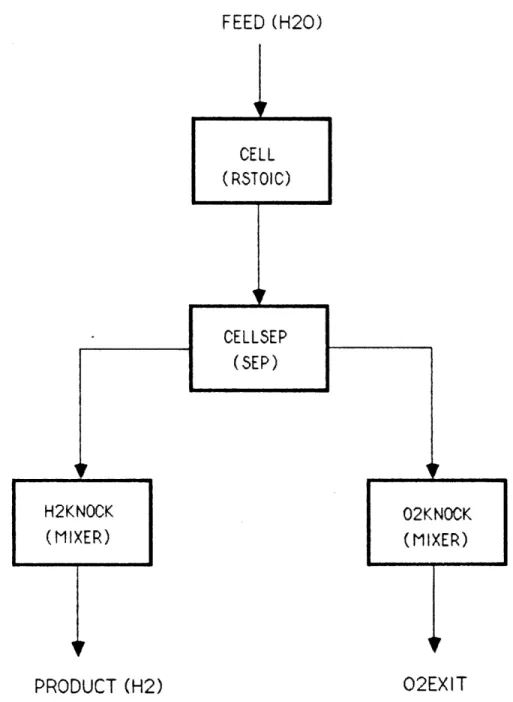
a simple ASPEN block diagram, as seen in Figure 9. Listing 3 in the Appendix shows the ASPEN input language for this simulation. The feed, water, enters the electrolysis cell
which is modeled with an "RSTOIC" reactor. Here the
stoichiometry of water going to hydrogen and oxygen is specified. Since it has been assumed that all of the feed water is separated, the conversion fraction for this
reaction is set at 1.0.
Because only one exit stream is allowed for an "RSTOIC" block, the fact that hydrogen and oxygen are easily separated at the opp
the block "CELLSEP." This of the hydrogen and puts it
all of the oxygen and putti
Because occasionally liquid
exit gases, knock-out drums
that the product streams wi
The costing section
primarily of the capital ex cell and the cost of the el literature data, the instal
osite electrodes is modeled with
is a "SEP" block which takes all
in one exit stream while taking
ng it in the other exit stream. water can be entrained with the are put in the flowsheet so 11 be pure and dry.
of the simulation consists
penditure for the electrolysis
ectricity used. Based on some led capital cost was calculated on the basis of $300 per kw hydrogen heating value. (4)
28
FEED (H20)
PRODUCT (H2)
02EXIT
For the operating cost, no credit was given for the oxygen produced due to the fact that additional investment would be necessary to liquify the oxygen for shipping and it was assumed that there would be no use for oxygen on site.
30
III. SIMULATION RESULTS
STEAM REFORMING OF METHANE
The simulations developed for these hydrogen
production processes have been executed to show some
representative results and to demonstrate the potential of
flowsheet simulation. There are several ways to measure
the performance of a system. First, there is the purity of
the product stream. Generally, this stream will consist of
hydrogen and methane, and the closer it is to 100% hydrogen
the better. Second, there is the hydrogen production
rate. If the feed is held constant and the operating
conditions varied, not only will the purity change, but the production rate of hydrogen will also change. It might be possible, for example, to run the process in such a way as to get 95% pure hydrogen product while producing at a much lower rate than the potential. This would occur if a great
deal of carbon dioxide is produced, which is subsequently
removed. So both the purity and production rate are measures of how efficiently the feed is being converted
into hydrogen. Also of great importance in measuring the
performance of the system is the operating cost per unit of
hydrogen produced. This will tell if the plant is cost effective. All of these results will be looked at for the
simulations developed.
There are many parameters in the steam reforming
process which can be varied to change the performance of the system. Because the reformer reactor is the heart of
the system, however, only the operating conditions
associated with this unit have been studied. These include
the reformer temperature, reformer pressure, and feed steam
to methane ratio.
Figure 10 shows the fraction of hydrogen in the
process product stream (i.e. the purity - the remaining
fraction is all methane) as a function of the reformer temperature. Three curves are shown, each representing a different steam to methane feed ratio. It is clear that as
the temperature increases the reformer reactions are driven
toward the right, and the purity of the product stream increases. It is interesting to note that the purity
approaches 100% under all conditions at temperatures above 1200K. This suggests that operation above 1200K does not
gain much and research into higher temperature catalysts
and materials is not of great importance.
Figure 10 also shows that the higher the steam to methane ratio, the greater the final purity. Again this is because the excess steam tends to push the methane reaction
toward completion.
Figure 11 shows the product stream hydrogen purity
versus the reformer pressure. Here the purity drops as the
pressure increases, suggesting that higher pressure
32
900
FIGURE 10:
1000 1100 1200
REFORMER TEMPERATURE (K)
Fraction of hydrogen in the steam reforming product
stream versus reformer temperature for several steam
to methane
mole
ratios
with pressure = 20 ATM
R
A
C H Y D R O G E N N P R0
D U CT
.95 .9 .85 .8 .75 .7 .65 .6 1300F . R 1
A
9 9 C .98 H Y .g7 D R .960
G .95 E N .9 4 I .93 N .9 2 R .910
9 D U .8 9 CT
10 15 20 25REFORMER PRESSURE (ATM)
FIGURE
1:
Fraction of hydrogen in the steam reforming product
stream versus reformer pressure for several steam
to methane mole ratios
with
temperature =1100K
published literature data. (1) Again the different lines representing different steam to methane feed ratios show that excess steam helps to make the product stream more
highly concentrated in hydrogen.
Figure 12 shows the hydrogen production rate from a fixed methane feed versus the reformer temperature. The same trend as observed in Figure 10 is seen here. Higher
temperatures favor hydrogen production as do higher steam
flow rates.
Figure 13 shows a similar plot for hydrogen
production as a function of reformer pressure. It is clear that high pressure comes into direct conflict with high production rates from a given feed. This suggests that the process should be run at low pressure. Indeed, this is often done, however the desirability of high pressure
hydrogen at the end of the process becomes a problem.
Rather than investing in the compressor necessary to
produce this high pressure product, usually the pressure
throughout the process is kept high at the sacrifice of production rate. The suitability of one method or the
other depends on the required condition of the product
stream. For these simulations it has been assumed that pressurized hydrogen is desired (15 ATM or so) and that this pressure is achieved in the process and not with an
additional compressor.
Of primary concern in a process such as this is
determining the operating conditions which will produce
900
FIGURE 12:
1000 1100 1200 1300
REFORMER TEMPERATURE (K)
Daily hydrogen production rate from the steam reforming
process versus the reformer temperature for several
steam to methane mole ratios with pressure
=
20 ATM
H
2
P R0
D U C T RA
T
Em
s
c
f
/ da
Y 400 350 300 250 200 150 10036
10
FIGURE 13:
15 20 25 30
REFORMER PRESSURE (ATM)
Daily hydrogen production rate from the steam reforming
process versus the reformer pressure for several steam
to methane mole ratios
with temperature
=1100K
H2
P R0
D U C T R A T Em
S C fd
a
y
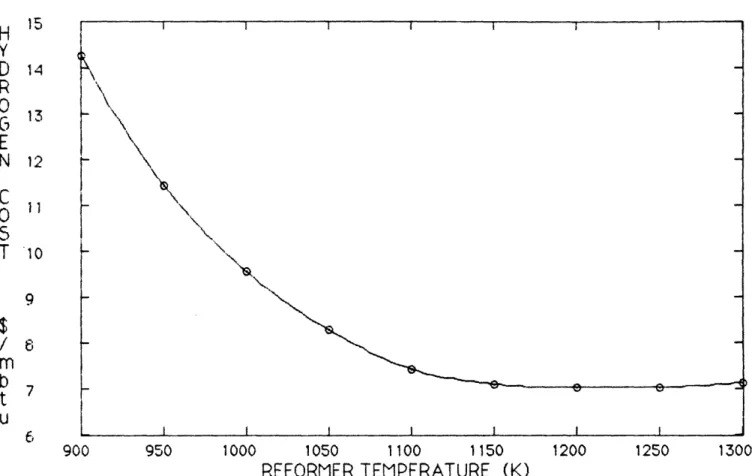
370 360 350 340 330 320 310 300 290 280 270 260 250the cost of hydrogen production is plotted versus each of the operating variables. Figure 14 shows the steam
reforming operating cost per million BTU versus the
reformer temperature with the pressure set at 20 ATM and the steam to methane ratio at 4.0. The cost drops as
temperature increases but reaches an asymptotic limit at
about 1100K. With the pressure and steam rate set
accordingly, then, the optimum reformer temperature would
be about 1100K. In this way the temperature would be the
lowest possible while still producing the least expensive
hydrogen possible.
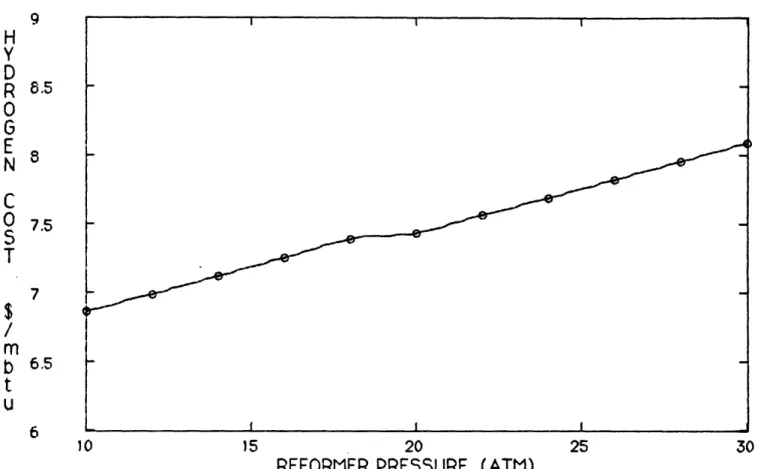
Figure 15 shows the hydrogen production cost as a function of the pressure with the temperature set at 1100K and the steam to methane ratio set at 4.0. Because of the
decrease in production associated with high pressures, the
operating cost rises with pressure. There is no way to look at this curve and select an optimum pressure. As
discussed above, the pressure must be selected from a
trade-off between cost and necessary exit pressure. For
the purposes of this simulation, a value of 20 ATM in the reformer has been assumed to be best - with pressure drops
in the process this yields about 14-15 ATM product.
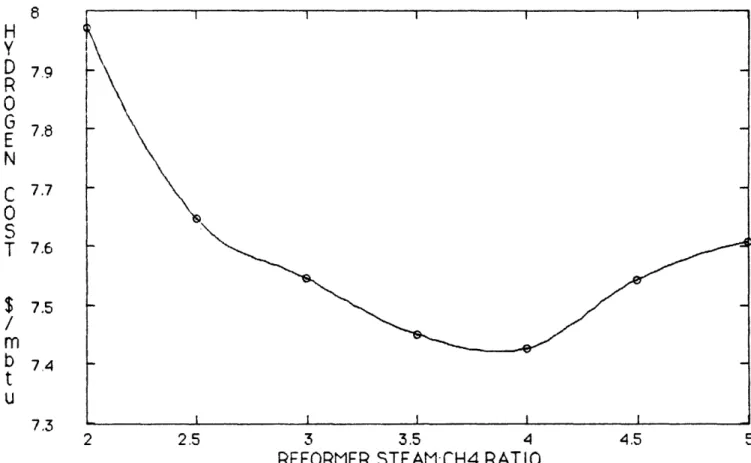
Figure 16 shows the hydrogen cost as a function of the steam to methane ratio with the temperature set at 1100K and pressure set at 20 ATM. At first, as the steam ratio increases, the cost drops. This is because, as
observed before, excess steam helps push the methane
reaction toward completion. However, above a ratio of
38
900 950 1000 1050 1100 1150 1200 1250 1300
REFORMER TEMPERATURE (K)
FIGURE 14: Cost of hydrogen produced by the steam reforming
process versus the reformer temperature with the
reformer pressure = 20 ATM, Steam:CH4 = 4.0
H lb Y D 14 R G 13 E N 12 C 11
0
T
io
9 / 6 mb
t
U20
REFORMER PRESSURE
FIGURE 15:
Cost of hydrogen produced by the steam reforming
process versus the reformer pressure with the
reformer
temperature
=
1 OOK,
Steam:CH4 = 4.0
9 8.5 8 7.5 7 6.5 H Y D R
0
G E N C0
S
T
/t
u
u
6 10 15 I I I f I I 25(ATM)
302 2.5 3 3.5 4
REFORMER STEAM:CH4 RATIO
FIGURE 16:
Cost of hydrogen produced by the steam reforming
process versus the reformer steam:CH4 feed ratio
with reformer temp = 1 1 OOK, pressure = 20 ATM4.0 H Y D R
0
G E N C0
S
T $ / m bt
U 8 7.9 7.8 7.7 7.6 7.5 7.4 7.3 4.5 5about 4.0 the cost begins to rise. This is probably due to the increased purchase cost of the steam and the heating requirements for bringing the incoming steam up to reaction
temperatures. The gain associated with excess steam above
a ratio of 4.0 is outweighed by the direct operating
costs. With the temperature and pressure set as indicated, then, the optimum steam to methane ratio for the reformer feed is 4.0.
It should be emphasized that the optimizations
discussed above are reasonably simplified. Each variable
was optimized individually with the other two fixed at some value. In a real process, all three would have to be
varied simultaneously in order to obtain the overall
process optimum.
With the reformer operating conditions set, it is informative to look at a "cross-section" of the process to
see what is happening. Figure 17 - obtained with data from
a run with the temperature at 1100K, the pressure at 20 ATM, and the steam to methane ratio at 4.0 - shows such a
cross-section. The dry mole percent of each species is
plotted versus the position in the process.
As indicated, the feed is pure methane. After the reformer, the methane percent has dropped to about 5% and
hydrogen is the dominant species at 75%. Carbon monoxide
and carbon dioxide are present in about equal
concentrations at 10%. In the shift reactors the carbon
monoxide is converted to hydrogen and carbon dioxide.
42
REFORM HT SHIFT LT SHIFT SCRUB PRODUCT
FIGURE 17:
Species profile of steam reforming process. The lines
show the mole percent of each species in the streams
exiting the indicated unit operations
100
P
E R C E NT
NS
T
R EA
M ,090
80
70 60 50 40 3020
10 0 FEEDwhile the carbon dioxide and hydrogen curves rise. Methane
stays the same, for it is considered an inert in these
reactors.
After the scrubber, the carbon dioxide percent
drops to zero, for it has been removed. Because carbon dioxide was acting as a diluent, its removal causes the percentages of all of the other species to rise. The product stream shows the removal of all remaining carbon
monoxide by the methanator. The resulting product consists
of 95% hydrogen and 5% methane.
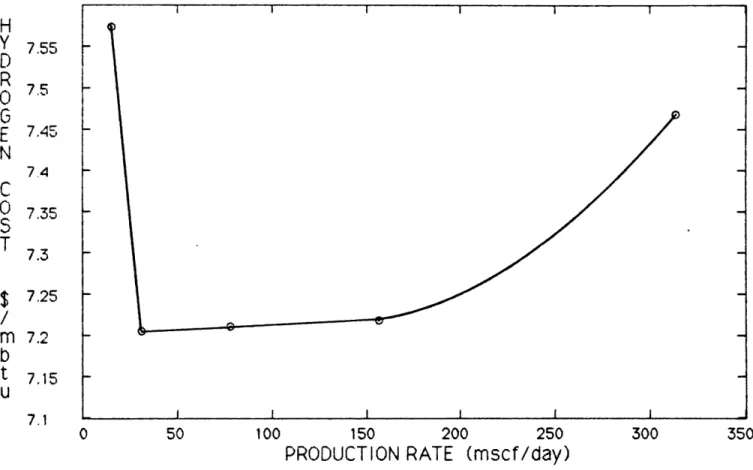
It is well known that different size plants will perform economically differently. As a final look at the steam reforming process, it is informative to look at the hydrogen cost as a function of the plant capacity. Figure 18 show such a plot. Because of the wide range of plant sizes covered (10 mscf/day to 300 mscf/day) three distinct areas emerge on this plot. At low capacity, a sharp
economy of scale is observed. There are minimum sizes for units such as reformer furnaces, and if the process is run below the limits of these units, it will be very expensive (high capital and operating cost spread over low production rates). Thus the cost drops as the size increases for low
production rates.
In the center of the figure, a relatively flat
region is observed. Here the process is being run at rates
easily handled by the equipment available. Increasing
production simple increases the capital and operating costs
50 100 150 200 250 300
PRODUCTION RATE
(mscf/day)
FIGURE 18:
Cost of hydrogen produced by the steam reforming
process versus the plant capacity with the reformer
temp = 1 1OOK, pressure = 20 ATM, steam:CH4 = 4.0
44
H y D R0
G E N C0
S
T m bt
U 7.55 7.5 7 .457.4
7.35 7.3 7.25 7.2 7.15 7.1 0350
about the same.
At high production rates, however, larger and
larger pieces of equipment are necessary. As equipment
size increases, the costs tend to rise more quickly. Thus at high production rates the costs are increasing faster than the hydrogen produced, and the unit cost begins to rise.
As a basis of comparison with the other processes, the actual cost figures for a selected plant size have been summarized. Figure 19 shows this summary. As indicated, a medium size facility of 300 mscf/day was used. The
reformer operating conditions are indicated. The total
operating cost was found to be $7.43 per million BTU of
hydrogen which is in agreement with some representative
literature data. (9) As the pie chart indicates, the major pieces of the operating cost are raw materials (e.g.
methane and feed steam costs) and utilities (e.g. fuel oil and cooling water). The remainder of the cost is split
fairly evenly between labor, overhead, and capital
depreciation.
Also shown in Figure 19 is the capital investment required for a steam reforming plant this size. The total
bill would be about $300 million, split between process
unit purchase costs, setting labor, other directs such as
46
PLANT CAPACITY: 300 million scf per day
OPERATING
PARAMETERS:
Reformer Temperature = 1 OOK
Reformer Pressure
= 20 ATM
Steam:CH4
=4.0
OPERATING
COST = $ 7.43 per million btu hydrogen
OPERATING COST BREAKDOWN:Depreciation 4.5%
-
Overhead 5.3%
\ Labor 4.2%
CAPITAL COST SUMMARY:
Process Units
Other Directs
Setting Labor
Contingency
Working Capital
Start up Cost
TOTAL:
$
69,901,000
34,885,000
50,953,000
45,538,000
75,223,000
55,816,000
$ 332,316,000
FIGURE 19: Operating and capital cost breakdowns for a 300 mscf
per day hydrogen plant using steam reforming
PARTIAL OXIDATION OF METHANE
A similar analys has been made. In this steam reforming with par
many operating parameter
affect the system perfor
is wa ti ma ma
study concentrates only on
associated with the primar
operating parameters inclu
pressure, oxygen to methan
methane feed ratio. To li to methane ratio was set a this variable. The perfor as a function of the remai Figure 20 shows th function of the oxidizer t
represent different oxygen
of the partia y, it is possi al oxidation. in this proces nce. As with those operati
y reactor: the
de the oxidize e feed ratio, mit the scope t 1.0 througho mance of the s ning1 oxidation process
ble to compare Again s can be changed to the reformer, this ng conditionsoxidizer. These
r temperature, and steam to
slightly, the steam
ut to eliminate vs tem
three operating
e hydrogenemperature.
to methane was co product purl The threefeed ratios
studied
nditions.
ty as acurves
As with the reformer, as the temperature increases the purityrises. They all begin to reach an asymptotic limit at a temperature slightly over 1100K. This graph also indicates that the higher the oxygen to methane ratio, the higher the
purity of the product stream. This is because excess
oxygen drives the methane reaction to the right,
eliminating the methane from subsequent process streams.
Figure 21 shows the hydrogen product purity as
function of the oxidizer pressure. As with the reformer,
higher pressure tends to inhibit the reactions, decreasing
900
FIGURE 20:
1000 1100 1200
OXIDIZER TEMPERATURE (K)
Fraction of hydrogen in the partial oxidation product
stream versus the oxidizer temperature for several
oxygen
to
methane mole ratios
with pressure = 20 ATM
48 F R
A
C H Y D R0
G E N N.P
R0
D U C T .9 .8 .7 .6 .5 1300R
A
C .95 H Y D .9 R0
G .85 E N .8 I ,e N p .75 R0
D .7 U C T ~r, 10 15 20 25OXIDIZER PRESSURE (ATM)
FIGURE
21: Fraction of hydrogen in the partal oxidation product
stream versus the oxidizer pressure for several
oxygen to methane mole ratios
with temperature = 1100K
30
the concentration of hydrogen in the product. This graph
suggests that higher oxygen to methane ratios not only
produce more pure product, but also tend to limit the
adverse effects of the higher pressures (compare the slope
of the 02:CH4=1.5 line with the 02:CH4=0.5 line).
Figure 22 shows the total hydrogen production rate
versus the oxidizer temperature. The production rate
increases then begins to level off at some point. This shows that similar to the reformer process there is no
great advantage to using temperatures above about 1200K for
partial oxidation. It is important to note that this
figure shows that low oxygen to methane feed ratios yield a higher production rate from a set methane feed. This is one of those cases in which the product purity conflicts with the production rate (compare Figures 20 and 22).
Excess oxygen forces more methane to react, increasing the
purity, but this same excess oxygen causes full oxidation
to take place, burning up some of the desired hydrogen. Figure 23 shows a similar plot for hydrogen
production rate versus oxidizer pressure. Increasing the
pressure drops the production rate. This highlights again
the conflict between production rate and desired product
pressure. Also shown is a confirmation of the fact that
higher oxygen to methane feed ratios give lower production
rates.
The effect of the operating conditions on the hydrogen cost will now be examined. Figure 24 shows the hydrogen cost per million BTU versus the oxygen to methane
1000 1100 1200 OXIDIZER TEMPERATURE (K)
FIGURE 22:
Daily hydrogen production rate from the partial oxidation
process versus the oxidizer temperature for several
oxygen to methane mole ratios
with pressure = 20 ATM
H
2
P
R0
D U CT
R AT
Em
s
Cf
/ da
y
250 200 150 100 50900
130052
s15 20 25 30
OXIDIZER PRESSURE (ATM)
FIGURE 23:
Daily hydrogen production rate from the partial oxidation
process versus the oxidizer pressure for several oxygen
to methane mole ratios
with
temperature =1100K
H
2
P R0
D U C T R AT
Em
S Cf
d ay
160 150 140 130 120 110 100 90 60 70 1C.5 .6 .7 . .8 .9 1 1.1
OXIDIZER OXYGEN:CH4 RATIO
FIGURE 24:
Cost of hydrogen produced by the partial oxidation
process versus the oxidizer oxygen:CH4 feed ratio
w i th oxidi zer temp=
1 OOK,
pressure=20 ATM
H Y D R0
G E N C0
T / m bt
u 10.5 10 9.5 9 8.5 8 7.5 7 6.5feed ratio with the temperature set at 1100K and the pressure set at 20 ATM. Because of decreasing production rates, increasing the oxygen to methane ratio increases the hydrogen cost. This is also in part due to the increasing cost of the oxygen which must be supplied to the oxidizer. There is no way to select an optimum ratio from this
curve. There is a trade-off between cost and desired
product purity which can only be solved when the purity is
specified. In order to compare to the results from the steam reforming process, the desired purity was set at about 95%. Based on this, for the given temperature and pressure, the necessary oxygen to methane ratio is 1.0 (see Figure 20).
Figure 25 shows the hydrogen cost as a function of the oxidizer temperature with the oxygen to steam ratio set at 1.0 and the pressure set at 20 ATM. The cost drops as the temperature increases and then levels off. As with the
reformer process, the optimum temperature was taken as the lowest at which the cost is a minimum. From Figure 25 this optimum oxidizer temperature is seen to be about 1100K.
Figure 26 shows the hydrogen cost versus the
oxidizer pressure. The cost rises steadily as the pressure
increases. Again, an optimum cannot be determined without
a specification of the desired product pressure. For
comparison with the reformer process, an oxidizer pressure
of 20 ATM was selected.
Figure 27 shows a cross-section of the partial
950 1000 1050 1100 1150 1200 1250
OXIDIZER TEMPERATURE (K)
FIGURE 25:
Cost of hydrogen produced by the partial oxidation
process versus the oxidizer temperature with
oxidizer pressure=20 ATM, 02:CH4 = 1.0
22 20 18 16 14 12 10 8 H y D R
0
G E N C0
S
T $ / m bt
U 6 900 130015 20 25 OXIDIZER PRESSURE (ATM)
FIGURE 26:
Cost of hydrogen produced by the partial oxidation
process versus the oxidizer pressure with the
oxidizer temp= 11 OOK, 02:CH4 = 1.0
56
H Y D R0
G E N C0
T $ / m bt
u
10 9.5 9 8.5 8 7.5 7 10 30FEED OXIDIZER HT SHIFT LT SHIFT SCRUB PRODUCT
FIGURE 27: Species profile of partial oxidation process. The lines
show the mole percent of each species in the streams
exiting the Indicated unit operations
100
P
E 90 R C 8o E N 7 0 T 60 N 50S
T
40
R E 30A
M20 % 10reforming. The feed is pure methane, and after the
oxidizer the methane concentration drops to less than 5% on a dry mole basis. The carbon monoxide and carbon dioxide concentrations are about equal at 20%. Oxygen is not shown, for it was found to completely react in the
oxidizer. This leaves hydrogen at about 57%. Comparing
this to the steam reforming result shows that more carbon
oxides are formed in this process, yielding less hydrogen
from the primary reactor.
The two shift reactors show the carbon monoxide
being almost completely converted to carbon dioxide and
hydrogen. The scrubber removes all of the carbon dioxide,
and the methanator reacts the trace amounts of carbon
monoxide. The final product stream, as desired, is about
95% hydrogen and 5% methane.
Figure 28 shows the cost of the hydrogen as a
function of the plant capacity. Three curves are shown,
each representing a different oxygen purchase cost. It has
been suggested that the primary reason steam reforming is
favored over partial oxidation is because of the investment
necessary to produce the oxygen. (11) This investment can be translated into the oxygen purchase cost in order study
the effect of this cost on the viability of the process. As would be expected, this graph shows that cheaper oxygen
produces a cheaper hydrogen product. These curves will be
compared to the one from steam reforming later in this
section.
0 50 100 150 200 250 300 350
PRODUCTION RATE (mscf/day)
FIGURE 28: Cost of hydrogen produced by the partial oxidation process
versus the plant capacity for several oxygen purchase costs
with oxidizer
temp=1 lOOK, pres=20 ATM, 02:CH4 = 1.0
14 H Y D 1 3 R
0
G 12 E N C 110
S
T Io
$ 9 /m
b
8
t
u
-702 Cost = 0.08 $/kg
02 Cost = 0.016 $/Kg
02 Cost = 0.00 1 $/kg _ I I IJ I - I Isteam reforming are seen in Figure 28. At low production rate there is a sharp economy of scale. Yet as production increases, the costs rise faster than the capacity and the hydrogen cost slowly rises.
The operating and capital costs for a 300 mscf/day partial oxidation plant have been tabulated in Figure 29. The operating conditions are shown and the operating cost is seen to be $8.74 per million BTU hydrogen - about $1.30 more expensive than steam reforming. The operating cost breakdown is quite different for this process than that of steam reforming. The major cost is raw materials and
utilities take up less of the cost. This is because in partial oxidation the heat in the primary reactor is
supplied by the feed oxygen (a raw material) while in steam reforming the heat is supplied externally by burning fuel oil (a utility).
Figure 29 also shows the capital investment summary for a partial oxidation plant of this size. The total
investment would be about $186 million - $150 million lower
than the steam reforming process. The fact that the
capital is lower for partial oxidation is in large part due to the fact that the primary reactor is far less
complicated, requiring a lower purchase , setting, and
start-up cost.
PLANT
CAPACITY: 300 million scf per day
OPERATING PARAMETERS:Oxidizer Temperature = 1100K
Oxidizer Pressure
= 20 ATM
Oxygen:CH4 = 1.0
Steam:CH4 = 1.0
OPERATING
COST = $ 8.74 per million btu hydrogen
OPERATING COST BREAKDOWN:~~-Depreciation 0.5%
~'-
Overhead 0.6%
Labor 0.5%
CAPITAL COST SUMMARY:
Process Units
Other Directs
Setting Labor
Contingency
Working Capital
Start up Cost
TOTAL:
$ 10,937,000
4,924,000
6,120,000
6,427,000
96,225,000
62,005,000
$ 186,638,000
FIGURE 29:
Operating and capital cost breakdowns for a 300 mscf
per day hydrogen plant using partial oxidation
-ELECTROLYSIS OF WATER
In the electrolysis simulation there are no real
operating conditions which can be varied. Although the
temperature and pressure can have some effect on the cell efficiency (4), for simplicity the cell efficiency in this simulation was assumed constant at 85%. The only operating parameter of interest, then, is the hydrogen production rate versus the feed flow rate. Figure 30 shows this
relationship. As would be expected, the production
increases linearly with the water feed rate. This graph
can be used to find the necessary water feed rate given a
desired production rate.
Figure 31 shows the cost performance of this
process. In the oxidation process the price of oxygen was the key cost factor. Here the cost of electricity is critical. The three curves shown in Figure 31 represent
different electricity purchase prices. In all cases the
cost of hydrogen increases with the plant capacity because
of the accelerating cost of high capacity electrolysis
cells. It is interesting to note that no economy of scale is observed at low production rate. This is because unlike
reformer or oxidizer reactors, electrolysis units do not
really have a minimum size. As expected, the lower the cost of electricity, the lower the product hydrogen cost.
Figure 32 shows the operating and capital cost
breakdowns for an electrolysis plant producing 300 mscf/day
5000
10000
15000
20000
25000
30000
WATER FEED RATE (kmol/hr)FIGURE
30:
Daily hydrogen production rate from the electrolysis
system versus the water feed flow rate
H
2
P R0
D U C T I0
N ms
c
f
/d
ay
300 270 240210
180 150 120 9060
30
0 0100 150
PRODUCTION RATE
200
(mscf/day)
FIGURE 31;
Cost of hydrogen produced by electrolysis
versus the
plant capacity for several electricity purchase costs
64
H Y D R0
G E N C0
S
T
/ mb
t
u
45 40 3530
25 20 15Elec Cost = 0.06 $/kwhr
Elec Cost = 0.03 $/kwhr
Elec Cost
=
0.01 $/kwhr
L --- I I "Ic
~
~~~
I
I
~
~
1
~
,,I,
~~
050
250 300PLANT CAPACITY: 300 million scf per day
OPERATING PARAMETERS:Water Feed Rate = 30,000 kmol/hr
OPERATING
COST = $ 28.95 per million btu hydrogen
OPERATING COST BREAKDOWN:.
Raw Materials 0.2%
Labor
Overead
14.8%
/
\
18.7%S
Deprec
CAPITAL COST SUMMARY: