A Computational Memory and Processing Model
for Prosody
by
Janet Elizabeth Cahn
B.A. in Computer Science, Mills College (1983)
S.M., Visual Studies, Massachusetts Institute of Technology (1989)
Submitted to the Program in Media Arts and Sciences, School of
Architecture and Planning
in partial fulfillment of the requirements for the degree of
Doctor of Philosophy
at the
MASSACHUSETTS INSTITUTE OF TECHNOLOGY
February 1999
©
Massachusetts Institute of Technology 1999. All rights reserved.
MASSACHU OF TE
MIAR
Author.
L--
IB
Program in Media Arts and Sciences, School of Architecture and
Planning
October 30, 1998
Certified by
-...~-1...
a...
Kenneth Haase
Visiting Professor, Progrm in Media Arts and Sciences
/ A A
cademifAdvisor
Accepted by ...
Stephen A. Benton
Chairman, Departmental Committee on Graduate Students
SETTS INSTITUTE CHNOLOGY
1
9
1999
RARIES
A Computational Memory and Processing Model for
Prosody
by
Janet Elizabeth Cahn
Submitted to the Program in Media Arts and Sciences, School of Architecture and Planning
on October 30, 1998, in partial fulfillment of the requirements for the degree of
Doctor of Philosophy
Abstract
This thesis links processing in working memory to prosody in speech, and links different working memory capacities to different prosodic styles. It provides a causal account of prosodic differences and an architecture for reproducing them in synthesized speech. The implemented system mediates text-based information through a model of attention and
working memory.
The main simulation parameter of the memory model quantifies recall. Changing its value changes what counts as given and new information in a text, and therefore determines the intonation with which the text is uttered. Other aspects of search and storage in the memory model are mapped to the remainder of the continuous and categorical features of pitch and timing, producing prosody in three different styles: for small recall values, the exaggerated and sing-song melodies of children's speech; for mid-range values, an adult expressive style; for the largest values, the prosody of a speaker who is familiar with the text, and at times sounds bored or irritated. In addition, because the storage procedure is stochastic, the prosody from simulation to simulation varies, even for identical control parameters. As with with human speech, no two renditions are alike.
Informal feedback indicates that the stylistic differences are recognizable and that the prosody is improved over current offerings. A comparison with natural data shows clear and predictable trends although not at significance. However, a comparison within the natural data also did not produce results at significance.
One practical contribution of this work is a text mark-up schema consisting of relational annotations to grammatical structures. Another is the product - varied and plausible prosody in synthesized speech. The main theoretical contribution is to show that resource-bound cognitive activity has prosodic correlates, thus providing a rationale for the individual and stylistic differences in melody and rhythm that are ubiquitous in human speech.
Academic Advisor: Kenneth Haase
Thesis Committee
Committee Chair r
mp-Kenneth Haase, Ph.D. Visiting Professor Program in Media Arts and Sciences
X) A I-N
Research Advisor
Member
Stan Sclaroff, Ph.D. Assistant Professor, Computer Science Boston University
Julia Hirschberg, Ph.D. Head, Human-Computer Interface Research Department
A.T. & T. Labs - Research
Memb er
V - Pattie Maes, Ph.D.
Associate Professor Program in Media Arts and Sciences Massachusetts Institute of Technology
Acknowledgments
Thanks first to my committee. Ken Haase has encouraged both creativity and
com-munity spirit in his students and has been an enthusiastic supporter of my research.
Julia Hirschberg has provided expert commentary and in addition, has always pointed
me to exactly the right people, papers and data. Her insight and standards of
schol-arship have made this a far better piece of work. Pattie Maes has the rare ability to
identify the key strengths and weakness of any work
-
her advice and encouragement
have been both practical and deep. Stan Sclaroff has been indispensable as a friend
and an advisor. He provided encouragement and feedback at key points and was
instrumental in helping me defend and finish. It could not have happened without
him.
This work would not have begun without the help of Dave Barrett, who generously
gave of his time and skill to help me machine my chair to ergonomic standards. It
would not have proceeded without the brilliant practical and theoretical suggestions
of Marilyn Walker and Susan Brennan. It would have taken even longer were it not for
the generosity of: Marilyn Walker, who gave me her code for the memory model; Anil
Chakravarthy, who gave me his WordNet code; Trevell Perkins and Erin Panttaja and
Hannes Vilhjalmsson, who provided technical assistance with the speech synthesizer
software and related hardware; Mari Ostendorf and Stephanie Shattuck-Hufnagel,
both of whom gave me many useful papers and provided me with the early versions
of their annotated speech data.
Philip Resnik gave me the word collocation data from his dissertation and Lisa
Stifel-man gave me the timing data from hers. While my explorations of their data did not
find their way into this work, I am grateful for their trust and generosity.
Many other friends and colleagues have patiently and expertly answered my many
technical questions, both mundane and complex, especially, Deb Roy, Sumit Basu,
Baback Moghaddam, Kris Popat, Lee Campbell, Raissa d'Souza, Bill Butera, Josh
Smith, Ravi Pappu, Dan Ellis, Louis Weitzman, Warren Sack, Mike Best, Anil
Chakravarthy, Tim Chklovski and Bernd Schoner.
Mike Best's organizational and content suggestions have greatly improved this
doc-ument. My father's editing expertise has greatly improved the first two chapters.
The writing has also benefited from-feedback from Ken Haase, Pushpinder Singh and
Wendy Plesniak.
Thanks also to faculty, students and staff outside my research group, especially to:
Sandy Pentland for sensible and insightful advice on both practical and research
matters; Aaron Bobick, Neil Gershenfeld, Bruce Blumberg and Justine Cassell for
useful feedback at various stages of the work; Fred Martin, Steve Strassman and
Lenny Foner for helpful technical advice on all kinds of questions over the years; Henry
Holtzman and Ben Lowengard for sublimely effective social and technical solutions;
Will Glesnes, Viet Anh and Tomas Revesz for patient and expert hardware and
software support; Linda Peterson, Santina Tonelli and Laurie Ward, for clear and effective counsel on academic matters; Greg Tucker and Dennis Irving for timely and wise logistical help. Rebecca Prendergast, Glen Sherman, Felice Gardner and Florence Williams for providing administrative support with unmatched professional and human competence.
Many other people have (also) provided support and friendship, all of which have been incalculably wonderful and necessary. Aside from those friends I have already thanked, I am also excruciatingly grateful to Laura Teodosio, Tomoko Koda, Sara Elo, David Dean, Babette Wils, Jennifer Gonzalez, Steve Whittaker, Candy Sidner, Kathy Blocher, Michelle Fineblum, Michael Gevelber, Maribeth Back, Tara Rosen-berger, Marina Bers, Josh Bers, Paula Hooper, Ingeborg Endter, Joey Berzowska, Flavia Sparacino, Dave Rosenthal, Martin Hadis, Mike Travers, Soo-jin Chung, Chris Verplaetse, Lorin Wilde, John Underkoffler, Teresa Marrin, Judith Donath, Nuria Oliver, Kristin Hall, Kim Binsted, Kim Foley, Judy Bornstein, Nancy Etcoff, Amy Pearl, Stephanie Graham, Kaitilyn Riley, Nancy Blachman, Steve Gray, Vicki O'Day, Anna Henderson, Lisa Borden, Lydia Mann, Barbara LiSanti, Cathleen Craviotto, Pat Lordan, John Wilkes, Sally Stuffin, Alex Sherstinsky, to name a few...
Final thanks go to my family, immediate and extended. My parents, Arno and Blossom, provided financial support for my ergonomic research. They also provided strategic professional advice and unconditional support and encouragement. It is a debt only partially repaid by graduating. My sister, Nancy, and brother-in-law, Craig, have been supportive despite their complete bewilderment at my career path.
My brother Jonathan has held to his unwavering belief that I would graduate before
the millennium, and recognizes it for the Sign that it is. I also thank my cousins Joanne, Roberta, Dan, Zach, Doron and Ilan for providing welcome and warmth. This research was generously supported by funding from the News in the Future consortium.
In memory of Diane McEntyre, Gena Tan, Zvi Erez and Celia
Sack, and dedicated to the three furies, the three graces -
Arianna,
Gabrielle and Nicole.
Contents
I
Foundations
1 Introduction
1.1
T erm s . . . .
1.2 Plan of the thesis . . . .
2 Motivations
3 Theoretical and Empirical Foundations
3.1
Competence explanations of prosody
3.2
Performance explanations of prosody
3.3
Computational theories of prosody
3.4 Pierrehumbert's intonational grammar
3.5
Summary . . . .
37
. . . . 38 . . . . 40 . . . . 45 . . . . 49 . . . . 524 Related work
4.1
Text-to-speech synthesis . . . .
4.2 Concept-to-speech synthesis . . . .
4.3 D iscussion . . . .
4.4 Simulations of processing effects on linguistic behavior
4.5 Summary . . . .
II
Approach
5 Overview
5.1 T he text . . . .
5.2 The linguistic analysis . . . . 5.3 The memory model . . . . 5.4 Mapping cognitive processing to prosody . .
5.5 The synthesizer . . . . 5.6 Sum m ary . . . . . . . . 69 . . . . 69 . . . . 71 . . . . 72 . . . . 72
6 A model of attention and working memory
6.1 Limited attention and the given-new distinction . . . .
6.2 Landauer's computational model of attention and working memory
6.3 Operational and spatial effects of the AWM design . . . .
6.4 D iscussion . . . .
6.5 C ritique . . . .
6.6 Revision: AWM with restricted local storage . . . .
6.7 Sum m ary . . . .
7 Input: Processed Text
7.1 Manual text mark-up . . . .
7.2 Automatic analyses . . . .
7.3 Online linguistic databases . . . . 7.4 Sum m ary . . . ..
8 Memory operations
8.1 Matching: The main operation . . . .
65
73 73 77 79 79 80 81 83 85 86 99 102 104 105 1058.2
8.3
8.4
8.5
8.6
8.7
8.8
9 Output: Prosodic correlates of search
9.1
Pitch accents . . . .
9.2
Phrase tones...
9.3
Word duration . . . .
9.4 Pause duration and location . . . . .
9.5
Pitch range . . . .
9.6
Final filters: Speaker biases . . . . .
9.7
Discussion . . . .
9.8
Summary . . . .
and storage
121
. . . .
12 1
. . . .
124
. . . .
126
. . . .
128
129
130
131
133
10 System integration
10.1 The text . . . .
10.2 Manual and automatic text analysis . . . .
10.3 Processing in AWM' . . . .
.
10.4 Mapping search and storage to pitch and timing
10.5 Interpreting the mapping for the synthesizer . .
10.6 Discussion . . . .
10.7 Sum m ary . . . .
The results of a comparison . . . .
Compression: An augmentation to storage
Retrieving a compressed item . . . .
Special tokens . . . .
The state of a memory item . . . .
Model time: Incrementing the clock
.
. . .
Sum m ary . . . .
114
115
117
118
118
119
120
135
. . . .
135
. . . .
136
. . . .
140
. . . .
141
. . . .
141
. . . .
143
. . . .
144
III Results and Evaluation
145
11 Results
147
11.1 T he text . . . . 148 11.2 Initial explorations . . . . 149 11.3 Summary . . . . 16012 Evaluation
163
12.1 Measuring similarity using Cohen's kappa . . . . 16412.2 The natural speech data . . . . 165
12.3 Test categories . . . . 166
12.4 Trends and variability in the natural prosody . . . . 167
12.5 Trends and variability in the LoQ prosody . . . . 171
12.6 Kappa comparison between LoQ and natural intonation . . . . 176
12.7 D iscussion . . . . 184
12.8 Conclusion . . . . 185
IV
Conclusion
187
13 Contributions, Future Directions, Conclusion
189
13.1 Main contribution . . . . 18913.2 Additional contributions . . . . 190
13.3 Future Directions . . . .
191
13.4 Conclusion . . . . 194
B The texts
201
B .1 Fiction . . . .
201
B.2 Nonfiction: News story . . . .
202
B.3 Rhymed poetry . . . .
203
C Analyzed text example
205
C.1
The mark-up tokens . . . .
205
C.2
Example text mark-up . . . .
206
List of Figures
3-1
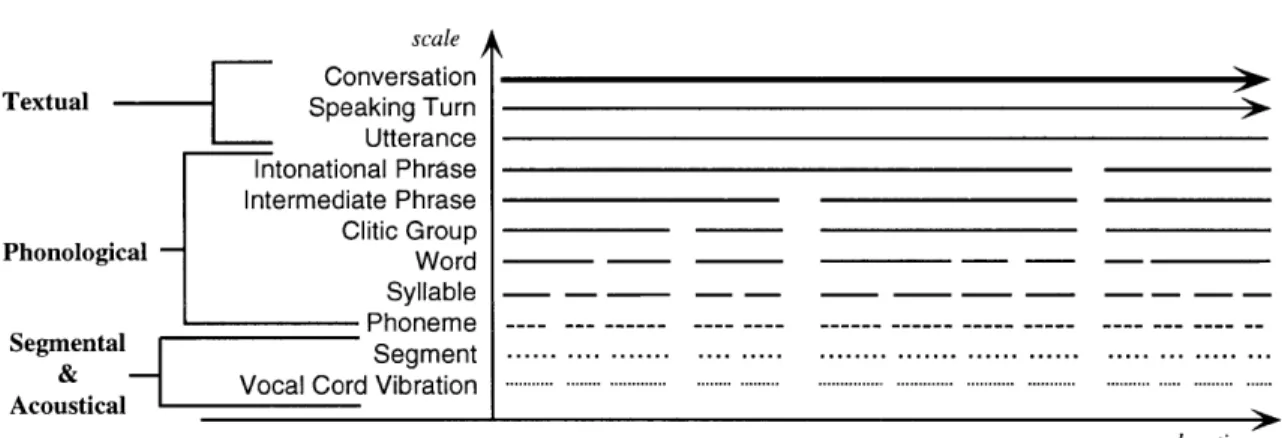
A hierarchy of textual, phonological and acoustical scales in
conversa-tion and speech. . . . .
46
3-2 Pierrehumbert et al.'s context-free grammar of intonation.
("+"
de-notes "one or more",
"I"
denotes "or", and nonterminals are in angle
brackets.) . . . .
50
4-1 Prototypical text-to-speech system. . . . .
56
4-2
Prototypical concept-to-speech system. . . . .
60
5-1
The
LOQ
system . . . .
68
5-2 Sources and types of text analysis in LoQ. . . . .
69
5-3 The input, output and sources of linguistic knowledge that are used in
the m atching process. . . . .
71
5-4 Memory operations and their results are mapped to continuous and
categorical features of prosody . . . .
71
6-1
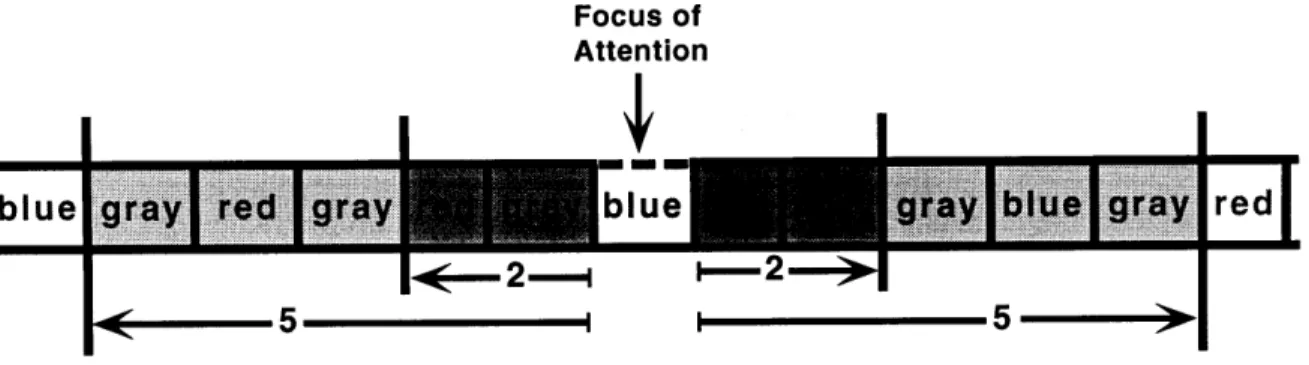
Working memory as a last-in-first-out queue. The speaker's attention
is focused on blue, at the head of the queue. Items within the shaded
regions are accessible for a search distance of five. Items within the
darker region are accessible for a search distance of two. . . . .
75
6-2 Working memory as a bi-directional queue. Search extends in two
directions outward from the current focus of attention at the center.
.
75
6-3 Working memory as a circular queue. Search extends outward from
the focus of attention. . . . .
76
6-4 A section of a two-dimensional representation of working memory. blue
is new information for a search radiusof 2, and given information for a search radius of 5. The focus of attention is at the center. . . . . . 76 6-5 Search radius, storage and the path of the pointer's random walk for
Landauer's model of attention and working memory . . . . 78 6-6 Given and new determinations as a consequence of the random walk,
temporal sequencing of stimuli, and the search radius. The memory is periodic (wraparound) as shown by the area covered by the search region . . . . 78 6-7 The number of nodes in a region of periodic Cartesian space increases in
an S-curve as the radius of the region increases. Likewise, the number of new locations is the derivative of the total number of locations. The
smallest (0) and largest distances contribute only one node each. . . . 80
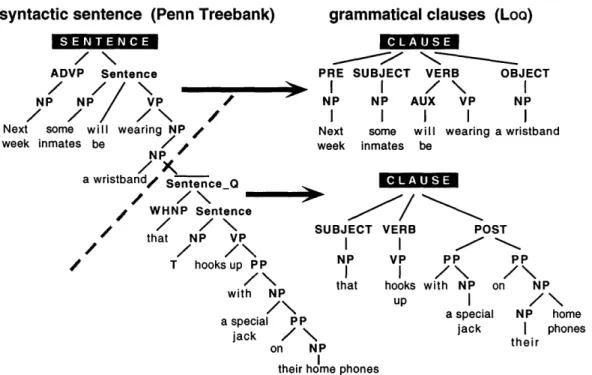
7-1 A deep syntactic parse from the Penn Treebank and its representation
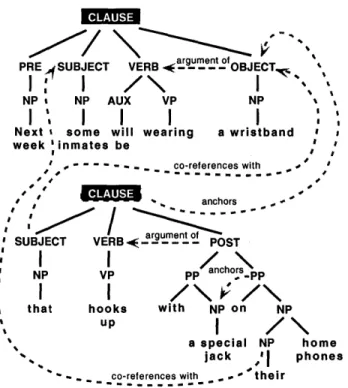
as two shallower and minimally recursive trees, which are organized around grammatical roles and fewer syntactic categories. . . . . 89
7-2 Bottom up sequential processing as the decomposition of a parse based on gram m atical role. . . . . 90 7-3 Annotations to the clauses preserve the attachment information that
is explicit in the deeper structure of a syntactic parse. . . . . 95
8-1 The matching algorithm for LoQ. . . . . 113
9-1 Bitonal m apping. . . . . 123
9-2 Inverse log scaling of duration for search radius. The shortest durations are mapped to the slowest speech for the smallest radii. Shown for the radii of 1, 10, 20 and 50. . . . . 128
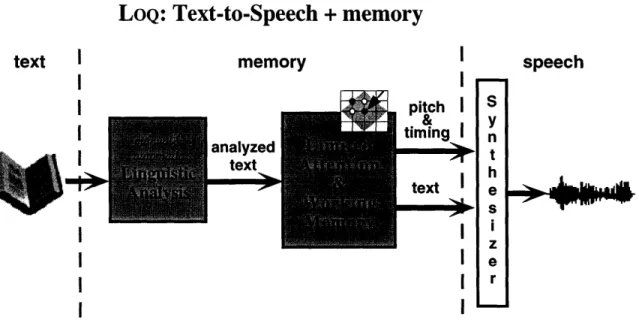
10-1 The LoQ system. Text is analyzed and then processed by a dynamic
model of limited attention and working memory. . . . . 135 10-2 Example of the clausal analysis input to LoQ . . . . 139
11-1 Mean and standard deviation for the distribution of pitch accent types,
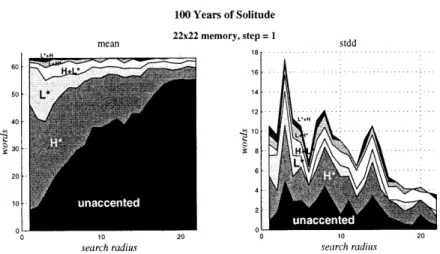
for a step size of 1, a medium memory capacity (22x22) and the fiction sam ple . . . . 152
11-2 Mean and standard deviation for the distribution of phrase contour types, for a step size of 1, a medium memory capacity (22x22) and the fiction sam ple. . . . . 153 11-3 Mean and standard deviation for pitch accent prominence, for three
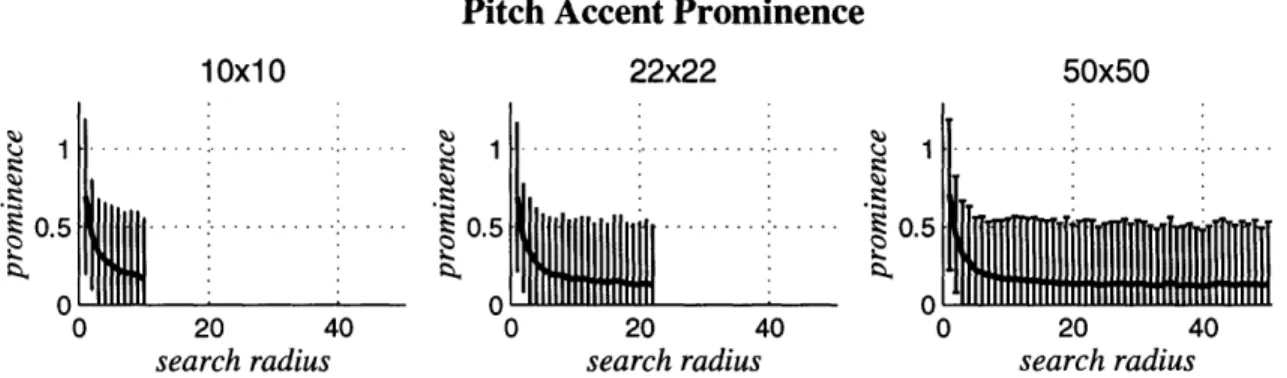
memory sizes and a step size of 1 (fiction text sample). . . . . 153
11-4 Mean and standard deviation for pause duration for three memory sizes and a step size of 1 (fiction text sample). . . . . 154
11-5 Mean distribution of pitch accent types, shown for the largest memory
and for the pointer step sizes of 1, 2 and 3 (fiction text sample). . . . 155 11-6 Pitch range mean and standard deviation for the fiction sample for
three memory sizes and a step size of 1. . . . . 156 11-7 Mean boundary tone prominence for three memory sizes, and three
step sizes (fiction text sample). . . . . 157 11-8 Standard deviation for boundary tone prominence, for three memory
sizes and three step sizes (fiction text sample). . . . . 157 11-9 Mean durations for three memory sizes, for a step size of one (fiction
text sam ple). . . . . 157
11-1OArea plots of the mean pitch accent distributions for all three texts, for medium-sized memory and a pointer step of 1. . . . . 159
11-1lArea plots of the mean phrase final contour distributions for all three texts, for a medium-sized memory (22x22) and a step size of 1. . . . . 160
12-1 Accent and phrasal tone distributions for the natural data, for the one and five paragraph excerpts. . . . . 169
12-2 Mean and standard deviation for pairwise kappa comparisons for all speakers, for the first paragraph of the news story. As indicated by the dotted lines, significant kappa is above .8; possibly significant values are above .67. . . . . 170
12-3 Mean and standard deviation for averaged pairwise kappa comparisons
12-4 Mean distributions for accenting phenomena as a function of search radius and step size. . . . . 173
12-5 Mean and standard deviation of the kappa scores for the pitch accent tests for the LoQ simulations of the NPR news story (first paragraph). Five simulations were run per data point. . . . . 174
12-6 Mean distributions of phrase contour types in LoQ simulations as a
function of search radius and step size. . . . . 174
12-7 Mean and standard deviation of kappa scores for the phrase location
and boundary tests on the LoQ versions of the NPR news story (first paragraph). . . . . 175 12-8 Counts of kappa values per radius. Dotted lines indicate the minimum
values for criteria #1 and #2. The solid lines mark Krippendorff's tentative and actual significance criteria of .67 and .8, respectively. . . 177
12-9 Mean and standard deviation kappa values, per radius, for pairwise
comparisons between LoQ and natural speakers. . . . . 179 12-1OPitch accent test results by radius (for all step sizes) and for the first
three m atch criterion . . . . . 179
12-11Pitch accent test results according to the speaker they best match, usually speakers M2B and F3A, for all radii and all step sizes. .... 180 12-12Pitch accent tests by step size for the first three match criterion. The
step size of one consistently produces the greatest number of matches. 180 12-13Phrase boundary location test results . . . . . 182
12-14Results for test iv. . . . . 183
List of Tables
3.1
Pierrehumbert and Hirschberg's (1990) account of pitch accent meanings. 52
6.1
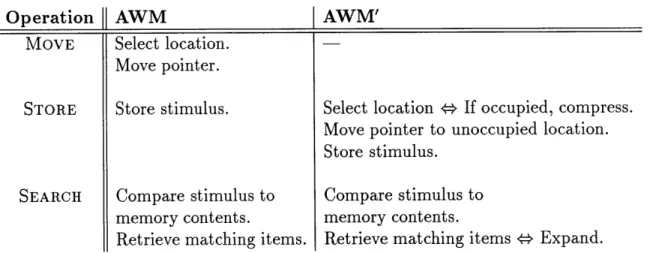
Comparison of the update rules for AWM and AWM'. . . . .
83
7.1
LoQ annotations that denote the function of punctuation and layout
tokens...
...
96
8.1
Rankings for the major predicate categories. Matches on co-reference
criteria contribute the highest mutual information . . . .
110
9.1
Derivation of the simple tones. . . . .
122
9.2
Derivation of the bitonal forms. . . . .
123
9.3
Fixed output parameters and ranges. . . . .
132
9.4 The mapping between pitch and timing features and properties of the
model, and their interpretations . . . .
133
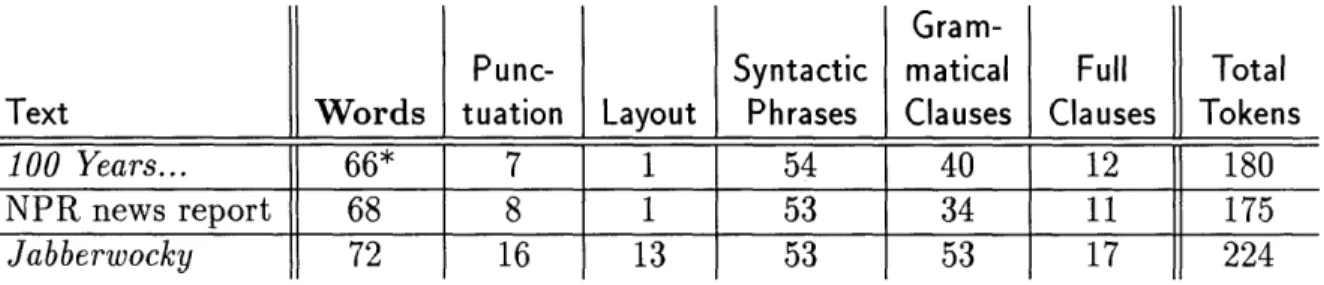
10.1 The three texts prepared for processing by LoQ. . . . .
136
10.2 Manual and automatic processing of linguistic information for a text.
137
10.3 An example of the synthesizer instructions that LoQ produces. The
words, phrase accents and boundary tones are followed by a a
promi-nence value. Words and boundary tones are preceded by the topline
and baseline specifications for the pitch range. . . . .
143
11.1 Equivalent samples from each text. . . . .
148
11.2 Number of LoQ tokens per text and per category. The word total for
100 Years of Solitude includes three deletions. . . . .
149
11.3 Spatial properties and simulation parameters for two and three
dimen-sional memories. Because the spaces wrap around, all dimensions must be even. The two and three dimensional spaces have an equivalent num ber of nodes. . . . . 150 11.4 Control parameters and their combinations in the simulations. . . . . 151
11.5 For the smaller samples, the percent of the tokens that represent empty
categories. . . . . 158
12.1 Tests used by Ross and Ostendorf to compare the intonational predic-tions of their synthesis algorithm to the natural intonation. (The X*? notation indicates the presence of an accent but uncertainty about its typ e.) . . . . 167
12.2 Tests on NPR and LoQ data. . . . . 168
12.3 Pitch accent and intonational phrase counts for five BU corpus
speak-ers, for the one and five-paragraph excerpts from chief justice news story. . . . . 168
12.4 LoQ simulation parameters and the total number of runs. . . . . 172
12.5 Minimum kappa scores for the four threshold criteria. . . . . 177
12.6 Matches on pitch accent location (test (ii)) for each of the three step
sizes times each of the three match criteria, and by count (1 or 2) for the number of matches per radius. . . . . 181
12.7 Simulations that match according to the lowest three match criteria. . 182
A.1 Predicates in order of application and their contribution to the total
match score. X is the stimulus; Y is an item in memory; . . . . 196
A.2 Predicates in order of application and their contribution to the total
match score. X is the stimulus; Y is in memory; Z is either in memory or in one of the online databases. . . . . 197 A.3 Predicates in order of application and their contribution to the total
match score. X is the stimulus; Y is in memory; Z and ZZ are either in memory or in one of the online databases. "*" indicates an additive score. For example, if X is an argument of Y, both the
argument-relation and the X = argument(Y) predicates contribute to the total m atch score. . . . . 198
A.4 Predicates in order of application and their contribution to the total match score. X is the stimulus; Y is in memory. . . . . 199
Part I
Chapter 1
Introduction
Few utterances are alike. Whether the same words are repeated many times by one
speaker, or once by many speakers, each rendition will have a unique prosody
-
that
is, the combination of melody and rhythm will vary with the speaker and the speaking
situation. The nature of the variation is predictable when the speakers are socially or
professionally distinct. Children's prosody is animated while that of adults is more
subdued. Sports announcers shout while classical music announcers soothe.
Intra-speaker, inter-speaker and stylistic variations abound and are ubiquitous in both
public and private life, in readings of prepared text and in daily conversation.
The study of prosodic variation is a study of the actual instead of the ideal, of
deviations instead of the norm. It is a study of linguistic performance, which is
one half of the distinction made famous by Chomsky [Cho65]. The other half is
competence, a term that Chomsky employs to distinguish a grammar that generates
well-formed sentences from the actual sentence structures that a speaker produces on
the fly and in real time. Chomsky draws this distinction to support his contention
that by focusing on competence, grammar can be studied as a formal system. As he
explains, ([Cho65], pp.9):
To avoid what has been a continuing misunderstanding, it is perhaps
worth while to reiterate that a generative grammar is not a model for
a speaker or a hearer. It attempts to characterize in the most neutral
possible terms the knowledge of the language that provides the basis for
actual use of language by a speaker-hearer.
That is, for the purpose of advancing linguistic theory, the grammar of a language
should be abstracted away from a particular user of that grammar. Beyond
recom-mending a method of study and analysis, Chomsky uses this distinction to support
his claim that there exists a knowledge of grammar which is universal among humans
and whose expression in a particular language is the result of (universal) parameters
that are turned on or off [Coo88]. For example, some grammars (Japanese) require explicit lexical markers for attentional focus, while others (English) do not. It is the feature of abstracting away from a particular speaker or hearer that identifies most theories of prosody as theories of prosodic competence. However, there is no further claim that prosodic abstractions are innate. They may have been learned. Similarly, it is not necessary to claim that the prosodic abstractions are universal1, but rather,
that they depict a recognized standard for a language, which may be either an ideal or a norm.
Theories of prosodic competence present formal and generative accounts. In such accounts, intonation (the melody) conveys the attentional and logical propositions expressed by the structure and semantics of the text
([WH85,
PH90, Bir9l, Oeh9l, Ste90]). Timing features - syllable stress within a word and word stress within a phrase - are the consequence of phonetic, morphological and syntactic forms ([CH68, LP77, Sel84]). Because these theories link prosody to the structure and semantics oftext, they have little to say about why prosody varies within and among speakers. The performance explanation I propose does not reject theories of competence but adds that the prosodic elucidation of a text also depends on a particular speaker's abil-ity to understand it. More specifically, my proposal links prosody to the attentional capacities of the speaker, and prosodic differences to differences in the attentional capacities within and among speakers. This is not a traditional explanation and so raises several questions.
The first question concerns the meaning of attentional capacity. I use a definition that is simple and quantitative - attentional capacity is the number of items that a speaker can access in her working memory. A large capacity speaker can access many items; a small capacity speaker can access only a few. Attentional capacity is separate from storage capacity. Even though working memory may be large and full, a speaker with a small attentional capacity can access very little of its contents. The second question concerns the source of differences in attentional capacity. One claim is that differences in attentional capacity are innate. Indeed, some memory pathologies are explained by extremely limited attention. However, the exploration of pathologies is not the focus of this work. The explanation I prefer is that differences in attentional capacity (within a normal range) are task related and that attention is limited with respect to a particular cognitive task or is situational. For example, a child (to whom many things are new) is likely to be performing many computations in working memory at the same time. Consequently, only a small part of her2 attentional
capacity is available for listening and speaking. The opposite case is represented
by a person who is knowledgeable or skilled with regard to a particular task. By
'Although Bolinger [Bol58] states that the use of a rising pitch to mark new information is universal across languages.
2Following [Bre90] and Heeman [Hee9l] the speaker is denoted by female pronouns, the hearer by
definition, this person is in possession of numerous and salient facts about the task.
By the same token, she has a large attentional capacity, as defined by the number of
accessible items. Accordingly, skill at a particular task may be depicted by differences in attentional capacity. This explanation does not depend on pathology but rather accounts for the influence of both the current situation and acquired skills.
The next question deals with the rationale for linking attentional capacity to prosodic variation. A partial answer is that the link between attention and prosody is already established for intonation. Speakers typically mark salient information with rising pitch if they believe that it is new to the hearer or no longer salient to him [Wa192, Wal93, Cru93]. Conversely, when they believe that the hearer is already aware of the information, it is typically unmarked [Bro83]. Intonational variance is therefore explained by the speaker's presumptions about the hearer's attentional capacities and needs.
The last question touches on the reason for linking prosody to the attentional capac-ities of the speaker. The main reason is that even though a speaker typically adapts her prosody for the hearer, her own attentional capacity (for the task) constitutes the upper bound on her performance. Thus, while the ideal prosody is optimized for the hearer, the prosody produced by the limited capacity speaker is often a compromise between optimizing the information content for the listener and optimizing the ease of production for herself. In a situation where the text or its content are familiar, a speaker can most afford to adapt to the needs of the hearer. For example, when an adult instructs a child, she will typically use exaggerated intonation and speak slowly and clearly as well [FS84, AK96]. Her prosody mainly reflects her assumptions about the child's limited attentional capacity. However, when production itself is difficult, her prosody is likely to reflect these difficulties, for example, in pauses that interrupt the flow of text [GE58].
The main goal of this work is to demonstrate a link between prosodic variation and attentional and working memory capacity. A supporting goal is to develop a model that predicts and generates prosodic quantities as well as qualities. The final goal is to apply it to synthesized speech to improve its expressive and stylistic range. The remainder of this section describes the terms of the discussion and the plan of the thesis in support of these goals.
1.1
Terms
In this section, I define the speech terms that are used throughout this work. The first is prosody itself. It is defined as the melody and rhythm of speech. The melody is described by fluctuations in fundamental frequency over the course of an utterance. The fundamental frequency is determined by the rate of vibration of the vocal cords. It is the lowest harmonic in the speech signal. The other frequencies contribute to
the perception of both voice quality and the actual phoneme type. Phonemes are the unique sounds of a language that are combined into words. They are functionally defined such that exchanging one for another produces a different word. Sounds that are separate phonemes in one language may be a single phoneme in another. For example, r and I are unique phonemes for English, but count as one phoneme for Japanese.
The fundamental frequency is referred to in the speech literature as FO ("F-zero" or "F-nought") to distinguish it from F1, F2, etc., which are the formants - high energy regions in the speech spectrum - that characterize a phoneme. FO is a function of vocal cord vibration, while a formant is a function of a vocal tract configuration, which boosts some frequencies and dampens others.
Pitch denotes the perception of fundamental frequency. Intonation describes the com-municative aspects of melody in speech, especially pitch fluctuations at the word level and at the end of a phrase. The change in pitch over time is called a pitch contour; a distinctive pitch contour applied to a single word is a pitch accent
[Bol58].
Speakers use pitch accents to highlight salient words and thus, the concepts to which they re-fer. They use distinctive phrase final contours to group words into phrases, distinguish sentence types such as a declarative or a question, and to convey discourse structure- for example, phrase final rises convey continuation and phrase final falls convey
completion.
The prominence of a pitch accent or phrase final contour is the magnitude of its rise or fall. The distance between the highest and lowest FO values of a phrase describes the pitch range. The pitch range often undergoes change over the course of a phrase. It is typically widest at the beginning and shrinks thereafter.
Pitch accents are acoustical devices that convey emphasis at the sentence level. Changing the location or the type of the accent changes the meaning of the sentence (whereas changing a phoneme changes the meaning of the word). Over-articulating or increasing the duration of a word are two other means for conveying sentential stress. In general, the location of sentential stress is variable. However, the location of lexical stress is restricted by the citation form of a word, which describes its most typical phoneme and stress pattern. The lexically stressed syllable for the word bears primary stress. For example, the first syllable carries primary stress for the noun, "INsult",'
and no stress for the verb, "inSULT'.' Longer words show more gradations of stress. For example, in "CONdemNAtion". "NA" carries primary stress and "CON" carries secondary stress.
The rhythmic component of prosody is partially characterized by patterns of stress across the phrase (such as iambic pentameter for poetry) and partially by the duration of words and pauses. Pauses may be expressed by vocalization, such as "um" or "uh", or by silence. The first is called a filled pause, the second is called an unfilled pause. Pauses are also distinguished by their location in the structure of a phrase or sentence. Hesitation pauses occur within a syntactic and intonational unit, while fluent
pauses occur between syntactic units. The actual size or make-up of these units is
unspecified in both definitions. Typically, hesitation pauses occur before content words
- those words within a language whose form, content and members change relatively quickly over the life of the language. Usually, these are nouns, verbs, adjectives and adverbs. Function words, on the other hand, describe the small set of words whose membership is relatively stable over time and whose use and meaning are slow to change. Such words have little intrinsic meaning but are essential to the syntax. Pronouns, prepositions and conjunctions are examples of function words.
The final set of definitions distinguishes the two main types of speech synthesis. Text-to-speech systems take unrestricted text and assign phrasing and intonation according to punctuation, the part of speech for a word and perhaps a syntactic parse. Concept-to-speech systems (formerly, "message-Concept-to-speech") are text generation systems with a speech interface and a task model. The text of an utterance is derived from both the system's representation of domain knowledge and its model of the current state of the domain or communicative task.
1.2
Plan of the thesis
This is document in four parts: Foundations (chapters 1 through 4), Approach (chap-ters 5 through 10), Results and Evaluation (chap(chap-ters 11 and 12) and Conclusion (chapter 13).
Chapter 2 discusses the principle impetus for this work: the need for a cognitive model that will generate prosodic quantities as well as qualities, and for improved prosody in synthetic speech.
Chapter 3 reviews the theoretical and empirical foundations and divides them ac-cording to whether they describe competence or performance. This is followed by a discussion of prosodic style and genre. Finally, the computational theories of prosody are reviewed. The intonational theory developed by Pierrehumbert and colleagues is reviewed in depth because it is widely accepted and is one of the foundations of this work.
Chapter 4 discusses two areas of related work: the work on prosody for synthetic speech, and the few computer simulations that focus on the effects of cognitive re-source bounds on linguistic performance. The related synthesis work includes both text-to-speech and concept-to-speech efforts. The most directly related computer simulations model the effects of limited attention on learning, comprehension and interaction. However, a few other simulations are reviewed, including connectionist models of language processing.
the text analysis and the mapping of search and storage in working memory to pitch and timing in speech. Each component is discussed in more detail in the chapters that follow.
Chapter 6 introduces the computational model of attention and working memory developed by Landauer
[Lan75]
to simulate the effects of limited search and retrieval on learning and recall. I use it in LoQ, the implemented system, to demonstrate the effects on prosody of limited attention and storage in working memory. The model is critiqued with respect to insufficiently defined properties, in order to introduce changes that are more in line with limited capacity assumptions.Chapters 7, 8 and 9 describe the operation of LoQ, the system that maps the pro-cessing of text in working memory to pitch and timing in speech. Chapter 7 describes how a reader's knowledge of language use and meaning is approximated by the com-bination of text mark-up, automated text analysis and the incorporation of online linguistic databases. Chapter 8 describes the operations of attention and working memory that are relevant to storage and retrieval. The essence of retrieval is the search for a match in memory to the current stimulus. A match is determined by domain-dependent criteria. For speech and language, they include pragmatic, seman-tic, syntacseman-tic, acoustic and orthographic criteria. Chapter 9 presents the algorithms that map search and storage in the memory model to both categorical and quan-titative features of prosody. They produce specifications for pitch accents, phrase final contours, intonational prominence, pitch range, the duration of a word and the duration and location of fluent pauses.
Chapter 10 describes the integration of linguistic databases, linguistic input, mem-ory operations and the mapping algorithms in LoQ, the computer-based simulation system for generating prosody in speech.
Chapter 11 presents the results of the simulations. These show the effects on pitch and timing of three simulation parameters: (1) the size of the working memory model; (2) the attentional capacity within the model; (3) the speed at which the focus of attention changes.
Chapter 12 evaluates the intonation generated by LOQ by comparing it to human readings of the same text - a news story originally broadcast on WBUR in Boston. To compare the two, intonation is treated as a text mark-up that is performed by a speaker. This motivates the use of Cohen's kappa as an evaluation tool. It is a statistic originally developed to determine how closely evaluators agree when classifying the same data [Coh60]. The variation within the natural and LoQ speech is first examined separately, and then the two are compared.
Chapter 13 discusses the contributions and future directions and concludes the work. The key contributions are the limited resource explanation of prosody and the im-plementation that produces varied prosody as a consequence of limited attention and working memory. The future directions propose work in both speech synthesis and
Chapter 2
Motivations
My aim is to demonstrate that prosody is not predictable from text alone and that
claims about default prosody encode implicit assumptions about the processing
ca-pabilities of the default speaker. More strongly, prosody is not speaker independent
and cannot be. It is, after all, delivered by a speaker and not by a text.
If this claim is plausible, it gives rise to the challenge of devising the best
character-ization for differences in processing abilities. The few extant analyses of
speaker-dependent prosody locate the source of differences in the emotional state of the
speaker. These analyses have their own problems, since emotion labels are often
subjective. At best, they form a qualitative taxonomy, if not several taxonomies.
Moreover, none of the taxonomies so far has been generative
-
they do not in and
of themselves account for the central causes and effects of the phenomena they
de-scribe. Probably as a reflection of the fact that there is not yet a generative theory of
emotion, efforts to produce synthetic emotional speech have opted for a descriptive
approach of the output, and one whose acoustical descriptors are selected beforehand.
The processing approach I adopt is generative, quantitative and does not fall prey to
the problems of a descriptive taxonomy. It links prosody to the simplest mechanisms
of working memory, namely, to those that affect attention and recall. It further
claims that quantifiable differences in attentional and recall capacities can be linked
to characteristic differences in prosody.
The advantage of this perspective is that a focus on attention and recall neither
implies nor forbids any particular emotional or affective state. Furthermore, they
are common to all forms of cognitive impression and expression. In addition, the link
between attention and prosody is theoretically and empirically supported. Intonation
conveys salience and grouping and therefore, is an attentional device by definition.
Similarly, duration has been shown to respond to differences in retrievability
-
salient
words are uttered more quickly [FH87, Lev89, FLB97] and longer pauses occur before
rare words [GL83].
A second and related motivation is to expand the expressive range of synthetic speech.
While synthetic speech has attained significant intelligibility and a reasonable (male) voice quality [Kla87], it remains under-employed in all areas where its use should be obvious: in information applications (such as one that gives driving directions
[DH88, DT87, Dav89]), as a tool for dramatic prototyping [Cah90, Cah], as the voice of
an autonomous agent [WCW97], as a reader to the blind [Ram94] or as a voice for the voice-impaired [Kla87, Cah90, MAN88, MA93]. The main problem is that synthesized speech is still acoustically and perceptually impoverished. The voicing source is often too regular, the phoneme transitions awkward and the prosody inappropriate. In general, synthesized speech contains less information per speech feature, less re-dundancy across features, and information that is often distorted in comparison to natural speech. Luce et al. [LFP83] describe it as perceptually equivalent to natural speech in a noisy environment because the acoustics of both are degraded. Conse-quently, it requires the listener to direct more of his processing toward recovering basic forms, such as phonemes and words, rather than toward encoding and manipulating content. Not surprisingly, experimental subjects show impaired performance in mem-ory and comprehension tasks when synthetic speech is used to present information
[LFPS3, WT85, RPL+91].
The quest for better prosody is one avenue by which synthetic speech can be im-proved. It promises to produce prosody that is both more accurate (it expresses plausible propositions about the text) and more natural (it produces informative prosodic patterns that are also easily processed). For text-to-speech synthesis, the quest has mainly been for an algorithm that will generate the best possible discourse-neutral [BF90] prosody. This is a necessary goal for unrestricted and minimally understood text. However, it produces prosody that is repetitive and often inap-propriate to the content of the text. Concept-to-speech synthesis is better able to produce prosody that conveys both task semantics and discourse structure because the generating system has access to both. However, its prosody is only as good as its knowledge representations and the algorithms that map them to prosody.
Moreover, both approaches fail to convey other information for which hearers listen, namely, the pitch and timing features that reveal a speaker's characteristic
physiol-ogy (e.g., young, old), momentary physiolphysiol-ogy (e.g., tired, energetic), affective state
(e.g., calm, annoyed) and attitude towards the text or the interaction (e.g., sincere, ironic, grudging). From this, hearers can then deduce the speaker's likely intention, and therefore, the context in which to interpret her utterances. The search for bet-ter algorithms for emulating linguistic competence ultimately requires not a default competence, but one that belongs to a specific speaker, with a specific physiology and history, all of which impinge on how she stores and accesses information and thus, on
her lexical and acoustical choices.
In summary, although processing in working memory is not the only influence on prosody, it is an important one and one that has so far been missing from both
theory and implementation. I suggest that it is only by accounting for speaker specific influences in a model of prosody that we can hope to duplicate in synthetic speech the stylistic and individual variation that is a matter of course in human speech.
Chapter 3
Theoretical and Empirical
Foundations
By conveying emphasis and grouping, prosody serves many purposes. Speakers use
it to disambiguate syntax, distinguish questions from statements, draw attention to salient semantics, coordinate turn-taking and structure a discourse into topic seg-ments. This information helps the hearer locate referents, identify topic structure and participate in the interaction.
A cooperative speaker will try to provide this information as a matter of course.
However, like hearers, speakers have finite cognitive capacities. If they are engaged in spontaneous speaking situations, they are simultaneously constructing an utterance, producing it and attending to the hearer's response - and all in real time. At times, their prosody may well reflect the difficulty of managing these tasks as much as the structure and content of the information they deliver. However, the possibilities are not exclusive. A focus on communication emphasizes the speaker's accommodation to the limited attention and working memory of the hearer. It treats prosody as instruc-tions that help the hearer process both text and interaction. A focus on production emphasizes the limited resources of the speaker. It treats prosody as information about the speaker's online processing as she constructs and organizes the text. Both address aspects of resource-bound processing in conversation. The first focuses on how prosodic form reflects the speaker's accommodation to the information and pro-cessing needs of the hearer. The second focuses on prosodic form as a reflection of the speaker's own limited resources. Alternatively, these differences illustrate competence and performance explanations, respectively.
In the first two sections of this chapter, I organize the accounts of prosody according to whether they emphasize the speaker's competence or performance. As a reflection of competence, prosody conveys information about the form and content of a text. As a reflection of performance, it demonstrates the effects of the speaker's processing and production capacities. This is not a traditional distinction, mainly because most
studies and models are of the competence variety. However, discussing prosody as an elucidator of both text and processing clarifies the reason for attempting an approach based on the limited cognitive resources of the speaker.
Following that, I discuss the research on stylistic and individual differences in prosody, including the scant work that links prosodic differences to individual differences of cognitive capacities and mental state. Finally, I review computational approaches to prosody. I discuss the intonational theory of Pierrehumbert and colleagues in depth because it provides the main framework for research on understanding and synthesizing intonation.
3.1
Competence explanations of prosody
The competence explanations treat prosody as a communicative and interactive re-source. They propose that speakers use intonation to group and to emphasize, and thereby structure the discourse into topics, subtopics and turns [PH90, GH92, HG92,
SG94]. and direct the hearer's attention to the areas where processing effort is most
profitably applied [Cut84].Applied to an individual word, intonation communicates its information status such as whether it is familiar, in context, or novel [Pri81, Bro83]. It also conveys specific propositions about the word or phrase to which it belongs, such as contrast [WH85], similarity, or set membership [LP84, PH90]. The differ-ent phrase final contours (rising, falling, level) distinguish among sdiffer-entence types, such as interrogative or declarative, and speech acts ([Aus62, Sea69]), such as re-questing or informative. They also convey topic structure, coordinate turn-taking [Sch82, Yng70, SSJ74] and affirm social connection [McL91]. In essence, the interac-tive and information structure interpretations identify prosody as a resource used by the speaker to facilitate the hearer's comprehension and cooperation.
Studies in this vein have uncovered useful correlations between prosodic features and discourse structure, information status and speech acts. For example, speakers typically signal topic shifts by expanding their pitch range [MB82, HG92]. Ayers [Aye94] found correlations between the size of the pitch range and the position of a discourse segment within the hierarchy of segments that make up a conversation. She notes that the relation of the pitch range to the discourse hierarchy is more pronounced for read speech than for spontaneous speech. Hirschberg and Grosz [HG92, GH92] found that a speaker's pitch range tends to expand for quotations and to compress for parentheticals. They also report a slower rate of speech and an increased amplitude at the beginning of new discourse segments, and a faster rate of speech for parentheticals. Pause duration is often a cue to the strength of a phrase boundary, and more so for read speech. Ayers [Aye94], inter alia, found long pauses at the boundaries between segments of read speech, but found no clear pattern of pause duration in spontaneous speech. However, when the durations of filled pauses ("um", "uh") are taken into
account for spontaneous speech, there is evidence that pause duration reflects topic structure. Swerts et al. [SWB96] found that filled pauses that initiate a new segment have longer durations and a higher average pitch than those that are phrase internal. Phrase final contours are often correlated with speech acts - e.g., request, inform, command - and the corresponding sentence types - e.g., question, declarative, im-perative [LS74, MB82, EC86, Cam95, GvH95]. The prototypical yes-no question in English has a high phrase final rise, and both the prototypical wh-question and the declarative statement are produced with a phrase final fall. As with other intona-tional features, Hirschberg
[Hir95]
found that these trends were more consistent in read speech than in spontaneous speech.An important function of pitch accents is to convey information status such as theme (the current topic) and rheme (additional information about the topic) [Hal67, PS94], and especially the distinction between given and new. Prince [Pri8l] defines given information as information that the speaker believes is available to the hearer. She enumerates the criteria under which a speaker is entitled to this presumption: (1) if the information has just been presented; or (2) if it is inferable; or (3) if it has been evoked textually by prior mention, or situationally. Her taxonomy predicts that new information is accented (with high pitch) and that given information is de-accented. Brown [Bro83] investigated this claim and found that whether an item was previously mentioned was not a sufficient predictor of givenness. In her studies of elicited spon-taneous speech, referents of the currently evoked item (the item in focus) tended to be de-accented, and pronominalized as well. In contrast, if an item had been previously mentioned but was not the current focus of attention, it was likely to be accented with high pitch if the speaker believed that the hearer did not expect it. This corroborates with the converse [NT82], that a speaker will tend to de-accent if she believes that
an interpretation is already available to the hearer.
Accent is also correlated with the textual features that convey information status, such as grammatical role, sentence position (for word order languages) and pronomi-nalization. It has been found that items about to become the current focus are often in object position, while items already in focus tend to occur in subject position
[Sid79,
Pri81, BFP87]. Such items are given, and therefore tend to be de-accented. In SVO languages such as English and Dutch, subject position is usually sentence initial. Terken, et al. [NT82, Ter84, TH94] have found that de-accenting is most probable when these two features coincide. This often occurs for referring expres-sions of greatest specificity,1 such as pronouns, since they are indicators of continued salience [Sid86, WW90].1lndefinite reference (a book) is less specific than definite full-NP reference (he book), which is less
referentially specific than i. The importance of context increases along with increased specificity. Pronouns depend almost entirely on context to select their referent.
3.1.1
Discussion
Competence accounts mainly focus on how prosody is shaped by the propositions in the text, but less so on how it is shaped by the individual speaker who produces the text. The main linkage of prosody to attentional capacity focuses on the hearer rather than the speaker. In the next section, I review research that explicitly links prosody to the attentional and memory resources of the speaker.
3.2
Performance explanations of prosody
Psychological studies attribute shorter completion times, for both production and recognition tasks, to the greater accessibility of task-related information in working memory. In studies of speech performance, both the duration of the word and the pause that precedes it appear to correlate with word frequency. Geffen and Luscsz
[GL83] have found that speakers produce significantly longer pauses before rare words
and that rare words take marginally longer to articulate. Hesitation pauses occur most often before content words (whose members are numerous and varied) than function words (whose members are ubiquitous and few). Pauses in general are far more frequent in spontaneous than read speech [Cut96] - the result of constructing the content and form of the utterance in real time. Goldman-Eisler [GE61] observes that longer pauses precede the expression of more complex and interesting thoughts, a result (it is hypothesized) of a search for not only the right word, but the right thought.
Recency is also a well-known predictor of retrievability in that the more recent the mention, the more quickly the item will be recalled. This is suggested by both Levelt's
[Lev89] and Fowler and Housum's [FH87] findings that word durations are shorter at second mention than at first mention. Levelt found that words at second mention are also lower-pitched and softer. Fowler and Housum found that they are less intelligi-ble. It appears that both retrieval time and production effort are reduced at second mention. Elaborating on these findings, Fowler et al. [FLB97] found that the dura-tion of repeated words was reduced within a (read) discourse segment but blocked at boundaries marked by "meta-narrative statements" rather than narrative discon-tinuities. This suggests that a meta-narrative statement effects a shift in perspective that reduces the accessibility of previously salient items.
Intonation is most often linked to the meaning and structure of a text. However, accenting has also been shown to respond to frequency of occurrence. Function words, the most ubiquitous of a language, tend to be de-accented [Hir90, Hir93] and content words tend to be accented [Ter84], reflecting the relative frequency of use for the language and the corresponding retrievability for an individual.