Phytoremediation: Sulphonated Aromatic Pollutants
:
I
Sulphonated Aromatic Pollutants
Limits o f M i c r o b i a l D e g r a d a b i l i t y a n d Potential o f P h y t o r e m e d i a t i o n
Jean-Paul Schwitzgu~beP', Sylvie A u b e r t 1, WolfgangGrosse 2 and
F r a n k L a t u r n u s 31 Laboratory for Environmental Biotechnology (LBE), Swiss Federal Institute of Technology Lausanne (EPFL), CH-1015 Lausanne, Switzerland
2Institute of Botany, University of Cologne, Gyrhofstrasse 15, D-50931 Koeln, Germany
3Department of Chemistry, University of Copenhagen, Symbion Science Park, Fruebergvej 3, DK-2100 Copenhagen O, Denmark
*
Corresponding author
([email protected])DOh httn:lldx.doi.orc#l 0.1065/esDr2001.09.084.4
Abstract. Many synthetic sulphonated aromatic compounds are used as starting material to produce dyes and pigments, or are released as by-products in the effluents of the textile and dye industry. A large number of these chemicals are poorly biode- gradable and cannot be eliminated by classical wastewater treat- ment plants. To limit the impact of these pollutants on the envi- ronment, new processes, based on the use of higher plants (constructed wetlands or hydroponic systems), are under devel- opment. Detergents and surfactants are essential for both
in-
dustrial
and domestic applications, the most important family being the alkylbenzene sulphonates. Originally, the alkyl side chains were branched and thus recalcitrant to biodegradation. Therefore, they have been replaced by linear alkylbenzene sulphonates. Although more acceptable, present formulations still have adverse environmental and toxic effects. In this con- text, phytoremediation appears to be a promising approach to remove these compounds from contaminated soils and waters. Keywords: Biodegradability; detergents; dyes; industrial efflu- ents; LAS (linear alkylbenzene sulphonates); linear alkylbenzene sulphonates (LAS); pigments; phytoremediation; sulphonated aromatic compounds; surfactants; wastewater treatmentIntroduction
Whereas naturally produced, and biologically degradable, sulphonated organic compounds are mostly aliphatic (tan- rine, coenzyme M, cysteate, methanesulphonate, sulphoace- tate, sulpholactate, plant sulpholipids), only a few natural aromatic sulphonates are k n o w n , like aeruginosin B pro- duced by Pseudomonas species, and some undefined com-
pounds present in marine sediments and soils, largely in humic materials. In contrast, the sulphur present in organic synthetic compounds is mostly found in the form of a sul- phonate moiety (-SO3-) bound to one or several carbon(s) of an aromatic nucleus, as in the sulphonate dyes, the linear alkylbenzene sulphonate surfactants and their by-products. Therefore, many sulphonated xenobiotics rejected in the environment are often only p o o r l y biodegradable and thus the efficiency of classical biological wastewater treatment
plants to cope with effluents containing such compounds
is
not always the best. Even if sulphonated aromatics are not considered as priority pollutants, their increasing produc- tion, use and release will become of concern in the near fu- ture (Cook 'et al. 1999, Nigam et al. 2000, Riediker et al. 2000, Robinson et al. 2001).The present review aims to address the environmental prob- lems linked with two families of sulphonated aromatic com- pounds: dyes and pigments, as well as linear alkylbenzene sup phonate surfactants. The state-of-the-art knowledge on the toxicity, microbial degradability, impact and behaviour of such xenobiotics in the environment will be presented. The recent and promising developments of phytoremediation, i.e. the use of green plants and their associated micro-organisms, to re- move, contain and/or render harmless environmental pollut- ants, will be emphasized, especially to treat wastewater con- taining sulphonated aromatic compounds.
1 Dyes and Pigments 1.1 Structure, use and toxicity
More than 106 tons of at least 10,000 different synthetic dyes and pigments are produced annually worldwide. Of this amount, approximately 280,000 tons are discharged every year into the environment (Willetts and Ashbolt 2000), mainly via industrial effluents, but also via leachates from landfills (Riediker et al. 2000). Synthetic anthraquinone is the parent compound for a large palette of dyes and an important start- ing material in their production, via anthraquinone sulphonates (Fig. 1), giving to this family of chemicals an actual impact on the environment, especially rivers. Benzene sulphonate and p- toluene sulphonate are used as intermediates in the manufac- ture of optical brighteners, pickling agents, dyestuffs,
tanning
agents, insecticides, surfactants, wetting agents and antioxi- dants. They are also used as acidic catalysts and standardizing agents in dyestuff manufacture. As for naphthalene sulphonic acids, they are important precursors for dye intermediates, wetting agents and dispersants.It is not only the colour of these organic compounds that render their release into the environment unacceptable, but
6 2 ESPR - Environ Sci & Pollut Res 9 (1) 62 - 72 (2002)
P h y t o r e m e d i a t i o n S u l p h o n a t e d A r o m a t i c P o l l u t a n t s
O O O
AQ AQ-I-S AQ-2-S
Ho.s SO H
HO~S o o o
AQ-1,5-SS AQ-1,8-SS AQ-2,6-SS
Fig. 1 : Anthraquinone and sulphonated derivatives their increasing discharge into water bodies and domestic
wastewater treatment plants is causing significant concerns to environmental regulatory agencies (Banat et al. 1996). Information on the toxicology of many sulphonated aro- matic compounds is rather scarce (Greim et al. 1994). These molecules, regardless of their structure and the way or du- ration of their application, seem to have a low systemic tox- icity and seem to be neither carcinogenic nor mutagenic. The acute toxicity of sulphonated xenobiotics to rats is low, regardless of their particular structure. The hydrophilic prop- erties of the sulphonic acids result in their rapid excretion from the organism, several of them without any biotrans- formation. Findings on irritation and skin sensitisation do not indicate any common effect for the group. However, more detailed studies are required with different sulphonated xenobiotics to assess their toxicity.
1.2 Impact and behaviour in the environment
Because they contain at least one sulphonic group and often also varying substitutions such as nitro groups, these aromatic compounds are not uniformly susceptible to bio-decolourisa- tion and biodegradation in conventional wastewater treatment plants. Actually, the organosulphonate group plays an impor- tant role not only in altering the solubility and dispersion prop- erties of the xenobiotic molecule, but also in increasing its recalcitrance to environmental breakdown, because of the ther- modynamically stable carbon-sulphur bond (Kertesz et al. 1994). In addition, these aromatics are also highly mobile in aquatic systems (Angelino et al. 1999).
Effluents from the detergent, dye and textile industry are thus often contaminated with sulphonated aromatic compounds. Consequently, pollution of many European rivers by sulphur- organic xenobiotics is largely due to this class of chemicals (Young and Yu 1997). Furthermore, it has recently been re- ported that benzene and naphthalene sulphouates are also found in plumes and leachates from landfills (Riediker et al. 2000). Data available on more than 20 sulphonated aromatic com- pounds show distinct ecotoxicological properties of these xenobiotics (Greim et al. 1994). First of all, their biodegrad- ability seems highly variable, and many of these compounds must be categorized as recalcitrant. For example, no degra- dation was observed for six of the eight naphthalene sul-
phonic acids listed. The log Kow (where Kow is the octanol- water partition coefficient) for all benzene, stilbene, diphe- nyl, naphthalene and other sulphonic acids tested was de- termined to be equal to or less t h a n 2.2. Therefore, no significant accumulation in the fats of living organisms is expected. The value of acute toxicity to fish is greater or equal to 100 mg/L for most of the aromatic sulphonic acids tested. However, due to the poor biodegradability and vary- ing values for fish toxicity of these compounds, the release of industrial effluents containing significant amounts of such compounds into rivers can have deleterious effects on the organisms living in such waters.
Sulphonated aromatics can be adsorbed on algae or plant resi- dues (Fernandez et al. 1996, Nigam et al. 2000), whereas cells isolated from rhubarb can accumulate this class of xenobiotics (Schwitzgu~bel 1996, Duc et al. 1999 a and b). Preliminary experiments with different species show that whole plants can also accumulate these c o m p o u n d s . Thus, sulphonated xenobiotics could possibly enter the food chain, either directly via the water supply, or after sorption by plants.
1.3 Treatment possibilities
Colour removal has been largely investigated during the last two decades. Several physico-chemical decolourisation tech- niques have been reported, like coal adsorption or UV/HzO z treatment (Yang et al. 1998). However, their expensiveness, low efficiency and inapplicability to a wide variety of dyes have inhibited their development and use.
Since dyes and by-products usually contain a wide variety of substituted sulphonated aromatic compounds, the substrate spectrum of bacteria has been intensively investigated with regard to their possible application for the treatment of indus- trial wastewater and to the cost-effectiveness of such an ap- proach. Unfortunately, microbial degradation of these pollut- ants often requires unusual catabolic activities rarely found in a single species (Ohe et al. 1990, Dangmann et al. 1996, Seignez et al. 1996, Cook et al. 1999, Ruff et al. 1999). An important step in the biodegradation appears to be catalysed by dioxygenases adding oxygen across the double bond bearing the sulphonate group, leading to its elimination (Kuhm et al. 1991, Contzen et al. 1996). Thus, special attention has been paid to the substrate specificity of dioxygenases, often consid-
ered as a rate-limiting step for the mineralization of sulpho- nated aromatic compounds. Unfortunately, a rather limited substrate range has been observed for bacterial isolates and the accumulation of dead-end products often occurs (N6rte- mann et al. 1994). The decolourisation of several synthetic dyes including azo and anthraquinone derivatives has also been examined in white-rot fungal cultures, k n o w n to produce ligninase a n d o t h e r p e r o x i d a s e s ( M u r a l i k r i s h n a a n d Renganathan 1993, Young and Yu 1997). However, an inhi- bition seems to occur at rather low concentrations, depending on the individual dye structure. Furthermore, the production of the key enzyme responsible for dye decolourisation, lignin peroxidase, is dependent on carbon or nitrogen limitation, which is usually not the case for industrial effluents (Wong and Yu 1999). These negative features limit the efficiency and, therefore, the use of conventional bio-fihers and wastewater treatment plants, because of the limited ability of micro-or- ganisms to degrade sulphonoaromatic compounds, and thus to cope with various mixtures of these xenobiotics.
In this context, the development of ahernative biological treatments to eliminate these pollutants from industrial ef- fluents is a requirement (Robinson et al. 2001). More pre- cisely, selected plant species are able to remove pollutants from wastewater, by the use of constructed wetlands (Biddle- stone et al. 1991, Davies and Cottingham 1994) or hydro- ponic type treatment plants (Furukawa and Fujita 1993). Both offer a potentially low cost, low maintenance biologi- cal method for wastewater treatment. Most of the systems currently in use have been designed to treat domestic waste- water, but have a great potential to remove a wide range of xenobiotics and to treat industrial effluents containing re- calcitrant organics such as priority pollutants and dyes (Davies and Cottingham 1994).
Even if phytoremediation has developed mostly for polluted soil decontamination (Salt et al. 1998, Siciliano and Germida 1998), the use of green plants and plant material to treat wa- ter contaminated with xenobiotic compounds appears as a
promising approach (Dec and Bollag 1994, Low et al. 1995,
Hughes et al. 1997, Medina et al. 2000). Plant metabolism is diverse and can be exploited to treat recalcitrant compounds not degradable by bacteria. To develop such phytoremediation treatments, isolated plant cells cultivated in vitro offer many advantages over the whole plants. In particular, the screening of plant species as to their ability to degrade or remove xenobiotics belonging to the same chemical family is made easier and quicker (Harms 1992, Hughes et al. 1997, Schwitzgu6bel et al. 1998, Vanek et al. 1998). Such an approach has been used for the development of a novel treatment to eliminate several sulpho- nated aromatic pollutants from wastewater.
Whereas benzene sulphonate (BS) and p-toluene sulphonate (p-TS) are moderately biologically degradable (Khlebnikov et al. 1997), the biodegradation of many substituted ben- zene sulphonates is difficult or even impossible. Therefore, industrial effluents containing a mixture of such compounds are not suitable for treatment in biological wastewater treat- ment plants. This family of xenobiotics therefore has to be considered as a potential and actual cause of pollution for soils and waters (Riediker et al. 2000).
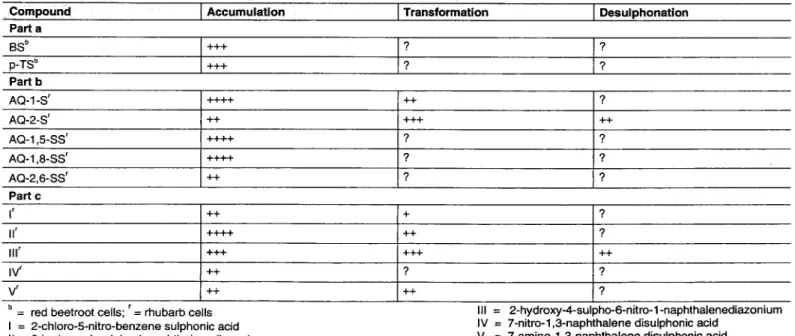
The ability of the bacterium Comamonas testosteronii to at- tack p-TS is dependent on the activity of both mono and dioxygenases. Since the synthesis of betalain pigments by red beetroot also involves the activity of a dioxygenase, this en- zyme could possibly accept p-TS and BS as substrates. Cells isolated from red beetroot (Beta vulgaris) were thus tested for their ability to degrade or transform these compounds. Cells were grown in shake flasks in the presence of the xenobiotic compounds added at different times. After incubation, cells were separated from the growth medium by filtration and the filtrate was analysed by High Performance Liquid Chroma- tography (HPLC), Capillary Electrophoresis (CE) and spec- trophotometry for its content in the parent compounds and, eventually, in metabolites derived from them. The most sig- nificant results are summarized below (Table 1, part a).
Table 1 9 Present knowledge on the fate of different aromatic sulphonated compounds by plant cells
C o m p o u n d A c c u m u l a t i o n I Transformation Desulphonation Part a BS b +++ ? ? p-TS b +++ 9 ? Part b AQ-1 -S r ++++ ++ ? AQ-2-S' ++ +++ ++ AQ-1,5-SS' ++++ ? ? AQ-1,8-SS r ++++ ? ? AQ-2,6-SS r ++ ? ? Part c I r + + + .'? II ~ ++++ ++ ? III r + + + + + + + + IV' ++ ? ? M r + + + + ?
b = red beetroot cells; r = rhubarb cells Ill = 2-hydroxy-4-sulpho-6-nitro-l-naphthalenediazonium
I = 2-chloro-5-nitro-benzene sulphonic acid IV = 7-nitro-l,3-naphthalene disutphonic acid II = 2 - h y d r o x y - 4 - s u l p h o - l - n a p h t h a l e n e d i a z o n i u m V = 7 - a m i n o - l , 3 - n a p h t h a l e n e disulphonic acid
Phytoremediation
Sulphonated Aromatic Pollutants
When added at 900 mg/L, the highest uptake rate of p-TS was observed if the xenobiotic was given during the exponential phase of growth: 22 mg/L per day, leading to an overall de- crease of one third within two weeks. If the xenobiotic was present from the beginning of the growth, no uptake was ob- served during the first 7 days, but the uptake rate reached a value of 19 mg/L per day from the seventh day of incubation. If given during the stationary phase, the uptake rate of p-TS was only 10 mg/L per day. In contrast, the highest uptake rate of BS, given at 900 mg/L, was observed if added to red beetroot cells after 15 days of cultivation (stationary phase): 43 mg/L per day, leading to a decrease of more than 30% of its initial concentration within a week. If BS was present from the be- ginning of cultivation, no uptake was observed during the first 7 days. However, the uptake rate reached a value of 29 mg/L per day from the seventh day of incubation. An uptake rate of 29 mg/L per day was also observed if BS was added after 7 days of cultivation (exponential phase), leading to a removal of more than 40% of the xenobiotic within 16 days. It is not yet known if both xenobiotic compounds are transformed by beetroot cells, or only accumulated.
Different derivatives of anthraquinone naturally occur in several plant genera like Rheum (rhubarb), Rumex and Rubia
(Trease and Evans 1983, Van den Berg and Labadie 1989). Rhubarb could thus possess enzymes capable of accepting sulphonated anthraquinones as substrates. Cells were iso- lated from Rheum palmatum and grown in shake flasks or in bioreactors in the presence of up to 700-800 mg/L an- thraquinones with sulphonate groups in different positions (Fig. 1). The position of the sulphonated moiety on the aro- matic ring structure, rather than the number of such groups, appears to be the main factor controlling the fate of the xenobiotic in rhubarb cells (Table 1, part b): simple uptake from the medium, transformation, desulphonation, conju- gation or partial degradation (Schwitzgu~bel et al. 1995, Schwitzgutbel 1996, Schwitzgutbel et al. 1996).
Rhubarb cells are also able to efficiently accumulate other sulphono-aromatics rejected by the dye industry, like 2-chloro- 5-nitro-benzene sulphonate 2-hydroxy-4-sulpho- and 2-hy- droxy-4-sulpho-6-nitro-naphthalene-diazonium, as well as 1,3- naphthalene disulphonates, containing either an amino or a nitro group in position 7. Furthermore, rhubarb cells trans- form four of these compounds without releasing any interme- diate (Table 1, part c, and Schwitzgutbel 1998, Duc et al. 1999, a and b).
Based on the promising results obtained with different sul- phonated aromatic compounds of the same family, future en- vironmental applications can be considered. Further studies, however, are required to characterize and better understand the biochemical mechanisms leading to the accumulation, the transformation and/or the degradation of sulphonated xeno- biotics in isolated cells and whole rhubarb plants. On the other hand, this hardy plant species could be a good candidate to develop biological processes to treat wastewaters and sites contaminated with sulphonated aromatic pollutants. In the future, whole plants grown in the field could help to decon- taminate soils or groundwater, whereas rhubarb or Rumex cultivated under hydroponic conditions could be used to treat wastewater containing sulphonated derivatives of benzene, toluene, naphthalene or anthraquinone.
2
Surfactants2.1 Use,
structure, determination, and toxicityUse and structure. In the middle of the 20th century, when the use of washing-machines was getting popular in Europe, soap was replaced by detergents with about 15% (v/v) sur- factants in washing powder and up to 45% (v/v) in liquid detergents (Stache and Kosswig 1990). Although worldwide soap is still used more than surfactants, the wide variety of processes in which surfactants are involved has resulted in a significant increase in their consumption from about 13 * 106 tons in 1977 to 18"106 tons in 1996 (Granados 1996). Of this total, some 1.5"106 tons per year correspond to the anionic linear alkylbenzene sulphonates (LAS) (Fig. 2), the leading type of surfactants in term of volume consumption (Krueger et al. 1998a, Perales et al. 1999a). They are widely
OH 3 .OH 3 OH 3 OH 3
H
3
C
~
v
"SO 3"
TPSH 3 ~ C H 3
LAS
(n=3-7)
~0-oxidation
SO3"
H 3 C ~ ~ O H
~-oxidation$
SO 3"
H 3 ~ ' ~ ~
OH
SO 3"
H3C ~ ~ ' O H
@ oo
SO3-
H 3 C ~
~ O H
0
k , ~
+ H3C..~OH
SO 3"
SPCFig. 2:
Chemical structures of tetrapropylbenzene sulphonate (TPS), line-
ar alkylbenzene sulphonate (LAS), and intermediates of bacterial biode-
gradation of I_AS to sulphophenyl carbonylate (SPC) by o-oxidation followed
by ~-oxidation
used as ingredients in detergents, personal care and house- hold cleaning products, but also in a variety of industrial and commercial applications.
LAS consists of two moieties, 6) a sulphonated aromatic ben- zene ring of variable positioning is fixed at (ii) a linear ali- phatic chain containing from 10 to 14 C-atoms (C-10 to C- 14). Since the tetrapropylbenzene sulphonate (TPS) (Fig. 2) primarily used, which is most recalcitrant due to its branched side-chain, was naturally degraded very slowly and insuffi- ciently, the environment and drinking water showed a high pollution by these compounds (Malz 1980). Therefore, it has been replaced by the less recalcitrant LAS, mainly due to the easier natural degradation and mineralization by dif- ferent bacterial mechanisms.
LAS are produced from straight-chain hydrocarbons isolated from the kerosene fraction of petroleum by molecular-sieve chromatography (Henkel 1976), followed by benzoylation and the final sulphonation (Stache and Grossmann 1985). The final commercial product is a mixture of several homo- logues of LAS roughly consisting of 4-6% C-10,
43-49%
C-11, 36-40% C-12, 10-13% C-13, and 1% C-14, respec- tively, and of isomers resulting from the different positions the benzene-sulphonate moiety is fixed at the linear side- chain including the terminal position (Hellmann
1995).
Determination. Anionic surfactants are commonly measured by the methylene blue method as described for example by the German standard method DIN 38409-H23-1 (DEV-9, Edition 1981). Both water-soluble cationic methylene blue and anionic surfactant react to a less water-soluble com- plex, which can be easily extracted from the aqueous samples for being well soluble in chloroform and trichloromethane, respectively, and finally quantified spectrophotometrically. Unfortunately, the same methylene blue complexes are formed also by some biogenic anions, which commonly oc- cur in environmental samples, mimicring the presence of surfactants. On the other hand, the occurrence of anionic surfactants may be masked by their reaction with quater- nary ammonium compounds in displacing methylene blue in the complex. This is also the case when cationic surfac- tants are available in the same sample (Hellmann 1995). During the last decade, new analytical methods have been de- veloped for environmental screening. Distribution of LAS and their potential sulphonated and non-sulphonated metabolites in natural waters was assessed in using, for instance, HPLC (Sarrazin et al. 1997). More recently, a biosensor was devel- oped for monitoring LAS content in water (Nomura et al. 1998). Since the lack of more specific detection methods was obvi- ous, as well as information on metabolites, their level and toxicity in water, the European PRISTINE research project (ENV4-CT97-0494) was established in 1997 as one of the three 'Waste Water Cluster' projects to develop specific meth- ods (Knepper and Kruse 2000, Li and Schroeder 2000, Riu et al. 1999 and 2000) for simultaneous identification and quantification of surfactants and their metabolites in Euro- pean aquatic environments, fixed at different matrices or accumulated by marine organisms, e.g. fish
(Diplodus vul-
garis)
and clam(Ruditapes semidecussatus),
with special emphasis on monitoring the fate and toxicity of these corn-pounds. To determine LAS adsorbed in sediments, pressur- ized liquid extraction followed by ion-pair derivatization GC- MS was used (Ding and Fann 2000).
Toxicity. When acute (LC-48 h) and chronic (NOEC 21 days) toxicity studies were performed according to the OECD- 202 guidelines, with various LAS homologues versus ma- rine (e.g.
Nanochloropsis gladitana)
and freshwater (e.g.Scenedesmus subspicatus)
algae for hazard assessment, the assays show a remarkable effect of increasing molecular mass. The EC-50% (24 h to 96 h) ranges are between 9.8 and 6.0 mg/L for Na-LAS C-10 versus N.gladitana.
The toxicity (EC-50%; 24 h to 72 h) increases with 1.1 mg/L for Na-LAS C-12 to 0.6 mg/L for Na-LAS C-14. In assessing the freshwater algaeS. subspicatus,
the toxicity (EC-50%; 24 to 72 h) with 48 mg/L for Na-LAS C-12 is about one order of magnitude lower than in marine environment (Moreno 2000). Among the freshwater plankton, the cili- ares and heterotrophic nano-flagellates are the most sensi- tive groups with non-effect concentrations (NEC) as low as 0.02 mg LAS/L. Most other planktonic organisms are af- fected at concentrations higher than normally found in aquatic habitats. Exceptions to the general trend are the pho- tosynthetic activity of the phytoplankton and the cryptophyte abundance which both are nearly as sensitive parameters as protozoan abundance (Jorgensen and Christoffersen 2000). Changes in embryonic development of the seabreamSparus
aurata
are observed with the five LAS (C-10 to C-14) homo- logues, commercial LAS mixture (Na and Mg salts), and the degradation intermediate SPC C-11. In studying survival and hatching rate of eggs by exposing them to increasing concen- trations of these surfactants, the LCs0 values for the different LAS homologues decrease with increase of the alkyl-chain length. In general, LCs0 values for LAS (C-10 and C-11) ho- mologues are about one order of magnitude higher than that of the LAS (C-12 to C-14) homologues and the commercial LAS. Commercial LAS produce approximately 90% of mor- tality at 0.5 mg/L, whereas at 0.25 mg/L the survival of the exposed organisms is similar to the control. With the degra- dation intermediate SPC C-11, no mortality is observed over the entire experimental concentration range. In general, theLCso
of eggs-larvae ofS. aurata
versus LAS seems much higher than the LAS concentrations usually found in marine environ- ments (Hampel et al. 2000a).Several homologues of LAS inhibit enzymes related to cellu- lar protection mechanisms (e.g, glyoxalase, cholinesterase, acid phosphatase), using gills of
Ruditapes philippinarum
as a target organ (Hampel and Blasco, unpublished). The inhibiting effect on glyoxalase activity, similar for all tested homologues, occurs above 10 mmol/L. No activity at all is found at concentrations higher than 50 mmol/L. But, by measuring the effect of 0-100 mg/L LAS (C-11 and C-13) on marine micro-algae
Tetraselmis chuii,
esterase activity is significantly more inhibited by LAS C-13 than by LAS C- 11. Whereas a significant decrease of activity is observed at 1.0 mg/L LAS C-13, no significant difference can be seen between control and organisms exposed to C-10 homologue (Hampel et al. 2000b).P h y t o r e m e d i a t i o n S u l p h o n a t e d A r o m a t i c P o l l u t a n t s
Estrogenic activity. Due to their similar chemical properties with the estrogenic alkylphenolpolyethoxylates, LAS and deg- radation metabolites could have some estrogenic activity. However, using in vitro bioassays, the yeast estrogene recep- tor assay and the vitellogenin assay with cultured trout hepa- tocytes, no estrogenicity is observed for any of the tested com- pounds (Navas et al. 1999). The estrogenicity studies by in
vivo tests, utilising Wistar female rats as test animals and the increase of uterine weight as an estrogenic factor, corroborate these results. Other than Bisphenol A (800 mg/kg body weight) and DES, the Na-LAS C-12 does not show any estrogenic activity under the same conditions (Moreno 2000).
2.2 Impact and behaviour in the environment
Non-point source pollution. Commercial surfactants, used in equal amounts by private households and industry, are com- plex mixtures of homologues and isomers of anionic, non- ionic, cationic and amphoteric compounds. They are com- monly discharged completely by waste effluents and a huge amount of synthetic surfactants, and degradation products occur in marine and freshwater environments. As long as sew- age water is not discharged in an untreated form, the waste- water treatment plants processing municipal or industrial ef- fluents are the main source of environmental pollution by surfactants and their degradation products. The direct dis- charge of small volumes of wastewater containing LAS in natu- ral water may not be a major problem, as the observed bio- degradation values are higher than 96% (Ferrer et al. 1996). Degradation efficiency of wastewater treatment plants is variable, but a shift of LAS ratio is observed during the pas- sage of the sewage water through the treatment plants. Com- pared to the LAS homologue distribution normally observed in influent samples, it is significantly shifted towards the shorter alkyl chain species. The concentrations of the higher homol0gues LAS C-13 and LAS C-12 are predominantly reduced for the increasing degradation rate along with an
increasing of the side-chain length of LA5 homologues. For example, in comparison to the homologue ratio of commer- cialLAS, with 31 100, 88, and 60 for LAS C-10 through LAS C-13, respectively, the LAS ratio shifted in influents of 5 wastewater treatment plants near Barcelona, Spain, to 73- 100 (LAS C-10), 82-100 (LAS C-11), 6-27 (LAS C-12), 0-4 (LAS C-13), in the range of about 0.5-1.2 mg LAS/L. Anionic surfactants with their high solubility predominantly occur in the aqueous phase and are attached at minor amounts to soil or sediment particles. However, terrestrial environments may also be contaminated, especially when sewage sludges are used as fertilisers (Fox et al. 1997, Cavalli and Valtorta 1999).
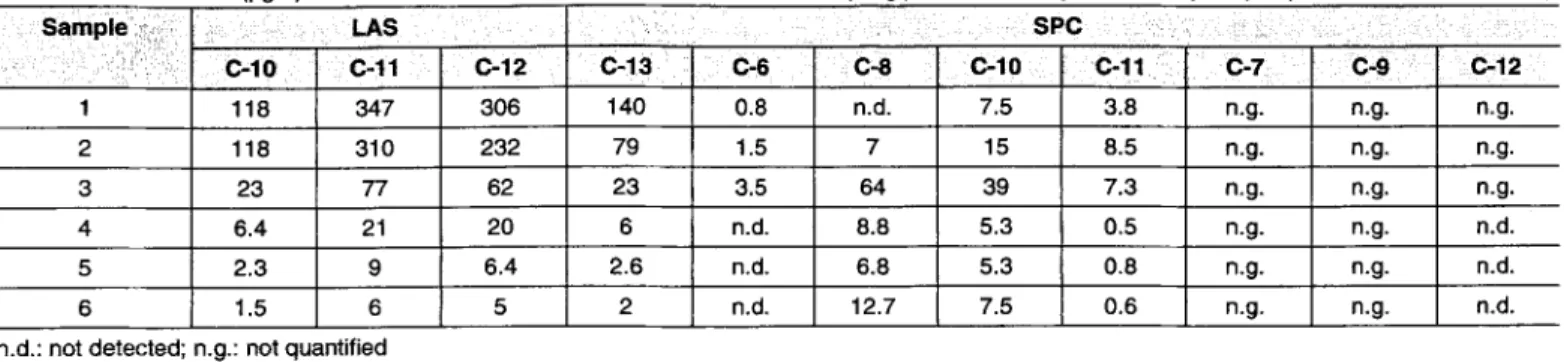
Environmental distribution. Since LAS and the degradation intermediate sulphophenyl carbonylate (SPC) are the pre- dominant surfactants continuously discharged to the recipi- ents (Table 2), it is not surprising that rivers are commonly contaminated in highly varying concentrations as shown by a survey on German rivers with LAS concentrations of 1- 1,400 lag/L. Transport of LAS occurs with about 90% in the aqueous phase and 10% attached at suspended particles (Hellmann 1995). Therefore, LAS content in river sediments, resulting from suspended particles, is usually not higher than 10% of the LAS content in the aqueous phase. LAS pollu- tion in the same range with highest values of 135 pg/L was measured in the Lao-Jie River in Taiwan. This is a typical Eastern-Asian river, with less than 5% of all discharged municipal wastewater treated by wastewater treatment plants so that large quantities of the surfactant residues in the wastewater are discharged directly into the river and ocean (Ding et al. 1999). LAS pollution is not a specific feature of freshwater, but also accounts for marine ecosys- tems. Studies in the Bay of Cadiz, Spain, have shown a re- lated level of pollution by the common LAS and SPC homo- logues (Table 3) up to 447 p g / L (LAS C-11) and 64 pg/L (SPC C-8), respectively (Riu et al. 1999). Since LAS is not Table 2: Concentration ranges of selected surfactants in municipal wastewater passing wastewater treatment plants partly receiving run-off from textile industry (adapted from www.Dfistine-wwc.de)
Compound I In fluent I E f f l u e n t
[pg/Ll [PgJLI
Behaviour of selected surfactants in municipal wastewater passing wastewater treatment plants
Linear alkyl benzenesulphonates 1,100 160
Sulphophenyl carboxylates (e.g. C-5) <10-280 <10-74
Alkyl mono glucosides 8 <0.1
Alkyl glucamides 60 <0.1
C4-glucamide acid ? ?
Nonylphenol ethoxylates 2.1-170 <0.05-6.1
Nonylphenol ethoxy carboxylates ? ?
Nonylphenol <0.05-23 <0.05-1.0
Different LAS hemologues in waste water treatment plants at Porto, Portugal, receiving textile wastewater
Nonylphenol ethoxylate (C-10) 32.3 90.8
Nonylphenol ethoxylate (C-11) 136 147
Nonylphenol ethoxylate (C-12) 88.6 30.8
Nonylphenol ethoxylate (C-13) 32.5 3.9
Nonylphenol ethoxylates (C-10 through C-13) sum 289.4 272.5
Table 3: Concentrations (pg/L) of LAS and SPC found in samples from different sampling points in the Bay of Cadiz, Spain (adapted from RIU et al. 1999) 1 118 2 118 3 23 4 6.4 5 2.3 6 1.5 n.d.: not detected: 347 310 77 21 9 6 n.g.: not quantified 306 140 232 79 62 23 20 6 6.4 2.6 5 2 0.8 n.d. 7.5 1.5 7 15 3.5 64 39 n.d. 8.8 5.3 n.d. 6.8 5.3 n.d, 12.7 7.5 3.8 n.g. n.g. n.g. 8.5 n.g. n.g. n.g. 7.3 n.g. n.g. n.g. 0.5 n.g. n.g. n.d. 0.8 n.g. n.g. n.d. 0.6 n.g. n.g. n.d.
degraded sufficiently in anaerobic sewage sludge digesters (De Wolf and Feijtel 1998, Krueger et al. 1998b), significant amounts of surfactants are applied to agro-ecosystems when that sludge is used for fertiliser in agriculture.
Degradation - Microbial degradation of LAS via sulphophenyl carboxylates (SPC) is the main decontamination process in aqueous solution, sludge, and soil (Fig. 2). Terminal (o-oxi- dation of the side-chain is the initiating reaction. Then a step by step shortening of the side-chain by [5-oxidation fol- lows before the final mineralization to CO2, H20, and
SO42-
occurs by ring cleavage, desulphonation, and oxidation (Hrsak and Grbic-Galic 1995, Denger and Cook 1997, Cook et al. 1999, Perales et al. 1999b, Schleheck et al. 2000, Schulz et al. 2000), with specific contributions of bacterial biofilm aggregations under experimental as well as environmental conditions (Boeije et al. 2000). Environmental parameters (e.g., temperature, pH, redox potential) modulate the bio- degradation process, but do not substantially alter it (Perales et al. 1999a). From the degradation of such mixtures of LAS homologues and isomers, a large set of intermediates can be expected. That makes it extremely difficult to determine their levels in aqueous habitats, sediments, sewage, and sludge- fertilized soil contaminated with surfactants and their me- tabolites, and to correlate the various surfactants with their toxicity and environmental impact.
2.3 R e m e d i a t i o n possibilities
As LAS is used as a detergent agent, it mainly enters the environment via industrial and domestic sewage (Krueger et al. 1998b). Significant quantities of LAS co-products, like dialkyhetralin sulphonates and LAS with single methyl branching on the alkyl chains (iso-LAS), can be found in sewage too (Nielsen et al. 1997). The removal and degrada- tion of LAS and co-products already start when entering the sewer system (Moreno et al. 1990, Holt et al. 1998). The sewer lines contribute up to 60% to the removal and are an effective first step in urban effluent treatment: the biodegra- dation is influenced by the length of the sewer lines and the conditions of aeration. At present, the most effective meth- ods for the remediation of sewage contaminated by LAS are municipal and industrial wastewater treatment plants based on aeration/settling, activated sludge/aerobic digestion of sludge, or activated sludge/anaerobic digestion of sludge (Berna et al. 1989). LAS and co-products entering the treat-
ment plants through the sewage influents are degraded up to 99.7% of the influent concentrations (Berna et al. 1989,
Field et al. 1992, Nielsen et al. 1997, Waters et al. 2000), with half-lives in the range of 1-2 days for activated sludge (Krueger et al. 1998b). LAS and most of the co-products undergo extensive mineralization (>50 %) and ultimate bio- degradation (80-90% mineralization plus conversion to bio- mass), but release some (10-20%) of their carbons as wa- ter-soluble intermediates (Nielsen et al. 1997). When sewage farms or trickling filters are used to clean-up sewage, LAS removal was reported for 80 to 89% of the influent concen- trations (Rapaport and Eckhoff 1990, Boeije et al. 2000}. However, LAS is persistent in oxygen-depleted groundwa- ter and sewage-contaminated groundwater (Barber et al.
1995, Krueger et al. 1998b), as well as in anaerobic sewage sludge digesters (De Wolf and Feijtel 1998, Krueger et al. 1998b). Especially in Europe and N o r t h America, large amounts of sewage sludge are applied to agricultural fields for fertilization. The concentrations of LAS reported in anaerobic digested sludge are 1 to 2 orders of magnitude greater than those observed for aerobically digested sludge (McAvoy and Eckhoff 1993). Despite the fact that LAS in anaerobic digested sludge can be removed to nearly 100% by composting with an average half-life between 7 and 9 days (Prats-Rico et al.
1999), large-scale application of sewage sludge and waste- water effluents to soil has led to concerns about the poten- tial a c c u m u l a t i o n of surfactants in soil e n v i r o n m e n t s (Kloepper-Sams et al. 1996, Nielsen et al. 1997). Although the use of LAS in surfactant-enhanced remediation of sewage- contaminated and ex situ soil washing is of recent interest (Deshpande et al. 1998, Krueger et al. 1998 a and b, Goudar et al. 1999), the presence of LAS and co-products in the agro-ecosystem is of particular concern because they can be transferred to humans via agricultural products or by leach- ing to groundwater (Laturnus et al. 1999). Thus, biodegra- dation should be an important process for removing surfac- tant residues from the terrestrial environment.
In the soil, bacteria are involved in the biodegradation of LAS and co-products (Branner et al. 1999). Surfactants like LAS can alter subsurface microbial populations by increas- ing the abundance of free-living bacteria (Barber et al. 1995).
In the marine environment, LAS mineralization is carried out by bacterial associations rather than by single organ- isms (Vives-Rego et al. 2000). However, the sorption of LAS
Phytoremediation
Sulphonated Aromatic Pollutants
to sludge solids and soil components reduce the bioavail- ability to terrestrial organisms (Kloepper-Sams et al. 1996). Furthermore, seasonal variations apparently have an influ- ence on the degradation of LAS by micro-organisms in soil and water, as higher microbial activity occurred during sum- mer (KnaebeI et al. 1990, Takada et al. 1992). For example, in a small wetland of 474 m 2, the natural purification of LAS was assessed (Inaba 1992). The study involved adsorp- tion on sediment particles and bacterial degradation in the wetland, and showed that biodegradation but not adsorp- tion was affected by temperature as no degradation occurred in winter. During a one-year study of the degradation of LAS in sewage sludge-treated soil, a very fast decrease in concentration (> 80 % ) was observed within the first month. A removal of up to 96% was also observed by a passage of LAS contaminated water through a two-chamber constructed wetland with tropical/subtropical vegetation (Grosse et al. i 999). A significant shift of soil bacteria to gamma and delta Proteobacteria sub-classes, as well as a significant increase of Planctomycetes in the root zone areas after LAS applica- tion could be detected by whole cell hybridization techniques using Cy3-1abeled rRNA-targeted oligonucleotide probes specific for different taxonomic levels (Roisch et al., sub- mitted for publication).
However, in sludge-treated soil and landfills, a residual LAS concentration remains even after 320 days (Marcomini et al. 1989). The use of plants may increase the availability of sorbed LAS to terrestrial organisms, and, therefore, phyto- remediation may be a suitable tool to degrade the part of the LAS, which could not be removed in wastewater treat- ment plants. It has been shown in greenhouse experiments that the growth of crops like barley and carrots can reduce LAS added to the soil by sewage sludge (Laturnus et al. 1999, G r i n et al. 2000). The increased degradation is probably due to enhanced soil aeration, and, therefore, stimulated microbial activity induced by the root growth. The addi- tional aeration of the soil may also support the aerobic deg- radation of LAS. However, when high sludge doses are trans- ferred to the soil, the degradation may be hindered, as LAS present in the sludge particles may not be available for bio- degradation (Gren et al. 2000). The greenhouse studies showed that there is no uptake of LAS to the green parts of the crops used, and only negligible concentration are found in the plant roots (Grin et al. 2000). Apparently, most of the LAS are degraded and the degradation products released into the atmosphere, as studies with radio-labelled LAS showed (Figge and Schoberl 1989). At present, the general theme is that LAS does not pose a risk to terrestrial organ- isms such as plants and invertebrates (De Wolf and Feijtel 1998), and that LAS are biodegraded and have no effect on the growth of crops when applied to soil by sewage sludge (Gilbert and Kleiser 1988, Laturnus et al. 1999, Grin et al. 2000). However, the addition of LAS has a suppressive ef- fect on the elongation of the rice plant, inhibits water ab- sorption by the roots, and affects photosynthesis, as leafs turn yellow after treatment (Taniyama 1978). For crops grown in soils treated with LAS containing sewage sludge,
no such effect has been observed. When sewage sludge is applied to soil for the purpose of discharge, the growth of plants would support and increase the degradation of LAS add.ed with the sludge.
3 Outlook
It is a prerequisite that plants used in any phytoremediation or rhizofiltration process are resistant/tolerant to the pol- lutants to be removed. Sulphonated aromatic pollutants are not detrimental to isolated rhubarb cells cultured in vitro. Whole rhubarb plants can also germinate, grow and de- velop in the presence of significant amounts of such xenobiotics, comparable to those found in industrial efflu- ents: plant material is thus screened against several sulpho- nated aromatic pollutants, chosen to represent contaminants of current concern, having a range of physico-chemical prop- erties (solubility, Kow), thesecharacteristics being signifi- cant for the breakdown process. Not only rhubarb, but also other plants producing anthraquinones, like R u m e x and
Rubia, should be tested. As a comparison, non-producing anthraquinones plants, like celery and aquatic plants, will be grown in the presence of different sulphonoaromatics. Plants selected for their tolerance have then to be tested for growth under hydroponic conditions and for their ability to remove sulphonoaromatics from contaminated water. If the pollutant under investigation disappears from the liq- uid medium, then its possible adsorption, accumulation and/ or decomposition by the plant should be estimated, and the possible role of micro-organisms associated with roots evaluated. The accumulation of the parent compounds and/ or metabolites possibly derived from them should be deter- mined by extraction of different parts of the plants and appropriate analyses. The rates and yields of pollutant re- moval calculated per unit biomass should be used as one of the technological criteria to choose the most appropriate plant species for the treatment of effluents from the dye and textile industry.
Although LAS and their known degradation intermediates seem to be the less serious compounds among surfactants, some environmental risks may still exist. This should arise for the environment from LAS and SPC residues accumu- lated to higher concentrations by absorption under specific soil and sediment conditions. Acute and chronic health ef- fects may be expected in mammals and humans, when LAS together with other xenobiotics come into contact with the skin or are accumulating in their organs. Problems are pos- tulated, for example, for workers handling pesticides inap- propriately, due to contaminated clothing that has been laun- dered and residues of xenobiotics and LAS commonly used for washing clothes, remain on the fabrics and together come into contact with the skin.
The observed toxicity, especially on marine algae, may in- duce shifts in the algae populations with unfavourable im- pact on the food chain in the marine ecosystems. No infor- mation is presently available on the impact of LAS and
derivatives on the m i c r o - l o o p , as a m o s t i m p o r t a n t p a r t o f the food chain. Such effects should be expected f r o m the observed shift in bacterial p o p u l a t i o n s following LAS ap- plication to constructed wetlands, but also f r o m the ob- served sensibility of some planktonic protozoans. Although, well operated w a s t e w a t e r t r e a t m e n t plants are reducing the LAS contents in treated sewage below environmentally risky concentrations on a global scale, the high discharge of un- treated sewage effluents with high surfactant contents are still polluting river w a t e r and the oceans, which m a y be of some hazard to susceptible ecosystems. Therefore, the treat- m e n t of sewage effluents should be i m p r o v e d w o r l d w i d e for reducing the e n v i r o n m e n t a l pollution, and higher plant- based a p p r o a c h e s are p r o m i s i n g for such a purpose.
References
Angelino S, Bianco Prevot C, Gennaro MC, Pramauro E (1999): Ion-interaction high-performance liquid chromatography and micellar electrokinetic capillary chromatography: two comple- mentary techniques for the separation of aromatic sulfonated compounds. Journal of Chromatography A845, 257-271 Banat I, Nigam P, Singh D, Marchant R (1996): Microbial decol-
orization of textile-dye-containing effluents: a review. Biore- source Technology 58,217-227
Barber LB, Krueger CJ, Metge DW, Harvey RW, Field JA (1995): Fate of LAS in groundwater - Implication for in situ surfactant enhanced remediation. ACS Symposium Series 595, 95-111 Berna JL, Ferrer J, Moreno A, Prats D, Ruiz Bevia F (1989): The
fate of LAS in the environment. Tenside, Surfactants, Detergents 26, 101-107
Biddlestone AJ, Gray KR, Thurairajan K (1991): A botanical ap- proach to the treatment of wastewaters. Journal of Biotechnol- ogy 17, 209-220
Boeije GM, Schowanek DR, Diederik R, Vanrolleghem PA (2000): Incorporation of biofilm activity in river biodegradation mod- elling: a case study for linear alkylbenzene sulphonate (LAS). Water Research 34, 1479-1486
Branner U, Mygind M, Jorgensen C (1999): Degradation of linear alkylbenzene sulfonate in soil columns. Environmental and Toxi- cological Chemistry 18, 1772-1778
Cavalli L, Valtorta L (1999): Surfactants in sludge-amended soil. Tenside, Surfactants, Detergents 36, 22-28
Contzen M, Wittich RM, Knackmuss HJ, Stolz A (1996): Degra- dation of benzene 1,3-disulfonate by a mixed bacterial culture. FEMS Microbiology Letters 136, 45-50
Cook AM, Laue H, Junker F (1999): Microbial desulfonation. FEMS Microbiology Reviews 22, 399-419
Dangmann E, Stolz A, Kuhm AE, Hammer A, Feigel B, Noisommit- Rizzi N, Rizzi M, Reuss M, Knackmuss HJ (1996): Degrada- tion of 4-aminobenzenesulfonate by a two-species bacterial co- culture. Biodegradation 7, 223-229
Davies TH, Cottingham PD (1994): The use of constructed wet- lands for treating industrial effluents (textile dyes). Water Sci- ence and Technology 29 (4) 227-232
Dec J, Bollag JM (1994): Use of plant material for the decontami- nation of water polluted with phenols. Biotechnology and Bioengineering 44, 1132-1139
Denger K, Cook AM (1997): Assimilation of sulphur from alkyl- and arylsulfonates by Clostridium spp. Archives of Microbiol- ogy 167, 177-181
Deshpande S, Shiau BJ, Wade D, Sabatini DA, Harwell JH (1998): Surfactant selection for enhancing ex situ soil washing. Water Research 33, 351-360
DeWolf W, Feijtel T (1998): Terrestrial risk assessment for linear alkylbenzenesulfonates (LAS) in sludge-amended soils. Chemo- sphere 36, 1319-1343
Ding WH, Tzing SH, Lo JH (1999): Occurrence and concentra- tions of aromatic surfactants and their degradation products in river water of Taiwan. Chemosphere 38, 2597-2606
Ding WH, Farm JC (2000): Determination of linear alkylbenzenesul- fonates in sediments using pressurized liquid extraction and ion- pair derivatization gas chromatography-mass spectrometry. Analytica Chimica Acta 408, 291-297
Duc R, Vanek T, Soudek P, Schwitzgu~bel JP (1999a): Experimen- tation with Rhubarb in Europe. Soil and Groundwater Cleanup. February/March, 27-30
Duc R, Vanek T, Soudek P, Schwitzgu~bel JP (1999b): Accumula- tion and transformation of sulfonated aromatic compounds by rhubarb cells (Rheum palmatum). International Journal of Phytoremediation 1, 255-271
Fernandez N, Chacin E, Garcia C, Alastre N, Leal F, Forster CF (1996): The use of seed pods from Albizia lebbek for the re- moval of alkyl benzene sulphonates from aqueous solution. Pro- cess Biochemistry 31,383-387
Ferret J, Moreno A, Vaquero MT, Comellas L (1996): Monitoring of LAS in direct discharge situations - Untreated sewage and on sludge amended soils. In: Proceedings of 4th World Surfactants Congress, Asociacion Espanola de Productores de Sustancias papa Aplicaciones Tensiosctivas, Barcelona, Vol 3, pp 99-112 Field JA, Barber LB, Thurman EM, Moore BL, Lawrence DL, Peake
DA (1992): Fate of alkylbenzenesulfonates and dialkyhetralin- sulfonates in sewage-contaminated groundwater. Environmen- tal Science and Technology 26, 1140-1148
Figge K, Schoberl P (1989): LAS and the application of sewage sludge in agriculture. Tenside, Surfactants, Detergents 26, 122-128 Fox KK, Chapman L, Solbe J, Brennand V (1997): Effect of envi-
ronmentally relevant concentrations of surfactants on the des- orption or biodegradation of model contaminants in soil. Tenside, Surfactants, Detergents 34, 436-441
Furukawa K, Fujita M (1993): Advanced treatment and food pro- duction by hydroponic type wastewater treatment plant. Water Science and Technology 28 (2) 219-228
Gilbert PA: Kleiser H H ( 1988): Assessing the environmental safety of LAS. Tenside, Surfactants, Detergents 25, 128-133
Goudar C, Strevett K, Grego J (1999): Competitive substrate bio- degradation during surfactant-enhanced remediation. Journal of Environmental Engineering 125, 1142-1148
Granados J (1996): Surfactants raw materials. Constant evolution and a solid future. In: Proceedings of 4th World Surfactants Con- gress, Asociacion Espanola de Productores de Sustancias papa Aplicaciones Tensiosctivas, Barcelona, pp 100-123
Greim H, Ahlers J, Bias R, Broecker B, Hollander H, Gelbke H, Klimisch H, Mangelsdorf I, Paetz A, Sch6n N, Stropp G, Vogel R, Weber C, Ziegler-Skylakakis K, Bayer E (1994): Toxicity and ecotoxicity of sulfonic acids. Structure activity relationship. Chemosphere 28, 2203-2236
Grin C, Laturnus F, Mortensen GK, Egsgaard H, Samso-Petersen L, Ambus P, Jensen ES (2000): Plant uptake of LAS and DEHP from sludge-amended soil. In: Persistent Bioaccumulative Toxic Chemicals: Fate and Exposure. Eds Lipnick R, Muir D, Hermens J. ACS Symposium Series 772, pp 99-111
Grosse W, Wissing F, Perfler R, Wu Z, Chang J, Lei Z (1999): Bio- technological approach to water quality improvement in tropical
Phytoremediation
Sulphonated Aromatic Pollutants
and subtropical areas for reuse and rehabilitation of aquatic eco- systems. Consohdated final report. Project N ~ ERBIC18CT960059 in Biotechnology of INCO-DC of the 4th Framework Programme of the European Commission, Brussels
Hampel M, Ortiz JB, Sarasquete C, Blasco J (2000a): Effects of homologues of linear alkylbenzene sulphonates (LAS CI0 to C14) on survival of embryos and larvae of seabream (Sparus aurata). In Proceedings of 5th World Surfactants Congress, pp 1617-1626
Hampel M, Sobrino C, Lubian LM, Blasco J (2000b): Acute toxic- ity of LAS homologues in marine microalgae. Esterase activity and inhibition of growth as endpoints of toxicity. In: Proceed- ings of 5th World Surfactants Congress, pp 1627-1636 Harms I-IH (1992): In vitro systems for studying phytotoxicity and
metabolic fate of pesticides and xenobiotics in plants. Pesticides Science 35,277-281
Hellmann H ( 1995): Belastung yon Fliet~gew~issern mit Tensiden - Analytik und Ergebnisse. In: Handbuch Angewandte Limnologie V.2.3. Eds Steinberg C, Bernhardt H, Klapper H. ecomed ver- lagsgesellschaft, Landsberg, Germany
Henkel & Cie (Ed), (1976): Waschmittelindustrie. 1. Edition, Hiithig-Verlag, Heidelberg, Germany
Holt MS, Fox KK, Burford M, Daniel M, Buckland H (1998): UK monitoring study on the removal of linear alkylbenzene sulfonate in trickling filter type sewage treatment plants. Science of Total Environment 210/211,255-269
Hrsak D, Grgic-Galic D (1995): Biodegradation of linar alkylbenzene sulphonates (LAS) by mixed methanotrophic-heterotrophic cul- tures. Journal of Applied Bacteriology 78, 487-494
Hughes JB, Shanks J, Vanderford M, Lauritzen J, Bhadra R (1997): Transformation of TNT by aquatic plants and plant tissue cul- tures. Environmental Science and Technology 31, 266-271 Inaba K (1992): Quantitative assessment of natural purification in
wetland for linear alkylbenzenesulfonates. Water Research 26, 893-898
Jorgensen E, Christoffersen K (2000): Short-term effects of linear alkylbenzene sulfonate on freshwater plankton studied under field conditions. Environmental Toxicology and Chemistry 19, 904-911
Kertesz MA, Cook AM, Leisinger T (1994): Microbial metabolism of sulfur- and phosphorus-containing xenobiotics. FEMS Mi- crobiological Reviews 15, 195-215
Khlebnikov A, Zhoukov V, P6rmger P (1997): Comparison of p-tolu- enesulphonic acid degradation by two Comamonas strains. Bio- technology Letters 19, 389-393
Kloepper-Sams P, Toffs F, Feijtel T, Gooch J (1996): Effects assess- ment for surfactants in sludge-amended soils - A literature re- view and perspectives for terrestrial risk assessment. Science of Total Environment 185, 171-185
Knaebel DB, Federle TW, Vestal JR (1990): Mineralization of LAS and linear alcohol ethoxylate in 11 contrasting sites. Environ- mental and Toxicological Chemistry 9, 981-988
Knepper TP, Kruse M (2000): Investigations on the formation of sulfophenylcarboxylic acids (SPC) out of linear alkylbenzene- sulfonates (LAS) by means of liquid chromatography/mass spec- trometry. Tenside, Surfactants, Detergents 37, 41--47
Krueger CJ, Barber LB, Merge DW, Field JA (1998a): Fate and transport of linear alkylbenzenesulfonate in a sewage-contami- nated aquifer - A comparison of natural-gradient pulsed tracer tests. Environmental Science and Technology 32, 1134-1142 Krueger CJ, Radakovich KM, Sawyer TE, Barber LB, Smith RL,
Field JA (1998b): Biodegradation of the surfactant linear alkylbenzenesulfonate in sewage-contaminated groundwater -
A comparison of column experiments and field tracer test. En- vironmental Science and Technology 32, 3954-3961
Kuhm AE, Stolz A, Ngai KL, Knackmuss HJ (1991): Purification and characterization ofa 1,2-dihydroxynaphthalene dioxygenase from a bacterium that degrades naphthalenesulfonic acids. Jour- nal of Bacteriology 173, 3795-3802
Laturnus F, Gran C, Mortensen GK, Ambus P, Bennetzen S, Jensen ES (1999): Degradation of organic contaminants in sludge- amended agricultural soil. In: Proceedings of 5 th International In Situ and On-Site Bioremediation Symposium. Eds Leeson A, Alleman BC. Battelle Press, Columbus, Vol 6, pp 15-20 Li HQ, Schroeder HF (2000): Surfactants - Standard determination
methods in comparison with substance specific mass spectromet- ric methods and toxicity testing by Daphnia magna and Vibrio fischeri. Water Science and Technology 42 (7-8) 391-398 Low KS, Lee CK, Tan KK (1995): Biosorption of basic dyes by
water hyacinth roots. Bioresource Technology 52, 79-83 Malz F (1980): Der Hauptausschut~ Detergentien - Modell zur
L6sung yon Umweltproblemen. Tenside, Surfactants, Detergents 17, 314-318
Marcomini A, Capel PD, Lichtensteiger T, Brunner PH, Giger W (1989): Behavior of aromatic surfactants and PCBs in sludge- treated soil and landfills. Journal of Environmental Quality 18, 523-528
McAvoy DC, Eckhoff WS (1993): Fate of linear alkylbenzene sul- fonate in the environment. Environmental Toxicology and Chem- istry 12, 977-987
Medina VF, Larson SL, Bergstedt AE, McCutcheon SC (2000): Phyto-removal of trinitrotoluene from water with batch kinetic studies. Water Research 34, 2713-2722
Moreno A (2000): Status report 4 of Pristine - ENV4-CT97-0494 Moreno A, De Ferret J, Berna JL (i990): Biodegradability of linear alkybenzenesulfonate in a sewer system. Tenside, Surfactants, Detergents 27, 312-315
Muralikrishna C, Renganathan V (1993): Peroxidase-catalyzed desulfonation of 3,5-dimethyl-4-hydroxy and 3,5-dimethyl-4- aminobenzenesulfonic acids. Biochemical and Biophysical Re- search Communications 197, 798-804
Navas J, Gonz~iles-Mazo E, Wenzel A, Gomez-Parra A, Segner H (1999): Linear alkylbenzene sulfonates and intermediate prod- ucts from their degradation are not estrogenic. Marine Pollu- tion Bulletin 38, 880-884
Nielsen AM, Britton LN, Beall CE, McCormick TP, Russell GL (1997): Biodegradation of coproducts of commercial linear alkyl- benzene sulfonates. Environmental Science and Technology 31, 3397-3404
Nigam P, Armour G, Banat IM, Singh D, Marchant R (2000): Physi- cal removal of textile dyes from effluents and solid-state fer- mentation of dye-adsorbed agricultural residues. Bioresource Technology 72, 219-226
Nomura Y, Ikebuburo K, Yokoyama K, Takeuchi T, Arikawa Y, Karube I (1998): Application of a linear alkylbenzene sulfonate biosensor to river water monitoring. Biosensors and Bioelec- tronics 13, 1047-1053
N6rtemann B, Kuhm AE, Knackmuss HJ, Stolz A (1994): Conver- sion of substituted naphthalenesulfonates by Pseudornonas sp. BN6. Archives of Microbiology 161, 320-327
Ohe T, Ohmoto T, Kobayashi Y, Sato A, Watanabe Y (1990): Me- tabolism of naphthalenesulfonic acids by Pseudomonas sp. TA- 2. Agricultural and Biological Chemistry 54, 669-675 Perales JA, Manzana MA, Sales D, Quiroga JM (1999a): Linear
alkylbenzene sulphonates: biodegradability and isomeric com-
position. Bulletin of Environmental Contamination and Toxi- cology 63, 94-100
Perales JA, Manzana MA, Sales D, Quiroga JM (1999b): Biodeg- radation kinetics of LAS in river water. International Biode- terioration and Biodegradation 43, 155-160
Prats-Rico D, Rodriguez Pastor M, De la Muela Chasco MA, Lla- mas Torregrosa J M, Moreno Davila A, De Ferrer Daroca J, Berna Tejero JL (1999): Elimination of xenobiotics during corn- posting - A case study of LAS. Tenside, Surfactants, Detergents 36,294-298
Rapaport RA, Eckhoff WS (1990): Monitoring linear alkyl ben- zene sulfate in the environment 1973-1986. Environmental Toxi- cology and Chemistry 9, 1245-1257
Riediker S, Suter MJF, Giger W (2000): Benzene and naphthalene- sulfonates in leachates and plumes of landfills. Water Research 34, 2069-2079
Riu J, Gonzfiles-Mazo E, Gomez-Parra A, Barcel6 D (1999): De- termination of parts per trillion level of carboxylic degradation products of linear alkylbenzenesulfonates in coastal water by solid-phase extraction followed by liquid chromatography/ion spray/mass spectrometry using negative ion detection. Chromato- graphia 50, 275-281
Riu J, Eichhorn P, Guerro JA, Knepper TP, Barcel6 D (2000): De- termination of linear alkylbenzenesulfonates in wastewater by automated solid phase extraction followed by capillary electro- phoresis-UV and confirmation by capillary electrophoresis-mass spectrometry. Journal of Chromatography A889, 221-229 Robinson T, McMullan G, Marchant R, Nigam P (2001): Reme-
diation of dyes in textile effluent: a critical review on current treatment technologies with a proposed alternative. Bioresource Technology 77, 247-255
Roisch U, Schroeder L, Grosse W (2001, submitted): Dynamics of plant-root-soil bacteria-associations in constructed wetlands caused by linear alkylbenzenesulphonates (LAS). Ecological Engineering
Ruff J, Hitzler T, Rein U, Ritter A, Cook AM (1999): Bioavailability of water-polluting sulfonoaromatic compounds. Applied Micro- biology and Biotechnology 52, 446-450
Salt DE, Smith RD, Raskin I (1998): Phytoremediation. Annual Review of Plant Physiology and Plant Molecular Biology 49, 643-668
Sarrazin L, Arnoux A, Rebouillon P (1997): High-performance liq- uid chromatographic analysis of a linear alkylbenzenesulfonate and its environmental biodegradation metabolites. Journal of Chromatography A 31,285-291
Schleheck D, Dong W, Denger K, Heinzle E, Cook AM (2000): An alpha-proteobacterium converts linear alkylbenzenesulfonate sur- factants into sulfophenylcarboxylates and linear alkyldiphenyl- etherdisulfonate surfactants into sulfodiphenylethercarboxylates. Applied and Environmental Microbiology 66, 1911-1916 Schulz S, Dong W, Groth U, Cook AM (2000): Enantiomeric deg-
radation of 2-(4-Sulfophenyl)Butyrate via 4-sulfocatechol in Delftia acidovorans SPB1. Applied and Environmental Micro- biology 66, 1905-1910
Schwitzgu6bel JP, Vanek T, Mathieu N, Thirot JL, Novotny M (1995): Biotransformation of sulfonated xenobiotic compounds by plant cells. In: Biosorption and Bioremediation. Ed Macek T et al., Prague, pp L 2-10
Schwitzgu6bel JP (1996): Biodegradation of xenobiotics by plants. In: Kurzfassungen der DECHEMA-Jahrestagungen '96, Band I, DECHEMA, Frankfurt am Main, pp 442-443
Schwitzgu~bel JP, Thirot JL, Mathieu N, Novotny M, Vanek T (1996): Biotransformation of sulfonated aromatic compounds by plant cells. Experientia 52, A22
Schwitzgu4bel JP (1998): From plant cells to phytoremediation. In: Biotec'98 - Book of abstracts. Eds Mota M, Ferreira EC. Braga, ISBN 972-97810-0-1, p 8
Schwitzgu6bel JP, Duc R, Vanek T (1998): Development of a bio- logical process to treat industrial effluents and by-products using plant cells. In: Abstracts of Third Annual International Confer- ence on Phytoremediation, June 22-25, Houston, TX, USA, p 10 Seignez C, Adler N, Suard JC, P6ringer P (1996): aerobic and anaero- bic biodegradability of 1-anthraquinone sulphonate. Applied Mi- crobiology and Biotechnology 45,719-722
Siciliano SD, Germida JJ (1998): Mechanisms of phytoremediation: biochemical and ecological interactions between plants and bac- teria. Environmental Review 6, 65-79
Stache H, Grossmann H (1985): Waschmittel, 1. Edition, Springer Verlag, Berlin, Germany
Stache H, Kosswig K (1990): Tensid-Taschenbuch. 1. Auflage, Han- sen-Verlag, M6nchen, Germany
Takada H, Ogura N, Ishiwatari R (1992): Seasonal variations and modes of riverine input of organic pollutants to the coastal zone - 1.Flux of detergent-derived pollutants to Tokyo Bay. Environ- mental Science and Technology 26, 2517-2523
Taniyama T (1978): Effects of various synthetic detergents on pho- tosynthesis, dry matter and grain production in rice plants. Mie Daigaku Kankyo Kagaku Kenkyu Kiyo 3, 93-104 (in Japanese) Trease GE, Evans WC (1983): Phenols and phenolic glycosides. In: Pharmacognosy, 12th edition, Bailli~re Tindall, London, pp 368-414
Van den Berg AJJ, Labadie RP (1989): Quinones. In: Methods in Plant Biochemistry, Volume 1, Plant Phenolics. Ed Harborne JB. Academic Press, London, pp 451-491
Vanek T, Soudek P, Hubalek M, Schwitzgu~bel JP, Duc R (1998): Plant cell cultures as a model system for phytoremediation. In: Proceedings of International Workshop on Innovative Potential of Advanced Biological Systems for Remediation. Ed Timmis KW. Hamburg, p 193
Vives-Rego; J, Lopez-Amoros R, Guindulain T, Garcia MT, Comas J, Sanchez-Leal J (2000): Microbial aspects of linear alkylbenzene sulfonate degradation in coastal water. Journal of Surfactants and Detergents 3,303-308
Waters J, Lee KS, Perchard V, Flanagan M, Clarke P (2000): Moni- toring of diester surfactant residues in UK and Dutch sewage treat- ment effluents. Tenside, Surfactants, Detergents 37, 161-171 Willetts J, Ashbolt N (2000): Understanding anaerobic decolourisa-
tion of textile dye wastewater: mechanism and kinetics. Water Science and Technology 42 (1-2), 409-415
Wong Y and Yu J (1999): Laccase-catalyzed decolorization of syn- thetic dyes. Water Research 33, 3512-3520
Yang Y, Wyatt DT, Bahorsky M (1998): Decolorization of dyes using UV/H202 photochemical oxidation. Textile Chemist and Colorist 30 (4) 27-35
Young L, Yu J (1997): Ligninase-catalysed decolorization of syn- thetic dyes. Water Research 31, 1187-119
Received: February 14th, 2001 Accepted: November 15th, 2001 OnlineFirst: December 17th, 2001