The People’s Democratic Republic of Algeria
Ministry of Higher Education and Scientific Research
University of Mostaganem Abdel Hamid Ben Badis
Faculty of Letters and Arts
English Department
A Dissertation Submitted for the Fulfillment of the Requirements for the Master Degree in Language and communication
Option:
Submitted by: BENHADDA Mohamed El Amine
Under the Supervsion of :Dr. SARNOU Dallel
Chairperson: Mrs. BEKRI
Examiner: Dr. SARNOU Hanane
The Impact of using EnglishPodcasting on enhancing
EFL learners pronunciation
I
D
EDICATIONSTo my parents, brothers, friends, and classmates…
To all my teachers …
II
Acknowledgments
My first, and most earnest, expression of gratitude and thankfulness go to my supervisor and advisor,
Dr
. SARNOU Dallel
for her consistent availability, willingness to listen, to guide and support, whose useful discussions and scholarly notes have developed and reshaped my reflection and understanding, and, above all, for being patient and for being the ideal source of inspiration and motivation.I thank the board of examiners Dr. SARNOU Hanane and Mrs. Bekri for having accepted to read my work and being part of my committee.
I also wish to thank the host teachers and students for helping me out complete this work. Where they all exchanged their own interesting ideas, thoughts and made it possible to complete my study with all accurate information
III
Abstract
This study investigates the use of English podcasts as a pedagogical tool in teaching English to ameliorate students’ pronunciation. Chiefly, the headmost objectives of the research are to unveil the extent of podcasts’ use by teachers as well as students, the difficulties that the students may face while using podcasts as a learning method, the teachers’ and students’ attitudes towards integrating English podcasts as a pedagogical tool. To that end, the study is done by means of two research tools namely, a questionnaire addressed to L3 students of English, and an interview held with the teachers of English, both at Abdelhamid Ibn Badis University. Moreover, a case study consisting of 25 students and 5 teachers participated in the data collection process. The results revealed that podcasts use as a learning method is well spread amongst students; however, new considerations have to be taken into consideration while using it in the academic context. Conjointly, evidence is found for the use of podcasts in the teaching/learning process has a positive impact in ameliorating students’ speaking skills in general and pronunciation in particular.
IV
List of Figures
Figure 01 : Podcasts Logos Captured from Google pictures………...……….……05
Figure 02: Students’ Age………..…15
Figure 03: Students’ Gender ………15
Figure 04: The Extent of Podcasts’ Use in the Classroom………...16
Figure 05: The Teachers’ Use of Podcasts ………16
Figure 06: The Students’ Own Evaluation of their Speaking Skills ………16
Figure 07: The students’ Attitudes towards the Usefulness of Podcasts……….……17
Figure 08: The Existence of Podcasts’ Positive Impact on the Students Users………18
Figure 09: Students’ Engagement in Speaking Practice………...………18
Figure 10: Podcasts’ Integration by Teachers ………..………20
Figure 11: The Times of Podcasts Use by Teachers……….……21
Figure 12: Sources of Podcasts Used by Teachers………...…21
Figure 13: The Ways of Podcasts’ Integration……….21
V
List of Tables
VI Table of Contents Dedications ... I Acknowledgements... II Abstract ... III List of Figures………;;………...IV List of Tables………;;………..………V General Introduction………;…………..………1
I.Chapter One: THEORITICAL BACKGROUND
I.1. INTRODUCTION ...3I.2.PODCASTS AS A TECHNOLOGICAL TOOL ...3
I.2.1.THE DEFINITION OF PODCASTS ... 3
I.2.2.THE HISTORY OF PODCASTS ... 3
I.2.3.TYPES OF PODCASTING ... 4
I.3. PODCASTS AS A PEDAGOGICAL TOOL ...4
I.3.1.PEDAGOGICAL IMPORTANCE OF PODCASTS ... 4
I.3.2.THE POTENTIAL OF USING PODCASTS ... 5
I.4. THE USE OF PODCASTS IN TEACHING PRONUNCIATION...6
I.4.1.IMPORTANCE OF PRONUNCIATION ... 6
I.4.2.PODCASTS AND THE DEVELOPMENT OF ORAL SKILLS ... 6
I.4.3.TEACHING PRONUNCIATION VIA PODCASTS ... 7
I.5.PODCASTING IN THE ALGERIAN EDUCATION ... 8
I.6. CONCLUSION ...9
II. CHAPTER TWO: RESEARCH MTHODOLOGY
II.1. INTRODUCTION ... 11II.2. METHOD ... 11
II.3. RATIONALE FOR CHOOSING MIXT APPROACH ... 12
II.4. CONTEXT AND SAMPLING ... 12
II.4.1.THE STUDENTS ... 12
II.4.2.THE TEACHERS ... 13
II.5. DESCRIPTION OF THE DATA COLLECTION TOOLS ... 13
VII
II.5.2.THE INTERVIEW ... 14
II.6. DESCRIPTION OF THE RESULTS ... 15
II.6.1.THE STUDENTS’QUESTIONNAIRE RESULTS ... 15
II.6.2.THE TEACHERS’INTERVIEW RESULTS ... 19
II.7. CONCLUSION ... 23
CHAPTER THREE: METHODOLOGY
III.1 INTRODUCTION ... 23III.2. SUMMARY OF THE FINDINGS AND ANALYSIS ... 23
III.2.1.THE QUESTIONNAIRE ... 23
III.2.2.THE INTERVIEW ... 24
III.3. DISCUSSION OF THE FINDINGS ... 25
III.4. CONCLUSION... 27
GENERAL CONCLUSION………...…..29
Conlusion of Findings………..29
Limitations of the Sudy……….30
Recommendations for Further Research……….….30
List of References………1 Appendices
G
ENERALI
NTRODUCTION1
General Introduction
1. Field of research
The role of technology has evolved in a noticeable way over time. As a matter of fact, technology has become an integral part, and sometimes a major constituent, in all the sectors. It is apparent that technology has affected and revolutionized all life domains which increased the need to adapt to its demands and requirements (Mumford, 1979, p. 2). Accordingly, it has remarkably contributed to the field of education where the teaching/learning process has begun to follow new ways of acquiring a fluent and automatic pronunciation. The use of podcasts has a massive effect on student’s performance and pronunciation, the latter has become a part of a lesson plan to enhance rapidly and efficiently the learner’s oral performance.
2. Motivation
This study is motivated by a number of reasons to bring about the use of English podcasts in classroom to improve the learners’ speaking skills. Algerian EFL learners always struggle to develop their pronunciation as the context do not allow them to practice the language or improve it. For that reason, one chose podcasts as a pedagogical tool because they are authentic materials that allow students to improve and consolidate their speaking skills in general and their pronunciation in specific.
3. Research Objectives
This study aims at achieving a number of objectives. The main aim of this study is to shed light on the effects of podcasts on students’ performance and pronunciation. Another objective of this study is to unveil the difference between the learners who use podcasts in their studies and the learners who do not in terms of enhancing the speaking skills. Furthermore, the use of podcasts in learning may involve some difficulties, hence; we attempt to discover these difficulties in order to try to give some solutions to them and encourage the podcasts way of language learning.
4. Research Questions and Hypotheses
1- To what extent does podcasting enhance students’ pronunciation?
2-Is there a difference between students who use podcasts to improve pronunciation and those who do not?
3-What are the difficulties that EFL learners may encounter when using podcasts to enhance their competencies?
Therefore, we hypothesize that the use of podcasts would improve EFL students’ pronunciation. Among the problems is that they cannot understand native speakers easily and they cannot catch up with them in an easy way.
5.Methodology
In order to reach the aims of the research and increase the validity of its outcomes, a questionnaire was addressed to the L3 students of English at Abdelhamid Ibn Badis University. In addition, an interview was addressed to the teachers of English at the same University.
6.Organisation of the Research
This study is to be divided into three chapters. The first chapter sets forth the theoretical background to the different parts that are linked to the research topic. This chapter is made up of four parts. The first part is generally about podcasting as a technological tool. Henceforth, the second part attempts to present podcasting as a pedagogical tool. The third part introduces the use of podcasting in teaching pronunciation. Thus, the fourth part depicts the contextualization of podcasting use in the Algerian education. The second chapter, thence, deals with the research methodology description. Two tools of research are intended to be used in order to reach the objectives of the research. The first instrument of research is a questionnaire conducted with L3 students at Abdelhamid Ibn Badis University in addition to an interview conducted with the teachers of the same University. Finally, the third chapter tackles the analysis and discussion of the results obtained through the data collection tools. The outcome in this chapter will answer the research questions and the objectives that have been previously set. Additionally, the most significant findings in this study will be highlighted and the effects of using podcasting as a pedagogical tool in order to improve the students’ speaking skills will be determined within the context of the study.
I.Chapter One:
I.1. Introduction
This chapter covers the literature review related to English podcasting and its impact on developing learners’ pronunciation. This chapter will also highlight the major term of English podcasts which constitute a potential pedagogical resource when we talk about learning languages. The aim is to examine its potential role in facilitating the process of teaching and learning. In addition, we aim to spotlight on the ways of supporting students’ pronunciation through the use of English podcasts.
I.2.Podcasts as a Technological Tool
In this section, one will deal with the definition of podcasts, their historical background, and the different types of them.
I.2.1. The Definition of Podcasts
A podcast is a serial digital periodical publication, either in audio or video, and can normally be downloaded from the Internet through a web syndication. The University of Austin at Texas proposed a four-part definition: "A podcast is a digital audio or video file that is episodic, downloadable, runs on a program, mainly with a driver or subject, and usually via an automatic feeder with computer software. " (Digital Storytelling for Employability. Page 37 edited by Laura Malita, Vanna Boffo. – Firenze : Firenze University Press, 2010.)
I.2.2. The History of Podcasts
The word was originally suggested by Ben Hammersley from the mixture in English of iPod (gadget with which they became popular) and Broadcast (to spread contents). (Guardian’s Ben Hammersley 2004). Although at first it was necessary to have one of these devices to listen to them, today it is no longer necessary and just install any audio player in any operating system. In fact, most podcasts can be heard directly from the web. These episodes programs began to become popular with the massification of the iPod. With regard to the use of podcasts in English language teaching, the benefits of its use stand out since in language teaching pronunciation, accentuation and inflection are essential for an accurate learning. On the another hand, the recording and making available to students of Podcasts can also help bridge the lack of opportunities for students to listen to other languages in a school context. Figure 01 below shows
C
HAPTERO
NE:
THEORITICAL
BACKGROUND
4
different logos of podcasting, the left icon represent the audio podcasts logo. However the right icon represent also podcasts logo whether they are audio or video.
Figure 01 : Podcasts Logos Captured from Google pictures.
I.2.3. Types of podcasting
As Mack and Ratcliffe (2007) argue that a podcast is an audio recording delivered via a static URL containing a Real Simple Syndication (RSS) feed. Podcast users can easily and lightly download and install the iTunes software program on their computers or smart phones in order to access and download podcasts through internet or portable devices such as MP3 players or iPods. Three types of podcasts being produced and used: audio-podcast, enhanced podcasts, and video podcasts. Audio-podcasts include audio only and need a relatively small storage space (Mack & Ratcliffe, 2007).
I.3. Podcasts as a Pedagogical Tool
This section is devoted to the pedagogical importance of podcasts and their potential use.
I.3.1. Pedagogical Importance of Podcasts
New technology has always had a heavy impact on education, and Podcasting is no different. Many learning institutions are cutting back on textbooks and investing in technology to enhanced learning process. The use of technology such as podcasts, social networking sites, wikis, and Google docs for communicating information which supports
teaching and learning in tertiary institutions is well documented (Bates, 2005). These tools have been shown to enhance traditional lectures and tutorials (Salmon, 2007). Users may subscribe to a site that links directly to the most recent materials or podcasts. Educational podcasts at university level can be divided into four categories based on their purposes of production, namely, teaching-driven (e.g. record of lecture), service-driven (e.g. library tour), marketing-driven (e.g. student recruiting advertisement) and technology-driven (e.g. support provided by university technology/media departments) (Harris and Park 2008). Many researchers conducted experimental studies in which they saw if the use of podcasts would improve the learning process or disprove. However, the results of this studies on the effectiveness of podcasts in education shown that some researchers found a similar effect on student learning when using other review materials and did not find that the use of podcasts had a significant effect in enhancing student grades (Copley 2007; Lazzari, 2009). By contrast, some of them found that there is a value in using podcast by student which leds to enhancing their grades.
In general terms, podcasting carries the inherent advantage of the spoken word over the written text because it can convey the rhythm, tempos, and inflection of oral language (Power, 1990). In specific terms, podcasting benefits can be organized around two dimensions. The first dimension describes the instructor viewpoint, in which podcasting provides opportunities to expand and restructure classroom boundaries and learning time by providing convenient access to anytime/anywhere course materials (Aldrich, Bell & Batzel, 2006).
I.3.2. The Potential of Using Podcasts
The potential that a mean such as the podcast allows in the classroom context are numerous mainly if the teacher is motivated and willing to face the new challenges that this technology makes possible. From equipment planning to the choice of the audio editor, through the reflection on the aims and objectives to be achieved, there are steps that have to be done before using the podcast in an Algerian educational context.
C
HAPTERO
NE:
THEORITICAL
BACKGROUND
6
I.4. The Use of Podcasts in Teaching Pronunciation
This section tackles the use of podcasts in teaching pronunciation. First, it deals with the importance of pronunciation, then the integration of podcasts in teaching the oral skills, and last teaching pronunciation via podcasts.
I.4.1. Importance of pronunciation
Speaking has a paramount importance in learning any language. Many students spend months studying English in textbooks, doing fill-in-the-box exercises, studying grammar, etc., but they never stop listening to language via podcasts which accompany the books, in their mp3 players. Therefore, how do we expect learners to understand and speak English if you do not listen to the language?
If the learner’s goal is fluency, i.e. the ability to understand and communicate in English, listening is the most important activity. Hence, one should questionhow to do this listening, what and where to listen in order to speak. In fact, in the past, access to audio materials was much more limited. The most we had was stacks of K7 tapes with horrible sound quality. Nowadays, with globalization and new technologies, everything has become much easier. You can watch English channels via cable TV, watch videos, news and listen to Internet radio, you can download podcasts and listen to them on your mp3 player while walking, traveling, etc. You can, even without living in the US or England, surround yourself with language. Here's an example of website full of podcasts such as [eslpod] in which you can find real English, spoken by native speakers, as if we were in the US or England. And remember that regularity in listening at least one hour every day is very important, because this activity will give the chance to speak fluently.
I.4.2. Podcasts and the Development of Oral Skills
There are many podcasts are accompanied by images and videos that facilitate, understand or present the audio in a more contextualized way. Hence, we know that in many Algerian universities internet access is still very far. So if this case, the teacher can download the audio files from internet and take them to the compatible with devices available at school.
Among the purposes of using podcasts to learn foreign languages identified by Furtoso & Gomes (2011, p.1044), the vocabulary review, interviews with native speakers and oral comprehension exercises. These authors also point to the existence of an other facts of using
the podcast for learning foreign language, which is the student's own podcast, because in addition to developing the ability to understanding of the student, improves their fluency.
Table 1.4.3, below, presents objectives and possible activities identified by these authors for oral development, with the production of podcast in the context of teaching-learning in a foreign language. We can see that the creation of the podcast is an activity that allows the student to use the spoken language in a real context of use. It can record presentation messages to the class, read texts, communicate with people from other countries, among a multitude of possibilities of using this resource. When recording and listening to the recordings of colleagues, teacher and other podcasts available on the internet, the student can perceive issues such as intonation, rhythm, word junction etc., which facilitates the acquisition of oral ability.
I.4.3. Teaching Pronunciation via Podcasts
The use of podcasts has a positive impact on students’ acquisition of foreign language skills. The students in university classes reported that the use of podcasts helped them improve and develop their language skills in all domains, including reading, listening, writing and speaking, as well as increase their knowledge of vocabulary and grammatical rules. In addition, they reported that the use of podcasts helped them most in the acquisition of oral and aural skills and in building their foreign language vocabulary. The iPods are a great idea because it allows students access to hear the teacher speak which gives them an understanding of pronunciation. Being an English major I know that learning how to pronounce new vocabulary is extremely important. For foreign languages, listening is one of the hardest skills to pick up, so any podcast in another language will help, especially with pronunciation and comprehension.
Producers of podcast Objectives Possible examples Students -Development of oral proficiency
in view of the feedback from the teacher with evaluation functions.
-Recording of a text reading provided by the teacher. -Recording a message from personal presentation of the student.
Teachers -Provide content in alternative formats and that can be used on
-Recording a manual text of university, read by the
C
HAPTERO
NE:
THEORITICAL
BACKGROUND
8
mobile devices common. (MP3 players, etc.).
-Provide examples of oral expression in a foreign language.
-Give individualized feedback on production (oral and writing) of the students. teacher. -Recording of article readings newspapers in a foreign language. - Feedback recording individualized information on the students.
Teachers and students -Write together texts and make their locution, promoting collaboration and cooperation between students and teachers.
-To promote knowledge of cultures associated with language study through the exchange of documents produced.
-Recording of a texts on their
domains and sending to teachers and students of university from other countries.
Table 1.4.3 Objectives and Possible Activities Identified by Furtoso & Gomes
I.5. Podcasting in the Algerian Education
The use of technology obviously enhances the motivation level. Those who are engaged with Computer Assisted Language Learning (CALL) as subject can benefit us a lot in this respect. Podcast technology is being used in very diverse contexts. In fact, there are numerous advantages that can arise from the educational use of podcast. Coutinho and Bottentuit Junior (2007) emphasize: i) the podcast induces a greater interest in learning because it enables a different teaching and learning strategy in the classroom of class; ii) is a resource that adapts to different rhythms of student learning; iii) enables learning inside and outside the classroom; iv) the interaction between the act of speaking and listening allows for more meaningful learning than the simple act of reading; v) and the podcast work can be done in a group, collaborative learning, bringing advantages over the individualized, as
demonstrated by numerous studies carried out in our country; vi) when recording episodes, students have greater preparation of a good text to be heard by the teacher, colleagues or by all netizens who use the Web.
Moving to the use of such a mean like podcast in the Algerian context , in my opinion nowadays we found deficiencies in using podcasts as a tool of teaching in an Algerian context, the main problem that we can face is the difficulty of how podcast can be integrated with this educational system .
I.6. Conclusion
This chapter represents a general overview about the conceptual and theoretical framework of the present study. Within the first chapter, the study dealt with different points mainly with some key concepts like knowing the impact of using English podcasts in classes, as well as, tackling the importance of English podcasting toward language learning especially developing learners’ pronunciation. Furthermore, it affects the teaching process, English podcasting is an E-tool to support distant learning and to attain the learners’ objectives and needs by creating a new and joyful learning atmosphere that varies from the traditional learning, which directs and raises the learners’ interest and motivation towards language learning.
II. Chapter Two:
Research Methodology
II.1. Introduction
This chapter deals with research methodology and data collection. We will examine the various aspects of English podcasting by giving convincing observations to explain and find answers about the impact of English podcasting on EFL learners’ speaking skills at the department of English at Abdelhamid Ibn Badis University. Instruments such as interview and questionnaire were used during this research in order to collect data from L3 students of English department.
II.2. Method
This research attempts to shed light on the use of English podcasts as a pedagogical tool to enhance the process of learning, to improve learners’ speaking skills and how the teachers can benefit from using podcasts to respond with the students’ needs. This inquiry was drawn from the fact that most students spend several years at University studying English, yet it is often noticed that they cannot communicate using the target spoken language as they are expected. We assert that this handicap may indicate a lack of proficiency in oral interaction and speaking abilities. Our research was conducted following both quantitative and qualitative approaches to reach out convincing results. Therefore, this investigation was embarked with students and teachers of the department of English at the University of Abdelhamid Ibn Badis Mostaganem.
This study aims at investigating the attitudes of both teachers and students’ towards integrating the English podcasting as a pedagogical tool. In fact, evaluating the students’ points of view towards the use of podcasting in the learning process and the teachers’ perspectives about the most appropriate ways to integrate it in the teaching process, were the core of this study. From this perspective, the following research questions were formulated in order to be inquired:
1-To what extent does podcasting enhance students’ pronunciation?
2-Is there a difference between students who use podcasts to improve pronunciation and those who do not?
3-What are the difficulties that EFL learners may encounter when using podcasts to enhance their competencies?
C
HAPTERT
WO:
R
ESEARCHM
ETHODOLOGY12
To answer these questions, we opted for a questionnaire addressed to students and an interview conducted with teachers.
II.3. Rationale for Choosing Mixt Approach
The selection of a research approach was influenced by the study being undertaken. While some topics suit a qualitative approach, others suit a quantitative approach or even a blend of the two approaches. Both quantitative and qualitative approaches can be used to research educational issues. It was necessary to select a research methodology which had the ability to focus on exploring and understanding the complex process of teaching and dealing with challenging student behaviours. Teacher participants needed to be able to share their experiences and individual perspectives so words would provide the required in-depth data. Rather than take an instantly strong stance against a quantitative or qualitative approach, we chose to accept the Ary et al. (2002) and Holliday (2002) opinions that all approaches are valuable and the choice depends on the research question being asked and personal preference. The decision to carry out this research using a mixt approach was based on the view that “particular problems demand particular solutions, research should always be tailor-made” (Davidson & Tolich, 2003, p.128).
When considering all of the above mentioned factors and the aims and research questions of this research, the mixt approach fitted well, because it gave the researcher an opportunity to gather perspectives from a number of participants in great depth.
II.4. Context and Sampling
This study attempts to investigate the perception of teachers and students about podcasting as an educative way. The study was conducted at Abdelhamid Ibn Badis University. This context was chosen because of the familiarity of the researcher with the participants.
On one hand, the sampling method used was random in terms of the selection of participants since the main objective of the questionnaire was to investigate the learners’ attitudes. On the other hand, the sample method concerning the students’ level was purposive. For the reason that third year Licence students are supposed to spend enough time at University and are more aware about the learning methods and their actual level in English.
The participants were 25 L3 students of English who participated in the collection of the data for the study.
II.4.2. The Teachers
For data collection, 5 participants from the department of English at the University of Abdelhamid Ibn Badis were chosen.
II.5. Description of the Data Collection Tools
In order to achieve the objectives of the study, a questionnaire was conducted with (25) L3 students of English and an interview with (5) teachers of English was held. On one hand, the students’ questionnaire contained (10) questions (Appendix A), while the teachers’ interview had 9 questions. The questionnaire was submitted online via Google website in order to facilitate the data collection process and to give more time to students to answer the questions which will increase the validity of the results, while the teachers’ interviews were held at the University of Abdelhamid Ibn Badis.
II.5.1 Questionnaire
The questionnaire focused on evaluating the benefits of using podcasts in the classrooms. The main aim behind the questionnaire was to confirm the hypothesis of the present study via collecting students’ answers which were analyzed eventually. The items in this questionnaire were divided into two different parts.
Part One
It included two items which were dedicated to L3 students in order to investigate their personal information: age and gender.
Part Two
It is about the integration of English podcasts in the learning process. It contains ten questions that show how students’ see the integration of this technology in the classroom and its usefulness in developing communication skills.
Question one attempts to discover whether EFL students use podcast to learn outside the classroom. This question aims at investigating if university teachers make use of English podcasting to teach their students.
C
HAPTERT
WO:
R
ESEARCHM
ETHODOLOGY14
Question 2 and 3 aim at investigating whether university teachers make use of podcasting to teach their students or not.Question four tries to reveal students’ opinions towards the use of podcasting to enhance
their pronunciation.
Question five seeks to scrutinize students’ attitudes towards the use of podcasts in order to
facilitate their learning process.
Question six addresses the challenges that students encounter when using podcasting to learn.
Question seven aims at establishing the difference between students who use podcasting and those who do not in terms of pronunciation.
Question eight attempts to give learners a chance to describe the benefits of podcasting on speaking skills.
Question 9 &10 try to examine students’ engagement in speaking practice.
II.5.2. The Interview
Conducting an interview was another research means to gather the required data. On that basis, we opted for both closed type of questions and open type likewise. These two types of questions will provide teachers with both limitation and freedom to answer the questions. The main purpose behind the interview is to obtain a thorough data about the proper ways to use English podcasting in EFL classes.
The interview is composed of 9 questions that will be further explained:
Question oneaims at investigating whether the teachers knows their students’ learning needs
or not and the proper ways to know that.
Question two attempts to discover the variation of strategies used by teachers in their teaching.
Question three and four try to reveal if the teachers use English podcasts in classes and to discover teachers’ opinions towards how this new media technology helps students to improve their speaking skills.
Question five and six try to reveal the differences when the teachers use English podcasts and when they do not.
Question seven aims at discovering the platforms where the teachers bring English podcasts.
Question eight tries to recognize the proper way of using such a kind of instrument in classroom.
Question nine tries to examine the attitude of using English podcasts as a motivational tool in the university.
II.6. Description of the Results
In this section a description of the obtained results from the collected data will be presented and transcribed.
II.6.1. The Students’ Questionnaire Results
As the first tool of research, the questionnaire, aims at investigating the research objectives of the study that are: the extent of teachers’ use of podcasts, the impact of podcasts on students’ learning, the difficulties students face while learning via podcasts.
Thence, the results of the questionnaire are to be reported:
Part One: Students’ Age and Gender
The results showed that females are about 56% of Efl learners within this population. Nonetheless, males are about 44% of the rest of EFL students. The age varied between 20 years old to 27.
C
HAPTERT
WO:
R
ESEARCHM
ETHODOLOGY16
Part Two
Question 01:The Extent of Podcasts’ Use in the Classroom
The results show that half of students use English podcasts in classrooms that is around 52%.
Figure 04: The Extent of Podcasts’ Use in the Classroom Question 02 & 03: The Teachers’ Use of Podcasts
In the case if students were taught via English podcasts previously, 15 students answered yes and the rest of them 10 students said no.
Figure 05: The Teachers’ Use of Podcasts
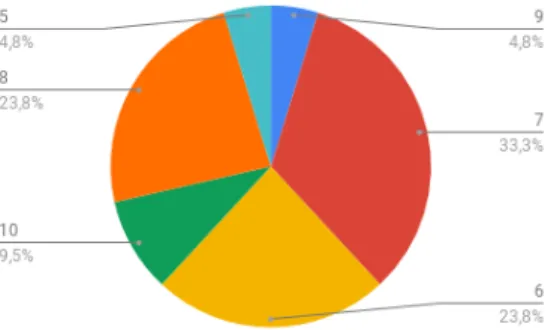
Speaking about students’ level in oral communication, one student said 5 on scale out of 10, 5 students have chosen 6 out of 10. Another 7 students rated themselves 7 on the scale of 10. Moreover, 3 students 7.5 out of , 05 students 8 out of 10, 1 student 9 and the last one said 10 out of 10.
Figure 06: The Students’ Own Evaluation of their Speaking Skills Question 04: Students’ Attitudes towards Using Podcasts as a Pedagogical Tool
When the students were asked whether the teachers use podcasts as a main teaching material or not, all the students answered no.
Question 05: The students’ Attitudes towards the Usefulness of Podcasts
In this question, most of the students showed great importance to the use of English podcasts when it comes to the improvement of pronunciation , 24 students said yes it helps but the last one said that he has his own ways.
Figure 07:The students’ Attitudes towards the Usefulness of Podcasts Question 06: The Difficulties Students may Face when Using Podcasts
Some of the learners seem to encounter difficulties to understand the context when it comes to the use of English podcast by the teacher in the classroom. Some of them said that they didn’t use English Podcast before, so obviously they don’t have an idea about it. The others mentioned that they need to find the right and the useful podcasts in order to facilitate the learning process. Others do not encounter any difficulties when they use English Podcast. The rest of the students face difficulties in understanding those podcasts while listening and in terms of the accent of speaking.
C
HAPTERT
WO:
R
ESEARCHM
ETHODOLOGY18
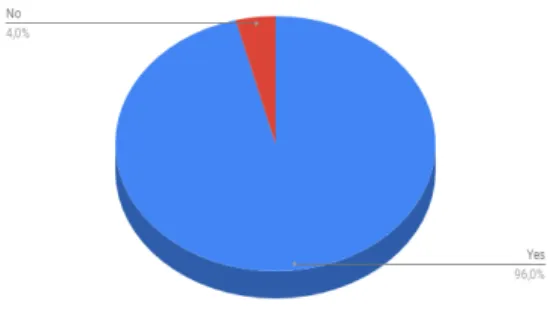
In this question, the results reveal that the majority of the students represented in (96%) said that English podcasts facilitate the learning process, and only (04%) answered with no. This indicates that most of learners are aware about the importance of English Podcast.
Figure 08: The Existence of Podcasts’ Positive Impact on the Students Users Question 08: The effects of Podcasts on Students’ Speaking Skills
The giving question was asked about the difference between students who use podcasts to improve their pronunciation and those who do not. The results reveal that 15 of the students agree that podcasts are with a great help in improving their pronunciation, 07 of the students disagree, 03 with no answer.
Question 09 & 10: Students’ Engagement in Speaking Practice
The results show that all students described positively the use of English podcasts to enhance communication skills, and few of them mention that English Podcast is a productive tool to enhance the four skills, such as, the speaking skill. 05 students did not reply and left it blank. These are the most important multiple reasons for the benefits of podcasts in class according to the participants of the study.
In the last question, according to the given results, it is apparent that the majority of students stated that the use of English podcasts is highly recommended in the learning process due to the effectiveness of the method and it should be part of the educational system.
Figure 09:Students’ Engagement in Speaking Practice
II.6.2. The Teachers’ Interview Results
The interview was conducted with five teachers of English at the University of Mostaganem, the Department of English. The five teachers (4 females and 1 male) had a significant experience of teaching, where the first teacher had a12 years of experience, the second teacher 08 years, the third teacher has 03 years, the fourth teacher has 02 years, and the fifth teacher has one year of teaching experience as the less experienced teacher amongst the participants.
Thence, the results of the interview will be reported:
Question 01: Teachers Awareness about their Students’ Needs
All the teachers answered that they know their students’ learning needs. Generally, the answers to this question express same view towards the importance of the awareness about their student’s learning needs. Responses about the methods they use to know their students’ needs were divided between those who said simply by asking and those who think they know by observing them closely. Three of the respondents answered that they know by using both methods.
Question 02: The Teachers’ Strategies Variation
This question was intended to know the strategies used by the teachers depending on the learning styles. Teacher one said yes by stating one of these strategies: ‘’ I use colors, videos , audios and encourage pair and group work because collaborative learning has a high importance in my classes and always I use gifts as a toll of motivation’’. Teacher two also said yes by integrating new media of technology. Teacher three answered by no, the third teacher believes that learning with fun and making English a language not just a subject in the curriculum, rather the language of communication outside the classroom. Teacher four said yes by using different materials. Teacher five wrote yes , concerning the motive behind this answer was by saying ‘’ I mix traditional with modern way of teaching depending on the topic
C
HAPTERT
WO:
R
ESEARCHM
ETHODOLOGY20
that I teach, for example, sometimes I use handouts and lecturing, other times I use data show and role plays, so it depends. ‘’
Question 03 & 04: Podcasts’ Integration by Teachers
Most of the teachers agreed on using podcasts in their teaching. The responses given by the teachers allowed to draw a summary about a given topic that seem to be interesting to both teachers and students which is the use of English podcasts in the classroom. Teachers gave their arguments as far as their views are concerned. First “In my EFL class for beginners, for example, I play videos and audios all the time to get my students accustomed to English as a language and as a vehicle of culture’’. Second “by posting previously a video on their Facebook group, and discuss it in class.” Third “because they are well spread and I use them via smart phone application.’’ Fourth “I use them to make some messages reach the students, it's better than keeping explaining because this is boring, I use podcasts by the data show “ Fifth with no answer.
All of the teachers expressed the same point of view. Teacher 1 reveals ‘’ by developing their listening skills they definitely demonstrate an improvement in their speaking ones be it by a correct pronunciation, intonation or the richness of vocabulary.’’ Another teacher believes that it depends. Another teacher adds “yes, I think it will improve their ability to speak English flawlessly.” Another one said, “yes, they upload an application in their phone so they can use it every day, and this is going to help them improve their speaking skills.’’ Another teacher shares the same opinion as the first one by saying “yes, by listening they will improve the speaking skills.’’
Figure 10: Podcasts’ Integration by Teachers Question 05 & 06: The Impact and Times of Podcasts Use by Teachers
When teachers were asked about whether the use of podcasts has an impact on students’ learning or not, their answers were positive. One of the teachers said “Yes. It makes them focus and provide me with a back up to clear up the confusion off their faces. ”Another
one said, “Sometimes podcasts help students enrich their vocabulary. ”Another one answered by “I can't say changes, because I don't use them for the speaking skills, rather I use them to ameliorate their listening ones, however; I see that both are complementary. ’’The others just said yes.
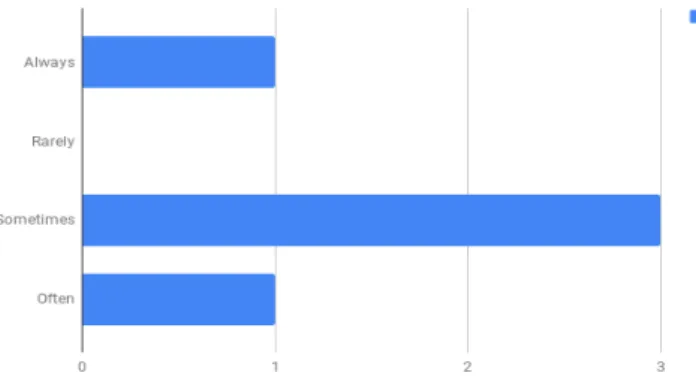
As far as the times when the teachers use podcasts in their classrooms, the answers were divided. Three of the teachers answered by sometimes, another one by always and the last one by often.
Figure 11: The Times of Podcasts Use by Teachers Question 07: Sources of Podcasts Used by Teachers
Without any surprise, almost unanimously, the respondents declared not using any extra-sources. They are limited by YOUTUBE. One teacher brought it from podcasts smart phone application and the other one from Oxford press.
Figure 12: Sources of Podcasts Used by Teachers Question 08: The Ways of Podcats’ Integration
Basically most of the teachers responded by “Watch the video together with the students.”
C
HAPTERT
WO:
R
ESEARCHM
ETHODOLOGY22
Figure 13: The Ways of Podcasts’ Integration Question 09: The Use of Podcasts as a Motivational Tool
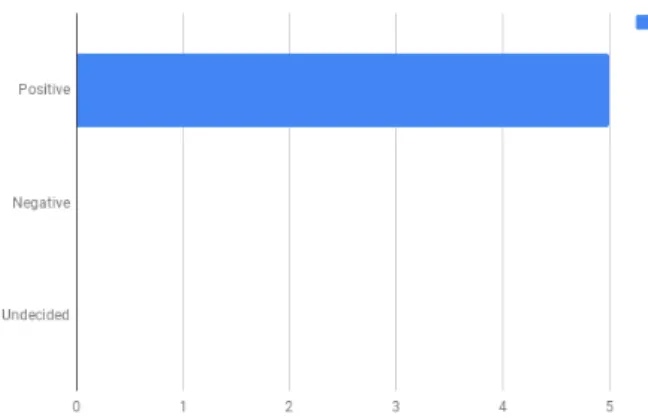
All the teachers see that using podcasts as a motivational tool is effective. In details, The first teacher justified his answer by “It gives you that edge of moving from a classic traditional classroom which is boring by the way to a productive classroom where my students are able to express their ideas, beliefs and develop their critical thinking.’’ Another one proved it by saying “because most students are audiovisual learners. ‘’ The third one commented by “podcasts helps the teacher to expose the students to real English, they are easy to find, and students are interested by podcasts.” The last one said “Anything that presents real English is helpful when learning that language, podcasts represent a way to expose the students to native English speech which will surely improve their listening and oral skills.”
II.7. Conclusion
Through this chapter, one has shed light on the methodology and the data collection procedures of the proposed study. It first gives the description of the method used in the data collection that is a mixt method. . Accordingly, it also conveyed a detailed description of the data collection instruments. Hence, there were two data collection instruments: a questionnaire and an interview conducted with L3 students of English and teachers of English, respectively, at the same University of Abdelhamid Ibn Badis. Lastly, the results obtained from both data collection tools were listed in the chapter. According to the results and findings, the impact of podcasting on students’ pronunciation and speaking skills was clearly noticed. The data gathered from the participants will be examined and analysed. Ultimately, the following chapter will further the discussion about the data analysis and the research findings.
III. Chapter Three:
METHODOLOGY
III.1 Introduction
In this chapter, the results of our inquiry will be statistically analysed, with a total referee to the research questions. The current chapter, therefore, attempts to testify the research hypotheses that will be either be validated or invalidated.
The analysis of the data is however to determine the following objectives:
1- Setting the extent of using podcasts to enhance students’ pronunciation.
2- Unveiling the difference between the students who use podcasts in learning English and the ones who do not.
3- Analysing the difficulties that students may encounter while using podcasts as a learning strategy.
Eventually, in the last chapter, the most significant findings of this research will be finally highlighted, analysed and discussed, together with inspecting the extent of podcasts use to enhance students’ pronunciation will be determined within the context of this study. Therefore, the research questions will be answered and the objectives will be achieved.
III.2. Summary of the Findings and Analysis
In this section, a brief description of the results obtained from the formerly data collected is to be reported.
III.2.1. The Questionnaire
The questionnaire was addressed to L3 students of English at the University of Abdelhamid Ibn Badis Mostaganem.
The Extent of Podcasts’ Use by Students
The extent of podcasts use by students entails different results. The results show that most of students use English podcasts by their own, however; all the students claimed that their teachers do not use podcasts in the classrooms. The latter did not covers the students’ will to use podcasts in their classroom. According to them, the use of English podcasts may contribute highly in improving their speaking skills in general and their pronunciation in particular.
C
HAPTERT
HREE:METHODOLOGY
24
The Difficulties that Face Students while Using Podcasts
In fact, we discovered that some difficulties may encounter students while using podcasts as a learning tool. One of the most difficulties is understanding the context of the podcasts which is set by the teacher. In addition, finding an appropriate podcasts which they can use for learning purposes is another difficulty which can be solved by the teacher’s help and assistance. Furthermore, some students find it difficult to understand the native speakers’ speech and catch up with them.
The Impact of Podcasts while Learning the Language
The impact of podcasts while learning the language is to be indicated by the students. The majority of the students said that English podcasts facilitate the learning process, this indicates that most of learners are aware about the importance of EP. The results show that all students described positively the use of English podcasts in developing oral skills. The majority of students encourage the podcasts’ use by the teachers because they see it as an effective way to develop their communication skills.
III.2.2. The Interview
The interview was addressed to the teachers of English at the University of Abdelhamid Ibn Badis to collect data about: the extent of podcasts use by the teachers, the impact of podcasts while teaching the language, and teachers’ attitudes towards using podcasts.
The Extent of Podcasts’ Use by Teachers
In this study, all of the teachers confirmed that they use English podcasts in their teaching. This use vary from one teacher to another. All of them use EP via data-show in order to reach their objectives in making the information clear to the students. In fact, they believe that while improving the listening skills, they improve the speaking ones too. Other teachers recommend to students to upload the podcast application on their phones in order they will be able to consult it easily. The latter reveals that the teachers are aware and they encourage their students to learn via podcasts.
The Impact that Podcasts have while Teaching the Language
According to the teachers, podcasts have a positive impact on the learners. First, the students engagement and focus increase by using podcasts. Podcasts enrich students’ vocabulary as well. In fact, the majority of the teachers use podcasts as an additional tool in teaching and not as the main one. For that reason, the impact of podcasts can stop at the level of the listening skills, but it is not enough to ameliorate the speaking skills.
Teachers’ Attitudes towards Using Podcasts
The teachers’ attitudes towards using podcasts indicate that they all encourage the idea. Podcasts are a good way to shift from the traditional way of teaching, while students can express themselves freely and be engaged in the classroom. They are the best way to audiovisual learners who represent the majority of the students. Teachers see them as an authentic material to teach English and address both the listening and the speaking skills.
III.3. Discussion of the Findings
First of all, let us restate our hypotheses as follows:
1 - To what extent does podcasting enhance students’ pronunciation?
2 -Is there a difference between students who use podcasts to improve pronunciation and those who do not?
3 -What are the difficulties that EFL learners may encounter when using podcasts to enhance their competencies?
In the previous section, we have provided a brief description of the results obtained by means of the two data collection instruments, namely, a questionnaire for students and an interview for teachers of English. Hence, in order to achieve the research objectives, the following section appertains to a general discussion of the results and findings with reference to the themes identified in the literature.
The obtained results from the pupils’ questionnaire and teachers’ interview demonstrate their awareness of the importance of using English podcasts in the educational system. These results indicated that English podcasting provides a high E-tool to motivate EFL learners in the classrooms. From what the teachers have answered, we can expose their awareness of the impactful use of English podcasts on improving EFL learners’ pronunciation skills. Because it creates an atmosphere which help the students to be confident, cooperative,
C
HAPTERT
HREE:METHODOLOGY
26
and autonomous. The data reinforce the perception that the interest in inserting innovations in the classes comes accompanied by some insecurity about what can be done. In any case, teachers have shown that they can perceive various possibilities to be experienced.
Teaching English at the university nowadays requires rethinking of teaching practices so that we can guide our students to experience other contexts of interaction that break with the traditional structure of the classroom. To do this, we need to provide subsidies that make our students agents, critical citizens, autonomous in the selection and production of knowledge in real life, through the development of research and careful evaluation of contents, as well as allowing them to express their opinions and ideas through the use of language and of varied technologies. Although the oral skills self-assessment differs and although students say teachers don not reply on Ep they still see it can help and that is because Ep is far more attractive, lucid, and efficient than regular teaching. It gives sight to the subjects and the topic, the field, and the details in the real world.
Using English podcasts in class gave the possibility of using the language in an authentic way, with concrete people, communicating in the everyday language of everyday life. By using these instruments, students leave their own mark in the world either through their opinion or their work, which they may see published and accessible across the world through the Internet. New learning contexts are created, after all the research that has been carried out, it is concluded that English podcasts are tools to make the teaching of this language more interactive and practical and promoting the reduction of the lectures of classes and making the participants active in their own teaching and learning process.
Several studies have emphasized the important role of English podcasting for Efl students to make them pay attention to speaking. All of these researchers asserted that English podcasting has an effect on learner’s listening and speaking. However, the researchers had paid rare attention to students’ attitudes and motivation since motivation and attitude are the elements which students need to sustain in the lengthy process of learning a foreign language (Dornyei, 2001).
To sum up, above and the conclusions drawn from the results, first we verified the hypothesis that the use of English podcasts would improve EFL students’ pronunciation. Second, among the problems and difficulties that EFL learners may encounter when using podcasts to enhance their competencies is that they cannot understand native speaker easily and they cannot catch up with them in an easy way.
III.4. Conclusion
Throughout this chapter, the data gathered via the two tools of research: the questionnaire and the interview were analysed and discussed. The discussion of the results aimed at addressing the different research objectives. Initially, a summary of the results obtained from the two research instruments was provided in the first part of the chapter. Thereafter, a discussion of the main findings was established.
As a result, we dedicated that podcasts can be used effectively, particularly to enhance pronunciation and speaking skills in general. However, some difficulties may encounter the students. In fact, we discovered that there is a clear-cut difference between the students who use podcasts in learning English and the ones who do not. In the following part, the conclusion of the grounds formerly established in this chapter along with the other parts of the study is to be discussed in the general conclusion in order to provide a holistic perspective of the results and findings of the study.
G
ENERALC
ONCLUSION29
General Conclusion
In modern education, technology has invaded the educational system. Podcasts as a technological tool is well spread amongst the young generation. It is obvious that education is witnessing a drastic change in the pedagogical tools especially the use of ICTs. Hence, podcasts as a new technology becomes an interesting learning method for students. EFL students need that tool improve their speaking skills in general and pronunciation in particular. For that reason, the following study attempts to investigate three aspects of that phenomenon: the extent of podcasts use as a pedagogical tool by teachers and students, the difficulties that students may encounter while using podcasts, and the impact of podcasts on students’ speaking skills and pronunciation.
The review of literature chapter introduced several points. This study was divided into three chapters. The first chapter sets forth the review of literature linked to the subject under investigation. It involved four parts. The first part was about podcasting as a technological tool. It was about exploring the meaning of podcasting, its historical background, and types of podcasting as well. In addition, the second part attempted to present podcasting as a pedagogical tool. In this section, we dealt with the pedagogical importance of podcasting and the potential of using podcasting in education. The third part was about the use of podcasting in teaching pronunciation. Thence, the fourth part was about podcasting use in the Algerian education.
The second chapter concerned with the practical part of the study. A mixt method was used in order to address the objectives of the study. Basically, two research instruments were opted for that are: a questionnaire for L3 students of English and an interview for teachers of English at the same University which is Abdelhamid Ibn Badis.
The analysis and discussion of the results were, eventually, displayed in the last chapter. The latter introduced a description of the results obtained by means of the two data collections instruments. Ultimately, the last part of the chapter set forth the mains findings of the research.
1. Conclusion of Findings
In fact, the results obtained from the two research instruments were related to the theoretical part that was established in the first chapter. The research objectives of this study were to inspect the different variables namely: the extent of using English podcasts to
improve students’ pronunciation and the different difficulties they may encounter while learning English via podcasts. The purpose was also, to analyse the difference between the students who use podcasts in their learning of the language and the students who do not.
As a consequence, a summary of the main findings of the research is now to be stated:
The use of podcasts for English learning purposes is well spread amongst students. Students encounter some difficulties while using podcasts in their learning in terms of
deciphering native English speakers speech.
Students declared that podcasts are a good way to learn English because they help them to improve their listening and speaking skills.
The teachers are aware about using podcasts as a pedagogical and motivational tool in their teaching.
The teachers advocate that podcasts facilitate the teaching/ learning process via increasing students’ engagement and positive presence.
The teachers encourage the use of podcasts in teaching because it suits the audio-visual students who represent the majority of learning style amongst students.
2. Limitations of the Study
In the first place, the study was conducted within a single University; moreover, the sample was limited to only five teachers and 20 students at the same University. On that account, due to the restricted sampling, the results attained cannot be generalized. However, similar context and samples may benefit from the findings.
3. Recommendations for Future Research
This study highlighted a number of issues in need of further investigation:
A study with a larger sample in different teaching contexts is also necessary in order to increase the credibility and add value to the research findings.
Further research is strongly recommended in examining the impact of using podcasts on the students’ speaking skills such as: fluency, accuracy, and word choice.
A research can be conducted about the use of podcasts to increase the students’ motivation to learn English.
Other research can be conducted on the role of podcasting in facilitating the teaching process in the domain of language teaching.
L
IST OFR
EFERENCES1
List of ReferencesAldrich, D., Bell, B., & Batzel, T. (2006). Automated podcasting solution expands the boundaries of the classroom. Proceedings of the 34th Annual ACM SIGUCCS Conference on User Services, Edmonton, Alberta, Canada.
Amin, R., Mohamad & Azarnoosh, Maryam & Jalal Abdolmanafi-Rokni, Seyed. (2017). The Effect of Podcasting on Iranian EFL Learners' Motivation and Attitude. Theory and Practice in Language Studies
Archard, S. & Merry, R. (2010). Podcasts as a conversational pedagogy. Computers in New Zealand Schools: Learning, leading, Technology, 22(3), 1-11.
Bates, A.W. (2005). Technology, e-learning and distance education. (2nd ed.). New York: Routledge.
Ben Hammersley (2004). The Guardian’s, page 02
Bottentuit Junior, J. B.; Coutinho, C. P. (2008). Recommendations for Producing Podcasts and Advantages in Use in Virtual Learning Environments, nº6, 158-179.
Cássia Veiga Marriott, Rita (2008) ‘Handbook of Research on E-Learning Methodologies for Language Acquisitio, page 341
Copley, J. (2007) ‘Audio and video podcasts of lectures for campus-based students:
production and evaluation of student use’, Innovations in Education and Teaching International, vol. 44, no. 4, pp. 387–399
Harris, H. & Park, S. (2008) ‘Educational usages of podcasting’, British Journal of Educational Technology, vol. 39, no. 8, pp. 548–551.
Laura Malita, Vanna Boffo.(2010). Digital Storytelling for Employability. edited by – Firenze : Firenze University Press, Page 37
Lazzari, M. (2009) ‘Creative use of podcasting in higher education and its effect on competitive agency’, Computers and Education, vol. 52, no. 1, pp. 27–34.
Salmon, G. (Producer). (2007, March 29). Learning futures: Creative, collaborative,
communicative [Podcast]. Retrieved from http://www.health.heacademy.ac.uk/ resources/healthcast/hspvideo/keynote3.wmv/view
Appendices
Appendix A: Questionnaire for Students
Dear Student! This questionnaire is a survey about the integration of English podcasts in the classroom and how it may help improve learners’ speaking skills. The survey provides you with an opportunity to evaluate whether English podcasts will improve the learning process or not.
Thank you for taking the time to fill this questionnaire
Part one: background information
Gender: Male Female Age:
Part two: the integration of podcasts in the classroom
Please put a (√) to each question:
Question 01: Haveyou ever used English podcasts during your study inside the classroom?
Yes No Question 02: Have you been taught via podcasting previously?
Yes No
Question 03: On the scale of 1 to 10, what do you think your level in oral communication is?
1 / 2 / 3 / 4 / 5 / 6 / 7 / 8 / 9 / 10
Question 04: Do you think that English podcasts can help you improve your pronunciation?
Yes No
If no, say why:
……… ……… ………
Question 05: what are the difficulties that you encounter when you use English podcasts to learn?
………
Question 06: Do you see that the use of English podcasts would facilitate the learning process?
APPENDICES
Question 07: Is there a difference between students who use podcasts to improve pronunciation and those who do not?
……… ………... ………
Question 08: How can you describe the benefits of using this new media technology to improve your speaking skill?
……… ……… ………
Question 09: According to you, to what extent do you see it compulsory to use new media technology facilities such as podcast in universities and colleges?
……… ……… ………
Question 10: Does your teacher use podcasts as a main teaching material?
Yes No
Thank you
Appendix B: Teachers’ Interview
Dear teachers, this is a survey interview to collect data about the impact of using English podcasts on EFL learners’toimprove oral communication skills The data obtained is of significant importance for the conduction of our master dissertation.
You are kindly requested to answer the interview below. Your answers will be held in a strict confidence.
Age:
Gender: Male Female
Duration of teaching:
1- Do you know your student’s learning needs?
2- Do you vary your teaching strategies depending on your student’s leaning styles? If yes, what are these strategies?
3- Do you use English podcasts in your classroom? If yes, why and how?
4- Do you think that using English podcasts would help your students to improve their speaking skills? How?
5- Do you see any changes when you use podcast and when you don’t? 6- How often do you use them?
a-Always b-Sometimes c-Rarely d-Often 7- What are your sources ?
a-YouTube b-Daily Motion c-Specific Web sites
Others:... 8- How do you use videos in the classroom? a- Watch the video together with your students b- Ask the students to watch independently c- Ask the students to watch it at home
d- Other:...
9- How would you describe your attitude toward using podcast as a motivational and pedagogical tool in university classes?
a-Positive b-Negative c-Undecided Justify: