HAL Id: hal-00296878
https://hal.archives-ouvertes.fr/hal-00296878
Submitted on 9 Jan 2006
HAL is a multi-disciplinary open access
archive for the deposit and dissemination of
sci-entific research documents, whether they are
pub-lished or not. The documents may come from
teaching and research institutions in France or
abroad, or from public or private research centers.
L’archive ouverte pluridisciplinaire HAL, est
destinée au dépôt et à la diffusion de documents
scientifiques de niveau recherche, publiés ou non,
émanant des établissements d’enseignement et de
recherche français ou étrangers, des laboratoires
publics ou privés.
Coupled model simulations of mid-Holocene ENSO and
comparisons with coral oxygen isotope records
J. Brown, M. Collins, A. Tudhope
To cite this version:
J. Brown, M. Collins, A. Tudhope. Coupled model simulations of mid-Holocene ENSO and
compar-isons with coral oxygen isotope records. Advances in Geosciences, European Geosciences Union, 2006,
6, pp.29-33. �hal-00296878�
SRef-ID: 1680-7359/adgeo/2006-6-29 European Geosciences Union
© 2006 Author(s). This work is licensed under a Creative Commons License.
Advances in
Geosciences
Coupled model simulations of mid-Holocene ENSO and
comparisons with coral oxygen isotope records
J. Brown1, M. Collins2, and A. Tudhope3
1Centre for Global Atmospheric Modelling, Department of Meteorology, University of Reading, Reading, UK 2Hadley Centre for Climate Prediction and Research, Met Office, Exeter, UK
3School of Geosciences, University of Edinburgh, Edinburgh, UK
Received: 15 August 2005 – Revised: 18 October 2005 – Accepted: 19 October 2005 – Published: 9 January 2006
Abstract. The sensitivity of El Ni˜no-Southern Oscilla-tion (ENSO) to changes in mean climate is investigated for simulations of pre-industrial and mid-Holocene (6000 years before present) climate using the Hadley Centre cou-pled atmosphere-ocean model, HadCM3. Orbitally-forced changes in insolation in the mid-Holocene produce changes in seasonality which may alter ENSO amplitude and fre-quency. The model simulations are compared with mid-Holocene fossil coral oxygen isotope records from the west-ern Pacific Warm Pool. The coral records imply a reduction of around 60% in the amplitude of interannual variability as-sociated with ENSO in the mid-Holocene, while the model simulates a smaller reduction in ENSO amplitude of around 10%. The model also simulates a slight shift to longer period variability and a weakening of ENSO phase-locking to the seasonal cycle in the mid-Holocene. There is little change in the pattern of ENSO tropical precipitation teleconnections in the simulated mid-Holocene climate.
1 Introduction
Palaeoclimate records indicate that El Ni˜no-Southern Oscil-lation (ENSO) may have been weaker than present or absent in the early and mid-Holocene (∼10 000 to ∼5000 years ago) (Sandweiss et al., 1996; Rodbell et al., 1999; Tudhope et al., 2001). Changes in the timing of perihelion resulted in altered solar forcing at this time, with increased Northern Hemi-sphere and tropical seasonality, although annual average in-solation was virtually unchanged from the present. Previous modelling studies have found changes in ENSO amplitude and frequency in response to Holocene orbital forcing (e.g. Clement et al., 2000, 2001; Otto-Bliesner et al., 2003). We
Correspondence to: J. Brown
use the HadCM3 coupled atmosphere-ocean model to simu-late mid-Holocene and pre-industrial climate. We consider the change in mean climate in the mid-Holocene, and the change in interannual sea surface temperature (SST) variabil-ity, ENSO amplitude and frequency. We compare the model results with modern and fossil coral oxygen isotope records from coastal Papua New Guinea in the western Pacific Warm Pool. The ultimate aim of this study is to evaluate the model’s ability to simulate past climates in order to build confidence in its ability to simulate future anthropogenic climate change.
2 Mid-Holocene coral records
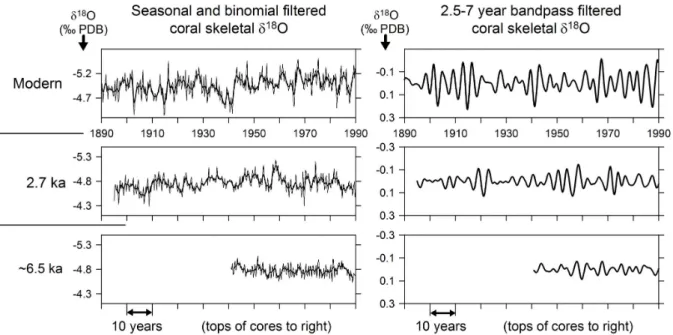
Coral oxygen isotope records have been obtained from liv-ing and fossil corals from the Huon Peninsula, Madang and Laing Island on the north coast of Papua New Guinea (Fig. 1). The oxygen isotope ratio (δ18O) from living coral at the three sites is found to be strongly correlated with ENSO activity due to cooler (warmer) SSTs and decreased (increased) precipitation during El Ni˜no (La Ni˜na) events (Tudhope et al., 1995, 2001). Selected modern and fos-sil coral oxygen isotope records from the mid- and late Holocene are shown in Fig. 2. The oxygen isotope ratios in mid-Holocene fossil coral from 6500 years ago (6.5 ka) show weaker variability at ENSO periods, a reduction of 60% rel-ative to 20th century amplitudes, while the amplitude in the late Holocene (2.7 ka) coral record is similar to the modern amplitude (Tudhope et al., 2001).
The coral oxygen isotope ratio reflects changes in both SST and local ocean isotopic ratio, which is influenced by the balance between precipitation and evaporation. While SST and precipitation vary together for modern ENSO events at the coral site (e.g. Tudhope et al., 1995), this relation-ship may differ for past climates. For example, Gagan et al. (2004) examine coral oxygen isotope ratios and Sr/Ca
30 J. Brown et al.: Mid-Holocene ENSO
Fig. 1. Location of Laing Island, Madang and Huon Peninsula coral
sites (adapted from Tudhope et al. (2001)).
ratios at 6.2 ka from Great Barrier Reef fossil corals and find that SST variability associated with ENSO was reduced by 20% while precipitation variability was reduced by around 70% compared with late 20th century values. It is possi-ble that changes in ENSO precipitation teleconnections may contribute to the large reduction in amplitude in the Huon Peninsula records, as the signal at the Papua New Guinea site is predominantly influenced by precipitation rather than SST for modern coral records (Tudhope et al., 1995). We there-fore investigate the changes in modelled ENSO precipitation and SST variability in comparison with the proxy record.
3 Modelled mid-Holocene climate
HadCM3 is a fully coupled atmosphere-ocean model with 3.75◦longitude and 2.5◦latitude horizontal resolution and 19 levels in the atmospheric component, as described by Pope et al. (2000). The ocean component has a uniform resolu-tion of 1.25◦ with 20 vertical levels (Gordon et al., 2000). The model exhibits no significant climate drift, and so can perform multi-century integrations without flux correction. HadCM3 has been shown to simulate ENSO as well as other state-of-the-art coupled models, with an amplitude and fre-quency which is broadly similar to observations. Known bi-ases in the model climate which may influence the evolution of ENSO temperature and precipitation anomalies include a cold bias in the central equatorial Pacific Ocean and a warm bias over the Maritime continent (e.g. Inness et al., 2003; Turner et al., 2005). The equatorial Pacific trade winds are stronger than observed, and convection tends to be confined to the western Pacific Warm Pool and stronger than observed. The pre-industrial climate simulation is carried out using modern orbital parameters, vegetation coverage and conti-nental ice sheets, and an atmospheric CO2concentration of
280 ppmv. The orbital parameters are altered for the mid-Holocene simulation, with all other boundary conditions the same as for the pre-industrial simulation. The model is run for 100 years in each case and flux corrections are not ap-plied. Figure 3 shows the seasonal (DJF and JJA) surface temperature anomalies in the mid-Holocene climate in re-sponse to the change in insolation. In the mid-Holocene, Northern Hemisphere mid-latitude continental surface tem-peratures are increased in summer and decreased in winter. Due to the increased Northern Hemisphere summer land-sea temperature gradient, the Asian summer monsoon precipita-tion is increased, although interannual variability of monsoon strength is reduced according to both dynamical and precip-itation indices (not shown). The Sahel region in Africa also experiences increased precipitation during the summer mon-soon, with a slight northward shift in the region of maximum precipitation.
The mean state of the tropical Pacific in the mid-Holocene remains the subject of some debate. Lake sediment records from Ecuador indicate fewer strong El Ni˜no events in the mid-Holocene, which Rodbell et al. (1999) interpret as evi-dence for warmer eastern Pacific SSTs. More recent studies (e.g. Clement et al., 2000; Liu et al., 2003) have argued that these lake sediment records are consistent with a cooler east-ern Pacific. Mg/Ca records from near the Galapagos sug-gest mid-Holocene cooling in the eastern Pacific, with an enhanced zonal SST gradient and strengthened trade winds (Koutavas et al., 2002). Coral evidence of warming in the western Pacific (Gagan et al., 1998) may have resulted in an increased zonal SST gradient across the Pacific. Mol-lusk distributions on the coast of Peru imply locally warmer waters, which may be due to changes in coastal SSTs and upwelling or large-scale El Ni˜no-like conditions (Sandweiss et al., 1996). Several previous modelling studies have sug-gested that the mean tropical ocean state was La Ni˜na-like in the mid-Holocene with a relative cooling in the eastern Pa-cific, in some cases accompanied by a strengthening of the trade winds and changes in the distribution of precipitation (e.g. Otto-Bliesner, 1999; Bush, 1999; Liu et al., 2003).
The modelled change in tropical SSTs from mid-Holocene to pre-industrial climate is shown in Fig. 3. There is a cool-ing of up to 1◦C in the central and eastern tropical Pacific in DJF, while in JJA SSTs warm slightly on the equator in the eastern Pacific with cooling off the equator and in the cen-tral and western equatorial Pacific. The annual average zonal SST gradient in the equatorial Pacific is unchanged in the mid-Holocene simulation, although the zonal SST gradient is seasonally strengthened following boreal winter and weak-ened following boreal summer. The easterly trade winds also undergo seasonal changes in the mid-Holocene simulation, with a strengthening from boreal summer onwards in the cen-tral and western Pacific (not shown), consistent with previous modelling studies.
Fig. 2. Oxygen isotope ratios from Papua New Guinea coral. Left: Seasonal resolution (thin lines) and 2.25-year binomial-filtered skeletal
δ18O records from fossil corals of 2.7 ka and 6.5 ka age, with the record from a modern coral shown for comparison. Right: 2.5–7 year (ENSO) bandpass-filtered coral δ18O anomalies (adapted from Tudhope et al. (2001)). Coral δ18O values are given in permil (PDB).
Fig. 3. Difference between model-simulated mid-Holocene and
pre-industrial surface temperature for DJF (above) and JJA (below). Contour interval is 0.5◦C.
4 Modelled mid-Holocene ENSO
The timeseries of the SST anomaly in the Nin˜o-3 region (5◦N–5◦S, 150–90◦W) is calculated for the 100-year pre-industrial and mid-Holocene simulations (Fig. 4). The stan-dard deviation of the Ni˜no-3 index is 0.81◦C for the pre-industrial run and 0.71◦C for the mid-Holocene run,
repre-Fig. 4. Ni˜no-3 SST anomalies (◦C) for 100-year pre-industrial (above) and mid-Holocene (below) climate simulations. Dashed line indicates ±2 standard deviations of the Ni˜no-3 anomalies. Monthly mean values are shown with the seasonal cycle removed.
senting a reduction in ENSO amplitude of 12%. The dif-ference between the amplitude of ENSO in the two runs is within the range of internal model interdecadal variability in a 1000-year HadCM3 control run (Collins, 2000a), therefore it is difficult to make statistically robust conclusions.
The power spectrum of Ni˜no-3 SST anomalies for HadISST observed SSTs from 1949–2002 (Rayner et al., 2003) is compared with the pre-industrial and mid-Holocene Ni˜no-3 spectra in Fig. 5. The modelled pre-industrial ENSO has maximum power at periods of 2–3 and 5 years, while the mid-Holocene ENSO has maximum power at slightly longer
32 J. Brown et al.: Mid-Holocene ENSO
Fig. 5. Spectra of HadISST observed (solid line), pre-industrial
(dashed line) and mid-Holocene (dot-dashed line) Ni˜no-3 SST anomalies (above); seasonal cycle of HadISST observed (solid line), pre-industrial (dashed line) and mid-Holocene (dot-dashed line) standard deviation of Ni˜no-3 SST anomalies (below).
periods of 4.5 and 5.5 years. The mean annual cycle of Ni˜no-3 SST anomalies is also shown in Fig. 5 in comparison with HadISST observations. The modelled pre-industrial ENSO shows phase-locking to the annual cycle in broad agreement with observations, with maximum amplitude in December although the minimum is later than the observed April min-imum. The simulated mid-Holocene ENSO has a weaker phase-locking to the seasonal cycle, with a strong reduction in amplitude in the period September–April.
The precipitation response to ENSO is investigated using the correlation between monthly anomalies of Ni˜no-3 SST and precipitation, as shown in Fig. 6. In the pre-industrial case, the model simulates a positive Ni˜no3 SST-precipitation correlation over the western Pacific Warm Pool region corre-sponding to the coral sites, whereas in observations this rela-tionship is reversed with reduced precipitation during warm El Ni˜no events (e.g. Dai and Wigley, 2000). This is a known bias in HadCM3, with the overly strong trades confining the
Fig. 6. Correlation between monthly Ni˜no-3 SST anomalies and
precipitation anomalies in pre-industrial (above) and mid-Holocene (below) climate simulations, highlighting ENSO teleconnection patterns. Contour interval is 0.2.
eastward expansion of the Warm Pool and associated convec-tion during El Ni˜no events (e.g. Inness et al., 2003; Turner et al., 2005). In the mid-Holocene, the model simulates a largely unchanged spatial pattern of correlations, with posi-tive correlations located over the north coast of Papua New Guinea. Thus while the model broadly simulates the SST and precipitation anomalies associated with ENSO, regional biases over the coral site prevent direct comparison of precip-itation variability at this location. Nevertheless, the lack of major changes in the simulated large-scale precipitation tele-connection patterns from the mid-Holocene to pre-industrial supports the interpretation of the coral records as showing a reduction in ENSO amplitude rather than a change in ENSO precipitation teleconnections.
5 Conclusions
The coral oxygen isotope records imply up to 60% reduc-tion in ENSO amplitude in the mid-Holocene, while the model simulates a reduction of around 10%. Although the model and coral records are in qualitative agreement, the coral records provide evidence for a substantially larger re-duction in ENSO amplitude than is simulated by the model. The difference between the model and proxy records could be due to changes in the local ENSO precipitation response at the coral site, as discussed above. The western Pacific ENSO precipitation teleconnection is unchanged in the sim-ulated mid-Holocene climate, although this result may not be robust as the model is unable to reproduce the observed mod-ern teleconnection at this location. Nonetheless, the majority
of palaeoclimate records of mid-Holocene ENSO, including the coral oxygen isotope records of Tudhope et al. (2001), in-dicate a more significant reduction in ENSO amplitude than is simulated by the model.
Alternatively, the model may not correctly capture the physical response of ENSO to the increased seasonality in the mid-Holocene. For example, the biases in the mean state of the model may reduce the convective response in the west-ern Pacific to increased summer insolation and the resulting strengthening of trade winds in the late summer and autumn period which has been identified as a possible mechanism for damping El Ni˜no events in mid-Holocene climate. Previous studies have also identified uncertainties in the model ENSO response to climate forcing which may depend on details of the model physics and resolution (Collins, 2000b). The un-certainties in model simulations of ENSO in past, present and future climate will be examined in a future study using ver-sions of HadCM3 with perturbed physical parameters in the atmospheric model following the approach of the Quantify-ing Uncertainty in Model Predictions (QUMP) project (Mur-phy et al., 2004).
Acknowledgements. Paul Valdes provided assistance with the
set-up for the mid-Holocene simulations. This work was funded by NERC as part of the RAPID programme.
Edited by: P. Fabian and J. L. Santos
Reviewed by: Paul Aharon and another referee
References
Bush, A. B. G.: Assessing the impact of Mid-Holocene insolation on the atmosphere-ocean system, Geophys. Res. Lett., 26, 99– 102, 1999.
Clement, A. C., Seager, R., and Cane, M. A.: Suppression of El Ni˜no during the mid-Holocene by changes in the Earth’s orbit, Paleoceanography, 15, 731–737, 2000.
Clement, A. C., Cane, M. A. and Seager, R.: An orbitally driven tropical source for abrupt climate change, J. Clim., 14, 2369– 2375, 2001.
Collins, M.: The El Ni˜no-Southern Oscillation in the second Hadley Centre coupled model and its response to greenhouse warming, J. Clim, 13, 1299–1312, 2000a.
Collins, M.: Understanding uncertainties in the response of ENSO to greenhouse warming, Geophys. Res. Lett, 27, 3509–3512, 2000b.
Dai, A. and Wigley, T.: Global patterns of ENSO-induced precipi-tation, Geophys. Res. Lett., 27, 1283–1286, 2000.
Gagan, M. K., Ayliffe, L. K., Hopley, D., Cali, J. A., Mortimer, G. E., Chappell, J., McCulloch, M. T., and Head, M. J.: Temperature and surface-ocean water balance of the mid-Holocene tropical western Pacific, Science, 279, 1014–1018, 1998.
Gagan, M. K., Hendy, E. J., Haberle, S. G., and Hantoro, W. S.: Post-glacial evolution of the Indo-Pacific Warm Pool and El Ni˜no-Southern Oscillation, Quaternary International, 118–199, 127–143, 2004.
Gordon, C., Cooper, C., Senior, C. A., Banks, H., Gregory, J. M., Johns, T. C., Mitchell, J. F. B., and Wood, R. A.: The simulation of SST, sea ice extent and ocean heat transports in a version of the Hadley Centre coupled model without flux adjustments, Clim. Dyn., 16, 147–168, 2000.
Inness, P. M., Slingo, J. M., Guilyardi, E., and Cole, J.: Simulation of the Madden-Julian Oscillation in a coupled general circulation model. Part II: The role of the basic state, J. Clim., 16, 365–382, 2003.
Koutavas, A., Lynch-Stieglitz, J., Marchitto, T. M., and Sachs, J. P.: El Ni˜no-like pattern in Ice Age tropical Pacific sea surface temperature, Science, 297, 226–230, 2002.
Liu, Z., Brady, E. C., and Lynch-Stieglitz, J.: Global ocean response to orbital forcing in the Holocene, Paleoceanography, 18, 1041, doi:10.1029/2002PA000819, 2003.
Murphy, J. M., Sexton, D. M. H., Barnett, D. N., Jones, G. S., Webb, M. J., Collins, M., and Stainforth, D. A.: Quantification of mod-elling uncertainties in a large ensemble of climate change simu-lations, Nature, 430, 768–772, 2004.
Otto-Bliesner, B. L.: El Ni˜no/La Ni˜na and Sahel precipitation dur-ing the middle Holocene, Geophys. Res. Lett., 26, 87–90, 1999. Otto-Bliesner, B. L., Brady, E. C., Shin, S.-I., Liu, Z., and Shields,
C.: Modeling El Ni˜no and its tropical teleconnections during the last glacial-interglacial cycle, Geophys. Res. Lett., 30, 2198, doi:10.1029/2003GL018553, 2003.
Pope, V. D., Gallani, M. L., Rowntree, P. R., and Stratton, R. A.: The impact of new physical parametrizations in the Hadley Cen-tre climate model: HadAM3, Clim. Dyn., 16, 123–146, 2000. Rayner, N. A., Parker, D. E., Horton, E. B., Folland, C. K.,
Alexan-der, L. V., Rowell, D. P., Kent, E. C., and Kaplan, A.: Global analyses of sea surface temperature, sea ice and night time ma-rine air temperature since the late nineteenth century, J. Geophys. Res., 108, 4407, doi:10.1029/2002JD002670, 2003.
Rodbell, D. T., Seltzer, G. O., Anderson, D. M., Abbott, M. B., Enfield, D. B., and Newman, J. H.: An ∼15 000-year record of El Ni˜no-driven alluviation in southwestern Ecuador, Science, 283, 516–520, 1999.
Sandweiss, D. H., Richardson, J. B., Reitz, E. J., Rollins, H. B., and Maasch, K. A.: Geoarchaeological evidence from Peru for a 5000 year B.P. onset of El Ni˜no, Science, 273, 1531–1533, 1996. Tudhope, A. W., Shimmield, G. B., Chilcott, C. P., Jebb, M., Fallick, A. E., and Dalgleish, A. N.:, Recent changes in climate in the far western equatorial Pacific and their relationship to the Southern Oscillation; oxygen isotope records from massive corals, Papua New Guinea, Earth Plan. Sci. Lett., 136–34, 575–590, 1995. Tudhope, A. W., Chilcott, C. P., McCulloch, M. T., Cook, E. R.,
Chappell, J., Ellam, R. M., Lea, D. W., Lough, J. M., and Shim-mield, G. B.: Variability in the El Ni˜no-Southern Oscillation through a glacial-interglacial cycle, Science, 291, 1511–1517, 2001.
Turner, A. G., Inness, P. M., and Slingo, J. M.: The role of the basic state in the ENSO-monsoon relationship and implications for predictability, Q. J. R. Meteor. Soc., 131, 781–804, 2005.