HAL Id: hal-00295200
https://hal.archives-ouvertes.fr/hal-00295200
Submitted on 10 Sep 2002
HAL is a multi-disciplinary open access
archive for the deposit and dissemination of
sci-entific research documents, whether they are
pub-lished or not. The documents may come from
teaching and research institutions in France or
abroad, or from public or private research centers.
L’archive ouverte pluridisciplinaire HAL, est
destinée au dépôt et à la diffusion de documents
scientifiques de niveau recherche, publiés ou non,
émanant des établissements d’enseignement et de
recherche français ou étrangers, des laboratoires
publics ou privés.
The UV-visible absorption cross-sections of IONO2
J. C. Mössinger, D. M. Rowley, R. A. Cox
To cite this version:
J. C. Mössinger, D. M. Rowley, R. A. Cox. The UV-visible absorption cross-sections of IONO2.
Atmospheric Chemistry and Physics, European Geosciences Union, 2002, 2 (3), pp.227-234.
�hal-00295200�
Atmos. Chem. Phys., 2, 227–234, 2002
www.atmos-chem-phys.org/acp/2/227/
Atmospheric
Chemistry
and Physics
The UV-visible absorption cross-sections of IONO
2
J. C. M¨ossinger1, D. M. Rowley*, and R. A. Cox1
1Centre for Atmospheric Science, Chemistry Department, University of Cambridge, UK
*present address: Chemistry Department, University College London, UK
Received: 8 April 2002 – Published in Atmos. Chem. Phys. Discuss.: 12 June 2002 Revised: 9 August 2002 – Accepted: 29 August 2002 – Published: 10 September 2002
Abstract. The UV-visible absorption spectrum of gaseous
IONO2has been measured over the wavelength range 245–
415 nm using the technique of laser photolysis with
time-resolved UV-visible absorption spectroscopy. IONO2 was
produced in situ in the gas phase by laser flash photoly-sis of NO2/CF3I/N2mixtures. Post flash spectra were de-convolved to remove contributions to the observed absorp-tion from other reactant and product species. The resulting spectrum attributed to IONO2consists of several overlapping broad absorption bands. Assuming a quantum yield of unity for IONO2photolysis, model calculations show that during sunlit hours at noon, 53◦N, the first order solar photolysis rate coefficient (J value) for IONO2is 4.0 × 10⁻²s−1.
1 Introduction
Iodine chemistry has been implicated in tropospheric ozone depletion since the 1980s (Chameides and Davis, 1980; Davis et al., 1996; Jenkin et al., 1985). Atmospheric iodine source gases are readily photolysed by sunlight, yielding iodine atoms. Iodine atoms react with ozone forming IO. Any subsequent reactions of IO forming an iodine atom
lead to catalytic ozone loss. In competition, IO can be
sequestered into reservoir species. One of the main gaseous reservoir species for iodine in the atmosphere is believed to be IONO2(Chameides and Davis, 1980; Davis et al., 1996; Jenkin, 1992; Jenkin et al., 1985).
IONO2is formed by the reaction of IO with NO2
IO + NO2+M → IONO2+M (R1)
The rate of formation of IONO2 in reaction (R1) is well
known (De More et al., 1997) but the amount of IONO2
Correspondence to: J. C. M¨ossinger ([email protected])
residing in the atmosphere and its consequent impact on the atmospheric chemistry depends on its loss processes. Gas
phase IONO2 loss processes include photolysis, thermal
decomposition and heterogeneous uptake. IONO2can be photolysed via two possible routes:
IONO2+hν →IO + NO2 (R2a)
→I + NO3 (R2b)
However, no studies of the absorption cross-sections, the
photolysis quantum yields or the products of IONO2
pho-tolysis have been reported to date.
Thermal decomposition of IONO2could proceed as in re-action (R3).
IONO2
1
−→IO + NO2 (R3)
However, recent observations imply that reaction (R3) is a slow process at ambient temperature (Dillon, 2001; Allan and Plane, 2002).
A recent laboratory study has provided the first experimen-tal evidence that IONO2can be lost from the gas phase via a heterogeneous process (Holmes et al., 2001). It was shown that IONO2is taken up efficiently by dry and frozen salt sur-faces to form the di-halogens IBr and ICl, which are then released back into the gas phase.
IONO2has been synthesised in the laboratory in solution. However, IONO2 was found to be unstable and the first at-tempts to observe its ultraviolet-visible absorption spectrum
failed (Schmeisser and Braendle, 1961). The absorption
cross-sections for IONO2in the UV-visible are essential, in order to evaluate the daytime atmospheric photolysis rate of IONO2and the efficiency of the tropospheric ozone loss cy-cle involving IONO2.
Broske and Zabel (1998) attempted to measure the gas phase UV-visible absorption spectrum of IONO2by photoly-sis of I2/NO2mixtures in a large reaction chamber equipped
228 J. C. M¨ossinger et al.: The UV-visible absorption cross-sections of IONO2
Table 1. Concentrations used and generated during an experiment
Before laser photolysis After laser photolysis/O atom reaction
N2/molecules cm−3 2.5 × 10¹⁹ 2.5 × 10¹⁹ NO2/molecules cm−3 4.0 × 10¹⁵ 3.9 × 10¹⁵ CF3I/molecules cm−3 5.5 × 10¹⁶ 5.5 × 10¹⁶ CF3/molecules cm−3 − 7.5 × 10¹³ IO/molecules cm−3 − 7.5 × 10¹³ NO/molecules cm−3 − 8.5 × 10¹³ NO3/molecules cm−3 − 1.0 × 10¹²
for in situ spectroscopy. A diode array detector was used to monitor the UV-visible absorption spectrum. However,
because of the low concentrations of IONO2produced
un-der their experimental conditions and the presence of strong absorbers such as INO2, produced by the reaction of iodine atoms from I2photolysis with NO2, they were unable to re-trieve the spectrum of IONO2. Nevertheless, the UV-visible
absorption spectrum of gaseous INO2 was reported
(Atkin-son et al., 2000).
In order to avoid the effects of complicating chemistry in-volving iodine atoms produced in the IO source reactions, as well as the effects of secondary chemistry, a pulsed laser photolysis system and a photochemical source of IO with no initial iodine atom production (NO2/CF3I) was used in this study. We report here, for the first time observation of a gas phase ultraviolet-visible spectrum attributed to IONO2. The results were used to calculate the atmospheric photolysis rates of IONO2, and the atmospheric chemistry of IONO2is discussed briefly.
2 Experimental
The IONO2 absorption spectrum was obtained using the
technique of laser flash photolysis with UV absorption spec-troscopy, utilising a CCD detection system. The apparatus has been described in detail elsewhere (Rowley et al., 1996), therefore only a brief description is given here.
During an experiment, gases were flowed slowly and con-tinuously through a 98.2 cm long cylindrical quartz cell kept at a total pressure of 760 Torr. Reactions were initiated in the cell using a pulsed excimer laser beam passed longitu-dinally along the cell. Concentrations of reactant and prod-uct gases in the cell were monitored using UV-vis absorp-tion spectroscopy. The analysis light beam from a xenon arc lamp was passed through the cell, counter propagating the laser beam, and focused onto the entrance slit of a 0.25 m fo-cal length astigmatic Czerny-Turner spectrograph fitted with three interchangeable diffraction gratings ruled at 150, 300 and 600 grooves/mm. In order to protect the spectrograph and detector from impinging reflected laser light a narrow
band filter was used in the 350 nm region. Wavelength re-solved analysis light from the spectrograph was then imaged across the top 30 rows of a CCD detector, to record spectra. Signal (charge) transfer then enabled recording of sequential spectra, which were acquired before, during and after pho-tolysis.
A NO2/CF3I/N2chemical system was employed to gen-erate IONO2via the following reaction scheme:
NO2+hν →NO + O(3P) (R4)
O(3P) + CF3I → CF3+IO (R5)
IO + NO2+M → IONO2+M (R1)
CF3+NO2→CF2O + FNO (R6)
net : 3NO2+CF3I → CF2O + FNO + IONO2
The reaction was initiated using 351 nm XeF excimer laser photolysis of NO2to form O(3P) (DeMore et al., 1997). N2 (Messer, 99.996%), 2000 ppm NO2in N2(Messer) and CF3I (Fluorochem, 99%) were used as supplied. Gas mixtures were flowed through the reaction cell at a total pressure of 760 Torr and at 298 K via mass flow controllers or ball flow meters (for NO2 in N2) and their concentrations (see Ta-ble 1 for concentrations used) were calculated from known calibrated flow rates. In a single experiment 1152 spectra were collected on the CCD with a clocking speed of ∼ 1 µs per pixel. The actual time resolution was ∼ 15 µs result-ing from exposure of 30 pixels of the array. Post flash ab-sorbance spectra were calculated relative to preflash spec-tra using Beer’s law (A = ln(Ipreflash/Ipostflash)). Con-sequently observed absorbances show changes in absorption brought about by the laser flash and by subsequent chemistry over a period of ∼ 1 ms. The total absorption spectrum of the gas mixture was recorded using a 150 g/mm and a 300 g/mm grating giving a 130 nm and a 65 nm wavelength coverage, respectively. In the 245–335 nm region the 150 g/mm grat-ing was used with a 50 µm spectrograph entrance slit givgrat-ing a resolution (fwhm) of 1.67 nm. In the 385–415 nm region the 300 g/mm grating was used with a 10 µm entrance slit and a resolution (fwhm) of 0.55 nm. In both cases time
J. C. M¨ossinger et al.: The UV-visible absorption cross-sections of IONO2 229
Table 2. Chemical reaction scheme used in the FACSIMILE model (Curtis and Sweetenham, 1987)
Reaction Rate coeff. 295 K/cm−3molecule−1s−1 Reference
O(3P) + NO2→NO + O2 1.10 × 10⁻¹¹ (DeMore et al., 1997)
O(3P) + NO2→NO3 4.20 × 10⁻¹² (DeMore et al., 1997)
O(3P) + CF3I → CF3+IO 1.10 × 10⁻¹¹(*0.85) (Addison, et al., 1979)
NO2+CF3→CF2O + FNO 1.53 × 10⁻¹¹ (Pagsberg et al., 1998)
NO + CF3→CF3NO 1.89 × 10⁻¹¹ (Ley et al., 1995)
CF3+CF3→C2F6 8.32 × 10⁻¹² (Rossi and Golden, 1979)
IO + IO → 2I + O2 8.60 × 10⁻¹¹(*0.7) (Bloss et al., 2001)
IO + IO → OIO + I 8.60 × 10⁻¹¹(*0.3) (Bloss et al., 2001)
O(3P) + IO → O2+I 1.20 × 10⁻¹⁰ (DeMore et al., 1997)
IO + NO2→IONO2 9.00 × 10⁻¹² (DeMore et al., 1997)
I + NO2→INO2 7.50 × 10⁻¹² (DeMore et al., 1997)
I + NO → INO 4.50 × 10⁻¹³ (DeMore et al., 1997)
IO + NO → I + NO2 2.20 × 10⁻¹¹ (DeMore et al., 1997)
I + INO2→I2+NO2 8.32 × 10⁻¹¹ (v.d. Bergh and Troe, 1976)
I + NO3→IO + NO2 4.50 × 10⁻¹⁰ (Chambers et al., 1992)
pendent spectral information from up to three experiments were averaged to increase the signal to noise ratio.
Under the conditions chosen (Table 1) numerical
mod-els show that the chemistry of IO and CF3 dominates, as
O(3P) reacts mainly (93%) with CF3I. In addition, only
small amounts of NO are expected (from NO2 photolysis
and the O(3P) + NO2 reaction (7%)) and I atom
produc-tion from the reacproduc-tion IO + NO → I + NO2is consequently
unimportant. Thus, only small amounts of INO2via reaction
I + NO2+M → INO2+M are formed. IONO2is expected
to be the only major iodine containing product formed under the experimental conditions used, as the reaction of NO2with IO dominates over other possible reactions with IO. Thus, the IONO2spectrum can in principle be obtained from the exper-imental spectrum, after subtraction of the absorption due to CF2O and FNO formed via reaction (R6) and addition of ab-sorbance due to NO2and CF3I consumed in reactions (R4) and (R5), respectively. However, it should be noted that the yield for reaction (R5) is 0.85 (Gilles et al., 1996). The iden-tity of the remaining reaction channels is unknown (Gilles et al., 1996). Other products that could be formed via reac-tion (R5) such as IF or CF3IO could also contribute to the overall absorption spectrum obtained. However, since their absorption cross-sections have not been reported to date it is not possible to correct for their contribution to the overall ab-sorption. Other known secondary and side reactions that oc-cur were taken into account by using the numerical integra-tion package FACSIMILE (Curtis and Sweetenham, 1987) to model the post flash chemistry in order to calculate the final product distribution. Details of the chemical reaction scheme used are listed in Table 2. The contribution of secondary products including INO2will be discussed in the results and discussion section below. Spectra were not recorded below
245 nm or between 335–385 nm, due to low light levels of the analysis light beam in these regions, the latter due to the attenuation by the laser beam filter in the 350 nm region. The overall error on the IONO2cross-sections including the un-certainty due to the unknown reaction channels mentioned above was estimated to be 25%. The chemical mechanism adopted in the FACSIMILE model could not be fully tested, as all the products could not be diagnosed using our detection method and the time resolution of the experiment (∼ 15 µs) did not allow the kinetics of product formation to be fol-lowed. The estimated error of 25% excludes possible sys-tematic errors that could result from errors in the chemical mechanism used in the FACSIMILE model.
3 Results and discussion
The absorption spectrum recorded in the short wavelength region (245–335 nm) of the spectrum (Fig. 1), i.e. the ab-sorbance calculated relative to pre-laser intensities, repre-sents the change in absorption due to the overall chemical reaction initiated by the laser flash. In the analysis it was as-sumed that only the 5 principal species (NO2, CF3I, FNO, CF2O and IONO2) contribute to this absorption. Thus a neg-ative change in absorption results from NO2and CF3I con-sumption and a positive change in absorption due to IONO2,
CF2O and FNO production make up the observed spectrum.
The post flash spectrum obtained was reproducible and re-mained constant over the time-scale of the spectral acquisi-tion (the photolysed gas flowed out of the cell over a period of 10–15 s). The total absorption spectrum measured and the absorption spectrum of IONO2can be expressed as shown in Eq. (1) and (2), respectively.
230 J. C. M¨ossinger et al.: The UV-visible absorption cross-sections of IONO2 Fig1 Fig2 -0.006 -0.004 -0.002 0 0.002 0.004 0.006 0.008 0.01 0.012 245 255 265 275 285 295 305 315 325 335 wavelength/nm A b so rb an ce N O2 , CF 3 I, , FNO 0 0.01 0.02 0.03 0.04 0.05 0.06 0.07 A b so rb an ce A total a nd A IONO2 0 0.01 0.02 0.03 0.04 0.05 0.06 0.07 245 255 265 275 285 295 305 315 325 335 wavelength/nm Absorbance
Fig. 1. Post flash absorption spectrum in the low wavelength region
(245–335 nm) following flash photolysis of NO2-CF3I mixtures.
Fig1 Fig2 -0.006 -0.004 -0.002 0 0.002 0.004 0.006 0.008 0.01 0.012 245 255 265 275 285 295 305 315 325 335 wavelength/nm A b so rb an ce N O2 , CF 3 I, , FNO 0 0.01 0.02 0.03 0.04 0.05 0.06 0.07 A b so rb an ce A total a nd A IONO2 0 0.01 0.02 0.03 0.04 0.05 0.06 0.07 245 255 265 275 285 295 305 315 325 335 wavelength/nm Absorbance
Fig. 2. Spectral stripping procedure in the low wavelength region
(245–335 nm). Note changes in scale on the left and right hand axis. Black, pink, green and blue lines show the total absorption spectrum and absorption of FNO, NO2, and CF3I, respectively. The red spectrum is attributed to IONO2after the stripping procedure. The contribution of CF2O is not shown as it only absorbs below 245 nm.
Atotal=AIONO2+ACF2O+AFNO−ANO2 −ACF3I (1)
AIONO2 =Atotal−ACF2O−AFNO+ANO2 +ACF3I (2)
Thus IONO2was found by spectral deconvolution. The con-tribution of each absorber to the total absorption at each wavelength recorded during an experiment is given by:
A(λ) = σi(λ) × l × 1ci (3) where A(λ) is the absorbance of a species i at wavelength
λ, l is the pathlength of the reaction cell used [cm], 1c = change in concentration of species i [molecules cm−3] and
σi(λ)= absorption cross-section of species i at that wave-length [molecule cm−2].
In order to obtain the IONO2spectrum the contribution of all species to the total absorbance change other than IONO2
has to be known. The concentrations of all species were calculated by simulating the post flash chemistry, and the main contributions (NO2, CF3I, FNO, CF2O) were deter-mined from the known cross-sections of these species. Other possible contributors were I2, OIO, I2O2, but the yields of these together with their known spectra were judged to be unimportant. Exceptions were the contribution of CF3IO, for which we have no information about the cross-sections, and the contribution of INO2, which is discussed in detail below. The absolute cross-sections of CF3I, FNO and CF2O have been reported in the literature (DeMore et al., 1997) and were smoothed to the spectral resolution used for the present experiment (CF2O only absorbs at wavelength shorter than 245 nm and its contribution to the overall absorption is thus not shown in Fig. 2). The change in concentration of each species after the laser flash is determined by the O atom con-centration produced from NO2 photolysis in the flash and the stoichiometry of subsequent chemistry. In order to de-termine these concentration changes a kinetic model of the reaction system was constructed in the numerical integra-tion package FACSIMILE (Curtis and Sweetenham, 1987). The model provided the simulated change in concentration of each species during an experiment for all given experimental conditions with the initial post flash O atom concentration being the only variable. In separate experiments NO2 was photolysed in the absence of CF3I and the initial O atom con-centration was determined from the change in NO2 concen-tration following the flash, which was obtained from the mea-sured change in absorption of NO2and its cross-section. It
was assumed that [O] = 2 1NO2. Together with the known
cross-sections, the contribution of each species to the absorp-tion spectra was then subtracted from the overall post flash spectrum recorded as shown in Fig. 2 for the 245–335 nm re-gion of the spectrum. The same procedure was applied to the data obtained in the longer wavelength region (385–415 nm) as shown in Fig. 3. However, in this wavelength region only NO2absorbs significantly and thus the NO2spectrum had to be subtracted from the total absorption spectrum. The fact that the structural features of FNO and NO2do not appear to a significant extent in the final spectrum provides support for the deconvolution procedure used.
Secondary chemistry generates about 15% of INO2
com-pared to IONO2 in the laser flash. The cross-sections for INO2are known (Atkinson et al., 2000) and together with its simulated concentration the contribution of INO2to the total absorption spectrum recorded during an experiment was also subtracted. Figure 4 shows the IONO2absorption spectrum obtained from subtracting the main components as described above together with the INO2 absorption spectrum and the final IONO2absorption spectrum corrected for the contribu-tion of INO2(Atkinson et al., 2000). Subtraction of INO2 does not significantly change the shape of the IONO2 absorp-tion spectrum and the change in the magnitude of the cross-sections lies within the estimated uncertainty. The absorp-tion cross-secabsorp-tions of IONO2were then obtained assuming
J. C. M¨ossinger et al.: The UV-visible absorption cross-sections of IONO2 231
Figure 3. Spectral stripping procedure in the high wavelength region (385-415 nm). Black, green and red lines show the total absorption spectrum, absorption of NO2 and
IONO2 after the stripping procedure, respectively.
-0.02 -0.015 -0.01 -0.005 0 0.005 0.01 0.015 385 390 395 400 405 410 415 420 wavelength/nm Absorbance
Fig. 3. Spectral stripping procedure in the high wavelength region
(385–415 nm). Black, green and red lines show the total absorption spectrum, absorption of NO2and IONO2after the stripping proce-dure, respectively. Fig4 Fig6 0.00 0.01 0.02 0.03 0.04 0.05 0.06 245 275 305 335 365 395 425 wavelength/nm Ab so rb an ce IO NO 2 0.0000 0.0005 0.0010 0.0015 0.0020 0.0025 0.0030 0.0035 Absorbance I N O2 0 0.01 0.02 0.03 0.04 0.05 0.06 245 265 285 305 325 345 365 385 405 425 445 wavelength/nm A b so rb an ce
Fig. 4. Comparison of the absorption spectrum of IONO2and INO2 generated during an experiment. Note changes in scale on the left and right hand axis. Black, green and red line show the spectrum originally assigned to IONO2obtained from the initial deconvolu-tion process, the absorbance due to INO2generated following the laser flash, and the final IONO2absorption spectrum after correc-tion for the contribucorrec-tion of INO2, respectively.
that the remaining absorption was attributed to the simulated amount of IONO2generated in the reaction.
The IONO2 absorption spectrum over the entire
wave-length range of 245–415 nm was obtained by fitting the ob-served spectrum to three Gaussian functions. This enabled interpolation of the IONO2 absorption in spectral regions
where absorbance could not be recorded. The resulting
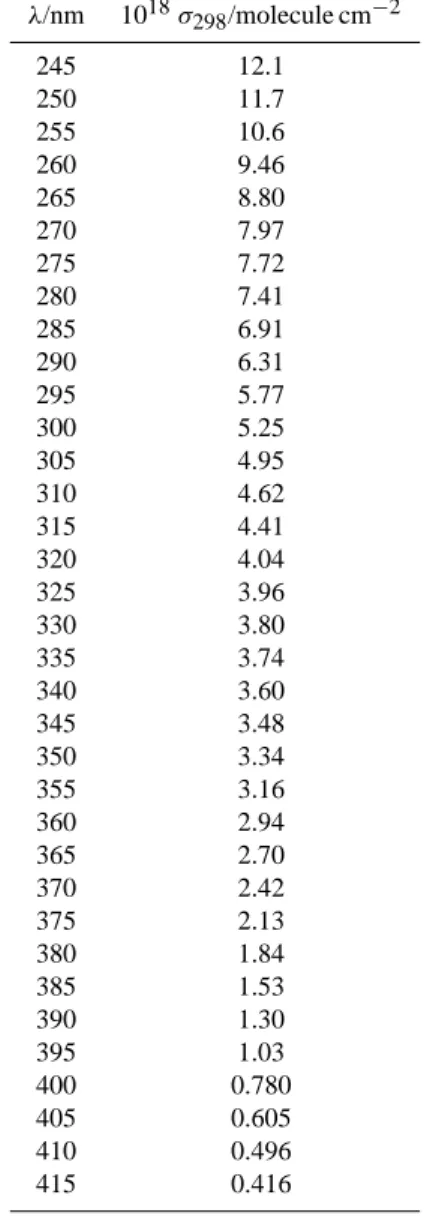
spectrum consists of a broad continuous absorption band as shown in Fig. 5. The IONO2cross-sections are listed in Ta-ble 3. There is also a possibility of a contribution to the apparent IONO2 spectrum from formation of light scatter-ing aerosol produced in the IO radical chemistry. A max-imum potential contribution to the absorption from aerosol
Table 3. The absorption cross-sections of IONO2at 298 K
λ/nm 1018σ298/molecule cm−2 245 12.1 250 11.7 255 10.6 260 9.46 265 8.80 270 7.97 275 7.72 280 7.41 285 6.91 290 6.31 295 5.77 300 5.25 305 4.95 310 4.62 315 4.41 320 4.04 325 3.96 330 3.80 335 3.74 340 3.60 345 3.48 350 3.34 355 3.16 360 2.94 365 2.70 370 2.42 375 2.13 380 1.84 385 1.53 390 1.30 395 1.03 400 0.780 405 0.605 410 0.496 415 0.416
was calculated assuming all absorption at λ = 450 nm was due to aerosol extinction and that the attenuation at lower wavelength followed a 1/λ4functional dependence on wave-length (Cox and Coker, 1983). After subtraction of this com-ponent the lower curve in Fig. 6 was obtained which
cor-responds to minimum values for the IONO2cross-sections.
Examination of time resolved absorption spectra also show no evidence for time delayed aerosol growth for the first two experiments performed in a clean flow tube. After rapid for-mation of IONO2the absorption remained constant over the whole time period of the experiment. Only after multiple experiments in the flow tube did we observe a time delayed increase in overall absorption with time, possibly due to the formation of aerosols, presumably from precursors formed in heterogeneous processes on the walls of the reaction cell.
232 J. C. M¨ossinger et al.: The UV-visible absorption cross-sections of IONO2
Figure 5. Absorption cross-sections of IONO2. Red diamonds: data recorded in the
245-335 nm and in the 385-415 nm wavelength region. Black line: Fit to data.
1E-19 1E-18 1E-17 1E-16 245 265 285 305 325 345 365 385 405 425 wavelength/nm cross-section/molecule cm -2 σΙΟΝΟ2 = 5.14E-18*EXP(-162.51*(LN(237.83/λ))^2)+8.27E-18* EXP(-20*(LN(257.63/λ))^2)+2.10e-18*EXP(-79.721*(LN(354.67/λ))^2)
Fig. 5. Absorption cross-sections of IONO2. Red diamonds: data recorded in the 245–335 nm and in the 385–415 nm wavelength re-gion. Black line: Fit to data.
Figure 6. Comparison of the absorption spectrum of IONO2 (red), the predicted
absorption due to aerosol formation as a function of 1/λ4 (black) and the contribution due to aerosol absorption subtracted from the original absorption spectrum of IONO2
(blue). 0 0.01 0.02 0.03 0.04 0.05 0.06 245 265 285 305 325 345 365 385 405 425 445 wavelength/nm Absorbance
Fig. 6. Comparison of the absorption spectrum of IONO2(red), the predicted absorption due to aerosol formation as a function of 1/λ4 (black) and the contribution due to aerosol absorption subtracted from the original absorption spectrum of IONO2(blue).
Figure 7 shows a comparison of the IONO2 absorption
and the (IONO2-aerosol) absorption with those of ClONO2 (Burkholder et al., 1994) and BrONO2 (Burkholder et al., 1995). All spectra show similar broad band absorption fea-tures. The absorption due to IONO2is red shifted and is sig-nificantly more intense at all wavelengths than the chlorine and bromine analogues.
4 Atmospheric implications
The IONO2 absorption cross-sections recorded here were
used to calculate the tropospheric solar photolysis rate of IONO2using a photochemical box model (McFiggans et al.,
2000). We assumed a quantum yield of unity for IONO2
photolysis throughout the absorption band. The resulting photolysis rate coefficient (J -value) for IONO2is shown in Fig. 8 as a function of time of day in the marine boundary
layer, for July 53◦N at Mace Head, Ireland, where
mea-Fig 7 Fig8 0 0.005 0.01 0.015 0.02 0.025 0.03 0.035 0.04 0.045 0 2 4 6 8 10 12 14 16 18 20 22 24 time of day/hours jION O2 /s -1 1E-22 1E-21 1E-20 1E-19 1E-18 1E-17 1E-16 245 295 345 395 445 495 545 wavelength/ nm cr o ss-sect io n / mo lecu le cm -2
Fig. 7. Comparison of the absorption spectra of ClONO2(black), BrONO2(green), IONO2(red) and (IONO2-aerosol) contribution (blue). Fig 7 Fig8 0 0.005 0.01 0.015 0.02 0.025 0.03 0.035 0.04 0.045 0 2 4 6 8 10 12 14 16 18 20 22 24 time of day/hours jION O2 /s -1 1E-22 1E-21 1E-20 1E-19 1E-18 1E-17 1E-16 245 295 345 395 445 495 545 wavelength/ nm cr o ss-sect io n / mo lecu le cm -2
Fig. 8. J -values for IONO2as a function of time of day in the marine boundary layer, for midsummer 53◦N (Mace Head, Ireland, July 1997).
surements of atmospheric composition had taken place in
1997. The calculated photolytic lifetime of IONO2 under
these conditions is less than one minute. At the same loca-tion and time, the surface to volume ratio (S/V ) of the fine fraction of the sea-salt aerosol present was determined to be
(6 ± 1) × 10−7cm2cm−3with an effective particle radius of 2.5 × 10⁻⁵cm (McFiggans et al., 2000). Using these values, the lifetime of IONO2with respect to heterogeneous uptake on sea-salt aerosols, τhet[s], was calculated to be ∼ 10 h us-ing Eqs. (4) and (5) below, and assumus-ing a reactive uptake coefficient of γ = 0.01 (Holmes et al., 2001). Equation (4) assumes spherical geometry of the sea-salt particle. It also takes diffusion of IONO2to the particle surface into account (Turco et al., 1989). khet= 0.25 × γ × ω × S/V (1 + (3 × γ × r)/(4 × λ)) (4) τhet= 1 khet (5)
J. C. M¨ossinger et al.: The UV-visible absorption cross-sections of IONO2 233
where ω = the average molecular speed of IONO2 at any
given temperature [cm s−1], khet = first order rate constant for loss of IONO2on the aerosol [s−1], λ = mean free path of a molecule in air at any given temperature and pressure [cm]. During daytime, solar photolysis is thus expected to be the major loss process for IONO2and IOxis not lost from the
gas phase. However, the reaction of IONO2 with sea-salt
aerosol may become a significant loss process for IONO2
during night time. Uptake of IONO2 is expected to form
the di-halogens ICl and IBr (Holmes et al., 2001), which are released into the gas phase during the night. At dawn, IBr and ICl are photolysed. Hence IOx would not be lost per-manently from the gas phase via this reaction as suggested previously (Chatfield and Crutzen, 1990; Davis et al., 1996; Jenkin, 1992), and the uptake of IONO2represents a route to liberation of bromide and chloride from sea-salt aerosols, as has been predicted by more recent modelling studies (Mc-Figgans et al., 2000; Vogt et al., 1999). Thermal decomposi-tion of IONO2may also contribute to the night time loss of
IONO2. However, recent observations have shown that the
lifetime of IONO2with respect to thermal decomposition at 298 K is approximately 6 min with a lower limit of 2.4 min (Allan and Plane, 2002).
Depending upon the photolysis product yields, photolysis of IONO2could contribute directly to ozone destruction via the following reaction cycle:
IO + NO2+M → IONO2+M (R1) IONO2+hν →I + NO3 (R2b) NO3+hν →NO + O2 (R7) NO + O3→NO2+O2 (R8) I + O3→IO + O2 (R9) 2 O3→3 O2
However, it is important to note, that this cycle will not op-erate if the products of IONO2photolysis are IO + NO2. No studies of the photolysis products of IONO2 have been re-ported, and such studies are essential to elucidate further the role of atmospheric IONO2.
5 Conclusions
The UV-visible cross-sections of IONO2 have been
deter-mined over the wavelength ranges 245–335 nm and 385– 415 nm. Both data sets were used to interpolate an IONO2 absorption spectrum over the wavelength range of 245– 415 nm. The resulting spectrum consists of several
over-lapping broad absorption bands. Based on the IONO2
ab-sorption cross-section, the tropospheric solar photolysis rate
coefficient of IONO2 has been calculated. This indicates
that the photochemical lifetime of atmospheric IONO2 is
less than one minute under most sunlit conditions and conse-quently that photolysis is the main loss process for gaseous IONO2. Thus, IONO2is thus not expected to act as a stable reservoir of atmospheric iodine during daytime.
Acknowledgements. The authors thank William Bloss for help with
the experimental system and Gordon McFiggans and Xin Yang for calculating the photolysis rate coefficients for IONO2. Many thanks to John Crowley for helpful comments on the manuscript. J. C. M¨ossinger would like to thank Girton College Cambridge for a Ju-nior Research Fellowship. D. M. Rowley would like to thank NERC for the award of an Advanced Fellowship.
References
Allan, B. J. and Plane, J. M. C.: A study of the recombination of IO with NO2, and the stability of INO3: implications for the atmospheric chemistry of iodine, J. Phys. Chem., in press, 2002. Addison, M. C., Donovan, R. J., and Gamanay, J.: Reactions of O(21D2) + O(23Pj) with halogenomethanes, Farad. Discuss. Chem. Soc., 286–293, 1979.
Atkinson, R., Baulch, D. J., Cox, R. A., Hampson, Jr., R. F., Kerr, J. A., and Troe, J.: Evaluated Kinetic and Photochemical Data for Atmospheric Chemistry, Supplement VIII, J. Phys. Chem. Ref. Data, 167–266, 2000.
Bloss, W. J., Rowley, D. M., Cox, R. A., and Jones, R. L.: Ki-netic and products of the IO self reaction, J. Phys. Chem. A, 105, 7840–7854, 2001.
Burkholder, J. B., Ravishankara, A. R., and Solomon, S.: Temperature-dependence of the ClONO2 UV absorption spec-trum, Geophys. Res. Lett., 21, 585–588, 1994.
Burkholder, J. B., Ravishankara, A. R., and Solomon, S.: UV vis-ible and IR absorption cross-sections of BrONO2, J. Geophys. Res., 100, 16 793–16 800, 1995.
Broske, R. and Zabel, F.: The UV-visible absorption spectrum of IONO2, in: Laboratory Experiments of Iodine Chemistry in the Stratosphere-LEXIS, EC, Brussels, 1998.
Chambers, R. M., Heard, A. C., and Wayne, R. P.: Inorganic gas-phase reactions of the nitrate radical: I2+ NO3and I + NO3, J. Phys. Chem., 96, 3321–3331, 1992.
Chameides, W. L. and Davis, D. D.: Iodine: Its possible role in tropospheric photochemistry, J.Geophys. Res., 85, 7383–7393, 1980.
Chatfield, R. B. and Crutzen, P. J.: Are there interactions of io-dine and sulfur species in marine air photochemistry, J. Geophys. Res., 95D, 22 319–22 341, 1990.
Cox, R. A. and Coker, G. B.: Absorption cross-section and kinetics of IO in the photolysis of CH3I in the presence of ozone, J. Phys. Chem., 87, 4478–4484, 1983.
Curtis, A. R. and Sweetenham, W. P.: FACSIMILE, AERE Harwell publication R 12805, Computer Science and Systems Division, Harwell Laboratory, Oxfordshire, UK, 1987.
Davis, D., Crawford, J., Liu, S., McKeen, S., Bandy, A., Thornton, D., Rowland, F., and Blake, D.: Potential impact of iodine on tro-pospheric levels of ozone and other critical oxidants, J. Geophys. Res., 101, 2135–2147, 1996.
DeMore, W. B., Sander, S. P., Golden, D. M., Hampson, R. F., Kurylo, M. J., Howard, C. J., Ravishankara, A. R., Colb, C. E., and Molina, M. J.: Chemical Kinetics and Photochemical Data
234 J. C. M¨ossinger et al.: The UV-visible absorption cross-sections of IONO2 for use in Stratospheric Modeling, Evaluation No 12. Pasadena,
CA, Jet Propulsion Laboratory, 1997.
Dillon, T.: Ph.D. thesis, University of Leeds, UK, 2001.
Gilles, M. K., Turnipseed, A. A., Talukdar, R. K., Rudich, Y., Vil-lalte, P. W., Huey, L. G., Burkholder, J. B., and Ravishankara, A. R.: Reactions of O (P-3) with alkyl iodides: Rate coefficients and reaction products, J. Phys. Chem., 100, 14 005–14 015, 1996. Holmes, N. S., Adams, J. W., and Crowley, J. N.: Uptake and
reac-tion of HOI and IONO2on frozen and dry NaCl/NaBr surfaces and H2SO4, Phys. Chem. Chem. Phys., 3, 1679–1687, 2001. Jenkin, M. E.: The photochemistry of iodine containing compounds
in the marine boundary layer, Technical Report AEA-EE-0405, Harwell Laboratory, Oxfordshire, UK, 1992.
Jenkin, M. E., Cox, R. A., and Candeland, D. E.: Photochemical as-pect of tropospheric iodine behaviour, J. Atmos. Chem., 2, 359– 375, 1985.
Ley, L., Masanet, J., Canalp, F., and Lesclaux, R.: Kinetics of the association reactions of NO with the series of chlorofluoromethyl radicals CFxCl3−x, J. Phys. Chem., 99, 1953–1960, 1995. McFiggans, G., Plane, J. M. C., Allan, B. J., Carpenter, L. J., Coe,
H., and O’Dowd, C.: A modelling study of iodine chemistry in the marine boundary layer, J. Geophys. Res.-Atmos., 105, 14 363–14 369, 2000.
Pagsberg, P., Jodkowski, J. T., Ratajzak, E., and Sillesen, A.: Ex-perimental and theoretical studies of the reaction between CF3+ NO2at 298 K, Chem. Phys. Lett., 286, 138–144, 1998.
Rossi, M. J. and Golden, D. M.: Rate of the decomposition of hex-afluoroazomethane and the absolute rate of recombination of tri-fluoromethyl radical at higher temperatures, Int. J. Chem. Kinet., 11, 775–783, 1979.
Rowley, D. M., Harwood, M. H., Freshwater, R. A., and Jones, R. L.: A novel flash photolysis/UV absorption system employing charge-coupled device (CCD) detection: A study of the BrO + BrO reaction at 298 K, J. Phys. Chem., 100, 3020–3031, 1996. Schmeisser, M. and Braendle, K.: Halogennitrate und ihre
Reaktio-nen, Angew. Chem., 73, 388–393, 1961.
Turco, R. P., Toon, O. B., and Hamill, P.: Heterogeneous physico-chemistry of the polar ozone hole, J. Geophys. Res., 94, 16 493– 16 510, 1989.
van den Bergh, H. and Troe, J.: Kinetic and thermodynamic prop-erties of INO + INO2intermediate complexes in iodine recombi-nation, J. Chem. Phys., 64, 736–748, 1976.
Vogt, R., Sander, R., Glasow von, R., and Crutzen, P. J.: Iodine chemistry and its role in halogen activation and ozone loss in the marine boundary layer: A model study, J. Atmos. Chem., 32, 375–395, 1999.