HAL Id: hal-00182837
https://hal.archives-ouvertes.fr/hal-00182837
Submitted on 24 Feb 2020
HAL is a multi-disciplinary open access
archive for the deposit and dissemination of
sci-entific research documents, whether they are
pub-lished or not. The documents may come from
teaching and research institutions in France or
abroad, or from public or private research centers.
L’archive ouverte pluridisciplinaire HAL, est
destinée au dépôt et à la diffusion de documents
scientifiques de niveau recherche, publiés ou non,
émanant des établissements d’enseignement et de
recherche français ou étrangers, des laboratoires
publics ou privés.
Accuracy of solitary wave generation by a piston wave
maker
Katell Guizien, Eric Barthélemy
To cite this version:
Katell Guizien, Eric Barthélemy. Accuracy of solitary wave generation by a piston wave maker. Journal
of Hydraulic Research, Taylor & Francis, 2002, 40 (3), pp.321-331. �10.1080/00221680209499946�.
�hal-00182837�
Accuracy of solitary wave generation by a piston wave maker.
Precision de la generation d'une onde solitaire par un batteur piston.
GUIZIEN KATELL, Laboratoire des Ecoulements Geophysiques et lndustriels, BP 53, 38041 Grenoble Cedex 9, France. Tel: +33 4 76 82 51 17 I Fax: +33 4 76 82 50 OJ I E-mail: [email protected]
BARTHELEMY ERIC. Laboratoire des Ecoulements Geophysiques et Industriels, BP 53, 38041 Grenoble Cede.r 9, France. ABSTRACT
A new experimental procedure to generate solitary waves in a flume using a piston type wave maker is derived from Rayleigh's ( 1 876 , [ 1 8]) solitary wave solution. Resulting solitary waves for dimensionless amplitudes£ ranging from 0.05 to 0.5 are as pure as the ones generated using Goring's ( 1978. [7]) procedure which is based on Boussinesq ( 1 871 a, [ 1 ]) solitary wave , with trailing waves of amplitude lower than 3 % of the main pulse amplitude. Ln contrast with Goring's procedure. the new procedure results in very little loss of amplitude in the initial stage of the propagation of the solitary waves. We show that solitary waves generated using this new procedure are more rapidly established. This is attributed to the better description of the outskirts decay coefficient in a solitary wave given by Rayleigh's solution rather than by a Boussinesq expression. Two other generation procedures based on first-order (KdV) and second order shallow water theories are also tested. Solitary waves generated by the latter are of much lower quality than those generated with Rayleigh or Boussinesq-based procedures.
RESUME
Une nouvelle procedure experimentale pour generer des ondes solitaires dans un canal a !'aide d'un batteur p iston est proposee a partir de Ia solution on de solitaire de Rayleigh ( 1 876. [ 1 8]). Les on des solitaires produites pour des amplitudes reduites £all ant de 0.05 a 0.5 sont aussi pures que celles obtenues par Goring ( 1 978. [7]) a !'aide d'une procedure basee sur !'expression on de solitaire de Boussinesq ( 1 871 a . [I]). L'amplitude des ondes suivant le pic principal ne depasse pas 3% de !'amplitude de celui-ci. Le pic principal des ondes generees avec cette nouvelle procedure diminue tres peu en amplitude. contrairement a celles de Goring. On montre que les ondes generees a !'aide de cette procedure sont done plus rapidement etablies. Ceci est attribue a une meilleure description du para metre de ten dance dans Ia solution onde solitaire de Rayleigh que dans I' expression de Boussinesq. Deux autres procedures basee sur les theories au premier et second ordre de l'eau peu profonde sont aussi testees. Les ondes solitaires generees par ces deux demieres procedures sont de bien moindre qualite que celles obtenues avec les procedures basees sur Rayleigh ou Boussinesq.
Keywords : solitary wave, generation , piston wave maker. experiments.
1. Introduction
The aim of this study is to assess solitary wave generation proce dures. Hammack and Segur (1 974, [ 1 0]) showed experimentally and theoretically that from any net positive volume of water above the still water level, at least one solitary wave will emerge followed by a train of (dispersive) waves. Thus, different proce dures have been used to generate solitary waves. Scott Russel ( 1 845, [20]) generated solitary waves by allowing a solid weight to fall from near the surface to the bottom of a tank. Similarly, Daily and Stephan ( 1952, [6]) displaced a given mass of water by the vet1ical motion of a piston rising from the bottom of a tank. They also tested a method consisting in releasing a mass of water behind a moveable barrier at one end of a flume. Goring ( 1 978, [7]) studied in detail the generation of solitary waves using a pis ton-type wave maker.
Our concern in this study is to generate solitary wave as 'pure' as possible. This means we have focussed our efforts in generating waves with minimised trailing waves but also of stable amplitude during propagation. These concerns have scientific practical im portance. For instance. the study of solitary wave reflection (Renouard et al., 1985 [ 1 9]) or of interaction of either solitary waves with solitary waves or monochromatic waves with solitary waves (Guizien and Barthelemy, 2000 [9]) require waves as pure
as possible, especially if phase shifts are to be measured. Since long waves are associated to quasi vertically uniform hori zontal velocity, the piston-type wave maker seems a natural gen eration device. However it is technically more difficult to set up than the other generation means cited above. Without paying much attention to the way in which the generator is displaced (mass falling or rising, barrier, wave maker), the success of all these methods is based on the fact that the largest solitary wave outruns any transient dispersive disturbance and also any other solitary wave of lower amplitude for sufficient propagation dis tances. Indeed, as the dimensionless amplitude of a solitary wave increases up to£= 0.796 (E = A!h0 where A is the solitary wave amplitude and h0 is the mean water depth), its phase speed in creases. However, above this value, the phase speed tends to de crease (Longuet-Higgins and Fenton, 1 974 [ 1 5], Byatt-Smith and Longuet-Higgins, 1 976 [ 4]). Regarding generation, this feature raises a major problem, as highlighted by Longuet-Higgins ( 198 1 , [ 14]) because, together with the phase speed, the total displaced mass decreases over the upper range of solitary wave amplitude. Hence, there are actually two waves of different amplitude with the same displaced mass. Thus, using the aforementioned proce dures, two distinct solitary waves may emerge. However, in most applications, generating the largest solitary wave is not so impor tant.
The usual procedure for long-wave and more specifically solitary wave generation consists in matching the paddle velocity at each position in time with the vertically averaged horizontal velocity of the wave. Mathematically this is expressed in the following way:
dX --=u(X,t)
dt (1)
-where x =X is the paddle position along the x-axis and u(x,t) is the long wave depth-averaged horizontal velocity in the labora tory frame of reference. The x-axis is the centreline of the flume. taking the origin x = 0 at the back position of the piston stroke as defined on figure l . This contrasts with the approach taken by Synolakis ( 1 990, [23]) who solved an inverse evol ution problem of the Korteweg-De Vries (KdV) equation in order to generate arbitrary long waves at any location in a horizontal flume. In the present paper, we discuss Goring's procedure which is based on Boussinesq ( 187 l a, [I J) solitary wave solution in com
parison with four generation laws derived from other existing solitary wave solutions. Two generation laws are obtained using Rayleigh's ( 1 876. [ 18]) solitary wave solution. Indeed, by assum ing a small displacement, an analytical law of motion can be de rived from the integration of equation ( J) in which the Rayleigh solitary wave solution is used. This analytical law of motion is compared with a law of motion obtained after fitting the numeri cal integration of equation ( 1), also using Rayleigh's solution. by a hyperbolic tangent. The other two laws of motion tested in this study are derived from linearization of the Lagrangian formula tion in the first-order (or Korteweg and De Vries) and second order shallow water theories (Temperville. 1 985 [241). In our ex periments, we use a very similar device to the one used by Gor ing. that is described in section 3. In section 4, performances of
the tested laws of motion are compared. In order to understand the good performance of both Goring procedure and the law of motion based on Rayleigh's sol itary wave solution, paddle laws of motion are discussed in section 5 in comparison with the one deduced from Byatt-Smith's (1970, [3J) numerical solution.
2. Wave maker laws of motion
ln this section. we present the different laws of motion to be pre scribed to the paddle in order to generate a solitary wave. A soli tary wave is a steady solution in the wave co-moving frame trav elling at the wave phase speed c. Hence, equation (I), that gives
the paddle position X in the laboratory frame of reference, can be
written after a change of variables from (x,/) to (8 = ct -X,t) in the general form:
-dX u(8(X))
de c-u(8(X))
(2)
In equation (2), the solitary wave depth-averaged horizontal ve locity can be given by various theories. Amongst them, the Boussinesq ( 1 871 a, [I]) and Rayleigh (I 876, [I 81) solitary waves have the following same functional form:
�(S)
= c1")(8)hil
+ 11(8)(3)
(4)
where A is the solitary wave amplitude, h11 the mean water depth, c the phase speed, � the outskirts decay coefficient, 11(8) the free surface elevation from rest and u(8) the depth-averaged horizon tal velocity. The two solitary wave expressions differ in terms of the values of c and �- Then, integrating (2) with (3) and (4)
yields: 2A
X(t) =-tanh[�(ct-X(t))/2] (5)
hil�
From (5), the total stroke of the paddleS can be deduced: (6)
The duration'! of the paddle motion can be determined after trun cation of the infinite theoretical Jaw of motion:
rrsist i w� prol1es posit ions
second srt .r1 = 5m .r'l. =10m .r:1 =15m .. r..t =20m .T.'i =25m .t: = 0 :r = S first set. .1" = .\" .c1 = Gm piston type· wan• maker a' :t:1 = 19.5m · · · Xu= 21.0m
L±±±J
-'"' = 0.511l II= ct- .r .4 :r = 36111I
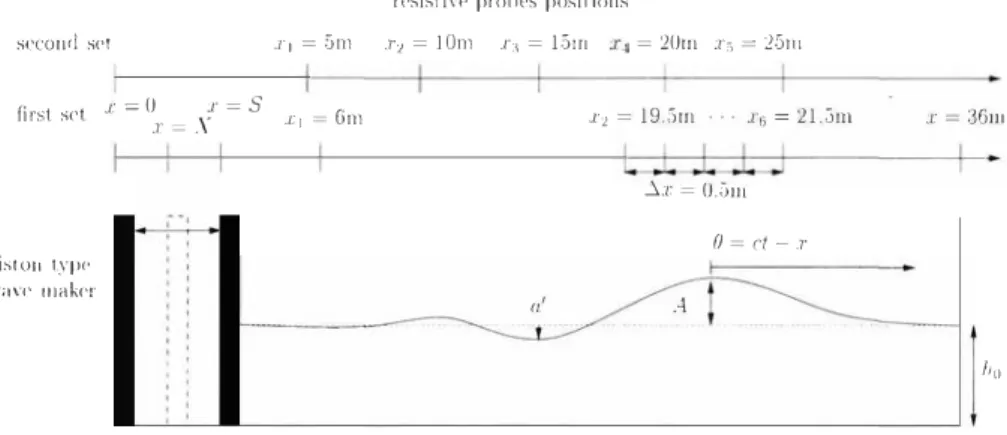
• ""Fig. I Sketch and dimensions of the experimental equipment. The .<s are the resistive probes positions. (0.2 <:: h0 <:: 0.3 m. 0.015 <;A <; 0.15 m. a'<; 0.1 A. S <; 0.55 m).
1 =
�
[
tanh-1(0.999)+�
J
�c
h0
2.1
Goring/ Boussinesq
(7)
In his study, Goring ( 1 978, [7]) first tackled the question of minimising trailing waves in solitary waves generation. He chose a procedure based on the Boussinesq ( 1 871a, [I] ) solitary wave expression. Following Daily and Stephan' s ( 1 952, [6]) conclu sions regarding the best agreement of this expression with experi ments, he chose the following values for c and � in (5):
f1_
=
� 3A
2
4h,;
(8)(9)
In his study, Goring used both a paddle law of motion derived from th� full equation (5) and� simplified paddle law of motion taking u(X,t) to be equal to
u(O,t)
in equation (1 ). This yields the following expression:X
(I)= Sc;
tanh[7.6(t h- 0.5)]where s. (,
= 4) Aho
is the total stroke of the paddle.3
These two laws of motion were prescribed for the paddle by means of a hydraulic servo-system. The solitary waves generated experimentally using the simplified procedure were followed by a dispersive tail of
I
0% of the amplitude of the main pulse. Us ing the paddle law of motion derived from the full equation, trail ing wave amplitude is drastically reduced. Yet, it was noted that by taking a duration of motion I 0 % longer than that given by (7) with (8) and (9), the amplitude of the trailing dispersive waves was even more reduced. The two experimental records plotted by Goring ([7], pp 123 and 1 30) show nearly pure solitary waves generated using this longer duration. Yet, the resulting solitary waves show a rapid decrease in amplitude, larger than what can be attributed to friction.2.2
Shallow water first order/KdV
Clamond and Germain (1 999, [5]) used a paddle law of motion XKdv(t) derived from the KdV (or first-order shallow water) solu tion and written:
( 1 0)
where �Kdv
=
�--;;;:
�
and cKrtv=.Jiih:[t+__i_l·
2h[J
The paddlestroke is thus s Kdf! =
4) Aho
, the same as that derived from 3Boussinesq's solitary wave form in Goring's procedure. This is obtained from calculations in Lagrangian form after linearization around X
=
0.2.3
Shallow water second order
In the same way and following calculations from Temperville ( 1 985, [24]), a second-order shallow-water paddle law of motion
can be derived. For a soli tary wave of amplitude
A,
the paddlelaw of motion x,.2(t) is:
�[
A'
l
x�\V1(t) =
2�3
I+
h;
tanh(�S\V2Csw/ I 2 )+ �
�
3A
' tanh(�swF,w/ / 2 ) 34h0
cosh2(�m·F1w/ / 2 ) (I I)[
']
3A'
A'
1 9A'
-where
�
.1w2 =� ,
, c1w2=
.jih;;
I+
-
+
-
[
-)
andh0
2h0 40 h0
A A
'[
SA'
]
ho
=h;
I+4ho
.�[
A'
l
The paddle stroke is thus s\IV1
= 4�3 I+
h;
. In practicethis law is truncated with respect to the precision of experimental device and the last term can be neglected.
2.4
Rayleigh
Shallow water approximation relies on both long waves and small amplitude assumptions. Avoiding the latter restriction of small amplitude, it is possible to derive a set of equations for non linear waves (Mei, 1 992 [ 1 6]). Indeed, assuming the Ursell number
U,=£k:}
to be of order 1 (£""cr2 with cr=h1/ 1\ where 1\=21� is a hori zontal length scale of the solitary wave), Whitham ( 1 974, [25]) derived the Boussinesq equations (see eq. ( 13.10I)
in Whitham, 1 974 [25]). Without making this assumption, namely allowing £ to be of order 1 , the following set of equations is derived after truncating at the order cr4 ( Serre, 1 953 [21 ], Su and Gardner, 1 969 [22]):1l,+[(h0+1l)�l=O
(12) - -- 2h
+11
u,+uu, +gll .+-)'11 .+-'-'
-y =0
' 3 ' 3 ' (1 3) ( 1 4) SetTe (1 953, [21 ] ) found a solitary wave solution for this set of equations which is actually the solitary wave solution that Ray leigh (1876, [1 8], see also Lamb, 1 932 [13 ] ) found for the steady progressive solution described by Russel and has the form (3) taking:f1_
3A
24h,�(A+h0)
CR=�g(A+h0)
( 15) ( 1 6)It should be noted here that Rayleigh's solitary wave solution dif fers from the conjectured Boussinesq solitary wave form by the
outskirts decay coefficient
p
(Miles, 1980 [ 1 7] ). The paddle posi tion X is thus given by equation (5) incorporating (15) and ( 1 6).k . . b A(A + h0)
Hence the paddle stro e ' IS given y S = 4 .
R
3
Equation (5) together with ( 1 5) and ( 16) can be solved either nu merically or, if small displacements are assumed, explicitly after linearization:
( 1 7)
A hyperbolic tangent function of the form X(t) = a tanh(8t) can be fitted in the least square sense on the numerical integration of equation (5), where c and Pare given by ( 1 5) and (16). The coef
ficients a and
p
corresponding to the experiments are reported in table 1 .Table I Coefficients for the hyperbolic tangent function a tanh(�t) fitted on the numerical integration of (I) for Rayleigh's solitary wave solution. f. h0 = 0.2 m h0 = 0.3 m a
p
ap
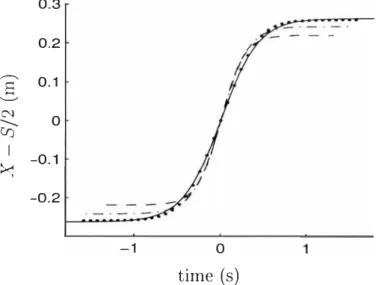
0.05 - - 0.0795 1.0622 0.10 0.0768 1.7675 0. 1 152 1.4432 0. 1 5 - - 0. 1 446 1.7000 0.20 0.1 1 39 2.3147 0. 1 708 1.8899 0.25 - - 0.1 952 2.0364 0.30 0.1457 2.6349 0.2 1 85 2. 1 513 0.35 - - 0.2409 2.2427 0.40 0.1752 2.8356 0.2628 2.3 1 52 0.45 - - 0.2843 2.3726 0.50 0.2036 2.9607 - -0.60 0.23 1 4 3.0337 --For practical purposes, the paddle laws of motion are all truncated using the following same criterion, namely by imposing tanh(8t) = 0.9999. Figure 2 shows these different laws of motion for the same expected resulting solitary wave. The two paddle laws of motion derived from Rayleigh's solution lead to larger paddle displacements than paddle laws of motion derived from KdV or second-order shallow-water theory. As paddle displace ments are limited by jack length, the maximum dimensionless amplitude generated using paddle laws of motion derived from Rayleigh' s solution would be smaller than those derived from KdV.
3. Experiments description
The experiments are conducted in a 36 m long, 0.55 m wide and 1.2 m high flume as sketched on figure 1. At one end of the flume a piston-type wave maker can be displaced horizontally. The
pis-_..-...
s
-...-C'l ....___ tr.:;_ I><
Fig. 2 0.3 0.2 0.1 0 -0.1 -0.2 -1 0time (s)
The four laws of motion tested for a solitary wave of dimensionless amplitude£= 0.4 with a water depth h0 = 0.3 m: first-order shallow water(- -); second-order shallow water(-.-); hyperbolic tangent fitted to Rayleigh numerical integration(-); analytical linearization of Rayleigh-based law of motion( . . . ).
ton is linked to a hydraulic jack capable of a 550 mm stroke. The control system is monitored by a computer. Different motions of the paddle can be prescribed by the computer, enabling the gener ation of either solitary waves or sinusoidal waves. Nevertheless the piston-type wave maker is more appropriate for long wave generation since it displaces the entire water column uniformly. However, we need to prescribe the appropriate law of motion for the paddle in order to produce solitary waves that are as pure as possible. The different laws of motion detailed in the previous sections are tested. A solitary wave of expected amplitude A is generated using each law. The two Rayleigh laws require larger paddle displacement than the shallow-water laws. With regard to the finite stroke of the jack, the laws deduced from the Rayleigh solution lead to smaller solitary wave amplitudes.
For a water depth h0 = 0.3 m, the upper bound of the solitary wave dimensionless amplitude f.= Alh0 is 0.35, while using the first-order shallow water law allows a dimensionless amplitude up to 0.5. We generate the broader range of dimensionless soli tary wave amplitudes possible for depths at rest of h0 = 0.3 m (£ varies from 0.05 to 0.35) and h0 = 0.2 m (£varies from 0. 1 to 0.6). Surface displacements during the experiments are measured i n fixed locations by resistive probes. Probe precision is estimated to be 0.5 mm for free surface elevations lower than 5 em and at 1 mm beyond this limit. This is due to probe calibration (Guizien, 1998 [8]). This means that the relative error in the dimensionless amplitude is about 3 % for the smallest solitary waves (£= 0.05) and is less than 2 % for the others. All experimental recordings are measurements of free surface displacement against time (be tween 1 5 and 25 seconds duration). Two series of experiments were performed. In the first set (h0 = 0.2 m and h0 = 0.3 m), the probes are located along the centreline of the flume to avoid lat eral perturbations, at x1 = 6 m and every 0.5 m between x2 =
19.5 m and x6 = 2 1 .5 m. In the second set (h0 = 0.3 m), five probes are located every 5 m up to 25 m. All distances are given from the flume end where the paddle is located.
4. Experimental results
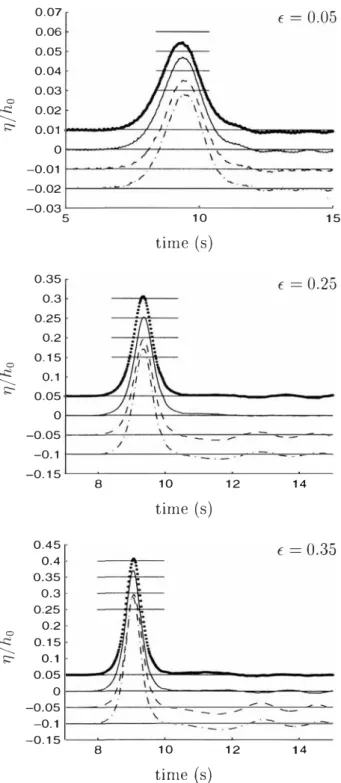
Figures 3 shows the free surface elevation measured at a distance x = 67 h0 from the wave maker end of the flume, corresponding to solitary waves generated using the four paddle laws of motion with £= a!h0 ranging from 0.05 to 0.35 for h0 = 0.3 m. Figures 4
represents the same measured at x = I 00h0 from the paddle with £ranging from 0.1 to 0.6 for h0 = 0.2 m. These measurements correspond to the first set of experiments.
0.07 E = 0.05 0.06 0.05 0.04 0.03 0 ..::: 0.02 ---,:::- 0.01 0 -0.01 , I / -0.02 . .-' -0.03 5 10 15 time
(s)
0.35 E = 0.25 0.3 0.25 0.2 0.15 0 ..::: 0.1 ---,:::- 0.05 0 -0.05 ' / ' -0.1 -0.15 8 10 12 14 time(s)
0.45 E = 0.35 0.4 0.35 0.3 0.25 0.2 0 ..::: 0.15 ---,:::- 0.1 0.05 0 -0.05 ,. I'-' -0.1 · --0.15 8 10 12 14 time(s)
Fig. 3 Solitary waves generated using the 4 laws of motion con sidered (same legend as fig.! - The horizontal solid line represents the prescribed main pulse amplitude.)- Record of free surface elevation at x = 67 h0 away from the pad dle with h11 = 0.3 m. 0.14 E = 0.1 0.12 0.1 0.08 0.06 0 ..::: 0.04 ---,:::- 0.02 0 / \ ' -0.02 \ -0.04 -0.06 10 12 14 16 time
(
s)
E = 0.3 I 0.4 0.35 0.3 0.25 0.2..!?
0.15 --- 0.1,:::-J,r \:
)/'' �
0.05 1----/4JJ,,L....:ll\�,\_:'!ooo.---o�---L�--�=---==--- -0.05�----�-1�'--�'� ' ��--���J-� ��-- / \ -0.1 �----��--��---.�- �-�.�-�.��-=� -0.15 L---�---�---�---�-10 12 14 16 time(
s)
0.6 s t:= 0 .5 0.5 0.4 0.3 0 ..::: 0.2 --- ,:::-0.1}!; \.
-0 /, � ' --0.1 . � -0.2 10 12 14 16 time(s)
0.7 E = 0.6 0.6 • 0.5 0.4 0 0.3 ...:: ---,:::- 0.2 0.1 �}!
\�
- -0 /I -- ----� '- --0.1 ./ ' - -. ·--0.2 10 12 14 16 time(
s)
Fig. 4 Solitary waves generated using the 4 laws of motion con sidered (same legend as fig. I and 3)- Record of free sur face elevation at x = I 00 h0 away from the paddle with
All solitary waves generated using a paddle law of motion de rived from KdV or second-order shallow water theory exhibit a trough (dispersive wave) after the main pulse whereas using pad dle laws of motion derived from Rayleigh, a bump (maybe a smaller solitary wave) trails it. It is noticeable that the bumps are of smaller amplitude than the troughs, except for the largest waves with £ = 0.6 for h0 = 0.2 m. Indeed, this case behaves dif ferently. There is sometimes breaking or two solitary waves are clearly generated for laws of motion giving good results for lower amplitudes and the worst law of motion suddenly gives better results. This latter feature was already observed for £ = 0.5 with the second-order shallow water procedure. In fact, the limit of the dynamic servo-controller is reached for such waves. The discrep ancy between the prescribed and actual paddle motion is no lon ger negligible, due to the very large acceleration required. On figure 5, the paddle laws of motion corresponding to the hyper bolic tangent function fitted to a Rayleigh numerical integration are plotted for £ ranging from 0. 1 to 0.6. Greatest accelerations occur somewhere between the beginning of motion (zero veloc ity) and mid-stroke (maximum velocity). Qualitatively, the larger the maximum velocity and the shorter the duration of motion, the greater the acceleration. From figure 5, it may be expected that the maximum acceleration will increase with the amplitude of the solitary wave and may reach the limit of the servo-controller. From figure 2, it may also be noted that for a prescribed ampli tude, the law of motion based on the second-order shallow water theory requires greater acceleration than the other procedures. This explains why for this law of motion the servo-controller limit is already reached when£= 0.5. Thus, we will exclude from our discussion the £= 0.6 experiment for all laws and the £ = 0.5 experiment for the second-order shallow water theory based pro cedure. Indeed, except for these cases, the actual paddle law of motion is sufficiently close to the prescribed one.
4.1 Trailing waves
Confident in the assumption that the system is capable of
follow-0.5 0 ...c: ---N' 0 ---Cf) I >< -0.5 � -1 -3 -2 -1 t =
0.6
t = 0.5 t = 0.4 t = 0.3 t = 0.2 t = 0.1 -maximum acceleration 0 time(s)
2 3Fig. 5 Laws of motion for solitary waves of dimensionless amplitude
£ ranging from 0.1 to 0.6 (h0 = 0.2 m) obtained from the linearized solution of (5) for a Rayleigh solitary wave. Maxi mum velocity is reached when t = 0 and maximum acceleration
occurs where the curvature is the greatest.
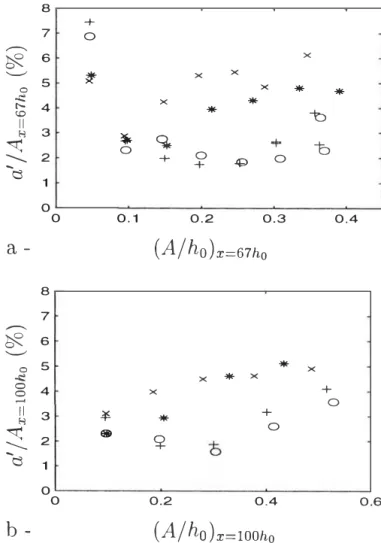
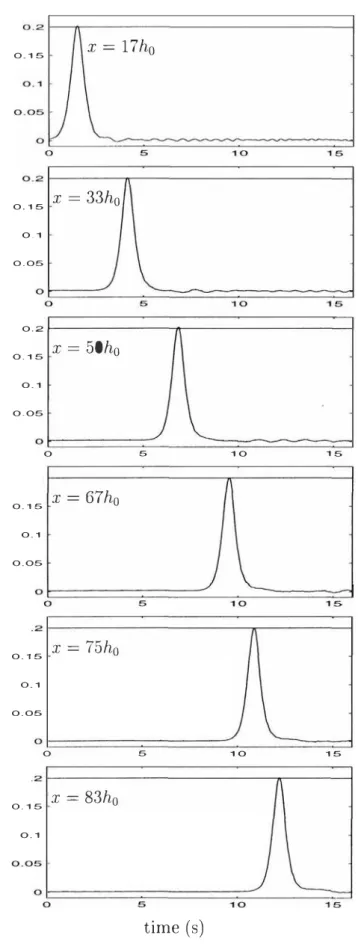
ing the desired law of motion, our interest is to minimise the trail ing waves. On fig. 6.a and .b, we present the amplitude a' of these bumps or troughs with respect to the main pulse amplitude measured at x = 67 h0 (resp. x = l 00h0) away from the paddle end of the flume for h0 = 0.3 m (resp. h0 = 0.2 m). The trough ampli tudes (on average 5 %) are sometimes more than twice those of the bumps (on average 3 % ). We also discuss the four procedures tested in our experiments in comparison to Goring's ( 1 978, [7]). The only records plotted in Goring's thesis correspond to small amplitude solitary waves (£ = 0. 1 , [7], p 1 23 and £ = 0.2, [7], p 1 30). In our experiments' equivalent, solitary waves generated using laws of motion derived from Rayleigh' s solution show sim ilarly small bumpy trailing waves with less than 3 % amplitude. Measurements of the free surface elevation at different distances from the paddle for a solitary wave of prescribed dimensionless amplitude£= 0.2 generated using Rayleigh's numerical integra tion are plotted on figure 7. This graph is comparable to the one produced by Goring ([7], p 1 30) regarding the trailing waves. Yet, in Goring's experiments, the solitary wave amplitude is se verely damped to £= 0. 1 5 atx = 85h0.
8 + 7 0 ---.
�
6 ...__., 5 0 � X X X ...c: I'- 4 <0 X * * II 3 H�
... 2C5
1 *�
+ 0 + + 0 ..q;;> 0 0 0 0.1 0.2 0.3 a-(A/ ho)x=67ho
8 7 ---.�
6 ...__., 0 5 ...c: X * X * 0 4 0 X ,... II 3 H�
2 ... -¥ * + 8 0�
C5
1 0 0 0.2 0.4b-
(A/ho)x=lOOho
X * * "'b � 0.4 X + 0 0.6Fig. 6 Relative amplitude of the first trailing wave a' (bump or trough) versus the dimensionless solitary wave amplitude. Solitary waves are generated using paddle laws of motion derived from KdV (x), second-order shallow-water theory (*), Rayleigh ana lytical (o) and Rayleigh numerical (+) solutions at (a) at x = 67
h0 away from the piston paddle for h0 = 0.3 m and (b) at x = I 00
0.2��.---4
1\
x = 17h0 0.15 0.2�---,�---4 x = 33hoI\
0.15 0.1 0.05 0.21---rtl\
___________________ -l x = 50ho 0.15 0.1 0.05 0 5 10 15 0.2�---��---�
x = 67ho 0.15 0.1 0.05o C=======�====�--���====�
0 5 10 15 0.21---�r�---�
x = 75ho 0.15 0.1 0.05 o t===================�--�==�==� 0 5 10 15 0.2�---�r---�
x = 83ho 0.15 0.1time (s)
Fig. 7 Solitary waves generated using the paddle motion based on the tanh fit on the numerical integration of equation (2) for Rayleigh solitary wave solution - Record of free surface elevation at dif ferent distances from the paddle (f. = 0.2 , h11 = 0.3 m).
4.2 Main pulse stability
By reproducing the same generation sequence several times, it becomes clear that the generated wave is highly reproducible, so that for a given paddle law, the solitary wave amplitude could be determined at any location in the flume together with the relative size of the trailing waves given the probe accuracy. During the second set of experiments, we studied the changes occurring in the first moments of propagation of the solitary wave emerging
from the KdV and Rayleigh solutions, between x = 1 7 h0 and x =
83h0 for h0 = 0.3 m (see figure 8). In the first and second set of
experiments, the amplitude of solitary waves generated using KdV or the second-order shallow water theory clearly decreases more as it propagates than it does when using Rayleigh. This can not be attributed only to damping by viscous friction as estimated by the Keulegan formula ( 1 948, [ 1 1 ]) although this formula gives a very good prediction of this dissipation, as tested by Renouard et al. ( 1 985, [ 1 9]). Indeed, from Keulegan' s formula, the ampli
tude decrease due to viscous dissipation over fu: = 45h0 would be
3.3 % whereas the measured damping over the same distance for solitary waves generated using KdY or the second-order shallow water theory varies between 5 and 6 %. For a solitary wave gen erated using Rayleigh, this damping is no more than 3 %, and on average 1 .5 %.
This loss of amplitude is also observed in the experiments by Goring ([7], p 1 30). Indeed, for a solitary wave of initial dimensionless amplitude £= 0. 1 75 (h0 = 0.1 m, which is already
6 � >::- a-6 � >::- b-Fig. 8 10 8 x = 17h0 x = 50ho x = 83ho 6 4 2 0
J
\
v1
\
�li
....____..- ..<"'-0 5 10 15 20 time(s)
10 8x = 17ho x = 50ho x = 83ho
6 4 2 0
) \ )L j_
\
0 5 10 15 20 time(s)
Solitary waves of dimensionless amplitude f. =0.3 (h0 = 0.3 m)
generated by KdV (a) and Rayleigh (b) based procedures mea sured at different distances from the paddle. The KdV based procedure results in a solitary wave pulse that decreases. In con trast, the Rayleigh based procedure produces very stable pulses.
lower that the prescribed amplitude £ = 0.2), Goring gives a
damping over Llx = 1 00h0 (between x = 10h0 and x = l l 0h0) of
1 7 %, whereas the estimation from Keulegan's formula is II %.
In similar conditions (£ = 0.2, h0 = 0.2 m), our experiments give
a damping over Llx = 67.5h0 for solitary waves generated using
Rayleigh-based procedures of 5.5 % (4.6 % for the tanh fit and 6.2% for the linearization), and 8% for shallow water based pro cedures, while Keulegan' s formula predicts a viscous damping of 4.8 %. Figure 9 shows the loss of amplitude for all the sets of ex periments performed. These plots contain values given for all the generation laws tested. The trend discussed above appears very clearly. Rayleigh based procedures (and especially the numerical one) result in solitary wave primary pulses whose amplitude de creases less than in the case of those produced by shallow water. Goring noticed that the Boussinesq based procedure produced severely damped sol itary waves as wel l . Moreover the Boussinesq, KdV and second-order shallow water procedures produce trailing waves that need a longer distance to separate from the main pulse. This indicates that energy exchanges be tween these two parts of the wave train last longer, resulting in less stable primary pulses. For all amplitudes, it is shown that a solitary wave generated using Rayleigh based procedures is stable
0 ..c: N N II H
�
a-0 ..c: 0 0 ... II H�
0 ..c: U") N M II H�
b-0 ..c: t- (CJ II H�
0 ..c: 0 0 ... II H�
10 .---�---�---�--. X 8 6 4 2 X X + 0 X + + + + X * + O L---�---�--���--� 0 0.1 0.2 0.3 0.4(A/ ho)x=67ho
10 .---�---, 8 6 4 2 X + 0 * X * X +* + 0 O L---�---� 0 0.2 0.4 0.6(A/ ho)x=lOOho
Fig. 9 Loss of amplitude of the main pulse between 6.5 m and 20 m
from the paddle versus designed dimensionless amplitudes for solitary waves generated using paddle laws of motion derived from KdV (x), second-order shallow-water theory(*), Rayleigh
analytical (o) and Rayleigh numerical (+)solutions for (a) 1111 =
0.3 m and (b) h11 = 0.2 m. The Keulegan formula estimates are
plotted as solid lines.
beyond x = 20h0 while for other procedures the distance can be
estimated at x = 80h0. The good performance of laws of motion
derived from Rayleigh's solution are probably due to the accuracy with which Rayleigh's solution describes certain characteristics of the exact solitary waves. These aspects are discussed below.
5. Discussion
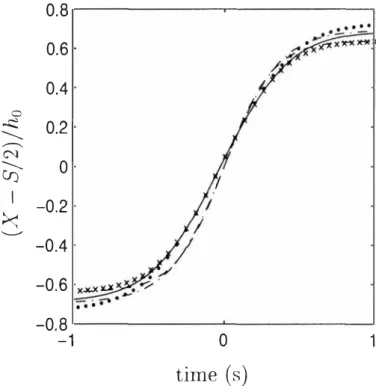
The Byatt-Smith (1970, [3]) numerical solution will be used as a reference for the exact solitary wave. It is indeed known to be one of the most accurate solitary wave solution within the potential flow theory. From this solution, the depth-averaged horizontal velocity is easily computed and substituted in (I) to compute a law of motion for the paddle. It should be noted that no experi ments were performed using this law. However it is felt that a Byatt-Smith procedure is not very practical since each wave ve locity field needs to be computed numerically which is very time consuming. On figure I 0, the dimensionless paddle laws of mo tion with time for Byatt-Smith, Rayleigh and Boussinesq (Goring procedure) solitary waves and for shallow-water theories are plot ted for£= 0.306. For the same wave we also plot on figure II the dimensionless paddle velocity corresponding to these laws of mo tion. In the example shown on figure I 0 it appears that the total paddle stroke is better described by the second-order shallow wa ter solution than by any other solution. Figure 12 plots the depth averaged net mass displacement L in a sol itary wave computed from Byatt-Smith's numerical solution compared to the ones as sociated to KdV, shallow water second-order and Rayleigh solu tions. This net mass displacement is the total stroke of the paddle prescribed in each procedure. Hence. it is confirmed that the total
0.8 0.6 0.4 0 ..c: 0.2 ... _....--..._ C\1 ... 0 \f) I -0.2
><
-....__...--0.4 -0.6 -0.8 -1 0 1time
(s)
Fig. 10 Paddle law of motion derived from Byatt-Smith's numerical solution(-), KdV solution (--),second-order shallow water so lution ( -.-), Rayleigh's solution ( ... ) and Goring's procedure (xxx) for£= 0.306.
0.35 0.3
�
0.25 0.2 ..____ ,.--..._ ..., 'lj 0.1 5 '\ ..____�
'\ 'lj 0.1 '� . "--'"' '"' . 0.05 . '«. •·��
0 0 0.5time (s)
Fig. I I Dimensionless paddle velocity versus time for Byatt-Smith's
numerical solution(-), KdV (- -),second-order shallow water solution(-.-), Rayleigh's solution( . . . ) and Goring's procedure (xxx) for£= 0.306.
stroke in the second-order shallow-water theory procedure is the closest to the Byatt-Smith solution mean net mass displacement, at least in the solitary wave dimensionless amplitude range con sidered in the experiments. Nevertheless, it seems that this good agreement is not sufficient to produce 'pure' solitary waves. In deed, trailing waves are smaller when using Goring or Rayleigh procedures and yet, total strokes are smaller and larger respec tively in Goring and Rayleigh procedures compared to the Byatt Smith mean net displacement. Figure II also shows that the Boussinesq and Rayleigh paddle velocities closely match the ve locity required by Byatt-Smith' s solution. In fact, in both
proce-solitary wave (SW) limiting steepness
1 ,---�----r---�---��� I I I I 0.8 I I I I I I I I I 0.6 '<.! I / . 0.4 0.2 / 0 0 1 2 3
L/ho
Fig. 12 Mean horizontal displacement obtained from Byatt-Smith's nu merical solution (-), KdV (- -), second-order shallow water so lutions(-.-) or Rayleigh's ( ... )analytical solutions versus soli tary wave dimensionless amplitude£ ranging from 0 to I.
1.5 /
SW
limiting steepness
/ / / /�
/ / 1 / / / -... / / l-l // <:l E: / "/ ,.--..._ / · ;...> / \j 0.5 -...�
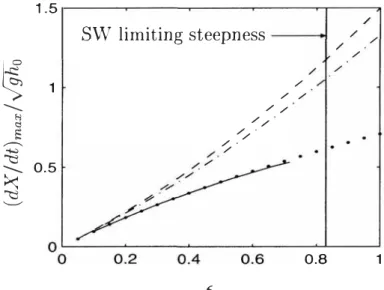
\j '----' 0.8 1 EFig. 13 Dimensionless maximum paddle velocity at mid-stroke for Byatt-Smith's numerical solution(-), KdV (- -).second-order shallow water solution (-.-), Rayleigh's solution ( ... ) versus dimensionless solitary wave amplitude c. The maximum paddle velocity in Goring's procedure is the same as in the Rayleigh based procedure.
dures, paddle laws of motion match the Byatt-Smith based paddle motion around mid-stroke (fig. 10), where the paddle velocity reaches its maximum (fig. I I ). Indeed, the maximum paddle ve locity deduced from Byatt-Smith solution (which occurs at mid stroke) is very well described by the Rayleigh or Boussinesq solu tions (there are equals) over a broad range of dimensionless am plitudes as shown on figure 1 3. As shown by (4) a good estima tion of the maximum depth-averaged velocity requires a good estimation of the phase speed. The dimensionless phase speed (or Froude number) F = c I
Jih;
is plotted on 1 4.a.lt shows that theRayleigh phase speed is the closest to both the Byatt-Smith nu merical and experimental estimations. The outskirts decay coeffi cient versus the dimensionless amplitude is plotted on figure 1 4.b. This outskirts decay coefficient describes the way free surface elevation tends towards the mean level at infinity. Stokes showed that
�
is a solution of the following equation, also used by Byatt Smith:Fe= tan(
�
)�
( 1 8)It should be underlined here that the Boussinesq solitary wave expression is neither a solution of the KdV nor of the Boussinesq equations (1 872, [2]). It appears to be a mixture of the Rayleigh phase speed and of the KdV outskirts decay coefficient and con sequently, net mass transport. Concerning the outskirts decay co efficient, the same hierarchy as for the phase speed is observed on figure 1 4.b. This explains why the paddle velocity in Rayleigh's procedure matches the paddle velocity based on Byatt-Smith so lution both at the maximum and the outskirts.
As a matter of fact none of these approximate solutions matches the Byatt-Smith reference with regard to all the criteria used in this study. Second-order shallow water theory correctly predicts the mean net displacement. The Rayleigh and Boussinesq
solu-1 .5 .---�---�---�---�.---. / 1 . 45 1 .4 1 .35 1 .3 1 .25 1 .2 1 . 1 5 1 . 1 1 . 05
SW
limiting steepness
----0.2 0.4 0.6 0.8 1 a -2 .---�----�---�---�.---.SW
limiting steepness --+-�
. - . 1 O L---�---�---�---�L---� 0 0 . 2 0 . 4 0 . 6 0 . 8 1 b - EFig. 14 Froude number versus solitary wave dimensionless amplitude
(a) and outskirts decay coefficient versus Froude number (b) obtained for Byatt-Smith's numerical solution (-). KdV (- -) , second-order shallow water theory(-.-) or Rayleigh's ( . . . ) ana lytical solutions and experiments (o).
tions agree with Byatt-Smjth' s numerical solution concerning the maximum velocity at mid-stroke. And finally paddle velocity de rived from Byatt-Smith's numerical solution is matched by Ray leigh-based paddle velocity at the outskirts.
We can now understand why, by increasing the duration of mo tion for a given stroke, Goring reduces the waves trailing the first solitary wave. Indeed, the duration of motion as expressed by (7) is a function of both the phase speed c and the outskirts decay
coefficient � of the solitary wave. To a given stroke corresponds a given outskirts decay coefficient. Thus, to prolong the duration of motion it would be necessary to take a smaller phase speed than the one corresponding to the outskirts decay coefficient in Boussinesq form. This is in agreement with the relation in Byatt Smith' s numerical solution between outskirts decay coefficient, phase speed and solitary wave amplitude. Thus, prolonging the duration of motion tends to match both outskirts decay coefficient and phase speed to the Byatt-Smith solution but for a smaller am plitude than the design one. As a consequence, the relation be tween the net displacement (paddle stroke) and solitary wave am plitude will tend to be fulfilled since in Boussinesq' s solitary wave the net displacement was underestimated. But how much should we prolong motion duration to get the purest solitary waves? Goring suggested 1 0 o/o but this value actually depends on the solitary wave amplitude and hence is not constant. Therefore, we suggest using Rayleigh's procedure rather than Goring's
be-cause it is then unnecessary to modify the duration of paddle mo tion arbitrarily and the resulting solitary waves are as pure and more rapidly established.
6. Conclusion
It has been shown in this paper that solitary waves generated us ing a paddle law of motion derived from Rayleigh' s solution (linearized or fitted) are purer and more rapidly established than with any of the shallow-water theory-based procedures. Trailing waves after solitary waves generated using this new procedure are indeed as small as in Goring's procedure, being less than 3 o/o of the main pulse amplitude. However, none of these generation pro cedures is perfect. Indeed, taking Byatt-Smith' s (1 970, [3 ] ) nu merical solution as a reference for the solitary wave solution, the paddle stroke is better described by second-order shallow-water theory than in the other procedures, whereas the maximum paddle velocity at mid-stroke is better predicted in our procedure or in Goring's. With respect to solitary wave generation, we suggest that this maximum paddle velocity is a key parameter. For a given maximum velocity, a Froude number is selected. The con·espond ing paddle stroke for this Froude number should then be pre scribed. We found that the Rayleigh solitary wave with an accu rate description of the Froude number and outskirts decay coeffi cient meet the above requirements. Hence the generation proce dures based on Rayleigh's solitary wave solution is a good com promise for obtaining quite pure and rapidly established solitary waves.
7. Acknowledgements
The authors would like to thank Jean-Marc Barnoud for technical support and assistance when performing the experiments. This work has been financially supported by the MAST-IH EC programme, under contract MAS3-CT95-0027. The first author is grateful to the French Ministry of Education for attributing her a PhD grant.
8. Notation
The fol lowing notations are used in the paper:
A
a'
solitary wave main pulse amplitude first trailing wave amplitude
A' second-order solitary wave amplitude
c solitary wave phase speed F = c I
Jih;
Froude numberg gravity
170 mean water depth
L solitary wave depth averaged mass displacement S paddle stroke
f.!.r = £/cr2 Ursell number
u(x, t) depth-averaged horizontal velocity of solitary wave time
X Lagrangian space variable giving paddle position
a tanh fit parameter
�
solitary wave outskirts decay coefficient8 tanh fit parameter
£ = Alh0 dimensionless solitary amplitude
1\ = 2/� horizontal solitary wave length scale y(x, t) vertical acceleration at free surface ll(x, t) free surface elevation
e = ct -X solitary wave co-moving frame variable <J = hof 1\ shallow water parameter
t duration of paddle motion
The fol lowing subscripts are used in the paper: B G KdV R SW2 X
Boussinesq solitary wave expression Goring generation procedure
Korteweg and De Vries solitary wave solution Rayleigh solitary wave solution
second-order shallow water theory derivation with respect to time derivation with respect to space
9. References
[ I ] B o u ss i N ESQ M.J., Theorie de !'intumescence liquide,
appelee on de solitaire ou de translation, se propageant dans un canal rectangulaire, C.-R. Acad. Sci. Paris, 72( 1 87 1 ), p 755-59.
[2] Bou s s i N ES Q M.J., Theorie des ondes et des remous qui se
propagent le long d'un canal rectangulaire horizontal, en communiquant au liquide contenu dans un canal des vitesses sensiblement pareilles de Ia surface au fond, J. Math. Pure et Appl., 2( 1 7)( 1 872), p 55- 108.
[3] BYATT-SMITH J.G.B., An exact integral equation for steady surface waves, Proc. Roy. Soc. London, A. 3 1 5( 1 970), p 405-4 1 8.
[4] BYATT-SMJTH J.G.B. and Longuet-Higgins M.S., On the
speed and profile of steep solitary waves, Proc. Roy. Soc. London, A. 350( 1 976), p 1 75- 1 89.
[5] CLAMOND D. and GERMA I N J.-P., Interaction between a Stokes wave packet and a solitary wave, Eur. J. Mech. B/Fluids, 1 8(1 )( 1 999), p 67-9 1 .
[6] DAILY J.W. and STEPH A N S.C., The solitary wave: its ce lerity, internal velocity and amplitude attenuation in a hori zontal smooth channel, Proc. 3rd Conf. Coastal Eng., ( 1 952), p 1 3-30.
[7] GORI NG D.G., Tsunamis - The propagation of long waves onto a shelf, PhD thesis of the California Institute of Tech nology, Pasadena, California ( 1 978).
[8] GuJZIEN K., Les ondes tongues internes: generation et interaction avec Ia houle, These de I' Universite Joseph
Fourier, Grenoble ( 1 998).
[9] Gu ! ZIE N K. and BART H ELEMY E., Short waves modula
tions by large free surface solitary waves. Experiments and models., Phys. Fluids, 1 3( 1 2), p 3624-3635 .
[ 1 0] HAMMACK J.L. and S E G U R, H., The Korteweg-de Vries
equation and water waves. Part 2. Comparison with experi ments., J. Fluid Mech., 65( 1 974), p 289-3 14.
[ 1 1 ] KE U L EG A N G.H., Gradual damping of solitary waves, J.
Res. Nat. B ur. Standards, 40( 1 948), p 487-498.
[ 1 2] KORTEWEG D.J. and DE VRI E S G., On the change of form
of long waves advancing in a rectangular canal, and on a new type of stationary waves, Phil. Mag., 39(5)( 1 895). p 422-443.
[ 1 3] LAMB H., Hydrodynamics, Cambridge University Press, 6th ed. ( 1 932), 738 p.
[ 14] LON G U ET-HIG G I N S M.S., Trajectories of particles at the
sUiface of steep solitary waves, J. Fluid Mech., 1 1 0( 1981 ).
p 239-247.
[ 1 5] LO N G U E T-HI G G I N S M.S. and FEN TO N J.D., On the mass,
momentum, energy and circulation of a solitary wave. Part II., Proc. Roy. Soc., A 340( 1 974), p 47 1 -493.
[ 1 6] MEI C.C., The applied dynamics of ocean surface waves, Advanced Series on Ocean Engineering, ( 1 992), World Scientific.
[ 1 7] MI L E S J.W., Solitary waves., Ann. Rev. Fluid Mech., 1 2( 1 980), p 1 1 -43.
[ 1 8] RAYLEIGH LORD, On waves., Phil. Mag., 1 ( 1 876), p 257-279.
[ 1 9] REN OU A R D D.P., Seabra-Santos F.J. and Temperville
A.M., Experimental study of the generation, damping, and reflection of a solitary wave, Dynamics of Atm. and Oceans, 9( 1 985), p 34 1 -358.
[20] RusSEL J.S., Report on waves, Proc. 1 4th Meeting, Brit. Ass. Adv. Sci., York ( 1 845), p 3 1 1 -390.
[2 1 ] S E R R E F., Contribution a ! ' etude des ecoulements permanents et variables dans les canaux, La Houille Blanche, 8( 1 953), p 374-388.
[22] Su C . H . and GA RDN E R C . S . , KdV equation and generalisations. Part III. Derivation of Korteweg-de Vries equation and Burgers equation., J. of Math. Phys., 1 0(3)( 1 969), p 536-539.
[23] SYNOLAKIS C.E., Generation of long waves in laboratory, J. of Waterway, Port, Coastal, and Ocean Engineering, 1 1 6(2)( 1 990), p 252-266.
[24] TEM P E R V I L L E A., Contribution a !'etude des ondes de
gravite en eau peu profonde, These d'Etat, Universite Jo seph Fourier - Grenoble I ( 1 985).
[25] WHI T H A M G.B., Linear and non linear waves. Pure and Applied Mathematics Series, Ed. Wiley-Interscience, ( 1 97 4 ).