HAL Id: hal-01146233
https://hal.inria.fr/hal-01146233
Submitted on 28 Apr 2015
HAL is a multi-disciplinary open access
archive for the deposit and dissemination of
sci-entific research documents, whether they are
pub-lished or not. The documents may come from
teaching and research institutions in France or
abroad, or from public or private research centers.
L’archive ouverte pluridisciplinaire HAL, est
destinée au dépôt et à la diffusion de documents
scientifiques de niveau recherche, publiés ou non,
émanant des établissements d’enseignement et de
recherche français ou étrangers, des laboratoires
publics ou privés.
A Multi-Agent Architecture For Distributed Corporate
Memories
Fabien Gandon
To cite this version:
Fabien Gandon. A Multi-Agent Architecture For Distributed Corporate Memories. Third
Interna-tional Symposium ”From Agent Theory to Agent Implementation” at the 16th European Meeting on
Cybernetics and Systems Research (EMCSR 2002), Apr 2002, Vienna, Austria. �hal-01146233�
Fabien Gandon
ACACIA research team - INRIA Sophia Antipolis - 2004, route des Lucioles
BP93 - 06902 Sophia Antipolis Cedex - France
email: [email protected]
Abstract
This paper presents an approach to design a multi-agent system managing a corporate memory in the form of a distributed semantic web and describes the resulting architecture.
1 Introduction
With our entrance in the information society, organi-zations had to adapt to the shift in the economy and market rules that followed. Information systems are becoming backbones of organizations and therefore their interest in corporate knowledge management grows stronger. Our research team, ACACIA, studies the semantic web technologies to provide tools, and methodologies to materialize and structure a corporate memory and prepare their exploitation in the form of corporate semantic webs. In parallel, distributed artifi-cial intelligence now proposes the new paradigm of multi-agents system that appears to us as very well suited to deploy a software architecture over this dis-tributed information landscape. We present results from the CoMMA European project [CoMMA, 2000] aiming at implementing a corporate memory manage-ment framework based on emerging technologies: agents, ontologies, XML, information retrieval and machine learning techniques. The project is imple-menting this system in the context of two application scenarios: (1) assisting the insertion of new employees in the company and (2) supporting the technology monitoring processes. In a first part we will present the intervention context and justify the conceptual and technical choices we made. Then we will focus on the approached we followed to design the CoMMA system and the architecture we implemented and tested.
2
The context: a distributed memory
A corporate memory is an explicit, disembodied and persistent representation of knowledge and informa-tion in an organizainforma-tion, in order to facilitate their ac-cess and reuse by members of the organization, for their tasks [Dieng et al., 2001]. The stake in building a corporate memory management system is the coherent integration of this dispersed knowledge to promote knowledge growth, knowledge communication and in general to preserve knowledge within an organization [Steels, 1993]. This first part presents the motivations of our conceptual and technical choices.2.1
Integrating emerging technologies
The multi-agent approach relying on loosely coupled software components, is naturally prone to facilitate integration of different technologies in one system. This was an important need for CoMMA, since several emerging technologies have been chosen for the sys-tem implementation to address initial observations: (1) The memory is, by nature an heterogeneous anddistributed information landscape. Corporate
memo-ries are facing the same problem of precision and re-call as the Web. The semantic Web [Berners-Lee et
al., 1995] is a promising approach where the semantics
of documents is made explicit through metadata and annotations to guide later exploitation. We propose to study corporate memories as corporate semantic Webs where RDF (Resource Description Framework) is used to semantically annotate the corporate resources. (2) The population of the stakeholders of the memory
is, heterogeneous and distributed in the corporation.
The system has to interface users with the content of the memory and enable them to exploit or contribute to its content. The CoMMA system relies on machine learning techniques to make agents adaptive to the users and the context. This goes from learning user's preferences, up to information push technologies. (3) The tasks as a whole to be performed on the
mem-ory are, by nature, distributed and heterogeneous.
Moreover, both the corporate memory and its popula-tion of users are distributed and heterogeneous. There-fore, it is interesting to consider a distributed and het-erogeneous system such as a Multi-Agents System (MAS) to manage and exploit this information land-scape. Programming progresses were achieved through higher abstraction enabling us to model systems more and more complex and MAS are a new stage in ab-straction that can be used to understand, to model and to develop a whole new class of distributed systems [Wooldridge et al., 2000]. We believe the MAS para-digm is well suited for designing and deploying a software architecture above distributed information landscapes of corporate memories: on the one hand, individual agents locally adapt to users and resources they are dedicated to ; on the other hand, thanks to cooperating software agents distributed over the net-work, the whole system capitalizes an integrated view of the corporate memory.
2.2
An annotated world for agents
The article "Agents in Annotated Worlds" [Doyle and Hayes-Roth, 1998] explains that "knowledge can liter-ally be embedded in the world as annotations attached to objects, entities and locations" and thus we obtain "annotated environments containing explanations of the purpose and uses of spaces and activities that allow agents to quickly become intelligent actors in those spaces". Thus annotated information worlds are, in thecurrent state of the art, a quick way to make informa-tion agents smarter : if the memory becomes an
tated world, agents can use the semantics of the anno-tations and, through inferences, help users exploit it.
RDF [Lassila and Swick, 1999] uses a simple data model expressed in XML syntax for representing properties of Web resources and their relationships.
We describe the content of documents through seman-tic RDF annotations and then use and infer from these annotations to efficiently exploit the corporate mem-ory. RDF annotations can be either internal or external
to the document, thus existing documents of the corpo-rate memory may be kept intact and annotated exter-nally. Annotations are based on the O'CoMMA ontol-ogy [Gandon, 2001] described and shared thanks to RDF Schema [Brickley and Guha, 2000]. Keyword-based search engines are limited to terms occurrences, the introduction of ontology-based annotations enables agents to access the semantic level. O'CoMMA is the keystone of our system: it is a full resource of the memory and it provides the building blocks for models (user profiles, corporate model), annotations and agent messages, with their associated semantics.
The enterprise model is an oriented, focused and somewhat simplified explicit representation of the organization. It gives the system an insight in the or-ganizational context and environment to tune its inter-actions and reinter-actions. Likewise, the users' profile captures all aspects of the user that were identified as relevant for the system behavior. It contains adminis-trative information and topic interests. It positions the user in the organization: role, location and potential acquaintance network. In addition to explicitly stated information, the system derives information from past usage by collecting the history of visited documents and possible feedback from the user, as well as the user's recurrent queries. From this, agents learn some of the user's habits and preferences [Kiss and Quin-queton, 2001]. These derived criterions are used for interface or information push.
2.3
A Multi-Agents Information System
CoMMA adopted the weak notion of agency [Wooldridge and Jennings, 1995] but we do not claim that in our current prototype all our agents are one hundred percent compatible with this definition. The information agents are part of the intelligent agents. A MAS is a loosely coupled network of agents that work together as a society aiming at solving problems that would generally be beyond the reach of any individual agent. A MAS is heterogeneous when it includes agents of at least two types. A Multi-AgentsInforma-tion System (MAIS) is a MAS aiming at providing some or full range of functionalities for managing and exploiting information resources. Based on these no-tions, the software architecture of CoMMA is an het-erogeneous MAIS ; the application of a MAIS to cor-porate memories means that the cooperation of agents aims at enhancing corporate knowledge capitalization.
So far a large number of MAIS projects focused on the problem of dynamically integrating heterogeneous sources of information (e.g. InfoSleuth [Nodine et al., 1999]). It comes from the fact that it was one of the problems being addressed in the field of information systems when MAS came to meet them and also be-cause the decentralized nature and local adaptability of agents were assets for wrapping heterogeneous sources. Another interesting type of projects concerns the management of digital libraries (e.g. SAIRE [Odu-biyi et al., 1996] and UMDL [Weinstein et al., 1999]). In CoMMA we do not stress the heterogeneous sources reconciliation aspect: documents may be heterogene-ous but annotations are represented in RDF and based on a shared ontology formalized in RDFS. CoMMA is focusing on the design of an architecture of cooperat-ing agents, becooperat-ing able to adapt to the user, to the con-text, and supporting information distribution. The duality the word 'distribution' reveals two important problems to be addressed : (a) 'distribution' means dispersion, that is the spatial property of being scat-tered about, over an area or a volume ; the problem here is to handle the naturally distributed data, infor-mation or knowledge of the organization. (b) 'distribu-tion' also means the act of spreading ; the problem then is to make the relevant pieces of information go to the concerned agent (artificial or human). It is with both purposes in mind that we designed the CoMMA ar-chitecture as presented in the following section.
3
Designing the MAS
Our approach shares with the A.G.R. model used in AALAADIN [Ferber and Gutknecht, 1998] and GAIA [Wooldridge et al., 2000] methodologies the concern for an organizational approach where the MAS archi-tecture is tackled, as in a human society, in terms groups, roles and relationships. The manifesto of Pan-zarasa and Jennings [2001] goes even further, advo-cating the application of modern organization theory. This type of approach is attractive in the context of an organizational memory and in this section we present our experience in designing the agent society manag-ing the memory, startmanag-ing from societal level require-ments and going down to the agent internal behavior.
3.1
F r o m m a c r o s c o p i c t o m i c r o s c o p i c
The functional requirements of the system do not sim-ply map to some agent functionalities but influence and are finally diluted in the dynamic social interac-tions of agents and the set of abilities, roles and be-haviors attached to them. This section explains how we went from the system requirements expressed at the societal level down to the point where agent roles can be identified.Architecture versus Configuration
The MAIS architecture is a structure that portrays the different kinds of agencies existing in an agent society and the relationships among them. A configuration is an instantiation of an architecture with a chosen ar-rangement and an appropriate number of agents of each type. One given architecture can lead to several configurations. In the case of a multi-agents corporate memory system, the configuration depends on the topography and context of the place where the system is rolled out (organizational layout, network topogra-phy, stakeholders location), thus it must adapt to this information landscape and change with it. The archi-tecture must be designed so that the set of possible configurations covers the different corporate organiza-tional layouts foreseeable. The configuration descrip-tion can be studied and documented at deployment time using adapted UML deployment diagrams to represent hosts (servers, front-end...), MAS platforms, agent instances and their acquaintance graph.
The architectural description is studied and fixed when designing the MAS. The architectural analysis starts from the highest level of abstraction of the sys-tem (i.e. the society) and by successive refinements (i.e. nested sub-societies) it goes down to the point where the needed agent roles and interactions can be identified. Considering the system functionalities we identified four dedicated sub-societies of agents: (1) The sub-society dedicated to Ontology and model (2) Annotation-dedicated sub-society (3) User-dedicated sub-society (4) Connection-dedicated sub-society. These societies are analyzed in the following parts.
Organizing sub-societies
Analyzing the resource dedicated sub-societies (On-tology/model, Annotation and Connection Agents) we found that there was a recurrent set of possible internal organizations for these sub-societies:
A hierarchical organization distinguishes between two kinds of roles: (1) The representative role: the agent is a mediator between its society and the rest of the MAS. It deals with the external requests. If needed it breaks them up into several sub-requests. It contacts and delegates to resource-dedicated agents. Finally, it compiles the possibly partial results to answer the external requester. (2) The resource-dedicated role: the agent is dedicated to a local resource repository and contributes to solve the requests it receives from the representative as much as it can with its local re-sources. In this organization, workload is greatly dis-tributed because resource agents only work with the resource they have locally and they leave the fusion work to representative agents that can be placed on another machine that does not necessarily hold a re-pository of information. However this organization is quite network-consuming.
A peer-to-peer organization sets up egalitarian rela-tionships between the roles. Roles are not distributed, but completely redundant: any agent can be contacted from outside the society to handle a request concern-ing the resource type its society is dedicated to. It will then have to cooperate with its peers in order to
effi-ciently fulfill the request. Agents are specialized only through the content of the local resource repository they are attached to. The workload is less distributed than in the previous case but the network-load may be decreased. There is only one role merging the two previous roles (representative and resource dedicated). Coalitions will be formed to solve external queries.
A replication organization is a subtype of the previ-ous case: neither the roles nor the repository content are distributed. Each agent keeps up to date a complete copy of all the resources and is able to solve any re-quest by itself. Therefore the only social interactions that exist are for content updates. The workload is even less distributed than in the previous case and the contents has to be replicated everywhere an agent sits which can be an unacceptable constraint. On the other hand the system is highly redundant, thus more robust, and the network use is minimal when dealing with a request. The only role is the resource-dedicated one.
Depending on the type of tasks to be performed, the size and complexity of the resources manipulated, a sub-society organization will be preferred to another.
Sub-society dedicated to Ontology and Model
The agents from this sub-society are concerned with the ontology and model exploitation aspects of the information retrieval activities. They provide down-loads, updates and querying mechanisms for other agents, on the hierarchy of concepts and the descrip-tion of the organizadescrip-tion. For this sub-society, the three types of organizations are conceivable: (1) In a hierar-chical organization, we would have a Master role in charge of resolving external queries and an Archivist role in charge of a part or a view of the ontol-ogy/model ; (2) in a peer-to-peer society, we would have a cooperative Archivist role; (3) in a replication society each agent would have a complete copy of the ontology/model and could resolve queries by itself.
The last choice is acceptable when the ontology is stable and when a consensus is reached by the users so that the ontological commitment is centralized and the global ontology is updated and propagated over the agent society. This option is implemented in the cur-rent prototype of CoMMA. The remaining options are interesting if the ontology/model is large or changes quite often and if the system must support the onto-logical consensus process ; the agent society can then support the break-up of the ontology/model and main-tain the coherence between the different repositories as in the FRODO project [Elst and Abecker, 2001].
Annotation dedicated sub-society
The agents from this sub-society are concerned with the exploitation of the annotations structuring the cor-porate memory, they will search and retrieve the refer-ences matching the users' queries. Here, only the two first types of organization are conceivable: (1) In a hierarchical organization there is an Mediator role and an Archivist role. (2) In a peer-to-peer organization we would have a cooperative Archivist role. (3) A repli-cation society is not realistic because it would imply to replicate a full copy of the corporate memory for each
resource agent. This is obviously not acceptable since the corporate memory, is a huge amount of informa-tion broken up and distributed over the intranet.
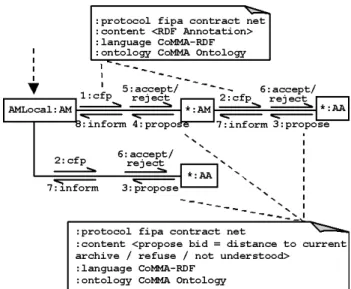
The current CoMMA system opted for the first type of society. The Annotation Mediator (AM) typically provides its services to other societies to solve their queries and requests the services of the resource agents to effectively solve them: (1) It breaks the queries and contacts the relevant Annotation Archivists (AAs) at each stage of the decomposition to get partial results. (2) It compiles the partial results to build the complete answer. The AA role is attached to a local annotation repository, and when it receives a query, it tries to obtain at least partial results from its local resources to enable the AM to handle results distributed over sev-eral information sources. The AM also allocates new annotations to AAs in a contract-net fashion. Bids are based on a similarity measure between the new anno-tation and the content of the archive of the AA.
Interconnection dedicated sub-society
Agents from this sub-society are in charge of match-making other agents using their respective needs and service provider descriptions. Each provider must first register itself with at least one middle agents and ad-vertise its capabilities. Requests are then matched to these descriptions to find which agent can provide a required service.
The CoMMA system is implemented using the JADE platform [Bellifemine et al., 2001] that provides an agent type called Directory Facilitator (DF). DF are federable to build a peer-to-peer society and in charge of managing Yellow Pages. According to FIPA1 speci-fications, DF provide agent identifiers matching the service description and the ontology specified in a pattern. Thus DF are matchmakers identifying relevant providers and returning the selection of candidates to the requester. The result of the matchmaking can be further refined in a second stage. For instance the AM requires statistics from the AAs to know what types of annotations they have to decide when to appeal to them during the distributed solving process.
User dedicated sub-society
The agents from this sub-society are concerned with the interface, the monitoring, the assistance and the adaptation to users. They are, typically, requester agents. Because they are not related to a resource type, they cannot be studied using the typology we pro-posed. However, we can distinguish at least two recur-rent roles in this type of sub-society: (1) the user inter-face management: to enable users to express their requests and to present results in a appropriate format (2) the management of user's profile: to archive and make the profiles available to be used for interface purposes, learning techniques, pro-active searches... The machine learning techniques are developed by the LIRMM2 [Kiss and Quinqueton, 2001] and additional
1 Foundation for Intelligent Physical Agents - www.fipa.org 2
Laboratoire d'Informatique, de Robotique et de Microé-lectronique de Montpellier - www.lirmm.fr
roles conceivable for this sub-society can be found in [Gandon et al., 2000].
3.2
Roles, Interactions and behaviors
From the architecture analysis, we now derive the characteristics of the identified roles, their interactions and we discuss the implementation of the correspond-ing behaviors in a set of agent types.Agent roles
Roles represent the position of an agent in a society and the responsibilities and activities assigned to this position and expected by others to be fulfilled. In the design junction between the micro-level of agents and the macro-level of the MAS, the role analysis is a key step. The previous part identified the following roles, implemented in the first prototype of CoMMA:
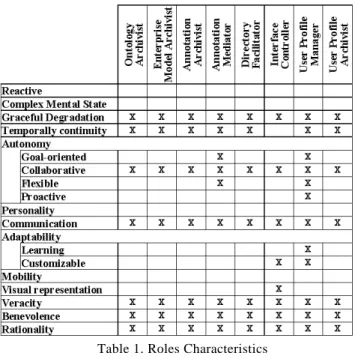
Ontol-ogy Archivists maintain and access the ontolOntol-ogy ; En-terprise Model Archivists maintain and access the
enterprise model ; Annotation Archivists maintain and access annotation repositories ; Annotation Mediators manage and mediate among a set of Annotation Archi-vists ; Directory Facilitators maintain and access yel-low pages ; Interface Controllers manage and monitor user interfaces ; User Profile Managers update users' profile ; User Profile Archivists store and distribute users' profile.
The list of characteristics that are debated in the agent community gives an overview of the actual ca-pabilities envisaged. Their diversity reveals the influ-ence and the integration in MAS of results from a lot of research areas. Table 1 compiles some of them, found in the literature3, and uses them to characterize the roles. Other methodologies, such as [Wooldridge et
al., 2000], propose a formalization of the roles but it
was not deemed necessary for our first prototype.
Table 1. Roles Characteristics
3
[Etzioni and Weld, 1995] , [Franklin and Graesser, 1996] , [Nwana, 1996] and [Wooldridge and Jennings, 1995]
Social interactions
Following the sub-societies and roles identification comes the specification of the interactions. Interac-tions consist of more than the sending of isolated mes-sages and the conversation patterns need to be speci-fied with protocols. Agents must follow these proto-cols for the MAS to work properly. Protoproto-cols are codes of correct behavior, in a society, for agents to interact with each others. They describe a standard procedure to regulate information transmission be-tween agents and they institutionalize patterns of communication occurring between identified roles. The definition of a protocol starts with an acquain-tance graph at role level, that is a directed graph iden-tifying communication pathways between agents playing the roles involved in an interaction scenario. From that we specify the possible sequences of mes-sages. Figure 1 shows an extract of the protocol being for handling annotations submission ; it could be de-scribed as a nested contract-net.
Figure 1. Interactions when allocating an annotation The acquaintance connections among the roles and the protocols adopted derive from both the organiza-tional analysis and the use cases dictated by the appli-cation scenarios. The acquaintance graphs and the ACL message traces are depicted using protocol grams, a restriction of the UML collaboration dia-grams [Bergenti, and Poggi, 2000] .
The implementation of CoMMA relies on JADE [Bellifemine et al., 2001], which is an open source MAS development platform compliant with the FIPA specifications. The agent communication language FIPA ACL is based, like its counterpart KQML, on the speech act theory and comes with already standardized protocols to be used or extended with the semantic of their speech acts specified in the FIPA ontology. In the first prototype, the content languages of the messages were SL for the speech acts specified by FIPA for the envelop (Figure 2-a) and the speech acts involved in the CoMMA protocols (Figure 2-b). RDF was used for the exchanged annotations and query patterns (Figure 2-c). The latest prototype uses RDF as an ACL.
Figure 2. A message asking for the title of Memos
Behavior and technical competencies
From the role and interaction descriptions we proposed and implemented agent types that fulfill one or more roles. The behavior of an agent type combines behav-iors implemented by the designers to accomplish the activities corresponding to the assigned roles. For instance there is currently one agent type playing both the Ontology Archivist and Enterprise Model Archivist roles. Its behavior contains both associated behaviors which are themselves made up of sub-behaviors han-dling the different tasks and interactions linked to these roles. Behaviors are directly linked to the im-plementation choices and determine the responses, actions and reactions of the agent. The implementation of the behavior is constrained by the role but it is also subject to the toolbox of technical abilities available to the designers. As an example, an AA has a behavior handling its involvement in distributed query-solving. A task occurring in this behavior, is the projection of a sub-part of the complete query to propose partial re-sults to the AM that will build a complete answer. Therefore the behaviors of the AA and the AM include calls to the CORESE API [Corby et al., 2000] a pro-totype of search engine enabling inferences on RDF annotations.
4
Conclusion
In this paper we presented an approach to corporate memory management relying on the technologies of multi-agent, XML and machine learning. We described the methodology we followed do design such a system and the architecture we obtained and implemented in the first prototype of CoMMA. The full implementa-tion of the CoMMA prototype is now finished and trials are being prepared to evaluate the complete so-lution. Even if groups and roles are not first citizens in the JADE platform, an organizational approach proved to be successful to specify the implementation. Several methodologies now propose formal models to support a sound organizational analysis. It would be interesting to compare how these different models would repre-sent the CoMMA architecture and capture the design rationale. Agentization was difficult for large and complex components but this would disappear if fully finalized Agent-Oriented languages were used instead
of object-oriented languages with an Agent API. Therefore from a feasibility and conceptual point of view the multi-agent paradigm proved to be extremely well-suited to design a software architecture that could be deploy in a variety of configurations to adapt to a distributed information landscape. Concerning the integration phase of the development, the agent tech-nology proved to be extremely valuable: the different agents have been developed by distant partners having the needed experience, starting from shallow agents ; but since the agents are loosely coupled software com-ponents and that their role and interactions have been specified using a consensual ontology, the integration and setup of a first prototype was achieved in less than two days. The currently trial will enable us to discuss and evaluate this new approach with real end-users.
Acknowledgments
I thank my colleagues of ACACIA and the CoMMA consortium for our fruitful and the European Commis-sion that funds the CoMMA project (IST-1999-12217).
References
[Bellifemine et al., 2001] Bellifemine F., Poggi A., Rimassa G. Developing multi agent systems with a FIPA-compliant agent framework. Software Practice
& Experience, 31:103-128, 2001.
[Bergenti, and Poggi, 2000] Bergenti F., Poggi A. Exploiting UML in the Design of Multi-Agent Sys-tems. Omicidi A., Tolksdorf R., Zambonelli F.
Engi-neering Societies in the Agents World - Springer,
LNAI 1972:106-113, 2000.
[Berners-Lee et al., 1995] Berners-Lee T., Hendler J., Lassila, O., The Semantic Web, Scientific American, p. 35-43, May 2001.
[Brickley and Guha, 2000] Brickley D., Guha R.V. – Resource Description Framework (RDF) Schema Specification. W3C Candidate Recommendation [CoMMA, 2000] Corporate Memory Management
through Agents, Proc. E-Work E-Business, 2000. [Corby et al., 2000] Corby O., Dieng R., Hébert C., A
Conceptual Graph Model for W3C Resource De-scription Framework. Proceedings ICCS'00 Darm-stadt, LNAI 1867, 2000.
[Dieng et al., 2001] Dieng R., Corby O., Gandon F., Giboin A., Golebiowska J., Matta N., Ribiere M., Méthodes et outils pour la gestion des connais-sances, 2nd edn, Dunod, 2001, ISBN 2 10 006300 6 [Doyle and Hayes-Roth, 1998] Doyle P., Hayes-Roth
B., Agents in Annotated Worlds, Proc. Autonomous
Agents, ACM SIGART, p. 173-180, 1998.
[Elst and Abecker, 2001] Elst L., Abecker A., Domain Ontology Agents in Distributed Organizational Memories Workshop on Knowledge Management
and Organizational Memories, IJCAI, 2001.
[Etzioni and Weld, 1995] Etzioni O., Weld D., Intelli-gent AIntelli-gents on the Internet: Fact, Fiction and
Fore-cast, IEEE Expert/Intelligent Systems & Their
Appli-cations, 10(4), August 1995.
[Ferber and Gutknecht, 1998] Ferber J., Gutknecht O., A meta-model for the analysis and design of organi-zations in multi-agent systems. IEEE Computer
So-ciety, Proc. 3rd ICMAS, p. 128-135, 1998.
[Franklin and Graesser, 1996] Franklin S., Graesser A., . Is it an Agent, or just a Program ? : A Taxon-omy for Autonomous Agents. Proc. 3rd International Workshop on Agent Theories, Architectures and Languages, Springer - Verlag, 1996
[Gandon et al., 2000] Gandon F., Dieng R., Corby O., Giboin A., A Multi-Agents System to Support Ex-ploiting an XML-based Corporate Memory, Proc.
PAKM'00, p. 10.1-10.12
[Gandon, 2001] Gandon, F., Engineering an Ontology for a Multi-Agents Corporate Memory System, Proc.
ISMICK'01, p. 209-228, 2001.
[Kiss and Quinqueton, 2001] Kiss A., Quinqueton J. Multiagent Cooperative Learning of User Prefer-ences, Proc. of European Conference on Machine
Learning Principles and Practice of Knowledge Dis-covery in Databases, 2001.
[Lassila and Swick, 1999] Lassila O., Swick R. – Re-source Description Framework (RDF) Model and Syntax Specification. W3C Recommendation [Nodine et al., 1999] Nodine M., Fowler J., Ksiezyk
T., Perry B., Taylor M., Unruh A.; Active Informa-tion Gathering In Infosleuth™ , Proc. Internat.
Sym-posium on Cooperative Database Systems for Ad-vanced Applications, International Journal of
Coop-erative Information Systems, World Scientific. [Nwana, 1996] Nwana H.S., Software agents: an
over-view, The Knowledge Engineering Reover-view, 11(3): 205-244, 1996.
[Odubiyi et al., 1996] Odubiyi J., Kocur D, Weinstein S, Wakim N. Srivastava S., Gokey C., Graham J., SAIRE A Scalable Agent-Based Information Re-trieval Engine, Proc. Autonomous Agents, 1997. [Panzarasa and Jennings, 2001] Panzarasa P., Jennings
N.R., The organisation of sociality: A manifesto for a new science of multi-agent systems, Proc.
MAAMAW'01, LNAI, Springer Verlag, 2001.
[Steels, 1993] Steels, L. Corporate knowledge man-agement. Proc. of ISMICK'93, p. 9-30, 1993.
[Weinstein et al., 1999] Weinstein P., Birmingham W., Durfee E., Agent-Based Digital Libraries: Decen-tralization and Coordination. IEEE Communication
Magazine, p. 110-115, 1999.
[Wooldridge et al., 2000]. Wooldridge M., Jennings N., Kinny D., The Gaia Methodology for Agent-Oriented Analysis and Design, Autonomous Agents
and Multi-Agent Systems, 3(3):285-312, 2000.
[Wooldridge and Jennings, 1995] Wooldridge M, Jennings N., Intelligent Agents: Theory and Practice.