HAL Id: inria-00490893
https://hal.inria.fr/inria-00490893v2
Preprint submitted on 11 Jun 2010
HAL is a multi-disciplinary open access
archive for the deposit and dissemination of
sci-entific research documents, whether they are
pub-lished or not. The documents may come from
teaching and research institutions in France or
abroad, or from public or private research centers.
L’archive ouverte pluridisciplinaire HAL, est
destinée au dépôt et à la diffusion de documents
scientifiques de niveau recherche, publiés ou non,
émanant des établissements d’enseignement et de
recherche français ou étrangers, des laboratoires
publics ou privés.
To cite this version:
Fiammetta Cerreti, Benoît Perthame, Christian Schmeiser, Min Tang, Nicolas Vauchelet. Waves for
an hyperbolic Keller-Segel model and branching instabilities. 2010. �inria-00490893v2�
Waves for an hyperbolic Keller-Segel model and branching instabilities
Fiammetta Cerreti
(1) UPMC, CNRS UMR 7598, Laboratoire Jacques-Louis Lions, F-75005, Paris. Email: fi[email protected]
Benoît Perthame(1)(2)
(2) INRIA Paris-Rocquencourt, Equipe BANG. Email: [email protected]
Christian Schmeiser
Faculty for Mathematics, University of Vienna, Austria, and RICAM, Linz, Austria. Email: [email protected]
Min Tang(2)
Email: [email protected]
Nicolas Vauchelet(1)(2) Email: [email protected]
Received (Day Month Year) Revised (Day Month Year) Communicated by (xxxxxxxxxx)
Recent experiments for swarming of the bacteria Bacillus subtilis on nutrient rich media show that these cells are able to proliferate and spread out in colonies exhibiting complex patterns as dendritic ramifications. Is it possible to explain this process with a model that does not use local nutrient depletion?
We present a new class of models which is compatible with the experimental obser-vations and which predict branching instabilities and does not use nutrient limitation. These conclusions are based on numerical simulations. The most complex of these mod-els is also the biologically most accurate but the essential effects can also be obtained in simplified versions which are amenable to analysis. An example of instability mecha-nism is the transition from a shock wave to a rarefaction wave in a reduced two by two hyperbolic system.
Keywords: Keller-Segel system, hyperbolic system, shock waves, branching instability,
cell communities.
AMS Subject Classification:
35L45, 35L67, 65M99, 92C17
1. Introduction
The motivation of this work comes from recent experiments and measurements on swarming of the bacteria Bacillus subtilis reported in 10,15,16. It is observed that, when inoculated on nutrient rich media, these cells are able to proliferate and spread out in colonies exhibiting complex patterns as dendritic ramifications. This occurs under the effect of cellular communication through excretion of signalling molecules. Collective behaviours like this are, however, poorly understood and this has initiated the research field of ’cell communities self-organization’ (sometimes also called socio-microbiology), a vast subject which can also be related to fluid flows 27.
In the first phase of a typical experiment, an inoculum of cells proliferates and grows into a so called mother colony. After a sudden bursting phenomenon, a num-ber of (primary) dendrites grows from the mother colony. Dendrites typically con-tain two different types of cells: highly motile swarmers in the tip and supporters with significantly smaller motility in the stem. The supporters are maintained at a constant density. Subsequent branching events create complicated patterns. Other observations are the creation of surfactin at least by the mother colony, which is essential for the process, the preference of the dendrites for the radial direction, and the tendency of dendrites to avoid each other. Finally, the experiments have been carried out on nutrient rich substrates and seem to indicate that the whole process is not nutrition limited.
This final observation leads to the essential contribution of this work. As ob-served in 21, all past attempts to model branching patterns for B. subtilis are based on the assumption of a nutrition limited process (see 19,23,17,8 and the survey in 24). Most of them are related to dynamical pattern formations à la Gray-Scott 9. Continuing the arguments in 21, a new class of models will be presented, which is compatible with the experimental results, which predicts branching, and which as-sumes abundance of nutrient. The most complex of these models (which we call the ’full model’) is also the biologically most accurate. It will be shown, however, that the essential effects can also be observed in simplified versions which are amenable to analysis.
The most important part of the full model is the description of the swarmer dy-namics. On the one hand it is assumed that surfactin acts on them like a chemore-pellent, on the other hand cell-cell signaling by a chemoattractant is assumed, which has the effect to keep the group of swarmers together as observed in experiments. To prevent overcrowding, a density dependent chemotactic sensitivity is used turning off the chemotactic effect when a critical density is reached.
Neglecting the effect of surfactin, the model for swarmers is reminiscent of the usual Keller-Segel model (see 13,14,12,23,25 and the references therein) for cell
ag-gregation, however without diffusion effects and with prevention of overcrowding. Indeed, in the absence of surfactin, this system has been studied, both theoreti-cally and numeritheoreti-cally by several authors 3,4,6,7. In any dimension, solutions exist
that stay bounded. They exhibit a coarsening process reminescent of phase change models, where plateau-like peaks of the cell density form after a short transient period leading to sharp fronts (shock waves). With a small diffusion of the cells, these ’plateaus’ (along with the terminology of 11) merge with an exponentially slow dynamics. In the present paper, the question is to understand the dynamics of the plateaus resulting from the repellent forces.
Swarmer cells are assumed to multiply, but we assume that after division, one of the two daughter cells becomes a supporter. This assumption is based on the experimental observation that the number of swarmers seems to remain constant during dendrite elongation. Two possible mechanisms for maintaining the observed constant supporter density are considered: either diffusion with a diffusivity pro-portional to the density of a trace substance produced by the swarmers (which we consider the biologically more sound alternative), or a logistic birth-death process. The mother colony is formed of cells packed in a multilayer. They are supposed immotile and do not multiply. Thus, they are represented as a group of ’frozen’ cells.
For the dynamics of surfactin, production by the mother colony and by the sup-porters is assumed, as well as decay and diffusion. Production by the mother colony followed by diffusion should induce the preferred radial direction of the dendrites. Production by the supporters is motivated by the experimental observation that long enough dendrites, which are separated from the mother colony, keep extend-ing and splittextend-ing. The chemoattractant is (obviously) produced by the swarmers, and diffuses fast enough for its density to maintain a quasi-steady state, balancing production, diffusion, and decay.
Several of our modeling assumptions are questionable and certainly not suffi-ciently supported by experimental evidence. On the other hand, we are not aware of any contradictions to experimental observations. Our purpose is to understand, if these ingredients are enough to predict the growth and branching of dendrites. Our analysis has to be understood as purely qualitative. We shall work with a nondimensionalized model, where no effort has been undertaken to identify realistic parameter values.
In Section 2, we formulate the full model and present several numerical simula-tions, showing that dendrite growth and branching can be predicted. One aspect, namely dendrite growth, can be explained analytically for a strongly simplified model. This is done in Section 3 in the form of a traveling wave analysis. The sim-plified model is one-dimensional, neglects supporters and the mother colony, and assumes that surfactin is produced by the swarmers. Growth of a dendrite is then represented by a moving plateau solution, which can be given analytically in the limit of vanishing surfactin diffusivity. It turns out that such a solution is only stable for strong enough chemoattraction. This analysis will be continued in a more math-ematical paper 26. Finally, in Section 4, three different simplified models are solved numerically showing that splitting of plateaus, i.e. branching of dendrites, seems to be a rather generic consequence of the competition between cell aggregation and
the dispersive effect of surfactin.
2. The full model: mother colony, supporters, swarmers
According to the assumptions formulated in the previous section, the full model has the form ∂tn +∇ · [ n(1− n)∇c − n∇S]= 0, −Dc∆c + τcc = αcn, ∂tS− Ds∆S + τsS = αsmcol+ αff, ∂tDm= dmn, ∂tf − ∇ · (Dm∇f) = Bff (1− f) + Bnn, (2.1)
where all quantities are dimensionless. We have denoted the unknowns by
• n(x, t) the density of swarmers, for which we consider a conservation
equa-tion (explained by the assumpequa-tion that cell division always produces one swarmer and one supporter cell). The swarmers move under the effect of surfactin (with density S) acting as a chemorepellent, and of a chemoattrac-tant (with density c), which has the effects of holding together the swarmer cells forming the tips of dendrites and of cooperating with S in the splitting mechanism.
• c(x, t) the chemical concentration of the chemoattractant, which is
pro-duced by the swarmers with a rate αc. It diffuses with diffusivity Dc and is
degraded with rate τc. This reaction-diffusion process is assumed to be fast
compared to the other effects and therefore modeled to be in a quasi-steady state.
• S(x, t) the surfactin density that is released by both supporters and by the
mother colony with rates αf and, respectively, αs. It diffuses with diffusivity
Ds, and it is degraded with a rate τs. The cell density mcol(x) of the mother
colony is assumed as fixed and given.
• Dm(x, t) the density of a trace substance left by the swarmers. It is released
with a rate dm.
• f(x, t) the density of supporters, which are produced by cell division of
swarmers with rate Bn, diffuse with diffusivity Dm, and reproduce with
the logistic rate Bf(1− f). The last two effects, both providing a tendency
to make the supporter density constant, will be considered alternatively. Auxiliary conditions and parameter values: For numerical purposes, the sys-tem is considered in a bounded domain Ω = [0, L]2⊂ R2 subject to homogeneous
Neumann boundary conditions for c, S, and f , implying also zero flux through the boundary (and therefore no necessity for boundary conditions) for the swarmer density n.
We have performed simulations with Ω = [0, 4]2. We chose the parameter values
Dc= 0.001, τc= 1, αc= 1, Ds= 0.5, τs= 10, αs= 2, αf = 30, dm= 50, Bf = 0,
Bn = 1. The small value of Dc (together with the moderate value of τc) has the
consequence that the chemoattraction between swarmer cells is a short range effect. The mother colony is located around the lower left corner with a density given by
mcol(x) = 31I|x|≤0.4. The initial data can be seen as a caricature of the situation
immediately after bursting with a small swarmer region next to the mother colony:
n(x, 0) = 1I0.4≤|x|≤0.5, Dm(x, 0) = f (x, 0) = 0, and S(x, 0) = S0(x), solving the
problem
−Ds∆S0+ τsS0= αsmcol,
subject to homogeneous Neumann boundary conditions. This assumes that, pre-vious to bursting, the time of production of surfactin by the mother colony was sufficiently long to produce an equilibrium.
Numerical scheme: The numerical simulation of system (2.1) faces a major difficulty which is the diversity of mathematical structures with hyperbolic and parabolic or elliptic equations. For this reason we have used two different ap-proaches; the finite volume method on a rectangular grid is more acurate for the hyperbolic equations while a finite element method is better fit to diffusion equa-tions. We use compatible grids to combine both.
We first discretize the square domain [0, L]× [0, L] with structured rectangles by introducing the nodes (xi, yj) = (i∆x, j∆y)(i,j)∈N2. Each rectangle can be split
into two rectangular triangles which will be referred to as the triangular mesh. A decoupled time-stepping approach is applied, where the equations in (2.1) are solved consecutively. Assume that c, S and f are known on the nodes of the mesh. We compute the gradients ∇c and ∇S thanks to the approximation ∂xc(xi, yj) =
(c(xi+1, yj)− c(xi−1, yj))/(2∆x) + O(∆x2). Then the hyperbolic conservation law
for n is discretized by a first order finite volume Engquist-Osher-type scheme 2 on the rectangular grid. For stability, we impose the CFL (Courant-Friedrichs-Levy) condition ∆t < ∆x/(max|∇S|+max |∇c|). Then it is possible to compute the trace
Dmdirectly and we use implicit in time Euler scheme.
For the discretization of the parabolic/elliptic equations for c, S and f , we make use of the general Finite Element package FreeFem++ (see 1) on the triangular grids. Since n and Dm are known on the nodes of the mesh, an implicit Euler
discretization in time is used for the equation for S and f ; then a P1 finite element
discretization is performed to find an approximation of c, S and f . All this is built in FreeFEM++.
Finally the algorithm is the following. Assume all quantities are known at time
tk. We first compute the cell density n at time tk+1. Then, an implicit in time Euler
scheme gives Dmat time tk+1. We are yet able to solve the equation for c, S and f
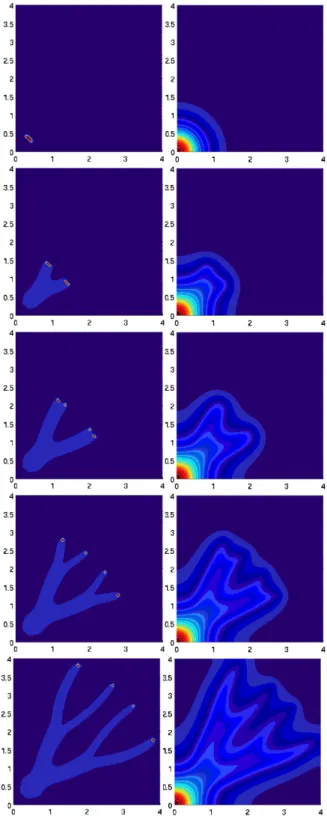
Results: The results are shown in Figure 1, where we depict five snap shots of the simulation. With our choice of parameters, the swarmer cells form a plateau traveling outwards (in accordance with the traveling wave analysis in Section 3). Additionally, one can observe successive branching, which is compatible with the experimental observations. The main branching mechanism seems to be stable and is kept with Bf ̸= 0. This mechanism, since it does not use local nutrient depletion,
is very different from that observed for reaction-diffusion systems (see 19,23,17,8 and
the references therein). The system (2.1) can generate several types of instabilities and we study some of them below for simplified equations.
3. Traveling plateaus in one dimension for small surfactin diffusivity
In order to explain the branching instabilities that occur in (2.1) as shown in Figure 1, a simplification of the full model is introduced. The supporters and the mother colony are not represented, and we assume that the surfactin is solely produced by the swarmers. The resulting model has the form
∂tn +∇ · ( n(1− n)∇c − n∇S)= 0 , −Dc∆c + τcc = n , ∂tS− DS∆S = αn . (3.1)
Thus, we just analyze the effect of repellent forces when added to the hyperbolic Keller-Segel model proposed in 7, see also similar models with diffusion in 12 and the references therein. This system is interesting in itself and shares similarities with models for crowds derived by various authors 5,22, although key ingredients
are different.
We shall study planar traveling waves. More precisely, we are interested in un-derstanding the capability of the system to produce plateau waves, and in the stability and instability mechanisms involved in the multidimensional dynamics of these waves.
The hyperbolic Keller-Segel system generates plateaus as we explained earlier. The main property of system (3.1) is to create traveling plateaus and, in one space dimension when the repellent signal S does not diffuse, we can give an explicit analytical form of these plateaus. More interesting is their stability, whose analysis is facilitated by a change of unknowns, where (3.1) (with DS = 0) is transformed into
an hyperbolic system (with nonlocal coupling), as it was done in 20 for the Keller-Segel system with a nutrient. With x∈ R and with the new variable v = −∂xS, the
system (3.1) becomes ∂tn + ∂x ( (n(1− n)∂xc + nv ) = 0 , ∂tv + ∂x(αn) = DS∂x2v , −Dc∂2xc + τcc = n . (3.2)
Figure 1. Time dynamic of swarmers and supporters density (left) and of the surfactin concen-tration S (right) computed with the model (2.1).
Traveling plateaus for vanishing surfactin diffusivity
We set DS = 0 and look for traveling waves with speed σ, which are solutions of
the form n(x− σt), v(x − σt), c(x − σt) and, thus, have to satisfy
−σn′+(n(1− n)c′+ nv)′ = 0 ,
−σv′+ αn′= 0 ,
−Dcc′′+ τcc = n ,
(3.3)
where the prime denotes differentiation with respect to y = x− σt. The first two equations of (3.2) with DS = 0 and with c considered as given are a nonlinear
system of hyperbolic conservation laws. For the computation of weak solutions of the traveling wave system (3.3), smooth parts of solutions can be connected by jump discontinuities of n and v, satisfying the Rankine-Hugoniot conditions
σ[n] = [n(1− n)∂yc + nv] , σ[v] = [αn] , (3.4)
where the bracket denotes the jump across a discontinuity. A traveling plateau solution that vanishes outside of a bounded interval, then has to satisfy
n(−σ + (1 − n)c′+ v)= 0 , −σv + αn = 0 . (3.5) Therefore, the nontrivial constant solution (n, v) = (1, σ) exists, if its speed satisfies
σ2= α, and it can be connected to the state (n, v) = (0, 0). In the following, without loss of generality, positive wave speeds will be considered. The above states are not influenced by the chemoattractant density, which can be computed separately. Thus, we conclude:
Theorem 3.1 (Existence of traveling plateau solutions). For every L > 0,
the traveling plateau with speed σ =√α and width L, n(y) = { 1 for 0≤ y ≤ L , 0 otherwise, v(y) = { √ α for 0≤ y ≤ L , 0 otherwise, with the chemoattractant concentration given by
c(y) = eµy(1− e−µL)/(2τ c) for y < 0 ,
(1− eµ(y−L)/2− e−µy/2)/τc for 0≤ y ≤ L ,
e−µy(eµL− 1)/(2τ
c) for y > L ,
µ =√τc/Dc,
is a weak solution of (3.3).
The parameter L can be interpreted as the total number of cells since L = ∫
n(y)dy. This is, together with the usual translational invariance, the only free
parameter for the traveling wave. The surfactin concentration can be computed by integration: S(y) = √ αL for y < 0 , √ α(L− y) for 0 ≤ y ≤ L , 0 for y > L .
Surfactin is produced inside the plateau, and a trace of surfactin is left behind. Each plateau wave contains two shock waves. These are only practically relevant, if they are stable, i.e. they have to satisfy an entropy condition. For the purpose of checking this, we need the spectral properties of the Jacobian
Dn,vf = ( (1− 2n)c′+ v n α 0 ) , (3.6)
of the flux vector f = (n(1− n)c′ + nv, αn). In these computations, c′ can be considered as a given constant, since it is continuous across shocks. The eigenvalues are given by λ±(n, v) = 1 2 ( (1− 2n)c′+ v±√((1− 2n)c′+ v)2+ 4αn ) , (3.7) implying that the flux is strictly hyperbolic as long as (n, v)̸= (0, −c′), which holds along the plateau waves, since c′ ̸= 0 for y < 0 and for y > L. We have λ+ ≥ 0,
λ−≤ 0. An eigenvector corresponding to eigenvalue λ is given by r = (λ, α).
The Hugoniot locus of the origin (n, v) = (0, 0) (i.e. the set of all states reachable by a shock) is determined by elimination of the shock speed σ from (3.5). It consists of the v-axis with constant shock speed σ = 0, implying that the corresponding field is linearly degenerate, and of the curve determined by
αn− v(1 − n)c′− v2= 0 . (3.8)
A tangent vector at the origin is given by (c′, α), which has to be collinear to one
of the eigenvectors. Since
λ+(0, 0) = max{0, c′} , λ−(0, 0) = min{0, c′} ,
curve (3.8) belongs to the (+)-field for c′ > 0 and to the (−)-field for c′< 0. Since
c′(0) = 1− exp ( −L√τc/Dc ) 2√τcDc > 0 ,
the shock at y = 0 belongs to the (+)-field, and the Lax entropy condition
λ+(1,
√
α) < σ < λ+(0, 0) is satisfied iff ∂yc >
√ α.
For the shock at y = L the Hugoniot locus of the state (n, v) = (1,√α) has to be
examined using c′(L) < 0. This shock also belongs to the (+)-field, and the entropy condition now takes the form λ+(0, 0) = 0 < σ < λ+(1,
√
α), which is satisfied
unconditionally.
We collect our results:
Theorem 3.2 (Stability of traveling plateau solutions). For dynamic stability
of the traveling plateau solutions of Theorem 3.1 (as solutions of (3.2)),
c′(0) = 1− exp ( −L√τc/Dc ) 2√τcDc >√α (3.9)
is a necessary condition.
We are not aware of a rigorous result concerning sufficient conditions for stability, even without production of surfactin (see, however, 7 for a formal stability analysis in this case).
The stability condition (3.9) shows that plateaus can be destabilized by a too strong production of surfactin, by a too large diffusivity of the chemoattractant, or if they are too short.
Shock profiles for small surfactin diffusivity
We examine the effect of a small surfactin diffusivity 0 < Ds≪ 1 on the shape of
traveling waves. Traveling wave solutions of (3.2) satisfy
−σn′+((n(1− n)c′+ nv)′= 0 , −σv′+ αn′ = DSv′′, −Dcc′′+ τcc = n . (3.10)
Integration of the first two equations and the far field conditions n(±∞) = v(±∞) = 0 give n (−σ + (1 − n)c′+ v) = 0 , −σv + αn = DSv′, −Dcc′′+ τcc = n . (3.11)
Now c, c′, and v can be expected to be continuous, whereas n may still have jumps. The first two equations imply that these jumps have to be between regions, where
n = 0 , DSv′ =−σv , (3.12)
and regions, where
n = 1 +v− σ c′ , DSv ′=(α c′ − σ ) v + α ( 1−σ c′ ) . (3.13)
Shock profile at the left jump: We shall construct shock profiles close to the jump points y = 0 and y = L of the traveling wave of Theorem 3.1 and start with the left end of the wave at y = 0. By the smallness of DS, the profile can be
described asymptotically in terms of the boundary layer variable ξ = y/DS. In the
language of singular perturbation theory, v can be expected to be a fast variable, approximated as v = v(ξ), whereas (for moderate values of Dc) c′is a slow variable,
which can be approximated by the constant value c′(0) (see (3.9)). The density n may have jumps between n = 0 and regions where, by (3.13), n is approximated by
n = 1+(v(ξ)−√α)/c′(0), since the wave speed is approximated by σ =√α as given
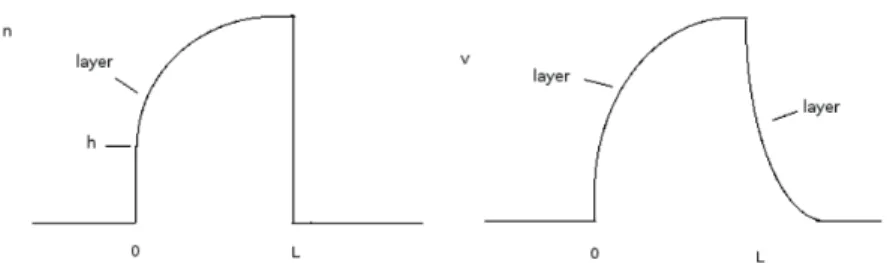
Figure 2. Qualitative representation of traveling plateau solutions of (3.2). Left: the swarmer density n, where h = 1−c′σ(0) is the height of the jump on the left side of the front. Right: the
gradient v of the surfactin concentration.
ξ < 0 we then have dv/dξ = −σv subject to the matching condition v(−∞) = 0,
which has the unique solution v(ξ)≡ 0. For ξ > 0, (3.13) implies
dv dξ = µ0( √ α− v) , with µ0= √ α ( 1− √ α c′(0) ) ,
subject to v(0) = 0 and to the matching condition v(∞) =√α. At this point we
recover the stability condition c′(0) > √α of Theorem 3.2, which is necessary for
solvability. If it is satisfied, we finally obtain the shock profile
n(ξ) = { 0 for ξ < 0 , 1−c√′(0)αe−µ0 ξ for ξ > 0 , v(ξ) = { 0 for ξ < 0 , √ α(1− e−µ0ξ)for ξ > 0 .
We reiterate that it contains a jump of n at ξ = 0.
Shock profile at the right jump: The construction of a shock profile at y = L is similar. Now the boundary layer variable is given by η = (y−L)/DS, and we search
for a solution, where (3.13) holds for η < 0 and (3.12) for η > 0. Since c′(L) < 0, both differential equations for v have decaying solutions, again meaning that the only bounded solution for η < 0 is constant. This finally leads to the shock profile
n(η) = { 1 for η < 0 , 0 for η > 0 , v(η) = { √ α for η < 0 , √ α e−√α ηfor η > 0 .
Note that now there is no profile in the swarmer density. An illustration of our qualitative results is given in Figure 2.
The theoretical predictions concerning the stability of the traveling waves have been examined by numerical simulations, which have been performed with x∈ [0, 7] and two sets of coefficients. Results are shown in Figure 3, where we can see (Figure 3a) the formation of the boundary layers as predicted above, when the stability condition is satisfied. Figure 3b shows the results of numerical simulations, when the stability condition is violated. We observe that the jump on the left side of the profile is replaced by a rarefaction wave.
a) 0 1 2 3 4 5 6 0 0.2 0.4 0.6 0.8 1 1.2 1.4 0 1 2 3 4 5 6 0 0.05 0.1 0.15 0.2 0.25 0 1 2 3 4 5 0.2 0.4 0.6 0.8 1 0 1 2 3 4 5 6 −0.05 0 0.05 0.1 0.15 0.2 0.25 0.3 b) 0 1 2 3 4 5 6 0 0.2 0.4 0.6 0.8 1 0 1 2 3 4 5 6 0 1 2 3 4 5 0 1 2 3 4 5 6 0 0.2 0.4 0.6 0.8 1 0 1 2 3 4 5 6 −1 0 1 2 3 4 5
Figure 3. Numerical simulations of (3.2) with two sets of coefficients and the plateau wave of Theorem 3.1 as initial datum. The left column depicts the initial data for n and for the chemoat-tractant c by solid and dash dotted lines, respectively, (top) and for the gradient v of the surfactin concentration (bottom). The right column is a snapshot at a later time. a) DS= 0.01, α = 0.05,
τc= 1, and Dc= 0.01. In this case, the stability condition c′(0) >√α is satisfied. The results verify the qualitative picture in Figure 2. b) DS= 0.01, α = 20, τc= 1, and Dc= 0.01. Now the stability condition is violated, the shock at the left is unstable and is replaced by a rarefaction wave.
4. Plateau splitting in reduced models
As we have seen, reduced models such as (3.1) can produce stable traveling plateaus for swarmers taht are compatible with the elongation of dendrites. In this section we show, based on numerical solutions, that reduced models are also able to produce instabilities and branching patterns. It turns out that the source term for S is crucial and we explore several possible forms. We will come back on mathematical questions of existence (in smallness regimes) in a forthcoming work 26.
4.1. Reduced 1D model without supporters
In the numerical results shown in Section 2, branching of dendrites is induced by the splitting of groups of swarmers transversal to the direction of movement. This section shows that splitting in the longitudinal direction is also possible. We consider an extension of the one-dimensional version of (3.1), where we incorporate the
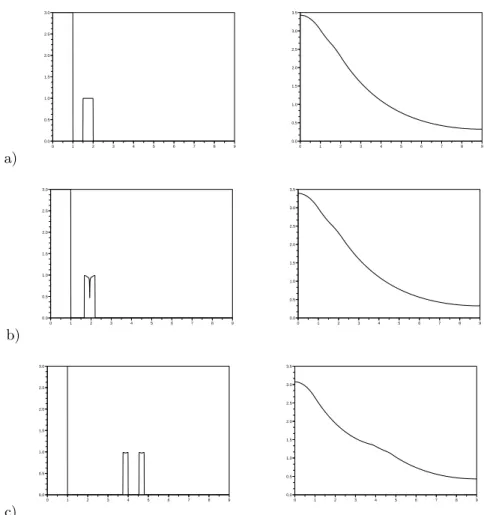
a) 0 1 2 3 4 5 6 7 8 9 0.0 0.5 1.0 1.5 2.0 2.5 3.0 0 1 2 3 4 5 6 7 8 9 0.0 0.5 1.0 1.5 2.0 2.5 3.0 3.5 b) 0 1 2 3 4 5 6 7 8 9 0.0 0.5 1.0 1.5 2.0 2.5 3.0 0 1 2 3 4 5 6 7 8 9 0.0 0.5 1.0 1.5 2.0 2.5 3.0 3.5 c) 0 1 2 3 4 5 6 7 8 9 0.0 0.5 1.0 1.5 2.0 2.5 3.0 0 1 2 3 4 5 6 7 8 9 0.0 0.5 1.0 1.5 2.0 2.5 3.0 3.5
Figure 4. Numerical solution of (4.1) with DS = 7, αS = 6, α = 3, τS = τc = 1, αc = 1 and Dc = 0.002. The left column shows n + mcol and the right column S: a) initial data, b) intermediate state, c) split state.
mother colony as an additional driving force and degradation of surfactin. This yields ∂tn + ∂x ( n(1− n)∂xc− n∂xS ) = 0 , −Dc∂2xc + τcc = n , ∂tS− DS∂x2S + τSS = αSmcol+ αn . (4.1)
Numerical simulations have been carried out with 0≤ x ≤ 9 and with the mother colony mcol = 3χ[0,1] (three times higher than the swarmer population density
in accordance with the biophysical situation described in the introduction). The initial data for the swarmer density and for the surfactin concentration are given by
n0 = χ[1.5,2] and, respectively, by the stationary solution of the surfactin equation
with n replaced by n0. Other model parameters are given in the figure caption.
Results are depicted in Fig. 4. We observe a splitting of the swarmer colony occurring due to the combined effect of a drop of n in the plateau (due to the effect of the production of surfactin by the swarmers) and of the capability of the system to recreate plateaus that are separated by the external signal from the mother colony. In simulations with α = 0, i.e. without production of surfactin by the swarmers (results not shown), splitting does not occur. The surfactin gradient just transports a plateau of swarmer cells.
4.2. Reduced 2D model without supporters
In this section we present numerical results for the two-dimensional version of (4.1) with α = 0, i.e., ∂tn + div(n(1− n)∇c − n∇S) = 0 , −Dcc + τcc = αcn , ∂tS− DS∇2S + τSS = αSmcol. (4.2)
We emphasize the choice α = 0, avoiding plateau splitting in the longitudinal direc-tion, according to the results of the previous section. In two dimensions, however, transversal splitting may occur, which is the basis for dendrite branching. This is shown in Figure 5. The term−∇S acts so as to stretch the initial plateau-like state transversally, as depicted in Fig. 5a). Once the stripe is too thin, the conservation of mass and the action of∇c give rise to the splitting.
Here we have used x ∈ [0, 2]2, α = 0, DS = 1, τS = 10, τc = 1, αc = 1 and
Dc = 0.005. The mother colony occupies the left bottom corner of the
computa-tional domain and we have chosen mcol= 3χ|x|≤0.2. The initial swarmer density is
n(0, x) = χB with B ={x = (x1, x2) : (x1− 0.5)2+ (x2− 0.5)2< 0.32, 0.4 <|x| <
0.6}, as displayed in Figure 5a).
4.3. Reduced 2D model with supporters The system considered now,
∂tn +∇(n(1 − n)∇c − n∇S) = 0 , −Dcc + τcc = n , −DS∆S + S = αSmcol+ αff , ∂tf = Bff (β− f) + Bnn , (4.3)
is almost the full system (2.1), however without the effect of supporter diffusion caused by a trace substance and with a quasistationary equation for the surfactin concentration. On the other hand, a logistic growth term for the supporters should have a similar effect of making the supporter concentration approximately constant.
a) 0 0.5 1 1.5 2 0 0.5 1 1.5 2 0 0.2 0.4 0.6 0.8 1 1.2 1.4 b) 0 0.5 1 1.5 2 0 0.5 1 1.5 2 0 0.2 0.4 0.6 0.8 1 1.2 1.4 c) 0 0.5 1 1.5 2 0 0.5 1 1.5 2 0 0.2 0.4 0.6 0.8 1 1.2 1.4
Figure 5. Numerical simulations of (4.2) with x ∈ [0, 2]2, α = 0, DS = 1, τS = 10, τc = 1,
αc= 1, Dc= 0.005. The swarmer density is shown at different points in time: a) initial data, b) intermediate state, c) split state.
This is a mathematical simplification, which preserves this feature as can be seen in Fig. 6, but ignores the observed motility of supporter cells.
Moreover, taking the time derivative for the equation for S, one gets
∂tS = DS∂t∆S + αf∂tf = DS∂t∆S + αfBff (β− f) + αfBnn ,
so that when αfis small and DS = 0, (4.3) is a perturbation of the reduced traveling
wave model (3.1). By the results of Section 3, this makes the existence of traveling wave solutions rather likely.
For a numerical solution, the parameters have been chosen as L = 2, DS = 0.05,
Dc = 0.0005, αc = 2, αm = 1, αf = 2, Bf = 12, Bn = 4, β = 1/3. The mother
colony is still chosen as mcol = 3χ|x|<0.2. The initial conditions are f (t = 0) = 0,
n(t = 0) = χB with B ={x = (x1, x2) : 0.2 <|x| < 0.3, (x1− 0.2)2+ (x2− 0.2)2<
a) b)
c) d)
Figure 6. Time dynamic of swarmers plus supporters density computed with the 2d model (4.3) with supporter cells.
The results are shown in Fig. 6. This simplified model reproduces branching patterns similar to that of the full model (2.1), with a constant density of swarmers and supporters respectively in the tip and along the dendrite.
5. Conclusion
Dentritic patterns are commonly observed during the swarming of bacterial cells colonies such as B. subtilis. Established models to reproduce these patterns are usually based on parabolic equations, and the instability is driven by the local depletion of nutrient.
Here we have considered an hyperbolic model for the swarmer cells, which pro-vides the leading mechanisms of the system, completed by various, possibly degen-erate, parabolic equations for the other cells (in particular supporters) and for the chemicals excreted by these cells. But, motivated by experiments on rich media, no nutrient limitation is used.
New branching instabilities have been observed in the complete model includ-ing a mother colony, supporter cells and swarmers which has been devised based on former hyperbolic Keller-Segel with logistic sensitivity models proposed in 4,7.
Reduced models, more amenable to analysis, explain several numerical observa-tions: traveling plateaus for the swarmers exist generically and are stable under size conditions in one space dimension. The instability mechanisms, responsible for branching, are numerous and depend on the dimension, where the computations are performed.
From the modeling side, improvement of the description of short range effects of surfactin is necessary, and we can expect different branching instabilities in more realistic systems. From the theoretical point of view, understanding two dimensional effects and further instability effects is certainly the most challenging problem. Acknowledgements
This work was achieved as C. S. was visiting INRIA/UPMC team Bang on a visitor position. F. C. has been supported by the Marie Curie Actions of the European Commission in the frame of the DEASE project (MEST-CT-2005-021122). Bibliography
1. http://www.freefem.org/ff++.
2. Bouchut F., Nonlinear stability of finite volume methods for hyperbolic conservation laws and well-balanced schemes for sources. Series Frontiers in Mathematics, Birkhäuser Verlag, Basel (2004).
3. M. Burger, M. Di Francesco, Y. Dolak-Struss, The Keller-Segel model with prevention of overcrowding: linear vs. nonlinear diffusion. SIAM J. Math. Anal. 38 No. 4, (2006) 1288-1315.
4. M. Burger, Y. Dolak-Struss, C. Schmeiser, Asymptotic analysis of an advection-dominated chemotaxis model in multiple spatial dimensions. Commun. Math. Sci. 6 No. 1,(2008) 1-28.
5. M. Burger, P. Markowich, J.-F. Pietschmann. Work in preparation.
6. A. L. Dalibard, B. Perthame, Existence of solutions of the hyperbolic Keller-Segel model. Trans. Amer. Math. Soc. 361 No. 5, (2009) 2319-2335.
7. Y. Dolak-Struss, C. Schmeiser, The Keller-Segel model with logistic sensitivity function and small diffusivity. SIAM J. Appl. Math., 66 No. 1, (2005) 286-308.
8. I. Golding, Y. Kozlovsky, I. Cohen, E. Ben-Jacob, Studies of bacterial branching growth using reaction-diffusion models for colonial development. Physica A 260, (1998) 510-554.
9. P. Gray, S. K. Scott, Autocatalytic reactions in the isothermal continuous stirred tank reactor: isolas and other forms of multistability. Chem. Eng. Sci. 38, no. 1, (1983) 29-43.
10. K. Hamze, D. Julkowska, S. Autret, K. Hinc et al., Identification of genes required for different stages of dentritic swarming in Bacillus subtilis, with a role for phrC. Microbiology 155, (2009) 398-412.
11. T. Hillen, A classification of spikes and plateaus. SIAM Rev. 49(1), (2007) 35-51. 12. T. Hillen, K. Painter, A user’s guide to PDE models for chemotaxis. J. Math. Biol.
58, (2009) 183-217.
13. D. Horstmann, From 1970 until present: The Keller-Segel model in chemotaxis and its consequences, Part I. Jahresbericht der DMV 105, no. 3, (2003) 103-165.
14. D. Horstmann, From 1970 until present: The Keller-Segel model in chemotaxis and its consequences, Part II. Jahresbericht der DMV 106, no. 2, (2004) 51-69.
15. D. Julkowska, M. Obuchowski, I. B. Holland, S. J. Seror, Branched swarming pat-terns on a synthetic medium formed by wild type Bacillus subtilis strain 3610. Mi-crobiology 150, (2004) 1839-1849 .
16. D. Julkowska, M. Obuchowski, I. B. Holland, S. J. Seror, Comparative analysis of the development of swarming communities Bacillus subtilis 168 anda a natural wild type: critical effect of the surfactin and the composition of the medium. J. Bacteriol. 187, (2005) 65-74.
17. Y. Kozlovsky, I. Cohen, I. Golding, E. Ben-Jacob, Lubricating bacteria model for branching growth of bacterial colony. Phys. Rev. E, Phys. plasmas fluids Relat. In-terdisciplinary Topics, 50, (1999) 7025-7035.
18. D. A. Kessler, H. Levine, Fluctuation induced diffusive instabilities. Nature, 394, (1998) 556-558.
19. K. Kawasaki, A. Mochizuki, M. Matsushita, T. Umeda, N. Shigesada,
modeling spatio-temporal patterns created by Bacillus-subtilis. J. Theor. Biol., 188, (1997) 177-185.
20. T. Li, Z. Wang, Nonlinear stability of traveling waves to a hyperbolic-parabolic system modeling chemotaxis. To appear in SIAM J. Appl. Math.
21. A. Marrocco, H. Henry, I. B. Holland, M. Plapp, S. J. Séror, B. Perthame, Models of self-organizing bacterial communuities and comparisons with experimental observa-tions. Math. Model. Nat. Phenom. Mathematical Modelling of Natural Phenomena Vol. 5 No 1 (2010), 148–162.
22. B. Maury, A. Roudneff-Chupin, F. Santambrogio, A macrodcopic crowd motion model of gradient flow type. M3AN, to appear.
23. M. Mimura, H. Sakaguchi, M. Matsushita, Reaction diffusion modeling of bacterial colony patterns. Physica A, 282, (2000) 283-303.
24. J.D. Murray, Mathematical biology, Vol. 2, Second edition. Springer, 2002.
25. B. Perthame, Transport equations in Biology (LN Series Frontiers in Mathematics), Birkhauser, (2007).
26. B. Perthame, C. Schmeiser, M. Tang, N. Vauchelet. Traveling plateaus for a Keller-Segel system with logistic sensitivity; existence and branching instabilities. Work in preparation.
27. A. Sokolov, I. S. Aranson, J. O. Kessler, R. E. Goldstein, Concentration dependence of the collective dynamics of swimming bacteria. PRL 98, 158102 (2007).

![Figure 5. Numerical simulations of (4.2) with x ∈ [0, 2] 2 , α = 0, D S = 1, τ S = 10, τ c = 1, α c = 1, D c = 0.005](https://thumb-eu.123doks.com/thumbv2/123doknet/15015676.681006/16.892.218.725.291.737/figure-numerical-simulations-α-d-s-τ-s.webp)