Faculté des Sciences Economiques Avenue du 1er-Mars 26
CH-2000 Neuchâtel
www.unine.ch/seco
PhD Thesis submitted to the Faculty of Economics and Business
Institute of Economic Research University of Neuchâtel
For the degree of PhD in Economics by
Sandra KLINKE
Accepted by the dissertation committee:
Prof. Mehdi Farsi, University of Neuchâtel, thesis director Prof. Bruno Lanz, University of Neuchâtel
Dr. Catherine Cooremans, University of Lausanne
Prof. Joachim Schleich, Grenoble Ecole de Management, France
Defended on the 25th of April, 2018
v
Abstract
Energy service contracting consists in the outsourcing of energy-related services to a contractor, an Energy Service Company (ESCO), through a long-term contract. This business model has been deemed, in the literature, a promising market-based instrument to foster the deployment of renewable energy and energy conservation projects. This thesis examines empirically the determinants of adoption of energy service contracting and their underlying economic mechanisms. After a general introduction including a critical literature review, the first chapter focuses on adoption of energy supply contracting (ESC), while the second chapter examines the willingness to opt for energy performance contracting (EPC). The last chapter assesses how new energy policies could expand the supply-side of ESC and EPC. The analyses are based on three original datasets, including real contractual choices and two stated choice experiments targeted at the potential demand and supply of the energy service contracting market. The empirical evidence suggests that risk sharing is an important determinant of the client’s adoption. Economies of scale and trust have also an impact, while the financing from the ESCO has a positive effect only for a minority of energy consumers. The transaction costs involved in these contracts are exacerbated by the number of decision-makers involved. On the supply side, only important changes in the energy market, such as the implementation of White Certificates or an increase in the demand of energy contracting from both public and private clients, have a significant impact on the willingness to enter the ESCO market. Using original empirical methods, this PhD thesis provides new insights in the mechanisms that could foster the diffusion of these contracts and exploit their potential in the energy transition and in business opportunities.
Keywords: energy service contracting, energy efficiency, renewable energy, risk sharing, transaction cost economics, energy service company (ESCO)
vi
Résumé
Les contrats de services énergétiques consistent à externaliser au travers d’un contrat de longue durée la provision et l’optimisation de services d’énergie à un contracteur, nommé ESCO (Energy Service Company). Ce modèle d’affaire est perçu dans la littérature comme un instrument de marché prometteur pour déployer des projets liant énergie renouvelable et économies d’énergie. Cette thèse étudie empiriquement les déterminants d’adoption des contrats de service énergétique et les mécanismes économiques sous-jacents. Faisant suite à une introduction générale contenant une revue critique de la littérature, le premier chapitre se concentre sur l’adoption des contrats de fourniture énergétique, alors que le second chapitre examine la volonté d’opter pour des contrats de performance énergétique. Le dernier chapitre explore comment de nouvelles politiques énergétiques pourraient étendre l’offre de ces contrats. Les analyses reposent sur trois bases de données inédites, découlant de choix contractuels réels et de deux expériences à choix (préférences exprimées) ciblant la demande et l’offre potentielles sur le marché des contrats de services énergétiques. L’analyse empirique montre que le partage du risque est un déterminant important dans le choix du client d’adopter de tels contrats. Les économies d’échelle et la confiance ont aussi un impact, alors que le financement par l’ESCO a un effet positif seulement pour une minorité. Les coûts de transactions de ces contrats sont exacerbés par le nombre de décisionnaires impliqués. Du côté de l’offre, seuls d’importants changements sur le marché de l’énergie, par exemple l’introduction de certificats blancs ou une augmentation de la demande de contracting de la part des clients privés et publics, ont un impact significatif sur l’offre. En se basant sur des méthodes empiriques inédites dans le domaine, cette thèse de doctorat offre de nouvelles perspectives sur les mécanismes susceptibles d’étendre la diffusion de ces contrats et ainsi exploiter leur potentiel dans la transition énergétique et les opportunités commerciales.
Mots-clés: Contrats de service énergétiques, efficacité énergétique, énergies renouvelables, partage du risque, économie des coûts de transaction, ESCO
vii
Content
Abstract ... v Résumé ... vi Content ... vii Acknowledgements ... viii Abbreviations ... ix Introduction ... 1 1 Motivation... 12 Energy Service Contracting ... 2
3 The interest of energy service contracting ... 6
4 Diffusion of energy service contracting... 17
5 Theoretical review of the determinants of adoption of energy service contracting ... 22
6 Determinants of adoption from the client’s point of view: empirical review ... 26
7 Is policy intervention needed? ... 28
8 Structure of the thesis ... 30
1 The determinants of adoption of Energy Supply Contracting: Empirical evidence from the Swiss market ... 37
Abstract ... 37
1 Introduction ... 38
2 Background and hypotheses development... 40
3 Empirical Methodology ... 47
4 Results and discussion ... 58
5 Conclusion and policy implications... 68
6 Appendix ... 71
2 The determinants of adoption of Energy Performance Contracting: Empirical evidence from a discrete choice experiment ... 85
Abstract ... 85
1 Introduction ... 86
2 Background and hypotheses development... 88
3 Methodology ... 93
4 Data ... 106
5 Results ... 112
6 Conclusion ... 128
7 Appendix ... 131
3 The provision of energy service contracting...147
Abstract ... 147 1 Introduction ... 148 2 Background ... 150 3 Methodology ... 152 4 Data ... 158 5 Estimation results ... 168
6 Discussion and conclusions ... 174
7 Appendix ... 177
Conclusion and further research ...186
viii
Acknowledgements
First and foremost, I would like to express my gratitude to my supervisor, Prof. Mehdi Farsi, for the continuous support, the inspiring ideas, and for the many precious suggestions. I am also grateful to the experts in my PhD committee, Prof. Bruno Lanz, Prof. Joachim Schleich and Prof. Catherine Cooremans for their valuable comments, which improved considerably the quality of my work. I also thank my co-authors Martin Jakob, Ulrich Reiter and other researchers, in particular Benjamin Volland, Sylvain Weber, Fléance Cocker and three anonymous reviewers who gave me precious advices on my research.
This research would not have been possible without the financial support from the Swiss Federal Office of Energy and from the Swiss Competence Center for Energy Research (SCCER CREST) funded by the Comission for Technology and Innovation. I also thank sincerely the respondents of the two surveys as well as the representatives of the two ESCO’s that granted me access to their data on contracts offers and took the time to answer my questions. My sincere gratitude also goes to the Swissesco members and the experts in the field who answered my questions, and in particular Patrick Sudan and Jean-Marc Zgraggen.
Special thanks go to my former colleagues at the Institute of Economic Research of the University of Neuchâtel (IRENE), with whom I spent highly valuable moments during all these years, and in particular Géraud Krähenbühl, Caspar Sauter, Thierry Graf, Lionel Perrini, Luciano Lopez, Alexandra Kiss, Cécile Hediger, Arnaud Blaser, Ivan Tilov, Benjamin Tissot-Daguette and Joséphine Leuba. I also benefitted from the encouragement and comprehension of my current colleagues, and especially Corentin Maucoronel, Yann Gronek, Jean-Michel Lopez and Antoine Delay.
I am immensely grateful for the unconditional support and encouragement of my parents, my two brothers and my husband’s family. To my children, Elia, Elena and the little one on his way: thank you for your adaptation and infinite patience.
And finally, last but by no means least, thank you Gian-Paolo, my eternal cheerleader and reviewer, without whom I would have never succeeded.
ix
Abbreviations
ESC Energy Supply Contracting EPC Energy Performance Contracting ESCO Energy Service Company
1
Introduction
1
Motivation
The Swiss authorities are considering to progressively abandon nuclear power while ensuring security of energy supply via a smooth transition to a sustainable and low carbon economy. In this context, it is crucial to attract sufficient investments in both renewable technologies and energy efficiency. The success of the energy policy programs will depend on the extent to which they can identify and overcome market barriers to investment. Thus, the potential of instruments such as energy contracting in Switzerland should be explored.
Energy service contracting is considered as a market-based instrument that can facilitate investments in renewable and efficient energy services and combines business opportunities with social benefits. These contracts have resulted in important energy savings (Soroye and Nilsson, 2010; Goldman et al., 2012) and investment in innovative renewable energy systems (Bleyl, 2011). In 2011, the aggregate revenues for the contractors were estimated to reach $5 billion in the US (Gilligan, 2011), and 3.5 to 5 billion Euros in Germany in 2013 (Bertoldi et al., 2014). Yet, the potential of energy service contracting does not seem to be fully exploited (Backlund and Thollander, 2011). In most countries indeed, these contracts have been applied only to large energy consuming buildings in specific market segments (Backlund and Thollander, 2011; Pätäri et al., 2016). In Switzerland, despite strong financial institutions and credit-worthy private and public institutions, the Energy Supply Contracting market has experienced a slow growth while Energy Performance Contracting has only recently started to emerge.
This PhD thesis intends to answer the following question: What are the determinants, and the underlying economic mechanisms, for adoption of energy service contracting? While the literature on energy contracting is wide and has benefitted from the contribution of experts coming from many fields such as engineering, business management, public policy, physics, law or finance, this thesis focuses on the economic perspective and uses econometric tools to answer this question. More
2
specifically, the determinants of energy service contracting are explored using economic theories on vertical integration, transaction cost economics, risk sharing, access to capital and economies of scale. This thesis uses empirical evidence from both the demand side and the supply side of the Swiss market of energy service contracting. The main contribution of this thesis relies on the original datasets and on the econometric methods used to explore energy service contracting adoption, namely discrete choice experiments.
This introductory chapter provides a critical review of the existing literature and exposes the contribution of the thesis.1 The chapter is structured as follows: the next section reviews the definition and concepts of energy service contracting, as well as the technologies and contractual schemes involved. The interest of energy service contracting is exposed in section 3 and a presentation of the general tendencies on the markets is provided in section 4. A literature review of the determinants of adoption of energy service contracting is provided in section 5 for theoretical contributions and 6 for empirical evidence. The role of the government is discussed in section 7. The contribution of the PhD thesis is then exposed in section 8, and is followed by some concluding remarks.
2
Energy Service Contracting
2.1 Definition and concept
Energy service contracting involves the provision of energy services. Although many definitions of energy services exist in the literature, the relevant definition in the context of energy service contracting is provided by a directive of the European Parliament (Fell, 2017): “Energy service: the physical benefit, utility or good derived from a combination of energy with energy efficient technology and/or with action, which may include the operations, maintenance and control necessary to deliver the service, which is delivered on the basis of a contract and in normal circumstances has proven to lead to verifiable and measurable or estimable energy efficiency improvement and/or primary energy savings.“
3
In this thesis, the conditions under which an activity is considered as energy service contracting, and under which a contractor is considered as an ESCO (Energy Service Company) follow Sorrell (2005): “A necessary feature of an energy service contract appears to be the transfer of decision rights over key items of energy equipment under the terms and conditions of a long-term contract, including incentives to maintain and improve equipment performance over time.”
Firms, public communities and house-owners usually outsource some of the activities related to the provision of energy services. However, these activities are considered as energy contracting only if the contractor has decision rights over the installations and/or the operation and an incentive to optimize equipment performance once the equipment is installed. As a result, conventional projects of construction or retrofit where the contractor or the engineer is paid at project delivery are not considered as energy service contracting, since the contractor is not involved in operating the installation and there is no long-term contract.
Energy service contracts involve at least two parties. The clients are typically the owners of the building. The contractors are called Energy Service Companies (ESCOs), which are typically energy utilities, energy equipment and appliances providers, facility managers or general companies.
The literature often refers to two different types of energy contracting: Energy Supply Contracting (ESC) and Energy Performance Contracting (EPC) that are defined in the following sections.
2.2 Energy Supply Contracting (ESC)
ESC, also called Delivery Contracting (DC) (Marino et al., 2011), covers usually one or more streams of useful energy (e.g. steam/hot water, coolant, electricity), but the contractor exerts no or little control over the demand of energy services (e.g. room heating, ventilation, lighting). In these contracts, the ESCO typically has no incentive to reduce energy service demand because it is usually paid by an indexed unit price for delivered energy plus a fix amount for the equipment. Helle (1997) presents the main characteristics of ESC: “The characteristics feature of that type of contracting is to be found in its shifting the interface between energy suppliers and energy
4
consumers by one (conversion) stage along the energy chain (primary energy - final energy -useful energy -energy services). While with the traditional energy market structure the interface between energy supplier and energy consumer is placed at the stage of supplying final energy, contracting from the energy supplier’s point of view constitutes a forward integration.”
The characteristics given by Helle (1997) imply that the adoption of ESC by the client consists in some way in outsourcing useful energy provision to an ESCO. This remark has been used by Sorrell (2007) to relate the decision to opt for ESC to the literature of vertical integration and transaction costs economics. This framework applied to the ESC choice will be reviewed in a following section.
Another general characteristic of ESC relies on the fact that the ESCO keeps the ownership of the installation during the contract’s duration.
Energy supply contracting in Europe mostly promotes energy efficiency, renewable energy provision or innovative technologies for the delivery of heat (Bleyl, 2011). These types of contracts often involves technologies for the production of heating, hot water or cooling, such as heat pumps, biomass heating (pellets or woodchips), or solar (thermal).
2.3 Energy performance contracting (EPC)
Energy performance contracting delivers energy savings to the building owner. The basic principle of EPC is that a contractor assesses, develops and finances energy efficiency measures. By monitoring the technical installations, the contractor provides its client with a reduction in energy costs in exchange for a fixed fee or part of the savings achieved. The contractor finances the equipment or guarantees energy savings to the building owner. EPC differs from ESC in the fact that the contractor does have an influence on the demand of energy services and delivers energy savings to the client. Typical measures proposed within EPC are efficient lighting, heating control systems, energy automation systems, and occasionally improved insulation of the building envelope and combined heat and power (CHP) systems (IEA-RETD, 2013). The two dominant EPC models are shared savings and
5
guaranteed savings (Hansen, 2006), which are mainly differentiated by the financing characteristic:
Shared savings: the ESCO typically finances or receives financing by a third party in order to design and implement the project. Energy cost savings are then shared between the two parties.
Guaranteed savings: In this model, the client carries the financing or gets financing by a third party. The ESCO guarantees that the energy saved will meet a certain threshold. Otherwise, the ESCO reimburse the difference. In these types of contracts, the ESCO is typically paid a fixed fee.
The fact that the ESCO is paid or provides guarantees according to the savings achieved obliges the two parties to agree on the measurement and verification methods of the outcome.
Other EPC schemes exist and can mix the characteristics of shared savings and guaranteed savings. The methods of financing are flexible and can involve a share of the actions financed by the ESCO while the rest is invested by the client. An additional actor such as an investor can also be part of the contract, as in the
forfaiting scheme (swissesco, 2016). In this scheme, the investor finances partly or
completely the installation and gets in return a corresponding predefined fixed share of the savings (from the client or the ESCO). As in the guaranteed-savings scheme, the client also pays a fixed fee to the ESCO which provides in return a guarantee on the energy savings achieved. In practice, it is also possible to see more comprehensive contracts that combine characteristics of both ESC and EPC. For instance, EPC can involve the financing of renewable energy technologies, such as solar photovoltaic systems, thermal collectors or heat pumps. ESC can also include quality insurance for energy efficiency measures as in the so-called Integrated Energy Contracting model (Bleyl, 2011).
2.4 ESC versus EPC
ESC provides energy delivery while EPC provides energy savings. This results in the fact that ESC often includes renewable energy technologies while EPC rather focuses on equipment increasing energy efficiency. While the contractor is required to
6
decrease energy costs in EPC, there is no mean or incentive to reduce the energy consumption in ESC.
Despite this main divergence, the two types of contracts are closely related. First, both ESC and EPC provide risk sharing mechanisms. This is the case even if different risks prevail in each type: risk related to energy provision and renewable energy for ESC and risk related to energy savings for EPC.
Second, as both types of contracts can involve financing from the ESCO, they can both be seen as financing mechanisms.
Thus, the economic theory underlying the client’s choice to opt for ESC or EPC is comparable (Sorrell, 2007). EPC and ESC are operating on the same supply chain of energy services, although EPC can be seen as a variant of ESC which goes deeper in terms of the ESCO’s control on the energy distribution process.2
These similarities justify the interest of discussing the results in the contexts of both ESC and EPC in this PhD thesis. For instance, while chapter 1 focuses on ESC, EPC literature will still be discussed throughout the chapter. In this case, it is also relevant because the empirical literature on ESC adoption is inexistent while already wide on EPC, thus bringing insights into my empirical investigation.
A brief literature review on the interest of energy service contracting in the context of renewable and energy efficiency is further discussed in the next section.
3
The interest of energy service contracting
3.1 Renewable energy and the role of ESC
Investment in the development and production of small scale renewable technologies has been seen earlier in the literature as sub-optimal, due to barriers such as lack of access to capital, missing information and awareness, and restricted access to technology at a reasonable price (Painuly, 2001).
In particular, many small-scale renewable technologies for heating and cooling are produced by SMEs that cannot reach the critical level to benefit from economies of
7
scale (IEA-RETD, 2013). Moreover, the uncertainty concerning new technologies may bias consumers’ decision towards status quo or may imply that it is rational for consumers to delay investments. In this case, the literature calls this phenomenon irreversibility (Pindyck, 1991; Dixit and Pindyck, 1994).
Finally, any reasonable diffusions of renewable energy, let alone a mass-market development, depend also on the success of energy utilities to identify and exploit the potential market niches with a relatively high willingness to invest. However, the interested companies might be unable to identify and target the relevant potential customers. Indeed, although existing research shows positive willingness to pay for green energy (Borchers et al., 2007 among others), empirical evidence suggests that the estimates are highly heterogeneous across individuals and technologies (Borchers et al., 2007; Scarpa and Willis, 2010). As a result, while renewable technologies are significantly valued by consumers, for the vast majority of them this value is not sufficiently large to cover the capital costs of micro-generation energy technologies without any kind of financial or regulatory support.
ESC is typically used by customers to install new equipment that often involves renewable and/or innovative technologies such as co-generation systems (Bleyl, 2011). However, there has been no attempt in the literature to empirically prove that ESC promotes investments in renewable technologies. The impact of EPC, on the other hand, has been explored by Okay and Akman (2010) and Fang and Miller (2013), who analyse its influence on CO2 emissions3. First, Okay and Akman (2010) use the ESCO markets’ study of Vine (2005) on 38 countries to analyze pairwise correlations between ESCO indicators, such as the age of EPC market, the number of ESCOs and the total value of ESCO projects, and country indicators, such as GDP per capita, CO2 emissions and energy consumption. They find positive correlations between ESCO indicators and CO2 emissions and conclude that this suggests that ESCO projects are either not necessarily targeted to emission-reduction or that the market is unsaturated in most countries observed. Fang and Miller (2013) reach an opposite conclusion using a panel of 129 countries from 1980 to 2007. Using a GMM
3 Vine (2005), Okay and Akman (2010), Fang and Miller (2013) use the general term of ESCOs to refer to companies that are engaged in performance-based projects. Even if they also account for projects involving renewable energy, it is plausible to consider that they refer to EPC rather than ESC in their research.
8
estimation method, they find a negative impact of the existence of ESCO activities on CO2 emissions that increase over time. Nevertheless, the results from both studies may still suffer from endogeneity problems and unobserved heterogeneity across countries.
As a result, there is no reliable empirical proof in the existing literature that energy contracting has a causal negative impact on CO2 emissions and more precisely, that
energy contracting promotes investment in renewable energy. This is the case even if many authors have argued that investments in renewable technologies are promoted because energy contracting, and especially ESC, can reduce some of the barriers aforementioned. For instance, Sorrell (2005) argues that ESC allows the client to transfer some risk onto the ESCO, thus reducing uncertainty linked for instance to the technical aspects of new technologies. Also, the customer can concentrate on core activities while finding a way to reduce his lack of technical knowledge or access to capital (Sorrell, 2005; Painuly, 2001; IEA-RETD, 2013). Moreover, the long-term contract and the incentive it creates for the ESCO to maintain equipment performance during the contract implies that ESC is an “instrument to minimize life-or project cycle cost, including the operation phase of the building” (Bleyl, 2011, p. 185). As a result, limited access to innovative and renewable technology at a reasonable price, as stated by Painuly (2001), may actually be overcome by ESC. This opinion is supported by Eikmeier et al. (2009) who explore the advantage of ESC over in-house energy provision, once an old heating system is replaced. Using query of contracting companies and telephone interviews with selected market participants, they find that “contracting enables to counter successive declines of the annual use efficiency over the heater lifetime roughly 4% better on average than in-house solutions”. Sorrell (2007) argues also that ESC can reduce significantly technologies’ prices since competitive bidding induces the ESCO to minimize production and operation costs. Conversely, when the energy supply is managed in-house, incentives of market competition are not present, unless such incentives are provided by an internal management mechanism (Irrek et al., 2005; Capelo, 2011). Then, Sorrell (2007) asserts that access to expensive, promising or new technologies can be achieved at reasonable price thanks to the economies of scale that ESCOs experience. Indeed,
9
while he observes that organizations usually lack the scale to implement large energy projects, the ESCOs, through specialization and contracting with multiple clients, can reach significant economies of scale.
While citing all these apparent advantages provided by ESC, it is to be kept in mind that a contract also incurs transaction costs. Indeed, while contracting is expected to reduce overall productions costs as compared to in-house procurement, the overall transaction costs are also expected to increase (Capelo, 2011). Even if this argument has been used by Capelo (2011) about EPC, this also applies to ESC where the client must gather information about the ESCO and the implications of the contract, which comes at a cost (Sorrell, 2007).
Finally, no author has argued that ESCOs are more effective than conventional energy providers to target and reach customers with high willingness to pay for renewable energy.
To summarize, although the existing literature suggests that there may be several channels through which energy contracting may support and induce investment in innovative and renewable technologies, there is hardly any empirical attempt to support these conjectures. Nevertheless, the apparent success of the ESC markets in Europe to supply cost-effective projects with innovative and renewable technologies (see for instance Bleyl, 2011) suggests that the ESCOs attracted a significant part of the consumers interested in investing in these technologies.
In this context, exploring the relative importance of the mechanisms of ESC adoption would permit to propose contracting options that focus primarily on these important features, in order to develop further the ESC market and attract more customers who invest in promising renewable technologies. This represents the motivation of my first chapter of my PhD thesis, which assesses the mechanisms of ESC adoption.
3.2 Energy efficiency
In order to understand how energy service contracting may have a role to play in energy efficiency, it is important to review the literature and the concepts underlying the energy efficiency gap. The literature in this domain is important because it gives insights on how the barriers to energy efficiency could be mitigated. These barriers
10
could also exist in the context of renewable energy. The objective is then to review the literature on the role of energy service contracting in this domain. Nevertheless, because this PhD thesis does not aim to explore in detail the concept of the energy efficiency gap, the present chapter proposes a summary of the literature, which does not pretend to be exhaustive.
Experts’ interest in energy efficiency investments started with Hausman (1979). By comparing the capital costs with the expected operating costs, Hausman (1979) estimated an implied discount rate of approximately 20% - well above the rates at which most individuals borrowed or invested money. Hausman’s observation that individuals do not seem to invest optimally in energy efficiency, or as stated by Jaffe and Stavins (1994), the existence of an energy efficiency gap, has given rise to an important literature (See Gillingham and Palmer, 2013). The potential reasons of this gap, among which market failures, have been analyzed in the literature, although its size remains unclear and the relative importance of its causes unknown.
The gap may take different definitions across studies. Engineering studies typically compare the amount of energy efficiency investments presenting positive net present values with the current level of investments (See for instance EPRI, 2009; McKinsey Company, 2009). On the other hand, economists define the gap as the difference between what is optimal from the consumer’s perspective and what is actually invested (Gillingham and Palmer, 2013). A larger definition of the gap covers the difference between the socially optimal investment level in efficiency and the current level of investment. This chapter considers this wider definition, in order to analyze the role of energy service contracting in energy efficiency in general.
Several market failures can explain the energy efficiency gap as defined by the economists. While it has been argued in the literature that all these causes are playing a significant role in the energy efficiency gap, there has been hardly any attempt to compare the sizes of their impact on the sub-optimal investment.
Split incentives may arise because the up-front costs are not paid by the individual who benefits from lower energy costs (IEA-RETD, 2013). Both theoretical models and
11
empirical evidence show that this results in under-investment in energy efficiency.4 Split
incentives can occur between landlords and tenants, as well as within a firm.5 The
landlord-tenants split incentives is of particular importance in the Swiss context where only 37% of the dwellings were inhabited by their owners in 2010 (OFS, 2013).
Imperfect information may prevent the investor from appropriately assessing ex ante the potential of an investment (Tietenberg, 2009; Gillingham and Palmer, 2013). Gathering the necessary information about the differences in quality of these investments may also be too costly (Allcott and Greenstone, 2012; Sorrell et al., 2004).
Limited access to capital or credit constraints has been cited as a market failure characterizing investments in energy efficiency, in cases where the lender cannot distinguish between good or bad credit risk borrowers (Gillingham and Palmer, 2013). This phenomenon is exacerbated if borrowers with a high energy savings potential have poor credit risk profiles (Palmer, Walls and Gerarden, 2012). Other constraints may prevent entities from investing in energy efficiency, such as debt ceilings (particularly affecting the public sector) or limited budget for non-core activities (in the case of private firms). In the latter case, firms may be reluctant to find external financing for investments that are not directly linked to the core-business (Hansen, 2006) and even if internal capital is available, the energy efficiency project may be considered less strategic than other investments (Cooremans, 2011). Finally, investors may be insufficiently informed about the financing options or subsidies available when making their decisions (IEA-RETD, 2013).
Regulatory failures correspond to divergences between electricity prices and marginal costs, resulting from economic regulation of electricity markets, which may distort incentives to invest in energy efficiency and increase the gap when the price falls below marginal cost (Gillingham and Palmer, 2013). However, this effect may be only temporary since prices can also rise above the marginal cost, creating positive incentives to invest. Jaffe and Stavins (1994) argue that these potential distortions do not relate to the energy efficiency gap, since regulatory failures do not help in explaining non-adoption at current prices.
4 See Murtishaw and Sathaye (2006) and Davis (2010) for empirical evidence and the appendix of Gillingham et al. (2012) for a formal explanation.
5 Within firms, split incentives may arise when the department which is in charge of investing in building technologies and the department who has to pay for the energy costs are separated and also have separated financial accounting.
12
Finally, the energy efficiency gap has also been explained by the fact that consumers do not necessarily act according to the standard assumptions underlying the neoclassical economic theory. Gillingham and Palmer (2013) describe in detail the related behaviors that they call behavioral anomalies, such as loss aversion (Greene et al., 2009) or a systematic undervaluation of discounted future energy costs (Allcott and Wozny, 2012). Limited attention or non-standard decision-making processes lead individuals to simplify the decision by focusing only on certain attributes when making a choice or to stick to familiar or salient options.6
Other insights may be brought into the energy efficiency gap literature by exploring how other non-financial considerations affect the decision to invest in energy efficiency (Cooremans, 2011; Cooremans, 2012), such as power relationships within the firms or the firm’s strategy. The investment category in terms of analytical characteristics and scope is also likely to play a major role in the firm’s decisions. The analytical characteristics of an investment include the impact, the level of risk, the financial return, the solutions available, the number of actors and the incentive to invest. The scope on the other hand defines whether the investment is related to the core-business or not. Therefore, not only the profitability matters in the investment decisions, but also its strategic component in terms of increasing the competitiveness of the core-business (Cooremans, 2011; Cooremans, 2012). One should also consider the fact that the firms are likely to have different criteria of decision depending on the type of investment. Investments related to the core-business may be typically evaluated using profitability criteria such as net present value. But, the decision-making process may be different in the case of investments that are not directly related to the core-business, such as investments in energy efficiency. In these cases, other requirements (rate of return) or other criteria (payback time) may apply.
Several other elements may explain why seemingly cost effective investments in efficiency are not undertaken. These elements represent the difference between engineering measures and the gap considered by the economists:
First, the heterogeneity across energy consumers may imply that the net present value of an investment may be positive for the average consumer, but negative for a majority of individuals (Jaffe and Stavins, 1994; Allcott and Greenstone, 2012).
6 This has been studied in other contexts, such as consumption practices on eBay (Hossain and Morgan, 2006). Sensitivity to the framing of choices, whereby the presentation of choices can affect significantly the decision (Duflo et al., 2005), are also cited as having an impact on the energy efficiency gap (Gillingham and Palmer, 2013).
13
Second, engineering studies fail to account for hidden costs, such as the discomfort linked to some technologies or the opportunity costs, which represent the return of any alternative investment that the consumer forgo when investing in energy efficiency. These opportunity costs may be particularly important for firms where the part of energy in production costs often represents a small share of 2-5%, implying that investments on the production process are well more interesting than energy efficiency (Hansen, 2006). Uncertainty about future energy prices and risk due to the irreversibility of the investment may also imply that it is rational for consumers to delay their investments in energy efficiency (Dixit and Pindyck, 1994) and thus lead to an overestimation of the energy efficiency gap in engineering studies.
The risk inherent to energy efficiency investments reduces the number and amount of investments undertaken in energy efficiency (Anderson and Newell, 2004) and may explain the high implicit rates observed by Hausman (1979). Risk stems from financial or technical uncertainties. In the former case, it relates to unexpected realization costs or future energy price variations. The technical risk in energy efficiency investment relates to unexpected technical failures of the equipment, under-performance or uncertain energy savings. Based on 50 retrofitted residential multifamily buildings in Switzerland, Khoury and Hollmuller (2017) find that realized energy savings do not meet the expected savings, but are instead considerably lower due to a variety of reasons (mismatch between actual use and standards, uncertainty in facility managers and clients behaviour or poor input data quality).7
Then, the estimations do not account for possible interactions between technologies if implemented together and often “assume perfect installation and maintenance” (Gillingham and Palmer, 2013). Moreover, the coordination of the different actors involved in energy efficiency projects is very important to guarantee an optimization of the system as a whole (Levine et al., 2007) and may imply significant transaction costs that are not included in these estimates.
Finally, engineering studies may not account for the fact that expected energy savings can be reduced because of rebound effects, in which wealth effects following the implementation of energy-efficient installations lead the individuals to consume more8.
7According to their model, 500MJ/m2/year expected savings translate in 310MJ/m2/year realized. 8 See for instance Sorrell and Dimitropoulos (2008) for more details on the rebound effect.
14
Finally, the optimal level of investment from the consumer’s perspective will still be lower than the socially optimal outcome because of externalities. Increasing the actual level of investment in energy efficiency will bring social benefits by decreasing negative externalities.
3.3 The role of energy service contracting
3.3.1 Split incentives
There has been no attempt in the literature to determine whether and how energy service contracting reduces split incentives. One could argue that the ESCO, or the facilitator, can help tenants to coordinate in order to invest in energy efficiency. The ESCO may also assist potentially interested owners to redirect the costs of energy efficiency investments to the tenants. Nevertheless, I show in the first chapter of this thesis that having tenants is an important barrier to ESC adoption and suggest that the Swiss legal framework regarding the transfer of costs to the tenants should be clarified. In the UK (Nolden and Sorrell, 2016) as well as in the mature US and Canadian ESCO markets (Panev et al., 2014), commercial centers and office buildings represent untapped potential because of the involvement of tenants. While energy service contracting, in its standard form, does not seem to solve split incentives issues, it is possible that energy service contracts with alternative payment schemes are more effective in that sense. Nolden and Sorrell (2016) provide a list of these schemes, such as on-bill financing, in which repayments are typically tied to the property and not the owner or the tenant. However, because these schemes always involve a remuneration of the capital via the energy bill or an increased rent, they are not suitable for the current Swiss legal framework. Indeed, transferring to the tenants 100% of the retrofits capital costs via an increased rent is not possible, since only the value added can be transferred. The Swiss law explicitly mentions that retrofits capital costs cannot be transferred to the tenants in the ancillary costs either.9 Hence, having
9See art. 6 OBLF, concerning the ancillary costs (“charges accessories”). One exception exists: district heating capital costs can be totally transferred to the tenant via ancillary costs. One should also note that the prohibition to transfer the capital c osts via ancillary costs concerns by definition only capital costs of what is considered as an investment. It the EPC involves no investment on new equipment, but just energy equipment optimization (such as improved energy systems regulation), the costs for such optimization can be transferred to the tenants via the ancillary costs. Thus, on-bill financing has already been applied in some EPC contracts in Switzerland. But these contracts do not involve any capital investment. They just focus on energy systems optimization.
15
tenants is expected to decrease the likelihood of energy efficiency investment, with or without energy service contracting.
3.3.2 Imperfect information and risk
In both ESC and EPC, the operation and maintenance is covered by the contractor during the whole contractual period. Thus, the client benefits from the technical knowledge of the ESCO in the long run, which may reduce imperfect information. EPC is designed to give both the ESCO and the customer the incentive to reduce energy costs. ESC guarantees energy delivery at the same cost during the whole contractual period. These contracts therefore represent important risk sharing mechanisms. Even if the risk is not considered as a cause of the energy efficiency gap as perceived by the economists, it may still explain the low level of investment in energy efficiency as observed by engineers. Sharing the risk with the contractor, which is specialized in these types of equipment, may permit to reach a level of investment, which is closer to the socially optimal level.
Nevertheless, a guarantee comes at the cost of a risk premium paid to the ESCO. Respondents are likely to have heterogeneous preferences and perceptions towards the technological risk. Recent research from Polzin et al. (2016b) show that German municipalities underestimate the risks associated with street lighting LEDs retrofits and therefore do not value the risk-sharing advantage of EPC. But this result may be specific to the LED technology perceived as safe.
3.3.3 Limited access to capital
ESCOs can facilitate access to financing, either by paying for the installation themselves, or by guaranteeing a third-party investment via the EPC “forfaiting” scheme (Swissesco, 2016). Li et al. (2014) find empirical evidence that ESCOs can partly relieve the clients of their financing need, using a sample of 140 EPC projects implemented in China.
However, these results may be challenged by the fact that the ESCO’s guarantee in the “forfaiting” scheme will provide added value only if the third party investor evaluates the ESCO with a better risk profile than the client. In ESC and in the shared-savings scheme, ESCOs may also have difficulties to find the necessary
16
capital (Nolden and Sorrell, 2016; Panev et al., 2014). Whether the facilitated access to capital provided by ESCOs is indeed valued by building managers depends on their actual credit constraints with respect to energy efficiency investments. These constraints might be relatively small in Switzerland especially in periods of low interest rate.
3.3.4 Non standard behaviors and non-financial considerations
To my knowledge no research has yet explored the impact of energy service contracting in this area. Because these contracts involve annual payments that are agreed upon at the signature of the contract, the underestimation of future financial flows as opposed to the initial investment may be reduced. Also, because the technical and financial risk is shared with the ESCO, the latter has an incentive to propose the investment which is the most relevant to the client. This may reduce the complexity of the choices the building owner has to make and thus may mitigate inattention or imperfect optimization.
Despite the lack of literature in this domain, the ESCO market actors seem aware of the importance of non standard behaviors: “We want to acknowledge the fact and raise awareness among Facilitators and other stakeholders [on the ESCO markets], that the identified needs for change require approaches beyond economic rationale based on a homo oeconomicus concept or environmental awareness. Instead psychological and organizational change processes need to be put on the agenda, even though this may be new territory for most energy efficiency professionals.” (Bleyl et al., 2012).
3.3.5 Other empirical evidence on the role of EPC
The extent to which EPC promotes energy efficiency has first been studied by Soroye and Nilsson (2010). Using data on EPC projects implemented in the public sector in Sweden between 2000 and 2010, they find that these projects led to an average of 22% energy savings for heating and hot water. They also observe that ESCOs helped to increase the awareness of firms about the usefulness of energy efficiency, although this could not be precisely measured. A few other studies attempted to measure the impact of EPC. Okay and Akman (2010) estimate pairwise correlations
17
between ESCO and country indicators in a sample of 38 countries and find that the volume and maturity of the EPC market is positively related to energy consumption. They conclude that this result stems either from the ineffectiveness or the non-saturation of the EPC market. However, this result could be due to reverse causality. Indeed, countries with higher energy use have a greater need for EPC solutions. Fang et al. (2012) reach an opposite conclusion using a panel of 94 countries over the period 1981 to 2007. They find that the existence of the EPC market has a negative impact on energy use and that the effect becomes stronger over time. However, these results may still suffer from endogeneity and/or unobserved heterogeneity across countries. Goldman et al. (2012) provide insights into the estimated amount of energy saved in the US thanks to EPC. Based on a sample of 2,484 projects implemented in the US over the period 1990-2008, they evaluate that EPC generated a net direct economic benefit of $23 billion to their clients. While these studies provide illustrations of the potential size of energy savings induced by EPC, they do not provide empirical evidence that EPC induces investment in energy efficiency and thus reduces the energy efficiency gap. Indeed, it is possible that EPC simply facilitated the tasks of customers who would have invested anyway and as such, cannot be considered as a complete solution for the energy efficiency gap. Also, EPC projects may only involve optimization of the energy equipment and as such, do not directly imply an investment in energy efficiency, since they have no impact on the balance sheet. They will just affect the expenses, by providing energy savings, without any capital investment.
While the potential role of energy service contracting has been reviewed in this section, the next section explores whether these potentials are exploited in the current ESCO markets.
4
Diffusion of energy service contracting
4.1 Foreign ESCO markets
An important part of the relevant literature consists in assessing the evolution and the size of the ESCO markets around the world (see for instance Vine, 2005; Goldman et al., 2005; Painuly et al., 2003; Lee et al., 2003; Bertoldi et al., 2014; Bertoldi et al.,
18
2017; Marino et al., 2010; Marino et al., 2011; Xu et al., 2011; Goldman et al., 2012; Panev et al., 2014; Stuart et al., 2016; Nolden and Sorrell, 2016).
In 2014, the US was considered as the most mature ESCO market (Fang et al., 2012; Panev et al., 2014).10 The US private industry has been developing since the 1970s as a response to the oil shocks and was mostly based on the shared-savings model (Langlois and Hansen, 2012). While the US was becoming a more mature market, the guaranteed-savings model has become predominant (Goldman et al., 2005). In a more recent report, Stuart et al. (2016) show that the US ESCO industry revenues have been stagnating between 2011 and 2014 and that ESCOs have tried to diversify. For instance, they are now proposing non-energy benefits within EPC, such as water conservation, emission credits or avoided operation and maintenance.
The initial Energy Contracting concept started in Western Europe more than 100 years ago (Hansen, 2006; Bertoldi et al., 2006; Adnot et al., 2002). However, it only re-emerged significantly in the European Union in the 1980s. In 2000, the estimation of the EPC market size in Western Europe was around 150 million Euros per annum (Bertoldi et al., 2003). Bertoldi et al. (2006) present the results of a survey conducted in the EU-25 countries and Romania and Bulgaria in the period 2003 to 2004 and show that there were important differences among the situation and evolution of the markets across countries. With 500 ESCOs and an estimated annual revenue of 3.5 to 5 billion Euros in 2013 (Bertoldi et al., 2014), Germany is the leading market in Europe (Eikmeier et al., 2009). It is followed by Italy and France (Marino et al., 2010; Bertoldi et al., 2014). The general trend in European countries shows stagnation or a slow growth for the 2010-2013 period (Bertoldi et al., 2014). Exceptions are France, Spain, Denmark and Ireland which experienced a strong growth in the same period. In 2013, the ESCO markets are still emerging or inexistent in a majority of countries11 (Bertoldi et al., 2014), suggesting that the situation may significantly evolve in the EU in the next years (Bertoldi and Boza-Kiss, 2017).
The following tendencies have been noted on the foreign ESCO markets:
10 The US market may be now supplanted by the Chinese market, which was estimated to account for 55% of worldwide ESCO
revenues in 2015 (IEA, 2016).
11 Exceptions are Germany, France, Austria, Czech Republic, Denmark, Finland, Italy and UK, which show either moderate or
19
ESC projects dominate significantly the markets, as compared to EPC in both
European and US markets (Eikmeier et al., 2009; Bleyl, 2011; Bertoldi et al., 2006; IEA-RETD, 2013).
The advantages of energy contracting are most relevant beyond a certain scale, mainly due to the transaction costs involved in the contracting process. For ESC, a Swiss ESCO uses typically bottom threshold of 50kW12, i.e. more than ten household
units, while in Germany, Eikmeier et al. (2009) cites a thermal load of 100kW, i.e. around 20 000 € annual energy costs (Bleyl, 2011), as a minimum project size to cover all the transaction costs, based on empirical results from a market study. For EPC, which is expected to incur even higher transaction costs, the critical size for a viable project is even larger than under ESC. This has been showed by Goldman et al. (2005) who observed a median project cost of US$1 million for EPC compared to US$0.5 million for non-performance-based contracting projects. In Germany, the minimum energy cost for an EPC project is estimated at 100’000 euros per year (Bleyl, 2011).
Project financing varies across countries and seems to depend on the maturity of
the ESCO market. While the US ESCOs used to finance sometimes with their own
funds the projects in the premises of contracting activities, this has drastically changed and projects are now financed with long-term debt or leases. Nowadays, US ESCOs prefer to serve as vehicle or facilitator to provide financing rather than directly finance themselves, in order to balance the risks (ICF, 2007; IEA-RETD, 2013). Conversely, shared savings is the dominant model used in Europe, while 90% of the contracts in the US are rather using guaranteed savings schemes. Since the European ESCO is a younger market, clients are likely to be less confident and aware about this new
business model, and usually let the ESCO finance the investment and bear the financial risk as it is the case in the shared savings model (Hansen, 2006; Marino et al., 2011). In the US, on the other hand, confidence of the consumer leads them to invest in EPC projects, through guaranteed savings schemes (Goldman et al., 2005).
Finally, while in practice ESC is used in various market segments, such as housing,
commerce industry or public buildings (IEA-RETD, 2013), EPC is practically limited to the public sector, such as hospitals, swimming facilities or schools (Bleyl,
2011; Marino et al., 2011). The actors call it the “MUSH” market (municipal and state government, universities and colleges, schools and hospitals) (Satchwell et al., 2010).
20
The abundance of public EPC projects in spite of private investments may be explained by several causes. First, public institutions often need third party financing and the ESCOs are not reluctant to provide the financing in such cases because public clients are credit worthy (Bleyl, 2011). Then, the size, the use and the age of public
infrastructures typically represent high savings potentials that are attractive for the ESCOs (Bleyl, 2011). Moreover, regulations have forced public entities to implement energy policy goals in their own buildings (Langlois and Hansen, 2012). Finally, the public sector seems to accept longer payback period. Indeed, based on a sample of approximately 1 500 EPC projects, Goldman et al. (2005) find a median payback time of 10 years for public infrastructure as compared to 3 years for private projects.
4.2 The Swiss energy contracting market
In Switzerland, detailed statistics on the energy contracting market are not available. The available data suggest a slow growth, due to lacking in-house expertise, limited flexibility for the industry, and financing barriers for small contractors (Marino et al., 2010; Bertoldi et al., 2014). In 1999, the Swiss Federal Office of Energy (SFOE) estimated the ESC market at 170 million Euros/year (Bundesamt für Energie, 1999). This number has reached 350 million Euros in 2009, according to Swiss Contracting13.
The EPC market, on the other hand, is still small and undeveloped with only a few ESCOs active and consequently only a few contracts per year signed. These projects encompass improvement of heating ventilation and air-conditioning (HVAC), lighting, pumps, automation, motors and inverters, with a relative dominance for industrial and non-residential buildings (Bertoldi et al., 2014). As opposed to other markets, a major part of EPC projects in Switzerland has been implemented with private clients.
Although interest from the supply-side for EPC exists, the concept is rather unknown among consumers14. The first call for tender applied to EPC has been published in 2016. The apparent delay of the Swiss EPC market as compared to other European ESCO market is not explained in the literature. Some experts argue that the main difference between the Swiss market and foreign ESCO markets lies in the fact that
13Association that listed 76 energy contractors in 2010 which include local energy producers and distributors with some of them
providing ESC. An estimation is that around 7-10 companies (mainly local energy utilities) have carried out energy contracting projects (Bertoldi et al., 2014).
21
the Swiss potential clients do not need external financing, which has often been a trigger of adoption in foreign ESCO markets.
4.3 Diffusion of energy service contracting and the energy service gap
Despite the success of energy contracting in some countries, some authors have argued that the potential of this business model was not fully exploited in terms of both energy savings and business opportunities (Marino et al., 2010; Bleyl, 2011; Langlois and Hansen, 2012), which lead Backlund and Thollander (2011) to refer to this problem as the energy service gap. The main reason for the existence of the energy service gap, evoked by Backlund and Thollander (2011), relies on transaction costs that prevent the market to further develop. As a result, theses contracts are mostly relevant beyond a certain scale and targeted at specific market segments, leaving out small energy consumers (Backlund and Thollander, 2011) and SMEs (Pätäri et al., 2016). Second, stagnation has been observed on some mature markets such as in the US (Stuart et al., 2016). Other authors observed that there is also an untapped potential of energy efficiency improvements in the public sector (Satchwell et al., 2010) as well as in the existing residential buildings (IEA-RETD, 2013).
Some authors claim that this is explained by the fact that low hanging fruits have already been harvested in most countries (Marino et al., 2010; Goldman et al., 2005). These attractive projects are typically represented by public buildings and simple technologies that reduce easily energy consumption, such as LED, HVAC, voltage optimization and building controls and rarely apply more comprehensive retrofits such as envelope enhancement (Bleyl, 2011; Nolden et al., 2016; Nolden and Sorrell, 2016). This observation could mean that the ESCOs have already exploited all their potentials and that other instruments than contracting must be found to cover other market segments or technologies.
One could also study the energy service gap under another perspective, i.e. indirect benefits. For instance, Goldman et al. (2005) state that customers in the US are no longer interested in cost/benefit ratios only, but are also increasingly valuing other indirect benefits, such as mitigating facility security or electric reliability of on-site
22
generation projects that are usually not taken into account in cost-benefit analyses. In this case, there may still be a potential untapped by the ESCOs.
Whether the energy service gap exists or not calls for a further investigation on the potential developments that remain for energy contracting. If these possibilities to grow further and target new market segments exist but are not exploited, then one should review the barriers that are hampering such an expansion. If these barriers happen to be non-existing or unbinding, then this could mean that ESCOs have already exploited the existing market niches. In this context, exploring the determinants of adoption of energy service contracting allows to assess whether and how its potential could be further exploited.
5
Theoretical review of the determinants of adoption of
energy service contracting
Only a few studies attempted to develop a theoretical framework applied to energy contracting. Yik and Lee (2004) and Li et al. (2014) provide a model for energy performance contracting viability and design based on net present values of future savings. Sorrell (2007) relies on economic theory, and more specifically on transaction cost economics (TCE), to assess contracts’ viability, applicable for both energy performance and energy supply contracting.
Sorrell (2007) argues that energy contracting represents a shift from a hierarchical form of organization (vertical integration) to a more market-based form and thus can reasonably be related to the economic theory of the firm, i.e. the so-called “make-or-buy” decision.
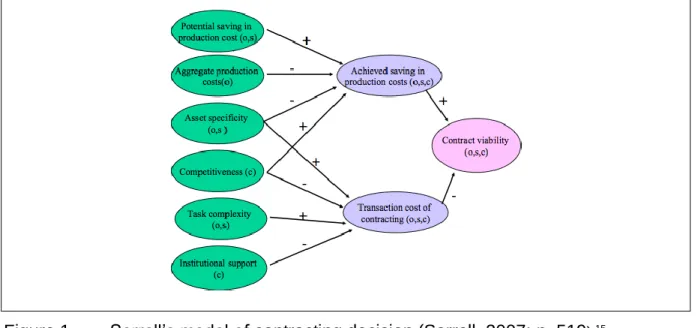
Sorrell’s model on the choice to invest in energy contracting rather than self-invest is summarized by Figure 1. The decision to opt for contracting draws upon the comparison of anticipated production costs (i.e. financing, distribution, control, maintenance, etc.) and transaction costs (i.e. consulting and legal costs, negotiations, costs associated with opportunistic behavior, etc.). Potential savings in production costs and aggregate production costs are key determinants in Sorrell’s model to explain contracts’ viability. Two other factors inspired from the TCE are added,
23
namely asset specificity and task complexity. Finally, he also incorporates two external variables specific to the context, i.e. competitiveness of the energy service market and institutional context (e.g. information, procurement, accreditation, consultancy, etc.).
Figure 1 Sorrell’s model of contracting decision (Sorrell, 2007; p. 519).15
The main determinants of adoption of energy service contracting considered in this thesis are transaction costs, risk sharing, economies of scale and financing. They are briefly developed in the next sections and further detailed in chapters I and II of this thesis.
5.1 Transaction costs
This PhD follows Sorrell's (2007) conjecture by identifying transaction costs as an important determinant of adoption of energy service contracting.
All investments in energy efficiency or renewable energy incur transaction costs. These may include consulting and legal costs, the cost of negotiations with the potential suppliers, as well as the burden of gathering information related to the available technologies, financing or subsidies opportunities. Energy service
15 (o) refers to factors determining the contracting decision, (s) to determinants explaining why particular services are in or out of the contract, (c) for elements that clarify why contract’s viability varies between comparable organizations in different contexts.
24
contracting may reduce part of these costs, since the ESCO benefits from its experience in the domain and accompanies the client in these processes.
On the other hand, because energy service contracting involves long term contracts, it incurs transaction costs in writing and negotiating the contractual clauses. The expected transaction costs that will occur after the contract’s signature are also expected to have an impact on the client’s decision to adopt energy service contracting. These costs include renegotiation and litigation costs, potential legal expenses and all the costs related to a modification of the technology or a transfer to another client or supplier. The transaction costs incurred in energy service contracts will depend on the technology specificity, the building and the client’s type. The elements impacting energy service contracting adoption through transaction costs are developed in the first chapter of the thesis.
5.2 Risk
When investing in renewable energy or energy efficiency, the client faces technological risks, such as unpredictable costs that arise in the construction phase of the project or any technological default that occurs in the equipment lifetime. A financial risk is also incurred in energy efficiency measures, due to the uncertainty surrounding energy savings. The ESCO can diversify the risk via a large portfolio of projects and other activities and benefit from higher technical knowledge than the client. It has also a better expertise in assessing a project’s risk. As a result, it is optimal for clients with risky projects to share the risk with the ESCO in order to gain from a better control and mitigation of the risks. Thus, risk sharing is expected to be an important determinant of adoption of energy service contracting.
5.3 Economies of scale
Many building owners cannot reach the critical level to invest in renewable energy or energy efficiency at reasonable costs. ESCOs may help the building owners to reach the critical size by pooling them together. This is typically the case in energy supply contracting involving district heating. Because the ESCO has a financial incentive to regroup the energy consumers, it will bear the costs of negotiating with the different potential clients to reach a viable size. This may also apply in the context of EPC, in
25
which the ESCO may help the clients to pool their buildings together in a single contract in order to benefit from economies of scale.
Transaction costs, risk and economies of scale are determinants that are likely to be interdependent in the client’s decision to adopt energy service contracting. For instance, the client’s size in terms of energy costs combines the effects of transaction costs and economies of scale. Sorrell (2007) argues that transaction costs for small consumers are likely to outweigh all ESC benefits, including economies of scale advantages. At the other extreme, very large consumers may benefit less from the ESCO’s advantages such as economies of scale or risk sharing since they may benefit from in-house energy management. As a result, ESC contracts are likely to be the most viable for mid-size energy consumers.
Using different factors related to these concepts, the chapter I of this thesis intends to disentangle their effect in the willingness to adopt these contracts.
5.4 Financing from the ESCO
A building owner willing to implement energy efficiency measures or renewable technologies may have limited access to capital. This has been cited as a market failure characterizing investments in energy efficiency, in cases where the lender cannot distinguish between good or bad credit risk borrowers (Gillingham and Palmer, 2013). This phenomenon is exacerbated if borrowers with a high energy savings potential have poor credit risk profiles (Palmer, Walls and Gerarden, 2012). Taken together, these elements result in higher interest rates that can hamper consumers to invest. Building owners or managers may also be insufficiently informed about the financing options or subsidies available when making their decisions (IEA-RETD, 2013). Other constraints may prevent entities from investing in energy efficiency or renewable energy, such as debt ceilings (particularly affecting the public sector) or limited budget for non-core activities (in the case of private firms).
Both ESC and EPC can relieve the clients from their financing needs, since these contracts can include financing from the ESCO. Whether the facilitated access to