Digital Technology for Conviviality:
Making the Most of Students' Energy and Imagination in Learning Environments by
Arnan Sipitakiat
B.Eng. Computer Engineering Chiangmai University, Thailand. 1995
Submitted to the Program in Media Arts and Sciences, School of Architecture and Planning in partial fulfillment of the requirements for the degree of Master of Science in Media Arts and Sciences at the Massachusetts Institute of Technology
August 2001
Massachusetts Institute of Technology, 2001
All Rights Reserved
Autho~r
Arnan Sipitakiat Program in Media Arts and Sciences August 10, 2001
Certified by __ _ _ _ _ _ _ _ _ _ _ _ _ _ _ _ _ _ _ _ _ _ _ _ _ _
C Seymour Papert
Professor of Education and Media Technology MIT Media Laboratory
Certified by
Gloriannd Davenport Principal Research Associate, Interactive Cinema Group MIT Media Laboratory
Accepted by______________________ _____ Dr. Andrew B. Lippman Chair, Departmental Committee on Graduate Students
Program in Media Arts and Sciences
MASSACHUSETTS INSTITUTEDigital Technology for Conviviality:
Making the Most of Students' Energy and Imagination in Learning Environments
by
Arnan Sipitakiat
Submitted to the Program in Media Arts and Sciences School of Architecture and Planning, on August 10, 2001 in partial fulfillment of the requirements for the degree of Master of Science in Media Arts and Sciences.
Abstract
This thesis contributes to the body of research on constructionist philosophy. It expands the conceptual framework to a broader scale by linking constructionism to Ivan Illich's notion of conviviality. An emphasis on developing convivial learning
environments has been made. The learning activities were developed with a special highlight on the idea of emergent design. The emphasis on conviviality and emergent design allowed a systematic and theorized framework to identify and discuss the pattern in the developmental process of learning activities, which is an area in the constructionist framework that needs more study. I gave special emphasis on learning activities that involve tool construction. I show how the making of tools could strengthen conviviality. I present a concept of dynamic equilibrium that allows different methods of learning and teaching to intertwine. I present a case study based on a five-week fieldwork conducted at a rural school of northern Thailand.
Thesis Advisors: Seymour Papert
Professor of Education and Media Technology Glorianna Davenport
Digital Technology for Conviviality:
Making the Most of Students' Energy and Imagination in Learning Environments
by
Arnan Sipitakiat
The following person served as the reader for this thesis:
Reader
David P. Cavallo Research Scientist, The Future of Learning Group MIT Media Laboratory
Acknowledgements
I am grateful for the people who have been helping me during the past two
years at MIT. It has truly been a wonderful experience. I came to MIT as a technical person with interest, but with little experience, in epistemology and learning. I have learned how unique my experience has been. The way things happen in Thailand, where I come from, is so different from the way they happen in the future of learning group here at the Media Lab, which is a unique place in MIT, which is a unique place in Cambridge, which is a unique place in America. The way this research happened was also unique and would not have been possible with out the support from these people:
o Seymour Papert, thank you for your comments and suggestions that helped this thesis get into a good shape.
o Glorianna Davenport, I am truly grateful for your support and especially your patience during the past two years. I have never known anybody who is in your position and is so supportive. Thank you.
o David Cavallo, what can I say? All of what I am now at MIT is because of your support. Thank you.
o Khun Paron Israsena and Khun Bangkok Chowkwanyun, Thank you for your constant support with everything. I truly admire the effort you have invested with the Lighthouse project.
o Dr. Suchin Petcharuksa, my research fieldwork could not have happened without your support. Thank you for organizing everything in Lumpang. o Ajarn Taweesak and Ajarn Pawana, thank you for you assistance planning
everything with the school and for making sure that I had everything I needed.
o Ajarn Sawat and Ajarn Wiratchai, thank you for staying late with me during my fieldwork and also for sacrificing your weekends for me. It was a pleasure to work with both of you.
o Eak, Nung, and Ore, Thank you for helping me with the students and for keeping me happy. I could not have done the work without you all. I miss the
dinners we had together at the kaw-tom place.
o Finally, I want to thank all the students, Lek, Tan, Pan, Non, Khompet, Ja, Tu, Meaw, Oui, Kib, Tic, Ging, and Jeyb for being such wonderful students. I have truly enjoyed the five weeks we had together. Thanks for the friendship and the wonderful experiences you gave me.
Contents
Introduction 11
1.1 Overview 11
1.1.1 Theoretical Contributions 11
1.1.2 Empirical Level Contribution 13 1.2 Motivation 14 1.3 Conviviality 15 1.3.1 General Idea 15 1.3.2 Implementation 16 1.3.3 Tool Construction 18 1.4 Case Studies 20
2
Theoretical Background 22
2.1 Realization of the Crisis 23 2.2 Recovery 28
2.3 Tools for Conviviality 30
2.3.1 Constructionism and Digital Technology 32 2.3.2 Making Tools 34
2.3.3 Emergent Design 35
3
Context: The Education Intervention effort in
Thailand 37
3.1 The National Educational Act of B.E. 2542 (1999) 37 3.2 Project Lighthouse 40
3.3 Lumpang Circuit 42
4
Case Studies 47
4.1 The First Day 49
4.2 Ideas for Children's Day 50 4.2.1 Saving the Princess 53 4.2.2 A New Game Emerged 55
4.2.3 Depression 57
4.2.4 Recovery 58
4.2.5 Show time: The Children's Day 59 4.2.6 The Dance Game 63
4.2.7 Reflection 64
A. First Reaction from the Students 64
B. Source of Authority: An Equilibrium 66
C. Tan's Resistant to Lego 68
4.3 An Introduction to Electronics 69 4.3.1 A Disappointing Project 72 4.3.2 Planning the Project 73 4.3.3 Komphet 76
4.3.4 Lek and Her Electronic Tool 80 4.3.5 Changing Plans 81
4.3.6 A Mistake 83 4.4 Lek and Her Fish Farm 85
4.5 Tan's Obsession with Visual Basic 89 4.5.1 Chat as a Tool 92
4.6 Digital Video as a Convivial Tool 94 4.6.1 Kib's Proverb Video Project 96
5
Lessons Learned 99
5.1 The Essence of Conviviality 99
5.1.1 The Komphet Phenomenon: An Evidence That Goes Against the
Industrial Mode of Production 99
5.1.2 A Suggested Recovery 103
5.2 Nourishing Conviviality in Learning Environments 106 5.2.1 Whose Ideas Count? Building Trust and Respect 107 5.2.2 A New Source of Authority 109
5.2.3 A Culture of Obedience: Conviviality and The Local Culture 111 5.3 Digital Technology for Conviviality 115
5.4 Making Tools 119
5.5 Conclusions 121
References 123
Introduction
1.1 OvervIew
This research is about experimenting with ideas that could deeply change learning environments. This thesis presents a new learning framework and a case study based on a five-week fieldwork conducted with a group of eight-graders at a rural school in northern Thailand. This research develops new discussions both in the theoretical and empirical level.
1.1.1 Theoretical Contributions
The basis of this thesis joins many works' in its constructionist philosophy [Papert,
1993]. However, the ideas presented are
unique in the following ways:
- I put constructionism into the context of Ivan Illich's notion of conviviality [Illich,
Examples of these works are [Papert, 1980], [Martin, 1994], [Resnick, 1994], [Cavallo, 2000], and [Bers, 1999].
1973]. Although a relationship between
Papert's work and Illich has been noted before (See [Falbel, 1990] and [Segall,
1990]), I believe that my development
goes further and has a unique character.
- Constructionist writers generally give importance to projects. However, only few have paid attention to features in the development of a project conducted
by school-aged students (See [Cavallo,
2000], [Harel, 1991], and [Kafai, 1995]). I specifically use and add to the idea of emergent design [Cavallo, 2000] in my framework. I make a more systematic and theorized approach that could identify patterns and strategies that would be useful to constructionist educators.
- I give special attention to the role of tool-making in project work and use the making of tools in a double role: as tools and as projects. I focus on the area of electronics and mechanics as well as programming.
- I synthesized and developed from the
idea of conviviality a concept of dynamic equilibrium in the interplay between different modes of learning and teaching.
1 -Introduction
1.1.2 Empirical Level Contribution
- I illuminate patterns in the learning
environment that are specific to a particular (Thai) culture and how they effect the implementation of the learning framework.
- I reveal patterns in the dynamics of the evolution of projects. I describe carefully and in detail: the development of learning activities; how the activities can go though phases; effects of the existing culture; importance of trust and respect. The emphasis of this research is on the initial reaction of learners who have never been exposed to any learning styles other than the traditional practice of schooling.
- I probe the complex relationship between a child's work and real community applications.
1.2 Motivation
The basis of this thesis is to present a qualitative analysis of a learning environment that is different from and often runs counter to the traditional education paradigm. The general tone for the framework follows the belief Papert and Cavallo have that [Papert and Cavallo, 2000]:
o Digital technology is a powerful force that is already changing practices of learning.
o Though the movement is massive, it is unacceptably limited.
o The fundamental limiting factor is the deficiencies and rigidities in thinking about learning.
According to Papert and Cavallo, the development of digital technology has out paced the development of cultures that make effective and humane use of technology in learning environments. The learning framework presented in this thesis is intended to contribute to this overlooked area. The hope is that this work, together with many others, would serve as evidence that a learning revolution is possible and would contribute to the public realization of the time, effort,
research, resources, and commitment required for such revolution to come about.
14 __ Diqital Technoloqy For Conviviality
I
Digital Technoloav For Conviviality 14
1 - Introduction
1.3 Conviviality
1.3.1 General Idea
Conviviality is the term that Ivan Illich uses to define a society that prefers the maximization of individual's creativity, imagination, and energy to the maximization of outputs, where the latter usually leads to an industrial mode of production. The traditional schools are clearly the opposite of conviviality, as it focuses on the production of students in an industrial mode [Illich, 1973; P.19]. Students are put through a standardized process that would transform them into an educated person. Thus, in order to be educated, a person is required to spend x number of years in schools, to study what they are told, and to pass a set of test. Anybody who can manage to handle this process deserves to be called an educated person.
In a convivial environment, the emphasis is the opposite of shaping and squeezing people though a standardized process. Conviviality aims to reach out to each person's diversity and make the most of the interest, energy, and imagination each has. Learners' primary motive in a convivial environment is not to gain a higher social status through the acquisition of an education degree. Rather, learning takes place by the desire to know
more about the world and to enrich their environment with their personal meaning.
1.3.2 Implementation
In addition to the theoretical framework, I need to decide how to form the implementation of the learning activities. I believe there is more than one way to build an environment that nourishes conviviality. However, I suggest in this research a practical framework that evidently shows a good result. Here are the design-decisions I made to carry out the case studies presented in this thesis:
Learning activities: The activities were project
based. Digital technologies (e.g. computers, Lego Mindstorms2, and digital cameras) were the primary tools and were used to construct artifacts (e.g. computer programs, Lego cars, and electronic light switches). This constructionist approach resonated with Illich's emphasis on using tools to promote conviviality. By constructing artifacts, they were engaged in planning, problem solving, and reflection of their work. These activities promoted a process of externalization and re-internalization of learners' ideas, which were based on their interaction with the physical object and the
2 See more information about Lego Mindstorms in Chapter 4
1 - Introduction
environment [Papert 1993; P.142]. Externalization of ideas has proven to be a preferred process in an environment that promotes learners' imagination and creativity. The case studies presented in chapter four shows examples of what I mean.
Activity development: I focus on the interplay
between different modes of teaching and learning. Though activities that emerge from the students are preferred, it does not mean the teachers' interest and knowledge should not have any valuable influence. 'Thus, though the final decision of what to do belongs to the students, I concentrate on developing relationships in the learning community that leads to a collective and collaborative development of ideas. Only few researchers have focused on this process (as mentioned in 1.1.1). I present a detailed documentation and discussion of the process in chapters four and five.
Time and participation: The learning activity
was carried out as an after school program. Participating students were able to come and leave as they wanted. This arrangement was necessary. An environment that learners are forced to participate would not provide an ideal condition for students to develop projects that are personally meaningful and that exercise their energy and imagination.
1.3.3 Tool Construction
One of the important contributions I have made in this research was my emphasis on identifying activities that involve tool construction as a theme that fosters a convivial environment particularly well. In chapter two, I discuss how learners' fluency with their tools and how their interaction with their community play an important role in the development of conviviality. The case studies suggest these two aspects happen felicitously in tool construction projects. For example, one student built a programmable power switch. Because it was supposed to be a general-purpose tool, the student had to generalize the design not to include any features that would tie the use of the tool to any specific device. It was a process
that made the students go one step further in the design process thereby gaining more fluency with the tools used to construct the switch. Towards the end of the five-week project, the switch was used at a fish farm to control lights that attract insects. The project involved student's parents who benefited from the use of the switch. Thus, the use of the tool created an interaction between the toolmaker and his or her community, which was beneficial to both parties.
1 - Introduction
Tool construction also benefited students in the learning process. For example, students' tools served as a tangible unit that contained the toolmaker's ideas and experiences. Since the tools were meant to be applied in different situations, the embedded ideas and experiences were portable and conveniently reusable. New ideas were built on top of existing ones for each new use. In addition, because tools were most likely to be used by many people, they created a feedback loop for the toolmaker. The feedback allowed the toolmaker to reflect and to further develop his or her ideas in the making of the tool. Examples of these benefits are shown in the case studies.
1.4 Case studies.
In chapter four, I present a concrete example of a learning environment that was developed based on the framework presented above. Chapter five reflects the underlying ideas of the learning framework and presents crucial issues that must be taken into account when a theoretical framework is transformed in to learning activities. These issues include the reaction from students, mindset changes of teachers, resource constraints, and cultural behaviors. Some examples of the case studies include:
o Situations where the teacher and the student have different motives and how positive outcomes can happen when the teacher is opened to students' ideas and let go of his or her total authority. This is a case of a dynamic tension [Cavallo, 2000] that the teacher has to deal and has to make decisions based on the specific situation in order to keep students ownership over their learning activity while not losing the opportunity to learn new ideas.
o How a student that failed completely in the traditional school could perform and learn extremely well when he is given the respect of his
1 - Introduction
learning interest, pace, and style. I document how I gradually develop a relationship of trust and respect that leads to the change.
o How teaching can still be part of the learning activities without depriving students' from their ownership of the learning activity. I discuss how teaching is used in a convivial way. That is, teaching is used to empower the students based on what they need and not as an activity imposed by someone else.
Theoretical
Background
In this chapter, I discuss my learning framework in more detail. My primary inspiration is Ivan Illich's notion of conviviality, which argues that people need tools to "make the most of the energy and imagination each has" [Illich, 1973]. I have added two ideas in order to build a strong practical ground for the construction of a digitally rich convivial learning environment. First, I emphasize the development of tools following a constructionist approach [Papert, 1993]. This emphasis on "making" and "building" tools gives the learning activities a general theme that resonates with how Illich believes tools should be used.
Conviviality also asks for a methodology that allows learning activities to emerge from learners, as opposed to being prescribed by the teacher. Here, I use an "Emergent Design" framework recently developed by David
2 - Theoretical Background
Cavallo, which uses the practice of applied epistemological anthropology and an analysis of learning behaviors to both probe the existing skills and knowledge, and to identify the learning potentials of a learning community [Cavallo, 2000]. The following sections discuss each of these ideas and their relationships in detail.
2.1 Realization of the crisis
In the most general sense, Illich uses the term conviviality to create a realization of the destructive side effects of institutions that focus too much on growth and productivity. We live in a society that favors higher outputs, lower cost, and better equity though standardization. According to Illich, this industrial mode of production used in institutions such as education, health care, and transportation appears favorable at first. But over time they will quickly pass a critical point that will begin to create destructive side effects, or even work against its initial goals.
Automobiles
The growth of automobiles is a good example of Illich's point. The car is one of the most remarkable inventions of human kind.
With this technology, people can conveniently and affordably travel greater distances than ever before. However, when personal automobiles became affordable for most people, it started to overwhelm other modes of transportation. Thus cars gradually become what Illich calls "radical monopoly." The following examples set the tone of what this phenomenon means.
In Chiangmai city of northern Thailand, personal vehicles (predominantly cars and motorcycles) have precluded city buses and other metropolitan public transportation. Only few bus routes survive and still operate today. Thus, it is not practical for most people to travel anywhere without owning a car or a motorcycle. The suggested solution was to produce more cars and make them affordable to more people by offering long-term installments plane. An economy car in Thailand would cost more than fifty times the standard salary of a person holding a bachelor's degree. The time it takes to pay off a car installment is often longer that the lifetime of the car itself. This burden does not include gas, tax, maintenance, and other expenses the car owner has to pay. Thus, people have to work harder to own cars. They end up in a vicious circle where a huge portion of their time are spent either working for a car or in the car itself.
2 - Theoretical Background
With too many cars, traffic congestion becomes a problem. People end up spending more time traveling then ever. Take a large city like Bangkok as an example. In the past four decades, the number of cars in Bangkok has increased dramatically. The traffic congestion causes people to spend more and more time driving. An average driver spends anywhere between two to eight hours on the road each day. Yet driving seems to be unavoidable, as it has become the standard mode of transportation and there are no other preferred choices. Many children have to wakeup as early as four o'clock in the morning to get to school in time. People often say Bangkok children grow in cars instead of in their home. Then there are other effects such as nose and atmospheric pollution that cars have created.
The Thai government attempts to solve the crisis by spending large portions of their budget on new highways. These highways not only failed to match the increasing number of cars, they make cars even more necessary, as only the people with cars have the privilege to travel relatively faster. This is an example of a feedback loop that is a result of a society that overly focuses on growth.
The School institution
Similar to automobiles, the school is an institution that has been put into the industrial mode of production [Illich, 1973; P.19]. Schools have become compulsory for most children. School learning has precluded most other possible ways of learning and has been accepted as the only right way to give children the knowledge they need for their future. It is clear that schools have become a radical monopoly. According to Illich, there have been harmful side effects resulting from schools, most of which are unrecognized.
When the modern school was established in the seventeenth century, it was the first time that seven or twelve grades of compulsory learning were proposed. It was believed that a blueprint could be designed so that every child could go through stages of development and could be transformed into a "new type of man who would fit into an environment created by scientific magic" [P.
19]. With this blueprint, schools could be
replicated, which would make education cheaper, better, and available for all.
Schools have become an institution that transforms learning into a commodity called "education." Schools are carefully designed to put learners through multiple stages on an assembly line that is supposed to transform
2 - Theoretical Background
them into gold. But no matter how hard schools tried, they always conclude that the majority of learners are unfit to be enlightened. Thus, most learners do not deserve the better life that the few good students would gain [P. 20].
When most people fail to be categorized as the elite, the A+, or the top ten, teachers and concerned parents react by imposing the only remedy they recognize: more schooling. For example, it is most likely for students in large cities of Thailand to spend one or two extra hours in special tutorial courses after school. Much of their weekend time is consumed by these tutorial courses as well. Vacations between semesters are becoming shorter. Students are spending more and more time in classrooms, but no matter how hard they try, most of them still fail to become the elite. As children's life style becomes more stressful, they continue to be blamed for their failures.
One of the worst consequences happens when the school imposes an ideology on students about what counts as learning. Those who succeed get their post docs along with all the glory while the school dropouts learn that they are incapable. Thus, other possible ways of learning are skewed in favor of "school education." When the school curriculum and its tests are all that counts, students are inevitably put into a role of mere consumers.
Self-motivated learning and exploration decreases. They soon feel they need to be taught in order to learn anything at all. This stereotype is what Illich calls "overprogramming" [P.57].
2.2 Recovery
Defining the crisis of the school institution is only half the picture. Proposing and shaping the alternatives is the true challenge. In this research, I present conviviality as one possible alternative that should lead to the recovery from the destructive effects that the overwhelmingly desire for productivity have created. I will begin by elaborating what Illich means by conviviality. Then, I will narrow the scope down to a practical level that is used in this research.
Illich believes that we must not allow the commodities we invent to shape our society. People should not be forced, consciously or not, to accept any single tool or service as the mean to archive a specific goal. Instead, people must have the freedom to use tools to "make the most of the energy and imagination each has" and to "make things among which they can live, to give shape to them according to their own tastes" [P. 11]. Thus, in the context of learning, schools must reverse their ideology from being a place that shapes the students
2 - Theoretical Background
according to a predefined blueprint to a place that supports students to discover themselves and maximize their potentialities.
Though Illich has a strong view against school institutions, he does not reject everything in schools altogether. Rather, he suggests a watershed that the industrial system should not exceed. Conviviality provides an alternate route that defines the equilibrium.
Illich defines the necessary changes from two points of view: a political view and a practical view. For any institution to change, the managers and policy makers need to realize the crisis and commit themselves to finding a new approach that will lead to a different organization. In the context of schools, this commitment needs to come from teachers, headmasters, and up to the very top of the organizational hierarchy. This is not an easy request. There have been many attempts in the past that came in terms of school reform. But most schools have not changed (See [Tyack and Cuban, 1995]). This change in the institutional level is beyond the focus of this work. I focus primarily on the grass-root, individual development level.
2.3 Tools for Conviviality
Illich emphasizes that conviviality could be achieved though the use of convivial tools. Tools serve as a medium that a person uses to express and reflect him or herself in their society and "to the degree that he masters his tools, he can invest the world with his meaning; to the degree that he is mastered by this tools, the shape of the tool determines his own self-image" [Illich, 1973; P.22]. Convivial tools are "those which give each person who uses them the greatest opportunity to enrich the environment with the fruits of his or her vision" [P.22].
Illich uses the term tool broadly. It includes not only physical tools like hammers, drills, scissors, computers, telephone but also productive institutions that produce tangible and intangible (services like education) commodities as well [P.20]. The scope of this work is to provide learners with both physical convivial tools and a productive environment that nourishes conviviality.
2 - Theoretical Backgound
In terms of physical tools, Ricky Goldman Segall concluded in her thesis that "conditions of a convivial tool are that it be accessible, easy to use, and beneficial to humankind" [Segall, 1990]. I use these definitions as guidelines for my work. However,
I emphasize the need to make users fluent with
a tool more than making the tool easy to use. Fluency in this context means more than the mere ability to use the tool. A fluent person should be able to transform an intuitive idea into the implementation of that idea using tools [Resnick et al., 1998]. This argument does not mean it is not necessary to make tools easier to use. I consider fluency as a better way of thinking about tools for conviviality than ease of use. A personal computer can be a convivial tool although it is not necessarily easy to use. But when a person is fluent with the computer, he or she could better use it to express himself or herself. Thus, fluency elevates the convivial relationship he or she has with the computer.
Accessibility points to tools that "can be easily used, by anybody, as often or as seldom as desired, for the accomplishment of a purpose chosen by the user" [Illich, 1973; P.23]. Students usually have a convivial relationship with computers that they own at home more than the ones at school. In schools, students are usually bound to use the computers only during computer classes and only for the purposed defined by the teacher.
On the other hand, computers at students' homes are usually more accessible both in terms of access time and purpose.
In the context of this work, tools that are beneficial to human kind are those that are used with good intentions. Knives can be used both in ways that are beneficial and ways that are threatening to other people. Without this guideline, a murderer's knife may still be counted as a convivial tool. In this sense, a tool will be convivial when it does not deprive others from their liberty. In a more positive sense, convivial tools are those that are used
"in caring for and about others" [P.1 1].
2.3.1 Constructionism and Digital
Technology
Providing convivial tools to learners would mean nothing unless they also work in an environment that nourishes conviviality. It would be silly to believe conviviality would happen automatically when we throw convivial tools to the learners. There is a need for a framework that gives a good grounding that can lead to convivial use of the tool. Here I use Seymour Papert's idea of constructionism. Though constructionism focuses primarily on how learning happens and how digital technology can enrich the learning process, it
2 - Theoretical Background
also includes practical grounds for the learning activities that may take place as well. As the name confers, constructionism emphasizes on "making" and "building" personally meaningful artifacts. There are clearly overlapping ideas between constructionism and conviviality. In this research, I leverage the practical ideas along with some digital tools that have been developed and used in constructionist research, namely Logo programming language and Lego construction kits (see more details about these tools in chapter 4).
Computational technologies are particularly well suited for this kind of activity. Students can easily customize and modify programmable tools to serve the functionalities required. Computational tools can also serve as "object to think with" connecting students to ideas and knowledge domains desirable in the context of learning [Papert, 1980].
2.3.2 Making tools
This work has emphasized the construction of tools, not merely the use of pre-constructed tools. I suggest in the case studies that tool construction activities foster learners' convivial relationship with their tools particularly well.
Similar to Idit Harel's observation that "the best way to learn a subject is to teach it," [Harel & Papert, 1990] I argue that the best way to master a tool is to build it. Learners will not only learn the body of knowledge embedded in the construction process, learners will also have the ability to apply and modify the tools to work in different applications as well, thus, maximizing learners' development of their fluency with the tool.
When developing tools, it is, by
definition, assumed that many users would use the tool. Thus, tool construction is a way that inherently makes that tool beneficial to others. In addition, when others use the tools, the toolmaker is likely to receive feedback that creates an intellectual feedback loop preferred in the context of learning. It can also enrich social interactions that further nourish conviviality.
2 - Theoretical Background
2.3.3 Emergent Design
We now have the tools and the type of projects we want. The final piece needed for the framework is the method by which we can develop the projects. Here, I use "emergent design," which is "a theoretical framework that emphasizes the practice of applied epistemological anthropology to probe for skills and knowledge that reside in the local learning community. It puts a spotlight on the need to study the conceptual space where the purposeful stance implied by the word design mates with the openness implied by the word emergent" [Cavallo, 2000].
I take for granted that emergent design is necessary and I build on top of it. In Cavallo's thesis, he focuses on using emergent design to build applications. For instance, he worked with a group of villagers in rural Thailand using Logo programming language to think and visualize local agricultural issues. These issues include agricultural field layouts that take advantage of the topography of the terrain, water conservation and the efficiency
of water delivery [P. 126-127].
In this research, I focus more on using emergent design to build tools. For example, students write programs that friends can use, they build computer controlled light switches
that can be used in many applications. By making tools, I believe the underlying philosophies, including emergent design, Constructionism, and Illich's notion of conviviality, will support each other and become most fruitful.
I propose that the learning framework
formed by the ideas above can create a new practice of using digital tools in learning environments which will produce outputs that are much more meaningful for students than the traditional practice of instruction generally used in schools. Students will benefit from the development of self-image from convivial use of tools, the development of self-control from the process of transforming impulses into productive purposes guided by emergent design, and more personally meaningful knowledge gained from the constructionist approach.
Context:
The Education Intervention
effort in Thailand
3.1 The National Educational Act of
B.E. 2542 (1999)
Thailand had come to realize that the future of the nation depends on the knowledge and the skills of their children. As the world is moving in to the age of globalization and knowledge-based economy, Thailand recognized that their long rooted drill and practice educational system does not prepare their young generation for the forthcoming new world of economy, culture, politics, and society. Thus, Thailand's first National
educational act was promulgated in August Figure 3-1 An add emphasizing that
1999. It serves as the fundamental law for the just memorizing facts (symbolized by the parrots and the Mynahs) is not enough.
administration and provision of education and One needs to think and understand as
well.
training [Onec, 2000]. The general goal is to (Image source: ONEC website, http://www.onec.go.th)
build people's capacity to "kit pen, tum pen, rean-rue pen," which is translated as being
able to think, take action based on their ideas, and learn what is necessary for them.
The Educational Act sets forth an ambitious vision for the nation. The principles in the new framework reflect the need for profound changes in the provision of education and the administration of learning institutions. The following is a brief summary of the primary features included in the new act.
Education provision is based on three principles [Section 8]:
1. Life-long learning for all;
2. All segments of the society participating the provision of education;
3. Continuous development of the bodies of
knowledge and learning process.
The organization of system, structure, and process of education basically calls for diverse implementations of education provision based on the local needs. This means the authority would be more distributed, providing freedom to define the learning content, methodology, and assessment [Section 9].
Although the new educational act gives an ambitious outline of a superior education system, it does not provide a concrete guideline for how such a system could come about. The act consists of nine chapters, most of which focus on establishing the law required for the administration and management of the
3 - Context
new education. Only chapter four focuses on the reform of the actual education provision itself. It broadly states that education will be based on the principle that "all learners are capable of learning and self-development, and are regarded as being most important" [Section 22]. No practical outline existed about how the preferred learning environment could come about.
Because all schools in Thailand have to change in accord to this new act, much debate about the practicality of the new act have been generated. Some see the new learning environment merely as the escalation of the current school-practice. That is, to invest more effort and resources in teaching. Some others view student-centered learning as a softer or in-direct approach of introducing a subject to students. For instance, the following is a teaching idea suggested by a first-grade teacher:
When I step into my first-grade classroom I would say "Hello students, should we go for a field-trip today?" Of course, the students would say yes and
start suggesting places they want to go. I would then gradually persuade them to go and look at the flowers and trees in front of the school. I know there would be something from the trip that I can teach them. Students would eventually follow what I teach
[NEC, 2000; P.24; translated from the Thai original].
There have been many other similar ideas presented. Though they are, in some ways, better than the traditional approach, they all fall not far from the traditional system. The
traditional ideas of teacher-defined curriculum, teacher teaching, and standardization are still dominant.
3.2 Project Lighthouse
Initiated collaboratively by the Suksaphatana foundation and the MIT Media Laboratory in 1997, project lighthouse aims to develop more profound ideas about learning. The goal is to "break mindsets about what education must be by providing concrete examples" [Cavallo, 2000]. Project lighthouse is based on constructionism as a learning philosophy. Similar to the educational act, constructionism views the learner as the agent who constructs his or her own knowledge. Thus, in both cases, the learners are considered as most important. However, project lighthouse introduces radically different approaches both in the learning organization and in the actual learning environment. Here are some examples:
In terms of organization, there is an emphasis on eliminating subject, time, and age segregation. The learning process happens through personal or group projects, special attention is invested in developing examples of ideas like how teachers can work collaboratively with students, how students could learn not only the knowledge-content but
3 - Context
also acquire problem solving, planning, and researching skills. Pilot sites have been created in the areas of non-formal and formal education, rural development, and teacher training.
In addition to the learning ideas above, there is a strong emphasis on using digital technology as a learning tool and an incubator of the education paradigm shift. For example computers are used not to merely teach computer software, but to mediate knowledge to students in an engaging, personally meaningful, and joyful manner. Students construct their own projects like games, stories, and drawings with the computer. The dynamic and interactive nature of the computer environment allows students to receive feedback resulting from their ideas. It allows things to go wrong in a way that does not punish the students, but, instead, engages them to debug and get their project to work. Through this process, students not only learn the knowledge required to finish their work (e.g. geometry or variables), but also learn the skills necessary to pursue their own ideas.
Computers also often lead to desirable changes in the learning environment. Changes happen both with the students and with the teachers. The highly responsive nature of computers engages students in their own learning activities in a way not usually seen in regular classrooms. Thus, the quality of
knowledge learned and students' relationship with the term "learning" are profoundly deepened. On the other hand, computers may affect teachers and how they operate the learning environment. For instance, students usually learn the computers faster than the teachers. Thus, teachers' mentality of knowing more than their students and being able to answer all questions is not sustained. The role of the teacher needs to change. Teachers, in many cases, may learn from students; they can play the role of a facilitator, using his or her mature experience to push students' projects forward, make suggestions of how a problem could be solved, and connect the students' project to related knowledge domains.
3.3 Lumpang Circuit
In Lumpang province of northern Thailand, a group of eleven primary schools in the Maeta sub district started collaboration with the Lighthouse's Constructionism Lab and the teacher training college to create example of learning programs based on the ideas presented above. The unique strength of Lumpang circuit is the connection between four supporting parties.
1. The constructionism lab. The lab
provides support in terms of
3 - Context
equipment (e.g. Lego Mindstorms, digital cameras, lab space).
2. Suksaphatana foundation. The foundation supports some schools with computer labs and Internet
connection.
3. Teacher training college. The
collaboration leads to the preparation of the new generation of teachers who will become future facilitators equipped with the new educational ideas.
4. Maeta district primary school supervisors. The supervisors provide the school with full support from the administrative level.
3.4 Tongtip School and the Sarnfun
Project
Tongtip is one of the most active Lumpang circuit schools. It is located approximately twenty kilometers from Lumpang city. Tongtip is an extension school. That is, it offers secondary education (grades seven to nine) while it holds a primary school status. Tongtip is located in an agricultural community. Like most other agricultural communities in Thailand, rice is the dominant crop grown.
Lead by Ajarn Sawat, an English teacher and a highly regarded activist in the school, the school reorganized a computer lab and formed a learning program with a group of eighth grade students. Because of Ajarn Sawat's technical skills and his personal interest in computer technology, he was able to push forward students' projects to reach a relatively greater depth than in other Lumpang circuit schools. His enthusiasm also led Tongtip School to move one step forward by planning a whole school reform effort. Suksaphatana foundation provided the school with additional eight computers and an Internet connection.
A rather remarkable outcome became
evident when some students enjoyed the experience with the technology so much that they want to pursue a career in the computer industry. These ambitions are not common for students who live in a rural agricultural community. That was when the "Sarnfun sai sai hai pen jing" (translated as "making a glorious dream come true") project was started (we call the project Sarnfun for short).
3
-
Context
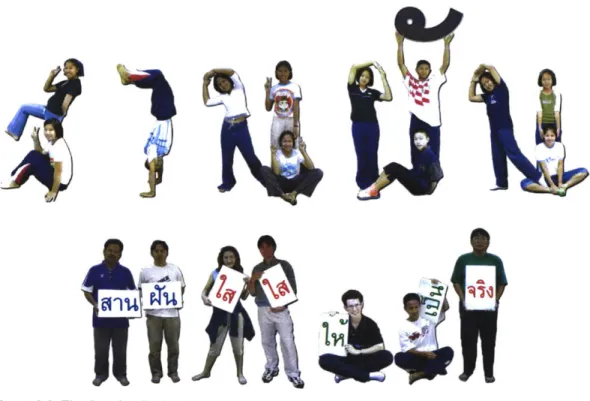
Figure 3-2: The Sarnfun Project
Thirteen eighth graders, two schoolteachers, three researchers joined me in the five week learning activity at Tongtip school.
The students on the top row are posing for each letter in the word Sarnfun (ff iuU)
I based my research on the Sarnfun project for a couple of reasons.
" The ages of the students were suitable
for the types of projects I had in mind (using the Lego Mindstorms's RCX brick and making electronic circuits).
* The students are familiar to the computational tools normally used for project development. They have used the computers for more than a year. They have experience with Logo programming language. I was able to push forward the technologically rich
learning environment to produce useful project examples and learning stories for other sites.
e The constructionism lab could provide support in terms of digital tools, lab space, and human resources. I was able to use the lab facilities to introduce digital video editing to the students. There is a sufficient number of Lego Mindstorms available. Also, three researchers assisted me with project development, data collection, and transportation, during the five-week Sarnfun learning activity.
Case Studies
After months of preparation, the time had finally come to start my research fieldwork. Refreshed from a two-week vacation with my family, I setoff from Chiangmai, my hometown, to Lumpang province. I had organized a five-week after-school learning activity with a group of eighth-graders at a public school, Tongtip, located in Mae-Ta district of Lumpang province. I went to Lumpang one day before the activity began to make sure I had enough preparation time with Dr. Suchin Petcharugsa, my main coordinator of this learning activity and director of the Constructionism Lab at the Northern Region Non-Formal Education Center. Unfortunately, Dr. Suchin was away for the day. However, I talked to him on the phone and he said everything was organized. He arranged three researchers, Nung, Aek, and Ore, to help me throughout the five-week activity.
rigure 4-1: i ongtip extension scnooi.
Tongtip School provides secondary education to approximately seventy-five students. The School is situated in an agricultural community twenty kilometers away from Lumpang city.
I went to Tongtip School in the afternoon
to meet with the principal and Ajarn Sawat, my coordinator at the school. The principle gave me a warm welcome and confirmed that they were excited to host this activity. Their motivation is driven primarily from the need to experiment
how technology could be used to support the new education act (as described in chapter 3). Originally, more than twenty students wanted to join this activity. However, we decided to keep
the group small, which would allow closer observation of each student. So, we reduced the number to ten (though by the second week, three more students joined).
The Suksaphat foundation supported a lab with fifteen computers in early 2000, some of which are networked and could connect to the Internet though a modem. Tongtip had some power drop problems, which had already destroyed power supplies in some computers.
Pigure 4-Z: ine omputer LaD.
We had enough computers for each student to have their own workstation.
4 - Case Studies
Luckily, Ajarn Sawat knows how to fix and maintain computers. He managed to keep most computers running throughout the five-week activity.
4.'1 The
First Day
It was an exciting day for everyone. I arrived at Tong-Tip school around 15:30 and found that all ten students were already waiting. They started to giggle as I walked in. I knew some of the students before and have even been in e-mail contact with one of them. The students were not sure what they would be doing in the coming weeks. I did not want to give them a feeling that they were in a school class or a special training program, which I felt was the general impression of the students. So, I told the students that this activity is an after school club. They should feel comfortable to come and leave as they wish. They could work individually or in groups. They could work inside or outside the computer lab as they want. My goal was to make the environment as casual and relaxed as possible. I can, then, get to know the students, see what they had already done, and start developing project ideas from there. Hence, I was building a convivial learning environment from the very beginning. In order to reach into students' potentials, it was important that students did not feel obliged to join or to do a specific task imposed by the teacher. This is the reason why I made the Sarnfun project an after school activity and did not made it compulsory.
Digital Technology For Conviviality
NFR.RFED COMMLNIC -IC FOR~
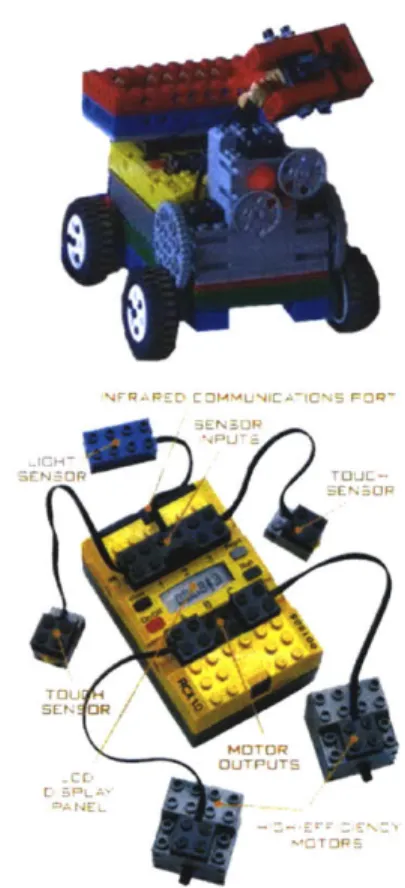
Figure 4-3: Lego Mindstorms.
This commercial product from Lego allows children to design and build actual Robots. With a small programmable computer called the RCX brick, children can process inputs from various sensors and drive output devices such as motors, lights, or speakers responsively.
However, I felt that the students were not sure what I meant. They were waiting for me to do or teach something. I soon realized that I had to start working on projects right away. I had a few Lego Mindstorms sets with me. So, I opened the boxes and invited students to join me. Mean while, I made sure I mentioned to them that not everyone had to stay. Students who are not interested in Lego are free to work on other projects. Since it was their first experience with Lego Mindstorms, all the students were interested and wound up playing with Lego. Everyone enjoyed making cars, adding motors, and making the cars run. I took that opportunity to talk to students and to get to know them better. The first day was a success! We were able to get past the traditional ways of teaching and learning.
4.2 Ideas for Children's Day
While we were playing with Lego, I was reminded that the coming weekend was Thailand's children's day. I noticed that the students were excited about it and were looking forward to the school's children's day festival on Friday. There would be no classes. Instead, there would be games and sports for the students to play. I felt it would be a great event for which students could make projects. So, on the second day, I suggested to the students that we could build something for children's day, something
4 - Case Studies
that other students could enjoy. The students liked the idea. After a short discussion, we concluded that we would divide into three teams, each making a game. The students formed groups and went off to talk among themselves about projects they wanted to do. I decided to make my own game as well. I wanted the students to see that I was not there just as a teacher or supervisor. It would also allow me to demonstrate new tools that I had. It might capture a few students' interest and lead to new projects. The practice of a teacher working on his or her own project together with the students also sets a different tone to the learning environment.
The first group had two members. They decided to build a Lego car and a controller for it. Lek, 14, said she saw other junior students wanting to play with the Lego car she built the day before. So, she wanted to make a better car and give everybody a chance to try. I happily agreed and started to ask about what features she and Tan, her partner, wanted the car to have and how they would implement the ideas. The first functionality they wanted was obviously to control the car so that it could move forward, backward, and turn.
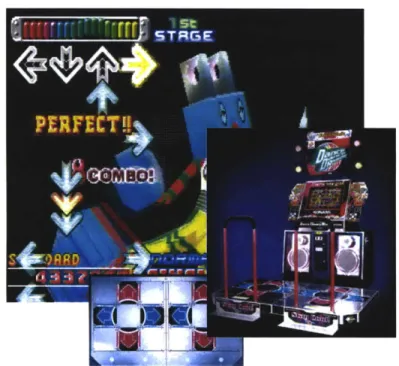
The second group had six members. Although the group seemed too large and I had suggested that they break into two groups, they insisted on staying together. After their meeting, the group decided to create a Dance game, which would imitate a, at that time, famous arcade
game called "Dance Dance Revolution" (Figure 4-4). The basic idea of this game is to make the player dance by stepping on floor mats following the sequence and rhythm seen on the screen.
I was not so sure whether making the dance game would be a feasible idea. Though the students were thinking of simplifying it by using the keyboard instead of the floor mat, the game still sounded too complex for them to finish within two days. However, they were determined. So, I did not say anything against it. Ore, one of the research assistants from Lumpang Constructionist Lab, offered to help me facilitate this project. I suggested to Ore that she should discuss with the students how to divide the program into smaller parts and, may be, try to simplify them. I was worried that they might lose their confidence if they could not get the game working on time.
4 - Case Studies
Figure 4-4: Dance Dance Revolution.
This arcade game was extremely famous among teenagers. Driven by dance music, the player has to step on four different arrow mats following the sequence showed on the screen.
The final group had two male members: Non and Pan. They did not come up with any ideas at all. They felt left out, as they did not feel fit with neither the all-girls dance game group or the Lego car group. So, I offered them to help me with my game. They agreed, though without much motivation. I could see that they were not so excited about the whole children's day idea.
4.2.1
Saving the
Princess
Since I had to build my own game, I wanted to utilize the opportunity by making a project that uses a tool that the students have
4 - Case Studies
not seen before. In this case, I wanted to use the Go-Go kit: a new tool that I had developed. The Go-Go kit basically provides a channel for Microworlds to sense and control the environment through the Lego Mindstorms's RCX brick. The general idea was to use my project as a mean to introduce the tool to the students.
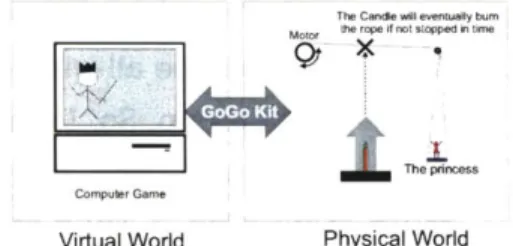
To make the game interesting for young children, I made up a story to go with it. The player would imagine himself as a prince who has to save the princess from an evil king. The princess awaits the prince in a cage that is hanging on a piece of rope. The evil king could destroy the cage by burning the rope and let the cage fall to the ground. A fire would gradually move upwards until it reaches the rope. The prince has to stop this fire before the princess falls.
With the general story set, I initially planed to create the prince as a character in a computer game created with Microworlds programming environment. The princess, on the other hand, would be represented by a doll hanging on a piece of rope in the physical world. The player has to win the computer game in order to save the princess. A candle controlled by a Lego mechanism would, if not stopped by the prince, eventually burn the rope and the princess would not survive. The two parts would be integrated with the Go-Go kit.
The Cande will eventually bum Motor the rope if not Stopped intime
The princess
Computer Game
Virtual World Physical World
Figure 4-5: My Initial Game Idea I wanted to do a project that uses a new tool
that I have developed (the Go-Go kit). The hope was that some students would be interested in the new tool and, later on, come up with new project ideas.
4 - Case Studies
4.2.2 A New Game Emerged
Non and Pan were not so impressed by my game idea. I was not surprised, as the game was totally my idea and they did not have a clue how the game could be implemented. However, they wanted to contribute to the children's day activity. So, they offered to help me design and build the Lego mechanism that would lift the candle.
Just when I was about to program the Microworlds game, Lek who had overheard the details of my project, came up with an alternative game suggestion. Lek thinks the game would be much more interesting if we used her Lego car to represent the prince. That is, the players would maneuver the Lego car and trigger something to stop the fire and save the princess. I remember myself being so excited about the idea, as it truly made more sense to everyone. Lek's idea would put her Lego car into a story context. The game would suddenly have a character and a mission for the players to accomplish. It would also lead to interesting and open-ended questions, as we would need to think about how the car could stop the fire and what would indicate that the princess has been saved. I was happy with this new game idea, though it meant I would lose my opportunity to use the Go-Go kit altogether. But to me, getting students to suggest and work on their own ideas was more important. After all,
rigure 4-o:%roup uiscussion
We discussed the game ideas together. The students were still very shy and passive.
my focus is on student-driven projects not teacher-driven ones.
After spending some time discussing ideas about the final implementation of the game, we came up with the following plan:
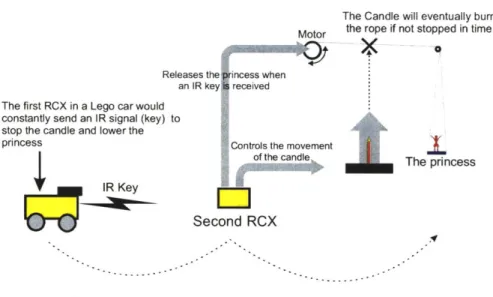
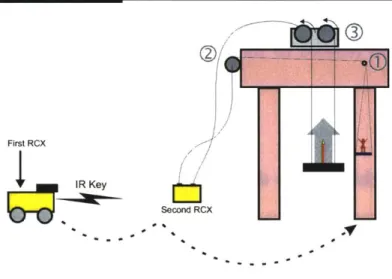
o The Lego car would carry an RCX brick on it. The brick would constantly send an infrared (IR) signal as a "key" to stop the fire. Though the students have used infrared before (for example, in remote controls), this was the first time that the idea of using in IR signal to transmit data was demystified. The students were learning to use concepts that are usually exposed only to engineering students. o A second RCX brick would control Non and
Pan's mechanism, which periodically raises the candle and would stop only when it receives the IR "Key" from the
Lego car.
o The princess would be tied to a rope. The rope would be wounded through pulleys to a motor also controlled by the second RCX.
o When an IR "Key" is detected, the second RCX would stop the candle and lower the princess. The Lego car must catch her before she reaches the ground.
4 - Case Studies
Releases the an IR key The first RCX in a Lego car would
constantly send an IR signal (key) to stop the candle and lower the princess
4V
IR
Key
Sec
The Candle will eventually bum Motor the rope if not stopped in time
received
Controls the movement
of the candleTepics
The princess
ond RCX
Figure 4-7: The game plan
Lek and Tan were responsible for the Lego car, while Non and Pan were in charge of the mechanism necessary to control the movement of the candle.
4.2.3 Depression
Just when we were starting to make the game, I noticed that Tan had lost his interest with the Lego car. I was surprised because I
remembered seeing him motivated during the first day. When I asked Tan how he was feeling, he told me he does not enjoy using Lego. He preferred to go back to programming. Although he still wanted to be part of the car project, he kept his distance. Lek remained active with the construction of the Lego car.
Non and Pan were not motivated as well. At that point, they were doing the project just for the sake of having something to do. The fact that they were not familiar with Lego made the situation worse. On top of that, thinking about
how to implement the candle mechanism was an open-ended question. There were no instructions to follow. It was clear to me that they did not know how to tackle the problem. I tried to make them feel more comfortable by helping them divide the project into sub-tasks. I introduced them to Lego gears and how they could gear-up or gear-down the motors to increase or decrease rotation speed. I hoped these ideas would give them schemes for building the structure. However, both of them were very passive and quiet. At that point, I was not sure how successful the project would be. Three out of four students were not motivated. The situation was awkward.
4.2.4 Recovery
The twist came when all the game pieces started to work together. Non and Pan programmed an RCX brick to periodically turn on a motor, which lifts a candle upwards slowly. Lek tested her car and figured out how much time the player should have before the candle burns the rope. Everything started to come together. I was surprised how Non and Pan changed. Now, they want to make their project work! They started to talk and respond to my questions and ideas. When their Lego mechanism broke, they created a more stable motor and gear structure. The environment changed. Ajarn Wiratchai, the school's science teacher, who was helping me that day, initially did not want to stay later than six o'clock. But in the end, he also got interested