
arXiv:1202.1383v3 [hep-ex] 15 Apr 2017
CERN-PH-EP-2012-012 31 Jan 2012
J/ψ suppression at forward rapidity
in Pb-Pb collisions at
√
s
NN= 2.76 TeV
ALICE Collaboration∗
Abstract
The ALICE experiment has measured the inclusive J/ψ production in Pb-Pb collisions at √sNN=
2.76 TeV down to zero transverse momentum in the rapidity range 2.5 < y < 4. A suppression of the inclusive J/ψyield in Pb-Pb is observed with respect to the one measured in pp collisions scaled by the number of binary nucleon-nucleon collisions. The nuclear modification factor, integrated over the 0%–80% most central collisions, is 0.545 ± 0.032(stat.) ± 0.083(syst.) and does not exhibit a significant dependence on the collision centrality. These features appear significantly different from measurements at lower collision energies. Models including J/ψ production from charm quarks in a deconfined partonic phase can describe our data.
Ultra-relativistic collisions of heavy nuclei aim at producing nuclear matter at high temperature and pressure. Under such conditions Quantum Chromodynamics predicts the existence of a deconfined state of partonic matter, the quark-gluon plasma (QGP). Among the possible probes of the QGP, heavy quarks are of particular interest since they are expected to be produced in the primary partonic scatterings and to coexist with the surrounding medium. Therefore, the measurement of quarkonium states and hadrons with open heavy flavor is expected to provide essential information on the properties of the strongly-interacting system formed in the early stages of heavy-ion collisions [1]. In particular, according to the color-screening model [2], measuring the in-medium dissociation probability of the different quarkonium states is expected to provide an estimate of the initial temperature of the system. In the past two decades, J/ψ production in heavy-ion collisions was intensively studied at the Super Proton Synchrotron (SPS) and at the Relativistic Heavy Ion Collider (RHIC), from approximately 20 to 200 GeV center of mass energy per nucleon pair (√sNN). At the SPS, a strong J/ψ suppression was found in the most central
Pb-Pb collisions [3]. The observed suppression is larger than the one expected from Cold Nuclear Matter (CNM) effects, which include nuclear absorption and (anti-) shadowing. The dissociation of excited cc states like χcand ψ(2S), which in pp collisions constitute about 40% of the inclusive J/ψ yield [1], is one
possible interpretation of the observed suppression. A J/ψ suppression was also observed at RHIC, in central Au-Au collisions [4, 5], at a level similar to the one observed at the SPS when measured at mid-rapidity although it is larger at forward mid-rapidity. Several models [6, 7, 8, 9] attempt to reproduce the RHIC data by adding to the direct J/ψ production a regeneration component from deconfined charm quarks in the medium, which counteracts the J/ψ dissociation in a QGP. A quantitative description of these final-state effects is however difficult at the present time because of the lack of precision in the CNM effects and in the open charm cross section determination. The measurement of charmonium production is especially promising at the Large Hadron Collider (LHC) where the high-energy density of the medium and the large number of c¯c pairs produced in central Pb-Pb collisions should help to disentangle between the different suppression and regeneration scenarios. At the LHC, a suppression of inclusive J/ψ with high transverse momentum was observed in central Pb-Pb collisions at √sNN= 2.76 TeV with respect
to peripheral collisions or pp collisions at the same energy by ATLAS [10] and CMS [11], respectively. In this Letter, we report ALICE results on inclusive J/ψ production in Pb-Pb collisions at √sNN= 2.76
TeV at forward rapidity, measured via the µ+µ− decay channel. Our measurement encloses the low transverse momentum region that is not accessible to other LHC experiments and thus complements their observations. The J/ψ corrected yield in Pb-Pb collisions is combined with the one measured in pp collisions at the same center-of-mass energy [12] to form the J/ψ nuclear modification factor RAA. The
results are presented as a function of collision centrality and rapidity (y), and in intervals of transverse momentum (pt).
The ALICE detector is described in [13]. At forward rapidity (2.5 < y < 4) the production of quarkonium states is measured in the muon spectrometer 1 down to pt = 0. The spectrometer consists of a ten
interaction length thick absorber filtering the muons in front of five tracking stations comprising two planes of cathode pad chambers each, with the third station inside a dipole magnet with a 3 Tm field integral. The tracking apparatus is completed by a triggering system made of four planes of resistive plate chambers downstream of a 1.2 m thick iron wall, which absorbs secondary hadrons escaping from the front absorber and low momentum muons coming mainly from π and K decays. In addition, the silicon pixel detector (SPD) and scintillator arrays (VZERO) were used in this analysis. The VZERO counters, two arrays of 32 scintillator tiles each, cover 2.8 ≤ η ≤ 5.1 A) and −3.7 ≤ η ≤ −1.7 (VZERO-C). The SPD consists of two cylindrical layers covering|η| ≤ 2.0 and |η| ≤ 1.4 for the inner and outer layers, respectively. All these detectors have full azimuthal coverage. The minimum bias (MB) trigger requirement used for this analysis consists of a logical AND of the three following conditions: (i) a signal in two readout chips in the outer layer of the SPD, (ii) a signal in A, (iii) a signal in VZERO-1In the ALICE reference frame, the muon spectrometer covers a negative η range and consequently a negative y range. We
have chosen to present our results with a positive y notation.
)
2
(GeV/c
µ
µ
m
2
2.5
3
3.5
4
4.5
5
)
2
Events / ( 50 MeV/c
210
310
410
= 2.76 TeV, centrality 0%-80%
NNs
Pb-Pb
events
71.77 10
Opposite sign pairs
Fit total
Fit signal
Fit background
Fig. 1:(Color online) Invariant mass spectrum ofµ+µ−pairs (solid black circles) with pt≥ 0 and 2.5 < y < 4 in
the 0%–80% most central Pb-Pb collisions.
C, providing a high triggering efficiency for hadronic interactions. The beam induced background was further reduced by timing cuts on the signals from the VZERO and from the zero degree calorimeters (ZDC). The contribution from electromagnetic processes was removed with a cut on the energy deposited in the neutron ZDCs. The centrality determination is based on a fit of the VZERO amplitude distribution as described in [14]. A cut corresponding to the most central 80% of the nuclear cross section was applied; for these events the MB trigger is fully efficient. A data sample of 17.7× 10⁶Pb-Pb collisions collected in 2010 satisfying all the above conditions is used in the following analysis. It corresponds to an integrated luminosity Lint≈ 2.9 µb−1. This data sample was further divided into five centrality
classes from 0%–10% (central collisions) to 50%–80% (peripheral collisions).
J/ψ candidates are formed by combining pairs of opposite-sign (OS) tracks reconstructed in the geomet-rical acceptance of the muon spectrometer. To reduce the combinatorial background, the reconstructed tracks in the muon tracking chambers are required to match a track segment in the muon trigger system. The resulting invariant mass distribution of OS muon pairs for the 0%–80% most central Pb-Pb collisions is shown in Fig. 1, where a J/ψ signal above the combinatorial background is clearly visible. The J/ψ raw yield was extracted by using two different methods. The OS dimuon invariant mass distribution was fitted with a Crystal Ball (CB) function to reproduce the J/ψ line shape, and a sum of two exponentials to describe the underlying continuum. The CB function connects a Gaussian core with a power-law tail [15] at low mass to account for energy loss fluctuations and radiative decays. At high transverse momenta (pt≥ 3 GeV/c), the sum of two exponentials does not describe correctly the underlying continuum; it
was replaced by a third order polynomial. Alternatively, the combinatorial background was subtracted using an event-mixing technique. The resulting mass distribution was fitted with a CB function and an exponential or a first order polynomial to describe the remaining background. The event mixing was
preferred to the like-sign subtraction technique since it is less sensitive to correlated signal pairs present in the like-sign spectra and gives better statistical precision. The ψ(2S) was not included in the signal line shape since its contribution is negligible. The width of the J/ψ mass peak depends on the resolution of the spectrometer which can be affected by the detector occupancy that increases with centrality. This effect, evaluated by embedding simulated J/ψ→ µ+µ−decays into real events, was found to be less than
2%. This conclusion was confirmed by a direct measurement of the tracking chamber resolution versus centrality using reconstructed tracks. Therefore, the same CB line shape can be used for all centrality classes. The parameters of the CB tails were fixed to the values obtained either in simulations or in pp collisions where the signal to background ratio is much higher. For each of these choices, the mean and width of the CB Gaussian part were fixed to the value obtained by fitting the mass distribution in the centrality range 0%–80%. In addition, a variation of the width of± 1 standard deviation was applied to account for uncertainties (varying the mean has turned out to have a negligible effect in compari-son). The raw J/ψ yield in each centrality class was determined as the average of the results obtained with the two fitting approaches and the various CB parametrizations, while the corresponding system-atic uncertainties were defined as the RMS of these results. It was also checked that every individual result differs from the mean value by less than three RMS. The raw J/ψ yield in our Pb-Pb sample is 2350± 139(stat.) ± 189(syst.). The invariant mass resolution is around 78 MeV/c2, in very good
agree-ment with the embedded J/ψ simulations. The signal to background ratio integrated over± 3 σ of the mass resolution varies from 0.1 for central collisions to 1.5 for peripheral collisions.
The measured number of J/ψ (Ni
J/ψ) was normalized to the number of events in the corresponding cen-trality class (Ni
events) and further corrected for the branching ratio (BR) of the dimuon decay channel, the
acceptance A and the efficiency εi of the detector. The inclusive J/ψ yield in each centrality class i for
our measured ptand y ranges (∆pt, ∆y) is then given by:
YJ/iψ(∆pt, ∆y) =
NJ/i ψ
BRJ/ψ→µ+µ−Neventsi Aεi
. (1)
The product Aε was determined from Monte Carlo simulations. The generated J/ψ ptand y distributions
were extrapolated from existing measurements [16], including shadowing effects from EKS98 calcula-tions [17]. As the measured J/ψ polarization in pp collisions at√s= 7 TeV is compatible with zero [18], and J/ψ mesons produced from charm quarks in the medium are expected to be unpolarized, we presume J/ψ production is unpolarized. For the tracking chambers, the time-dependent status of each electronic channel during the data taking period was taken into account as well as the residual misalignment of the detection elements. The efficiencies of the muon trigger chambers were determined from data and were then applied in the simulations [19]. Finally, the dependence of the efficiency on the detector occupancy was included using the embedding technique. For J/ψ mesons emitted at 2.5 < y < 4 and pt≥ 0, a
run-averaged value of Aε= 0.176 with a 8% relative systematic uncertainty was obtained. A 8% ±2%(syst.) relative decrease of the efficiency was observed when going from peripheral to central collisions. The J/ψ yield measured in Pb-Pb collisions in centrality class i is combined with the inclusive J/ψ cross section measured in pp collisions at the same energy to form the nuclear modification factor RAAdefined
as: RiAA= YJ/iψ(∆pt, ∆y) hTi AAi × σ pp J/ψ(∆pt, ∆y) . (2)
The inclusive J/ψ cross section in pp collisions σJ/ppψ(∆pt, ∆y) was measured using the same apparatus and
analysis technique within the corresponding pt and y range [12]. The reference value σJ/ppψ used for the
calculation of RAAintegrated over ptand y is 3.34±0.13(stat.) ±0.24(syst.) ±0.12(lumi.)+0.53−1.07(pol.) µb.
The centrality intervals used in this analysis, the average number of participating nucleons hNparti and
Table 1:The average number of participating nucleonshNparti without and with hNcolli weighting, the mid-rapidity
charged-particle density dNw
ch/dη|η=0withhNcolli weighting and the average value of the nuclear overlap function
hTAAi for the centrality classes expressed in percentages of the nuclear cross section [14].
Centrality hNparti hNpartw i
dNw ch dη|η=0 hTAAi (mb −1) 0%–10% 356±4 361±4 1463±60 23.5±1.0 10%–20% 260±4 264±4 979±37 14.4±0.6 20%–30% 186±4 189±4 658±23 8.74±0.37 30%–50% 107±3 117±3 369±13 3.87±0.18 50%–80% 32±2 47±2 110±5 0.72±0.05 0%–80% 139±3 264±4 – 7.03±0.27
Table 2:Summary of the systematic uncertainties entering the RAAcalculation. The type I (II) stands for correlated
(uncorrelated) uncertainties. The centrality dependence for the type II is given as a range.
source value type
signal extraction 5%–12% II
input MC parametrization 5% I
tracking efficiency 5% and 0%–1% I and II
trigger efficiency 4% and 0%–2% I and II
matching efficiency 2% I
TAA 4%–8% II
σJ/ppψ at √sNN= 2.76 TeV 9% I
average value of the nuclear overlap functionhTAAi derived from a Glauber model calculation [14] are
summarized in Table 1. Since our most peripheral bin is rather large, the variableshNpartw i and the
charged-particle density measured at mid-rapidity dNw
ch/dη|η=0were weighted by the number of binary collisions
hNcolli. Indeed in absence of nuclear matter effects, the J/ψ production cross section in nucleus-nucleus
is expected to scale withhNcolli. The weighted values are given in Table 1 and are used for the ALICE
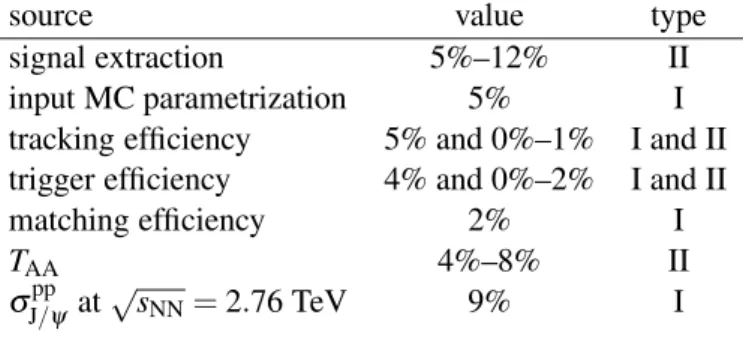
data points in the following figures. All systematic uncertainties entering the RAAcalculation are listed in
Table 2. In the figures below, the point to point uncorrelated systematic uncertainties are represented as boxes at the position of the data points while the statistical ones are indicated by vertical bars. Correlated systematic uncertainties are quoted directly on the figures.
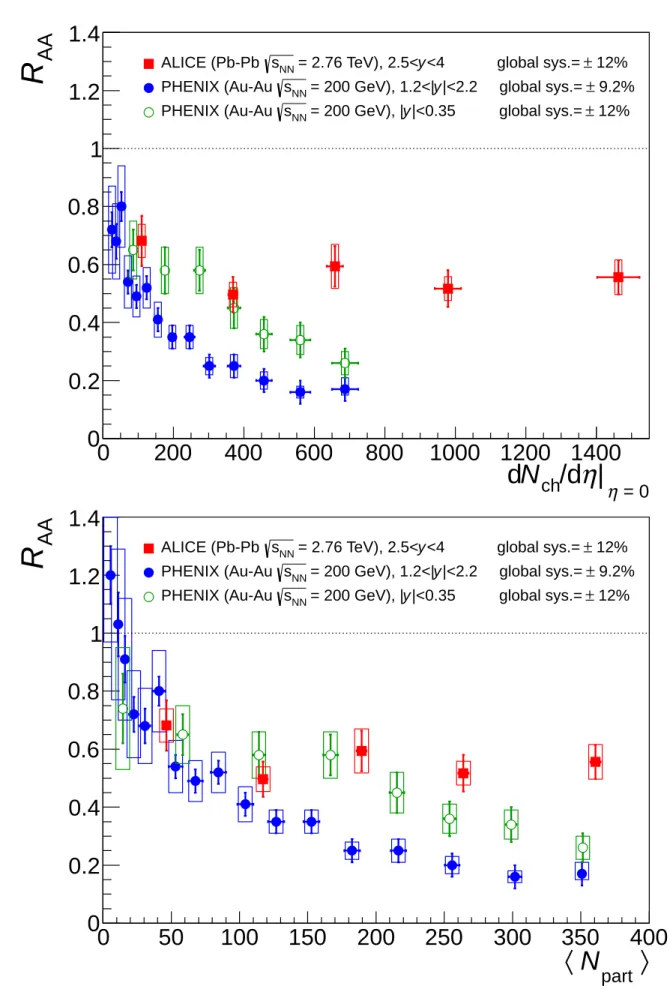
The inclusive J/ψ RAA measured by ALICE at √sNN= 2.76 TeV in the range 2.5 < y < 4 and pt≥ 0
is shown in Fig. 2 as a function of dNch/dη|η=0 (left) and Npart (right). The charged-particle density
closely relates to the energy density of the created medium whereas the number of participants reflects the collision geometry. The centrality integrated J/ψ RAAis R0%AA−80%= 0.545 ± 0.032(stat.) ± 0.083(syst.),
indicating a clear J/ψ suppression. The contribution from beauty hadron feed-down to the inclusive J/ψ yield in our y and ptdomain was measured by the LHCb collaboration to be about 10% in pp collisions at
√
s= 7 TeV [21]. Therefore, the difference between the prompt J/ψ RAAand our inclusive measurement
is expected not to exceed 11% if Ncollscaling of beauty production is assumed and shadowing effects are
neglected. All RAAresults are presented assuming unpolarized J/ψ production in pp and Pb-Pb collisions.
The comparison with the PHENIX measurements2at √sNN= 200 GeV at forward rapidity 1.2 < |y| <
2.2 [5, 20] shows that our inclusive J/ψ RAA is almost a factor of three larger for dNch/dη|η=0 & 600
(Npart& 180). In addition, our results do not exhibit a significant centrality dependence.
2 The PHENIX mid-rapidity J/ψ R
AA was measured in centrality classes wider than the ones in which the mid-rapidity
charged-particle density is given [20]. Therefore a linear interpolation was done to extract the mid-rapidity charged-particle density in the three most peripheral classes.
= 0
η
|
η
/d
ch
N
d
0
200
400
600
800
1000 1200 1400
AA
R
0
0.2
0.4
0.6
0.8
1
1.2
1.4
12% ± <4 global sys.= y = 2.76 TeV), 2.5< NN s ALICE (Pb-Pb 9.2% ± |<2.2 global sys.= y = 200 GeV), 1.2<| NN s PHENIX (Au-Au 12% ± |<0.35 global sys.= y = 200 GeV), | NN s PHENIX (Au-Au〉
part
N
〈
0
50
100
150
200
250
300
350
400
AA
R
0
0.2
0.4
0.6
0.8
1
1.2
1.4
12% ± <4 global sys.= y = 2.76 TeV), 2.5< NN s ALICE (Pb-Pb 9.2% ± |<2.2 global sys.= y = 200 GeV), 1.2<| NN s PHENIX (Au-Au 12% ± |<0.35 global sys.= y = 200 GeV), | NN s PHENIX (Au-AuFig. 2: (Color online) Inclusive J/ψ RAA as a function of the mid-rapidity charged-particle density (top) and the number of participating nucleons (bottom) measured in Pb-Pb collisions at √sNN= 2.76 TeV compared to
PHENIX results in Au-Au collisions at √sNN= 200 GeV at mid-rapidity and forward rapidity [4, 5, 20]. The
ALICE data points are placed at the dNw
y
2
2.5
3
3.5
4
4.5
AA
R
0
0.2
0.4
0.6
0.8
1
1.2
1.4
= 2.76 TeV
NNs
Pb-Pb
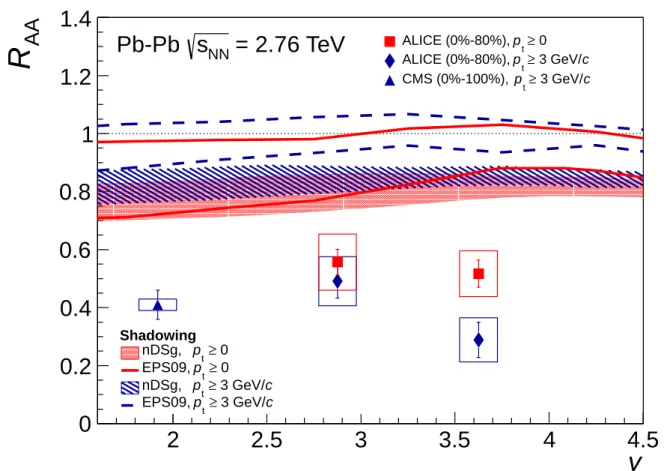
≥ 0 t p ALICE (0%-80%), c 3 GeV/ ≥ t p ALICE (0%-80%), c 3 GeV/ ≥ t p CMS (0%-100%), Shadowing 0 ≥ t p nDSg, 0 ≥ t p EPS09, c 3 GeV/ ≥ t p nDSg, c 3 GeV/ ≥ t p EPS09,Fig. 3:(Color online) Centrality integrated inclusive J/ψ RAAmeasured in Pb-Pb collisions at √sNN= 2.76 TeV
as a function of rapidity for two pt ranges. The open boxes contain the total systematic uncertainties except the
ones on the integrated luminosity in the pp reference and on the TAA, i.e. 5.2% (8.3%) for the ALICE (CMS [11])
data. The two models [22, 23] predict the RAAdue only to shadowing effects for nDSg (shaded areas) and EPS09
(lines) nPDF respectively.
The rapidity dependence of the J/ψ RAA is presented in Fig. 3 for two pt domains, pt ≥ 0 and pt ≥
3 GeV/c. The J/ψ reference cross sections in pp collisions 3 and the R
AA total systematic
uncertain-ties, indicated as open boxes in the figure, were evaluated in the same kinematic range. Our results are shown together with a measurement from CMS [11] of the inclusive J/ψ RAA in the rapidity range
1.6 < |y| < 2.4 with pt≥ 3 GeV/c. No significant rapidity dependence can be seen in the J/ψ RAAfor
pt ≥ 0. For pt ≥ 3 GeV/c, a decrease of RAA is observed with increasing rapidity reaching a value of
0.289 ± 0.061(stat.) ± 0.078(syst.) for 3.25 < y < 4. At LHC energies, J/ψ nuclear absorption is likely to be negligible and the modification of the gluon distribution function is dominated by shadowing ef-fects [24]. An estimate of shadowing efef-fects is shown in Fig. 3 within the Color Singlet Model at Leading Order [22] and the Color Evaporation Model at Next to Leading Order [23]. The shadowing is respec-tively calculated with the nDSg and the EPS09 parametrizations [23] of the nuclear Parton Distribution Function (nPDF). For nDSg (EPS09) the upper and lower limits correspond to the uncertainty in the fac-torization scale (uncertainty of the nPDF). The effect of shadowing shows no dependence with rapidity and its overall amount is reduced by the addition of a transverse momentum cut. At most, shadowing effects are expected to lower the RAAfrom 1 to 0.7. Recent Color Glass Condensate (CGC) calculations
for LHC energies may indicate a larger initial state suppression (RAA ≈ 0.5) [25]. However, any J/ψ
suppression due to initial state effects, CGC or shadowing, will be stronger at lower pt contrary to the
3We report here σpp
J/ψ(pt≥ 3GeV/c, 2.5 < y ≤ 3.25) = 0.34 ± 0.03(stat.) ± 0.03(syst.) ± 0.02(lumi.) µb and σ pp J/ψ(pt≥
〉
part
N
〈
0
50
100
150
200
250
300
350
400
AA
R
0
0.2
0.4
0.6
0.8
1
1.2
1.4
/dy=0.25 mb c c σ d /dy=0.15 mb c c σ d 12% ±= 2.76 TeV), 2.5<y<4 global sys.=
NN
s ALICE (Pb-Pb
Stat. Hadronization Model Transport Model I
Transport Model II
Fig. 4: (Color online) Inclusive J/ψ RAA measured in Pb-Pb collisions at √sNN= 2.76 TeV compared to the
predictions by Statistical Hadronization Model [26], Transport Model I [27] and II [28], see text for details. The ALICE data points are placed at thehNw
parti values defined in Table 1.
data behavior.
In Fig. 4, our measurement is compared with theoretical models that include a J/ψ regeneration compo-nent from deconfined charm quarks in the medium. The Statistical Hadronization Model [6, 26] assumes deconfinement and a thermal equilibration of the bulk of the c¯c pairs. Then charmonium production occurs only at phase boundary by statistical hadronization of charm quarks. The prediction is given for two values of dσc¯c/dy in absence of a measurement for Pb-Pb collisions. The two transport model
results [27, 28] presented in the same figure differ mostly in the rate equation controlling the J/ψ dis-sociation and regeneration. Both are shown as a band which connects the results obtained with (lower limit) and without (higher limit) shadowing. The width of the band can be interpreted as the uncertainty of the prediction. In both transport models, the amount of regenerated J/ψ in the most central collisions contributes to about 50% of the production yield, the rest being from initial production.
In summary, we have presented the first measurement of inclusive J/ψ nuclear modification factor down to pt = 0 at forward rapidity in Pb-Pb collisions at √sNN = 2.76 TeV. The J/ψ RAA is larger than the
one measured at the SPS and at RHIC for most central collisions and does not exhibit a significant centrality dependence. Statistical hadronization and transport models which respectively feature a full and a partial J/ψ production from charm quarks in the QGP phase can describe the data. Towards a definitive conclusion about the role of J/ψ production from deconfined charm quarks in a partonic phase, the amount of shadowing needs to be measured precisely in pPb collisions. In this context, the measurement of open charm and J/ψ elliptic flow will also help to determine the degree of thermalization for charm quarks.
Acknowledgements
The ALICE collaboration would like to thank all its engineers and technicians for their invaluable con-tributions to the construction of the experiment and the CERN accelerator teams for the outstanding performance of the LHC complex.
The ALICE collaboration acknowledges the following funding agencies for their support in building and running the ALICE detector:
Calouste Gulbenkian Foundation from Lisbon and Swiss Fonds Kidagan, Armenia;
Conselho Nacional de Desenvolvimento Cient´ıfico e Tecnol´ogico (CNPq), Financiadora de Estudos e Projetos (FINEP), Fundac¸˜ao de Amparo `a Pesquisa do Estado de S˜ao Paulo (FAPESP);
National Natural Science Foundation of China (NSFC), the Chinese Ministry of Education (CMOE) and the Ministry of Science and Technology of China (MSTC);
Ministry of Education and Youth of the Czech Republic;
Danish Natural Science Research Council, the Carlsberg Foundation and the Danish National Research Foundation;
The European Research Council under the European Community’s Seventh Framework Programme; Helsinki Institute of Physics and the Academy of Finland;
French CNRS-IN2P3, the ‘Region Pays de Loire’, ‘Region Alsace’, ‘Region Auvergne’ and CEA, France;
German BMBF and the Helmholtz Association;
General Secretariat for Research and Technology, Ministry of Development, Greece; Hungarian OTKA and National Office for Research and Technology (NKTH);
Department of Atomic Energy and Department of Science and Technology of the Government of India; Istituto Nazionale di Fisica Nucleare (INFN) of Italy;
MEXT Grant-in-Aid for Specially Promoted Research, Japan; Joint Institute for Nuclear Research, Dubna;
National Research Foundation of Korea (NRF);
CONACYT, DGAPA, M´exico, ALFA-EC and the HELEN Program (High-Energy physics Latin-American– European Network);
Stichting voor Fundamenteel Onderzoek der Materie (FOM) and the Nederlandse Organisatie voor Wetenschappelijk Onderzoek (NWO), Netherlands;
Research Council of Norway (NFR);
Polish Ministry of Science and Higher Education;
National Authority for Scientific Research NASR (Autoritatea Nat¸ional˘a pentru Cercetare S¸tiint¸ific˘a -ANCS);
Federal Agency of Science of the Ministry of Education and Science of Russian Federation, International Science and Technology Center, Russian Academy of Sciences, Russian Federal Agency of Atomic En-ergy, Russian Federal Agency for Science and Innovations and CERN-INTAS;
Ministry of Education of Slovakia;
Department of Science and Technology, South Africa;
CIEMAT, EELA, Ministerio de Educaci´on y Ciencia of Spain, Xunta de Galicia (Conseller´ıa de Edu-caci´on), CEADEN, Cubaenerg´ıa, Cuba, and IAEA (International Atomic Energy Agency);
Swedish Research Council (VR) and Knut & Alice Wallenberg Foundation (KAW); Ukraine Ministry of Education and Science;
United Kingdom Science and Technology Facilities Council (STFC);
The United States Department of Energy, the United States National Science Foundation, the State of Texas, and the State of Ohio.
References
[1] M. Bedjidian, D. Blaschke, G. T. Bodwin, N. Carrer, B. Cole, et al., “Hard probes in heavy ion collisions at the LHC: Heavy flavor physics,” arXiv:0311048, 2004.
[2] T. Matsui and H. Satz, “J/ψ Suppression by Quark-Gluon Plasma Formation,” Phys. Lett., vol. B178, p. 416, 1986.
[3] B. Alessandro et al., “A new measurement of J/ψ suppression in Pb-Pb collisions at 158 GeV per nucleon,” Eur. Phys. J., vol. C39, pp. 335–345, 2005.
[4] A. Adare et al., “J/ψ production vs centrality, transverse momentum, and rapidity in Au+Au col-lisions at √sNN=200 GeV,” Phys. Rev. Lett., vol. 98, p. 232301, 2007.
[5] A. Adare et al., “J/ψ suppression at forward rapidity in Au+Au collisions at √sNN= 200 GeV,” Phys.Rev., vol. C84, p. 054912, 2011.
[6] P. Braun-Munzinger and J. Stachel, “(Non)thermal aspects of charmonium production and a new look at J/ψ suppression,” Phys. Lett., vol. B490, pp. 196–202, 2000.
[7] R. L. Thews, M. Schroedter, and J. Rafelski, “Enhanced J/ψ production in deconfined quark mat-ter,” Phys. Rev., vol. C63, p. 054905, 2001.
[8] A. Andronic, P. Braun-Munzinger, K. Redlich, and J. Stachel, “Evidence for charmonium genera-tion at the phase boundary in ultra-relativistic nuclear collisions,” Phys. Lett., vol. B652, pp. 259– 261, 2007.
[9] X. Zhao and R. Rapp, “Transverse Momentum Spectra of J/ψ in Heavy-Ion Collisions,” Phys.
Lett., vol. B664, pp. 253–257, 2008.
[10] G. Aad et al., “Measurement of the centrality dependence of J/ψ yields and observation of Z production in lead-lead collisions with the ATLAS detector at the LHC,” Phys.Lett., vol. B697, pp. 294–312, 2011.
[11] S. Chatrchyan et al., “Suppression of non-prompt J/ψ, prompt J/ψ, and ϒ(1S) in PbPb collisions at √s
NN= 2.76 TeV ,” JHEP, vol. 1205, p. 063, 2012.
[12] B. Abelev et al., “Inclusive J/ψ production in pp collisions at√s= 2.76 TeV,” arXiv:1203.3641, 2012.
[13] K. Aamodt et al., “The ALICE experiment at the CERN LHC,” JINST, vol. 3, p. S08002, 2008. [14] K. Aamodt et al., “Centrality Dependence of the Charged-Particle Multiplicity Density at
Midra-pidity in Pb-Pb Collisions at √sNN= 2.76 TeV,” Phys. Rev. Lett., vol. 106, p. 032301, Jan 2011.
[15] J. E. Gaiser, Charmonium Spectroscopy from Radiative Decays of the J/ψ and ψ′. PhD thesis, Standford, 1982. Appendix-F, SLAC-R-255.
[16] F. Bossu, Z. del Valle, A. de Falco, M. Gagliardi, S. Grigoryan, et al., “Phenomenological extrap-olation of the inclusive J/ψ cross section to proton-proton collisions at 2.76 TeV and 5.5 TeV,”
arXiv:1103.2394, 2011.
[17] K. J. Eskola, V. J. Kolhinen, and C. A. Salgado, “The scale dependent nuclear effects in parton distributions for practical applications,” Eur. Phys. J., vol. C9, p. 61, 1999.
[18] B. Abelev et al., “J/ψ polarization in pp collisions at √s = 7 TeV,” Phys.Rev.Lett., vol. 108, p. 082001, 2012.
[19] D. Stocco et al., “Efficiency determination of the MUON Spectrometer trigger chambers from real data,” ALICE-INT-2008-004, 2008.
[20] S. S. Adler et al., “Systematic studies of the centrality and √sNN dependence of the dET/dη and
dnch/dη in heavy ion collisions at midrapidity,” Phys. Rev. C, vol. 71, p. 049901, Apr 2005.
[21] R. Aaij et al., “Measurement of J/ψ production in pp collisions at √s=7 TeV,” Eur.Phys.J., vol. C71, p. 1645, 2011.
[22] E. Ferreiro, F. Fleuret, J. Lansberg, N. Matagne, and A. Rakotozafindrabe, “Cold Nuclear Matter
Effects on extrinsic J/ψ production at √sNN = 2.76 TeV at the LHC,” Nucl.Phys., vol. A855,
pp. 327–330, 2011. and Priv. Comm.
[23] R. Vogt, “Cold Nuclear Matter Effects on J/ψ and ϒ Production at the LHC,” Phys. Rev., vol. C81, p. 044903, 2010. and Priv. Comm.
[24] C. Lourenc¸o, R. Vogt, and H. K. W¨ohri, “Energy dependence of J/ψ absorption in proton-nucleus collisions,” JHEP, vol. 02, p. 014, 2009.
[25] F. Dominguez, D. Kharzeev, E. Levin, A. Mueller, and K. Tuchin, “Gluon saturation effects on the color singlet J/Psi production in high energy dA and AA collisions,” Phys.Lett., vol. B710, pp. 182–187, 2012.
[26] A. Andronic, P. Braun-Munzinger, K. Redlich, and J. Stachel, “The thermal model on the verge of the ultimate test: particle production in Pb-Pb collisions at the LHC,” J.Phys.G, vol. G38, p. 124081, 2011.
[27] X. Zhao and R. Rapp, “Medium Modifications and Production of Charmonia at LHC,” Nucl.Phys., vol. A859, pp. 114–125, 2011.
[28] Y.-P. Liu, Z. Qu, N. Xu, and P.-F. Zhuang, “J/ψ Transverse Momentum Distribution in High Energy Nuclear Collisions at RHIC,” Phys.Lett., vol. B678, pp. 72–76, 2009. and Priv. Comm.
A The ALICE Collaboration
B. Abelev68, J. Adam33, D. Adamov´a73, A.M. Adare118, M.M. Aggarwal77, G. Aglieri Rinella29,
A.G. Agocs60, A. Agostinelli21, S. Aguilar Salazar56, Z. Ahammed114, A. Ahmad Masoodi13, N. Ahmad13, S.U. Ahn63 ,36, A. Akindinov46, D. Aleksandrov88, B. Alessandro94, R. Alfaro Molina56, A. Alici97 ,9, A. Alkin2, E. Almar´az Avi˜na56, J. Alme31, T. Alt35, V. Altini27, S. Altinpinar14, I. Altsybeev115, C. Andrei70, A. Andronic85, V. Anguelov82, J. Anielski54, C. Anson15, T. Antiˇci´c86, F. Antinori93, P. Antonioli97,
L. Aphecetche101, H. Appelsh¨auser52, N. Arbor64, S. Arcelli21, A. Arend52, N. Armesto12, R. Arnaldi94,
T. Aronsson118, I.C. Arsene85, M. Arslandok52, A. Asryan115, A. Augustinus29, R. Averbeck85, T.C. Awes74,
J. ¨Ayst¨o37, M.D. Azmi13, M. Bach35, A. Badal`a99, Y.W. Baek63 ,36, R. Bailhache52, R. Bala94,
R. Baldini Ferroli9, A. Baldisseri11, A. Baldit63, F. Baltasar Dos Santos Pedrosa29, J. B´an47, R.C. Baral48,
R. Barbera23, F. Barile27, G.G. Barnaf¨oldi60, L.S. Barnby90, V. Barret63, J. Bartke103, M. Basile21,
N. Bastid63, B. Bathen54, G. Batigne101, B. Batyunya59, C. Baumann52, I.G. Bearden71, H. Beck52,
I. Belikov58, F. Bellini21, R. Bellwied109, E. Belmont-Moreno56, G. Bencedi60, S. Beole25, I. Berceanu70, A. Bercuci70, Y. Berdnikov75, D. Berenyi60, C. Bergmann54, D. Berzano94, L. Betev29, A. Bhasin80, A.K. Bhati77, N. Bianchi65, L. Bianchi25, C. Bianchin19, J. Bielˇc´ık33, J. Bielˇc´ıkov´a73, A. Bilandzic72, S. Bjelogrlic45, F. Blanco109, F. Blanco7, D. Blau88, C. Blume52, M. Boccioli29, N. Bock15, A. Bogdanov69, H. Bøggild71, M. Bogolyubsky43, L. Boldizs´ar60, M. Bombara34, J. Book52, H. Borel11, A. Borissov117, S. Bose89, F. Boss´u25, M. Botje72, S. B¨ottger51, B. Boyer42, P. Braun-Munzinger85, M. Bregant101, T. Breitner51, T.A. Browning83, M. Broz32, R. Brun29, E. Bruna25 ,94, G.E. Bruno27, D. Budnikov87, H. Buesching52, S. Bufalino25 ,94, K. Bugaiev2, O. Busch82, Z. Buthelezi79, D. Caballero Orduna118,
D. Caffarri19, X. Cai39, H. Caines118, E. Calvo Villar91, P. Camerini20, V. Canoa Roman8 ,1, G. Cara Romeo97, F. Carena29, W. Carena29, N. Carlin Filho106, F. Carminati29, C.A. Carrillo Montoya29, A. Casanova D´ıaz65,
J. Castillo Castellanos11, J.F. Castillo Hernandez85, E.A.R. Casula18, V. Catanescu70, C. Cavicchioli29,
J. Cepila33, P. Cerello94, B. Chang37 ,121, S. Chapeland29, J.L. Charvet11, S. Chattopadhyay89,
S. Chattopadhyay114, M. Cherney76, C. Cheshkov29 ,108, B. Cheynis108, E. Chiavassa94, V. Chibante Barroso29,
D.D. Chinellato107, P. Chochula29, M. Chojnacki45, P. Christakoglou72 ,45, C.H. Christensen71,
P. Christiansen28, T. Chujo112, S.U. Chung84, C. Cicalo96, L. Cifarelli21 ,29, F. Cindolo97, J. Cleymans79, F. Coccetti9, F. Colamaria27, D. Colella27, G. Conesa Balbastre64, Z. Conesa del Valle29, P. Constantin82, G. Contin20, J.G. Contreras8, T.M. Cormier117, Y. Corrales Morales25, P. Cortese26, I. Cort´es Maldonado1, M.R. Cosentino67 ,107, F. Costa29, M.E. Cotallo7, E. Crescio8, P. Crochet63, E. Cruz Alaniz56, E. Cuautle55, L. Cunqueiro65, A. Dainese19 ,93, H.H. Dalsgaard71, A. Danu50, I. Das89 ,42, K. Das89, D. Das89, S. Dash40 ,94, A. Dash107, S. De114, A. De Azevedo Moregula65, G.O.V. de Barros106, A. De Caro24 ,9, G. de Cataldo98, J. de Cuveland35, A. De Falco18, D. De Gruttola24, H. Delagrange101, E. Del Castillo Sanchez29, A. Deloff100, V. Demanov87, N. De Marco94, E. D´enes60, S. De Pasquale24, A. Deppman106, G. D Erasmo27, R. de Rooij45, D. Di Bari27, T. Dietel54, C. Di Giglio27, S. Di Liberto95, A. Di Mauro29, P. Di Nezza65, R. Divi`a29,
Ø. Djuvsland14, A. Dobrin117 ,28, T. Dobrowolski100, I. Dom´ınguez55, B. D¨onigus85, O. Dordic17, O. Driga101,
A.K. Dubey114, L. Ducroux108, P. Dupieux63, A.K. Dutta Majumdar89, M.R. Dutta Majumdar114, D. Elia98,
D. Emschermann54, H. Engel51, H.A. Erdal31, B. Espagnon42, M. Estienne101, S. Esumi112, D. Evans90,
G. Eyyubova17, D. Fabris19 ,93, J. Faivre64, D. Falchieri21, A. Fantoni65, M. Fasel85, R. Fearick79,
A. Fedunov59, D. Fehlker14, L. Feldkamp54, D. Felea50, G. Feofilov115, A. Fern´andez T´ellez1, R. Ferretti26,
A. Ferretti25, J. Figiel103, M.A.S. Figueredo106, S. Filchagin87, D. Finogeev44, F.M. Fionda27, E.M. Fiore27,
M. Floris29, S. Foertsch79, P. Foka85, S. Fokin88, E. Fragiacomo92, M. Fragkiadakis78, U. Frankenfeld85,
U. Fuchs29, C. Furget64, M. Fusco Girard24, J.J. Gaardhøje71, M. Gagliardi25, A. Gago91, M. Gallio25, D.R. Gangadharan15, P. Ganoti74, C. Garabatos85, E. Garcia-Solis10, I. Garishvili68, J. Gerhard35, M. Germain101, C. Geuna11, A. Gheata29, M. Gheata29, B. Ghidini27, P. Ghosh114, P. Gianotti65, M.R. Girard116, P. Giubellino29, E. Gladysz-Dziadus103, P. Gl¨assel82, R. Gomez105, E.G. Ferreiro12,
L.H. Gonz´alez-Trueba56, P. Gonz´alez-Zamora7, S. Gorbunov35, A. Goswami81, S. Gotovac102, V. Grabski56, L.K. Graczykowski116, R. Grajcarek82, A. Grelli45, A. Grigoras29, C. Grigoras29, V. Grigoriev69,
A. Grigoryan119, S. Grigoryan59, B. Grinyov2, N. Grion92, P. Gros28, J.F. Grosse-Oetringhaus29, J.-Y. Grossiord108, R. Grosso29, F. Guber44, R. Guernane64, C. Guerra Gutierrez91, B. Guerzoni21, M. Guilbaud108, K. Gulbrandsen71, T. Gunji111, A. Gupta80, R. Gupta80, H. Gutbrod85, Ø. Haaland14,
C. Hadjidakis42, M. Haiduc50, H. Hamagaki111, G. Hamar60, B.H. Han16, L.D. Hanratty90, A. Hansen71,
Z. Harmanova34, J.W. Harris118, M. Hartig52, D. Hasegan50, D. Hatzifotiadou97, A. Hayrapetyan29 ,119,
S.T. Heckel52, M. Heide54, H. Helstrup31, A. Herghelegiu70, G. Herrera Corral8, N. Herrmann82,
K.F. Hetland31, B. Hicks118, P.T. Hille118, B. Hippolyte58, T. Horaguchi112, Y. Hori111, P. Hristov29,
I. Hˇrivn´aˇcov´a42, M. Huang14, S. Huber85, T.J. Humanic15, D.S. Hwang16, R. Ichou63, R. Ilkaev87, I. Ilkiv100,
M. Inaba112, E. Incani18, G.M. Innocenti25, P.G. Innocenti29, M. Ippolitov88, M. Irfan13, C. Ivan85,
M. Ivanov85, A. Ivanov115, V. Ivanov75, O. Ivanytskyi2, A. Jachołkowski29, P. M. Jacobs67, L. Jancurov´a59,
H.J. Jang62, S. Jangal58, M.A. Janik116, R. Janik32, P.H.S.Y. Jayarathna109, S. Jena40,
R.T. Jimenez Bustamante55, L. Jirden29, P.G. Jones90, H. Jung36, W. Jung36, A. Jusko90, A.B. Kaidalov46,
V. Kakoyan119, S. Kalcher35, P. Kaliˇn´ak47, M. Kalisky54, T. Kalliokoski37, A. Kalweit53, K. Kanaki14,
J.H. Kang121, V. Kaplin69, A. Karasu Uysal29 ,120, O. Karavichev44, T. Karavicheva44, E. Karpechev44, A. Kazantsev88, U. Kebschull51, R. Keidel122, S.A. Khan114, M.M. Khan13, P. Khan89, A. Khanzadeev75, Y. Kharlov43, B. Kileng31, M. Kim121, T. Kim121, S. Kim16, D.J. Kim37, J.H. Kim16, J.S. Kim36, S.H. Kim36, D.W. Kim36, B. Kim121, S. Kirsch35 ,29, I. Kisel35, S. Kiselev46, A. Kisiel29 ,116, J.L. Klay4, J. Klein82, C. Klein-B¨osing54, M. Kliemant52, A. Kluge29, M.L. Knichel85, A.G. Knospe104, K. Koch82, M.K. K¨ohler85, A. Kolojvari115, V. Kondratiev115, N. Kondratyeva69, A. Konevskikh44, A. Korneev87,
C. Kottachchi Kankanamge Don117, R. Kour90, M. Kowalski103, S. Kox64, G. Koyithatta Meethaleveedu40, J. Kral37, I. Kr´alik47, F. Kramer52, I. Kraus85, T. Krawutschke82 ,30, M. Krelina33, M. Kretz35,
M. Krivda90 ,47, F. Krizek37, M. Krus33, E. Kryshen75, M. Krzewicki72 ,85, Y. Kucheriaev88, C. Kuhn58, P.G. Kuijer72, P. Kurashvili100, A.B. Kurepin44, A. Kurepin44, A. Kuryakin87, V. Kushpil73, S. Kushpil73, H. Kvaerno17, M.J. Kweon82, Y. Kwon121, P. Ladr´on de Guevara55, I. Lakomov42 ,115, R. Langoy14, C. Lara51, A. Lardeux101, P. La Rocca23, C. Lazzeroni90, R. Lea20, Y. Le Bornec42, K.S. Lee36, S.C. Lee36,
F. Lef`evre101, J. Lehnert52, L. Leistam29, M. Lenhardt101, V. Lenti98, H. Le´on56, I. Le´on Monz´on105,
H. Le´on Vargas52, P. L´evai60, J. Lien14, R. Lietava90, S. Lindal17, V. Lindenstruth35, C. Lippmann85 ,29,
M.A. Lisa15, L. Liu14, P.I. Loenne14, V.R. Loggins117, V. Loginov69, S. Lohn29, D. Lohner82, C. Loizides67,
K.K. Loo37, X. Lopez63, E. L´opez Torres6, G. Løvhøiden17, X.-G. Lu82, P. Luettig52, M. Lunardon19,
J. Luo39, G. Luparello45, L. Luquin101, C. Luzzi29, K. Ma39, R. Ma118, D.M. Madagodahettige-Don109, A. Maevskaya44, M. Mager53 ,29, D.P. Mahapatra48, A. Maire58, M. Malaev75, I. Maldonado Cervantes55, L. Malinina59 ,,i, D. Mal’Kevich46, P. Malzacher85, A. Mamonov87, L. Manceau94, L. Mangotra80,
V. Manko88, F. Manso63, V. Manzari98, Y. Mao64 ,39, M. Marchisone63 ,25, J. Mareˇs49, G.V. Margagliotti20 ,92, A. Margotti97, A. Mar´ın85, C.A. Marin Tobon29, C. Markert104, I. Martashvili110, P. Martinengo29,
M.I. Mart´ınez1, A. Mart´ınez Davalos56, G. Mart´ınez Garc´ıa101, Y. Martynov2, A. Mas101, S. Masciocchi85, M. Masera25, A. Masoni96, L. Massacrier108 ,101, M. Mastromarco98, A. Mastroserio27 ,29, Z.L. Matthews90, A. Matyja103 ,101, D. Mayani55, C. Mayer103, J. Mazer110, M.A. Mazzoni95, F. Meddi22,
A. Menchaca-Rocha56, J. Mercado P´erez82, M. Meres32, Y. Miake112, L. Milano25, J. Milosevic17 ,,ii,
A. Mischke45, A.N. Mishra81, D. Mi´skowiec85 ,29, C. Mitu50, J. Mlynarz117, B. Mohanty114, A.K. Mohanty29,
L. Molnar29, L. Monta˜no Zetina8, M. Monteno94, E. Montes7, T. Moon121, M. Morando19,
D.A. Moreira De Godoy106, S. Moretto19, A. Morsch29, V. Muccifora65, E. Mudnic102, S. Muhuri114,
H. M¨uller29, M.G. Munhoz106, L. Musa29, A. Musso94, B.K. Nandi40, R. Nania97, E. Nappi98, C. Nattrass110,
N.P. Naumov87, S. Navin90, T.K. Nayak114, S. Nazarenko87, G. Nazarov87, A. Nedosekin46, M. Nicassio27,
B.S. Nielsen71, T. Niida112, S. Nikolaev88, V. Nikolic86, S. Nikulin88, V. Nikulin75, B.S. Nilsen76,
M.S. Nilsson17, F. Noferini97 ,9, P. Nomokonov59, G. Nooren45, N. Novitzky37, A. Nyanin88, A. Nyatha40,
C. Nygaard71, J. Nystrand14, A. Ochirov115, H. Oeschler53 ,29, S.K. Oh36, S. Oh118, J. Oleniacz116, C. Oppedisano94, A. Ortiz Velasquez28 ,55, G. Ortona25, A. Oskarsson28, P. Ostrowski116, J. Otwinowski85, K. Oyama82, K. Ozawa111, Y. Pachmayer82, M. Pachr33, F. Padilla25, P. Pagano24, G. Pai´c55, F. Painke35, C. Pajares12, S.K. Pal114, S. Pal11, A. Palaha90, A. Palmeri99, V. Papikyan119, G.S. Pappalardo99, W.J. Park85, A. Passfeld54, B. Pastirˇc´ak47, D.I. Patalakha43, V. Paticchio98, A. Pavlinov117, T. Pawlak116, T. Peitzmann45, E. Pereira De Oliveira Filho106, D. Peresunko88, C.E. P´erez Lara72, E. Perez Lezama55, D. Perini29,
D. Perrino27, W. Peryt116, A. Pesci97, V. Peskov29 ,55, Y. Pestov3, V. Petr´aˇcek33, M. Petran33, M. Petris70, P. Petrov90, M. Petrovici70, C. Petta23, S. Piano92, A. Piccotti94, M. Pikna32, P. Pillot101, O. Pinazza29, L. Pinsky109, N. Pitz52, F. Piuz29, D.B. Piyarathna109, M. Płosko´n67, J. Pluta116, T. Pocheptsov59 ,17, S. Pochybova60, P.L.M. Podesta-Lerma105, M.G. Poghosyan29 ,25, K. Pol´ak49, B. Polichtchouk43, A. Pop70,
S. Porteboeuf-Houssais63, V. Posp´ıˇsil33, B. Potukuchi80, S.K. Prasad117, R. Preghenella97 ,9, F. Prino94,
C.A. Pruneau117, I. Pshenichnov44, S. Puchagin87, G. Puddu18, J. Pujol Teixido51, A. Pulvirenti23 ,29,
V. Punin87, M. Putiˇs34, J. Putschke117 ,118, E. Quercigh29, H. Qvigstad17, A. Rachevski92, A. Rademakers29,
S. Radomski82, T.S. R¨aih¨a37, J. Rak37, A. Rakotozafindrabe11, L. Ramello26, A. Ram´ırez Reyes8,
S. Raniwala81, R. Raniwala81, S.S. R¨as¨anen37, B.T. Rascanu52, D. Rathee77, K.F. Read110, J.S. Real64, K. Redlich100 ,57, P. Reichelt52, M. Reicher45, R. Renfordt52, A.R. Reolon65, A. Reshetin44, F. Rettig35, J.-P. Revol29, K. Reygers82, L. Riccati94, R.A. Ricci66, T. Richert28, M. Richter17, P. Riedler29, W. Riegler29, F. Riggi23 ,99, M. Rodr´ıguez Cahuantzi1, K. Røed14, D. Rohr35, D. R¨ohrich14, R. Romita85, F. Ronchetti65, P. Rosnet63, S. Rossegger29, A. Rossi19, F. Roukoutakis78, C. Roy58, P. Roy89, A.J. Rubio Montero7, R. Rui20,
E. Ryabinkin88, A. Rybicki103, S. Sadovsky43, K. ˇSafaˇr´ık29, R. Sahoo41, P.K. Sahu48, J. Saini114,
H. Sakaguchi38, S. Sakai67, D. Sakata112, C.A. Salgado12, J. Salzwedel15, S. Sambyal80, V. Samsonov75,
X. Sanchez Castro55 ,58, L. ˇS´andor47, A. Sandoval56, S. Sano111, M. Sano112, R. Santo54, R. Santoro98 ,29,
J. Sarkamo37, E. Scapparone97, F. Scarlassara19, R.P. Scharenberg83, C. Schiaua70, R. Schicker82,
C. Schmidt85, H.R. Schmidt85 ,113, S. Schreiner29, S. Schuchmann52, J. Schukraft29, Y. Schutz29 ,101,
K. Schwarz85, K. Schweda85 ,82, G. Scioli21, E. Scomparin94, P.A. Scott90, R. Scott110, G. Segato19, I. Selyuzhenkov85, S. Senyukov26 ,58, J. Seo84, S. Serci18, E. Serradilla7 ,56, A. Sevcenco50, I. Sgura98, A. Shabetai101, G. Shabratova59, R. Shahoyan29, N. Sharma77, S. Sharma80, K. Shigaki38, M. Shimomura112, K. Shtejer6, Y. Sibiriak88, M. Siciliano25, E. Sicking29, S. Siddhanta96, T. Siemiarczuk100, D. Silvermyr74, G. Simonetti27 ,29, R. Singaraju114, R. Singh80, S. Singha114, B.C. Sinha114, T. Sinha89, B. Sitar32, M. Sitta26, T.B. Skaali17, K. Skjerdal14, R. Smakal33, N. Smirnov118, R.J.M. Snellings45, C. Søgaard71, R. Soltz68, H. Son16, J. Song84, M. Song121, C. Soos29, F. Soramel19, I. Sputowska103, M. Spyropoulou-Stassinaki78, B.K. Srivastava83, J. Stachel82, I. Stan50, I. Stan50, G. Stefanek100, G. Stefanini29, T. Steinbeck35, M. Steinpreis15, E. Stenlund28, G. Steyn79, D. Stocco101, M. Stolpovskiy43, K. Strabykin87, P. Strmen32, A.A.P. Suaide106, M.A. Subieta V´asquez25, T. Sugitate38, C. Suire42, M. Sukhorukov87, R. Sultanov46, M. ˇSumbera73, T. Susa86, A. Szanto de Toledo106, I. Szarka32, A. Szostak14, C. Tagridis78, J. Takahashi107, J.D. Tapia Takaki42, A. Tauro29, G. Tejeda Mu˜noz1, A. Telesca29, C. Terrevoli27, J. Th¨ader85, D. Thomas45,
R. Tieulent108, A.R. Timmins109, D. Tlusty33, A. Toia35 ,29, H. Torii38 ,111, L. Toscano94, F. Tosello94,
D. Truesdale15, W.H. Trzaska37, T. Tsuji111, A. Tumkin87, R. Turrisi93, T.S. Tveter17, J. Ulery52,
K. Ullaland14, J. Ulrich61 ,51, A. Uras108, J. Urb´an34, G.M. Urciuoli95, G.L. Usai18, M. Vajzer33 ,73,
M. Vala59 ,47, L. Valencia Palomo42, S. Vallero82, N. van der Kolk72, P. Vande Vyvre29, M. van Leeuwen45,
L. Vannucci66, A. Vargas1, R. Varma40, M. Vasileiou78, A. Vasiliev88, V. Vechernin115, M. Veldhoen45, M. Venaruzzo20, E. Vercellin25, S. Vergara1, D.C. Vernekohl54, R. Vernet5, M. Verweij45, L. Vickovic102, G. Viesti19, O. Vikhlyantsev87, Z. Vilakazi79, O. Villalobos Baillie90, A. Vinogradov88, L. Vinogradov115, Y. Vinogradov87, T. Virgili24, Y.P. Viyogi114, A. Vodopyanov59, K. Voloshin46, S. Voloshin117, G. Volpe27 ,29, B. von Haller29, D. Vranic85, G. Øvrebekk14, J. Vrl´akov´a34, B. Vulpescu63, A. Vyushin87, B. Wagner14, V. Wagner33, R. Wan58 ,39, D. Wang39, M. Wang39, Y. Wang82, Y. Wang39, K. Watanabe112, J.P. Wessels29 ,54, U. Westerhoff54, J. Wiechula113, J. Wikne17, M. Wilde54, G. Wilk100, A. Wilk54, M.C.S. Williams97,
B. Windelband82, L. Xaplanteris Karampatsos104, H. Yang11, S. Yang14, S. Yasnopolskiy88, J. Yi84, Z. Yin39, H. Yokoyama112, I.-K. Yoo84, J. Yoon121, W. Yu52, X. Yuan39, I. Yushmanov88, C. Zach33, C. Zampolli97 ,29,
S. Zaporozhets59, A. Zarochentsev115, P. Z´avada49, N. Zaviyalov87, H. Zbroszczyk116, P. Zelnicek51,
I.S. Zgura50, M. Zhalov75, X. Zhang63 ,39, Y. Zhou45, D. Zhou39, F. Zhou39, X. Zhu39, A. Zichichi21 ,9,
A. Zimmermann82, G. Zinovjev2, Y. Zoccarato108, M. Zynovyev2
Affiliation notes
iAlso at: M.V.Lomonosov Moscow State University, D.V.Skobeltsyn Institute of Nuclear Physics, Moscow,
Russia
iiAlso at: ”Vinˇca” Institute of Nuclear Sciences, Belgrade, Serbia
Collaboration Institutes
1 Benem´erita Universidad Aut´onoma de Puebla, Puebla, Mexico 2 Bogolyubov Institute for Theoretical Physics, Kiev, Ukraine 3 Budker Institute for Nuclear Physics, Novosibirsk, Russia
4 California Polytechnic State University, San Luis Obispo, California, United States 5 Centre de Calcul de l’IN2P3, Villeurbanne, France
6 Centro de Aplicaciones Tecnol´ogicas y Desarrollo Nuclear (CEADEN), Havana, Cuba
7 Centro de Investigaciones Energ´eticas Medioambientales y Tecnol´ogicas (CIEMAT), Madrid, Spain 8 Centro de Investigaci´on y de Estudios Avanzados (CINVESTAV), Mexico City and M´erida, Mexico 9 Centro Fermi – Centro Studi e Ricerche e Museo Storico della Fisica “Enrico Fermi”, Rome, Italy 10 Chicago State University, Chicago, United States
11 Commissariat `a l’Energie Atomique, IRFU, Saclay, France
12 Departamento de F´ısica de Part´ıculas and IGFAE, Universidad de Santiago de Compostela, Santiago de
Compostela, Spain
13 Department of Physics Aligarh Muslim University, Aligarh, India
14 Department of Physics and Technology, University of Bergen, Bergen, Norway
15 Department of Physics, Ohio State University, Columbus, Ohio, United States 16 Department of Physics, Sejong University, Seoul, South Korea
17 Department of Physics, University of Oslo, Oslo, Norway
18 Dipartimento di Fisica dell’Universit`a and Sezione INFN, Cagliari, Italy 19 Dipartimento di Fisica dell’Universit`a and Sezione INFN, Padova, Italy 20 Dipartimento di Fisica dell’Universit`a and Sezione INFN, Trieste, Italy 21 Dipartimento di Fisica dell’Universit`a and Sezione INFN, Bologna, Italy
22 Dipartimento di Fisica dell’Universit`a ‘La Sapienza’ and Sezione INFN, Rome, Italy 23 Dipartimento di Fisica e Astronomia dell’Universit`a and Sezione INFN, Catania, Italy
24 Dipartimento di Fisica ‘E.R. Caianiello’ dell’Universit`a and Gruppo Collegato INFN, Salerno, Italy 25 Dipartimento di Fisica Sperimentale dell’Universit`a and Sezione INFN, Turin, Italy
26 Dipartimento di Scienze e Tecnologie Avanzate dell’Universit`a del Piemonte Orientale and Gruppo
Collegato INFN, Alessandria, Italy
27 Dipartimento Interateneo di Fisica ‘M. Merlin’ and Sezione INFN, Bari, Italy 28 Division of Experimental High Energy Physics, University of Lund, Lund, Sweden 29 European Organization for Nuclear Research (CERN), Geneva, Switzerland 30 Fachhochschule K¨oln, K¨oln, Germany
31 Faculty of Engineering, Bergen University College, Bergen, Norway
32 Faculty of Mathematics, Physics and Informatics, Comenius University, Bratislava, Slovakia
33 Faculty of Nuclear Sciences and Physical Engineering, Czech Technical University in Prague, Prague,
Czech Republic
34 Faculty of Science, P.J. ˇSaf´arik University, Koˇsice, Slovakia
35 Frankfurt Institute for Advanced Studies, Johann Wolfgang Goethe-Universit¨at Frankfurt, Frankfurt,
Germany
36 Gangneung-Wonju National University, Gangneung, South Korea
37 Helsinki Institute of Physics (HIP) and University of Jyv¨askyl¨a, Jyv¨askyl¨a, Finland 38 Hiroshima University, Hiroshima, Japan
39 Hua-Zhong Normal University, Wuhan, China 40 Indian Institute of Technology, Mumbai, India
41 Indian Institute of Technology Indore (IIT), Indore, India
42 Institut de Physique Nucl´eaire d’Orsay (IPNO), Universit´e Paris-Sud, CNRS-IN2P3, Orsay, France 43 Institute for High Energy Physics, Protvino, Russia
44 Institute for Nuclear Research, Academy of Sciences, Moscow, Russia
45 Nikhef, National Institute for Subatomic Physics and Institute for Subatomic Physics of Utrecht University,
Utrecht, Netherlands
46 Institute for Theoretical and Experimental Physics, Moscow, Russia
47 Institute of Experimental Physics, Slovak Academy of Sciences, Koˇsice, Slovakia 48 Institute of Physics, Bhubaneswar, India
49 Institute of Physics, Academy of Sciences of the Czech Republic, Prague, Czech Republic 50 Institute of Space Sciences (ISS), Bucharest, Romania
51 Institut f¨ur Informatik, Johann Wolfgang Goethe-Universit¨at Frankfurt, Frankfurt, Germany 52 Institut f¨ur Kernphysik, Johann Wolfgang Goethe-Universit¨at Frankfurt, Frankfurt, Germany 53 Institut f¨ur Kernphysik, Technische Universit¨at Darmstadt, Darmstadt, Germany
54 Institut f¨ur Kernphysik, Westf¨alische Wilhelms-Universit¨at M¨unster, M¨unster, Germany
55 Instituto de Ciencias Nucleares, Universidad Nacional Aut´onoma de M´exico, Mexico City, Mexico 56 Instituto de F´ısica, Universidad Nacional Aut´onoma de M´exico, Mexico City, Mexico
57 Institut of Theoretical Physics, University of Wroclaw
58 Institut Pluridisciplinaire Hubert Curien (IPHC), Universit´e de Strasbourg, CNRS-IN2P3, Strasbourg,
France
59 Joint Institute for Nuclear Research (JINR), Dubna, Russia
60 KFKI Research Institute for Particle and Nuclear Physics, Hungarian Academy of Sciences, Budapest,
Hungary
61 Kirchhoff-Institut f¨ur Physik, Ruprecht-Karls-Universit¨at Heidelberg, Heidelberg, Germany 62 Korea Institute of Science and Technology Information
63 Laboratoire de Physique Corpusculaire (LPC), Clermont Universit´e, Universit´e Blaise Pascal,
64 Laboratoire de Physique Subatomique et de Cosmologie (LPSC), Universit´e Joseph Fourier, CNRS-IN2P3,
Institut Polytechnique de Grenoble, Grenoble, France
65 Laboratori Nazionali di Frascati, INFN, Frascati, Italy 66 Laboratori Nazionali di Legnaro, INFN, Legnaro, Italy
67 Lawrence Berkeley National Laboratory, Berkeley, California, United States 68 Lawrence Livermore National Laboratory, Livermore, California, United States 69 Moscow Engineering Physics Institute, Moscow, Russia
70 National Institute for Physics and Nuclear Engineering, Bucharest, Romania 71 Niels Bohr Institute, University of Copenhagen, Copenhagen, Denmark 72 Nikhef, National Institute for Subatomic Physics, Amsterdam, Netherlands
73 Nuclear Physics Institute, Academy of Sciences of the Czech Republic, ˇReˇz u Prahy, Czech Republic 74 Oak Ridge National Laboratory, Oak Ridge, Tennessee, United States
75 Petersburg Nuclear Physics Institute, Gatchina, Russia
76 Physics Department, Creighton University, Omaha, Nebraska, United States 77 Physics Department, Panjab University, Chandigarh, India
78 Physics Department, University of Athens, Athens, Greece
79 Physics Department, University of Cape Town, iThemba LABS, Cape Town, South Africa 80 Physics Department, University of Jammu, Jammu, India
81 Physics Department, University of Rajasthan, Jaipur, India
82 Physikalisches Institut, Ruprecht-Karls-Universit¨at Heidelberg, Heidelberg, Germany 83 Purdue University, West Lafayette, Indiana, United States
84 Pusan National University, Pusan, South Korea
85 Research Division and ExtreMe Matter Institute EMMI, GSI Helmholtzzentrum f¨ur
Schwerionenforschung, Darmstadt, Germany
86 Rudjer Boˇskovi´c Institute, Zagreb, Croatia
87 Russian Federal Nuclear Center (VNIIEF), Sarov, Russia 88 Russian Research Centre Kurchatov Institute, Moscow, Russia 89 Saha Institute of Nuclear Physics, Kolkata, India
90 School of Physics and Astronomy, University of Birmingham, Birmingham, United Kingdom 91 Secci´on F´ısica, Departamento de Ciencias, Pontificia Universidad Cat´olica del Per´u, Lima, Peru 92 Sezione INFN, Trieste, Italy
93 Sezione INFN, Padova, Italy 94 Sezione INFN, Turin, Italy 95 Sezione INFN, Rome, Italy 96 Sezione INFN, Cagliari, Italy 97 Sezione INFN, Bologna, Italy 98 Sezione INFN, Bari, Italy 99 Sezione INFN, Catania, Italy
100 Soltan Institute for Nuclear Studies, Warsaw, Poland
101 SUBATECH, Ecole des Mines de Nantes, Universit´e de Nantes, CNRS-IN2P3, Nantes, France 102 Technical University of Split FESB, Split, Croatia
103 The Henryk Niewodniczanski Institute of Nuclear Physics, Polish Academy of Sciences, Cracow, Poland 104 The University of Texas at Austin, Physics Department, Austin, TX, United States
105 Universidad Aut´onoma de Sinaloa, Culiac´an, Mexico 106 Universidade de S˜ao Paulo (USP), S˜ao Paulo, Brazil
107 Universidade Estadual de Campinas (UNICAMP), Campinas, Brazil
108 Universit´e de Lyon, Universit´e Lyon 1, CNRS/IN2P3, IPN-Lyon, Villeurbanne, France 109 University of Houston, Houston, Texas, United States
110 University of Tennessee, Knoxville, Tennessee, United States 111 University of Tokyo, Tokyo, Japan
112 University of Tsukuba, Tsukuba, Japan
113 Eberhard Karls Universit¨at T¨ubingen, T¨ubingen, Germany 114 Variable Energy Cyclotron Centre, Kolkata, India
115 V. Fock Institute for Physics, St. Petersburg State University, St. Petersburg, Russia 116 Warsaw University of Technology, Warsaw, Poland
117 Wayne State University, Detroit, Michigan, United States
118 Yale University, New Haven, Connecticut, United States 119 Yerevan Physics Institute, Yerevan, Armenia
120 Yildiz Technical University, Istanbul, Turkey 121 Yonsei University, Seoul, South Korea
122 Zentrum f¨ur Technologietransfer und Telekommunikation (ZTT), Fachhochschule Worms, Worms,

![Fig. 4: (Color online) Inclusive J/ ψ R AA measured in Pb-Pb collisions at √ s NN = 2.76 TeV compared to the predictions by Statistical Hadronization Model [26], Transport Model I [27] and II [28], see text for details](https://thumb-eu.123doks.com/thumbv2/123doknet/14069765.462227/8.892.126.780.130.601/inclusive-measured-collisions-compared-predictions-statistical-hadronization-transport.webp)
