HAL Id: lirmm-01337019
https://hal-lirmm.ccsd.cnrs.fr/lirmm-01337019
Submitted on 3 Jun 2020
HAL is a multi-disciplinary open access
archive for the deposit and dissemination of
sci-entific research documents, whether they are
pub-lished or not. The documents may come from
teaching and research institutions in France or
abroad, or from public or private research centers.
L’archive ouverte pluridisciplinaire HAL, est
destinée au dépôt et à la diffusion de documents
scientifiques de niveau recherche, publiés ou non,
émanant des établissements d’enseignement et de
recherche français ou étrangers, des laboratoires
publics ou privés.
DALEK: a Tool for Dialectical Explanations in
Inconsistent Knowledge Bases
Abdallah Arioua, Madalina Croitoru, Patrice Buche
To cite this version:
Abdallah Arioua, Madalina Croitoru, Patrice Buche. DALEK: a Tool for Dialectical Explanations in
Inconsistent Knowledge Bases. COMMA: Computational Models of Argument, Sep 2016, Potsdam,
Germany. pp.461-462, �10.3233/978-1-61499-686-6-461�. �lirmm-01337019�
DALEK: A Tool for Dialectical
Explanations in Inconsistent Knowledge
Bases
Abdallah ARIOUAa, Madalina CROITORUb, Patrice BUCHEa
aIATE, INRA, INRIA Graphik/LIRMM University Montpellier 2, France bINRIA Graphik/LIRMM University Montpellier 2, France
Abstract. In this paper we present a prototype of a framework called
dalek (DiALectical Explanation in Knowledge-bases). This framework implements dialectical approaches to explain query answers in inconsis-tent knowledge bases. The motivation behind the prototype is as fol-lows: given an inconsistent knowledge base represented within Datalog±, a semantics for handling inconsistency and a query Q, the goal is to explain whyQ is accepted or not accepted under such semantics. The explanation takes a dialogical form (cf. [1,3]).
Keywords. Applications of Argumentation, Explanation and Argumentation
Dialogues, Datalog±.
1. DALEK Framework: Explain!
dalek engages a User and the Reasoner in a dialogue about the entailment of any boolean conjunctive query in Datalog± knowledge bases. The dialogue could be of argumentative or explanatory nature. In dalek the User can shift between dialogue types (i.e. dialectical shifts). The framework is general enough to carry out a standalone argumentation dialogue as well as a standalone explanatory dialogue. dalek also implements commitments and understanding stores.1
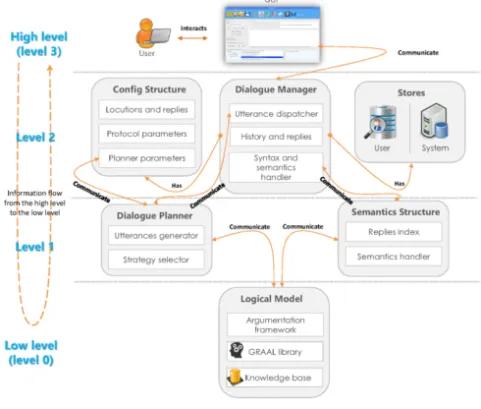
When theUser interacts with the GUI, the latter communicates with the di-alogue manager which possesses the configuration structure and the stores. Then, the dialogue manager, at its turn, communicates with the semantics structure through the sub-module “Syntax and semantics handler” and with the dialogue planner through the sub-module “Utterance dispatcher”. Next, the dialogue plan-ner and the semantics structure communicate directly with the logical model that uses the Datalog± GRAAL library [2] to query the knowledge base. Hereafter we detail each module of Figure 1.
Configuration structure. This module specifies: (1) the set of allowed locutions with their legal replies, (2) the parameters of the protocol, e.g. unique-move, multiple-move, the participants, etc. and (3) the parameters of the planner.
Dialogue manager. This is the referee between the User and the Reasoner (i.e. dialogue planner), it dispatches their utterances through the sub-module
“Utter-1See http://www.lirmm.fr/~arioua/dkb/#rulesdalek for more details.
Computational Models of Argument P. Baroni et al. (Eds.)
© 2016 The authors and IOS Press.
This article is published online with Open Access by IOS Press and distributed under the terms of the Creative Commons Attribution Non-Commercial License 4.0 (CC BY-NC 4.0). doi:10.3233/978-1-61499-686-6-461
Figure 1. The dalek’s architecture. Each layer is composed of modules and each module is
composed of sub-modules.
ance dispatcher” after ensuring their legality. To verify the legality the dialogue manager communicates with the module semantics structure through the sub-module “Syntax and semantics handler” that makes use of the stores. The syn-tactical verification ensures the legality of any advanced utterance with respect to : (1) legality of the utterance itself, and (2) legality of the reply within the dia-logue. The semantics verification ensures, among other things, the legality of the utterances with respect to the content. It checks whether the advanced utterance holds a legal content and it replies with a legal content.
Semantics structure.This structure implements an operational semantics of the dialogue. It associates with each reply a procedure that should be called by the dialogue manager to check the legality of the reply.
Dialogue planner.This module receives the utterances from theUser through the dialogue manager and plans the next utterance. The planner in its current state tries to answer User’s utterances as they come.
2. Acknowledgments
The authors acknowledge the support of QUALINCA (ANR-12-0012) and DUR-DUR (ANR-13-ALID-0002) grants.
References
[1] A. Arioua and M. Croitoru. Formalizing explanatory dialogues. In Proceedings of SUM’15, pages 282–297. Springer, 2015.
[2] J.-F. Baget, M. Lecl`ere, M.-L. Mugnier, S. Rocher, and C. Sipieter. Graal: A toolkit for query answering with existential rules. In Proceedings of RuleML’15, pages 328–344. Springer, 2015.
[3] H. Prakken. Coherence and flexibility in dialogue games for argumentation. Journal of
logic and computation, 15(6):1009–1040, 2005.
A. Arioua et al. / DALEK: A Tool for Dialectical Explanations in Inconsistent Knowledge Bases