CRINESE URBAN PLANNING EDUCATION: AN OVERVIEW
by SRWU MING CHEN
B,A., University of Pennsylvania 1978
Submitted to the Department of Urban Studies and Planning in Partial Fulfillment of the
Requirements of the Degree of
MASTER OF CITY PLANNING at the
MASSACHUSETTS INSTITUTE OF TECHNOLOGY June 1982
(g) Shwu Ming Chen 1982
The author hereby grants to M.I.T. permission to reproduce and to distribute copies of this thesis document in whole or in part. Signature of Author
Certified by
Accepted by
Department of Urban Studies and Planning May 19, 1982
Tunney Lee Thesis Supervisor == We ==
Langley C. Keyes Chairman, Departmental Committee on Graduate Students
MASSACHUSETTS INSTiTUTE
OF GY
AUG
1982
CRINESE URBAN PLANNING EDUCATION; AN OVERVIEW
by $HWU MING CHEN
Submitted to the Department of Urban Studies and Planning on May 19, 1982 in partial fulfillment of the requirements for
the Degree of Master of City Planning ABSTRACT
Urban planning education in the People's Republic of China is known to exist but public knowledge of it is limited to passing re-ferences in Chinese and in English. This overview is an attempt to understand, to the extent possible at this time, Chinese urban plan-ning education: its origins and evolution, its structure, and its contents.
Very little written information is available. Published material in English consist of passing references to the existence of Chinese urban planning education. At the same time, there is very limited dis-cussion of it in Chinese. Chinese universities do not publish catalogs, maintain open archives, compile course descriptions nor list pourses
and their contents for outside eyes. Therefore, the discussion is based on other less conventional sources of information. The basic urban plan-ning text Principles of City Planplan-ning, now being used in universities across China, is obtainable. The bulk of the information however, is based on lengthy conversations and interviews with Chinese academicians spread over a two-year period, 1980 to 1982. The Chinese urban plan-ning experience is carried by individuals directly involved over the past thirty years.
Much emphasis is given to the influence of historical, political, economic, ideological, institutional, Soviet factors as well as the powerful pragmatic orientation of Chinese development. The objectives of the education and the features of that education are delineated. Following that is a discussion of the resulting obstacles and gaps in the planning field and in the implementation of plans.
Thesis Supervisor; Professor Tunney Lee
PREFACE
The research. for this overview of urban planning education in the People's Republic of China began in 1980 while I was in China. The information gathered came from informal conversations with those in the field and came about, not with a thesis in mind, but through curiosity in how Chinese programs may differ from the program at the Massachusetts Institute of Technology (which I was to enter that fall). Once at MIT, the schooling began to provide a general frame-work into which much random information could be made coherent. Courses such as Planning in Socialist Countries and the Workshop in Regional Economic Planning in Developing Countries focused issues and provided the background for further research. A second trip to China resulted in more specific questions for interviews and in the gathering of newly published materials from China. This overview
is based on conversations, interviews, and observations buttressed by some published articles and books in Chinese. The data are limi-ted and therefore biased. However, it is valuable as an attempt to understand urban planning education from an observer's informal point of view.
Many thanks must be given for the time and energy provided by The many Chinese academicians and practitioners who were so open, warm, and patient;
Professor Tunney Lee for his guidance and encouragement for this thesis as well as for my interest in China's development;
Professor Karen Polenske for her perceptive comments and con-tinued interest as the reader;
And peers such. as Lee Yok-shiu who freely shared information and spent much time in translating materials from the Chinese, and Wu Da-yu who gave not only complete support but also researched and wrote an essay to detail a Chinese view of the topic.
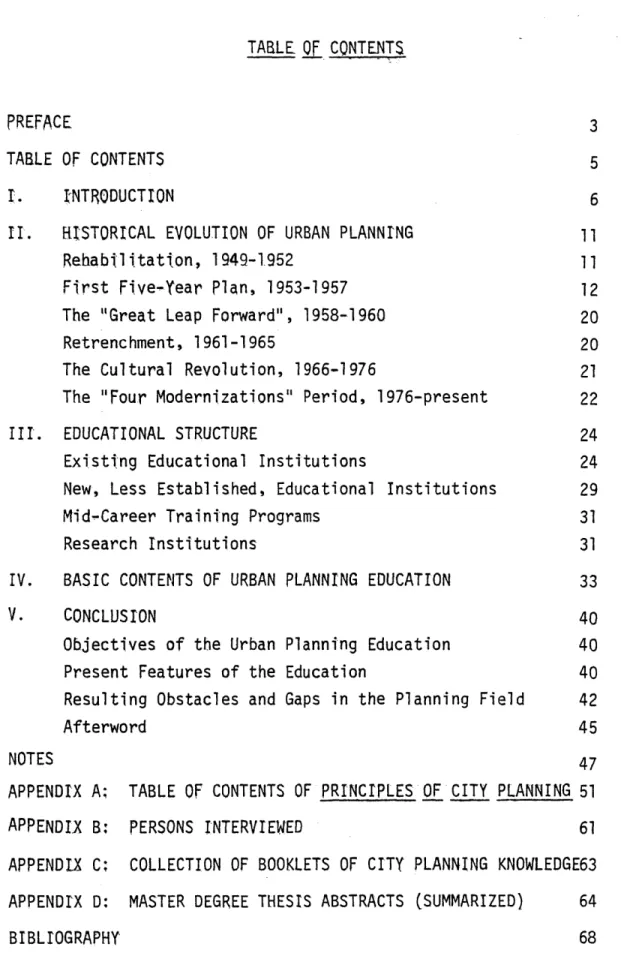
TABLE OF CQNTENTS
PREFACE 3
TABLE OF CONTENTS 5
I. ItNTRODUCTION 6
II. HISTORICAL EVOLUTION OF URBAN PLANNING 11
Rehabilitation, 1949-1952 11
First Five-Year Plan, 1953-1957 12
The "Great Leap Forward", 1958-1960 20
Retrenchment, 1961-1965 20
The Cultural Revolution, 1966-1976 21
The "Four Modernizations" Period, 1976-present 22
III. EDUCATIONAL STRUCTURE 24
Existing Educational Institutions 24
New, Less Established, Educational Institutions 29
Mid-Career Training Programs 31
Research Institutions 31
IV. BASIC CONTENTS OF URBAN PLANNING EDUCATION 33
V. CONCLUSION 40
Objectives of the Urban Planning Education 40
Present Features of the Education 40
Resulting Obstacles and Gaps in the Planning Field 42
Afterword 45
NOTES 47
APPENDIX A; TABLE OF CONTENTS OF PRINCIPLES OF CITY PLANNING 51
APPENDIX B: PERSONS INTERVIEWED 61
APPENDIX C: COLLECTION OF BOOKLETS OF CITY PLANNING KNOWLEDGE63 APPENDIX D: MASTER DEGREE THESIS ABSTRACTS (SUMMARIZED) 64
I. INTRODUCTION
Urban planning education in the People's Republic of China is known to exist but public knowledge of it is limited to passing re-ferences in Chinese and in English. This overview is an attempt to understand, to the extent possible at this time, Chinese urban plan-ning education: its origins and evolution, its structure, and its contents. The discussion will be divided into three general sections:
1. Historical evolution of the urban planning field
2. The present educational structure 3. The basic contents of the training.
The evolution of the field and education for it will be traced, starting with its beginnings in 1949 through numerous ups and downs to its present blossoming. The link between relations with the Soviet Union and educational restructuring as well as changes in content will be noted. Throughout, the fate of urban planning is inextricably intertwined with that of architecture.
The structure of urban planning education across China is ra-ther complex due to the State organizational framework of numerous ministries, commissions, and bureaux responsible for aspects of ur-ban construction. This results in academic institutions each funded by different ministries and many different agencies carrying out planning. In addition, there are three separate kinds of academic departments which contain some kind of urban planning training. This decentralized and uncoordinated development comes about from
differing approaches to urban needs as perceived by architecture and geography departments. Institutions other than colleges and univer-sities also train planners. These include commuter vocational schools, mid-career training courses organized by planning and implementation
agencies, and various research institutes which have graduate degree programs.
As for the contents of the education, there are three main points to note. The objective of the undergraduate urban planning education is to produce people who will be practitioners. This then dictates what is taught. The definition of urban planning is not as
all-encompassing as in the West. Rather, it denotes urban design and physical planning. Given the objective and the physical design orientation of Chinese planning, it is technical skills in archi-tecture and engineering that are taught. Social science still has no explicit role in teaching materials. To illustrate, curricula of several programs will be presented including that of Tongji Uni-versity which has the most established urban planning program and is the only place where urban planning is a full-fledged specialization, not merely a topic of special study.
The context within which urban planning developed in post-Liberation China is an important component of the discussion. Nei-ther urban planning nor planning education can be seen without con-sideration of socialist ideology, the evolution of political and economic policies, and the perceived needs of a developing country. The aim of creating a new socialist person within a newly organized
society motivates urban planning in its design for the transformation of people and their lives. The ideological goal of diminishing the
"Three Great Differences" between 1) cities and countryside, 2) work-ers and peasants, and 3) mental and manual labor affects the approaches and models used in urban planning.
Political and economic policies have also influenced the field and Its education. In fact, shifts in policy have dictated its changing fortunes over the last thirty years. Soviet influence is
quite clear in the models used and in the structure and content of theceducation. Ancient Chinese principles of urban design have been relegated to the position of out-dated curiosity since they served the feudal past. A new and more urgent commitment to economic de-velopment through industrialization and the various paths taken to accomplish it since 1949 coupled with periodic political upheavals and consolidations have made the evolution of urban planning rather tortuous and uneven. And now that there are closer political and economic ties to the West, Western influence is identified as such and Western ideas are openly displayed and debated.
Not to be overlooked is the pressure of perceived needs on urban planning models and education. China is ideologically moti-vated but also extremely pragmatic. The acute awareness of her developing and resource-constrained status and an almost obsessive focus on rapid economic development color the position of urban planning. Since the city plays a crucial role in economic develop-ment, there is concern over its growth and control. In addition,
Chinese. experience in the past thirty years has shown that a planned economy without planned spatial development means chaos and unwanted long-range re.sults due to enterprise or district level decisions which run counter to ideological criteria and macro socio-economic
interests.
Before embarking on the discussion however, some comments on the sources of information are in order. Very little written in-formation is available. Published material in English consist of passing references to the existence of Chinese urban planning edu-cation. At the same time, there is very limited discussion of it in Chinese. Chinese universities do not publish catalogs, main-tain archives (especially during the educational chaos of the Cul-tural Revolution), compile course descriptions nor list courses and their contents for outside eyes. Each department and institution may collect relatively complete records of the past. However, the sys-tem is a closed one where members of another institution or depart-ment are not free to obtain written information. Foreign groups and
visitors have even less access and are only given general introduc-tions due to language and time constraints as well as a reluctance to give formal statements. Damage to the educational system during the Cultural Revolution is also extensive and the passage of those ten years has not left much in the way of reference and other mater-ials ouside of what was preserved by individuals.
Therefore, the following discussion is based on other less con-ventional sources of information. The basic urban planning text
Principles of City Planning, now being used in universities across China, is obtajnable in China (Table of Contents in translated form, appendix A ). The bulk of the information however, is based on
lengthy conversations and interviews with Chinese academicians (who also practicel spread over a two-year period, 1980 to 1982. They
include Professor Li De-hua, vice-chairman of the Tongji University Architecture Department who is also in charge of the only full-fledged urban planning specialization in China at this juncture. Other professors of Tongji University, Qinghua University, Nanjing
Institute of Technology as well as a group from the Chinese Aca-demy of Building Research were consulted in China and in the United States (List of names and relevant information, appendix B ). The
Chinese urban planning experience is carried by individuals directly involved over the past thirty years. This overview is based on the structure available in the Chinese reference text and fleshed out through extensive informal conmunication with the participants them-selves.
II, HISTORICAL EVOLUTION OF URBAN PLANNING
The path. of Chinese urban planning has been a difficult and spotty one stretched over the last thirty years. Urban planning education has suffered the same fate and has been in existence (often just barely) for a total of less than twenty years. Besides sharing every setback that architecture education has endured, since it was often a subset of the architecture department, it has suffered its own setbacks due to its less established standing and closer re-lationship to economic policies that shifted periodically. In tra-cing the evolution of the field since 1949, one can see that dis-tinct periods can be identified and these periods are defined by political-economic shifts. Therefore, each period examined will be labeled according to established usage in the China field:
1. Rehabilitation, 1949-1952
2. First Five-Year Plan, 1953-1957 3. The "Great Leap Forward", 1958-1960 4. Retrenchment, 1961-1965 '
5. The Cultural Revolution, 1966-1976
6. The "Four Modernizations" Period, 1976-present 1 Rehabilitation, 1949-1952
This was a period of consolidation of control and recovery from decades of war. Urban work was to follow the policy of "urban con-struction for production and for the life of the worker."2 The city was not to be seen as a center of commerce as port cities came to be
but rather, they were. to be centers of production. Given the aboye policy, emphasis was put on rehabfilitation and replacement of da-maged industry and housing. In housing, there was special stress on slum clearance and construction of new housing complexes in their place,
By 1952, it was apparent that urban planning was needed to co-ordinate construction for rapid economic development. A national symposium on urban construction was organized and officially recog-nized the importance of urban planning with the establishment of urban planning agencies and appointment of planning officials.3 The birth of urban planning from economic development needs set the tone for future evolution of the field. No matter what the ideological or technical discussions of planning approaches may have been, it was the demands of socialist economic growth that finally dictated the path chosen.
First Five-Year Plan, 1953-1957
Soon, the field of urban planning began to be part of urban de-velopment. The fact that the first Five-Year Plan put heavy emphasis
on industrial growth in specially designated cities and industries determined the planning work carried out. A 1953 directive on urban
construction spelled out the task as planning for key industrial cities and regions. In the course of the work, experience in for-mulating master plans was first gained. Eventually, there was
ad-vancement to industrial regional plans. However, the acute shortage of planners and other skilled personnel coupled with lack of data
resulted in construction de.lays due to incomplete comprehensive plans for many cities.4
The central government's support for urban planning was made ex-plicit when members of the State Council were directly involved in the planning of several key industrial cities. In addition, it es-tablished State level as well as provincial level planning organi-zations and created design institutes. And finally, the first urban planning specialization at the university level was set up to fill the great need for planners.
Soviet influence during this period was pervasive. The first Five-Year Plan itself was modelled on that of the Soviet Union and the Soviet imprint was very clear in the areas of education, archi-tecture, and urban planning. In education, a total restructuring occurred. Universities that had consisted of schools of science, engineering, humanities, medicine, etc. were disbanded and changed into specialized institutions along the lines of the Soviet system. For example, Tongji University in Shanghai was originally comprised of many schools: engineering, sciences, humanities, each containing several departments. Due to the restructuring, all schools and their departments except technical departments and architecture were moved to other colleges. At the same time, entire architecture departments of other colleges were brought to Tongji. One of the first urban planning specializations established was at Tongji. Specializations within schools became extremely narrow and isolated and students did not gain exposure to other fields, even related ones.5 The impact
of this constricted higher educational system can still be felt today through- the many difficulties in coordination and communication be-tween specialists and agencies.
In archi.tecture, Soviet influence was also profound. Stalin-esque "monumentalism" had taken hold. Because of limited resources, efforts were concentrated (as in the economic and planning policies) on a few key structures in a city or district. These were invaria-bly large, ponderous, and very permanent edifices of a distinctly Russian flavor. Both the massive Great Hall of the People and the imposing Chinese History Museum flanking each side of Tian An Men Square are circled by huge columns and approached by vast stair-cases. Indeed, some buildings were exact replicas of those in Moscow. A prime example is the Soviet Union Exhibition Hall (now called the Beijing Exhibition Hall).
In urban planning, the impact was no less profound. Soviet experts were brought into the general planning of nine large key cities (Sian, Lanzhou, Baotou, Wuhan, Luoyang, Taiyuan, Datong, Chengdu, and Shijiazhuang). A look at the master plan of Luoyang done during this period reveals a distinct likeness to the linear plan of Stalingrad stretched along the railroad tracks. There are
broad boulevards, green belts to buffer residential areas, indus-try located on the fringe of the city, and residential areas built as a neighborhood unit with services.
Elements of the Moscow Plan6 formulated in 1935 look very fa-miliar when compared to urban planning principles used in China
LUOYANG
(from slide by Tunney Lee)
STALINGRAD
(from Maurice Parkins,
City Planning in Soviet Russia)
Fm. 17.-Scnetna PLAN 1o0 Tun RwCoNsTuCTorN or STAmwoAD, 194d
Academicians: K. S. Alabian, A. V. Shchusev; architects: N. Kh. Poliakov, D. M. Sobolov, A. A. Dzherzshkovich, A. E. Pouharkii; engineer, V. A.
BudagLn. 1, lower longitudinal thoroughfare: 2, middle longitudinal thoroughfare; 3, upper longitudinal thoroughfare; 4, new central square; 5, Mamaev Kurga Hil; 6, Park of Culture and Rest; 7. Pionerka River; 8, industrial sections; 9, railroad station; 10, main crosstown avenue; 11, Moscow highway.
(particularly Be.iji.ng).
1. Limit population growth: Moscow was to have a limit of five million people while Beijing is now aiming for a limit of ten million.
2. New territories: The Moscow municipal area was doubled in the Plan while the Beijing municipal area had also doubled by 1958. This strategy facilitated decentralized
industrial growth, controlled agricultural land use and its direct impact on municipal consumption and resulted in control of population distribution and efficient use of local transportation and labor by getting rid of ju-risdictional problems.
3. Circulation system: The basic layout of the old city was kept (Moscow had a radial -ring layout while Beijing had a grid layout). Additonal construction was built to facilitate flow by avoiding the center and by a set of concentric ring roads. At least one existing street was made a showpiece through widening to over 120 feet across (Gorky Street in Moscow and Chang An Street in Beijing).8 Other major arteries were made into tree-lined boulevards.
4. Functional zoning: A rational and discrete distribution of uses was created. These were generally categorized as industrial, socio-cultural, residential, green zones, and central administrative zones.
5. Residential neighborhoods: Residential districts (mikro-rayon) of up to 50,000 people were provided with all ser-vices and amenities such as educational, sports, park, health, commercial, and cultural facilities.9 These
dis-tricts comprised of neighborhoods or superblocks (kvartaly) accomodating several thousands. Each superblock was to have lower level services (of the same nature as above
except for the sports, and cultural facilities) withi.n walking distance for all residents. In addition, child care services were to be. provided. Within these super-blocks, only pedestrian traffic was permitted and green strips separated superblocks from each other. The buil-dings were multistoried walk-ups rather than massive ele-vator buildings.10 These self-contained neighborhoods were organized to relieve transportation facilities (as they were built near industry to house the workers of that industry) and to encourage local administration.11
6. Stress on housing: Housing shortages were acute then and now. Per capita living space was only about two
square meters in China in 1956. In the 1970s, per-capita living space for the urban population is estimated to be only four to five square meters (as compared to over six square meters in Singapore in 1970 and almost eight square meters in the Soviet Union in 1971).12
7. Suburban zone: A suburban zone was planned which would contain industry and agriculture. In Beijing, these
zones were divided into two types, "near" and "far" su-burbs. "Near" suburbs contained much of the vegetable growing communes and industry. The much larger "far" suburb was to provide the city with grain, coal, water, and construction materials.13
Other similarities between the two cities include a large square with wide boulevards on an east-west axis, district parks, several
sports stadiums, civic centers for municipal buildings, and cul-tural palaces. The above features can be seen in virtually every Chinese city of size.14
Unfortunately, for China, not all of Soviet assistance was ap-propriate or of high quality. Urban planning and development in the
M WILONS anIStt
a INDUSTItAL ARIAS N 4 k
cz PARK CRAS 4
- MAJOR TH@A@UOVAM & SIAGONALS0 4 S S ICK
- ,XITING SOUNSART 0 2 4 6 9 1K
o : ao snta Choy
-- PxsneE SSNogARt
" MAAO STATIons I A. NOATNERN CIARoLAVL). ,oCTota KAZAN';
S. KUSS O.SAMATOV& S. KIEV; LVNITE RUSSIAN - SAToiG
I, Ermiin; 2, Red Square; 8, Palace of SoviKs 4 boulewd ring; 5, Sadovoe Ping; 6, new highway; 7, new bouevrd ing; 8, Kirv Street; 9, Baiheatvnka Boulevard; 10, Gor'kI Steet; 11, park ring: 12.
O -ka- 13, Shl'nii 14. uathan port; 14 Stalin pla. 16, lady.
BEIJING
(from text, Principles of City Planning)
MOSCOW 1935 General Plan (from Maurice Parkins, City laninq in Soviet Russi a)~
Soyiet Union during th-is same period was chaotic. There was lack of integrated plannilng for lioth the urban and suburban areas. No planning agency had the expertise or experience to do integrated planning and no methodology existed. Over 600 cities still needed general plans and only a few major cities such as Moscow, Kiev,
Leningrad, and Stalingrad had urban development plans. Disorderly and nonrationalized development was occurring. Significantly, the cause of these problems was a shortage of urban planners which was due to inadequate educational institutions for training planners.15 Added to this kind of limited expert assistance were China's own
paucity of understanding and expertise, problems of adapting for-eign theories and techniques, and severe resource constraints. It is not surprising that flawed plans and inappropriate transplanting of Soviet designs resulted.
During this initial period of urban planning education, Soviet influence is also evident. The planning field was categorized under architecture in the Soviet educational system. There were two types of architectural-planning schools: the architectural-art schools which produced architects with special training in city planning, and the architectural schools which trained architects with special emphasis on construction. The curricula were similar and lasted six years. Special courses were also offered by almost all
plan-ning organizations which trained their own planners and technicians. 16 Chinese planning education followed the same model, used textbooks translated from Russian, and sent students to study in the Soviet
.Un i on.
The "Great Leap Forward", 1958-1960
Establishment of urban planning agencies continued around the country so that most cities and some counties had some form of an agency. Planning could not escape the influence of the "Great Leap Forward", however. Like the mistakes made in economic activities, much planning and construction in large cities was done without in-vestigation or consideration of realities. Cities were allowed to grow uncontrolled during this period resulting in an influx of pea-sants who entered the cities as laborers.
Retrenchment, 1961-1966
After three years of natural disasters and an economy in dire straits, a period of economic adjustment was needed. In urban plan-ning as well, a review and analysis of past experience was needed. However, at a State Planning Council in 1960, it was announced that there would be a three-year hiatus on all urban planning decisions. This created the impression that urban planning was not a crucial part of development in the minds of many leaders and cadres. The still very new planning organizations were weakened and the already inadequate ranks of planners and technicians were diminished through transfers to other lines of work. Several universities went so far as to abolish their urban planning specializations. The damage to such a new and complex field in this setback was deep.
At the end of this "three-year adjustment" in 1963, when the economy was starting on the way to recovery, it was announced that
urban work should include the making of short-range plans and the revision of existing master plans. However, no implementation fol-lowed 17
The Cultural Revolution, 1966-1976
Even more devastating to urban planning and its education was the disruption of the Cultural Revolution. Architecture, its home department, was entirely changed in curriculum with less theoretical courses, more actual practice, more politics, and more labor in a shortened course of three years, one half of its original length. Urban planning did not fare so well. The planning specialization in architecture departments was entirely abolished.18 The field was said to be useless and unnecessary.19 Planning work was in essence stopped, agencies disbanded, personnel dispersed and many plans stroyed. The results of this long neglect are not difficult to de-tect. In most cities, there was little control or guidance of de-velopment, services were overlooked, the environment suffered, his-torical structures and green areas infringed upon, and transportation deteriorated. The extent of the damage varied from city to city.
Beijing saw a harmful and random expansion of industries on un-suitable sites. For example, a temple and a residential area were changed to a record factory.20 More importantly, there -is a ques-tion of whether Beijing should have been left as a cultural and ad-ministrative city. Unlike Beijing, the city of Hefei, capital of
Anhui Province, was able to maintain aneasure of control over ir-rational development and preserved much of its original plan. One
likely reason for its escape was that the deputy mayor -himself was
a
trained planner from Shanghai.The "Four Modernizations" Period, 1976-present
After the fall of the "Gang of Four" and the end of the Cul-tural Revolution, a vigorous revival has occurred. The Third Urban Work Conference was held in 1978 and attempted to sum up urban plan-ning of the past thirty years and pointed a direction for planplan-ning for the "Four Modernizations". And in 1980, Vice Premiers Wan Li and Gu Mu addressed the National Conference of City Construction Bureau Chiefs. It was pointed out that there has been too little attention given to urban planning in the past. So, it is necessary to strengthen the field and large cities should consider establishing city construction commissions. Officials at provincial and municipal levels should strengthen their city construction leadership. Small cities should also pay attention to planning. It was also mentioned that the main task of mayors is to plan, construct, and manage cities well. 21
At the same time, universities began to re-establish their urban planning education in 1978 and 1979 by creating urban planning teach-ing groups as a first step in collecting and passing on the remaining expertise. Urban planning in most higher education institutions is still only an area of special studies and not a full specialization. Tongji University, which had one of the first planning programs
Estarted
in 1952), now has a well-defined specialization. The field is still expanding with the creation of new institutions to fill theneed. And in 1981, the first text on city planning since the Cul-tural Revolution was published. In the past two years many journals
have returned and have leapt energetically into discussions of the past, present, and future, and of trends and ideas from outside China. Books on various planning questions have come into print. There are now graduate students and the first and second post-Cultural Revolu-tion classes are graduating this year. The field is obviously re-viving with renewed energy.
III. EDUCATIONAL STRUCTURE
The general structure of higher education in China is very dif-ferent from that of the United States. All education is government
run. As mentioned earlier, institutions have become specialized and fields of study exceedingly narrow as in the Soviet Union of the
150s. Upon the foundation of the Soviet model, China's urban plan-ning education has evolved in its own way since the late 1950s under the unique political-economic pressures of her development and in
accordance to her perceived practical needs of the period.
Because of the uneven and tortuous path of urban planning in China, its educational structure has become complicated and frag-mented much like the planning and construction functions carried out
by different ministries and bureaux with inadequate coordination and resulting cross-purposes. Even now, there are attempts in both aca-demic institutions and governmental agencies, to organize and cen-tralize planning and its implementation. There are four different types of programs presently in existence. There are those in:
1. existing educational institutions;
2. other newly formed educational institutions of a less established nature;
3. training programs outside of educational institutions; 4, research institutes.
Existing Educational Institutions
the funding level Cfrom outside to the institute), the institute level (under the jurisdiction of which department), and the depart-ment level
Cits
place in the department).In funding, there are at least three state level organizations, the Ministry of Education, the Construction Commission, and the City Construction Bureau, that are responsible for various institutions with planning programs. For example, Qinghua University, Beijing
University, and Nanjing Institute of Technology are under the Mi-nistry of Education While Tongji University and the Chongqing In-stitute of Architectural Engineering are under the Construction Com-mission. And just last year, the State Council approved the
es-tablishment of the first city construction college, the Wuhan City Construction College, which will be under the City Construction Bureau.2 This fragmentation is characteristic of overlapping plan-ning and implementation functions performed by numerous government organizations.
At the institute level, different institutions have their planning program in different departments. The main department types are architecture (as in the Soviet Union) and geography. There seems to be only one case of planning as a specialization not subordinate to another field which will be in the proposed Wuhan City Construction College.
The planning curriculum of the different types of departments is similar in content. The prominence of engineering skills is ap-parent. There are slightly different emphaseshowever. The
plan-ning taught 'n archatecture departments of Tongji, Ch-Qngqing, and Harhin is very much urban design while the "economic geography" of
geography departments of Beijing, Nanjing, Hangzhou, and Zhongshan Universities refers to urban and regional planning, and the plan-ning taught in the architecture departments of Nanjing Institute of Technology and Qinghua University focuses on the urban design of dis-tricts (within a municipality).4
Within the department, planning may be in one of two arrange-ments: as a specialization (zhuan ye) or as a subject of special
study (zhuan men hua). In the initial phase of establishing an urban planning program, most institutions will start small with only a teaching or research group made up of selected faculty mem-bers who will teach a few courses on the subject. Undergraduate students who are interested may select planning courses in the last one or two years of their training as a special studies topic and then use the graduation thesis or project as an opportunity to delve into the topic. Institutions such as Qinghua University and Nanjing Institute of Technology have this arrangement under their architec-ture departments. Students attend common architectural core and other required courses for the first two to three years after which they begin to enter their special studies by attending specialized classes.5
Urban planning as a full-fledged specialization is less common. Of those in architecture departments, at present only Tongji
ACADEMIC INSTITUTIONS WITH URBAN PLANNING
PROGRAMS H A * F G *
$2
A Beijing University, Beijing
B Chongqing Institute of Architectural Engineering, Chongqing, Sichuan Province
C Hangzhou University, Hangzhou, Zhejiang Province
D Harbin Architectural Engineering College, Harbin, Heilongjiang Province
E Huanan Institute of Technology, Guangzhou, Guangdong Province
F Nanjing Institute of Technology, Nanjing, Jiangsu Province
G Nanjing University, Nanjing, Jiangsu Province
H Qinghua University, Beijing
I Tianjing University, Tianjing J Tongji University, Shanghai
K Zhongshan University, Guangzhou, Guangdong Province
L Wuhan Building Materials College, Wuhan, Hubei Province (future Wuhan City Construction College)
ESTABLISHED EDUCATIONAL INSTITUTIONS WITH URBAN PLANNING PROGRAMS
LEVELS
__ _1__ _ _ _ _Y 11
* City planning
spe-cialization plan ned as of 1980.
** Information given
pertains to new Wuhan City Con-struction College. INSTITUTIONS FUNDING 0 -__ 0 Ln,.f
INST. DEPT. YEARS OFSTUDY
eijing. Univer- X X X 4 sity Chongqing Inst. of Architectural 'En,. X x gineering Hangzho1 0U Univer- .x sity Harbin Architectu-ral Engineering X College Huanan Inst. of X X 5 Technology * Nanjing Inst. of X X X 4 Technology Nanjing Univer- X X sity Qinghua Univer- x X X 5 2 2 sity Tianjing Univer-XX sity Tongji Univer- X X X 4 2 s ity Zhongshan Uni- X X 4 versity.
Wuha-n Building
Ma-terials College** X X X 4
(future Wuhan City
tailored for city plannilng from their freshman year.6 -When the new Wuhan City Construction College is established, it too will have a city planning specialization.7
One very crucial feature of these institutions is that they are now encouraging research through graduate studies. At this point, there are only a handful of master degree students graduating each year Cstarting in 1981) from each program. However, the first class of doctoral students will soon be graduating and the number of
re-search students are increasing each year.
New, Less Established, Educational Institutions8
With the new emphasis and attention put on urban planning in the late 1970s, it became obvious that existing institutions could not fulfill the demand. Existing higher education institutions were ad-mitting only the very best of those few who did well on college
en-trance examinations reinstated in 1977. It is estimated that only about 0.5% of all middle school graduates were admitted to these institutions. Planning programs in established institutions pro-duce very few graduates. The planning program at Qinghua propro-duces approximately thirty students9 a year while Tongji produces an average of sixty.10 The first class since the Cultural Revolution just graduated in January of 1982. The demand for trained profes-sionals was intense due to the ten-year hiatus of the Cultural Re-volution and at the same time, young people who did very well in the examinations but were not selected, were intensely interested in gaining more education and skills. These two circumstances were
more than enough to spur the growth Qf new educational institutions in the form of vocational schools for commuting students and pro-fessional schools.
These institutions were begun in several large cities on an experimental basis in l8O. Some programs were to be three years long, while others were to be much like regular programs of four years. The professional schools were to have two-year programs.
Several features distinguish these schools from the established in-stitutions, Though the teachers are from the regular programs (gain-ing extra income outside of their regular duties), the facilities available are inferior and access to resources such as university libraries are limited. These schools also have no campus, there-fore students are all commuters. Not only that, the students pay tuition (though quite inexpensive) unlike regular subsidized col-lege students and are not assigned employment after graduation. Rather, they must seek work through their own efforts in a socio-economic system where employment has always been assigned, and therefore guaranteed, by the State. It is not clear at this point,
how these new institutions and their students are faring or what will be the final outcome. It is likely that those with planning
training will be able to find employment in various planning agen-cies and organizations due to the extreme shortage of technical personnel at this time. However, the standing and promotion po-tential of these students is not as certain. It is still too early to comment on how well trained they will be and how their training
will be perceived by oth.ers. Mid-Career Training Programs
There
are
many practicing professionals and technical person-nel in State and city construction and planning agencies who are not eligible to attend college due to age limits for students but who need further training in order to carry out their present planning and planning related tasks. The organizations are also unwilling to lose many people to graduate programs when there is such a shor-tage of planners. Therefore, bureaux and agencies have organized mid-career training courses to raise the level of expertise of the staff. Professors and teachers of nearby universities are brought in to teach courses. The exact arrangement (whether composed of evening classes, of intensive short-term programs, or of a series of lectures during the work week) varies from program to program.Speakers from abroad are also brought in on occassion for special lectures. Attendance in these programs are usually restricted since time off from work is often required and since so many would like to participate.
Research Institutions
There are numerous research institutions of various sizes at the national, provincial, and municipal levels. They are created by different ministries, bureaux, and commissions to advise and improve urban construction.12 Once again, the diffused nature of the field
is apparent. The largest and most influential institutes are those at the State level under the State Construction Commission. Some
urban planning researchk is done in the Chinese Academy of Building Research by architects as well as by research students who obtain
13
advanced degrees from the Academy. There is also the City Con-struction Research Institute and many design istitutes around the country which have researchers interested in the field and which have research students who are practitioners. It must be pointed out that the vast majority of planners are architects who pursue their interest in planning and are often trained on the job.14
Therefore, many institutions of building research contain architects who plan just as in academic institutions where planning faculty is drawn from the architecture faculty.
IV. BASIC CONTENTS OF URBAN
PLANNING
EDUCATIONBefore discussing the contents and form of Chinese urban plan-ning education, one must first be aware of the objective of that edu-cation. To the Chinese, the very urgent objective need for qualified urban planning professionals is ever present. Therefore, the main objective is to produce professionals who have the necessary tech-nical skills to perform planning tasks within the constraints and specifications set by the client and/or the decision-makers after one year of apprenticeship. A new and secondary objective is to
faci-litate research through cultivation of graduate students for develop-ment of the field. Given these two objectives, it is not difficult to understand why Chinese urban planning education is more narrowly defined as urban design and physical planning than in the West.
The text used reflects the rather specialized nature of the training. There is at present only one standardized text used around the country as a guide and reference. The Chinese educational sys-tem prefers standardized texts to insure uniformity of knowledge and expertise. This text, titled Principles of City Planning, was publi-shed in 1981 and was written by a team made up of faculty members from Tongji University, Chongqing Institute of Architectural Enginee-ring, and the Wuhan Building Materials College. The team developed the text from a 1961 text titled Urban and Rural Planning. The new text gives a systematic exposition of basic principles of city planning and design as well as addresses technical and economic questions in
planning. The. main content of the book- includes a brief history of the city and discusses, among other things, tasks. of city planning,
key elements and layout of the city, design of residential areas and rehabilitation of old areas, public spaces, street layouts, and im-plementation. This survey of the field was meant to be used as a reference for those in the planning field, academic and professional.
Another resource is a collection of booklets on urban planning knowledge which addresses specific topics in planning such as the environment, infrastructure, roads, land use, parks and green areas. 2
(A partial list of booklet titles of the series, appendix C.) Each academic program then supplements these two standardized publications with their own materials.
The task of undergraduate training is to produce future pro-fessionals who will become practitioners after a one-year appren-ticeship following four to five years of studies (most programs are now four years long though Qinghua has changed to a five-year pro-gram). Therefore, many of the technical skills taught in the geo-graphy departments and the architecture departments are similar. As mentioned before, the emphasis may be dissimilar. Some illus-trations follow.
An example of urban planning as a special studies topic under an economic geography specialization is the urban geography and city planning special studies at Zhongshan University. Teaching in the field began as a one-year program for professionals in 1974. Now it is a four-year undergraduate course. Twenty required and core
cour-ses such as mathematics, physics, a foreign language, politics, in-dustrial geography, transportation, etc.,, are needed for the economic geography specialization and students in planning take city planning classes on industrial planning, communications and transportation, master and residential planning, urban geography, history of the city, foreign urban geography, demography, economics, statistics, the urban environment, architecture, and cartography. There is also great in-terest in the use of satellite photos, land use planning and map-ping, planning theories, and data management.3 The above is not an exhaustive list, but it does illustrate the point that the training
is quite technical and physically oriented. The geography point of view is evident in the presence of cartography, demography and study of the environment. In addition, the economic geography specialization
also includes the special studies topic of rural geography. Due to the presence of both urban and rural geography in one specialization, a more regional perspective can be easily coordinated.
The orientation of planning in architecture departments is slight-ly different. Urban planning is seen as urban design and physical city planning. For programs which are special studies within an ar-chitecture department, the planner is really an architect with some urban design training. Different institutions may have particular topics in planning and design which are more fully developed than others. The case of Qinghua University's five-year program with a city planning special studies is an example. Residential planning and design is well advanced and much work is done on the subject.4
The students need not be restricted to housing however. Their under-graduate education begins with three years of basic and core courses for architects. These include courses on drawing, painting, archi-tectural history (Chinese, foreign, modern and ancient), materials,
structures, building construction, and a foreign language. It is only in their fourth year that they start to concentrate in city planning. Courses include city planning history and theory, residential plan-ning theory, transportation, economics, industrial planplan-ning, and the "greening" of a city. Lectures at Qinghua include one on resi-dential clusters and all architecture students attend lectures on environmental pollution, sewage disposal (with a lecturer from the civil engineering department) and computer science. And besides courses there are studios to be taken each year. Much of the train-ing is in architecture though there are design projects on residen-tial districts, superblocks, and small cities. The final project is the graduation project in which five to six students are given the same problem but each formulates his or her own design and plan.5
For programs which are specializations within an architecture department, the student becomes well grounded in physical planning and urban design after four years (five years of study was contem-plated but the need for planners was considered too acute for de-lay). A detailed look at the urban planning specialization in Tong-ji University will illustrate.6 The urban planning curriculum is divided into two categories of courses: engineering and related
stu-dios and field work involving much team work, a characteristic of actual practice in the planning field.
In the engi.neering category, there are seven required courses. They include a major emphasis on transportation in terms of road construction, along with courses on water supply and
drainage,geo-logy and hydrodrainage,geo-logy, surveying, structural engineering, strength of materials in structural theory, and calculus. Electives include an
experimental course on statistics for planners (taught by a planning professor) where questions of optimization and data analysis are dealt with.
In th.e urban design category, there are eight courses: the theory of city planning and its history, planning and design, re-gional planning (there is less emphasis than at Beijing University and Nanjing University), history of the Chinese city, "greening" of the city, environmental protection, urban industry (unique to Tongji University), and intercity transportation (special to Shanghai as a
hub for rail and air transportation). This set of courses is a good example of how a program can tailor its contents to local needs. There are several studios and field work experience required. These
include a half a semester on design of a superblock, another half on a residential district and a studio on transportation where students observe, analyze and design a system. The field work required varies but work in a bureau of planning is now part of the training. In addition, master plan studio is required in the second term of the third year and continued into the first term of the fourth year.
Students stay in a city to investigate the local situation in a large group. They then divide into smaller groups to draw up a master plan. In many cases, one or more of the plans are then presented to the city for consideration. The practical implications of the exercise is im-printed in the students' mind and cities may, at the same time, bene-fit from the planning training received by the students. In the last semester, students work on either a graduation thesis or project. Most students prefer the project. The final product is individual though some of the process may occur in a group.
Tongji University students entering in 1981 have an additional demand on them that does not seem to be as strong in other insti-tutions. The university places great importance on facility in a foreign language. This may be due in part to its founding by Ger-mans before 1949 and the fact that classes were not taught in Chinese. There is also the feeling that there is great need for exposure to outside theories and developments. The volume of translations is much too small. Therefore, students are expected to master a for-eign language enough to attend at least one or two courses taught in either English or German. One half of the students use English as the foreign language while the other half of the students use Ger-man (these students take one year of intensive language training be-fore starting on the four-year program).
With the kind of intensive language training proposed by Tongji University, the main obstacle to graduate studies is removed. There are at present, at most a handful of graduate planning students in
each program that has graduate s.tudies. Tongji had two master de-gree students graduate in 1981 and three in 1982. Five more were ad-mitted in September of 1981 for the two-year master degree program. An additional two years of study after the master degree can mean a doctoral degree at Qi.nghua University. Though graduate students must pass stiff examinations with very high scores and must have working experience in city planning, it is not these- requirements which disqualify many; it is the foreign language requirement.7
Once admitted, graduate students choose their advisor (actual flexibility is often limited due to the small selection of
profes-sors available) and then attend lectures, take studios and, when possible, cross-register with nearby universities to broaden ex-posure. Qinghua University graduate students have attended art his-tory courses at Beijing University.8 Most importantly, however,
is the research effort put into the thesis. Some thesis topics chosen at Tongji University include a mathematical approach to the problem of what to do with the old city (rehabilitation or destroy), an anlysis of how much abuse an environment can absorb and a dis-cussion of "greening" of a city and its open public spaces. (Two
abstracts of Tongji University graduate students are summarized in appendix D).
V, CONCLUSION
Objectives of the Urban Planning Education
The major features of Chinese urban planning education hinge on the objectives of that education: to produce professionals who have the necessary technical skills to carry out planning tasks within the constraints and specifications set by the client and/or decision-makers. A secondary objective is the cultivation of graduate
stu-dents to carry on research and development in the field. Primarily, the education consists of professional training focused on needs and feasibility, not on exploration and innovation. Given the object-ives, Chinese urban planning education is characterized by the teaching of technical skills in a specialized education that is composed of ur-ban design and physical planning. There is no real analysis of theories or exploration of ideas. Rather, skills are imparted and rigid economic, policy, and client specified constraints are taken as given. The field is, by its very nature, interdisciplinary. The Chinese system has, however, confined it to ideological, economic, construction, and aesthetic considerationsi with no theoretical use of social sciences, such as psychology and sociology, to link it dir-ectly to the user. There is at present a dissenting view on the
relative emphasis of technical versus a more interdisciplinary ap-proach to urban development.
Present Features of the Education
se-yeral. Filrstly, the necessity engendered by real circumstances make for a pragmatic rather than a theoretical approach.. The impetus for creation of the field was urgent need and that is still the driving
force behind the field. More theoretical interest exists but is well-grounded in reality.
Secondly, the political -economic system in which centralization and a command orientation are characteristic means that the center of decision-making is outside the scope of planners. Two other relevant factors concern the economic and institutional aspects of the system. National priorities place economic development as unmistakably first. All proposals and actions are measured against the yardstick of
eco-nomic development. Planning is no exception. Institutionally, plan-ning functions are both specialized in content and diffused in exe-cution. Each organization has its specific tasks (some of which overlap) and tackles problems as they appear, resulting in piecemeal adjustments to deal with symptoms rather than attack the causes.
Thirdly, the evolution as traced above shows clearly the path of this young and immature field. The roots of urban planning and its education in the architecture discipline is along the 1950s Soviet model. But planning in the Soviet Union has changed much
since the Sino-Soviet split in 1960. Soviet planning has abandoned population limits (which were not enforceable) and has seen the entry of sociology and other social sciences. Though China has observed over the last thirty years the Soviet experience, she has not suffi-ciently comprehended its many implications and has not fully
bene-fited directly from the sixty years of Soviet experience. China has 41
also had to progress without the stability needed to establish the standing of city planning.
Finally, the role of the planner as a specialized technical staff member with an advisory relationship with the leadership2 has dictated the contents of present education. Larger issues of policy are out of the reach of planners within the present system. Resulting Obstacles and Gaps in the Planning Field
The consequences of the above circumstances are a series of obstacles for planners (which are not unique to China) and several gaps in planning education. The obstacles experienced by planners the world over are also encountered in China despite what appears to be great potential for impact in a centralized and planned po-litical-economic system. The reality of urban planning's lack of establishment in the minds of decision-makers has resulted in a weak position in practical terms. There has been and still is a sense that urban planning may facilitate development,but is not essential to that development. The most damaging outcome of the Cultural Revolution to the planning field is not the loss of ten years of potential development. Rather, it is the blow to the field's legiti-macy and standing as a crucial component of urban development that was the most devastating. The leadership came to take the field, its con-tributions and its issues lightly. The outgrowth of this weakened
image is the lack of influence in political, economic, and social terms on policy, decision-making, and implementation. The planner in China
is a technician and his or her advice and plans are not backed by en-forceable laws and regulations. This hinderance
to effective planning is so tmportant that in the text Principles
of City Planning, whole sections are devoted to justification of
planning's claim to official attention (in Chapter 1, section 3, the close relationship between.the field and Party policies is de-lineated) and to an explicit call for increased influence through scientific argument, the master plan, and enforced laws and re-gulations.
The practice of ranking economic development above all else, including social development, has been a constant problem for ef-fective planning and implementation. China is still a developing country,and she is very aware of that fact. Her almost obsessive preoccupation with "modernization" (seen as economic, technological and material growth) has often resulted in violation of plans and strategies for overall long-term development. This leads to frus-tration on the part of urban planners who must deal with bureau-cratic inertia and loss of credibility when officials of the dif-fused and fragmented system fail to implement or follow plans.
In addition to impediments faced by practicing planners, the state of the political-economic system, the evolution of the field and its education and the role of the planner has also meant gaps
in urban planning education. As mentioned earlier, the education at present is narrow and lacks social science analysis and metho-dology to supplement and improve designs for the people. Urban development is not dealt with as a whole, but as a series of
deficiency however, has not gone unnoticed. Some are now advocating the re-establishment of a field called urban construction Ca literal translation). The term comes originally from the English phrase
"technology of the urban community". It is a truly interdisciplinary field that embraces the humanities, social sciences, and natural sci-ences and has links with the social economy, engineering technology,
ecological environment, aesthetics, etc. Questions of population, housing, transportation, land use, water supply, and so on and their relationship within the context of natural and economic laws are to be addressed. A comprehensive rather than the present piece-meal approach is advocated.3 This proposal for a broader education is not new, however. From 1956 to 1966, the specialization of ur-ban construction was added to the program at Tongji University. The result, adcording to some educators, was broad but not deep enough to suit China's immediate needs. So, when urban planning was
re-instated after the Cultural Revolution, urban construction was omitted.
Another deficiency, which is not exclusive to urban planning education, is the lack of discussion and analysis. The technical nature of the training leaves little room for inquiry by students. Passive acceptance, a characteristic of all Chinese education, is the norm. This is a deficiency because students become rigid and limited in their solutionsand the field begins to stagnate and
lose contact with the realities of dynamic urban development. The infinite variations of urban situations and needs are not directly
addressed in static technical training.
A third deficiency in thLe formal education is the absence of
institutional analysis to aid students when confronted in the future with non-technical problems of implementation. Effectiveness as a
practicing professional involves much more than merely technical expertise, This very practical problem is now being addressed by the Tongji University program through required "field work" in plan-ning bureaux during the four year course.5
Afterword
In sum, it is apparent that Chinese urban planning education is inextricably tied to its history and its political-economic environ-ment. It is also true that though it and the field suffered
mul-tiple setbacks since 1949, there is a dynamism and vivacity which guaranteed its rapid development in the past few years. There are yearly, even monthlychanges occurring which make this overview already outdated. So little written documentation in Chinese as well as in English is available on the past and even the present situation. Instead, the Chinese urban planning experience is car-ried by individual participants, academics and practitioners, direc-tly involved over the past thirty years. Further research on the sub-ject can be fruitful and relevant to the study of Chinese development.
Some possible future studies can include a deeper analysis of the urban planning education system: the evolution of its contents, its causes and results; the nature and extent of Western and Soviet urban planning concepts' influence on Chinese planning; the nature
and extent of Soviet educational structure and its effect on the field; and the debate between the broader, more interdisciplinary,urban con-struction specialization and the narrower, more technically oriented, urban planning specialization. What may be most interesting and re-vealing in future inquiry would be an analysis of how the education links with actual design and planning and how that design relates to implementation and outcome. In other words, what are the dynamics that dictate the final form of a city when contrasted with the theo-retical content taught to professionals. A look at the formal and in-formal interpersonal and institutional interactions between the stages of planning and implementation may be a natural follow-up to an
NOTES
II,
HISTORICAL
EVOLUTION OF URBAN PLANNING1. Tongji University, Chongqing Institute of Architectural Engineering, Wuhan Building Materials Institute, Principles of City Planning CBeijing, 19811, pp. 23-25.
2. Tongji University, p. 23. 3, Tongji University, p. 24.
4. Lee Ngok and Leung Chi-keung (eds.), China: Development and Challenge, Volume II (Kong Kong, 1979), p. 279.
5. Wu-Da-yu, "Preliminary Look at Chinese Urban Planning Edu-cation," unpublished essay.
6. Maurice Frank Parkins, City Planning in Soviet Russia (Chicago, 1953), pp. 37-41.
7. Ngok, p. 287.
8. H. Wentworth Eldredge (ed.), World Capitals: Toward Guided Urbanization (New York, 1975), p. 297.
9. Eldredge, p. 300.
10. Eldredge, p. 312.
11. Rhoads Murphey, The Fadin of the Maoist Vision: City and Country in China's Development (New York, 1980), p. 87.
12. Laurence Ma and Edward Hanten (eds.), Urban Development in Modern China (Boulder, Colorado, 1981), p. 248.
13. Ngok, p. 288. 14. Ngok, p. 281. 15. Ngok, p. 280.
16. Parkins, pp. 100-101. 17. Tongji University, p. 25.