HAL Id: hal-00963805
https://hal.archives-ouvertes.fr/hal-00963805
Submitted on 22 Mar 2014HAL is a multi-disciplinary open access archive for the deposit and dissemination of sci-entific research documents, whether they are pub-lished or not. The documents may come from teaching and research institutions in France or abroad, or from public or private research centers.
L’archive ouverte pluridisciplinaire HAL, est destinée au dépôt et à la diffusion de documents scientifiques de niveau recherche, publiés ou non, émanant des établissements d’enseignement et de recherche français ou étrangers, des laboratoires publics ou privés.
A new way to access the interaction forces between
complex tissues and needles
Adeline Robert, Grégory Chagnon, Ivan Bricault, Philippe Cinquin,
Alexandre Moreau-Gaudry
To cite this version:
Adeline Robert, Grégory Chagnon, Ivan Bricault, Philippe Cinquin, Alexandre Moreau-Gaudry. A new way to access the interaction forces between complex tissues and needles. 19th Congress of the European Society of Biomechanics, Aug 2013, Patras, Greece. �hal-00963805�
A NEW WAY TO ACCESS THE INTERACTION FORCES
BETWEEN COMPLEX TISSUES AND NEEDLES
Adeline L.G Robert 1,2, Grégory Chagnon 2, Ivan Bricault 3, Philippe Cinquin 1, Alexandre Moreau-Gaudry 1
1
TIMC-IMAG laboratory; 2 Grenoble University; 3 CHU Grenoble – France; Introduction
The aim of this study is to determine a generic static loading basis applied on a medical needle inserted into human tissue during a percutaneous procedure. Such a basis can be worthwhile to highlight the forces effectively encountered in a medical act and may be useful to develop models of needle deflection or medium deformation.
Methods
To achieve the purpose of this study, a needle (PN) was inserted 62 times into a fresh pig shoulder and segmented from CT images. It was a 22-gauge needle with a length of 200mm and the Young’s modulus of the constitutive steel is estimated at 200GPa. First, all needle deflections are adjusted in order to make them comparable. Second, all needle deflection are model by using B-splines theory. Then, by associated B-spline and Beam theory, the bending moment and the shear forces can be determined. Finally, a statistical approach: Principal Component Analysis (PCA) [Cootes, 2000] is employed to extract the relevant information from the set of deflection as well as the bending moment and the shear forces, of which the basis will be made up [Robert, 2013].
Results
This generic 3D static loading basis can then be applied to reconstruct any needle deflection with a linear combination of the linearly independent load vectors of the basis.
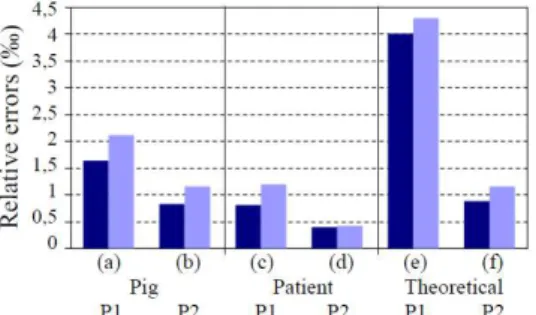
The performance of this static loading basis was checked by estimating the errors of needle shape reconstructions all along the needle. The errors of reconstruction from the loading basis, shown in figure 1, were estimated on 3 needle cases: needle inserted 62 times into pig shoulder, needles inserted into patients during real clinical intervention and needles model by Beam theory (theoretical).
Figure 1: Reconstruction errors in 2 orthogonal planes: first bar (median value), second bar (upper quartile).
Discussion
In this paper, it is shown that the loading basis can be used to reconstruct needles deflection during real medical intervention in a relevant way. The validation on 3 needle cases confirms the robustness of the model.
As procedures are a succession of needle insertions and images acquisitions, this static loading assumption could provide a better model for understanding and apprehending real clinical needle behaviour.
Finally, this static loading basis may be well adapted in order to optimize the needle shape reconstruction of an instrumented needle. The knowledge gleaned from this work may be useful to enrich techniques to track in real time the motion of the needle to make the medical procedure safer, less invasive and more efficient.
Acknowledgements
The clinical trial, performed in the Grenoble University Hospital, was authorized by the AFSSaPS, the relevant French regulatory authority for biomedical research, and by the Comitee de Protection de Personnes Sud-Est V, an institutional French review board (ClinicalTrials.gov identifier: NCT00828893).
References
T. Cootes et al, Image processing and analysis, 223-248, 2000.
Robert et al, Journal of the Mechanical Behaviour of Biomedical Materials, submitted, 2013.