HAL Id: tel-03180913
https://tel.archives-ouvertes.fr/tel-03180913
Submitted on 25 Mar 2021
HAL is a multi-disciplinary open access
archive for the deposit and dissemination of sci-entific research documents, whether they are pub-lished or not. The documents may come from teaching and research institutions in France or abroad, or from public or private research centers.
L’archive ouverte pluridisciplinaire HAL, est destinée au dépôt et à la diffusion de documents scientifiques de niveau recherche, publiés ou non, émanant des établissements d’enseignement et de recherche français ou étrangers, des laboratoires publics ou privés.
Femtosecond laser direct writing of circular optical
properties in silica glass
Jing Tian
To cite this version:
Jing Tian. Femtosecond laser direct writing of circular optical properties in silica glass. Material chemistry. Université Paris-Saclay, 2020. English. �NNT : 2020UPASF038�. �tel-03180913�
Femtosecond laser direct writing of
circular optical properties in silica
glass
Thèse de doctorat de l'université Paris-Saclay
École doctorale n°571 : 2MIB (Sciences chimiques : molécules, matériaux, instrumentation et biosystèmes) Spécialité de doctorat: Chimie
Unité de recherche : Universitéé Paris-Saclay, CNRS, Institut de chimie moléculaire et des matériaux d'Orsay, 91405, Orsay, France. Référent : Faculté des sciences d’Orsay
Thèse présentée et soutenue à Orsay, le 17 décembre
2020, par
Jing TIAN
Composition du Jury
Fabian ZOMER
Professeur des universités Université Paris Saclay
Président
François COURVOISIER
Directeur de recherche
CNRS - Université de Franche-Comté
Rapporteur & Examinateur
Razvan STOIAN
Directeur de recherche
CNRS - Université Jean MONNET
Rapporteur & Examinateur
Enrique GARCIA-CAUREL Ingénieur de recherche Ecole polytechnique Examinateur
Direction de la thèse
Matthieu LANCRY Enseignant-Chercheur ICMMO,Université Paris-Saclay Directeur de thèseThè
se de
doctorat
NNT : 2020U PA SA 001Université Paris-Saclay, CNRS
Institut de chimie moléculaire et des matériaux d'Orsay, 91405, Orsay, France.
OUTLINE
Acknowledgement ... 9
Introduction ... 11
Chapter1 State of the art of Femtosecond Laser Direct Writing in
Glasses ... 20
1.1 Introduction ... 21
1.2 Silica Glass ... 21
1.3 Propagation of ultrashort laser pulses in a vitreous material ... 23
1.3.1 Basic principles ... 23
1.3.2 Self-focusing by Kerr effect ... 25
1.3.3 Filamentation... 26
1.3.4 Self-phase modulation... 26
1.3.5 Spectral dispersion and temporal broadening ... 26
1.4 Femtosecond laser interactions in glasses ... 28
1.4.1 Ionization and relaxation in intense field ... 28
1.4.2 Relaxation mechanisms ... 30
1.4.3 Material changes induced by femtosecond laser irradiation ... 31
1.4.4 Heat accumulation effects ... 32
1.5 Damage thresholds and different type of permanent modifications ... 34
1.5.1 Isotropic index changes based modifications (Type I) ... 36
1.5.2 Anisotropic refractive index changes based modifications (Type II)... 38
1.5.3 Voids (Type III) ... 40
1.6 Focus on Type II modifications and nanogratings formation ... 40
1.6.1 From LIPSS to self-organized nanogratings in silica ... 40
1.6.2 Physical and optical properties of nanogratings in silica glass ... 42
1.6.3 Tentative mechanisms for nanogratings formation ... 43
1.6.4 Nanogratings parameters dependence ... 48
1.7 Towards 3D imprinted optical chirality in inorganic glasses ... 54
1.8 Conclusions ... 57
1.9 References ... 59
4
2.1 Introduction ... 72
2.2 Femtosecond laser direct writing (FLDW) system... 72
2.3 Fundamentals of polarization of light ... 76
2.3.1 Stokes vector and the Poincaré sphere ... 76
2.3.2 Mueller matrix formalism ... 78
2.4 Basic polarimetric properties ... 78
2.4.1 Dichroism and diattenuation ... 79
2.4.2 Retardation and linear birefringence ... 81
2.4.3 Depolarization ... 84
2.4.4 Polarizance ... 87
2.5 Extraction of polarimetric properties ... 88
2.5.1 Product decomposition ... 88
2.5.2 Sum decomposition ... 89
2.5.3 Logarithmic decomposition ... 90
2.6 Polarimetric instrumentation ... 93
2.6.1 “de Sénarmont” compensator ... 94
2.6.2 Circular Dichroism spectro-polarimeter - JASCO- J-810 ... 97
2.6.3 Vis-Near IR (400-1000nm) Mueller Ellipsometry – MM-16 ... 101
2.6.4 UV-Vis-Near-IR Mueller ellipsometry – MM-12 ... 102
2.7 Conclusions ... 105
2.8 References ... 106
Chapter3 Study of laser induced circular dichroism using a CD
spectro-polarimeter ... 110
3.1 Introduction ... 112
3.2 Samples and Methodology ... 113
3.3 Preliminary experiments to identify the modifications thresholds of
linear optical properties ... 116
3.3.1 Study of writing kinetics at various repetition rates ... 116
3.3.2 Study of writing kinetics according to the numerical aperture ... 118
3.3.3 Study of writing kinetics according to the laser polarization ... 119
3.3.4 Spectral measurements of the retardance and linear extinction difference .... 120
3.4 Study of femtosecond laser irradiated silica using a CD
spectro-polarimeter ... 121
5
3.4.1 Preliminary observations ... 121
3.4.2 Study of circular diattenuation CD according to the pulse energy ... 122
3.4.3 Study of circular diattenuation CD according to the line-to-line spacing ... 123
3.4.4 Study of circular diattenuation according to the angle between polarization orientation and the laser scanning direction ... 126
3.4.5 Study of circular diattenuation according to the pulse-to-pulse overlapping rate and the laser repetition rate ... 129
3.4.6 Study of circular diattenuation according to the focusing depth ... 131
3.5 Analysis of CD measurements artifacts and asymmetric transmission of
circularly polarized light ... 132
3.5.1 Study of CD artifacts due to the spectro-polarimeter ... 132
3.5.2 Investigations of Asymmetric transmission of circularly polarized light ... 135
3.6 Discussion on the origin of fs laser-induced chiral optical property . 137
3.6.1 An introduction to chirality and chiral optical properties in molecules ... 1373.6.2 Qualitative interpretation... 138
3.7 Conclusions ... 140
3.8 References ... 144
Chapter4 Mueller matrix spectro-polarimetry in femtosecond
irradiated silica glass ... 151
4.1 Introduction ... 152
4.2 Materials and methods ... 153
4.3 Typical results using MM-16 spectro-polarimetry ... 155
4.3.1 Raw Mueller matrix measurements ... 155
4.3.2 Extraction of polarimetric properties ... 157
4.3.3 Investigation of asymmetric transmission ... 160
4.4 Study of laser parameters dependence: pulse energy, pulse-to-pulse
overlap and focusing depth ... 163
4.5 Influence of the laser writing configuration ... 172
4.5.1 Influence of the writing polarization direction for a fixed scanning direction and orientation i.e. along +X ... 175
4.5.2 Influence of the laser scanning direction with respect to the writing laser polarization ... 178
6
4.6 Dependence of the stress-induced birefringence with the laser writing
polarization ... 180
4.7 Thermal stability of fs-induced anisotropic optical properties ... 184
4.8 Conclusions ... 193
4.9 References ... 196
Chapter5 Investigations of the UV-Vis-NIR spectral properties:
comparison between nanogratings and stress-induced birefringence
silica glass ... 202
5.1 Introduction ... 203
5.2 Spectral dependence of femtosecond laser induced circular optical
properties in silica ... 204
5.3 A Comparison between Nanogratings-Based and Stress-Engineered
Waveplates Written by Femtosecond Laser in Silica ... 205
Chapter6 Discussion on the origin of the anisotropic linear and
circular optical properties created within Type II regime ... 207
6.1 Introduction ... 208
6.2 On the origin of the anisotropic linear optical properties within Type II
regime in fs-irradiated silica glass ... 209
6.2.1 Form birefringence within Type II regime... 209
6.2.2 Stress-induced birefringence within Type II regime ... 215
6.2.3 Point defects formation and annealing within Type II regime ... 219
6.2.4 Conclusion on anisotropic linear properties thermal stability ... 222
6.3 Modeling anisotropic circular optical properties using Mueller matrix
formalism using a two linear retarders model ... 223
6.3.1 Short description of the modeling procedure ... 224
6.3.2 Modelling a single linear retarder ... 226
6.3.3 Modelling the formation of CB only using two linear retarders ... 227
6.3.4 Modeling the formation of CD with two linear retarders ... 231
6.3.5 Modeling the formation of both CB and CD using two linear retarders ... 234
6.4 Polarization dependent anisotropic optical properties: a comparison
between modeling and experimental measurements ... 236
7
6.5 Interpretation of the polarization dependent anisotropic optical
properties and the creation of circular optical properties ... 239
6.6 Conclusions ... 244
6.7 References ... 246
Conclusions and perspectives ... 252
Publications list ... 260
9
Acknowledgement
I would like to express my gratitude to the numerous individuals whose help and support assisted my professional growth during my recent years and contributed to my work presented in this thesis.
Firstly, I want to thank to my PhD supervisor Matthieu LANCRY, who introduced me to the research in physics and optics and lead my doctoral project and creating good atmosphere in the laboratory.
I acknowledge all the help and support from our research group members Bertrand Poumellec, Rudy Desmarchelier, Yitao Wang, Maxime Cavillon, Ruyue Que, Benjamin Sapaly. Especially I want to thank to our collaborators Enric Garcia-Caurel, Sang Hyuk Yoo, Razvigor Ossikovski from Ecole Polytechnique and Michel Stchakovsky, Celine Eypert from HORIBA, as they helped me a lot to learn new field about Mueller matrix ellipsometry techniques.
I am grateful to my friends Miaobo Pan and Kuankuan Zheng who supported me a lot during my PhD.
And my final appreciation is to the China scholarship council (CSC) who gave the opportunity to study in the Université Paris-Saclay by supporting my PhD financially.
11
Introduction
What is the common problem existing between the mastering of elaboration of all optical functions in a glass for integrated optics? It is the control of the final product structure (the atomic arrangement) and of its orientation resulting in a control of the imprinted optical properties. One current challenge is to achieve these goals “simply” by using laser light.
The photosensitivity of glass (e.g. in germanosilicates and Boron-doped silica glasses) to ultraviolet (UV) laser radiation (continuous wave or nanosecond pulsed lasers) was perceived in the 1990s as a tool for functionalizing materials. Chemistry quickly took its share within this field, as it was realized that photosensitivity was a function of glass chemical composition as well as its physico-chemical environment (including material thermal history and surrounding environmental conditions). Thus, the physical properties of the material, subsequent its laser irradiation, originated from photochemistry processes. The lasers used at that time, though relatively intense (usually continuous or nanosecond UV lasers) to induce substantial structural modifications of a material, were still in linear optical domain or nonlinear through two-photon absorption. The main strategy was to use point defects, absorbing in the material optical bandgap, as an initial step to couple energy into the glass network. Typically, homogeneous Gaussian laser beams, with an axisymmetric structure, were used to deposit optical energy inside the glass material mainly by linear absorption or sometimes through a two-photon process [1].
The development of femtosecond lasers, enabling the use of pulses having extremely high powers, completely transformed this vision. Using these lasers, the peak power density is such that the research community moved to nonlinear optics with the possibility of electrons excitation across the silica optical bandgap, using six photons or even eight photons at 800 nm or 1030 nm, respectively. In fact, the femtosecond pulses make it possible, by delivering the energy in a controlled volume, to easily reach very high power densities (typically 1012-14W/cm2 after focusing). These multiphoton excitations lead to photo-induced
physicochemical reactions and various structural modifications [2]: changes of the intrinsic material ordering (through a fictive temperature change), phase changes (re-crystallization, phase separation), chemical migrations. These modifications induce permanent changes of physical properties, including dielectric tensor, second order nonlinear optical properties (frequency doubling, electro-optical effects...). It is thus an attractive candidate for many applications since the photo-induced effects are by nature strongly localized in 3D in a “voxel” volume of a few cubic microns (µm3).
Since the early birth of femtosecond lasers in the 1990s, Femtosecond Laser Direct Writing (FLDW) has opened a new path allowing 3D micro/nano-structuring of the linear and non-linear optical properties of transparent materials with functionalities inaccessible by other processes. From a broader standpoint, it becomes possible to imprint optical components at low cost, and/or to shape any beam into any other one, characterized by a set of parameters 𝑘⃗ (𝑟), 𝑒 (𝑟) and 𝐼 (𝑟), where r is a spatial position located in the beam cross-section, 𝑘⃗ is the wave vector, 𝑒 is the polarization vector and I is the intensity). In this sense, the research community envisions to produce new structures and new 3D optical devices
12 such as Fresnel lenses, axicons, delay plates (e.g. for the compensation of aberrations), Bragg gratings in volume (e.g. pulse compression or stabilization of fiber lasers) but also birefringent elements such as micro-wave arrays for polarimetry, radial / azimuth polarization converters, polarizing waveguides [3-7]. These devices have enormous potential for micro-optics, communications, lasers, data storage systems or imaging. The impact at the industrial level is recognized and it is clear that this technology will generate employment activities. Thus, femtosecond laser direct writing is expected to become an ubiquitous tool of choice for the realization of micro optical devices in 3D. One objective of this thesis is to control the material transformations induced through it.
In this context, understanding interaction of matter with femtosecond laser pulses will enable the evaluation of the industrial potential this new direct writing method has to offer. Some aspects of the light-matter interaction are fundamentally new. The underlying physics is the behavior of electron plasma in the presence of an ionic support and of a light wave. Here, solid and plasma states coexist for a fraction of picosecond. In addition, both, matter and light are in interaction to produce a structured organization of the plasma density. The fundamental problems are to accurately describe the structuration of the plasma of free electrons produced at the end of multiphoton ionization (transition through the gap of the transparent insulator). Here the solid intervenes as a source of electrons. Its microstructure organizes the plasma in coherence with that of the light beam. Then, after the pulse, this electron density distribution is "imprinted" by trapping electrons in the solid, and, it can be used as a “source” by the next pulse thus ensuring a memory effect. In this operation, the solid is not destroyed; it remains below the vaporization threshold, it is restructured in the force field created by the laser. We can therefore imagine the orientation of the material, imprinted oriented nano/microstructures like directionally solidified eutectics. This is a new physics. But for chemistry too, there are new aspects because the processes involve highly excited states, which are largely off equilibrium. It is therefore necessary to question some previous ideas. For example, the knowledge on the effect of impurities, defects states, or easily ionized states, remains highly limited. In addition the use of ultrashort pulses has an original characteristic: a large spectral width (100 fs ≡ 10 nm). The phasing of the spectral components is the laser manufacturer's goal to achieve maximum compression of the pulse (minimum duration of the pulse). But these components can be separated, modified and recombined to produce pulses of various shapes that have different effects in the transparent material. In particular, force fields and not energy fields are produced. Their control opens the door to a science of material modification by laser. This is the focus of the today work carried out by Bertrand Poumellec and Matthieu Lancry. In particular, three discoveries form the basis of this PhD thesis.
The first breakthrough is from our colleagues at Southampton and Kyoto Universities, namely Peter Kazansky and Y. Shimotsuma, who discovered self-organized nanogratings in SiO2 (200-400 nm periodicity persisting on mm range, including fringes as thin as 10-30 nm),
which are in fact the smallest structures ever created by light [8]. From the authors, these nanogratings arise from modulation of the chemical composition (probably oxygen redistribution) and this would be related to stationary density waves in the plasma produced by the coupling between bulk plasmonic waves and light waves. In 2011, our group revealed
13 that nanogratings are in fact an assembly of nanoporous layers due to oxide decomposition [9, 10] likely through a tensile stress assisted nanocavitation process [11]. These structures, also called Type II modifications in the literature, are at the root of other experimental unusual phenomena like high linear birefringence response (up to -10-2), polarized
luminescence, anisotropic light scattering, strong linear “dichroism”, negative index changes and extraordinary good thermal stability (until a few 10’s hours at 1000°C). These experimental observations left a number of opened questions that should be addressed to enable reliable applications. How to master such structures and the resulting properties, and consequently how to use them efficiently?
The second breakthrough is the discovery of a sensitive interaction with the direction of writing (directional writing dependence), which is original [12, 13]. Thus, we observed differences in the effect between scanning the sample (centrosymmetric) with the laser beam, for a given direction, in one direction and the other; a bit like we can see a difference between writing a line of characters from right to left or from left to right with the same pen holder! But this is also different according to the scanning orientation (orientational writing
dependence). This asymmetrical behavior of the interaction is likely due to the interaction
process between the laser and the material revealing some unusual behavior. It appears that the pulse is ultra-short, the latter being associated with a significant spectral width and that the beam at the focal point is probably not axisymmetric [14]. Moreover these asymmetric structures translate in an original way on several properties [15] such as the appearance of a strong linear birefringence, a linear dichroism, and the transition from nanogratings to bubbles formation...
The third breakthrough is our recent discovery of the creation of photo-induced chiral
mechanical structures in silica glass by a femtosecond laser being linearly polarized [13,
16]. Let us recall that neither the laser beam (linearly polarized), nor the matter (glass is center-symmetric), show chirality. In addition, due to laser beam asymmetry, this interaction is also sensitive to the direction of writing. However, the inscription of orientable circular properties has not made a breakthrough until our recent publication [17]. This last point is a breakthrough because the creation of this circular di-attenuation has been done in an achiral glass (pure silica) with a beam that could have been considered achiral under an orthogonal geometry. This result and how it was obtained was thoroughly debated before being accepted because of the newly aspect. Such circular optical properties play a crucial role in optoelectronic devices, biological sensing, and analytical chemistry. The challenge of this PhD thesis was thus to pave the way of a new paradigm in the understanding of the interaction of femtosecond laser with mater, in order to control the overall anisotropic optical properties (sign, amplitude, orientation, at the microscale level) in transparent solid materials using a low cost, ideally environmentally friendly, and sustainable technology for optical applications. These experimental observations underpin a large number of questions to be answered. As a result, the heart of this thesis work aims to:
• Characterize and understand the laser-induced transformations in silica-based glasses, their types and their structuration. The principal interest it is to understand the mechanisms at the root of such spectacular changes in anisotropic optical prop-erties and in particular circular optical propprop-erties.
14 • Master this type of photosensitivity that will allow us to correctly assess the potential of this new method and to fully exploit the strength of this interaction. This will open the door towards innovative applications based on these anisotropic linear and cir-cular optical properties.
First of all, the first chapter provides a review of the basic knowledge necessary to fully understand this thesis. We will highlight the structure of silica glass, which is the principal material constituting our samples. We shall discuss ultrashort laser pulse propagation in glass as well. Therefore, we will summarize the different processes of interaction leading to structural changes, associated with the formation of permanent changes in the glass optical properties. Finally, the last part of this chapter will focus on the anisotropic optical properties (birefringence and dichroism) and nanogratings formation in silica glass. In particular these anisotropic optical properties will be measured and studies throughout this thesis.
The second chapter is dedicated to the experimental techniques necessary to carry out all of our studies in the next chapters. We describe the femtosecond laser direct writing (FLDW) bench available in our institute (ICMMO at University Paris Saclay) and the experimental conditions that I used to realize my thesis. The predominant nondestructive way of characterizing nanogratings is quantitative birefringence measurements and more generally anisotropic optical properties, which provide information on the dependence of induced modifications on the laser writing parameters. Thus, we will introduce fundamentals of polarization of light, Stokes formalism and the Mueller calculus formalism, which is a complete mathematical approach to describe the polarimetric light-matter interaction. Finally the overall spectro-polarimetric characterization methods will be described, since they provide the means to measure the key physical quantities of the femtosecond laser written structures with sufficient accuracy to draw meaningful conclusions from the experiments designed in each chapter.
Chapter 3 is dedicated the investigation of circular di-attenuation that might occur in the laser–matter interaction within a silica glass. The mechanism of interaction of the femtosecond laser light with dielectric materials is not fully understood. However, one recognized specificities due to the very small pulse duration is that the action of the light on electrons and ions is decoupled. Then, by choosing the correct configuration of the beam (e.g. pulse front tilt, polarization orientation and scanning direction) for controlling the ponderomotive force, we can imagine forcing the electrons to preferentially move to one side of the beam, creating inhomogeneous plasma densities. Therefore, the control of light intensity gradient and of the laser polarization according to the displacement should lead to the control of material local symmetry and its orientation. In addition, much literature have reported the following two phenomena when strongly focusing light inside an optical material: (1) self-focusing when the pulse energy exceeds the threshold and (2) spatial aberrations which increase with focus depth. Both phenomena should impact the creation of circular optical properties. In this chapter, we discuss the optical properties a series of samples prepared via different laser writing parameters to investigate the dependence of the writing laser polarization, pulse energy, focusing conditions, and the pulse-to-pulse overlapping rate on the photo-induced circular dichroism or circular diattenuation. All measurements have been made using a classical experimental technique, i.e., a circular
15 dichroism spectro-polarimeter based on photo-elastic modulator.
In chapter 4, we discus the use of a quite recent method, called Mueller-matrix spectroscopic ellipsometry, as a powerful tool to examine structural and optical properties of materials that exhibit both linear and circular optical properties from a single measurement. The objective of this chapter is to widely investigate circular optical properties using differential matrix formalism on transmission Mueller matrices measured on femtosecond laser-induced modifications in silica within type II regime. This allows quantifying the effective or equivalent circular birefringence and dichroism in the presence of strong linear optical properties like linear birefringence. In particular, we will focus on photo-induced optical activity (or circular birefringence) in silica glass by laser irradiation. We will investigate the dependence of circular optical properties with pulse energy, the focusing depth, the repetition rate and the laser-writing configuration. In addition, it is known that compaction and rarefication processes affecting the surrounding medium and lead to stress-induced birefringence that accompanies the formation of nanogratings. Accordingly we have imprinted Type II modifications following a specific design, in such a way we can create a confined stress-zone between laser-induced “stress bars”. In particular we investigated the stress-induced birefringence (its amplitude and its slow axis orientation) according to the orientation of the writing laser polarization. Finally the thermal stability of the overall anisotropic optical properties within type II regime by step isochronal annealing is analyzed. The experimental results made possible the comparison between the thermal stability of anisotropic linear optical properties and circular optical properties, as well as the stress-induced birefringence. This work will tentatively bring additional insight on the origin of the imprinted chiral optical properties.
In chapter 5, the spectral dependence of both linear and circular optical properties are discussed on the basis of polarimetric and ellipsometric measurements in a wide spectral range, from the ultraviolet (250 nm) to the near infrared (1800 nm). Transmission Mueller-matrix spectroscopic ellipsometry will be applied to study femtosecond laser induced nanogratings in silica glass. The first part of the chapter follows a paper published in 2019, which discusses the use of the differential decomposition of Mueller matrices to quantify the circular birefringence of femtosecond laser irradiated SiO2. Then the second part is related to a paper published in 2020. Here we compared anisotropic linear optical properties (linear birefringence, linear dichroism, degree of polarization) and “performances” (absorption coefficient, thermal stability) of two types of birefringent waveplates fabricated in silica glass by femtosecond laser direct writing. The first type of waveplate is based on birefringence induced by self-organized nanogratings imprinted in the glass, whereas the second design is based on birefringence originating from the stress-field formed around the aforementioned nanogratings. In addition to the provided comparison, we report on the manufacturing of stress-engineered half waveplates in the UV-Visible range, and with mm-size clear aperture and negligible optical losses.
The characteristic feature of Type II modifications is the formation of nanogratings that can easily be detected through polarization dependent linear birefringence measurements but also simply with direct observation using scanning electron microscopy (SEM) techniques. However, the total birefringence, which comprises, both linear and circular
16 birefringence, arises from the addition of several contributions, including form birefringence, stress-induced birefringence but also the formation of point defects and Type I-densified zones (e.g. in between the porous nanolayers). The cumulative contribution from all these factors yields to refractive index and birefringence changes in the presence of nanogratings. In the light of new results, chapter 6 shortly reviews these different contributions, including their thermal stability since it provides a way to estimate the contribution of each mechanism and their potential link with the original chiral-optical properties we observed in the previous chapters. Then based on the overall results obtained in previous chapters, we investigate and discuss the mechanisms that could create anisotropic circular optical properties.
17
References
1. Lancry, M. and B. Poumellec, UV laser processing and multiphoton absorption processes in optical telecommunication fiber materials. Physics Reports, 2013. 523(4): p. 207-229. 2. Stoian, R., Volume photoinscription of glasses: three‑dimensional micro‑and
nanostructuring with ultrashort laser pulses. Applied physics. A, Materials science & processing, 2020. 126(6).
3. Cheng, G., et al., Ultrafast laser photoinscription of polarization sensitive devices in bulk silica glass. Optics Express, 2009. 17(12): p. 9515-9525.
4. Fernandes, L.A., et al., Femtosecond laser writing of waveguide retarders in fused silica for polarization control in optical circuits. Optics Express, 2011. 19(19): p. 18294-18301. 5. Beresna, M., M. Geceviçius, and P.G. Kazansky, Polarization sensitive elements fabricated by femtosecond laser nanostructuring of glass [Invited]. Optical Materials Express, 2011.
1(4): p. 783-795.
6. Voigtländer, C., et al., Inscription of high contrast volume Bragg gratings in fused silica with femtosecond laser pulses. Applied Physics A, 2011. 102(1): p. 35-38.
7. Zhang, B., X. Liu, and J. Qiu, Single femtosecond laser beam induced nanogratings in transparent media-Mechanisms and applications. J. of Materiomics, 2019. 5(1): p. 1-14. 8. Shimotsuma, Y., et al., Self-organized nanogratings in glass irradiated by ultrashort light
pulses. Physical review letters, 2003. 91(24): p. 247405.
9. Canning, J., et al., Anatomy of a femtosecond laser processed silica waveguide [Invited]. Optical Materials Express, 2011. 1(5): p. 998-1008.
10. Lancry, M., et al., Ultrafast nanoporous silica formation driven by femtosecond laser irradiation. Laser and Photonics Reviews, 2013. 7: p. 953-962.
11. Rudenko, A., J.-P. Colombier, and T.E. Itina, Nanopore-mediated ultrashort laser-induced formation and erasure of volume nanogratings in glass. Physical Chemistry Chemical Physics, 2018. 20(8): p. 5887-5899.
12. Kazansky, P.G., et al., "Quill" writing with ultrashort light pulses in transparent materials. Applied Physics Letters, 2007. 90(15): p. 151120.
13. Poumellec, B., et al., Femtosecond laser irradiation stress induced in pure silica. Optics Express, 2003. 11(9): p. 1070-1079.
14. Salter, P., R. Simmonds, and M. Booth. Adaptive control of pulse front tilt, the quill effect, and directional ultrafast laser writing. in Frontiers in Ultrafast Optics: Biomedical, Scientific, and Industrial Applications XIII. 2013.
15. Poumellec, B., et al., Asymmetric Orientational Writing in glass with femtosecond laser irradiation. Optical Materials Express, 2013. 3(10): p. 1586-1599.
16. Poumellec, B., et al., Non reciprocal writing and chirality in femtosecond laser irradiated silica. Optics Express, 2008. 16(22): p. 18354-18361.
18 irradiation in silica glass&quest. Light: Science & Applications, 2016. 5(11): p. e16178.
20
Chapter1 State of the art of Femtosecond Laser Direct
Writ-ing in Glasses
Content
1.1 Introduction ... 21
1.2 Silica Glass ... 21
1.3 Propagation of ultrashort laser pulses in a vitreous material ... 23
1.3.1 Basic principles ... 23
1.3.2 Self-focusing by Kerr effect ... 25
1.3.3 Filamentation... 26
1.3.4 Self-phase modulation... 26
1.3.5 Spectral dispersion and temporal broadening ... 26
1.4 Femtosecond laser interactions in glasses ... 28
1.4.1 Ionization and relaxation in intense field ... 28
1.4.2 Relaxation mechanisms ... 30
1.4.3 Material changes induced by femtosecond laser irradiation ... 31
1.4.4 Heat accumulation effects ... 32
1.5 Damage thresholds and different type of permanent modifications ... 34
1.5.1 Isotropic index changes based modifications (Type I) ... 36
1.5.2 Anisotropic refractive index changes based modifications (Type II)... 38
1.5.3 Voids (Type III) ... 40
1.6 Focus on Type II modifications and nanogratings formation ... 40
1.6.1 From LIPSS to self-organized nanogratings in silica ... 40
1.6.2 Physical and optical properties of nanogratings in silica glass ... 42
1.6.3 Tentative mechanisms for nanogratings formation ... 43
1.6.4 Nanogratings parameters dependence ... 48
1.7 Towards 3D imprinted optical chirality in inorganic glasses ... 54
1.8 Conclusions ... 57
21
1.1
Introduction
First of all this chapter gives a reminder of the basic notions necessary for a full understanding of this thesis. We will see the structure of silica composing our samples and the ultrashort laser pulse propagation in these glasses. It will also be seen that during propagation, different processes of interaction leading to structural changes occur associated to the formation of permanent changes in the glass optical properties. Finally, the last part of this chapter presents of focus on the anisotropic optical properties (birefringence and dichroism) and nanogratings formation in silica glass. In particular these anisotropic linear and circular optical properties will be measured and studied throughout this thesis as part of the central point of our studies.
1.2
Silica Glass
Silica glasses have been studied a lot and especially since the discovery of their photosensitivity to Ultraviolet (UV) radiation at the end of the 70s [1]. Since the 1960s, the effects of electron bombardment on glasses have been studied with high-energy sources in the MeV range [2-4]. As early as the 1980s, some authors began using less energetic electron beams (of the order of keV) in order to study the induced changes in volume and induced optical modifications [5-7]. Irrespective of the type of irradiation, these changes are based on structural changes induced by irradiation. That is why we begin this first chapter with a short description of the structure and optical properties of silica glasses.
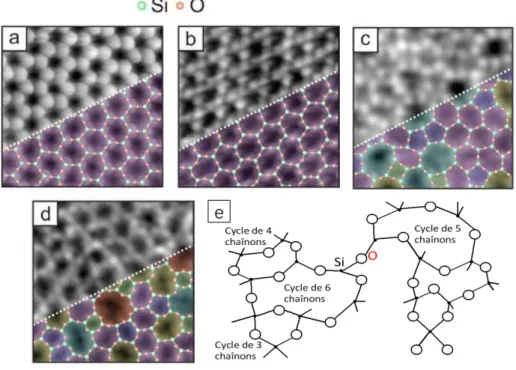
Figure 1.1: Atomic resolution STM images of silica bilayers: crystal structures of -quartz (a and b) and disordered SiO2 glass (c and d); scheme of the random network and silica rings (e). Adapted from [8].
Most commercial glasses are silicates and they contain many constituents included in a SiO2 based matrix. The glass with the simplest composition is pure silica glass, despite its
difficulty to be technically developed with high purity. It is composed of an irregular 3D network consisting of disordered tetrahedral SiO4 units as shown in Figure 1.1 using atomic
22 resolution STM of silica bilayers [8]. In this PhD work we will mostly use Type III- silica glasses that are synthetic vitreous silica produced by hydrolysis of SiCl4 when spraying into an
oxygen-hydrogen flame. This material is practically free from metallic impurities, but contains a high amount of OH, in the order of 1000 ppm, and because of the starting material, Cl, in quantities of the order of 100 ppm. Trade names are for example Suprasil (from Heraeus), Spectrosil or Corning 7940.
Silica glasses structure
There are various possibilities of assembling SiO4 tetrahedra in 3D with each other. But
the most stable configuration that is established is that for which the Si-Si distance will be longest, which is achieved in an assembly by the vertices. This mode of assembly is found in all forms of silica: quartz, trydimite, cristobalite and coesite. The intermediate bond of the Si-O-Si group gives an average angle of 145° [9], which admits a certain dispersion, corresponding to an Si-Si distance of approximately 3.12 Å. The distance Si-O varies between 1.62 Å and 1.77 Å and the distance O-O is between 2.50 Å and 2.65 Å [10]. The complete assembly of all the tetrahedra in silica glass thus forms a three-dimensional network presenting only a short-range order, but having no order at a long distance. This representation of the structure corresponds to the definition of the disordered or random network in the literature.
At a short distance, the order is governed by the coordination of silicon: a silicon atom is surrounded by 4 oxygen atoms forming a tetrahedron and, each oxygen is shared between 2 tetrahedra, to respect the SiO2 stoichiometry. Silica glass is a special case of disordered
systems because it has a medium range order. The latter is due to molecular connectivity. There are always four tetrahedra surrounding a given tetrahedron. However, there is no Euclidean translational symmetry [11]. The correlation length is defined as the number of successive correctly ordered tetrahedra. The free space in the structure allows tetrahedra to rotate. In this case, the correlation length or the degree of polymerization of the glass may vary according to the method of preparation and especially the cooling rate and more generally the thermal history. The structure of a cooled glass is frozen from a so-called fictive temperature Tf as described in details in Ref. [12]. Silica has the same medium-range order
as the crystalline form of tridymite and cristobalite. When silica is elaborated under high pressures [13], its specific volume is lower. It then adopts a denser structure, this new configuration approaching that of quartz or coesite. Silica subjected to a very high pressure can also adopt a rutile structure in the form of SiO6 octahedra, it is stishovite [14].
Point defects in silica glasses
A glass can be subjected to a multitude of treatments such as heating, high pressure or laser irradiations and their combination. These treatments will locally modify the linkage sequence to form point defects. The definition of a defect in the glass is different from the definition given in a crystal. Indeed, in a crystal, any exception in translational symmetry is considered a defect. In a glass, this symmetry of translation does not exist and this definition cannot apply. The notion of default is then based on the notion of chemical order. The
23 perfect network of silica glass can be presented as a sequence of SiO4 tetrahedra
interconnected by common oxygen atoms. Thus, each silicon atom is connected to four oxygen atoms and each oxygen atom must have two Si as nearest neighbors. Any exception in this sequence ≡Si-O-Si≡ can be considered as a defect. Each defect has a structure and properties (absorption, fluorescence, magnetism, etc ...) that are unique to it. In order to better understand and subsequently control the impact of point defects on the properties of silica, it is essential to know their atomic structure. This is usually determined by a combination of experimental results from spectroscopy and theoretical calculations of quantum chemistry. The experimental technique that quickly proved to be the most suitable for developing and confirming defect models was the RPE (Electronic Paramagnetic Resonance). Although the RPE is a priori only applicable to paramagnetic defects, the absence of RPE signal in the case of a diamagnetic defect can be important information in the search for models. Rigorously applied, the RPE can thus indicate the orbital composition of the spin functions of the single electron spins, as well as the chemical nature, the size and the steric environment of the atoms. Each defect thus has a signature RPE of its own. If we can thus demonstrate the correlation between the RPE signal and an optical absorption band, we can deduce the origin of this one. A certain number of absorption bands have thus been identified. Begun several decades ago, the study of point defects is far from over. The structure of many defects, the absorption bands associated with them, or the mechanisms that lead to their appearance or disappearance, are still the subject of many disagreements. For more details on the properties of point defects, we can refer to the works of Griscom [15, 16], Garapon [17], Skuja [18, 19] and Trukhin [20].
1.3
Propagation of ultrashort laser pulses in a vitreous
material
This section lays the foundation for the propagation of laser pulses in a linear and nonlinear dielectric medium as well as the definition of the different notions relating to femtosecond laser pulses.
1.3.1 Basic principles
The equation of propagation of an electromagnetic wave in a dielectric medium is deduced from the Maxwell equations and is written in the following form [21]:
∇2𝐸⃗ − 1 𝑐2 𝜕2𝐸⃗ 𝜕𝑡2 = 𝜇0 𝜕2𝑃⃗ 𝜕𝑡2 Equation 1.1
where 𝐸⃗ means the electric field; 𝜇0 is the magnetic permeability checking the
relationship, 𝜀0𝜇0 = 𝑐12 with 𝑐 is the speed of light in the vacuum and 𝜀0 is the electric
permittivity; 𝑃⃗ is the polarization. The polarization 𝑃⃗ induced by electric dipoles is a non-linear function of the electric field 𝐸⃗ and can be developed in increasing powers of the electric field [21] in the dipolar approximation as :
24
𝑃⃗ = 𝑃⃗ (1)+ 𝑃⃗ (2)+ 𝑃⃗ (3)+ ⋯ Equation 1.3
𝑃⃗ = 𝑃⃗ 𝐿+ 𝑃⃗ 𝑁𝐿 Equation 1.4
where 𝜒(𝑖) is the susceptibility and 𝑃⃗ (𝑖) is the polarization of order Iwhere according to the classical description of non-linear optics [22-24], the vector polarization is the sum of linear polarization 𝑃⃗ 𝐿 = 𝑃⃗ (1) and non-linear polarization𝑃⃗ 𝑁𝐿 = 𝑃⃗ (2)+ 𝑃⃗ (3)+ ⋯
In a centrosymmetric medium such as silica glass, the second order susceptibility tensor is identically zero because of the inversion center [21-23, 25]. We have thus:
𝜒(2)= 0 Equation 1.5
By simplifying the expression of the polarization (Eq. 1.2) to the order 3, we obtain the expression in the case of an isotropic material:
𝑃⃗ = 𝜀0𝜒̿(1)𝐸⃗ + 𝜀0𝜒̿̿(3)𝐸⃗ . 𝐸⃗ . 𝐸⃗ Equation 1.6 𝑃⃗ = 𝜀0(𝜒̿(1)+ 𝜒̿̿(3)𝐸⃗ . 𝐸⃗ )𝐸⃗ Equation 1.7 𝑃⃗ = 𝜀0(𝑛02− 1 +34𝜒𝑒𝑓𝑓(3)|𝐸⃗ | 2 ) 𝐸⃗ Equation 1.8 𝑃⃗ = 𝜀0[𝑛02(1 +34 𝜒𝑒𝑓𝑓(3) 𝑛02 |𝐸⃗ | 2 ) − 1] 𝐸⃗ Equation 1.9 𝑃⃗ = 𝜀0(𝑛2− 1)𝐸⃗ Equation 1.10
where 𝑛02 = 𝜒𝑒𝑓𝑓(1) + 1 is the linear refractive index of the medium and 𝑛 = 𝑛0(1 +
3 4 𝜒𝑒𝑓𝑓(3) 𝑛02 |𝐸⃗ | 2 ) 1 2
is the refractive index of the medium. By carrying out the limited development of (1 + 𝑥)𝑎 at the first order, we get:
𝑛 ≈ 𝑛0(1 +34𝜒𝑒𝑓𝑓 (3) 𝑛02 |𝐸⃗ | 2 ) 1 2 = 𝑛0+38𝜒𝑒𝑓𝑓 (3) 𝑛0 |𝐸⃗ | 2 = 𝑛0+38 𝜒𝑒𝑓𝑓 (3) 𝜀0𝑐𝑛02𝐼 = 𝑛0 + 𝑛2𝐼 Equation 1.11
where 𝐼 = 𝜀0𝑐𝑛0|𝐸⃗ |2 is the laser intensity and 𝑛2 =38𝜀𝜒𝑒𝑓𝑓(3)
0𝑐𝑛02 is the non-linear refractive
index that leads to the optical Kerr effect developed in the next section. The equation of evolution of the envelope of the electric field is given by the relation [26] :
𝑇𝜕𝐸𝜕𝑧 =2𝑘𝑖 0∆𝑇𝐸 − 𝑖𝑘0" 2 𝜕2𝐸 𝜕𝜏2 + 𝑖 𝑘0 𝑛0(𝑛2𝐼)𝐸 Equation 1.12 where 𝑇 = (1 +𝑘𝑖 0𝑣𝑔 𝜕 𝜕𝜏) is an operator; 𝑘0 = 𝜔0 𝑐 = 2𝜋
𝜆0 is the wave vector in the vacuum ;
25 in the vacuum ; ∆𝑇= (𝜕 2 𝜕𝑟2+ 1 𝑟 𝜕
𝜕𝑟) is the transverse Laplacian of the envelope of the electric
field in cylindrical coordinates; 𝑘0" = 𝑑
2𝑘
𝑑𝜔2|𝜔
0 is the group speed dispersion (GVD) ; 𝜏 = 𝑡 −
𝑧 𝑣𝑔
represents the delayed time; with 2𝑘𝑖
0∆𝑇𝐸 is the diffraction term in a medium of index 𝑛0 in
cylindrical coordinates ; 𝑖𝑘20"𝜕𝜕𝜏2𝐸2 is the term of dispersion of the group velocity; 𝑖𝑘0
𝑛0(𝑛2𝐼)𝐸 is
the term relating to the optical Kerr effect.
1.3.2 Self-focusing by Kerr effect
The self-focusing of light is a process in which the intensity of the beam changes the optical properties of the material, in particular the refractive index. Due to the intensity spatial distribution (Gaussian profile), the laser beam induces a variation of index such that the index at the center of the beam is larger than at its periphery. Thus, the material acts as a lens with a positive focal length gradient, called the Kerr lens, causing the beam to converge in its focus. This phenomenon occurs when the power of the laser beam is greater than or equal to the critical power defined by the relationship [21] :
𝑃𝑐𝑟 =𝜋(0,61𝜆0)
2
8𝑛0𝑛2 Equation 1.13
where 𝜆0 is the wavelength of the laser in vacuum. In the case of our silica sample irradiation experiments, we have: 𝜆0 = 1030𝑛𝑚 ; 𝑛2 = 3,2. 10−16𝑐𝑚2/𝑊𝑎𝑛𝑑 𝑛0 =
1,45 à 1030𝑛𝑚. The critical power deduced is 3.3MW.
Figure 1.2: Self-focusing versus lens-focusing. Close to the boundary obtained for a given spot size (𝜛0)
of the beam at the plane of lens, both self-focusing and lens-focusing play a role. The calculations per-formed for fused silica at = 1030 nm. Typically the critical power in silica is around 3,3 MW. Figure extracted from PhD thesis of Ausra Cerkauskeité [27].
Self-focusing of a collimated Gaussian beam is observed if the radiation power is greater than the critical power. In such a situation the Kerr nonlinearity continuously dominates over the transverse diffraction. The situation may be different if the lens is used in the direct writing system as it is our case for laser writing. For tight focusing the lens-focusing is dominating and the Kerr nonlinearity could be neglected, and for loose focusing the
self-26 focusing is dominating. The boundary between these two regimes can be determined by [28, 29]:
√𝑃𝑖𝑛
𝑃𝑐𝑟 = 0.852 + √0.0219 + 0.1347 × (
(𝑘𝜛02 )2−(𝑁𝐴𝑛)2+1
(𝑁𝐴𝑛)2−1 ) Equation 1.14
when near the boundary obtained for a given spot size of the collimated beam before the lens both self-focusing and lens-focusing play a role. For example, if numerical aperture of the focusing lens is less than 0.01, self-focusing is likely to occur at input powers close to critical (Figure 1.2). If the numerical aperture is higher than 0.1, in order to get self-focusing the input power has to be much higher than critical (Pin 10Pcr). However, the calculations do not account for plasma generation, and also loses its validity when the incident power is much larger than the critical power (Pin 100Pcr).
1.3.3 Filamentation
When there is a balance between the effect of self-focusing by Kerr effect, that of defocusing due to the formation of free electrons plasma excited the laser and the diffraction effect present during the entire propagation of the impulse even stronger that the size of the beam is small. The laser beam then propagates with a constant diameter: this is called filamentation (Figure 1.3).
Figure 1.3: Representation of focusing cycles (due to the Kerr effect) / defocusing (due to plasma for-mation) giving rise to the phenomenon of Filamentation (c).
1.3.4 Self-phase modulation
As seen previously, the intensity of the beam propagating in a medium induces a variation of the refractive index. This variation leads to a phase shift in the pulse and therefore to a change in the frequency spectrum. This modification of the spectrum results in a spectral broadening of the pulses.
1.3.5 Spectral dispersion and temporal broadening
The relatively large spectral width associated with the femtosecond pulses makes it necessary to take into account the dispersion laws of the optical elements encountered by the pulse. Indeed these dispersive elements and in particular the microscope objective for focusing the pulses, can change the spectro-temporal characteristics. If we consider the
27 transparent materials in the visible and the IR like silica, their refractive index varies according to the wavelength, it is the chromatic dispersion. The analytical relationship between the refractive index and the wavelength is called the Sellmeier equation and is written in the following form: 𝑛02(𝜆) = 1 + 𝐵1𝜆 2 𝜆2−𝐶1+ 𝐵2𝜆2 𝜆2−𝐶2+ 𝐵3𝜆2 𝜆2−𝐶3 Equation 1.15
where 𝐵1,2,3 et 𝐶1,2,3 are the Sellmeier coefficients specific to the material. Table 1.1 gives these coefficients for two variants of pure silica.
Table 1.1 Coefficients of Sellmeier for two silica materials: Infrasil and Suprasil families. Data from Heraeus technical datasheet.
Consider the time domain of the electric field of an incident wave without coupling with the variable z denoted 𝐸𝑖𝑛(𝑡) passing through a dispersive medium. The expression of the incident electric field is:
𝐸𝑖𝑛(𝑡) = 𝑒𝑥𝑝(−Γ0𝑡2)𝑒𝑥𝑝(𝑖𝜔0𝑡) Equation 1.16
where Γ0 = 2𝑙𝑛2Δ𝑡
02 with Δ𝑡0, the half-width duration of the Gaussian laser pulse in the
incoming time; or in the Fourier space:
𝐸̃𝑖𝑛(𝜔) = 𝑒𝑥𝑝 [−(𝜔−𝜔0)
2
∆𝜔2 ] Equation 1.17
where ∆𝜔 = 2√Γ0 is the spectral width of the pulse, or in the wavelength range Δ𝜔 = 2𝜋𝑐Δ𝜆𝜆2. After passing through the medium, the outgoing wave acquires a spectral phase 𝜙(𝜔) corresponding to the time shift of the spectral components. This phase can develop into a Taylor series around the central pulsation 𝜔0 such as:
𝜙(𝜔) = 𝜙0 +𝑑𝜙𝑑𝜔|𝜔 0(𝜔 − 𝜔0) + 1 2 𝑑2𝜙 𝑑𝜔2|𝜔 0(𝜔 − 𝜔0) 2+ ⋯ Equation 1.18
The outgoing wave can be written in the form: 𝐸̃𝑜𝑢𝑡(𝜔) = 𝑒𝑥𝑝 [−(𝜔−𝜔0)
2
4Γ0 ] 𝑒𝑥𝑝[𝑖𝜙(𝜔)] Equation 1.19
28 𝐸𝑜𝑢𝑡(𝑡) = 𝑒𝑥𝑝[−Γ(𝑡 − 𝜙0′)2]𝑒𝑥𝑝[−𝑖(𝜔0𝑡 − 𝜙0)] Equation 1.20
• Γ =2𝑙𝑛2Δ𝑡2 is defined by the relation1Γ= Γ1
0+ 𝑖2𝜙0
" which leads to defining
the extension of the duration of the impulse Δ𝑡 = Δ𝑡0√1 + (4𝑙𝑛2 𝜙0
"
Δ𝑡02) 2
in the case of a Gaussian pulse;
• 𝜙0 is the constant phase term;
• 𝜙0′ =𝑑𝜙𝑑𝜔|𝜔
0 is the delay representing the optical path time, therefore, it
does not modify the beam characteristics; • 𝜙0" =𝑑
2𝜙
𝑑𝜔2|𝜔
0 is called the quadratic phase and represents the group delay
dispersion (GDD).
The GDD therefore introduces a variable propagation delay as a function of the frequency (or wavelength) of the laser propagating in a medium; this phenomenon is at the origin of the temporal chirp. This term is proportional to the dispersion of the group velocity (GVD) defined by 𝑘0" = 𝑑
2𝑘
𝑑𝜔2|𝑘
0 such as 𝜙0
" = 𝑘
0"𝑧. GVD is also expressed as a function of the
wavelength in the form:
𝑘0" = 𝜆
3
2𝜋𝑐2(
𝑑2𝑛
𝑑𝜆2) Equation 1.21
This term is specific to each material or optical system and is expressed in fs2.mm-1. For
silica, it is equal to 𝑘0" = 36𝑓𝑠2. 𝑚𝑚−1 at 800nm and 𝑘0" = 20𝑓𝑠2. 𝑚𝑚−1 at 1030nm.
1.4
Femtosecond laser interactions in glasses
1.4.1 Ionization and relaxation in intense field
In order to introduce the interest of femtosecond lasers for the laser-matter interaction, this section briefly presents the mechanisms of interaction in glasses under the influence of an intense and ultra-brief electromagnetic field. Numerous fundamental studies on the physical processes involved have been conducted, allowing significant progress in understanding these mechanisms and leading to a fairly clear vision of the interaction processes shown in Figure 1.4.
29 Figure 1.4: Schematics of main physical processes involved in the ultrashort laser processing of silica glass including temperature-dependent processes. Extracted from A. Rudenko et al. [30].
Figure 1.4 shows the time scale of the interaction mechanisms that can be summarized in three steps: the electronic excitation [31], the thermalization, the different relaxation mechanisms and the permanent modifications. Part of the laser energy absorbed by the electrons is transferred to the network (i.e. to the phonons) over a period of about ten picoseconds in the silica. After a few nanoseconds, a shock wave is emitted. On the time scale from nanosecond to microsecond, heat propagates around the focal zone. For rates that are low enough to prevent heat accumulation build-up [32, 33], the material returns to ambient temperature within a few microseconds in SiO2. At sufficiently high energy, these
processes can also cause non-thermal ionic motion and leave permanent structural changes such as inelastic deformation (densification or expansion depending on the irradiation conditions and the composition of the material), the appearance of an elastic response (stress) [34-38] in and around the irradiated area and the formation of point defects [39] that absorb in UV and VUV, etc ... These mechanisms are developed in the following references [40-44].
The solids we have studied in this thesis are essentially dielectric materials with wide bandgap, chosen either for their many applications in different fields that may be optics. We studied mostly silica glass (SiO2). In these materials, the conduction band is empty and the
highest populated electronic states are those at the top of the valence band. Between the two, the forbidden band is of the order of 9 eV, and is therefore much higher than the energy of the incident photons (Eq. 1.5 eV for the Ti-Sa laser emitting radiation at the wavelength 800nm and 1.2 eV for 1030nm laser). Electronic excitation from the valence band to the conduction band can only occur by a non-linear process such as the simultaneous absorption of several photons. This multi-photon ionization process can only be observed for high laser field amplitude. It has been shown that at these high intensities, there is also a phenomenon of "electron heating" within the conduction band, which continue to absorb
30 a large number of photons after having crossed the forbidden band. Thus, by means of photoemission experiments, the measurement of the kinetic energy of the photoelectrons has made it possible to obtain the energy distribution of the electrons in the conduction band, which ranges between 10 and 40eV in the case of silica [45] and for irradiation conditions similar to the experiments we will performed within this PhD thesis.
Some results obtained by our group and published in collaboration with Stéphane Guizard (LSI, CEA Saclay) on this point shows that in our experimental conditions (NA = 0.5 and I = 1-30TW/cm2), the main mechanism of ionization happens to be multiphoton
ionization: 6 photons in silica and 5 photons in Germanium doped silica. It should be noted that under our experimental conditions, neither tunnel ionization nor the presence of avalanche ionization are detected for pulse durations below 200fs [46, 47]. More recently, it has been shown that in SiO2, it is possible, under specific conditions, to observe an increase
in carrier ionization impact [48]. All these results demonstrate that the avalanche process, which is often invoked in the laser breakdown literature, does not play a dominant role in optical breakdown induced by short pulses. The relative importance of this phenomenon is always subject to intense discussion. It is now widely accepted that this relative importance depends largely on the experimental parameters [49-53]. In particular, it seems to depend on the pulse duration as well as its illumination or the width of the bandgap of the material.
1.4.2 Relaxation mechanisms
After this phase of electronic excitation, which takes place during the excitatory pulse, the photo-excited charge carriers are "out of equilibrium" and will thermalize with the solid by different mechanisms according to their kinetic energy. If the energy of the electrons is greater than the forbidden band, the inelastic collisions between electrons of the conduction band and the valence band, or the impact ionization, can occur at the attosecond scale (Figure 1.5 step1). In this case, the electron loses a significant energy, at least equal to the forbidden band and we end up with two electrons of lower energy at the bottom of the conduction band. For time scales from femtosecond to picosecond (Figure 1.5 step 2), lower energy electrons transfer their energy mainly via collisions with the lattice, by acoustic or optical phonon emission leading to heat effects leading permanents change like phase transition, photochemistry... In some materials, the electron-hole or exciton pairs induces local polarization and lattice deformation (Figure 1.5 step 3). At this deformation or atomic displacement, defined in the following part, corresponds to the appearance of electronic levels in the forbidden band, on which the charge carriers will be able to locate (Figure 1.5 step 4). We talk about trapped excitons (or self-trapped excitons noted STE) but also STH (self-trapped holes). This mechanism has a very short lifetime and occurs for a small percentage of charge carriers. STE has been studied in all alkali halides [54]. It has been demonstrated much more recently in silica and doped silica, and constitutes the intermediate step between electronic excitation and the formation of point defects, also known as "colored centers". Finally, non-trapped electrons will recombine with a hole in the valence band (Figure 1.5 step 5).
31 Figure 1.5: Diagram showing the different elementary mechanisms involved during and after the interac-tion between a short pulse and a dielectric sample. 1: electronic excitainterac-tion: either multiphoton (hv <Eg) or
one photon (hv > Eg); 2: electronic relaxation: process of inelastic electron-electron collisions or impact
ionization; 3: electronic relaxation, continued: thermalization via collisions with the network; 4: trapping and location of charges (self-trapped excitons); 5: radiative recombination of excitons [extracted from HDR of S. Guizard, CEA/LSI/ Ecole polytechnique].
1.4.3 Material changes induced by femtosecond laser irradiation
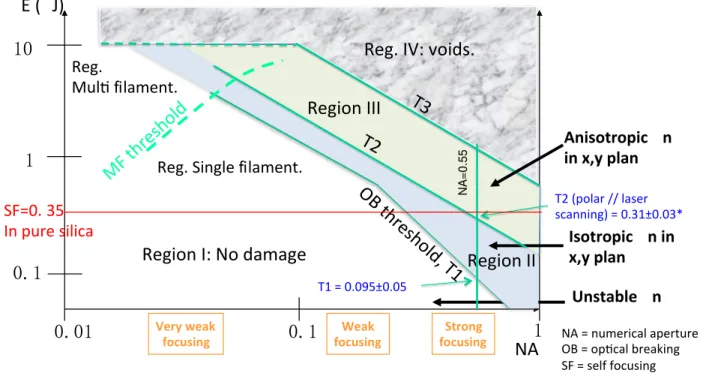
The structural modifications of the glass are, of course, dependent on the efficiency of transfer of light energy to the material. As we have said before, in the case of an ultrashort light pulse and sufficiently powerful, interband transitions by multiphoton absorption are possible. They lead to the creation of quasi-free electron plasma, which is followed by electronic relaxations (STE, point defects, network heating). In silica, three structural transformation regimes are observed and correspond to different kind of modifications as shown in Figure 1.6: an isotropic modification of the refractive index of the medium [55], anisotropic modification of the refractive index mainly due to form birefringence according to the literature [56-58], and micro-explosions leading to nano/micro-voids formation [59]. These modification regimes depend not only on the laser parameters: energy, pulse duration, laser repetition rate, wavelength, polarization (state and orientation), numerical aperture, depth of focus, writing speed, etc [60] but also properties of the material: band gap, viscosity, density, heat capacity, thermal conductivity and their dependence with temperature [61-64].STE
STH
h
n
E
g2E
g0
100as
10fs
10fs
100fs
1ps
100ps
ns
ms
e
e
e
e
e
h
2
1
3
4
5
ph
Temps
Bande de conduc on
Bande de valence
32 Figure 1.6 (a) Typical writing geometry for Femtosecond Laser Direct Writing (FLDW) and (b) Description of the three main kind of permanent modifications photo-induced in silica glass as review in Refs [44, 60, 65]. .
1.4.4 Heat accumulation effects
The time required for the dissipation of the deposited energy out of the focal volume (diffusion time tD) is given by tD = ω20 /2D, with ω0 the focal radius and D the diffusivity of
the material [66]. The diffusivity is defined as:
D = κ/ρ. Cp Equation 1.22
with κ the thermal conductivity, Cp the specific heat and ρ the density of the material.
For a focusing with a NA of about 0.5, the width of a single pulse modification in fused silica is about 1 μm, resulting in a diffusion time of about 1 μs. If the time between two successive pulses is shorter that this heat diffusion time, the temperature inside the focal volume will increase stepwise by each pulse. This process is called heat accumulation [32, 43, 67]. Figure 1.7 shows the calculated temperature rise for different repetition rates at fixed pulse energy of 200 nJ in fused silica in a distance of 2 μm from the focal center (pulse duration 450 fs, NA of 0.5). The model used to calculate the temperatures is based on Fourier equation with a Gaussian heat source along the radial axis and a Lorentzian distribution along the beam propagation.
In irradiation regime with a large number of pulses at a low repetition rate (for example <200 kHz in silica), the material cools to room temperature between two successive pulses. Indeed the energy deposited by a pulse in the focal volume is “removed” by thermal diffusion in the mass of the material in about a microsecond in SiO2. No thermal
accumulation mechanism is expected a priori, the modification of the material being carried out independently by each pulse. However, it is possible to observe incubation effects due to the large number of pulses. During strong focusing (NA = 1.4), Schäffer et al. [68] do not observe any incubation effects: the size of the modified zone increases with energy but not with the number of pulses whereas the Δn increases with the number of pulses. On the other hand, at low focusing (typ. NA = 0.25), the incubation is responsible for the reduction of the damage threshold, as observed during surface experiments [69, 70]. In the latter case, it has
33 been demonstrated in experiments [71] that the effect of the incubation is twofold: i) it modifies the absorption by accumulation of point defects ii) it introduces new possibilities of energy deposition in the network, in addition to the electron-phonon coupling. These possibilities are based on a coupling of electrons trapped in the network. The increase in the concentration of the defects is proportional to the initial concentration of defects, to the increment of the number of pulses, and also depends on the number of atomic sites likely to be affected during the accumulation process. Still in this low repetition rate regime (<200 kHz), Streltsov and Borelli [72] have shown in silica that the refractive index increase as a function of the laser energy seems to follow the temperature increase caused by a single pulse. On the other hand, since a high temperature (2500 °C) limits the refractive index increase, the effect of the temperature is not clearly established.
Figure 1.7: Results of the Raman measurements from our group’s previous work [73]. (a) D2 peak height
(left axis) and corresponding fictive temperature (right axis) as function of the longitudinal cross section (inset shows an optical micrograph with indication of the measurement trace). (b) Microscopic optical image and corresponding map of the fictive temperature for a laser-induced modification inscribed with 9.4 MHz, 150 nJ and 1000 pulses per laser spot. The arrow indicates the propagation direction of the laser pulses.
Recently Yoshino et al. have [74] measured the temperature inside glass during femtosecond laser microprocessing by time-resolved micro-Raman microscopy. They successfully obtained the time evolution of heat and its dependence on pulse energy, which were found be different for fused silica and Borofloat33. The maximum temperature was found to be as high as 5000 K in silica for 2 J whereas the temperature remains limited below 1500 K in Borofloat33, whereas their thermal properties are of the same magnitude. However the melting temperature and the viscosities are quite different since the viscosity of Borofloat33 is several orders of magnitude lower than SiO2. This indicates that the
maximum temperature is relaxation time dependent and it seems limited by phase transformation like in Borofloat33.
In the high repetition rate regime (> 0.5 MHz in SiO2), the period between two
consecutive pulses is shorter than the thermal diffusion time out of the focal volume. The pulse train then gradually heats the material, this thermal accumulation leads to the permanent modification of a volume that is much greater than the focal volume [32]. In addition, the thermal diffusion is isotropic and the volume of the heated-affected zone increases with the number of pulses. The main mechanism is based on a local melting, in agreement with the corresponding simulations [32]. When the irradiation is stopped, the