HAL Id: tel-01597740
https://tel.archives-ouvertes.fr/tel-01597740
Submitted on 28 Sep 2017
HAL is a multi-disciplinary open access
archive for the deposit and dissemination of sci-entific research documents, whether they are pub-lished or not. The documents may come from teaching and research institutions in France or abroad, or from public or private research centers.
L’archive ouverte pluridisciplinaire HAL, est destinée au dépôt et à la diffusion de documents scientifiques de niveau recherche, publiés ou non, émanant des établissements d’enseignement et de recherche français ou étrangers, des laboratoires publics ou privés.
Synthesis of new dicinnamoyl quinic acid derivatives and
analogs and the evaluation of their potential as
biopesticides
Xiubin Li
To cite this version:
Xiubin Li. Synthesis of new dicinnamoyl quinic acid derivatives and analogs and the evaluation of their potential as biopesticides. Ecology, environment. Université de Lyon, 2016. English. �NNT : 2016LYSEI032�. �tel-01597740�
2016LYSEI032
THESE de DOCTORAT DE L’UNIVERSITE DE LYON
opérée au sein de
(L’INSTITUT NATIONAL DES SCIENCES APPLIQUEES DE LYON) Ecole DoctoraleN° ED206
(Ecole Doctorale de Chimie de Lyon) Spécialité Chimie
Soutenue publiquement le 28/04/2016, par
(Xiubin LI)
Synthèse de dérivés et analogues des acides dicinnamoyl
quiniques nouvelle et évaluation de leur activité
insecticide
Synthesis of new dicinnamoyl quinic acid derivatives and
analogs and the evaluation of their potential as
biopesticides
Directeurs de thése: Dr. Yves Queneau, Dr. Sylvie MOEBS-SANCHEZ
Devant le Jury composé de:
M. Peter Goekjian, Professeur à l’Université Claude Bernard-Lyon 1 Examinateur
Mme. Evelyne Delfourne, Chargé de Recherche à l’Université Paul Sabatier Rapporteur
M. Yves Blache, Professeur à l’Université de Toulon Rapporteur
Mme. Claire Dufour, Chargé de Recherche à INRA-Centre de Recherche PACA Examinateur
Mme. Sylvie Moebs, Maître de conférence à l’INSA de Lyon Co-directrice
M. Yves Queneau, Directeur de Recherche CNRS à l’INSA de Lyon Directeur
INSA Direction de la Recherche - Ecoles Doctorales – Quinquennal 2012-2016
SIGLE ECOLE DOCTORALE NOM ET COORDONNEES DU RESPONSABLE
CHIMIE
CHIMIE DE LYON
http://www.edchimie-lyon.fr
Insa : R. GOURDON
M. Stéphane Daniele
IRCELYON, Institut de recherches sur la catalyse et l'environnement de Lyon, UMR5256
2 avenue Albert Einstein 69626 VILLEURBANNE Cedex Tél : 04.72.44 53 60 [email protected] E.E.A. ELECTRONIQUE, ELECTROTECHNIQUE, AUTOMATIQUE http://edeea.ec-lyon.fr Secrétariat : M.C. HAVGOUDOUKIAN [email protected] M. Gérard SCORLETTI
Ecole Centrale de Lyon 36 avenue Guy de Collongue 69134 ECULLY Tél : 04.72.18 60 97 Fax : 04 78 43 37 17 [email protected] E2M2 EVOLUTION, ECOSYSTEME, MICROBIOLOGIE, MODELISATION http://e2m2.universite-lyon.fr Insa : H. CHARLES
Mme Gudrun BORNETTE
CNRS UMR 5023 LEHNA Université Claude Bernard Lyon 1 Bât Forel 43 bd du 11 novembre 1918 69622 VILLEURBANNE Cédex Tél : 04.72.43.12.94 [email protected] EDISS INTERDISCIPLINAIRE SCIENCES-SANTE http://ww2.ibcp.fr/ediss
Sec : Safia AIT CHALAL Insa : M. LAGARDE
M. Didier REVEL
Hôpital Louis Pradel Bâtiment Central 28 Avenue Doyen Lépine 69677 BRON Tél : 04.72.68 49 09 Fax :04 72 35 49 16 [email protected] INFOMATHS INFORMATIQUE ET MATHEMATIQUES http://infomaths.univ-lyon1.fr M. Johannes KELLENDONK
Université Claude Bernard Lyon 1 LIRIS - INFOMATHS Bâtiment Nautibus 43 bd du 11 novembre 1918 69622 VILLEURBANNE Cedex Tél : 04.72. 43.19.05 Fax 04 72 43 13 10 [email protected]
*ScSo : Histoire, Geographie, Aménagement, Urbanisme, Archéologie, Science politique, Sociologie, Anthropologi
Matériaux
MATERIAUX DE LYON
Secrétariat : M. LABOUNE PM : 71.70 –Fax : 87.12 Bat. Saint Exupéry
M. Jean-Yves BUFFIERE
INSA de Lyon MATEIS
Bâtiment Saint Exupéry 7 avenue Jean Capelle
69621 VILLEURBANNE Cédex Tél : 04.72.43 83 18 Fax 04 72 43 85 28
MEGA
MECANIQUE, ENERGETIQUE, GENIE CIVIL, ACOUSTIQUE
Secrétariat : M. LABOUNE PM : 71.70 –Fax : 87.12 Bat. Saint Exupéry
M. Philippe BOISSE
INSA de Lyon Laboratoire LAMCOS Bâtiment Jacquard 25 bis avenue Jean Capelle 69621 VILLEURBANNE Cedex Tél :04.72.18.71.70 Fax : 04 72 43 72 37 [email protected] ScSo ScSo* M. OBADIA Lionel
Sec : Viviane POLSINELLI Insa : J.Y. TOUSSAINT
M. OBADIA Lionel Université Lyon 2 86 rue Pasteur 69365 LYON Cedex 07 Tél : 04.78.69.72.76 Fax : 04.37.28.04.48 [email protected]
Acknowledgement
I would like to express my gratitude to all those who helped me during my PhD life.
My deepest gratitude goes first and foremost to Dr. Yves QUENEAU, Directeur de Recherche CNRS à l’INSA de Lyon, who kindly offered me the chance to be a PhD student in the lab. I am deeply impressed by his strict and curious attitude about science. Many thanks for his constant encouragement and guidance during my PhD research.
I owe a special debt of gratitude to Dr. Sylvie MOEBS for her valuable guidance of my bench work, indispensable advices on the research strategies, important effort for improving my ability of both oral presentation and poster creation, strong recommendation and encouragement in my French study, consistent and illuminating instruction on the writing of this thesis and kind help in my life. Without her patient instruction, insightful criticism and expert guidance, the completion of this thesis would not have been possible.
I would also like to acknowledge my committee members: Pr. Peter Goekjian (from l’Université Claude Bernard-Lyon 1), Dr. Evelyne Delfourne (from l’Université Paul Sabatier), Pr. Yves Blache (from l’Université de Toulon) and Dr. Claire Dufour (from INRA-Centre de Recherche PACA) for having graciously agreed to serve on my committee.
I feel grateful to all the teachers who once offered me valuable courses during my study. My sincere thanks are also given to Dr. Pedro da Silva and Dr. Yvan Rahbé who are in collaboration with us in my project. Many thanks to Lucie Grand for her effort of the preliminary research of my project but also her careful maintenance of experimental equipment and timely reparation of things in problem.
Then, I need to thank all the people who created such a good atmosphere in the lab. Particular thanks to all PhD students from the lab: XU Rui, TAN Jia-neng, LI Si-zhe, YANG Zong-long, FAN Wei-gang, Manon BOULVEN, Marine JANVIER, Hubert LAVRARD.
Many thanks to the Chinese Scholarship Council offering the fellowship for my PhD study.
Last but not least, my thanks would go to my beloved family and fiancee for their loving considerations and great confidence in me all through these years.
Abbreviations
Ac Acetyl
AChE Acetylcholinesterase
AIBN Azobisisobutyronitrile
ATP Adenosine triphosphate
BBA Butane 2,3-bisacetal
CAL-A Candida Antarctica lipase A
CDI 1,1’-Carbonyldiimidazole
COSY Correlation spectroscopy
CQA Hydroxycinnamoylquinic acid
CSA Camphorsulfonic acid
DCC N,N'-Dicyclohexylcarbodiimide
DCE 1,2-Dichloroethane
DCM Dichloromethane
DMAP 4-Dimethylaminopyridine
DMF Dimethylformamide
DMP Dimethoxypropane
DMSO Dimethyl sulfoxide
EPA Environmental Protection Agency
FAO Food and Agriculture Organization
HMBC Heteronuclear multiple-bond correlation
HPLC High Performance Liquid Chromatography
HSQC Heteronuclear single-quantum correlation spectroscopy
IPM Integrated pest management
LC50 Lethal Concentration causing 50% death
LT50 Median Lethal Time
NMR Nuclear magnetic resonance
NOESY Nuclear Overhauser Effect Spectroscopy
SEM [(Trimethylsilyl)ethoxy]methyl
TBS Tert-butyldimethylsilyl
TBME Tert-butylmethyl ether
TBDPS Tert-butyldiphenylsilyl
TCDI 1,1’-Thiocarbonyl-diimidazole
TFA Trifluoroacetic acid
TMAH Tetramethylammonium hydroxide
TMB Tetramethoxy butane
TMS Trimethylsilyl
TMSOTf Trimetylsilyl trifluoromethanesulfonate
TLC Thin layer chromatography
Abstract
The use of conventional pesticides, especially the synthetic chemical pesticides, has greatly reduced the crop losses and gained a commercial success. However, the excessive use of pesticides lacking toxic specificity has caused a series of environmental and public health problems. The research interest toward new naturally-occurring biopesticides with novel modes of actions aims at a better balance between the efficiency of pesticide and reducing possible harms to environment and humans. Botanicals are an important source of biopesticides. Cinnamoyl quinic acids (CQA), isolated from various plants and shown to exhibit in vivo and in vitro a wide spectrum of biological activities, have attracted the attention with potential as biopesticides based on the patented toxicity of 3,5-di-O-caffeoylquinic acid against the larvae of Myzus persicae. The investigation of the insecticidal activity of CQA including their mode of action and the study of some structure-activity relationships could benefit from the synthesis of different CQA derivatives and analogs. A series of natural CQA derivatives natural 3,4- and 4,5-dicinnmamoylquinic acid derivatives but also analogs like 4-deoxy-3,5-dicinnamoylquinic acids were so synthesized. Seven targeted 4-deoxy CQA analogs were subjected to insecticidal assays, and two compounds were found to exhibit higher insecticidal activities than natural 3,5-dicaffeoylquinic acid. As perspectives to this work, confirming the activity of the synthesized compounds on other aphid species of agronomic importance could be performed. Furthermore, other collaborations could be established with biologists dedicated to measure other bioactivities of the synthesized compounds or use them as tools to investigate various biological pathways.
Key Words: Crop protection; Biopesticide; Cinnamoylquinic acid (CQA); 4-Deoxy
Résumé
L'utilisation de pesticides conventionnels, en particulier les pesticides chimiques de synthèse, a considérablement réduit les pertes de récoltes et a connu un succès commercial. Cependant, l'utilisation excessive de pesticides chimiques qui manquent de toxicité spécifique a provoqué une série de problèmes environnementaux et de santé publique. L'intérêt de la recherche vers de nouveaux biopesticides naturels avec de nouveaux modes d'actions vise à un meilleur équilibre entre l'efficacité des pesticides et la réduction des méfaits possibles pour l'environnement et les humains. Les plantes sont une source importante de biopesticides. Les acides chlorogéniques (CQA), isolés à partir de diverses plantes et présentent in vivo et in vitro un large spectre d'activités biologiques, ont attiré l'attention avec un potentiel comme biopesticides basé sur la toxicité brevetée de l'acide 3,5-di-O-caféoylquinique contre les larves de Myzus persicae. L'étude des propriété insecticides notamment la mode d'action et l'étude de certaines relations structure-activité pourrait bénéficier de la synthèse de différents dérivés et analogues de CQA. Des analogues des acides 4-désoxy-3,5-dicinnamoy quiniques et 3,4- et 4,5-dicinnamoylquiniques naturels ont été synthétisés. Sept analogues dans la série 4-désoxy ont été soumis à des essais insecticides et deux composés présentent une activité insecticide plus élevée que l'acide 3,5-dicaféoylquinique naturel. Comme perspectives à ce travail, confirmer l'activité des composés synthétisés sur d'autres espèces de pucerons d'importance agronomique pourrait être réalisé. De plus, d’autres collaborations avec des biologistes pourraient être établies afin d’évaluer d'autres activités des composés synthétisés ou les utiliser comme outils pour étudier des mécanismes de biosynthése.
Mots clés: Protection des cultures; Biopesticides; Acids chlorogéniques; Analogues
Contents
Acknowledgement ________________________________________________________ 1 Abbreviations ___________________________________________________________ 4 Abstract ________________________________________________________________ 8 Résumé _______________________________________________________________ 10 Chapter 1 State of the art _________________________________________________ 15 1.1 Crop protection __________________________________________________________ 17
-1.1.1 A brief history ______________________________________________________________ 17
-1.1.2 Mainly used pesticides _______________________________________________________ 20
-1.1.3 The advent of biopesticides? ___________________________________________________ 29
-1.2Hydroxycinnamoylquinic acids (CQA) _______________________________________ 31
-1.2.1 CQA and derivatives as new biopesticide? _______________________________________ 31
-1.2.2 Definition and classification ___________________________________________________ 33
-1.2.3 Isolation and diverse biological activities ________________________________________ 36
-1.2.4 Synthesis of CQA derivatives and analogs _______________________________________ 41
-1.2.5 Stability of CQA molecules ____________________________________________________ 73
-1.3Conclusions _____________________________________________________________ 82
-1.4Thesis project____________________________________________________________ 83
Chapter 2 Synthesis of CQA analogs based on a 4deoxy intermediate ____________ 86 2.1 Introduction _____________________________________________________________ 88 2.2 Preparation of 4deoxy methyl quinate _______________________________________ 89 -2.3 Synthesis of 4-deoxy-3,5-homodicinnamoyl methyl ester and quinic acid analogs and bioassays___________________________________________________________________ 93
2.3.2 Synthesis of 4deoxy3,5diOhomoesters ________________________________________ 98 2.3.3 Deprotection to target compounds _____________________________________________ 107 2.3.4 Insecticidal bioassays ________________________________________________________ 117
2.4 Synthesis towards 4deoxy3,5heterodicinnamooyl quinic acid analogs __________ 119 2.4.1 Introduction _______________________________________________________________ 119 2.4.2 Synthesis of monoesters ______________________________________________________ 120 2.4.3 Synthesis of heterodiesters ____________________________________________________ 127 2.4.4 Deprotection reactions _______________________________________________________ 134
2.5 Conclusions ____________________________________________________________ 136 Chapter 3 Towards natural 3,4 and 4,5diOCQA derivatives __________________ 138 3.1 Introduction ____________________________________________________________ 140 3.2 Towards 3,4diOCQA derivatives _________________________________________ 141 3.2.1 Preparation of two triol intermediates __________________________________________ 141 3.2.2 Coupling from triol 168 ______________________________________________________ 144 3.2.3 Coupling from quinide 51 ____________________________________________________ 149
3.3 Towards 4,5diOCQA derivatives _________________________________________ 155 3.3.1 Preparation of two intermediates ______________________________________________ 155 3.3.2 Coupling from triol 169 ______________________________________________________ 159 3.3.3 Deprotection reactions _______________________________________________________ 163 3.3.4 Coupling from 1,3carbonate4,5diol 170 _______________________________________ 168
3.4 Conclusions ____________________________________________________________ 170 General Conclusions ___________________________________________________ 171 Chapter 4 Experimental Section __________________________________________ 175 References ____________________________________________________________ 241
1.1 Crop protection
1.1.1 A brief history
The global population is currently 7 billion people and is predicted to grow to over 9 billion by 2050.1 And with the economic advances in developing countries, more high
quality food, which means more consumption of meat and dairy food and increasing use of grains for livestock feed, are supposed to be present in their daily food consumption. Both these two facts exert great pressure to the crop production with limited suitable land and restricted water availability. Thus, a more sustainable crop production is urgently needed.
Productivity of crops has been threatened by the universal incidence of pests since the dawn of agriculture. In consequence, crop protection measures have been developed to prevent or reduce the crop losses caused by harmful organisms including weeds, insects and pathogens.
In the early times, manual work such as hand weeding and hand-picking of insect larvae were the only options for the pest control. Sumerians and Chinese firstly developed sulphur compounds as pesticides.2 A survey of the Shengnong Ben Tsao Jing era (25–220 A.D.) showed that 267 plant species were known to have pesticidal activity.3 Later on, the use of beneficial insects to control other insect pests was mentioned by Linnaeus as early as 1752.4 Inorganic chemicals including copper, sulphur
and organic mercury were also used to control plant diseases.5 For example, Bordeaux
mixture (“Bouillie bordelaise”), a mixture of copper sulfate (CuSO4) and slaked lime
(Ca(OH)2), was invented in late 19th century to control powdery and downy mildew.
In the early 20th century, four kinds of natural compounds including nicotine and
alkaloids, rotenone and rotenoids, pyrethrum and pyrethrins and vegetables oils were commonly used pesticides.6 However, the use of these compounds was disadvantaged by their nonspecific toxicity (nicotine) or instability (pyrethrum).6
Figure 1 Structures of nicotine and rotenone
A rapid emergence of pesticide exploitation started during the Second World War with the introduction of synthetic pesticides such as organochlorides, carbamates and organophosphates. These synthetic chemicals were effective, low-costly, easy to use and thus have gained a great popularity. In consequence, these discoveries gave rise to a new era of pest management for crop protection.
However, the wide use of these synthetic pesticides has caused a series of environmental and health problems which brought about the movements towards more environmentally friendly crop protection methods emerged in the 1960s. The story of DDT (dichlorodiphenyltrichloroethane) was a representative example for these changes. DDT's insecticidal action was discovered by the Swiss chemist Paul Hermann Müller in 1939. DDT was made available for use as an agricultural insecticide and its production and use duly increased. Müller was awarded the Nobel Prize in Physiology or Medicine “for his discovery of the high efficiency of DDT as a contact poison against several arthropods” in 1948. The great success of DDT in pest control stimulated the development of other synthetic pesticides. In 1962, Rachel Carson’s book “Silent Spring” was published, DDT was shown to cause cancer and threaten wildlife, particularly birds. Subsequently the manufacture and use of DDT were banned or severely restricted in many countries during the period 1970 to 2000.
Figure 2 Structure of DDT
Since the environmental movements in the 1960s, researchers began to find alternative methods called integrated pest management (IPM).7 According to the
definition of FAO (Food and Agriculture Organization), IPMmeans “the careful consideration of all available pest control techniques and subsequent integration of appropriate measures that discourage the development of pest populations and keep pesticides and other interventions to levels that are economically justified and reduce or minimize risks to human health and the environment. IPM emphasizes the growth of a healthy crop with the least possible disruption to agro-ecosystems and encourages natural pest control mechanisms.” IPM assumes that low levels of pests are tolerable and thus eradication is not necessarily a goal or even desirable in some cases because the elimination of a pest may also result in the loss of the beneficial predators or parasites that need the pest in order to survive. However, IPM has rarely been used as substitute to strategies using pesticides, and the latter were often the best choice to handle with pest outbreaks.7
The advent of new naturally-occuring biopesticides with novel modes of action offers the opportunity to protect crops with better selectivity towards the targeted pest and reduced impact on environment and public health. The development of these biopesticides has in many cases been inspired by the identification of the working mechanisms of natural pesticides. Based on a series of closely related compounds, the structure-activity relationships can be identified and then help the researchers to design new biopesticides betting for improved pesticide activity and reduced environmental risk.
There exist also other techniques for pest control such as the use of genetic engineering8,9 and sex pheromone attractants.10 Our work, however, focuses on conventional pesticides and biopesticides.
For the perspectives, the trend toward reduced-risk biopesticides will likely continue and thus keep on reducing the load of xenobiotic chemicals in the environment. Practical levels of pest control could be maintained, or even increased, so that agriculture can meet its challenge of supplying enough food within existing limited resources of land, water, and other resources to a world population expected to exceed 9 billion by 2050.
The development, mode of action, pros and cons of common used pesticides will be discussed in next section.
1.1.2 Mainly used pesticides
Pesticides are defined as “chemical substances used to prevent, destroy, repel or mitigate any pest ranging from insects (i.e., insecticides), rodents (i.e., rodenticides) and weeds (herbicides) to microorganisms (i.e., algicides, fungicides or bactericides)”.11
Pesticides may be classified in a number of ways by their chemical nature (inorganic and organic pesticides), their target pest species (fungicides, herbicides, insecticides, pesticides et al.) or by how they enter the target organism or where they act (contact toxicants, stomach toxicants, systemic toxicants et al.).12 We have been
interested in organic pesticides, the vast majority of which are synthetic pesticides, some of which are natural pesticides, and a few of which are synthetic natural-derived pesticides.13
1.1.2.1 Synthetic pesticides
The use of synthetic pesticides became widespread after World War II. These pesticides were found to increase farm yield far beyond pre-World War II levels.14 The main classes of synthetic pesticides consist of organochlorines, organophosphates and carbamates.
1.1.2.1.1 Organochlorines
Organochlorine pesticides are chlorinated hydrocarbons used extensively from the 1940s through the 1960s in agriculture and mosquito control. Representative compounds in this group include DDT, methoxychlor, lindane, dieldrin, toxaphene et al. Based on different sites of toxic action or mechanisms, organochlorine pesticides can be divided into DDT-like pesticides (e.g. DDT, methoxychlor in Figure 3) and chlorinated alicyclic pesticides (e.g. lindane, dieldrin and toxaphene in Figure 3).15
Figure 3 Representative compounds of organochlorine pesticides
The organochlorine pesticides attack the sensory organs of insects and their mechanisms differ slightly. For example, DDT exerts its toxic action by preventing the deactivation or closing of sodium gate of the axon after activation. The hyperexcitability
pesticides, the mechanism is the pesticide binding with γ-aminobutyric acid chloride ionophore complex, which inhibites chloride flow into the nerve and results in hyperexcitability.17
These organochlorine pesticides have a broad spectrum of pesticide activities, low acute toxicity to mammals and are inexpensive.18 However, they are very resistant to degradation and, therefore, persist and accumulate in the environment.15 Their nonspecific toxicity in the nervous system affects also animals and humans, and has caused a lot of environmental and health problems.19, 20
1.1.2.1.2 Organophosphates
Organophosphates are primarily triesters of phosphoric acid P(O)(OH)3 and
phosphorothioic acid P(S)(OH)3. They are characterized by their ability or that of their
metabolites to inhibit the enzyme acetylcholinesterase (AChE) that deactivates the neurotransmitter acetylcholine.21 That’s the main mechanism by which the
organophosphorous pesticides exert their toxicity.22
The general structure of organophosphates can be illustrated in Figure 4, in which X is the “leaving group” that is displaced when organophosphates bind to AChE, R1 and
R2 are alkyl, aryl, alkylthio or alkylamino groups.
Organophosphorus pesticides degrade rapidly by hydrolysis on exposure to sunlight, air, and soil. Therefore, their use does not cause the problems of bioaccumulation and food chain transfer. Their biodegradable property made them an attractive alternative to the persistent organochloride pesticides.23 However, these organophosphorus pesticides generally lack selectivity and are toxic to nearly all animals including humans.18, 24
1.1.2.1.3 Carbamates
Carbamates are organic compounds derived from carbamic acid (NH2COOH).
The representative compounds in this group are aldicarb ,
carbofuran, carbaryl, fenobucarb and oxamyletc.
Figure 5 Representative compounds of carbamate pesticides
Carbamates are the third major group of synthetic pesticides developed after organochlorine and organophosphorus pesticides. These insecticides kill insects by a similar mechanism to that of organophosphate pesticides. But inactivating the enzyme acetylcholinesterase by carbamates is reversible and, therefore, carbamates are much safer than organophosphates.18
These carbamate pesticides are generally biodegradable and have lower environmental effect than organochlorine pesticides. Nevertheless, some carbamates
(e.g., aldicarb, oxamyl) have caused severe poisoning in humans and domestic animals.18
In general, synthetic pesticides are quite controversial due to their combined characterizations of a wide spectrum of pesticide activities, low cost and their potential harmful effects to environment and public health, which were barely known before their use. As a contrast, many natural compounds have found a use in crop protection. The natural pesticides currently used will be discussed in the next section.
1.1.2.2 Natural pesticides
Although synthetic pesticides are favored by pesticide industry for having greatly reduced the cost and increased the efficiency of pest control, there is a growing requirement for “greener” pesticides. The use of natural pesticides often meets this need. There are a number of currently market available natural pesticides. The representative examples are nicotinoids, neem-based products, spinosads, rotenone andpyrethrum.
1.1.2.2.1 Nicotinoids
Nicotine is the main bioactive component of the tobacco plant Nicotiana tabacum and Nicotiana rustica.25 Nicotine was used to control a wide range of pests including
aphids, thrips and whitefly.26 Other nicotinoids such as nornicotine and anabasine are also naturally occurring pesticides.18
Figure 6 Structures of three nicotinoid pesticides
These nicotinoid pesticides affect the nervous system of insects by binding to the cholinergic acetylcholine nicotinic receptor and cause a sustaining firing of this neuroreceptor.26,27 However, nicotine is very toxic to humans by inhalation and by skin
contact and to birds, fish and other aquatic organisms.26 The lethal oral dose for humans
was stated to be 40–60 mg.26
1.1.2.2.2 Neem based products
The neem-based pesticides were extracted from the seeds of the Indian neem tree,
Azadirachta indica. The major active constituent is azadirachtin A.28
Well known as a potent antifeedant to many insects, azadirachtin blocks the synthesis and release of molting hormones and leads to incomplete ecdysis in immature insects and sterility in adult female insects.28 Azadirachtin-based products such as Agroneem® and Trilogy® are used to control a wide spectrum of insects and fungal infections.13
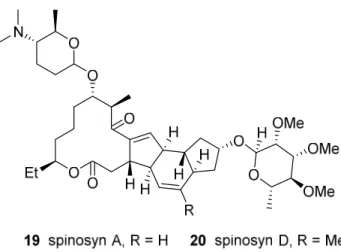
1.1.2.2.3 Spinosads
Spinosad was originally isolated from the fermentation of the soil Actinomycete,
Saccharopolyspora spinose. The major active constituents are spinosyn A and D.26
Figure 8 Structure of the major active constituent from soil actinomycete, Saccharopolyspora spinose
The mode of action of spinosad is the activation of nicotinic acetylcholine receptors leading to disruption of acetylcholine neurotransmission,29 and secondary effects on
γ-amino-butyric acid neurotransmission leading to hyperexcitation and disruption of the nervous system of insects.29,30
Spinosad has a very low mammalian toxicity and is non-toxic to birds but slightly to moderately toxic to fish.26 For example, even the highest observed daily dosage for a
spinosad-treated hamster was below the LC50 for rats (> 5000 mg/kg rat oral).31 Besides,
spinosad is degradable by photolysis on soil surface and by soil microorganisms below the soil surface.26,32 Spinosad products are sold as concentrated aqueous formulations under several trade names26,33 such as Conserve®, Entrust® and SpinTor® and are quickly becoming a main choice for not only conventional farmers but also organic farmers.13
1.1.2.2.4 Rotenone
Rotenone was mainly obtained from plant species Derris, Lonchocarpus and
Tephrosia.
Figure 9 Structure of rotenone, a major constituent in rotenone pesticides
For the mode of action, rotenone works as an inhibitor of the electron-transport chain for respiration of insects and as a selective pesticide with contact and stomach action.26,34
Rotenone is used to control a wide spectrum of arthropod pests. However, rotenone is highly toxic to mammals (with the estimated lethal dose for humans being 300–500 mg kg−1) and fish.26
1.1.2.2.5 Pyrethrum
Pyrethrum refers to a mixture extracted from flowers of Chrysanthemum
cinerariaefolium and Cynomorium coccineum. The mixture contains at least six
pyrethrin esters.
Figure 10 Structures of six pyrethrin esters.
For the mode of action, pyrethrins have been shown to activate the voltage-sensitive sodium channels in insect nervous systems leading to death.26
Pyrethrins are especially valuable pesticides due to their rapid paralysis of flying insects and that their toxic action is inactivated on exposure to light.18 They are
recommended to control a wide range of insects and mites on fruit, vegetables and field crops.26 Pyrethrins have moderate toxicity to mammals, low toxicity to birds but high
toxicity to fish and honey bees.26,35
In general, the use of pesticides for crop protection has greatly helped to reduce the crop losses. However, the intensive use of pesticides, especially the synthetic pesticides, has also led to a lot of environmental and health problems. A number of pesticides such as DDT were withdrawn and banned in many countries.36 Combined with the rapidly
food, the need for alternative tactics aiming at more sustainable crop protection is increasingly urgent. The use of biopesticides will probably meet these requirements. In the next section, the focus of the discussion was on biopesticides.
1.1.3 The advent of biopesticides?
According to U.S. Environmental Protection Agency (EPA), biopesticides are defined as “certain types of pesticides derived from such natural materials as animals, plants, bacteria, and certain minerals”.37
Biopesticides have been researched and promoted as new tools for crop protection for many years. The desirable qualities of biopesticides include a natural occurring origin, a target specificity, a reduced toxicity to nontarget organisms, a reduced persistence in the environment, a low mammalian toxicity.38 These desirable qualities of biopesticides are also their advantages as an important competitor or replacer for conventional pesticides.
Despite the increasing interest in biopesticides for crop control, the market for biopesticide products still represents a small percentage (only 3% of the global annual market for pesticides in 2014).38,39 Several reasons exist for the current low penetration
of biopesticides into the pesticide market. Among these are factors such as low efficacy, narrow range of target species, inconsistent field performance, high cost, short self-life and difficulties in production.39,40 These disadvantages are, however, offset by their
distinct advantages compared with conventional chemical pesticides.40 Another factor
driving the research of biopesticides is their good suitability in integrated pest management (IPM) programs.39
Many commercialized biopesticides have good specificity and target a single major pest. Contans®, originating from fungus Coniothyrium minitans, attacks solely the
pathogen genus Sclerotinia spp.41 BioshieldTM, based on the bacterium Serratia
entomophila, targets only a single grass grub insect.42 The narrow range of toxicity of highly-specific biopesticides makes it difficult for them to share a bigger percentage of the market.
A major group of commercially available biopesticide products are these derived from the bacterium Bacillus thuringiensis (Bt).39,40 Their successful penetration into the market may attribute to the ability to kill a range of invertebrate pest species.39 The mode
of action for Bacillus thuringiensis-based pesticides is to produce a protein crystal (the Bt δ-endotoxin) during bacterial spore formation leading lysis of gut cells of insects. The produced δ-endotoxin is safe to vertebrates, humans, beneficial organisms and the environments.43
A narrow definition of biopesticide includes only these products originating from microorganisms.39 The reason for that may be that a majority of the currently commercialized biopesticides are microorganism-based.40 But in a broader definition of biopesticide, botanical compounds and semiochemicals (e.g. pheromones) should also be encompassed.39 The commercialized neem-based products and pyrethrum mentioned
above can be considered as biopesticides in the broader definition. But another botanical compound nicotine is not regarded as “bio” since it is as toxic and hazardous as many synthetic pesticides.6
The discoveries of botanical compounds used as pesticides rely on two parallel methods: (1) Isolation and identification of active molecules from the traditional used plants and extracts for crop protection. That is the case for nicotine extracted from tobacco.25 (2) A wide screening of series of plants exhibiting better self-protecting resistance to some pest species followed by analysis of plant extracts and biological tests in order to discover the active molecules. The focus in this thesis concerns a series of botanical compounds belonging to the family of hydroxycinnamoylquinic acids (CQA). The discovery of pesticide activities of CQA falls in the second category.
1.2
Hydroxycinnamoylquinic acids (CQA)
1.2.1 CQA and derivatives as new biopesticide?
Hydroxycinnamoylquinic acids (CQA) are series of compounds exhibiting various bioactivities such as antioxidant, antibacterial, anticancer, antiviral etc.44,45,46,47However, the pesticide activities of CQA have been rarely studied and with discordant results. Although some authors have established a correlation between di-O-caffeoylquinic acid (di-O-CaQA) from lettuce root and its resistance to an aphid (Pemphigus bursarius), they have never shown direct face-to-face biological activities as pesticides.48
A patent, co filled by a team from INSA-Lyon-BF2I and INRA-Avignon, has recently related a method to prepare 3,5-di-O-caffeoylquinic acid and other derivatives from non-tuberous roots, and its use for fighting against aphids.49 A correlation was
made between concentration in CQA and disease susceptibility or insect infestation susceptibility of peach trees (Prunus persica).
The peach tree, which adapts to the Mediterranean climate, is mainly cultivated in China, North America (California), South America (Chili and Argentina) and in Europe (Spain, Italy, France and Greece). It represents an undeniable economic interest for the meridional regions. However, the peach tree is the target of numerous animal or microbes derived pest attacks. A particularly preoccupant attack is that of the green aphid, Myzus persicae. This biting and sucking insect is particularly harmful, not only by direct damage it causes but also because it is a potential vector of Plum Pox Virus, the causative agent of Sharka disease that causes deformations and discolorations of fruits, making them unmarketable. The infected trees must be cut down with no curative control available.
So it is necessary to find new treatments to fight effectively but respectful way of the environment against aphids, including green peach aphid (Myzus persicae).
Reduced levels of infection to some green peach aphids, Myzus persicae, appeared in plants showing higher concentrations of CQA. Some plant species thus seem to develop resistance mechanisms and an insecticide activity was detected for some CQA isomers.49
The mechanism of toxicity against Myzus persicae is however still to be discovered and the enzymes involved in this biosynthetic pathway are very interesting targets for new non-toxic insecticides as the shikimic pathway is absent in mammals.49 In addition,
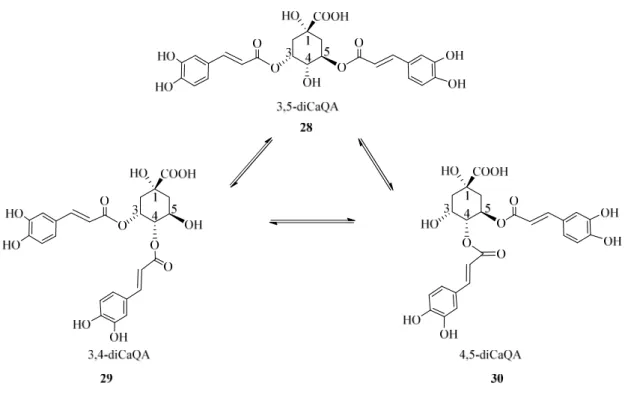
the migration of caffeoyl group between vicinal hydroxyl groups was observed during test or even natural conditions leading from a pure isomeric product to a mixture of isomers (Figure 11). This phenomenon makes it difficult to achieve unambiguous conclusions about the activities of each isomer.
Figure 11 The migration of caffeoyl group at vicinal hydroxyl groups
A better understanding of the metabolism of di-O-caffeoylquinic acids will need
purpose of this thesis through a synthetic chemistry program designed to prepare various CQA derivatives and analogs and test their pesticide activities under the collaboration with the biologists from INSA-Lyon-BF2I (Biologie Fonctionnelle Insectes et Interaction). In the section below, the literatures on CQA including its classification, biological activities, synthetic methodologies and the stabilities of CQA molecules are reviewed.
1.2.2 Definition and classification
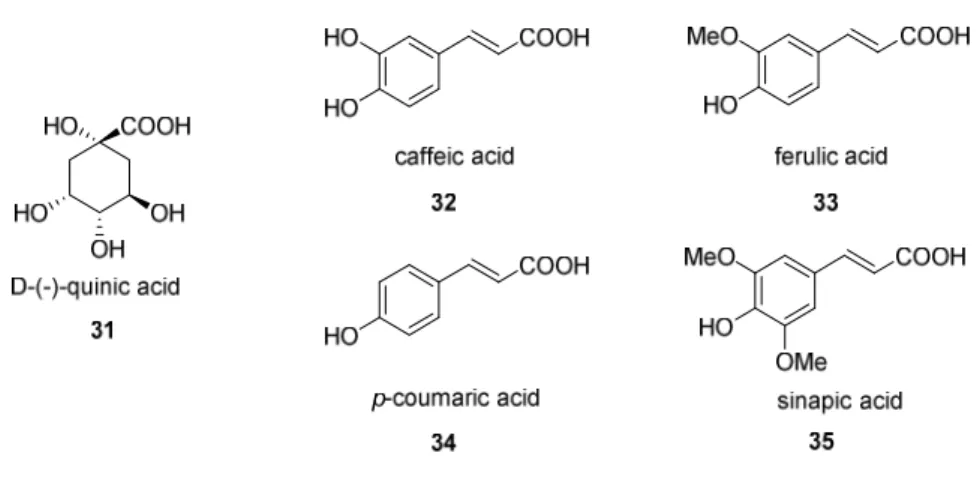
Hydroxycinnamoylquinic acids (CQA) (Figure 12) are constituted by a quinic acid core and different hydroxycinnamic acids groups.
Figure 12 Structures of D-(-)-quinic acid and examples of hydroxycinnamic acids
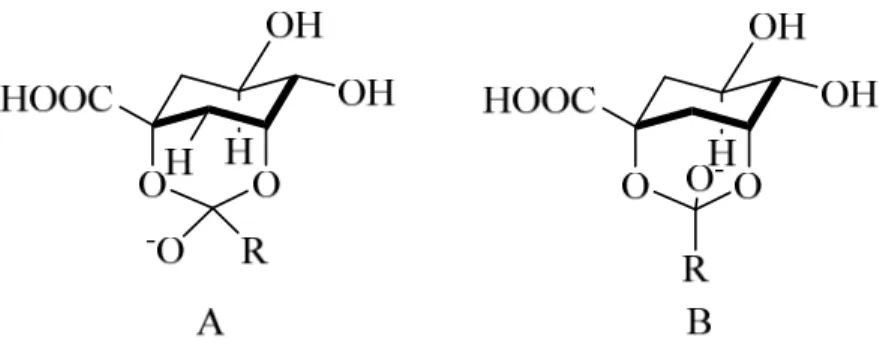
It should be carefully noted that there exist different numbering systems of the quinic acid ring.50 Using the preferred IUPAC recommended numbering51 as illustrated
in Figure 13, the commonest individual CQA is 5-O-caffeoylquinic acid (5-O-CaQA). It is still often called chlorogenic acid52,53 or 3-O-caffeoylquinic acid53 (preIUPAC
chlorogenic acids refer to a series of compounds which in this thesis are called hydroxycinnamoylquinic acids (CQA).
Figure 13 IUPAC and preIUPAC numbering systems for CQA taking 5-O-caffeoylquinic acid as an example on its main conformation
More than 70 different species of CQA have now been identified from different sources.57 These classic CQA may be subdivided by the identity, number and position
of the acyl residues. The following subgroups are known:
(1) the relatively widespread mono-esters of caffeic acid (caffeoylquinic acids (CaQA)),
p-coumaric acid (p-coumaroylquinic acids (pCoQA)) and ferulic acid
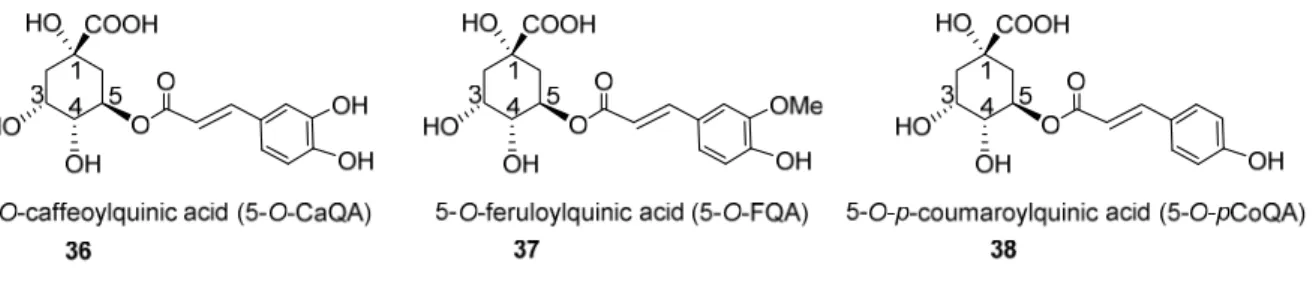
(feruloylquinic acids (FQA)). Presentative examples are given below in Figure 14.
Figure 14 Three 5-O-hydroxycinnamoylquinic acids
(2) homodiesters (di-O-CQA), homotriesters (tri-O-CQA) and the single tetra-ester of caffeic acid (tetra-O-CaQA).58,59
HO COOH O OH O O HO HO O OH OH 3,5-di-O-caffeoylquinic acid (3,5-di-O-CaQA)
1 3 4 5 COOH HO OH O O OH OH 1,5-di-O-caffeoylquinic acid (1,5-di-O-CaQA)
1 3 4 5 O O HO HO HO COOH O O OH O HO 1 3 4 5 O OH
3,4-di-O-p-coumaroylquinic acid (3,4-di-O-pCoQA)
HO COOH O O O O HO 1 3 4 5 O OH
3,4,5-tri-O-caffeoylquinic acid (3,4,5-tri-O-CaQA) O OH OH HO HO 28 39 40 41
Figure 15 CQA homodiesters and homotriesters
(3) heterodiesters60,61 and heterotriesters.62
(4) derivatives involving various permutations of residue of caffeic acid with residue of aliphatic acid63,64 or aliphatic chain.65
Figure 17 CQA derivatives bearing non-cinnamoyl substitutes
1.2.3 Isolation and diverse biological activities
CQA have been isolated in various plants such as coffee species, various fruits and vegetables, oilseeds such as soya bean and sunflower and also from medicinal plants.66,67,68,69,70
The reported methods for isolation, purification, identification and characterization of CQA include nuclear magnetic resonance spectroscopy,71 infrared spectrometry,72 liquid chromatography,73,74 gas chromatography,75 and chemiluminescence.76
A series of Coffea genetic resources have been reported to contain CQA at significant levels.77 It has been suggested that CQA consumed by regular coffee drinkers
have correlation with some therapeutic effects such as lower risks of symptomatic gallstone disease and liver cirrhosis.78,79
Fruits and vegetables are another source, in which CQA are the most important and predominant phenolic molecules. Möller and Herrmann studied the CQA content in stone and pome fruits.70 In fresh plum, three monocaffeoylesters 3-O-caffeoylquinic acid (3-O-CaQA), 4-O-caffeoylquinic acid (4-O-CaQA), and 5-O-caffeoylquinic acid (5-O-CaQA) were identified. In cherries, O-caffeoylquinic acid (O-CaQA) and
3-O-p-coumaroylquinic acid (3-O-pCoQA) were identified as the major constituents of
CQA, 5-O-caffeoylquinic acid (5-O-CaQA) and 4-O-caffeoylquinic acid (4-O-CaQA) were also found in minor quantities. In addition, 3-O-caffeoylquinic acid (3-O-CaQA) and 5-O-caffeoylquinic acid (5-O-CaQA) were predominant in apricots and peaches. Apples and pears contained 5-O-caffeoylquinic acid (5-O-CaQA) in a predominant quantity.
Besides, three CQA derivatives including 3-O-(3’-methylcaffeoyl) quinic acid, 4-methoxy-5-O-caffeoylquinic acid, 1-methoxy-3-O-caffeoylquinic acid have been isolated from the leaves of bamboo Phyllostachys edulis.68 A total number of nine CQA were identified and quantified from fourteen medicinal plants by Marques.80
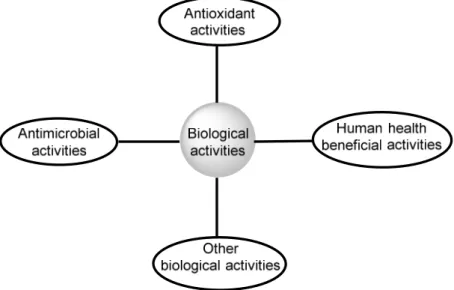
CQA and derivatives isolated from natural sources were investigated in a very large number of publications with respect to a variety of biological activities (see Figure 18).
From the best of our knowledge, the biological activities of CQA can be divided into 3 categories: (1) antioxidant activities,44,81 (2) inhibition of human chronic diseases or other health beneficial activities,82,83,84 and (3) antimicrobial activities including antifungal, antibacterial, and antiviral.45,46,47Other biological effects of CQA such as the effect of on the sleep–wakefulness cycle in rats were also investigated.85
The antioxidant activities of CQA arise from the hydroxycinnamic acid moiety resulting from their ability of inhibiting the formation of reactive radical species or scavenging them. Hydroxycinnamates readily form a resonance-stabilized phenoxy radical, which account for their antioxidant activities, due to both the phenolic moiety and extended unsaturated side-chain conjugation.
In an environment with reactive radicals, the contact of radicals with phenol readily results in the abstract of a hydrogen atom from the phenol to form a phenoxy radical. This radical is highly stabilized due to the formation of different resonance forms in which the unpaired electron may be present not only on the oxygen but also through the entire molecule. The unsaturated side chain provides additional resonance stability. Different resonance forms are illustrated below in Figure 19 taking ferulic acid as an example.
Figure 19 Resonance stabilization of ferulic acid radical
As a consequence of the resonance stabilization, the phenoxy radical generates easily and lacks reactivity to initiate or propagate a radical chain reaction. Therefore, a
collision and condensation of the phenoxy radical with another radical is its most probable fate.44
The presence of a second phenolic hydroxyl group, e.g. in caffeic acid, enhances the radical-scavenging ability. In caffeic acid, the donation of a hydrogen atom from the phenolic hydroxyl group generates a stable phenoxy radical which can readily give out another hydrogen atom resulting in the formation of quinone. The formed quinone provides additional stability.
Figure 20 Formation of quinone from caffeic acid
Ferulic acid can be considered as the derivative of p-coumaric acid by methoxylation at a ortho position of the phenolic hydroxyl group. The methoxylation destabilizes the phenoxy radical to some extent, and slightly impairs the antioxidant potential of ferulic acid.
Both the enhancing effect of a second phenolic hydroxyl group in caffeic acid and impairing effect of a methoxyl group in ferulic acid on the stability of phenoxy radicals account for that the order of antioxidant activities of these three hydroxycinnamic acids is caffeic acid > p-coumaric acid > ferulic acid. This order was observed in Guptas’ study of the role of phenolics as antioxidant for the clarified butter Ghee.81
Due to the antioxidant activities of CQA, their uses are suggested in pharmaceuticals, foodstuffs, feed additives, and cosmetics. CQA such as
5-O-caffeoylquinic acid is marketed under the trade name Svetol® in Norway and the United
Kingdom as a food active ingredient used in coffee, chewing gum, and mints.
Furthermore, CQA may play a beneficial role in the prevention of certain oxidative diseases.86,87,88,89,90 In particular, 5-O-caffeoylquinic acid has been reported to exert inhibitory effects on carcinogenesis in the large intestine, liver, tongue, and a protective action on oxidative stress in vivo. Other research has examined the protective effects of 5-O-caffeoylquinic acid against oxidative damage.91 In addition, 5-O-caffeoylquinic
acid and caffeic acid are antioxidants in vitro and might therefore contribute to the prevention of cardiovascular disease92 and type 2 diabetes mellitus.93
Additional non-antioxidant mechanisms have also been suggested for their role in inhibition of chronic diseases.82,83,84 For example, evidence from in vitro and in vivo
studies suggests that the prevention of β-amyloid fibril deposition by ferulic acid may be independent of its antioxidant activities.94,95 Furthermore, anti-hypertensive effects of dietary ferulic acid may be mediated through significant decreases in angiotensin-1-converting enzyme activities in stroke-prone spontaneously hypertensive rats.96,97,98 In addition, ferulic acid prevents the production of thromboxane A2 and stimulates the production of NO in animal models.99,100,101 5-O-Caffeoylquinic acid and
5-O-p-coumaroylquinic acid significantly inhibit intestinal absorption of glucose and increases gut hormone GLP-1102,103 suggesting a potential preventative role against type 2
diabetes.82,104 5-O-Caffeoylquininic acid exerts anti-inflammatory effects through
lipopolysaccharide-induced cyclooxygenase-2 expression,105 and was also observed to
have beneficial effects on cardiovascular diseases via suppressing P-selectin expression on platelets.106
CQA were also claimed to have antimicrobial activities including antifungal,45,107 antibacterial,46,108 and antiviral47,109 effects with relatively low toxicity and side effects.
From the aforementioned isolation and biological activities of CQA, most of these research concerns monohydroxycinnamoylquinic acid (monoCQA). Other diesters
(homo and hetero), triesters and tetraesters were also isolated but poorly further studied no matter their biological activities or synthesis.
As a contrast to the reported various biological activities, however, the pesticide activities of CQA have been rarely studied. The aforementioned patent49 related
3,5-di-O-Caffeoylquinic acid and other derivatives with disease susceptibility or insect
infestation susceptibility of peach trees (Prunus persica). Further pesticide activity research needs the synthesis of CQA derivatives and analogs. In the next section, a summary of existing methods and procedures for the synthesis of CQA derivatives and analogs will be discussed.
1.2.4 Synthesis of CQA derivatives and analogs
The retrosynthetic analysis of CQA mainly relies on the coupling of a quinic acid core and different hydroxycinnamic acid moieties. The quinic acid part, bearing four hydroxyl groups and one carboxylic group, needs a tedious protection and deprotection process before being used in a specific reaction at desired positions. The chemical insights in D-(-)-quinic acid would deepen our understanding of these kinds of compounds and give us the information needed for the modification of the quinic acid core during our synthesis for CQA derivative and analog targets.
D-(-)-Quinic acid ((1R,3R,4R,5R)-1,3,4,5-tetrahydroxycyclohexane-l-carboxylic acid) occurs widely in both plants and microorganisms.110 Being easily isolated in a state
of very high enantiomeric purity from natural sources through simple processes, it is commercially available (cas number 77-95-2). In fact, chemists have long been aware of the potential advantages of using natural chiral building blocks as starting materials in organic chemical synthesis. The application of D-(-)-quinic acid as a chiral template in natural product synthesis have been rapidly growing.
Barco et al.110 and Mulzer et al.111 have discussed the use of D-(-)-quinic acid as a
chiral scaffold in the synthesis of natural products. D-(-)-Quinic acid itself and its transformations (quinide, quinide ketals and acetals) provided a series of synthetic routes to introduce new stereogenic centers in more complex structures and culminated in the synthesis of different classes of natural products.
Figure 21 Structures of D-(-)-quinic acid and different quinide, ketals or acetals
Based on the two reported reviews110,111 about the use of D-(-)-quinic acid as the
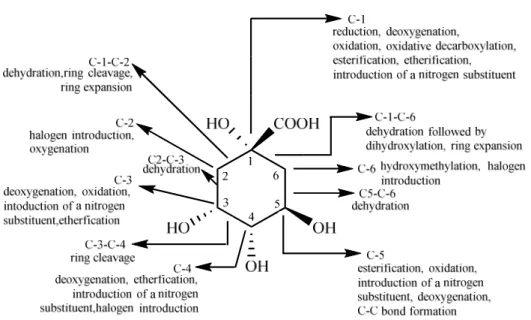
starting material in synthesis, the possible transformations from D-(-)-quinic acid are summarized in Figure 22.
From Figure 22, the wide utility of D-(-)-quinic acid in synthesis is self-evident due to the presence of possible reaction centers throughout the whole molecule. On the other hand, that increases spontaneously the difficulties of using D-(-)-quinic acid for a specific reaction, in which a complex protection and deprotection process is generally required. The difficulties also reside in the chemical synthesis for our targeted CQA derivatives and analogs.
The reports concerning the synthesis of CQA derivatives and analogs are rather limited compared to the great number of publications of their various biological activities. To the best of our knowledge of the literatures concerned with the synthesis of CQA derivatives and analogs, the reported synthesis procedures used mainly 3 kinds of methodologies: (1) esterification of properly-protected quinic acid unit with suitable protected hydroxycinnamic acid moiety followed by deprotection reactions; (2) enzymatic esterification reactions; (3) a process by first transferring the quinic acid core into malonic esters and later formation of the cinnamoyl moiety with Knoevenagel condensation.
1.2.4.1 Esterification of a quinic acid moiety with a hydroxycinnamic acid moiety
The most commonly used coupling method is the esterification of an appropriately-protected quinic acid moiety with an appropriately-appropriately-protected hydroxycinnamic acid moiety, the latter is normally activated as acid chloride, anhydride or imidazolide or is used directly as carboxylic acid.
The protected acid chloride is the most widely used one for the coupling reactions with the quinic acid moiety, and in most cases, the phenols were protected as acetate.52,53,112,113 Other protected hydroxycinnamoyl chlorides will also be illustrated
analogs. In addition, the protected carboxylic acids,114 the protected anhydrides115 and
the protected imidazolide116 played also the role of a cinnamoyl-group-donor.
Figure 23 Examples of protected hydroxycinnamic acid unit for coupling
The key coupling reactions were accomplished under different conditions providing esters, and, after deprotection, the final CQA were obtained. More details are given in the next section firstly about the synthesis of monohydroxycinnamoylquinic acids (monoCQA) then about the synthesis of dihydroxycinnamoylquinic acids (diCQA) and the trihydroxycinnamoylquinic acids (triCQA) and other derivatives.
1.2.4.1.1 Synthesis of monoCQA and derivatives
The synthesis of different 1-O-, 3-O-, 4-O- and 5-O-monoCQA and derivatives were reported. Among them, 5-O-monoCQA, as the most abundant CQA in natural sources, was the most studied.
As early as in 1955, Panizzi et al.117 reported the synthesis of 5-O-caffeoylquinic
acid 36 (named chlorogenic acid in the literature) in a route shown in Scheme 1. A key intermediate 58 was made from quinic acid in 4 steps, then the target 5-O-caffeoylquinic acid was obtained by esterification of the unsubstituted hydroxyl group at position 5 with 3,4-oxomethylenedioxycinnamoyl chloride 59 providing ester 60, followed by removal of the isopropylidene group in acid and hydrolysis of the carbonate, ethoxycarbonyl, and methyl ester groups with barium hydroxide.
Scheme 1 Synthesis of 5-O-caffeoylquinic acid
It is the first report about the synthesis of 5-O-caffeoylquinic acid. However, no detailed protocols or yields were given. In 2001, Sefkow cited this literature52
commenting that the overall yield in seven steps from quinic acid was low (<5%). This method required several protecting steps and a sequential hydrolysis of protecting groups first in acidic condition then in basic condition. Basic hydrolysis in the last step should be avoided since hydroxycinnamoylquinic acids are sensitive to oxidation in basic conditions. The final basic hydrolysis may impair to some extent the final product and contribute to the low yield.
In 1961, E. Haslam et al.118 reported the synthesis of 5-O-p-coumaroylquinic acid
(named 3-O-p-coumaroylquinic acid in the literature using the preIUPAC numbering system) 38 (Scheme 2) in modifying Panizzi’s method. It was sought in particular to protect the carboxylic group of quinic acid with diphenylmethyl group which can be removed in acidic conditions. 5-O-p-Coumaroylquinic acid was prepared by esterification of the unsubstituted hydroxyl group at position 5 in the ester 61 with 4-O-ethoxycinnamoyl chloride 62 providing ester 63 (There exist data errors in the literature, based on which the yield of ester 63 from ester 61 was calculated as 139%) followed by removal of the phenolic ethoxy group by hydrolysis with NaOH solution in methanol giving 64 and the protecting groups for carboxylic acid, 1-hydroxyl and isopropylidene group in 80% aqueous acetic acid solution.
Scheme 2 Synthesis of 5-O-p-coumaroylquinic acid
In this procedure, a protecting process and a two-step deprotection manipulation were still needed. Although the deprotection process was modified to avoid the possible losses of the final product as in Panizzi’s procedure using basic hydrolysis in the final step (Scheme 1), the yield for the two-step deprotection process was only 20%. No overall yield can be calculated since that the yield of ester 61 from quinic acid was not given and due to the presence of data errors.
In 1997, the synthesis of a series of CQA derivatives including 5-O-p-coumaroylquinic acid 38 was reported by Hemmerle et al.116 From quinic acid,
3,4-O-cyclohexylidene lactone 65 was synthesized in refluxing cyclohexanone with H2SO4.
After protection of the hydroxyl group of 65 at position 1 with
[(trimethylsilyl)ethoxy]methyl chloride (SEM-Cl) and hydrolysis of lactone moiety with NaOH, a key intermediate sodium salt 67 was obtained. The coupling of sodium salt 67 with imidazolide 57 followed by an acidic hydrolysis of all protecting groups gave the final product 5-O-p-coumaroylquinic acid 38 (61% two-step yield).
Scheme 3 Synthesis of 5-O-p-coumaroylquinic acid
The synthesis was fulfilled in 5 steps from quinic acid and the overall yield was 42%. Using the key intermediate sodium salt, the carboxylic acid was regenerated after the coupling reaction by acidification to pH 4 with 1N potassium hydrogen sulfate aqueous solution. That avoids the protection of carboxylic group before the coupling reaction.
In 2001, Sefkow’s group also reported the synthesis of
monohydroxycinnamoylquinic acids (monoCQA).52,53 Firstly, an efficient synthesis of
5-O-caffeoylquinic acid 36 (referred under the preIUPAC numbering as 3-O-caffeoylquinic acid in the literature) was reported.52 First, silylation of quinic acid with
trimethylsilyl chloride (TMSCl) afforded the pentasilyl derivative 68 in 95% yield. After an optimization of both the kinetic acetalization conditions and the workup procedure, the best yield (82%) for bisacetonide 69 was obtained by treatment of silyl ether 68 with trimethylsilyl trifluoromethanesulfonate (TMSOTf) at -95 oC for 2 hours then -30 oC for
24 hours. Esterification of 69 with 1.5 equivalents of caffeoyl chloride 54, which was obtained by acylation of caffeic acid with Ac2O in pyridine and chlorination with 2
equivalents of oxalyl chloride, was realized in a solvent system CH2Cl2/pyridine with
the catalysis of DMAP, giving the ester 70 in 92% yield. Cleavage of all protecting groups was achieved with 1N aqueous HCl containing 15% THF after 10 days at room temperature and the 5-O-caffeoylquinic acid 36 was isolated in 70% yield.
Scheme 4 Synthesis of 5-O-caffeoylquinic acid
Thus, 5-O-caffeoylquinic acid 36 was synthesized in only 4 steps from quinic acid
31 with an overall yield of 51%. The preparation of the intermediate 69 by a kinetic
acetalization protocol in 78% yield from quinic acid was the key step for the improvement in overall yield. However, an ultralow temperature was needed for the synthesis of the intermediate 69. The deprotection step under acidic conditions needed a quite long reaction time (10 days).
Sefkow et al. also reported the synthesis of 3 other monocaffeoylquinic acids including 1-O-caffeoylquinic acid 72(Scheme 5), 4-O-caffeoylquinic acid 75 (Scheme
6), and 3-O-caffeoylquinic acid 79 (Scheme 7).53
Obtained from quinic acid 31, the intermediate quinide 52 with unprotected hydroxyl group at position 1 was prepared, then the esterification was conducted with
acid chloride 54 in the CH2Cl2/pyridine/DMAP system but with a different volume ratio
of CH2Cl2/pyridine (40/1), providing the ester 71 in 58% yield. Hydrolysis of the
protecting groups was accomplished in a two-step sequence. All labile esters were cleaved using LiOH in a degassed H2O/THF solution under an inert gas, and removal of
the acetal group was then achieved after acidification of the reaction mixture with 2 M HCl, 1-O-caffeoylquinic acid 72 was obtained in 79% yield (41% from quinic acid 31,
Scheme 5). The yield of 1-O-caffeoylquinic acid 72 was less than 20% when the
hydrolysis was performed entirely under acidic conditions (1 M HCl). What is worthy of being mentioned is that the solution turned deep brown after addition of the base LiOH if the solution H2O/THF was not carefully degassed, indicating that the liberated
catechol had been oxidized to some extent.
Scheme 5 Synthesis of 1-O-caffeoylquinic acid
The synthesis of 3-O-caffeoylquinic acid 75 is illustrated in Scheme 6. Differentiation of the secondary hydroxyl groups at positions C-4 and C-5 of quinide
51119 was effectively achieved with TBSCl at a low temperature, providing silyl ether
pyridine provided ester 74 in 55% yield, indicating the esterification of 1-hydroxyl was more difficult due to a bigger steric hindrance. It was mentioned that no esterification was observed when the reaction was performed in CH2Cl2 even with several equivalents
of pyridine. Hydrolysis of all protecting groups was accomplished with 1M HCl at room temperature, and 4-O-caffeoylquinic acid 75 was obtained in 83% yield (36% from quinic acid 31, Scheme 6). When the sequential basic and acid procedure (used for synthesis of 1-O-caffeoylquinic acid in Scheme 5) was performed, however, the cleavage of all esters was observed.
Scheme 6 Synthesis of 4-O-caffeoylquinic acid
For the synthesis of 3-O-caffeoylquinic acid 79 (referred to 5-O-caffeoylquinic acid with preIUPAC numbering in the literature, Scheme 7), a strategy involving trans-acetal 77120 was developed. Quinic acid 31 was converted into methylquinate 76 using
(±)-10-camphorsulfonic acid (CSA) in refluxing methanol. Selective protection of the C-3 and C-4 vicinal diequatorial hydroxyls with 2,2,3,3-tetramethoxybutane in the presence of CSA and trimethyl orthoformate resulted in butane 2,3-bisacetal (BBA) protected methyl quinate 77 in 84% yield from quinic acid. Selective esterification of the 5-hydroxyl was accomplished with 1.2 equivalents of acid chloride 54 using the
CH2Cl2/pyridine/DMAP system providing ester 78 in 88% yield, then the removal of all
protecting groups was achieved with 1M HCl and the 3-O-caffeoylquinic acid 79 was afforded in 81% yield (60% from quinic acid 31) containing small amounts of 4-O-caffeoylquinic acid as indicated by 1H NMR.
Scheme 7 Synthesis of 3-O-caffeoylquinic acid
Thus, Sefkow’s group has shown the synthesis of four different monoCaQA including 1-, 3-, 4- and 5-O-caffeoylquinic acid in 3 to 5 steps in fair to good overall yields from quinic acid. The conditions and yields for coupling reactions varied from each other depending on different substrates.
Besides, the synthesis of other monohydroxycinnamoylquinic acids (monoCQA) including 3-, 4-, 5-O-feruloylquinic acids, 5-O-feruloylquinic acid methyl ester, 1-O-(3,4-dimethoxycinnamoyl)quinic acid and 1-methoxy-5-O-caffeoylquinic acid were also reported.
In 2006, T. Hofmann et al. studied the decomposition of roast coffee beverage and provided the synthetic procedures for 5-O-feruloylquinic acid 82 (Scheme 8).121 The same intermediate 69 as used by Sefkow for 5-O-caffeoylquinic acid was prepared in a
two-step 45% yield from quinic acid by using Sefkow’s synthetic strategy with modifications shown in Scheme 8. The esterification of 69 with acetyl protected feruloyl chloride 80 gave the ester 81 in 89% yield, the cleavage of all protecting groups was accomplished in THF/HCl and the 5-O-feruloylquinic acid 82 was obtained in 80% yield.
(2) acetone, DMP, TMS-OTf in CH2Cl2 -95oC~-45 oC~-32oC OH O O O O O CH2Cl2/pyridine = 10/3 DMAP, rt, 20h O O O O O O O OMe OAc THF, 1 M HCl rt, 48h 80% O O OMe OH HO OH HO COOH 69 81 82 HO HO OH OH COOH MeO AcO Cl O 89% (1) TMSCl, Et3N,-5 oC, 5h 45% 80 31
Scheme 8 Synthesis of 5-O-feruloylquinic acid
Hofmann barely modified Sefkow’s protocol (TMS-OTf was added as solution in CH2Cl2 at -95 oC then the mixture was stirred for 2 hours at -45 oC and kept at -32 oC
for 24 hours) and admitted a poorer yield of intermediate bisacetonide 69 than Sefkow (45% vs 81%) as this intermediate must be sensitive and unstable.
In 2013, Dokli et al. reported the synthesis of 3-, 4-, and 5-O-feruloylquinic acids (84, 85 and 82, preIUPAC numbering was used in this literature) applying Sefkow’s procedures with a few modifications in overall yields of 45%, 15% and 33%, respectively.54
The synthesis of 3-O-feruloylquinic acid 84 was illustrated in Scheme 9. The synthesis route for 3-O-feruloylquinic acid was based on Sefkow’s strategy for the