People’s Democratic Republic of Algeria Ministry of Higher Education and Scientific Research
University of Tlemcen
Faculty of Letters and Languages Department of English
Assessing The Speaking Skill Among EFL Learners
The Case of Third- Year Licence Students
at the University of Tlemcen
Dissertation submitted to the Department of English as a Partial
Fulfillment of the Requirements for Master’s Degree in Didactics and Assessment in English Language Education
PRESENTED BY : SUPERVISED BY : Ms. Imane GHERMAOUI Dr. Nawal BENMOSTEFA
BOARD OF EXAMINERS
Dr. zakia Djabari President University of Tlemcen Dr. N.BENMOSTEFA Supervisor University of Tlemcen Dr. Imane OMARI Examiner University of Tlemcen Academic Year: 2017-2018
II
Dedications
I dedicate this work to:
My beloved parents.
My precious brother and my adorable sisters. My lovely friends.
All people who encourage me and give positive energy to continue this work during difficult times.
III
Acknowledgements
First of all I owe particular thanks to Allah for having helped me to accomplish this modest work.
Special thanking to my supervisor Dr. Nawal BENMOSTEFA, who guides me to explore this research.
I would like to express my gratitude and thanking to the members of the jury,Dr.Imane OMARI and Dr. zakia Djabari for their guides about the dissertation.
Finally, all thanks to the teachers and the students participated in this study for their contribution.
Abstract
IV
This current study aims to investigate the assessment of students’ speaking skill at the English department of Tlemcen University, case of third year EFL students. The main purpose underlying this work is to gather data about the speaking assessment practices within EFL learners and to examine the effectiveness of teachers ‘techniques of assessment in improving their speaking abilities. To carry out this research and confirm our hypotheses, Two questionnaire are administered, one for teachers of oral expression and another for the third year students at the Department of English at university of Tlemcen. The collected information was analyzed both qualitatively and quantitatively. The data collected of this study shows that the assessment practices adopted by teachers of oral expression are effective in developing students’ speaking performance. It also reveals that teachers focus on both accuracy and fluency in assessing the students’ speaking abilities. Finally this study aims at suggesting some strategies, techniques and procedures that may help teachers to assess speaking skill.
Table Of Contents
VTable of contents
Dedications ………..…….……….………..……...ii Acknowledgements ... iii Abstract ... iv Table of Contents ...vList of Tables ... viii
List of Figures and Graphs ... ix
Key to Abbreviations………... x
General Introduction ... 1
Chapter One Theoretical Aspects of Speaking and Assessment 1.1. Introduction ……….…… 5
1.2. The Speaking Skill………..……5
1.2.1 Definition of Speaking………..….5
1.2.2 Elements of Speaking………6
1.2.3 The Importance of Speaking………..………6
1.2.4 Teaching Speaking Skill………6
1.3 An Introduction to Assessment……….……….11
1.3.1 Assessment, Testing and Evaluation………...…11
1.3.2 Definition of Assessment………13
Table Of Contents
VI 1.3.3.1Summative Assessment ……….14 1.3.3.2 Formative Assessment ………16 1.3.3.3 Diagnostic Assessment ………17 1.3.4 Principles of Assessment ……….………19 1.3.4.1.Practicality………..………....19 1.3.4.2 Reliability ………..………20 1.3.4.3 validity………..…….201.4 Assessment of Speaking Skills………...……21
1.4.1 Types of Speaking Assessments………..22
1.4.1.1 Formal and Informal assessment……….22
1.4.1.2 Direct and Indirect assessment………..22
1.4.2 Types of Scoring ……….23
1.4.2.1. Holistic Rubrics………...23
1.4.2.2 Analytical Rubrics………23
1.5 Conclusion ………...24
Chapter Two Research Methodology and Data Analysis 2-1 Introduction………26
2.2 Research Participants………..…26
2.2.1 Students’ Profile ………..26
2.2.2 Teachers’ profile………...26
Table Of Contents
VII
2.3.1 The Questionnaire ………..…27
2.3.2 Teachers’ Questionnaire ………28
2.3.2.1 Aim of the Questionnaire ………28
2.3.2.2 Description of the Questionnaire ……….….28
2.3.3 Students’ Questionnaire ……….….…28
2.3.3.1 Aim of the questionnaire ……….28
2.3.3.2 Description of the questionnaire ………..29
2.4 Data Analysis………..29
2.4.1 Analysis of the Teachers’ Questionnaire………...29
2.4.2 Students’ Questionnaire Analysis ……….41
2.5 Data interpretations………52
2.6 Conclusion ………53
2.7 Suggestions and Recommendations………...…...55
General Conclusion………56
Bibliography……….………...58
Appendices………..61
AppendixA: Teachers’Questionnaire………..……...62
List of Tables
VIII
List of Tables
Table1.1The Main Differences between Assessment and Evaluation …...13
Table 1.2 Differences between Formative,Diagnostic and Summative Assessment…...19
Table2.1 Teachers’ Qualifications………..………...30
Table2.2 Years of Experience………..31
Table2.3 the most reliable skill for teachers………32
Table2.4 Teachers’ Justification Behind Their Choices………..33
Table 2.5 Students’ Frequency of Participation in the Oral Expression………..34
Table 2.6 Teachers’ Justification of Students’ Frequency of Interaction ………..35
Table 2.7 Types of Assessment Used by Teachers to Assess Speaking Skill……….35
Table2.8 the Main Reasons Behind the Teachers’ Type of Assessment………36
Table 2.9 Teachers’ Preferable Speaking Tasks in Class………37
Table 2.10 Purpose of Assessing the Speaking Skill……….……….38
Table 2.11 Difficulties in assessing speaking skill………..41
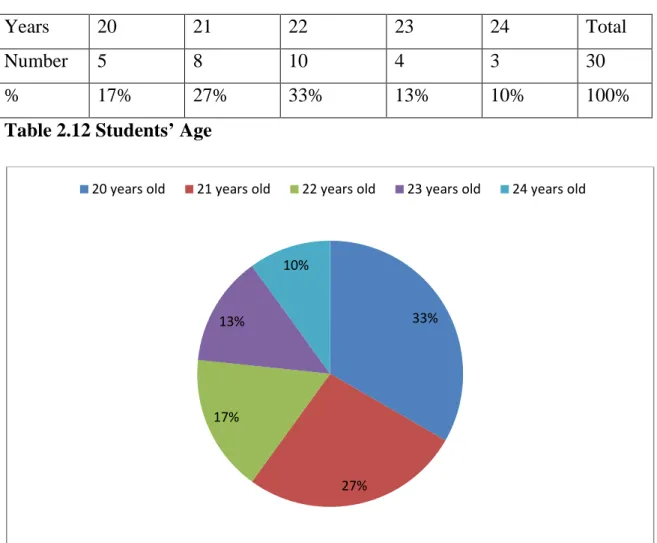
Table 2.12 Students’ Age………42
Table2.13 Students’ Gender………....43
Table2.14English Language Learning……….43
Table 2.15 Specific Skill for Learning………44
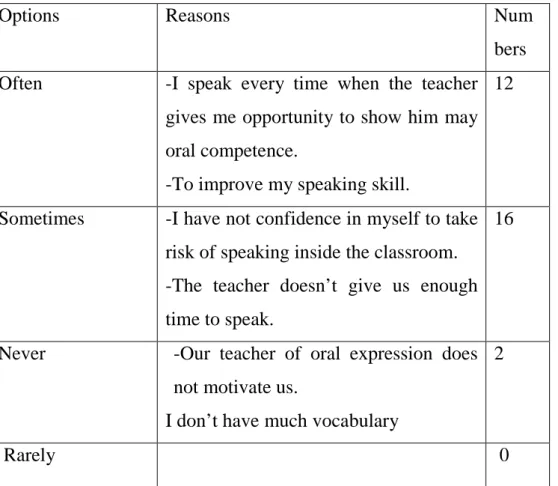
Table 2.16 Students’ Participation in the Oral Expression……….45
Table 2.17 Justifications of Students’ Participation in the Oral Expression………..46
List of Graphics and Figures
IX
List of Graphics and Figures
Figure 1.1. Elements of Speaking ……….……7
Graph 2.1 Teachers’ qualifications………..30
Graph 2.3 the most reliable skill for teachers………..31
Graph 2.4 the most reliable skill for teachers………32
Graph 2.5 Students’ Frequency of Participation in the Oral Expression……….34
Graph 2.6 Types of Assessment Used by Teachers to Assess Speaking Skill. ……….36
Graph 2.7 Teachers’ Reliable Speaking Tasks in Class……….37
Graph 2.8 Reliable Criteria Used in Rating Scales………38
Graph 2.9 Purpose of Assessing the Speaking Skill………..39
Graph 2.10 The Scoring procedures ………40
Graph 2.11 Students’ Age……….42
Graph 2.12 Student’Gender………..43
Graph 2.13 The Specific Skill for Learning………..44
Graph 2.14 Learners’ proficiency level in speaking………..45
Graph 2.15 Students’ Preferable Tasks in the Classroom………..46
Graph 2.16 Students’ opinion about teacher correction during speaking………..47
Graph 2.17 The Students’ Views about Types of Assessment………..48
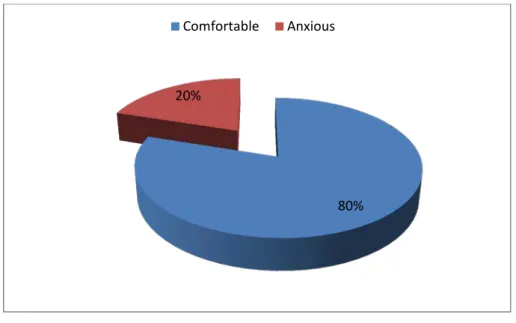
Graph 2.18 Students’ Feelings During Speaking Tests……….49
Graph 2.19 Students’ feedback after a speaking test………50
Graph 2.20 The Correction Procedures……….51
Key To Abbreviations and Acronyms
X
Key to Abbreviations and Acronyms
LMD: License Master DoctorateTEFL: Teaching English as a Foreign Language EFL : English as a Foreign Language
General
General Introduction
1
GENERAL INTRODUCTION
Speaking skill is one of the basic language skills that has significant role rather than other skills in teaching process for foreign learners. Getting proficiency in speaking English is the dream of every learner of the English language. In this sense, in order to develop speaking skill teachers of English language must spend much time on speaking activities.
Different tasks and activities can be used in order to improve the quality of speaking and achieve the desire goal on students’ oral performance. Hence, the assessment of speaking skill is considered as a crucial part in language teaching and learning in general.
Moreover, after the oral language assessment procedures, teachers easily identify the area of weaknesses in the students’ speaking performance and try to evaluate it in order to reinforce the learners’ oral skill achievements. In this study we are going to investigate the assessment of third year EFL students’ speaking skill at the University of Tlemcen .
This research is an attempt to answer the following research questions:
1. What do Algerian EFL university teachers focus on in assessing the speaking performance?
2. How can assessment practices affect students’ speaking performance? The above mentioned questions led to formulate the following hypotheses:
1. Algerian EFL university teachers focus in accuracy of speech in assessing the speaking performance of their students.
2. The assessment practices adopted by teachers of oral expression at the English Department of Tlemcen University help in improving students’ speaking performance.
General Introduction
2
This research work is divided into two chapters. The first chapter focuses on the literature review of the concepts related to “speaking” and “assessment”. It attempts to give a background and definitions about the speaking skill and the elements of this crucial skill .In addition to the importance of teaching speaking skill within the process of teaching and learning. Moreover, the chapter sheds the light on the definition of assessment, its types and principles.
The second chapter is devoted to the investigation of the obtained results with an overview of the main methods that will be used in this work, sampling, instrumentation used in this study are also explained. Then, these results are analyzed and discussed. This chapter seeks also to answer the research questions by confirming or nullifying the research hypotheses. Thus, we have provided some suggestions and recommendations.
The thesis finishes with some suggestions and recommendations to teach and assess speaking at university level. Such suggestions focus on the need to cope with the strategies and the techniques of assessment and explaining the criteria which the assessment base on for students. It also sheds light on the importance of Designing classroom activities which base on group work and using different teaching materials to get the students’ attention and motivate them
Chapter One : Theoretical Aspects of Speaking And Assessment
3
Chapter One : Theoretical Aspects of Speaking and Assessment 1.1. Introduction
1.2. The Speaking Skill
1.2.1 Definition of Speaking 1.2.2 Elements of Speaking 1.2.3 The Importance of Speaking 1.2.4 Teaching Speaking Skill 1.3 An Introduction to Assessment
1.3.1 Assessment, Testing and Evaluation 1.3.2 Definition of Assessment 1.3.3 Types of Assessment 1.3.3.1Summative Assessment 1.3.3.2 Formative Assessment 1.3.3.3 Diagnostic Assessment 1.3.4 Principles of Assessment 1.3.4.1.Practicality 1.3.4.2 Reliability 1.3.4.3 validity
1.4 Assessment of Speaking Skills
1.4.1 Types of Speaking Assessments 1.4.1.1 Formal and Informal assessment 1.4.1.2 Direct and Indirect assessment
Chapter One : Theoretical Aspects of Speaking And Assessment
4 1.4.2 Types of Scoring 1.4.2.1. Holistic Rubrics 1.4.2.2 Analytical Rubrics 1.5 ConclusionChapter One : Theoretical Aspects of Speaking And Assessment
5 1.1. Introduction
In the present chapter, we will review the basic components and the key concepts related to the assessment of the speaking skill. First, we will provide a definition of speaking, the elements and the importance of the speaking skill. The teaching of the speaking skill will also highlight in this chapter. Furthermore, we will deal with the assessment definition, explaining its types and principles. Finally, it is worth shedding light on the methods of assessing speaking skill.
1.2. The Speaking Skill
The speaking skill has been defined differently by many researchers. Defining speaking and setting the most interesting sides to it for EFL learners is needed before moving to deal with assessment and its related concepts.
1.2.1 Definition of Speaking
Speaking is one of the four language skills (reading, writing, listening and speaking). It is considered "productive skills", as opposed to the "receptive skills" of reading and listening. It is defined in Oxford Advanced Learners Dictionary as the act of talking to somebody about something; to have a conversation with or communicate in or be able to communicate. In the same vein, (Brown, 1994; Burns & Joyce, 1997) defines speaking as an interactive process of constructing meaning that involves producing and receiving and processing information”. In both definitions, speaking is described as the means through which learners can communicate with others to achieve certain goals or to express their opinions. While according to another expert (Chaney,1998, P.13), speaking is "the process of building and sharing meaning through the use of verbal and non-verbal symbols, in a variety of contexts"
Researchers explain the speaking skill from different perspectives .one of these perspectives defines the speaking skill as a combination of two main
Chapter One : Theoretical Aspects of Speaking And Assessment
6
approaches the bottom-up and the top down approach .The bottom-up approach was introduced by Bygate (1987, pp.5-6) through his explanation that the speaking act is focusing much more on motor perceptive skills. He explains that : "motor perceptive skills involve perceiving ,recalling, and articulating in the correct order sounds and structures of language "
While the top down view is based on the interactional skills . “interaction skills involve making decisions about communication, such as: what to say, how to say it, and whether to develop it, in accordance with one’s intentions, while maintaining the desired relations with others” (Bygate 1987, p.6) .
This main reasons of speaking surrounded on communication and interaction are not the only reasons of speaking skill, we can also found other goals as expressing ideas and opinions as McDonough and Shaw state that :
“There are some reason for speaking involved expressing ideas and opinions: expressing a wish or a desire to do something, negotiating and/or
solving particular problem or establishing and maintaining social relationships and friendships. Besides, fluency, accuracy, and confidence are important goal in speaking ”
(McDonough and Shaw quoted in Gilang , 2017,pp.7-8)
In the above definition, speaking skill is an important tool for verbal communication that facilitates interaction between learners and provides them with the opportunity to express themselves and share their knowledge and ideas. Thus, speaking is used for specific purposes to achieve the goal of communication.
1.2.2 Elements of Speaking
To speak the second language fluently and accurately, learners need to be able to know some elements which are very important to develop this skill , According to Thordores (2001, pp.23-26), there are two elements of speaking which are summarized in the following figure:
Chapter One : Theoretical Aspects of Speaking And Assessment
7
Figure 1.1. Elements of Speaking . Thordores (2001, pp. 23-26)
According to language features, effective English speaking requires producing more connected sounds not only separated phonemes. So, Students should be involved in talking situations in order to improve their connected speech .also, they should be able to organize at least some supra-segmental features and devices in the same way if they want to be fully effective communicators. Students often use the same lexical structures when they produce utterances, the teacher role is to give certain words and language functions, such as agreeing and disagreeing, surprise, and so forth. The students Also, must use negotiation language to show the structure of their discourse especially when they can see that the other interlocutors did not understand them. Those elements are completely significant for mastering a speaking ability and giving students opportunities to be good communicators.
On the other hand, developing Language skill of the speaker depends on rapid mental and social processing skill, such as language processing, interaction with one or more participants, and information processing quite apart from our responses to others' feelings.
Chapter One : Theoretical Aspects of Speaking And Assessment
8 1.2.3 The Importance of Speaking
Achieving the goal of improving any language learners’ ability can be done only by practicing the four language learning skills of: listening, speaking, reading and writing. Mastering speaking as a part of these four basic skills has the highest priority for native, second and foreign language learners. Speaking is an “activity requiring the integration of many subsystems…all these factors combine to make speaking a second or foreign language a formidable task for language learners…yet for many people, speaking is seen as the central skill” ( Bailey and Savage quoted in Rocío , 2011, p.21 )
Furthermore, speaking is the skill which people use it as the basis of their daily life .In our community speaking is used basically as an activity for communicating and interacting with one another. The lack of the speaking ability can be a real problem while the ability to speak correctly in a public context can solve many complex problems.
“An effective speaker can gain the attention of the audience and hold it till the completion of his message. Speaking skills are important for career success, but certainly not limited to one’s professional aspirations. Speaking skills can also enhance one’s personal life ”
Mrs Ishrat (2016, p.3)
So the speaking importance lies in its power of facilitating learners ‘abilities and people‘s daily life.
1.2.4 Teaching Speaking Skill
Speaking is considered as a basic skill that has to be mastered by EFL learners’ .In the classroom, it is the teacher ‘responsibility to prepare the students as much as possible to be able to speak in English and improve their communicative skills. Then, language Teachers must bear in mind that oral fluency is a main goal that must be achieved when teaching the productive skill of speaking with a wild attention to enhancing their students to structure accurate speech .Thus, Fluency and accuracy are
Chapter One : Theoretical Aspects of Speaking And Assessment
9
two major concepts in teaching speaking skill for the purpose of mastering the language and to guide students in the way of success.
Fluency and accuracy are two major components that must be taken into consideration when designing activities for EFL learners in order to enhance their communication ability. Richards (2010, pp.222-223) defines fluency as the aspects which make utterances more natural and normal i.e. native speakers like in pausing, rhythm, intonation, stress, rate of speaking, and use of interjections and interruptions . To achieve this goal, the teachers then should encourage their learners to be at ease when they speak and to feel comfortable when they express their own ideas and to avoid repeated pauses and gaps. ( Faerch et al quoted in Tricia Hedge, 2000) list three types of fluency : “semantic fluency: linking together propositions and speech acts, lexical-syntactic fluency: linking together syntactic constituents and words, articulatory fluency: linking together speech segments”.
The idea of matching fluency to how much the speaker is rapid in his speaking is supported by Harris and Hodges (1995, p.14) when defining fluency as the ability to speak quickly and automatically. It means that fluent speaker should be able to speak quickly and automatically. Starting to speak rapidly without pauses do not prove the fluently of speakers because they need to take breath from time to time in order to let the listeners understand what they said. On the subject of appropriate placement of pauses Thornbury (2005, p.7) says that “natural sounding pauses are those that occur at the intersection of clauses, or after groups of words that form a meaningful unit. Unnatural pauses on the other hand, occur midway between related groups of words”.
Accuracy means the ability to produce correct sentences using correct grammar and vocabulary Richards (2010). It is very important for language teachers to focus in teaching accuracy to their learners. If awareness is much more on producing fluent speech without structuring accurate speech, the speech utterances will be inappropriate .Thus, speakers should be careful about their spoken structures and they must avoid making errors or mistakes in order to produce a well-controlled output.
Chapter One : Theoretical Aspects of Speaking And Assessment
10
Besides fluency and accuracy, there are another three important components that students need to recognize while learning to speak .These components are vocabulary, grammar and pronunciation.
Vocabulary is the appropriate diction which is used in communication. Vocabulary can be defined as the words of a language, including single items and phrases or chunks of several words which covey a particular meaning, the way individual words do. Vocabulary addresses single lexical items or words with specific meaning(s) , but it also includes lexical phrases or chunks. Teaching vocabulary helps students understand and communicate with others in English. As Wilkins (1972) points that “. . . while without grammar very little can be conveyed, without vocabulary nothing can be conveyed”. Thus, students can not engage in talking situations without having a sufficient vocabulary.
Grammar is the whole system and structure of a language or of languages in general, usually taken as consisting of syntax and morphology (including inflections) and sometimes also phonology and semantics. According to lewis and hill (1997, p.82) grammar can enhance the learner ability to grasp meanings and to fast reply with appropriate articulation. Grammar aspects are very important for Language learners because it helps with its functions to improve their speaking skill.
Pronunciation is the ability to produce words in proper pronunciation gives a clear image to the teacher about the students’ level of speaking. Practicing pronunciation is one of the major stages that helps students to achieve a degree of accuracy and enhances their understanding of spoken English. Pronunciation is defined by AMEP Research Centre (2002, p.1) as:
Chapter One : Theoretical Aspects of Speaking And Assessment
11
the production of sounds that we use to make meaning. It includes attention to the particular sounds of a language (segments), aspects of
speech beyond the level of the individual sound, such as intonation, phrasing, stress, timing, rhythm (suprasegmental aspects), how the voice is projected (voice quality) and, in its broadest definition, attention to gestures and expressions that are closely related to the way we speak a language
However, the speaker should be aware of this different sounds and aspects of pronunciation such as stress, rhythm, and intonation in order to produce acceptable and understood words.
1.3 An Introduction to Assessment
Assessment is a huge field on which much research has been carried out and a huge amount of literature and theory have been published .It comprises many types which are used in language classrooms. It has also different principles and it is used for specific purposes. Assessments is used for assessing different skills and in assessing the speaking skill, many activities and methods are applied for the purpose of gathering evidence about this skill.
1.3.1 Assessment, Testing and Evaluation
The frequently use of these three terms in the area of language assessment makes them viewed as synonyms. However, there is a broad difference between their meanings. Testing is a process prepared in advance during which students try to perform their best and are aware of the fact that they are being tested. On the other hand, assessment is a constant, subconscious process that takes place whenever the student answers a question, gives a comment or tries to use a new word / phrase, etc. It may be done by teachers, the students themselves, and possibly even by other students (Brown, 2004, p.4).
In addition, Assessment is a classroom activity conducted by the teacher to get useful outcomes for the improvement of both teaching and learning. As mentioned by (
Chapter One : Theoretical Aspects of Speaking And Assessment
12
Palomba and Banta, 1999 , p.4) “Assessment is the systematic collection, review, and use of information about educational programs undertaken for the purpose of improving learning and development”. In contrast testing is seen as an instrument of assessment that is used for the purpose of measuring students ‘performance and sample their degree of skill. It has been defined as “the process of administering a test to measure one or more concepts usually under standardised conditions” (Braun and Kanjee, 2006, p.9).Thus, testing is not synonymous to assessment but it is used administratively as one of the assessment tools to gather data about the student progress.
Evaluation is another term that is commonly used in the field of language assessment. It is refers to a periodic process of gathering data and then analyzing or ordering it in such a way that the resulting information can be used to determine whether your organization or program is effectively carrying out planned activities, and the extent to which it is achieving its stated objectives. Furthermore, the collection and interpretation of information includes aspects of the curriculum such as; learners, teachers, and materials for decision making (Brindley, 2001).
From above definitions of the three terms and the distinction made between them, we conclude that assessment as a design of classroom techniques and methods includes test as one of its instrument to provide information on how learners respond to particular teaching approaches, while evaluation is the general term which covers the other terms.
Chapter One : Theoretical Aspects of Speaking And Assessment
13
Dimension of Difference Assessment Evaluation Meaning Assessment is an act of gathering,
revising, and using data, for the sake of identifying areas for improvement.
Evaluation can be defined as the process of passing judgment basing on specific standards.
Purpose Formative: Ongoing Summative:Final Orientation Process-Oriented Product -Oriented
Nature Diagnostic; identify areas for
improvement. Judgmental; arrive at an overall grade.
Table 1.1 The Main Differences between Assessment and Evaluation (Angelo and Cross, 1993, p.427)
1.3.2 Definition of Assessment
Assessment is regarded as a vital component of the teaching process .It is defined as an ongoing process of gathering information about students and making judgments about their achievement and their performance( Angelo ,1995). Assessment is viewed as a collections of tasks which put both teachers and students in judgment about the level of student achievement or performance, and conclusions about the actually learning process (Falchikov, 2005).In other words, assessment is a tool which enables teachers to check the learners’ weaknesses and straightness and to identify their needs in order to implement them in designing the incoming courses. In the same sense, it is defined by the Quality Assurance Agency Code of Practice as follows:
Chapter One : Theoretical Aspects of Speaking And Assessment
14
Assessment is a generic term for a set of processes that measure the outcomes of students' learning, in terms of knowledge acquired, understanding developed, and skills gained. It serves many purposes. Assessment provides the means by which students are graded, passed or fail. It provides the basis for decisions on whether a student is ready to proceed, to qualify for an award or to demonstrate competence to practice. It enables students to obtain feedback on their learning and helps them improve their performance. It enables staff to evaluate the effectiveness of their teaching.
(QAA Code of Practice, 2000)
In above definition, assessment is a classroom activity of determining achievement by gathering, evaluating, and grading students in order to enhance their performance. Then, through measuring the outcomes, teachers get more improvement of the teaching process.
1.3.3 Types of Assessment
There are ranges of Assessment’ ways which are central to the success of the teaching and learning process. Researchers in the field of language studies distinguish between different types of assessment. This distinction is based on the different reasons the assessment sake for at various stages in the learning sequence. And result the must well known assessment ways which are: summative, formative and diagnostic assessment.
1.3.3.1 Summative Assessment
Summative assessment is a type of assessment which takes place at the end of a learning sequence and it is used for the purpose of making decision about students’ overall achievement at a given point .It is considered as an assessment of learning that help the teacher to report, record and measure the students ‘performance in learning and the learners ‘outcomes. According to McKean and Aitken :
Chapter One : Theoretical Aspects of Speaking And Assessment
15
assessment of learning can be a valuable tool to summarise a collection of assessment cycle rotations. Conceptualise it as a geological core sample that communicates a student’s learning over a period of time. It accomplishes on a macroscale what occurs on a microcosmic level in the classroom all the time. When used appropriately, this feedback can provide a student with a greater sense of accomplishment, at an organisational level can provide learning opportunities for teachers and administrators concerning how to support further student learning; and at a political/societal level can provide potential information that, when used correctly can contribute to vital decision making processes.
(McKean and Aitken, 2016, p.34) In addition, Kellough & Kellough (1999, pp.418-419) state different purposes for using summative assessment in the classroom are summarized as follows:
1. To support student learning
2. To identify students’ strengths and weaknesses 3. To match students needs with the oncoming course.
4. To assess and improve the curriculum progress and the teaching process. 5. To facilitate decision-making with providing more data and information. 6. To give parents the chance to interact with teachers.
Moreover, summative assessment can take many forms that are used in language classroom as part of the grading process. Some of the examples of summative assessments are mentioned as follows:
• State assessments
• District benchmark or interim assessments • End-of-unit or chapter tests
Chapter One : Theoretical Aspects of Speaking And Assessment
16 • End-of-term or semester exams
• Scores that are used for accountability of schools (AYP) and students (report card grades)
( Garrison and Ehringhaus,2012) 1.3.3.2 Formative Assessment
Unlike summative assessment, known as assessment of learning, formative assessment is referred to as assessment for learning. Brown (2007) refers to this type of assessment as an evaluation of students progress in the teaching process for the purpose of continues in the growth. Furthermore, Formative assessment is used by teachers during instruction to get data in order to adapt the existing curriculum to enhance students’ performance (Carter and Nunan,2001). Thus, the course adapted to the needs of students is the result of current data obtained from formative assessment. Otherwise, students benefits from this kind of assessment in modifying their learning this idea is supported by Gipps :
A key development in the formative assessment process, and an indispensable condition for improvement, is that the student comes to hold a notion of the standard or desired quality similar to that of the teacher, is able to monitor the quality of what is being produced at the time of production, and is able to regulate their work appropriately.
(Gipps 1994,quoted in Bouab,2016,p.5) Moreover, Moss & Brookhart( 2009,p.6) state six elements of the formative assessment process. These interrelated elements are the following:
• Shared learning targets and criteria for success • Feedback that feeds forward
• Student goal setting • Student self-assessment • Strategic teacher questioning
Chapter One : Theoretical Aspects of Speaking And Assessment
17 • Student engagement in asking effective questions
Furthermore, formative assessment as an collaborative process engaged by teachers and students works for such purposes :” Focus on learning goals, take stock of where current work is in relation to the goal and take action to move closer to the goal.” ( Brookhart quoted in Moss & Brookhart, 2009;p.6).
1.3.3.3 Diagnostic Assessment
Diagnostic assessment is another type of assessment which usually takes place at the start of a school year, term, semester, or teaching unit .It is defined as a tool used by the teacher to check students’ learning misconceptions and their readiness to perceive new items outlined in the curriculum expectations. It involves the gathering and careful evaluation of detailed data to diagnose strengths and areas of need in all students in a given learning area in order to facilitates teachers’ planning instruction and setting appropriate learning goals. In the same vein, Srivasta Va & Kumari (2005, p.2) define diagnostic assessment as “being used when the teacher decides that information is needed about student knowledge or skills prior to deciding on the most effective instruction”. Thus, diagnostic assessment is efficient in informing instruction. Successful language teaching can be attained when language teachers use an appropriate Diagnostic assessment to assess learners’ strength and weaknesses for the purpose of providing feedback about learners’ skills and abilities. Furthermore, teachers use the findings to monitor the incoming course to reduce failure rate and improves performance in the area of skills acquisition. In other words, the results of a well- designed diagnostic assessment can be a good indicator of the effectiveness or ineffectiveness of the teaching process.
In addition, Barr et al (2013), outlined the principles of diagnosis as follows: 1. Diagnostic assessment based on decision- making. Teachers make decisions about students in achieving learning goals.
2. Diagnosis process considers the whole learner. This implies that teachers should examine multiple forms of data including past experiences, attitudes , learning styles, interest, strengths and weakness, reasons for referral, conducting interviews with parents etc.
Chapter One : Theoretical Aspects of Speaking And Assessment
18
3. Determine the specific nature of learning difficulties: diagnosis of learning difficulties depend on the nature of the difficulty.
4. Determine the factors causing learning difficulties.
5. Diagnosis and remediation go hand in hand. The effectiveness of any teaching and learning process depends on teacher understanding the learners’ level of mastery of the subject area and is achieved through diagnostic assessment.
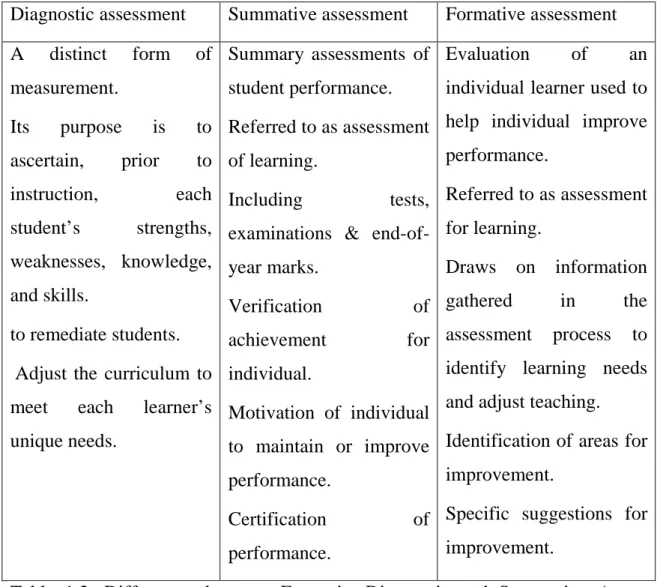
Furthermore, diagnostic assessment can take many forms that are used in language classroom, for example: journal, student self-assessments, gap closing, mind map,etc. All these forms are used for the purpose of planning for the next steps to meet each learner’s unique needs. The following table summarizes the main differences between formative, diagnostic and summative assessment:
Chapter One : Theoretical Aspects of Speaking And Assessment
19
Diagnostic assessment Summative assessment Formative assessment A distinct form of measurement. Its purpose is to ascertain, prior to instruction, each student’s strengths, weaknesses, knowledge, and skills. to remediate students. Adjust the curriculum to meet each learner’s unique needs. Summary assessments of student performance. Referred to as assessment of learning. Including tests, examinations &
end-of-year marks. Verification of achievement for individual. Motivation of individual to maintain or improve performance. Certification of performance. Evaluation of an individual learner used to help individual improve performance. Referred to as assessment for learning. Draws on information gathered in the assessment process to identify learning needs and adjust teaching.
Identification of areas for improvement.
Specific suggestions for improvement.
Table 1.2. Differences between Formative,Diagnostic and Summative Assessment (Nuhad Y Dumit,2012)
1.3.4 Principles of Assessment
There are a set of requirements that every test should follow in order to measure what it intends to measure. Researchers in the field argue that an examination should fulfill some qualities like practicality, reliability and validity in order to meet effective, appropriate and well-designed assessment.
1.3.4.1.Practicality
The most important concept in language assessment is termed ‘practicality’. Language test practicality is to design test that is not expensive and ease to administer and it does not take too much time to answer (Brown, 2004,p.19). Another feature of
Chapter One : Theoretical Aspects of Speaking And Assessment
20
practicality is that it should be easy to score. In other words, the scorer must select the appropriate scoring procedure that suits the type of test.
1.3.4.2 Reliability
Reliability consists on getting similar scores for the same test giving to the same student .In other words; test reliability refers to the consistency and stability of test results on different situations. As , Lado (1964, p. 330) argued : “Reliability has to do with the stability of scores for the same individuals. If the scores of students are stable the test is reliable; if the scores tend to fluctuate for no apparent reason, the test is unreliable”. Thus, a test is said to be reliable when and if the results do not differ for no logical reason.
1.3.4.3 validity
Language test validity is concerned with testing what it purports to test. According to Longman Dictionary of Contemporary English, validity is ‘based on what is true or sensible, and so should be accepted or treated in a serious way’. In other words, if something is true it should be accepted .
In the same vein , Fulcher and Davidson(2007, p. 4) explain that, when designing a test there is a specific intention to measure something, that the ‘something’ is ‘real’, and that the principle of validity require finding out whether a test ‘actually does measure’ what is supposed to measure.
However, different types of validity can be used by teachers to determine the validity of certain test. Assessment specialists have identified three types of validity: content validity, construct validity, Criterion-related , and face validity.
The first evidence is Content validity which contributed to facilitate determining the validity of any designed test. It is concerned with ensuring that an assessment adequately meets the standards or objectives of an instructional unit. As supported by Flavell “The content specification is important because it ensures as far as possible that the test reflects all the areas to be tested in suitable proportions and also because it represents a balanced sample, without bias towards the test material which happens to be available”
Chapter One : Theoretical Aspects of Speaking And Assessment
21
Construct validity is another evidence which means the interpretation of scores given by the scorer as a proof of the testees’ language ability. Criterion-related evidence of validity is concerned with how accurately an assessment equates with another assessment that is intended to measure the same learning outcomes, standards, or objectives. It could be determined when 2 related assessment occur in proximity to each other. The last evidence is Face validity which is concerned with how accurately an assessment aligns with theoretical framework of interded learning outcomes, standards, or objectives of the instructional unit.
1.4 Assessment of Speaking Skills
Assessment tools are a procedures used to measure the students’ abilities, knowledge or performance with the use of different procedures , according to Halya and Austin (2004, p.117) assessment involves development of materials, processes, activities, and criteria to be used as a tool for deterring how place .One of this tools is the speaking test which is used to measure students ‘speaking proficiency ,According to Fulcher (2003), testing second language speaking is considered to be more difficult than testing other language skills. .Assessing speaking focus much more on the oral production in which students faced talking tasks and have to speak while the teacher ‘role is to evaluate the students ‘level of speech and correct them. When we give a speaking test to the students, normally, we are going to measure the following criteria: - Pronunciation
- Fluency -Vocabulary - Grammar
- Discourse features (cohesion, sociolinguistic appropriateness, etc.) -Task (accomplishing the objective of the task is also closely dependant on comprehension).
( Brown ,pp. 2007- 352) Enhancing the speaking skill as one of the productive skill is very important in the teaching of speaking. The teacher must provide students with opportunities to
Chapter One : Theoretical Aspects of Speaking And Assessment
22
practice the language orally for the sake of proved his student mastery of the language. The next important step for language teachers is to measure their students’ abilities in the speaking performance. Evaluating the speaking ability is not an easy task as it needs much time to administer to a large class .Language teachers are intended to judge their learners oral performance through observing students' interaction and participation in class activities.
1.4.1 Types of Speaking Assessments
Tests in speaking varies from tests in other skills, for that Hughes (2003,pp.53-55) states that Assessment of speaking can be done by using: interview, interaction with peers and responses to tape recording. These techniques are examples of the many techniques that are used to assess students’ abilities in speaking skill. Under the many formats of assessing the speaking skill of learners we mention the following: 1.4.1.1 Formal and Informal assessment
According to Thorubury (2005, p.124) assessment of speaking can be done by using tow forms: formal assessment and informal assessment. Formal assessments are based on systematic and planned techniques as mention by Brown (2004) It is referred to as formal because of the fact that it is “systematic, planned sampling technique constructed to give teacher and student an appraisal of student achievement” (Brown, 2004, p. 6) .While informal assessments are not planned, i.e. can take place at various occasions during the course by asking question to evaluate the student’ progress through commenting on their speaking level. Also, it may be referred to any kind of teachers' feedback aimed at the students, such as a word of encouragement, a smile, a pointed finger, a piece of advice concerning pronunciation, grammar, etc. 1.4.1.2 Direct and Indirect assessment
In the field of language testing the speaking skill, can be directly tested since it is considered as a productive skill that gives the examiner a direct output. Direct assessment can be defined as a test that actually requires the learners to demonstrate their ability in the speaking skill performance and interact directly with the
Chapter One : Theoretical Aspects of Speaking And Assessment
23
examiner,i.e. it requires face to face interaction. However, when the teachers choose direct assessment, they assess what the students are actually performing since direct assessment strongly facilitates the teachers’ control of the learner performance (Luoma, 2004). While, Indirect assessment is used to measures the ability or knowledge that underlies the skill that is trying to be to measured. Pronunciation tests in which the students are required to read some words out loud are an example of direct testing whereas asking the students to check the word that sounds different in a group of words is an example of an indirect test of pronunciation.
1.4.2 Types of Scoring
Test must be reliable to get dependable scores, so that we can rely on them in decision-making. Unreliable scores, on the other hand, can lead to wrong placements, unjustified promotions, or undeservedly low grades on report cards. Luoma (2004,p.9) talks about the different types of rubrics that are generally used in speaking assessment. These different rubrics are categorized into two main groups which are: Holistic Rubrics and Analytical Rubrics.
1.4.2.1. Holistic Rubrics
The scorers assign a single score based on the general quality of students’ oral performance without relying on scoring specific ability Brown (2004,p.191).Such rubric has one basically advantage over its disadvantages which is time consuming .That is to say, this type of rubric is fast and saves time for the teachers when they have many groups of students to assess their speaking performance. On the other hand, holistic rating scale has some disadvantages as it does not guide and help students to progress in their speaking ability as it gives no details about their weaknesses in speaking.
1.4.2.2 Analytical Rubrics
The analytic rubrics require the assessor to pay attention at individual criteria separately such as ,pronunciation, fluency and accuracy and gives each of them its own score ,then create a final score (Hughes, 2003, pp. 94 – 95).In other words, The
Chapter One : Theoretical Aspects of Speaking And Assessment
24
score in this approach is the sum of several aspects of the oral performance rather than a single score. Thus, employing analytic rubrics helps students to enhance their oral performance by recognize their area of weaknesses and which aspect of speaking they need to work on for further improvement. However, it takes more time and energy for teachers to apply it.
1.5 Conclusion
This chapter dealt with several clarifications of the terms related to speaking and assessment. From the review of the literature, a definition of the speaking skill, the importance and the elements of the speaking performance were discussed. Equally important, we had an outlook on the process of teaching the speaking skill. Then, we highlighted the assessment process, its types and principles. At the end of the chapter, the assessment of the speaking skill and its importance were discussed.
In the next chapter, the researcher will shed light on the situation under investigation. The collected data will also be analyzed and discussed and the hypotheses will either be confirmed or rejected.
Chapter Two : Research Methodology and Data Analysis
25
Chapter Two : Research Methodology and Data Analysis
2-1 Introduction
2.2 Research Participants 2.2.1 Students’ Profile 2.2.2 Teachers’ profile 2.3 The Research Instruments 2.3.1 The Questionnaire 2.3.2 Teachers’ Questionnaire
2.3.2.1 Aim of the Questionnaire 2.3.2.2 Description of the Questionnaire 2.3.3 Students’ Questionnaire
2.3.3.1 Aim of the questionnaire
2.3.3.2 Description of the questionnaire 2.4 Data Analysis
2.4.1 Analysis of the Teachers’ Questionnaire 2.4.2 Students’ Questionnaire Analysis 2.5 Data interpretations
Chapter Two : Research Methodology and Data Analysis
26 2-1 Introduction
The present research work aims at investigating the significant role that speaking assessment plays in improving students’ oral performance. In order to fulfill our study, two research instruments are used and the methodology of each one are explained. The data obtained from third year students and teachers of oral expression in the department of English at Tlemcen University through two different questionnaires; teachers’ and students’ questionnaires, are analyzed both qualitatively and quantitatively. However in our present work, we have introduce the sample population, then we have provide some suggestions and recommendations for both teachers and students. Finally, the main information drawn from this research are summarized and linked to our research questions and hypothesis to examine their validity.
2.2 Research Participants
The Sample population informants were third year EFL students and oral production teachers from the University of Tlemcen. They were targeted to respond to the research instruments addressed to them. In fact, from the larger population, a sample of thirty students and seven teachers was chosen so as to represent the whole population.
2.2.1 Students’ Profile
Thirty (30) from third year EFL students (males and females) at the English Department of Tlemcen University, were randomly selected to respond to the students’ questionnaire. The average age of the students in this research work was 23 years. In addition, the questionnaire was distributed to students from different groups .
2.2.2 Teachers’ profile
Four (4)teachers of oral expression module (COE) at the English Department of Tlemcen University were concerned to respond to the teachers’ questionnaire. They all held either the degree of ‘Magister’ or ‘Doctorate’. Their experience in teaching oral production varies from 4 to 6 years. So, they can enrich this research work by their
Chapter Two : Research Methodology and Data Analysis
27
different views about the use of assessment and its role in developing EFL learners’ speaking skill.
2.3The Research Instruments
There are multiples types of research tools such as questionnaire, interview and observation. This research work focuses on two questionnaires, one distributed to the students and another for teachers. The aim of the two questionnaires is to provide data about the assessment of EFL speaking skill and how teachers assess students’ performance in the speaking skill.
2.3.1 The Questionnaire
The questionnaire is a research tool that researchers use for the purpose of obtaining useful data. Jordan (1997,p.33) states that:
The questionnaire has been established the most common method, through which they can express Themselves since it involves the students’ awareness of their language use and areas of difficulties as it can be also conducted to teachers of the target language. In other words; it helps us to draw a profile of the learners’ needs, Lacks, wants, learning styles and strategies.
A questionnaire can appear in three forms : structured, semi-structured, or unstructured. However, the use of such instrument can provide the researchers with quantitative and qualitative data.
For the present study, the researcher has used two questionnaires. One was devoted to EFL oral expression teachers and the other one to third year EFL students in order to examine the research questions and hypotheses.
Chapter Two : Research Methodology and Data Analysis
28
We administered this questionnaire after the spring holidays; We gave it to different students from different groups and teachers’ questionnaire was distributed to four oral production teachers from the Department of English at Tlemcen University. 2.3.2 Teachers’ Questionnaire
This questionnaire was given to four teachers of oral expression in the department of English at the University of Abou Bekr Belkaid in Tlemcen.
2.3.2.1 Aim of the Questionnaire
The teachers questionnaire aims at providing data about the various techniques using by teachers to assess students speaking skill and their goals behind how often they assess them. In addition ,to the introduction of the different tasks they usually used in assessing speaking and the different criteria they usually focused on when they design their tests .Then, to measure what extent its help in enhancing the oral abilities of the EFL learners.
2.3.2.2 Description of the Questionnaire
The questionnaire consists of 11 questions divided in 2 sections each of them focus on a particular aspect. The first section includes questions concerning personal information about gender, educational level, and length of teaching English at the university. In the second section teachers are asked about the various tasks, techniques and criteria they based on when designing their tests of speaking skill and the purpose which they hope reach from assessing speaking.
2.3.3 Students’ Questionnaire
This questionnaire was given to 40 students, 30 only answered the whole questionnaire.
2.3.3.1 Aim of the questionnaire
The main purpose of this questionnaire is to find out students’ view concerning the speaking skill, to discover the various ways and techniques of teaching and assessing them and the difficulties they encounter when performing speaking tests. It
Chapter Two : Research Methodology and Data Analysis
29
was a relevant resource which helped us to find out students’ opinions on how assessment of their oral performance can improve their communicative competence. 2.3.3.2 Description of the questionnaire
This questionnaire comprised of sixteen questions: twelve questions of multiple choices, three questions are yes or no questions and one question is open ended. The questions are supposed to answer by third year English students at the Department of Tlemcen University of the academic year 2017/2018, under a sample of 40 participants only 30 students answer the whole questionnaire.
It is divided into three sections: the first one contained six questions dealing with the way a student views the speaking skill and their perception of the elements of the speaking skill and their acceptance of the importance of the speaking skill. Also a question (7) inquires about what the difficulties the learners face when speaking. The next three questions of the second section are designed for asking students about the types of assessment their teachers use to assess them and their preferable tasks in classroom. Whereas the last part of the questionnaire contains five questions which try to focus on the type of correction procedures the teacher use and to highlight the students’ satisfaction with the way the teachers marked their speaking performances, and the last question was an open-ended question that required the students to mention their general opinion about the assessment of speaking skill.
2.4 Data Analysis:
In this section, we will analyze data gathered throughout the research tool (teachers’ and students’ questionnaire) to get the appropriate answers of the research questions.
2.4.1Analysis of the Teachers’ Questionnaire
As it was mentioned earlier, the questionnaire was addressed to teachers of oral production. Four (4) of them were taken as a sample to respond to this questionnaire. They were asked to answer some questions concerning the assessment of speaking skill among EFL learners.
Chapter Two : Research Methodology and Data Analysis
30 Section one :Teachers’ profile
The first section aims at gathering data about the teachers’ personal information. Question One:Gender
The first question specifies the gender of the teachers
The female oral expression teachers are( 3), while male oral teachers are(1) , which means that female teachers’ assessment practice will take the largest opportunity in the analysis.
Question Two: Teachers’ qualifications
Answers to this question are reported in table and graph below:
The answers The responses The percentage%
BA (license) 0 0%
M(master/magister) 4 100%
PHD (doctorate) 0 0%
Total 0 100%
Table2.1: Teachers’ Qualifications
Graph 2.1 Teachers’ Qualifications 100%
0% 0%
Chapter Two : Research Methodology and Data Analysis
31
The second question gave Information about the teachers in terms of degrees:
The table and the graph have shown that the teachers’ degrees are all magister degree. Question three: For how many years have you been teaching oral expression?
The answers The responses The percentage
8 months-2 years 1 25%
3 years-5 years 3 75%
Total 4 100%
Table2.2: Years of Experience
Graph 2.2 Years of Experience
The aim of this question is to know the teachers experience in teaching English at university .One of them declared that they have been teaching English between three years and five years ,who presented the percentage of 25%.While 3 teachers the equivalent of 75% state that they have been teaching English from eight months to two years
25%
75%
Chapter Two : Research Methodology and Data Analysis
32 Section two: Teachers’ Assessment Practice
The second section aims at presenting the different tasks the teachers usually used in assessing speaking and the different criteria they usually focused on when they design their speaking tests. In addition, it aims at illustrating the teachers’ usual types of assessments and scoring methods.
Question four: Which skills do you rely on to teach oral expression?
The results for each skill are graphically presented below choices Speaking Listening Reading Writing
Frequency Number
4 3 2 1
% 100% 75 50% 25%
Table2.3: the most reliable skill for teachers
Graph 2.4 the most reliable skill for teachers 0 20 40 60 80 100 120
Chapter Two : Research Methodology and Data Analysis
33
the aim of this question is to know which skill teachers rely on most to teach oral expression. 100% of teachers have declared speaking as the most skill to teach in oral expression. While 75% of teachers also declared that they rely on listening skill as well to teach oral expression .we can say that because the two skills are interrelated to each other and the good listener is a good speaker. The more they listen to English the more their speaking skill is developed. In the other hand, 50 % of teachers stated that they rely on reading and 25% declared that they rely on writing. In the table below we are going to mention the main reason behind the teachers’ choices.
Choices Teachers’ justification Frequency number
Total
Speaking -To improve their fluency progress and to make them native speakers like. -The main goal of the oral expression goal is to produce English speakers so, we as oral teachers must focus on training the speaking ability of learners.
4 100%
Listening -the two skills are interrelated to each other and the good listener is a good speaker
3 75%
Reading Reading is necessary to get new vocabulary.
2 50%
Writing Writing skill should be developed in order to produce good speakers
1 25%
Chapter Two : Research Methodology and Data Analysis
34
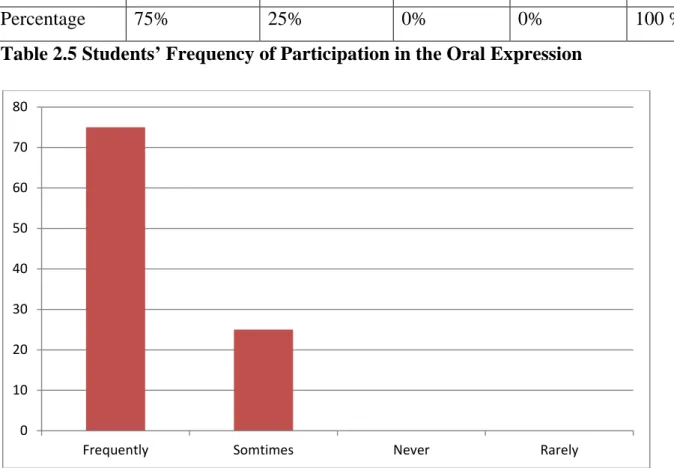
Question five: How often do your students participate in the oral expression?
Choices Frequently Sometimes Rarely Never Total
Number 3 1 0 0 4
Percentage 75% 25% 0% 0% 100 %
Table 2.5 Students’ Frequency of Participation in the Oral Expression
Graph 2.5 Students’ Frequency of Participation in the Oral Expression
The aim of this question is to know how many times the students use the target language in the oral expression course. The majority of teachers (3) participants making up75% stated that their students are frequently participating during the oral session. We result that these teachers are controlling their students and making them interested in the different activities that are used in the classroom while only one teacher the equivalent of 25% stated sometimes and none of teachers stated rarely and never. The table below summarizes teachers’ justification concerning the students’ interaction 0 10 20 30 40 50 60 70 80
Chapter Two : Research Methodology and Data Analysis
35
Choices Justifications Number
Frequently -We need to make them participate to improve their speaking skill.
- Participation of students is marked so they have to participate frequently to get high scores.
3
Sometimes -anxiety and fear from mistakes make them silent.
1
Never / 0
Rarely / 0
Total / 4
Table 2.6 Teachers’ Justification of Students’ Frequency of Interaction
Question six: What types of assessment do you use to evaluate students’ speaking? Choices Summative assessment Formative assessment Total Number 4 2 6 Percentages 100% 50% 100%
Chapter Two : Research Methodology and Data Analysis
36
Graph 2.6 Types of Assessment Used by Teachers to Assess Speaking Skill.
A quick look at the table above shows that the majority of our participants prefer to use summative assessment .4 teachers making up100% go for using summative assessment while 2 teachers making up 50 % go for mixing between the two types of assessment. In the table below we are going to mention the main reasons behind the teachers’ choices.
Choices Justifications Total
Summative assessment -We must use summative
assessment for administrative constraints.
4
Formative assessment -We believe that formative assessment helps to evaluate students ‘progress.
2
Table2.8. the Main Reasons Behind the Teachers’ Type of Assessment
Four teachers mentioned that they use summative assessment for administrative constraints while only two teachers believe that formative assessment helps to evaluate students’ progress.
Summative assessment
Chapter Two : Research Methodology and Data Analysis
37
Question 7: The specific tasks using by teachers in their assessment
Choices Number Percentage %
Role play 2 50%
Interview 2 50%
Oral presentation 4 100%
Picture description 2 100%
Table 2.9. Teachers’ Preferable Speaking Tasks in Class
Graph 2.7 Teachers’ Reliable Speaking Tasks in Class.
In this question, we asked about the assessment activities used by teachers to assess speaking students in the class, all teachers said that they use oral presentation; only two said that they use interview with oral presentation, and another two use role play beside oral presentation.
Question eight: What are the criteria you use to assess speaking?
Within this question, we wanted to know the specific criteria the teacher use to assess the oral performance of their students .A large number of the participants (35%) maintain that they base on pronunciation as a criterion on their rating scale. A number of (23%) claims that they focus on accuracy and fluency. While other participants
0 20 40 60 80 100 120
Chapter Two : Research Methodology and Data Analysis
38
(18%) and (6%) assess their students’ speaking basing on vocabulary.The following graph represents the criteria used by the teachers in their rating scales:
Graph 2.8 Reliable Criteria Used in Rating Scales
Question nine: What is your purpose of assessing the speaking skill?
The aim of this question is to know what the main reasons behind the teachers ‘assessment of speaking skill. The results are represented is the table below:
Choices Enhancing students’ progress Providing feedback Comparing between learners Planning the course based on the students ‘proficiency level Number 4 2 0 3 % 50 % 25 % 0% 25%
Table 2.10 Purpose of Assessing the Speaking Skill 35%
6% 18%
18% 23%
Chapter Two : Research Methodology and Data Analysis
39
Graph 2.9 Purpose of Assessing the Speaking Skill
As it is mentioned in the table and the graph, (4) Subjects from our sample making up (50%) declared that they tested the students’ speaking for further progress (2) subjects the equivalent of (25%) state that want resulting feedback. Also, (3) subject and (25%) affirmed the assessment of speaking is used to prepare the incoming course basing on the students ‘proficiency level.
Question ten: What type of scoring procedures the teacher use?
The aim of this question was to know the type of correction that teachers use. The final results are represented in the Bar-graph as below;
50% 25%
0%
25%
Enhancing students’ progress Providing feedback Comparing between learners Planning the course
Chapter Two : Research Methodology and Data Analysis
40 Graph 2.10 the scoring procedures .
As it is shown in the bar graph above,two teachers used both holistic and analytic procedures (50%). The third teacher corrected his students’ speaking using only holistic correction (25%) and the forth one used analytic correction (25%). They claimed that holistic procedures were used for rhetorical and ideational focus. While, the use of analytic correction maked them focusing much more on the language. It also helped students understand the reasons for the grade obtained because this type provided them with detailed correction.
Question eleven: What are the difficulties you face when testing speaking?
The purpose behind this question is to explore the difficulties teachers encountered while testing learners’ oral ability. Teachers give a number of suggestions:
0 10 20 30 40 50 60