HAL Id: hal-03232950
https://hal.archives-ouvertes.fr/hal-03232950
Submitted on 22 May 2021HAL is a multi-disciplinary open access archive for the deposit and dissemination of sci-entific research documents, whether they are pub-lished or not. The documents may come from teaching and research institutions in France or abroad, or from public or private research centers.
L’archive ouverte pluridisciplinaire HAL, est destinée au dépôt et à la diffusion de documents scientifiques de niveau recherche, publiés ou non, émanant des établissements d’enseignement et de recherche français ou étrangers, des laboratoires publics ou privés.
Origin of hydrogen isotopic variations in chondritic
water and organics
Laurette Piani, Yves Marrocchi, Lionel Vacher, Hisayoshi Yurimoto, Martin
Bizzarro
To cite this version:
Laurette Piani, Yves Marrocchi, Lionel Vacher, Hisayoshi Yurimoto, Martin Bizzarro. Origin of hy-drogen isotopic variations in chondritic water and organics. Earth and Planetary Science Letters, Elsevier, 2021, 567, pp.117008. �10.1016/j.epsl.2021.117008�. �hal-03232950�
Origin of hydrogen isotopic variations in chondritic water and organics
1 2 3
Laurette Piani1,*, Yves Marrocchi1, Lionel G. Vacher2, Hisayoshi Yurimoto3, 4
Martin Bizzarro4
5 6 7
1Université de Lorraine, CNRS, CRPG, UMR 7358, Vandoeuvre les Nancy, France
8 9
2Laboratory for Space Sciences and the Department of Physics, Washington University in St.
10
Louis, St. Louis, MO 63130, USA 11
12
3Department of Natural History Sciences, Faculty of Science, Hokkaido University, Sapporo,
13
Japan 14
15
4StarPlan - Centre for Star and Planet Formation, GLOBE Institute, University of
16
Copenhagen, Øster Voldgade 5-7, Copenhagen, Denmark, DK-1350 17
18
*Corresponding author: [email protected]
19 20 21
Abstract: 22
Chondrites are rocky fragments of asteroids that formed at different times and heliocentric 23
distances in the early solar system. Most chondrite groups contain water-bearing minerals, 24
attesting that both water-ice and dust were accreted on their parent asteroids. Nonetheless, the 25
hydrogen isotopic composition (D/H) of water in the different chondrite groups remains 26
poorly constrained, due to the intimate mixture of hydrated minerals and organic compounds, 27
the other main H-bearing phase in chondrites. Building on our recent works using in situ 28
secondary ion mass spectrometry analyses, we determined the H isotopic composition of 29
water in a large set of chondritic samples (CI, CM, CO, CR, CY, and C-ungrouped 30
carbonaceous chondrites) and report that water in each group shows a distinct and unique D/H 31
signature. Based on a comparison with literature data on bulk chondrites and their water and 32
organics, our data do not support a preponderant role of parent-body processes in controlling 33
the D/H variations among chondrites. Instead, we propose that the water and organic D/H 34
signatures were mostly shaped by interactions between the protoplanetary disk and the 35
molecular cloud that episodically fed the disk over several million years. Because the 36
preservation of D-rich interstellar water and/or organics in chondritic materials is only 37
possible below their respective sublimation temperatures (160 and 350–450 K), the H isotopic 38
signatures of chondritic materials depend on both the timing and location at which their 39
parent body formed. 40
41 42
Keywords: 43
chondrite, water, organic matter, hydrogen isotopes, disk, molecular cloud 44 45 46 1. Introduction 47 48
Molecular clouds correspond to cold regions (i.e., 10–30 K) of accumulated 49
interstellar gas (mainly H2) and dust in the narrow midplanes of galactic disks. Their
50
isothermal gravitational collapse and fragmentation drive the formation of clusters of tens to 51
several hundreds of protostars; the Sun itself was likely born near a few hundred stars 52
(Gounelle and Meynet, 2012). The conservation of angular momentum induces the rapid 53
formation of protoplanetary disks around young stellar objects, through which materials from 54
molecular clouds are channeled and reprocessed (Pignatale et al., 2018). Protoplanetary disks 55
are expected to rapidly assemble from the infalling molecular clouds, reaching their 56
maximum masses within 300 kyr (Williams and Cieza, 2011; Yang et al., 2013). In contrast, 57
the lifetimes of star-forming molecular clouds are estimated to be ~20–30 Myr (Murray, 58
2011), and recent hydrodynamic simulations suggest that they can fuel the formation of 59
protoplanetary disks episodically throughout their evolution (Kuznetsova et al., 2020). 60
Chondrites are rocks leftover from the evolution of the solar protoplanetary disk 4.56 61
Ga. They are partially composed of high-temperature components (refractory inclusions, 62
chondrules, and Fe-Ni metal nuggets) formed by various nebular and/or planetary processes. 63
These components are surrounded by complex, volatile-rich, fine-grained matrix material 64
hosting the two main chondritic hydrogen-bearing phases: fluid-derived phyllosilicates and 65
both soluble and insoluble organic matter (Le Guillou and Brearley, 2014). Matrix modal 66
abundances are highly variable among chondrites, ranging from <5% in CB/CH chondrites to 67
>95% in CI chondrites (Scott and Krot, 2014). Although the fine-grained matrices of different 68
types of chondrites contain variable amounts of fluid-derived phyllosilicates and organic 69
matter implying that their parent bodies accreted different amounts of water-ice grains and 70
organic materials (Alexander et al., 2012; Vacher et al., 2020), matrix-rich chondrites (i.e., CI 71
and CM carbonaceous chondrites) are enriched in H and C compared to their matrix-poor 72
counterparts (i.e., ordinary and enstatite chondrites; Alexander et al., 2012; Vacher et al., 73
2020; Piani et al., 2020). 74
The source of the original water-ice grains and organics accreted by chondritic parent 75
bodies is a long-standing debate. Hydrogen isotopes (expressed as D/H ratios) are powerful 76
tracers of their origins because water-ice and organic grains inherited from the molecular 77
cloud should be enriched in deuterium by ~2–3 orders of magnitude relative to those formed 78
during the evolution of the protoplanetary disk (Ceccarelli et al., 2014; Cleeves et al., 2014; 79
2016). In the solar system, the H isotopic composition of water in planetary objects is 80
generally thought to increase from very low values near the Sun (D/H ≈ 20 × 10–6; Geiss and 81
Gloecker, 2003) to intermediate D/H ratios in the inner solar system (e.g., D/H ≈ 150 × 10–6 82
in Earth’s ocean and bulk carbonaceous chondrites; e.g. Alexander et al., 2012; Vacher et al., 83
2020) and high D-enrichments in the outer solar system (e.g., up to 530 × 10–6 in comet 84
67P/Churyumov-Gerasimenko; Altwegg et al., 2015). Nonetheless, direct comparisons 85
between different planetary objects are not obvious because bulk chondrites correspond to 86
complex mixtures of organics and hydrated minerals that cannot be mechanically separated 87
for measurement of their specific D/H compositions. Consequently, chondrite bulk D/H ratios 88
do not correspond to those of water-ice grains accreted by their respective parent bodies. In 89
addition, the D/H ratios of cometary water are estimated from remote sensing measurements 90
of deuterated vs. non-deuterated water molecules (HDO/H2O) or fragments (e.g., OD/OH) in
91
the vapor sublimated from comets (Bockelée-Morvan et al., 2015 and references therein), 92
which cannot account for inputs from organic components and may be affected by 93
sublimation-induced isotopic fractionations. Therefore, caution should be exercised when 94
comparing the D/H ratios of different solar system objects and drawing conclusions on the 95
origin(s) of water accreted by asteroidal and cometary bodies. 96
To better understand the process(es) responsible for the hydrogen isotopic variations 97
observed among chondrites, we determined the D/H ratios of water in different types of 98
carbonaceous chondrites (CI-, CM-, CO-, CR-type and Ungrouped) via in-situ secondary ion 99
mass spectrometry (SIMS) measurements of the C/H and D/H ratios of chondritic matrices 100
(Piani et al., 2018; Piani and Marrocchi, 2018). This technique allows the D/H ratios of 101
hydrous minerals, and thus of initial water-ice grains accreted by chondritic parent bodies, to 102
be determined without hydrogen contamination from adjacent organic grains (Piani et al., 103
2018). By comparing our isotopic results to literature data on water and organics, we propose 104
a protoplanetary disk evolution scenario accounting for the D/H ratios observed in all 105
chondrite groups. Our model reveals that the infall of molecular-cloud material (i) 106
significantly contributed to chondritic water and organic budgets and (ii) occurred 107
episodically for several millions of years, likely through filaments connecting the protosolar 108
molecular cloud to the protoplanetary disk. 109
2. Material and methods 111
112
SIMS hydrogen isotopic measurements were performed on five CM-type (each with 113
different degrees of aqueous alteration: Aguas Zarcas CM2.2, Martin and Lee, 2020; Jbilet 114
Winselwan CM2.4/2.7, King et al., 2019b; Lonewolf Nunataks, LON 94101 CM2.2/2.3, 115
Lindgren et al., 2011; Maribo CM2.6/2.7, van Kooten et al., 2018; and Mukundpura CM2.0, 116
Rudraswami et al., 2019), one CR-type (Renazzo), one CO-type (Dominion Range, DOM 117
08006), two CI-type (Alais, Orgueil), one CY-type (Yamato, Y 980115) and three ungrouped 118
(Bells, Essebi, and Tagish Lake) carbonaceous chondrites. Sub-millimeter pieces of each 119
chondrite were handpicked under a stereomicroscope and pressed in pure indium. The Bells, 120
Essebi, and DOM 08006 chondrites were taken from powders prepared for previous studies 121
(Alexander et al., 2012, 2013; Howard et al., 2011, 2015). The Bells powder was made from 122
two different pieces: samples C, from a stone recovered shortly after the fall, and W, from a 123
stone recovered after a hurricane (Alexander et al., 2012). The pressed samples were not 124
polished to avoid contamination and/or removal of soluble organics by the use of solvents. 125
The workable nature of the fine-grained matrix material allows us to obtain flat areas of 126
several hundreds of micrometers. The matrix areas were then identified using a polarized 127
reflected-light microscope and backscattered electron images and chemical maps acquired by 128
dispersive X-ray spectroscopy (EDS). Chondrule fragments, areas with large silicates or holes 129
were avoided based on EDS maps. A final verification was performed after SIMS 130
measurements to verify the position of the SIMS analyses. Analyses with positions that did 131
not correspond to flat fine-grained matrix were removed from the final dataset. The samples 132
were stored in a vacuum cabinet before and after analyses and were introduced in the SIMS 133
instruments several days before measurement. 134
Following our previous works (Piani et al., 2018; Piani and Marrocchi, 2018), a series 135
of reference materials including hydrated minerals (montmorillonite and serpentine), 136
hydrogen-bearing glasses, and terrestrial and extraterrestrial D-rich organic matter were used 137
to calibrate the SIMS and correct for instrumental mass fractionation on the D/H ratio. All 138
samples and standards were pressed in indium and gold-coated before analysis. 139
All SIMS analyses were performed using the CAMECA IMS-1280HR2 instruments 140
installed at Hokkaido University (Japan) and the CRPG-CNRS (France) during five analytical 141
sessions between December 2015 and July 2019. The analytical conditions used are detailed 142
in Piani et al. (2018) and Piani and Marrocchi (2018) and briefly summarized here. A 10 keV 143
Cs+ primary beam was used for the measurements. The vacuum in the analytical chamber was 144
always below 5 × 10⁻⁹ mbar. Prior to analyses, the samples were pre-sputtered at high current 145
(1.5–2.5 nA) for 5–8 minutes to clean the sample surface, remove the adsorbed H and reach 146
the sputtering steady-state. The samples were then sputtered with a 80–500 pA beam either 147
(1) shaped by an aperture in the primary column, allowing a large homogeneous ellipsoidal 148
shape with a major axis of about 70 µm and a minor axis of about 50 µm, or (2) rastered over 149
a 50 × 50 µm2 area. A high-magnification mode (Max Area 40) and a small field aperture (FA 150
2000) were used to minimize H contamination that would diffuse from the border of the 151
beam. A normal-incidence electron gun was used for charge compensation. In the case of the 152
shaped beam, the analyzed area was restricted to a 10 × 10 µm2 area in the center of the 153
ellipse by using the small field aperture and high-magnification mode to remove H coming 154
from the border of the analyzed area. In the case of the rastered beam, the analyzed area was 155
additionally restricted to a 15 × 15 µm2 area in the center of the rastered area by using a 30%
156
electronic gate to remove H coming from the border. Identical results were obtained for the 157
standards and some reference samples with the two beam settings (Piani et al., 2018; Piani 158
and Marrocchi, 2018). H–, D–, 13C–, and 29Si– ions were collected successively by changing 159
the magnetic field and counted with the monocollection electron multiplier. The mass 160
resolution power was set to M/ΔM = 3,300 to avoid interferences on 13C– by 12CH– and on 161
29Si– by 28SiH–. For each analysis, 30–50 cycles were collected with 1 s of counting time per
162
cycle for H–, 13C–, and 29Si– and 10–20 s per cycle for D–, totaling 30 minutes per analyses. 163
Due to the lower abundance of 13C compared to 12C, we were able to measure carbon with the 164
electron multiplier across the entire range of C concentrations, from the poorest to the C-165
richest matrix areas. No clear relation between 29Si– and 13C–, H–, or D–/H– was observed in
166
the matrices. The statistical error on D/H in the sample having the lowest D/H ratio was 3 % 167
(2σ) and the reproducibility on the reference materials was ≤ 8 % (2σ standard deviation). The 168
statistical error for the 13C/H ratio on the samples with low C-content is typically of 6 % (2σ). 169
The D/H ratios estimated for water in chondrites were corrected for instrumental mass 170
fractionation using a calibration line determined using the standard materials (Remusat et al., 171
2016; calibration parameters in Table 1). 172
The zero-intercept of the D–/H– vs. C–/H– correlation in each chondrite’s matrix was 173
used to estimate the D/H ratio of water in that chondrite (Table 1; see Piani et al., 2018 for 174
details). Because the main H-bearing phases in carbonaceous chondrite matrices correspond 175
to hydrated silicates (Fe-Mg serpentine, saponite, and cronstedtite), and because the 176
equilibrium isotopic fractionation factor α between hydrated silicates and water is lower than 177
the D/H reproducibility on the reference materials, we consider the zero-intercept to be a 178
direct proxy for the D/H ratio of the water from which the minerals formed (Piani et al., 2018; 179
Piani and Marrocchi, 2018). 180
181
3. Results 182
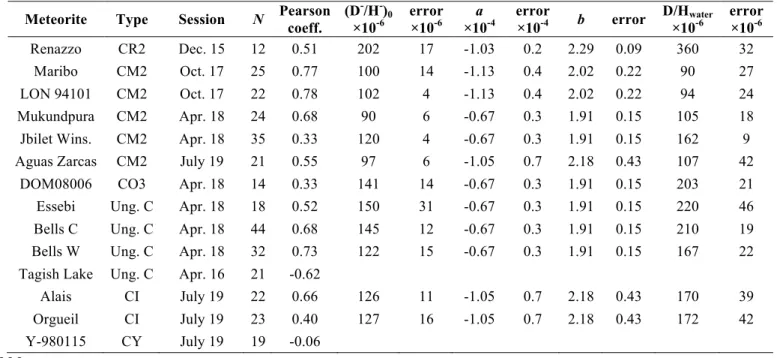
From our SIMS data measured in the chondrite matrices, we obtained correlations 184
between D/H and C/H for ten of the twelve analyzed chondrites (Pearson coefficients from 185
0.33 to 0.78; Table 1; Figs. 1 and S1). No correlation was observed for the chondrites Tagish 186
Lake (ungrouped) and Y-980115 (CY; Table 1; Figs. 1b and S1). For the ten others, the D/H 187
ratio of water was estimated from the zero-intercept and corrected for instrumental mass 188
fractionation using the standard calibration measured during the same session (Table 1, Fig. 189
1). 190
Water in four of the five CM-type carbonaceous chondrites has D/H ratios that are 191
identical within error (2σ, Table 1): Aguas Zarcas (107 ± 41 × 10–6), LON 94101 (94 ± 24 × 192
10–6), Maribo (90 ± 27 × 10–6), and Mukundpura (105 ± 18 × 10–6). As observed by Piani et 193
al. (2018), the degree of aqueous alteration of a chondrite does not obviously affect the D/H 194
ratio of its water. Compared to the other CM chondrites, only water in Jbilet Winselwan (CM) 195
has a distinctly higher D/H ratio (162 ± 87 × 10–6) and a lower regression coefficient (Pearson 196
coefficient of 0.33) indicating greater scattering of the data around the regression line (Table 197
1). Water in the two CI chondrites Alais and Orgueil has consistent D/H values of 170 ± 39 × 198
10–6 and 172 ± 42 × 10–6, respectively (Table 1). Water in the CO chondrite DOM 08006 is 199
estimated to have a D/H ratio of 203 ± 21 × 10–6 (Table 1), although the correlation in this 200
sample shows a low Pearson correlation coefficient of 0.33 (Table 1). Water in the two 201
ungrouped chondrites Essebi and Bells has D/H ratios of 220 ± 46 × 10–6 and 210 ± 19 × 10–6, 202
respectively (Table 1; Fig. 1), and is thus enriched in deuterium compared to water in the CI, 203
CM, and CO chondrites. In contrast to the Bells C sample (D/H = 210 ± 19 × 10–6), water in 204
the Bells W sample presents a lower D/H value (167 ± 22 × 10–6) that might indicate either 205
terrestrial contamination of this late-recovered sample or heterogeneity within the Bells 206
chondrite. Water in the CR chondrite Renazzo has a D/H ratio of 360 ± 32 × 10–6 (Table 1), 207
the most deuterium-rich value yet obtained for water in carbonaceous chondrite matrices. 208
209
4. Discussion 210
211
4.1 Hydrogen isotopic compositions of chondritic water 212
213
The D/H ratios determined in this study for water in CM, CI, CO, and CR chondrites 214
span a large range of values, from 90 to 360 × 10–6 (Fig. 2, Table 1). In Figure 2, these values 215
are reported alongside those estimated in our previous works for water in CV and other CM 216
chondrites (Piani et al., 2018; Piani and Marrocchi, 2018) and by bulk analyses of CM and 217
CR chondrites (Alexander et al., 2012). Except for Jbilet Winselwan, our D/H ratios estimated 218
for water in CM chondrites (90–107 × 10–6)are similar within errors to the mean value
219
obtained previously using the same technique (101 ± 6 × 10⁻⁶, Fig. 2; Piani et al., 2018). 220
Excluding the peculiar CM chondrites Jbilet Winselwan and the D-rich Paris (Vacher et al., 221
2016; Piani et al., 2018), the average D/H ratio of water in all CMs analyzed is 100 ± 4 × 10⁻⁶ 222
(2σ). This value is in agreement with those inferred from hydrated minerals in Maribo (103– 223
114 × 10–6; van Kooten et al., 2018), but is slightly higher than that determined from the bulk 224
measurements of 45 CM chondrites characterized by different degrees of aqueous alteration 225
(87 ± 8 × 10⁻⁶, 2σ, Fig. 2; Alexander et al., 2012). Our D/H ratio for water in the CR 226
chondrite Renazzo (360 ± 32 × 10–6, 2σ) is significantly higher than that estimated from bulk 227
measurements of 11 CR carbonaceous chondrites (96!!"!!!" × 10–6, 2σ; Alexander et al., 2012).
228
However, we consider that their D/H value for water is more representative than our estimate 229
based on a single meteorite. Because only a single CO chondrite was measured in this study, 230
our estimate might not be representative of water in other CO chondrites and will be omitted 231
from further discussion. 232
An important outcome of our results is that the average D/H ratios of water are distinct 233
among the different chondrite groups: 149 ± 10 × 10–6 (2σ), 100 ± 4 ×10⁻⁶ (2σ), 171!!"!!" × 10–
234
6 (1σ; Alexander et al., 2012), 171 ± 16 × 10–6 (2σ), and 215 ± 10 × 10–6 (2σ) in CV, CM,
235
CR, CI, and ungrouped chondrites, respectively (Fig. 2). These values are either similar to 236
(CV, CI, and ungrouped) or lower than (CM and CR) those obtained for the bulk chondrites 237
(Fig. 3; Table S1 and references therein), likely reflecting the accretion of variable amounts of 238
organic matter with varying D enrichments. The range of water D/H values observed in 239
carbonaceous chondrites (CCs) is thus small and D-depleted compared to the most pristine 240
ordinary chondrite (OC) Semarkona (D/H = 393–609 × 10–6; Deloule and Robert, 1995; Piani
241
et al., 2015) and cometary water (D/H = 140–650 × 10–6; Altwegg et al., 2017 and references
242
therein; Fig. 3 and 4). 243
The D/H ratios of the main component of chondritic organic matter, insoluble organic 244
matter (IOM), have been measured in a large set of samples (Alexander et al., 2007) and show 245
a wider range than those of water in both CCs and non-carbonaceous chondrites (NCs; Fig. 246
4). IOM D/H ratios in the three groups of OCs (870 × 10–6, 660 × 10–6, and 710 × 10–6 in H, 247
L, and LL groups, respectively; Table S1) are about 4 times the average value of IOM in 248
enstatite chondrites (D/H = 153 × 10–6; Table S1, Fig. 4; Alexander et al., 2007; Piani et al., 249
2012). In carbonaceous chondrites, IOM D/H ratios increase from CV/CO (~220 × 10–6) to 250
CM/CI (~300 × 10–6) and finally to CR/ungrouped (>600 × 10–6; Table S1; Fig. 4). 251
The origin of these large hydrogen isotopic variations in chondritic water and IOM in 252
both NCs and CCs remains unclear and controversial. These variations have been attributed to 253
several processes and/or locations within the protoplanetary disk, including early fluid 254
circulation during the evolution of chondritic parent bodies, physico-chemical processes 255
operating in the solar protoplanetary disk, and inheritance from the molecular cloud. In the 256
following section, we discuss these different possibilities in light of our new results and using 257
diagrams compiling the D/H values of chondritic water, IOM, and the bulk meteorites (Fig. 3 258
and 4). 259
260
4.2 Origin of hydrogen isotopic variations in chondritic water and organics 261
262
4.2.1 Role of parent-body processes
263 264
It has been proposed that secondary parent-body processes could be at the origin of the 265
hydrogen isotopic variations observed in chondrites due to (1) the aqueous oxidation of iron-266
bearing phases followed by H2 loss and Rayleigh-type isotopic fractionation (Alexander et al.,
267
2010; Sutton et al., 2017) and/or (2) hydrogen isotopic exchange between organic 268
components and aqueous fluids (Alexander et al., 2010; Bonal et al., 2013). The former 269
process is considered to be most effective for enriching the most water-depleted chondrites 270
(i.e., OCs, CV and CO-type CCs) in deuterium because their bulk D/H ratios are not buffered 271
by the large amount of remaining water (Alexander et al., 2010). The efficiency of the latter 272
process should depend on the temperature and duration of the interaction between water and 273
organics as well as the nature of the organics and their ability to exchange hydrogen with 274
water (e.g., Sessions et al., 2004). However, no experimental study has measured the putative 275
H isotopic fractionation produced through the anaerobic corrosion of metal, and tests of 276
water-organic isotopic exchanges under asteroidal conditions revealed complex patterns 277
(Foustoukos et al., 2021). In addition, these models are based on the strong and debatable 278
assumptions that (i) all chondrites accreted water-ice and organic matter with similar 279
respective D/H ratios and (ii) asteroidal parent-body processes have swamped any D 280
enrichments inherited from solar-system or molecular-cloud processes (Alexander et al., 281
2010; Sutton et al., 2017). Consequently, the parent-body model remains speculative and 282
difficult to comprehend given the complexity of organic components in meteorites (De 283
Gregorio et al., 2010; Remusat et al., 2010). Based on our data and a comprehensive 284
hydrogen isotopic database, we show in the following paragraphs that secondary parent-body 285
processes, although important, cannot be advocated as the main processes controlling the 286
observed D/H variations of chondrites and their constituents. 287
288
Ordinary chondrites. Highly heterogeneous D/H values and extreme D-enrichments
289
up to D/H = 1,800 × 10–6 have been reported in the matrix of the least altered OC LL3.00 290
Semarkona (Deloule and Robert, 1995; Grossman and Brearley, 2005; Piani et al., 2015). 291
Although OCs display the most D-rich bulk values among chondrites, their IOM is less 292
enriched in D and more homogenous (showing only rare, micron-sized D-rich anomalies, or 293
"hotspots"; Remusat et al., 2016) than some of the extremely heterogeneous hydrated 294
minerals found in Semarkona (Piani et al., 2015). These facts do not support OM-water 295
isotopic exchanges following the D enrichment of water through Rayleigh-type fractionations 296
(Alexander et al., 2010). Moreover, if IOM was enriched in D by isotopic exchange with 297
water that was itself enriched in D due to H2 loss, the bulk D/H ratios of moderately
298
metamorphosed OCs should be enriched in D compared to the least metamorphosed OCs. 299
However, D enrichments are observed even in the most pristine OCs (i.e., <3.2; Marrocchi et 300
al., 2020) whereas mildly to highly metamorphosed chondrites show D-poor bulk 301
compositions (McCubbin and Barnes, 2019; Vacher et al., 2020). This strongly suggests that 302
the D enrichments and heterogeneities observed at both mineral and bulk scales in OCs do not 303
result from H2 loss during parent-body processes but were inherited from ice precursors.
304 305
CM chondrites. Excluding Paris and Jbilet Winselwan, water in all CM chondrites
306
displays similar D/H ratios, regardless of the degree of alteration (Fig. 2; Piani et al., 2018). 307
The Paris chondrite is a specific case because water in the least altered lithology is 308
significantly enriched in D compared to the more altered lithology, which shows D/H values 309
close to the average for CM water (Piani et al., 2018). Because Fe-Ni metal beads have been 310
highly oxidized in the altered Paris lithology but remain unaltered in the most pristine regions 311
(Hewins et al., 2014; Marrocchi et al., 2014), the opposite isotopic characteristics are 312
expected if Rayleigh-type fractionation following metal oxidation and H2 loss were the
313
dominant processes controlling D/H variations. Furthermore, the similarity of the water D/H 314
ratios estimated by SIMS (100 ± 4 × 10⁻⁶; Piani et al., 2018) and bulk measurements (87 ± 8 × 315
10–6; Alexander et al., 2012) implies that isotopic re-equilibration between water and organics 316
was extremely limited during the evolution of the CM parent body(ies). Indeed, any isotopic 317
exchange would have increased the D/H ratio of water while decreasing that of organics, the 318
intensity of isotopic variations being dependent on their relative proportions (e.g., Foustoukos 319
et al., 2021). If that were the case, important isotopic differences would be particularly 320
expected for chondrites characterized by varying degrees of alteration, such Cold Bokkeveld 321
(CM2.2, highly altered), LON 94101 (CM2.2/2.3, mildly altered), and Murray (CM2.5, 322
poorly altered), which is not the case (Fig. 2 and Fig. 5; Piani et al., 2018). The lack of IOM-323
water isotopic equilibration in CMs implies the existence of an additional C-bearing 324
component having higher D/H values than IOM. Importantly, recent bulk hydrogen 325
measurements performed on a series of CCs and OCs revealed the importance of removing 326
atmospheric contamination when measuring H contents and isotopic compositions (Vacher et 327
al., 2020). They performed pre-degassing at 120 °C during 48 h under vacuum prior to H 328
measurements to remove atmospheric water adsorbed on the sample surface. The lower slope 329
obtained in the D/H vs. C/H plot for samples for which the atmospheric contamination was 330
reduced (Fig. 6A) is inconsistent with the IOM of CMs being initially as D-rich as the IOM in 331
CRs (Fig. 6B), indicating that they inherited isotopically distinct IOM in their respective 332
parent bodies. 333
334
CI, CR, and Bells/Essebi chondrites. These chondrites are characterized by (i) D-rich
335
water and IOM compared to CMs (Fig. 4) and (ii) the presence of D-rich hotspots in IOM 336
(e.g., Busemann et al., 2006). In addition, large D/H variations have been reported in hydrated 337
minerals in CR chondrites (Bonal et al., 2013). These characteristics imply that water-IOM 338
isotopic exchanges cannot be at the origin of the H isotopic differences between these 339
meteorites and CMs. In addition, Rayleigh-type fractionation is not expected to be efficient in 340
water-rich meteorites (Sutton et al., 2017). Furthermore, small-scale heterogeneities in IOM 341
and hydrated minerals are unlikely to result from parent-body processes unless invoking 342
unconstrained, localized kinetic reactions. 343
344
CV chondrites. The D/H ratios of water and IOM in oxidized CVs are rich and
D-345
poor, respectively, compared to CM water and IOM (Alexander et al., 2007; Piani and 346
Marrocchi, 2018). These peculiar characteristics could result from isotopic exchange during 347
parent-body alteration, assuming an initial CM-like H isotopic composition for water and 348
organics (Piani and Marrocchi, 2018). However, they could also result from the accretion of 349
water-ice and organics from different reservoirs characterized by variable H isotopic 350
compositions (Piani and Marrocchi, 2018). 351
352
Jbilet Winselwan (CM), Tagish Lake (C-ungrouped), and Y-980115 (CY). The absence
353
of a positive correlation between D/H and C/H in these peculiar chondrites (Table 1) may 354
suggest perturbations of the initial isotopic signatures of their organic and water components. 355
Such perturbations might have resulted from impact-induced dehydration in Jbilet Winselwan 356
(King et al., 2019a), thermal metamorphism (>500 °C, King et al., 2019b) and/or terrestrial 357
weathering in Y-980115 (e.g., Alexander et al., 2018), or IOM-water isotopic exchange 358
and/or the possible loss of a D-rich component in Tagish Lake (Herd et al., 2011). Another 359
possible explanation for Tagish Lake could be that the abundant carbonates, that can represent 360
half of the total carbon content (Grady et al., 2002), could influence the measured C/H ratio 361
independently to the D/H ratio. 362
Thus, the H isotopic compositions of bulk CCs and their water and IOM do not 363
support a preponderant role of parent-body processes in controlling D/H variations among 364
chondrites. CV chondrites are the only group in which isotopic exchanges between water and 365
organics remain possible or even favorable due to the high hydrothermal temperatures of the 366
CV parent body (Ganino and Libourel, 2017). In addition, only a few specific meteorites 367
(Jbilet Winselwan, Tagish Lake, Y-980115) experienced hydrothermal alteration and impact 368
heating sufficient to modify their primordial isotopic signatures. These results thus suggest 369
that the H isotopic features of chondrites are mostly inherited from processes that operated 370
within the solar system and/or the parent molecular cloud. 371
372
4.2.2 Fingerprints of the protosolar molecular cloud in meteoritic water and organics
373 374
Astronomical observations have revealed that water molecules in the interstellar 375
medium (ISM) are significantly enriched in deuterium relative to molecular hydrogen, with 376
D/H ratios of water in protostars reaching up to a few 10–2(e.g., Ceccarelli et al., 2014 and 377
references therein). Similarly, highly D-rich organics (i.e., 2–7 × 10⁻²; Roberts et al., 2002) 378
are produced in dense regions of the ISM due to the cold temperatures and high levels of 379
galactic cosmic radiation (Geiss and Gloeckler 2003). Protoplanetary disks are by-products of 380
star formation, resulting from the conservation of angular momentum of the parent molecular 381
cloud from which they formed. Observational and theoretical evidence show that 382
protoplanetary disks are initially compact, with most infalling material from the molecular 383
cloud being injected close to the protostars (Fig. 7; Pignatale et al., 2018; Zhao et al., 2020). 384
While being fed by the molecular cloud, the disks expand through viscous spreading (Hueso 385
and Guillot, 2005) and their centrifugal radii, the distance within which the parental cloud 386
material is injected, increase with time. 387
Infalling D-rich interstellar water-ice grains will experience sublimation upon 388
injection into the inner tens of astronomical units of protoplanetary disks (Visser et al., 2009). 389
Subsequently, the D/H ratio of water will decrease toward bulk chondrite values (i.e., ~150 × 390
10−6) through isotopic exchange with the D-poor protosolar H2 (Jacquet and Robert, 2013;
391
Yang et al., 2013) via the reaction: 392
HDO + H! ↔ H!O + HD ,
393
whose equilibrium fractionation factor 𝛼!!!!!! is temperature-dependent, increasing with 394
decreasing temperature (Richet et al., 1977). Later ionization-driven chemical reactions 395
during the disk’s evolution do not efficiently enrich water in deuterium (Cleeves et al., 2014; 396
Roskosz et al., 2016). This implies that the range of water D/H ratios observed among 397
chondrites (i.e., 90–500 × 10–6; Figs. 3 and 4) corresponds to a mixture between (i) water 398
formed by sublimation, high-temperature isotopic equilibration, and/or recondensation during 399
the evolution of the disk and (ii) inherited D-enriched interstellar ices unaffected by disk 400
processes (Jacquet and Robert, 2013; Yang et al., 2013). The inheritance of molecular cloud 401
material may become even more obvious when considering organic grains because, compared 402
to chondritic water, they show higher and more variable D/H (e.g., Busemann et al., 2006; 403
Alexander et al., 2007; 2012) that cannot be reproduced by disk-ionization models (Cleeves et 404
al., 2016). Nonetheless, organo-synthesis triggered by organic radicals produced in ionized 405
disk environments may at least partly explain the D/H heterogeneities observed in meteoritic 406
organics (Robert et al., 2017). 407
Based on the above observations, we propose a model in which incoming water-ice 408
and organic grains from the molecular cloud episodically fuel the solar protoplanetary disk 409
throughout its evolution. The lifetimes of star-forming molecular clouds are estimated to be 410
~20–30 Myr (Murray, 2011), implying that D-rich water-ice and organic grains from the ISM 411
can be injected into protoplanetary disks throughout their evolution and until their dissipation 412
(i.e., 5–10 Myr). Water-ice and organic grains have different vaporization temperatures (the 413
so-called snow and tar lines; Figs. 7 and 8), with refractory organic grains being stable at 414
much higher temperatures (i.e., above 350–450 K) than water-ice grains (i.e., ~160 K, Fig. 7; 415
Nakano et al., 2003; Kuramoto and Yurimoto, 2005; Bermingham et al., 2020). Consequently, 416
the tar line is inward of the snow line, defining three regions in the disk (#1–3, Fig. 8) where 417
(#1) refractory organic and water-ice grains are sublimated, (#2) refractory organic grains are 418
stable but water is in vapor form, and (#3) both refractory organic and water-ice grains are 419
unaffected. As the disk temperature drops, region #2 will grow due to (i) the inward drift of 420
the tar line and (ii) the fossilization of the snow line at 3 astronomical units (Morbidelli et al., 421
2016). Consequently, within region #2, water-ice grains experience continued sublimation 422
and isotopic exchange with D-poor H2 whereas refractory organics do not, leading to an
423
isotopic decoupling (Fig. 4). This implies that most organic grains are not affected by thermal 424
reprocessing in the disk and maintain their D enrichments and D/H variability. Moreover, the 425
synthesis of organic matter with D-poor signatures in ionized disk environments (e.g., Bekaert 426
et al., 2018) and/or under aqueous conditions on asteroidal parent bodies (e.g., Kebukawa et 427
al., 2013) may result in a final mixture of chondritic organic compounds bearing large H 428
isotopic variations. In contrast to refractory organics, water experiences isotopic exchange 429
with the gas until the disk temperature becomes cold enough for isotopic exchange reactions 430
and sublimation to be ineffective at ~200 K and 160 K, respectively (Fig. 7; Jacquet and 431
Robert, 2013). This naturally explains why hydrated chondritic minerals (and thus water) are 432
less enriched in deuterium and less isotopically variable than organics (Fig. 4; Alexander et 433
al., 2010, 2012; Piani et al., 2015). Thus, depending on the timing of accretion of chondritic 434
parent bodies, water and organics may be characterized by drastically different D/H ratios. 435
Accordingly, in this model, several scenarios are possible: 436
1) Chondrites that accreted early in the disk’s history are characterized by D-poor 437
water and organics (e.g., enstatite chondrites, COs, and CVs; Fig. 4). 438
2) Chondrites that accreted below the organic sublimation temperature comprise D-439
rich organics, but water variably depleted in deuterium compared to the organics (e.g., CMs, 440
CIs, and C-ungrouped; Fig. 4). The D-depleted water in CM chondrites could thus be the 441
result of a more efficient isotopic re-equilibration with H2, possibly at higher temperatures
442
and/or during longer interactions than for CI and C-ungrouped chondrites. 443
3) Finally, chondrites that accreted when the disk cooled to <200 K comprise both D-444
rich water and organic grains (e.g., OCs and CRs; Fig. 4). 445
This model implies that chondrites have continuously recorded processes (i.e., 446
sublimation and isotopic exchange) that eventually became inefficient during the evolution of 447
the protoplanetary disk, thus allowing for the highly heterogeneous isotopic compositions of 448
their constituent hydrated minerals (Bonal et al., 2013; Piani et al., 2015) and/or organics 449
(Busemann et al., 2006). 450
A key question regarding chondrites concerns their accretion ages. As the background 451
temperature of the disk controlled the efficiency of sublimation and isotopic exchange 452
processes (e.g., Jacquet and Robert, 2013), our model suggests that the H-isotopic 453
compositions of both water and organics are also directly related to the timing of accretion of 454
chondrites. It also suggests that the isotopic decoupling between water-ice grains and IOM 455
may have occurred asynchronously between the NC and CC reservoirs because their 456
respective thermal evolutions likely differed, in line with recent models (e.g., Lichtenberg et 457
al., 2021). Of note, our qualitative model is coherent with estimates of the timing of accretion 458
of chondritic parent bodies, with (i) enstatite chondrites having accreted before OCs and CCs 459
and (ii) among CCs, poor CO, CV, and CK chondrites having accreted before water-460
rich CR, CM, and CI chondrites (Sugiura and Fujiya, 2014; Desch et al., 2018). Sugiura and 461
Fujiya (2014) also suggest that OCs, which formed in the inner regions of the disk, may have 462
been accreted before CCs, making the large H isotopic variabilities observed in OCs 463
counterintuitive, as one would expect that the inner disk remained hotter for a longer duration 464
than the outer disk. However, recent estimates of the ages of OC chondrules using Al-Mg and 465
Pb-Pb systematics have shown that they formed up to 3 Myr after the formation of Ca- and 466
Al-rich inclusions (Bollard et al., 2017; Pape et al., 2019). Because chondrules formed before 467
the accretion of planetesimals, this implies that the OC and CC parent body(ies) formed 468
contemporaneously, further highlighting the isotopic decoupling between water-ice grains and 469
IOM (Fig. 4). 470
Because some D-rich organics and waters are not at isotopic equilibrium with the gas 471
of the disk (i.e., largely different water and IOM values per chondrite class in Fig. 4), our data 472
suggest that they did not experience the high-temperature chondrule-forming events that 473
would have induced sublimation, isotopic exchange, and/or recondensation. Hence, we 474
propose that the isotopically heterogeneous D-rich ices and organics observed in OCs and 475
CRs correspond to materials that arrived and were reprocessed late in the history of the disk. 476
Interestingly, this suggests that both the inner and outer parts of the disk were, at some point, 477
cold enough for unprocessed, D-rich interstellar water-ice and organic grains to accrete (Fig. 478
7). This also reiterates that the parent molecular cloud episodically fed the disk for at least 479
several million years, and possibly throughout the disk’s history, through filaments 480
connecting both structures (Hennebelle et al., 2016; Zhao et al., 2020). Such structures 481
−observed at all scales in the interstellar medium, from molecular clouds to individual stars− 482
result from prominent contracting forces induced by gravity, turbulences and/or magnetic 483
fields (e.g., Federrath, 2016). They play a key role in the star-forming processes and could 484
have contributed to the establishment of the peculiar H isotopic signature of our solar system. 485 486 487 488 489 5. Concluding remarks 490 491
We determined the hydrogen isotopic compositions of water in a large set of 492
chondritic samples (CI, CM, CO, CR, CY, and C-ungrouped) by in-situ SIMS analyses. Our 493
main result is that the D/H ratios of chondritic water appear to be distinct and unique among 494
the different groups of carbonaceous chondrites. This result can be used for the 495
characterization and comparison of the samples returned from the asteroids Ryugu and Bennu 496
by the spatial missions Hayabusa 2 (JAXA; 5.4 g of samples delivered to Earth in December 497
2020) and OSIRIS-REx (NASA; to be returned on Earth in 2023). Waters in CCs are D-498
depleted and show a restricted range of D/H values relative to the most pristine ordinary 499
chondrite and cometary water. 500
From these results, and by comparison with literature data on chondritic water and 501
organics, we drew the following conclusions. 502
(i) The D/H ratios of water and IOM do not support a preponderant role of parent-503
body processes in controlling the D/H variations of carbonaceous and ordinary chondrites. 504
(ii) D/H variations among chondrites represent a mixture between water formed by 505
sublimation, high-temperature isotopic equilibration, and/or recondensation during the 506
evolution of the disk and inherited D-rich interstellar ices unaffected by those processes. 507
(iii) Based on their different sublimation temperatures, water-ice experienced 508
sublimation and isotopic exchange with molecular H2 for a longer duration than refractory
509
organics. This induced an isotopic decoupling through which organics preserve more D-rich 510
signatures than water. 511
(iv) Hydrated minerals and/or organics in later-accreted chondrites may record 512
extreme and highly heterogeneous D/H values inherited from the interstellar medium. 513
(v) The molecular cloud episodically fed the protoplanetary disk for several millions 514
of years through filaments connecting both structures. 515
516
Appendix A. Supplementary material 517
Table S1 presents the literature data for bulk, IOM and water D/H ratios used in Fig. 3 and 4. 518
Fig. S1 presents the measured D/H vs. 13C/H ratios measured by SIMS in the matrices of all 519
carbonaceous chondrites analyzed in the present study (Table 1). Linear fits (solid lines) and 520
95% confidence interval bands (dashed lines) are shown for all chondrites. Error bars 521
represent 2σ internal errors. 522
523
Appendix B. Supplementary material 524
SIMS data related to this article can be found on-line at https://doi.org/10.24396/ORDAR-61. 525
526 527 528 529
530 531 532 Acknowledgments 533 534
Conel Alexander is warmly thanked for stimulating discussions on the onset of parent-535
body processes. Patrick Hennebelle and Sébastien Charnoz are warmly thanked for intense 536
and fruitful discussions on the interactions between molecular clouds and accretion disks. We 537
thank Conel Alexander and Kieren Howard for providing the Bells, Essebi, and DOM 08006 538
powders. We also thank the National Institute of Polar Research (Japan), the Natural History 539
Museum of Denmark (Copenhagen), and the Museum national d’Histoire Naturelle (Paris, 540
France) for loaning samples. This work was funded by l’Agence Nationale de la Recherche 541
through grant ANR-19-CE31-0027-01 HYDRaTE (PI Laurette Piani). This is CRPG 542 contribution #2728. 543 544 545 546 547 548 549 550 551 552 553 554 555
References 556
Alexander, C.M.O'D., Herd, C.D.K., Nittler, L.R., Bowden, R., Fogel, M.L., Howard, K.T., 557
2012. The provenances of asteroids, and their contributions to the volatile inventories of 558
the terrestrial planets. Science 337, 721–723. 559
Alexander, C.M.O'D., Fogel, M., Yabuta, H., Cody, G.D., 2007. The origin and evolution of 560
chondrites recorded in the elemental and isotopic compositions of their macromolecular 561
organic matter. Geochim. Cosmochim. Acta 71, 4380–4403. 562
Alexander, C.M.O'D., Greenwood, R.C., Bowden, R., Gibson, J.M., Howard, K.T., Franchi, 563
I.A., 2018. A mutli-technique search for the most primitive CO chondrites. Geochim. 564
Cosmochim. Acta 221, 406–420. 565
Alexander, C.M.O'D., Howard, K.T., Bowden, R., Fogel, M.L., 2013. The classification of 566
CM and CR chondrites using bulk H, C and N abundances and isotopic compositions. 567
Geochim. Cosmochim. Acta 123, 244–260. 568
Alexander, C.M.O'D., Newsome, S.D., Fogel, M.L., Nittler, L.R., Busemann, H., Cody, G.D., 569
2010. Deuterium enrichments in chondritic macromolecular material-Implications for 570
the origin and evolution of organics, water and asteroids. Geochim. Cosmochim. Acta 571
74, 4417–4437. 572
Altwegg, K., Balsiger, H., Berthelier, J.J., Bieler, A., Bochsler, P., Briois, C., Calmonte, U., 573
Combi, M., Keyser, J. De, Eberhardt, P., Fiethe, B., Fuselier, S.A., Galand, M., Gasc, 574
S., Gombosi, T.I., Hansen, K.C., Keller, H.U., Kopp, E., Korth, A., Roy, L. Le, Mall, 575
U., Marty, B., Mousis, O., Neefs, E., Owen, T., Rubin, M., Tornow, C., Waite, J.H., 576
Wurz, P., 2015. Time variability and heterogeneity in the coma of 67P/Churyumov-577
Gerasimenko. Science 347, 2–5. 578
Altwegg, K., Balsiger, H., Berthelier, J.J., Bieler, A., Calmonte, U., De Keyser, J., Fiethe, B., 579
Fuselier, S.A., Gasc, S., Gombosi, T.I., Owen, T., Le Roy, L., Rubin, M., Sémon, T., 580
Tzou, C.-Y., 2017. D2O and HDS in the coma of 67P/Churyumov–Gerasimenko.
581
Philos. Trans. R. Soc. A Math. Phys. Eng. Sci. 375, 20160253. 582
Bekaert, D. V., Derenne, S., Tissandier, L., Marrocchi, Y., Charnoz, S., Anquetil, C., Marty, 583
B., 2018. High-temperature ionization-induced synthesis of biologically relevant 584
molecules in the protosolar nebula. Astrophys. J. 859, 142. 585
Bermingham, K.R., Füri, E., Lodders, K., Marty, B., 2020. The NC-CC isotope dichotomy: 586
Implications for the chemical and isotopic evolution of the early solar system. Space 587
Sci. Rev. 216, 133. 588
Bockelée-Morvan, D., Calmonte, U., Charnley, S., Duprat, J., Engrand, C., Gicquel, A., 589
Hässig, M., Jehin, E., Kawakita, H., Marty, B., Milam, S., Morse, A., Rousselot, P., 590
Sheridan, S., Wirström, E., 2015. Cometary isotopic measurements. Space Sci. Rev. 591
197, 47–83. 592
Bollard, J., Connelly, J.N., Whitehouse, M.J., Pringle, E.A., Bonal, L., Jørgensen, J.K., 593
Nordlund, A., Moynier, F., Bizzarro, M., 2017. Early formation of planetary building 594
blocks inferred from Pb isotopic ages of chondrules. Science Advances 3, e1700407. 595
Bonal, L., Alexander, C.M.O'D., Huss, G.R., Nagashima, K., Quirico, E., Beck, P., 2013. 596
Hydrogen isotopic composition of the water in CR chondrites. Geochim. Cosmochim. 597
Acta 106, 111–133. 598
Busemann, H., Young, A.F., Alexander, C.M.O'D., Hoppe, P., Mukhopadhyay, S., Nittler, 599
L.R., 2006. Interstellar chemistry recorded in organic matter from primitive meteorites. 600
Science 312, 727–730. 601
Ceccarelli, C., Caselli, P., Bockelée-Morvan, D., Mousis, O., Pizzarello, S., Robert, F., 602
Semenov, D., 2014. Deuterium fractionation: The Ariadne’s thread from the precollapse 603
phase to meteorites and comets today, in: Protostars and Planets VI, Henrik Beuther, 604
Ralf S. Klessen, Cornelis P. Dullemond, and Thomas Henning (eds.), University of 605
Arizona Press, Tucson, 914 pp., p.859-882. 606
Cleeves, L.I., Bergin, E.A., Alexander, C.M.O'D., Du, F., Graninger, D., Öberg, K.I., Harries, 607
T.J., 2016. Exploring the Origins of deuterium enrichments in solar nebular organics. 608
Astrophys. J. 819, 13. 609
Cleeves, L.I., Bergin, E.A., Alexander, C.M.O'D., Du, F., Graninger, D., Öberg, K.I., Harries, 610
T.J., 2014. The ancient heritage of water ice in the solar system. Science 345, 1590– 611
1593. 612
Desch, S.J., Kalyaan, A., Alexander, C.M.O'D., 2018. The effect of Jupiter’s formation on the 613
distribution of refractory elements and inclusions in meteorites. Astrophys. J. Suppl. 614
Ser. 238, 11. 615
De Gregorio, B.T., Stroud, R.M., Nittler, L.R., Alexander, C.M.O'D., Kilcoyne, A.L.D., Zega, 616
T.J., 2010. Isotopic anomalies in organic nanoglobules from Comet 81P/Wild 2: 617
Comparison to Murchison nanoglobules and isotopic anomalies induced in terrestrial 618
organics by electron irradiation. Geochim. Cosmochim. Acta 74, 4454–4470. 619
Deloule, E., Robert, F., 1995. Interstellar water in meteorites? Geochim. Cosmochim. Acta 620
59, 4695–4706. 621
Federrath, C., 2016, On the universality of interstellar filaments: theory meets simulations and 622
observations. Monthly Notices of the Royal Astronomical Society, 457, 375-388. 623
Foustoukos, D.I., Alexander, C.M.O'D., Cody, G.D., 2021. H and N systematics in thermally 624
altered chondritic insoluble organic matter: an experimental study. Geochim. 625
Cosmochim. Acta, In press. 626
Ganino, C., Libourel, G., 2017. Reduced and unstratified crust in CV chondrite parent body. 627
Nat. Commun. 8. 628
Geiss J, Gloeckler G, 2003. Isotopic composition of H, He and Ne in the protosolar cloud. 629
Space Science Reviews 106, 3–18. 630
Gounelle, M., Meynet, G., 2012. Solar system genealogy revealed by extinct short-lived 631
radionuclides in meteorites. Astronomy and Astrophysics 545, A4-9. 632
Grady, M.M., Verchovsky, A.B., Franchi, I.A., Wright, I.P., Pillinger, C.T., 2002. Light 633
element geochemistry of the Tagish Lake CI2 chondrite: comparison with CI1 and CM2 634
meteorites. Meteorit. Planet. Sci. 713–735. 635
Grossman, J.N., Brearley, A.J., 2005. The onset of metamorphism in ordinary and 636
carbonaceous chondrites. Meteorit. Planet. Sci. 40, 87–122. 637
Hennebelle, P., Commerçon, B., Chabrier, G., Marchand, P., 2016. Magnetically self-638
regulated formation of early protoplanetary disks. The Astrophysical Journal 830, L8. 639
Herd, C.D.K., Blinova, A., Simkus, D.N., Huang, Y., Tarozo, R., Alexander, C.M.O., 640
Gyngard, F., Nittler, L.R., Cody, G.D., Fogel, M.L., Kebukawa, Y., Kilcoyne, A.L.D., 641
Hilts, R.W., Slater, G.F., Glavin, D.P., Dworkin, J.P., Callahan, M.P., Elsila, J.E., De 642
Gregorio, B.T., Stroud, R.M., 2011. Origin and evolution of prebiotic organic matter as 643
inferred from the Tagish Lake meteorite. Science 332, 1304–1307. 644
Hewins, R.H., Bourot-Denise, M., Zanda, B., Leroux, H., Barrat, J.A., Humayun, M., Göpel, 645
C., Greenwood, R.C., Franchi, I.A., Pont, S., Lorand, J.P., Cournède, C., Gattacceca, J., 646
Rochette, P., Kuga, M., Marrocchi, Y., Marty, B., 2014. The Paris meteorite, the least 647
altered CM chondrite so far. Geochim. Cosmochim. Acta 124, 190–222. 648
Howard, K.T., Alexander, C.M.O'd., Schrader, D.L., Dyl, K.A., 2015. Classification of 649
hydrous meteorites (CR, CM and C2 ungrouped) by phyllosilicate fraction: PSD-XRD 650
modal mineralogy and planetesimal environments. Geochim. Cosmochim. Acta 149, 651
206–222. 652
Howard, K.T., Benedix, G.K., Bland, P.A., Cressey, G., 2011. Modal mineralogy of CM 653
chondrites by X-ray diffraction (PSD-XRD): Part 2. Degree, nature and settings of 654
aqueous alteration. Geochim. Cosmochim. Acta 75, 2735–2751. 655
Hueso, R., Guillot, T., 2005. Evolution of protoplanetary disks: constraints from DM Tauri 656
and GM Aurigae. Astronomy and Astrophysics 442, 703–725. 657
Jacquet, E., Robert, F., 2013. Water transport in protoplanetary disks and the hydrogen 658
isotopic composition of chondrites. Icarus 223, 722–732. 659
Kebukawa, Y., David Kilcoyne, A.L., Cody, G.D., 2013. Exploring the potential formation of 660
organic solids in chondrites and comets through polymerization of interstellar 661
formaldehyde. Astrophys. J. 771. 662
King, A.J., Bates, H.C., Krietsch, D., Busemann, H., Clay, P.L., Schofield, P.F., Russell, S.S., 663
2019a. The Yamato-type (CY) carbonaceous chondrite group: Analogues for the 664
surface of asteroid Ryugu? Chemie der Erde 79, 125531. 665
King, A.J., Russell, S.S., Schofield, P.F., Humphreys-Williams, E.R., Strekopytov, S., 666
Abernethy, F.A.J., Verchovsky, A.B., Grady, M.M., 2019b. The alteration history of the 667
Jbilet Winselwan CM carbonaceous chondrite: An analog for C-type asteroid sample 668
return. Meteorit. Planet. Sci. 54, 521–543. 669
Kuramoto K. and Yurimoto H., 2005. Oxygen isotopic heterogeneity in the solar system: the 670
molecular cloud origin hypothesis and its implications for meteorites and the planets. In 671
Chondrites and the Protoplanetary Disk (eds. A. N. Krot, E. R. D. Scott, and B. 672
Reipurth), pp. 181-192. ASP Conference Series. 673
Kuznetsova, A., Hartmann, L., Heitsch, F., 2020. Angular Momenta, Magnetization, and 674
Accretion of Protostellar Cores. The Astrophysical Journal 893, 73. 675
Le Guillou, C., Brearley, A., 2014. Relationships between organics, water and early stages of 676
aqueous alteration in the pristine CR3.0 chondrite MET 00426. Geochim. Cosmochim. 677
Acta 131, 344–367. 678
Lichtenberg, T., Dra̧żkowska, J., Schönbächler, M., Golabek, G.J., Hands, T.O., 2021. 679
Bifurcation of planetary building blocks during Solar System formation. Science 371, 680
365–370. 681
Lindgren, P., Lee, M.R., Sofe, M., Burchell, M.J., 2011. Microstructure of calcite in the CM2 682
carbonaceous chondrite LON 94101: Implications for deformation history during and/or 683
after aqueous alteration. Earth Planet. Sci. Lett. 306, 289–298. 684
Marrocchi, Y., Bonal, L., Gattacceca, J., Piani, L., Beck, P., Greenwood, R., Eschrig, J., 685
Basque, A., Nuccio, P.M., Martin, F.F., 2020. The Piancaldoli meteorite: A forgotten 686
primitive LL3.10 ordinary chondrite. Meteorit. Planet. Sci. 55, 1–12. 687
Marrocchi, Y., Gounelle, M., Blanchard, I., Caste, F., Kearsley, A.T., 2014. The Paris CM 688
chondrite: Secondary minerals and asteroidal processing. Meteorit. Planet. Sci. 49, 689
1232–1249. 690
Martin, P.M.C., Lee, M.R., 2020. Degree of aqueous alteration of the CM carbonaceous 691
chondrite Aguas Zarcas: implication for understanding Ryugu and Bennu, in: Lunar and 692
Planetary Institute Science Conference. p. 1375. 693
McCubbin, F.M., Barnes, J.J., 2019. Origin and abundances of H2O in the terrestrial planets,
694
Moon, and asteroids. Earth Planet. Sci. Lett. 526, 115771. 695
Morbidelli, A., Bitsch, B., Crida, A., Gounelle, M., Guillot, T., Jacobson, S., Johansen, A., 696
Lambrechts, M., Lega, E., 2016. Fossilized condensation lines in the Solar System 697
protoplanetary disk. Icarus 267, 368–376. 698
Murray, N., 2011. Star formation efficiencies and lifetimes of giant molecular clouds in the 699
milky way. The Astrophysical Journal 729, 133. 700
Nakano, H., Kouchi, A., Tachibana, S., Tsuchiyama, A., 2003. Evaporation of interstellar 701
organic materials in the Solar Nebula. Astrophys. J. 592, 1252–1262. 702
Pape, J., Mezger, K., Bouvier, A.-S., Baumgartner, L.P., 2019. Time and duration of 703
chondrule formation: Constraints from 26Al-26Mg ages of individual chondrules. 704
Geochimica et Cosmochimica Acta 244, 416–436. 705
Piani, L., Marrocchi, Y., 2018. Hydrogen isotopic composition of water in CV-type 706
carbonaceous chondrites. Earth Planet. Sci. Lett. 504, 64–71. 707
Piani, L., Marrocchi, Y., Rigaudier, T., Vacher, L.G., Thomassin, D., Marty, B., 2020. Earth’s 708
water may have been inherited from material similar to enstatite chondrite meteorites. 709
Science 369, 1110–1113. 710
Piani, L., Robert, F., Remusat, L., 2015. Micron-scale D/H heterogeneity in chondrite 711
matrices: A signature of the pristine solar system water? Earth Planet. Sci. Lett. 415, 712
154–164. 713
Piani L., Robert F., Beyssac O., Binet L., Bourot-Denise M., Derenne S., Le Guillou C., 714
Marrocchi Y., Mostefaoui S., Rouzaud J.-N. and Thomen A. (2012) Structure, 715
composition, and location of organic matter in the enstatite chondrite Sahara 97096 716
(EH3). Meteorit. Planet. Sci. 47(1), 8–29. 717
Piani, L., Yurimoto, H., Remusat, L., 2018. A dual origin for water in carbonaceous asteroids 718
revealed by CM chondrites. Nat. Astron. 2, 317–323. 719
Pignatale, F.C., Charnoz, S., Chaussidon, M., Jacquet, E., 2018. Making the planetary 720
material diversity during the early assembling of the Solar System. Astrophys. J. Lett. 721
867, L23. 722
Remusat, L., Guan, Y., Wang, Y., Eiler, J.M., 2010. Accretion and preservation of D-rich 723
organic particles in carbonaceous chondrites: Evidence for important transport in the 724
early solar system nebulA. Astrophys. J. 713, 1048–1058. 725
Remusat, L., Piani, L., Bernard, S., 2016. Thermal recalcitrance of the organic D-rich 726
component of ordinary chondrites. Earth Planet. Sci. Lett. 435, 36-44. 727
Richet, P., Bottinga, Y., Javoy, M., 1977. A Review of hydrogen, carbon, nitrogen, oxygen, 728
sulphur, and chlorine stable isotope fractionation among gaseous molecules. Annual 729
Review of Earth and Planetary Sciences 5, 65–110. 730
Robert, F., Derenne, S., Lombardi, G., Hassouni, K., Michau, A., Reinhardt, P., Duhamel, R., 731
Gonzalez, A., Biron, K., 2017. Hydrogen isotope fractionation in methane plasma. Proc. 732
Natl. Acad. Sci. 114, 870–874. 733
Roberts, H., Fuller, G.A., Millar, T.J., Hatchell, J., Buckle, J.V., 2002. A survey of 734
[HDCO]/[H2CO] and [DCN]/[HCN] ratios towards low-mass protostellar cores. A&A
735
381, 1026–1038. 736
Roskosz, M., Laurent, B., Leroux, H., Remusat, L., 2016. Experimental investigation of 737
irradiation-driven hydrogen isotope fractionation in analogs of protoplanetary hydrous 738
silicate dust. Astrophys. J. 832, 55. 739
Rudraswami, N.G., Naik, A.K., Tripathi, R.P., Bhandari, N., Karapurkar, S.G., Prasad, M.S., 740
Babu, E.V.S.S.K., Vijaya Sarathi, U.V.R., 2019. Chemical, isotopic and amino acid 741
composition of Mukundpura CM2.0 (CM1) chondrite: Evidence of parent body aqueous 742
alteration. Geosci. Front. 10, 495–504. 743
Scott, E.R.D., Krot, A.N., 2014. Chondrites and Their Components, in: Davis, A.M. (Ed.), 744
Meteorites and cosmochemical processes, Volume 1 of Treatise on Geochemistry 745
(Second Edition). Elsevier, 2014. pp. 65–137. 746
Sessions, A.L., Sylva, S.P., Summons, R.E., Hayes, J.M., 2004. Isotopic exchange of carbon-747
bound hydrogen over geologic timescales. Geochim. Cosmochim. Acta 68, 1545–1559. 748
Sugiura, N., Fujiya, W., 2014. Correlated accretion ages and ε54Cr of meteorite parent bodies 749
and the evolution of the solar nebula. Meteorit. Planet. Sci. 49, 772–787. 750
Sutton, S., Alexander, C.M.O'D., Bryant, A., Lanzirotti, A., Newville, M., Cloutis, E.A., 751
2017. The bulk valence state of Fe and the origin of water in chondrites. Geochim. 752
Cosmochim. Acta 211, 115–132. 753
Vacher, L.G., Marrocchi, Y., Verdier-Paoletti, M.J., Villeneuve, J., Gounelle, M., 2016. 754
Inward radial mixing of interstellar water ices in the solar protoplanetary disk. 755
Astrophys. J. 827, L1. 756
Vacher, L.G., Piani, L., Rigaudier, T., Thomassin, D., Florin, G., Piralla, M., Marrocchi, Y., 757
2020. Hydrogen in chondrites: Influence of parent body alteration and atmospheric 758
contamination on primordial components. Geochim. Cosmochim. Acta 281, 53–66. 759
van Kooten, E.M.M.E., Cavalcante, L.L., Nagashima, K., Kasama, T., Balogh, Z.I., Peeters, 760
Z., Hsiao, S.S.Y., Shang, H., Lee, D.C., Lee, T., Krot, A.N., Bizzarro, M., 2018. Isotope 761
record of mineralogical changes in a spectrum of aqueously altered CM chondrites. 762
Geochim. Cosmochim. Acta 237, 79–102. 763
Visser, R., van Dishoeck, E.F., Black, J.H., 2009. The photodissociation and chemistry of CO 764
isotopologues: applications to interstellar clouds and circumstellar disks. Astronomy 765
and Astrophysics 503, 323–343. 766
Williams, J.P., Cieza, L.A., 2011. Protoplanetary disks and their evolution. Annual Review of 767
Astronomy and Astrophysics 49, 67–117. 768
Yang, L., Ciesla, F.J., Alexander, C.M.O'D., 2013. The D/H ratio of water in the solar nebula 769
during its formation and evolution. Icarus 226, 256–267. 770
Zhao, B., Tomida, K., Hennebelle, P., Tobin, J.J., Maury, A. elle, Hirota, T., Sánchez-Monge, 771
Á., Kuiper, R., Rosen, A., Bhandare, A., Padovani, M., Lee, Y.-N., 2020. Formation 772
and evolution of disks around young stellar objects. Space Science Review 216, 43. 773
Figure caption 775
776
Fig. 1. Measured D/H vs. 13C/H ratios in the matrices of representative carbonaceous
777
chondrites Mukundpura (CM), Jbilet Winselwan (CM), Aguas Zarcas (CM), Essebi 778
(Ungrouped), Bells (pieces C and W; Ungrouped), Alais (CI), and Y-980115 (CY). The data 779
were acquired during two analytical sessions in April 2018 (left) and July 2019 (right). Linear 780
fits (solid lines) and 95% confidence interval bands (dashed lines) are shown for all 781
chondrites except Y-980115, which does not show any correlation (see Table 1). Error bars 782
represent 2σ internal errors. 783
784
Fig. 2. D/H ratios of water estimated from the D/H vs. C/H correlation measured by SIMS for 785
all chondrites measured so far by SIMS. Error bars indicate the 95% error estimated from 786
SIMS analyses of the samples and standards. Water D/H ratios estimated from bulk 787
measurements of CM and CR chondrites (Alexander et al., 2012) are also reported with 2σ 788
errors. Superscripts indicate data references: 1, Piani et al., 2018; 2, Piani and Marrocchi, 789
2018; 3, this study; 4, Alexander et al., 2012. 790
791
Fig. 3. Bulk and water D/H ratios measured in carbonaceous chondrites plotted as a function 792
of the putative heliocentric distance at which their parent bodies formed (Desch et al., 2018). 793
Bulk data are from a literature compilation (see Table S1). Water D/H ratios are from 794
Alexander et al. (2012) for CR chondrites, Piani and Marrocchi (2018) for CV chondrites, 795
Piani et al. (2018) and the present study for CM chondrites, and only the present study for CI 796
and Ungrouped chondrites. 797
798 799