HAL Id: hal-00978323
https://hal.archives-ouvertes.fr/hal-00978323
Submitted on 19 May 2017
HAL is a multi-disciplinary open access
archive for the deposit and dissemination of
sci-entific research documents, whether they are
pub-lished or not. The documents may come from
teaching and research institutions in France or
abroad, or from public or private research centers.
L’archive ouverte pluridisciplinaire HAL, est
destinée au dépôt et à la diffusion de documents
scientifiques de niveau recherche, publiés ou non,
émanant des établissements d’enseignement et de
recherche français ou étrangers, des laboratoires
publics ou privés.
New architectural forms to increase dew collection
Daniel Beyssens, Filippo Broggini, Iryna Milimouk-Melnytchouk, Jalil
Ouazzani, Nicolas Tixier
To cite this version:
Daniel Beyssens, Filippo Broggini, Iryna Milimouk-Melnytchouk, Jalil Ouazzani, Nicolas Tixier. New
architectural forms to increase dew collection. Chemical Engineering Transactions, AIDIC, 2013, 34,
pp.79-84. �hal-00978323�
C
C
H
H
E
E
M
M
I
I
C
C
A
A
L
L
E
E
N
N
G
G
I
I
N
N
E
E
E
E
R
R
I
I
N
N
G
G
T
T
R
R
A
A
N
N
S
S
A
A
C
C
T
T
I
I
O
O
N
N
S
S
VOL. 34, 2013
A publication of
The Italian Association of Chemical Engineering Online at: www.aidic.it/cet
Guest Editors:Neven Duić,, Petar Sabev Varbanov
Copyright © 2013, AIDIC Servizi S.r.l.,
ISBN 978-88-95608-25-9; ISSN 1974-9791 DOI: 10.3303/CET1334014
New Architectural Forms to Enhance Dew Collection
Daniel Beysens*
,a, Filippo Broggini
b, Iryna Milimouk-Melnytchouk
c,
Jalil Ouazzani
d, Nicolas Tixier
ea
ESEME, ESPCI-PMMH, 10, rue Vauquelin, 75231 Paris, France ; ESEME, SBT, CEA-Grenoble, 17, rue des Martyrs, 38504 Grenoble, France; OPUR, 60, rue Emeriau, 75015 Paris, France;
bAgence BlueOfficeArchitecture –
Bellinzona Suisse
c
ARCOFLUID, Parc Parc Innolin, 3 Rue du Golf, 33700 MERIGNAC, France ; ESPCI-PMMH, 10, rue Vauquelin, 75231 Paris, France; OPUR, 60, rue Emeriau, 75015 Paris
d
ARCOFLUID, Parc Parc Innolin, 3 Rue du Golf, 33700 MERIGNAC, France; OPUR, 60, rue Emeriau, 75015 Paris, France
eUMR CNRS Ambiances Architecturales et Urbaines, Laboratoire Cresson, Ecole Nationale Supérieure d'Architecture
de Grenoble, France [email protected]
Dew water is water vapour that passively condenses from air. Once properly collected, it can provide a useful supplementary water resource for plants and humans. Its production can be significantly improved by using specific materials and particular geometry. In this context, new shapes for dew collectors are
presented and their water yields are compared with those of a 1 m2, 30°, inclined planar condenser used
as a standard. The experiments were carried out in Pessac (SW France), situated about 45 km from the Atlantic Ocean, during summer and fall 2009. In addition to conical shapes, which have 30 % larger yields than the planar reference condenser and whose functioning was simulated numerically, two new families of forms are considered: egg-box and origami types. The egg-box shape yields 9 % more water as compared to the reference planar condenser, a result nearly independent of the dew yield. In contrast, the origami shape gives yields 150 % larger than the reference planar condenser for events with high dew volumes and can show 400 % greater yields for low dew volumes. These results are analysed and discussed in terms of (i) radiative effects correlated with the angular variation of sky emissivity, (ii) heat losses by free and forced (wind) air convection and (iii) gravity water flow. General rules to increase dew collection are outlined.
1. Introduction
Passive dew collection refers to the condensation of atmosphere vapour by radiative exchange cooling and without external energy. It is known to provide good quality water and can provide a useful supplementary source of drinking water (see e.g. Lekouch et al., 2012). Although the maximum expected
available yield is in the order of 0.8 Lm-2night-1, such an amount has yet to be reported. The highest dew
collection amount we are aware of is just over 0.6 Lm-2night-1 for Jerusalem (S. Berkowicz, Hebrew
University, personal communication July 2012). In this paper we examine new collector shapes, different than the planar geometry used to date. In contrast to meteorological conditions, which can not be modified, we will see that the shape of the condenser can increase or lower the dew yield by a large factor.
2. Simulation
Dew formation involves radiative cooling below the atmosphere dew point temperature. What matters is
Ps. The local radiative power, P, emitted by a source depends on the local temperature, T, through the Stephan-Boltzmann law
P = (T+273)4, (1)
where is the Stephan-Boltzmann constant and is the emissivity of the surface]. When considering a
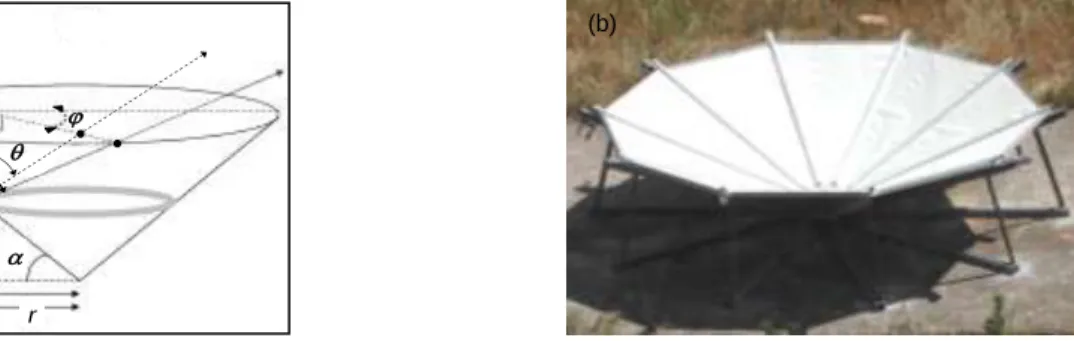
complicated surface, such as the cone in Figure 1, the radiative power emitted by each surface element over a given sky solid angle element must be integrated over the total condenser structure and visible sky solid angle. This necessitates considering both the surface directional emissivity (that varies as the cosine
of the angle with the normal to the surface element) and the sky directional emissivity s,. Due to this
specific θ dependence, the lowest atmospheric layer contained in the first 15° solid angle emits a
significant amount (25 %) of the total IR sky radiation. In Clus et al. (2009) numerical simulations of substrates (horizontal, 30° inclined planar substrate, conical and ridge shapes) were performed and compared to experiments outdoors.
Figure 1. (a) Integration scheme for the funnel shape ( 0 < θ < θL , 0 < φ < 360° and 0 < r < R). (b) Photo of
the funnel-shaped condenser (7.3 m² surface area with 60° cone angle, 30° from horizontal). The internal surface of the experimental condenser is coated with OPUR (www.opur.fr) low density polyethylene foil insulated from below with 3 cm styrofoam.
Numerical calculations were made for a condenser taken as a “grey” body with emissivity c0.94 and a
sky radiation corresponding to common night weather conditions in a temperate climate (e.g. Europe):
clear sky, Ta = 288 K (15 °C) ambient temperature and RH = 85% relative humidity, corresponding to the
dew point temperature Td = 285.5 K (12.5 °C). The integrations of the radiative budget are computed for
various radiator temperatures Tc .
Among the collection surface forms already investigated - planes, ridge, cone (Clus et al., 2009), the latter conical or funnel shapes (Fig. 1b) gave the best results. The surfaces are all equipped with the OPUR foil (OPUR, 2013) whose composition is from Nilsson et al. (1994). It is 0.39 mm thick and made of 5.0 vol % of TiO2 microspheres of 0.19 µm diameter, and 2.0 vol. % of BaSO4 of 0.8 µm diameter embedded in a matrix of low-density polyethylene (LDPE). It also contains approximately 1 vol % of a surfactant additive non-soluble in water. This material improves the mid-infrared emitting properties to provide radiative cooling at room temperature and efficiently reflects the visible (sun) light. Figure 2a compares surface
mean temperature with respect to wind speed for a conical geometry and a 1 m2 condenser inclined 30°
from horizontal, with wind blowing towards the hollow part of the planar condenser. As expected, cooling decreases when wind speed increases.
3. Shapes
A good condenser design will reduce the heat exchange of the condenser surface with air flow (free convection, forced convection with wind). Hollow forms, such as the funnel shape, are preferred as they also reduce free convection along the surface by blocking the heavier cold air at the bottom. In addition, because of the cone symmetry with respect to the vertical axis, the effects are the same whatever the wind direction. Assuming a symmetric temperature distribution with respect to the vertical axis over the internal funnel surface, a portion of the surface is in radiative equilibrium with the remaining parts of the surface, such that the internal radiative budget is null. In addition, in masking the lower (and most IR emissive) atmospheric layer to most of the surface, the funnel shape lowers the intensity of downward long wave sky
L r R y (a) (b)
radiation and thus enhances the radiative cooling power. Cooling is thus expected to increase and condensation enhanced with respect to the inclined planar condenser.
When dealing with a cone, choosing a smaller cone angle (larger ) reduces convection heating but also
reduces radiative cooling because the radiation solid angle of the sky is lower. The optimal cone angle was deduced from several simulations with different wind speeds and for different cone angles while keeping the cone radius constant at 1.5 m (i.e. the condenser area projected on the ground). The mean condenser
surface temperature <Tc> was obtained by averaging the local surface temperature over the condenser
area. From simulations at angles 25°, 30°, 35°, 40° and 50°, the ≈ 30° angle (cone angle ≈ 60°) give
the best cooling efficiency. Figure 2a shows the averaged surface temperatures <Tc> for both a cone with
= 30° and a planar surface inclined 30° from horizontal as obtained by numerical simulation. The data
are given with respect to wind speed at 10 m elevation. No condensation occurs above the broken line
<Tc> > Td = 285.5 K (12.5 °C), corresponding to Ta = 288 K (15°C) and RH = 85 %. 6 7 8 9 10 11 12 13 14 0 0.5 1 1.5 2 2.5 3 3.5 4 < T c > (°C ) cone 7.3 m² plane 1 m² wind speed (m/s) (a) 0 100 200 300 400 500 600 700 800 0.001 0.01 0.1 Reference (L/m2/day) (b) Ra tio % 0 100 200 300 400 500 600 700 800 0.001 0.01 0.1 Reference (L/m2/day) R a ti o % (c)
Figure 2. (a) Mean surface temperature <Tc> with respect to wind speed. (b) Dew gain R of a 7.3 m2 cone
with respect to a 1m2 plane (semi-log plot; adapted from Clus et al., (2009)).(c) Id. for a pyramid collector, (adapted from Jacobs et al. (2008)).
Hollow shapes are preferred, as discussed above, with a particular interest for slopes around 30°. This hollow configuration (i) prevents the lower layers of the atmosphere to radiate inside the cone and thus improve cooling, (ii) lowers the influence of wind forced convection, whatever the wind direction, and (iii) confines cold air inside the cone by buoyancy. Incidentally, this angle is also the optimal angle for plane condensers (Beysens et al., 2003). In addition, this particular angle allows water to easily flow by gravity as the gravity forces are only reduced by 50 % with respect to vertical.
Such conical shapes have already been tested (Clus et al., 2009; Awanou and Hazoume, 1997), or similar shapes such as a square hollow pyramid with angle 30° from horizontal (Jacobs et al., 2008). In Figure 2b
the yields of a 7.3 m2 cone is compared to a 1 m2 planar reference condenser inclined 30° from horizontal,
coated with the same OPUR foil, through the ratio
0
h
h
R
c (2)where hc,0 is the volume of dew water collected per day and per unit projected area of condenser surface.
The subscripts (c) and (0) stands for the collector and planar reference, respectively. The measurements were performed in Ajaccio, France, from May 25, 2005 to November 11, 2005. The data are fitted to an ad- hoc power law with exponent -0.3.
When compared with a reference planar condenser inclined 30° from horizontal, the yield is increased. In (Clus et al., 2009) the improvement was 22 % on average, ranging from 30% at wind speeds below 1.5 m/s to 0 % above 3 m/s. In Figure 2b one sees that the gain is larger for low dew yields. The inverted pyramid with angles 30° from horizontal equipped with the OPUR foil, gives on average a 20 % higher yield (Jacobs et al., 2008), with also a tendency to higher yields for low dew volumes (Figure 2c). The measurements were performed from March 2004 to May 2005 in Wageningen (The Netherlands). The data are fitted to an ad- hoc power law with exponent -0.23.
In the present study, a pyramidal shape condenser (Figure 3a) was assembled. It was not tested in the field as data have been already collected in the above reported investigations. The interest of our design was the use of an industrial flexible texture. The thermal insulation was made according to the principle of a double-skin filled with rockwool.
(a ) (b1) (b2) (c1) (c2)
Figure 3. (a) Inverted pyramid with an angle 30° from horizontal. The section at the top is 1 m x 1m. (b1, b2) Egg-box shape (2 m x 2 m). (c1,c2) Origami shape (1.8 m x 1.8 m).
When considering the construction of large scale collectors, the conical shape is technically difficult to envisage and is costly. In its place, we considered hollow shapes that can be made repetitive to eventually pave a planar or weakly curved surface (roof). We also looked for the aesthetics of the ensemble and the cost of construction. From the many shapes that were studied, we retained only two: the egg-box (EB) and origami (OR) types (Figures 3b,c). Two roofing units were erected, 4 m² projected on the ground (EB) and
3.24 m2 (OR). For improved performance, the external surface was coated with a paint containing an
additive that makes it hydrophilic and gives it a high infra-red emissivity. This coating gives the same collecting and emissive properties as the OPUR foil used above. It has the advantage of lasting longer since insensitive to UV aging. Each condenser was coated below with styrofoam thermal isolation. The prototypes were fabricated in 2008 at "Les Grands Ateliers" (Villefontaine - France).
4. Study site
The study site is located south of the Bordeaux urban area, in the town of Pessac at Le Bourghail (44°
48’16’’ N, 0°41’34’’ W), approximately 17 m a.s.l. The dominant wind direction during the night (21:00 – 06:00) is SW (240°). The distance from the Atlantic Ocean is about 50 km. The planar dew condenser has been described in Beysens et al. (2003). It consists of a plane OPUR foil covering a 1 m x 1 m surface area, thermally isolated from below with a 20 mm thick sheet of polystyrene foam. The planar condenser was set at an angle of 30° with respect to horizontal. A PVC gutter collects water into a polyethylene bottle. No scraping was performed and dew water was collected only by natural gravity flow.
The collectors are set above the ground and faced west. The EB collector was slightly inclined (about 10°) to collect water. For the OR structure, water was collected by a hole made in its centre. An automatic meteorological station (Oregon Scientific, USA) continuously recorded the following parameters: air relative humidity, air and dew point temperature, wind direction and windspeed.
5. Measurements
The data were collected during 51 d, between 29/08/2009 to 18/10/2009; 23 dew events occurred (45 % of
the period) and 2 d of fog (4% of the period). The yields were compared to the 1 m2 planar reference
condenser through the ratio R defined above in Eq. (2). The evolution of dew yields are reported in Figure
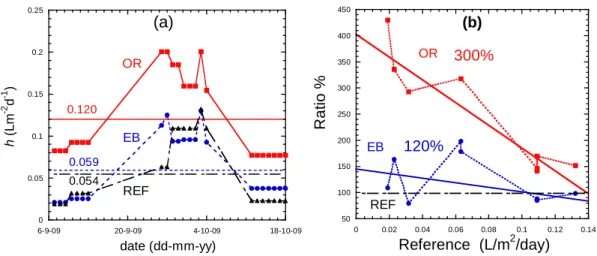
4a for the different structures. The mean values (in Lm-2day-1) are <h> = 0.054 for the planar reference,
0.059 for the EB and 0.12 for the OR, corresponding to R mean values <R> = 1.09 and 2.22 for the EB and OR.
This ratio is dependent on the efficiency of collection, which itself is a function of the collected volume. This
is why we report in Figure 4b the variation of R with respect to h0, the planar reference yield. There is a
general tendency to increase dew yields for small yields, with a ratio that can reach about 400 % for the OS and 150 % for the EB.
50 100 150 200 250 300 350 400 450 0 0.02 0.04 0.06 0.08 0.1 0.12 0.14
Reference (L/m
2/day)
R
a
ti
o
%
OR EB REF300%
120%
(b)
Figure 4. (a) Evolution of dew yields (Lm-2day-1) for the origami (OR, squares, full line), egg box (EB, short dashed line) and reference plane (REF, triangles, long dashed line) with mean values (horizontal lines). (b) Ratio R (%) of the condenser to the reference plane with respect to dew yields (OR, squares, full line), (EB, dashed line). The thick lines are 100% weighting of the data
6. Discussion
It is clear that the OR structure is more effective than the planar reference and than the EB structure, especially for light dew episodes. The EB structure, however, always remains more effective than a simple plane. The lower performance of the EB type when compared to the OR structure is due to the flat top of the EB structure from where dew cannot flow easily, thus reducing the efficiency. In addition, one should note that for our test of the modules, construction irregularities can have a considerable effect on the flow. Without reaching the output of the origamic structure, a better output of the egg-box is possible without joints. This study shows that the geometry of collectors can have a considerable influence on dew yield. Hollow structures increase cooling by preventing wind influence and are preferred over planar surfaces. However, the efficiency of water collection also matters. When the angle with vertical becomes too low, as on the top of the egg-box bumps, water cannot flow and the yield is reduced.
There is also a positive effect of the edges (Figure 5) for water collection. The dew drops on the edges collect more moisture than drops on the plane, which have to compete to grow. This enhanced water vapour collection process speeds up droplet growth such as they detach sooner than the other drops on the substrate. When flowing down, the edge droplets coalesce with other drops, grow in an avalanche-like process and form rivulets. Flowing down is later enhanced where rivulets have formed, which increases the collection of further condensed dew water. This accelerating mechanism is absent from collectors without sharp edges, like the EB.
Figure 5. Edge effects on dew water collection. Drops on the edge induce avalanches or rivulets (arrows). (Hydrophilic paint on a cooled vertical stainless steel foil. From Bibi et al. (2012)
7. Concluding remarks
Many forms can then be designed and tested for dew collection. However, they should follow general rules in order to obtain good yields. Our goal in the suggested forms presented here is to increase the surface of
1 cm
0 0.05 0.1 0.15 0.2 0.25 6-9-09 20-9-09 4-10-09 18-10-09 0.054 0.059 0.120 h ( L m -2 d -1 ) date (dd-mm-yy) OR EB REF(a)
collection without increasing the height of the module much. This characteristic associated with repetition and the assembly of the modules suggests that modular structure for dew collection can be used that can also serve as a roof to be used on homes, public use, industry, and other built structures.
Acknowledgments
We gratefully thank Yi Duan, A. Kitromilides, A. Roche, K. Spanou, A. Ulisse and V. Raducanu for the prototype constructions, and S. Berkowicz, Hebrew University of Jerusalem, for his critical reading, helpful remarks and relevant suggestions.
References
Awanou C.N., Hazoume R.P., 1997. Study of natural condensation of atmospheric humidity. Renewable Energy, 10, 19-34.
Beysens D., Milimouk I., Nikolayev V., Muselli M., Marcillat J., 2003. Using radiative cooling to condense atmospheric vapor: a study to improve water yield. Journal of Hydrology, 276, 1-11.
Bibi H., Medici M.G.M., Mongruel A., Beysens D., 2012. Collection of dew water droplets: the effect of substrate edges. PMMH Internal report, Paris, France.
Clus O., Ouazzani J., Muselli M., Nikolayev N., Sharan G., Beysens D., 2009. Comparison of various radiation-cooled dew condensers using computational fluid dynamics. Desalination, 249, 707–712. Jacobs A.F.G., Heusinkveld B.G., Berkowicz S.M., 2008. Passive dew collection in a grassland area, The
Netherlands. Atmospheric Research, 87, 377-385.
Lekouch I., Lekouch K., Muselli M., Mongruel A., Kabbachi K., Beysens D., 2012. Rooftop dew, fog and rain collection in southwest Morocco and predictive dew modelling using neural networks. Journal of Hydrology 448–449, 60–72.
Nilsson T.M.J., Vargas W.E., Niklasson G.A., Grangvist C.G., 1994. Condensation of water by radiative cooling. Renewable Energy, .5, 310–317.