Determination of the crystal structure of CuSnTi by full profile
Rietveld analysis
F. Weitzer
Institut fur Physikalische Chemie, Universitat Wien, Vienna, Austria L Perringa)
Institut de Chimie Minerale et Analytique, Universite de Lausanne, Switzerland T. Shibayanagi and M. Naka
Joining and Welding Research Institute, Osaka University, Osaka, Japan J. C. Schuster
Institut fur Physikalische Chemie, Universitat Wien, Vienna, Austria (Received 27 September 1997; accepted 26 October 1999)
The crystal structure of the new ternary phase CuSnTi is determined by full profile Rietveld analysis of the powder diffractogram. 104 reflections were refined to a final /?Bragg value of 5.60%. CuSnTi crystallizes with the spacegroup P63/mmc and is isostructural to InNi2. The lattice parameters are a = 0.439 555(5) nm and c = 0.601 505(9) nm. © 2000 International Centre for Diffraction Data. [S0885-7156(90)00301-3]
INTRODUCTION
In the course of investigating phases occurring in Cu-Sn-Ti solder alloys (Uray et al, 1998) the structure of ter-nary phase CuSn3Ti5 was recently characterized (Schuster
et al., 1999). This phase is a major constituent in Cu-Sn-Ti
alloys having a wide range of compositions including alloys quite rich in Cu such as Cu45Sn25Ti30 (Naka et al., 1999). However, in the neighboring alloy Cu45Sn30Ti25 only traces of CuSn3Ti5 are observed and a new diffraction pattern oc-curs, which was not identifiable with any phase listed in the book of Villars and Calvert (1991). The present paper reports on the composition and crystal structure of this phase as determined by full profile analysis (Rietveld, 1969) of the X-ray diffractogram.
EXPERIMENT
An alloy of composition Cu45Sn30Ti25 was arc melted from Ti sponge (purity: 99.8mass%, from Sumitomo Sitix, Amagasaki, Japan), Cu and Sn ingots (purity: 99.9mass%, from Osaka Asahi, Osaka, Japan) sealed in evacuated quartz tubes, and heat treated at 800 °C for 115 h. No mass loss was observed during these steps. The alloy was pulverized manu-ally in a tungsten carbide mortar and spread on a thin poly-mer foil. Powder photographs were taken in transmission using a Guinier-Huber chamber, CuKa^-radiation, and Ge standard (pulverized from lump, metal purity 99.9999%, from Johnson Matthey GmbH, Karlsruhe, Germany) assum-ing a lattice parameter of a = 0.565 790 6 nm. The powder diffraction profile was recorded on a Philips PW 1051/81 diffractometer in the range of 2 0 = 5 to 140° in steps of
0.02° using Cutfa-radiation {\Kax =0.154056nm, XKa2
= 0.154 440 nm). The width of the receiving slit was 0.1 mm. Total measuring time was 48 h, equivalent to 25.4 s per scan step.
al
Present Address: Dept. of Quality and Safety Assurance, CRN-NESTEC, Lausanne, Switzerland.
REFINEMENT
Refinement was done using the "FullProf" software (Rodriguez-Carjaval, 1997). Diffraction peaks were indexed based on lattice parameters derived from the Guinier powder photographs. Beginning with the phases where the crystal structure and approximate composition was known, each phase was refined separately to convergence by employing the following sequence of steps: (1) refinement of global parameters such as lattice parameters and peak profile pa-rameters for the peak profile function identified suitable (Pseudo-Voigt), (2) atom position parameters, (3) occupation factors, peak assymmetry, and preferred orientation. The to-tal number of parameters refined was 56.
RESULTS
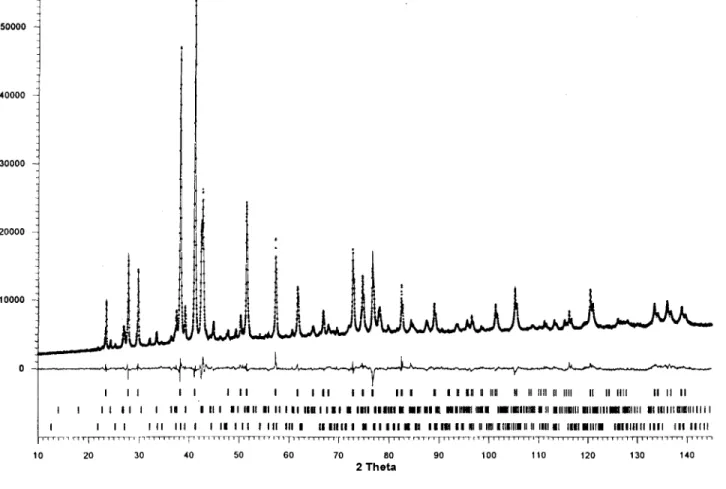
Three phases were present in the alloy investigated (Fig-ure 1): A dominant phase indexed using a hexagonal unit cell [a = 0.439 39(4) nm, c = 0.6012(5) nm] and two minority phases, identified to be Cu10Sn3 (spacegroup P63/m, Lenz and Schubert, 1971) and CuSn3Ti5 (Schuster et al, 1999), respectively. Reducing the symmetry of Cu10Sn3 to space group P 63 (Brandon et at., 1975) did not result in compa-rable ^?Bragg factors unless the Sn content was allowed to decrease by about one-third of the starting value, which is unacceptable in view of the Cu-Sn phase diagram.
Initial attempts to refine the majority phase in space-group P(s-Jmmc with Caln2 structure type did not yield /?Bragg values below 18%. Starting with the NiAs-type crystal structure of Cu6Sn5 (Gangulee et al., 1973), however, opened the door to successfull refinement. Assuming the space group Pd^lmmc, the atomic positions (2d) for Cu, (2c) for Sn, and (2a) for Ti, and allowing for some mutal site exchange between Cu and Ti, refinement to convergence resulted in a final /?Bragg value of 5.60% (Table I). For the minority phases ^Bragg values of 8.34% (for Cu10Sn3) and 10.30% (for CuSn3Ti5) were obtained. Thus the new ternary phase is labeled CuSnTi. This composition is corroborated by EPMA (Naka et al, 1999). It is isostructural to InNi2. In 91 Powder Diffraction 15 (2), June 2000 0885-7156/2000/15(2)/91/3/$6.00 © 2000 JCPDS-ICDD 91 https://doi.org/10.1017/S0885715600010897
50000 40000 30000 20000 10000 -10 20 r. p-30 i l l i i i i i i l l ii i i i i 11 ii IIII N II nn n mi II n mi II II I I
i II i i M I n I I I I i n nm i n • mi I I I I I I • • m i mum mi HIIIIIIUIII •niiiiiiinaiiiMHiiii iiiiinioiiiiimi i i I I i n I I I I in i II nm i • 111 I I • n 11 in I I n u mi i mini II IIIIII I I Miami iniiiiiiiiii in inn
40 50 60 70 80 90 100 110 120 130 140
2Theta
Figure 1. Diffraction profile of alloy Cu45Sn3OTi25 (arc melted and annealed at 800 °C) using Cuifa-radiation. Top: dots=data points observed (/obs); line=calculated profile (/ca,c). Below: line=difference/obs—/calc. Bottom: Bragg peak positions for CuSnTi (highest line), Cu,0Sn3 (center line), and CuSn3Ti5 (lowest line) calculated using the lattice parameters given in Table I.
TABLE I. Crystallographic data obtained from refinement (final chi2 = 5.58).
Main phase: CuSnTi
Second phase: Cu10Sn3
Third phase: CuSn3Ti5
Space group: P6i/mmc, hP6, InNi2-type, a = 0.439 555(5) nm, c = 0.601 505(9) nm; 104 reflections refined; /JBragg=5.( Rf=4M%
Cu, in (2d) Ti, in (2d) Sn, in (2c) Cu2 in (2a) Ti2 in (2a) X 1/3 1/3 1/3 0 0 y 2/3 2/3 2/3 0 0 Z 3/4 3/4 1/4 0 0 B 0.4 0.4 0.2 0.4 0.4 occup. 1.81 0.190(6) 2.00 0.16 1.803(6) Space group: P6^/m, hP26, Cu,0Sn3-type
a = 0.733 14(2) nm, c = 0.786 40(3) nm 638 reflections refined; «B r a g g=8.34%, Rf=1.0l% Cu, Sn, Ti, Cu2 Cu3 Cu4 in (12i) in (6ft) in (6ft) in ( 4 / ) in (2d) in (2b) X 0.6701(8) 0.2958(7) 0.2958(7) 1/3 2/3 0 y 0.0239(8) 0.9763(8) 0.9763(8) 2/3 1/3 0 z 0.0792(6) 1/4 1/4 0.0709(12) 1/4 0 B 0.4 0.2 0.3 0.4 0.2 0.4 occup. 12.00 4.74(6) 1.30 4.00 2.00 2.00 Space group: Pb^lmcm, hP\%, Ti5Ga4-type
o = 0.815 07(7) nm, c = 0.558 95(6) nm 269 reflections refined; fiBragg= 10.3% ^ = 6 . 8 5 %
Sn, in (6g) Ti, in (6g) Ti2 in (Ad) Cu, in (2b) X 0.6163(6) 0.2720(16) 1/3 0 V 0 0 2/3 0 z 1/4 1/4 0 0 B 0.2 0.2 0.2 0.2 occup. 6.00 6.00 4.00 1.04(4)
92 Powder Diffr., Vol. 15, No. 2, June 2000 Weitzer et al. 92
https://doi.org/10.1017/S0885715600010897
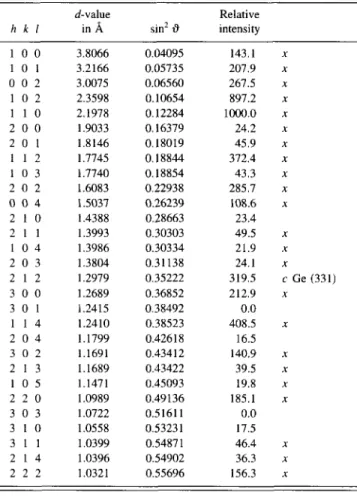
TABLE II. Powder diffraction pattern of CuSnTi calculated from the pa-rameters given in Table I for Guinier chamber geometry and CuKc^ radia-tion (x marks the reflecradia-tions observed on the Guinier film).
h 1 1 0 1 1 2 2 1 1 2 0 2 2 1 2 2 3 3 1 2 3 2 1 2 3 3 3 2 2 0 0 0 0 1 0 0 1 0 0 0 1 1 0 0 1 0 0 1 0 0 1 0 2 0 1 1 1 2 / 0 1 2 2 0 0 1 2 3 2 4 0 1 4 3 2 0 1 4 4 2 3 5 0 3 0 1 4 2 (i-value in A 3.8066 3.2166 3.0075 2.3598 2.1978 .9033 .8146 .7745 .7740 .6083 .5037 .4388 .3993 .3986 .3804 .2979 .2689 .2415 .2410 .1799 1.1691 1.1689 1.1471 1.0989 1.0722 1.0558 1.0399 1.0396 1.0321 sin2 # 0.04095 0.05735 0.06560 0.10654 0.12284 0.16379 0.18019 0.18844 0.18854 0.22938 0.26239 0.28663 0.30303 0.30334 0.31138 0.35222 0.36852 0.38492 0.38523 0.42618 0.43412 0.43422 0.45093 0.49136 0.51611 0.53231 0.54871 0.54902 0.55696 Relative intensity 143.1 207.9 267.5 897.2 1000.0 24.2 45.9 372.4 43.3 285.7 108.6 23.4 49.5 21.9 24.1 319.5 212.9 0.0 408.5 16.5 140.9 39.5 19.8 185.1 0.0 17.5 46.4 36.3 156.3 X X X X X X X X X X X X X X c G e (331) X X X X X X X X X
Table II the powder diffraction pattern calculated for CuSnTi using the parameters in Table I is given. Powder diffracto-grams calculated from these data for Cu]0Sn3 and CuSn3Ti5 match excellently the patterns published by Lenz and
Schu-bert (1971) and Schuster et al. (1999), respectively.
It is interesting to note that other ternary Cu-Sn-Me alloys of 1:1:1 composition are reported to have Caln2-type crystal structure for Me=Sc, Y, and RE metal, but InM2-type structure for Me=Dy (Villars and Calvert, 1991). On the other hand, the phase CuSiTi crystallizes with Co2Si-type structure (Villars and Calvert, 1991).
Due to the small amounts of the minority phases present in the sample investigated the accuracy of parameter deter-mination as well as the reliability factors obtained for Cu10Sn3 and CuSn3Ti5 are considerably inferior than the data regarding CuSnTi (Table I). Nevertheless, the data clearly show that Cu10Sn3 crystallizes in spacegroup P63/m rather than P63. Furthermore, Cu10Sn3 is found to dissolve (about 5 at%) Ti on the Sn sites. The phase CuSn3Ti5 is found to be stoichiometric confirming the proposed structure (Schuster
etai, 1999).
Brandon, J. K., Pearson, W. B., and Tozer, D. J. H. (1975). "A single crystal x-ray study of the f bronze structure, Cu20Sn6,'' Acta
Crystal-logr., Sect. B: Struct. Crystallogr. Cryst. Chem. B31, 774-779. Gangulee, A., Das, G. C , and Bever, M. B. (1973). "An x-ray diffraction
and calorimetric investigation of the compound Cu6Sn5," Metal. Trans.
4, 2063-2066.
Lenz, J., and Schubert, K. (1971). "Crystal structure of Cu10Sn3 (m),"
Monatsh. Chem. 102, 1689-1698.
Naka, M., Shibayanagi, T., and Schuster, J. C. (1999). "Phase equilibria in the system C u - S n - T i " (unpublished).
Rietveld, H. M. (1969). "A profile refinement method for nuclear and mag-netic structures," J. Appl. Crystallogr. 2, 65-71.
Rodriguez-Carjaval, J. (1997). Computer program "FullProf," version 3.3, Aug. 97-LLB-JRC (Laboratoire Leon Brillouin, CEA-CNRS, Grenoble, France).
Schuster, J. C , Naka, M., and Shibayanagi, T. (1999). "Crystal structure of the phase CuSn3Ti5" (unpublished).
Urai, S., Kimura, H., Maeda, K., and Naka, M. (1998). "Brazing of SiC using CuSnTi alloys," DVS Ber. 192, 314-316.
Villars, P., and Calvert, L. D. (1991) Pearsons Handbook of
Crystallo-graphic Data for lntermetallic Phases (ASM, Materials Park, OH).
93 Powder Diffr., Vol. 15, No. 2, June 2000 Determination of the crystal structure of CuSnTi 93 https://doi.org/10.1017/S0885715600010897