Ethylene Production in Spinach Leaves
during Floral Induction
M. CREVECOEUR
13, C. PENEL
1, H. GREPPIN
1AND TH. GASPAR
21
Physiologie vegitale, Universite de Geneve, CH-1211 Geneve 4, Switzerland
2
Hormonologie Fondamentale et Appliquee, Institut de Botanique B 22,
Universite de Liege, Sart Tilman, B-4000 Liige, Belgium
Received 17 February 1986
ABSTRACT
Crevecoeur, M., Penel, C, Greppin, H. and Gaspar, Th 1986. Ethylene production in spinach leaves during floral induction.—J. exp. Bot. 37: 1218-1224.
Spinach plants were induced to flower by transferring them from short days to continuous light. Their leaf laminae released more ethylene than those from vegetative plants. These leaves also exhibited a greater capacity to convert exogenous ACC into ethylene. Cell wall preparations from the leaves of continuously illuminated plants also converted exogenous ACC into ethylene more readily than extracts from short day plants. These effects and also those previously reported for peroxidases appear very similar to these brought about by various environmental stresses such as pollution and mechanical irritation.
Key words—Ethylene, floral induction, stress, photoperiod, spinach.
Correspondence to: Laboratoire de Physiologie vegetate, Universite de Geneve, 3, pi de F Universite, CH-1211 Geneve 4, Switzerland.
I N T R O D U C T I O N
'There is little question that ethylene can play a significant role in flower initiation . . .
Studies of SAM (5-adenosylmethionine) or ACC (1-aminocyclopropane-l-carboxylic acid)
biosynthesis and transport in relation to environmental and chemical controls of floral
initiation should provide important clues as to how ethylene itself may participate in
induction and perhaps evocation ...' (Bernier, Kinet, and Sachs, 1981). There are indeed few
studies on ethylene metabolism and production in relation to the induction of flowering.
Suge (1977) was probably the first to follow endogenous ethylene in relation to flowering. He
found that ethylene production increased gradually and then declined in both radish and pea
exposed to vernalizing temperature. After return to normal growing temperatures ethylene
production was slower in the vernalized than in the non-vernalized plants. These results
may help to explain why the absolute requirement of vernalization for the flowering
ability of buds of Cichorium intybus can be replaced by an ethylene treatment at room
temperature (Joseph, Billot, Soudain, and Come, 1985). It also may explain why ethylene
3 To whom correspondence should be addressed.
Abbreviations: ACC, l-aminocydopropane-!<arboxylic acid; AVG, aminocthoxyvinylglycine; CL, continuous light; HEPES, JV-2-hydroxycthylpiperazine-N-2-cthane sulphonic acid; MES, 2-(W-morpholino)-ethane sulphonic acid; SAM, S-adenosylmethionine; SD, short days; TRIS, a,oyi-Tris-(hydroxymethyl)-methylamine.
treatment of tobacco and Pharbitis immediately after an exposure to a floral inductive environment favoured vegetative growth and retarded flowering (Suge, 1974; Kasperbauer and Hamilton, 1978). More recently, De Greef, van Dijck, de Proft, and Mekers (1983) have shown that Aechmea plants can be induced to flower either by ethylene or ACC application but only when such plants reached 'flowering maturity'. Flowering maturity of these plants was precisely correlated with their capacity to convert large amounts of ACC into ethylene. It was also shown that flowering induction of some Bromeliaceae could be retarded by AVG (aminoethoxyvinylglycine), an inhibitor of ethylene biosynthesis (Mekers, de Proft, and Jacobs, 1983).
In order to elucidate further the possible role of ethylene synthesis in the flowering induction process, the extent of ethylene production and the conversion of ACC to ethylene was examined in the leaves of the long-day plant Spinacia oleracea currently used in our laboratory for the study of flowering (Penel and Greppin, 1974, 1975; Karege, Penel, and Greppin, 1982). From this work it seems that the earliest steps of this process involve fast biophysical and biochemical modifications of cell structures that support vegetative growth (Greppin, Auderset, Bonzon, and Penel, 1978).
M A T E R I A L S A N D M E T H O D S Plant material
Spinach plants (Spinacia oleracea L. cv. Nobel) were grown in a phytotron under standard conditions of illumination (100 /JE m~2 s"1 provided by Sylvania fluorescent lamps 'daylight', 40 W, Sylvania
Electric products, Danvers, Mass., U.S.A.), temperature (21 °C) and humidity (70% during the dark, 50% during the light period).
Photoperiodic treatments
Three different light treatments were used in order to characterize: (i) the vegetative state (5 weeks in short days of 8 h light), (ii) the transition to the floral state (5 weeks in short days, then transfer in continuous light for 24 h), and (iii) the effect of a transfer as in (ii), but with plants already induced by 24 h continuous illumination but transferred back to short days for 5 d. This treatment is called 'mimicked inductive treatment'.
Sampling
The two youngest leaves (3 and 4) fully expanding at the time of analysis were excised and divided into laminae and petioles.
Ethylene measurements
Two leaf laminae were dipped by their bases in a 2 x 10~6 m3 glass test tube containing 0-7 x 10 ~6m3
H2O or ACC (10 mol m ~ 3) fixed at the bottom of a 60 cm3 glass bottle hermetically closed with a rubber
plug. Petiole segments 20 mm long were set on a filter paper sheet imbibed either with H2O or ACC (10
mol m"3) in 35 x 10"6 m3 glass bottles similarly closed. Whole plants with their four leaves and with
their roots (previously rinsed with tap water) were similarly enclosed in 150 x 10~6 m3 bottles (1 plant
per bottle) in the presence of H2O or ACC. Ethylene production was quantified after 24 h at room
temperature by G.C. according to the method used by Boyer, Desbiez, Hofinger, and Gaspar (1983). Fractionation
Samples of leaves weighing 10 g were ground in a precooled mortar in 25 cm3 m~3 MES buffer
containing 500 mol m~3 sucrose, and adjusted to pH 7-2 with TRIS buffer. After filtration on a nylon
cloth, the extract was centrifuged at 3 000 g for 10 min. The supernatant was centrifuged at 6 000 g for 10 min, then at 20 000 g for 30 min. The resulting supernatant and the pellet constituted the soluble and the microsomal fractions respectively. The pellet obtained after the first centrifugation was resuspended in 25 mol m " 3 MES buffer (pH 7-2) and centrifuged at 1000 g for 10 min. This yielded a wall pellet. Both
the microsomal and the wall pellets were resuspended in 10 mol m " 3 HEPES buffer, pH 8-2. Aliquots of
1220 Crevecoeur et al.—Ethylene and Floral Induction
glass bottles in the presence of ACC (1-0 mol m "3) a n d MnCl2(O5 mol m~3); ethylene production was
measured after 24 h at room temperature.
ACC content
Samples (1 0 g) of leaf lamina or petiole were extracted with 80% ethanol and centrifuged at 5 000 g for
10 min. The supernatant was evaporated to dryness at 37 °C and the residue was resuspended in
1 x 10~
6m
3distilled water. Free ACC content was then determined according to Lizada and Yang
(1979) from the ethylene evolved after 2 h from 1-0 cm
3solution containing: 08 x 10~
6m
3aqueous
extract, sodium hypochlorite 0-44% (wt./vol.), HgCl
21 -0 mol m "
3and 33% (v/v) of a NaOH saturated
solution. This was enclosed in a sealed 35 cm
3glass bottle.
Freshly prepared standards were run routinely. Each experiment was repeated at least four times
with different batches of plants.
R E S U L T S
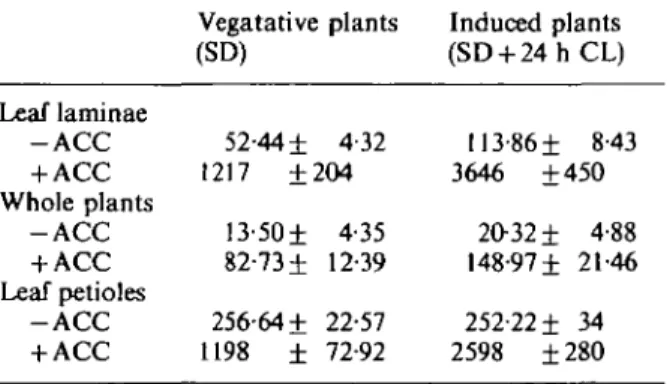
Ethylene production by excised laminae of leaves 3 and 4 from vegetative plants (grown
under SD) measured at the end of a darkness period was 52 fim
3g"
1over 24 h (Table 1).
Leaf laminae from plants that have been induced to flower (by a 24 h period of continuous
light) produced twice as much ethylene. Comparable results were obtained using whole
plants instead of excised leaf laminae (Table 1). Further analyses indicated that this increase
already was measurable during the first hours following the transfer of SD plants to
continuous light. Ethylene production by excised petioles of the same leaves 3 and 4 was quite
the same for vegetative and induced plants (Table 1).
When ACC was applied to leaf laminae and to petioles, ethylene production from both
vegetative plants and plants induced to flower was increased severalfold (Table 1). The ability
of laminae from induced plants to convert exogenous ACC to ethylene was three times
greater than that from vegetative plants (Table 1); that of petioles was twice as high (Table 1).
Table 2 indicates that ACC in the laminae was more concentrated in vegetative plants than
that in Morally induced plants. However, the ACC content in the petioles was similar in both
types of plants.
Laminae of plants which had been induced by 24 h continuous light and transferred back
to short days for 5 d returned to a rate of ethylene production and ability to convert ACC to
ethylene typical of non-induced plants (Table 3). A second inductive treatment of 24 h
continuous illumination at the end of these 5 short days again resulted in the changes
mentioned before (Table 3).
T A B L E
1. Ethylene production (jim
3g ~
1over 24 h) by excised leaf laminae, petioles and whole
vegetative and induced spinach plants in the absence and in the presence of ACC (10 mol m~
3).
Means of four replicates and standard errors
Leaf laminae - A C C + ACC Whole plants - A C C + ACC Leaf petioles - A C C + ACC Vegatative plants (SD) 52-44 ± 4-32 1217 ±204 13-50± 4-35 82-73 ± 12-39 256-64 ± 22-57 1198 ± 72-92 Induced plants (SD + 2 4 h C L ) 113-86 ± 8-43 3646 ±450 20-32 ± 4-88 148-97 ± 21-46 252-22 ± 34 2598 ± 280
T A B L E
2. ACC content (10
9molg
lfr.wt.)inleaflaminae and petioles from vegetative and
induced plants
ACC content in
Vegetative plants
(SD)
Induced plants
(SD + 24hCL)
Leaf laminae
Petioles
2-36 ±0-20
112±O17
l-50±O19
113±O18
Means of four replicates and standard errors.
T A B L E
3. Ethylene production (jim
3g'
1over 24 h) by excised leaf laminae from plants
subjected to various photoperiod sequences
Photoperiodic treatments
Leaf laminae Leaf laminae
+ H
2O + ACC(10molnT
3)
37 36 31 30 SDSD + 24
SD + 24
SD + 24
h h h CLCL + 5
CL + 5
SDSD + 24 hCL
50 ±10-78
94 ±12-58
54± 5-13
137 ±16-93
1287 ±170
4505 ±380
1399±192
5714±152
Means of four replicates and standard errors.
T A B L E
4. Ethylene production (jwi
3mg~
lprotein over 24 h) by microsomal, soluble and cell
wall fractions from leaf laminae of vegetative and induced spinach plants
Fraction
Microsomal
Soluble
Cell wall
Components added
to the fraction
Buffer
Buffer + ACC mol m"
3Buffer + ACC mol m"
3+ MnCl
20-5 mol m"
3Buffer
Buffer + ACC mol n T
3Buffer + ACC mol m"
3+ MnCl
2O-5 mol m"
3Buffer
Buffer + ACC mol m~
3Buffer + ACC mol m~
3+ MnCl
20-5 mol m"
3Vegetative
plants
17 178 277 6 28 104 19 177 338Induced
plants
13 185 292 4 19 112 20 246 428As expected from literature data (Mayak, Legge, and Thompson, 1981; McRae, Baker, and
Thompson, 1982; Lynch, Sridhara, and Thompson, 1985; Kevers and Gaspar, 1985), a
microsomal fraction from spinach leaves converted ACC to ethylene in vitro in the presence
of manganese (Table 4). Calcium ions up to 10 mol m~
3appeared uneffective (data not
shown) but no difference could be seen in the rates of ACC conversion to ethylene by
micTosomes between vegetative and induced plants (Table 4). Soluble fractions from both
types of plants showed very low and similar capabilities for such a conversion. The cell wall
1222 Crevecoeur et al.—Ethylene and Floral Induction
fractions from both induced and vegetative plants were seen to convert ACC to ethylene, with
a higher activity for those prepared from induced plants. Activity of this fraction was
maintained after both a washing in a sucrose gradient and a treatment with 1000 mol m~
3NaCl.
DI SC US S ION
For many years, ethylene or ethylene-releasing compounds such as
2-chloroethane-phosphonic acid are known to promote flowering of pineapple (Cooke and Randall, 1968;
Adriansen, 1976; Zeevaart, 1978). Application of exogenous ethylene is now standard
commercial practice for the controlled flowering of pineapple and also of other bromeliads.
Besides those in the Bromeliaceae, a few other species have also been found to respond
positively to ethylene applications. Ethylene may thus play a role in flowering induction.
There are, however, few studies of endogenous ethylene in relation to flowering (Suge, 1977;
De Greef et al., 1983). We show here that the transfer of spinach plants from non-inductive to
inductive conditions rapidly increases the rate of ethylene production by leaf laminae and
also their capacity to convert ACC to ethylene. ACC measurements in laminae indicate a
lower concentration within induced plants. This probably corresponds to a faster conversion
to ethylene. However, the transfer to continuous light of previously induced plants
(mimicked induction) indicates that the changes in ethylene release and ACC-ethylene
con-version may not be caused by the onset of flowering since they can be reproduced twice on
the same plants. They may be considered rather as a more direct response to photoperiod.
Two cell fractions are able to convert ACC into ethylene in spinach leaves i.e. microsomal
and cell wall. Activity of the microsomal fraction is in good agreement with studies indicating
that ACC conversion to ethylene is associated with membrane systems (Imaseki and
Watanabe, 1978; Mayak et al, 1981; McRae et al., 1982; Lynch et al., 1985). As far as we
know, conversion of ACC to ethylene by a cell wall fraction has not been reported until now.
However, studies have shown that cell wall digesting enzymes and their cell wall products are
capable of stimulating ethylene biosynthesis, and suggest that certain cell wall fragments
produced as a consequence of stress may serve as signals eliciting the synthesis of ethylene
(Anderson, Matoo, and Lieberman, 1982; Vandermolen, Labavitch, Strand, and DeVay,
1983; Anderson, Chalutz, and Matoo, 1985). This suggests a role for the cell wall in ethylene
metabolism. We show that increased capacity of the leaves from induced plants to convert
ACC to ethylene is related to an increased capacity of the cell wall fraction.
Although the enzyme responsible for ACC-ethylene conversion has not been isolated,
some studies indicate that peroxidases may be considered as a part of the enzyme complex
catalysing this step of ethylene metabolism (Yang, Ku, and Pratt, 1967; Rohwer and Mader,
1981; Vioque, Albi, and Vioque, 1981; Boyer and De Jaegher, 1986). That peroxidases may
play a role in ethylene synthesis was suggested by data indicating a relation between ethylene
production and membrane binding of peroxidases in vitrifying tissues (Kevers and Gaspar,
1985) and in tissues subjected to stresses, for instance mechanical stress (Boyer et al., 1983). In
spinach, it was previously shown that flowering induction is characterized by an increase of
the total peroxidase activity and of the acid/basic ratio (Penel and Greppin, 1975). These
changes in peroxidases and those reported here for ethylene are very similar to those
described in various plant tissues in response to different types of stresses, for instance,
mechanical perturbation (Boyer and De Jaegher, 1986) indicating relations between changes
in ethylene and in cellular distribution of peroxidases (Gaspar, Penel, Castillo, and Greppin,
1985). This leads us to propose that flowering induction could be considered as a stress
response of the plants to a change in their light regime. Results of the mimicked induction are
Crevecoeur et al.—Ethylene and Floral Induction 1223
in good agreement with this view. Further studies are now needed to determine whether the
changes in ethylene biosynthesis described here in spinach plants transferred to continuous
light can be related to biochemical (sugar composition, enzyme association) modifications at
the cell wall level.
A C K N O W L E D G E M E N T
This work was partly supported by the Swiss Foundation for Scientific Research (Grant no.
3.140-081).
L I T E R A T U R E C I T E D
ADRIANSEN, E., 1976. Induction of flowering in bromeliads with cthephon. Tidsskriftfor Planteavl., 80, 857-68.
ANDERSON, J. D., CHALUTZ, E., and MATOO, A. K., 1985. Induction of ethylene biosynthesis by cell wall digesting enzymes. In Cellular and molecular biology of plant stress. Alan R. Liss, Inc. Pp. 263-78.
MATOO, A. K., and LIEBERMAN, M., 1982. Induction of ethylene biosynthesis in tobacco leaf discs by cell wall digesting enzymes. Biochemical and Biophysical Research Communications, 107, 588-96.
BERNIER, G., KINET, J. M., and SACHS, R., 1981. Levels, distribution, and metabolism of endogenous substances. In The physiology of flowering. CRC Press, Inc., Boca Raton, Florida. Pp. 135-60. BOYER, N., and DE JAEGHER, G., 1986. Direct or indirect role of pcroxidases in ethylene biosynthesis? In
Molecular and physiological aspects of plant peroxidases. Eds H. Greppin, C. Penel and Th. Gaspar. University de Geneve—Centre Botanique publication (in press).
DESBIEZ, M. O., HOFINGER, M., and GASPAR, T H . , 1983. Effect of lithium on thigmomorpho-genesis in Bryonia dioica. Ethylene production and sensitivity. Plant Physiology, 72, 522-5. COOKE, A. R., and RANDALL, D. I., 1968. 2-Haloethanephosphonic acids as ethylene releasing agents
for the induction of flowering in pineapple. Nature, 218, 974-5.
DE GREEF, J. A., VAN DUCK, R., DE PROFT, M., and MEKERS, O., 1983. Flowering maturity and ethylene
production capacity of Aechmea victoriana through ACC application. Ada Horticulturae, 137, 211-16.
GASPAR, TH., PENEL, C , CASTILLO, F. J., and GREPPIN, H., 1985. A two-step control of basic and acidic peroxidases and its significance for growth and development. Physiologia plantarum, 64, 418-23. GREpprN, H., AUDERSET, G., BONZON, M., and PENEL, C , 1978. Changement d'etat membranaire et
mecanisme de la floraison. Saussurea, 9, 83-101.
IMASEKI, H., and WATANABE, A., 1978. Inhibition of ethylene production by osmotic shock. Further evidence for control of ethylene production by membrane. Plant Cell Physiology, 19, 345-8. JOSEPH, C , BILLOT, J., SOUDAIN, P., and COME, D., 1985. The effect of cold, anoxia and ethylene on the
flowering ability of buds of Cichorium intybus. Physiologia plantarum, 65, 146-50.
KAREGE, F., PENEL, C., and GREPPIN, H., 1982. Floral induction in spinach leaves by light, temperature and gibberellic acid: use of the photocontrol of basic peroxidase activity as biochemical marker. Zeitschrift fur Pflanzenphysiologie, 107, 357-65.
KASPERBAUER, M. J., and HAMILTON, J. L., 1978. Ethylene regulation of tobacco seedling size, floral induction and subsequent growth and development Agronomy Journal, 70, 363-6.
KEVERS, C , and GASPAR, TH., 1985. Vitrification of carnation in vitro: changes in ethylene production, ACC level and capacity to convert ACC into ethylene. Plant Cell Tissue Organ Culture, 4, 215-23. LIZADA, C. C , and YANG, S. F., 1979. A simple and sensitive assay for
1-aminocyclopropane-l-carboxylic acid. Analytical Biochemistry, 100, 140-5.
LYNCH, D. V., SRIDHARA, S., and THOMPSON, J. E., 1985. Lipoxygenase generated hydroperoxides account for the non-physiological features of ethylene formation from 1-aminocyclopropane-l-carboxylic acid by microsomal membranes of carnation. Planta, 164, 122-5.
MCRAE, D. G., BAKER, J. E., and THOMPSON, J. E., 1982. Evidence for involvement of the superoxide radical in the conversion of 1-aminocyclopropane-l-carboxylic acid to ethylene by pea microsomal membranes. Plant Cell Physiology, 231, 375-83.
MAYAK, S., LEGGE, R. L., and THOMPSON, J. E., 1981. Ethylene formation from 1-aminocyclopropane-1 -carboxylic acid by microsomal membranes from senescing carnation flowers. Planta, 1-aminocyclopropane-153,49-55. MEKERS, O., DE PROFT, M., and JACOBS, L., 1983. Prevention of unwanted flowering of ornamental
1224 Crevecoeur et al—Ethylene and Floral Induction
PENEL, C , and GREPPIN, H., 1974. Variation de la photostimulation de 1'activite des peroxydases basiques chez l'epinard. Plant Science Letters, 3, 75-80.
1975. The balance between acid and basic peroxidases and its photoperiodic control in spinach leaves. Ibid. 5, 41-5.
ROHWER, F., and MADER, M., 1981. The role of peroxidase in ethylene formation from 1-aminocyclopropane-1-carboxylic acid. Zeitschrift fur Pflanzenphysiologie, 104, 363-72.
SUGE, M., 1974. Nature of the ethylene inhibition of flowering in Pharbitis nil. In Plant growth substances, 1973. Proceedings 2nd International Conference on Plant Growth substances. Hirokowa Publ. Cy. Tokyo. Pp. 960-6.
1977. Changes in ethylene production of vernalized plants. Plant Cell Physiology, 18, 1167-71. VANDERMOLEN, G. E., LABAVTTCH, J. M., STRAND, L. L., and DEVAY, J. E., 1983. Pathogen-induced
vascular gels: ethylene as a host intermediate. Physiologia plantarum, 59, 573-80.
VIOQUE, A., ALBI, M. A., and VIOQUE, B., 1981. Role of IAA-oxidase in the formation of ethylene from 1-aminocyclopropane-l-carboxylic acid. Phytochemistry, 20, 1473-5.
YANG, S. F., K U , M. S., and PRATT, M. K., 1967. Photochemical production of ethylene from methionine and its analogues in the presence of flavin mononucleotide. Journal of Biological Chemistry, 242, 5274-80.
ZEEVAART, J. A. D., 1978. Phytohormones and flower formation. In Phytohormones and related compounds: a comprehensive treatise. Volume II. Eds D. S. Letham, P. B. Goodwin, and T. J. V. Higgins. Elsevier/North-Holland Biomedical Press, Amsterdam. Pp. 291-327.