Publisher’s version / Version de l'éditeur:
Proceedings of the International Conference On Powder Metallurgy and Particulate Materials, 2006, 2006-06-18
READ THESE TERMS AND CONDITIONS CAREFULLY BEFORE USING THIS WEBSITE.
https://nrc-publications.canada.ca/eng/copyright
Vous avez des questions? Nous pouvons vous aider. Pour communiquer directement avec un auteur, consultez la première page de la revue dans laquelle son article a été publié afin de trouver ses coordonnées. Si vous n’arrivez pas à les repérer, communiquez avec nous à [email protected].
Questions? Contact the NRC Publications Archive team at
[email protected]. If you wish to email the authors directly, please see the first page of the publication for their contact information.
NRC Publications Archive
Archives des publications du CNRC
This publication could be one of several versions: author’s original, accepted manuscript or the publisher’s version. / La version de cette publication peut être l’une des suivantes : la version prépublication de l’auteur, la version acceptée du manuscrit ou la version de l’éditeur.
Access and use of this website and the material on it are subject to the Terms and Conditions set forth at
High Performance Lubricants for Demanding PM Applications
St-Laurent, Sylvain; Thomas, Yannig; Azzi, Lhoucine
https://publications-cnrc.canada.ca/fra/droits
L’accès à ce site Web et l’utilisation de son contenu sont assujettis aux conditions présentées dans le site LISEZ CES CONDITIONS ATTENTIVEMENT AVANT D’UTILISER CE SITE WEB.
NRC Publications Record / Notice d'Archives des publications de CNRC:
https://nrc-publications.canada.ca/eng/view/object/?id=7b160684-57fd-4508-8b3d-24235a221b9c https://publications-cnrc.canada.ca/fra/voir/objet/?id=7b160684-57fd-4508-8b3d-24235a221b9c
HIGH PERFORMANCE LUBRICANTS FOR DEMANDING PM
APPLICATIONS
Sylvain St-Laurent, Yannig Thomas * and Lhoucine Azzi * Quebec Metal Powders Limited
Tracy, Québec
* Industrial Materials Institute, National Research Council Canada, Boucherville, Québec
ABSTRACT
The achievement of high density at reasonable cost is without a doubt one of the major quests of the P/M industry. High density can be achieved through various processing routes involving the shaping of the part and/or the sintering. In particular, single pressing methods such as warm compaction and die wall lubrication are known to give green density in the range of 7.2 to 7.5 g/cm³ depending on the powder formulation. Nevertheless, these pressing techniques normally require tighter control, are costly and may reduce productivity compared to conventional pressing method. More recently, new high performance lubricants were developed to achieve higher green density than conventional lubricant by cold
compaction or temperature-controlled die compaction. This paper presents the green and sintered characteristics of these newly developed high performance lubricants in a laboratory scale. In particular, the compaction and ejection characteristics of these new lubricants are compared to that obtained with other conventional lubricants.
INTRODUCTION
The performance of internal lubricant used in powder mixes is one of the major concerns of the PM industry since numerous years and significant amount of efforts were spent to develop new family of lubricant and/or improve the performance of conventional PM lubricants. The need for better lubricant is driven either by the quest for higher and higher density at the lowest cost possible, the production of complex PM parts difficult to eject with high aspect ratios and surface areas, the requirement for higher green strength or by the desire to increase the capacity and productivity of existing presses.
Techniques such as the double press/double sintering (DPDS) and forging are well know and used to achieve densities in the range of 7.4 to 7.5 g/cm³ and to nearby full density respectively [
1
]. However,the production costs associated with these techniques are quite significant. On the other hand, single pressing/single sintering significantly reduces the production cost versus DPDS and forging but densification is more limited. Indeed, green density that is normally achieved by cold compaction of mixes containing conventional lubricant such as waxes, metal stearates or admixture of both lubricants, is limited to values below 7.20 g/cm³. Of course, density depends on the compressibility of the base powder, the amount of additives and lubricant added, the part geometry and height, and the compacting conditions.
A lot of efforts were done during the last years and are still done these days to improve densification by single compaction. Warm pressing and die wall lubrication pressing are two examples of compaction techniques that were developed to improve density. Densities in the range of 7.25 to 7.50 g/cm³ can be achieved with these techniques [
2
]. Warm pressing, which consists of pressing a preheated powder mixin a heated die [
3
], normally requires lubricants and binders specifically designed for that process. Inparticular, the organics must be able to withstand the temperature encountered during powder pre-heating and compaction, typically between 130 and 150°C. The die wall lubrication technique offers a high potential to achieve high densities by reducing the level of internal lubricant, which normally limits the densification of the part. An external lubricant is sprayed to the die walls prior to feeding the powder into the die to ease the compaction and ejection. Both methods are considered to be low cost alternatives versus the DPDS and forging methods. Nevertheless, even if significant amount of papers have
confirmed the high potential of warm compaction and die wall lubrication, their usage in the PM industry seems to be quite limited likely because they are much more complex to control then conventional compaction under an industrial and production environment.
More recently, efforts were spent to develop or identify more efficient lubricants for conventional compaction. In some cases, it is argued that the die and punches must be moderately heated in order to achieve a sufficient temperature in the part during compaction. This process of compacting a non-heated powder in a heated die is known as the controlled-die compaction process.
This paper describes the behavior of conventional and newly developed lubricant systems showing very high potential for compaction. As a first step, a description of the densification process of iron powder is presented followed by the description of the analytical method used to characterize the compaction and ejection performance of lubricants and mixes in this paper. Then, the performance of a new type of lubricant used alone is presented and compared to conventional lubricants. Finally, the performance of an experimental lubricant system specifically engineered for better ejection and high density is discussed. DESCRIPTION OF DENSIFICATION OF IRON POWDERS
The green density achieved after compaction in a closed die is a function of numerous factors. It depends typically on the compaction procedure and conditions, the tool materials, clearance and design, the part shape and complexity and the powder mix properties. However, for a given application and
manufacturing conditions, the green density achieved is only a function of the mix characteristics. It is mainly affected by the apparent density and flow, which determine the capacity of a powder to fill the die in a given time, the pore free density (which is the density if all the porosity is eliminated) and the compressibility.
The compressibility is the relation between the green density and the applied pressure. It is usually expressed by the applied pressure needed to reach a required green density or by the green density achieved at a given applied pressure [
4
]. However, the compressibility is dependent on three keyphenomena, which take place during the compaction process:
1- The intrinsic ability of the powder to be densified in the absence of friction at die walls named compactability or also intrinsic compressibility,
2- The friction between particles and die walls, 3- The expansion or the springback at ejection.
It should be emphasized that the compactability is only dependent on the intrinsic mechanical behavior of the powder during compaction while the compressibility is influenced by all factors affecting these three parameters. In particular, the compact size or aspect ratio strongly affects the amount of friction at the die
walls and therefore the compressibility while the compactability is on the contrary independent of the compact aspect ratio [10].
All these characteristics are strongly affected by the lubricant/binder system. Lubricant is mainly required to reduce the friction at die walls and ensure a good transfer of the compaction force throughout the part, low ejection forces and good surface finish and minimize tool damage. It is quite obvious that the lubricity at the die wall is proportional to the level of internal lubricant added to the mix.
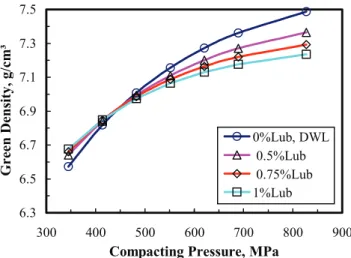
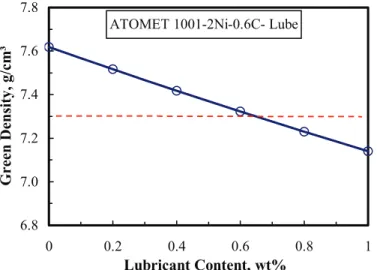
Lubricant has also a strong influence on the density curves as illustrated in Figure 1. At compacting pressures below ~ 500 MPa (<36 tsi), increasing the lubricant content is beneficial to the green density. In fact, lubricant reduces internal friction between particles and improves the particle rearrangement and the transfer of the compacting pressure throughout the part, which is beneficial to densification. On the other hand, lubricants have very low specific gravity compared to steel and occupied a significant proportion of volume in the green part. Indeed, lubricants occupy around 8 times the volume of steel for the same weight. The level of lubricant has thus a strong effect on the maximum density that can be achieved during compaction. Increasing their contents in the mix significantly reduces the pore free density, and thus the maximum achievable green density at high pressures. As a rule of thumb, each addition of 0.1% lubricant/binder decreases the pore free density by about 0.05 g/cm³. Figure 2 illustrates the influence of internal lubricant content on the maximum density achievable for a FN0205 formulation. The maximum density achievable is estimated as 98% of the pore free density. It can be seen that the lubricant must be kept at a maximum of 0.6% in order to be able to achieve density of ~ 7.3 g/cm³ by single compaction. The amount of internal lubricant in the mix may be further lowered if higher densities are targeted.
ANALYSIS OF COMPACTION PROCESS IN A RIGID DIE
I.
DescriptionAs described earlier, the compaction process in a rigid die can be described by two fundamental phenomena: The intrinsic reaction of a powder mix to an applied pressure and the friction between the particles and the die walls, which controls how the applied pressure is transmitted through the compact [
5
]. These two phenomena can be described by the two key parameters: the compactability or the intrinsic compressibility and the slide coefficient. These parameters are defined in the next paragraphs.Figure 1. Effect of level of lubricant in a powder mix on compressibility curves. 6.3 6.5 6.7 6.9 7.1 7.3 7.5 300 400 500 600 700 800 900
Compacting Pressure, MPa
G re en D en si ty , g /c m ³ 0%Lub, DWL 0.5%Lub 0.75%Lub 1%Lub
Figure 2. Effect of lubricant content on the maximum green density achievable by compaction for a FN0205 formulation. Maximum density is equal to 98% of pore free density.
Gasiorek and al. [
6
,7
] have introduced an empirical relation for the determination of a slide coefficient !on a single action press. The slide coefficient ! characterizes the efficiency of transferring the compaction force throughout the part and the densification uniformity. ! is given by the following equation, Equ (1):
!
"# $ % &'( ) *+ , -. Pt Pa F SH 4where Pa is the pressure applied to the compacting punch, Pt the pressure transmitted to the stationary punch, F the cross-section area,
S the cross-section perimeter, H the height.
The factor 4F/SH represents the compact aspect ratio or compact geometry factor. For a cylindrical compact, the factor 4F/SH is equal to D/H where D is the diameter of the compact. ! can vary between 0 and 1, 0 representing an infinite friction and 1 no friction. The higher the !, the lower the friction loss and the better the lubrication and densification uniformity. For a given IN die density, the value of the slide coefficient proved to be a good parameter to compare the lubrication behavior of similar steel powder mixes containing different types of lubricants [
8
]. However, the value of slide coefficient is far from being constant through the pressing process. The variation of the slide coefficient results in fact from the complex evolution of the friction coefficient and the angle of pressure transmission or radial to axial stress ratio. The evolution of the coefficient of friction and the stress ratio during compaction is discussed in details in reference9
.On the other hand, as mentioned earlier, the compactability is defined as the intrinsic ability of a powder to be densified in the absence of friction at die walls. It can be expressed by the relation between the average IN die density and the average pressure seen by the compact. Considering that the density varies linearly along the compaction axis as shown by several researchers [
10
,11
], it can be stated that thedensity at mid-height is equal to the average density. The average pressure or net pressure, PNET can thus
be evaluated at mid-height of compact with the following equation for a cylindrical compact, ATOMET 1001-2Ni-0.6C- Lube
6.8 7.0 7.2 7.4 7.6 7.8 0 0.2 0.4 0.6 0.8 1 Lubricant Content, wt% G re en D en si ty , g /c m ³
Equ. (2):
P
Pa
*
2D/
Pa
*
Pt
0
1/2 H NET"
"
( ' & % $ #!
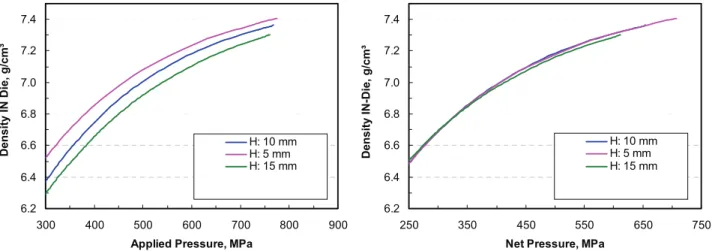
The compactability is by definition independent of the compact aspect ratio unlike the compressibility as defined earlier. This is well illustrated in Figure 3 that shows the relation between the density In-Die and the applied pressure (3a) and the net pressure (3b) for different part heights. In the first case, the part height had a strong effect on compressibility curve, the applied pressure required to reach a given density increasing with the part height. This is explained by a reduction in the net pressure due to higher friction at die walls when height is increased. In fig 3b, it is seen that part height has no effect on the curves. This results confirms that this method to estimate the compactability is sound.
Figure 3. Relation between the In-Die density and the applied pressure (a) and net pressure (b) for different part height.
II.
Experimental ProceduresIn this paper, the compaction characteristics as described in the previous paragraph were determined with an instrumented single action compacting press known as the Powder Testing Center (PTC) [5]. This lab press allows continuous recording of the moving punch displacement and pressures applied to the moving punch and transmitted to the stationary punch all along the compaction and ejection process, allowing determination of the compactability, slide coefficient and the ejection forces. Cylindrical specimens 10 mm tall were pressed in a C-350 high speed steel tool having a diameter of 9.525 mm at a compacting rate of 1 mm/sec. It is worth mentioning that the aspect ratio of the 10 mm compacts pressed in the PTC are 3 times higher than that of standard 6.35 mm (¼ in) thick T.R.S bars normally pressed in laboratory. In addition, the compacting rate is also much higher than in lab presses. Those compacts are therefore more representatives of parts commonly produced at a production scale. The compacting temperature was around 60°C (~1401F), which corresponds better to the temperature reached by the part after compaction on production presses.
The materials evaluated were either FC0208 or FN0205 mixes made with atomized steel powder ATOMET 1001 produced by Quebec Metal Powder Ltd. Different conventional lubricants and new lubricating systems were used. The lubricant content was varied from 0.5 to 0.75%.
6.2 6.4 6.6 6.8 7.0 7.2 7.4 300 400 500 600 700 800 900
Applied Pressure, MPa
D e n s it y I N D ie , g /c m ³ H: 10 mm H: 5 mm H: 15 mm 6.2 6.4 6.6 6.8 7.0 7.2 7.4 250 350 450 550 650 750
Net Pressure, MPa
D e n s it y I N -D ie , g /c m ³ H: 10 mm H: 5 mm H: 15 mm
RESULTS
I.
COMPARISON BETWEEN CONVENTIONAL LUBRICANTS AND A NEW FAMILY OFLUBRICANT
In this section, the compaction and ejection performance of a newly identified family of lubricant is presented and compared to that of conventional lubricants. The nature of that new type of lubricant as well as all the others that will be introduced and discussed in this paper is proprietary and is kept confidential. As a first step, results achieved with FC0208 mixes containing 0.75% lubricant are presented. In a second step, the performance of FN0205 mixes at lower level of lubricant more suitable for high-density is discussed.
a. FC0208 mixes with 0.75% lubricant
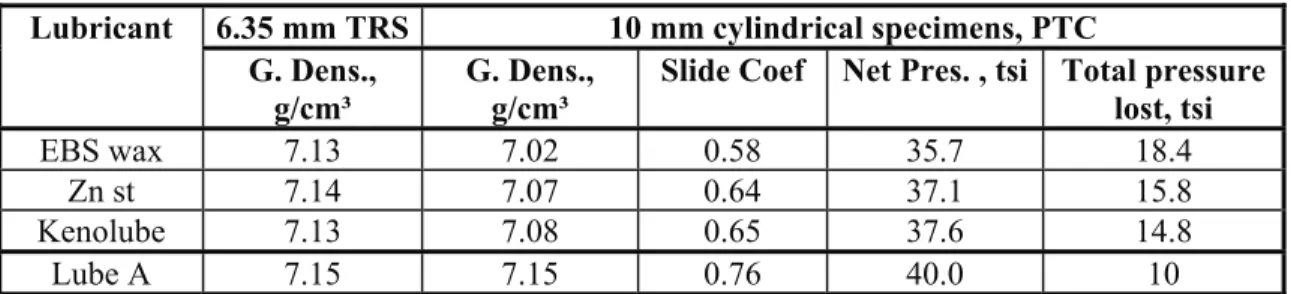
FC0208 mixes containing conventional lubricants, EBS wax, Zn stearate and Kenolube, and a new lubricant, identified as Lube A, were prepared and evaluated in a lab press with standard 6.35 mm (¼ in) TRS bars and in the PTC with cylindrical specimens 10 mm height and with an aspect ratio 3 times higher than that of TRS bars. The level of lubricant was 0.75% and Acrawax C atomized was used as the EBS wax. It should be emphasized that the pore free density of these mixes is ~ 7.36 g/cm³. Compaction was carried out at a temperature of ~ 60°C or 1401F, which corresponds approximately to the temperature of parts after compaction. Green density achieved at 620 MPa (45 tsi) with the two compaction methods are given in Table 1.
Table 1. Compressibility of FC0208 mixes with different lubricants at 601C and an applied pressure of 620 MPa (45 tsi). The level of lubricant was 0.75wt%.
6.35 mm TRS 10 mm cylindrical specimens, PTC Lubricant G. Dens., g/cm³ G. Dens., g/cm³
Slide Coef Net Pres. , tsi Total pressure lost, tsi
EBS wax 7.13 7.02 0.58 35.7 18.4
Zn st 7.14 7.07 0.64 37.1 15.8
Kenolube 7.13 7.08 0.65 37.6 14.8
Lube A 7.15 7.15 0.76 40.0 10
In the case of small TRS specimens, almost no difference in green density between the various lubricants was obtained on the lab press with TRS bars, density varying between 7.13 and 7.14 g/cm³ for
conventional lubricants and up to 7.15 g/cm³ for Lube A. However, in the case of tests in the PTC with slugs with much higher aspect ratio, significant difference in density was obtained. Indeed, EBS wax gave a density of 7.02 g/cm³ versus ~ 7.08 g/cm³ for Zn stearate and Kenolube and 7.15 g/cm³ for Lube A. In fact, in comparison with TRS bars, it can be seen that the green density of conventional lubricants was significantly reduced while the density of Lube A remained unchanged.
The significant difference in compressibility observed with the longer slugs can be explained when considering the friction at die wall and its effect on the pressure really seen by the compacts during compaction. Indeed, it can be seen in Table 1 that the slide coefficient ! was significantly different from one lubricant to the other. EBS wax gave the lowest slide coefficient amongst all the lubricant tested while Zn stearate and Kenolube gave intermediate values and Lube A gave the highest value. As a result, the net pressure reached for an applied pressure of 620 MPa was significantly higher for Lube A as
compared to that of conventional lubricants. The influence of slide coefficient on the net pressure and green density is illustrated in Figure 4. In both case, the net pressure and green density increased linearly with an increase in slide coefficient. The trends in figure 4 tend to demonstrate that the variation in density from one lubricant to the other obtained in the PTC was mainly due to a variation of the friction at die walls and not to a change in the intrinsic compressibility. Figure 5 that shows the intrinsic compressibility curves (green density versus net pressure) for the different lubricants. Very small difference in compressibility curves was observed between the lubricants, EBS wax being slightly less compressible then the two other conventional lubricants and Lube A. However, the difference remains small in regards to that caused by the lubrication. Indeed, if all the lubricants had identical lubricating behavior, and thus, identical net pressure for a given applied pressure, the difference in density between Lube A and EBS wax would be only 1/3 of the difference obtained, i.e. 0.04 versus 0.12 g/cm³. Thus, it can be concluded that the lower density obtained with EBS wax was mainly due to a higher friction at die walls (lower slide coefficient), which resulted in a higher lost of pressure in the compact as given in Table 1. At the inverse, the higher density reached with Lube A is mainly explained by a lower friction at die walls, and thus a higher net pressure.
Figure 4. Influence of slide coefficient on green density and net pressure for FC0208 mixes containing various lubricants. Cylindrical specimens pressed at 620 MPa and 601C.
Figure 5. True compressibility curves (Green density versus net pressure) for FC0208 mixes containing various lubricants. Cylindrical specimens pressed at 620 MPa and 601C.
460 480 500 520 540 560 0.50 0.55 0.60 0.65 0.70 0.75 0.80 0.85 Slide Coefficient N e t P re s ., M P a 7.00 7.04 7.08 7.12 7.16 7.20 G . D e n s ., g /c m ³ 6.8 6.9 7.0 7.1 7.2 400 450 500 550 600
Net Pressure, MPa
G re e n D e n s it y , g /c m ³ LubeA Zn st Wax Keno
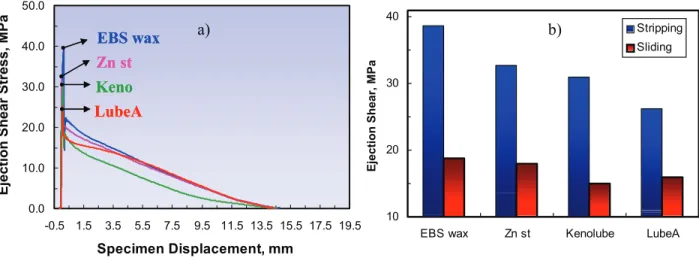
The fact that the difference in density is mainly driven by the friction at die walls allows explaining why the difference in density obtained with standard TRS bars was not very important. Indeed, for such a type of specimens, the surface area of the compact in contact with the die wall is very low, and thus the friction at die walls. As a result, the loss in pressure due to the friction at the die walls would remain very small. Finally, Figure 6 shows the typical ejection curves for all the lubricants at 620 MPa (45 tsi) along with the average stripping and sliding shear stress. It is seen that the ejection performance of Lube A was quite good. Indeed, the ejection performance of Lube A was better than that of EBS wax, that showed the highest stripping and sliding force amongst all the lubricants, and comparable to that of Zn stearate. Compared to Kenolube, Lube A gave a lowest stripping pressure but a slightly higher sliding pressure. In fact, Kenolube was the lubricant that presented the best ejection behavior when compact was moving out of the die.
Figure 6. Ejection performance of FC0208 mixes with various lubricants pressed at 620 MPa and 601C. a) Typical ejection curves b) Average stripping and sliding shear stress.
b. FN0205 mixes with 0.6% lubricant
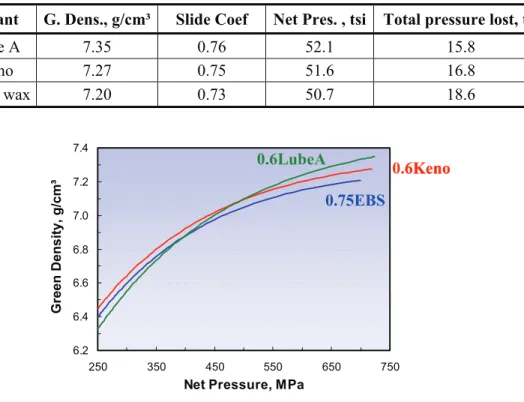
Results presented in the previous section confirmed the very good lubricating properties of Lube A. Nevertheless, for high-density applications, it is well known that the level of lubricant must be kept as low as possible, typically at 0.6% or below. Previous results also showed the very good performance of Kenolube during ejection. Thus, the compaction and ejection performance of Lube A was compared to that of Kenolube at lower level of lubricant. For that comparison, FN0205 mixes containing 0.6% lubricant were prepared and evaluated in the PTC. Mix with 0.75% EBS wax was also used as a reference. The pore free density of mixes at 0.6 and 0.75% is respectively 7.46 and 7.39 g/cm³. Cylindrical specimens ~ 10 mm height were pressed at 830 MPa (60 tsi) and 601C in a HSS die. Results of tests are summarized in Table 2. Green density of 7.35 g/cm³ was reached with 0.6% Lube A versus 7.26 g/cm³ for 0.6% Kenolube and 7.21 g/cm³ for 0.75% EBS wax. These densities correspond to 98.5, 97.3 and 97.4% of the pore free density respectively. Contrary to what was observed in the previous section, the higher density reached with Lube A cannot be directly related to a higher net pressure due to a better lubrication. Indeed, very similar slide coefficients, and thus, net pressures were obtained at 830 MPa for all the mixes. Figure 7 shows the compressibility curves for the three lubricants. It can be seen
10 20 30 40
EBS wax Zn st Kenolube LubeA
E je c ti o n S h e a r, M P a Stripping Sliding 0.0 10.0 20.0 30.0 40.0 50.0 -0.5 1.5 3.5 5.5 7.5 9.5 11.5 13.5 15.5 17.5 19.5 Specimen Displacement, mm E je c ti o n S h e a r S tr e s s , M P a EBS wax LubeA Zn st Keno EBS wax LubeA Zn st Keno a) b)
that the behavior of Lube A is different than that of the other conventional mixes. Indeed, the compressibility of Lube A improved significantly as pressure is increased. This is particularly more evident in this series of test compared to the previous one because of the very high pressure applied, 830 MPa versus 620 MPa. The significant improvement in compressibility observed when pressure became very important may be explained by the fact that Lube A, because of its relatively low viscosity, moves easily to the die walls when sufficiently pressure is applied. As a result of that phenomena, the level of internal lubricant that remains in the compact after compaction tends to become lower as the compaction proceeds.
Table 2. Compressibility of FN0205 mixes measured in the PTC at 651C and an applied pressure of 830 MPa (60 tsi).
Lubricant G. Dens., g/cm³ Slide Coef Net Pres. , tsi Total pressure lost, tsi
0.6 Lube A 7.35 0.76 52.1 15.8
0.6 Keno 7.27 0.75 51.6 16.8
0.75 EBS wax 7.20 0.73 50.7 18.6
Figure 7. True compressibility curves for FN0205 mixes containing 0.6% Kenolube, 0.6% Lube A and 0.75% EBS wax pressed at 601C.
It can be noticed in Table 2 that the slide coefficient obtained for the conventional lubricants were better than those achieved in the previous section. This can be explained by looking at the behavior of the slide coefficient as a function of the In-Die density in Figure 8. Indeed, it is seen for conventional lubricant like EBS wax and Kenolube that the slide coefficient was particularly low at density of ~ 6.0 g/cm³ but increased with the In-Die density. The increase in slide coefficient became more and more important as density increased, likely due to a higher amount of lubricant moving to the die walls. Since density is a function of the pressure applied, this behavior explains why better slide coefficient was obtained at 830 MPa than at 620 MPa. The behavior of Lube A was totally different. It is seen that the slide coefficient was already very high at low density and remained almost unchanged during the compaction process, increasing slightly when density In-Die approached the pore free density. This indicates that Lube A is much more efficient to transfer the pressure than conventional lubricant at relatively low density and is better or equivalent to conventional lubricant when density approaches the pore free density.
6.2 6.4 6.6 6.8 7.0 7.2 7.4 250 350 450 550 650 750
Net Pressure, MPa
Green Density, g/cm³ 0.6LubeA 0.75EBS 0.6Keno 6.2 6.4 6.6 6.8 7.0 7.2 7.4 250 350 450 550 650 750
Net Pressure, MPa
Green Density, g/cm³ 0.6LubeA 0.75EBS 0.6Keno
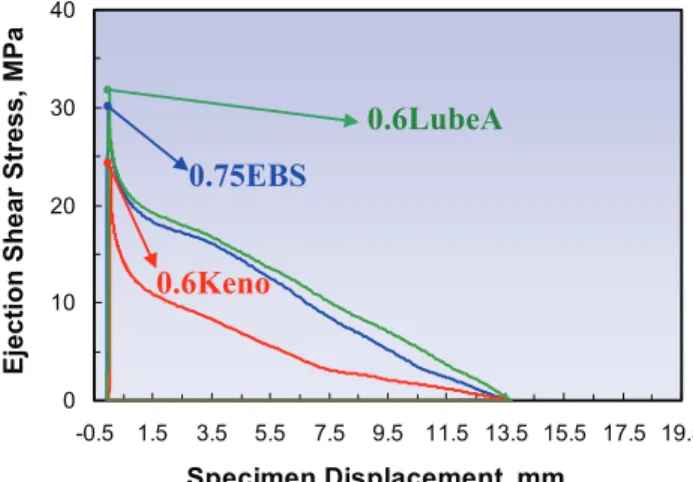
Figure 9 shows typical ejection curves for the three systems. The ejection behavior of 0.6% Lube A was almost identical to that of 0.75% EBS wax even if its quantity was much lower. However, the ejection performance of Kenolube was significantly better than that of Lube A and EBS wax. Even if it is difficult to correlate the results obtained on a hydraulic lab press ejecting a low rate and the performance that would be obtained on production presses compacting and ejecting at much higher rates, it is believed that the ejection performance of Lube A would be sufficient for low aspect ratio parts (short length) but would be probably not good enough for parts with higher aspect ratio.
Figure 8. Variation of slide coefficient as a function of In-Die density. FN0205 mixes pressed at 601C.
Figure 9. Typical ejection curves for FN0205 mixes with various lubricants. Pressing done at 830 MPa and 601C.
II.
Performance of an new experimental lubricant systemThe previous section showed that Lube A, a lubricant from a new family with relatively low melting point, had very interesting compaction characteristics: excellent lubrication at the die walls and higher green density than conventional lubricants. In addition to that, these new lubricants have very good flow rate and green strength. However, the ejection performance, even if comparable to that of EBS wax, was quite limited. This section presents the performance of a lubricant system specifically engineered based on that new family of lubricant to give better ejection properties but similar compaction properties than Lube A. This system is called lube C.
0.4 0.5 0.6 0.7 0.8 0.9 1.0 6.0 6.2 6.4 6.6 6.8 7.0 7.2 7.4 Density IN Die, g/cm³ S li d e C o e ff ic ie n t E ta 0.6LubeA 0.75EBS 0.6Keno 0 10 20 30 40 -0.5 1.5 3.5 5.5 7.5 9.5 11.5 13.5 15.5 17.5 19.5 Specimen Displacement, mm E je c ti o n S h e a r S tr e s s , M P a 0.6LubeA 0.75EBS 0.6Keno
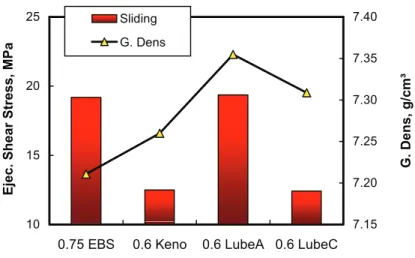
Figure 10 gives the ejection performance and density obtained with the new lube system lube C in
comparison with Kenolube, Lube A and EBS wax. 0.6% was added to FN0205 mixes in the case of Lube A, lube C and Kenolube and 0.75% in the case of EBS wax. Again, compaction was carried out in the PTC at 601C and 830 MPa (60 tsi). It can be seen that the ejection performance of lube C are much better than that of Lube A, the stripping as well as the sliding force being almost equivalent to what was
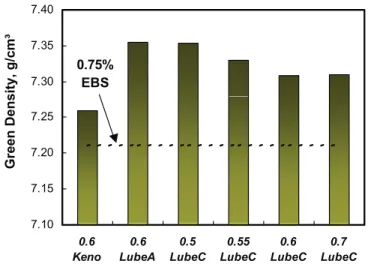
achieved with Kenolube. In addition, the performance of 0.6% lube C was significantly better than that of 0.75% EBS wax, the sliding shear stress being 35% lower. On the other hand, it is also seen in Figure 10 that the green density achieved with lube C was only slightly lower than that achieved with Lube A. Nevertheless, density remained higher than that achieved with 0.6% Kenolube and 0.75% EBS wax. The very good ejection performance showed by lube C open the possibility to reduce further its content in the mix, which should help increasing the density. Figures 11 and 12 show the green density and ejection performance respectively for FN0205 mixes containing different levels of lube C from 0.5 to 0.7%. Results obtained with 0.6% Kenolube and 0.75% EBS wax are also given as reference. Compaction was carried out at 830 MPa and 601C. First, it is seen in Figure 11 that reducing the lubricant content led to an increase in green density, up to 7.35 g/cm³ at 0.5% lube C. On the other hand, it is also seen that increasing the lubricant content up to 0.7% had almost no detrimental effect on green density. This is explained by the fact that lubricant is expelled out of the part at high pressure.
In Figure 12, it is seen that reducing the lubricant content from 0.6 to 0.5% led to an increase in the sliding ejection shear stress. Nevertheless, it remained significantly lowered that the values achieved with 0.75% EBS wax and 0.6% Lube A at 830 MPa. The ejection performance of the mix with 0.5% lube C pressed at 830 MPa is even comparable to that achieved with 0.75% EBS wax pressed at a much lower compacting pressure, clearly showing the very good lubricating properties of the new lubricant system. Based on that, we could expect a very good performance on production press, even for high aspect ratio parts.
Next steps are validation of these new lubricant systems on a production press. Preliminary results, not presented here, showed very promising results, the gain in density being maintained and ejection being in line with results achieved in the PTC.
Figure 10. Ejection performance given by the sliding ejection shear stress and compressibility of a new lubricant system called lube C. FN0205 mixes pressed at 830 MPa and 601C.
10 15 20 25
0.75 EBS 0.6 Keno 0.6 LubeA 0.6 LubeC
E je c . S h e a r S tr e s s , M P a 7.15 7.20 7.25 7.30 7.35 7.40 G . D e n s , g /c m ³ Sliding G. Dens
Figure 11. Green density of FN0205 mixes containing various levels of lube C. Compaction done at 830 MPa and 601C.
Figure 12. Ejection performance as given by the sliding ejection shear stress for FN0205 mixes containing various levels of lube C. Compaction done at 830 MPa and 601C.
CONCLUSIONS
In this paper, the performance of a new family of lubricants and an experimental lubricant system specifically engineered to give good ejection properties and high green density was presented and discussed. The characteristics of mixes containing these new lubricants and also conventional were evaluated with a fully instrumented laboratory compaction device allowing a compete characterization of the compaction, lubricating and ejection processes.
In particular, it was shown that a new grade of lubricant, called Lube A, showed significant improvement in compaction behavior, the lubrication at die walls being significantly improved all along the compaction process and green density being higher at relatively pressure. Ejection was found to be very good when 0.75% is added and comparable to that of 0.75% EBS wax when 0.6% is added. However, ejection was not as good as Kenolube
7.10 7.15 7.20 7.25 7.30 7.35 7.40 0.6 Keno 0.6 LubeA 0.5 LubeC 0.55 LubeC 0.6 LubeC 0.7 LubeC G re e n D e n s it y , g /c m ³ 0.75% EBS 10.0 12.0 14.0 16.0 18.0 20.0 22.0 0.6 Keno 0.6 LubeA 0.5 LubeC 0.55 LubeC 0.6 LubeC 0.7 LubeC G re e n D e n s it y , g /c m ³ 0.75% EBS wax 830 MPa 620 MPa
An experimental lubricant system called lube C was developed to improve ejection. Comparable ejection performance to that of Kenolube was achieved, with green density of ~7.3 g/cm³ for high aspect ratio specimens. Reducing the lubricant content down to 0.5% led to an increase in density up to 7.35 g/cm³ with ejection performance remaining significantly better than that of 0.75% EBS wax at 830 MPa. Validation of these systems is underway in production presses but preliminary results confirmed the improvement in green density achieved in lab and the very good ejection performance.
REFERENCES
1
F. Chagnon and S. St-Laurent, paper presented at the 2000 Powder Metallurgy World Congress inKyoto, November, 2000.
2
F. Chagnon and Y. Trudel, Advances in Powder Metallurgy and Particulate Materials, MPIF,Princeton, N.J., 1995, Vol. 2, p. 5-3.
3
. V. Musella and M.D'
angelo, "Process for Preheating Metal in Preparation for CompactingOperations", U.S. Patent No. 4,955,798.
4
. Standard Test Methods for Metal Powders and Powder Metallurgy Products, MPIF, Princeton, NJ, 1995.5
. Powder Testing Center model PTC-03DT, User’s manual V-20. KSK Powder Technologies Corp.,1996.
6
. S. Gasiorek, K. Maciejko and J. Szatkowska, Proceedings of 4th International Conference On ModernCeramic Technologies, Italy, 1979, p. 223.
7
. S. Gasiorek, Sci. Bull. of Stanislaw Staszic University of Mining and Metallurgy, no 737, 40,Poland, 1979.
8
Y. Thomas, S. Pelletier and J.M. McCall, Advances in Powder Metallurgy and Particulate Materials-1998, Vol. 2, Compiled by J.J. Oakes and J.H. Reinshagen, MPIF, Princeton, NJ, 1998, p. 11-25.
9
S. Turenne, C. Godère, Y. Thomas and P.E. Mongeon, Powder Metallurgy, Vol.42, N°3, 1999, p.263.