HAL Id: cirad-01154846
http://hal.cirad.fr/cirad-01154846
Preprint submitted on 30 May 2015HAL is a multi-disciplinary open access archive for the deposit and dissemination of sci-entific research documents, whether they are pub-lished or not. The documents may come from teaching and research institutions in France or abroad, or from public or private research centers.
L’archive ouverte pluridisciplinaire HAL, est destinée au dépôt et à la diffusion de documents scientifiques de niveau recherche, publiés ou non, émanant des établissements d’enseignement et de recherche français ou étrangers, des laboratoires publics ou privés.
Aleppo pine (Pinus halepensis.Mill) reafforestation stem
form study using natural form factors method
Kada Bencherif, Youcef Belouatek
To cite this version:
Kada Bencherif, Youcef Belouatek. Aleppo pine (Pinus halepensis.Mill) reafforestation stem form study using natural form factors method. 2011. �cirad-01154846�
form study using natural form factors method
Bencherif K1 and Belouatek Y11. POB 119, Department of Forest resources, University of Tlemcen, 13000, Algeria.
Abstract: Form factors are often used for stem timber volume estimation at both tree and forest stand levels. But this estimation
becomes easy and faster when for each species is established a table where are ordered these factors according to the trees height. This contribution proposes such table for Aleppo pine reforestation realized in 1890 in the region of Tlemcen (West of Algeria). The method used for its establishment uses advantageously the existing relation between natural and artificial (breast-height) factors and requires a limited number sample trees (50 to 80 only). The obtained values, from 0540 to 0356 for respectively 6 to 25 meters heights, express better taper of the stems in the study stand and allow practically quick stem timber volume evaluation in our survey zone or in other similar stations.
Key-words: Aleppo pine, form factor, relative height, stems volume
1. Introduction
Two main methods are used in forest practice for stem timber volume estimation: Direct evaluation through taper measurement and indirectly through volume tables (or equations). Although it’s expensive, direct taper measurement is the most accurate as it takes into account the real stem form: For a long time, it's admitted that for a given diameter and height, stem timber volume is absolutely linked to its form [1]. Various dendrometrical expressions were established to embody the stem general form but the currently used one is the form factor [2].
The form factor is the ratio of the stem volume to a fixed diameter or length and the volume of a cylinder witch basis is the basal area (g) of a section at a fixed height and which height is the reference hr of the considered volume: fi = v/gihr (1). When the level "i" corresponds to a man height (1.30 m), we specify the breast height or the artificial form factor whose great inconvenient is its dependence on height. Other mathematical expressions characterize stem form through relationships between diameters measured at two different levels [3]. Their general form is [1]: d/dhp = f(h/H) (2) where (d) is the stem diameter measured at the height (h), (bhd) the breast height diameter and (H) the total tree height.
In forest practice are known others form factors that the ones measured to breast height. In 1880, Smallians and Pressler proposed the natural form factors [4]: initially, the natural factor is defined by the ratio of a given stem volume and the volume of a cylinder having as basis the basal area to 1/20 of the stem height, and as height, the stem height. Later, this notion is extended by measuring basal areas in any relative heights (1/n). It‘s expressed therefore by the formula: fn = v/g1/nh (3). The particular case of the natural factor is the absolute one that relates to a basal area measured to the stem basis, so to a relative height 1/∞ = 0 from where f0 = v/g0h (4).
The three form factors types (f1.3; fn ; f0) are very important for both stem and stand timber estimation. Indeed, equations based on basal area, dominant (or mean) height and an evaluation of (f) permit quick volume calculation of forest stands. But the form factors are hardly appreciated or measured accurately for an inexperienced observer [2). Although it’s possible to estimate them from yield tables or by using the relascope of Bitterlicht, they can be presented in special tables whose construction can be achieved through four methods: the statistical method, the taper method at breast height, the form quotient method and the method of the natural form factor to relative height (0.x). The common inconvenience to the first three methods is the necessity to cut an important number sample trees (some thousands for the statistical method for example).
The natural factors method while using the existing relation between artificial factor at breast height and those naturals, permits to avoid the disadvantages of the former methods. Indeed, the natural factor is fully independent of the tree height and is the real expression of its form. Besides, the method doesn't require a great number samples trees and the felling can be limited to only 60 or 80 trees. Another advantage of the method is that the obtained natural factors are considered in the practice as artificial. The Aleppo pine (dominant resinous specie in Algeria) form factors table establishment will have a double interest therefore: to know better form factors values of Aleppo pine reforestation and to allow the foresters to overcome constraints often linked to stand timber volume estimation because of volume or yield tables unavailability.
Corresponding author: K. Bencherif, Ph.D., conference master, research fields: landscaped forest management and remote sensing.
Contribution to the Aleppo pine forests inventory
2
2. Materials and methods
2.1. Study area
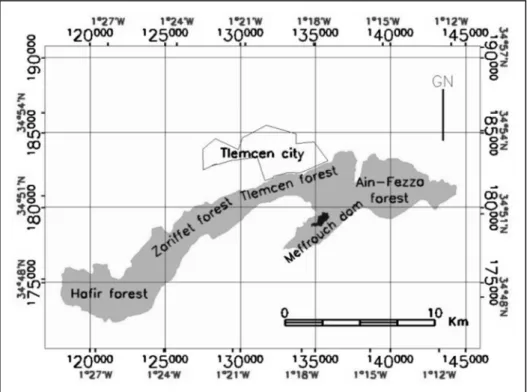
The suburban state forest of Tlemcen (figure1) is a pure Aleppo pine (Pinus Halepensis.Mill) reforestation dating from 1890. It is localised upstream of Tlemcen city, to an average altitude of 1023 m. The undergrowth is characterized by the presence of Juniper (Juniperus oxycedrus), of asparagus (Asparagus acutifolius), of doum (Ampelodesma mauritanica),of holm-oak (Quercus ilex), of spiny broom (Calycotome spinosa) and of the dwarf palm (Chamaerops humilis). The forest was integrated in 1993 to the national park of Tlemcen, and spreads on 286 hectares. Generally, it presents a topographic homogeneity with the exception of the north part, where the slope is of 25% and more. The forest growths on the chalky substratum under the influence of Mediterranean climate with two well distinct seasons: a cold and humid short term wintry season, and a hot and dry long term summery season [5].
Figure 1: Study area localisation (North Algeria Lambert kilometric projection)
2.2. Principle of the method
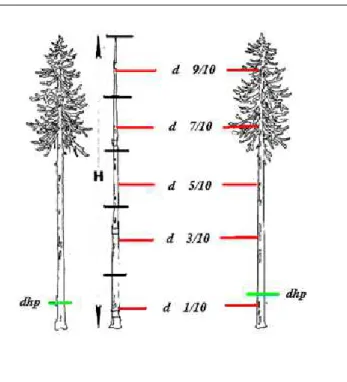
The method combines both artificial and natural factors advantages: the factors are calculated as naturals but in practice are used as artificial. Such decision is based on the existing relationship between the two factors types. Indeed and for a set natural factors, there is certainly one that is at the same time artificial and natural: it’s the factor corresponding to the relative height 1.3/h. Figure 2 shows that for a given stem are calculated several natural form factors. The stem is divided in five sections and as basis of calculation is used the basal areas (diameters) measured to 1/10 (0.1), 3/10 (0.3), 5/10 (0.5), 7/10 (0.7) and 9/10 (0.9) of the height. Notice that higher is measured the diameter, smaller will be the volume of the cylinder to compare to the stem volume, fact that leads to great values of its correspondent natural factors.
Graphically, these natural factors are expressed by the natural form factors curve (figure 3) from where we can determine breast-height form factors ((f1.3). In fact, this last is a natural factor at relative height 1.3/h. To establish form factors table using this method, four stages are necessary:
To select and to treat a sufficient number of sample trees To calculate for every sample tree a serial of natural factors To calculate the mean arithmetic curve of the natural factors To construct the natural form factors table
Figure 2: Stem Segmentation scheme of equal length sections
Figure 3: Natural form factors curve general appearance
Generally, the method requires felling and measuring of about sixty samples trees of a height superior to 20 meters. The measures on the sample trees are the same that those serving to stem timber estimation using the commercial formula of Huber applied to successive sections. The profile of every sample tree is plotted then in a coordinates system, in ordinates the diameters and in abscissas the heights to which are measured these diameters. For every sample tree processed in this way are calculated a set of natural form factors. This last serves to calculate graphically the mean curve from where will be read directly the natural factors at relative height (1.3/h) and corresponding to different values of the height.
2.3. Field measures
The field data concern the description of both forest stand and dendrometrical characteristics of the sample trees. 0,1 0,2 0,3 0,4 0,5 0,6 0,7 0,1 0,3 0,5 0,7 0,9 N a tu ra l fo rm f a c to rs Relative height (0.x)
Contribution to the Aleppo pine forests inventory
4
2.3.1. Forest stand description
The description of some qualitative variables permits to get a characterization of the site making possible its comparison with other sites. Indeed, the fundamental problem of the stem volume estimation affects the relation between the tree form and the site conditions [6]. Generally, the description must be about the composition, the cover, the physical difficulties of exploitation and the relative importance of the regeneration of the different species. This description is completed by an ecological report permitting to determine the evolution series of the forest stand [7]. In our case, five variables were described: the exposition and the slope (with a clinometer-compass), the altitude (with an altimeter), the soil and finally the recovery of the arborescent stratum. The table I
summarise the survey zone characteristics by sample plot.
Table 1: Physical Sample-plots characteristics
Sample-plots Exposition Altitude (m) Slope(degree) Soil depth (cm) Recovery (%) 1 2 3 4 5 North North-west north-east North North 1050 950 1120 1010 1100 12° 8° 20° 14° 9° 10 15 8 12 10 40 % 55 % 45 % 50 % 60 %
2.3.2. Dendrometrical characteristics measure
Two main dendrometrical parameters are necessary for our survey, the diameter and the height. The trees felling being impossible, we used the relascope of Bitterlich since this instrument permits to measure the diameters in different heights. Within each of the 5 plots, 10 sample trees have been selected, i.e. 50 trees to the total. The selection criteria are the stem rectitude, the height and the sanitary state. Two techniques are possible for taking measures: to divide the stem in several successive sections of equal length (2m for example) and in this case the diameter in the middle of the first will be measured to 1 m of height, the one of the second to 3 m and so forth, or to divide the stem in a defined sections number (i.e. 10 in our case) but of variable length according to the full height of the tree.
3. Results and discussion
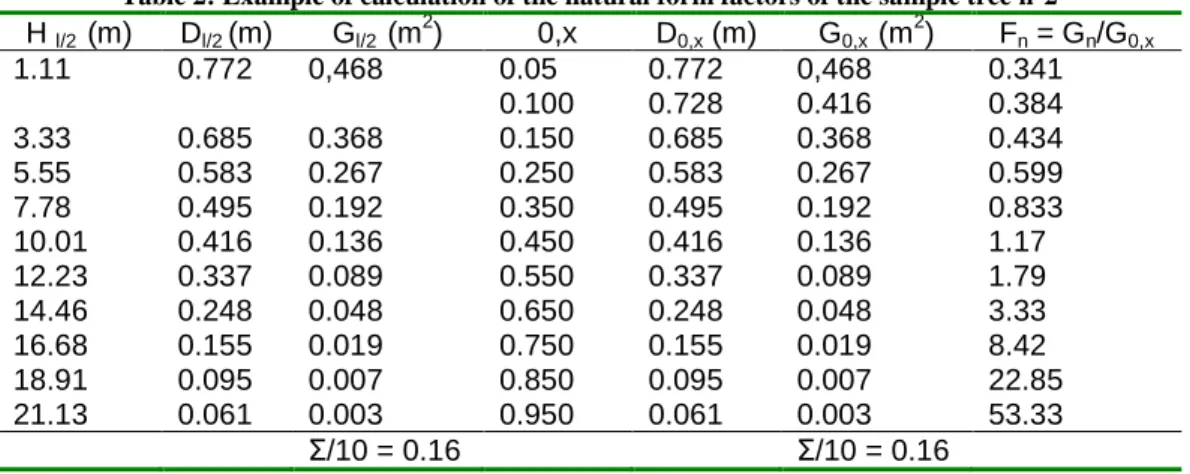
For a given sample tree is calculated a set of natural factors using the formula fn=gn/g0,x (5) where gn is the tree natural basal area : It is the arithmetic mean of the basal areas measured in the middle of every section. Since the trees have been divided in 10 sections (i.e. 20 half - sections), the middle of the first section will be to 1/20 the tree height, the one of the second to 3/20, of the third to 5/20, of the fourth to 7/20 etc. In other words, we obtain the relative heights 0.05; 0.150; 0.250; 0.350 etc. But It’s necessary to take always into account the relative height 0.x = 0.100. Having calculated gn and g0.x, we can determine easily for a given sample tree, the natural form factors by the formula (5). The table 2 shows an example among the 50 treated trees in this survey.
Table 2: Example of calculation of the natural form factors of the sample tree n°2
Of the same way are calculated the form factors for the 49 other sample trees while establishing for each of them a similar table to the previous one (Table II).The next stage consists in constructing the table III where are given, for the 50 sample trees, the factors corresponding to the relative heights only from 0.05 to 0.250 since those
H l/2 (m) Dl/2 (m) Gl/2 (m 2 ) 0,x D0,x (m) G0,x (m 2 ) Fn = Gn/G0,x 1.11 0.772 0,468 0.05 0.772 0,468 0.341 0.100 0.728 0.416 0.384 3.33 0.685 0.368 0.150 0.685 0.368 0.434 5.55 0.583 0.267 0.250 0.583 0.267 0.599 7.78 0.495 0.192 0.350 0.495 0.192 0.833 10.01 0.416 0.136 0.450 0.416 0.136 1.17 12.23 0.337 0.089 0.550 0.337 0.089 1.79 14.46 0.248 0.048 0.650 0.248 0.048 3.33 16.68 0.155 0.019 0.750 0.155 0.019 8.42 18.91 0.095 0.007 0.850 0.095 0.007 22.85 21.13 0.061 0.003 0.950 0.061 0.003 53.33 Σ/10 = 0.16 Σ/10 = 0.16
relating to important relative heights are not necessary. The factors are added then by relative height and divided by the number of trees (i.e. 50) and in this way is obtained a mean set of natural form factors.
Table 3: Natural form factors values of the different sample trees
N° of the sample tree
Relative height 0,x N° of the sample tree Relative height 0,x 0,050 0,100 0,150 0,250 0,050 0,100 0,150 0,250 1 0,266 0.322 0,491 0,686 26 0,318 0.375 0,416 0,583 2 0,341 0,384 0,434 0,599 27 0,394 0.447 0,493 0,581 3 0,419 0.485 0,509 0,632 28 0,355 0.537 0,453 0,607 4 0,354 0.411 0,477 0,633 29 0,388 0.445 0,490 0,608 5 0,419 0.452 0,482 0,581 30 0,400 0.440 0,492 0,617 6 0,375 0.447 0,489 0,609 31 0,372 0.429 0,461 0,637 7 0,432 0.477 0,505 0,631 32 0,394 0.477 0,486 0,602 8 0,288 0.318 0,366 0.500 33 0,329 0.405 0,451 0,625 9 0,357 0.402 0,452 0,590 34 0,412 0.466 0,535 0,616 10 0,421 0.396 0,593 0,749 35 0,328 0.378 0,415 0,628 11 0,331 0.388 0,453 0,623 36 0,385 0.427 0,495 0,615 12 0,416 0.478 0,558 0,689 37 0,400 0.447 0,491 0,600 13 0,333 0.375 0,418 0,569 38 0,398 0.425 0,472 0,599 14 0,312 0.364 0,427 0,586 39 0,355 0.400 0,453 0,553 15 0,400 0.492 0,490 0,631 40 0,388 0.446 0,495 0,602 16 0,380 0.446 0,481 0,643 41 0,424 0.480 0,515 0,601 17 0,300 0.352 0,406 0,604 42 0,383 0.420 0,467 0,576 18 0,372 0.427 0,468 0,611 43 0,358 0.400 0,436 0,584 19 0,386 0.440 0,475 0,635 44 0,353 0.387 0,431 0,541 20 0,352 0.402 0,450 0,601 45 0,334 0.403 0,460 0,575 21 0,304 0.352 0,401 0,572 46 0,329 0.379 0,455 0,580 22 0,347 0.418 0,472 0,613 47 0,393 0.436 0,472 0,660 23 0,329 0.398 0,443 0,585 48 0,322 0.374 0,425 0,604 24 0,342 0.394 0,451 0,566 49 0,319 0.353 0,402 0,531 25 0,369 0.420 0,483 0,610 50 0,334 0.387 0,434 0,610 ∑ Fn 18.11 20.803 23.275 30.279 Fn/50 0,362 0,416 0,465 0,605
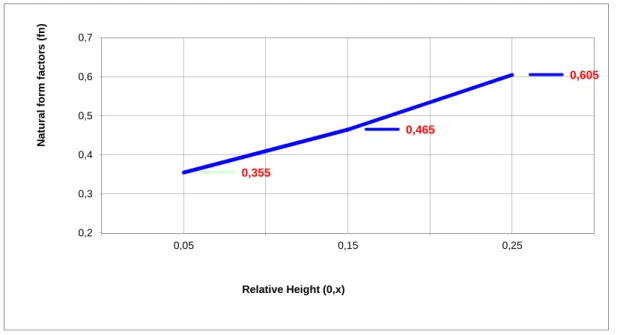
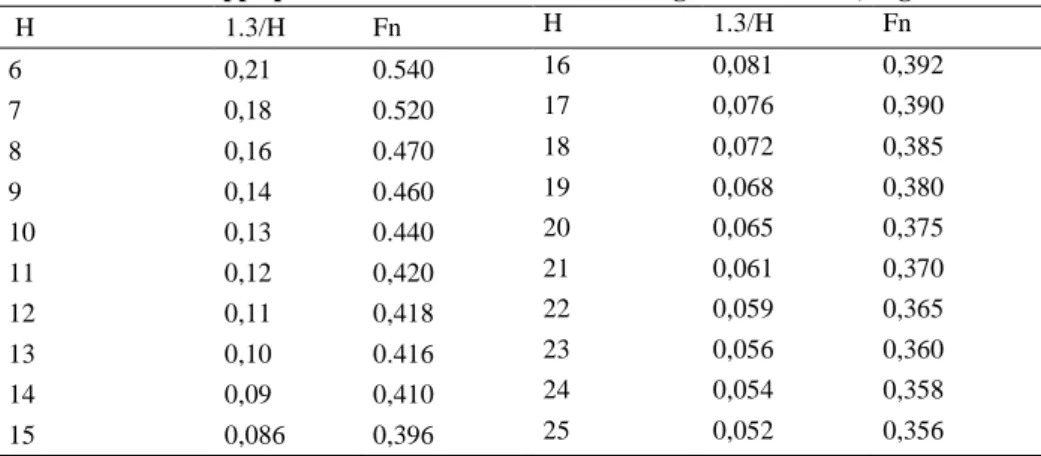
Graphically, this set is illustrated by the figure 4 representing the mean curve of Aleppo pine form factors and permitting to construct the corresponding table. But it is necessary to know first this interval of the heights values of the trees to measure through this table. Then, the absolute height at breast height (1.3 m) is converted in relative height while dividing it by the height of the tree. From the form factor curve (figure 4) are read and ordered in a table (Table 4) the natural factors for relative heights 1.3/h. These last will be used as if they were measured to breast-height (i.e. 1.3m).
Figure 4: Mean curve of the natural form factors for the 50 sample trees
0,355 0,465 0,605 0,2 0,3 0,4 0,5 0,6 0,7 0,05 0,15 0,25 N a tu ra l fo rm f a c to rs ( fn ) Relative Height (0,x)
Contribution to the Aleppo pine forests inventory
6
Table 4: Aleppo pine natural form factors table. Region of Tlemcen, Algeria
H 1.3/H Fn H 1.3/H Fn 6 0,21 0.540 16 0,081 0,392 7 0,18 0.520 17 0,076 0,390 8 0,16 0.470 18 0,072 0,385 9 0,14 0.460 19 0,068 0,380 10 0,13 0.440 20 0,065 0,375 11 0,12 0,420 21 0,061 0,370 12 0,11 0,418 22 0,059 0,365 13 0,10 0.416 23 0,056 0,360 14 0,09 0,410 24 0,054 0,358 15 0,086 0,396 25 0,052 0,356
The obtained values give us a first idea on the possible form factors values of an Aleppo pine reforestation according to its height. These values don't move away a lot of those obtained in other regions and seems very better. By way of comparison, the table 5 gives the values obtained for the natural Aleppo pine in the “Aures” region (Eastern Algeria) according to the dominant height.
Tableau 5: Aleppo pine Form factors values. Region of Aures, Eastern Algeria [8]
Dominant height (m) 8 10 12 14 16 18 20
F 0.475 0.457 0.432 0.404 0.370 0.339 0.304
This better stem form of the study site is due to some site conditions (sub-humid climate) and probably to the genetic qualities (seeds provenance) that were in favour of this form. Globally, the obtained values are interesting and express satisfactory form and taper of specie well known by its twisted trunk, justifying therefore Aleppo pine production reafforestation.
As regard to the accuracy of this table, three error types are to fear: errors related to the instrument reading, errors related to the operator, and errors related to the used instrument. These errors could be accentuated by the site conditions: rocky and hilly terrain or sylvicultural conditions: bad lopping that doesn't permit a comfortable use of the relascope. At present and in the absence of reference data, the three mentioned errors cannot be determined.
4. Conclusion
The established form factors table will certainly be of a great utility for forest planning inventories of Aleppo pine forests in the region and particularly those resulting from reaforestation. The time and the efforts provided for its construction will be saved by the foresters for stem timber volume estimation. On other side, as it don’t requires the felling of a big number sample trees, the method of the natural form factors can be used for other species (resinous or deciduous). The resulting tables will serve subsequently to volume table’s construction. However, and in order to improve the stem volume estimation, it is recommended to acquire more knowledge on the relationships of the specie stem form with the site conditions.
References
[1] CH. Ung, Forme des tiges d'érable à sucre et de hêtre à grandes feuilles dans une jeune futaie selon leur position sociale et leur âge. Ann.Sci.For. 46(3) (1989). 261-271.
[2] J. Pardé, J. Bouchon, Dendrométrie. 2e édition. Ecole nationale du génie rural, des eaux et forêts. France. (1988)
[3] O. M'hirit, JG. Postaire., Analyse de la forme des tiges pour la construction de tarifs de cubage. Application au cèdre du Maroc (Cedrus atlantica. Manetti). Ann.sc.for.41(3). (1984). 303-322.
[4] J. Doukhovnikov, I. Mikhov, Dendrométrie. Ed.zemisdat, Sofia, Bulgarie. (1983)
[5] M. Bouazza, Etude phyto-écologique de la steppe à stipa tenacissima au sud de Sebdou - Oranie- Algérie).Thèse en sciences, Fac.Sc. Marseille- Saint - Jérôme, France. (1991)
[6] CH. Ung, Inventaire par échantillonnage pour estimer la production ligneuse et son accroissement. Partie 3. Acquisition et traitement des informations. Cours n°25, Formation continue. Ed. Ordre des ingénieurs forestiers du Québec. (2006).
[7] Saucier JP., Croissance et rendement en fonction des types écologiques photointerprétés dans la région écologique 5a-Basses et Moyennes Appalaches (Québec). Thèse de maîtrise. Faculté de foresterie et de géomatique, Université Laval. (1992).