Anatomy-Based Algorithms for Detecting Oral Cancer
Using Reflectance and Fluorescence Spectroscopy
The MIT Faculty has made this article openly available. Please share
how this access benefits you. Your story matters.
Citation
Ann Otol Rhinol Laryngol. 2009 Nov;118(11):817-26.
As Published
http://www.ncbi.nlm.nih.gov/pmc/articles/PMC2860948/
Publisher
Annals Publishing Company
Version
Author's final manuscript
Citable link
http://hdl.handle.net/1721.1/67836
Terms of Use
Attribution-Noncommercial-Share Alike 3.0 Unported
Annals of Otology, Rhinology á tuiryngology 118( 11 ):817-826.
© 2009 Annals Publishing Company. All rights reserved.
Anatomy-Based Algorithms for Detecting Oral Cancer Using
Reflectance and Fluorescence Spectroscopy
Sasha McGee, PhD; Vartan Mardirossian, MD; Alphi Elackattu, MD;
Jelena Mirkovic, PhD; Robert Pistey, MD, MA; George Gallagher, DMD, DMSc;
Sadru Kabani, DMD, MA; Chung-Chieh Yu, PhD; Zimmern Wang, MD;
Kamran Badizadegan, MD; Gregory Grillone, MD; Michael S. Feld, PhD
Objectives: We used reflectance and fluorescence spectroscopy to noninvasively and quantitatively distinguish benign from dysplastic/malignant oral lesions. We designed diagnostic algorithms to account for differences in the spectral prop-erties among anatomic sites (gingiva, buccal mucosa, etc).
Mettiods: In vivo reflectance and fluorescence spectra were collected from 71 patients with oral lesions. The tissue was then biopsied and the specimen evaluated by histopathology. Quantitative parameters related to tissue morphology and biochemistry were extracted from the spectra. Diagnostic algorithms specific for combinations of sites with similar spec-tral properties were developed.
Resutts: Discrimination of benign from dysplastic/malignant lesions was most successful when algorithms were de-signed for individual sites (area under the receiver operator characteristic curve [ROC-AUC], 0.75 for the lateral surface of the tongue) and was least accurate when all sites were combined (ROC-AUC, 0.60). The combination of sites with similar spectral properties (floor of mouth and lateral surface of the tongue) yielded an ROC-AUC of 0.71.
Conctusions: Accurate spectroscopic detection of oral disease must account for spectral variations among anatomic sites. Anatomy-based algorithms for single sites or combinations of sites demonstrated good diagnostic performance in distin-guishing benign lesions from dysplastic/malignant lesions and consistently performed better than algorithms developed for all sites combined.
Key Words: diagnosis, fluorescence, oral cancer, reflectance, spectroscopy.
INTRODUCTION
Currently, definitive detection and diagnosis of oral cancer requires biopsy followed by histopatho-logic assessment of the excised tissue.' However, there are several shortcomings to this scheme. First, only a limited number of biopsy specimens can be taken because of the invasiveness of the procedure. On the basis of his or her experience, the physician selects the area of the lesion most likely to show sig-nificant disease as the biopsy site. The absence or presence of disease in this specimen is assumed to be representative of the extent of disease in the sus-picious lesion as a whole, and this finding often de-termines whether treatment is indicated.^ Given the subjective nature of this process, regions of disease can be missed. Significant underdiagnosis has been noted with biopsy, particularly when the lesion is
nonhomogeneous or only a single biopsy specimen is obtained.2'3 Second, the accuracy of pathological classification is limited by significant interobserver and intraobserver variability, largely due to the qual-itative nature of the markers used for assessment."*"^ Spectroscopy may provide an objective and non-invasive tool for disease diagnosis. Promising find-ings have been reported for identifying oral lesions by using reflectance and fluorescence spectrosco-py 7-13 -phe majority of these studies have focused on distinguishing healthy mucosa from visible le-sions (either a group consisting of dysplastic and malignant lesions ["dysplastic/malignant"] or ma-lignant lesions).^-^-'^"'^ However, this separation has no clinical relevance, because these categories are easily distinguished by visual inspection. In some cases, benign lesions are grouped with healthy
mu-From the G. R. Harrison Spectroscopy Laboratory, Massachusetts Institute of Technology (McGee, Mirkovic, Yu, Badizadegan, Feld), the Departments of Otolaryngology-Head and Neck Surgery (Mardirossian, Elackattu, Wang, Grillone) and Anatomic Pathology (Pistey). Boston Medical Center, the Department of Oral and Maxillofacial Pathology, Boston University Goldman School of Den-tal Medicine (Gallagher, Kabani), and the Department of Pathology, Harvard Medical School and Massachusetts General HospiDen-tal (Badizadegan), Boston, Massachusetts. This research was supported by National Institutes of Health grants R0I-CA097966 and P4I-RR02594-21.
Correspondence: Sasha McGee, PhD. Bldg 6-205, Massachusetts Institute of Technology, 77 Massachusetts Ave, Cambridge, MA 02139.
cosa samples .^'^'^ Most studies combine data from several anatomic sites (eg, gingiva, buccal mueosa) in each category in generating diagnostic algorithms based on differences in the spectral properties (spec-tral contrast).7'io^n.i3,i4,i8,2i j ^ j s approach may not be ideal, because numerous studies have shown sig-nificant differences in the spectral properties be-tween various anatomic sites, even for healthy oral mucosa.'''^'^^"^'* We refer to the spectral contrast produced by variations in histologie characteristics from site to site as anatomic spectral contrast. The presence of keratin on some sites (particularly the gingiva and hard palate) produces marked anatomic spectral contrast between these sites and nonkerati-nized sites.^'^^^ A recent study of clinically normal mueosa in healthy volunteers (HVs) by our group demonstrated considerable anatomic spectral con-trast even among nonkeratinized sites .^^ The results of our investigation suggested that spectral diagnos-tic algorithms must be site-specific to ensure accu-rate disease diagnosis. We use the term anatomy-based algorithms to refer to algorithms that meet this condition, in that they are developed from and applied to a specific site or group of sites. Because most studies combine several sites, the reported di-agnostic accuracies may be confounded by anatom-ic spectral contrast and therefore unreliable.
The distinction of benign lesions from dysplastic/ malignant lesions is not possible by visual inspec-tion alone and has considerable clinical significance, yet few spectroscopy studies focus on this separa-tion .2'•2^"^*' Anatomic spectral contrast can also in-fluence the diagnostic results for this separation if it is not taken into account. In a study by de Veld et al,^^ for most analysis methods, values of less than 0.70 were obtained for the area under the receiver oper-ator characteristic (ROC) curve (ROC-AUC) when data from U anatomic sites were combined. Us-ing fluorescence spectroscopy, van Staveren et al" combined all sites and achieved a sensitivity of 31 % and a specificity of 67%. Greater success has been achieved in distinguishing lesions when the analy-sis was limited to a single site or a specific group of sites. Wang et aP^ performed a fluorescence study of patients with lesions located only on the buccal mueosa. They obtained a sensitivity of 81% and a specificity of 96% for distinguishing benign lesions from dysplastic/malignant lesions. Mallia et aF' successfully developed diagnostic algorithms to dis-criminate various oral lesions by using fluorescence spectroscopy, but only after excluding lesions of the vermilion border of the lip and of the dorsal and lat-eral surfaces of the tongue. They suggested that a separate spectral database is needed for these 3 sites. In another study by Mallia et al,^^ reflectance
spec-troscopy was used to develop algorithms for all sites combined and for the buccal mueosa (ie, an anato-my-based algorithm). The sensitivities and specific-ities obtained for algorithms specific to the buecal mueosa were consistently higher for the discrimina-tion of benign lesions from dysplastic lesions and dysplastic lesions from malignant lesions. Müller et al^ developed a diagnostie algorithm to distinguish benign lesions from dysplastic/malignant lesions specifically for keratinized sites, and they obtained a higher sensitivity and specificity than when kera-tinized and nonkerakera-tinized sites were combined. Al-though diagnostic algorithms for single sites or lim-ited groups of sites have been investigated, a sys-tematic approach for developing spectral algorithms for multiple sites has not been developed.
The goal of the present study was to develop a strategy for designing anatomy-based algorithms for multiple anatomic sites. Although the spectral prop-erties of different anatomic sites may vary consider-ably, certain subsets may be similar enough in their spectral properties such that they can be combined. Furthermore, in many settings, developing a single diagnostic algorithm for spectrally similar sites may be more practical and less time-consuming than de-veloping a diagnostic algorithm for each individual site. Anatomy-based spectral diagnostic algorithms are developed for 2 applications: \) distinguishing visibly healthy mueosa from visible lesions, and 2) distinguishing benign lesions from c|ysplastic/ma-lignant lesions. The distinction of clinically normal (healthy) mueosa from clinically abnormal mueosa (lesions) has been the focus of most of the previous studies in the oral cavity. We address the question of whether anatomic spectral contrast affects the diag-nostic accuracy of this separation. The second ap-plication is the primary objective of this work, since lesions demonstrating disease (dysplasia or malig-nancy) require intervention.
From the tissue spectra, we extract parameters re-lated to the morphological and biochemical proper-ties. To account for anatomic spectral contrast, we first study healthy mueosa from several anatomie sites to characterize the similarities and differenc-es in their spectroscopy parameters. We then ap-ply these findings by developing common diagnos-tic algorithms for combinations of sites that share a high degree of spectral similarity. To evaluate the benefit of anatomy-based algorithms, we compared the performance of algorithms developed for these specific combinations of sites to those developed for all anatomic sites combined and to those for a single anatomic site. We also examine the trends in the spectroscopy parameters on the basis of disease category.
McGee et al, Anatomy-Based Spectroscopic Algorithms for Oral Cancer 819
PATIENTS AND METHODS
Patients. Patients were recruited from the Depart-ment of Otolaryngology-Head and Neck Surgery at Boston Medical Center. The experimental protocol for in vivo data collection was approved by the In-stitutional Review Board of Boston Medical Center and the Committee on the Use of Humans as Ex-perimental Suhjects at the Massachusetts Institute of Technology. Suhjects enrolled in the study included patients undergoing hiopsy for clinically suspicious lesions, as well as patients undergoing surgical re-section of known dysplastic or malignant lesions. Pregnant women and individuals under the age of 18 years were excluded from the study. Written formed consent was obtained from all suhjeets to in-dicate their willingness to participate. Spectral data were collected from tissues with visible abnormali-ties identified hy the clinician. The elinical appear-ance of the lesions (eg, leukoplakia, erythroplakia) was recorded. After collecting the spectral data, the physician scored the exact area from which the data were acquired using the hlade of a small punch hi-opsy instrument (1.5 or 2 mm in diameter). The tis-sue sample was subsequently removed using a larg-er punch biopsy instrument (3.5 mm diametlarg-er) and sent for histopathologie evaluation. In some eases, a scalpel hiopsy was performed because of the lesion architecture or location. Spectral data were collected from multiple tissue samples in a patient when the physician selected multiple areas of the lesion for hiopsy, or when several hiopsies were performed of a lesion to he resected. The histopathologie assess-ment was performed hy 3 pathologists. Specimens were classified as henign, dysplastic, malignant, or indefinite for dysplasia. The consensus diagnosis (agreement between at least 2 of the 3 pathologists) was considered the final diagnosis. An additional set of 710 spectra previously collected from 79 HVs at 9 anatomic sites was also analyzed, as described be-low.25 Tissue samples from HVs were assumed to represent healthy mueosa and were not hiopsied.
Data Collection. Reflectance and fluorescence spectra were collected from patients using the Fast Excitation Emission Matrix (FastEEM), an investi-gational instrument developed hy our lahoratory that has been previously described.^' A 1.3-mm-diame-ter optical fiber probe was used to deliver the exci-tation light and collect the light emitted from the tis-sue. The optical fiher prohe was disinfected with Ci-dex OPA (Advanced Sterilization Products, Irvine, California) according to the manufacturer's specifi-cations, and placed in contact with the tissue during data collection. No exogenous contrast agents were applied to the tissue. The data collection procedures have heen further described elsewhere.^^ Data were
collected and analyzed from the following anatom-ie sites: hueeal mueosa (BM), dorsal surface of the tongue (DT), floor of the mouth (FM), gingiva (GI), hard palate (HP), lateral surface ofthe tongue (LT), retromolar trigone (RT), soft palate (SP), and ventral surface ofthe tongue (VT).
Model-Based Analysis. We employed physical models to extract morphological and biochemical parameters from the tissue reflectance and fluores-cence spectra. Details of the models are presented in other reports.25.32,33 -pj^g inputs to the reflectance model are the reduced scattering coefficient, |as'(À.), and the absorption coefficient, \\&(k). By modeling the wavelength dependence of \i&', we extract 3 pa-rameters: A, B, and C. The A parameter is a sealing parameter proportional to the density of scatterers. The B parameter reflects the size of the scattering particles.3^* The C parameter represents the magni-tude of scattering by small seatterers.
The ahsorption coefficient was modeled as the sum ofthe eontrihutions from 2 ahsorbers, hemoglo-hin (Hb) and ß-earotene (ßC). Hemoglohemoglo-hin absorp-tion, |Ji»^*(X), was modeled with use of a correction for the effeet of vessel packaging, whieh provides the effective blood vessel radius as an additional fit-ting parameter.25 By modeling the absorption, we extracted the following 4 parameters: the concentra-tion of Hb (eHb), the oxygen saturaconcentra-tion (a), the ef-fective vessel radius, and the concentration of ßC (eßC). Henee, from the reflectance spectra we ex-tracted 7 parameters in all: 3 scattering parameters (A, B, C) and 4 ahsorption parameters.
We applied a physical model to the measured fluorescence spectra in order to remove distortions introduced by scattering and absorption and obtain what we call the intrinsie fluoreseenee.33,35 j ^ or-der to apply the findings of a study of the spectral properties of healthy mueosa hy MeGee et aP^ to the present study, data were analyzed at the same 2 excitation wavelengths (308 nm and 340 nm). At 308-nm excitation, the spectra were fit with a linear combination of tryptophan (308 nm). Coll (308 nm), and NADH (308 nm). The number in parentheses represents the excitation wavelength. Coll refers to collagen, and NADH refers to the reduced form of nieotinamide adenine dinueleotide. At 340 nm exci-tation, the spectra were fit with a linear combination of NADH (340 nm), Coll401 (340 nm), and Coll427 (340 nm). Coll40] (340 nm) and Coll427 (340 nm) are attributed to 2 distinct collagen components.^^ We obtained a total of 6 fluorescence parameters. Overall, a total of 13 speetroseopy parameters were used to characterize the degree of spectral similar-ity between various sites and to construct diagnostic
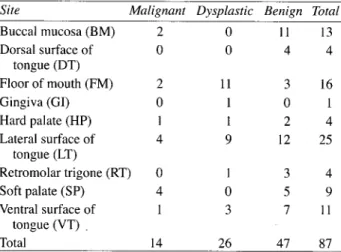
TABLE 1. TOTAL NUMBER OF SPECTRA MEASURED AT EACH ANATOMIC SITE IN PATIENTS AND
PATHOLOGICAL CLASSIFICATION
TABLE 2. SIMILARITY SCORES FOR EACH PAIR OF ANATOMIC SITES
Site Malignant Dysplastic Benign Total
Buccal mucosa (BM) 2 0 11 13 Dorsal surface of 0 0 4 4 tongue (DT) Floor of mouth (FM) 2 11 3 16 Gingiva (GI) 0 1 0 1 Hard palate (HP) 1 1 2 4 Lateral surface of 4 9 12 25 tongue (LT) Retromolar trigone (RT) 0 1 3 4 Soft palate (SP) 4 0 5 9 Ventral surface of 1 3 7 11 tongue (VT) . Total 14 26 47 87 algorithms.
Identifying Spectrally Similar Anatomic Sites. We compared the spectroscopy parameters extracted from each of the 9 sites in the HV data to identify anatomic sites that shared similar spectral proper-ties and could be combined. The interquartile range exclusion criteria were applied to the data to re-move outliers (eg, from probe slippage, tissue re- move-ment) .^^ For each spectroscopy parameter, a multi-ple comparison test was performed to compare each pair of sites and identify those that had statistically different distributions. The Tukey-Kramer correc-tion was applied to compensate for multiple com-parisons. For each pair of anatomic sites, we calcu-lated a "similarity score," the total number of spec-troscopy parameters for which the distributions for the 2 sites were not statistically different. Perfect correspondence between the spectroscopy parame-ter distributions for a pair of sites would be indicat-ed by a similarity score of 13 (total number of spec-troscopy parameters). We considered pairs of sites with a similarity score of at least 10 to be spectrally similar sites.
Spectral Diagnostic Algorithm Development. The diagnostic performance of anatomy-based algo-rithms developed for spectrally similar sites or in-dividual sites was compared to that of algorithms designed for all sites combined. Logistic regression was used to develop the diagnostic algorithms. The log-likelihood ratio test was used to identify the spectroscopy parameters with the greatest diagnostic potential for the distinction of healthy mucosa from lesions and of benign lesions from dysplastic/ma-lignant lesions .^^ The discriminatory power of each algorithm was evaluated by leave-one-out cross-val-idation and by calculating the ROC-AUC, sensitiv-ity, and specificity. The sensitivities and
specifici-Site DT ΠHP BM DT FM GI HP LT RT SP 1 6 1 II 10 7 9 7 4 6 5 3 12 2 0
ties quoted in the subsequent analysis were selected based on the Youden index, the point on the ROC curve with the maximum vertical distance from the 45° line.38
The fewest parameters necessary to achieve the maximum ROC-AUC for a comparison were re-tained. To prevent overtraining, we limited the max-imum number of spectroscopy parameters used in the model to nl5, where n is the number of training samples in the category with the fewest samples. To further ensure the reliable assessment of the diag-nostic algorithms, we only analyzed categories in which there were at least 10 samples.
RESULTS
General Description of Data Set. A total of 71 patients were recruited for this study. The average age (±SD) of the patients was 5 6 + 1 4 years. Of the 101 spectra collected from patients, 12 spectra from 7 patients were excluded because of an error noted during data collection, a broken probe, or the poor quality of the biopsy specimen, or because the pa-thology results were unavailable. Two samples, one of which was a lymphoma and another of which was classified as ihdefinite for dysplasia, were also ex-cluded. Thus, a total of 87 spectra collected from 64 patients were included in the final analysis (Table 1). The abbreviations for the 9 sites are also shown in Table 1. The average age (±SD) of the 64 patients was 56 ± 15 years. Data collected from HVs on the BM, DT, FM, GI, HP, LT, RT, SP, and VT were used in the subsequent analysis. These groups consisted of 100,124,112,58,54,112,33,43, and 74 spectra, respectively (not shown in Table 1).
Identification of Spectrally Similar Sites. The set of 710 spectra collected from 9 anatomic sites in HVs was used to calculate similarity scores for each pair of sites and to identify which specific pairs could be combined. There were pronounced differ-ences in the spectral properties amcng the various anatomic sites (Table 2). For 75% of the compari-sons, the similarity score was 7 or less. We
identi-McGee et al, Anatomy-Based Spectroscopic Algorithms for Oral Cancer 821 TABLE 3. Similarity Score 10 12 II
DESCRIPTION OF SPECTRALLY SIMILAR ANATOMIC SITES Spectrally Similar Sites BM and SP FM and VT GI and HP Dysplastic/ Malignant 6 17 3 Benign 16 10 2
TABLE 4. ROC-AUC VALUES FOR DISCRIMINATION OF HEALTHY MUCOSA FROM LESIONS
fied sites with a high degree of similarity on the ba-sis of a similarity score of at least 10. The following 3 pairs of sites met this criterion: 1) BM and SP, 2) FM and VT, and 3) GI and HP. We refer to pairs of sites with high similarity scores as spectrally similar sites. Just as for the dysplastic/malignant category, we use the slash notation (eg, FM/VT) in the text that follows to refer to a group that combines sam-ples from 2 sites.
For algorithm development, it is important to have a sufficient number of samples in each cate-gory. In this study, we used the criterion of at least 10 samples per category. Table 3 lists the numbers of benign and dysplastic/malignant lesions for each of the 3 pairs. For the FM/VT group, we analyzed samples from every category (healthy mucosa, sions, benign lesions, and dysplastic/malignant le-sions). For the BM/SP group, we analyzed samples from the healthy mucosa, lesion, and benign lesion categories.
Distinguishing Healthy Mucosa From Lesions. We first examined the benefit of anatomy-based al- " gorithms when applied to the distinction of healthy mucosa samples from lesions. Table 4 lists the ROC-AUC results for discriminating healthy mu-cosa (HV data) from visible lesions (patient data). In each case, the results are shown for all sites com-bined (9 sites total), nonkeratinized sites (all sites except the GI and HP), individual sites, and spec-trally similar sites. Our prior study in HVs clearly demonstrated that the GI and HP display significant spectral contrast from most other sites for several spectroscopy parameters .^^ By analyzing nonkerati-nized sites separately, we eliminate spectral contrast due to keratin, and can determine whether eliminat-ing it improves the identification of lesions among the remaining sites in the group.
The results in Table 4 indicate that excellent dis-crimination between healthy mucosa and lesions is possible with spectroscopy (ROC-AUC, 0.81 to 0.97), particularly when the diagnostic algorithms are developed and applied to individual sites or spectrally similar sites. The diagnostic performance of the spectral algorithms was poorest for the group in which all sites were combined (ROC-AUC, 0.81 to 0.85). The spectroscopy parameters frequently
Group All sites Nonkeratinized LT FM BM* VT FM/VT BM/SP* ROCAUC -*No dysplastic Healthy Mucosa vs Lesions 0.83 sites 0.84 0.95 0.94 0.94 0.95 0.97 0.91 Healthy Mucosa vs Dysplastic/ Malignant Lesions 0.85 0.88 0.97 0.95 0.97 Healthy Mucosa vs Benign Lesions 0.81 0.84 0.93 0.96 0.94 0.90
area under receiver operator characteristic curve. samples.
identified as diagnostic included NADH (340 nm), cßC, tryptophan (308 nm), Coll427 (340 nm), and a. The effective vessel radius. Coll (308 nm), and A and C parameters were not diagnostic.
When lesions were compared to healthy mucosa, the parameter trends were found to be identical for all 3 separations: healthy mucosa versus all lesions, benign lesions, and dysplastic/malignant lesions, respectively. Lesions were characterized by high-er B paramethigh-er, cHb, a, tryptophan (308 nm), and NADH (340 nm) and by lower cßC, NADH (308 nm), Coll401 (340 nm), and Coll427 (340 nm). We compared the parameter trends for lesions relative to healthy mucosa to the trends for healthy keratinized sites (GI and HP) relative to healthy nonkeratinized sites. The latter comparison was used as a marker for the influence of keratin; however, mucosal fea-tures specific to the GI and HP may also contribute to the trends. The trends for both comparisons were identical for 7 of the 9 spectroscopy parameters em-ployed in the spectral diagnostic models (data not shown).
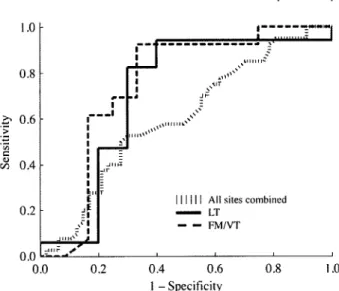
Distinguishing Benign Lesions From Dysplastic/ Malignant Lesions, We next evaluated the benefit of anatomy-based algorithms for a clinically rel-evant distinction, the discrimination of benign le-sions from dysplastic/malignant lele-sions. Spectral al-gorithms were developed for the 4 groups with at least 10 samples in the 2 lesion categories: all sites combined, nonkeratinized sites, the LT alone, and the FM/VT group. The Figure shows ROC curves for all sites combined, the LT alone, and the FM/VT group. The ROC curve for all sites combined dem-onstrated the poorest discriminatory power.
Table 5 lists the ROC-AUC values, sensitivities, and specificities for the discrimination of benign le-sions from dysplastic/malignant lele-sions. The
high-1.0 h 0.8 Z' 0.6 •> 0.4 0.2 0.0
n
TABLE 6. SIGNIFICANT DIAGNOSTIC PARAMETERSFOR DISCRIMINATION OF BENIGN LESIONS FROM DYSPLASTIC/MALIGNANT LESIONSAll sites combined FM/VT
0.0 0.2 0.4 0.6 0.8 1.0
1 - Specificity
Receiver operator characteristic curves for discrimina-tion of benign lesions from dysplastic/malignant lesions for all sites combined (hatched line), lateral surface of tongue (LT; thick dashed line), and floor of mouth/ven-tral surface of tongue (FM/VT; thick solid line).
est ROC-AUC value (0.75) was obtained for the LT, and once again, the lowest value (0.60) was ob-tained when all sites were combined. The diagnostic performance of the FM/VT group was considerably better than that of all sites combined.
Table 6 lists the spectroscopy parameters that were combined to yield the performance values shown in Table 5. The diagnostic parameters were almost en-tirely different from those used to separate healthy mucosa from lesions (data not shown). Although the C parameter was not diagnostic in distinguish-ing healthy mucosa from lesions, it played a signifi-cant role in separating benign lesions from dysplas-tic/malignant lesions. Similarly, Coll401 (340 nm) had greater significance in separating benign lesions from dysplastic/malignant lesions than in separating healthy mucosa from lesions. The cßC continued to be an important diagnostic parameter. Dysplastic/ malignant lesions were characterized by higher C parameter and cHb and by lower cßC, Coll401 (340 nm), and Coll427 (340 nm).
DISCUSSION
The oral cavity is complex, in that it consists of
TABLE 5. ROC-AUC, SENSITIVITY, AND SPECIFICITY VALUES FOR DISCRIMINATION OF BENIGN LESIONS
FROM DYSPLASTIC/MALIGNANT LESIONS
Sensitivity Specificity (Based on (Based on Youden Youden Group ROC-AUC Index) Index)
All sites 0.60 53% 70% Nonkeratinized sites 0.63 49% 76% LT 0.75 92% 67% FM/VT 0.71 94% 60% Group All sites Nonkeratinized sites LT FM/VT BM/SP*
*No dysplastic samples.
Diagnostic Parameters for Benign Lesions vs Dysplastic/ Malignant Lesions C parameter, Coll40l (340 nm), cßC C parameter, Coll401 (340 nm), cßC cßC,Coll401 (340 nm) C parameter, Coll427 (340 nm), cHb A parameter
multiple morphologically distinct anatomic sites, each of which is characterized by its own spectral properties. In many clinical studies, only a limited amount of data can be collected in a practical time period; therefore, data from all anatomic sites are combined to maximize the number of samples in each category. Consequently, differences in the his-tologie characteristics between the anatomic sites may confound the detection of spectral contrast re-lated to the presence of disease. We developed a strategy to evaluate whether certain pairs of sites are comparable in their spectral properties so that one could combine those sites with a high degree of similarity. This approach was designed to address 2 potential pitfalls: 1) combining dissimilar sites may broaden parameter distributions and make it more difficult to detect disease-related spectral contrast and 2) if the sites being combined have different spectral properties and samples are unevenly dis-tributed between the 2 categories being compared, the likelihood is increased that anatomic spectral contrast may compete with or contribute to the ap-parent disease-related contrast. We identified 3 pairs of spectrally similar sites: 1) BM and SP, 2) FM and VT, and 3) GI and HP.
Distinguishing Healthy Mucosa From Lesions. The results of this comparison demonstrated the significant influence of anatomic spectral contrast on diagnostic accuracy, as well as a clear benefit to combining spectrally similar sites. As in other studies, we obtained excellent results for this com-parison; however, anatomy-based algorithms were more accurate (ROC-AUC, 0.90 to 0.97) than were algorithms developed for all sites combined (ROC-AUC, 0.81 to 0.85). We tested an alternative ap-proach for combining multiple sites on the basis of a morphological criterion, only combining nonkera-tinized sites together. The performance of the diag-nostic algorithm for the nonkeratinized group did not produce ROC-AUC values dramatically higher than those for all sites combined. The number of le-sion samples from keratinized sites in our data set was limited (5 samples total); however, this finding
McGee et al, Anatomy-Based Spectroscopic Algorithms for Oral Cancer 823
is consistent with our previous observation of sig-niflcant anatomic spectral contrast among nonkera-tinized sites, and supports the need for a more ef-fective strategy for determining which sites to com-bine25
The excellent separations achieved for compari-sons between healthy mueosa and lesions may be influenced by hyperkeratosis, ulcération, or other mucosal changes associated with lesions that are not directly linked to malignancy. The spectral con-trast between healthy mueosa and visible lesions is largely independent of the presence of disease, as shown by the comparable ROC-AUC values for dis-criminating healthy mueosa from benign lesions and healthy mueosa from dysplastic/malignant lesions (0.81 to 0.96 and 0.85 to 0.97, respectively). The parallel parameter trends for lesions compared to healthy mueosa and healthy keratinized sites com-pared to healthy nonkeratinized sites provide added support for the hypothesis that keratin, rather than disease, is a major source of spectral contrast. These results indicate that clinically healthy mueosa sam-ples and samsam-ples from elinically abnormal mueosa (lesions) should be treated as distinct entities. The high values for the diagnostic accuracy reported for this comparison in previous studies may in fact be unrealistically high because of the confounding ef-fects of mucosal changes that are unrelated to dis-ease.
The parameter trends we observed when compar-ing lesions to healthy mueosa are consistent with those of other studies. In distinguishing healthy mu-eosa from malignant lesions, Amelink et al'^ noted that malignant lesions exhibited a lower a, an in-crease in blood content, and an inin-crease in scattering slope (B parameter). A decrease in scattering ampli-tude (A parameter) was also observed, which was not found in our analysis. Müller et al^ also noted in-creased NADH and dein-creased collagen fluorescence for lesions excited at 340 nm. The increase in the B parameter is most likely due to scattering from kera-tin present in leukoplakias, as previous work has shown that this parameter is greatly affected by this feature.25 Vascular dilation or inflammation in ul-cerated lesions or erythroplakias may give rise to an increased cHb. The decreased collagen fluorescence at 340 nm excitation, which may result from degra-dation of the extracellular matrix by matrix metal-loproteinases, has been noted in numerous spectro-scopic studies."-39-41 The increased NADH at 340 nm excitation may be due to the increased metabolic activity of abnormal proliferating epithelial cells.
Distinguishing Benign Lesions From Dysplastic/ Malignant Lesions. The results for the distinction
of healthy mueosa from lesions demonstrated the benefit of anatomy-based algorithms, but this appli-cation has no real clinical importance. Therefore, we applied the anatomy-based algorithms to the distinc-tion of benign lesions from dysplastic/malignant le-sions. Once again, the best diagnostie performance was obtained for the individual site (LT), and the poorest performance for all sites combined (ROC-AUC, 0.60). The FM/VT group (spectrally similar sites) also produced more accurate results (ROC-AUC, 0.71) than did all sites combined. We did not evaluate the BM/SP group, because it did not meet the criterion of at least 10 samples in each category. The ROC-AUC values obtained for the distinc-tion of benign lesions from dysplastic/malignant lesions were significantly lower than those for the distinction of healthy mueosa from lesions. Further-more, very few parameters were statistically signif-icant in the diagnostic model for the former com-parison. Therefore, the diagnostic accuracies report-ed in studies eomparing healthy mueosa to lesions may be misleading, because they do not reflect how spectroscopy performs when applied to clinically important diagnostic distinctions. The heterogene-ity of lesions within each category contributes to the challenge of distinguishing lesion eategories and can further obscure subtle disease-related changes in the spectroscopy parameters. Some malignant le-sions had small foci of invasion in a large area of relatively normal mueosa, whereas others demon-strated more diffuse disease. Similarly, the benign lesions ranged from mildly to highly hyperkeratotic, with various degrees of hyperplasia and inflamma-tion. Interindividual variation is another source of spectral contrast that may affect diagnostic perfor-mance.
Another approach for combining sites, employed by some researchers, is to combine healthy mueosa samples with benign lesions. This can dramatical-ly increase the number of samples in the negative-for-dysplasia/malignancy category, because healthy mueosa samples are readily available. However, this approach may produce misleading results for 2 rea-sons. First, we have shown that there is significant spectral contrast between healthy mueosa and le-sions even in the absence of disease. Second, our findings demonstrate a marked difference in spec-tral contrast between benign lesions and dysplas-tic/malignant lesions, as compared to healthy mu-eosa and visible lesions. Therefore, the diagnostic performance may falsely appear to improve as the proportion of healthy mueosa samples in the neg-ative group increases. To test this hypothesis, we combined 10 LT healthy mueosa samples with the
henign LT lesions. Whereas an ROC-AUC value of 0.75 was ohtained for distinguishing henign lesions from dysplastie/malignant lesions, the ROC-AUC value increased to 0.85 when we used the eomhined healthy mueosa/henign lesion category (data not shown). When 50 LT healthy mueosa samples were eomhined with the same benign samples, the ROC-AUC value increased further, to 0.91. These results underscore the importanee of considering how data are eomhined in order to reliahly evaluate spectral diagnostic algorithms.
We examined the trends in the spectral parame-ters used in the diagnostic models with increasing disease severity. The increase in the C parameter is eonsistent with increased scattering hy small parti-cles, as may oeeur with increased epithelial prolifer-ation. The higher cHh may he the result of vaseular dilation and inflammation as seen in erythroplakias or with ulcération (features that are more likely to be assoeiated with dysplasia/malignaney), where-as white lesions are less hkely to be dysplwhere-astic/ma- dysplastic/ma-lignant upon biopsy.'*^''*^ Deereased collagen fluo-rescenee was observed once again for this distinc-tion. The reason for the deereased eßC is unknown. ß-Carotene is an antioxidant and can be metabolized into vitamin A, which is involved in the differentia-tion of normal epithelial eells."*^
Application of Spectral Algorithms in Clinical Practice. The current standard screening method for oral eaneer — inspection with palpation — en-ahles inspection of the entire oral eavity. Our prohe may not he appropriate for this purpose, beeause it samples only a small area of tissue. However, when patients with suspicious lesions are referred to an otolaryngologist, speetroseopy may be useful for distinguishing benign lesions from dysplastie/ma-lignant lesions. A study by Waldron and Shafer42 of 3,256 leukoplakias (the most eommonly eneoun-tered oral lesions) found that 42.9% of biopsies from FM lesions and 24.2% of biopsies from tongue le-sions exhihited dysplasia/malignaney. Of the 3,256 eases of leukoplakia, 6.8% and 8.6%, respeetively, were located at these sites. If we eonsider 1,000 pa-tients with leukoplakia of the tongue or FM, a to-tal of 442 FM lesions and 558 tongue lesions would he expeeted, given the relative frequeney of leuko-plakia at these 2 sites noted in that study. Of these patients, 32.5% would he expeeted to show dyspla-sia/malignaney (42.9% of FM lesions and 24.2% of tongue lesions). The performance values for the LT and FM/VT sites are similar, so we use the aver-age values of 93% and 64% as the sensitivity and specificity, respeetively, of the spectral diagnostie test. Based on these values and the aforementioned
prevalenee estimates for diseased lesions, the posi-tive and negaposi-tive predieposi-tive values for our test are 55% and 95%, respeetively. These results indicate that our spectral algorithms ean identify the absenee of dysplasia/malignaney, with few false negatives, thereby redueing the number of unnecessary biop-sies. A large prospective study is needed to rigor-ously confirm these findings.
CONCLUSIONS
The results of this study demonstrate the impor-tanee of developing anatomy-based algorithms for disease detection in the oral cavity. Combining mul-tiple anatomic sites without accounting for anatom-ie spectral eontrast redueed disease-related eontrast and resulted in poor diagnostie performanee. Spec-tral algorithms designed specifically for multiple an-atomie sites sharing a high degree of spectral simi-larity considerably improved diagnostie aeeuraeies. The best diagnostie performanee was achieved when anatomy-hased algorithms were developed for indi-vidual sites. The diserimination of healthy mueosa from lesions yielded excellent results, as in previous studies, but the findings do not extend to the elini-eally relevant distinction of henign lesions from dys-plastie/malignant lesions. However, anatomy-based algorithms signifieantly improved diagnostie per-formance for the latter distinetion. Diagnostie aeeu-raeies for distinguishing healthy mucosa/benign le-sions from dysplastie/malignant lele-sions were depen-dent on the proportion of healthy mueosa samples and were therefore unreliable, even with the use of anatomy-hased algorithms. This study demonstrates a successful approach for developing eommon algo-rithms for multiple anatomic sites while accounting for anatomie spectral eontrast.
Developing a spectral diagnostie algorithm for every anatomie site may not be neeessary to pro-vide a substantial elinieal benefit. One potential future direetion is to develop a reliable diagnostie tool designed speeifieally for sites at high risk for oral eaneer. To ensure that dysplasia or malignaney is not missed, biopsies are likely to be taken of le-sions at these sites; therefore, a tool for identifying henign lesions eould reduce the numher of unnec-essary hiopsies. Alternatively, unnecunnec-essary biopsies eould be redueed by developing a tool for sites at whieh lesions are frequently eneountered but gener-ally prove benign by histopathology (low likelihood of disease). Large, prospeetive elinieal studies are needed to reliably evaluate the efficacy of speetros-eopy for these applieations. Ultimately, we would like to detect invisihle disease, partieularly in high-risk individuals and at surgical margins.
McGee et al, Anatomy-Based Spectroscopic Algorithms for Oral Cancer 825
Acknowledgments: We thank Luis Galindo and Jon Nazemi for developing the spectroscopic clinical instrumentation.
REFERENCES
1. Pindborg J, Reichart P, Smith C, van der Waal L World Health Organization: histological typing of cancer and precancer of the oral mucosa. Berlin, Germany: Springer-Verlag, 1997.
2. Pentenero M, Carrozzo M, Pagano M, et al. Oral mucosal dysplastic lesions and early squamous cell carcinomas: under-diagnosis from incisional biopsy. Oral Dis 2003;9:68-72.
3. Lee JJ, Hung HC, Cheng SJ, et al. Factors associated with underdiagnosis from incisional biopsy of oral leukopla-kic lesions. Oral Surg Oral Med Oral Pathol Oral Radiol Endod 2007; 104:217-25.
4. Fischer DJ, Epstein JB, Morton TH Jr, Schwartz SM. Re-liability of histologie diagnosis of clinically normal intraoral tissue adjacent to clinically suspicious lesions in former upper aerodigestive tract cancer patierits. Oral Oncol 2005;41:489-96.
5. Fischer DJ, Epstein JB, Morton TH, Schwartz SM. Inter-observer reliability in the histopathologic diagnosis of oral pre-malignant and pre-malignant lesions. J Oral Patliol Med 2004;33: 65-70.
6. van der Waal I, Schepman KP, van der Meij EH, Smeele LE. Oral leukoplakia: a clinicopathological review. Oral Oncol 1997;33:291-301.
7. Gillenwater A, Jacob R, Ganeshappa R, et al. Noninva-sive diagnosis of oral neoplasia based on fluorescence spec-troscopy and native tissue autofluorescence. Arch Otolaryngol Head Neck Surg 1998; 124:1251-8.
8. Majumder SK, Ghosh N, Gupta PK. Support vector ma-chine for optical diagnosis of cancer. J Biomed Opt 2005; 10: 024034.
9. Müller MG, Valdez TA, Georgakoudi L et al. Spectro-scopic detection and evaluation of morphologic and biochemi-cal changes in early human oral carcinoma. Cancer 2003;97:
1681-92.
10. Onizawa K,Okamura N, Saginoya H, Yusa H, Yanagawa T, Yoshida H. Analysis of fluorescence in oral squamous cell carcinoma. Oral Oncol 2002;38:343-8.
11. van Staveren HJ, van Veen RLP, Speelman OC, Witjes MJH, Star WM, Roodenburg JLN. Classiflcation of clinical autofluorescence spectra of oral leukoplakia using an artificial neural network: a pilot study. Oral Oncol 2000;36:286-93.
12. Amelink A, Kaspers OP, Sterenborg H, van der Wal JE, Roodenburg JLN, Witjes MJH. Non-invasive measurement of the morphology and physiology of oral mucosa by use of optical spectroscopy. Oral Oncol 2008;44:65-7l.
13. Sharwani A, Jerjes W, Salih V, et al. Assessment of oral premalignancy using elastic scattering spectroscopy. Oral On-col 2006;42:343-9.
14. Heintzelman DL,UtzingerU, Fuchs H, et al. Optimal ex-citation wavelengths for in vivo detection of oral neoplasia using fluorescence spectroscopy. Photochem Photobiol
2000;72:l03-13.
15. Kolli VR, Savage HE, Yao TJ, Schantz SP. Native cellu-lar fluorescence of neoplastic upper aerodigestive mucosa. Arch Otolaryngol Head Neck Surg 1995;121:1287-92.
16. Majumder SK, Ghosh N, Kataria S, Gupta PK. Nonlinear pattern recognition for laser-induced fluorescence diagnosis of cancer. Lasers Surg Med 2003;33:48-56.
17. Manjunath BK, Kurein J, Rao L, et al. Autofluorescence of oral tissue for optical pathology in oral malignancy. J Photo-chem Photobiol B 2004;73:49-58.
18. Schantz SP, Kolli V, Savage HE, et al. In vivo native cel-lular fluorescence and histological characteristics of head and neck cancer. Clin Cancer Res 1998;4:1177-82.
19. Wang CY, Chiang HK, Chen CT, Chiang CP, Kuo YS, Chow SN. Diagnosis of oral cancer by light-induced autofluo-rescence spectroscopy using double excitation wavelengths. Oral Oncol I999;35:144-50.
20. Schwarz RA, Gao W, Redden Weber C, et al. Noninva-sive evaluation of oral lesions using depth-sensitive optical spectroscopy. Cancer 2009; 115:1669-79.
21. Mallia RJ, Thomas SS, Mathews A, et al. Laser-induced autofluorescence spectral ratio reference standard for early dis-crimination of oral cancer. Cancer 2008; 112:1503-12.
22. Dhingra JK, Perrault DF Jr, McMillan K, et al. Early di-agnosis of upper aerodigestive tract cancer by autofluorescence. Arch Otolaryngol Head Neck Surg 1996; 122:1181 -6.
23. de Veld DCG, Skurichina M, Witjes MJH, et al. Auto-fluorescence characteristics of healthy oral mucosa at different anatomical sites. Lasers Surg Med 2003;32:367-76.
24. Pavlova I, Williams M, El-Naggar A, Richards-Kortum R, Gillenwater A. Understanding the biological basis of auto-fluorescence imaging for oral cancer detection: high-resolu-tion fluorescence microscopy in viable tissue. Clin Cancer Res 2008; 14:2396-404.
25. McGee S, Mirkovic J, Mardirossian V, et al. Model-based spectroscopic analysis of the oral cavity: impact of anatomy. J Biomed Opt 2008; 13:064034.
26. Mallia RJ, Thomas SS, Mathews A, et al. Oxygenated hemoglobin diffuse reflectance ratio for in vivo detection of oral pre-cancer. J Biomed Opt 2008;13:041306.
27. Mueller MM, Fusenig NE. Tumor-stroma interactions directing phenotype and progression of epithelial skin tumor cells. Differentiation 2002;70:486-97.
28. de Veld DCG, Skurichina M, Witjes MJH, Duin RPW, Sterenborg HJCM, Roodenburg JLN. Autofluorescence and diffuse reflectance spectroscopy for oral oncology. Lasers Surg Med 2005;36:356-64.
29. de Veld DCG, Skurichina M, Witjes MJH, Duin RPW, Sterenborg HJCM, Roodenburg JLN. Clinical study for classi-fication of benign, dysplastic, and malignant oral lesions using autofluorescence spectroscopy. J Biomed Opt 2004;9:940-50.
30. Wang CY, Tsai T, Chen HM, Chen CT, Chiang CP. PLS-ANN based classiflcation model for oral submucous flbrosis and oral carcinogenesis. Lasers Surg Med 2003;32:318-26.
31. Tunnell JW, Desjardins AE, Galindo L,et al. Instrumen-tation for multi-modal spectroscopic diagnosis of epithelial dys-plasia. Technol Cancer Res Treat 2003;2:505-14.
32. Zonios G, Perelman LT, Backman V, et al. Diffuse re-flectance spectroscopy of human adenomatous colon polyps in vivo. AppI Opt l999;38:6628-37.
33. Müller MG, Georgakoudi I, Zhang QG, Wu J, Feld MS. Intrinsic fluorescence spectroscopy in turbid media: disentang-ling effects of scattering and absorption. AppI Opt 2001;40: 4633-46.
34. Mourant JR, Freyer JP, Hielscher AH, Eick AA, Shen D, Johnson TM. Mechanisms of light scattering from biological cells relevant to noninvasive optical-tissue diagnostics. Appl Opt 1998;37:3586-93.
35. Zhang Q, Müller MG, Wu J, Feld MS. Turbidity-free fluo-rescence spectroscopy of biological tissue. Opt Lett 2000;25: 1451-3.
36. Wilcox RR. Fundamentals of modem statistical methods: substantially improving power and accuracy. New York, NY: Springer, 2001.
37. Kleinbaum DG, Klein M, Pryor ER. Logistic regression: a self-learning text. New York, NY: Springer, 2002.
38. Perkins NJ, Schisterman EF. The inconsistency of "opti-mal" cutpoints obtained using two criteria based on the receiver operating characteristic curve. Am J Epidemiol 2006:163:670-5.
39. Arifler D, Pavlova I, Gillenwater A, Richards-Kortum R. Light scattering from collagen fiber networks: micro-optical
properties of normal and neoplastic stroma. Biophys J 2007:92: 3260-74.
40. Jordan RCK,Macabeo-Ong M, Shiboski CH, et al. Over-expression of matrix metalloproteinase-1 and - 9 mRNA is as-sociated with progression of oral dysplasia to cancer. Clin Can-cer Res 2004; 10:6460-5.
4L Tosios KI, Kapranos N, Papanicolaou SL Loss of base-ment membrane components laminin and type IV collagen par-allels the progression of oral epithelial neoplasia. Histopathol-ogy 1998:33:261-8.
42. Waldron CA, Shafer WG. Leukoplakia revisited. A clin-icopathologic study 3256 oral leukoplakias. Cancer 1975:36:
1386-92.
43. Reichart PA, Philipsen HP. Oral erythroplakia — a re-view. Oral Oncol 2005:41:551-61.
44. Steinmetz KA, Potter JD. Vegetables, fruit, and cancer prevention: a review. J Am Diet Assoc 1996:96:1027-39.