HAL Id: hal-02154935
https://hal.archives-ouvertes.fr/hal-02154935
Submitted on 18 Dec 2019
HAL is a multi-disciplinary open access
archive for the deposit and dissemination of
sci-entific research documents, whether they are
pub-lished or not. The documents may come from
teaching and research institutions in France or
abroad, or from public or private research centers.
L’archive ouverte pluridisciplinaire HAL, est
destinée au dépôt et à la diffusion de documents
scientifiques de niveau recherche, publiés ou non,
émanant des établissements d’enseignement et de
recherche français ou étrangers, des laboratoires
publics ou privés.
Joint amalgamation of most parsimonious reconciled
gene trees
Celine Scornavacca, Edwin Jacox, Gergely Szöllösi
To cite this version:
Celine Scornavacca, Edwin Jacox, Gergely Szöllösi.
Joint amalgamation of most parsimonious
reconciled gene trees. Bioinformatics, Oxford University Press (OUP), 2015, 31 (6), pp.841-848.
�10.1093/bioinformatics/btu728�. �hal-02154935�
Phylogenetics
Joint amalgamation of most parsimonious
reconciled gene trees
Celine Scornavacca
1,2,*
,
Edwin Jacox
1and
Gergely J. Szo¨llo
†si
3,*
1
ISEM, UM2-CNRS-IRD, Place Euge`ne Bataillon 34095 Montpellier, France,
2Institut de Biologie Computationnelle
(IBC), 95 rue de la Gale´ra, 34095 Montpellier, France and
3ELTE-MTA ‘Lendu¨let’ Biophysics Research Group 1117
Bp., Pa´zma´ny P. stny. 1A., Budapest, Hungary
*To whom correspondence should be addressed. Associate Editor: David Posada
Received on May 27, 2014; revised on October 28, 2014; accepted on October 29, 2014
Abstract
Motivation:
Traditionally, gene phylogenies have been reconstructed solely on the basis of
mo-lecular sequences; this, however, often does not provide enough information to distinguish
be-tween statistically equivalent relationships. To address this problem, several recent methods have
incorporated information on the species phylogeny in gene tree reconstruction, leading to dramatic
improvements in accuracy. Although probabilistic methods are able to estimate all model
param-eters but are computationally expensive, parsimony methods—generally computationally more
ef-ficient—require a prior estimate of parameters and of the statistical support.
Results:
Here, we present the Tree Estimation using Reconciliation (TERA) algorithm, a parsimony
based, species tree aware method for gene tree reconstruction based on a scoring scheme
combin-ing duplication, transfer and loss costs with an estimate of the sequence likelihood. TERA explores
all reconciled gene trees that can be amalgamated from a sample of gene trees. Using a large scale
simulated dataset, we demonstrate that TERA achieves the same accuracy as the corresponding
probabilistic method while being faster, and outperforms other parsimony-based methods in both
accuracy and speed. Running TERA on a set of 1099 homologous gene families from complete
cyanobacterial genomes, we find that incorporating knowledge of the species tree results in a two
thirds reduction in the number of apparent transfer events.
Availability and implementation:
The algorithm is implemented in our program TERA, which is
freely available from http://mbb.univ-montp2.fr/MBB/download_sources/16__TERA
.
Contact:
[email protected], [email protected]
Supplementary information:
Supplementary data
are available at Bioinformatics online.
1 Introduction
Molecular phylogenetics infers gene trees based on the information contained in molecular sequences. Unfortunately, individual sequences may contain limited signal, and, as a result, phylogenetic reconstruction often involves choosing between statistically equiva-lent or weakly distinguishable evolutionary relationships.
Although each homologous gene family has its own unique story, these are all related by a shared species history—which can be helpful for gene tree inference (Maddison, 1997; Szo¨llo†si et al., 2014). In the past decade,several methods have been developed that
model the evolutionary processes that generate gene trees within the species tree (Akerborg et al., 2009; Arvestad, 2003; Hallett and Lagergren, 2001;Rannala and Yang, 2003;Rasmussen and Kellis, 2007,2012;Sjo¨strand et al., 2014;Suchard, 2005;Szo¨llo†si et al., 2012,2013a;Than and Nakhleh, 2009). From an inference perspec-tive,these methods attempt to find the optimal way to explain the phylogenetic signal in extant sequences—represented as a gene tree—given the species tree. They explore the set of possible recon-ciliations, i.e. different ways to draw the gene tree into the species tree given some combination of macro evolutionary events, such as
VCThe Author 2014. Published by Oxford University Press. 1
This is an Open Access article distributed under the terms of the Creative Commons Attribution Non-Commercial License (http://creativecommons.org/licenses/by-nc/4.0/), which permits non-commercial re-use, distribution, and reproduction in any medium, provided the original work is properly cited. For commercial re-use, please contact [email protected]
doi: 10.1093/bioinformatics/btu728 Advance Access Publication Date: 6 November 2014 Original Paper
gene duplications, gene transfers, gene losses and incomplete lineage sorting. Studies that incorporate such events into gene tree inference have shown that information on the species phylogeny significantly improves the accuracy of gene tree inference (Akerborg et al., 2009;
Boussau et al., 2013; Rasmussen and Kellis, 2010; Szo¨llo†si et al., 2013b). To design such species tree aware methods for reconstruct-ing gene phylogenies, the space of reconciled gene trees must be explored using information from both a model of sequence evolu-tion and a reconciliaevolu-tion model, in order to optimize a joint se-quence-reconciliation score. Such exploration is computationally expensive with traditional optimization approaches that rely on the local search of the space of gene trees.
To circumvent this problem,David and Alm (2010)introduced the amalgamation algorithm, described in detail in Section 2.3 below and illustrated in Figure 1. Furthermore, Szo¨llo†si et al. (2013b)recently developed an approach to exhaustively explore all reconciled gene trees that can be amalgamated from a sample of gene trees,i.e. obtainable by combining clades observed in the sam-ple. Additionally, their method—ALE, for Amalgamated Likelihood Estimation—combines the amalgamation algorithm of David and Alm (2010)with conditional clade probabilities (CCPs)introduced byHo¨hna and Drummond (2012)and reconstructs the gene phylog-enies by optimizing a joint sequence-reconciliation likelihood score,
resulting in gene trees that are dramatically more accurate than those reconstructed using molecular sequences alone.
ALE overcomes a fundamental limitation of recent parsimony based methods that improve gene trees given a putative species tree (David and Alm, 2010; Nguyen et al., 2012; Wu et al., 2013). Unlike those methods,it does not require the user to specify a cost
for each type of event or a threshold on statistical supports. However, ALE faces the drawbacks associated with probabilistic methods. In particular: (i) when computing the reconciliation score, ALE has an increased computational cost compared with a parsi-mony algorithm (e.g. Conow et al., 2010; Doyon et al., 2010),
which is due to a potentially large constant factor resulting from the numerical integration of the likelihood; (ii) ALE’s results are contin-gent on difficult to estimate time-like branch lengths of the species tree, while parsimony methods can reconcile gene trees relying only on the order of speciations in time (e.g.Doyon et al., 2010), and even deal with undated species trees (e.g. Bansal et al., 2012). Parsimony methods in general,despite lacking an explicit connec-tion to a generative probabilistic model and relying on other heuris-tics, have been shown to be highly accurate, comparable to sophisticated probabilistic reconciliation methods, with reduced runtime (Wu et al., 2013,2014).
Here we present the TERA algorithm (Tree Estimation using Reconciliation and Amalgamation) that amalgamates the most par-simonious reconciled gene tree from a set of gene trees reconstructed from a unique gene alignment, according to a joint sequence-recon-ciliation score. Although TERA, like other parsimony based meth-ods, requires the prior specification of the costs associated with duplication, transfer and loss (DTL) events, it does not require prior assumptions about a statistical support threshold, as it estimates a self-consistent support threshold from its input. Furthermore, TERA considers explicitly the possibility of transfer from extinct or unsampled branches of the species tree, which is expected to be the case for practically all transfers (Szo¨llo†si et al., 2013a). TERA does not, however, consider incomplete lineage sorting.
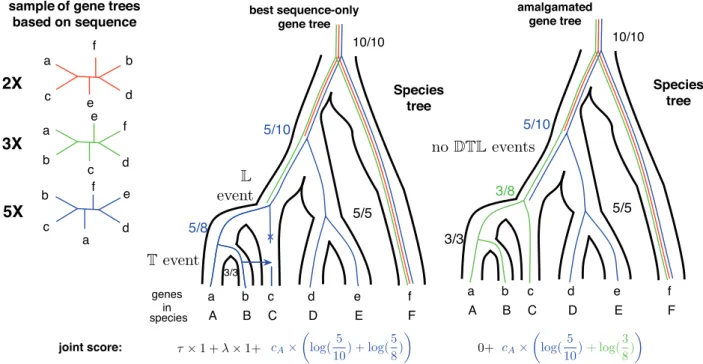
Fig. 1.CCPs can be used to estimate the posterior probability of any tree that can be amalgamated from clades present in a sample of gene trees (David and Alm, 2010;Ho¨hna and Drummond, 2012). Conditional clade frequencies can be used to approximate CCPs and are computed as the proportion of occurrences of a
par-ticular split of a clade according to a tripartitionp, e.g. (abc j de) among all trees in which the clade, e.g. (abcde), is found. Estimates based on the sample of trees
on the left are shown as fractions for two different gene trees that can be amalgamated. The estimate for a gene tree is given by the sum of the reconciliation score and the logarithm of the tree CCPs. Based on the sample on the left, the tree with the highest posterior probability is the third tree (blue online). Reconciling it with the species tree requires one transfer and one loss event. It is, however, possible to combine clades present in the second (green online) and third (blue on-line) trees to produce a gene tree that is not present in the original sample but is identical to the species tree, i.e. it requires no events to draw it into the species
tree. Depending on the costs of transfer and loss events, and the self-consistently estimated cAparameter, the scenario without transfer might be optimal for the
joint score
The self-consistent score estimation scheme used by TERA, introduced in Section 2.4, should be applicable to other parsimony methods, while amalgamation is in theory compatible with any rec-onciliation algorithm that assumes branches of the gene tree to be independent.
2 Materials and methods
2.1 Preliminaries
Given a binary rooted tree T, we respectively denote by V(T), E(T), L(T) and r(T), its node, edge, leaf node sets and root node. The label of each leaf u is denoted by LðuÞ, while the set of labels of leaves of T is denoted by LðTÞ. Given a node u 2 VðTÞ, we denote respect-ively by up, usand ful; urg the father, the sibling and the children of
u (if they are defined). Note that in this article all trees are con-sidered as unordered, so uland urare interchangeable. For a node u of T, Tudenotes the subtree of T rooted at u. Given two nodes u and v of T, u #Tv (u<Tv, respectively) if and only if v is on the unique
path from u to r(T) (respectively, and u 6¼ v); in such a case, u is said to be a (strict) descendant of v. Given a node u of T, we define the clade associated with u, denoted by C(u), as the set LðTuÞ. If u is an
internal node, we define the tripartition associated with u, denoted byPðuÞ, as the triple (LðTuÞ; LðTulÞ; LðTurÞ). For leaf nodes, the
trivial tripartitionPðuÞ is defined as the triple (LðuÞ; ;; ;). Finally, the height of T is denoted by h(T).
In this article, unless stated otherwise, we assume that gene and species trees are rooted, binary and uniquely leaf labeled, i.e. within each tree there is a bijection between leaves and labels. Due to this bijectivity we will refer to leaves and labels interchangeably.
We define a gene tree G as a tree where each leaf represents an extant gene. Similarly, a species tree S is defined as a tree in which each leaf represents a distinct extant species. Note that several leaves of a gene tree can be associated to the same species due to gene birth corresponding to duplication and transfer events. Formally, we indi-cate this by a surjective function s : LðGÞ ! LðSÞ, called the species labeling of G. The set of species labels of the leaves of G is denoted SðGÞ.
A tree T is said to be time ordered when it is associated with a time functionhT: VðTÞ ! Rþthat associates each of its nodes with
a non-negative value so that, for any two nodes x; x02 VðTÞ, if x0is
a strict descendant of x thenhTðx0Þ < hTðxÞ. Moreover, 8x 2 LðTÞ,
we have thathSðxÞ ¼ 0. A subdivision T0of a time-ordered tree T is
the tree obtained from T by adding a new node y withhT0ðyÞ on
each edge ðxp; xÞ 2 EðTÞ such that there exists z 2 VðTÞ with
hTðxÞ < hTðzÞ < hTðxpÞ. For nodes x 2 VðT0Þ corresponding to
nodes already present in T, we sethT0ðxÞ ¼ hTðxÞ.
2.2 Species tree-gene tree reconciliation
Here, we consider the problem of finding the most parsimonious reconciliation (MPR) when considering—as possible macro-events that result in the birth and death of gene copies—speciation, gene duplication, gene transfers and gene loss (Szo¨llo†si and Daubin, 2012). The general problem of finding an MPR is known to be NP-complete,even for reconciling two binary trees (Tofigh et al., 2011). The complexity of the problem is due to the difficulty of ensuring the timeconsistency of gene transfers, i.e. satisfying the chronolo-gical constraints among nodes of the species tree that are induced by transfer events. However, the problem becomes polynomially solv-able when accepting a time-ordered species tree as input (among othersConow et al., 2010;Doyon et al., 2010 Tofigh, 2009,see
Doyon et al., 2011for a review). In this article, we build upon the
combinatorial reconciliation model introduced by Doyon et al. (2010),which can be used to solve this special case of the problem.
Some parsimony methods (e.g.Bansal et al., 2012) do not need information on the order of speciations in time. This allows a more efficient recursion over reconciliations,but at the cost of considering reconciliations that contain transfer events that are not consistent with any ordering of the species tree (Tofigh et al., 2011).
TheDTL model ofDoyon et al. (2010)can be used to reconcile a time-ordered binary species tree S with a binary gene tree G by con-structing a mapping a that maps each node u 2 VðGÞ into an ordered list of nodes in VðS0Þ, namely the ancestral and/or extant
species in which the sequence corresponding to u evolved. This model takes into account four kinds of biological events: speciation, gene duplication, gene transfer and gene loss. The atomic events of this model are: a speciation (S), a duplication (D), a transfer (T), a transfer followed immediately by the loss of the non-transferred child (TL), a speciation followed by the loss of one of the two result-ing children (SL), and a contemporary event (C) that associates an extant gene to its corresponding species. Finally, a null event (;), is used to model a gene lineage crossing a time boundary. Note that duplication-loss events and transfer followed by the loss of the trans-ferred gene, unlike a transfer followed by the loss of the non-trans-ferred gene and speciation-loss events, leave no trace and are therefore undetectable. This is why, in theDTL model, losses are never considered alone. We refer the reader toDoyon et al. (2010)
for the formal definition of aDTL reconciliation.
Leth, s, k be, respectively, the costs of a duplication, a transfer and a loss. Given a DTL reconciliation, we define the cost of a, denoted by cðaÞ, as the sum hd þ st þ kl, where d, t and l are respect-ively the number ofD events, of T and TL events, and of SL and TL events ina. InDoyon et al. (2010)the authors give an efficient algo-rithm to compute c(G,S) for a time-ordered species tree S and a gene tree G, where c(G, S) is defined as the minimum cost over all possibleDTL reconciliations between G and S.
2.3 Choosing a reliable gene tree among several
competing alternatives
Even though our aim is to reconstruct reliable gene trees from a mul-tiple sequence alignment and a species phylogeny, our approach does not directly take sequence alignments as an input, but requires a sample of gene trees, typically produced from the alignment by ei-ther a Markov Chain Monte Carlo (MCMC) methods such as PhyloBayes (Lartillot et al., 2009) and MrBayes (Ronquist et al., 2012),or bootstrap resampling.
To find the optimal gene tree, clades found in the input sample of gene trees are combined using the amalgamation approach in order to recover an optimal tree with respect to our scoring scheme. The optimal tree recovered will only contain clades found in the in-put sample of gene trees, but it will not in general be found in the sample itself.
Figure 1provides a schematic illustration of the amalgamation approach. Clades present in the sample of trees (the unrooted trees on the left) can be combined to obtain a tree such that each clade is found in the sample, but the tree itself is not. For example, one can produce a green-blue tree consisting of a green subtree with genes a, b and c, and a blue subtree with genes d, e and f. The sequence score of each tree is obtained using CCPs that depend on the number of times different trees are seen in the sample and is described in detail in the next section. The reconciliation score for each tree corres-ponds to the MPR of the gene tree with the species tree. The amal-gamation algorithm itself is a joint dynamic programming recursion
over (i) all trees that can be produced from clades present in the in-put sample and (ii) all possible ways to reconcile each of these trees with the species tree, to recover a gene tree with the smallest joint se-quence-reconciliation score. As shown inFigure 1 in the online appendix,amalgamation permits us to explore a vastly larger set of trees than those contained in the sample.
Conceptually, both ALE (Szo¨llo†si et al., 2013b) and TERA are based on the amalgamation approach of AnGST (David and Alm, 2010),and all three methods are—at the level of the dynamic pro-gramming recursion—closely related. TERA differs from AnGST in the underlying reconciliation model (Doyon et al., 2010) and be-cause it allows transfers going/coming from extinct or unsampled species (Szo¨llo†si et al., 2013a). Moreover, the AnGST scoring scheme is solely based on the reconciliation score. ALE differs from TERA in that it relies on a complex underlying probabilistic model; the results of which, in contrast to TERA, are contingent on time-like branch lengths of the species tree.
TERA’s amalgamation algorithm can be regarded as a generaliza-tion of the gene tree reconciliageneraliza-tion algorithm ofDoyon et al. (2010),
which iterates over reconciliations by mapping each node of a gene tree to branches of the species tree. In the joint recursion presented in this article, instead of nodes of a gene tree, the clades found in the in-put sample of gene trees are mapped into branches of the species tree.
More formally, assume we are given a set of (unrooted) gene trees G on the same leaf set reconstructed from a unique sequence alignment. We denote respectively by AðGÞ and PðGÞ the union of all the clades, and the union of all tripartitions in G. For each tripar-titionp, we denote by p½1' (p½2' and p½3', respectively) the first (se-cond and third, respectively) element ofp. If G contains unrooted trees we consider all possible rootings for each tree when computing AðGÞ and PðGÞ. Furthermore, for a given clade C of AðGÞ, we denote byPðCÞ the set of tripartitions p 2 PðGÞ for which p½1' ¼ C. When focusing only on the reconciliation score, the optimization problem consists of computing cðG; SÞ :¼ minG2GamcðG; SÞ, where Gamis the
set of gene trees such that AðGÞ ( AðGÞ for all G 2 Gam. The
pseudocode is given in Algorithm 1 in the appendix. Roughly speak-ing, our algorithm starts by computing the subdivision S0of S, and
the sets AðGÞ and PðGÞ. Then, it performs a joint traversal of all gene tree clades and species tree branches wherein clades C in AðGÞ are considered in order of increasing size, and nodes x0of S in order
of increasing height. For each pair (C, x0) the algorithm computes
the cost of reconciling clade C with x0by testing all possible
triparti-tionsp in PðCÞ. Because each non-trivial tripartition p can be seen as an internal node of an amalgamated tree, with childrenp½2' and p½3', the cost of reconciling a tripartition p with x0can be computed
according to Algorithm 1 ofDoyon et al. (2010). We refer the reader to Algorithm 1 ofDoyon et al. (2010)for a better understanding of the pseudocode. The correctness of our approach is proven in the appendix.
Note that—for ease of writing—the pseudocode of the algorithm does not contain the transfers from the dead, i.e. the transfers going/ coming from extinct or unsampled species (Szo¨llo†si et al., 2013a). However,Algorithm 1 can be easily modified to accommodate this kind of event by adding to the species tree S a sister group of the root clade such that, within this group, duplications and losses are free, spe-ciations are not permitted, and transfers to this new group (formally corresponding to unrepresented speciations) cost zero—similar to what is done in the likelihood framework bySzo¨llo†si et al. (2013a).
2.4 Taking into account the CCP
As described in the introduction, our goal is to create a species tree aware method for reconstructing gene phylogenies that uses
information from both gene sequences and from the reconciliation with a species tree. That is, we wish to construct a method that opti-mizes a joint sequence-reconciliation score. In order to do this, we must find an efficient manner to incorporate a sequence based cost in addition to the reconciliation cost ofDoyon et al. (2010)in the amalgamation scheme.
AnGST, the seminal algorithm ofDavid and Alm (2010)that introduced the idea of amalgamation,does not distinguish between trees that can be amalgamated. The problem with this approach is that, as the number of input trees—and thus the amount of informa-tion given as input—increases, the set of possible trees that can be amalgamated also increases—until all possible tree topologies can be amalgamated. At this point, since all possible tree topologies can be amalgamated, the most parsimonious reconciled gene tree will only depend on the reconciliation score. In practice this introduces the problem that the topology of the amalgamated gene tree may vary significantly when adding only a few trees to the sample of trees (in the worst case only one tree).
In a probabilistic framework, conditional clade probabilities (CCPs, cf.Fig. 1) provide an accurate approximation of posterior probabilities for a very large number of tree topologies from a smaller MCMC sample (Ho¨hna and Drummond, 2012; Larget, 2013; Szo¨llo†si et al., 2013b). The CCPof a rooted tree G 2 Gam
(Ho¨hna and Drummond, 2012),denoted by PCCPðGÞ, is defined as
the product of the conditional probabilities of all partitions in PðGÞ. The conditional probability of the partition of clade C ac-cording to the tripartitionp is denoted PCCPðpÞ and is approximated
by the ratio fGðpÞ=fGðp½1'Þ, where for each clade C 2 AðGÞ and for
each tripartitionp 2 PðGÞ; fGðpÞ and fGðCÞ is the frequency of C and
p in G.
Here, in order to construct a parsimony method that optimizes a joint sequence-reconciliation score, we choose to minimize the joint cost
cjointðG; SÞ ¼ cðG; SÞ þ cANA (1)
over G 2 Gam, where the parameter cAweights the contribution of the sequence alignment NAto the cost, defined as
NA¼ )log
PCCPðGÞ
PCCPðGMAPÞ
! "
(2)
where PCCPðGMAPÞ corresponds to the posterior probability of the
gene tree with the highest posterior probability according to the se-quence alignment. The logarithm of the CCP provides an additive cost for deviation from the phylogeny preferred by the sequence alignment alone, similar to the additive cost for deviation from spe-cies phylogeny provided by the DTL event costs. The parameter cA is analogous to a statistical support threshold, corresponding to a cost cAfor each point of log posterior probability difference between the log posterior probability of a given phylogeny and the gene tree with highest posterior probability.
As illustrated inFigure 1,Algorithm 1 in online appendixis easily modified by adding cA* log ðPCCPðpjCÞÞ to cS; cDcTwhile filling the dynamic programming matrix (on line 15, 17 and 18 of Algorithm 1, respectively). The term þcA* log ðPCCPðGMAPÞÞ, corresponding to the
gene tree with the highest posterior probability, can be neglected dur-ing cost minimization as it simply corresponds to an additive constant.
Given estimates for the DTL costs (available for example in
David and Alm, 2010;Nguyen et al., 2013),the parameter cAcan be estimated in a self-consistent manner.
However, finding the proper weight between the disagreement with the species tree (increase in DTL events) and the disagreement
with the sequence alignment (decrease in log ðPCCPðGÞÞ) is difficult.
Our estimation approach consists of looking for the set of costs that are the most self-consistent, i.e. the ratio of costs that best corres-ponds to the ratio of events.
We assume a simple model for how costs determine the number of events: each type of event, i.e. DTL events as well as the disagree-ment with the aligndisagree-ment counted by NA, are considered to occur in-dependently, such that events with smaller costs are expected to occur more frequently. In particular, the expected amount of dis-agreement with the species tree due to, respectively duplications, transfers and losses, is proportional to exp ð)dÞ; exp ð)sÞ and exp ð)kÞ, while the expected amount of disagreement with the sequence alignment is propotional to exp ð)cAÞ. The observed
amount of disagreement with the species tree is given by the sum of the number of DTL events, i.e. ND, NTand NL, while the observed amount of disagreement with the sequence alignment is given by NA. We then employ an expectation maximization like recursion equating at each step the observed frequencies with the expected frequencies: cnew A ¼ )log NA NDþ NTþ NLþ NA ! " : (3)
Algorithm 1 is then run until jcnew
A ) cAj is larger then a threshold !.
2.5 Implementation and validation
TERA is implemented in Cþþ and is freely available from http:// mbb.univ-montp2.fr/MBB/download_sources/16__TERA.
Posterior samples of gene trees, for both simulated and real alignments, were downloaded together with the ‘true’ gene trees used to simulate alignments from the dryad data repository (doi:10.5061/dryad.pv6df) provided bySzo¨llo†si et al. (2013b).
For all the parsimony-based species tree aware methods, includ-ing TERA, we used the DTL costsd ¼ 2, s ¼ 3, k ¼ 1 obtained by
David and Alm (2010) using a criteria based on minimizing the change in ancestral genome sizes on a large biological dataset. We ran TreeFix-DTL with default parameters,JTT/GTR with a gamma distribution as models of evolution, and as a starting tree the PhyML tree. MowgliNNI was run with default parameters, a thresh-old of 50 for weak edges, and with the PhyML tree—with bootstrap values—as a starting gene tree. AnGST was run with default param-eters using the dated species tree on samples of 1000 gene trees, whereas JPrIME-DLTRS was run with JTT with a gamma distribu-tion as model of evoludistribu-tion, 100 000 iteradistribu-tions, a thinning factor of 10 and a time out of 10 h. Finally, we ran TERA with a starting cA of 0.1 and for G samples from 10 up to 10 000 gene trees for each simulated alignment. The gene trees reconstructed by ALE were downloaded from the above mentioned data repository.
Note that, from a practical perspective, the DTL costs we use are the default parameters for all the parsimonious methods described in the article, and seem to work well for several parts of the Tree of Life. If the user suspects that these values are not suited for the ana-lyses, these parameters should be estimated beforehand, e.g. using the ALE method.
3 Results
To test the accuracy of gene trees reconstructed using TERA we chose a dataset based on 1099 homologous gene families present in 36 cyanobacterial genomes. This dataset, published inSzo¨llo†si et al. (2013b), was constructed using homologous families from the HOGENOM database (Penel et al., 2009) and contains both real
and simulated alignments as well as the gene trees used to simulate sequences. The mean number of genes per family in this dataset is 36.66, the largest family has 114 genes and the smallest 21 genes; the mean number of species in which a family is found is 31.49, with a minimum of 4 and a maximum of 36; the mean copy number per genome—counting as zero genomes in which a family is absent—is 1.012, with a minimum of 0.5833 and a maximum of 3.17.
We chose this dataset, because (i) it contains a diverse set of gene families from a reasonably large and divergent set of species, and (ii) the parametric bootstrap-like simulation procedure used attempts to retain as much of the complexity of the underlying biological dataset as possible (Szo¨llo†si et al., 2013b). Furthermore,to emulate the rela-tive complexity of real data compared with available models of se-quence evolution, we used a complex model of sese-quence evolution to simulate sequences—an LG model (Le and Gascuel, 2008) with across-site rate variation and invariant sites—and used PhyloBayes (Lartillot et al., 2009) with a simpler model—a Poisson model (Felsenstein, 1981) with no rate variation—to produce the sample of gene trees used by both TERA and AnGST (see below for more details).
3.1 Validation on simulated data
For the simulated alignments, both the ‘true’ gene tree used to gener-ate the sequences and the species tree—along which the gene trees evolved—are known. Consequently, it is possible to directly assess the accuracy of different reconstruction methods in recovering the correct gene tree.
As shown inFigure 1a in theonline appendix,the number of possible amalgamations increases roughly exponentially with increasing sample size in the simulated dataset, but the median re-construction accuracy achieved by TERA begins to saturate (Figure 1b in theonline appendix). To compare the accuracy of our method to that of others,we reconstructed gene trees using six different ‘spe-cies tree aware’ methods: (i) the TERA algorithm described here, (ii) ALE (Szo¨llo†si et al., 2013b),(iii) TreeFix-DTL (Bansal et al., 2014, submitted for publication, http://compbio.mit.edu/treefix-dtl/),(iv) MowgliNNI (Nguyen et al., 2013), (v) AnGST (David and Alm, 2010) and (vi) JPrIME-DLTRS (Sjo¨strand et al., 2014) as well as the species tree unaware method,PhyML (Guindon et al., 2010).
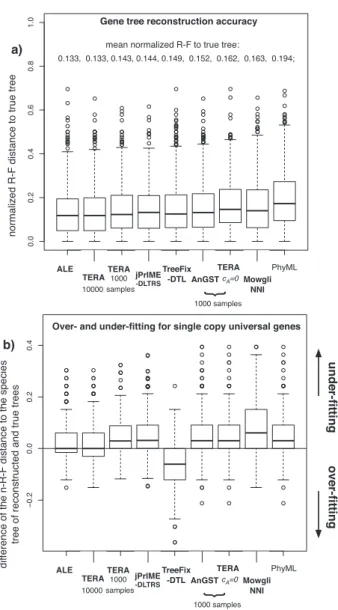
InFigure 2a,we plot the normalized Robinson-Foulds (defined as the Robinson-Foulds distance divided by its maximum possible value, and denoted as n-R-F in the following) distance of the recon-structed gene trees to the true tree. These results show that all of the species tree aware methods achieve better accuracy than the species tree unaware method PhyML, which is to be expected as they are given additional information in the form of the species tree. Among the species tree aware methods, with an input of 10 000 samples TERA’s accuracy is statistically indistinguishable from the more complex maximum likelihood based results from ALE (paired Wilcoxon test P > 0.1) and is significantly more accurate than TreeFix-DTL (Bansal et al., 2014, submitted for publication) (paired Wilcoxon test P < 10)8) as well as the other species tree aware method MowgliNNI (Nguyen et al., 2013). TERA also outper-formed jPrIME-DLTRS, although the accuracy of the latter may have been limited by the available run time (recall that a time out of 10 h per each data set was given). For an input of 1000 samples, TERA is less accurate than either TERA or ALE with 10 000 input samples (paired Wilcoxon tests P < 10)8), statistically indistinguish-able from jPrIME-DLTRS, slightly more accurate then TreeFix-DTL (paired Wilcoxon test P ¼ 0.026), and still significantly more accur-ate than MowgliNNI and AnGST (paired Wilcoxon tests P < 10)8).
Results for AnGST are only shown for sample sizes of 1000 gene trees, due to the very large memory requirement of the AnGST im-plementation. To investigate the effect of using a joint sequence-rec-onciliation score we also ran TERA with cA¼ 0, i.e. emulating AnGST in only optimizing the reconciliation score. We found that on a sample of 1000 trees AnGST was more accurate then TERA with cA¼ 0 with an n-R-F of, 0.156 and 0.166, respectively. However, using TERA with only 1000 samples, but estimating cA, resulted in a mean n-R-F of 0.146. The average cA estimated by TERA was 0.49 while the average NAwas 6.57.
An important difference of TreeFix-DTL compared with the other methods considered here, is that it does not use information of the time order of speciation events in the species tree (note that AnGST can also run without information on time ordering). Therefore TreeFix-DTL uses less information, which may explain
the difference in performance in comparison to TERA on the simu-lated dataset. Nonetheless, we ran TERA with 10 random time orderings of the species tree and this resulted in statistically identical n-R-F values when using the correct time order of speciations (Wilcoxon rank sum test P ¼ 0.6).
A potential concern regarding methods that optimize a joint rec-onciliation-sequence score is that we may overfit the species tree. If overfitting of the species tree occurs we expect the reconstructed gene trees to become too similar to the species tree. In the context of the simulated dataset used here, we expect that the reconstructed gene trees will become more similar to the species tree than the true trees used to simulate alignments. To test for such a signal of overfit-ting, we require a measure of similarity between gene trees and the species tree. The most straightforward solution is to restrict our ana-lysis to gene families that have exactly one copy in each species. In this case, we can simply use the n-R-F distance between the spe-cies tree and each of the gene trees as our similarity measure. In
Figure 2b,we show the results for the 431 single copy universal gene families in our simulated dataset. We measure the extent of over and underfitting as the difference in n-R-F distance between the species tree and the reconstructed gene tree and the n-R-F distance between the species tree and the true gene tree. We observe that the species tree unaware method, PhyML, as expected, reconstructs trees that are more distant to the species tree than the true tree. The results for the species tree aware methods are more variable: ALE, based on an explicit probabilistic approach, exhibits a median difference of zero and produces only a few examples of overfitting. TERA, which esti-mates the cAparameter giving the relative weight of the sequence and reconciliation component of the joint score, also achieves a me-dian difference of zero when 10 000 samples are given as input, but produces a somewhat larger number of slightly overfitted trees. When only 1000 samples are used, both TERA and AnGST underfit the species tree, similar to jPRIME-DLTRS, suggesting that it may be a lack of convergence of the sampling in all cases. TreeFix-DTL, which relies on a fixed support threshold, shows signs of more sig-nificant overfitting; while MowgliNNI substantially underfits the species tree, at least with the default parameters used here.
The runtimes for the methods discussed in this section are given inTable 1. We can see that TERA has the fastest stand-alone run-time. However,if the runtime necessary to generate the input tree(s) Fig. 2.(a) To compare the accuracy of TERA and other methods we used the
simulated data set of Szo¨llo†si et al. (2013b). We find that TERA achieves statis-tically equivalent accuracy to ALE and better accuracy than the other meth-ods, see main text for details. (b) To test for over and underfitting of the species tree we examined the 431 gene families with exactly one copy in each of the 36 cyanobacterial species. For each family we plot the difference of the R-F distance of the true tree to the species tree and the R-F distance of the reconstructed gene tree from the species tree. Negative values for the dif-ference indicate overfitting, while in the case of underfitting we expect a posi-tive value
Table 1.Mean runtimes in seconds for the methods discussed in the main text on a cluster of 2.1 GHz Intel Xeon processors with 24 GB of RAM with maximum runtime limited to 10 h per family.
Stand-alone [s] Input [s] PhyloBayes 1000 samples 10 000 samples TERA 3.65 756.6 7566 AnGST 54.9 756.6 — ALE 159.2 756.6 7566 PhyML MowgliNNI 6.3 182.5 TreeFix 5718.0 182.5
No input tree needed jPrIME 32 137.3 0
The time required to compute inputs is given by the runtime of PhyloBayes for 1000 and 10 000 samples and for the time required for PhyML to compute an ML tree with SH branch supports. Stand-alone runtimes are given for 10 000 samples for TERA and ALE and 1000 samples for AnGST.
are considered, Mowgli is the fastest method, but it is also the least accurate (cf. Fig. 2a). For an input size of 1000 samples TERA achieves comparable accuracy to TreeFix-DTL,but with a seven fold reduced mean runtime. For an input size of 10 000 samples TERA achieves similar accuracy to ALE and outperforms TreeFix-DTL, but considering the time to generate the required inputs TreeFix-DTL is 1.3 times faster on average.
3.2 Results on real data
In order to test TERA on biological data, we again used the dataset published inSzo¨llo†si et al. (2013b),but focusing on real alignments. As inputs to TERA we used: (i) the tree samples obtained from real alignments and (ii) the ML species tree unaware gene trees obtained using PhyML from the same alignments. Similar to the results of ALE (Szo¨llo†si et al., 2013b),we find that the number of transfer and loss events (but not duplication events) in most parsimonious recon-ciled gene trees is substantially lower than those found in the most parsimonious reconciliations of PhyML trees: the mean and median number of transfers per family was 3.914 and 3 compared with 10.38 and 9, respectively; the mean and median number of losses per family was 5.088 and 4 compared with 7.542 and 7, respect-ively, while the mean and median number of duplications per family was 1.071 and 0 compared with 1.042 and 0, respectively.
4 Discussion
We have presented a detailed description of the TERA algorithm, a parsimony-based species tree aware method of gene tree reconstruc-tion. We demonstrate that TERA reconstructs gene trees with nearly identical accuracy as the more complex ML based ALE method and, at least on the simulated datasets considered here, outperforms the other parsimony based species tree aware methods.
Examining a subset of single copy universal gene families we show that TERA does not overfit or underfit the species tree. This result lends credibility to TERA’s results on biological data, whereby two thirds of apparent gene transfers in gene trees reconstructed without taking into consideration the species tree are not recovered given knowledge of the species phylogeny.
Although parsimony based methods are fundamentally limited in some aspects compared with model based probabilistic methods, in the case of species tree aware gene tree reconstruction our results in-dicate that parsimony based methods can closely approach their ac-curacy. A further advantage of TERA compared with the corresponding probabilistic method ALE is that it is faster (if only up to a constant factor), does not require explicit time-like branch lengths that are difficult to estimate, and due to its relative simpli-city, in particular the lack of numerical integration, is more robust in practice. Compared with parsimony based methods that require prior assumptions about statistical support, TERA is distinguished by its ability to estimate a statistical support threshold from its in-put. In contrast to the methods considered here it does require more elaborate upstream analysis, taking as its input a sample of trees from e.g. an MCMC-based tree inference methods, while in contrast MowgliNNI requires a single tree with branch supports, and TreeFix-DTL a multiple sequence alignment.
Finally, while we have shown that it is possible to estimate the cA parameter, we have been less successful in estimating all four costs (d; s; k; cA) simultaneously, due to the tendency of the cost
esti-mates to diverge toward a very low transfer cost, and a correspond-ingly large number of transfers. We expect that relaxing the, in
general, unrealistic assumption of independence between events could ameliorate this problem.
Acknowledgements
The authors like to thank Eric Tannier, Bastien Boussau and Vincent Daubin for the constructive discussions.
Funding
C.S. and E.J. were supported by the French Agence Nationale de la Recherche Investissements d’avenir/ioinformatique (ANR-10-BINF-01-02, Ancestrome). G.J.Sz. was supported by the Marie Curie CIG 618438 ‘Genestory’ and the Albert Szent-Gyo¨rgyi Call-Home Researcher Scholarship A1-SZGYA-FOK-13-0005 supported by the European Union and the State of Hungary, co-financed by the European Social Fund in the framework of TA´ MOP 4.2.4. A/ 1-11-1-2012-0001 ‘National Excellence Program’. This publication is contri-bution no. 2014-178 of the Institut des Sciences de l’Evolution de Montpellier [ISEM, UMR 5554].
Conflict of Interest: none declared.
References
Akerborg,O. et al. (2009). Simultaneous Bayesian gene tree reconstruction and reconciliation analysis. Proc. Nat. Acad. Sci. USA, 106, 5714–5719. Arvestad,L. (2003). Bayesian gene/species tree reconciliation and orthology
analysis using MCMC. Bioinformatics, 19, 7i–15i.
Bansal,M.S. et al. (2012). Efficient algorithms for the reconciliation problem with gene duplication, horizontal transfer and loss. Bioinformatics, 28, i283–i291.
Boussau,B. et al. (2013). Genome-scale coestimation of species and gene trees. Genome Res. 23, 323–330.
Conow,C. et al. (2010). Jane: a new tool for the cophylogeny reconstruction problem. Algorithms Mol. Biol. 5, 16.
David,L.A. and Alm,E.J. (2010). Rapid evolutionary innovation during an Archaean genetic expansion. Nature, 469, 93–96.
Doyon,J. et al. (2011). Models, algorithms and programs for phylogeny recon-ciliation. Brief Bioinform. 12, 392–400.
Doyon,J.-P. et al. (2010). An efficient algorithm for gene/species trees parsimo-nious reconciliation with losses, duplications and transfers. In: Proceedings of the 2010 International Conference on Comparative Genomics, RECOMB-CG’10, Springer-Verlag, Berlin, Heidelberg, pp. 93–108. Felsenstein,J. (1981). Evolutionary trees from DNA sequences: a maximum
likelihood approach. J. Mol. Evol. 17, 368–376.
Guindon,S. et al. (2010). New algorithms and methods to estimate maximum-likelihood phylogenies: assessing the performance of PhyML 3.0. Syst. Biol. 59, 307–321.
Hallett,M.T. and Lagergren,J. (2001). Efficient algorithms for lateral gene transfer problems. In: Proceedings of the Fifth Annual International Conference on Computational Biology, ACM, New York, NY, pp. 149–156.
Ho¨hna,S. and Drummond,A. (2012). Guided tree topology proposals for Bayesian phylogenetic inference. Syst. Biol. 61, 1–11.
Larget, B. (2013). The estimation of tree posterior probabilities using condi-tional clade probability distributions. Syst. Biol. 62, 501–511.
Lartillot, N. et al. (2009). PhyloBayes 3: a Bayesian software package for phylogenetic reconstruction and molecular dating. Bioinformatics, 25, 2286.
Le,S.Q. and Gascuel,O. (2008). An improved general amino acid replacement matrix. Mol. Biol. Evol. 25, 1307–1320.
Maddison,W.P. (1997). Gene trees in species trees. Syst. Biol. 46, 523–536. Nguyen, T. et al. (2012). Accounting for gene tree uncertainties improves gene
trees and reconciliation inference. In: B.,Raphael and J Tang (eds.) Algorithms in Bioinformatics, volume 7534 of Lecture Notes in Computer Science. Springer, Berlin Heidelberg, pp. 123–134.
Nguyen,T.H. et al. (2013). Reconciliation and local gene tree rearrangement can be of mutual profit. Algorithms Mol Biol, 8, 12.
Penel,S. et al. (2009). Databases of homologous gene families for comparative genomics. BMC Bioinformatics, 6, S3.
Rannala,B. and Yang,Z. (2003). Bayes estimation of species divergence times and ancestral population sizes using DNA sequences from multiple loci. Genetics, 164, 1645–1656.
Rasmussen,M.D. and Kellis,M. (2007). Accurate gene-tree reconstruction by learning gene- and species-specific substitution rates across multiple com-plete genomes. Genome Res. 17, 1932–1942.
Rasmussen,M.D. and Kellis,M. (2010). A Bayesian Approach for Fast and Accurate Gene Tree Reconstruction. Mol. Biol. Evol. 28, 273–290. Rasmussen,M.D. and Kellis,M. (2012). Unified modeling of gene duplication,
loss, and coalescence using a locus tree. Genome Res. 22, 755–765. Ronquist,F. et al. (2012). MrBayes 3.2: efficient Bayesian phylogenetic inference
and model choice across a large model space. Syst. Biol. 61, 539–542. Sjo¨strand,J. et al. (2014). A bayesian method for analyzing lateral gene
trans-fer. Syst. Biol. 63, 409–420.
Suchard,M.A. (2005). Stochastic models for horizontal gene transfer: taking a random walk through tree space. Genetics, 170, 419–431.
Szo¨llo†si,G.J. and Daubin,V. (2012). Modeling gene family evolution and rec-onciling phylogenetic discord. Methods Mol. Biol. 856, 29–51.
Szo¨llo†si,G.J. et al. (2012). Phylogenetic modeling of lateral gene transfer re-constructs the pattern and relative timing of speciations. Proc. Nat. Acad. Sci. USA, 109, 17513–17518.
Szo¨llo†si,G.J. et al. (2013a). lateral gene transfer from the dead. Syst. Biol., 62, 386–397.
Szo¨llo†si,G.J. et al. (2013b). Efficient exploration of the space of reconciled gene trees. Syst. Biol. 62, 901–912.
Szo¨llo†si,G. et al. (2014). The inference of gene trees with species trees. Syst. Biol., doi: 10.1093/sysbio/syu048.
Than,C. and Nakhleh,L. (2009). Species tree inference by minimizing deep co-alescences. PLoS Comput. Biol. 5, e1000501.
Tofigh,A. (2009). Using trees to capture reticulate evolution, lateral gene transfers and cancer progression. PhD Thesis, KTH Royal Institute of Technology, Sweden.
Tofigh,A. et al. (2011). Simultaneous identification of duplications and lat-eral gene transfers. IEEE/ACM Trans. Comput. Biol. Bioinform. 8, 517–535.
Wu,Y.-C. et al. (2013). TreeFix: statistically informed gene tree error correc-tion using species trees. Syst. Biol. 62, 110–120.
Wu,Y.-C. et al. (2014). Most parsimonious reconciliation in the presence of gene duplication, loss, and deep coalescence using labeled coalescent trees. Genome Res. 24, 475–486.