HAL Id: ird-02463688
https://hal.ird.fr/ird-02463688
Submitted on 1 Feb 2020
HAL is a multi-disciplinary open access archive for the deposit and dissemination of sci-entific research documents, whether they are pub-lished or not. The documents may come from teaching and research institutions in France or abroad, or from public or private research centers.
L’archive ouverte pluridisciplinaire HAL, est destinée au dépôt et à la diffusion de documents scientifiques de niveau recherche, publiés ou non, émanant des établissements d’enseignement et de recherche français ou étrangers, des laboratoires publics ou privés.
Higher education and human resources capacity building
in Algeria
Jean-Baptiste Meyer, Mohamed Benguerna
To cite this version:
Jean-Baptiste Meyer, Mohamed Benguerna. Higher education and human resources capacity building in Algeria. International Journal of Technology Management and Sustainable Development, Intellect, 2019, 18, n°3, pp.229 - 241. �ird-02463688�
Higher education and human resources capacity building in Algeria.
Jean-Baptiste MEYER1 and Mohamed BENGUERNA2
International Journal of Technology Management and Sustainable Development Vol 18, n°3, 2019 pp 229-241
Keywords: higher education, students increase, education massification, feminization, Algeria, evolution figures
Introduction : Algeria a promising case study
Surprisingly, higher education in Algeria is not well known in international spheres. Apart from a few local though valuable attempts, it has not received much attention, so far (Ghalamallah 2011, Guerid 2014). However, it is an exceptional case study for its outstanding achievements in recent history. Since independence in 1962 it has grown at a pace between 100 and 300% every decade. Four periods of time may be highlighted: (i) the post-independence years, with still a strong foreign participation; (ii) the national development focus, from the mid-1970s to the early 1990s with institutional basis put in place; (iii) the crisis though continuous expansion at the end of the XXth century with threats and damages to intellectual developments in the country due to radical religious opposition; and finally (iv) the massification policy from 2000 to the present, with the aim to address the demographic challenge of a tremendous youth growth in the country.
Such an expansion deserves great attention, as it is the rough local context of difficult decisions taken about higher education issues on the agenda everywhere today: quality assessment and control, role of the private sector, international collaborations/integration and, last but not least, labour market links. In order to describe the evolution in macroscopic terms, at the country level, we resorted to a quantitative analysis through national statistics gathered in a systematic manner by the ministry of higher education and scientific research (MESRS). The data are quite reliable, recent and consistent, allowing interesting comparisons and interpretations.
The analysis will put the case in historical perspectives though insisting on most recent trends to describe the social issues at stake in current reforms and policies. The response given by the system in terms of staffing and infrastructures will be presented. The incidence on the constitution of a knowledge basis for the transformations of the Algerian productive system will be discussed. Questions arising from the description effort will be highlighted in the conclusion.
Higher education expansion for more than 5 decades
1 CEPED-IRD-USPC, centre population développement, institut de recherche pour le développement, Université Sorbonne Paris cité (Paris V Descartes), UMR 196,
2 CREAD, DFEI, centre de recherche en économie appliquée au développement, division des firmes et économie industrielle, Alger
Higher education has considerably grown up since the independence in 1962. All the indicators point at the increase of all aspects of the situation. To begin with, the number of students has been multiplied by a factor of 400 in 50 years time (Table 1).
Table 1: number of students enrolled in higher education from 1962 to 2010
Years 1962 1970 1980 1990 2000 2010
Studentsenrollment 2881 12560 61410 195317 428841 1138562 Source : MESRS 2012
The impact on the whole society is extremely sensible: while about one of 120 young people between 20 and 30 years old reached university in the early 1970s, the number rose to one out of 6 in 2010 and under one out of five today. During the same years, the proportion of female students rose from 23 to 60%. Many people from remote areas (Tamanrasset, Adrar, Batna, Khenchla) also gained access to higher education (see below). Finally, even though students largely may come from groups usually considered as middle class, the university has opened itself to the whole society, independently of income limitations. A significant number of facilities have been provided to ensure the largest participation across the country. No or very low fees are required. Housing, transportation, university restaurants, are all at symbolic prices, if not completely free. Grants, though usually of small amounts, are proposed to most students. In fact, the economic costs of studies have been limited to the very minimum.
The majority of the students are registered in Humanities and social sciences (2/3), followed by science and engineering (1/5) and then by natural (below 10%) and medical sciences (5%).Discussions may be held – and they are- on this distribution by major fields of studies and the impact on productive activities down the road. The evidence tends to show that the overall productivity of the system is improving, at least in terms of academic achievements. The number of graduates has considerably increased for the past 50 years, from just 1/30 in the 1960s to 1/4 today (MESRS 2012).
What the figures above show is that the country has definitely turned from a very low level of university graduates at the time of independence to a mass higher education system in the 21st century. Even
though the expansion has been extremely large and quick, it has also been increasingly productive, in terms of granted degrees. This has notably reinforced and shaped the formation of a qualified human resource base at a national level. It is the result of huge investments made in the infrastructures expected to receive the continuously increasing numbers of students.
The number of higher education institutions has jumped from 3 in the 1960s, to 26 at the eve of the 3rd millennium and to more than 100 today, with 48 universities and other schools or specialized
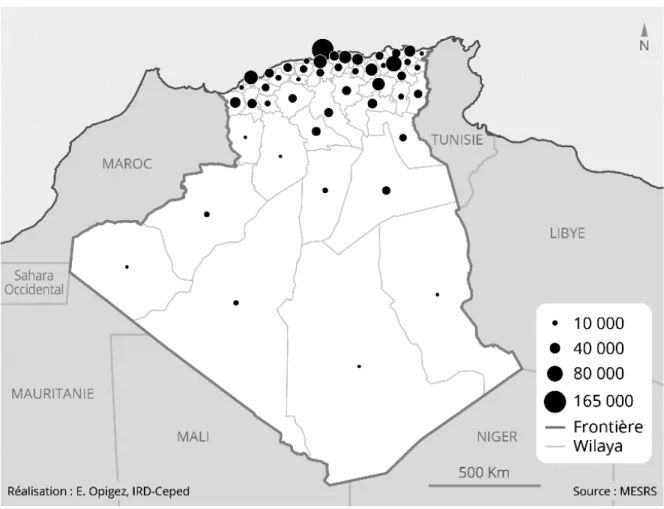
institutes. The main idea for the distribution of these capacities across the territory has been based on the idea to provide each administrative division (wilaya) with at least one higher education institution (see map1). The determination for the location of each university responds to the same equity principle that is to ensure a balanced access to higher education institutions. The calculation of the distances between them ensures that no part of the country is completely left out and that every citizen is at a reasonable distance to reach a university center (see MESRS 2012).
Towards a universal access to higher education on the national territory
The result of such a process is a massive generalization of higher education in Algeria, under a democratic, egalitarian rule. The revenues from oil production have been extensively mobilized to match the investments needed for such a construction.
Map 1: Students enrolment per wilaya in 2017
(source MESRS stats 2017)
The geographic distribution today reflects the urban spatial concentration: the central, eastern and western regions are roughly represented according to their demographic weight (table 2 below). The three divisions correspond to the “regional conferences” taken as administrative categories along which is organized higher education in Algeria.
% per region License-Master Diploma Postgraduate Teaching Staff
Center 39,8 38,5 42 38,8
East 39 39,5 33,2 39,5
West 21,2 22 24,8 21,7
(source MESRS stats 2017)
The Central and eastern regions make up for 80% of the whole numbers while the western one is about 20%. However, there are differences per level of study. While the East trains mainly students at the license and master levels, the postgraduate students gather in majority in the central region and are relatively over-represented in the West, in comparison to graduates.
Recent trends : a continuous expansion, reaching social limits
From the past 20 years, students enrolment kept on increasing at the same pace than from independence to 2000. The number was multiplied by four in this short period of time. It briefly slowed down at the turn of 2010 and sharply increased again for the past 3 years.
Figure 1 : Students enrolment (1999-2017)
(source MESRS stats 2017, estimate for the year 2017)
This is narrowly correlated with population growth. After the 1990s socio-political turmoil and the depressed demographic dynamics that clearly went along with these, the fertility rate happen to recover during the beginning of the century. As a result, youth expansion rebounded with what some demographers call a new baby boom (Courbage, interviewed by Merchet, 2015). Prospects are thus quite clear; they noticeably indicate an increase of potential candidates and subsequent expected enrolment at least in the short/mid run.
Is this supposed to have an impact on the whole system? There is indeed a perceptible evolution. The strong support given by the COUS (University social services) in terms of number of grants and
0 200000 400000 600000 800000 1000000 1200000 1400000 1600000 1 9 9 9 -2 0 0 0 2 0 0 0 -1 2 0 0 1 -2 2 0 0 2 -3 2 0 0 3 -4 2 0 0 4 -5 2 0 0 5 -6 2 0 0 6 -7 2 0 0 7 -8 2 0 0 8 -9 2 0 0 9 -1 0 2 0 1 0 -1 1 2 0 1 1 -1 2 2 0 1 2 -1 3 2 0 1 3 -1 4 2 0 1 4 -1 5 2 0 1 5 -1 6 2 0 1 6 -1 7
accommodations has stabilized since the beginning of the 2010s. The proportion of students benefiting from it peaked in the early 2000s and never ceased to decrease since then. It went down from 93% to 65% for scholarships and from 54% to 35% in university accommodations. It shows the limits of the conditions of expansion. There is a decision from the government not to keep on providing indiscriminate support to all those willing to register as a student within the higher education system. With respect to all standards, however, the Algerian system remains very egalitarian and socially inclusive. This is also visible in terms of gender balance.
The number of female students in higher education has increased tremendously. Since the end of the last century, female students constitute the majority of registered students and they represent today more than 60% of the students population. In terms of results, they have better achievements than their male counterpart with a proportion of degree obtained above 65%. It is five points above males’ student figures, per class level.
Staff increase to match growing students population
In order to face the huge number of new registered students, the universities have recruited a large number of academic staff. Their number has increased continuously with no interruption at all for the past 20 years. It went up from 20.000 to more than 60.000.
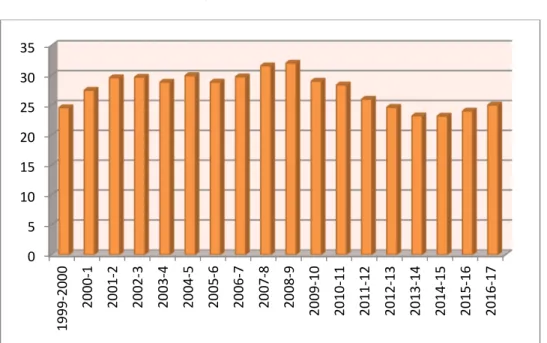
While, at the same time, the cohorts of students have stabilized temporarily in the early 2010s, the ratio student/staff provisionally tended to decrease. Nonetheless, it remained significantly higher than in OECD countries. Besides and as expected, it quickly worsened again for the most recent years with the rising number of students (figure 2).
Figure 2: Number of students per Lecturer at the university (1999-2017)
(Source MESRS stats 2017, estimate for the year 2017)
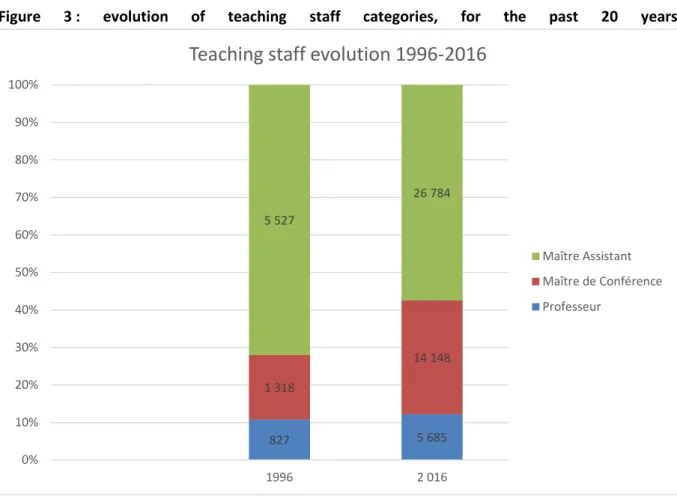
Interestingly enough, the various categories of academic staff have not grown evenly (figure 3). While the professors have seen their number multiplied by 5, those of the teaching assistants (maîtres
0 5 10 15 20 25 30 35 1 9 9 9 -2 0 0 0 2 0 0 0 -1 2 0 0 1 -2 2 0 0 2 -3 2 0 0 3 -4 2 0 0 4 -5 2 0 0 5 -6 2 0 0 6 -7 2 0 0 7 -8 2 0 0 8 -9 2 0 0 9 -1 0 2 0 1 0 -1 1 2 0 1 1 -1 2 2 0 1 2 -1 3 2 0 1 3 -1 4 2 0 1 4 -1 5 2 0 1 5 -1 6 2 0 1 6 -1 7
assistants) by 7, the lecturers (maîtres de conférence) have increased by a factor of 11 ! Their proportion has grown from 1/5 to 1/3, while the former, less qualified, declined from 3/4 to slightly more than 1/2. As the lecturers group constitutes the pool of trained and stable academic staff, a quality improvement in teaching may thus be expected.
Figure 3 : evolution of teaching staff categories, for the past 20 years
(source MESRS stats 2017)
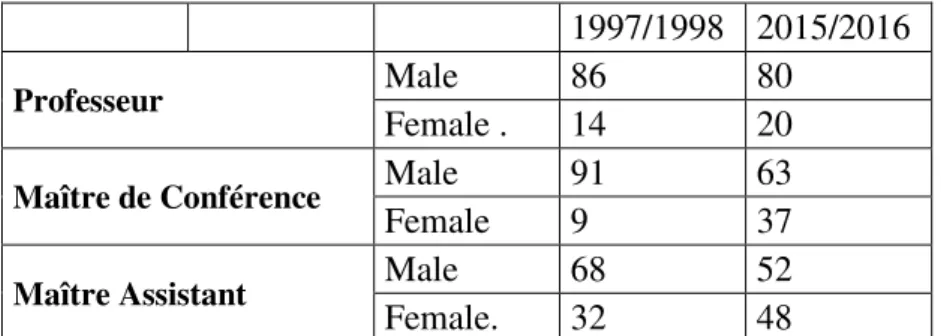
As to female academic staff, their involvement in teaching activities, is over represented in lower ranks of Assistants and Teaching Assistants while they constitute a minority in higher ranks (lecturers and professors). The ratio of students to female academic staff is also higher than for male. There is nevertheless a growing convergence between both though it is slow and different according to the status. Professors remain essentially male (80%) whilst Teaching Assistants is almost gender balanced at the end of the period (48% of women participation). The Lecturer position has been changing more quickly and profoundly than any other rank, from 9% 20 years ago to slightly above 33% in 2018. This augurates of a female renewal at the top of the academic hierarchy in the years and decades to come.
Table 3 : Male/female distribution in staff (%)- Comparison 1997/2016
827 5 685 1 318 14 148 5 527 26 784 0% 10% 20% 30% 40% 50% 60% 70% 80% 90% 100% 1996 2 016
Teaching staff evolution 1996-2016
Maître Assistant Maître de Conférence Professeur
1997/1998 2015/2016
Professeur Male 86 80
Female . 14 20
Maître de Conférence Male 91 63
Female 9 37
Maître Assistant Male 68 52
Female. 32 48
(source MESRS stats 2017)
Output of the higher education system
The enrolment growth corresponds to a comparable increase in diplomas earned by the students. Between 1/5 to 1/4 of those registered are awarded a degree after 5 years, in average. This proportion tends to rise along the years, possibly in relation to feminization.
Figure 4: Enrolment compared to degrees earned by age classes (1999-2012)
(source MESRS stats 2000-17)
The internal productivity of the system shows significant improvements. The number of students registered in masters programs has considerably increased. It has been multiplied by 10 between 2009 and 2016 (against only by 3 for degrees), and refers now to 1/3 of all registered students in higher education. The achievement rate per level has also considerably improved. It has been multiplied by 7 for degrees and 47 for the masters ! However, for the latter, it has to do with the expansion of the LMD system.
Interestingly enough, the gender distribution has changed dramatically to some respect. In 2009, the proportion of women registering in a master’s program was much higher than of those obtaining a similar degree this year (11% vs 7%). In 2015, the proportion changed completely (28% registered vs 34% degrees obtained). It clearly means that not only do women get increasingly registered in advanced studies but they also complete the program more often. They finish the program and
0 200000 400000 600000 800000 1000000 1200000 1999-2000 2000-1 2001-2 2002-3 2003-4 2004-5 2005-6 2006-7 2007-8 2008-9 2009-10 2010-11 2011-12 diplômés (-1) inscrits
graduate meanwhile they were used to withdraw, before. However, this is not the same for the degree (undergraduate) programs where withdrawal remains very high.
Evolution of the distribution per areas of knowledge
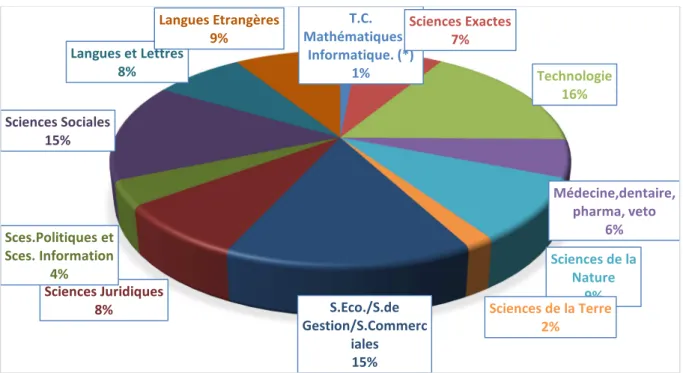
Evolution by disciplinary fields shows differences between the beginning and the end of the period. If technology and commerce/management, with a definite professional orientation, still have high percentages, they have been significantly decreasing for the past 20 years. Together with law and mathematics/information sciences, they constituted almost 2/3 of registered students. However, in 2018 they only represent 40%. There is here a clear relationship with higher education feminization. These fields are those most favored by the –relatively declining- male students population.
The distribution by gender is, indeed, quite unbalanced. Fields in which female students have massively enrolled are language and natural sciences (representing over 80% of students) as well as health sciences. However, in this latter field, veterinary science is quite an exception with a very low female proportion while medicine, pharmaceutical science and dentistry are 3/4 chosen by female students. The gender breakdown is thus marked though it is also evolutive Language attractiveness for female students, for instance, is fairly recent, as the low participation of women in these fields 20 years ago clearly shows. This composition has to be taken into account when looking at job prospects. There are preferences and biases per gender, though they remain flexible and susceptible of modifications. Figure 5 : Proportion of registered students per major disciplines 2015-16
(source MESRS stats 2017)
T.C. Mathématiques et Informatique. (*) 1% Sciences Exactes 7% Technologie 16% Médecine,dentaire, pharma, veto 6% Sciences de la Nature 9% Sciences de la Terre 2% S.Eco./S.de Gestion/S.Commerc iales 15% Sciences Juridiques 8% Sces.Politiques et Sces. Information 4% Sciences Sociales 15% Langues et Lettres 8% Langues Etrangères 9%
Focus on advanced (post-master) studies and research training
The increase of advanced students has been even more intense than for those registered in undergraduate programs. It went up from 20.000 to almost 80.000 from 1999 to 2016. However, it has very recently slowed down, due to a more selective access to doctoral studies and a concern about the number of Phd students whose thesis have been extended excessively and not completed.
There is a significant concentration of postgraduate students in the central region (see table 2above, 42%) while they are, at the opposite, under represented in the east (33%). Algiers’based institutions represent over 25% of all postgraduate students in the country . Other regions have nonetheless important poles of this category of students. These include Constantine (8%), Annaba (5,5%), Batna (5%), Biskra (4%) and Setif (3,5%), for the eastern part and Oran (10%) with Tlemcen (6%), for the west. These are the centers from which higher education started to grow, decades ago. This is where the most important scientific laboratories are located and where the main research centers have been set up, beside the universities, such as the CREAD and CRASC. Along the years, many research teams have developed among these organizations.
Map 2 : concentrations of advanced students
Registrations in doctoral studies increased considerably, from 21.000 to 57.000 between 2010 and 2016. Among these, the LMD type of doctorate goes up from1,3% to 29% while traditional doctorate figures stabilize at the end of the period. Interestingly, universities delivering doctorates increase, from 44 in 2010 to 74 in 2016 (out of a total of 100highereducation institutions).Around ¾ of the academic institutions are entitled to lead doctoral programmes.
Health and –to a minor extent in the recent years- technology, have become the most important fields at this level. Economics and commerce, as well as foreign languages, are particularly growing, and to a lesser extent, political and natural sciences. Female students are overrepresented in medical and natural sciences as well as in foreign languages. However, their participation in economics and commerce is increasing but they stay away from technology.
Even though the number of female students successfully completing their studies is much higher than their male counterparts, their participation in postgraduate studies (as well as for university staff, see table 3 above) lags far behind. However, this is also where the gap tends to fill up more quickly. There is an improvement of more than 16 points in 17 years, compared to 11 points only for the general registration figures.
Conclusion : past results and steps ahead
Algeria has been addressing the higher education challenge in a sustained and consistent way for the past 5 decades. It has continuously increased the proportion of national youth enrolled, in spite of its tremendous demographic growth. Notwithstanding these adverse conditions, the egalitarian and democratic orientation of the system building deserves to be emphasised. The good results in terms of gender balance and social equity reflect the success of such options today. However, this period is now coming to an end. The expansion rate is slowing down ; social support is in stagnation ; the public monopoly leaves room for some private initiatives ; quality assessment and highly selective programmes are being adopted. Doctoral studies, providing research and teaching staff as well as potentially R&D innovation, are in transformation. New trends are definitely emerging.
In particular, the issue of the system’s efficiency is at stake. Many critics argue that its growth has been realised at the expense of quality and that the teaching has effectively deteriorated. The results in terms of increasing enrolment and degree achievements may hide an absence of substantial evaluation. The absorption of a significant part of the Algerian youth by the higher education system is sometimes considered as a safety valve. In fact, the social pressure that this category of the population might produce if left without occupation and activities is seen as a major source of potential instability. In such a context, educational performance is not the priority and may be minimised in front of other considerations.
International rankings do not give a good picture of Algerian universities. In the 2018 ANRWU Shanghai classification, among 1500 universities, only 16 are African. Two of these are not english speaking and both are from Tunisia. In the Times Higher Education ranking, more than 25 African institutions feature among the 1000 world universities selected. One is from Algeria, compared to two from Morocco and Tunisia, and 8 from Egypt. An obvious weakness of Maghreb universities in these rankings is the lack of scientific research records in international publications data bases. It points at the necessity to
expand R&D activities – also nurturing educational programmes- and to lift them up to international standards.
Today the question of quality and evaluation are definitely at the top of the agenda, with regards to higher education issues. However, they are too often dealt with excessive conformism. Quality is, indeed, seen as a universal value aligned on non-contextual criteria. Therefore, simple management recipes transferred from European consulting firms often prevail above local analysis and actors’ collective reflection. However, external models cannot be successful, because the expansion met by the Algerian system is not similar to what happened elsewhere. Three centuries have been necessary to build up the modern European systems of higher education. How could their current norms be applicable to situations in developing countries where the processes have been recently implemented in just three decades?
Qualitative approaches need to take over from the quantitative assessment made in this article. In particular, we need to know what the current developments in higher education are changing in the Algerian society today, in terms of abilities, beliefs and relationships. How are innovation processes nurtured by the new human resources base thus created ? How are cultural behaviours modified by widespread training and access to information and knowledge ? How are jobs provision evolving with regards to qualifications intensity ? These are but a few of the questions arising from the evidence of outstanding transformations delivered by the Algerian case study, to further understand what this case can tell us about higher education and sustainable development.
References
European Commission (2010) Higher Education in Algeria, Tempus, European Commission, October 2010
Ghalamallah Mohamed (ed) (2011) L’universitéalgérienne et sa gouvernance, CREAD-Centre de recherche en Ecomomie Appliquée pour le développement, Alger
GueridDjamel (ed.) (2014) Repenser l’université, Arak Editions, Oran
Gardelle Linda and Mohamed Benguerna (eds) (2015) Les enjeux de la formation des élites maghrébines en France ; formation, identité et mobilité des ingénieurs dans un monde globalisé, éditions Publisud, Paris
MerchetJean-Dominique (2015) « Le baby boom imprévu du monde arabe », l’Opinion, 18 octobre 2015 https://www.lopinion.fr/edition/international/baby-boom-imprevu-monde-arabe-53397 (July 18th 2018)
MESRS (2017) Annuaire statistique n°45, 2015-2016, Ministère de l’Enseignement Supérieur et de la Recherche Scientifique, Alger
MESRS (2016) Annuaire statistique n°44, 2014-2015, Ministère de l’Enseignement Supérieur et de la Recherche Scientifique, Alger
MESRS (2015) Annuaire statistique n°43, 2013-2014, Ministère de l’Enseignement Supérieur et de la Recherche Scientifique, Alger
MESRS (2014) Annuaire statistique n°42, 2012-2013, Ministère de l’Enseignement Supérieur et de la Recherche Scientifique, Alger
MESRS (2013) Annuaire statistique n°41, 2011-2012, Ministère de l’Enseignement Supérieur et de la Recherche Scientifique, Alger
MESRS (2012) Annuaire statistique n°40, 2010-2011, Ministère de l’Enseignement Supérieur et de la Recherche Scientifique, Alger
MESRS (2012) L’enseignement supérieur et la recherche scientifique en Algérie, au service du Développement, 1962-2012, Ministère de l’Enseignement Supérieur et de la Recherche Scientifique, Alger
MESRS (2011) Annuaire statistique n°39, 2009-2010, Ministère de l’Enseignement Supérieur et de la Recherche Scientifique, Alger
Meyer Jean-Baptiste (2017) MOOCs et mobilités étudiantes : une nouvelle circulation mondiale des connaissances ? Journal of International Mobility, n°5 2017/1
Meyer Jean-Baptiste (2017) Etudier l’enseignement supérieur, la recherche et l’entreprise en Algérie, un projet en développement, Repères : 62-66