Sharing perception when using hands-on
exhibits in science centres: The case of vocal
depiction
Christina BRANDENBERGER & Christoph HOTTIGER
URPP Language and Space, University of Zurich1
There are various situations in our daily lives in which we share sensory perceptions in interaction, but research on how exactly we do this is relatively scarce and has often focused primarily on the visual and auditory channels. In this paper, we suggest an approach based on the methods of multimodal conversation analysis which also considers other perceptual fields, especially touch. By means of an example from an interaction between two visitors of a science centre and the way they handle an exhibit, we illustrate how one can approach the analysis of the techniques participants use to make their sensory perceptions available to their interactive partners. We will focus on one such technique, namely the vocal depiction of tactile perceptions.
1. Introduction
In our daily lives, moments in which we share our sensory perceptions in interaction are frequent and diverse. However, there are social occasions during which the practice of sharing sensory perceptions is even more essential than usual. Among these, one could list wine tastings or cultural events, such as film screenings, but also visits to museums, and, in particular, so-called science centres. What is crucial about the latter is that, in order to make sense of the exhibits, visitors must manipulate them. In this process, sharing one's sensory perceptions – be they visual, tactile, proprioceptive2, auditory or even olfactory – with one's co-visitors is of paramount importance: Only based on this interactive activity can a collaborative process of sense-making and knowledge construction based on the exhibit take place.
It is precisely the process of sharing multisensorial experiences in interaction which is the core interest of this paper. Our data, which stems from our corpus of over 30 hours of video and (partially) eye-tracking recordings of naturally occurring visitor interactions at the Swiss Science Center Technorama in Winterthur, Switzerland, indicate that visitors to the exhibition clearly have a desire to share their sensory perceptions with their co-visitors as they evoke
1 This paper was written as part of the SNSF-funded project 'Interactive discoveries: A video and
eye-tracking based study of knowledge construction in science centres' (project number 162848).
2 According to Mine et al. (1997: 19), proprioception can be defined as "a person's sense of the
their perceptions very frequently. But how exactly do they do this? There is a broad range of linguistic and embodied resources which visitors use to share their sensory experiences. However, in this article, we will focus on only one of them, namely that which we will call vocal depiction of tactile perception.3 We wish to illustrate this technique by presenting a case study of a brief excerpt of a young couple's visit to the Technorama.
2. Methodology
Our analysis will draw on the methods developed in conversation analysis and multimodal interaction analysis (for a brief overview of this approach cf. Heath & Luff 2008). Analyses in this tradition stick strictly to the sequentiality of the unfolding events and adhere to resources which are available to the interactants themselves. The following quote summarises the most important tenets of such an approach to analysing human interaction with a special emphasis on multimodality:
This methodology represents an empirical analysis of the sequential organization of human action, i.e. how participant actions build on prior actions and events, and through their design display how these actions and events are interpreted. In this approach language is seen as one possible modality that is used to perform and deliver actions. Since social interactants use language simultaneously with multiple semiotic resources (including gestures, the body and features of the material context) for producing and responding to actions and for interacting with each other, the analysis focuses on the integratedness of these resources, and how interactants use them together for communicating understandings of events and actions as they occur moment by moment in their real-life and everyday contexts […]. (Haddington 2013: 411f.)
A conversation analytical approach with an emphasis on multimodality, as described above, provides a useful framework for a detailed qualitative investigation of visitors' actual use of – and interactions at – exhibits in museums, as has been demonstrated in previous research (cf. e.g. Heath & vom Lehn 2001; Heath & vom Lehn 2008; Heath, vom Lehn & Osborne 2005).
3. Previous Research
Previous (video-based) research in a conversation analytical tradition has explored the question as to how interactants share individual sensory perceptions in interaction. In the context of museums, the work of Heath and vom Lehn is highly relevant for our question. However, the focus of their work is mostly on how visual perception is made available among interactants (vom Lehn & Heath 2007; Heath & vom Lehn 2001; vom Lehn et al. 2001). For
3 This issue seems to be attracting researchers' interest lately (cf. for instance Keevallik in press
for an analysis of the non-lexical vocalisations participants use to coordinate their actions while they are mucking out a sheep stable).
instance, vom Lehn and Heath (2007: 148) show how visitors assimilate their perspectives through social interaction in art galleries. They note that visitors often go to great lengths to point out some particularities of an exhibit they observe and thereby enable their partners to make the same (or at least similar) experiences (cf. vom Lehn & Heath 2007: 155). This is achieved by using verbal and embodied means within an intricate temporal organisation (cf. vom Lehn & Heath 2007: 156). Thus, visitors can be said to configure their ways of seeing an exhibit for themselves and for each other (cf. vom Lehn & Heath 2007: 160). In a broader context, Goodwin (1994) analyses how visual perceptions are shared in certain professional fields. He points out that, for instance among archaeologists, there are techniques through which they can structure a complex perceptual field in order to "divide a domain of scrutiny into a figure and a ground, so that events relevant to the activity of the moment stand out" (Goodwin 1994: 610). In a similar vein, such interactive techniques are employed during surgery by "team members […] to interpret the visual field in congruent ways […] for the purposes of the work at hand" (Koschmann et al. 2011: 521). These examples out of the professional world (and many more, cf. Hindmarsh & Heath 2000) clearly show that participants' efforts to assimilate their perspectives constitute a critical part of collaborating on a task.
As mentioned above, most of the previous conversation analytical studies on sharing sensory perceptions in interaction focus on the interactive configuration of vision. However, a preliminary analysis of our video data shows that, apart from visual perception, visitors' collaborations at the hands-on exhibits also frequently involve the exchange of other sensory perceptions, such as touch, proprioception, or hearing. The use of hands-on exhibits evidently provides more multisensorial experiences than traditional pieces of art, and, consequently creates more need for visitors to exchange those diverse experiences in interaction. However, as soon as more than one field of perception is available and potentially relevant to what the participants are doing, they may be faced with the interactive problem (cf. Hausendorf 2015: 55ff.) of evoking one of these fields in particular. This can be particularly challenging if the relevant field of perception is not visual, as, according to Nishizaka (2000; 2011), "what is talked about and dealt with in interaction is to be found first of all in the common visual field" (2011: 506, italics in the original). In this context, Nishizaka (2011: 506) explains that the participants in his study would sometimes close their eyes "to indicate […] that the current operand and referent is located and operated on in some field other than the visual". However, in our setting the visual field is accessed by all participants. Therefore, investigating techniques of communicating multisensorial experiences through multimodal resources promises to be particularly rewarding in the context of science centres. By focusing on vocal depiction as one such embodied technique of sharing multisensorial experiences, our analysis takes into account how visitors use their verbal and bodily resources, as well as the exhibits at hand, to make their multisensorial experiences available to each other. In doing
so, our analysis takes a step towards a domain to which research has not paid much attention yet (but see, e.g., attempts to establish a "sensory ethnography", Pink 2009).
4. Data and Participants
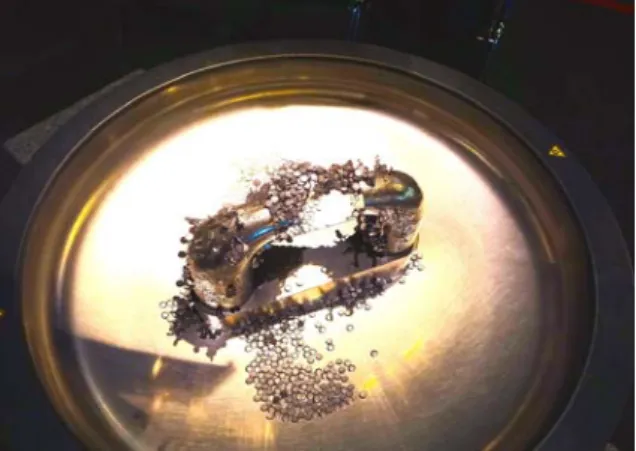
Our analysis will focus on vocal depiction as a technique of sharing tactile experiences in interaction. This will be done by means of an example drawn from our corpus of visitor interactions in the Swiss Science Center Technorama. In this extract, a young couple, Stella and Milo, are handling an exhibit which consists of a large bowl with two magnets placed in its centre (cf. figure 1). The magnets are bent towards each other and appear to form an interrupted semi-circle, that is to say they are not touching each other. In addition to this, a large number of small metal discs is lying in the bowl. These are attracted by the magnets and can be used – among other things – to bridge the gap between the two magnets.
Figure 1: Bowl with magnets and magnetic discs.
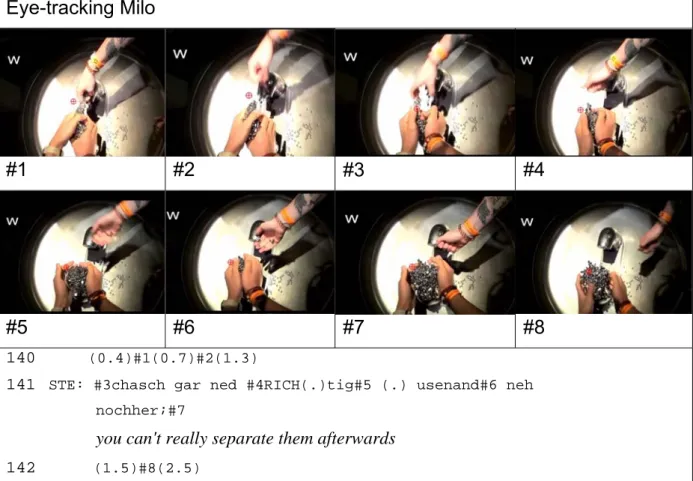
To exemplify how tactile perceptions can be made interactively available by means of vocal depiction, the analysis that follows scrutinises a single utterance by Stella as well as the way she manipulates the exhibit during this utterance. The excerpt is located about midway in the couple's interaction at the given exhibit and shown below as both a sequence of stills from Milo's eye-tracking data and a verbal transcript, which anchors the stills. This representation is used as the most compact way to present the most relevant aspects of the excerpt for our analysis, as the original data consists of four simultaneous data streams (two eye-trackers, two camcorders) arranged in a split screen, which is not suited to being presented in a small amount of space. It is important to note, however, that the stills we chose show only a part of the actual eye-tracking video in order to increase the visibility of the relevant phenomenon. This particular eye-tracking stream was chosen to illustrate the analysis at hand because, out of the four streams, it provides the best view of the participants' manipulation of the exhibit. While both of Milo's hands are visible in the lower part of the pictures in figure 2, the hand in the upper part of the images (with a
tattoo on the lower part of the arm) belongs to Stella (STE). The red cross hair represents the focus of Milo's gaze as measured and calculated by the eye-tracking software (D-Lab/Ergoneers). The verbal transcription follows the conventions of the transcription system called GAT2 by Selting et al. (2009). In addition, numbered hashtags were used to indicate the precise moment at which a still was taken relative to the verbal utterance. This approach is adapted from Kesselheim (2012).
5. Analysis
At the beginning of our extract, Stella grabs the 'bridge' of metal discs, which was set up between the two magnets, with two fingers (#1). At this point, she separates the 'bridge' (#2), but there are no discs in her hand when she withdraws it. Next, Stella grabs the remaining chain of discs (#3). Here, she starts her utterance as soon as her hand touches the chain of discs, which is attached to the big magnet on the right. This time she manages to separate the chain of discs from the magnet and takes away some of the discs (#4). Shortly afterwards, Stella brings back the same hand to get the discs which are still stuck to the big magnet (#5 and #6). She finishes her utterance slightly before managing to remove them from the magnet (#7). Then, Stella pulls back her hand (#8) and keeps the discs in it.
Eye-tracking Milo
#1 #2 #3 #4
#5 #6 #7 #8
140 (0.4)#1(0.7)#2(1.3)
141 STE: #3chasch gar ned #4RICH(.)tig#5 (.) usenand#6 neh
nochher;#7
you can't really separate them afterwards
142 (1.5)#8(2.5)
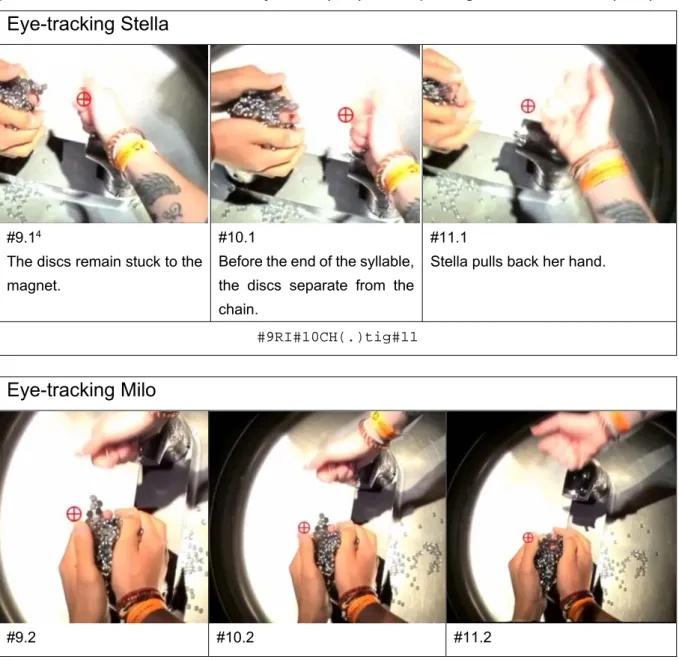
The following analysis will scrutinise Stella's second grab (#3), by which she removes some of the discs from the chain. The discs separate from the chain while Stella pronounces the word 'richtig' (really). Stella's exact sequence of manipulation while she is uttering 'richtig' is illustrated in figure 3, this time with extracts of stills of both Stella's and Milo's eye-tracking data. Stella emphasises the first syllable and even produces a micro pause between the first and the second syllable (RICH(.)tig). The discs, which Stella grabs while she is uttering
the first syllable, remain stuck to the chain at first (#9), but then come loose from the other part of the chain before the end of the syllable (#10). After the micro pause, she utters the second syllable (tig) while pulling back her hand (#11).
Eye-tracking Stella
#9.14
The discs remain stuck to the magnet.
#10.1
Before the end of the syllable, the discs separate from the chain.
#11.1
Stella pulls back her hand.
#9RI#10CH(.)tig#11
Eye-tracking Milo
#9.2 #10.2 #11.2
Figure 3: Verbal transcription of Stella's utterance and stills of Stella's and Milo's eye-tracking.
4 The eye-tracking images labelled #9.1 and #9.2 show the exact same point in time, but #9.1 is
drawn from Stella's glasses while #9.2 comes from Milo's glasses. The same holds for the stills labelled #10.1/#10.2 and #11.1/#11.2.
This sequence (figure 3) is highly interesting with respect to the techniques Stella uses to share her sensory perceptions. Remember, her whole utterance translates as you can't really separate them afterwards. Given the fact that she is manipulating the discs which are stuck to the large magnet while uttering these words, Stella's utterance can be interpreted as a reference to said discs, which she describes as hard to separate. Thus, the lexical content of her utterance already comments on the tactile and proprioceptive experience the manipulation of the exhibit provides. What is more, the simultaneity of speech and the manipulation of the exhibit means that the exact way Stella pronounces and structures her utterance can be thought of as an illustration of her bodily actions and the way she perceives them, not just visually but also in terms of her tactile and proprioceptive perceptions. Let us examine the structure of the decisive part of this utterance in detail while also considering Stella's simultaneous embodied actions: Stella stresses the first syllable of the word 'richtig' (RICH(.)tig) while she is pulling on the chain of discs (and before the
discs separate from the large magnet). Therefore, the stress on the first syllable can be read as a verbal 'illustration' of the 'force' she has to apply to separate the discs from the magnet due to the counterforce of the magnet. Next, Stella produces a micro pause before she finishes the word 'richtig'. This micro pause does not precisely coincide with the rupture of the chain of discs, but follows with a very minor 'delay' (RI#10CH(.)tig).5 Thus, Stella's way of pronouncing the
word 'richtig' can be heard as displaying the observation of counterforce and rupture she made immediately before. In a similar vein, the micro pause can be said to illustrate the sudden release of the discs from the chain of magnets. Overall, the precise way Stella structures her utterance in conjunction with her simultaneous bodily actions (separating the discs from the magnet) can be interpreted as a vocal depiction of the tactile and proprioceptive dimension of her observation of rupture, by which this perception is made interactively available to her partner. It is important to add here that it is not the case that the manipulation of the exhibit at hand requires a lot of force. Consequently, Stella's vocal depiction of her tactile perception and proprioception simply provides additional information to what her partner perceives visually and through his own manipulations. Simultaneously, her vocal depiction may also function as a means for Stella to structure her perception towards herself.
In addition, this example shows that through her way of structuring her utterance Stella can also emphasise the tactile dimension of her experience vis-à-vis the visual dimension. Obviously, the resistance and rupture of the disc of magnets can be perceived visually too. Nevertheless, in this case, the full potential of the experience is not limited to the visual field. This is precisely what Stella's vocal depiction manages to display: Even if Milo sees her actions and knows through
his own experience what the discs feel like, Stella's vocal depiction allows Milo (and the analyst) to recognize that, despite the dominance of the visual field in interaction noted by Nishizaka (2000; 2011), she emphasises the tactile domain. Indeed, Milo's next actions after this utterance seem to validate this reading: He manipulates the metal discs several times in a way that allows him to make tactile and proprioceptive experiences that are similar to the one evoked by Stella and, thereby, to reduce the "epistemic gradient" (Heritage 2012: 4) between him and his partner and acquire "primary access" (Raymond/Heritage 2006: 684) to that particular tactile experience.
A final point to consider is that the fact that Stella applies a vocal depiction allows her to share her perception (be it visual, tactile, or proprioceptive6) with her partner, even if the latter does not have the exact same domain of scrutiny at the very moment of her utterance. Milo's eye-tracking video indicates that at the moment when Stella is pronouncing 'richtig' (see figure 3: #9.2, #10.2, #11.2 above), Milo is occupied with his own manipulation of the exhibit and not focusing on the discs Stella is talking about. Even if it is very likely that he can still perceive Stella's manipulations without focusing on them,7 she can improve her partner's awareness of what she is doing by vocally depicting her perception of a procedure he is not looking at directly8 and not experiencing through touch. Stella's vocal depiction, therefore, has at least two effects: It presents an experience to Milo and it provides him with details of a domain of scrutiny other than his own.
6. Conclusion
Our analysis has shown one technique of how non-visual perceptions can be made available in interaction. What is striking about Stella's vocal depiction of her tactile perception is the intricate way it is tied to the sequentiality of her manipulation of the exhibit and the way it links language, tactile perception, proprioception and vision. Therefore, the example at hand is a case in point of why it is important not to isolate the ways interactants share sensory perceptions, but instead to consider how multiple sensory perceptions are shared while participants are interacting in a particular physical environment.
6 Research in biology suggests that touch and proprioception, which are usually understood as
being separate "modalities", are in fact interrelated both on the perceptual and on the physiological level, even if they can still be distinguished in terms of their "neural coding" (Ricon-Gonzalez et al. 2001: 490).
7 The frame of the eye-tracking pictures is not a reliable reference for the field of vision of the
participants. The eye-tracking software detects the participants' focus, but does not give evidence of what participants perceive in their peripheral vision.
8 This is not to say that Stella can know exactly what Milo is focussing on and thus uses a vocal
Bibliography
Goodwin, C. (1994): Professional vision. American Anthropologist, 96(3), 606-633.
Haddington, P. (2013): Action and space: navigation as a social and spatial task. In P. Auer, M. Hilpert, A. Stukenbrock & B. Szmrecsanyi (éds.), Space in language and linguistics: geographical, interactional, and cognitive perspectives. Berlin (de Gruyter), 411-433.
Hausendorf, H. (2015): Interaktionslinguistik. In L. Eichinger (éd.), Sprachwissenschaft im Fokus: Positionsbestimmungen und Perspektiven. Berlin (de Gruyter), 43-70.
Heath, C. & Luff, P. (2008): Video and the analysis of work and interaction. In P. Alasuutari, L. Bickman & J. Brannen (éds.), The SAGE handbook of social research methods. Los Angeles (SAGE), 493-505.
Heath, C. & vom Lehn, D. (2001): Configuring exhibitis. The interactional production of experience in museums and galleries. In H. Knoblauch & H. Kotthoff (éds.), Verbal art across cultures: the aesthetics and proto-aesthetics of communication. Tübingen (Narr), 281-297.
Heath, C. & vom Lehn, D. (2008): Configuring 'interactivity': enhancing engagement in science centres and museums. Social Studies of Science, 38(1), 63-91.
Heath, C., vom Lehn, D. & Osborne, J. (2005): Interaction and interactives: collaboration and participation with computer-based exhibits. Public Understanding of Science, 14(1), 91-101. Heritage, J. (2012): Epistemics in action: action formation and territories of knowledge. Research on
Language and Social Interaction, 45(1), 1-29.
Hindmarsh, J. & Heath, C. (2000): Embodied reference: a study of deixis in workplace interaction. Journal of Pragmatics, 32(12), 1855-1878.
Keevallik, L. (in press): The temporal organization of conversation while mucking out a sheep stable. In A. Deppermann & J. Streeck (éds.), Time in embodied interaction: Synchronicity and sequentiality of multimodal resources. Amsterdam/Philadelphia (John Benjamins), 97-122
Kesselheim, W. (2012): Gemeinsam im Museum: Materielle Umwelt und interaktive Ordnung. In H. Hausendorf, L. Mondada & R. Schmitt (éds), Raum als interaktive Ressource. Tübingen (Narr), 187-231.
Koschmann, T., LeBaron, C., Goodwin, C. & Feltovich, P. (2011): 'Can you see the cystic artery yet?' A simple matter of trust. Journal of Pragmatics, 43(2), 521-541.
Mine, M., Brooks, F. P. Jr., Sequin, C. H. (1997): Moving objects in space: exploiting proprioception in virtual-environment interaction. In Proceedings of the 24th conference on computer graphics and interactive techniques (SIGGRAPH 1997). New York (ACM Press/Addison-Wesley), 19-26. Nishizaka, A. (2000): Seeing what one sees: perception, emotion, and activity. Mind, Culture, and
Activity, 7(1-2), 105-123.
Nishizaka, A. (2011): Touch without vision: referential practice in a non-technological environment. Journal of Pragmatics, 43(2), 504-520.
Pink, S. (2009): Doing sensory ethnography. Los Angeles (SAGE).
Raymond, G. & Heritage, J. (2006): The epistemics of social relations. Owning grandchildren. Language in Society, 35(5), 677-705.
Ricon-Gonzalez, L., Warren, J. P., Meller, D. M., Helms Tillery, S. (2011): Haptic interaction of touch and proprioception: implications for neuroprosthetics. IEEE Transactions on Neural Systems and Rehabilitation Engineering, 19(5), 490-500.
Selting, M., Auer, P., Barth-Weingarten, D., Bergmann, J., Bergmann, P., Birkner, K., Couper-Kuhlen, E., Deppermann, A., Gilles, P., Günthner, S., Hartung, M., Kern, F., Mertzlufft, C., Meyer, C., Morek, M., Oberzaucher, F., Peters, J., Quasthoff, U., Schütte, W., Stukenbrock, A. & Uhmann, S. (2009): Gesprächsanalytisches Transkriptionssystem 2 (GAT 2). Gesprächsforschung – Online-Zeitschrift zur verbalen Interaktion, 10, 353-402.
vom Lehn, D. & Heath, C. (2007): Perspektiven der Kunst – Kunst der Perspektiven. In: H. Hausendorf (éd.), Vor dem Kunstwerk. Interdisziplinäre Aspekte des Sprechens und Schreibens über Kunst. München (Fink), 147-170.
vom Lehn, D., Heath, C. & Hindmarsh, J. (2001): Exhibiting interaction: conduct and collaboration in museums and galleries. Symbolic Interaction, 24(2), 189-216.