RESEARCH OUTPUTS / RÉSULTATS DE RECHERCHE
Author(s) - Auteur(s) :
Publication date - Date de publication :
Permanent link - Permalien :
Rights / License - Licence de droit d’auteur :
Bibliothèque Universitaire Moretus Plantin
Institutional Repository - Research Portal
Dépôt Institutionnel - Portail de la Recherche
researchportal.unamur.be
University of Namur
Properties and electrochromic performances of reactively sputtered tungsten oxide
films with water as reactive gas
Sadiki, H.; Pierson, J.; Rousselot, C.; Martin, N.; Terwagne, Guy
Published in:
Surface and Coatings Technology
Publication date: 2005
Document Version
Early version, also known as pre-print
Link to publication
Citation for pulished version (HARVARD):
Sadiki, H, Pierson, J, Rousselot, C, Martin, N & Terwagne, G 2005, 'Properties and electrochromic
performances of reactively sputtered tungsten oxide films with water as reactive gas', Surface and Coatings Technology, vol. 200, no. 1-4, pp. 232-235.
General rights
Copyright and moral rights for the publications made accessible in the public portal are retained by the authors and/or other copyright owners and it is a condition of accessing publications that users recognise and abide by the legal requirements associated with these rights. • Users may download and print one copy of any publication from the public portal for the purpose of private study or research. • You may not further distribute the material or use it for any profit-making activity or commercial gain
• You may freely distribute the URL identifying the publication in the public portal ?
Take down policy
If you believe that this document breaches copyright please contact us providing details, and we will remove access to the work immediately and investigate your claim.
Properties and electrochromic performances of reactively sputtered
tungsten oxide films with water as reactive gas
H. Sadiki
a, J.F. Pierson
a, C. Rousselot
a,*, N. Martin
b, G. Terwagne
ca
De´partement CREST, Institut F.E.M.T.O.-ST (UMR CNRS 6174), Universite´ de Franche-comte´, B.P. 71427, F-25211 Montbe´liard cedex, France b
L.M.S.-E.N.S.M.M., 26, chemin de l’e´pitaphe, F-25030 Besanc¸on cedex, France c
L.A.R.N., De´partement de Physique, 61, rue de Bruxelles, B-5000 Namur, France Available online 27 April 2005
Abstract
A change of water vapour partial pressure from 0 to 4 Pa was carried out in order to prepare sputtered tungsten oxide compounds with various oxygen and hydrogen concentrations. Oxygen, tungsten and hydrogen concentrations were determined by Rutherford Backscattering Spectroscopy (RBS) and by Elastic Recoil Detection (ERD) analysis. Structure of tungsten oxide films was analyzed by X-ray diffraction. At low water vapour partial pressure, the films are crystallized and WO2and W3O phases were observed. The electrochromic performances of
such film/SnO2/glass substrate system were measured and discussed taking into account the influence of the water vapour partial pressure
injected into the deposition process on the structure, chemical composition and optical properties of the films. D 2005 Elsevier B.V. All rights reserved.
PACS: 68.55.Nq; 78.20-ci; 81.15-cd
Keywords: Reactive sputtering; Tungsten oxide; Electrochromic
1. Introduction
Transition metal oxides have been studied with respect to their electrochromic properties for applications as smart windows, antidazzling mirrors and display devices [1,2]. Since the discovery of the electrochromism phenomenon
[3,4], electrochromic layers based on WO3 have been the
most widely investigated oxide in the past.
WO3is a cathodic electrochromic material in which the
coloration mechanism (from transparent to blue) is generated by the electrochemical reduction. This mechanism is pro-moted by cathodic polarization, which caused ion insertion and electron injection. The injected electrons are trapped by some WVIsites forming WVsites, and ions remain ionized in the interstitial sites of the expanded WO3lattice. This double
injection into the film of WO3induces the formation of the
tungsten bronze (HxWO3) having electronic structure,
electrical and optical properties changed in comparison with
single tungsten oxide. Thin films of WO3can be prepared by
different techniques. Sputtering is one of the most widely used techniques because high-quality films are obtained with higher composition reproducibility. To the best of our knowledge, no study has been devoted to the synthesis of WO3films by sputtering methods using water as reactive gas.
The introduction of hydrogen-bearing species in the growth process provides the possibility to modify the W valence and to change the transport and electrochromic properties of sputtered-deposited WO3films.
In this paper, we report on the use of water vapour as reactive gas to deposit tungsten oxide films. A survey on the effect of water vapour partial pressure on some process parameters is studied first. Structural and chemical compo-sition changes in relation to the optical and electrochromic properties are finally discussed.
2. Experimental
A tungsten target (purity: 99.95%, 50 mm diameter) was DC sputtered with a constant current density JW=20 A m 2.
0257-8972/$ - see front matterD 2005 Elsevier B.V. All rights reserved. doi:10.1016/j.surfcoat.2005.02.195
* Corresponding author. Tel.: +33 3 81 99 47 14; fax: +33 3 81 99 46 73. E-mail address: [email protected] (C. Rousselot).
Argon was introduced first up to a pressure PAr=0.4 Pa
(constant pumping speed S=10 L s 1). Afterwards, the water vapour partial pressure ( PH2O) was changed from 0 to 4 Pa
using a leak valve connected to a de-ionised water flask. The pressure ratio (RH2O) is defined by RH2O=PH2O/PT.
The crystallographic structure was investigated by X-ray diffraction using Cu Ka radiation (k=1.5406 nm) at a grazing angle incidence h=1-. Optical properties were analysed from optical transmittance spectra of the film/glass substrate system.
Nuclear elemental analyses were performed with ALTAI¨S, the 2 MV Tandetron accelerator installed at LARN. Typical nuclear reactions induced by a-particles were used to measure elemental composition. The exper-imental details for nuclear analysis have been presented in previous papers[5,6].
The electrochemical measurements were performed using a Tacussel model PGP201 potentiostat and voltamaster 1 pilot software with a three electrodes configuration in a 1.0 M H2SO4solution. The working electrode was glass/SnO2:F
(25 V/g)/WOxHyfilm. A platinum disk and a SCE (Standard
Calomel Electrode) were used as auxiliary and reference electrodes, respectively. Cyclic voltametry was carried out at a rate of 500 mV min 1 and potentiostatic intermittent experiments at voltages between 1.0 to 2.5 V/SCE. The optical density change is defined as DOD=log (Tb/Tc,) where
Tb=transmission at 632 nm for the bleached state and
Tc=transmission at 632 nm for the coloured state. The
coloration efficiency (CE) was calculated from the charge density Qc(C m 2) inserted during the step coloration and
calculated according to the following equation CE=DOD/Qc.
3. Results and discussion 3.1. Process
Deposition rate exhibits a maximum (1300 nm h 1) for RH2Oclose to 35% (Fig. 1), which corresponds to PH2O=0.3
Pa. Similar results have been obtained by Kaneko et al.[7]
and Yamamoto et al.[8]for the deposition of tungsten oxide using O2as reactive gas. The evolution of the target potential
as function of PH2O can be explained by the change of
sputtering mode. Oxidation rate at the target predominates on the sputtering rate. The difference of molar volumes of components deposited on the substrate can explain the rise of deposition rate if the number of W atoms impinging on the surface is the same. For further increase of PH2O, the target
potential exhibits a drop and reaches a minimum value close to Uw=390 V. It probably correlates with an oxidised state of the target. Then, the W – Ar – H2O process trapped in the
oxidised sputtering mode (sputtering yield of tungsten oxide lower than that of metallic tungsten) and the deposition rate decreases from 1300 to 1100 nm h 1. Such a decrease may indicate that the target poisoning starts at low RH2O and
spreads out above 75%. However for ratio higher than 90%, the deposition rate is almost constant, which probably corresponds to a fully oxidised state of the surface of the target. These results reveal that the amount of water vapour required to change the process to oxidised sputtering mode is high because transition is close to PH2O=1.5 Pa (RH2O=80%).
Also, the target potential can be used as a key parameter to
0 1 2 3 4 0 200 400 600 800 1000 1200 1400 Deposition rate (nm h -1)
Water vapour partial pressure (Pa)
Deposition rate 0 20 40 60 80 100 Pressure ratio Pressure ratio (P H2 O /P T )
Fig. 1. Deposition rate of tungsten oxide films and pressure ratio vs. water vapour partial pressure at 293 K.
0 20 40 60 80 100 120 0 20 40 60 80 100 120 W3O (002) RH 2O = 1% 2 Theta (°) W3O (012)
Intensity (arb. units)
RH 2O = 2% WO2 (210) WO 2 (020) RH 2O = 5% W (110) R H2O = 8% WO3 2 Theta (°) RH 2O = 88%
Intensity (arb. units)
RH
2O = 85%
R
H2O = 77%
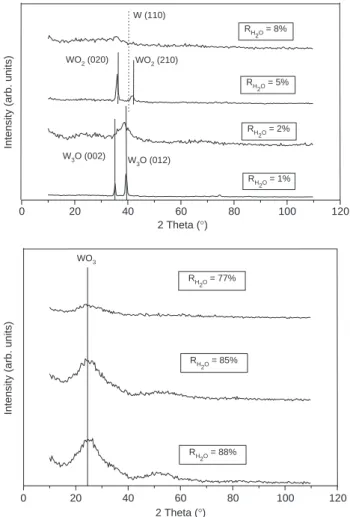
Fig. 2. X-ray diffraction patterns of tungsten oxide films deposited on glass substrate at 293 K for different water vapour pressure ratios.
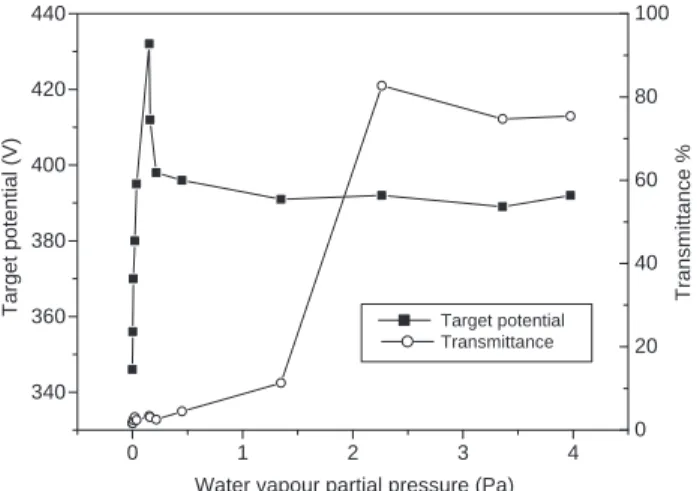
assess the change of sputtering mode. Transmittance of the films at a wavelength of 632 nm is plotted as a function of RH2O(Fig. 1). It is worth of noting that an increase of the
transmittance from 10 to 80% occurs when PH2O changes
from 1.3 to 2.2 Pa. Below PH2O=1.5 Pa, the films are not
transparent and exhibit a typical metallic aspect. Beyond this PH2O, which correlates to the transition from metallic
sputtering mode to the oxidised one, the films are transparent. This figure proves that the transition of sputtering mode is correlated to the gradual transition of the optical behaviours from metallic tungsten to WOxHycompounds.
3.2. Structure and chemical composition
X-ray diffraction patterns of the films show that the crystallographic structure is largely influenced by RH2O in
the range of 0 – 88% (Fig. 2). When RH2O=1%,
diffrac-tion peaks corresponding to the W3O phase (JCPDS no.
41-1230) are clearly observed (Fig. 2a). The W3O phase
is also detected when RH2O=2%. However this RH2O
induces a strong refinement of the W3O grains. This
W3O phase with low oxygen content vanishes when
RH2O increases (RH2O>2%). The nature of this oxide
phase has been described by several authors [8 – 10]. Recently, Maille´ et al. [10] suggested that the W3O
phase is related to the tungsten target pollution between two sputtering runs when the target is not well cleaned.
At RH2O ranged between 2% and 8%, two diffraction
peaks can be assigned to WO2phase (JCPDS no. 32-1393).
On the other hand, films prepared with RH2Oin the 8 – 77%
range exhibits an amorphous structure (Fig. 2b). However, for RH2Ohigher than 80% (Fig. 3b), we can observe large
diffraction peaks, which can be assigned to one of the WO3
phases with a poor-crystallised structure. This loss of a long range order when RH2O increases can be explained by the
lack of energy of particles impinging on the surface of the substrate and their low surface diffusion due to the deposition carried out at room temperature and at high total pressure. These results are consistent with those found by Yamamoto et al. [8] concerning tungsten oxide films deposited by RF sputtering in Ar+O2gas mixture.
The tungsten concentration decreases from 75% to 23%, when PH2O increases from 0.009 to 2.86 Pa. It is in
agreement with previous X-ray diffraction results, which indicate the progressive change of the crystallographic structure from W3O to WO3as RH2O increases up to 88%.
In addition, a significant amount of nitrogen (higher than 10 at.%) is observed for the lower total pressures (Table 1) which correspond to the experimental conditions to syn-thesis tungsten oxynitride films. It should be noted that the amount of hydrogen in the films increases with PH2Obut it
is strongly reduced when the total pressure is high (i.e. Ptot=3.25 Pa). At this pressure, the tungsten-based films
trap less hydrogen atoms and O/W ratio does not exceed 2.43 (Table 1). On the other hand, for lower total pressure (i.e. from 1 to 1.5 Pa) and with different RH2O included
between 80% and 95%, hydrogen concentration reaches 20 – 25%, O/W ratio tends to 3 and thin films behave as tungsten trioxide compounds with hydrogen as dopant. However, one can notice that the films prepared at a total pressure of 1.5 Pa and with the highest RH2O show the
lowest hydrogen content (18 at.%) and O/W ratio (2.33). As a result, the elemental analysis shows that the water vapour can be used as reactive gas to vary the oxygen and hydrogen contents in the films. According to these results, it can be suggested that the high hydrogen contents in the films and the low surface diffusion of the particles without additional heating of the substrate do not favour a well-crystallised WO3 phase. The hydrogen introduced in the
films during the sputtering process prevents the crystal growth of WO3 phase. 0 1 2 3 4 340 360 380 400 420 440 Target potential (V)
Water vapour partial pressure (Pa)
Target potential 0 20 40 60 80 100 Transmittance Transmittance %
Fig. 3. Tungsten target potential and transmittance at 632 nm of tungsten oxide films vs. water vapour partial pressure.
Table 1
Influence of the water vapour pressure on the chemical composition of the tungsten oxide films deposited at 293 K by DC reactive sputtering
PT(Pa) PH2O(Pa) RH2O(%) Thickness (nm) W (at.%) N (at.%) O (at.%) C (at.%) H (at.%) O/W ratio
0.43 0.009 2 210 75 11 2 8 4 0.02 0.56 0.153 27 350 30 12 44 4 10 1.46 0.87 0.45 52 450 25 2 36 2 35 1.44 3.25 2.86 88 650 23 0.1 56 3 18 2.43 1.5 1.20 80 480 18.5 0.1 55 2 25 2.97 1.5 1.27 85 520 18.5 0.1 55 2 25 2.95 1.5 1.42 95 300 24 – 56 2 18 2.33 1.0 0.95 95 400 20 0.1 56 2 22 2.80
3.3. Electrochromic behaviour
Typical cyclic voltammograms were recorded to meas-ure the colomeas-ured state during the cathodic scan (up to 1 V/SCE) and the bleached state during the anodic scan (up to 2.5 V/SCE). The current density and the transmittance at 632 nm measured as well as during the H+ injected/ extracted are used to calculate optical density change of colored state (DODc) or bleached state (DODb) as well as
charge density ( Qc). The ratio DODb/DODcis calculated to
estimate the optical reversibility (OR) of the film as well as the colouration efficiency (CE). As seen in Table 2, it is found that the electrochromic characteristics of tungsten oxide films are slightly dependent on PH2O. All tungsten
oxide films prepared with high total pressure ( PT=1.2 – 1.5
Pa) are hardly electrochemically coloured in blue and exhibit a non optical reversibility. Taking into account the chemical composition of these films (Table 1), we can suggest that high hydrogen content (18 – 25%) prevents not only the electrochemical colouration but especially the electrochemical bleaching because they remain in the partly coloured state. Since hydrogen atoms in the films take up the interstitial sites, there are not enough available sites to receive H+ions injected during the electrochemical colouration.
As a result, tungsten oxide films obtained with PT=1.2 Pa
exhibit poor electrochromic properties with CE about 30 cm2C 1whatever the pressure ratio. On the other hand, for total sputtering pressure higher than 1.5 Pa, the colouration
efficiency tends to the classical value of 60 cm2 C 1. However, this colouration efficiency decreases up to 36 cm2 C 1when PH2Oreaches 90%. The electrochromic
perform-ances are reduced when water vapour pressure ratio is high.
4. Conclusion
Water vapour was successfully used as reactive gas to deposit electrochromic tungsten oxide thin films by DC reactive sputtering. The target potential can be used to asses the change of sputtering mode when a systematic change of PH2O occurs during the sputtering process. The
tungsten oxide films formed at room temperature with high RH2O are sub-stoichiometric with O/W ratio lower than 3.
They exhibit an amorphous structure with high hydrogen content. At low PH2O, the films adopt the WO2and W3O
structures. Finally, electrochromic measurements demon-strated that it is possible to synthesise electrochromic WOxHy films by sputtering with water vapour as reactive
gas. However, high hydrogen content in the films favours the non optical reversibility and the fall of the electro-chromic performance.
References
[1] C.G. Granqvist, E. Avendan˜o, A. Azens, Thin Solid Films 442 (2003) 201.
[2] Carl M. Lampert, Mater. Today 7 (2004) 28. [3] S.K. Deb, Appl. Opt., Suppl. 3 (1969) 192. [4] S.K. Deb, Philos. Mag. 27 (1973) 801.
[5] J.M. Chappe´, N. Martin, J.F. Pierson, G. Terwagne, J. Lintymer, J. Gavoile, J. Takadoum, Appl. Surf. Sci. 225 (2004) 29. [6] G. Demortier, G. Terwagne, Non-destructive elemental analysis,
edited by Zeev B. Alfassi, Blackwell Science, 2001, p. 339. [7] H. Kaneko, F. Nagao, K. Miyake, J. Appl. Phys. 63 (1988) 510. [8] A. Yamamoto, Y. Abe, M. Kawamura, K. Sasaki, Vacuum 66 (2002)
269.
[9] Y.G. Shen, Y.W. Mai, Mater. Sci. Eng., A Struct. Mater.: Prop. Microstruct. Process. 284 (2000) 176.
[10] L. Maille´, C. Sant, C. Le Paven-Thivet, C. Legrand-Buscema, P. Garnier, Thin Solid Films 428 (2003) 237.
Table 2
Influence of the water vapour ratio on the electrochromic characteristics of tungsten oxide films deposited at 293 K by DC reactive sputtering PT (Pa) RH2O (%) DODc DODb OR (%) Qc (mC cm 2) CE (cm2C 1) 1.2 85 0.33 0.30 0.92 – – 1.2 90 0.34 0.14 0.40 11.0 30.9 1.2 95 0.43 0.32 0.76 14.1 30.5 1.5 80 0.74 0.57 0.77 13.8 53.6 1.5 85 0.59 0.39 0.67 13.7 43.1 1.5 90 0.42 0.24 0.58 11.5 36.5