RESEARCH OUTPUTS / RÉSULTATS DE RECHERCHE
Author(s) - Auteur(s) :
Publication date - Date de publication :
Permanent link - Permalien :
Rights / License - Licence de droit d’auteur :
Bibliothèque Universitaire Moretus Plantin
Institutional Repository - Research Portal
Dépôt Institutionnel - Portail de la Recherche
researchportal.unamur.be
University of Namur
Prototyping Multimodal Interfaces with the SMUIML Modeling Language
Dumas, Bruno; Lalanne, Denis; Ingold, Rolf
Publication date:
2008
Document Version
Peer reviewed version
Link to publication
Citation for pulished version (HARVARD):
Dumas, B, Lalanne, D & Ingold, R 2008, 'Prototyping Multimodal Interfaces with the SMUIML Modeling
Language', Paper presented at CHI 2008 Workshop on User Interface Description Languages for Next
Generation User Interfaces, CHI, Florence, Italy, 6/04/08 pp. 63-66.
General rights
Copyright and moral rights for the publications made accessible in the public portal are retained by the authors and/or other copyright owners and it is a condition of accessing publications that users recognise and abide by the legal requirements associated with these rights. • Users may download and print one copy of any publication from the public portal for the purpose of private study or research. • You may not further distribute the material or use it for any profit-making activity or commercial gain
• You may freely distribute the URL identifying the publication in the public portal ?
Take down policy
If you believe that this document breaches copyright please contact us providing details, and we will remove access to the work immediately and investigate your claim.
Prototyping Multimodal Interfaces with
the SMUIML Modeling Language
Abstract
In this position paper, we present an approach geared toward rapid prototyping of multimodal interfaces with SMUIML (Synchronized Multimodal User Interfaces Markup Language) and HephaisTK toolkit. The goal of SMUIML and HephaisTK is to offer developers with: on one side, a language allowing clear description of human-machine multimodal dialog and control over the way multiple input modalities have to be fused; and on the other side, an extensible tool implementing and managing this dialog.
Keywords
Multimodal interfaces, multimodal dialog, user-machine dialog description.
ACM Classification Keywords
D.2.2. Design Tools and Techniques: User Interfaces.
SMUIML: human/machine dialog and
modalities synchronization
SMUIML has been designed from the ground up as a XML language able to describe rich interactions between human and computer. In particular, it describes every interaction between the user and the machine at three different levels, as shown in Figure 1: the lower level enables the developer using SMUIML to
Copyright is held by the author/owner(s). CHI 2008, April 5 – 10, 2008, Florence, Italy
Bruno Dumas University of Fribourg Boulevard de Pérolles 90 1700 Fribourg, Switzerland [email protected] Denis Lalanne University of Fribourg Boulevard de Pérolles 90 1700 Fribourg, Switzerland [email protected] Rolf Ingold University of Fribourg Boulevard de Pérolles 90 1700 Fribourg, Switzerland [email protected]
2
describe the different modalities and associated recognizers that he needs, as well as description of incoming variables. The middle level of SMUIML
describes incoming event triggers and outgoing actions, per modality. Finally the higher level of SMUIML
describes the actual dialog between the user and the machine by means of a finite state machine.
Synchronization of content is achieved by allowing developers to express relationships between input modalities, following the CARE properties
(complementarity, assignment, redundancy, equivalence) presented in [5].
figure 1: The three levels of SMUIML.
A small instance of a SMUIML script is shown below; this instance is extracted from a use case describing a drawing table, with tangible and speech input.
<?xml version="1.0" encoding="UTF-8"?> <smuiml>
<integration_description client="xpaint_client">
<recognizers>
<recognizer name="reactivision">
<variable name="posx" value="x" type="int"/> <variable name="posy" value="y" type="int"/> </recognizer>
</recognizers>
<triggers>
<trigger name="operation">
<source modality="speech" value="erase shape | rotate shape | move shape"/>
</trigger> </triggers>
<actions>
<action name="draw_action">
<target name="xpaint_client" message="draw $oper $shape $posx $posy"/>
</action> </actions> <dialog> <context name="modification"> <transition name="modif_clause"> <par_and> <trigger name="operation"/> <trigger name="selected shape"/> <trigger name="position"/> </par_and> <result action="draw_action"/> </transition> <transition> <trigger name="return"/> <result context="start"/> </transition> </context> </dialog> </integration_description> </smuiml>
SMUIML seeks to build on the knowledge of previous attempts at creating multimodal interaction description languages, while staying simple and expressive. Most of the approaches presented below revolve around the concept of a “multimodal web”, enforced by the World Wide Web Consortium (W3C) Multimodal Interaction Activity and the proposed multimodal architecture. The work of the W3C inspired Katsurada et al. for their work on the XISL XML language [6]. XISL focuses on
synchronization of multimodal input and output, as well as dialog flow and transition. As such, MUIML and XISL follow a common goal, but SMUIML tends toward a stronger versatility and readability. Another approach is the one of Araki et al. [1], who propose MIML
(Multimodal Interaction Markup Language). One of the key characteristics of this language is its three-layered description of interaction, focusing on interaction, tasks and platform. A similar three-layered approach has been followed for MUIML, but with a stronger accent on modality relationships and synchronization. Finally, Stanciulescu et al. [8] followed a transformational approach for developing multimodal web user interfaces based on UsiXML, also in the steps of the W3C. Four steps are achieved to go from a generic model to the final user interface. Thus, one of the main features of their work is a strong independence to the actual input and output available channels. But this versatility is at the cost of heavy preprocessing.
HephaisTK, a toolkit using SMUIML
HephaisTK, a toolkit using SMUIML modelling language, is intended to be a toolkit allowing rapid creation of multimodal interfaces, offering a predefined set of recognizers as well as the possibility to plug any other modality recognizer, as long as it complies with a given set of conditions, e.g. communication with the toolkit by means of the W3C EMMA language. In the future, HephaisTK will also offer different fusion mechanisms to allow meaning from incoming recognizers to be
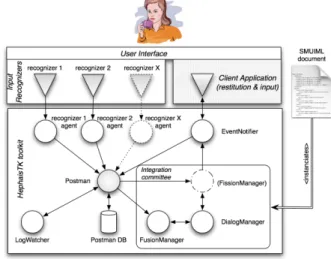
extracted, and passed to potential client applications. In its current state, HephaisTK is built upon a software agent system. Each time a new recognizer or fusion scheme is plugged into the toolkit, an agent is dispatched to monitor it. HephaisTK uses a central blackboard architecture (see Fig. 2): a “postman” centralizes each message coming from the different input recognizers and stores it into a database. Agents interested in a specific type of message can subscribe to the postman, which will accordingly redistribute
received messages. An integration committee composed of the fusion and dialog managers is configured following a given SMUIML script. Fusion of input modalities is achieved through meaning frames. When a Java developer wants to use HephaisTK toolkit to monitor multimodal inputs in its application, he has to declare the toolkit by means of event listeners. The fusion and dialog managers of HephaisTK are scripted by means of a SMUIML file.
figure 2: HephaisTK toolkit architecture.
Other researchers investigated ways to create multimodal toolkits. Bourguet [4] endeavoured in the creation of a multimodal toolkit in which multimodal scenarios could be modelled using finite state
machines. A similar approach was taken with SMUIML, but in a more modular way. Bouchet et al. [3] proposed a component-based approach called ICARE thoroughly based on the CARE [5] design space. These
modality-4
dependent tasks or generic tasks like fusion. This components-based approach has been used to create a comprehensive open-source toolkit called
OpenInterface [2]. Components are configured via CIDL XML files, and a graphical editor.
Conclusion
Of the toolkits presented above, only OpenInterface is widely available as open source software.
OpenInterface has been designed as an integrated environment, in which every part of a multimodal application has to be designed, from the input to the output. The approach taken by HephaisTK and SMUIML is radically different, in that the toolkit acts more as a multimodal input interface to a given application, and only manages the multimodal input part and their fusion. The idea behind this is to let developers create their application with their usual tools and facilitating the development of the multimodal input part with easy-to-program mechanisms, as opposed to an integrated approach in which a developer would have to learn a completely new environment from the ground up. Such a modular approach allows easy prototyping of multimodal applications; it is however to be noted that creation of a full-fledged application could require a more advanced approach such as the one of
OpenInterface.
To conclude, we believe in an approach with two tightly linked components: on one side human-machine dialog description by means of a XML file, and on the other side a tool implementing this dialog by means of multimodal fusion mechanisms. Finally, HephaisTK and SMUIML are still a work in progress, and will benefit in the near future from extensive validation. This
validation will take place in the context of the
MeModules (http://www.memodules.ch) project and the Swiss NCCR IM2 project (http://www.im2.ch) [7].
References
[1] Araki, M., Tachibana, K. Multimodal Dialog Description Language for Rapid System Development. In Proc. Of the 7th SIGdial Workshop on Discourse and Dialogue, Sydney, Australia, July 2006.
[2] Benoit, A., Bonnaud, L., Caplier, L., Damousis, I., Tzovaras, D., Jourde, F., Nigay, L., Serrano, M., Lawson, J.-Y. Multimodal Signal Processing and Interaction for a Driving Simulator: Component-based Architecture. In JMUI, Vol 1, No 1 (2007).
[3] Bouchet, J., Nigay, L., and Ganille, T. ICARE Software Components for Rapidly Developing Multimodal Interfaces. In Proc. of ICMI'2004, State College, Pennsylvania, USA, October 2004.
[4] Bourguet, M. L. A Toolkit for Creating and Testing Multimodal Interface Designs. In Proc. of UIST'02, Paris, Oct. 2002.
[5] Coutaz, J., Nigay, L., Salber, D., Blandford, A., May, J. and Young, R. Four Easy Pieces for Assessing the Usability of Multimodal Interaction: The CARE properties. In Proc. of INTERACT'95, Lillehammer, Norway, June 1995.
[6] Katsurada, K., Nakamura, Y., Yamada, H., and Nitta, T. 2003. XISL: a language for describing multimodal interaction scenarios. In Proc. of ICMI
2003, Vancouver, British Columbia, Canada, Nov. 2003.
[7] Lalanne, D., Evequoz, F., Rigamonti, M., Dumas, B., Ingold, R. An ego-centric and tangible approach to meeting indexing and browsing. In Proc. of MLMI’07, Brno, Czech Republic, July 2007.
[8] Stanciulescu, A., Limbourg, Q., Vanderdonckt, J., Michotte, B., and Montero, F. 2005. A transformational approach for multimodal web user interfaces based on UsiXML. In Proc. of ICMI’05, Torento, Italy, Oct. 2005.