RESEARCH OUTPUTS / RÉSULTATS DE RECHERCHE
Author(s) - Auteur(s) :
Publication date - Date de publication :
Permanent link - Permalien :
Rights / License - Licence de droit d’auteur :
Institutional Repository - Research Portal
Dépôt Institutionnel - Portail de la Recherche
researchportal.unamur.be
University of Namur
Nonmanuals and markers of (dis)fluency in French Belgian Sign Language (LSFB)
Notarrigo, Ingrid; Meurant, Laurence
Published in:
Proceedings of the 6th Workshop on the Representation and Processing of Sign Languages
Publication date:
2014
Document Version
Publisher's PDF, also known as Version of record
Link to publication
Citation for pulished version (HARVARD):
Notarrigo, I & Meurant, L 2014, Nonmanuals and markers of (dis)fluency in French Belgian Sign Language (LSFB). in Proceedings of the 6th Workshop on the Representation and Processing of Sign Languages: Beyond
the Manual Channel. pp. 135-142, 9th International Conference on Language Resources and Evaluation (LREC
2014), Reykjavik, Iceland, 26/05/14.
General rights
Copyright and moral rights for the publications made accessible in the public portal are retained by the authors and/or other copyright owners and it is a condition of accessing publications that users recognise and abide by the legal requirements associated with these rights. • Users may download and print one copy of any publication from the public portal for the purpose of private study or research. • You may not further distribute the material or use it for any profit-making activity or commercial gain
• You may freely distribute the URL identifying the publication in the public portal ?
Take down policy
If you believe that this document breaches copyright please contact us providing details, and we will remove access to the work immediately and investigate your claim.
Nonmanuals and markers of (dis)fluency
Ingrid Notarrigo and Laurence Meurant
F.R.S. – FNRS and University of Namur Namur, Belgium
E-mail: [email protected], [email protected]
Abstract
This paper focuses on the analysis and annotation of non-manual features in the framework of a study of (dis)fluency markers in French Belgian Sign Language (LSFB). In line with Götz (2013), we consider (dis)fluency as the result of the combination of many independent markers (“fluencemes”). These fluencemes may contribute either positively or negatively to the efficiency of a discourse depending on their context of appearance, their specific combination, their position and frequency. We show that the non-manual features in LSFB make distinctions within pauses and palm-up signs in a consistent way and contribute to the value of the manual marker. The selection of a limited number of relevant combinations of nonmanuals, in the context of pauses and palm-up signs, proves to simplify the annotation process and to limit the number of features to examine for each nonmanual. The gaze and the head appear to be necessary and sufficient to describe pauses and palm-up signs accurately. Though these findings are limited to this pilot study, they will pave the way to the next steps of the broader research project on (dis)fluency markers in LSFB this work is part of.
Keywords: annotation, fluency, disfluency, nonmanuals, pauses, palm-up signs, stops, gaze, eyes, eyebrows, head, mouth
1. Introduction
This study focuses on fluency and disfluency in “normal”, i.e. non-pathological, signing and sets apart the impressive amount of research on disfluency conducted in the areas of stuttering and aphasia (Marshall 2000;; Atkinson et al. 2002). From a holistic perspective, fluency is associated with the impression of an overall discourse quality, a “smooth, rapid, effortless use of language” (Crystal 1987: 421), or “the rapid, smooth, accurate, lucid, and efficient translation of thought or communicative intention into language” (Lennon 2000: 26). However, “fluency does not always imply an uninterrupted flow of speech which is grammatically perfectly irreproachable” (Lehtonen 1978);; in other words a successful communication or proficient/efficient speech does include disfluencies.
Götz (2013) noticed that disfluency can be considered not only as a signal of the speaker’s difficulties to plan and encode his/her discourse, but also as a positive signal when speakers use disfluencies for rhetorical purposes for example. She pointed out that, depending on its context, its combination with other features, its position and frequency, the same feature can contribute either to the fluency or to the disfluency of a production. This study is in line with Götz’s componential approach that sees (dis)fluency as the result of combinations of many independent markers (“fluencemes”), and is part of a PhD thesis that aims to identify fluencemes in French Belgian Sign Language (LSFB) and to observe their combinations within different contexts of speech. We expect to be able to identify fluency and disfluency profiles in terms of combinations of fluencemes, probably related to the type of speech context.
Two potential fluencemes of LSFB are focused on in this study, namely pauses and palm-up signs. Their non-referential contribution to the discourse makes them good (dis)fluency marker candidates. At a first glance, nonmanual features occurring with both pauses and
palm-ups seem to convey important information related to (dis)fluency. A gaze can for instance interrupt communication temporarily, an ‘erm’ mouthing or head and eyebrows behaviours can express reflexion or hesitation. However, annotating each non-manual articulator (i.e. gaze, eyes, eyebrows, mouth, head) in detail is extremely time consuming;; it may be worthwhile to test whether such precise annotation is relevant, i.e. whether non-manual information refine the information given by the manual marker (pause or palm-up). In this study, we address three main research questions: (1) What type of information do nonmanuals give about pauses and palm-up signs? (2) Is the annotation of each non-manual component needed for each pause and each palm-up sign? (3) How is it possible to code the potentially relevant nonmanuals?
2. Methodology
To answer these questions, we conducted a pilot study based on a 10-minute long corpus. The corpus consists in four excerpts of unprepared monologues produced by 2 native and 2 near-native signers of LSFB (see details in Table 1). The excerpts were selected from larger interviews or dialogues, but are considered as monologues because the interlocutor does not interrupt the signer’s turns within the selected clips.
Sex Age SL profile Clip duration Signer 1 M 33 Native 3 min Signer 2 F 22 Native 2 min Signer 3 M 25 near-native 2 min 30 Signer 4 F 28 near-native 2 min 30
Table 1: Signers and clips
Within these data, we first coded each pause and each palm-up sign. Then, we looked at their immediate context, and more precisely at the behaviour of the gaze, the eyes, the eyebrows, the head and the mouth, which were annotated in five separate tiers. In doing that we
improved our annotation guidelines for the nonmanuals and finally applied a template that appeared to be suited and efficient for our subject (see section 4).
With a multi-layer search in ELAN we extracted for each occurrence of a pause or of a palm-up sign its overlapping non-manual features. We finally queried the data in Excel and generated information about the non-manual features co-occurring with each manual marker. We tried to see whether some (combinations of) nonmanuals behave regularly when a pause or a palm-up appears, and whether these regularities draw boundaries between consistent groups of pauses and palm-ups. The absence of any regularity would contribute to the assumption that the behaviour of nonmanuals is not related to the pauses or the palm-ups they occur with, and therefore has not to be coded for its relation to each pause or palm-up occurrence. This pilot study alone can certainly not lead us to adopt this assumption conclusively, but it can determine the next steps of the investigation of the interaction between nonmanuals and manual markers of (dis)fluency.
3. Coding pauses and palm-ups
3.1 Pauses
In comparison with what is known about spoken language fluency, a first glance at our data reveals a strikingly small amount of unfilled pauses in the signing flow. In fact, this difference may be due to the breathing limits that constrain the speech flow, but above all it may be due to the scarce use of multimodal data for the description of spoken productions: access to the silent information conveyed by manual or non-manual components during speech productions would probably have led to give up the concept of unfilled pause. From videotaped sign language (SL) data, it becomes clear that the stops of the hands are inevitably “filled” with non-manual information. So, instead of distinguishing between filled and unfilled pauses, we considered all the stops of the hands as (dis)fluency markers, since all may help the signer to plan or reorganize the discourse, be it in a fluent or in a disfluent way.
We drew a distinction between stops during a sign (S1) and stops between signs (S2). The first group (S1) includes stops at the beginning, in the middle or at the end of a sign;; they are recognizable by the fact that handshape and location of the signs are hold. We took these kind of stops into account when they lasted at least 5 frames1, and
we coded them S1:start, S1:middle and S1:end respectively. The second group (S2) covers all the cases of non-signing at all, or in other words cases where the hands do not show a meaningful handshape or movement. We divided S2 into three sub-groups depending on the position of the hands: crossed hands (S2:crossed), along
1 This length of 5 frames (one frame is 1/50 sec.) does not come
from an upstream decision, but rather from the downstream observation that, below a length of 5 frames, we could not detect the stop.
the body (S2:body) and relaxed in the neutral space in front of the signer (S2:neutral). Table 2 provides an overview of these (sub-)groups and their respective tags.
Pauses Stop in the hands flow S1 Stop during a sign
S1:start Stop at the beginning of a sign S1:middle Stop in the middle of a sign S1:end Stop at the end of a sign S2 Stop between signs S2:crossed Stop with hands crossed S2:body Stop with hands along the body
S2:neutral Stop with relaxed hands in the neutral space
Table 2: Pauses (sub-)groups and related tags
3.2 Palm-up signs
The “palm-up” sign is described in numerous sign languages (among others van der Kooij, Crasborn and Ros 2006 and van Loon 2012 for NGT). The form of the sign (an upward palm orientation sign articulated in the neutral space and resulting from a wrist location) and its various functions (expression of modality, backchannel signal, elicitation of evolvement, start or end of a turn, conjunction, interrogative particle or pause filler) are similar across sign languages. The spectrum of functions related to palm-ups prompted us to count them as a potential (dis)fluency marker.
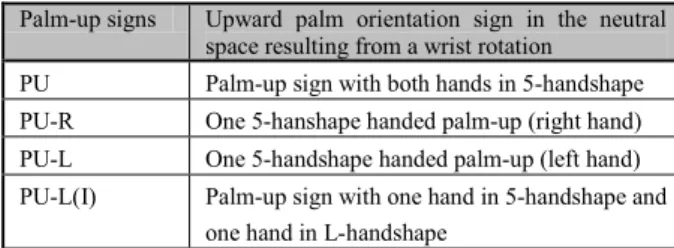
Four groups of palm-ups have been distinguished, according to the hand(s) involved in the sign and to the handshape(s) taken by the hand(s). The canonical palm-up sign is articulated by the two hands in 5-handshape (PU). But the palm-up can also be articulated with only one hand in 5-handshape (PU-R for the right hand and PU-L for the left hand). In some cases, we saw a two-handed palm-up with one hand in 5-hanshape and one hand in I-handshape (PU-L (I)). See Table 3 for an overview of these groups.
Palm-up signs Upward palm orientation sign in the neutral space resulting from a wrist rotation
PU Palm-up sign with both hands in 5-handshape PU-R One 5-hanshape handed palm-up (right hand) PU-L One 5-handshape handed palm-up (left hand) PU-L(I) Palm-up sign with one hand in 5-handshape and
one hand in L-handshape
Table 3: Palm-up groups and related tags
4. Coding nonmanuals
Once each pause (S) and each palm-up sign (PU) had been tagged, we coded the behavior of the non-manual components occurring in the close context of each S and PU: the gaze, the eyes, the eyebrows, the head and the mouth. We deliberately began with a quite extensive annotation grid based on existing protocols (Neidle 2002;; Nonhebel, Crasborn and van der Kooij 2004;; Johnston 2011) and refined it during the annotation process. One of the main changes we applied corresponds to the time
intervals we considered for each nonmanual. For example, we started to code the gaze components from two signs before to two signs after the manual marker (S or PU). But this interval appeared to provide noise, namely information that was obviously not related to the marker we were focused on but to the previous or next signs. Annotating the gaze behavior only one sign (300-500 milliseconds) before and one sign after the S or PU marker proved to be more accurate.
The annotation guidelines presented below are the final version we applied to all our data. In comparison with the first extensive guidelines, it represents a reduction of 66% of the time needed for annotation (from 150 min to 50 min for a 30-second video clip). The reduction might be due to transcribers getting used to the task, but the most important impact is due to the smaller number of non-manual elements to look at and of values for each non-manual element.
4.1 Gaze
As indicated above, the gaze component was taken into account from one sign before to one sign after the manual marker (S or PU). The tag set used distinguishes three behaviours and is based on Meurant (2006)’s study on gaze in LSFB.
First possibility: the gaze is tagged as “addressed”. This means that the gaze addresses a real or a fictive interlocutor, namely a discourse participant to whom the signer may say ‘I’ or ‘you’. Second possibility: the gaze is tagged as “spatial”. This means that the gaze installs or designates meaningful positions in space, other than the positions of the real or fictive interlocutors. Third possibility: the gaze is tagged as “other”. This means that the gaze is not addressed nor related to meaningful positions in space. It can for example be oriented to the floor, to the side or in the air, or be shifty.
When a change of gaze occurs and is accompanied by a blink, the blink is considered as the beginning of the new gaze behavior.
In a previous version of the guidelines, the “spatial” tag was split into “spatial – out of a role” and “spatial – within a role”. The former covered the gaze that installs or designates positions in the frontal space (Meurant 2006, pp. 407-408) without any relationship to the actualization of a character in a role-taking form. The latter covered the gaze that installs or designates positions in the space surrounding the signer (Meurant 2006, p. 409) in relation to the actualization of a character in a role taking form. We kept records of this previous tagging. The analyses of the data (section 5) suggest that the distinction between “out of a role” and “within a role” is relevant, especially within the PU and the S1:end categories. This means that the four-tag set (addressed / spatial – out of a role / spatial – within a role / other) will be re-introduced in our next guidelines.
4.2 Eyes
As for the gaze, the eye component was taken into account from one sign before to one sign after the manual
marker (S or PU). The tag set includes six features: “closed”, “blink”, “eyelid down”, “wide open”, “squint” and “other”. The interval of a blink begins the frame before the closing position and ends at the opening of the eyes;; the mean length of a blink is 5 frames as a whole. If the eyes are maintained in the closed position more than one image, they are considered as closed (Chételat-Pelé and Braffort 2010).
4.3 Eyebrows
Only two tags are used to describe the eyebrow movements: “raised” and “frown”. To avoid noisy information, they are used strictly within the interval of the manual marker: the movement can appear after the beginning of the S or the PU, but it never goes beyond the end of the S or the PU. The eyebrows movement is coded from one frame before the beginning of the raising or frowning movement to one frame after the peak. The movement after the peak is not coded because it is often hard to see.
4.4 Head
Coding the head components proved to be quite difficult. We came to the conclusion that the more consistent principle (in order to avoid to code movements that are not related to S or PU, but rather to the surrounding context) was to code only the changes that occur during the manual marker. Moreover, we excluded from these the changes that overlap with the manual marker but that are due to the next context (e.g. a negation after the S or the PU that produces a head turn before the very end of the S or the PU). We used seven tags for the description of the head: “nod”, “shake”, “turn”, “tilt”, “chin up”, “chin down” and “other”. Sometimes it is hard to distinguish the turn from the tilt. We tagged “turn” if the chin goes on one side and the face is no longer facing the interlocutor. We tagged “tilt” if the top of the head moves without a change in the direction of the face. The idea is to annotate the most salient feature. For example when a turn occurs, it is only coded as “turn” and not for the movement of the chin that is unavoidably linked to the turn.
4.5 Mouth
In a first step, we used the tags described in the sign language transcription conventions for the ECHO Project (Nonhebel et al. 2004). After having coded the mouth components in detail (open/closed, corner of the lips, tongue, teeth, etc.) for 92 Ss or PUs, we substantially cut down the number of features because the data would have been too heterogeneous to analyse in combination with non-manual tags. The seven remaining tags are the following: “closed”, “closed with lip movement”, “closed with air (breathe out)”, “open”, “open with lip movement”, “open with air (breathe in)”, and “mouthing”. We have limited the coding to the strict interval of the S or PU. A mouth movement that is similar to the ‘erm’ in spoken language has been coded as “open with air” and not as “mouthing” because the mouthing is not always clear enough.
Table 4 shows an overview of the final and complete tag set used for this pilot study to describe nonmanuals.
Gaze (G:) Eyes (E:) Eyebrows (B:) Head (H:) Mouth (M:)
addressed spatial other closed blink eyelid down wide open squint other Raised frown nod shake turn tilt chin up chin down other closed closed-lip mov. closed with air open open-lip mov. open with air mouthing Table 4: Tag set for nonmanuals
5. Results
After having annotated the small-scale corpus presented in section 2 according to the guidelines presented in section 3 for the manual elements and in section 4 for nonmanuals, we were able to start a multi-layer search in ELAN in order to extract for each occurrence of a pause or a palm-up sign its overlapping non-manual components.
Our first question aims to investigate the type of information nonmanuals give about pauses and palm-up signs. We tried to see whether some nonmanuals or some combinations of nonmanuals behave regularly when a pause or a palm-up appears, and whether these regularities can help distinguish consistent categories of pauses and palm-ups.
In practice, we started the analyses with a spreadsheet containing all the Ss (113) and PUs (80) occurrences (total: 193), each one being associated with its respective tags on non-manual components. Within these data, we investigated each pause (sub-)group and each palm-up group by filtering the data by non-manual tags. These filtering operations resulted in successive occurrences sets that we systematically examined in terms of consistency. Repetitively, the question was “is there any apparent coherence between the groups resulting from this filter (or combination of filters)?”. The consistency was approached in terms of position (within the turn or within the semantic unit, if the turn was made up of several ideas) and in terms of functions (in a broad sense and out of any theoretical typology of functions). The results of this investigation are presented below, showing the more consistent categories of manual markers arising from the regularities observed in their co-occurring nonmanuals.
5.1 Palm-up signs and nonmanuals
All categories of palm-up signs (PU, PU-R, PU-L, PU-L(I)) are clearly divided into two main categories by the criterion of gaze (see Table 5). A PU with a gaze tagged as “spatial” (more precisely a spatial gaze within a context of role taking2) fulfills the function of a modality
2 As previously mentioned (section 4.1), the distinction between
“spatial out of a role” and “spatial within a role” made in a pre-final step of the annotation guidelines should be re-introduced in the tag set.
marker (PU-Mod): It conveys a subjective comment or evaluation from the point of view of the role-played character or the signer himself/herself on what is being said (disagreement, feeling of inability, pleasure, etc.)3.
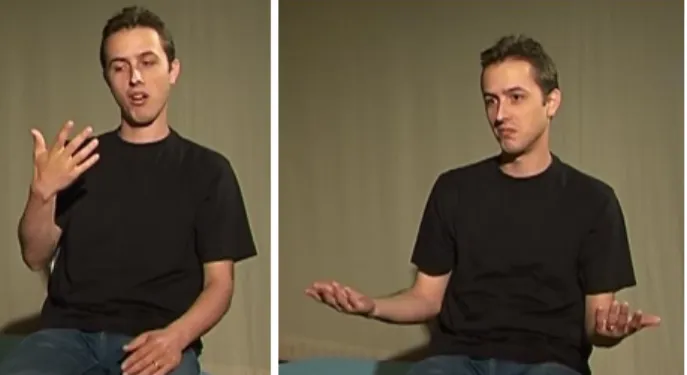
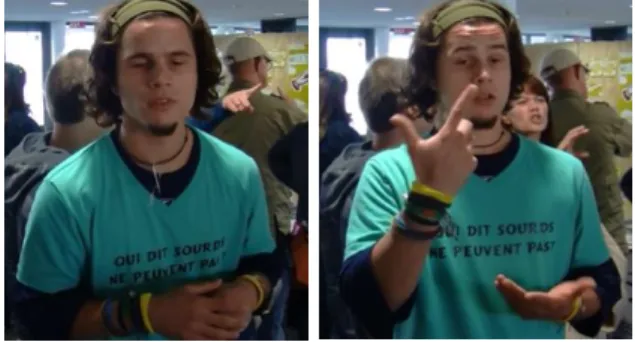
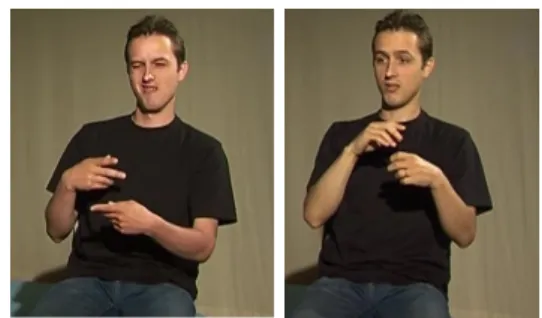
All the other gazes (“addressed”, “spatial out of a role” and “other”) indiscriminately cover the uses of PU as lexical units (THAT-IS or NOW) and fillers (PU-Lex/Fill), whatever the position of the PU is: at the starting, during or at the end of the semantic unit. See Examples 1-3 with Figures 1-4 to have an illustration of each category.
The PU-Lex/Fill are often accompanied by other potential (dis)fluency markers, such as pauses (S1 or S2), false starts, connecting particles, etc. Within the two categories, no other consistent sub-category seems to be related to any other nonmanual.
PU Defining nonmanual Tag Number of occurrences Modality marker G:spatial (within a role)
PU-Mod 21 Lexical units
and fillers
G:all the other tags PU-Lex/Fill 59
Table 5: Palm up categories
Ex. 1 BEFORE FG:E Grid PU-Mod FG:E GIVEN UP GRID GRID
CALCULATION GRID PU-Lex/Fill S2:body-BoE
Before, the sign for Excel was with the letter E. It is not
good. We gave up the letter E and we kept only the sign for
grid. Here it is.
Figure 1: PU-R-Mod on the left, PU-Lex/Fill on the right Ex. 2 PU-R-Lex/Fill I SIGN PU-Lex/Fill YES S2:crossed-BoM ERM I PU-L (I)-Lex:Fill DEAF WORLD DAY TRUE DEAF WORLD
DAY WHY?
Here it is. I sign now. [/] Yes, erm, according to me, well,
what is the point of the Deaf World Day?
Figure 2: PU-R Lex/Fill (HERE-IT-IS) on the left, PU Lex/Fill (NOW) on the right
Figure 3: S2:crossed-BoM on the left, PU-L-(I)-Lex/Fill on the right
Ex. 3 DEAF PU-L (I)-Mod NOT ENOUGH IN MORE WORLD
DEAF
Deaf people, Oh! they really are not involved enough in the deaf world.
Figure 4: PU-Mod
5.2 S1:end and nonmanuals
In a similar way as for the PUs, the S1:end markers are firstly sub-categorized by the opposition between the gaze-tag “spatial within a role” and the other gaze-tags (“addressed, “spatial out of a role” and “other”). This first distinction identifies a group of S1:end functioning as a modality marker (S1:end-Mod) in the same way as the PU-Mod (see below Ex. 4).
Ex. 4 I WALK BEAUTIFUL DUCK MANY I LOOK S1:end-Mod I BECAUSE I DEAF HEARING MANY I
ALONE S1:end-Mod DEAF
I’m walking. There are many beautiful ducks. I look at them for a long time. There are many hearing people
around me, but I am the only deaf person.
As for the other cases, namely with a gaze which is not “spatial within a role”, the presence of a head movement is relevant. When there is a head movement other than “nod”, S1:end functions as a marker of stress (S1:end-Str) (see Ex. 5). When there is a head nod, it fulfills a phatic function, namely it shows that the signer makes sure he is well understood (S1:end-Pha) (see Ex. 6).
Ex. 5 BEFORE WIRES1:end-Pha WIRE COMPUTER HOME
WIRE S1:end-Pha
PU-Lex/Fill WIRE NOTHINGS1:end-Str (shake head) Before, there was a wire, ok. At home, there was a wire line computer, ok, well there is no more wire.
Ex. 6 YES FUTURE BETTER CHANGE FOR
EXAMPLE S2:crossed-BoM TOO MUCH SPELLINGS1:end-Pha
FOR EXAMPLE USBS1:end-Pha BETTER KEYS1:end-Pha Yes, it is better to change. For example [/], there are too many signs with acronyms, ok. For example, for the sign
«USB», ok, it is better to use the sign for key, ok.
When S1:end is not accompanied by a head movement and the gaze is not the same as for the modality marker, it rather produces an effect of suspension within the discourse, a sort of blank in the communication (see below Ex. 7). Table 6 sums up these four categories. Ex.7 DEAF WORLD DAY YES THERE PARIS PARISS1:end-Sus
ERM THREE FOUR YEAR PAST
Yes, the Deaf World Day took place in Paris, Paris, erm, three or four years ago.
S1:end Defining nonmanual(s) Tag Number of occurrences Modality marker G:spatial (within a role)
S1:end-Mod 9 Others
Stress G:addressed or G:spatial out of a role H:movement but not “nod” S1:end-Str 7 Phatic G:addressed H:nod S1:end-Pha 19 Suspension G:addressed or G:other H:/ S1:end-Sus 12
Table 6: S1:end categories
5.3 S2:body/crossed and nonmanuals
S2:body and S2:crossed are both categorized in the same way by the nonmanual components. They all function as boundary markers (Bo). Once again, the gaze draws relevant boundaries between them. Combined with the
regularities in terms of position of the markers, the gaze distinguishes between three main S2:body/crossed categories. At the beginning or the end of a speech turn, a S2:body/crossed is perceived as a framing pause (S2:body/crossed-BoS and S2:body/crossed-BoE). In most cases (BoS and BoE) the gaze is addressed and may be highlighted by a head nod. But in some cases (only at the starting of a turn – BoS), the gaze is tagged as “other” and is layered by a turn. The S2:body/crossed markers that appear within a turn (S2:body/crossed-BoM) mark the end of a semantic unit. They may be accompanied by a turn. Table 7 provides an overview of these categories and Figures 3/5 illustrate the difference of gaze within these categories.
At the end of a turn, a S2:body/crossed with a nod fulfills a phatic function, in a similar way as S1:end-Pha. The various S2:body/crossed often appear just after or before a PU.
S2:body S2:crossed Defining nonmanuals Tag Number of occurrences Boundary marker Framing pause - End of turn (phatic) G:addressed H:nod G:addressed H:/ S2:body/crossed-BoE 10 7 Framing pause - Start of turn G:addressed H:nod G:addressed H:/ G:other H: turn S2:body/crossed-BoS 2 6 4 Middel of turn, end of semantic unit G:other H:turn or / S2:body/crossed-BoM 9
Table 7: S2:crossed and body categories
Figure 5: S2:crossed-BoM on the left, S2:body-BoE on the right
5.4 S2:neutral and nonmanuals
Three categories of S2:neutral have been found. These three categories are summed up in Table 8. All three are similar to the already established categories for the other kind of manual markers. The clue nonmanuals are the head (movement or not) and the gaze (spatial or not). The presence of a head movement characterizes the modality marker (S2:neutral-Mod, also recognizable by its usual “spatial – within a role” gaze) (see an illustration in Figure 6) and a boundary marker (with “addressed” or “other” gaze). As a boundary marker, S2:neutral specifically marks the transition between a concept and its explanation (S2:neutral-BoEx) as illustrated in the Example 8. Ex. 8 SOCIETY STRONG DIFFERENT S2:nEUTRAL-BoEx POOR
RICH WORLD ONE WORLD TWO
The society is very different [/] there are two worlds: one for the poor and another one for the rich.
The lack of head movement (whatever the gaze and the position of the marker is) produces an effect of suspension of the discourse (S2:neutral-Sus), in the same way as in S1:end-Sus (see Ex. 9). This third category often appears in the close context of another (dis)fluency marker, as for example S1 pauses, auto-contacts, “flying indexes”, etc. Ex. 9 INFORMATION DIFFERENT ASSOCIATION
THERE-IS FOR FOCUSS1:end-Sus
S2:neutral-Sus CULTURE
DEAF
There are different associations giving information in order to focus [/] on the deaf culture.
S2:neutral Defining nonmanual(s)
Tag Number of occurrences Modality marker H:movement
G:spatial (within a role)
S2:neutral-Mod 3 Boundary marker Explanation H:movement G:addressed or other S2:neutral-BoEx 4 Suspension H:no movement G:addressed or other S2:neutral-Sus 12
Table 8: S2:neutral categories
Figure 6: S2:neutral-Mod on the left, S2:neutral-Sus on the right
5.5 S1:start and nonmanuals
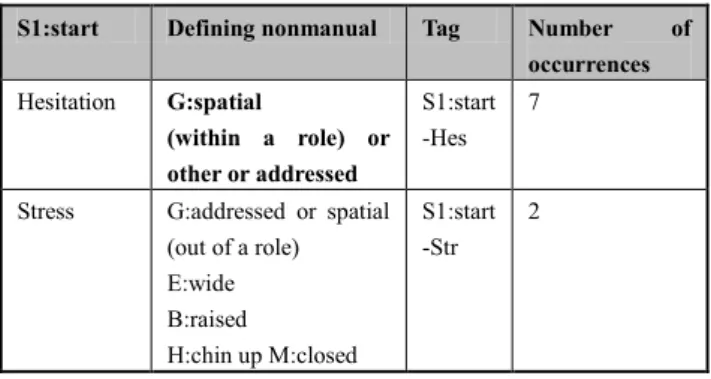
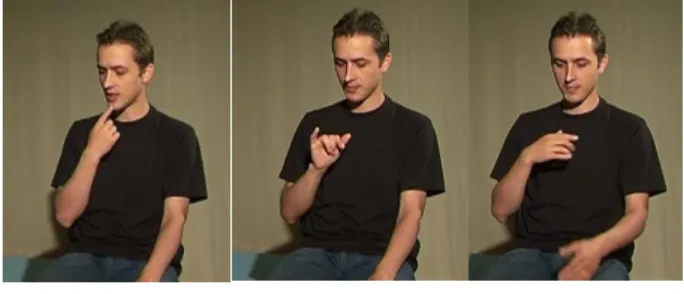
Our data only contained 9 occurrences of S1:start, so it is required to treat the remarks below with caution. We hypothesize that when a pause comes at the beginning of a sign, it can either produce an effect of hesitation similar to a false start, or mark a stress (see Table 9). Depending on our examples, the latter function is cued by a combination of five non-manual features: G:addressed or spatial (out of a role), E:wide, B:raised, H:chin up, M:closed. Figure 7 shows an illustration of the contrast between these two categories.
S1:start Defining nonmanual Tag Number of occurrences Hesitation G:spatial
(within a role) or other or addressed
S1:start -Hes
7
Stress G:addressed or spatial (out of a role) E:wide B:raised
H:chin up M:closed
S1:start -Str
2
Table 9: S1:start categories
Figure 7: S1:start-StrWHOLE on the left, S1:start-HesWINDOW
on the right
No cases of S1:middel were found in our data.
6. Discussion
The results presented in section 5 suggest that the non-manual components of LSFB make distinctions within pauses and palm-up signs consistently and contribute to the value of the manual marker. Each marker category was shown to cover various functions, such as modality or boundary or phatic markers. The distinction between the different functions can be linked to the non-manual information and even to a reduced set of non-manual features which may have a significant impact on the annotation work. In the same vein, the improvement of the guidelines we established (mainly the delimitation of the intervals to consider and of the features to examine) for the coding of the nonmanuals co-occurring with potential (dis)fluency markers such as pauses and palm-up signs, is in itself a considerable gain
(66% of time saving) for the annotation efficiency. This study and its results are limited by the shortcomings that are inherent to every pilot study: the reduced amount of data, of signers, of speech context variety, etc. The 193 occurrences of pauses and palm-ups we examined represent only a sample of 10 minutes of the productions of four signers. Despite the small-scale data, a qualitative study could be carried out that paves the way for the next – more extensive – steps of this research on (dis)fluency markers in LSFB. By using a broader corpus and quantitative analysis techniques (Chi2 and multivariate analysis for instance), we should be able to test the relevance of the nonmanuals combinations resulting from this first investigation on the sub-categorization of pauses and palm-ups.
With regard to the issue of nonmanuals and their relation to the two manual markers we have focused on, the preliminary findings can be summed up as follows.
[1] The fact that pauses and palm-up signs frequently appear with other probable (dis)fluency markers confirms that they deserve being taken into account in the combinatory study we pursue.
[2] The annotation guidelines presented in sections 4 and 5 seem to be appropriate and efficient for our subject. A small change will be done, within the gaze-tag set. Coming back to a previous choice, a four-tag set will be used for coding the gaze: addressed/spatial – out of a role/spatial – within a role/other.
[3] Two types of nonmanuals must be coded in order to describe pauses and palm-ups accurately, namely the gaze and the head. Together they form the defining cues for the sub-categories of all groups of markers: PU, S1:end, S2:body and S2:crossed, S2:neutral, S1:start. Moreover, depending on the marker, the annotator can know which nonmanual refines the information provided by the gaze and the head and which ones are not expected to provide regular information.
[4] One specific type of gaze (namely the “spatial – within a role” gaze) gives the same function to the PU, the S1:end and the S2:neutral markers. This function has been identified as the marking of modality.
[5] A particular behaviour of the head, namely the absence of movement of the head, layered with a pause or a palm-up and with a sort of fixity in all manual and nonmanual components, produces an effect of suspension that is common to S1:end and S2:neutral.
The presence of a nod, be it with S1:end or with S2:body or S2:crossed, gives to the marker a phatic function.
[6] These regularities among groups of markers can be seen as a signal of accuracy among the categories and features we found.
[7] Within the PUs, S1:end and S2:neutral, the opposition between “addressed” and “other” gaze surprisingly do not impact the function of the sign. The same can be seen with other markers in LSFB, like THAT-MEANS (see Figure 8), ALSO or the use of list buoys. This prompts us to investigate whether the gaze
would be independent, and whether it could be considered, in itself, as a (dis)fluency marker.
Figure 8: SAY WHAT THIS-IS (What does it mean? It is…)
7. Conclusions
This study shows that the non-manual components of LSFB make distinctions within pauses and palm-up signs in a consistent way and contribute to the value of the manual marker. The relevant combinations of nonmanuals, in the context of pauses and palm-up signs, help speeding up the annotation process by reducing the number of nonmanuals that must be taken into account and by limiting the number of features to examine for each nonmanual. The gaze and the head appeared to be necessary and sufficient to describe pauses and palm-up signs accurately.
These findings are limited to the extent of this pilot study. But it will pave the way for the next steps of the broader research project on (dis)fluency markers in LSFB (Degand et al. 2012) this work is part of. The next two steps will be to test the validity of these results on a broader corpus and to extend the study to other potential (dis)fluency markers. We will have to make a selection between, among others, false starts, self-repairs, repetitions, “flying indexes”, gestures/motions fillers, spatial discourse organization, constructed actions, connecting signs such as rhetorical questions, AND, ALSO, SAME, and finally maybe the eye gaze.
8. Acknowledgements
We would like to thank our deaf informants, as well as Simon Delauvaux, Calogero Notarrigo and Amandine Dumont for their collaboration. Our research is funded by a F.R.S-FNRS Research Fellow Grant FRESH FC 60970 and the A.R.C. n°12/17-044.
9. References
Atkinson, J. et al. (2002). When sign language breaks down: Deaf people’s access to language therapy in UK. In Deaf worlds 18 (1) 9-10, Forest Bookshop, pp. 9-13. Chételat-Pelé, E.;; Braffort, A. (2010). Investigation et analyse des Gestes Non Manuels impliqués en LSF: Le cas des clignements. Session posters at the Atelier
TALS. Montréal, Quebec.
Crystal, D. (1987). The Cambridge Encyclopedia of Language. Cambridge: Cambridge University Press.
Degand et al. (2012). Fluency and disfluency markers. A multimodal contrastive perspective, ARC: 12/17-044, University of Louvain-La-Neuve: Belgium.
Götz, S. (2013). Fluency in Native and Nonnative English Speech. Studies in Corpus Linguistics, 53. John Benjamins Publishing Company.
Herrmann, A. (2008). Sign Language corpora and the problems with ELAN and the ECHO annotation conventions. In O. Crasborn, E. Efthimiou, T. Hanke, E. Thoutenhoofd & I. Zwitserlood (Eds.), Construction
and Exploitation of Sign Language Corpora. [Proceedings of the 3rd Workshop and 6th LREC 2008]
Paris: ELRA, pp. 68-73.
Johnston, T. (2011). Auslan Corpus annotation guidelines. Lehtonen, J. (1978). On the problems of measuring fluency. In M. Leiwo and A. Rasanen (Eds.), AFinLA Yearbook 1978. Jyväskylä: AFinLA, pp.53-68. Lennon, P. (2000). The lexical element in spoken second
language fluency. In H. Riggenbach (ed.), Perspectives
on Fluency. Ann Arbor, MI: The University of
Michigan Press, pp. 25-42.
Marshall, R.C. (2000). Speech fluency and Aphasia. In H. Riggenbach (ed.) Perspectives on fluency, Ann Arbor: The University of Michigan Press, pp. 74-88.
Meurant, L. (2008). The speakers'eye gaze. Creating deictic, anaphoric and pseudo-deictic spaces of reference. In R. M. de Quadros (ed.) Sign Languages:
spinning and unraveling the past, present and future.
TILSR 9, Florianopolis, Brazil, pp. 403-414.
Millet, A. ;; Estève, I. (2012). Segmenter et annoter le discours d’un locuteur de LSF : permanence formelle et variabilité fonctionnelle des unités. In A. Braffort, L. Boutorat et G. Sérasset (Ed.), Actes de la conférence
conjointe JEP-TALN-RECITAL 2012, Atelier DEGELS 4-8 juin 2012, France, pp. 57-73.
Neidle, C. (2002). Sign StreamTM Annotation: Conventions used for the American Sign Language Linguistic Research Project. Boston, MA: American
Sign Language Linguistic Research Project Report
No.11, Boston University.
Nonhebel, A.;; Crasborn, O.;; van der Kooij, E. (2004). Sign language transcription conventions for the ECHO Project. Version 9, SSL mouth annotations and BSL and NGT mouth annotations version 2. University of Nijmegen http://www.let.kun.nl/sign-lang/echo/docs/
Schembri, A.;; Crasborn, O. (2010). Issues in creating annotation standards for sign language description. In P. Dreuw, E. Efthimiou, T. Hanke, T. Johnston, G. Martínez Ruiz & A. Schembri (Eds.) Corpora and Sign
Language Technologies. [Proceedings of the 4th Workshop and the 7th LREC 2010] Paris. ELRA,
pp.210-216.
van der Kooij, E. et al. (2006). Manual prosodic cues: PALM-UP and pointing signs. Poster presented at the 9th TISLR. Florianopolis, Brazil.
van Loon, E. (2012). What’s in the palm of your hands ? Discourse functions of Palm-up in Sign Language of the Netherlands, Master Thesis. University of Amsterdam, Netherlands.