CA~A~~A~
JOURNAL
OF EQUCATllONAL
COMMUNICATION
Volume 16, No. 4, Fall 1987 ISSN 0710-4340
An Extension of PSI Through the Application of Instructional Systems Design Technology
Dan 0 Coldeway Annabel E. Coldeway
The Value of Supplementing Panel Software Reviews with
Field Observations Ronald D. Owston Herbert H. Wideman
The Integration of Educational Technology in the University Diana R. Carl
Tele-Cottages in the Nordic Countries Henning Albrechtsen
Concordia University Don Beckwith Concordia University F. Barry Brown University of Saskatchewan Elaine Bruce Concordia University Bruce Clark University of Calgary Dan Coldeway A thabasca University George L. Geis McGill University W. D. Godfrey Softwords William Hanson
Calgary Board of Education William Hillgartner
McGill University Denis Hlynka
University of Manitoba Robert Jones
Sheridan College of Applied Arts and Technology
Richard F. Lewis University of Windsor Hanna Mayer
Bank of Montreal Institute Tom Rich
Prince Edward Island Department of Education Lauran Sandals University of Calgary Richard A. Schwier University of Saskatchewan Mariela Tovar Concordia University Jesus Vazquez-Abad Concordia University Cynthia B. Weston McGill University Laura R. Winer A PO Quebec
AMTEC BOARD OF
DIRECTORS
President Richard F. Lewis University of Windsor Past President Ed CrispThe University of Western Ontario President Elect
June R. Landsburg Simon Fraser University Secretary/Treasurer Ron Eyre
The Wellington County Board of Education Director F. Barry Brown University of Saskatchewan Director Greg McDonald
Nova Scotia Department of Education Director
Robert Jones
Sheridan College of Applied Arts and Technology
Canadian Journal of
Educational
Communication
Volume 16, Number 4
Fall 1987
Editor
Robert M. BernardAssistant Editors
Jacques LeCavalier Steven ShawEditorial Assistant
Lindy AmatoProduction Assistant
Helen de GourvilleColumn Editors
Richard Ellis, From the Media Periodicals Len Proctor, Microware Review
Rose Bene, Book Reviews ISSN 0710 - 4340
T h e Canadian Journal of Educational Com-munication is published quarterly by the As-sociation for Media and Technology in Edu-cation in Canada; 500 Victoria Road North; Guelph, Ontario N1 E 6K2; Canada; Atten-tion: Mr. Ron Eyre, Secretary/Treasurer. Notification of address ‘change should be sent to the above. All articles are copyright by AMTEC and may be reproduced for non-profit use without permission provided credit is given to CJEC. Back issues of C J E C are $10 Canadian and may be ob-tained by contacting the Editor. CJEC is in-dexed in the Canadian Education Index a n d E R I C .
Second Class Mail Registration No. 6956
ARTICLES
An Extension of PSI Through the Application of Instructional Systems Design Technology Annabel E. Coldeway
Dan 0 Coldeway
The Value of Supplementing Panel Software Reviews with Field Observations
Ronald D. Owston Herbert H. Wideman
The Integration of Educational Technology in the University
Diana R. Car/
PROFILE
Tele-Cottages in the Nordic Countries
Henning Albrechtsen
COLUMNS
From the Educational Communication and Technology Periodicals Book Reviews Index to Volume 16, 1987 309 3 2 7 334 3 3 7 3 4 1
All correspondence should be addressed to:
Dr. Robert M. Bernard, Editor Education Department Concordia University
1455 de Maisonneuve Blvd. W. Montreal, PQ, Canada H3G 1M8
In Future Issues PERSPECTIVE What is the Future of Educational Technology? Don Beckwith
Televised University Teaching: Cost Analysis of a Laboratory Class
Ruth C. MacKay E. Joyce Carver
The Renfrew Quality Education Project: Teachers’ Views after the First Year
Donna Sharon
Computerized Television: New Developments in Television Production Techniques
Nikos Metallinos
CJEC is typeset on an Apple Macintosh Plus(TM) in PageMaker 2.O(TM). Galley proofs to authors and final camera-ready impressions are
output on an Apple LaserWriter(TM).
Printing: McGill Printing Services.
CJEC ORDER FORM
CJEC is free to members of AMTEC. However, many prefer to order the journal separately, and may do so by completing the form below:
(Name) (Address)
0 $40.00 (Cdn.) annual subscription 0 New Subscriber
0 R e n e w a l
0 Please send me information about AMTEC and a membership form. CHANGE OF ADDRESS
_-_-Send this form to: Mr. Ron Eyre AMTEC
500 Victoria Road North Guelph, Ontario N1E 6K2 Canada
An Extension of PSI Through the
Application of Instructional Systems
Design Technology
Annabel E. Coldeway
Dan 0 Coldeway
Abstract: Keller’s Personalized System of Instruction has been an important innova-tion in higher educainnova-tion. Although the success of PSI is far reaching, it is not without critics. Keller and other PSI advocates report that many PSI failures were due to people not adhering carefully to the PSI principles and components. This paper addressesthis problem from an instructional systems design perspective and the results suggest that modifications to PSI can be done successfully. Moreover, a systematic approach to the design, devel-opment and implementation of courses allows the user to meet the important achievement and successgoals of PSI while avoiding the problems that PSI presents in certain contexts.
Keller’s Personalized System of Instruction (PSI) has received considerable atten-tion, both in practice and research (Keller, 1968; Ruskin, 1976; Kulik, Kulik, & Cohen,
1979). An analysis of the research indicated that PSI has been effective in improving end of course achievement, retention and transfer of knowledge learned in the course, time to completion of learning objectives, and student satisfaction (Kulik et al., 1979).
PSI is based largely on principles derived from the experimental analysis of behavior. Learning is viewed as behavior generated and maintained by consequences and conditions set by the PSI methodology. The focus is on individual mastery of clearly specified behavioral objectives. The study materials set the occasion for the student to respond and small units of instructional material allow for frequent evalu-ation of learning. Students receive feedback on their performance, both from the instructional materials and from proctors who serve in an evaluation and student guidance role. Students typically work individually and at their own pace. They also choose the amount of instructional assistance they need, either prior to unit evaluation or as a result of the feedback they receive after completing a unit test.
Keller and many of his associates have strongly advocated strict adherence to his guidelines for PSI courses. Keller has frequently indicated his frustration with what he calls SLI (something like it) approaches to PSI that often fail to follow all the PSI
Annabel E. Coldeway is Associate Professor of Psychology at Concordia College, Edmonton, AB. Dan O. Coldeway is a Professor with the Centre for Distance Education, A t h a b a s c a U n i v e r s i t y .
guidelines. Frequently such SLI applications report that PSI does not work success-fully, causing Keller and others another source of frustration (Keller, 1984). On the other hand, careful variations of PSI have worked extremely well (e.g., Kulik, Jaksa, & Kulik, 1978). Instructors with a thorough understanding of the principles of behavior and the systematic design of instructional systems can often turn SLI into a very successful course. Coldeway and Spencer (1982) have argued that PSI may be the basic paradigm for the design of many forms of individualized instruction if the rules underlying PSI are well understood and followed appropriately.
Although there is no question that PSI can be used in a variety of settings and in a variety of content areas (Ruskin, 1976), situations also arise where strict adherence to the PSI methodology is impossible or impractical Instead of dismissing the strengths that underlie PSI, instructors in such situations should consider modifying PSI method-ology rather than retreating to conventional instructional approaches that may not be the solution to the problem.
This paper describes a behavioral approach to the design and delivery of a course in introductory psychology. The course clearly represents an approach to teaching that has a focus on the individual learner and attempts to capitalize on the effective use of behavior analysis and instructional systems design that increases the probability that students will meet the important goals demonstrated in the PSI literature, The results of this experimental course provide important information about the strengths and weak-nesses of the underlying principles of PSI and these will be discussed in detail.
The experimental course described by this paper was designed following a series of steps or phases which represent what is often called instructional systems design (ISD). ISD is an instructional problem solving method that takes the user through a series of steps and evaluation points that increase the likelihood that the instructional end product will be successful (Branson, 1981; Hannum & Briggs, 1982). This paper will describe how ISD was used to prepare the course.
AN OVERVIEW OF THE ISD PROCESS
Figure 1 (see next page) presents a diagram of a basic ISD model. There are three important attributes of the model that should be noted. First, the thoroughness and sophistication of work done in one phase pays off at some future point. For example, if little effort is put into carefully looking for higher and more complex learning out-comes during the analysis phase, it is likely that the course may tend to emphasize only memorization type outcomes of the type identified by critics of PSI (Caldwell, 1985).
Second, within each phase of ISD there are many procedures important to the success of the overall model. Although the extreme complexity of ISD often discourages would-be users, much of that complexity is important in the success of ISD (Dick & Carey, 1978). Third, each ISD phase should result in some type of product. That product will not necessarily be the eventual instructional product. The importance of
being able to evaluate and revise instructional plans and products during ISD is one of its strengths. Such an approach can often prevent the later occurrence of costly andtime-consuming mistakes.
EXTENSION OF PSI 281
FIGURE 1. A Basic Instructional Systems Design (ISD) Model.
O n e T w o Three Four F i v e A n a l y s i s A /\ I n s t r u c t i o n a l I n s t r u c t i o n a l C o u r s e D e s i g n Development D e l i v e r y A A A /\ A /\
Continuous Evaluation (Quality Control)
Evaluation & R e v i s i o n
A /\
PHASE ONE: THE ANALYSIS PHASE
During the analysis phase all variables connected with the course are carefully scrutinized. These variables can be broken down into the following categories:
1) students (an analysis of their entering abilities, numbers, reading level, experience with individualized instruction, time availability, etc.);
2 ) available instructional materials (text selection, availability of ancillary study materials, etc.);
3 ) instructional environment (time available for instruction in semester and during each week, classroom space, grading policies, institutional rules connected with any aspect of the course, etc.);
4 ) learning outcomes (overall course goals, specific unit objectives, cognitive level of objectives, etc.);
5 ) instructor’s attributes (ability to lecture, time availability, experience with innovative and individualized approaches to teaching, etc.); and
6 ) other (possible disruptions to schedule, need for equipment and supplies, etc.). The product of the analysis phase consists of the answers to as many questions connected with the course plan as is possible. It is critical that all factors that could influence the course are clearly understood in advance and that the design of the course takes these into consideration. Moreover, during the analysis phase it is possible to confer with colleagues and supervisors in an effort to discover hidden factors that may prove important to the eventual product. The following sections describe some of the analysis done for the experimental course at Concordia College.
Students
The majority of students entering Concordia College are high school matriculation graduates seeking an undergraduate degree. A small number are adult students and
students who have certain deficiencies in their high school education. The class sizes for introductory psychology have ranged from approximately 35 to 60 students.
Introductory psychology is a popular option course for many students whose career goals vary widely. Very few students have had any experience with individual-ized instructional techniques at the university level. Students at Concordia College are encouraged to spend approximately 2 hours in study for every hour of lecture and so for the introductory psychology (3 credits) course students are expected to spend about 6 hours per week on the course.
Available Instructional Materials
Concordia College is a small junior college with a correspondingly small budget. Computer resources are not available for students taking introductory psychology. Overhead projectors, video equipment and other instructional aids are limited. The most important instructional materials are the textbook and study guide. Introductory psychology is offered as two, single semester courses, the first course covering the more scientific side and the second semester covering the more applied side of psychol-ogy. A textbook that treats both sides adequately is necessary since most students take both courses. Observations over the past several years suggested to us that readability is an important factor when selecting a textbook. A well prepared test manual was considered to be an important requirement as well. The availability of a commercially available student study guide was also considered important, although the instructor was prepared to design a study guide specifically for the course.
Instructional Environment
The introductory psychology course generally requires that students attend class 3 hours per week over a 13 week semester. Classrooms are small and a policy of the college is to maintain a small class atmosphere. Students are graded on a 1 to 9 scale that in some courses is competitively determined and in others is determined according to achievement. Concordia College does not have strict rules regarding how grades are to be assigned, although many instructors tend to use the University of Alberta’s guidelines in their grade assignments. Students are not normally permitted to complete course work beyond the end of the semester. For this reason self-pacing seemed unworkable.
Learning Outcomes
Introductory psychology is a general survey course covering diverse areas from physiology to sensation, perception, learning and memory. Students are usually
required to write two examinations during the semester and one comprehensive final at the end of the semester. These examinations tend to be objective and test basic knowl-edge of course content. Objective examinations have been the measurement technique of choice primarily because of the large numbers of students taking the course. The overall goal of introductory psychology courses in most institutions is to provide students with a general knowledge of the various areas within psychology. Advanced courses can then be selected by students who wish to study specific fields in more detail. Students typically find out what they are expected to be able to do only when
EXTENSION OF PSI 283
they write their first examination. Thus, providing clear and concise learning objectives for each unit of material was considered to be of prime importance in designing this course.
Instructor Attributes
The first author had taught introductory psychology at Concordia College numer-ous times over the preceding 7 years. Class size had usually been low and several sections of the course were taught each semester. One of the motives for redesigning the course involved avoiding repetition of lectures within a single day. It was not uncommon for the instructor to give the same lecture three times in one day. Although student evaluations of the instructor’s lectures were very positive, our analysis sug-gested that eventually quality would decrease as the repetition of similar lectures often tends to become overly routine and somewhat boring.
Other Factors
Concordia College is a small school and students tend to know each other and collaborate in their studies. This placed certain restrictions on how examinations were to be prepared, monitored and graded. In any PSI type format there is usually a great deal of testing. Feedback on tests should be provided as quickly as possible and without a computerized testing system, this placed certain restrictions on how the course could be designed.
Many instructors using the PSI approach solve the many problems involved in frequent testing with the use of student proctors who have completed the course. Concordia College is a two year transfer school making the availability of student proctors limited and the use of a proctoring system impractical.
PHASE TWO: THE DESIGN PHASE
Once the analysis is completed the design of the course can begin. The result of the design phase is not the course or course materials, but a type of blueprint for the course. This blueprint specifies the details of the course, what comprises the course, how it will be delivered and managed, and how it will be evaluated. The course design represents the information obtained during the analysis phase.
The benefits of having a blueprint prior to actually constructing the course are many. First, the blueprint is much less expensive in terms of time and resources than course development. As is the case in building a house, the blueprint can be discarded or revised much more cheaply than can the house if something is not right or does not work. Second, the blueprint can be inspected by people who have an interest or stake in the product. It is far easier to revise the blueprint because the Dean has a concern over the grading scheme than it is to redesign the course itself. Third, administrative concerns, such as textbook ordering and study guide printing requirements, can be anticipated at an early date. Many PSI courses have been severely disrupted because the study guide was not ready or the texts did not arrive on time. Finally, the blueprint makes the course development job much easier. The instructor feels confident that the
plan is workable and acceptable. the objectives and size of the course development job are made clear by the blueprint and that allows the instructor to proceed with develop-ment of study guides, examinations, and other materials according to already set plans. A brief description of the experimental course blueprint is described below.
Students
The majority of students are high school graduates, and the course was designed to meet their needs. The needs of the older adult or academically deficient students were not specifically considered. Class size was limited to 35 students for the first two sections of the course.
Course Materials
McConnell’s (1984) text Understanding Human Behavior, 4th Ed. was selected as the text for several reasons. The book covers the entire field in a readable manner. Also, an excellent test manual was available in both print format and on floppy disc.
A study guide was prepared by the first author to accompany the text. The com-mercially prepared study guide did not match the requirements of the course and it was decided that a guide designed specifically for the course was preferable to using bits and pieces of the available guide. The study guide provided comments, supplemental material, and corrections to the text in the few cases where this was necessary. The most important part of the study guide was the list of learning objectives for each unit in the course. Objectives were prepared carefully and the tests were constructed with these objectives in mind. The study guide also provided information on study methods, test-taking and other details of the course. Students were also provided with a written course description that described the organization of the course, the expectations of the instructor, the grading schem, and the test format.
Course Organization
The material to be covered in the course was organized into 11 units, each corre-sponding to a chapter in the text. Students were required to complete one unit each week. The first week was devoted to orienting the students to the course format; the last week was used to review, evaluate and discuss the course.
The first class hour of each week was a lecture. Because the instructor’s lecture ability was a positive attribute it was decided to retain this teaching technique for part of the course rather than to completely eliminate lectures as is often done with PSI. This lecture usually covered interesting aspects of the unit being studied, although in some cases the lecture clarified more difficult text material. The second class hour was used to test the students on the objectives for that unit. The third class hour provided a retest option for students who had not met the mastery criterion on the initial test. Test Format and Pass Criterion
A primary goal of most PSI courses is student mastery of clearly specified learning objectives. The mastery criterion is usually very high. In the present course each unit examination consisted of 20 to 30 multiple-choice questions, each corresponding to a specific learning objective. Students were expected to correctly answer 80% of the
EXTENSION OF PSI 285
items. Students’ unit examination scores were provided within an hour or two of the examination. Students who failed to meet the 80% criterion were required to take a retest. Students were expected to answer 75% of the items on the retest. Students who answered below 75% on the retest were given one more opportunity to achieve success by completing a remedial assignment on the objectives for the unit.
A final examination at the end of the course covered all the material and corre-sponded to the more important and general objectives provided in the study guide. No provisions were made for retests or remedial work after the final examination was taken, although an optional assignment for bonus points could be completed by all students.
Course and Grading Policy
Grading was determined by the number of points accumulated by the students during the course. The entire course consisted of a maximum of 1600 points. Each unit test consisted of 100 points with 80 points required for reaching the mastery criterion. The retests consisted of 80 points with 60 required for mastery. The reduced points available on the retest were intended to reduce the likelihood that students would wait and write the retest after ‘conferring’ with another student who had written the test. After writing all 11 unit examinations, students could accumulate a maximum of 1,100 points. The final exam consisted of 400 points and a bonus of 100 points could be
earned by completing an optional assignment. The unit examinations, the final exami-nation and the optional assignment accounted for 69%, 25%, and 6% of the course, respectively.
One interpretation of the self-pacing feature is that students would be able to complete the course whenever they had completed all course requirements. Concordia College’s policies would not allow for this self-pacing aspect. Students were required to complete the course requirements by the end of the semester.
The grading scheme used by Concordia College is based on that of the University of Alberta and grades range from 1 through 9. The University of Alberta suggests a frequency distribution that can be used for large classes and produces a negatively skewed distribution of grades with a mean of approximately 6. This distribution is produced by assigning grades based on suggested proportions of the total. For example, a grade of 9 might be assigned to the top 2% of the class. This distribution is only a guideline and instructors retain a great deal of flexibility in grade determination.
The grading scheme for the present course was based on achievement only with a minimum points requirement established for each grade. This scheme is presented in Table 1 (see next page). Students received a description of this scheme along with the rest of their course package.
PHASE THREE: THE INSTRUCTIONAL DEVELOPMENT PHASE
Once the blueprint has been found to be satisfactory and complete, the develop-ment of the course can begin. Instructional developdevelop-ment usually involves following the guidelines described by the design blueprint. That does not mean that instructional
TABLE 1
First Semester Grading Scheme
1200 points 9 1100 points 8 1000 points 7 900 points 6 800 points 5 700 points 4 600 points 3 500 points 2 < 500 points 1
Unit Tests: 11 Units @ 100 1100
Final Exam 400
Optional Assignment 100 TOTAL POINTS IN COURSE 1600
development cannot become extremely complex and time consuming. This is es-pecially the case when instructional
materials are being developed from scratch or when the blueprint calls for the use of high technology (e.g., computer-assisted instruction, videotape, etc.). Anyone who has produced programmed instructional materials will understand the range of alternatives and the skills required during the instructional develop-ment phase.
For many college and university courses the instructional development phase does not involve the development of original instructional material. Such courses use a textbook and a commer-cially produced study guide as the primary self-instructional materials. These are frequently supplemented with study guide materials produced by the instructor to meet the needs of the particular course and delivery plans specified in the design blueprint.
At a minimum, college and university courses that are designed to utilize an existing textbook or instructional package will require the development of the follow-ing instructional components:
1) instructional objectives and/or study questions to direct the learners attention to important course content;
2 ) advance organizers and commentaries to highlight important concepts, explain concepts not well explained in the text, or provide additional information not covered in the text (e.g., information, examples, rules, etc.); 3 ) practice exercises and self-study questions that give learners an opportunity
to test their knowledge of the unit objectives;
4) criterion tests and answer keys for use in monitoring student performance on each unit in the course. Often multiple forms of these are needed; and 5 ) student information handouts (i.e., a student manual for the course), that
describe the course procedures and the grading scheme.
PHASE FOUR: COURSE DELIVERY
This is the phase that is most representative of conventional college and university instruction in that lectures are presented, tests are given, questions are answered, and eventually grades are awarded. Course delivery following the ISD model is comparable to conventional course delivery. The details of the delivery plan have been worked out during the instructional design phase and are described both in the design blueprint and the student manual for the course.
EXTENSION OF PSI 287
There are a few procedural and mechanical activities that are important during the delivery phase. First, careful records of student performance must be kept and secured. Second, all personnel connected with course delivery (e.g., instructors, assistants, proctors, etc.) must be supervised and given help when needed. Third, even the most carefully designed course will have problems during initial delivery. The instructor must be prepared to make quick revisions and to solve problems as they occur. Finally, and perhaps most important, the instructor should be available to meet with students, demonstrate enthusiasm for the subject matter and the course, and should demonstrate a level of professionalism common to good college and university teaching. There is nothing about the ISD or the PSI approach that reduces the need for direct instructor interaction with students when it is appropriate.
PHASE FIVE: EVALUATION AND REVISION
The last phase the ISD model involves two distinct activities. First, a comprehen-sive evaluation of all aspects of the course should be planned and carried out. Given that it is unlikely that all instructional components and procedures will work perfectly the first time, it is important to find the problems and the strengths. Second, the results of the evaluation must then guide careful revisions of the course. The importance of building an empirical base for instruction has been emphasized elsewhere (Semb,
1976) and is an integral part of the ISD approach. The evaluation and revisions suggested by our results are presented in the remainder of the paper.
RESULTS
The results of offering this experimental course are presented in three sections. The first describes the results of the first semester course which was offered as a modified PSI course offered. The second section describes the results of offering the second half of the course in the conventional lecture-discussion format. The third section describes the results of the PSI course after evaluation and revision of the first semester course in section one. A discussion of the problems encountered during course delivery is also presented.
Semester One Results
It was clear that the instructional aspects of the course could not have started the first week of the semester. It took the first week to explain the course format. Several students did not attend the first day of class and the textbook was late in arriving at the bookstore. Had the course begun the first day of class, many students would have missed the first test or not been prepared for it.
Some of the study guide objectives appeared to be too specific. This became evident when creating test questions that required more general knowledge than that precisely stated in the objective. In addition, some objectives were too broad and students were unclear about the requirements of the objective. Objectives beginning with the word ‘explain’ were particularly troublesome to some students and these were
changed using terms like ‘describe’ and ‘list’. Overall, however, students reported sat-isfaction with the study guide.
Several problems developed with the tests and retests. The tests were prepared as the course progressed to allow modifications to be made. Several students did not reach criterion on the first unit test. It would have been desirable to construct the first test to ensure that most, if not all, students would succeed. Positive feedback early in the course can be an effective factor in maintaining higher levels of performance through-out the course (Skinner, 1968). Successful early experience should have been a course goal.
The first few units had only one form of the test and one form of a different retest. This was changed so that two versions of each form of the test were available. Students who failed to reach criterion on the test then took the alternate version as the retest. Some difficulties arose when students were close to mastery but still below the crite-rion. It would be desirable to construct tests so that borderline performance would be less likely to occur or could be adjudicated by the instructor.
The remedial assignments for students who had failed a retest involved writing clear answers for each objective listed in the study guide and handing these answers in at the next class meeting. Most students did this routinely when they prepared for a unit test and as a result it may not have been a particularly valuable technique in terms of remediation.
The optional assignment involved having students complete an essay describing the main points of one of the chapters not covered in the course. This assignment was done by most students even when it had little effect on their grade. The quality of work was not very high, presumably because the reinforcer (100 points) was not very powerful. Students seemed to hand in the assignment as a matter of course. Grading these assignments was somewhat difficult due to their lack of conformity in format or style. Providing more structure for the assignment would have increased the learning value of the exercise.
There was some concern that students would not attend the lecture because passing the test primarily involved studying the learning objectives and textual materials. In contrast, lecture attendance was very high. Presumably this would not occur if the lecture was of poor quality. Students did indicate midway through the course that they would appreciate a 15 minute period at the beginning of the lecture period to discuss any problems they were having with the learning objectives. Students were strongly encouraged to read the chapter and study the objectives before the lecture and most appeared to do so. Students being prepared improved the lecture because students were much more willing to participate by asking questions and answering questions posed by the lecturer. The grade distribution for the first semester course is shown in Table 2 (see next page). The large proportion of high grades was one of the major problems with the course.
Many students found themselves in a position of being able to do poorly on the final exam and still earn the top grade in the course. The range of 1,200 to 1,600 points for a top grade seemed much too wide and in fact several students with close to 1,600 points felt that their performance was much higher than those students closer to 1,200 points. These results suggest that the point requirement was too low, even though it did
EXTENSION OF PSI 289
TABLE 2 reflect approximately 80% of available
First Semester Final Grade Summary points.
Attrition rate has been of some Grade F r e q u e n c y concern to users of the PSI approach.
This did not appear to be a problem in
9 5 1 the present course. Although students had
8 7 the option of changing to a conventional
7 7 section of the course, few chose to do so.
6 1
3 1 Of a total of 71 students who began thecourse, two students withdrew from all studies and another two withdrew from the course. One of these was a foreign student who had a great deal of trouble with the English language. The second was doing very poorly on the unit tests. An attempt to locate a tutor to work with the foreign student was made but the student withdrew from the course before this was achieved. A tutor was also assigned to the second student and this arrangement was successful for a short time.
The student evaluations of the course were positive. Students seemed to appreciate that the additional testing served to decrease the required study time for the final exam. The great majority indicated that they learned more in this course than in others and found that they benefited a great deal by studying for a test every week. The only consistent criticism concerned the leniency of the grading scheme.
The final grade distribution is presented in Table 2. As this distribution indicates, there were many high marks. An analysis of the low marks indicated that the students typically failed to write several unit tests and when they did write tests often did not reach mastery on the first attempt.
Semester Two Results
Thirty-two of the students who participated in the experimental section of the first semester course continued with the second semester course of introductory psychology with the same instructor. Nine students continued with a different instructor. The second semester course was taught by both instructors using the conventional lecture-discussion method. Course grades were assigned based on two examinations and one cumulative final examination. Grades were determined according to the suggested guidelines provided by the University of Alberta. Table 3 (see next page) presents the final grades for the previous PSI students and for a comparison group of students who had taken the first course under conventional instruction.
Inspection of the frequency distribution indicates that the previous PSI students performed somewhat better than the conventional comparison group. Some critics of the PSI approach have suggested that students become dependent on the increased structure provided by the PSI format and have difficulty adjusting to a more conven-tional instrucconven-tional technique. These results would not support this conclusion.
Students finishing both semesters of the course were asked to evaluate the semes-ter just completed (conventional lecture-discussion) in comparison to the first semessemes-ter course (modified PSI). The evaluation indicated clear preference for the modified PSI course. Students indicated that they felt very well prepared for the second semester course and had no problems adjusting to the change in format.
TABLE 3
Second Semester Grade Summary G r a d e Previous Point PSI Conventional C o m p a r i s o n Group 9 3 2 8 3 5 7 1 0 3 6 9 1 8 5 9 8 4 5 4 3 1 1 N 4 0 4 1 Drops 1 0 M 6.07 6 . 0 TABLE 4
Third Semester Grade Summary G r a d e F r e q u e n c y 9 8 8 2 1 7 1 1 6 5 5 5 4 1 3 1
Semester Three Results
Based on the results from the first semester SLI course, a second SLI course was conducted the following year. Fifty-two students began the course. The adjusted grading scheme required 1,300 points out of a possible 1,500 for a top grade of 9. The optional bonus assign-ment was eliminated. Some of the test questions were altered because of problems that arose when they were used in the first course.
The final grades are presented in Table 4. The change in point require-ments for grades decreased the number of 9s and increased the range. This scheme seemed more in line with other college and university courses, although the grades were still higher. Students obtaining 8s and 9s were performing at 80% mastery on all tests and the final exam. The unit tests and final exam were of similar difficulty and content to tests used prior to the course and to tests used by other introductory psychology instruc-tors.
DISCUSSION
This paper has presented a model for course dcvclopment utilizing a behavioral approach to instruction within the context of instructional systems design. The impor-tance of both the ISD approach and the principles critical to the success of PSI will be discussed.
In a recent interview Keller (1984) indicated concern over the number of people who claimed to be using PSI as their instructional technique but were only using some of the features while often omitting critical features. Keller referred to this approach as
SLI (not PSI but Something Like It). Moreover, many PSI experts called upon to teach others to use PSI often required strict adherence to the PSI features and tolerated little
modification or adjustment to these features. In contrast, using PSI in the context of an overall ISD approach allows the user to do SLI in a way that capitalizes upon the
strengths of PSI while systematically dealing with many of the problems inherent in college level instruction. An ISD approach becomes a way of dealing with the many
EXTENSION OF PSI 291
issues and concerns that are important to the success of any individualized instructional method.
The ‘something like it’ PSI course that resulted from this effort retained many of the most important features of PSI, including mastery grading, small units of material, immediate feedback on performance, an emphasis on written instruction with supple-mentary lectures, frequent quizzing, and an opportunity for remediation when required. The main PSI features not used were complete self-study, self-pacing, and the use of proctors. However, within each week of the course there was a large degree of self-pacing, albeit unit examinations were scheduled at specific times throughout the week.
The important aspect of ISD as a systematic instructional problem solving tool is that it is possible to use it to look more generically at instructional options and blend them together into a functional instructional system. It is clear from the PSI literature that PSI was constructed in response to a need for improvement over conventional lecture-discussion methods and that the features of PSI developed from basic behavior principles and practical requirements of implementation of those principles. Keller, no doubt, had to systematically consider each feature in relationship to other features in order to design a particular PSI course. That process is more sophisticated than simply implementing a fixed set of features and perhaps explains why PSI was not imple-mented successfully in some cases. Instructors may have simply picked a point on the continuum of a given feature that handicapped the overall PSI system (e.g., designing three unit tests for a course as opposed to the conventional single final examination in order to do ‘frequent’ testing. Such a decision would make the remaining features of the system and the underlying PSI principles of little use).
After the authors described the approach to the design of this course and the results with Keller, he indicated that such planning and the careful use of the PSI features represented an effective use of PSI (F. S. Keller, personal communication, May, 1985). Apparently Keller’s concern about SLI courses is a concern over poor instructionaI planning and the misuse of behavioral instruction and not an attempt to encourage strict adherence to all the features of PSI. This is especially the case with features that may not prove important in a given context.
The improvement of college and university instruction is often viewed as an improvement to the components of conventional lecture-discussion techniques. The PSI model is a major departure from this approach and requires a major change in behavior and attitude on the part of the instructor. Instructors who are dissatisfied with conven-tional instruction and are looking for alternatives will find that PSI may serve as a basic model. However, modifications to that model should be made systematically and the functional aspects of the PSI system preserved.
Instructors interested in considering adoption of PSI should be aware of a few important problems. First, as this paper has already discussed in detail, PSI may not be possible in its pure form for many instructors. Systematic modification to PSI requires considerable sophistication in instructional systems design. Experience implementing behavioral programs, especially ones connected with instructional intervention, would be an asset. Second, the front-end cost of systematically designing a PSI course is higher than conventional lecture/discussion courses. The majority of this cost is measured in terms of preparation time and costs of duplicating student guides, multiple
forms of examinations, etc. However, once the course has been offered and the prob-lems of implementation solved, the course requires less time than conventional courses. Duplicating costs can also be amortized across many students and reduced accordingly. Third, PSI courses tend to identify student problems with learning that more conven-tional courses hide. Instructors should be prepared to deal with student learning and motivational problems that are made clear by the PSI system (e.g., inability to read effectively, not enough time to study to reach criterion, language difficulties, etc.). Fourth, the process of writing behavioral objectives can reveal just how much low level memorization behavior is required of students and covered in texts. Although there are instructional design options for increasing the level of objectives and corresponding materials and examinations, those skills require time to acquire and will often make conventional texts appear inadequate for learning at the concept or problem solving levels. These problems are often hidden in conventional courses that do not have clearly stated behavioral objectives. Finally, the underlying philosophy of PSI is that a significant majority of learners are capable of meeting most objectives if presented with an instructional system that supports such behavior. If an instructor simply does not believe that to be possible, it is unlikely that such an instructor will see the benefits of PSI. In contrast, if an instructor does believe it is possible and tries PSI he/she will likely begin to see both the strengths and limitations of the approach. The end result should be a course that maximizes the level of student achievement given the resources available.
REFERENCES
Branson, R. K. (1981). Application research in instructional systems development. Journal of Instructional Development, 4, 4.
Caldwell, E. C. (1985). Dangers of PSI. Teaching of Psychology, 12(l), 9-12.
Coldeway, D. O., & Spencer, R. E. (1982). Keller’s personalized system of instruction: A search for a basic distance education paradigm. Distance Education, 3(l), 51-71. Dick, W., & Carey, L. (1978). The systematic design of instruction.Glenview, IL: Scott,
Foresman.
Hannum, W. H., & Briggs, L. J. (1982, January). How does instructional systems design differ from traditional instruction? Educational Technology.
Keller, F. S. (1968). “Good-bye teacher”. Journal of Applied Behavior Analysis, 1, 78-89.
Keller, F. S. (1984, September). Conversation with Fred Keller, “The revolutionary gentleman”. Psychology Today, 44-48.
Kulik, J. A., Jaksa, P., & Kulik, C. C. (1978). Research on component features of Keller’s personalized instruction. Journal of Personalized Instruction, 3(l), 2-14. Kulik, J. A., Kulik, C. C., & Cohen, P. A. (1979). Meta-analysis of outcome studies of Keller’s personalized system of instruction. American Psychologist, 34, 307-318. McConnell, J. V. (1984). Understanding human behavior (4th ed.). New York: Holt,
Rhinehart & Winston.
Ruskin, R. S. (1976). An evaluative review of the personalized system of instruction. Washington: Center for Personalized Instruction.
EXTENSION OF PSI 293
Semb, G. (1976). Building an empirical base for instruction. Journal of Personalized Instruction, 1(l), 11-22.
Skinner, B. F. (1968). The technology of teaching. New York: Appleton-Century-Crofts.
Call for Papers
Dr. Robert M. Bernard, Editor
Canadian Journal of Educational Communication C o n c o r d i a U n i v e r s i t y
Dear Dr. Bernard:
THE IMPORTANCE OF BEING WRONG
Many years ago I attended a lecture with the appealing title of “On the Importance of Being Wrong”. Its thesis was that we can learn much more from a careful study of projects that fail, than we can from congratulating ourselves on those that succeeded.
Prompted by this idea, PLET 26(2) (Programmed Learning and Educational Technology) will be a special issue that concentrates on projects in educational and training technology that do not achieve their aims. The emphasis will be on a constructive analysis of the failure - examining the reasons why, and drawing lessons for the future. We all make mistakes and there are very few of us who can point to a perfect track record. An important skill is to learn from mistakes made by others!
So as the editor of the special issue, I would like to hear from those who have been involved in projects that failed -and would be interested in writing about it so that others can profit from their experience.
Please write or telephone as soon as possible to: Nick Rushby
Sundridge Park Training Technologies Plaistow Lane
Bromley, Kent
BR1 3TP UK TEL: 01 460 8585 I look forward to hearing from you all! Yours Faithfully,
JOURNAL OF DISTANCE EDUCATION
REVUE DE L’ENSEIGNEMENT A DISTANCE
The Journal of Distance Education is a peer reviewed international journal of the Canadian Association for Distance Education (CADE/ACED), published at
Simon Fraser University’s Centre for Distance Education, Continuing Studies. The Journal is intended as a forum for the dissemination of current theory, research and practice related to teaching and learning at a distance. Papers (published in English and French) will deal with the following aspects of distance education:
??learning and learning strategies ?? international/development education ?? instructional design ?? administration of distance education
?? higher education institutions
?? adult/continuing education ?? student counselling/support services ??teaching at a distance ?? educational technology
Please direct correspondence as follows: regarding subscriptions CADE Secretariat 151 Slater Street Ottawa, Ontario KlP 5Nl Canada regarding submissions Dr. Dan Coldeway
Centre for Distance Education Athabasca University
Box 10,000 Athabasca, AB TOG 2R0 Canada
Potential authors are encouraged to submit articles for a special issue of Journal of Distance Education to be published in May, 1988 with the theme: Building bridges between conventional academic disciplines and distance education.
The Value of Supplementing Panel
Software Reviews with
Field Observations
Ronald D. Owston
Herbert H. Wideman
Abstract: When purchasing software for classroom use, educators frequently have to rely on software evaluation reports in making their decisions. Unfortunately, most reports do not make clear the extent to which the software being reviewed has been field tested or whether it has been field tested at all. In this study, teacher panel reviews of software were compared to field test reports to determine the levels of agreement between the two evaluation types and what kinds of additional information can be obtained from field observations. The results suggest that field testing may: a) bring to light technical and design limitations that are not obvious to teacher reviewers; b) provide more accurate information on the ease of use of the software; c)suggest unique ways in which the software can be used in the classroom; and d) give a clearer indication of the suitability of software in meeting specialized student needs.
Educators interested in carrying out summative evaluations of microcomputer software face no shortage in evaluation models from which they can choose. A search of the literature on software evaluation can easily turn up over 50 different evaluation forms, checklists, or complete models, and there are as well perhaps hundreds of unpublished forms developed for local use. All of these procedures usually provide a series of questions or a set of rating scales to guide the teacher or other expert in assessing the content and instructional quality of software. They normally place little, if any, emphasis on gathering data by means of direct observation of students’ use of a program and on reporting these data. This is true of even the most widely used evalu-ation methods; for example, the evaluevalu-ation guidelines published by the Nevalu-ational Council of Teachers of Mathematics recommend only that ‘two or three’ students be observed during one use of the program, with most of the data for the evaluation being collected in the course of the teacher’s use of the package (NCTM, 1984). MicroSIFT’s widely used evaluation procedures do not require evaluators to observe students working with the software to complete their checklist, although this is left as an option (ICCE, 1984). MicroSIFT had intended to engage in field testing of software as the
Ronald D. Owston is Associate Professor of Education and Director of the Centre for the Study of Computers in Education, Faculty of Education, York University, 4700 Keele St., North York, ON M3J 1P3. Herbert H. Wideman is Research Associate in the Centre for the Study of Computers in Education.
fourth stage in their own evaluation activities, but this was never done. The Educational Products Information Exchange does require its evaluators to field test software until a consensus is reached about its quality, but there is no reference to any field test findings in their published reports (EPIE, 1986).
As the EPIE case illustrates, even when the evaluation procedures themselves may specify that field testing bc carried out, often there is no clear indication from the evaluation report whether, or to what extent, it was actually undertaken. The reader is typically given summary ratings and evaluative comments. Seldom is there any indication of the number of evaluators used, the length of the evaluation observation period, student responses, the type of school and classroom, or the age/grade of the students involved in the field test.
Nearly all the major models of educational evaluation, from Tyler’s objectives-based design to more recent formulations such as Guba and Lincoln’s responsive model and Eisner’s advocacy of educational connoisseurship, emphasize the importance of gathering data from program users (Eisner, 1979; Guba & Lincoln, 1981; Tyler, 1950). More recently, there has been increasing demand that courseware reviews meet these criteria (e.g., Muller, 1985; Pike, 1983; Ragsdale, 1982; Tovar & Barker, 1986).
Evaluation consumers need to know whether an evaluation report is based on field testing because the ultimate test of the value of a software package is its effectiveness in the classroom with users. Software producers certainly cannot be relied upon to provide this information; a recent survey of producers found that only half of the 125 respondents did any form of field testing, and just 12% of those included the results in their product documentation (Truett & Ho, 1986). Educators may have the expertise to assess the quality of a program’s content and instructional design, but it seems unrea-sonable to assume that they will be able to judge with any precision how students will respond to it. There is practically no research available that investigates how well teacher reviews are able to predict the classroom effectiveness of software. Certainly, if a consumer reads an evaluation report that was not based upon classroom observation, he or she has no reliable way of knowing how effective the software would actually be. The results of one study that has compared students’ and teachers’ perceptions of a series of algebra programs designed to complement classroom instruction do not encourage reliance solely on teacher ratings. Students proved to be stronger critics of the software than the teachers, rating it lower on adequacy of pacing and on instruc-tional and motivainstruc-tional value (Signer, 1983). Other research suggests that, even when well trained, teachers are often uncritical of software they evaluate (Preece & Jones,
1985). Elementary and middle school students, on the other hand, can frequently make ‘mature and sophisticated’ judgements about a program’s quality (Smith & Keep, 1986).
Experimental and quasi-experimental research has recently been advocated as being the most rigorous means for judging a program’s effects (e.g., Muller, 1985; Tovar & Barker, 1986). While these forms of evaluation can be most effective in minimizing threats to the validity of some forms of outcome data, practical limitations on the resources available for software assessment often restrict the number of pack-ages that can be evaluated in this manner. Alternatively, the use of trained teachers, working independently, to observe and record student reactions to software and to
SUPPLEMENTING PANEL REVIEWS 297
conduct student interviews would greatly increase the number of field tests that could be undertaken. While there would be an inevitable decrease in the amount of informa-tion gleaned about program outcomes, the collecinforma-tion of dam on students’ affective and cognitive responses to different aspects of a program’s content, design, and technical quality should provide a significant body of information which would substantially enhance the quality of teacher software reviews.
THE STUDY
The present study was designed to provide an assessment of the incremental value of one form of qualitative field testing undertaken by teachers working independently. A number of programs previously evaluated by panels of educators were field tested by teachers in their classrooms. (Both evaluation procedures are discussed in some detail below.) Qualitative comparisons were made between the panel and field evaluations of each software package in order to determine the extent to which the two kinds of data diverge and to assess the value of the contribution of the additional data obtained from the field test to the overall evaluation of the software. The data analysis had two parts. First, each comment and scale rating in the panel evaluations was coded as agreeing, disagreeing, or being supplemental to the comments in the matching field test report. In addition, field test remarks that contained information supplemental to that in the panel evaluations were coded as such. Coding was completed by each author independently; inter-rater agreement was found to be over 90%. The few discrepancies were resolved through discussion. In the second phase of the analysis, comparisons were made between the different pairs of evaluations using the constant comparative method (Glaser & Strauss, 1967). Substantive theories were developed about the overall trends in agreement, disagreement, and supplementation between the two forms of evaluation. These served as the basis for assessing the incremental utility of the field tests.
Thirty-six commercially available software packages were studied covering primary and junior level mathematics, language arts, reading, and general problem-solving skills. These included a variety of types of software ranging from drill and practice to more open-ended problem-solving packages.
Evaluation Procedures
A two-stage summative software evaluation model developed at York University Faculty of Education makes clear the role of field testing in software assessment. The model separates the evaluation process into two distinct phases - teacher review and field testing. Each phase has its own unique procedures, yet both yield evaluative data in the same categories.
Panel Evaluation. The first stage of the model is called panel evaluation (Owston, 1987). At this stage, groups of three teachers develop a consensus on what the rating of a software package should be using the York Educational Software Evaluation Scales (YESES). YESES is a set of four criterion-based scales that provide a more global or holistic assessment of software than is possible with the more commonly-used checklist approaches. It is more holistic in the sense that evaluators judge the overall quality of
the software using only four scales, rather than responding to a lengthy series of questions typically found in checklists. The four scales of YESES are pedagogical content, instructional presentation, documentation, and technical adequacy. The pedagogical content scale refers to the knowledge and skills that the software purports
to teach, including their organization, accuracy, and appropriateness; the instructional presentation scale is concerned with the manner in which software takes advantage of
the unique features of the microcomputer in presenting the content; the documentation scale refers to the supporting materials and instructions, available both in print and on screen, that accompany the software and explain its use; and the technical adequacy scale is concerned with the quality of the software design with respect to user inputs, software outputs, and system errors. For each of these dimensions, there is a four-point scale that describes the general characteristics of software that would be rated at that level. Software rated level 4 is labelled ‘exemplary’, level 3 ‘desirable’, level 2 ‘minimally acceptable’, and level 1 ‘deficient’. Figure 1 provides an illustration of the pedagogical content scale of YESES.
Figure 1. Pedagogical Scale of YESES.
D E F I N I T I O N
Content refers to the knowledge and skills the software purports to teach -the organization, accuracy, and appropriateness of -the material. Content organi-zation refers to the sequencing of the knowledge and skills within the lesson or lessons, the breadth or scope of the skills and knowledge, and the depth of instruction or amount of practice given to a topic. Accuracy is concerned with the truthfulnessof the knowledge and skills presented. Appropriateness deals with the suitability of the content for the intended user, including such factors as readability, the relationship between the complexity of the content and the intended user’s ability to master it, and the educational value of the content (i.e., whether the time spent learning the content is justified because of its inherent value). If one or all of these elements - organization, accuracy, and appropriateness - are weak, the content may be judged less than exemplary.
Level 4: Exemplary Content
Level 4 content is superior in its organization, accuracy, and appropriateness. The content organization is such that the scope of the knowledge and skills is congruent with the user’s ability to master them, the sequencing is logical and follows good pedagogical practice (e.g., less abstract ideas are presented before more abstract ideas), and the depth of instruction is sufficient to give the user adequate practice before proceeding to the next topic. The accuracy of Level 4 content is extremely high. Furthermore, the content at this level is very readable, well-matched to the intended user’s ability to master it, and has high educational value.
SUPPLEMENTING PANEL REVIEWS 299
Figure 1, continued. Pedagogical Scale of YESES.
Level 3: Desirable Content
The organization, accuracy, and/or appropriateness of Level 3 content is not quite as favorable as that of Level 4 due to relatively minor weaknesses. The organization may be weak because the content scope does not quite match the user’s ability to master it; the sequencing may be illogical or not in keeping with accepted pedagogical practice; the intensity of instruction may be either slightly more or less than necessary, requiring the user to complete too many or too few exercises; and the user may not receive sufficient practice with the material before moving on to the next topic. Problems with accuracy might consist of questionable (but not incorrect) facts or applications of concepts. Level 3 content may also present some vocabulary or sentence structures that give intended users diffi-culty. Its material may be too complex or too easy for the intended user to digest, and some aspects of the content may be of questionable educational value. However, all flaws in Level 3 content are slight.
Level 2: Minimally Acceptable Content
Level 2 content is weak in either one area or a combination of the areas of organization, accuracy, or appropriateness. The deficiency, however, is not serious enough to prevent the use of the software, if no other better software is available, and if the instructor is able to rectify the deficiency. In its organization Level 2 software may present too much material; it may be poorly arranged in sequence or not consistent with good educational practice; its instructional depth may be exaggerated or insufficient. Accuracy problems encountered with Level 2 content include incorrect minor facts or applications of concepts. At this level vocabulary and content structure may be too difficult for the intended user, the knowledge and skills too difficult to master (or too easy), or the educational value of the overall content questionable.
Level I: Deficient Content
Content at Level 1 is sufficiently substandard to call into question the use of the software, regardless of the strengths of its other characteristics. Organiza-tional problems may include weak, illogical sequencing, and content scope and/ or depth of instruction poorly matched with the user’s ability. This Level of content may also contain factual inaccuracies or incorrect applications of concepts. The content reading level may be inappropriately matched with the user’s ability, the knowledge and skills presented eithertoo complex or simple, or the topicscovered of dubious educational value.
The design of YESES was influenced by developments in three areas. The first is the field of the assessment of writing and, in particular, the analytical method of scoring writing (Diederich, 1974). In this field, the assumption is that there are several identifiable underlying traits of writing, all of which, in any context, are considered important, upon which the writing can be judged. Scales are constructed to measure each of these key traits, with each scale point being explicitly defined to describe writing characteristics of that level. The second field is criterion-referenced testing
(Popham, 1978). Here the belief is that more meaningful assessments of achievement, for example, can be attained by determining the extent to which specific domains of knowledge have been mastered, rather than by basing the assessment on achievement relative to others taking the test. Assessment of second language oral proficiency is the third area from which the rationale for YESES is drawn. Specifically, those techniques that enable teachers, through loosely structured interviews, to rate a student’s overall proficiency according to pre-defined criteria were examined (e.g., NBDE, 1974). The ideas of these three fields were influential in the design of YESES in that: a) four key characteristics of software were identified; b) criteria against which software would be judged were specified before evaluations were made; and c) evaluators have to make global assessments in each of the scale areas about the overall quality of the software.
In panel evaluation, the process is one of becoming thoroughly familiar with the software and then determining which level of YESES best characterizes the software for each of the four dimensions. The final step requires evaluators to write short evaluative comments, mentioning any unique features of the software and its possible applications, strengths, and weaknesses. When both the panel ratings and the written notes are combined, the reader obtains an overall impression of the quality of the software from the panel’s perspective.
Evaluators were given a one-day training session on the use of the instrument. The training session consisted of an in-depth introduction to the rationale, design, and interpretation of YESES. This was followed by a ‘hands-on’ experience in which individuals evaluated a software package that has been rated previously by the original calibration group involved in the development of YESES. A group discussion was then held during which time the original calibration group’s ratings of the software were revealed and evaluators were given the opportunity to raise questions and seek clarifi-cations. Evaluators then had the opportunity to do at least one more practice evaluation.
The inter-rater reliability and validity of the panel evaluation process have been found to be reasonably high (Owston, 1985, Owston & Dudley-Marling, 1986). When a software package is rated by the same panel on two different occasions, or by different panels, the ratings are, without exception, found to differ by no more than one or two points on one, two or three of the four evaluation scales. This level of reliability is realized because of the training evaluators receive in using and interpreting YESES and because of the use of explicit criteria for the scales of YESES. When a sample of panel evaluations were compared to evaluations of the same products done by EPIE, there was agreement or partial agreement on the overall value of the products in 71% of the cases. Further support for the validity of the YESES procedures can be found by observing the high level of agreement between software packages that are ‘recom-mended’ by Alberta Education (1986) and those that receive ‘exemplary’ ratings on all four scales of YESES.
Field Testing. Field testing, the second of the two stages in the York evaluation model, requires that software be tried out in a classroom for four to six weeks (Dudley-Marling, Owston & Searle, 1986). Common guidelines for conducting field tests were given to teachers and a group discussion was held on their use. The guidelines call for the teacher to observe children using the software and informally record their reactions. These notes are later used by the teacher for organizing a discussion with students
SUPPLEMENTING PANEL REVIEWS 301
about the software. Both the teacher observational data and student data are then grouped into the categories of YESES that most appropriately describe them. At this point a narrative report of two to three pages is written. In addition to the observations, the teacher reports on the dates when the evaluation was carried out, the hardware used, and the curricular context and instructional setting in which the evaluation took place. Only teachers who had had experience in conducting panel evaluations were used for field testing software. Furthermore, teachers did not field test the same products that they evaluated in panels.
In brief, the field test report describes how one teacher used a given software package in a particular setting and what results were obtained. The extent to which the results would be applicable to other settings will depend upon the similarity of the two settings. Thus the field test should be viewed as information to supplement the panel evaluation, not as a summative evaluation in its own right.
RESULTS
The comparison of the panel evaluations with the corresponding field tests proved illuminating. In 19 of the 36 pairs of evaluations that we have studied, the two forms of software review have been in general agreement about the quality of the software tested. In 10 cases, the two evaluations offered strongly divergent assessments of the quality of the software. And in the remaining seven instances, the panel and field evaluations concurred on certain aspects of the software’s quality but disagreed on others.
For the programs about which there was general agreement, those given ‘desirable’ or ‘exemplary’ ratings for content and instructional presentation in the panel evalu-ations were found by the field testers to be effective learning aids that held students’ interest and made good use of the computer’s capabilities. The packages considered inadequate or barely acceptable by the panels were those that the field testing indicated had little educational utility because of inappropriate content or poor design. The evaluations and field tests were usually also in agreement about several other aspects of the software, such as the quality of the screen displays and the documentation, the ease of program operation, and the adequacy of the feedback and on-line help.
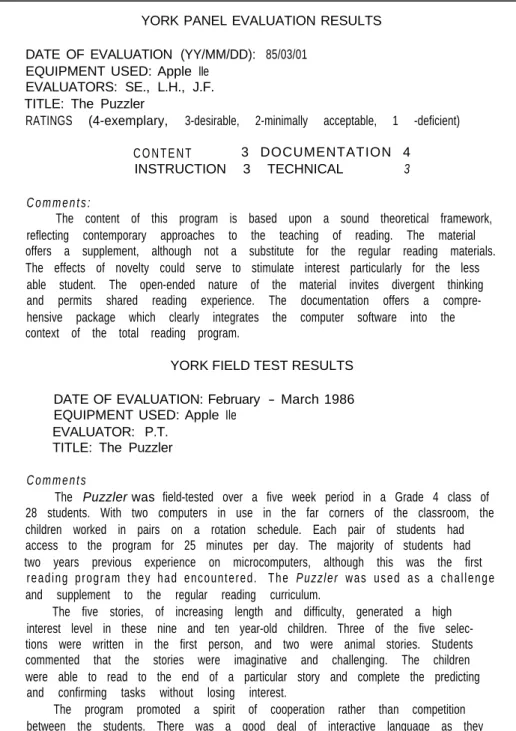
The evaluations of The Puzzler program, shown in Figure 2 (see next page),
provide an illustration of the level of agreement between the panel and field findings typical of the majority of cases. The panel evaluators rated the content, instruction, and technical quality of the program as ‘desirable’, and the documentation as ‘exemplary’. They noted in their comments that the novelty of the material should stimulate interest, and that the program invited divergent thinking and shared reading experience.
The students’ experiences with the software, as reported by the field tester, seemed to bear out the panel’s evaluation. The teacher noted that the students maintained a high
level of interest in the program and completed all of the relevant tasks. The students cooperated with each other in problem-solving, interacting frequently as they analyzed choices and made predictions. The documentation, which the panel had considered comprehensive and exemplary, proved extremely helpful to the teacher in integrating the program with the curriculum.