HAL Id: hal-00328599
https://hal.archives-ouvertes.fr/hal-00328599
Submitted on 9 Jan 2006
HAL is a multi-disciplinary open access
archive for the deposit and dissemination of
sci-entific research documents, whether they are
pub-lished or not. The documents may come from
teaching and research institutions in France or
abroad, or from public or private research centers.
L’archive ouverte pluridisciplinaire HAL, est
destinée au dépôt et à la diffusion de documents
scientifiques de niveau recherche, publiés ou non,
émanant des établissements d’enseignement et de
recherche français ou étrangers, des laboratoires
publics ou privés.
ENSO and interdecadal climate variability over the last
century documented by geochemical records of two coral
cores from the South West Pacific
T. Ourbak, Thierry Corrège, Bruno Malaizé, Florence Le Cornec, Karine
Charlier, J. P. Peypouquet
To cite this version:
T. Ourbak, Thierry Corrège, Bruno Malaizé, Florence Le Cornec, Karine Charlier, et al.. ENSO and
interdecadal climate variability over the last century documented by geochemical records of two coral
cores from the South West Pacific. Advances in Geosciences, European Geosciences Union, 2006, 6,
pp.27. �10.5194/adgeo-6-23-2006�. �hal-00328599�
Advances in Geosciences, 6, 23–27, 2006 SRef-ID: 1680-7359/adgeo/2006-6-23 European Geosciences Union
© 2006 Author(s). This work is licensed under a Creative Commons License.
Advances in
Geosciences
ENSO and interdecadal climate variability over the last century
documented by geochemical records of two coral cores from the
South West Pacific
T. Ourbak1,2, T. Corr`ege2, B. Malaiz´e1, F. Le Cornec2, K. Charlier1, and J. P. Peypouquet1
1D´epartement de G´eologie et Oc´eanographie (DGO), UMR CNRS 5805 EPOC, Universit´e Bordeaux 1, Avenue des facult´es,
33405 Talence cedex, France
2Institut de Recherche pour le D´eveloppement (IRD) UR055 Paleotropique 32, avenue Henri Varagnat 93143 Bondy cedex,
France
Received: 29 June 2005 – Revised: 5 October 2005 – Accepted: 18 October 2005 – Published: 9 January 2006
Abstract. The south west Pacific is affected by climatic phe-nomena such as ENSO (El Ni˜no Southern Oscillation) or the PDO (Pacific Decadal Oscillation). Near-monthly resolution calibrations of Sr/Ca, U/Ca and δ18Oc were made on corals taken from New Caledonia and Wallis Island. These geo-chemical variations could be linked to SST (sea surface tem-perature) and SSS (sea surface salinity) variations over the last two decades, itselves dependent on ENSO occurrences. On the other hand, near-half-yearly resolution over the last century smoothes seasonal and interannual climate signals, but emphasizes low frequency climate variability.
1 Introduction
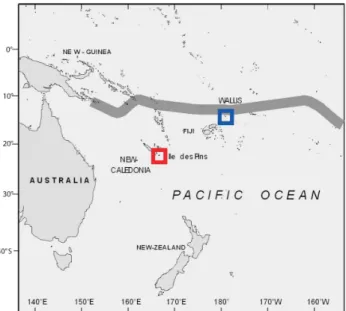
The west Pacific Warm Pool (WPWP), the warmest oceanic waters in the world, plays a crucial role in climate as an in-tense convective zone, and also in ENSO development (Mc Phaden, 1999). During El Ni˜no, due to the WPWP narrowing toward the equator, the south western Pacific is affected by cooling, contrasting with the well known eastern equatorial Pacific warm anomalies. In the southern part of the west-ern Pacific, temperature and precipitation anomalies present different patterns, depending on the position with respect to a pivotal line along the SPCZ (South Pacific Convergence Zone) (Salinger, 1995). This study aims to calibrate proxies in relation with ENSO in two south west Pacific sites: New Caledonia and Wallis Island (Fig. 1).
Geochemical analyses of corals provide a powerful tool to reconstruct the variations of paleoenvironmental factors. Massive corals can live up to thousands years (Watanabe et al., 2003) and be accurately dated (Bard et al., 1990). Dur-ing growth, the calcareous skeleton incorporates isotopes and chemical tracers reflecting environmental conditions in
am-Correspondence to: T. Ourbak
bient sea water. Sr/Ca is linked to SST (Beck et al., 1992). Coral oxygen isotopic ratios (δ18Oc) reflect some thermal imprint, but their variations also give information related to sea water isotopic composition (δ18Osw), itself linked to SSS variations (McCulloch et al., 1994; Gagan et al., 1998). U/Ca has a complex behaviour, and is SST-dependent (Min et al., 1995) but also SSS-dependent (Ourbak et al., 2005). High-resolution measurements of tracers from two coral cores col-lected from New Caledonia and Wallis allow the calibration of proxies against environmental parameters for the past 20 years. Then, the last century is investigated with half-yearly resolution on the same cores.
2 Study Area
Figure 1 presents the study area. The two sites are situ-ated in the Southwestern tropical Pacific, which is affected by seasonal to interdecadal displacements of the WPWP and the SPCZ. In the SPCZ, for the last 25 years, instrumen-tal records suggest that La Ni˜na impacts for both SST and SSS are slightly stronger in intensity than those of El Ni˜no (Gouriou and Delcroix, 2002). Based on in situ measure-ments, physicians from the IRD (Institut de Recherche pour le D´eveloppement) have shown that SST and ENSO-related precipitation anomalies are of an order of magnitude smaller than seasonal patterns. On the contrary, ENSO-related SSS signal is twice as strong as seasonal signal, with a 2 months-lag signature (Gouriou and Delcroix, 2002). In our two coring sites, more detailed regional studies confirm simi-lar ENSO-related patterns, but with differences in intensity. Thermosalinograph (TSG) data and satellite based SST pro-vide climatic records for the last two decades (Fig. 2).
24 T. Ourbak et al.: ENSO and interdecadal climate variability over the last century
Our results demonstrate that
paleoENSO occurrences can potentially be
identified with geochemical components of
New Caledonia and Wallis corals.
Nevertheless, only high resolution study
allows the detection of ENSO impacts. In
the last century, our pseudo-half yearly
resolution smoothes ENSO signatures, but
emphasizes inter decadal climatic
modulation. The 1924-47, 1947-76 and
1976-to present periods are recorded at
both sites. This preliminary study will be
followed by the extension of both coral
series over the last centuries. Another core
in the same coral in New Caledonia is
more than 500 years old, and will extend
the understanding of decadal climate
variability in this zone of the Pacific.
Acknowledgments:
The authors would like to thank
Theme 5 from UMR 5805 EPOC for
financial support. S. Power kindly provides
IPO data. We thank P. Aharon and an
anonymous reviewer for insightful reviews
that helped improve the manuscript. This is
EPOC-DGO no.1562 contribution.
Figures captions
Figure 1: South Pacific map with the location of Ile des Pins (New Caledonia, red square) and
Wallis (Blue square) in relationship with the rainfall maximum axis of the South Pacific
Convergence Zone (modified from Folland et al. (2002)).
Fig. 1. South Pacific map with the location of Ile des Pins (New Caledonia, red square) and Wallis (Blue square) in relationship with the rainfall maximum axis of the South Pacific Convergence Zone (modified from Folland et al. (2002)).
In New Caledonia, December to February are the warmest months and correspond to the rainy season; July to Septem-ber are colder and drier. Our coring site, Ile des Pins (22◦31 S; 167◦25 E, Fig. 1) has a clear seasonal climatic sig-nal (Fig. 2). Nicet and Delcroix (2000) have shown a positive SSS (∼0.2‰) and negative SST (∼0.5◦C) anomalies dur-ing El Ni˜no events. Although some New Caledonia corals were previously investigated (Quinn et al., 1996; Quinn et al., 1998; Corr`ege et al., 2000), this is the first one from Ile des Pins.
Wallis Island (13◦17 S, 176◦08 W, Fig. 1), situated in the heart of the SPCZ, is subjected to small seasonal SST vari-ations, but a large amount of rainfall has a great impact on SSS (Fig. 2). El Ni˜no signature at Wallis generally consists in a stronger SSS anomaly (∼0.4‰), and in a 0.3◦C cooling (Alory and Delcroix, 1999). Nevertheless, for the 1973–1995 period, not all El Ni˜no events had a negative impact on pre-cipitation and SSS.
3 Material and methods
In February 2003, we retrieved a continuous 3.4 m long core from a Porites sp colony growing on the Northeast side of Ile des Pins (IP thereafter), New Caledonia, at 8 m depth. In Au-gust 2000, a 3.65 m coral core was recovered from a Porites
sp colony growing at 5 m depth inside the Wallis lagoon.
Coral slabs (1 cm thick) were cut and cleaned with deion-ized water in an ultrasonic bath. Dry slabs were X-rayed for chronological purpose, and then sampled with a micro-drill along the main growth axis. Sr/Ca and δ18Oc were measured continuously every 0.08 cm for the calibration period (1989– 2003 for IP, 1982–1999 for Wallis). Then, taking a mean
extension rate of 1 cm/year (based on X-rays), a 0.5 cm res-olution was applied for the whole cores, in order to achieve a near half-yearly resolution. We measured oxygen isotope ratios with an Isotope Ratio Mass Spectrometer (Micromass Optima) at UMR 5805 EPOC, University of Bordeaux, with an individual acid reaction vessel system. Standard devi-ation on NBS19 interndevi-ational standard was 0.12‰. Sr/Ca at IP were measured with an Inductively Coupled Plasma Atomic Emission Spectrometer (ICP-AES) at the IRD centre in Noum´ea (New Caledonia). Wallis Sr/Ca and U/Ca mea-surements were achieved on an Inductively Coupled Plasma Mass Spectrometer (ICP-MS) at the IRD centre in Bondy (France), following the method of Le Cornec and Corr`ege (1997). Standard deviation is ±0.05 mmol/mol for Sr/Ca and
±0.03 µmol/mol for U/Ca (ICP-MS). For ICP-AES, stan-dard deviation on Sr/Ca is ±0.05 mmol/mol. Chronology for the calibration period is based on skeletal measurements, Sr/Ca for IP and U/Ca for Wallis. We tied extrema in trace element/Ca ratio to the corresponding SST annual extrema of each annual cycle, using a “peak to peak matching” tech-nique.
4 Results and discussion 4.1 Calibration
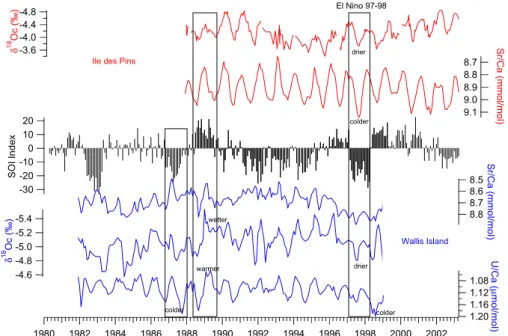
For the calibration period, monthly Southern Oscillation In-dex (SOI), near-monthly Sr/Ca and δ18Oc at IP, Sr/Ca, U/Ca and δ18Oc at Wallis are represented in Fig. 3.
For the IP record, clear seasonal cycles are visible. The strong 1997–1998 Ni˜no is clearly recorded: higher Sr/Ca in addition to heavier δ18Oc values indicate colder and drier conditions compared to the mean climatic signal. As noted for instrumental data (Alory and Delcroix, 1999), the 1990– 1994 period, known as a long, weak El Ni˜no, has an atypical signature in corals, reducing the amplitude of δ18Oc cycles. The 1988–1989 and the 1998–2000 La Ni˜na phenomena are recorded in Sr/Ca and δ18Oc. For example, the Sr/Ca peak in 1999 winter (the highest of the period) reflects warm winter anomalies.
Wallis coral exhibits less clear seasonal cycles. This re-sult is in good agreement with instrumental TSG data. The SST cycle is weak and precipitation patterns are not cyclic, despite a strong seasonal variability due to SPCZ shifts. Sig-nature of the strong 1997-98 El Ni˜no is particularly visible on Sr/Ca, giving the highest values of the calibration period (i.e. lowest SST). The 1991–1994 event again has peculiar impacts, smoothing both U/Ca and Sr/Ca variability. In this coral, there is no signature for the strong 1982–1983 El Ni˜no. Our hypothesis is that the 1982–1983 phenomenon (the high-est SOI value of the period) has stressed the coral, inhibiting a normal growth without giving any peculiar geochemical signature. The only strong La Ni˜na available on the studied period (1988–1989) is well recorded. It produces the highest
δ18Oc and the lowest U/Ca values, as well as low Sr/Ca ratio, indicating wetter and warmer conditions.
T. Ourbak et al.: ENSO and interdecadal climate variability over the last century 25 30 28 26 24 22 SS T Ile d es Pin s ( °C) 2004 2002 2000 1998 1996 1994 1992 1990 1988 1986 1984 1982 year 30 28 26 24 22 SST Wa llis (° C ) 36.0 35.5 35.0 34.5 34.0 33.5 33.0 S SS TSG U ito é ( p su ) 36.0 35.0 34.0 33.0 SSS TSG W a llis ( p su ) Wallis
Ile des Pins
Figure 2:
Instrumental records available for the calibration period. From top (sea surface salinity) to bottom (sea surface temperature): in blue Wallis records, in Red: Ile des Pins (New Caledonia). SSS from Institut de Recherche Pour le Developpement (IRD) Thermosalinograph (TSG) datasets.
SST : OI (Optimum Interpolation) SST (Reynolds and Smith 1994, dashed lines) from 1982 to present, and TSG data (thick lines). TSG data are from Uitoé site, situated at about one hundred kilometres from Ile des Pins.
Fig. 2. Instrumental records available for the calibration period. From top (sea surface salinity) to bottom (sea surface temperature): in blue Wallis records, in red: Ile des Pins (New Caledonia). SSS from Institut de Recherche pour le Developpement (IRD) Thermosalinograph (TSG) datasets. SST : OI (Optimum Interpolation) SST (Reynolds and Smith, 1994; dashed lines) from 1982 to present, and TSG data (thick lines). TSG data are from Uito´e site, situated at about one hundred kilometres from Ile des Pins.
9.1 9.0 8.9 8.8 8.7 S r/C a ( m mo l/mo l) 2002 2000 1998 1996 1994 1992 1990 1988 1986 1984 1982 1980 year -4.8 -4.4 -4.0 -3.6 δ 18 Oc (‰ ) -30 -20 -10 0 10 20 SO I In d ex 8.8 8.7 8.6 8.5 Sr/C a (m mo l/m o l) 1.20 1.16 1.12 1.08 U/Ca ( µ mol /mol ) -5.4 -5.2 -5.0 -4.8 -4.6 δ 18 Oc (‰ ) El Nino 97-98 colder drier warmer wetter colder colder drier Wallis Island
Ile des Pins
Figure 3: Calibration of coral proxies at Ile des Pins (top, red) and Wallis Island (bottom, blue). The Southern Oscillation Index (SOI) is also shown. Negative values of the SOI represent El Niño. 9.0 8.9 8.8 8.7 8.6Sr/C a ( m mo l/mo l) 1990 1980 1970 1960 1950 1940 1930 1920 1910 1900 year 1.3 1.2 1.1 U/ C a ( µµµµ m ol/m ol ) 9.2 9.1 9.0 8.9 8.8Sr/C a ( m m o l/mo l) 2 0 -2 P D O I nde x -20 0 20 SO I -4.5 -4.0 -3.5 δ 18 Oc (‰) -5.5 -5.0 -4.5 δ 18 Oc (‰) 1 -1 IPO In d e x
+
_
+
Figure 4: Comparison of proxy data for IP and Wallis with indices of interdecadal climate variability: SOI (Southern Oscillation Index, black), PDO Index (Pacific Decadal Oscillation,
Fig. 3. Calibration of coral proxies at Ile des Pins (top, red) and Wallis Island (bottom, blue). The Southern Oscillation Index (SOI) is also shown. Negative values of the SOI represent El Ni˜no.
This high resolution calibration study confirm previous works (Cole and Fairbanks, 1990; Evans et al., 1998; Cobb et al., 2003, among others). ENSO events can be recorded in corals, providing hope for the reconstruction of past ENSO.
4.2 The last century
On an interdecadal timescale, Mantua et al. (1997) showed the existence of a climatic signal they called the PDO (Pa-cific Decadal Oscillation). This signal was first described in the North Pacific, but probably has an imprint in the southern
26 T. Ourbak et al.: ENSO and interdecadal climate variability over the last century 9.1 9.0 8.9 8.8 8.7 S r/C a ( m mo l/mo l) 2002 2000 1998 1996 1994 1992 1990 1988 1986 1984 1982 1980 year -4.8 -4.4 -4.0 -3.6 δ 18 Oc (‰ ) -30 -20 -10 0 10 20 SO I In d ex 8.8 8.7 8.6 8.5 Sr/C a (m mo l/m o l) 1.20 1.16 1.12 1.08 U/Ca ( µ mol /mol ) -5.4 -5.2 -5.0 -4.8 -4.6 δ 18 Oc (‰ ) El Nino 97-98 colder drier warmer wetter colder colder drier Wallis Island
Ile des Pins
Figure 3: Calibration of coral proxies at Ile des Pins (top, red) and Wallis Island (bottom, blue). The Southern Oscillation Index (SOI) is also shown. Negative values of the SOI represent El Niño. 9.0 8.9 8.8 8.7 8.6Sr/C a ( m mo l/mo l) 1990 1980 1970 1960 1950 1940 1930 1920 1910 1900 year 1.3 1.2 1.1 U/ C a ( µµµµ m ol/m ol ) 9.2 9.1 9.0 8.9 8.8Sr/C a ( m m o l/mo l) 2 0 -2 P D O I nde x -20 0 20 SO I -4.5 -4.0 -3.5 δ 18 Oc (‰) -5.5 -5.0 -4.5 δ 18 Oc (‰) 1 -1 IPO In d e x
+
_
+
Figure 4: Comparison of proxy data for IP and Wallis with indices of interdecadal climate variability: SOI (Southern Oscillation Index, black), PDO Index (Pacific Decadal Oscillation,
Fig. 4. Comparison of proxy data for IP and Wallis with indices of interdecadal climate variability: SOI (Southern Oscillation Index, black), PDO Index (Pacific Decadal Oscillation, green) (+ and − for positive and negative phases, respectively), IPO (Interdecadal Pacific Oscillation, courtesy of S. Power, dark green). Geochemical measurements: Ile des Pins Sr/Ca (red), δ18Oc (orange). Wallis Sr/Ca (dark blue), δ18Oc (light blue), U/Ca (medium blue). Dashed Lines represent geochemical data, thicker lines are 7 years running means of each series.
hemisphere under the name IPO (Interdecadal Pacific Oscil-lation, Power et al., 1999). Figure 4 presents coralline trac-ers (Sr/Ca, δ18Oc at IP; Sr/Ca, δ18Oc and U/Ca at Wallis), as well as the Southern Oscillation Index (SOI), the PDO index and the IPO index. To obtain a near six months reso-lution, we sampled our corals on a regular basis. However, corals are known to grow irregularly, growing faster in warm months than in cold ones. Thus, one sample could encom-pass between 3 to 9 months, leading to time scale heterogene-ity. As a consequence, the ENSO signal, which has a 2 to 6 months impact, is smoothed and has not a clear signature in our low resolution samples (Fig. 4). However, low frequency climatic regimes of the last century are well recorded in our corals, especially in New Caledonia (Fig. 4). The PDO shift at about 1924–1925 started a positive phase. This shift seems to be recorded in geochemical records. As an example, in comparison with the 1900–1923 period, the 1924–1925 pe-riod shows a 0.12 mmol/mol shift in Sr/Ca (IP), reflecting a SST shift. Then, all geochemical signals show a global in-crease reflecting warmer and wetter conditions. The 1947– 1976 period experienced a negative PDO phase. At IP, slight
δ18Oc increase, together with quasi constant Sr/Ca, denote precipitation anomalies, toward drier conditions. At Wallis, the signal is more complex. Sr/Ca and δ18Oc show a PDO-like pattern first, then at the beginning of the 1960’s, there is an abrupt change contrasting with the PDO pattern. Inter-estingly, the IPO Index is in antiphase with Sr/Ca and δ18Oc Wallis, as well as, in a minor way, with IP Sr/Ca. After the 1976–1977 shift, PDO returned to a positive phase IP Sr/Ca, as well as Wallis Sr/Ca, followed the same pattern than in
1924. On the contrary, since the mid 1980’s, δ18Oc (IP and Wallis) and U/Ca Wallis have increased. This change in be-haviour of tracers reveals a possible climatic perturbation, in comparison with the preceding 75 years. When taking into account Sr/Ca ratios, results suggest that this climatic pertur-bation is most probably linked to a change in hydrological balance, revealing a change in precipitation-evaporation ra-tios. Due to the position of the core, in the heart of the SPCZ, we believe it is mainly a decrease of rainfall amount.
5 Conclusion
Our results demonstrate that paleoENSO occurrences can po-tentially be identified with geochemical components of New Caledonia and Wallis corals. Nevertheless, only high res-olution study allows the detection of ENSO impacts. In the last century, our pseudo-half yearly resolution smoothes ENSO signatures, but emphasizes interdecadal climatic mod-ulations. The 1924–1947, 1947–1976 and 1976-to present periods are recorded at both sites. This preliminary study will be followed by the extension of both coral series over the last centuries. Another core in the same coral in New Caledonia is more than 500 years old, and will extend the understanding of decadal climate variability in this zone of the Pacific.
Acknowledgements. The authors would like to thank Theme 5 from
UMR 5805 EPOC for financial support. S. Power kindly provides IPO data. We thank P. Aharon and an anonymous reviewer for in-sightful reviews that helped improve the manuscript. This is EPOC-DGO no. 1562 contribution.
T. Ourbak et al.: ENSO and interdecadal climate variability over the last century 27
Edited by: P. Fabian and J. L. Santos Reviewed by: P. Aharon and another referee
References
Alory, G. and Delcroix, T.: “Climatic variability in the vicinity of Wallis, Futuna, and Samoa islands (13◦–15◦S, 180◦–170◦W), Oceanologica Acta, 22 (3), 249–263, 1999.
Bard, E., Hamelin, B., and Fairbanks, R. G.: U-Th ages obtained by mass spectrometry in corals from Barbados: sea level during the past 130 000 years, Nature, 346 (6283), 456–458, 1990. Beck, J. W., Edwards, R., Ito, E., Taylor, F., Recy, J., Rougerie, F.,
Joannot, P., and Henin, C.: Sea surface temperature from coral skeletal Strontium/Calcium ratios, Science, 257, 644–647, 1992. Cobb, K. M., Charles, C. D., Edwards, R. L., Cheng, H., and Kast-ner, M.: El Ni˜no-Southern Oscillation and Tropical Pacific cli-mate during the last millennium, Nature, 424, 271–276, 2003. Cole, J. E. and Fairbanks, R. G.: The Southern Oscillation recorded
in the oxygen isotopes of corals from Tarawa Atoll, Paleoceanog-raphy, 5, 669–683, 1990.
Corr`ege, T., Delcroix, T., R´ecy, J., Beck, W. J., Gabioch, G., and Le Cornec, F.: Evidence for stronger El Ni˜no-Southern Oscillation (ENSO) events in a mid-Holocene massive coral, Paleoceanog-raphy, 15, 465–470, 2000.
Evans, M., Fairbanks, R. G., and Rubenstone, J. L.: A proxy index of ENSO teleconnections, Nature, 394, 732–733, 1998. Folland, C. K., Renwick, J., Salinger, M. J., and Mullan, A. B.:
Rel-ative influences of the Interdecadal Pacific Oscillation and ENSO on the South Pacific Convergence Zone, Geophys. Res. Lett., 29 (13), 1643, doi:10.1029/2001GL014201, 2002.
Gagan, M. K., Ayliffe, L. K., Hopley, D., Cali, J. A., Mortimer, G. E., Chappell, J., McCulloch, M. T., and Head, M. J.: Temperature and surface-ocean water balance of the mid-Holocene tropical western Pacific, Science, 279, 1014–1018, 1998.
Gouriou, Y. and Delcroix, T.: Seasonal and ENSO variations of sea surface salinity and temperature in the South Pacific Con-vergence Zone during 1976–2000, J. Geophys. Res., 107 (C12), 8011, doi:10.1029/2001JC000830, 2002.
Le Cornec, F. and Corr`ege, T.: Determination of Uranium to Cal-cium ratios in corals by Inductively Coupled Plasma Mass Spec-trometry, J. Analyt. Atomic Spectr., 12, 969–973, 1997.
Mantua, N. J., Hare, S. R., Zhang, Y., Wallace, J. M., and Francis, R. C.: A Pacific interdecadal climate oscillation with impacts on salmon production, Bulletin of American Meteorological Soci-ety, 78 (6), 1069–1079, 1997.
Mc Phaden, M. J.: Genesis and evolution of the 1997–1998 El Ni˜no, Science, 283, 950–954, 1999.
McCulloch, M. T., Gagan, M. K., Mortimer, G. E., Chivas, A. R., and Isdale, P. J.: A high-resolution Sr/Ca and δ18O coral record from the Great Barrier Reef, Australia, and the 1982–1983 El Ni˜no, Geochimica et Cosmochimica Acta, 58, 2747–2754, 1994. Min, R. G., Edwards, L. R., Taylor, F. W., Recy, J., Gallup, C. D., and Beck, W. J.: Annual cycles of U/Ca in coral skeletons and U/Ca thermometry, Geochimica et Cosmochimica Acta, 59 (10), 2025–2042, 1995.
Nicet, J. B. and Delcroix, T.: ENSO-related Precipitation changes in New Caledonia, southwestern tropical Pacific 1969–98, Mon. Wea. Rev., 128, 3001–3006, 2000.
Ourbak, T., Corr`ege, T., Malaiz´e, B., Le Cornec, F., Charlier, K., and Peypouquet, J.: A High Resolution investigation of tempera-ture, salinity and upwelling activity proxies in corals, Geochem-istry, Geophysics, Geosystems, in press, 2005.
Power, S., Casey, T., Folland, C., Colman, A., and Mehta, V.: Inter-decadal modulation of the impact of ENSO on Australia, Clim. Dyn., 15 (5), 319–324, 1999.
Quinn, T. M., Crowley, T. J., Taylor, F. W., Joannot, P., and Join, Y.: A multicentury stable isotope record from a New Caledonia coral: Interannual and decadal sea surface temperature variabil-ity in the southwest Pacific since 1657 A.D., Paleoceanography, 13 (4), 412–426, 1998.
Quinn, T. M., Taylor, F. W., Crowley, T. J., and Link, S. M.: Eval-uation of sampling resolution in coral stable isotope records: a case study using records from New Caledonia and Tarawa, Pale-oceanography, 11 (5), 529–542, 1996.
Reynolds, R. W. and Smith, T. M.: Improved global sea surface temperature analyses using optimum interpolation, J. Clim., 7, 929–948, 1994.
Salinger, M. J.: Southwest Pacific temperatures: trends in maxi-mum and minimaxi-mum temperatures, Atmos. Res., 37 (1–3), 87–99, 1995.
Watanabe, T., Gagan, M. K., Corr`ege, T., Scott-Gagan, H., Cow-ley, J., and Hantoro, W. S.: Oxygen isotope systematics in Diploastrea heliopora: new coral archive of tropical paleocli-mate, Geochimica et Cosmochimica Acta, 67 (7), 1349–1358, 2003.