HAL Id: hal-02456686
https://hal.archives-ouvertes.fr/hal-02456686
Submitted on 27 Jan 2020
HAL is a multi-disciplinary open access
archive for the deposit and dissemination of
sci-entific research documents, whether they are
pub-lished or not. The documents may come from
teaching and research institutions in France or
abroad, or from public or private research centers.
L’archive ouverte pluridisciplinaire HAL, est
destinée au dépôt et à la diffusion de documents
scientifiques de niveau recherche, publiés ou non,
émanant des établissements d’enseignement et de
recherche français ou étrangers, des laboratoires
publics ou privés.
Integration of Structural Constraints into TSP Models
Nicolas Isoart, Jean-Charles Régin
To cite this version:
Nicolas Isoart, Jean-Charles Régin. Integration of Structural Constraints into TSP Models. Principles
and Practice of Constraint Programming, pp.284-299, 2019, �10.1007/978-3-030-30048-7_17�.
�hal-02456686�
Models
Nicolas Isoart and Jean-Charles R´egin
Universit´e Cˆote d’Azur, CNRS, I3S, France {nicolas.isoart,jcregin}@gmail.com
Abstract. Several models based on constraint programming have been proposed to solve the traveling salesman problem (TSP). The most effi-cient ones, such as the weighted circuit constraint (WCC), mainly rely on the Lagrangian relaxation of the TSP, based on the search for span-ning tree or more precisely ”1-tree”. The weakness of these approaches is that they do not include enough structural constraints and are based almost exclusively on edge costs. The purpose of this paper is to correct this drawback by introducing the Hamiltonian cycle constraint associated with propagators. We propose some properties preventing the existence of a Hamiltonian cycle in a graph or, conversely, properties requiring that certain edges be in the TSP solution set. Notably, we design a propagator based on the research of k-cutsets. The combination of this constraint with the WCC constraint allows us to obtain, for the resolution of the TSP, gains of an order of magnitude for the number of backtracks as well as a strong reduction of the computation time.
Keywords: Global constraint, TSP, propagator
1
Introduction
The traveling salesman problem (TSP) is an NP-Hard problem. It has many applications and has been motivated by concrete problems, such as school bus routes, logistics, routing, etc. Almost all types of resolution methods (MIP, SAT, CP, evolutionary algorithms, etc.) have been used to solve it. When the graph is Euclidean, the most efficient program is the Concorde software [1]. Unfortu-nately, it cannot deal with additional constraints that are very present in real-world problems such as Pickup & Delivery, Dial-a-Ride, automatic harvesting, etc.
Solving the TSP is difficult since it involves finding a single cycle passing through all the vertices of a graph such that the sum of the costs of the edges it contains is minimal. It is quite easy to model the fact that each vertex belongs to a cycle. Indeed, it is sufficient that each vertex has at least two distinct neighbors, in other words, each vertex must be the end of at least two edges. Such a result can be obtained by modeling the problem as an assignment problem, which is solved in polynomial time. However, this model is not sufficient to obtain a single cycle in the graph, because the assignment corresponds to a coverage of
the vertices by a set of disjoint cycles. From this model, we obtain solutions where each vertex belongs to a cycle, but not to a unique cycle. The covering by a unique cycle can be achieved by imposing that the subgraph generated by the selected edges is connected. The combination of these two aspects is what makes the TSP so difficult.
Unlike the previous approach, a model can be built based on the notion of a connected subgraph. It was exactly the idea of Held and Karp [7, 8] who represented this notion by a 1-tree that is formed by a node x, two adjacent edges of x and a spanning tree of the graph without x. A 1-tree such that each node has a degree 2 is a Hamiltonian cycle, and a minimum 1-tree with these constraints is an optimal solution of the TSP. The use of a 1-tree is interesting because a minimum 1-tree is a good lower bound of the TSP. In addition, its computation is strongly related to the computation of a minimum spanning tree. Held and Karp proposed to relax the degree constraints with a Lagrangian relaxation. More precisely, the cost of the edges are modified in order to inte-grate the violation of these degree constraints. If a node has a degree strictly greater than 2, then the cost of its adjacent edges are decreased, and if the de-gree is strictly less than 2 then the cost of its adjacent edges are increased. A convergence towards the optimal solution is obtained by computing a succession of minimum 1-tree based on the Lagrangian relaxation.
The weighted circuit constraint (WCC) [2] implements the approach in con-straint programming. This concon-straint can be considered as the state of the art in CP as mentioned by Ducomman et al. [4]: ”The best approach regarding the number of instances solved and quality of the bound is the Held and Karp’s filtering”.
In this paper, we propose to improve the WCC by adding methods for solving Hamiltonian cycles (i.e. TSP without costs). To do this, we consider the work of Cohen and Coudert [3] on the structure of the Hamiltonian cycles carried out for the FHCP Challenge [6]. Fig. 1 shows an example in which the structure of the graph is important for the Hamiltonian cycle search. There is no Hamiltonian cycle in this graph, because it is impossible to find a cycle that visits all the vertices that pass only once through node C. Such a graph is said to be 1-connected: there is a vertex in the graph such that its removal disconnects it. We can therefore define a new structural constraint: if a graph is 1-connected, then it does not contain a Hamiltonian cycle.
A B
C D E
This idea can be extended to edges. For instance, consider two edges a1 and
a2 whose deletion disconnects the graph (i.e. it is 2-edge-connected). If there
exists an Hamiltonian cycle then it necessarily contains a1 and a2. We propose
to study k-edge-connected graphs for k > 1, and in particular values k = 2 and k = 3, which are common in practice. From this study, we defined a general filtering algorithm named k-cutset propagator.
This article is organized as follows: first, we recall some concepts of graph theory. Then, we formally define the structural constraints used in our method of solving the TSP. Next, we define a new data structure called cycled spanning tree, which is used to define a new algorithm to exploit structural constraints. The last part experimentally shows the advantages of our method. Finally, we conclude.
2
Preliminaries
2.1 Definitions
The definitions about graph theory are taken from [12].
A directed graph or digraph G = (X, U ) consists of a vertex set X and an arc set U, where every arc (u, v) is an ordered pair of distinct vertices. We will denote by X(G) the vertex set of G and by U (G) the arc set of G. The cost of an arc is a value associated with the arc. An undirected graph is a digraph such that for each arc (u, v) ∈ U , (u, v) = (v, u). If G1 = (X1, U1) and
G2= (X2, U2) are graphs, both undirected or both directed, G1is a subgraph
of G2 if V1 ⊆ V2 and U1 ⊆ U2. A path from node v1 to node vk in G is a
list of nodes [v1, ..., vk] such that (vi, vi+1) is an arc for i ∈ [1..k − 1]. The path
contains node vi for i ∈ [1..k] and arc (vi, vi+1) for i ∈ [1..k − 1]. The path is
simpleif all its nodes are distinct. The path is a cycle if k > 1 and v1= vk. A
cycle is Hamiltonian if [v1, ..., vk−1] is a simple path and contains every vertex
of X. The length of a path p, denoted by length(p), is the sum of the costs of the arcs contained in p. For a graph G, a solution to the traveling salesman problem (TSP)in G is a Hamiltonian cycle HC ∈ G minimizing length(HC). An undirected graph G is connected if there is a path between each pair of vertices, otherwise it is disconnected. The maximum connected subgraphs of G are its connected components. A k-edge-connected graph is a graph in which there is no edge set of cardinality strictly less than k disconnecting the graph. A tree is a connected graph without a cycle. A tree T = (X0, U0) is a spanning tree of G = (X, U ) if X0 = X and U0 ⊆ U . The U0 edges are the tree edges T and the U − U0 edges are the non-tree edges T . A bridge is an edge such that its removal increases the number of connected components. A partition (S, T ) of the vertices of G = (X, U ) such that S ⊆ X and T = X − S is a cut. The set of edges (u, v) ∈ U having u ∈ S and v ∈ T is the cutset of the (S, T ) cut. A k-cutset is a cutset of cardinality k. A k-cutset is minimum iff there is no subset of the k-cutset that disconnects the graph.
2.2 HCWME : Hamiltonian cycle with mandatory edges CP-based algorithms solving the TSP tend to:
•Eliminate edges that cannot be part of the optimal solution.
•Define edges belonging to any optimal solution, called mandatory edges.
Since each optimal solution of the TSP is a Hamiltonian cycle, the TSP solution set is a subset of the solutions of the Hamiltonian cycle problem (HCP). Property 1. Given G = (X, U ). If a ∈ U belongs to all HCP(G) solutions, then a necessarily belongs to all TSP(G) solutions.
Property 2. Given G = (X, U ). If HCP(G) has no solution, then TSP(G) has no solution.
As the concept of mandatory arc is introduced, we formulate the Hamilto-nian cycle with mandatory edges problem (HCWMEP) :
INSTANCE :A graph G = (X, U ) and a set of mandatory edges M ⊆ U . QUESTION : Is there a Hamiltonian cycle in G containing all the edges of M ?
Since the HCP is an NP-Complete problem, HCWMEP(G, M ) is NP-Complete.
3
Structural constraints
We will use the following notations G = (X, U ), n = |X|, m = |U |, M ⊆ U the set of mandatory edges of G, P = HCMWEP(G, M ). When not specified we will assume that G is symmetrical, connected and that a k-cutset is minimum. Proposition 1. Let K be a k-cutset, then any Hamiltonian cycle C contains an even and strictly positive number of edges fromK.
Proof. Consider a k-cutset of G and C a hamiltonian cycle. The k-cutset parti-tion G into two sets of vertices X1 and X2. Let u be our starting vertex in X1,
by definition C visits all the vertices of G and ends up visiting u (its starting vertex). Thus, visiting the vertices of X2involves taking one edge of the k-cutset
and taking a different one to come back into X1, at that moment: either all the
vertices of X2 have been visited and we end up joining u without using other
edges of the k-cutset, or we have to visit X2again and return to X1, every time
we visit X2 from X1 we need an edge to go in, and another to go back: this
means an even number of edges and the proposition holds. ut From Proposition 1, we define Properties 3, 4, 5, 6 and 7.
Property 3. If there is {a1, a2}, a 2-cutset in G, then a1and a2 become
manda-tory: M ← M + {a1, a2}.
Property 4. If there is a k-cutset with k odd containing k − 1 mandatory edges in G, then the non-mandatory edge a is deleted because it cannot be part of a Hamiltonian cycle: E ← E − {a}.
Property 5. If there is a k-cutset with k even containing k − 1 mandatory edges in G, then the non-mandatory edge a becomes mandatory: M ← M + {a}. Property 6. If there is a 1-cutset in G, then P has no solution.
Property 7. If there is a k-cutset with k odd containing k mandatory edges in G, then P has no solution.
Definition 1. It is said that two problems P and P0 are equivalent if their solution sets are in bijection. We then note that P= P0.
Corollary 1. Given P0 = P. If one or more of Properties 3, 4, 5, 6 or 7 are applied to P, then P and P0 remain equivalent.
Proof. Immediate from Proposition 1. ut
We write a∗∈ U a mandatory edge.
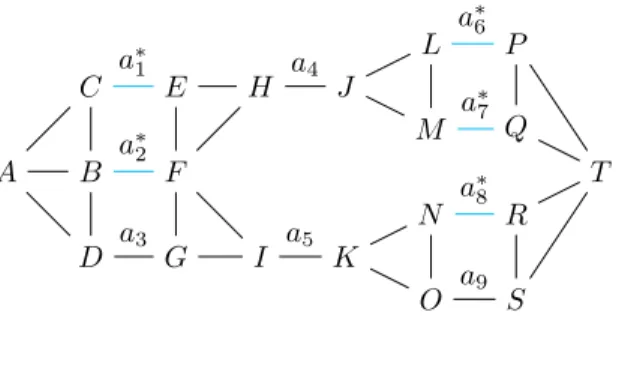
Example 1: A C B D E F G H I J K L M N O P Q R S T a∗ 1 a3 a∗2 a5 a4 a∗6 a∗ 7 a∗8 a9 Fig. 2. Graph G1.
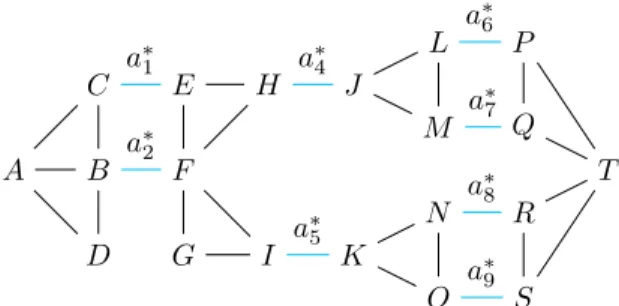
From Properties 3, 4 and 5, we can remove some edges from Fig. 2 and make them mandatory:
•{a4, a5} is a 2-cutset: if we want to connect the “left” part of H and I to
the “right” part of J and K by a cycle we must take (H,J) and (I,K) so a4 and
a5 become mandatory.
•{a∗1, a∗2, a3} is a 3-cutset and with {a∗1, a∗2} mandatory: it is a cutset with
an odd cardinality with an even number of mandatory edges. Then we can delete a3, because by choosing it the cutset would become a mandatory set of edges
with an odd cardinality.
•{a∗6, a∗7, a∗8, a9} is a 4-cutset and with {a∗6, a∗7, a∗8} mandatory: it is a cutset
with an even cardinality with 3 mandatory edges, so a9 must be mandatory.
A C B D E F G H I J K L M N O P Q R S T a∗1 a∗ 2 a∗5 a∗4 a∗ 6 a∗7 a∗ 8 a∗9
Fig. 3. Application of Properties 3, 4 and 5 on G1.
Example 2:
Now, consider Fig. 4. From Property 7, there is no Hamiltonian cycle:
•{a4} is a 1-cutset: there is no Hamiltonian cycle connecting {I, J, K} to
the other part of the graph.
•{a∗1, a∗2, a∗3} forms a 3-cutset with three mandatory edges.
Properties 3, 4, 5, 6 or 7 are based on the cardinality of the cutsets, so it is reasonable to ask how many cutsets a graph can have.
A C B D E F G H I J K a∗ 1 a∗ 3 a∗2 a4 Fig. 4. Graph G2.
Property 8. The number of cutset of a graph of order n is 2n.
Proof. Any part S ⊆ X forms an (S, T ) cut. The cardinality of the powerset of
S ⊆ X is 2n, so there are 2n cutsets. ut
In the case of the undirected graph, an (S, T ) cut has the same cutset as the (T, S) cut. Hence, the number of distinct cutsets is 2n/2 = 2n−1.
In the case of a very dense graph, there is a low probability of satisfying Properties 3, 4, 5, 6 or 7 for a small value of k. Nor does it seem very reasonable to apply these properties with a high value of k for at least two reasons:
•The complexity of the algorithms of k-cutset increases with k because they
are enumeration algorithms [14].
•The relationship between the cardinality of the cutset and the number of
mandatory edges is strong. The more k increases and the less chance we have of satisfying one of Properties 3, 4, 5, 6 or 7.
Consequently, we propose to study k =1, 2 and 3 with the following behaviors:
•1-cutsets: raise a fail.
•2-cutsets: make the edges of the 2-cutset mandatory.
•3-cutsets: consider only the 3-cutsets with at least 2 mandatory edges. If
it contains a non-mandatory edge, then it must be removed, otherwise a fail is raised.
4
k-cutset Propagator
We must be able to find the k-cutsets with k = 1, 2, 3 and two mandatory edges for k = 3. If we split the problem, finding the 1-cutset, which are actually bridges, can be done with the Tarjan algorithm [11] in O(m + n); finding 2-cutset can be done with the Tsin algorithm [13] in O(m + n). The strength of Tsin’s algorithm is that it also allows us to find bridges, so we can manage k = 1, 2 at the same time. We now have to manage k = 3 with at least two mandatory edges.
By the cut definition, if you remove a k-cutset edge, then it becomes a (k − 1)-cutset. We can then propose a first simple algorithm:
For each mandatory edge a∗∈ M , we look for the 2-cutsets of G − {a∗}. In this way, each of the 2-cutset found forms a 3-cutset with at least one mandatory edge. It is then sufficient to keep only the 3-cutsets with 2 mandatory edges.
The number of considered mandatory edges can be reduced. To do this, we will build a special structure called CST. The CST is not a required structure for the proper functioning of the k-cutset propagator, just an improvement. 4.1 CST : Cycled Spanning Tree
A CST is a 2-edge-connected subgraph of G such that for each edge a of G there is a cycle in G formed only by edges of the CST and a.
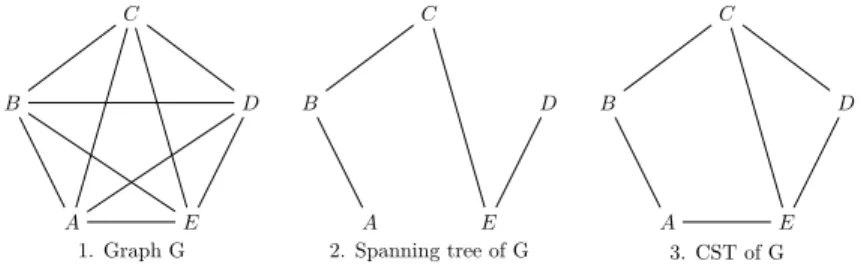
One way to build a CST is to calculate T a spanning tree, then add some edges to T until all the edges, those of T and those outside of T , belong to a CST cycle. Any edge a 6∈ T belongs to a cycle composed of a and only T edges. For the edges of T , the CST is built by adding edges to the spanning tree such that each tree edge belongs to a cycle of CST. This can be done in linear time by marking the tree edges each time a cycle is found. More precisely, we consider three graphs at the same time: G the graph, T the spanning tree, and CST the CST, initially equal to T . All tree edges are unmarked. We traverse the non tree edges of G until we find aT = (i, j) /∈ T such that there is a cycle formed by at least an unmarked edge of T , some edges of T and aT. We add aT to CST and we mark all the tree edges of C. We repeat this operation until
there is no more unmarked edge in T . Clearly, at the end, each tree edge which has been marked belongs to a cycle. In addition, there is at least one tree edge in each cycle, so the number of added edges is bound by n. An example of a construction is shown in Fig. 5. This algorithm can be efficiently implemented, similarly to Kruskal’s algorithm, by using a union-find data structure to avoid traversing each edge of each cycle. If we consider first the non mandatory edges for the construction of the spanning tree and for the construction of the CST, then we can expect to reduce the number of mandatory edges in the CST.
W.l.o.g. we assume that G is a connected bridgeless graph. Thus, there exist a CST in G. A B C D E 1. Graph G A B C D E 2. Spanning tree of G A B C D E 3. CST of G
Fig. 5. Example of building a CST.
Corollary 2. Givenk >1. If there is a k-cutset in G, then at least two edges of the cutset are in the CST.
Proof. By construction, the CST is connected and covers the graph with cycles. So each cut has a cardinality greater than or equal to two. ut Corollary 3. If there is a 3-cutset containing at least two mandatory edges, then at least one mandatory edge belongs to the CST.
Proof. Immediate from Corollary 2. ut
Definition 2. The identification edges are the mandatory edges for which a 2-cutset algorithm is run.
From Corollary 3, the simple algorithm can be improved by reducing the number of mandatory edges that are considered. Considering the identification edges as each mandatory edge a∗of CST, the algorithm becomes: for each iden-tification edges, search for the 2-cutsets of G − {a∗}. For each 3-cutset found, we obtain either a 3-cutset with three mandatory edges, or a 3-cutset with two mandatory edges or a 3-cutset with one mandatory edge. Then, we apply Prop-erties 3, 4, 5, 6 and 7.
Since mandatory edges outside the CST are not considered as identification edges and the edges in the CST are chosen during construction, it is a good idea to minimize the number of mandatory edges in the CST.
4.2 Additional improvement
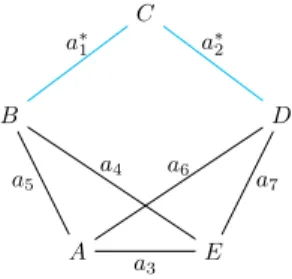
The proposed algorithm is highly dependent on the number of identification edges. From Corollary 2, if two edges belong to the same 2-cutset and are manda-tory, then they are identification edges. However, when searching for the 3-cutsets with an identification edge, it is not necessary to repeat the search for all the edges forming a 2-cutset with it. More precisely, the problem of searching for 3-cutsets with a∗ as an identification edge has the same set of solutions as the problem of searching for 3-cutsets with each of the edges forming a 2-cutset with a∗. Fig. 6 illustrates it well since the 2-cutset is a path.
A B C D E a5 a6 a3 a∗ 1 a4 a∗ 2 a7
Fig. 6. {a∗1,a∗2} is a 2-cutset. {a∗1,a4,a5} and {a∗1,a6,a7} are 3-cutsets including a∗1. We can deduce that {a∗2,a4,a5} and {a2∗,a6,a7} are 3-cutsets including a∗2.
Property 9. Let S1 be a k-cutset and S2 be a 2-cutset such that k > 1 and
S26⊆ S1. If ∃a ∈ S1such that a ∈ S2then (S1∪ S2) − {a} forms a k-cutset.
Proof. Given S2 = {a1, a2} a 2-cutset and a1 ∈ S1. Removing S1 from the
graph disconnects it into two connected components. In the modified graph, S2 − {a1} = {a2} is a bridge. Removing a2 further increases the number of
connected components: there are now three. If we put back a1, G is disconnected
into two connected components, its cutset is (S1− {a1}) ∪ {a2} = (S1− {a1}) ∪
(S2− {a1}) = (S1∪ S2) − {a1}. Since S1 is a k-cutset, there is no subset of
it that disconnects the graph other than the k-cutset itself. If (S1∪ S2) − {a1}
disconnects the graph then it is a k-cutset because we delete and add an edge
in a set of initial cardinality k. ut
Consider S1 a 3-cutset, S2 = {a1, a2} and S3 two distinct 2-cutsets. From
Property 9 the number of identification edges is reduced:
•If a1∈ S1, then (S1− {a1}) ∪ {a2} is a 3-cutset. •If a1∈ S3, then (S3− {a1}) ∪ {a2} is a 2-cutset.
Thus, the set of identification edges is defined by the mandatory edges of the CST that do not belong to any 2-cutset and the subset of edges belonging to all 2-cutsets of G that maximizes its cardinality such that there is no combination of it forming a 2-cutset.
To avoid any inconsistency, all 2-cutsets must be searched before performing the 3-cutset search. Otherwise, there may be a 2-cutset containing at least one non-mandatory edge. This may result in a edge being marked as removable when searching for 3-cutsets while it is necessary for the existence of a Hamiltonian cycle. In addition, deleting an edge in a 3-cutset may create a 2-cutset and so either we perform a 2-cutset search immediately or we wait until the end of the search of all 3-cutsets to make the deletions effective. The first possibility is too time-consuming, a better solution is to postpone the deletions.
With this method we consider a subset of the identification edges. The higher the mandatory number of edges required, the more likely it is that the number of edges considered will be reduced.
Finally, CST has another advantage: it is incremental. Indeed, as long as no CST edges are removed, all edges outside the CST belong to a cycle composed of CST edges, so there is no need to rebuild it.
4.3 Implementation
Algorithm 1 is a possible implementation of the k-cutset filtering. The main function is propagKCutset(G,M). Function propag2Cutset(G, M, set) de-fines a 2-cutset filtering. Function propag3Cutset(G, M, a∗) defines a 3-cutset filtering. Both filtering functions use find2Cutset(G, bridge, 2cutsandF ound) which finds all 2-cutsets in G as proposed in [13] with a complexity in O(n + m), this function is used as a black box. Filtering functions also have two sub-functions, bridge() and 2cutsetFound(M,a1,a2) describing the behavior that the
find2Cutset(G, bridge, 2cutsetF ound) algorithm must have when it finds a bridge or a 2-cutset in G. Function mergeCutpairs(S, set, id) allows the use of the improvement proposed in section 4.2. We will now describe the overall behavior of the algorithm. In Function propagKCutset(G, M), we define set as a set of pairs of edges forming 2-cutsets in G. Then, we use the filtering propag2Cutset(G, M, set) to find and make mandatory all the edges belong-ing to a 2-cutset in G, the 2-cutsets are stored in set. The id array represents for each edge its 2-cutset identifier. In order to create sets of edges forming 2-cutsets between them Function mergeCutpairs(S, set, id) is called. Each disjoint set will finally have a different identifier and each edge belonging to the same set will have the same identifier. Then, we define an array visited to allow us to consider only one edge per set described above. The identif icationEdges set contains the mandatory edges which are in the CST. Then, we consider one edge per set cal-culated by mergeCutpairs(S, set, id) and all the edges of the CST not being in any set. For each of its edges, the filtering propag3Cutset(G, M, a∗) is
per-formed, i.e. the Properties 4, 5 and 7 are used. As recommended in section 4.2, deletions are postponed. The final complexity of the Algorithm 1 is O(k∗(n+m)) where k <= |M | <= n. Tsin’s algorithm (O(n + m)) is called k times.
Algorithm 1: k-cutset(G,M)
propagKCutset(G, M ) :
set ← ∅ /* set of pairs of edges representing the 2-cutset */ if not propag2Cutset(G,M,set) then return False;
∀e ∈ U (G) : id[e] ← nil /* contains the 2cutset identifier of each edge */ mergeCutpairs(identificationEdges,set,id)
U’ ← U ∀e ∈ U (G) : visited[e] ← F alse
identificationEdges ← CST(G).getMandatoryEdges() for each a∗∈ identif icationEdges do
if id[a∗] = nil or ¬visited[id[a∗]] then
if not propag3Cutset(G, M, U0, a∗) then return False; if id[a∗] 6= nil then visited[id[a∗]] ← True;
G ← (X,U’) /* As deletion are postponed, update G */ return True
propag2Cutset(G,M,set):
/* Return False if the graph isn’t 3-edge-connected */ define bridge(){Exit propagation}
define 2cutsetFound(M, a1, a2){ if a1∈ M then M ← M ∪ {a/ 1}; if a2∈ M then M ← M ∪ {a/ 2}; set ← set ∪ (a1, a2); } return find2Cutset(G,bridge,2cutsetFound) propag3Cutset(G,M,U’,a∗):
/* Return False if the graph contains a 3-cutset with 3 mandatory edges */ define bridge(){ continue; }
define 2cutsetFound(M, a1, a2){
if a1∈ M and a2∈ M then Exit propagation; else if a1∈ M then U0← U0− {a2};
else if a2∈ M then U0← U0− {a1}; }
G0 ← (X(G), U (G) − {a∗})
return find2Cutset(G0,bridge,2cutsetFound) mergeCutpairs(S,set,id):
cpt ← 0
for each (a1, a2) ∈ set do
/* if both a1and a2 do have an identifier */ if id[a1] 6= nil and id[a2] 6= nil then
/*(a1, a2) is a 2-cutset: id[a1] must be equals to id[a2] : id are merges*/ for each s0∈ S do
if id[s0] = id[a1] then id[s0] ← id[a2]
/* if both a1and a2 do not have an identifier */ if id[a1] = nil and id[a2] = nil then
id[a1] ← id[a2] ← cpt cpt ← cpt + 1
/* if a2 does not have an identifier and a1 have one */ if id[a1] 6= nil and id[a2] = nil then
id[a2] ← id[a1]
/* if a1 does not have an identifier and a2 have one */ if id[a1] = nil and id[a2] 6= nil then
5
Experiments
The algorithms are implemented in Java 11 in a locally developed constraint programming solver. The experiments were performed on a Windows 10 machine using an Intel Core i7-3930K CPU @ 3.20 GHz and 64 GB of RAM. The reference instances are from the TSPLib [9], a library of reference graphs for the TSP. For fairness, we naturally took up the instances given by the state of the art [5]. All instances considered are symmetrical graphs.
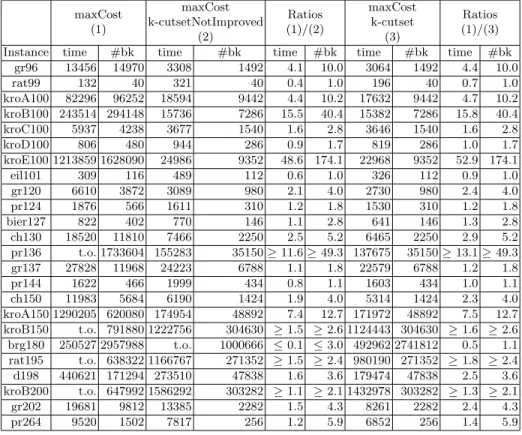
We present the results in tables. Each of them reports the solving time in milliseconds. Timeout (t.o) is set at 30 minutes. The number of backtracks is denoted by #bk. Tables include a column expressing the ratio of solving time and number of backtracks.
maxCost (1) maxCost k-cutsetNotImproved (2) Ratios (1)/(2) maxCost k-cutset (3) Ratios (1)/(3) Instance time #bk time #bk time #bk time #bk time #bk
gr96 13456 14970 3308 1492 4.1 10.0 3064 1492 4.4 10.0 rat99 132 40 321 40 0.4 1.0 196 40 0.7 1.0 kroA100 82296 96252 18594 9442 4.4 10.2 17632 9442 4.7 10.2 kroB100 243514 294148 15736 7286 15.5 40.4 15382 7286 15.8 40.4 kroC100 5937 4238 3677 1540 1.6 2.8 3646 1540 1.6 2.8 kroD100 806 480 944 286 0.9 1.7 819 286 1.0 1.7 kroE100 1213859 1628090 24986 9352 48.6 174.1 22968 9352 52.9 174.1 eil101 309 116 489 112 0.6 1.0 326 112 0.9 1.0 gr120 6610 3872 3089 980 2.1 4.0 2730 980 2.4 4.0 pr124 1876 566 1611 310 1.2 1.8 1530 310 1.2 1.8 bier127 822 402 770 146 1.1 2.8 641 146 1.3 2.8 ch130 18520 11810 7466 2250 2.5 5.2 6465 2250 2.9 5.2 pr136 t.o. 1733604 155283 35150 ≥ 11.6 ≥ 49.3 137675 35150 ≥ 13.1 ≥ 49.3 gr137 27828 11968 24223 6788 1.1 1.8 22579 6788 1.2 1.8 pr144 1622 466 1999 434 0.8 1.1 1603 434 1.0 1.1 ch150 11983 5684 6190 1424 1.9 4.0 5314 1424 2.3 4.0 kroA150 1290205 620080 174954 48892 7.4 12.7 171972 48892 7.5 12.7 kroB150 t.o. 791880 1222756 304630 ≥ 1.5 ≥ 2.6 1124443 304630 ≥ 1.6 ≥ 2.6 brg180 250527 2957988 t.o. 1000666 ≤ 0.1 ≤ 3.0 492962 2741812 0.5 1.1 rat195 t.o. 638322 1166767 271352 ≥ 1.5 ≥ 2.4 980190 271352 ≥ 1.8 ≥ 2.4 d198 440621 171294 273510 47838 1.6 3.6 179474 47838 2.5 3.6 kroB200 t.o. 647992 1586292 303282 ≥ 1.1 ≥ 2.1 1432978 303282 ≥ 1.3 ≥ 2.1 gr202 19681 9812 13385 2282 1.5 4.3 8261 2282 2.4 4.3 pr264 9520 1502 7817 256 1.2 5.9 6852 256 1.4 5.9
Table 1. Improvement of k-cutset filtering.
Table 1 shows the performance of adding k-cutset filtering to the WCC. This table is composed of three main columns (1, 2 and 3) showing the following results respectively: WCC without k-cutset filtering, WCC with k-cutset filtering
without the improvement proposed in 4.2 and k-cutset improved filtering. A static strategy such as maxCost, selecting arcs by decreasing costs allows us to compare the performance of the filtering without any disruption due to the strategy. These results show that using structural filtering is very interesting. For example, the search space of pr136 has been reduced by a factor of 49.3 and its solving time by a factor of 11.6 if the improvement proposed in 4.2 is not considered, by a factor of 13.1 otherwise. Indeed, the number of backtracks is generally reduced by a large factor (mean equal to 14.4, geometric mean equal to 4.3), which allows a good reduction in solving time (mean equal to 5.3, geometric mean equal to 2.4). The improvement allows the results to be refined by further improving the solving times.
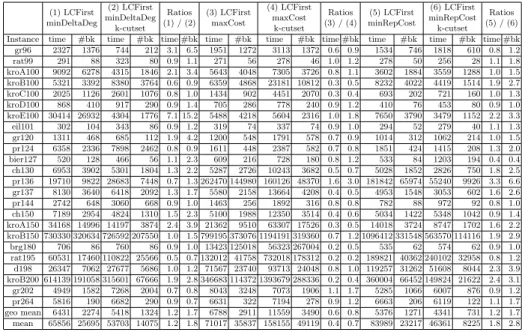
We are now considering different strategies, including LCFirst maxCost in-troduced by Fages et al. [5]. It keeps one of its two extremities for the last branching edge and selects the edges from the neighborhood of the kept node by decreasing costs. It is currently considered the best current strategy for resolving the TSP in CP. (1) LCFirst minDeltaDeg (2) LCFirst minDeltaDeg k-cutset Ratios (1) / (2) (3) LCFirst maxCost (4) LCFirst maxCost k-cutset Ratios (3) / (4) (5) LCFirst minRepCost (6) LCFirst minRepCost k-cutset Ratios (5) / (6) Instance time #bk time #bk time #bk time #bk time #bk time #bk time #bk time #bk time #bk gr96 2327 1376 744 212 3.1 6.5 1951 1272 3113 1372 0.6 0.9 1534 746 1818 610 0.8 1.2 rat99 291 88 323 80 0.9 1.1 271 56 278 46 1.0 1.2 278 50 256 28 1.1 1.8 kroA100 9092 6278 4315 1846 2.1 3.4 5643 4048 7305 3726 0.8 1.1 3602 1884 3559 1288 1.0 1.5 kroB100 5321 3392 8380 3764 0.6 0.9 6359 4868 23181 10812 0.3 0.5 8232 4022 4419 1514 1.9 2.7 kroC100 2025 1126 2601 1076 0.8 1.0 1434 902 4451 2070 0.3 0.4 693 202 721 160 1.0 1.3 kroD100 868 410 917 290 0.9 1.4 705 286 778 240 0.9 1.2 410 76 453 80 0.9 1.0 kroE100 30414 26932 4304 1776 7.1 15.2 5488 4218 5604 2316 1.0 1.8 7650 3790 3479 1152 2.2 3.3 eil101 302 104 343 86 0.9 1.2 319 74 337 74 0.9 1.0 294 52 279 40 1.1 1.3 gr120 1311 468 685 112 1.9 4.2 1200 548 1791 578 0.7 0.9 1014 312 1062 214 1.0 1.5 pr124 6358 2336 7898 2462 0.8 0.9 1611 448 2387 582 0.7 0.8 1851 424 1415 208 1.3 2.0 bier127 520 128 466 56 1.1 2.3 609 216 728 180 0.8 1.2 533 84 1203 194 0.4 0.4 ch130 6953 3902 5301 1804 1.3 2.2 5287 2726 10243 3682 0.5 0.7 5028 1852 2826 750 1.8 2.5 pr136 19710 9822 28683 7448 0.7 1.3 262470 144980 160126 48370 1.6 3.0 181842 65974 55240 9926 3.3 6.6 gr137 8130 3640 6418 2092 1.3 1.7 5580 2158 13664 4208 0.4 0.5 4953 1548 3053 602 1.6 2.6 pr144 2742 648 3060 668 0.9 1.0 1463 256 1892 316 0.8 0.8 782 88 972 92 0.8 1.0 ch150 7189 2954 4824 1310 1.5 2.3 5100 1988 12350 3514 0.4 0.6 5034 1422 5348 1042 0.9 1.4 kroA150 34168 14996 14197 3874 2.4 3.9 21362 9510 63307 17526 0.3 0.5 14018 3724 8747 1702 1.6 2.2 kroB150 730330 320634 726592 207550 1.0 1.5 799195 373076 1194191 319360 0.7 1.2 1096412 331548 563570 114116 1.9 2.9 brg180 706 86 760 86 0.9 1.0 13423 125018 56323 267004 0.2 0.5 535 62 574 62 0.9 1.0 rat195 60531 17460 110822 25566 0.5 0.7 132012 41758 732018 178312 0.2 0.2 189821 40362 240102 32958 0.8 1.2 d198 26347 7062 27677 5686 1.0 1.2 71567 23740 93713 24048 0.8 1.0 119257 31262 51608 8044 2.3 3.9 kroB200 614139 191058 315601 67666 1.9 2.8 346683 114372 1393679 288336 0.2 0.4 360004 66452 149824 21622 2.4 3.1 gr202 4949 1582 7268 2004 0.7 0.8 8043 3248 7073 1906 1.1 1.7 5285 1066 6007 876 0.9 1.2 pr264 5816 190 6682 290 0.9 0.7 6631 322 7194 278 0.9 1.2 6663 206 6119 122 1.1 1.7 geo mean 6431 2274 5418 1324 1.2 1.7 6788 2911 11559 3490 0.6 0.8 5376 1271 4341 731 1.2 1.7 mean 65856 25695 53703 14075 1.2 1.8 71017 35837 158155 49119 0.4 0.7 83989 23217 46361 8225 1.8 2.8
Table 2. Dynamic strategies.
Surprisingly, Table 2 shows that the k-cutset filtering is not interesting for the LCFirst maxCost strategy. The fact is that for the selected instances, the geometric mean of the solving times increases from 6788ms to 11559ms when k-cutset filtering is used. From our experiments, the strategy seems very ad hoc in regards to the propagator of the WCC constraint and in particular to
the Lagrangian relaxation. It seems to partially correct the lack of structural constraints of the WCC. However, Fages et al. [5] have proposed other strategies: LCFirst minDeltaDeg and LCFirst minRepCost, with performances comparable to LCFirst maxCost. The strategy LCFirst minRepCost is more suited to our model. It consists in selecting the edges by increasing replacement costs [2] with the LCFirst policy. This strategy has a slightly better sensitivity to the addition of k-cutset filtering and has the advantage of being generally more efficient. Indeed, between LCFirst minDeltaDeg and LCFirst minRepCost, we notice that when the k-cutset filtering is present, the geometric mean of the solving time of LCFirst minDeltaDeg is 5418 while that of LCFirst minRepCost is 4341, which is approximately 25% better. LCFirst minRepCost shows a significant reduction of the search space and a smaller reduction of the reduction time. For example, kroB200 gains a factor of 2.4 on solving time and a factor of 3.1 on the size of the search space.
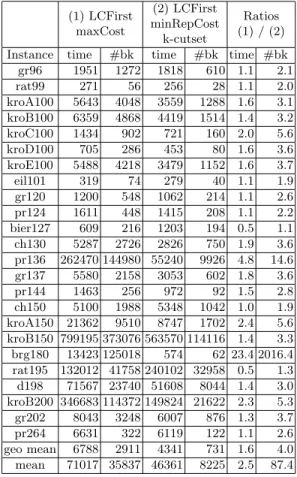
(1) LCFirst maxCost (2) LCFirst minRepCost k-cutset Ratios (1) / (2) Instance time #bk time #bk time #bk
gr96 1951 1272 1818 610 1.1 2.1 rat99 271 56 256 28 1.1 2.0 kroA100 5643 4048 3559 1288 1.6 3.1 kroB100 6359 4868 4419 1514 1.4 3.2 kroC100 1434 902 721 160 2.0 5.6 kroD100 705 286 453 80 1.6 3.6 kroE100 5488 4218 3479 1152 1.6 3.7 eil101 319 74 279 40 1.1 1.9 gr120 1200 548 1062 214 1.1 2.6 pr124 1611 448 1415 208 1.1 2.2 bier127 609 216 1203 194 0.5 1.1 ch130 5287 2726 2826 750 1.9 3.6 pr136 262470 144980 55240 9926 4.8 14.6 gr137 5580 2158 3053 602 1.8 3.6 pr144 1463 256 972 92 1.5 2.8 ch150 5100 1988 5348 1042 1.0 1.9 kroA150 21362 9510 8747 1702 2.4 5.6 kroB150 799195 373076 563570 114116 1.4 3.3 brg180 13423 125018 574 62 23.4 2016.4 rat195 132012 41758 240102 32958 0.5 1.3 d198 71567 23740 51608 8044 1.4 3.0 kroB200 346683 114372 149824 21622 2.3 5.3 gr202 8043 3248 6007 876 1.3 3.7 pr264 6631 322 6119 122 1.1 2.6 geo mean 6788 2911 4341 731 1.6 4.0 mean 71017 35837 46361 8225 2.5 87.4
Table 3 underlines the interest of using a structural filtering such as the k-cutset filtering. In comparison to the state of the art, we reduced the size of the search space for most instances by a very significant factor in order to obtain an improvement in solving time. There is a huge gain (solving time improved by 23.4) for the problem brg180. If we exclude this problem we improve the mean of the solving times by a factor of 1.5 and the mean of the number of backtracks by a factor of 3.6. The number of backtracks is reduced for each instance. The solving time is improved for 92% of the instances.
Note that the interaction of the k-cutset filtering with Lagrangian relaxation is not clear (the WCC is built around Lagrangian relaxation), a more in-depth study will have to be conducted to better understand it. Adding filtering can then disrupt the convergence of the latter and sometimes slow it down [10]. This explains why the gain factor of the number of backtracks is always much higher than that of the solving time.
6
Conclusion
We introduced a new structural constraint in the WCC based on the search for k-cutsets in the graph. The experimental results show the interest of our approach in practice. We observed that the number of backtracks is reduced by an order of magnitude depending on the chosen strategy and resolution times are significantly improved. The interactions between this constraint and the research strategy, as well as between this constraint and the Lagrangian model of the WCC, deserve further study.
7
Acknowledgements
We would like to thank Pr. Tsin for sending us his 2-cutset search algorithm implementation.
References
1. Applegate, D.L., Bixby, R.E., Chvatal, V., Cook, W.J.: The traveling salesman problem: a computational study. Princeton university press (2006)
2. Benchimol, P., R´egin, J.C., Rousseau, L.M., Rueher, M., van Hoeve, W.J.: Im-proving the held and karp approach with constraint programming. In: Lodi, A., Milano, M., Toth, P. (eds.) Integration of AI and OR Techniques in Constraint Pro-gramming for Combinatorial Optimization Problems. pp. 40–44. Springer Berlin Heidelberg, Berlin, Heidelberg (2010)
3. Cohen, N., Coudert, D.: Le d´efi des 1001 graphes. Interstices (Dec 2017), https://hal.inria.fr/hal-01662565
4. Ducomman, S., Cambazard, H., Penz, B.: Alternative filtering for the weighted circuit constraint: Comparing lower bounds for the tsp and solving tsptw. In: AAAI (2016)
5. Fages, J.G., Lorca, X., Rousseau, L.M.: The salesman and the tree: the importance of search in cp. Constraints 21(2), 145–162 (2016)
6. Haythorpe, M.: Fhcp challenge set: The first set of structurally difficult instances of the hamiltonian cycle problem (2019)
7. Held, M., Karp, R.M.: The traveling-salesman problem and minimum spanning trees. Operations Research 18(6), 1138–1162 (1970)
8. Held, M., Karp, R.M.: The traveling-salesman problem and minimum spanning trees: Part ii. Mathematical Programming 1(1), 6–25 (1971)
9. Reinelt, G.: Tsplib—a traveling salesman problem library. ORSA Journal on Com-puting 3(4), 376–384 (1991)
10. Sellmann, M.: Theoretical foundations of cp-based lagrangian relaxation. In: Prin-ciples and Practice of Constraint Programming - CP 2004, 10th International Con-ference, CP 2004, Toronto, Canada, September 27 - October 1, 2004, Proceedings. pp. 634–647 (2004)
11. Tarjan, R.E.: A note on finding the bridges of a graph. Inf. Process. Lett. 2, 160– 161 (1974)
12. Tarjan, R.E.: Data Structures and Network Algorithms. CBMS-NSF Regional Con-ference Series in Applied Mathematics (1983)
13. Tsin, Y.H.: Yet another optimal algorithm for 3-edge-connectivity. Journal of Dis-crete Algorithms 7(1), 130 – 146 (2009), selected papers from the 1st International Workshop on Similarity Search and Applications (SISAP)
14. Yeh, L.P., Wang, B.F., Su, H.H.: Efficient algorithms for the problems of enumer-ating cuts by non-decreasing weights. Algorithmica 56(3), 297–312 (2010)