HAL Id: hal-00916293
https://hal.inria.fr/hal-00916293
Submitted on 10 Dec 2013
HAL is a multi-disciplinary open access
archive for the deposit and dissemination of
sci-entific research documents, whether they are
pub-lished or not. The documents may come from
teaching and research institutions in France or
abroad, or from public or private research centers.
L’archive ouverte pluridisciplinaire HAL, est
destinée au dépôt et à la diffusion de documents
scientifiques de niveau recherche, publiés ou non,
émanant des établissements d’enseignement et de
recherche français ou étrangers, des laboratoires
publics ou privés.
Declarative Scheduling for Active Objects
Ludovic Henrio, Justine Rochas
To cite this version:
Ludovic Henrio, Justine Rochas. Declarative Scheduling for Active Objects. SAC 2014 - 29th
Sym-posium On Applied Computing, ACM Special Interest Group on Applied Computing, Mar 2014,
Gyeongju, South Korea. pp.1-6. �hal-00916293�
Declarative Scheduling for Active Objects
Ludovic Henrio
Justine Rochas
Univ. Nice Sophia Antipolis, CNRS, I3S, UMR 7271 06900 Sophia Antipolis, France
[email protected], [email protected]
ABSTRACT
Active objects are programming constructs that abstract dis-tribution and help to handle concurrency. In this paper, we extend the multiactive object programming model to offer a priority specification mechanism. This mechanism allows programmers to have control on the scheduling of requests. The priority representation is based on a dependency graph which makes it very convenient to use. This article shows how to use this mechanism from the programmer side, and exposes the main properties of the dependency graph. The software architecture of our implementation is also presented, as it can be applied to various scheduling systems. Finally, we validate our approach through a microbenchmark that shows that the overhead of our priority representation is rather low. On the whole, we provide a general pattern to introduce a prioritized scheduling in active objects or in any other con-current systems. The resulting framework is shown to be fine-grained, user-friendly, and efficient.
Categories and Subject Descriptors
D.1.3 [Programming Techniques]: Concurrent Programming; D.3.2 [Language Classification]: Concurrent, Distributed, and Parallel Languages
General Terms
Languages, Design
Keywords
concurrency, active objects, priority scheduling, annotations
1.
INTRODUCTION
The active object programming model [10] aims to facili-tate the writing of distributed applications. It mainly pro-vides asynchronous remote method calls and mechanisms to prevent data races inside an active object. Several imple-mentations of active objects came out with different ways of
Permission to make digital or hard copies of all or part of this work for personal or classroom use is granted without fee provided that copies are not made or distributed for profit or commercial advantage and that copies bear this notice and the full citation on the first page. To copy otherwise, to republish, to post on servers or to redistribute to lists, requires prior specific permission and/or a fee.
SAC’14March 24-28, 2014, Gyeongju, Korea.
Copyright 2014 ACM 978-1-4503-2469-4/14/03 ...$15.00.
handling concurrency and execution of requests. Some im-plementations, like Creol [9], offer release points that can be used to make requests progress in an interleaved manner. Then, this concept has been extended to groups of objects instead of objects, such as in JCoBox [13] or in ABS [8]. Other implementations like ASP [3] enforce a strict sequential exe-cution of requests. to prevent interleaved exeexe-cutions.
However, all these models do not take advantage of mul-ticore architectures as they are intrinsically mono-threaded. To overcome this problem and to increase the applicability of active-object oriented programming, recent extensions of existing models have been designed. In the context of ac-tors [2], Parallel Actor Moniac-tors [14] introduce schedulers that are pluggable to an actor[2, 4], and that can manage parallel execution of requests. Also, an extension of the ac-tive object model, called multiacac-tive objects [7], enables local parallelism at the request level without giving up simplic-ity and safety provided by active objects: programmers can declare which requests can be run in parallel through a cus-tomized specification language. In this paper, we enhance the coordination capabilities of the multiactive object program-ming model by introducing a simple way to specify priority of execution within a multiactive object, still in a declara-tive fashion. Programmers are thus able to assign priorities to requests, in order to influence on the internal scheduling of multiactive objects. For that, we introduce a mini meta-language that relies on annotations. Internally, we represent the priorities using a dependency graph, a structure that is well adapted to represent a partial order, and that is well suited for priorities. Our annotation-based language is easy to program and intuitive; still it gives a fine-grain control on the request scheduling, and this paper also shows a mi-crobenchmark proving its efficiency.
The paper is organized as follows. Section 2 presents the background, especially the multiactive object programming model. Section 3 introduces our graph-based priority spec-ification mechanism with its main properties. Section 4 ex-poses the general software architecture of our implementa-tion. Section 5 shows a microbenchmark that evaluates the performance of the priority graph representation. Section 6 compares our work with existing mechanisms which can pro-vide scheduling controls in active objects.
2.
MULTIACTIVE OBJECTS
The multiactive object programming model [7] enables re-quest parallelism within an active object: several rere-quests can progress at the same time. This is different from the coopera-tive not preempcoopera-tive scheduling offered by some accoopera-tive object
@DefineGroups ({
@Group ( name =" group1 " , selfCompatible = true ), @Group ( name =" group2 " , selfCompatible = false ) })
@DefineRules ({
@Compatible ({ " group1 " , " group2 " }) })
public class MyClass { @MemberOf (" group1 ") public ... method1 (...) { ... } @MemberOf (" group2 ") public ... method2 (...) { ... } ... }
Figure 1: Example of annotated class
languages [8, 9] because with those, only one request is al-lowed to progress at a time, to prevent data race-conditions. Oppositely, the goal of multiactive objects is to take advan-tage of multicore architectures. Multiactive objects aim at keeping the benefits of active objects in terms of ease of pro-gramming and safety of execution, while introducing a true parallelism in a simple and controlled way. For that, they rely on a meta language in order to specify which requests can safely be executed concurrently. Programmers can use this language to define requests that are compatible for concur-rent execution. In practice, methods of a multiactive object have to be partitioned into groups and then, compatibility can be specified for those groups. Groups are meant to provide a coarser granularity than requests to express execution com-patibility. The way to form groups is left to programmers: one can choose to group methods that are semantically re-lated while another would rather keep the number of groups the smallest possible.
The specific language we propose has been developed us-ing the Java annotation mechanism. Annotations are pro-cessed at runtime to decide whether a request can be executed in parallel with others, request compatibility could even be decided at runtime (e.g. depending on request parameters). Figure 1 shows how we can annotate a regular Java class to allow an active object to process several requests in parallel. In this example, we use firstly the @DefineGroups annota-tion to define two groups, named group1 and group2. Sec-ondly, the @DefineRules annotation specifies which groups are compatible together, i.e. which requests are allowed to be run in parallel with which others. Thirdly, in the class body, method1 is assigned to group1 thanks to the @MemberOf annotation. The same pattern is applied to method2. A few lines of such annotations enables significant speedup at the application level, thanks to multi-processing of requests.
To efficiently execute requests according to the defined compatibilities, multiactive objects enforce an adapted First In
First Outpolicy with possibility to overtake. More precisely,
a request that is waiting in the reception queue is executed if it is compatible with:
– All requests that are currently executing, and – All requests that are before in the reception queue. Any request that satisfies those two conditions is said to be ready to execute; it can be immediately executed in a new thread. Note that, if we execute the second request before the first one, then this second request will not prevent the first one from executing since they are compatible. Also, to avoid killing the whole performance by creating too many threads on the fly, the number of threads that run at the same time can be limited, again through an annotation. In
Figure 2: The internal queues of a multiactive object this case, multiactive objects rely on a fixed thread pool to execute requests. As a consequence of this limit, requests that are ready to execute might wait if all available threads are busy. Those requests that are ready to execute but that cannot be executed because of lack of threads form a new queue that we call the ready queue, in opposition with the reception
queuethat contains requests that are not ready to be served
(for incompatibility reasons).This mechanism is pictured on Figure 2. Improving the scheduling of requests in the ready queue is necessary to optimize request executions, and adapt it to the needs of programmers.
3.
GRAPH-BASED PRIORITIES
3.1
Presentation
Multiactive objects enable multi-threading within an active object. While this model is convenient for running multiple requests in parallel, it does not enable a particular scheduling other than First Compatible First Out, as explained in Sec-tion 2. Defining a priority relaSec-tionship between requests would greatly improve the efficiency by reducing the re-sponse time of important requests. We define a priority rela-tionship as the fact that requests having a high priority can overtake requests which have a low priority. To implement this scheduling mechanism, we must address two questions: “how can the programmer specify the priorities?” and “how to internally represent the priorities?”
To specify the priorities, we propose dedicated annotations that benefit from the simplicity of a declarative mechanism, and are consistent with the existing programming model. To internally represent the priorities, we have developed a model based on a dependency graph. The motivation of this representation is that it can express a partial order, whereas a representation based on integers to represent priority would result in a total ordering of requests. Another major problem problem with the integer-based approach is that the program-mer is bothered with the internal representation of priorities, having to take into account all the values previously assigned before defining a new one. Instead, we propose to specify the priorities by establishing a dependency between request groups. The internal representation of priorities is not ex-posed to the user, making the annotations higher level, and therefore, easier to use. Internally, we maintain a graph rep-resentation where nodes represent groups and directed edges represent the priority relation.
The new annotations we have developed are defined as follows. First, the @DefinePriorities annotation contains several chains of dependencies, each of them defined in a
@PriorityOrderannotation. A @PriorityOrder annotation
contains a sequence of sets of groups, each defined in a @Set annotation. A @Set annotation can contain several request groups that have the same position in the graph; the next set in the sequence has a lower priority than the previous one.
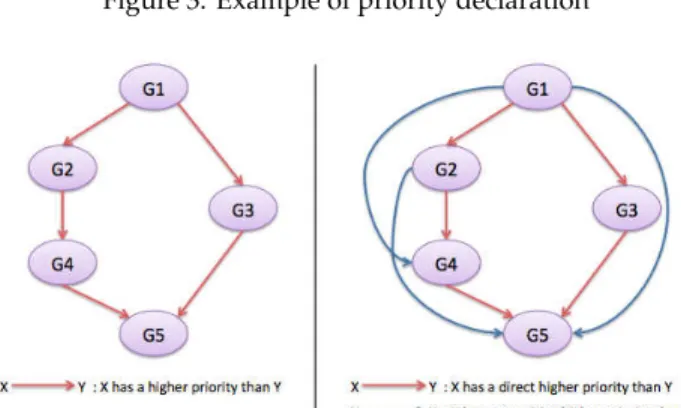
@DefinePriorities ({ @PriorityOrder ({ @Set ( groupNames = {" G1 "}) , @Set ( groupNames = {" G2 "}) , @Set ( groupNames = {" G4 "}) , @Set ( groupNames = {" G5 " }) }) , @PriorityOrder ({ @Set ( groupNames = {" G1 "}) , @Set ( groupNames = {" G3 "}) , @Set ( groupNames = {" G5 " }) }) })
Figure 3: Example of priority declaration
Figure 4: Graph of Figure 3 and its transitive closure An example of priority declaration is given on Figure 3, and the corresponding graph is depicted on Figure 4. In this graph, we prioritize five groups of requests. In particular, we specify that G1 has the highest priority and that G5 has the lowest priority. We can notice in this graph that group G3 is not related with group G2 nor group G4. Indeed, those groups do not belong to the same dependency tree, as can be seen on Figure 4. Note that there are several ways to define the same dependency graph. This model is very flexible because it is easy to add new priorities, independently from the priorities previously defined.
3.2
Scheduling policy and properties
When using priorities, the scheduling policy applied in multiactive objects depends on one main information: Can a request overtake another one when it is inserted in the ready queue. This information lies on the graph itself. In this section, we first introduce the main properties of the graph to be able to express the insertion process afterwards.
Construction. We ensure that the dependency graph contains
no cycle by construction. When a dependency is processed, if it introduces a cycle in the graph, we do not add the de-pendence; the execution is not stopped but an error message outputs. Also, in the graph, each group belongs to a single node. When a dependency is added, we first check whether a node labeled with this request group is already in the graph. If such a node exists, we only add edges to the graph, else we also add a node for the new group.
Notations. Here are the notations we use in the following. – A request is generally denoted R, a group G and the
ready queue Q.
– We start from a dependency graph defining a priority relation between groups, denoted with the relation −→, whose operands are nodes of the graph.
– In the graph, reachability is denoted −→+. G
1 −→+G2
means that there exists a directed path from the group
G1to the group G2. −→+is the transitive closure of −→.
In other words, G1−→+G2means that group G1has a
higher priority than group G2.
Overtakability. The main information we want to extract
from the graph is whether a request can overtake another one. This information lies in the dependency graph.
– A request of group G1can overtakea request of group G2
if and only if G1 −→+G2, i.e. if there is a directed path
from G1to G2.
– A request of group G1 has no priority relation with a
request of group G2if ¬ G1 −→+G2 ∧ ¬G2 −→+G1,
i.e. if there is no directed path from G1 to G2 and no
directed path from G2 to G1; this is denoted G1//G2.
Note that, for any group G, G//G.
Consequently, G1 cannot overtake G2 if either G1//G2 or
G2−→+G1.
Insertion. When a new request is inserted in the ready queue, overtakability properties are used to determine the position of the new request. An incoming request of group G must be inserted in the ready queue just before the first request whose group can be overtaken by the group G. More precisely, considering an incoming request R belonging to group G,
and a ready queue made of R1,R2, ...,Rnbelonging to groups
G1,G2, ...,Gn, R is inserted just before the smallest Risuch that
G −→+
Gi, or at the end of the queue if no such Ri exists.
More formally, we define the insertion process as follows: Definition 1 (Insertion process). Suppose group(R) = G, Q =[R1, ...,Rn], and ∀i ∈ 1..n, group(Ri) = Gi
if ∀i, Gi−→+G ∨ G // Gi, then insert(R, Q) = [R1, ...Rn,R]
else let j = min(i | G −→+
Gi) in
insert(R, Q) = [R1, ...,Rj−1,R, Rj, ...,Rn]
Considering this insertion process, the ready queue is al-ways ordered according to the overtakability relationship:
Property 1 (Ready queue ordering). The ready queue is
always ordered such that if i ≤ j, then Gi−→+Gjor Gi//Gj
We prove this property by checking that it is maintained both when a request is inserted by the insertion process, and when the first request is removed from the ready queue.
To sum up, the reordering of requests in the ready queue re-lies on the possibility that one request overtakes another one. This knowledge is provided by the dependency group, which is expressed by simple annotations giving a priority order be-tween request groups. Potentially, at each request insertion, the whole graph must be explored for each request in the ready queue. Although our approach is very expressive, the graph exploration during the insertion process might lead to a performance problem if the graph is large; this strongly de-pends on the way we internally represent the graph. Section 5 will finally measure the performance of our solutions.
3.3
Internal representation enhancement
To address the potential performance problem, we have developed an enhanced version of the graph-based priority representation that allows us to quicken the insertion process relatively to a naive graph exploration. From the priority graph, we compute its transitive closure. This graph of tran-sitive closure can be seen as a binary matrix that stores all the possible combinations of overtakability. In this matrix M, of size NxN where N is the number of nodes, we store a
Figure 5: Multiactive object classes with scheduling
positive value in M[n1][n2] if there exists an edge from n1to
n2in the transitive closure of the priority graph. To speed up
the insertion process, we access the matrix entries instead of exploring the graph. Both the priority graph and the matrix is built once, when the annotations are processed, and used the whole execution time.
The only drawback of the matrix representation, compared to the graph structure, is the memory used. There are exactly
N2entries in the matrix instead of N nodes for the graph plus
N ×(N + 1)/2 edges maximum (most of the time much less).
This can be a problem if there exists a lot of groups since the graph must be kept in memory the whole execution time. In practice, the number of methods of an active objects that are remotely invoked (and subject to priority ordering) is rather small because of the cost/benefit of communication time in a distributed environment. Still, if there is actually a lot of groups, one can choose to turn off the matrix optimization and use the plain graph. A better representation of the ma-trix could also be used. Choosing the right representation is indeed a trade off between time performance and memory space; however, we never had to make such a choice in our first experiments.
4.
SOFTWARE ARCHITECTURE
This section describes the overall architecture we imple-mented to schedule requests according to priorities in the multiactive object framework. It illustrates how we imple-ment a request selection and how we apply a scheduling mechanism based on code annotations from the program-mer. A multiactive object embeds an object of type Multiac-tiveService. The MultiactiveService has two purposes. First, it relies on an AnnotationProcessor that reads anno-tations and initializes all the structures required by a multi-active object; these structures store compatibilities, priorities, and threads. Second, the MultiactiveService has a
Reques-tExecutorthat schedules requests according to
compatibili-ties, prioricompatibili-ties, and available threads. For that, the
Reques-tExecutorrelies on managers, that are
CompatibilityMan-ager, PriorityManCompatibilityMan-ager, and ThreadManager. The manager classes can access the structures that store the information processed from the annotations; they also use dynamic struc-tures (the trackers). Figure 5 shows an UML diagram describ-ing the class composition of multiactive objects and the most important interfaces.
On one hand, the RequestExecutor has access to the man-ager interfaces. On the other hand, each entity manages its
own state internally. More precisely, to execute requests, the RequestExecutor first filters incoming requests using the CompatibilityManager. Among ready requests, a second fil-ter is applied using the PriorityManager, that sends back a list of requests that have the highest priority. Then, the fi-nal decision regarding the execution of a request depends on the ThreadManager, that knows if some threads are available. After applying those three filters sequentially, remaining re-quests are the ones that are actually executed.
The PriorityTracker contains the ready queue; it adheres to the Producer/Consumer design pattern. On one hand, a dedicated thread registers compatible requests to the ready queue. On the other hand, another dedicated thread polls the ready queue to retrieve highest priority requests. This syn-chronization is implemented using Java concurrency mech-anisms, and is totally hidden from programmers. When a request is registered to the ready queue, the
PriorityStruc-tureinterface is queried to know where the request must be
inserted. The concrete PriorityStructure used for that can be either our dependency graph (PriorityGraph), or other priority representations if needed (for example here, Prior-ityInteger). A concrete PriorityStructure must imple-ment the canOvertake(request1, request2) method that says whether a request can be executed before another one. In the PriorityGraph case, either the canOvertake method goes through the graph to retrieve this information, or it sim-ply checks the overtakability matrix if this feature is enabled. This design can easily be adapted to other implementations of active objects, provided that the language they rely on supports annotation processing and reflexivity.
5.
EXPERIMENTAL EVALUATION
5.1
Environment
In this section, we present a microbenchmark evaluating the general overhead of priorities. It is run on a single ma-chine because, even though the objective of active objects is to ease distributed programming, our priority mechanism ap-plies at the level of a single active object. Priorities contribute to the efficiency of local parallelism, not to the efficiency of distributed execution.
The machine used to run our experiments has four 4-core Intel Core Q6600 processors and 8GB of memory. Experi-ments are run using a Java 7 virtual machine. We developed our experiment using the EventCloud platform [12] because it provides an API to easily run multiactive objects. The EventCloud platform relies on the multiactive version of the ProActive middleware [1]. We have modified ProActive to introduce our scheduling mechanisms; we have then used this customized version as a basis of EventCloud. The gen-eral process of the microbenchmark is the following. We first create and run a single multiactive object. Then, we send requests to it and we record relevant metrics using logging mechanisms.
5.2
Overhead of priorities
We show here a test case where the graph of priorities is not trivial. Our objective is to evaluate the average insertion time of a request in the ready queue, i.e. the overhead of priorities. On top of the test class, we define ten groups using the @DefinePriorities annotation, from G1 to G10. Each of these groups has a single belonging request, from g1 to g10. All groups are declared compatible, otherwise, they
Figure 6: Dependency graph used for the microbenchmark would never be in the ready queue at the same time, and we could never apply priorities. The priority dependencies between them are declared using priority annotations; the corresponding graph is expanded on Figure 6.
We perform two runs with those annotations: one using the plain dependency graph, and one using the reachabil-ity matrix. Also, to evaluate the performance of both priorreachabil-ity representations compared to simpler approaches, we perform a third run with a third priority representation that we have implemented. It is based on integer ordering: instead of building a graph, we simply assign an integer to a group to represent its priority. Note that doing so is more restric-tive than expanding the priorities with a graph: the integer
ordering is total whereas the graph produces a partial order1.
In our test case, we sequentially send a request of each group in a predefined order. The chosen order is the following (with no particular meaning): g7, g1, g2, g9, g4, g10, g8, g3, g6, g5. Using a predefined sequence of requests allows us to have deterministic results while experimenting with all parts of the graph. We send 500 requests per group, so in total, 5000 requests are sent to the multiactive object. This test case follows a worst-case scenario in two senses. First, all requests have the smallest possible body, made at most of two instructions: a logging instruction and a return instruction. In practice, requests sent to a multiactive object should be long enough to be balanced with communication time. As a consequence, in practice, the performance of multiactive objects should be higher than in our experimental situation. Second, we intentionally block the execution until all requests we want to experiment are received and put in the ready queue. This way, we end up having a big ready queue, which again makes the scenario the worst possible. In brief, this microbenchmark tests the priority specification mechanism at its limits, and the performance can only be better in real cases.
As a first observation, to measure the overhead of the pri-ority mechanism, we compare it with the service time of an empty request. Even with the worst priority representation, the time to insert a request using the dependency graph is always below 10% of the minimal service time of a request when the ready queue contains less than 200 requests. This means that, considering the fact that the service time is the time we would pay anyway even if there was no priorities, managing the structures and all the mechanisms introduced for priorities is not costly compared to a priorityless approach. We evaluate the overhead that we pay in general when using the graph representation compared to the integer
rep-1We use one of the linear extensions of the graph of Figure 6
0 0.05 0.1 0.15 0.2 0.25 0.3 0.35 0-50 50-100 100-150 150-200 200-250 250-300 300-350 350-400 400-450 450-500 0 0.05 0.1 0.15 0.2 0.25 0.3 0.35 In serti on ti me (ms ) Request batch all priorities - graph all priorities - integer all priorities - graph with matrix
Figure 7: Average insertion time of requests resentation. We do not look specifically into the overhead of a given priority, but rather at the global overhead. For that, we average insertion times every 50 consecutive requests sent from the same group. Thus, we have 10 measurements per group, one for each stage of consecutive requests. We finally average the metrics of all groups for each stage. The results, displayed on Figure 7, correspond to the average insertion time of a request of any group. First of all, if we consider the run performed with the plain dependency graph and the run performed with the integer ordering, we can see that, as the queue gets bigger, the time to find the right position in the queue increases much more in the graph case. This is due to the fact that, at each request considered, we need to go through the graph to find (i) the group of the request to insert and (ii) the group of the request to consider, to know if the request to insert can overtake the considered request. Even if the overhead due to the priority mechanism is quite small, it is still more than twice higher than the overhead of the integer representation. However, thanks to the matrix representation, we managed to reach the same performance as the integer representation, because we reduce the over-takability problem to a fundamental operation (accessing a box of the matrix), as with the integer representation. It is thus possible to benefit from the ease of programming of the graph representation without requiring more time than the most efficient priority representation.
6.
RELATED WORKS
To provide control on the scheduling of requests in ac-tive objects, one classical approach is to design the acac-tive objects with a default scheduling policy and to propose to programmers to plug their own schedulers on top of it. In PAM [14], which is quite close to multiactive objects, a cus-tomized scheduler can be defined by the programmer and then plugged to any actor to control the scheduling of re-quests within it. In particular, if programmers want an actor to respond to a priority policy, the policy must be directly im-plemented in the scheduler definition, i.e. the entire priority queue must be implemented. In a similar way, ABS [8], which offers an active object implementation based on groups of ob-jects, named cogs, proposes to write customized schedulers and to plug them to active objects. However, this way to con-trol the scheduling of requests is fairly complex, as it requires programmers to write a significant part of the scheduling code, and to directly manipulate requests in the queue. Con-sequently, the expertise expected from programmers is high.
It is worth noting that, contrarily to what happens in actor programming [15, 5], our objective is not to allow an active object to treat thousands of messages per second because each message in our framework represents a communication between two remote machines. Also, we execute pure Java programs where each logical thread is a Java thread; thus a multiactive object is not meant to run thousands of threads in parallel, as context switching would be too costly.
JAC [6] is an extension of Java that decouples concurrency constructs from the application logic. Similarly to us, it uses annotations to deal with local concurrency but outside the context of active objects or actors. JAC offers a set of anno-tations to specify method compatibility for concurrent exe-cution. JAC also offers a @schedule annotation, placed on top of a method, in which programmers can define an addi-tional method that will be called just before the initial method call, to decide whether the initial method should actually be executed. The additional method has access to the list of wait-ing requests, which makes it possible to define fine-grained scheduling policies. Yet, accessing the list of waiting requests is quite low level.
Oppositely to the schedulers cited above, we introduce here a high level priority specification mechanism only based on a small set of declarative instructions, which is still very expressive. Programmers can thus focus on the design of their business code, and on the compatibility and priority relationship between requests. Our approach requires much less knowledge on the internal structure of active objects and requests than existing works.
Finally, the authors of [11] extended the possibilities of the Creol [9] active object language to be able to prioritize exe-cution of requests in a declarative fashion. This work is the closest to ours, request priorities can be defined both on the server side (upon a method definition) and on the client side (when calling the method). To decide the final priority of a particular request, the active object applies a deterministic function that takes into account both the method call prior-ity and the method definition priorprior-ity. Although this work introduce scheduling controls at a high level, it is still com-plex to use because programmers do not know right away the priority value of a request. In our approach, we chose to assign priorities on the server side only, to simplify the process and to avoid over-use of priorities on the client side. Our priorities are also highly connected to compatibilities, and compatibility is not covered by Creol as it does not sup-port multi-threading. Finally, the priority relation in Creol is based on integer ordering, whereas our priority definition is graph-based, and thus allows partial ordering.
7.
CONCLUSION
In this paper, we presented a way to control the schedul-ing within active objects by introducschedul-ing a declarative priority specification mechanism. The priorities allow programmers to control request scheduling within multiactive objects. As the mechanism relies on annotations, it is easy to assign pri-orities without having to code the intended behavior of the scheduler directly in the business code. Related works on high-level scheduling do not provide such an abstract speci-fication, or were fairly complex to use and required program-mers to know the internal mechanisms of active objects. In our work, we succeeded in providing a high level language to specify priority of execution, without asking programmers to directly manipulate requests. Our work is adapted to
mul-tiactive objects, the first active object model supporting both local multi-threading and large-scale distributed execution.
The priority specification mechanism we have developed relies on a dependency graph: when a group has a higher priority than another one, a dependency is created between them. This specification is easy to use and expressive, but requires time and processing resources. We showed that, provided a reachability matrix is used instead of a simple priority graph, we reach the same performance as a repre-sentation based on integer ordering, while the graph-based representation is more expressive. Consequently, we elab-orated a priority specification mechanism for active objects that is user-friendly, expressive, and also efficient.
8.
REFERENCES
[1] The Proactive middleware. proactive.inria.fr. [2] G. Agha. Actors: a model of concurrent computation in
distributed systems. MIT Press, Cambridge, MA, USA, 1986.
[3] D. Caromel, L. Henrio, and B. Serpette. Asynchronous sequential processes. Information and Computation, 2009. [4] J. Dedecker, T. Van Cutsem, S. Mostinckx, T. D’Hondt,
and W. De Meuter. Ambient-oriented programming in ambienttalk. ECOOP’06. Springer-Verlag.
[5] P. Haller and M. Odersky. Scala actors: Unifying thread-based and event-based programming. Theoretical Computer Science, 410(2-3):202–220, 2009. [6] M. Haustein and K.-P. Löhr. Jac: declarative java
concurrency. Concurrency and Computation: Practice and Experience, 2006.
[7] L. Henrio, F. Huet, and Z. István. Multi-threaded active objects. In C. Julien and R. De Nicola, editors,
COORDINATION’13, LNCS. Springer, June 2013. [8] E. Johnsen, R. Hähnle, J. Schäfer, R. Schlatte, and
M. Steffen. Abs: A core language for abstract behavioral specification. In B. Aichernig, F. Boer, and M. Bonsangue, editors, Formal Methods for Components and Objects, LNCS. Springer Berlin Heidelberg, 2012. [9] E. B. Johnsen, O. Owe, and I. C. Yu. Creol: A type-safe
object-oriented model for distributed concurrent systems. Theoretical Computer Science, 2006.
[10] R. G. Lavender and D. C. Schmidt. Active object: an object behavioral pattern for concurrent programming. In Pattern languages of program design 2. Addison-Wesley Longman Publishing Co., Inc., Boston, MA, USA, 1996. [11] B. Nobakht, F. S. de Boer, M. M. Jaghoori, and
R. Schlatte. Programming and deployment of active objects with application-level scheduling. SAC ’12. ACM, 2012.
[12] L. Pellegrino, F. Baude, and I. Alshabani. Towards a scalable cloud-based rdf storage offering a pub/sub query service. In CLOUD COMPUTING 2012.
[13] J. Schäfer and A. Poetzsch-Heffter. Jcobox: Generalizing active objects to concurrent components. In ECOOP 2010, LNCS. Springer Berlin Heidelberg.
[14] C. Scholliers, É. Tanter, and W. De Meuter. Parallel actor monitors: Disentangling task-level parallelism from data partitioning in the actor model. Science of Computer Programming, 2013.
[15] S. Srinivasan and A. Mycroft. Kilim: Isolation-typed actors for java. In J. Vitek, editor, ECOOP 2008, volume 5142 of LNCS. Springer.

![Figure 5: Multiactive object classes with scheduling positive value in M[n 1 ][n 2 ] if there exists an edge from n 1 to n 2 in the transitive closure of the priority graph](https://thumb-eu.123doks.com/thumbv2/123doknet/13212429.393365/5.918.107.411.82.311/figure-multiactive-classes-scheduling-positive-transitive-closure-priority.webp)