HAL Id: halshs-00174553
https://halshs.archives-ouvertes.fr/halshs-00174553
Submitted on 25 Sep 2007
HAL is a multi-disciplinary open access
archive for the deposit and dissemination of sci-entific research documents, whether they are pub-lished or not. The documents may come from teaching and research institutions in France or
L’archive ouverte pluridisciplinaire HAL, est destinée au dépôt et à la diffusion de documents scientifiques de niveau recherche, publiés ou non, émanant des établissements d’enseignement et de recherche français ou étrangers, des laboratoires
Sharing beliefs: between agreeing and disagreeing
Antoine Billot, Alain Chateauneuf, Itzhak Gilboa, Jean-Marc Tallon
To cite this version:
Antoine Billot, Alain Chateauneuf, Itzhak Gilboa, Jean-Marc Tallon. Sharing beliefs: between agree-ing and disagreeagree-ing. Econometrica, Econometric Society, 2000, pp.685-694. �halshs-00174553�
Sharing Beliefs: Between Agreeing and Disagreeing
By Antoine Billot, Alain Chateauneuf, Itzhak Gilboa, and Jean-Marc Tallon
11. introduction
When is it Pareto optimal for risk averse agents to take bets? Under what conditions do they choose to introduce uncertainty into an otherwise certain economic environment? One obvious case is where they do not share beliefs. As in the classical (theoretical) example of horse lotteries, people who do not agree on probability assessments do ¯nd it mutually bene¯cial to engage in uncertainty-generating trade.
If the agents involved are Bayesian expected utility maximizers and strictly risk averse, it is not hard to see that disagreement on probabili-ties is the only way that betting, understood as trade of an uncertain asset, may be Pareto improving when starting from a full insurance allocation. On the other hand, any such disagreement induces betting. Put di®erently, Pareto optimality dictates either that there be no betting (in case beliefs are common to all agents) or that there be betting (in case of disagreement). This is somewhat puzzling, because there is no lack of allocation-neutral, \sunspot" sources of uncertainty in the world around us. If every disagree-ment on probabilities of states of the world suggests a Pareto improving trade, one might have expected to see much more betting taking place.
Rather than believing that people who do not bet necessarily share prob-abilistic beliefs about anything they do not bet on (or, to be precise, share these beliefs up to some slack allowed by transaction costs), we tend to take the relative rarity of bets as a piece of empirical evidence against the Bayesian model. It seems that often people do not bet because they are uncertainty averse, and they therefore tend to avoid uncertainty that they know little about. It follows that a person's willingness to bet will increase with her subjective con¯dence in her information and in her likelihood as-sessments. It is worth emphasizing that Bewley's (1986) motivation for his work on Knightian decision theory was partly this absence of observed widespread betting.
While we do not attempt to argue that the full complexity of betting behavior can be explained by the type of models we study here,2 we are
led to ask, how much can be explained by these models if we relax some of the more demanding assumptions of the Bayesian model. Speci¯cally, we consider maxmin expected utility with a non-unique prior (Gilboa and Schmeidler (1989)) that captures Knightian uncertainty (Knight (1921)). Assume that such uncertainty averse agents who are also risk averse, give rise to an economy in which there is no aggregate risk. When does there exist full insurance, i.e., no-bet allocations that are also Pareto optimal? When is it the case that all Pareto optimal allocations are full insurance? Is any betting due to di®erent beliefs, and, conversely, does a di®erence in beliefs always trigger some betting?
function and a non-empty, closed and convex set of probability measures. The individual evaluates every act by its expected utility according to each possible probability measure, and chooses an act whose minimal expected utility is the highest. The family of preference relations described by this model strictly contains the relations described by Choquet expected utility with a convex capacity (see Schmeidler (1989)).
Consider now a pair of agents conforming to the multiple prior model. It is an easy extension of the expected utility analysis to show that these agents will not bet against one another if they share at least one prior. Moreover, in a general framework with more than two agents and complex bets possibly involving several of them, it is easy to show, following Dow and Werlang (1992) early intuition, that Pareto optimal allocations are indeed full insurance allocations whenever agents' sets of priors have a non-empty intersection (see, e.g., Tallon (1998), Dana (1998)).
The question of whether the converse to this result holds arises natu-rally: is commonality of beliefs, in the sense of agents sharing a prior in common, exactly what is needed to explain, within the framework of the multiple prior model, the absence of betting on the many possible sources of \extrinsic" uncertainty? Di®erently put, is the observation of a Pareto optimal allocation that is immune to sunspots enough to tell us something about the intersection of agents' sets of priors?
It turns out that we can answer this question a±rmatively and that the result in the Bayesian model has a conceptually identical counterpart in the multiple prior model. Under the same non-triviality conditions, there
exists a Pareto optimal full insurance allocation if and only if all Pareto optimal allocations provide full insurance, and this holds if and only if all agents share a prior probability on the states of the world. In other words, commonality of beliefs is the necessary and su±cient condition to explain the absence of betting. Whereas in the Bayesian model \sharing a prior" could only mean \having an identical prior," in the multiple prior model this phrase may be read as \having at least one prior in common." With this grammatical convention in place, the result holds verbatim.
Bayesian agents either agree on probability assessments, or disagree enough to bet against each other. By contrast, uncertainty averse agents can be in a \grey area" between agreeing and disagreeing: they may not agree in the sense of having the same set of possible priors, yet not disagree in the sense of being willing to bet against each other.
Finally, we emphasize another contribution of this note. In showing that commonality of beliefs is the minimal assumption explaining the absence of bets, we prove a separation theorem for n convex sets that might be of interest on its own.
The rest of this paper is organized as follows. Section 2 provides the set up of the model. In section 3 we state the main result and the separation theorem. Proofs are relegated to an appendix.
2. set-up
The economy we consider is a standard two-period pure-exchange econ-omy with uncertainty in the second period, but for agents' preferences. The state space is S, and § a ¾-algebra of subsets of S, so that (S; §) is a
measur-able state space. There are n agents indexed by subscript i. We assume (i) that there is only one good, which can be interpreted as income or money; and (ii) that there is no aggregate uncertainty. Trading an uncertain asset is thus interpreted as betting rather than as hedging. Let B(S; §) be the Ba-nach space of real-valued, bounded and measurable functions on S, endowed with the sup-norm. Let ba(S; §) be the space of bounded ¯nitely additive measures on (S; §) endowed with the weak?-topology. Agent i's consump-tion Ci, is a positive element of B(S; §), that is, Ci(s) is the consumption of
agent i in state s. Denote by w2 B(S; §) the constant-across-states aggre-gate endowment, and assume that w > 0. An allocation C = (C1; : : : ; Cn)
is feasible ifPni=1Ci = w. An allocation is interior if Ci(s) > 0 for all i, for
all s.
In the multiple-prior approach, each agent i is endowed with a utility index Ui : IR+ ! IR and a set Pi of probability distributions over S. Ui is
de¯ned up to a positive a±ne transformation, and is taken to be di®eren-tiable, strictly increasing and strictly concave. Pi is a convex and closed set
of ba(S; §). We assume that all priors inPi are ¾-additive.3Note thatPi is
compact in the weak?-topology since it is a weak?-closed subset of the set of
¯nitely-additive probability measures on §, which is compact in the weak? -topology (see, e.g., Dunford and Schwarz (1958)). The norm-dual of B(S; §) which is isometrically isomorphic to ba(S; §) will be denoted B?(S; §).
The overall utility function Vi de¯ned over B(S; §) then takes the
fol-lowing form:
Vi(Ci) = min ¼2Pi
We assume throughout that all priors are mutually absolutely continuous : 8A 2 §; 8i; j; 8¼i 2 Pi; 8¼j 2 Pj; ¼i(A) = 0() ¼j(A) = 0
This assumption essentially says that all agents agree on \null events". It is naturally satis¯ed if, say, the state space is ¯nite and all measures are strictly positive, or if all measures are absolutely continuous with respect to an underlying measure.
The last de¯nition we need is that of a full insurance allocation. An allocation C is said to be full insurance if it is constant apart from a set A 2 § that has ¼i(A) = 0 for some (and therefore, by the assumption of
mutual absolute continuity, for all) ¼i 2 Pi and i.4
3. the main result
The following theorem states that the set of Pareto optimal allocations and the set of full insurance allocations are either identical or disjoint. More-over, they are identical if and only if the agents share at least one prior.
Theorem 1 Under the maintained assumptions, the following assertions are equivalent:
(i) There exists an interior full insurance Pareto optimal allocation. (ii) Any Pareto optimal allocation is a full insurance allocation. (iii) Every full insurance allocation is Pareto optimal.
(iv) Tni=1Pi6= ;
follows. We prove that (iv) ) (ii) ) (iii) ) (i) ) (iv). If there is a common prior (iv), one can use strict concavity to show that a risk bearing allocation is Pareto dominated by the full insurance allocation that equals its expectation at every state, proving (ii).5 This step uses the mutual
ab-solute continuity assumption, as well as the assumption that the probability measures we deal with are ¾-additive (rather than only ¯nitely additive). Observe that with ¯nitely additive measures the implication (iv) ) (ii) does not hold, even in a Bayesian set-up. This is so because the integral of a function with respect to a ¯nitely additive measure may be strictly smaller than each of the values the function assumes. Therefore individuals who hold assets that they view as uncertain may not bene¯t from smooth-ing them across states. If every Pareto improvsmooth-ing allocation provides full insurance (ii), the converse (iii) also holds, since no two full insurance allo-cations can be Pareto ranked,6 and it follows trivially that there is at least
one such allocation (i). Finally, the crucial step and the main contribution of the theorem is that the existence of a full insurance Pareto optimal al-location (i) implies that there is a common prior (iv). This step does not require concavity of the utility index:7 In proving this last part we make
use of the following theorem, which generalizes the standard separating hy-perplane theorem, and may be of interest on its own. In the appendix we also comment on the geometric interpretation of this result which may be viewed as a separation theorem among n convex sets.
Theorem 2 Let X be a locally convex linear topological space and let
Pi µ X, 1 i n, be convex, non-empty, and compact. Then, the following
are equivalent: (i)Tni=1Pi =;
(ii) There exist I µ f1; : : : ; ng, I 6= ; and p 2 co ([i2IPi) and for each
i2 I, there exists a continuous linear functional hi: X ! IR such that:
(a) 8 i 2 I, hi(q¡ p) > 0 for all q 2 Pi
(b) Pi2Ihi = 0
An immediate corollary of Theorem 2 is that, under the same assump-tion, ifTni=1Pi =;, there exist continuous linear functionals hi, i = 1; : : : ; n
and a point p such that (a') hi(q ¡ p) ¸ 0 for all q 2 Pi, for all i, (b')
Pn
i=1hi = 0, and (c') there exist i, i0 such that the inequality in (a') is
strict.
It is worthy of note that a similar result, developed independently and with a rather di®erent motivation, is to be found in Samet (1998), for subsets of a ¯nite dimensional simplex. Samet's result is weaker in the sense that it guarantees the existence of linear functionals as in our case, but does not guarantee that the separating hyperplanes will intersect at one point p in the convex hull of the sets, and therefore does not yield itself to a straightforward geometric interpretation. Further, Samet's result can be easily derived from the corollary above specialized to subsets of the simplex. It does not appear that Samet's argument could easily be amended to get ours.
utility model with convex capacities, non-empty core intersection is equiva-lent to some, or all, Pareto optimal allocations being full insurance. Second, in the expected utility case, where the sets of priors are reduced to one point, some, or all, Pareto optimal allocations are full insurance allocations if and only if agents have the same beliefs (i.e., the same prior).
Note that even though we cast the argument in the multiple prior model, it should be clear from the proof that a similar result holds for Bewley (1986) approach. In Bewley's approach, agents are also endowed with a set of priors and move away from a (exogenously de¯ned) status quo situation only if the new situation is better than the status quo for all the probability distributions in their set of priors. While Bewley characterizes a partial order over acts, a proposed bet will be preferred to a certain status quo if and only if this preference holds in the multiple prior model of Gilboa and Schmeidler.8
Our analysis is conducted for an economy with one good. However, the only use we make of this assumption is in arguing that all full insurance allocations are Pareto optimal. Indeed, one can generalize our results to an economy with m goods, with the slight modi¯cation that full insurance allocations that are considered for optimality be assumed Pareto optimal in each state.
CERAS-ENPC and Universit¶e Paris II, 92, rue d'Assas, 75006 Paris, France. E-mail: [email protected]
CERMSEM, Universit¶e Paris I, 106-112, bld de l'H^opital, 75647 Paris Cedex 13, France. E-mail: [email protected]
and
Eitan Berglas School of Economics and Recanati School of Business, Tel-Aviv University, Tel Tel-Aviv 69978, Israel and Dept of Economics, Boston
Uni-versity, 270 Bay State Rd, Boston, MA, 02215, U.S.A. E-mail: [email protected] and
CNRS{EUREQua, 106-112, bld de l'H^opital, 75647 Paris Cedex 13, France. E-mail: [email protected]
appendix Proof of Theorem 1:
We ¯rst prove (iv) ) (ii) Assume to the contrary that there exists
an agent, say, agent 1, such that for every ¼1 2 P1 and every c 2 IR+,
¼1(fsjC1(s) < cg) + ¼1(fsjC1(s)g > cg) > 0.
Let ¼2 \iPiand de¯ne ¹Ci= E¼Cifor all i. Abusing notation, let ¹Cialso
denote the constant allocation giving ¹Ci to agent i in all states. ¹C = ( ¹Ci)i
is a feasible allocation sincePiC¹i=PiE¼Ci= E¼(PiCi) = E¼w1S = w.
Now, Vi(Ci) = min '2Pi E'Ui(Ci) E¼Ui(Ci) Furthermore, E¼Ui(Ci) Ui(E¼(Ci)) = Ui( ¹Ci) = Vi( ¹Ci)
for all i since Ui is concave.
Since ¼ belongs to Pi, one gets that
¼¡fsjC1(s) < ¹C1g¢+ ¼¡fsjC1(s) > ¹C1g¢> 0
Furthermore, ¼¡fsjC1(s) < ¹C1g¢= 0 is impossible, for then, ¼¡fsjC1(s) > ¹C1g¢>
0, implying by ¾-additivity of ¼ that E¼(C1) > ¹C1, a contradiction. Hence,
¼¡fsjC1(s) < ¹C1g¢> 0 and, similarly, ¼¡fsjC1(s) > ¹C1g¢> 0.
It follows that V1(C1) < V1( ¹C1) since U1 is strictly concave. Therefore,
the allocation ¹C Pareto dominates C, a contradiction.
To see that (ii) implies (iii), let C be a full insurance allocation. Assume, contrary to (iii), that it is not Pareto optimal, and is dominated by another
allocation C0. By the same argument as above, ¹C0 is at least as desirable as C0 for every agent. By transitivity of Pareto domination, ¹C0 Pareto dominates C. But this is a contradiction since both provide full insurance and there is only one good in the economy.
That (iii) implies (i) is obvious, and it remains to prove that (i) implies (iv). Suppose to the contrary that\iPi=;, and let C be an interior Pareto
optimal allocation that is a full-insurance allocation (Ci is constant for all i
apart on a set of measure zero, the latter notion being de¯ned unambiguously given our absolute mutual continuity assumption). By Theorem 2 (where X is B?(S; §) endowed with the weak?-topology), since \iPi =;, there exists
a non-empty set I, a point p and functionals hi 2 B?(S; §), i2 I such that:
(a) 8i 2 I, hi(q¡ p) > 0 for all q 2 Pi
(b)Pi2Ihi = 0
Recall that (see e.g. Kelley and Namioka (1963), p.155) every weak? -continuous linear functional on the conjugate space of a linear topological space E is the evaluation at some point of E. Hence, for all i 2 I, there exists Di 2 B(S; §) such that hi(p) = p(Di), for all p2 B?(S; §).
Construct the allocation ³Cbi
´ i=1;:::;n as follows: b Ci = Ci i =2 I b Ci = Ci+ " [Di¡ p(Di)1S] i2 I
with " > 0 small enough so thatC is an allocation.b We ¯rst check that this allocation is feasible :
" " X i2I Di¡ X i2I p(Di)1S # = " " X i2I Di¡ X i2I hi(p) #
= "X i2I Di since X i2I hi = 0
Now, Di is such that hi(q) = q(Di) for all q 2 B?(S; §) and hence
q(Pi2IDi) = 0 for all q2 B?(S; §).
To conclude thatPi2IDi = 0, suppose there exists s such thatPi2IDi(s) =
a, a6= 0. The event fs jPi2IDi(s) = ag is measurable because the Di are
measurable. Now, let q be the continuous linear functional in B?(S; §)
corresponding to the additive probability in ba(S; §) with the mass 1 on that event. Then q(Pi2IDi) = 0 implies a = 0, a contradiction. Hence,
P
i2IDi= 0.
Now, for i2 I, one has:
Vi(Cbi) = Eq^"Ui(Ci+ "[Di¡ p(Di)1S]) for some ^q"2 Pi = Vi(Ci) + "Ui0(Ci)[^q"(Di)¡ p(Di)] + o(") = Vi(Ci) + "Ui0(Ci)[hi(^q"¡ p)] + o(") ¸ Vi(Ci) + "Ui0(Ci)[ inf q2Pi hi(q¡ p) + ®(")] where ®(") = o(")" ! 0 as " ! 0.
Since infq2Pihi(q¡ p) > 0 by continuity of hi and compactness of Pi, and
®(")! 0, there exists " small enough so that the term in bracket is strictly positive. Hence, Vi ³ b Ci ´
> Vi(Ci) for i2 I, and we found a Pareto dominating
allocation³Cbi
´
i=1;:::;n, a contradiction. Q:E:D:
Proof of Theorem 2: We start with the following lemma:
Lemma: Let X be a locally convex linear topological space and letPiµ X,
but that for all ` n,\i6=`Pi 6= ;. Then, there exist p 2 co ([ni=1Pi) and a
continuous linear functional hi : X ! IR for each i n such that:
(a) 8 i n, hi(q¡ p) > 0 8q 2 Pi
(b)Pi nhi = 0
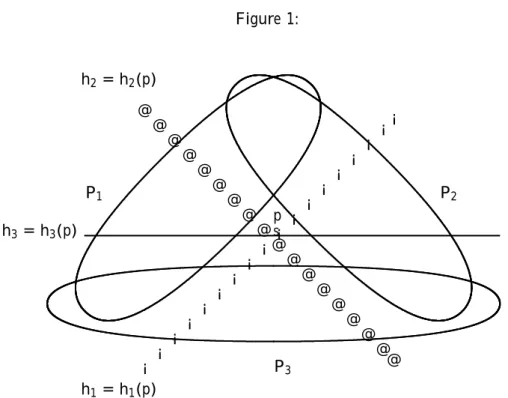
The geometric interpretation of this lemma is as follows. Assume that n convex and compact sets have an empty intersection, but that every subset of them has a non-empty intersection. Then, we can ¯nd a point p which is not included in any set, but which is \in the middle" in the following sense: one can ¯nd, for each set Pi, a hyperplane hi that passes through p which
is in the convex hull of the union of the Pi and leaves the entire Pi on one
side, such that the normals of these hyperplanes, multiplied by appropriate positive constants, add up to zero. In the case n = 2, our lemma reduces to a standard separation theorem between two disjoint sets. For n > 2, the lemma may be considered as an n-way separation among n convex sets. See ¯gure 1 for an illustration of the case n = 3.
Please insert Figure 1 here
Proof of the lemma: The proof is by induction on n. For n = 2, we
have P1 \ P2 = ; and we use a standard separation theorem (cf Kelley
and Namioka (1963), p.119, theorem on strong separation) to conclude that
there is a continuous linear functional h : X ! IR and a number ¯ 2 IR
such that h(q) > ¯ for q2 P1 and h(q) < ¯ for q2 P2. Choose p such that
h(p) = ¯, and set h1 = h and h2 = ¡h. By linearity of h it is possible to
Assume that the lemma holds for every n0 < n. Let there be given (Pi)ni=1. Set A = \i<nPi and B =Pn. Observe that A and B are convex,
non-empty, and compact. Furthermore, they are disjoint since \iPi = ;.
Apply the same separation theorem to conclude that there exist a continuous linearehn: X! IR and ¯ 2 IR such that
e
hn(q) > ¯ 8 q 2 B and ehn(q) < ¯ 8 q 2 A
Choose q0 2 X such thatehn(q0) = ¯. We shift the origin to q0. Speci¯cally,
de¯ne for each i n, Pbi =fp ¡ q0 j p 2 Pig = Pi¡ q0. Naturally,
³ b
Pi
´n i=1
and their intersections inherit all relevant properties of (Pi)i. Denote B =b
B¡ q0 =Pbn and A = Ab ¡ q0=\i<nPbi and observe thathen(q) > 0 8q 2Bb
and ehn(q) < 08q 2A. Consider Xb 0 =fq 2 X jehn(q) = 0g. X0 is a locally
convex linear topological subspace of X. Focusing on this subspace, de¯ne
b
Pi0 = Pbi \ X0 for i < n. Obviously, Pbi0 is convex and compact for every
i < n. We argue that it is also non-empty. Indeed, Pbi contains A. On theb
other hand,Pbi has a non-empty intersection withB =b Pbn. By convexity of
b
Pi and linearity ofehn,Pbi0 6= ;. Similarly, for ` < n, \i6=`;nPbi containsA andb
intersectsB and we therefore getb
\i6=`;nPbi0 6= ; 8 ` < n
However, X0 is an hyperplane separatingB fromb A. Henceb \i<nPb0 i =;.
It follows that³Pbi0
´
i<n on X
0 satisfy the conditions of the lemma for n0 =
n¡ 1. Therefore, there exist a pointpb2 co³[ni=1¡1Pbi0
´
and continuous linear functionals h0i : X0 ! IR, i < n, such that h0i(q¡p) > 0b 8q 2 Pbi0; i < n,
conclude that, for every i < n, h0i on X0 can be extended to hi on all of X
such that:
hi(q¡p) > 0b 8q 2Pbi
De¯ne h =Pi<nhi on X. Observe that for every q2 X0,
h(q) =X i<n hi(q) = X i<n h0i(q) = 0
Hencehen and h are continuous linear functionals on X satisfying:
e
hn(q) = 0) h(q) = 0 8q 2 X
By standard arguments (see Fact 2 below), there exists ® 2 IR such that h(q) = ®ehn(q)8 q 2 X.
We wish to show that ® < 0. Consider q 2A =b \i<nPbi. Since hi(q¡p) >b
08 i < n and h(p) = 0, we obtainb
h(q) = h(q¡p) =b X
i<n
hi(q¡p) > 0b
On the other hand,hen(q) < 0 since q2A. It follows that ® < 0.b
De¯ne hn= (¡®)hen. Since (¡®) > 0, hn(q¡p) = hb n(q) > 08 q 2Pbn.
To conclude, set p = p + qb 0. Observe that p2 co
³
[ni=1¡1Pi
´
and hence p 2 co ([n
i=1Pi). We claim that p and (hi)i n satisfy (a) and (b). Indeed,
for every i n, and every q2 Pi:
hi(q¡ p) = hi ³ (q¡ q0)¡ (p ¡ q0) ´ = hi ³ (q¡ q0)¡pb ´ > 0
since q¡ q0 2Pbi. Finally,Pi nhi= 0 by construction of hn. Q:E:D:
The following two facts, which are used in the proof above, are straight-forward and/or well-known.
Fact 1: Let X be a locally convex linear topological space. Let bh be a continuous linear functional and X0 = fp 2 X j bh(p) = 0g. Assume that
C µ X is convex and compact, and that C \ X0 6= ;. Further assume
that h0 : X0 ! IR is a continuous linear functional such that h0(p) > 0 8 p 2 C \ X0. Then, h0 can be extended to a continuous linear functional
h : X! IR such that h(p) > 0 8 p 2 C.
Proof of Fact 1: Set D =fp 2 X0 j h0(p) = 0g. Observe that D 6= ; since
the origin is in D. Thus C and D are disjoint non-empty closed and convex sets in X, and C is compact. Let a continuous linear functionaleh : X ! IR and d2 IR be such that:
e
h(p) < d 8 p 2 D and h(p) > de 8 p 2 C
We claim that eh has to be constant on D. Indeed, assume that for some p; q 2 D,h(p)e 6=eh(q). Since p; q 2 D implies bh(p) =bh(q) = 0 and h0(p) =
h0(q) = 0, we conclude that p + ®(q ¡ p) 2 D for all ® 2 IR. Hence
feh(p + ®(q¡ p)) j ® 2 IRg = IR, a contradiction to the fact that eh(p) < d 8 p 2 D. Thus there is a c 2 IR such thath(p) = ce 8 p 2 D. Since the origin is in D, we obtain c = 0. It follows that d > 0 and therefore
e
h(p) > d > 0 8 p 2 C
We now wish to show that, up to multiplication by a positive constant, eh extends h0 on X. Restrict attention to X0. If p2 X0 satis¯es h0(p) = 0, then p 2 D and we know that eh(p) = 0. By Fact 2 below, there exists ® 2 IR such that eh(p) = ®h0(p) 8 p 2 X0. However, on C\ X0, both eh and h0 are
on all of C. Q:E:D: Fact 2: Let X be a linear space and let eh; h : X ! IR be linear. Assume that
e
h(q) = 0) h(q) = 0 8 q 2 X
Then there exists ®2 IR such that h(q) = ®eh(q) 8 q 2 X
We skip the proof of this Fact and now turn to the proof of Theorem 2: (i)) (ii). Assume that \i nPi =;. Let I be a minimal (with respect to
set inclusion) subset off1; : : : ; ng with the property that \i2IPi=;. Since
\ni=1Pi = ;, but Pi 6= ; for every i, such a set I exists and for every such
setjI j¸ 2. Apply the Lemma to I.
(ii)) (i). Assume that a point p 2 X, a set I½f1; : : : ; ng and functionals (hi)i2I exist as required, and suppose, contrary to (i), that there exists
References
T. Bewley (1986): \Knightian decision theory: Part I," Discussion
Pa-per 807, Cowles Foundation.
|||{ (1989): \Market innovation and entrepreneurship: a Knightian
view," Discussion Paper 905, Cowles Foundation.
A. Chateauneuf, R.A. Dana, and J.-M. Tallon (1997): \Optimal
risk-sharing rules and equilibria with Choquet expected utility," Cahiers Eco-Maths 97-54, Universit¶e Paris I.
R.A. Dana(1998): \Pricing rules when agents have non-additive expected
utility and homogeneous expectations," Cahier du Ceremade, Universit¶e Paris IX.
J. Dow and S. Werlang(1992) \Uncertainty aversion, risk aversion, and
the optimal choice of portfolio," Econometrica, 60(1), 197{204.
N. Dunford and J.T. Schwartz(1958): Linear operators. Part I.
Inter-science, New-York.
I. Gilboa and D. Schmeidler (1989): \Maxmin expected utility with a
non-unique prior," Journal of Mathematical Economics, 18, 141{153.
J. Kelley and I. Namioka (1963): Linear topological spaces. Volume of
Graduate Text in Mathematics, Springer Verlag.
P. Milgrom and N. Stokey (1982): \Information, trade and common
knowledge," Journal of Economic Theory, 26, 17{27.
D. Samet(1998): \Common priors and separation of convex sets," Games
and Economic Behavior, 24, 172{174.
D. Schmeidler(1989): \Subjective probability and expected utility
with-out additivity," Econometrica, 57(3), 571{587.
J.-M. Tallon (1998): \Do sunspots matter when agents are
Choquet-expected-utility maximizers?" Journal of Economic Dynamics and Con-trol, 22, 357{368.
Footnotes
1. We thank participants of the Erasmus conference at Tilburg Univer-sity and two referees for useful comments.
2. In particular, we ignore the social aspects of betting as well as the strategic ones (see, e.g., Milgrom and Stokey (1982)).
3. Note that the axiomatization of Gilboa and Schmeidler (1989) delivers only ¯nitely additive probability distributions.
4. It is straightforward to check that C is of full-insurance if and only if 8i; Ciis constant apart from a set Ai 2 § that has ¼i(Ai) = 0 for some (and
therefore, by assumption of mutual absolute continuity, for all) ¼i 2 Pi.
5. This implication follows the logic of similar results for Choquet ex-pected utility in Chateauneuf, Dana, and Tallon (1998).
6. The fact that (iv) implies (ii) and (iii) also appears in Dana (1998) but in a ¯nite set-up.
7. Dana (1998) shows that if there is a full insurance competitive equi-librium in this economy with ¯nitely many states, then agents share a prior in common. Her proof, however, uses the concavity of the utility index and relies on the existence of a competitive equilibrium.
8. Bewley (1989) contains a similar no-trade result for agents whose preferences are given by partial orders as in Bewley (1986). His proof is very similar to Samet's, and his result is weaker than Theorem 2 in the same sense that Samet's is.
Figure 1: P1 P2 P3 s p h3 = h3(p) ¡¡ ¡¡ ¡¡ ¡¡ ¡¡ ¡¡ ¡¡ ¡¡ ¡¡ h1 = h1(p) @ @ @ @ @ @ @ @ @ @ @ @ @ @ @ @ @ @ h2 = h2(p)